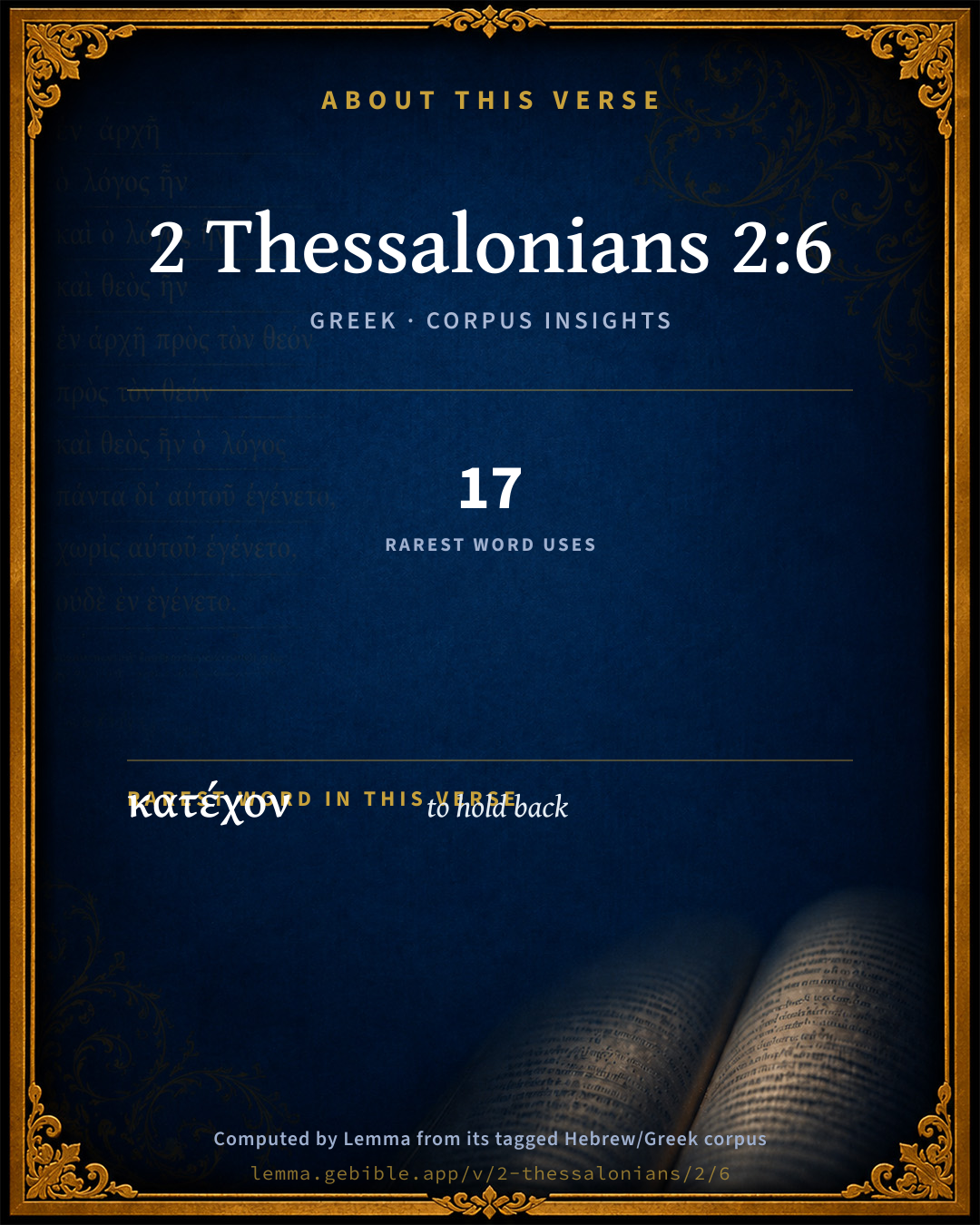
2 Thessalonians 2:6

Greek (Tischendorf 8th ed.) 2 Thessalonians 2:6 appears in the Greek New Testament. The text above is from the Tischendorf 8th edition. Each word links to its Strong’s number and a concise gloss. Click any word for its full Thayer’s Greek Lexicon entry.
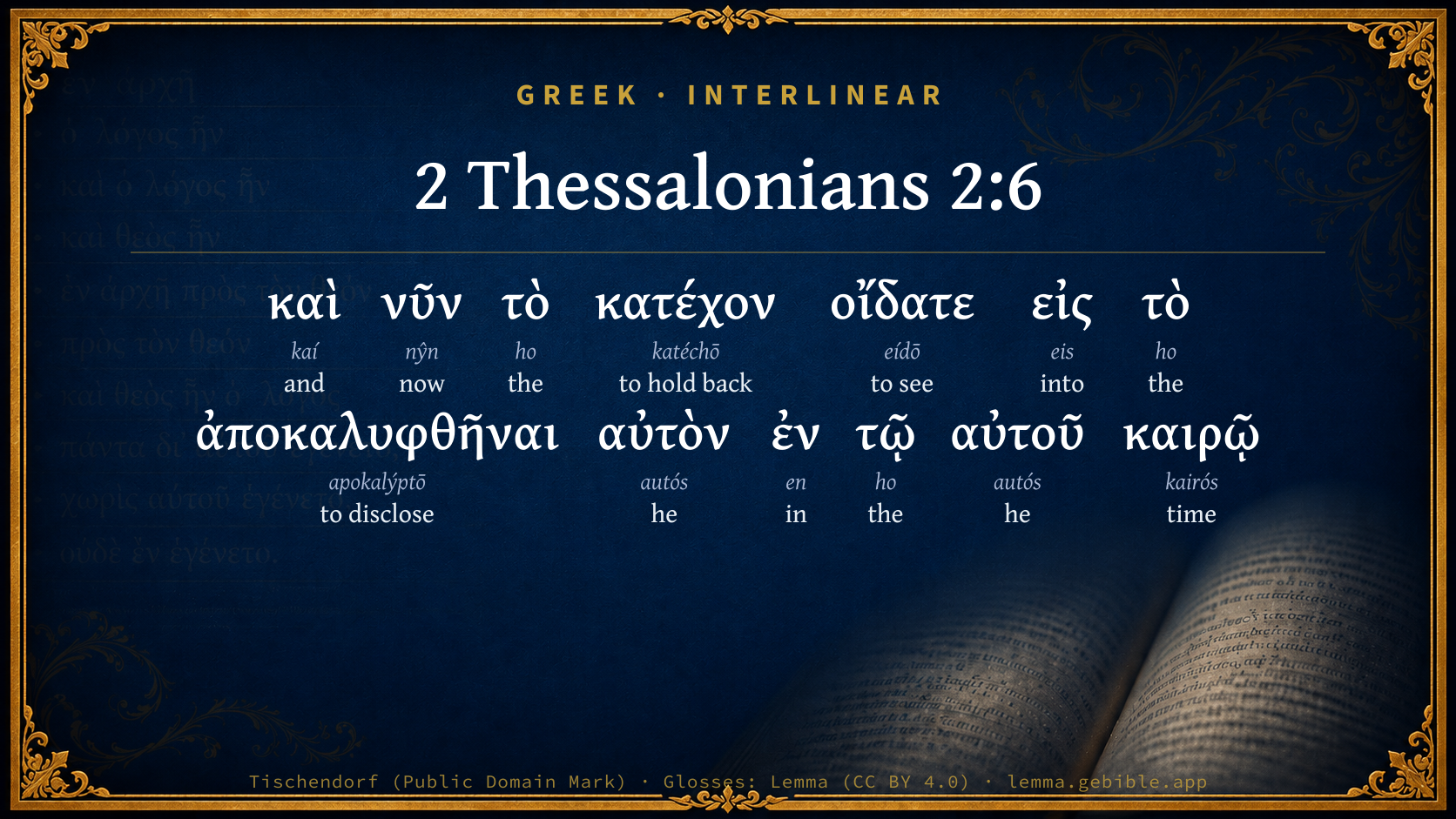
Download image
Cite this verse

2 Thessalonians 2:6 (World English Bible). Public Domain. Lemma interlinear Bible study tool, https://lemma.gebible.app/v/2-thessalonians/2/6.

Show BibTeX & RIS
BibTeX
RIS
English Translation
Now you know what is restraining him, to the end that he may be revealed in his own season.
World English Bible · Public Domain
Download a study sheet

One document with this verse’s original text, its word-by-word gloss line, the meaning frame, cross-references with their text, attributed commentary, and full source and license credits — printable, and it pastes into notes with its structure intact.

This verse Autodidact and up

Study sheet (.html) Plain text (.txt)

A passage Seminary Student

Up to 50 verses in one chapter. A passage sheet keeps up to 6 commentary sources and 12 cross-references per verse, in the order this page ranks them, and says so on the sheet whenever that leaves anything out. Ask for a single verse and you get the Autodidact verse sheet above.

Everything on this page stays free to read, with no account — the sheet is a download of what is already on screen, not access to it.

Want to remove ads? Support Godless Engineer
Compare translations 3

The same verse in 3 English versions, stacked beneath the original-language interlinear above. Click any original word for its lexicon entry.

Each is an independent rendering of the whole verse — the interlinear is not word-aligned to these translations.

Highlighted words mark where these versions differ — a whole-verse word diff, not a word-by-word alignment.

  • World English Bible Public Domain
    Now you know what is restraining him, to the end that he may be revealed in his own season.
  • King James Version Public Domain
    And now ye know what withholdeth that he might be revealed in his time.
  • unfoldingWord Literal Text CC BY-SA 4.0
    And now you know the one restraining, until his revealing in his time.

unfoldingWord Literal Text — © unfoldingWord, licensed CC BY-SA 4.0. Word-aligned USFM3 via Door43 (git.door43.org/unfoldingWord/en_ult).

Versions to compare (up to 4)

3 of 4 selected

Show all 19 translations

Every available English version of this verse, each an independent rendering of the whole verse.

  • World English Bible Public Domain
    Now you know what is restraining him, to the end that he may be revealed in his own season.
  • Berean Standard Bible Public Domain
    And you know what is now restraining him, so that he may be revealed at the proper time.
  • Majority Standard Bible Public Domain
    And you know what is now restraining him, so that he may be revealed at the proper time.
  • King James Version Public Domain
    And now ye know what withholdeth that he might be revealed in his time.
  • American Standard Version (1901) Public Domain
    And now ye know that which restraineth, to the end that he may be revealed in his own season.
  • Revised Version (1885) Public Domain
    And now ye know that which restraineth, to the end that he may be revealed in his own season.
  • Geneva Bible (1599) Public Domain
    And nowe ye knowe what withholdeth that he might be reueiled in his time.
  • Douay-Rheims (1899) Public Domain
    And now you know what withholdeth, that he may be revealed in his time.
  • Young's Literal Translation Public Domain
    and now, what is keeping down ye have known, for his being revealed in his own time,
  • Literal Standard Version CC BY-SA 4.0
    And now, you have known what is restraining, for his being revealed in his own time,
  • Unlocked Literal Bible CC BY-SA 4.0
    Now you know what restrains him, so that he will be revealed only at the right time.
  • unfoldingWord Literal Text CC BY-SA 4.0
    And now you know the one restraining, until his revealing in his time.
  • Darby Bible Public Domain
    And now ye know that which restrains, that he should be revealed in his own time.
  • World Messianic Bible Public Domain
    Now you know what is restraining him, to the end that he may be revealed in his own season.
  • Webster's Bible Public Domain
    And now ye know what withholdeth that he might be revealed in his time.
  • Free Bible Version CC BY-SA 4.0
    Now you know what's keeping him in check, because he will be revealed for what he is at the appropriate time.
  • Bible in Basic English Public Domain
    And now it is clear to you what is keeping back his revelation till the time comes for him to be seen.
  • Text-Critical English NT CC BY 4.0
    And you know what is now restraining him so that he will be revealed in his own time.
  • Tyndale New Testament (1534) Public Domain
    And nowe ye knowe what with holdeth: even that he myght be vttered at his tyme.

Literal Standard Version (2020), Covenant Press — licensed CC BY-SA 4.0. Text via the HelloAO Bible API (eBible.org). Unlocked Literal Bible (unfoldingWord) — licensed CC BY-SA 4.0. Text via the HelloAO Bible API (eBible.org). unfoldingWord Literal Text — © unfoldingWord, licensed CC BY-SA 4.0. Word-aligned USFM3 via Door43 (git.door43.org/unfoldingWord/en_ult). Free Bible Version, Dr. Jonathan Gallagher — licensed CC BY-SA 4.0. Text via the HelloAO Bible API (eBible.org).

Word by word

More ways to search: Search by grammar → Find every occurrence → Compare this word →

Practice this passage: Drill this verse → Learn its vocabulary →

κατέχον
katéchō
G2722
“to hold back”
Verb, Present, Active, Participle, Accusative, Singular, Neuter
Part of Speech
Verb
Tense
Present
Voice
Active
Mood
Participle
Case
Accusative
Number
Singular
Gender
Neuter
Full Thayer's Definition

Origin: from G2596 and G2192

TDNT: 15:49,3

1. to hold back, detain, retain a. from going away b. to restrain, hinder (the course or progress of) 1. that which hinders, Antichrist from making his appearance 2. to check a ship's headway i.e. to hold or head the ship c. to hold fast, keep secure, keep firm possession of 2. to get possession of, take a. to possess
  1. καὶ kaí G2532 “and” Conjunction
  2. νῦν nŷn G3568 “now” Adverb
  3. τὸ ho G3588 “the” Article, Accusative, Singular, Neuter
  4. οἴδατε eídō G1492 “to see” Verb, Perfect, Active, Indicative, 2nd person, Plural
  5. εἰς eis G1519 “into” Preposition
  6. τὸ ho G3588 “the” Article, Accusative, Singular, Neuter
  7. ἀποκαλυφθῆναι apokalýptō G601 “to disclose” Verb, Aorist, Passive, Infinitive
  8. αὐτὸν autós G846 “he” Personal pronoun, Accusative, Singular, Masculine
  9. ἐν en G1722 “in” Preposition
  10. τῷ ho G3588 “the” Article, Dative, Singular, Masculine
  11. αὐτοῦ autós G846 “he” Personal pronoun, Genitive, Singular, Neuter
  12. καιρῷ kairós G2540 “time” Noun, Dative, Singular, Masculine

About this verse

These counts appear in no published source. They are computed here, from the morphology-tagged text and Lemma’s own curated glosses. What Lemma adds →

13
words
10
distinct lemmas
Pauline Epistles
section

Notable vocabulary

The rarest word here is κατέχον to hold back G2722 — appearing just 17 times in the whole Greek New Testament.

Shared distinctive vocabulary

κατέχον to hold back G2722 occurs in 17 verses of the Greek New Testament. Also found in:

Repetition

Words recur within this verse:

  • τὸ the G3588 ×3
  • αὐτὸν he G846 ×2

Cross-references

2

Topical passages linked to 2 Thessalonians 2:6 in the Treasury of Scripture Knowledge — connected by theme and wording, ordered by reader-vote popularity; previews shown in the World English Bible.

  • 2 Thessalonians 2:3 Let no one deceive you in any way. For it will not be, unless the departure comes first, and the man of sin is revealed, the son of destruction,
  • 2 Thessalonians 2:8 Then the lawless one will be revealed, whom the Lord will kill with the breath of his mouth, and bring to nothing by the brightness of his coming;

Cross-references courtesy of OpenBible.info (CC BY 4.0).

Commentary

Notes on 2 Thessalonians 2:6 from classic Christian and Jewish commentators (each source and its license shown beneath its notes). The classic Christian expositions comment on the surrounding passage and are grouped to its opening verse, so a note may address several verses; the Jewish commentaries on the Tanakh (Rashi and others) are per-verse, so they appear only where the commentator wrote on this verse.

Lemma curates 59 commentaries, every one of them public domain or Creative Commons licensed, each selected and text-cleaned for this edition rather than reprinted as found. About our sources →

Jamieson, Fausset & Brown

Robert Jamieson, A. R. Fausset & David Brown

now ye know--by my having told you. The power must have been one "known" to the Thessalonians.

what withholdeth--that which holds him back; "keeps him in check": the power that has restrained the man of sin from his full and final development, is the moral and conservative influence of political states [OLSHAUSEN]: the fabric of human polity as a coercive power; as "he who now letteth" refers to those who rule that polity by which the great upbursting of godlessness is kept down [ALFORD]. The "what withholdeth" refers to the general hindrance; "he who now letteth," to the person in whom that hindrance is summed up. Romanism, as a forerunner of Antichrist, was thus kept in check by the Romanemperor (the then representative of the coercive power) until Constantine, having removed the seat of empire to Constantinople, the Roman bishop by degrees first raised himself to precedency, then to primacy, and then to sole empire above the secular power. The historical fact from which Paul starts in his prediction was probably the emperor Claudius' expulsion of the Jews, the representative of the anti-Christian adversary in Paul's day, from Rome, thus "withholding" them in some degree in their attacks on Christianity; this suggested the principle holding good to the end of time, and about to find its final fulfilment in the removal of the withholding person or authority, whereupon Antichrist in his worst shape shall start up.

that he might be--Greek, "in order that": ye know that which keeps him back, in God's purposes, from being sooner manifested, "in order that he may be revealed in his own time" (that is, the time appointed by God to him as his proper time for being manifested), not sooner (compare Dan 11:35). The removal of the withholding power will be when the civil polity, derived from the Roman empire, which is to be, in its last form, divided into ten kingdoms (Rev 17:3, Rev 17:11-13), shall, with its leading representative head for the time being ("he who now letteth," Greek, "withholdeth," as in Th2 2:6), yield to the prevalent godless "lawlessness" with "the lawless one" as its embodiment. The elect Church and the Spirit cannot well be, as DE BURGH suggests, the withholding power meant; for both shall never be wholly "taken out of the way" (Mat 28:20). However, the testimony of the elect Church, and the Spirit in her, are the great hindrance to the rise of the apostasy; and it is possible that, though the Lord shall have a faithful few even then, yet the full energy of the Spirit in the visible Church, counteracting the energy or "working" of "the mystery of lawlessness" by the testimony of the elect, shall have been so far "taken out of the way," or set aside, as to admit the manifestation of "the lawless one"; and so DE BURGH'S'S view may be right (Luk 18:8; Rev 11:3-12). This was a power of which the Thessalonians might easily "know" through Paul's instruction.

Jamieson, Fausset & Brown — Commentary Critical and Explanatory on the Whole Bible (1871) — public domain (CC PDM 1.0). Text via the HelloAO Bible API.

The Biblical Illustrator

Joseph S. Exell

2Th_2:6-7

And now ye know what withholdeth

The restraining power and its withdrawal

I.

What is this restraining power?

1. The explanation, now so difficult, was no difficulty to the Thessalonians. They knew what it was; and the Church of the first three centuries said without hesitation that it was the Roman Empire.

2. History has taught us the literal incorrectness of this, for the Roman Empire has passed away, and it is to play with language to regard it as living on in the German or Austrian Empires. This fact modified the interpretation of the later fathers, who regarded it as the restraining discipline of Divine order; and Christian thinkers are now coming to regard it as the regulated social order, that spirit of obedience to law which is the direct antagonist to the spirit of lawlessness which was embodied in ancient Rome; but this spirit is sustained by the working of the Spirit of God.

3. As a matter of fact the spirit of religion has been in all ages the restraining influence. Man is naturally attracted to lawlessness. Within Christian nations there have been the elements of destruction, but they have been held in check in three ways.

(1) Christianity has created and sustained a public opinion which has supported law and is antagonistic to lawlessness.

(2) It has called the conscience in to the support of constituted order because it has taught men that that order has supernatural sanction.

(3) It has created and administered a healthy discipline and taught men that obedience to the law of righteousness is the true regulation of life. For fifteen hundred years politicians have been ready to recognize this restraining influence.

4. By Gods will there are two great coordinate authorities, the civil and the ecclesiastical; He would have these work in their own sphere, the Church not invading the province of the State, and vice versa. And the Church has thus gone on in union with the State exercising its restraints.

II. What is meant by this power being taken out of the way? I believe it to be that crisis in our race which in the Apocalypse is called the Fall of Babylon--the collapse of the ecclesiastical influence in politics.

1. Babylon is represented as a harlot, a term distinctly applied in the Old Testament, not to heathenism, but to a faithless Church. And so in the New Testament it is only the professed Church that can fall into that depth of iniquity.

2. Turn to Rev_17:1-18 and Babylon is riding, controlling, guiding a scarlet-coloured beast. Afterwards there is the bitterest antagonism, and the beast and ten kings rise up against the apostate Babylon and treat her shamefully.

3. Now go back to mediaeval Europe, and the one arresting political feature is the Church. The Pope is virtually king of kings and lord of lords. In those days priests were judges, ecclesiastics, politicians, and the mystic woman is seen riding on the beast--the Church at least lending her authority to the maintenance of civil order. But her position was full of danger. It was the Masters temptation to world empire over again. Christendom failed where the Master won, and sought to realize a true conception by false means. She lost her spirituality and fell under the power of a mere secular ecclesiastieism. Contrast the Church of the Middle Ages with that of the first.

4. You cannot be surprised at people identifying Babylon with the Papacy, for the description of the apostle almost necessarily leads us to think of Rome. The spirit that rules the Roman see is of the earth earthy. Its policy is ruled not so much by principle as by the intricacies of human politics, and it is ever swayed by the three sad spirits that are predicted of mystic Babylon--ambition, covetousness, and luxury. The ideal of Ultramontanism, that the Church on earth is a perfect entity is true, but its sin is that it is the material realization of a conception that is emphatically spiritual.

5. What is the effect? This, that as the claims of the ecclesiastical spirit have become more and more intense, the nations of the world have revolted against the power with which for centuries they have been in closest alliance, Is not this the case in France, Germany, Belgium, and even Spain? Where can we find a country whose Church gives obedience to the Papacy that is not in conflict with the Papacy?

6. But this is not only with the Churches that own obedience to Rome. What about the great Eastern churches who have delivered up so much of their power to the Czar? What about our own? Is truth never compromised for expediency? Nay, the spirit of corruption has permeated Christendom, and our position is one of humiliation before God. And now mark the movements that are going on. Society and civilization for fifteen hundred years have had a Christian basis, but both are being constructed on a secular basis (See Leckys chapter on the Advance of Secularizing Polities).

Conclusion: What then is our position?

1. We must recognize the withdrawal of this restraining influence of civilization, and in it a warning of the approaching Advent. Christ may see fit to delay--but Be ye ready.

2. We should do all that in us lies to perpetuate the ministry and the restraining power that we may lengthen the days of opportunity for the race. (Canon Body.)

Restraints removed

Since a body falls to the ground in consequence of the earths attraction on each of its molecules, it follows that, everything else being the same, all bodies, great and small, light and heavy, ought to fall with equal rapidity, and a lump of sand without cohesion should, during its fall, retain its original form as perfectly as if it were compact stone. The fact that a stone falls more rapidly than a feather is due solely to the unequal resistances opposed by the air to the descent of these bodies. The resistance opposed by the air to falling bodies is especially remarkable in the case of falling liquids. The Staubbach in Switzerland is a good illustration. An immense mass of water is seen falling over a high precipice, but before reaching the bottom it is shattered by the air into the finest mist. In a vacuum, however, liquids fall, like solids, without separation of their molecules. The resistance opposed by the customs and ethics of society is the reason why many men are deterred in a rapid fall into ruin. Take away all the resistance which etiquette, conventional morality, philanthropy and religion, offer to the downfall of men, and, like things in a vacuum, how sadly fast the descent would become. Many men in respectable elevation owe their adventitious position to the happy accident of strong resistance offered to their fall by the circumstances and influences surrounding. (Prof. Ganot.)

The Biblical Illustrator, edited by Joseph S. Exell (c. 1880s–1900s) — public domain. Text from a community e-Sword module.

The Expositor's Bible

Chapter 20

THE RESTRAINT AND ITS REMOVAL

2Th_2:6-12 (R.V.)

CHRIST cannot come, the Apostle has told us, until the falling away has first come, and the man of sin been revealed. In the verses before us, we are told that the man of sin himself cannot come, in the full sense of the word, he cannot be revealed in his true character of the counter-Christ, till a restraining force, known to the Thessalonians, but only obscurely alluded to by the Apostle, is taken out of the way. The Last Advent is thus at two removes from the present. First, there must be the removal of the power which holds the man of sin in check; then the culmination of evil in that great adversary of God; and not till then the return of the Lord in glory as Saviour and Judge.

We might think that this put the Advent to such a distance as practically to disconnect it from the present, and make it a matter of little interest to the Christian. But, as we have seen already, what is significant in this whole passage is the spiritual law which governs the future of the world, the law that good and evil must ripen together, and in conflict with each other; and it is involved in that law that the final state of the world, which brings on the Advent, is latent, in all its principles and spiritual features, in the present. That day is indissolubly connected with this. The life that we now live has all the importance, and ought to have all the intensity, which comes from its bearing the future in its bosom. Through the eyes of this New Testament prophet we can see the end from the beginning; and the day on which we happen to read his words is as critical, in its own nature, as the great day of the Lord.

The end, the Apostle tells us, is at some distance, but it is preparing. "The mystery of lawlessness doth already work." The forces which are hostile to God, and which, are to break out in the great apostasy, and the insane presumption of the man of sin, are even now in operation, but secretly. They are not visible to the careless, or to the infatuated, or to the spiritually blind; but the Apostle can discern them. Taught by the Spirit to read the signs of the times, he sees in the world around him symptoms of forces, secret, unorganised, to some extent inscrutable, yet unmistakable in their character. They are the beginnings of the apostasy, the first workings, fettered as yet and baffled, of the power which is to set itself in the place of God. He sees also, and has already told the Thessalonians, of another power of an opposite character. "Ye know," he says, "that which restraineth only there is one that restraineth now, until he be taken out of the way." This restraining power is spoken of both in the neuter and the masculine, both as a principle or institution, and as a person; and there is no reason to doubt that those fathers of the Church are right who identified it with the Empire of Rome and its sovereign head. The apostasy was to take place among the Jews; and the Apostle saw that Rome and its Emperor were the grand restraint upon the violence of that stubborn race. The Jews had been his worst enemies, ever since he had embraced the cause of the Nazarene Messiah Jesus; and all that time the Romans had been his best friends. If injustice had been done him in their name, as at Philippi, atonement had been made; and, on the whole, he had owed to them his protection against Jewish persecution. He felt sure that his own experience was typical; the final development of hatred to God and all that was on Gods side could not but be restrained so long as the power of Rome stood firm. That power was a sufficient check upon anarchic violence. While it held its ground, the powers of evil could not organise themselves and work openly; they constituted a mystery of iniquity, working, as it were, underground. But when this great restraint was removed, all that had been labouring so long in secret would come suddenly to view, in its full dimensions; the lawless one would stand revealed.

But, it may be asked, could Paul imagine that the Roman power, as represented by the Emperor, was likely to be removed within any measurable time? Was it not the very type and symbol of all that was stable and perpetual in mans life? In one way, it was; and as at least a temporary check on the final eruption of wickedness, it is here recognised to have a degree of stability; but it was certainly not eternal. Paul may have seen plainly enough in such careers as those of Caligula and Claudius the impending collapse of the Julian dynasty; and the very obscurity and reserve with which he expresses himself amount to a distinct proof that he has something in his mind which it was not safe to describe more plainly. Dr. Farrar has pointed to the remarkable correspondence between this passage, interpreted of the Roman Empire, and a paragraph in Josephus, in which that historian explains the visions of Daniel to his pagan readers. Josephus shows that the image with the head of gold, the breast and arms of silver, the belly and thighs of brass, and the ankles and feet of iron, represents a succession of four empires. He names the Babylonian as the first, and indicates plainly that the Medo-Persian and the Greek are the second and third; but when he comes to the fourth, which is destroyed by the stone cut out without hands, he does not venture, as all his countrymen did, to identify it with the Roman. That would have been disloyal in a courtier, and dangerous as well; so he remarks, when he comes to the point, that he thinks it proper to say nothing about the stone and the kingdom it destroys, his duty as a historian being to record what is past and gone, and not what is yet to come. In a precisely similar way does St. Paul here hint at an event which it would have been perilous to name. But what he means is: When the Roman power has been removed, the lawless one will be revealed, and the Lord will come to destroy him.

What was said of the man of sin in the last chapter has again its application here. The Roman Empire did not fall within any such period as Paul anticipated; nor, when it did, was there any such crisis as he describes. The man of sin was not revealed, and the Lord did not come. But these are the human elements in the prophecy; and its interest and meaning for us lie in the description which an inspired writer gives of the final forms of wickedness, and their connection with principles which were at work around him, and are at work among us. He does not, indeed, come to these at once. He passes over them, and anticipates the final victory, when the Lord shall destroy the man of sin with the breath of His mouth, and bring him to nought by the appearance of His coming; he would not have Christian men face the terrible picture of the last workings of evil until they have braced and comforted their hearts with the prospect of a crowning victory. There is a great battle to be fought; there are great perils to be encountered; there is a prospect with something in it appalling to the bravest heart; but there is light beyond. It needs but the breath of the Lord Jesus; it needs but the first ray of His glorious appearing to brighten the sky, and all the power of evil is at an end. Only after he has fixed the mind on this does St. Paul describe the supreme efforts of the enemy.

His coming, he says-and he uses the word applied to Christs advent, as though to teach us that the event in question is as significant for evil as the other for good-his coming is according to the working of Satan. When Christ was in the world, His presence with men was according to the working of God; the works that the Father gave Him to do, the same He did, and nothing else. His life was the life of God entering into our ordinary human life, and drawing into its own mighty and eternal current all who gave themselves up to Him. It was the supreme form of goodness, absolutely tender and faithful; using all the power of the Highest in pure unselfishness and truth. When sin has reached its height, we shall see a character in whom all this is reversed. Its presence with men will be according to the working of Satan; not an ineffective thing, but very potent; carrying in its train vast effects and consequences; so vast and so influential, in spite of its utter badness, that it is no exaggeration to describe its "coming" (παρουσια), its "appearing" (επιφανεια) and its "revelation" (αποκαλυψις), by the very same words which are applied to Christ Himself. If there is one word which can characterise this whole phenomenon, both in its principle and in its consummation, it is falsehood. The devil is a liar from the beginning, and the father of lies; and where things go on according to the working of Satan, there is sure to he a vast development of falsehood and delusion. This is a prospect which very few fear. Most of us are confident enough of the soundness of our minds, of the solidity of our principles, of the justice of our consciences. It is very difficult for us to understand that we can be mistaken, quite as confident about falsehood as about truth, unsuspecting victims of pure delusion. We can see that some men are in this wretched plight, but that very fact seems to give us immunity. Yet the falsehoods of the last days, St. Paul tells us, will be marvellously imposing and successful. Men will be dazzled by them, and unable to resist. Satan will support his representative by power and signs and wonders of every description, agreeing in nothing but in the characteristic quality of falsehood. They will be lying miracles. Yet those who are of the truth will not be left without a safeguard against them, a safeguard found in this, that the manifold deceit of every kind which the devil and his agents employ, is deceit of unrighteousness. It furthers unrighteousness; it has evil as its end. By this it is betrayed to the good; its moral quality enables them to penetrate the lie, and to make their escape from it. However plausible it may seem on other grounds, its true character comes out under the touchstone of conscience, and it stands finally condemned.

This is a point for consideration in our own time. There is a great deal of falsehood in circulation-partly superstitious, partly quasi-scientific-which is not judged with the decision and severity that would be becoming in wise and good men. Some of it is more or less latent, working as a mystery of iniquity; influencing mens souls and consciences rather than their thoughts; disinclining them to prayer, suggesting difficulties about believing in God, giving the material nature the primacy over the spiritual, ignoring immortality and the judgment to come. The man knows very little, who does not know that there is a plausible case to be stated for atheism, for materialism, for fatalism, for the rejection of all belief in the life beyond the grave, and its connection with our present life; but however powerful and plausible the argument may be, he has been very careless of his spiritual nature, who does not see that it is a deceit of unrighteousness. I do not say that only a bad man could accept it; but certainly all that is bad in any man, and nothing that is good, will incline him to accept it. Everything in our nature that is unspiritual, slothful, earthly, at variance with God; everything that wishes to be let alone, to forget what is high, to make the actual and not the ideal its portion; everything that recalls responsibilities of which such a system would discharge us forever, is on the side of its doctrines. But is not that itself a conclusive argument against the system? Are not all these most suspicious allies? Are they not, beyond dispute, our very worst enemies? And can it be possible that a way of thinking is true, which gives them undisputed authority over us? Do not believe it. Do not let any plausibility of argument impose upon you; but when the moral issue of a theory is plainly immoral, when by its working it is betrayed to be the leaven of the Sadducees, reject it as a diabolical deceit. Trust your conscience, that is, your whole nature, with its instinct for what is good, rather than any dialectic; it contains far more of what you are; and it is the whole man, and not the most unstable and self-confident of his faculties, that must judge. If there is nothing against a spiritual truth but the difficulty of conceiving how it can be, do not let that mental incapacity weigh against the evidence of its fruits.

The Apostle points to this line of thought, and to this safeguard of the good, when he says that those who come under the power of this vast working of falsehood are those who are perishing, because they received not the love of the truth that they might be saved. But for this clause we might have said, Why expose men, defenceless, to such a terrific trial as is here depicted? Why expect weak, bewildered, unstable creatures to keep their feet, when falsehood comes in like a flood? But such queries would show that we mistook the facts. None are carried away by the prevailing falsehood but those who received not the love of the truth that they might be saved. It is a question, we see, not of the intelligence simply, but of the whole man. He does not say, They received not the truth; that might have been due to some cause over which they had no control. They might never have had so much as a good look at the truth; they might have got an incurable twist in their education, a flaw in their minds like a flaw in a mirror, that prevented them from ever seeing what the truth was like. These would be cases to stand apart. But he says, "They received not the love of the truth." That truth which is presented for our acceptance in the gospel is not merely a thing to scrutinise, to weigh, to judge by the rules of the bench or the jury box: it is a truth which appeals to the heart; from cultured and uncultured, from the clear-headed and the puzzle-headed, from the philosopher and the message boy, it demands the answer of love. It is this which is the true test of character-the answer which is given, not by the brain, disciplined or undisciplined, but by the whole man, to the revelation of the truth in Jesus Christ. Intelligence, by itself, may be a very little matter; all that some men have is but a tool in the hands of their passions; but the love of the truth, or its opposite, shows truly what we are. Those who love it are safe. They cannot love falsehood at the same time; all the lies of the devil and his agents are powerless to do them any harm. Satan, we see here, has no advantage over us that we do not first give him. The absence of liking for the truth, want of sympathy with Christ, a disposition to find less exacting ways than His, a resolution to find them or to make them, ending in a positive antipathy to Christ and to all the truth which He teaches and embodies, -these give the enemy his opportunity and his advantage over us. Put it to yourself in this light if you wish to discern your true attitude to the gospel. You may have difficulties and perplexities about it on one side or another; it runs out into mystery on every hand; but these will not expose you to the danger of being deceived, as long as you receive the love of it in your heart. It is a thing to command love; the truth as truth is in Jesus. All that is good in us is enlisted in its favour; not to love it is to be a bad man. A recent Unitarian lecturer has said that to love Jesus is not a religious duty; but that is certainly not a New Testament doctrine. It is not only a religious duty, but the sum of all such duties; to do it, or not to do it, is the decisive test of character, and the arbiter of fate. Does not He Himself say-He who is the Truth-"He that loveth father or mother more than Me is not worthy of Me"? Does not His Apostle say, "If any man love not the Lord Jesus Christ, let him be anathema"? Depend upon it, love to Him is all our goodness, and all our defence against the powers of evil. To grow cold and indifferent is to give the enemy of our souls an opening against us. The last two verses in this passage are very striking. We have seen already two agents in the destruction of mens souls. They perish by their own agency, in that they do not welcome and love the truth; and they perish by the malevolence of the devil, who avails himself of this dislike to the truth to befool them. by falsehood, and lead them ever further and further astray. But here we have a third agent, most surprising of all, God Himself. "For this cause God sendeth them a working of error, that they should believe a lie: that they all might be judged who believed not the truth, but had pleasure in unrighteousness." Is God, then, the author of falsehood? Do the delusions that possess the minds of men, and lead them to eternal ruin owe their strength to Him? Can He intend anybody to believe a lie, and especially a lie with such terrific consequences as are here in view? The opening words-"for this cause"-supply the answer to these questions. For this cause, i.e., because they have not loved the truth, but in their liking for evil have turned their backs upon it, for this cause Gods judgment comes upon them, binding them to their guilt. Nothing is more certain, however we may choose to express it, than the word of the wise man: "His own iniquities shall take the wicked himself, and he shall be holden with the cords of his sin." He chooses his own way, and he gets his fill of it. He loves the deceit of unrighteousness, the falsehood which delivers him from God and from His law; and by Gods righteous judgment, acting through the constitution of our nature, he comes continually more and more under its power. He believes the lie, just as a good man believes the truth: he becomes every day more hopelessly beclouded in error; and the end is that he is judged. The judgment is based, not on his intellectual, but on his moral state. It is true he has been deluded, but his delusion is due to this, that he had pleasure in unrighteousness. It was this evil in him which gave weight to the sophistries of Satan. Again and again in Scripture this is represented as the punishment of the wicked, that God gives them their own way, and infatuates them in it. The error works with ever greater power in their souls, till they cannot imagine that it is an error; none can deliver himself, or say, Is there not a lie in my right hand? "My people would not hearken to My voice, and Israel would none of Me. So I gave them up unto their own hearts lust: and they walked in their own counsels." "When they knew God, they glorified Him not as God, neither were thankful; wherefore God gave them up to uncleanness." "They changed the truth of God into a lie; for this cause God gave them up unto vile affections." "They did not like to retain God in their knowledge. God gave them over to a reprobate mind." "They received not the love of the truth: and for this cause God sendeth unto them a working of error." Sin bears its punishment in itself; when it has had its perfect work, we see that it has been executing a judgment of God more awful than anything we could conceive. If you would have Him on your side, your ally and not your adversary, receive the love of the truth.

This is the final lesson of the passage. We do not know all the forces that are at work in the world in the interest of error; but we know there are many. We know that the mystery of iniquity is already in operation. We know that falsehood, in this spiritual sense, has much in man which is its natural ally; and that we need to be steadily on our guard against the wiles of the devil. We know that passion is sophistical, and reason often weak, and that we see our true selves in the action of heart and conscience. Be faithful, therefore, to God at the core of your nature. Love the truth that you may he saved. This alone is salvation. This alone is a safeguard against all the delusions of Satan; it was one who knew God, who lived in God, who did always the works of God, who loved God as the only begotten Son the Father, who could say, "The prince of this world cometh, and hath nothing in Me."

William Robertson Nicoll, ed., The Expositor's Bible (London: Hodder & Stoughton, 1887–1910) — public domain. 65 of 66 books (1 Corinthians is not separately keyed, as that volume carries no machine-parseable verse references); section-level commentary keyed to the opening verse. Introductory and overview sections not keyed to a specific passage are excluded.

Tyndale Open Study Notes

Tyndale Open Resources

2:6 what is holding him back: This has been variously identified as God, the Holy Spirit, the church, the gospel, Paul, the emperor, the Roman Empire, or the government. Alternatively, the term may refer to something or someone who comes before the man of lawlessness, an agent of the lawlessness active at that time (2:7-8); in Greek literature, this expression could describe demonic possession. This figure would prepare the way for the man of lawlessness when his time comes (2:3, 8).

Tyndale Open Study Notes — © Tyndale Open Resources, licensed CC BY-SA 4.0. Text via the HelloAO Bible API.

Bengel's Gnomon

Johann Albrecht Bengel

2Th 2:6. Τὸ κατέχον, that which withholdeth, holdeth back) Some interpret it of one obtaining authority; but ὁ κατέχων is not thus used absolutely, much less τὸ κατέχον: κατέχειν, is to detain, to delay, in LXX., Gen 24:56, μὴ κατέχετε με, Hinder me not. On κατέχον, εἰς τὸ ——, coming presently afterwards, depends. If there were not the τὸ κατέχον, the Wicked would be sooner revealed.—οἴδατε, ye know) They knew from the present information given to them in this epistle, and by adding a view of existing events. He speaks safely [with prudent caution], nor was it necessary to say anything more openly.—ἐν τῷ αὐτοῦ καιρῳ, in his proper time) not sooner.

Bengel's Gnomon of the New Testament — English translation (T&T Clark, Edinburgh, 1860) — public domain. Text from a community e-Sword module.

Meyer's Critical & Exegetical Commentary

Heinrich August Wilhelm Meyer

2Th_2:6. Τὸ κατέχον] is that which keeps back, that which hinders (τὸ κωλύον, Chrysostom). But it does not denote, as Heinsius thinks (here and in 2Th_2:7), that which hinders the apostle from speaking freely of Antichrist;[46] also not that which hinders the commencement of the advent of Christ (Noack, der Ursprung des Christenthums, Bd. 2, Leipz. 1857, p. 315), but that which hinders the appearance of Antichrist. This follows from the additional sentence εἰς τὸ κ.τ.λ., in which (1) ΑὐΤΌΝ can only be referred to the ἌΝΘΡΩΠΟς Τῆς ἉΜΑΡΤΊΑς, and (2) ἈΠΟΚΑΛΥΦΘῆΝΑΙ ἘΝ Τῷ ἙΑΥΤΟῦ ΚΑΙΡῷ forms a contrast to the idea of keeping back contained in κατέχον. τὸ κατέχον is therefore, according to its objective side, to be completed by τὸ τὸν ἄνθρωπον τῆς ἁμαρτίας κατέχον. What, on the other hand, the apostle supposes to be the subject of this preventing power can only be explained at the conclusion of this section.

εἰς τὸ κ.τ.λ.] not donec, usque dum, but in order that (the aim of God in the κατέχειν).

ἘΝ Τῷ ἙΑΥΤΟῦ ΚΑΙΡῷ] in his time, i.e. in the time appointed for him by God. More difficult than these determinations is the solution of the question, In what connection this verse is conjoined to the preceding by means of καὶ νῦν. Storr, with whom Flatt agrees, finds in ΝῦΝ a contrast to ἜΤΙ, 2Th_2:5. The thought would then be, that the advent cannot commence until Antichrist appears, this I have told you by word of mouth; but now, after my written declaration (2Th_2:3), you know also why the appearance of Antichrist is still delayed, namely, by the circumstance that the ἀποστασία must precede his appearance. But if Paul had actually wished to have expressed this contrast, he would have been obliged to write in 2Th_2:5, ὍΤΙ ΤΑῦΤΑ ΜῈΝ ἜΤΙ ὪΝ ΠΡῸς ὙΜᾶς ἜΛΕΓΟΝ ὙΜῖΝ, and in 2Th_2:6, ΝῦΝ ΔῈ ΚΑῚ ΤῸ ΚΑΤΈΧΟΝ ΟἼΔΑΤΕ. Related to Storrs view is the interpretation of Kern, with whom Hilgenfeld (l.c. p. 247) agrees: That the advent of Christ does not take place until the man of sin be revealed, is already known to you: and now, in reference to what the present presents to you, ye know also that which hinders. The same objection is decisive against this view. Further, according to Hofmann, who considers 2Th_2:5-6 as two halves of one question united with καί, νῦν stands not, indeed, in opposition to ἜΤΙ, 2Th_2:5, but must express the present in reference to that future which was known to the readers, that they know that in the present by which its commencement is still hindered. But the temporal νῦν can never form a contrast to ΤΑῦΤΑ in 2Th_2:5; and to assume that the words in 2Th_2:6 are still contained in the question in 2Th_2:5 is entirely erroneous, because in this case ΚΑῚ ΝῦΝ Κ.Τ.Λ. could only be considered as dependent on ὍΤΙ,[47] but it is not necessary to recall to mind what is actually known in the present.

νῦν is also understood as a particle of time, by Whitby, Macknight, Heydenreich, Schrader, Olshausen, Baumgarten-Crusius, Wieseler, and Bisping, but they do not connect it with οἴδατε, but with τὸ κατέχον: and ye know that which at present hinders. But only a grammatical impropriety would be expressed thereby, as καὶ τὸ νῦν κατέχον would be required. For it is inconceivable that an adverb, whose proper place is between the article and the participle, should by a hyperbaton be placed first, because it has already in its natural position the same emphasis which it would receive by its being placed first. The passages appealed to, as 2Th_2:7, 1Co_7:17, Rom_12:3, etc., are not analogous. And as little do the temporal particles ἄρτι and ἤδη, 2Th_2:7, decide for this construction. For the emphasis lies not on ἄρτι, but on κατέχων, so that ἄρτι might be omitted without injury to the sense; and ἤδη is not put in exchange for νῦν, but for ἐν τῷ ἑαυτοῦ καιρῷ. Likewise νῦν is understood by Schott as a temporal and consecutive particle, but καί is then taken in the sense of also: For ye know also now (not only have ye learned it at that time when I was with you), why the appearance of Antichrist is still delayed. But (1) τὸ οὖν κατέχον οἴδατε καὶ νῦν would require to have been written; (2) τὸ κατέχον must refer to a point formerly already explained; but it is entirely a new point, as in what goes before what hindered the appearance of Christ, but not what hindered the appearance of Antichrist, was spoken of; (3) lastly, to what an idle, dragging, and trivial addition would 2Th_2:6 be degraded! The only correct view is to take καὶ νῦν in a logical sense, but not, with Koppe and Krause, as an inferential particle (and accordingly), but with de Wette, Alford, and Ewald, as a particle of transition to a new communication: and now, comp. Act_7:34; Act_10:5; Act_13:11; Act_20:25, etc.; Hartung, Partikellehre, II. p. 26. Accordingly, the emphasis does not lie on νῦν, but on κατέχον. The meaning is: and nowto pass on to a further pointye know what hindereth, namely, wherein it consists, and why the appearance of Antichrist is still prevented, that it should be revealed in its appointed time, marked out by God. The Thessalonians knew this point from the apostles oral instructions, so that they required only to be reminded of it.

[46] Neque ignoratis, quid sit, quod me nunc aperte vetat loqui; and on ver. 7: ille, qui nunc obstat, quo minus aperte loquar. Heinsius makes the words refer to the apostles fear of offending Nero!

[47] For if in the presumed, question, not οἴδατε and ἔλεγον, but and οἴδατε and μνημονεύετε were to correspond, καὶ οὐκ οἴδατε νῦν τὸ κατέχον would require to have been written.

Meyer — Critical and Exegetical Commentary on the New Testament — English translation by Peter Christie, edited by Frederick Crombie (T&T Clark, 1880) — public domain. Text from a community e-Sword module.

Expositor's Greek Testament

ed. W. Robertson Nicoll

2Th 2:6 . Well now, you know what restrains him from being manifested (coming fully into play and sight) before his appointed season . Νῦν probably goes with οἴδατε , not with τὸ κατέχον (as e.g. , in Joh 4:18 , so Olshausen, Bisping, Wieseler, Zahn, Wrede), and καὶ νῦν is not temporal, but “a mere adverb of passage” (Lünemann, Alford) in the argument (so with οἶδα in Act 3:17 ). Were νῦν temporal, it would mean ( a ) that during the interval between Paul’s teaching and the arrival of this letter fresh circumstances (so Zimmer) had arisen to throw light on the thwarting of the adversary. But of this there is no hint whatsoever in the context. Or ( b ), preferably, it would contrast with the following ἐν τῷ αὐτοῦ καιρῷ , as an equivalent for “already” (Hofmann, Wohl., Milligan, etc.).

The Expositor's Greek Testament, edited by W. Robertson Nicoll (1897–1910) — public domain. Text from a community e-Sword module.

Cambridge Greek Testament for Schools and Colleges

6. αυτου, in א*AKP 17 37, and some others: εαυτου, BDGL &c.—The latter seems to be a Western and Syrian emendation: or is αυτου an assimilation to αυτον occurring just above?

6. καὶ νῦν τὸ κατέχον οἴδατε. And for the present, you know the thing that withholds. Καὶ νῦν might be construed with οἶδα, or the like, describing a present knowledge due to past instruction, whether immediate or more distant: cf. Joh 8:52; Joh 16:30; Act 12:11; Act 20:25; also 1Th 3:8. At the same time, νῦν τὸ κατέχον does not stand for τὸ νῦν κατέχον, as some read it (ὁ κατέχων ἄρτι, 2Th 2:7, is different); but practically the same sense is arrived at by reading καὶ νῦν as equal to καὶ τὰ νῦν (cf. Act 3:17 with Act 4:29, Act 5:38; Act 20:22 with Act 20:32; τὰ νῦν is never found in St Paul), and for the present, in contrast with the future ἀποκάλυψις ἐν τῷ καιρῷ αὐτοῦ of 2Th 2:3; 2Th 2:6; 2Th 2:8. The stress thrown by 2Th 2:7 on the actual, contemporary working (ἤδη, ἄρτι; see notes) of τὸ μυστήριον τῆς ἀνομίας points decidedly to this rendering of the emphatically placed temporal adverb (cf. Joh 4:18); see Lightfoot and Bornemann ad loc.

Τὸ κατέχον οἴδατε,—not “you know what it is that withholds”; but “you know the withholding thing”: the restraint is something within the range of the readers’ experience; they are acquainted with it, apart from their having been told of it by the Apostle; cf. 1Th 2:1 f., 2Th 3:4; 1Co 16:15, &c. We have not, therefore, to look far afield for the bar then in the way of the Man of Lawlessness. Further definition is needless, and might have been dangerous on the writers’ part; verbum sapientibus sat. Τὸ κατέχον becomes ὁ κατέχων in 2Th 2:7—here a principle or power, there a personal agency, as with τὸ μυστήριον and ὁ ἄνθρωπος τῆς ἀνομίας. For the interpretation of the phrase, see the next verse. For the adverse sense of κατέχω, see note on 1Th 5:21 (otherwise applied in that passage); cf. Rom 1:18; Rom 7:6. The classical use of the neuter participle as a substantive is elsewhere confined to St Luke in the N.T.; see Luk 1:35; Luk 2:27; Luk 4:16, &c.

εἰς τὸ ἀποκαλυφθῆναι αὐτὸν ἐν τῷ αὐτοῦ καιρῷ, to the end that he (viz. ὁ ἄνθρωπος τῆς ἀνομίας, 2Th 2:3 f.) may be revealed in his season. For εἰς τό with infinitive, blending purpose and result, cf. 2Th 2:2, and note on 1Th 2:12. For καιρός, see 1Th 5:1, and note: “the Lawless One” has “his season,” the time fit and appointed for him in the development of events and in the counsels of God—one of the series of καιροί of which the Thessalonians had vainly desired to have the chronology. Antichrist has his set time, corresponding to that τῆς ἐπιφανείας τοῦ κυρίου ἡμῶν Ἰησοῦ Χριστοῦ, ἣν καιροῖς ἰδίοις δείξει ὁ μακάριος καὶ μόνος δυνάστης, 1Ti 6:14 f. The restraining power so operates as to hold back and put bounds to human lawlessness, until the hour strikes for its final outbreak in the Man of Lawlessness and the revelation of all its hidden potencies. This order of things belongs to God’s purposes. If He allows moral evil to exist in His creatures (and its possibility is inseparable from moral freedom), yet He knows how to control its activity, till the time when its full manifestation will best subserve its overthrow and judgement. The Jewish Law had also been in the Apostle’s view, and under the same theory of a Divine control and overruling of sin for its final extinction, a κατέχον and yet a δύναμις τῆς ἁμαρτίας for its sphere and age, preparing for and leading up to the καιρὸς τοῦ χριστοῦ: see Gal 3:19-24; Rom 5:13; Rom 5:20 f.; 1Co 15:56. The καιρὸς τοῦ ἀνόμου will be the last and worst of many such crises, chief amongst which was that of Luk 22:53: “This is your hour (ὑμῶν ἡ ὥρα) and the power of darkness”; cf. again 1Ti 4:1.

Cambridge Greek Testament for Schools and Colleges (Cambridge University Press, 1896; 21 vols, various authors incl. Carr, Maclear, Plummer, Farrar, Lumby, Moule, M. R. James, Simcox) — public domain. Text from a community e-Sword module.

Geneva Bible (1599)

Geneva Bible translators

What hindereth and stayeth.

Geneva Bible (1599) marginal notes — public domain. Text via Bolls.life.

Adam Clarke's Commentary

Verse 6. And now ye know what withholdeth] I told you this among other things; I informed you what it was that prevented this man of sin, this son of perdition, from revealing himself fully.

Adam Clarke's Commentary on the Bible (1810–1826) — public domain. Text from a community e-Sword/MySword module.

John Calvin's Commentaries

6. And now what withholdeth Τὸ κατέχον means here properly an impediment or occasion of delay. Chrysostom, who thinks that this can only be understood as referring to the Spirit, or to the Roman Empire, prefers to lean to the latter opinion. He assigns a plausible reason — because Paul would not have spoken of the Spirit in enigmatical terms, but in speaking of the Roman Empire wished to avoid exciting unpleasant feeling. He states also the reason why the state of the Roman Empire retards the revelation of Antichrist — that, as the monarchy of Babylon was overthrown by the Persians and Medes, and the Macedonians, having conquered the Persians, again took possession of the monarchy, and the Macedonians were at last subdued by the Romans, so Antichrist seized hold for himself of the vacant supremacy of the Roman Empire. There is not one of these things that was not afterwards confirmed by actual occurrence. Chrysostom, therefore, speaks truly in so far as concerns history. I am of opinion, however, that Paul’s intention was different from this — that the doctrine of the gospel would require to be spread hither and thither, until nearly the whole world were convicted of obstinacy and deliberate malice. For there can be no doubt that the Thessalonians had heard from Paul’s mouth as to this impediment, of whatever sort it was, for he recalls to their remembrance what he had previously taught in their presence.

Let my readers now consider which of the two is the more probable — either that Paul declared that the light of the gospel must be diffused through all parts of the earth before God would thus give loose reins to Satan, or that the power of the Roman Empire stood in the way of the rise of Antichrist, inasmuch as he could only break through into a vacant possession. I seem at least to hear Paul discoursing as to the universal call of the Gentiles — that the grace of God must be offered to all — that Christ must enlighten the whole world by his gospel, in order that the impiety of men might be the more fully attested and demonstrated. This, therefore, was the delay, until the career of the gospel should be completed, because a gracious invitation to salvation was first in order. Hence he adds, in his time, because vengeance was ripe after grace had been rejected.

John Calvin's Commentaries (1540-1563) — public domain. Text from the Calvin Translation Society English edition (1840s-50s) via the Christian Classics Ethereal Library (ccel.org). Calvin's coverage is partial (roughly two-thirds of the Bible); uncommented books and verses are honest gaps, never fabricated. The 19th-century editor's footnotes and remarks are omitted so the notes are faithfully Calvin's own voice.

Ellicott's Commentary for English Readers

(6) And now ye know.—Not “now, because of what I have just said,” for nothing has yet been said in the Letter from which the Thessalonians could gather what withheld the premature manifestation of the Man of Sin. The word “now” is not used exactly in a temporal sense, but as introducing another item. “You remember about Antichrist and his characteristics: very good; and now, what keeps Antichrist back? You know that too.” Knowing not only that Antichrist’s apocalypse must precede Christ’s, but also that Antichrist could not reveal himself yet, because the way was blocked by something still (as they saw) unremoved, the Thessalonians were absurd in acting as if the day of the Lord was come.

What withholdeth.—Rather, that which withholdeth: they did not merely know it as a dogma, but as a familiar object. “You are perfectly acquainted with the thing which acts as a check upon the Man of Sin.” Unlike the Man of Sin himself, who was a dim figure in the mysterious future, the Obstacle was present and tangible. They may have forgotten what the thing is, but St. Paul stirs their memory by telling them that they well know the thing itself. It must needs be a marked and mighty power which can prevent the development of the great Antichrist. At the same time, St. Paul’s doctrine is that this marked power is destined by-and-by to be removed (2Th_2:7). Possibly, then, St. Paul may shrink from naming it in writing, not only because he wishes to exercise the Thessalonians’ memories, but also for fear the power should discover and disapprove of his prophecies. For the question what the withholding power is, see the Excursus on the Interpretation of the Prophecy.

That he might . . . in his time.—Or, with a view to his being revealed at his proper moment. Not that the withholding power is conscious of such desire, but God’s design is to use that power for the purpose.

A Bible Commentary for English Readers, edited by Charles John Ellicott (1878–1897) — public domain. Text from a community e-Sword module.

The Cambridge Bible for Schools and Colleges

gen. ed. J. J. S. Perowne

6. And now ye know] After this allusion: “now that yon call to mind what I used to say about the final struggle with the powers of evil, that will precede Christ’s coming.”

(ye know) what withholdeth] Better, that which restraineth—rendered “letteth” in 2Th_2:7; only it is masculine there, denoting personal agency; here neuter, indicating a principle or power. The Thessalonians not only knew what the restraining influence was, they were acquainted with it; it lay within, the range of their experience. We have not therefore to look far a-field for this “restraint.” A hint was sufficient, verbum sapientibus; more than a hint would have been dangerous.

that he might be revealed in his time] The R. V. is more exact: to the end that he may be revealed in his own season. The unnamed subject is the dread personality whose form looms through this paragraph in ever-growing proportions.

With this ver. comp. 1Ti_6:14-15; where we read of “the appearing of the Lord Jesus, which in its own times He shall show, Who is the blessed and only Potentate” (comp. Act_1:7). As Christ’s advent has its proper season reserved for it, so has that of Antichrist. To this end the restraining power operates, holding back and setting bounds to human lawlessness, until the set time has come for its final outbreak and revelation.

This order of things belongs to God’s purposes. If He allows moral evil to exist in His creatures (and its possibility seems to be inseparable from moral freedom), yet He knows how to control its activity, till the time shall come when its full manifestation will best subserve its overthrow and judgement. This “season” of the Man of Lawlessness, in whom the bad element in human nature gets at length full play, will be the last and worst of many such crises; chiefest of which was that of Luk_22:53 : “This is your hour,” said Jesus to His enemies, “and the power of darkness.”

The Cambridge Bible for Schools and Colleges (gen. ed. J. J. S. Perowne; Cambridge University Press, 1878–1918) — public domain. Text from a community e-Sword module.

John Gill's Exposition

And now ye know what withholdeth,.... Or hinders the revelation of the man of sin, or antichrist; by which is meant not the Apostle Paul, though he by his ministry was a very great hinderance of the growth of error, and the spread of evil practices in the churches, and so of the more open appearance of the man of sin in his forerunners; and after his departure from Ephesus, and imprisonment at Rome, and suffering death, there was a great falling off in the churches, and among professors of religion, which made way for the manifestation of antichrist in due time: nor the preaching of the Gospel, in its power and purity, in the several parts of the world; though so long as this obtained, got ground, and gained success, the man of sin could not show his head; and therefore it must, as it did, decline, and was gradually taken away that he might appear: nor the Spirit of God, as the spirit of truth and holiness, though as long as he continued in his gifts and operations of grace in the churches, they were preserved from antichristian doctrine and worship; but when he removed from them, this enemy and adversary of Christ and his Gospel came in like a flood: nor the general defection in Th2 2:3 though that was to be previous to the revelation of antichrist, and was to be what would usher him in; nor could he appear until the wickedness of men was come to a pitch, that they would be ready to receive him, and pay homage and worship to him: nor is the decree of God meant, though till the time came fixed by God for his appearance, the decree must be a bar in his way; since as there is a time for every purpose, nothing can come to pass till that time comes: but by that which withheld, let or hindered the open appearance of antichrist, were the Roman empire and emperors; these stood in his way, and while this empire lasted, and the emperors wore the imperial crown, and sat on the throne, and held the government in their hands, the popes could not come at the height of their ambition, dignity, and authority, nor shine in their glory; nor could the whore of Babylon take her seat, and sit upon the seven hills of Rome until the Roman emperor was taken out of the way: this therefore hindered,

that he might be revealed in his time. The Ethiopic version renders it, "until his time appointed came": wherefore till the time that God had fixed for the appearance of this monster of iniquity, this son of perdition, the Roman empire must continue, and Roman emperors must keep their place and dignity to prevent his appearance sooner: the reason why the apostle expresses this not in plain words, but in an obscure manner, and with so much caution, was, that he might not offend the Roman emperors, and provoke them to a severe persecution of them as seditious persons, that sought the destruction of the empire: the word here used, which is rendered "withholdeth", or "letteth", as in the next verse, signifies a ruler or governor, and answers to the Hebrew word "to keep back, or restrain"; and which is used of kings, who by their laws and government restrain and withhold people from doing what they would; see Sa1 9:17 to which the apostle, who well understood the Hebrew language, doubtless had reference; so , is rendered, "a magistrate", in Jdg 18:7.

John Gill's Exposition of the Whole Bible (1746–1763) — public domain (CC PDM 1.0). Text via the HelloAO Bible API.

Trapp's Complete Commentary

John Trapp

6 And now ye know what withholdeth that he might be revealed in his time.

Ver. 6. What withholdeth, &c.] viz. The Roman empire, which had its rise, reign, and ruin, whereupon the popedom was founded, and grew to that excessive greatness, that it laboured with nothing more than with the weightiness of itself.

John Trapp, A Commentary or Exposition upon All the Books of the Old and New Testament (1647–1656) — public domain. Text from a community e-Sword module.

Albert Barnes' Notes on the Bible

And now ye know what withholdeth - Margin, “holdeth.” The reference is, to something that then operated to constrain or hold back the obvious tendency of things, so that the “man of sin” should not at once appear, or so that things should not soon so develop themselves as to give rise to this anti-Christian power. There were causes at work even then, which would ultimately lead to this; but there was also something which checked the tendency of things, so that the revelation or development of the “man of sin” was put off to a future period. The obvious meaning of this would be, that, when the apostle wrote, there was a tendency to what would occur under the great apostasy, and that this would soon develop itself if it were not restrained. If the reference is to the papacy, this would consist in corruptions already existing in the church, having a resemblance to those which afterward existed under that system, or which were the germ of that system.

If there was a tendency toward the concentration of all power in an individual in the church, - if there was an assumption of authority by one class of ministers above another, - if there was a denial of the “parity of the clergy,” the tendency would have been to that ultimate assumption of authority which is found in the Romish hierarchy. But conjecture is useless as to what was the precise form in which this tendency then began to develop itself. That the corruptions early began in the church which terminated in the papacy, and which led on directly to it, we know; and that the apostle was able to foresee and predict such a final development, shows that he was under the influence of inspiration. It is not known precisely what is referred to by the phrase “what withholdeth,” τὸ κατέχον to katechon. The phrase means properly, something that “holds back,” or “restrains.”

The word here is in the neuter gender, “What withholdeth.” In the following verse it is in the masculine gender, ὁ κατέχων ho katechōn - “he that letteth,” or withholdeth; and the reference would seem to be to some agency or state of things under the control of an individual, or of some civil power, that then operated as a restraint on the natural tendency of things. Of this, the apostle says, they had had full information; but we can only conjecture what it was. The restraining power of anything controlled by an individual, or of any government, or the restraining power of God, would meet all that the phrase implies. The most natural interpretation is that which refers it to civil power, meaning that there was something in the form of the existing administration which would prevent this development until that restraint should be removed. The supposition that there was even then a tendency to concentrate all ecclesiastical power at Rome, and that while the civil authority remained there it would not suffer ecclesiastical power to grow to the exorbitant height which it ultimately reached, will meet all that is implied in the language.

That he might be revealed in his time - The man of sin. The meaning is, that there was then a restraint operating which would prevent the development of this anti-Christian power until the proper time; that is, until the state of the world should be such that in the divine arrangements it would be proper to permit it. It was not to be permitted until the gospel should be extensively preached, and had had an opportunity of showing its fair effects on the nations; until it had become so planted and established that even the rise of this anti-Christian power could not effectually uproot it. If the “man of sin” had been permitted to rise at once, the consequence might have been that the new religion would have been crushed, so that it could never have revived again. There was then a providential arrangement by which this growth of wickedness should be checked and restrained, until the new religion should take deep root in the earth, and its perpetuity should be secured. Then the great trial was to be permitted under the “man of sin.”

Albert Barnes' Notes on the Bible (1834–1885) — public domain. Text from a community e-Sword/MySword module.

Matthew Poole's English Annotations

And now ye know what withholdeth: the apostle it seems had told them, as of his coming, so of what at present withheld the revealing of him. And what this was is difficult to know now, though it seems these Thessalonians knew it: there are many conjectures about it. This I shall say in general:

1. It was something that the apostle thought not safe openly to declare in writing; else he would not have written of it so obscurely.

2. It was both a thing, and a person; a thing, το κατεχον, in this verse, that which withholdeth; and a person, as in the next verse, ο κατεχων, he who letteth.

3. It was also such a thing and such a person as were to be removed out of the way, not totally, but as they were hinderances of this revelation.

Expositors, both popish and protestant, pitch upon the Roman emperor and empire as most probably meant here by the apostle; and therefore he wrote not plainly, lest by writing of the taking away that empire, which the Romans thought to be eternal, he might stir up their hatred against the Christians. Some understand it of the removing only the seat of the emperor from Rome to Constantinople, whereby the bishop of Rome had opportunity to grow up into greater power. The popish writers understand it of the total destruction of the empire, which because they see not yet done they conclude the man of sin is not yet revealed. Our protestant writers understand it only of such a weakening of the empire and imperial dominion, as gave the bishop and clergy of Rome advantage to rise up into power both spiritual and secular; as some learned writers have given an account thereof. When the empire was broken into ten kingdoms, the imperial power of the emperors was much weakened; and being afterwards united in the pope as an ecclesiastical monarch, he grew up, and the imperial power declined, the grandeur of them both could not stand together. And this is the beast with the ten horns, and ten crowns upon the horns, which is spoken of, Rev 13:1; whereupon this beast is worshipped, and the voice is: Who is like unto the beast? who is able to make war with him? 2Th 2:4. Some of the ancient fathers had this sense of the text: see Tertul. de Resurrect. 1. 4. c. 24. Chrysost. in locum. Aug. de Civ. Dei, 1. 19. c. 20. Jerome, when he heard of the taking of Rome by Alaricus, expected the coming of antichrist not far off. Whereupon the ancient church did pray that the Roman empire might continue long, that his coming might be delayed: Tertul. Apol. c. 32,39. But it is now evident how it is fallen from what once it was. The eastern part is under the dominion of the Turk; the western divided into ten distinct kingdoms under distinct governments; and in Germany, where it is most remaining, the empire is little more than titular; and Italy and Rome wholly in the pope’s possession: and hence this man of sin hath been long since revealed.

That he might be revealed in his time: as God appoints seasons for all his works, so for the revealing of him, as also for his ruin.

Matthew Poole's English Annotations on the Holy Bible (1683–1685) — public domain. Text from a community e-Sword/MySword module.

Whedon's Commentary on the Bible

Daniel D. Whedon

6. Ye know—So that all the specific points, the characteristics of antichrist were already known to them.

What withholdeth—He who now letteth, or hindereth, or prevents from coming. This hindering, or holding back, is done (2Th_2:7) both by a what, in the neuter gender, signifying a thing, and by a who, in the masculine, signifying a person. This thing and person, who thus hinder antichrist, his readers know; but St. Paul persists in not here naming it and him. Now there is a universal Christian tradition, held in the Greek, Roman, and Protestant Churches alike, which explains both the hinderer and the reason for this mysterious silence. The hindering thing was the Roman empire, and the hindering person was the emperor. And says Chrysostom, “If St. Paul had said that the Roman empire was to be destroyed, the heathen would have destroyed him as a rebel, and all the faithful with him as persons who took up arms against the Roman empire; and when that shall have been taken away, then the ‘man of sin’ will come.” Similar in very explicit terms (as given by Bishop Newton) were the views of Justin Martyr, Irenaeus, Tertullian, Origen, Lactantius, Ambrose, Jerome, and Augustine.

We have already said that John’s Apocalypse largely supplements this Apocalypse of St. Paul. With a great body of commentators, we identify this “man of sin” with the “beast” of Revelation 13; and the Roman empire with the great red dragon of 11 and 12. Each, as we have noted, is the antichrist, the historic guise of the personal Satan of his period. And we thus can understand why the man of sin cannot appear until the emperor disappears. For the beast antichrist cannot develop until the dragon antichrist has finished his career, both beast and dragon being guises and phases of the personal Satan.

When the dragon (Satan under insignia of the Roman empire) is cast down, his guise drops off, and he is the naked “Satan.” Rev_12:9. He next infuses his “power” into the “beast,” and gives him his “seat” and external “authority.” Rev_13:2. Though he does not merge his personality in the “beast,” yet he is the corporate soul of the organic monster, (papal Rome,) and constitutes it the regular successional antichrist of history. While the beast is in power, Satan is latent in him; but when the beast is destroyed by the conquering Christ, Rev_19:11-21, (Christ versus Antichrist,) the naked Satan reappears, as at Rev_12:9, is arrested, and cast into prison. At the close of the thousand years he makes his true literal, personal, incarnate parousia, and perishes before the divine parousia. He probably “deceives the nations” by professing to be the glorious Messiah, but turns out to be Satan-Messiah, such a Messiah as he tried to tempt Christ to be. Note on Mat_4:8. He will exhibit all the traits described in this, St. Paul’s, Apocalypse in a far deeper atrocity than the more immediate subject, and will verify the primitive Christian belief of a personal “man of sin.” The climax of blended human and diabolic wickedness will be attained, and the “brightness of His coming” before the “great white throne” will cut it short.

Daniel D. Whedon (gen. ed.), Commentary on the Old and New Testaments (1874–1909) — public domain. Text from a community e-Sword module.

The Pulpit Commentary

And now. The particle "now" has been variously interpreted. Some connect it with the restraining influence: "And ye know what now withholdeth;" but if so, there would have been a different arrangement of the words in the original Others consider it as a mere particle of transition: "Now, to pass over to another subject;" but there is no transition, the apostle continues his description of the man of sin. It is rather to be considered as a particle of time: "Now ye know, because you have been instructed on this point." Ye know; Paul having told them when he was at Thessalonica. What withholdeth; hindereth. The hindrance does not refer to the prevention of the apostle from speaking freely on this subject, lest he should involve himself in political difficulties; nor to any delay in the coming of Christ; but to a restraint upon the appearance of the man of sin: "Ye know what prevents his open manifestation." That he; namely, the man of sin. Might be revealed in his time; literally, in his season; in his proper time, the time appointed by God. Events were not yet ripe for his appearance. Just as there was a "fulness of time" when Christ should appear, (Gal_4:4) so there was a "fulness of time" when the man of sin should be revealed; there was a series of events going on which would culminate in his revelation. The nature of this restraining or withholding influence will afterwards be considered; whatever it was, the Thessalonians were formerly explicitly informed.

The Pulpit Commentary (1880–1919), ed. H.D.M. Spence-Jones & Joseph S. Exell — public domain. Text from a community e-Sword module.

John Wesley's Explanatory Notes

And now ye know - By what I told you when I was with you. That which restraineth - The power of the Roman emperors. When this is taken away, the wicked one will be revealed. In his time - His appointed season, and not before.

John Wesley, Explanatory Notes Upon the Whole Bible (1754–1765) — public domain. Text via the GEBible commentary corpus.

Burkitt's Expository Notes on the New Testament

William Burkitt

Observe here, 1. How our apostle intimated to the Thessalonians that Antichrist was not then revealed, and consequently that they were not then to expect the coming of Christ to judgment.

Observe, 2. The impediment that then hindered his revelation: Now ye know what withholdeth; by which the Roman empire is generally understood: the man of sin could not rise to his greatness, so long as the Roman emperor possessed Rome, and the seat was full, until it was void it could not be the seat of Antichrist.

But why did not the apostle name it then?

Ans. That he might not incense the Roman emperors against the Christians, as he must have done, had he openly said, "Antichrist shall not come till the Roman empire is destroyed;" he therefore covertly says, Ye know what witholdeth.

William Burkitt's Expository Notes on the New Testament (1700–1703) — public domain. Text from a community e-Sword module.

McGarvey & Pendleton's Commentaries

J. W. McGarvey

And now ye know [because Paul had told them verbally] that which restraineth [i. e., retards and delays the antichrist], to the end that he may be revealed in his own season . [And not prematurely. Thus we see that the Thessalonians had a key to Paul's prophecy that we do not possess. His probable reason for withholding from his Epistle that which he freely stated verbally will be given later.]

J. W. McGarvey (with Philip Y. Pendleton), Commentaries on the New Testament (The Fourfold Gospel, 1914; Acts; and the epistles) — public domain. Text from a community e-Sword/MySword module.

The People's New Testament

B. W. Johnson

6–10. Ye know now what withholdeth. They knew because Paul had told them when with them. We have not that advantage, but I believe that he told them that this development could not take place until pagan imperial Rome fell. We know that it did withhold, or prevent it.

B. W. Johnson's The People's New Testament with Notes (1889–1891) — public domain. Electronic text from the Christian Classics Ethereal Library (CCEL) ThML edition.

Alford’s Greek Testament

Henry Alford

6.] And now (not temporal, but as νυνὶ δέ in 1Co 13:13, ‘rebus sic stantibus’—‘now’ in our argument. We most not for a moment think of the ungrammatical rendering of Whitby, Masker., Heydenr., Schrader, OlSh., B.-Crus., and Wieseler, ‘that which at present hinders,’ which must be τὸ νῦν κατέχον: and for which ver. 7, Rom 12:3, 1Co 7:17, are no precedent whatever, not presenting any case of inversion of an adverb from its emphatic place between an article and a participle.

νῦν is a mere adverb of passage, and the stress is on τὸ κατέχον) ye know that which hinders (viz. ‘him’—the man of sin: not, the Apostle from speaking freely, as Heinsius,—nor the coming of Christ) in order that (the aim of κατέχον (in God’s purposes)—q. d. ‘that which keeps him back, that he may not be revealed before his,’ &c.) he may be revealed (see on ver. 3) in his own time (the time appointed him by God: reff.).

Henry Alford, The Greek Testament (1849–1861) — public domain. Text from a community e-Sword module.

International Critical Commentary

6-8a. In these verses, Paul is evidently explaining the delay of “the apostasy” and of the revelation or Parousia of the Anomos, and consequently the reason why the day of the Lord is not yet present. As the readers are not receiving new information, it is sufficient for Paul merely to allude to what they know already. Unfortunately, the allusions are so fragmentary and cryptic that it is at present impossible to determine precisely what Paul means. The conspicuous difficulty lies in the interpretation of To τὸ κατέχο and ὁ κατέχεω ἄρτ (v. infra). Since the reference is unknown, it is impossible to determine whether κατέχει is to be translated “withhold” or “detain,” an object αὐτό (= ἄνομο) being supplied; or, “hold sway” “rule” (κρατεῖ), κατέχει being intransitive. It is worth noting, however, that in vv. 6-12 there is nothing obviously political. The thought runs in the sphere of the supramundane; the categories are concrete and realistic; and the interest, as in apocalyptic at its best, is religious and moral, the assertion of faith that the universe is moral, the justification of the ways of God to men. Though the Devil controls his own, his movements are directed by the purpose of God. Indeed, as vv. 9-12 make clear, God first of all endeavours through his Spirit to stir up within men the love for his truth unto their salvation. When they refuse to welcome the heavenly visitor, then God as judge prepares them for the consequences of their refusal. It is thus God himself who sends an “operation unto delusion” into the souls of those who have destroyed themselves by refusing to welcome the love for the truth unto their salvation. Since then there is no obvious reference in vv. 6-12 to a political power, it is antecedently probable that τὸ κατέχο and ὁ κατέχων ἄρτ refer not to the Roman Empire and emperor as a restraining principle or person, but to a supernatural spirit or person conceived either as an unknown being who keeps the Anomos in detention as the Dragon of the saga is kept (cf. Dibelius), or as a well-known spirit or person, possibly the Devil himself who is in control of the forces of evil, the prince of the power of the air that operates in the sons of disobedience (cf. Schaefer).

The Meaning of τὸ κατέχο and ὁ κατέχων ἄρτ

The sphere of conjectural interpretations of τὸ κατέχο and ὁ κατέχων ἄρτ seems to be limited by the following probabilities: (1) The presence of a ἄρτ with ὁ κατέχω indicates that ὁ κατέχω (and similarly τὸ κατέχο, notwithstanding the fact that we do not have τὸ νῦν κατέχο or τὸ κατέχον νῦ) is not a proper name but a description of a definite and well-known figure whose activity in κατέχει is in progress at the time of Paul; (2) the ἄρτ is “now” to Paul; the τότ is of his expectation, and is not a far-distant “then”; (3) κατέχει has the same meaning in both participial phrases (so Boh “that which layeth hold” (Horner) and Syr.), though the Vulg (Th. Mops., Ambst) renders the former quid detineat and the latter qui tenet nunc. Within the limits of these probabilities, two types of opinion may be briefly sketched, the one based on the “contemporary-historical,” the other on the “traditional-historical” method of interpretation.

I. The usual conjecture finds a reference in both τὸ κατέχο and ὁ κατέχων ἄρτ to the Roman Empire. The older expositors (e. g. Tert. de resur. 24, and Chrys.) stretch the limits of τότ and include in ἄρτ both their own and Paul’s present. Modern writers, following the example of Wetstein (who thinks of Nero), Whitby (who thinks of Claudius), and Hitzig (who unlocks the pun qui claudit), are inclined to adhere firmly to the contemporary reference. Bacon (Introd. 77; cf. Spitta, Zur Geschichte und Litteratur, 1893, I, 1146 ff. and Dob. ad loc.) states the prevailing conjecture cogently: “We need not assume with Hitzig a play upon the name Claudius, nor deny that “the restrainer” may well be a primeval element of the Antichrist legend; but in the present application of the word, first neuter, then masculine, the reference is certainly to Paul’s unfailing refuge against Jewish malice and persecution, the usually incorruptible Roman magistracy (Rom 13:1-6) which at this very period was signally befriending him (Act 18:12-17), The difficulty with this generally accepted interpretation is (1) that while the fall of Rome is one of the signs of the Messianic Period (4 Ezr 5:3 Apoc. Bar. 39:7; cf. for the rabbinical literature Klausner, Die Messianischen Vorstellungen, etc. 1904, 39 ff. and Rabinsohn, Le Mcssianisme, etc. 1907, 63 ff.), the notion of Rome as a restrainer does not appear in Jewish apocalyptic literature (cf. Gunkel, Schöpfung, etc. 223). To obviate this objection, it is assumed that the trait is due to Paul or to contemporary Christianity (cf. Dob.). (2) A second difficulty is the fact that Paul the Roman citizen, although he does not identify the Roman Empire or emperor with the Antichrist (contrast Rev.), is compelled with grim apocalyptic determinism to put the Roman emperor, if not also the empire, ἐκ μέσο when once he, if not also it, has performed his service as restrainer. Augustine, in his interesting review of conjectural explanations (de civ. dei, xx, 19), notes the opinion of some that Paul “was unwilling to use language more explicit lest he should incur the calumnious charge of wishing ill to the empire which it was hoped would be eternal,” and concedes that “it is not absurd to believe” that Paul does thus refer to the empire as if it were said: “Only he who now reigneth, let him reign until he is taken out of the way.” But while the conjecture is not absurd, it creates the only political reference not simply in this passage but in Paul’s apocalyptic utterances as a whole. A theory which is not open to this objection would be distinctly preferable.

II. Passing by other opinions, as, for example, that the Holy Spirit is meant (noted by Chrys.), or a friendly supernatural being (Hofmann thinks of the angel prince of Daniel), or Elijah (Ewald, who notes Mat 17:11, Rev 11:3), we turn to the distinctively “traditional-historical” interpretations. (1) Gunkel (Schöpfung, 223 ff.) remarks that the heavenly or hellish powers who are to appear at the end are already in existence, and that the natural query why they have not yet manifested themselves is answered by the reflection that there must be something somewhere that holds them back for the time. The idea of κατέχω is originally mythical. Gunkel thinks that to Paul the κατέχω is probably a heavenly being, Elijah. (2) Dibelius in his Geisterwelt im Glauben des Paulus, 1909, 58 ff. and in his commentary (1911) on our passage attaches himself to Gunkel’s method, and makes the acute suggestion, supported by such passages as Job 7:12, Rev 13:1 Apoc. Bar. 29:4, 4 Ezra 6:52 and by instances from mythology and folk-lore, that τὸ κατέχο or ὁ κατέχω is the something somewhere (Paul does not know who or what it is exactly, and therefore shifts easily from neuter to masculine) which keeps the Anomos in detention until the time appointed by God for his advent. The trait is thus mythical, as Gunkel suspected. It is of interest to observe that while Gunkel takes κατέχει in the sense of κωλύει (so most from Chrys. on), Dibelius understands it in the equally admissible sense (see on I 5:21) of κρατεῖ confirming the meaning by an apt quotation from the Acta Pilati, 22:2, where Christ, in delivering Satan to Hades, says: λαβὼν αὐτὸν κάτεχ (“in Banden halte”) ἀσφαλῶς ἄχρι τῆς δευτέρας μου παρουσία (3) Schaefer in his commentary (1890) agrees with Döllinger in taking κατέχει intransitively and in translating it “herrschen”, “rule,” “hold sway.” In his exegesis of the passage he comes to the conclusion not only that τὸ κατέχο is the mystery of lawlessness and that αὐτο (v. 6) is Christ, but also that ὁ κατέχω is Satan. This indentification of ὁ κατέχω with Satan, original apparently with the Roman Catholic scholar, has the advantage of fitting admirably into Paul’s thinking both here and elsewhere. Assuming Schaefer’s identification as a working hypothesis and applying it in our own way, we suggest first of all that just as Christ is to Paul both the exalted Lord and the Spirit operating in believers, so Satan is both (1) “the god of this age” (2Co 4:4), “ the prince of the power of the air” (Eph 2:2), the (temporary) ruler (ὁ κατέχων ἄρτ) of the spiritual hosts of wickedness, and (2) the evil spirit (τὸ κατέχο) that energises in the sons of disobedience (Eph 2:2). The effect of the operation of Satan, the spirit or person who is now holding sway, is characterised as “ the mystery of lawlessness,” that is, the lawlessness which is secretly growing in unbelievers under the spell of Satan. This control of Satan is in accordance with the divine purpose, for it prepares the way for the revelation of the Anomos in the time set him by God and not before, the reason being that the mystery of lawlessness, which Satan sets in operation, is to culminate in a definitive apostasy on earth which is the signal for the advent of Satan’s instrument, the Anomos. But this apostasy will not come, and the Anomos will not be revealed until Satan, who is now holding sway, is put out of the way. The notion that a iimit has been set to the authority of Satan has recently received fresh confirmation in a manuscript of the Freer collection (cf. Gregory, Das Freer Logion, 1908), where between Mar 16:14: and 16:15 we read: “This age of lawlessness (ἀνομία) is under Satan who (which) does not permit τὰ ὑπὸ τῶν πνευμάτων ἀκάθαρτ to understand the true power of God”; and further, in words attributed to Christ: πεπλήρωται ὁ ὅρος τῶν ἐτῶν τῆς ἐξουσίας τοῦ Σατανᾶ ἀλλὰ ἐγγίζει ἄλλα δεινα But the unsolved difficulty in our passage is the reference intended by ἐκ μέσου γένητα It is just possible that Paul is alluding to the war in heaven (Rev 12:7 ff.), the religious revolt led by Satan, which is the signal for the sudden apostasy on earth. In this case, ἐκ μέσου refers to Satan’s expulsion from heaven to earth. Though he is thus removed, he makes use of his peculiar instrument, the Anomos, who now issues forth from his place of concealment, and gives him all his power, just as the Dragon (Rev 13:2) gives the beast his power, his throne, and great authority. Equipped with this power, the Anomos, whose advent is for the doomed alone, gathers his forces for war against Christ (cf. 1Co 15:24 ff.), attempts the assault on the throne of God in his holy temple in heaven, but is slain in the attempt by the Lord Jesus with the breath of his mouth and is destroyed with the manifestation of his advent. To this conjecture, based on Schaefer’s identification of ὁ κατέχω with Satan, it may be objected not that Satan is described in reference to his function of κατέχει, for Paul calls Satan ὁ πειράζω (I 3:5), but that (1) Paul might not subscribe either to the identification or to the deductions therefrom indicated above, and (2) that ἐκ μέσο, which to be sure designates only the fact not the manner (forced or voluntary) of the removal, does not at first blush suggest an ἐκβάλλεσθαι εἰς τὴν γῆ (Rev 12:9).

This brief review of conjectures only serves to emphasise the fact that we do not know what Paul had in mind, whether the Roman Empire, or a supernatural being that keeps the Anomos in detention, or Satan who is temporarily in control of the forces of evil, or something else quite different. Grimm (1861), for example, thinks of the Anomos himself and Beyer (1824) of Paul; see other conjectures in Lün. (ed. Gloag, 222-238). It is better, perhaps, to go with Augustine who says on v. 6; “Since he said that they (the Thessalonians) know, he was unwilling to say this openly. And thus we, who do not know what they knew, desire and yet are unable even cum labore to get at what the Apostle meant, especially as the things which he adds (namely, vv. 7-8a), make his meaning still more obscure”; and to confess with him: ego prorsus quid dicert me fateor ignorare (de oiv dei. xx, 19).

6. καὶ νῦν τὸ κατέχον οἴδατ. “And as to the present, you know that which restrains him” (if the reference is to the Roman Empire), or “detains him” (if the reference is to a supernatural being that keeps the Anomos, in detention), or “is holding sway” (if the reference is to Satan). From things to come (vv.3b-4), Paul turns with καὶ νῦ to things present (vv. 6-7); and then, having indicated the reason for the delay of the advent of the Anomos and so of Christ, he reverts in v. 8 with τότ to the future. The νῦ (cf. I 3:8) is not logical but temporal, calling attention to what is going on in the present in contrast not with the past (v. 5) but with the future (vv. 3-4; cf. the next clause ἐν τῷ αὐτοῦ καιρῷ and καὶ τότ v. 8). τὸ κατέχο is not a title, but the description of a supernatural being (or the Roman Empire) that is functioning as κατέχο in Paul’s present.

Some commentators (especially Lün.) explains νῦ in the temporal sense: “and now to pass to a further point.” This explanation puts so great a stress on the new point as such as to demand νῦν δε (cf. I Cor. , one of the few instances of logical νῦ in Paul). Since, however, the readers have already been instructed (Lün.) and need only to be reminded again of the point, and that too allusively, it is more likely that the emphasis is laid not on the new point as such but on the present situation involved in κατέχο as contrasted with the future situation when ὁ κατέχων ἄρτ will be removed, and the prophecy of v. 3 will be realised; and that therefore νῦ is temporal (so most). But to seek the contrast in ἔτ (v. 5) is to be forced to assume that the readers had never heard of τὸ κατέχο until now, and that from the cryptic utterances of vv. 6-8 a they could divine, without previous knowledge, Paul’s meaning. Dob. asks too much of the readers when he remarks: “Paulus muss seiner Sache in dieser Hinsicht sehr sicher gewesen, dass er sich mit dieser Andeutung begnügt.—The καὶ νῦ is detached and emphatic (cf. Joh 4:18), “und für jetzt” (Dibelius).—If κατέχει = “restrain” or “detain,” αὐτό = ἄνομο is to be supplied here and in v. 7; if it means “hold sway” “rule,” it is intransitive.

εἰς τὸ ἀποκαλυφθῆναι κτλ. The divine purpose (εἰς το; cf. 1:5) of the present action designated by τὸ κατέχο is “that he (namely, the Anomos; cf. ἀποκαλύπτεσθα vv. 3, 8) may be revealed in his time,” that is, the time set him by God, and not before. It is already evident (as v. 7 explains) that the terminus of the function indicated by τὸ κατέχο is the apostasy and the concomitant revelation of the Anomos.

The emphatically placed αὐτου (אAKP, et al.) is misunderstood by BDEGFL, et al., and changed to ἑαυτου (Zim; cf. Rom 3:25). The καιπό (cf. I 2:17, 5:1) is a day γνωστὴ τῷ κυρίῳ (Zec 14:7; cf. Ps. Sol. 17:23).—It is to be observed that we have εἰς τὸ ἀποκαλυφθῆναι κτλ, not τὸ μη or τοῦ μὴ ἀποκαλυφθῆναι πρὸ τοῦ καιροῦ αὐτου (cf. Luk 4:42) or ἕως αὐτὸς ἀποκαλυφθῇ ἐν τῷ αὐτοῦ καιρῷ

International Critical Commentary — older volumes (1896–1929), various authors — public domain. Text from a community e-Sword module.

Vincent's Word Studies in the New Testament

Marvin R. Vincent

What withholdeth [το κατεχον] . Better restraineth. The verb means to hold fast, as Luk 8:15 : to hold back, as Luk 4:42. See on Rom 1:18. He refers to some power which hinders the revelation of the man of sin or Antichrist.

In his time [εν τω αυτου καιρω] . Better, in his own season, Not before his appointed season.

Marvin R. Vincent, Word Studies in the New Testament (1887–1900) — public domain. Text from a community e-Sword/MySword module.

Lesson kit

Teaching starters — assembled from the data on this page, not authored interpretation. Every prompt links to the verse data it draws on. Edit before teaching.

2 Thessalonians, in the Pauline Epistles, opens this verse with 13 words (10 distinct Greek lemmas). Its most distinctive word is katéchō (“to hold back”). A historical commentator’s framing appears above. Read the whole chapter for the surrounding context.

Discussion questions

  1. The word katéchō carries the sense “to hold back.” How does it shape the verse?
  2. Luke 4:42 shares the word «to hold back» with this verse. How do the two illuminate each other?
  3. “the” occurs 3× in this one verse. What is the effect of the repetition?
  4. The translations on this page render this verse differently — a whole-verse word diff, not a word-by-word alignment. What might account for the different wordings?
  5. Reading how Jamieson, Fausset & Brown and The Biblical Illustrator read this verse, where do the two commentators agree and where do they part?

Things to notice

Reading settings

Reading text

Shown beneath each verse's original-language words.

Old Testament
Old Testament edition

Read the OT as the Masoretic Hebrew (MT) or the Greek Septuagint (LXX).

English shown for the Greek Septuagint (in the Hebrew ↔ Greek comparison).

Comparing translations? Open the Compare panel on any verse page to stack up to four side by side.