
Hebrews 9:5

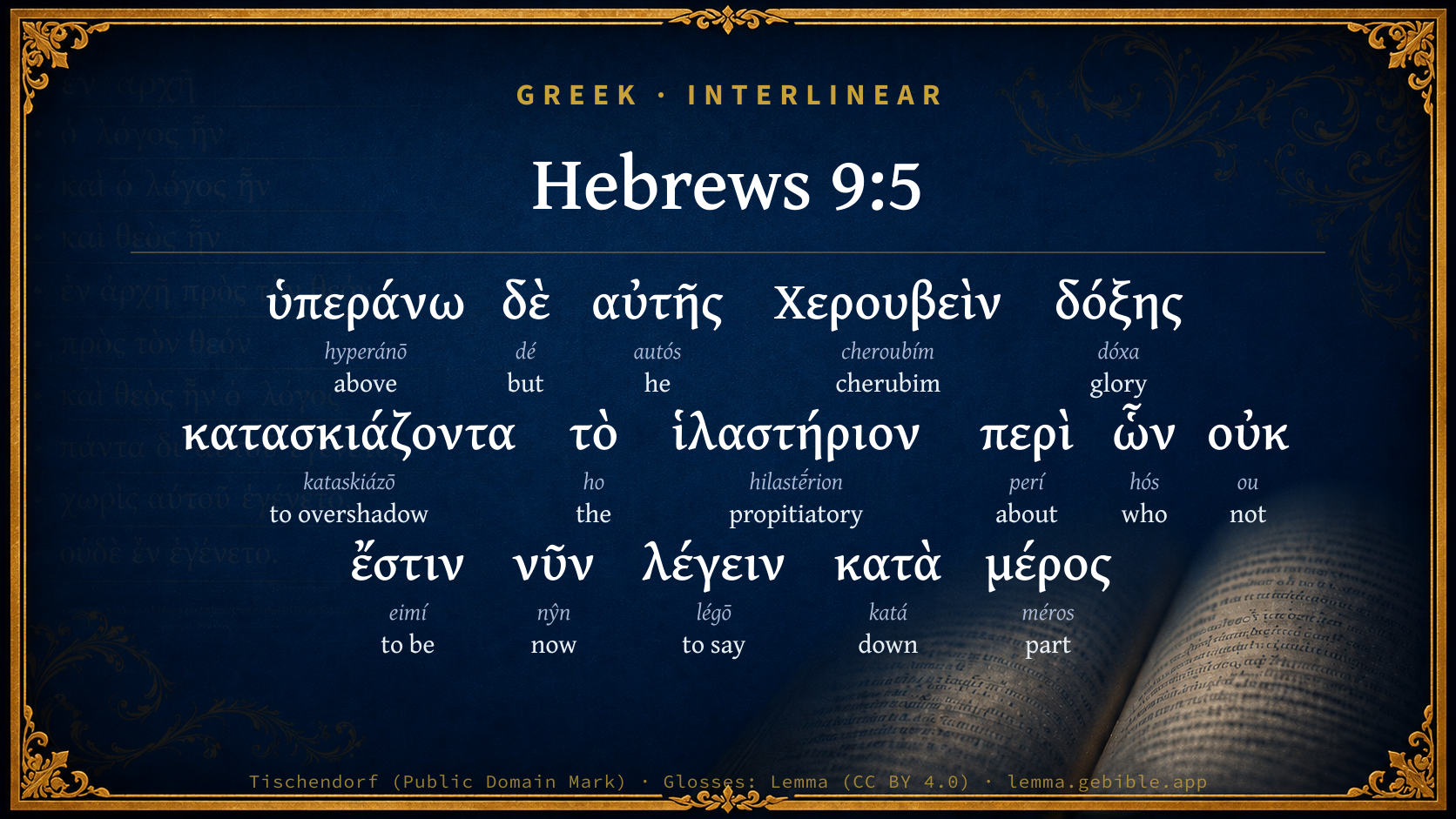
Greek (Tischendorf 8th ed.) Hebrews 9:5 appears in the Greek New Testament. The text above is from the Tischendorf 8th edition. Each word links to its Strong’s number and a concise gloss. Click any word for its full Thayer’s Greek Lexicon entry.
Download image
Cite this verse

Hebrews 9:5 (World English Bible). Public Domain. Lemma interlinear Bible study tool, https://lemma.gebible.app/v/hebrews/9/5.

Show BibTeX & RIS
BibTeX
RIS
English Translation
and above it cherubim of glory overshadowing the mercy seat, of which things we can't now speak in detail.
World English Bible · Public Domain
Highlights
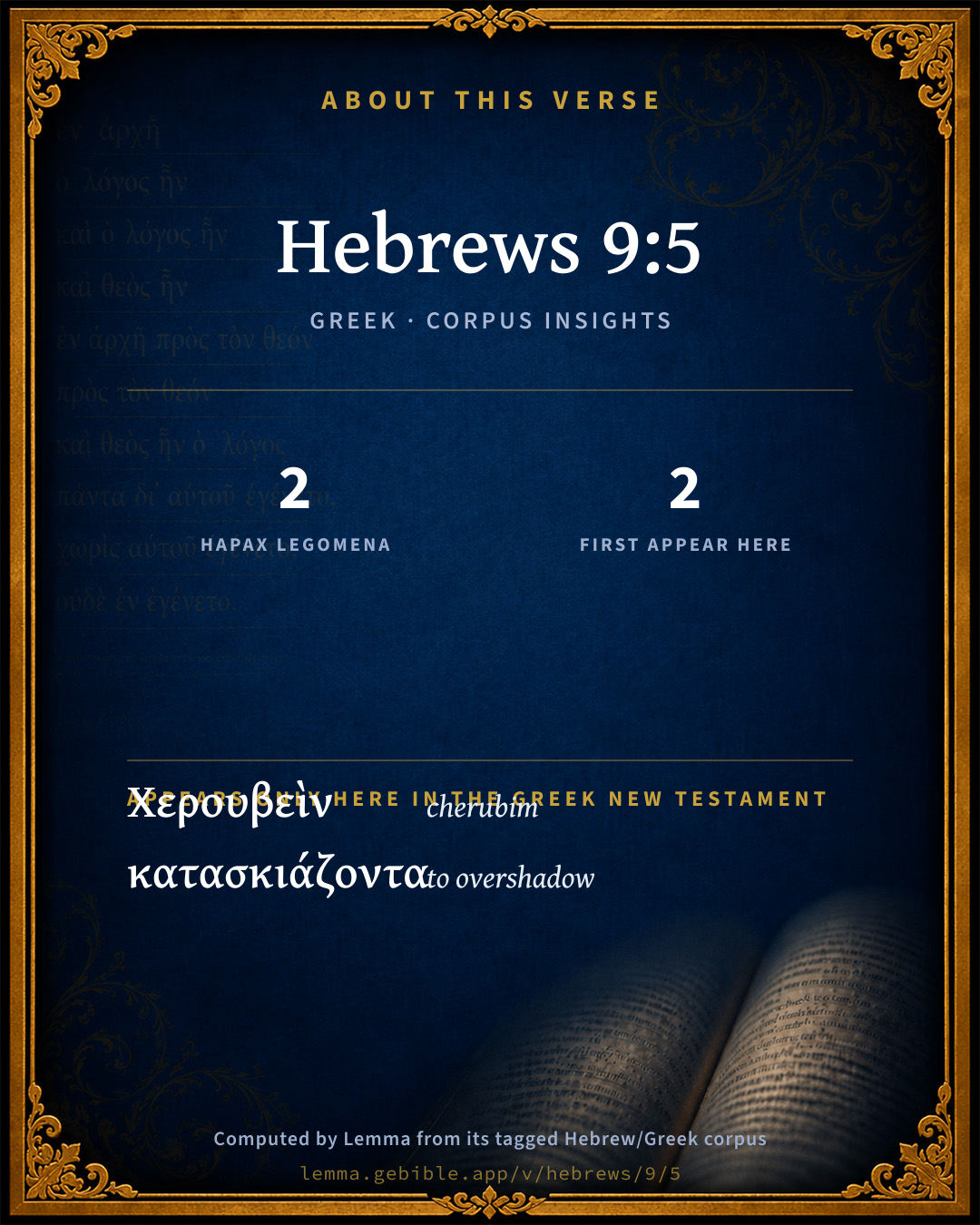
  • 2 hapax legomena — only here in the Greek New Testament
  • 2 first appearances in the Greek New Testament
Full analysis ↓
Download a study sheet

One document with this verse’s original text, its word-by-word gloss line, the meaning frame, cross-references with their text, attributed commentary, and full source and license credits — printable, and it pastes into notes with its structure intact.

This verse Autodidact and up

Study sheet (.html) Plain text (.txt)

A passage Seminary Student

Up to 50 verses in one chapter. A passage sheet keeps up to 6 commentary sources and 12 cross-references per verse, in the order this page ranks them, and says so on the sheet whenever that leaves anything out. Ask for a single verse and you get the Autodidact verse sheet above.

Everything on this page stays free to read, with no account — the sheet is a download of what is already on screen, not access to it.

Want to remove ads? Support Godless Engineer
Compare translations 3

The same verse in 3 English versions, stacked beneath the original-language interlinear above. Click any original word for its lexicon entry.

Each is an independent rendering of the whole verse — the interlinear is not word-aligned to these translations.

Highlighted words mark where these versions differ — a whole-verse word diff, not a word-by-word alignment.

  • World English Bible Public Domain
    and above it cherubim of glory overshadowing the mercy seat, of which things we can't now speak in detail.
  • King James Version Public Domain
    And over it the cherubims of glory shadowing the mercyseat; of which we cannot now speak particularly.
  • unfoldingWord Literal Text CC BY-SA 4.0
    and above it, cherubim of glory overshadowing the atonement lid, about which things it is not now to speak according to part.

unfoldingWord Literal Text — © unfoldingWord, licensed CC BY-SA 4.0. Word-aligned USFM3 via Door43 (git.door43.org/unfoldingWord/en_ult).

Versions to compare (up to 4)

3 of 4 selected

Show all 19 translations

Every available English version of this verse, each an independent rendering of the whole verse.

  • World English Bible Public Domain
    and above it cherubim of glory overshadowing the mercy seat, of which things we can't now speak in detail.
  • Berean Standard Bible Public Domain
    Above the ark were the cherubim of glory, overshadowing the mercy seat. But we cannot discuss these things in detail now.
  • Majority Standard Bible Public Domain
    Above the ark were the cherubim of glory, overshadowing the mercy seat. But we cannot discuss these things in detail now.
  • King James Version Public Domain
    And over it the cherubims of glory shadowing the mercyseat; of which we cannot now speak particularly.
  • American Standard Version (1901) Public Domain
    and above it cherubim of glory overshadowing the mercy-seat; of which things we cannot now speak severally.
  • Revised Version (1885) Public Domain
    and above it cherubim of glory overshadowing the mercy-seat; of which things we cannot now speak severally.
  • Geneva Bible (1599) Public Domain
    And ouer the Arke were the glorious Cherubims, shadowing the mercie seat: of which things we will not nowe speake particularly.
  • Douay-Rheims (1899) Public Domain
    And over it were the cherubims of glory overshadowing the propitiatory: of which it is not needful to speak now particularly.
  • Young's Literal Translation Public Domain
    and over it cherubim of the glory, overshadowing the mercy-seat, concerning which we are not now to speak particularly.
  • Literal Standard Version CC BY-SA 4.0
    and over it cherubim of the glory, overshadowing the propitiatory covering, concerning which we are not to particularly speak now.
  • Unlocked Literal Bible CC BY-SA 4.0
    Above the ark of the covenant, glorious cherubim overshadowed the atonement lid, which we cannot now talk about in detail.
  • unfoldingWord Literal Text CC BY-SA 4.0
    and above it, cherubim of glory overshadowing the atonement lid, about which things it is not now to speak according to part.
  • Darby Bible Public Domain
    and above over it the cherubim of glory shadowing the mercy-seat; concerning which it is not now [the time] to speak in detail.
  • World Messianic Bible Public Domain
    and above it cherubim of glory overshadowing the mercy seat, of which things we can’t speak now in detail.
  • Webster's Bible Public Domain
    And over it the cherubim of glory shadowing the mercy-seat; of which we cannot now speak particularly.
  • Free Bible Version CC BY-SA 4.0
    Above this were the glorious angel cherubim covering the place of reconciliation. We can't discuss all of this in detail now.
  • Bible in Basic English Public Domain
    And over it were the winged ones of glory with their wings covering the mercy-seat; about which it is not possible now to say anything in detail.
  • Text-Critical English NT CC BY 4.0
    Above the ark were the cherubim of glory, overshadowing the mercy seat. But we cannot discuss these things in detail now.
  • Tyndale New Testament (1534) Public Domain
    Over the arcke were the cherubis of glory shadowynge the seate of grace. Of which thynges we wyll not now speake perticularly.

Literal Standard Version (2020), Covenant Press — licensed CC BY-SA 4.0. Text via the HelloAO Bible API (eBible.org). Unlocked Literal Bible (unfoldingWord) — licensed CC BY-SA 4.0. Text via the HelloAO Bible API (eBible.org). unfoldingWord Literal Text — © unfoldingWord, licensed CC BY-SA 4.0. Word-aligned USFM3 via Door43 (git.door43.org/unfoldingWord/en_ult). Free Bible Version, Dr. Jonathan Gallagher — licensed CC BY-SA 4.0. Text via the HelloAO Bible API (eBible.org).

Word by word

More ways to search: Search by grammar → Find every occurrence → Compare this word →

Practice this passage: Drill this verse → Learn its vocabulary →

Χερουβεὶν
cheroubím
G5502
“cherubim”
Noun, Proper, indeclinable
Part of Speech
Noun · Proper, indeclinable
Full Thayer's Definition

Origin: plural of hebrew origin H3742

TDNT: 16:18,1

1. cherubim, two golden figures of living creatures with two wings; they were fastened to the lid of the ark of the covenant in the holy of holies (both at the sacred tabernacle and of Solomon's temple) in such a manner that their faces were turned towards each other and down towards the lid, which they overshadowed with their expanded wings. Between these figures God was regarded as having fixed his dwelling place.
  1. ὑπεράνω hyperánō G5231 “above” Adverb
  2. δὲ dé G1161 “but” Conjunction
  3. αὐτῆς autós G846 “he” Personal pronoun, Genitive, Singular, Feminine
  4. δόξης dóxa G1391 “glory” Noun, Genitive, Singular, Feminine
  5. κατασκιάζοντα kataskiázō G2683 “to overshadow” Verb, Present, Active, Participle, Nominative, Plural, Neuter
  6. τὸ ho G3588 “the” Article, Accusative, Singular, Neuter
  7. ἱλαστήριον hilastḗrion G2435 “propitiatory” Noun, Accusative, Singular, Neuter
  8. περὶ perí G4012 “about” Preposition
  9. ὧν hós G3739 “who” Relative pronoun, Genitive, Plural, Neuter
  10. οὐκ ou G3756 “not” Particle, Negative
  11. ἔστιν eimí G1510 “to be” Verb, Present, Active, Indicative, 3rd person, Singular
  12. νῦν nŷn G3568 “now” Adverb
  13. λέγειν légō G3004 “to say” Verb, Present, Active, Infinitive
  14. κατὰ katá G2596 “down” Preposition
  15. μέρος méros G3313 “part” Noun, Accusative, Singular, Neuter

About this verse

These counts appear in no published source. They are computed here, from the morphology-tagged text and Lemma’s own curated glosses. What Lemma adds →

16
words
16
distinct lemmas
General Epistles
section

Notable vocabulary

2 hapax legomena — words that appear only here in the entire Greek New Testament:

  • Χερουβεὶν cherubim G5502
  • κατασκιάζοντα to overshadow G2683

First appearance in Scripture

These words make their first canonical appearance in the Greek New Testament here:

  • Χερουβεὶν cherubim G5502
  • κατασκιάζοντα to overshadow G2683

Shared distinctive vocabulary

ἱλαστήριον propitiatory G2435 occurs in 2 verses of the Greek New Testament. Also found in:
Cross-references

14

Topical passages linked to Hebrews 9:5 in the Treasury of Scripture Knowledge — connected by theme and wording, ordered by reader-vote popularity; previews shown in the World English Bible.

  • Leviticus 16:2 and Yahweh said to Moses, "Tell Aaron your brother, not to come at all times into the Most Holy Place within the veil, before the mercy seat which is on the ark; lest he die: for I will appear in the cloud on the mercy seat.
  • Numbers 7:89 When Moses went into the Tent of Meeting to speak with Yahweh, he heard his voice speaking to him from above the mercy seat that was on the ark of the Testimony, from between the two cherubim: and he spoke to him.
  • Exodus 25:17–22 You shall make a mercy seat of pure gold. Two and a half cubits shall be its length, and a cubit and a half its breadth.
  • 1 Kings 8:6–7 The priests brought in the ark of the covenant of Yahweh to its place, into the oracle of the house, to the most holy place, even under the wings of the cherubim.
  • Leviticus 16:13 and he shall put the incense on the fire before Yahweh, that the cloud of the incense may cover the mercy seat that is on the testimony, so that he will not die.
  • Psalms 80:1 Hear us, Shepherd of Israel, You who lead Joseph like a flock, You who sit above the cherubim, shine forth.
  • Psalms 99:1 Yahweh reigns! Let the peoples tremble. He sits enthroned among the cherubim. Let the earth be moved.
  • Exodus 37:6–9 He made a mercy seat of pure gold. Its length was two and a half cubits, and a cubit and a half its breadth.
  • 1 Samuel 4:4 So the people sent to Shiloh; and they brought from there the ark of the covenant of Yahweh of Hosts, who sits [above] the cherubim: and the two sons of Eli, Hophni and Phinehas, were there with the ark of the covenant of God.
  • 2 Kings 19:15 Hezekiah prayed before Yahweh, and said, Yahweh, the God of Israel, who sit [above] the cherubim, you are the God, even you alone, of all the kingdoms of the earth; you have made heaven and earth.
  • 1 Chronicles 28:11 Then David gave to Solomon his son the pattern of the porch [of the temple], and of the houses of it, and of the treasuries of it, and of the upper rooms of it, and of the inner chambers of it, and of the place of the mercy seat;
  • Hebrews 4:16 Let us therefore draw near with boldness to the throne of grace, that we may receive mercy, and may find grace for help in time of need.
  • 1 Peter 1:12 To them it was revealed, that not to themselves, but to you, did they minister these things, which now have been announced to you through those who preached the Gospel to you by the Holy Spirit sent out from heaven; which things angels desire to look into.
  • Ephesians 3:10 to the intent that now through the assembly the manifold wisdom of God might be made known to the principalities and the powers in the heavenly places,

Cross-references courtesy of OpenBible.info (CC BY 4.0).

Commentary

Notes on Hebrews 9:5 from classic Christian and Jewish commentators (each source and its license shown beneath its notes). The classic Christian expositions comment on the surrounding passage and are grouped to its opening verse, so a note may address several verses; the Jewish commentaries on the Tanakh (Rashi and others) are per-verse, so they appear only where the commentator wrote on this verse.

Lemma curates 59 commentaries, every one of them public domain or Creative Commons licensed, each selected and text-cleaned for this edition rather than reprinted as found. About our sources →

Tyndale Open Study Notes

Tyndale Open Resources

9:5 The cherubim of divine glory were statues of angels formed into the Ark’s cover. This category of angels is especially associated with God’s glorious presence (Gen 3:24; Pss 80:1; 99:1; Isa 37:16). The Ark’s cover itself was the place of atonement, on which the blood from the Day of Atonement sacrifice was to be sprinkled (Lev 16:14-16). • But we cannot explain these things in detail now: The main focus of the discussion is the offering of sacrifices under the old covenant (Heb 9:6-10).

Tyndale Open Study Notes — © Tyndale Open Resources, licensed CC BY-SA 4.0. Text via the HelloAO Bible API.

Bengel's Gnomon

Johann Albrecht Bengel

Heb 9:5. Χερουβὶμ, the Cherubim) Exo 25:20; Exo 37:9.—δόξης, of glory) They were formed of the most precious materials, and represented the Glory of GOD riding upon the Cherubim; Eze 10:4.—κατασκιάζοντα) LXX., συσκιάζοντες, in the passages quoted above.—περὶ ἇν concerning which) The pronoun relates to the whole enumeration, from Heb 9:2.—οὐκ ἔστι νῦν λέγειν, we cannot now speak) The apostle had determined to treat, not so much of the sanctuary and its furniture, as of the sacrifices; and he does not say, we cannot afterwards, but we cannot now, implying, that each of these things also might be profitably discussed.

Bengel's Gnomon of the New Testament — English translation (T&T Clark, Edinburgh, 1860) — public domain. Text from a community e-Sword module.

Meyer's Critical & Exegetical Commentary

Heinrich August Wilhelm Meyer

Heb_9:5. The author turns from the objects to be found within the ark of the covenant to that which is above the same.

ὑπεράνω δὲ αὐτῆς] sc. τῆς κιβωτοῦ.

Χερουβίμ] comp. Exo_25:18 ff; Exo_37:7 ff.; Winer, Bibl. Realwörterb. I. 2 Aufl. p. 262 ff.; Bähr, Symbolik des Mob. Cultus, Bd. I. p. 311 ff. There existed two of them, of fine gold, one at each end of the cover or lid of the ark of the covenant, upon which, with faces turned towards each other, they looked down, and which they covered with their outspread wings. In the midst of the cherubim was the glory of God enthroned (1Sa_4:4; 2Sa_6:2; 2Ki_19:15; Isa_37:16), and from this place God would speak to Moses (Exo_25:22; comp. Num_7:89).

Χερουβίμ is here treated as a neuter, as likewise generally with the LXX., with whom the masculine οἱ Χερουβ. occurs but rarely (e.g. Exo_25:20; Exo_37:7). The neuter is not, however, to be explained by the supposition that πνεύματα is to be supplied to it in thought (comp. Drusius on our passage), but from the fact that the cherubim were regarded as ζῶα. Comp. Josephus, Antiq. iii. 6. 5, where the Mosaic cherubim are described as ζῶα πετεινά, μορφὴν, δʼ οὐδενὶ τῶν ὑπʼ ἀνθρώπων ἑωραμένων παραπλήσια. Comp. also Eze_10:15 : καὶ τὰ Χερουβὶμ ἦσαν τοῦτο τὸ ζῶον, ὃ ἴδον κ.τ.λ. Ibid. Heb_9:20.

The cherubim are called Χερουβὶμ δόξης. That may mean cherubim of glory or brightness, to whom glory or brightness is proper (so Camerarius, Estius, Schlichting, Jac. Cappellus, Stuart, Kuinoel, al.), or the cherubim which pertain to the divine glory, the כְּבֹוד יְהֹוָה, i.e. who are the bearers of the divine glory (so the majority). Grammatically the former is easier (on account of the absence of the article before δόξης). But the latter is to be preferred as yielding a more appropriate thought, and the omission of the article is to be justified from the usage of the LXX. Exo_40:34; 1Sa_4:22; Eze_9:3; Eze_10:18, al.

κατασκιάζοντα τὸ ἱλαστήριον] which overshadow the propitiatory (or mercy-seat). κατασκιάζειν in the N. T. only here. Comp. συσκιάζειν, Exo_25:20; σκιάζειν, Exo_37:9; 1Ch_28:18. A more choice verb than περικαλύπτειν, 1Ki_8:7. τὸ ἱλαστήριον (כַּפֹּרֶת), the cover of the ark of the covenant, which on the great day of atonement was sprinkled with the sacrificial blood for the expiation of the sins of the people. Comp. Lev_16:14 f.

περὶ ὧν] goes back not merely to the cherubim (Ebrard, p. 294), but also to all the objects before enumerated.

οὐκ ἔστιν] it concerns us not, or: is not the place, or: is impossible. Comp. 1Co_11:20. Of the same meaning as the more definite οὐκ ἔξεστιν. With Kurtz to supply τόπος is inadmissible.

κατὰ μέρος] in detail. The author does not design to set forth the typical significance of every single object enumerated; the indication of the typical significance of the two main divisions of the Jewish sanctuary is that which he at present aims at, and to this task he now addresses himself in that which immediately follows, comp. Heb_9:8.

Meyer — Critical and Exegetical Commentary on the New Testament — English translation by Peter Christie, edited by Frederick Crombie (T&T Clark, 1880) — public domain. Text from a community e-Sword module.

Geneva Bible (1599)

Geneva Bible translators

The Hebrews call the cover of the Ark of the covenant, the mercy seat, whom both the Greeks and we follow.

Geneva Bible (1599) marginal notes — public domain. Text via Bolls.life.

Jamieson, Fausset & Brown

Robert Jamieson, A. R. Fausset & David Brown

over it--over "the ark of the covenant."

cherubim--representing the ruling powers by which God acts in the moral and natural world. (See on Eze 1:6; Eze 10:1). Hence sometimes they answer to the ministering angels; but mostly to the elect redeemed, by whom God shall hereafter rule the world and set forth His manifold wisdom: redeemed humanity, combining in, and with itself, the highest forms of subordinate creaturely life; not angels. They stand on the mercy seat, and on that ground become the habitation of God, from which His glory is to shine upon the world. They expressly say, Rev 5:8-10, "Thou hast redeemed us." They are there distinguished from the angels, and associated with the elders. They were of one piece with the mercy seat, even as the Church is one with Christ: their sole standing is on the blood-sprinkled mercy seat; they gaze down at it as the redeemed shall for ever; they are "the habitation of God through the Spirit."

of glory--The cherubim were bearers of the divine glory, whence, perhaps, they derive their name. The Shekinah, or cloud of glory, in which Jehovah appeared between the cherubim over the mercy seat, the lid of the ark, is doubtless the reference. THOLUCK thinks the twelve loaves of the showbread represent the twelve tribes of the nation, presented as a community before God consecrated to Him (just as in the Lord's Supper believers, the spiritual Israel, all partaking of the one bread, and becoming one bread and one body, present themselves before the Lord as consecrated to Him, Co1 10:16-17); the oil and light, the pure knowledge of the Lord, in which the covenant people are to shine (the seven (lights), implying perfection); the ark of the covenant, the symbol of God's kingdom in the old covenant, and representing God dwelling among His own; the ten commandments in the ark, the law as the basis of union between God and man; the mercy seat covering the law and sprinkled with the blood of atonement for the collective sin of the people, God's mercy [in Christ] stronger than the law; the cherubim, the personified [redeemed] creation, looking down on the mercy seat, where God's mercy, and God's law, are set forth as the basis of creation.

mercy seat--Greek, "the propitiatory": the golden cover of the ark, on which was sprinkled the blood of the propitiatory sacrifice on the day of atonement; the footstool of Jehovah, the meeting place of Him and His people.

we cannot--conveniently: besides what met the eye in the sanctuary, there were spiritual realities symbolized which it would take too long to discuss in detail, our chief subject at present being the priesthood and the sacrifices. "Which" refers not merely to the cherubim, but to all the contents of the sanctuary enumerated in Heb 9:2-5.

Jamieson, Fausset & Brown — Commentary Critical and Explanatory on the Whole Bible (1871) — public domain (CC PDM 1.0). Text via the HelloAO Bible API.

Adam Clarke's Commentary

Verse 5. And over it the cherubims of glory] Cherubim is the plural of cherub, and it is absurd to add our plural termination (s) to the plural termination of the Hebrew. The glory here signifies the shechinah or symbol of the Divine presence.

Shadowing the mercy-seat] One at each end of the ark, with their faces turned toward each other, but looking down on the cover or propitiatory, ιλαστηριον, here called the mercy-seat.

Of which we cannot now speak particularly.] The apostle did not judge any farther account of these to be necessary; and I may be excused from considering them particularly here, having said so much on each in the places where they occur in the Pentateuch. What these point out or signify is thus explained by St. Cyril: Christus licet unus sit, multifariam tamen a nobis intelligitur: Ipse est Tabernaculum propter carnis tegumenturn: Ipse est Mensa, quia noster cibus est et vita: Ipse est Arca habens legem Dei reconditam, quia est Verbum Patris: Ipse est Candelabrum, quia est lux spiritualis: Ipse est Altare incensi, quia est odor suavitatis in sanctificationem: Ipse est Altare holocausti, quia est hostia pro totius mundi vita in cruce oblata. "Although Christ be but one, yet he is understood by us under a variety of forms. He is the Tabernacle, on account of the human body in which he dwelt. He is the Table, because he is our Bread of life. He is the Ark which has the law of God enclosed within, because he is the Word of the Father. He is the Candlestick, because he is our spiritual light. He is the Altar of incense, because he is the sweet-smelling odour of sanctification. He is the Altar of burnt-offering, because he is the victim, by death on the cross, for the sins of the whole world." This father has said, in a few words, what others have employed whole volumes on, by refining, spiritualizing, and allegorizing.

Adam Clarke's Commentary on the Bible (1810–1826) — public domain. Text from a community e-Sword/MySword module.

John Calvin's Commentaries

5. Of which we cannot now, etc. As nothing can satisfy, curious men, the apostle cuts off every occasion for refinements unsuitable to his present purpose, and lest a longer discussion of these things should break off the thread of his argument. If, therefore, any one should disregard the Apostle’s example, and dwell more minutely on the subject, he would be acting very unreasonably. There might be, indeed, an occasion for doing this elsewhere; but it is now better to attend to the subject of which he treats: it may further be said, that to philosophize beyond just limits, which some do, is not only useless, but also dangerous. There are some things which are not obscure and fitted for the edification of faith; but discretion and sobriety ought to be observed, lest we seek to be wise above what God has been pleased to reveal.

John Calvin's Commentaries (1540-1563) — public domain. Text from the Calvin Translation Society English edition (1840s-50s) via the Christian Classics Ethereal Library (ccel.org). Calvin's coverage is partial (roughly two-thirds of the Bible); uncommented books and verses are honest gaps, never fabricated. The 19th-century editor's footnotes and remarks are omitted so the notes are faithfully Calvin's own voice.

Ellicott's Commentary for English Readers

(5) Cherubims of glory.—See Exo_25:18-22; Exo_29:43; Num_7:89; Eze_10:19-20. As these passages will show, the reference is to the glory which appeared above the mercy seat. (See Note on Heb_1:3.) This is the only express mention of the cherubim in the New Testament; but see the Notes on Rev_4:6, et seq.

The mercy seat (literally, the propitiatory) is the rendering adopted in the LXX. for the Hebrew Capporeth, signifying the golden covering of the ark (Exo_25:17). Whether the Hebrew word properly denotes covering or bears the meaning which is expressed by the Greek translation, is a disputed question, into which we cannot here enter. The act of expiation with which the Greek name at all events stands connected is that of Lev_16:10-14. It is noteworthy that in 1Ch_28:11 the Most Holy Place itself is called “the house of the mercy seat.” (See the Note on Rom_3:25.)

Of which—viz., all things that the Holy Place and the Holy of Holies contained.

Particularly—i.e., severally, one by one.

A Bible Commentary for English Readers, edited by Charles John Ellicott (1878–1897) — public domain. Text from a community e-Sword module.

The Cambridge Bible for Schools and Colleges

gen. ed. J. J. S. Perowne

5. the cherubims] Rather, “the Cherubim,” since im is the Hebrew plural termination.

of glory] Not “the glorious Cherubim” but “the Cherubim of the Shechinah” or cloud of glory. This was regarded as the symbol of God’s presence, and was believed to rest between their outspread wings (see 1Sa_4:22; 2Ki_19:15; Hag_2:7-9; Sir_49:8). They were emblems of all that was highest and best in animated nature—the grandest products of creation combined in one living angelic symbol (Eze_10:4)—upholding the throne of the Eternal as on “a chariot” and bending in adoring contemplation of the moral law as the revelation of God’s will.

the mercy-seat] The Greek word “hilasterion” or “propitiatory” is the translation used by the LXX. for the Hebrew Cappôreth or “covering.” The word probably meant no more than “lid” or “cover;” but the LXX. understood it metaphorically of the covering of sins or expiation, because the blood of the expiatory offering was sprinkled upon it.

of which we cannot now speak particularly] Rather, “severally,” “in detail.” It was no part of the writer’s immediate purpose to enter upon an explanation of that symbolism of the Tabernacle which has largely occupied the attention of Jewish historians and Talmudists as well as of modern writers. Had he done so he would doubtless have thrown light upon much that is now obscure. But he is pressing on to his point, which is to shew that even the most solemn and magnificent act of the whole Jewish ritual—the ceremony of the Day of Atonement—bears upon its face the signs of complete transitoriness and inefficiency when compared with the work of Christ.

The Cambridge Bible for Schools and Colleges (gen. ed. J. J. S. Perowne; Cambridge University Press, 1878–1918) — public domain. Text from a community e-Sword module.

John Gill's Exposition

And over it the cherubim of glory,.... Or "glorious cherubim", where the Shechinah, or divine glory, dwelt, Psa 80:1. These were over the ark, and were in number two, as were the cherubim which God placed at the garden of Eden, Gen 3:24 according to the opinion of the ancient Jews (u); and very likely these were made after the form of them. Some have thought them to be birds of a very terrible aspect, which were set there to deter Adam and Eve from coming to the tree of life; and both Philo (w) and Josephus (x) say, they were winged fowls; but the generality of the Jewish writers take them for angels (y); and some of them say they were destroying angels, or noxious spirits (z), which is not probable; but why angels should be so called, and what was their appearance, there are different opinions. Jerom says (a) the word signifies a multitude of knowledge; and indeed Philo the Jew (b) observes, that the Greeks would interpret the Hebrew word, much knowledge and understanding; and another Jewish writer (c) affirms, that the word "cherubim" is a name for separate intelligences, as if angels were so called from their great knowledge, and that the word is the same as "cerabbim", as "Rabbins", doctors, or teachers; but for the most part they interpret it, "as young men" (d), because that angels have appeared in the form of young men. So in the Talmud (e) it is asked,

"what does cherub signify?" says R. Abhu, "as a young man", for so in Babylon they call a young man ''

Some think that the word "cherub" is the same with "Recub", the letters transposed, which signifies "a chariot", because God is said to ride upon a "cherub" and the angels are called the chariots of the Lord, Psa 18:10 to which may be added, that Ezekiel's vision of the "cherubim" is frequently, by the Jews (f), called "Mercabah", or "the chariot"; and mention is made of the chariot of the cherubim, in Ch1 28:18 to which reference may be had in Hab 3:8 though I rather think, with others, that the word is derived from "Carab", which in the Syriac and Arabic languages signifies "to plough", and so in the Talmud (g); and a cherub took its name from hence, because of the ox, whose face it had, that being a creature made use of in ploughing; and that the face of an ox, and the face of a cherub, is the same, may easily be concluded from Eze 1:10. And now because that Ezekiel's cherubim had four faces, the face of a man, the face of a lion, the face of an ox, and the face of an eagle; and the "cherubim" in the temple were in the same form, as may be gathered from Eze 41:18 those that were placed at the garden of Eden may be thought to be in the same form also: and some of late have fancied, that they were an hieroglyphic of the trinity of persons in the Godhead, signified by the ox, the lion, and eagle; and of the incarnation of the Son of God, the face of a man being added to them; to support which notion it is further observed, that the word should be pronounced "ce-rubbim", and interpreted, "as the mighty ones". But it should be known, that the word is also used in the singular number, Psa 18:10 and every single cherub had these four faces, so that each of them must be a representative of the Trinity, and of the incarnate Saviour, of which only the word in the singular number can be used; and then it can only be said of it, "cerub", as "the mighty one" which observation greatly weakens what is brought to support the fancy: besides, if the cherubim were an emblem of a plurality of persons in the Godhead, they would rather be an emblem of a quaternity, and not of a trinity of persons, since each had four faces, and those distinct from each other; for the face of a man is as much a distinct face as any of the rest. Now the human nature of Christ is no distinct person, much less one in the Godhead; and besides is the inferior nature of Christ, whereas the face of the man, in the "cherubim", is superior to the rest, which are the faces of irrational animals. Moreover, this would give us a similitude of the divine Being, and of that in him which is most incomprehensible by us, the trinity of persons in the Godhead; and so an answer may be given to such questions, the sense of which suggests, that no answer can be returned to them, Isa 40:18 and though the second Person often appeared in human form, and in the fulness of time became incarnate, and the Holy Ghost once descended as a dove, yet the Father's shape was never seen at any time, Joh 5:37 to which may be added, that this notion seems contrary to the second command, "thou shall not make unto thee any likeness of anything that is in heaven above", Exo 20:4 for allowing that the cherubim at the garden of Eden were figures made by the Lord himself, it is not credible he should make such, he afterwards forbid others to make; besides, the "cherubim" in the tabernacle and temple were the same figures with those in Eden, as is owned; and these were ordered of God to be made by men, and therefore surely cannot be thought to be figures, emblems, and representations of God himself in his three divine persons; likewise the cherubim are not only distinguished from him, but instead of being figures of him, they are always represented as vehicles on which he sits or rides, Exo 25:22. Once more, it may deserve some little consideration, that the prince of Tyre, a type of antichrist, the man of sin, is called a "cherub", Eze 28:14 which surely cannot be in allusion to the divine Being, and the persons in the Godhead, but very well in allusion to angels, the sons of God, as civil magistrates, good and bad, are sometimes called. No doubt there was something signified by the "cherubim" in the tabernacle and temple; but that this should be the mystery of them, is not easy of belief. Philo the Jew makes the "cherubim" to signify the two powers of God, his creative and governing powers (h); and the Jews frequently speak of , "the mystery of the cherubim" (i): the "cherubim" over the ark, here spoken of, are sometimes allegorized of the two Testaments, the Old and New; the matter of them being of gold may denote the excellency, purity, simplicity, and duration of them; their number is two, as were the "cherubim"; and as they were alike, and of one measure and size, this may intend the agreement between them; the doctrines, promises, prophecies, types, and figures of the Old Testament agree with the New; and the account that the one gives of the person and offices, and grace of Christ, agrees with the other; their situation and position, being placed at the two ends of the mercy seat, and looking towards it, may denote their being full of Christ, from one end to the other, and their pointing at him, and bearing witness to him; here God also reveals himself, as he did between the "cherubim"; and these are glorious as they were, full of glory, containing the glorious Gospel of the blessed God: though rather the "cherubim" on the mercy seat were symbols and representations of angels, since to these the Apostle Peter seems to allude, in Pe1 1:12, their being made of gold may denote their excellency, purity, and simplicity; their being on the mercy seat shows their dependence on Christ, their confirmation by him, and ministration to him; their having wings, expresses their readiness to do his will; and their looking one to another, signifies their unity and concord among themselves; and their looking to the mercy seat, their inspection into the mysteries of grace; and their being over the ark, and God being in the midst of them, declares the presence of God with them, whose face they always behold; and as these "cherubim" of glory, they are very glorious creatures, and in the glory of them will Christ come a second time:

shadowing the mercy seat; that is, with their wings, as in Exo 25:20 which was typical of Christ; its name agrees with him, a mercy seat; for in him God shows himself merciful to his people; all the stores of mercy are laid up in him; the mission of him into this world is owing to the mercy of God; and the mercy of God was glorified by him in the redemption of his people; and he himself is the way through which they obtain and receive mercy; and he is also a merciful high priest to them: the Hebrew word for the mercy seat, signifies "a covering": nor is our English word in sound very different from it; and it was so called, as Kimchi (k) observes, because it covered the ark: Christ is a covering to his people; their persons are clothed with his righteousness, and all their sins are covered by it; and they are secured from the curse and condemnation of the law, and wrath to come: the Septuagint interpreters render it by the word used here by the Apostle Paul, in Rom 3:25, there rendered "propitiation", and applied to Christ, who has made reconciliation for sin, and through whom God is propitious to his people. The matter, of which the mercy seat was made, was pure gold, denoting the excellency and preciousness of Christ; the make of it, in its length and breadth, was just the same with the ark, in which the two tables were, Exo 25:10. Christ is the fulfilling end of the law, and exactly answers to all its requirements; his nature, to the holiness and spirituality of it; his righteousness, to all the obedience it commands; and his sufferings and death, to the penalty it enjoins: its situation above the ark shows that there is no mercy but in a way of righteousness, and that Christ stands between God and the law, and, by fulfilling it, covers all the transgressions of it; and being above it, is able to suppress all its accusations and charges: from off the mercy seat, God communed with his people; the way to communion with God is by Christ; the encouragement to go to God is from him; and the enjoyment of him is through him: on the day of atonement the mercy seat was sprinkled with blood, typical of the blood of Christ, whereby peace is made, and a way opened into the holiest of all:

of which we cannot now speak particularly; not only of the mercy seat, but of all the things before mentioned; for the word "which" is in the plural number, and refers to all the preceding things; to discourse of which, largely and particularly, required more time than the apostle had, and must have exceeded the bounds of an epistle. The Ethiopic version renders it in the singular number; "of this".

(u) Targum Jon. &. Hieros. in Gen. iii. 24. (w) De Vita Mosis, l. 3. p. 668. (x) Antiqu. l. 3. c. 6. sect. 5. (y) Bereshit Rabba, sect. 21. fol. 19. 1. & Mattanot Cehunah in ib. Aben Ezra in Gen iii. 24. (z) Jarchi & Baal Hatturim in loc. (a) Ep. Paulino, Tom. III. fol. 3. F. (b) Ut supra. (De Vita Mosis, l. 3. p. 668.) (c) R. Samuel Tzartzah, Sepher Meker Chayim, fol. 8. 3. (d) Zohar in Gen. fol. 122. 3. & Imre Binah in ib. Aben Ezra in Gen. iii. 24. Kimchi Sepher Shorash. in rad. & R. Sol. Urbin. Ohel Moed, fol. 58. 2. (e) T. Bab. Chagiga, fol. 13. 2. & Succa, fol. 5. 2. (f) T. Bab. Chagiga, fol. 14. 2. (g) T. Bab. Sabbat, fol. 32. 2. Bava Kama, fol. 96. 2. (h) De Cherubim, p. 112. de Profugis, p. 465. & de Vita Mosis, l. 3. p. 669. (i) Zohar in Gen. fol. 99. 1. & 122. 4. (k) Sopher Shorash. rad.

John Gill's Exposition of the Whole Bible (1746–1763) — public domain (CC PDM 1.0). Text via the HelloAO Bible API.

Trapp's Complete Commentary

John Trapp

5 And over it the cherubims of glory shadowing the mercyseat; of which we cannot now speak particularly.

Ver. 5. And over it the cherubims] The ark covering the law within it, the mercy seat upon it, and over them two cherubims covering one another; all these set forth Christ covering the curses of the law, in whom is the ground of all mercy, which things the angels desire to pry into, as into the pattern of God’s unsearchable wisdom and goodness.

John Trapp, A Commentary or Exposition upon All the Books of the Old and New Testament (1647–1656) — public domain. Text from a community e-Sword module.

Albert Barnes' Notes on the Bible

And over it - That is, over the ark.

The cherubim of glory - A Hebrew mode of expression, meaning “the glorious cherubim.” The word “cherubim” is the Hebrew form of the plural, of which cherub is the singular. The word “glory” used here in connection with “cherubim,” refers to the splendor, or magnificence of the image, as being carved with great skill, and covered with gold. There were two cherubim on the ark, placed on the lid in such a manner that their faces looked inward toward each other, and downward toward the mercy-seat. They stretched out their wings “on high,” and covered the mercy-seat, or the lid of the ark; Exo 25:18-20; compare 1Ki 8:6-7; 1Ch 28:18. In the temple, the cherubim were made of the olive tree, and were ten cubits high. They were overlaid with gold, and were so placed that the wing of one touched the wall on one side of the Holy of Holies, and that of the other the other side, and their wings met together over the ark; 1Ki 6:23-28.

It is not probable, however, that this was the form used in the tabernacle, as wings thus expanded would have rendered it inconvenient to carry them from place to place. Of the form and design of the cherubim much has been written, and much that is the mere creation of fancy, and the fruit of wild conjecture. Their design is not explained in the Bible, and silence in regard to it would have been wisdom. If they were intended to be symbolical, as is certainly possible, (compare Eze 10:20-22), it is impossible now to determine the object of the symbol. Who is authorized to explain it? Who can give to his speculations anything more than the authority of “pious conjecture?” And of what advantage, therefore, can speculation be, where the volume of inspiration says nothing? They who wish to examine this subject more fully, with the various opinions that have been formed on it, may consult the following works, namely, Calmet’s Dictionary, Fragment No. 152, with the numerous illustrations; Bush’s notes on Exo 25:18; and the Quarterly Christian Spectator, vol. viii. pp. 368-388. Drawings resembling the cherubim were not uncommon on ancient sculptures.

Shadowing - Stretching out its wings so as to cover the mercy-seat.

The mercy-seat - The cover of the ark on which rested the cloud or visible symbol of the divine presence. It was called “mercy-seat,” or “propitiatory” - ἱλαστήριον hilastērion - because it was this which was sprinkled over with the blood of atonement or propitiation, and because it was from this place, on which the symbol of the deity rested, that God manifested himself as propitious to sinners. The blood of the atonement was that through or by means of which he declared his mercy to the guilty. Here God was supposed to be seated, and from this place he was supposed to dispense mercy to man when the blood of the atonement was sprinkled there. This was undoubtedly designed to be a symbol of his dispensing mercy to people in virtue of the blood which the Saviour shed as the great sacrifice for guilt; see Heb 9:13-14.

Of which we cannot now speak particularly - That is, it is not my present design to speak particularly of these things. These matters were well understood by those to whom he wrote, and his object did not require him to go into a fuller explanation.

Albert Barnes' Notes on the Bible (1834–1885) — public domain. Text from a community e-Sword/MySword module.

Haydock's Catholic Bible Commentary

And over it (the ark) were cherubims of glory or glorious cherubims, (in what shape they were represented, is not certain) overshadowing the propitiatory, or seat of mercy, which was all of gold, of the same size as the ark, and like a cover to it. Just over this propitiatory were placed the two cherubs, spreading their wings looking towards one another, and upon the propitiatory. See Exodus xxxvi. and xxxvii. From this place God made known his presence, and the effects of his mercy to this people. Here he was said to be seated on the cherubims, and that the ark was his footstool. Psalm xcviii. Adore his footstool; i.e. prostrate before his ark. These two images of cherubs, shew that God did not absolutely forbid images at that time, when the people were so addicted to idolatry, but only to adore them. (Witham) --- How futile is it to object from the commandment that it is forbidden to use holy images in the Church, when we here behold even amongst the people most prone to idolatry, most gross in their ideas of spiritual things, and to whom the precept was specially given not to make any graven idols, the same God commanding these images of angels to be made and set in the most holy place of the tabernacle or temple.

George Leo Haydock (1774–1849), Haydock's Catholic Family Bible and Commentary, 1859 edition — public domain. Excludes Psalms (Douay-Rheims chapter numbering differs from Protestant) and Deuterocanonical books (Catholic canon only).

Matthew Poole's English Annotations

And over it the cherubims of glory shadowing the mercy-seat; on the cover of the ark at each end was a cherub of beaten gold; these and the cover of the ark were all of one piece, they had their feet on the ledge of the cover, or its crown, at each end; their faces looked towards each other, and their wings touched each other in the extreme part of them, and so on the cover formed the mercy seat see Exo 25:17-22; and Exo 37:6-9; 40:20. Their form is described by Ezekiel, Eze 1:1-28 and Eze 10:1-22. They were glorious for matter and service, God in his glory manifesting himself over them, gave propitious answers unto Moses about his church, Exo 25:22; Lev 16:2. These cherubims typified the ministry of angels to our Lord Jesus, especially in his great work of rendering God propitious to his church, and saving it, Heb 1:14. Standing on the two ends of the ark’s cover, they showed Christ to be the basis of their own standing, when others fell: they spread out their wings, to show their readiness for serving him in all; with their faces opposite to each other, and looking down on the mercy-seat and ark, typifying what the apostle saith of them, 1Pe 1:10-12, desirous to pry into the mystery of this great Propitiator, the Surety and Mediator of God’s testament, and on his propitiation and its effects, which is admirable and astonishing, not to sinners only, but to angels, Eph 3:10.

Of which we cannot now speak particularly; the apostle apologizeth for his but mentioning these mysterious things now, that it was not to eclipse the glory of that administration, but because the matters were well known to them already, only in this they were defective, that they reached not after Christ, the truth and substance of all these types; and therefore he proceeds from the places, to treat of the services to be performed by the Aaronical priesthood in them.

Matthew Poole's English Annotations on the Holy Bible (1683–1685) — public domain. Text from a community e-Sword/MySword module.

Whedon's Commentary on the Bible

Daniel D. Whedon

5. Over it the cherubim—The “cherubim” were symbolical winged figures, presented in different Scriptures with some variation of form. In Eze_1:5-10 they have each four faces; in Revelation (Rev_4:6-8) they are four figures each with a different face. The four faces represent the highest species of the four kingdoms of the animated creation—man, lion, ox, and eagle. This fact, together with the prevalence of the number four, indicates a symbolism of the creation. There are but two at this ark. But, adopting the theory that the ark with its four sides symbolizes the world, we see how the fourness is still preserved. And, further, adopting the interpretation given by Abarnabel and others, that the words (Exo_25:19) “of the mercy seat shall ye make the cherubim,” mean that the mercy seat and cherubim were all of one piece, then we may see how the cherubim arise as personifications of the cosmos out from the cosmos itself, being, in fact, one with it. The bending of cherubim over the mercy seat is the attitude of reverent study (1Pe_1:12) and worship, exhibiting nature in her aspect of obedience to her Ruler. The divine law (like the deposited decalogue) is a hidden secret in the system of nature; and it is surmounted with the throne of mercy shadowed with the cherubim’s wings, while over all is the glory, the Shekinah, the divine overruling Presence.

Cannot… speak—For he had already (especially in Heb_9:4) lingered among interesting but less relevant details, and must hasten to the main typical point, the parallelism between the Jewish high priest entering the earthly most holy and our high priest entering the heavenly holy.

Daniel D. Whedon (gen. ed.), Commentary on the Old and New Testaments (1874–1909) — public domain. Text from a community e-Sword module.

John Wesley's Explanatory Notes

And over it were the cherubim of glory - Over which the glory of God used to appear. Some suppose each of these had four faces, and so represented the Three-One God, with the manhood assumed by the Second Person. With out-spread wings shadowing the mercy-seat - Which was a lid or plate of gold, covering the ark.

John Wesley, Explanatory Notes Upon the Whole Bible (1754–1765) — public domain. Text via the GEBible commentary corpus.

Scofield Reference Notes

C. I. Scofield

mercyseat

(Greek - ἱλαστήριον, place of propitation). (See Scofield "Rom 3:25").

The Scofield Reference Bible (1917 edition), notes by C. I. Scofield — public domain. Text from a community e-Sword module.

The People's New Testament

B. W. Johnson

5. And over it the cherubim. These symbolic figures, made of gold, hovered over the lid of the ark, called the mercy seat. Cannot now speak particularly. Cannot discuss the significance of each of these objects. The cherubim were angels. See Gen. 3:24.

B. W. Johnson's The People's New Testament with Notes (1889–1891) — public domain. Electronic text from the Christian Classics Ethereal Library (CCEL) ThML edition.

Cambridge Greek Testament for Schools and Colleges

5. δόξης. This is much better supported than the τῆς δ. of the rec.

5. Χερουβείν. “The Cherubim,” since im is the Hebrew plural termination (not as in A. V. “Cherubims”).

δόξης. Not “the glorious Cherubim” but “the Cherubim of the Shechinah” or cloud of glory. This was regarded as the symbol of God’s presence, and was believed to rest between their outspread wings (see 1Sa 4:22; 2Ki 19:15; Hag 2:7-9; Sir 49:8). They were emblems of all that was highest and best in animated nature—the grandest products of creation combined in one living angelic symbol (Eze 10:4)—upholding the throne of the Eternal as on “a chariot” and bending in adoring contemplation of the moral law as the revelation of God’s will.

τὸ ἱλαστήριον, “the propitiatory,” is the translation used by the LXX. for the Hebrew cappôreth or “covering.” The word probably meant no more than “lid” or “cover”; but the LXX. understood it metaphorically of the covering of sins or expiation, because the blood of the expiatory offering was sprinkled upon it.

κατὰ μέρος. “Severally,” rather than “particularly” (A. V.), “in detail.” It was no part of the writer’s immediate purpose to enter upon an explanation of that symbolism of the Tabernacle which has largely occupied the attention of Jewish historians and Talmudists as well as of modern writers. Had he done so he would doubtless have thrown light upon much that is now obscure. But he is pressing on to his point, which is to shew that even the most solemn and magnificent act of the whole Jewish ritual—the ceremony of the Day of Atonement—bears upon its face the signs of complete transitoriness and inefficiency when compared with the work of Christ.

Cambridge Greek Testament for Schools and Colleges (Cambridge University Press, 1896; 21 vols, various authors incl. Carr, Maclear, Plummer, Farrar, Lumby, Moule, M. R. James, Simcox) — public domain. Text from a community e-Sword module.

Alford’s Greek Testament

Henry Alford

5.] and (δέ, as contrasted to ‘within’) over above it (the ark of the covenant) (the) cherubim (the well-known fourfold animal forms, fencing from human approach, and at the same time bearing up and supporting, the glory of God: symbolizing, as I believe and have elsewhere maintained (Hulsean Lectures for 1841, Lect. i. See also note on Rev 4:6-8), the creation of God. See more below) of glory (ἢ τὰ ἔνδοξα, ἢ τὰ ὄντα τῆς δόξης, τουτέστι τοῦ θεοῦ: Œc., Cyril, similarly Thl., … ἢ τὰ λειτουργικὰ τοῦ θεοῦ, κ. πρὸς δόξαν αὐτοῦ ὄντα: and Chrys., … ἢ τὰ ὑποκάτω τοῦ θεοῦ. There can be little doubt that the latter class of meanings is to be taken, though Camerar., Beza (vers.), Est., Corn. a-Lap., Schlichting, Kuinoel, al. adopt the former. For we may well say, why such a periphrasis if a mere epithet were intended, when we have already the epithets χρυσοῦν and περικεκαλυμμένην χρυσίῳ? The δόξα is the Shechinah, or bright cloud of glory, in which Jehovah appeared between the cherubic forms, and to which, as attendants, and watchers, and upholders, they belonged. The want of the art. before δόξης is no argument for the other view, as δόξα is often used thus anarthrous for the Shechinah: cf. Exo 40:28 (34), κ. ἐκάλυψεν ἡ νεφέλη τὴν σκηνὴν τοῦ μαρτυρίου, κ. δόξης κυρίου ἐπλήσθη ἡ σκηνή: 1Ki 4:22: Eze 9:3; Eze 10:18 al. On the Cherubim, see further Winer, Realw. sub voce) overshadowing (casting shadow down upon, causing to be κατάσκιον: see reff. Exod. χερουβίν here, as usually, is neuter: cf. Gen 3:24: Exo 25:18 al.: sometimes the LXX have used it masc.: e. g. Exo 25:20; Exo 28:23 al. There seems to be a reason for the variation: the neut. being employed when they are spoken of merely as figures, the masc. when as agents. The neut. prevails in Philo: Josephus has οἱ χερουβεῖς Antt. iii. 6. 5, and αἱ χερουβεῖς ib. viii. 3. 3) the mercy-seat (the ἱλαστήριον ἐπίθεμα of Exo 25:17: the massive golden cover of the ark of the covenant, on which the glory of Jehovah appeared between the cherubim: Heb. כַּפֹּרֶת, cover. It was that upon which especially the blood of the propitiatory sacrifice was sprinkled on the day of atonement, Lev 16:15, and from this circumstance apparently, the propitiation taking place on it, it obtained its name of ἱλαστήριον. It was the footstool of God, 1Ch 28:2: Psa 99:5; Psa 132:7: Lam 2:1; the spot where He, the God of the covenant, met with Israel, the people of the covenant: see Exo 25:22: Lev 16:2: Num 7:89. See also Philo de Prof. § 19, vol. i. p. 561, τῆς δὲ ἵλεως δυνάμεως, τὸ ἐπίθεμα τῆς κιβωτοῦ, καλεῖ δὲ αὐτὸ ἱλαστήριον: Vita Mos. iii. 8, vol. ii. p. 150, ἧς ἐπίθεμα ὡσανεὶ πῶμα τὸ λεγόμενον ἐν ἱεραῖς βίβλοις ἱλαστήριον: ib., τὸ δὲ ἐπίθεμα τὸ προσαγορευόμενον ἱλαστήριον. Thl., h. l., says, ἱλαστήριον ἐλέγετο τὸ πῶμα τῆς κιβωτοῦ, ὡς ἐκ τῆς γραφῆς αὐτῆς μαθήσῃ ἀκριβέστερον· καὶ μὴ ἀπατηθεὶς τοῖς τινων λόγοις, ἄλλο τι νοήσῃς τοῦτο εἶναι): concerning which it is not (opportune) (this use of ἐστιν with inf.,= ἔξεστιν, is pure Attic) now to speak one by one (i. e. particularly, ‘singillatim:’ so κατὰ μέρος in Plato, Theæt. 157 b, δεῖ δὲ καὶ κατὰ μέρος οὕτω λέγειν καὶ περὶ πολλῶν ἀθροισθέντων: Polyb. iii. 32. 3; 19. 11, περὶ ὧν ἡμεῖς τὰ κατὰ μέρος.… διασαφήσομεν, al. in Bleek. The clause refers evidently not to the Cherubim only, but to all the contents of the sanctuary just mentioned. So Chrys., ἐνταῦθα ᾐνίξατο ὅτι οὐ ταῦτα ἦν μόνον τὰ ὁρώμενα, ἀλλὰ αἰνίγματά τινα ἦν, περὶ ὧν οὐκ ἔστι φησὶ νῦν λέγειν κατὰ μέρος, ἴσως ὡς μακροῦ δεομένων λόγου).

6,

Henry Alford, The Greek Testament (1849–1861) — public domain. Text from a community e-Sword module.

Vincent's Word Studies in the New Testament

Marvin R. Vincent

Cherubim of glory [χερουβειν δοξης] . Setting forth or exhibiting the divine glory. The word signifies living creatures, and they are described as zwa. Hence usually with the neuter article ta. See Isa 6:2, 3; Eze 1:5 - 10; Eze 10:5 - 20, and comp. Rev 4:6 - 8. Nothing could be more infelicitous than the A. V. rendering of zwa beasts.

Shadowing the mercy - seat [κατασκιαζοντα το ιλαστηριον] .

Kataskiazein, N. T. o, o LXX, occasionally in Class. Throwing their shadow down upon the mercy - seat. For, iJlasrhrion, see on Rom 3:25. Used in LXX to translate qophert, the place of covering sin, the throne of mercy above the ark.

Particularly [κατα μερος] . In detail; his main point being the twofold division of the tabernacle. The phrase N. T. o. Note the completeness of the list of articles of furniture in the tabernacle, even to the inclusion of things which had no connection with worship; also the emphasis on the costliness of the articles - gold. The writer will say all that can be said for this transitory, shadowy tabernacle; but all that he can say about the costliness of the apparatus only emphasizes the inferior and unspiritual character of the worship. The vessels are superior to the service. 209

Marvin R. Vincent, Word Studies in the New Testament (1887–1900) — public domain. Text from a community e-Sword/MySword module.

Westcott on Hebrews & the Epistles of John

Brooke Foss Westcott

5. ὑπεράνω δὲ αὐτῆς...) and above tt, ie. the Ark (superque eam V.), Cherubim of glory (Ex. xxv. 18 ff.), not simply ‘glorious Cherubim,’ as if the epithet characterised their nature, buat ‘Cherubim of glory’ ministering to the divine revelation. The divine glory, the revelation of God’s majesty, was in a peculfar sense connected with them. God revealed Himself ‘from between them’: Ex. xxv. 22; Num. vil. 89; 1 Sam. iv. 4; 2 Sam. vi. 2; 2 K. xix. 15 || Is. xxxvii. 16; Pa. Ixxx. 1; xcix. 1. Comp. Lev. xvi. 2; Ecclus. xlix. 8.

κατασκιάζοντα] The Cherubim are treated as (ga (Apoc. iv. 6). Compare Ex. xxv. 20 συσκιάζοντες.

τὸ ἱλαστήριον) Vulg. propitiatorium, O.L.expiationem. Lev. xvi.14f.(N}83). The literal meaning of M163 is simply entering, but the ‘covering’ is distinct from the Ark which is complete without it (comp. Dillm. Ex. xxv. 17). It is possible that at a Inter time the idea of the ‘covering,’ atonement, for sin may have been added to the material sense (1 Chron. xxviii, 11 ΓΊΒ9Π M2). In itself the ‘covering’ of the Ark had a natural symbolic ᾿ meaning. It was interposed between the Ark containing the Tables of the Law and the Divine glory.

On its first occurrence MJB) is translated in the Luxx. dacripio» it is rendered by ἱλαστήριον only. The rendering θυσιαστήριον in Lov.

xvi. 14 seems to be an error, though there is a trace of this rondering in one of the Greck Versions in Ex. xxxvii. 6 (ἄλλος᾽ θυσιαστήριον). The word ἱλαστήριον ia usod as technical by Philo: de vit. Mos. ili. § 8, it. p. 150 M.; de prof. ὃ 19, i. 561 M.

This rendering was taken from the use made of the ‘covering’ on the Day of Atonement when it was sprinkled with the atoning blood: Lev. xvi. 15.

In Ezekiel ἱλαστήριον is used as the ‘settle’ or ‘ledge’ of the altar.

περὶ ὧν... κατὰ pépos] Vulg. de quibus modo non est dicendum per singula, There is, it is implied, a typical significance in tho details, but the writer noticos only the lesson of the two great divisions of the Sanctuary, determined by the ordinances of service. For οὐκ ἔστιν comp. 1 Cor. xi. 20,

6—10. Aftor spoaking of the material arrangomonts of tho Sanctuary, tho writer goes on to shew the significant limitations which determined the use of it The priests entered day by day into the Holy place: tho High-pricst once in the year, with special ceremonies, into the Holy of Holies (ve. 6, 7). As yet, under the Mosaic order, it was clearly taught that thore was no free access to God (8—10). The people could only approach him through their ropresentatives; and these had only a partial right of drawing near to Him.

Though there was an august array of typical instruments and means of service, the access to the Divine Presence was not yet open. Part of the Sanctuary was open to the priests: part to the High-priest only on a single day in each year.

>. of “- ’ oux ἔστιν vuy λέγειν κατὰ μέρος.

(0) 6, 7. The priestly service of the Sanctuary.

Brooke Foss Westcott (1825–1901), The Epistle to the Hebrews (1889) and The Epistles of St John (1883) — public domain (pre-1929). Text recovered from Internet Archive / Google Books OCR scans. Westcott’s Gospel of John commentary is not included (its OCR lost the chapter running-heads required for reliable verse-keying). Some Greek quoted in the Hebrews volume is imperfectly rendered by the OCR.

Lesson kit

Teaching starters — assembled from the data on this page, not authored interpretation. Every prompt links to the verse data it draws on. Edit before teaching.

Hebrews, in the General Epistles, opens this verse with 16 words (16 distinct Greek lemmas). Its most distinctive word is cheroubím (“cherubim”). A historical commentator’s framing appears above. Read the whole chapter for the surrounding context.

Discussion questions

  1. The word cheroubím carries the sense “cherubim.” How does it shape the verse?
  2. This verse holds 2 words here found nowhere else in the Greek New Testament. What might the rare words draw attention to?
  3. 2 words here appear for the first time in Scripture. What is being introduced at this debut?
  4. Romans 3:25 shares the word «propitiatory» with this verse. How do the two illuminate each other?
  5. The translations on this page render this verse differently — a whole-verse word diff, not a word-by-word alignment. What might account for the different wordings?
  6. Reading how Tyndale Open Study Notes and Bengel's Gnomon read this verse, where do the two commentators agree and where do they part?

Things to notice

  • 2 words in this verse appear nowhere else in the Greek New Testament.
  • 2 words make their first canonical appearance in Scripture here.
  • These translations choose different wording for 20 words in this verse.
  • 16 distinct Greek lemmas span 16 words in this verse.

Reading settings

Reading text

Shown beneath each verse's original-language words.

Old Testament
Old Testament edition

Read the OT as the Masoretic Hebrew (MT) or the Greek Septuagint (LXX).

English shown for the Greek Septuagint (in the Hebrew ↔ Greek comparison).

Comparing translations? Open the Compare panel on any verse page to stack up to four side by side.