Philippians 1:5

Greek (Tischendorf 8th ed.) Philippians 1:5 appears in the Greek New Testament. The text above is from the Tischendorf 8th edition. Each word links to its Strong’s number and a concise gloss. Click any word for its full Thayer’s Greek Lexicon entry.
Download image
Cite this verse

Philippians 1:5 (World English Bible). Public Domain. Lemma interlinear Bible study tool, https://lemma.gebible.app/v/philippians/1/5.

Show BibTeX & RIS
BibTeX
RIS
English Translation
for your partnership in furtherance of the Gospel from the first day until now;
World English Bible · Public Domain
Download a study sheet

One document with this verse’s original text, its word-by-word gloss line, the meaning frame, cross-references with their text, attributed commentary, and full source and license credits — printable, and it pastes into notes with its structure intact.

This verse Autodidact and up

Study sheet (.html) Plain text (.txt)

A passage Seminary Student

Up to 50 verses in one chapter. A passage sheet keeps up to 6 commentary sources and 12 cross-references per verse, in the order this page ranks them, and says so on the sheet whenever that leaves anything out. Ask for a single verse and you get the Autodidact verse sheet above.

Everything on this page stays free to read, with no account — the sheet is a download of what is already on screen, not access to it.

Want to remove ads? Support Godless Engineer
Compare translations 3

The same verse in 3 English versions, stacked beneath the original-language interlinear above. Click any original word for its lexicon entry.

Each is an independent rendering of the whole verse — the interlinear is not word-aligned to these translations.

Highlighted words mark where these versions differ — a whole-verse word diff, not a word-by-word alignment.

  • World English Bible Public Domain
    for your partnership in furtherance of the Gospel from the first day until now;
  • King James Version Public Domain
    For your fellowship in the gospel from the first day until now;
  • unfoldingWord Literal Text CC BY-SA 4.0
    because of your fellowship in the gospel from the first day until now;

unfoldingWord Literal Text — © unfoldingWord, licensed CC BY-SA 4.0. Word-aligned USFM3 via Door43 (git.door43.org/unfoldingWord/en_ult).

Versions to compare (up to 4)

3 of 4 selected

Show all 19 translations

Every available English version of this verse, each an independent rendering of the whole verse.

  • World English Bible Public Domain
    for your partnership in furtherance of the Gospel from the first day until now;
  • Berean Standard Bible Public Domain
    because of your partnership in the gospel from the first day until now,
  • Majority Standard Bible Public Domain
    because of your partnership in the gospel from the first day until now,
  • King James Version Public Domain
    For your fellowship in the gospel from the first day until now;
  • American Standard Version (1901) Public Domain
    for your fellowship in furtherance of the gospel from the first day until now;
  • Revised Version (1885) Public Domain
    for your fellowship in furtherance of the gospel from the first day until now;
  • Geneva Bible (1599) Public Domain
    Because of the fellowship which ye haue in the Gospel, from the first day vnto nowe.
  • Douay-Rheims (1899) Public Domain
    For your communication in the gospel of Christ from the first day until now.
  • Young's Literal Translation Public Domain
    for your contribution to the good news from the first day till now,
  • Literal Standard Version CC BY-SA 4.0
    for your contribution to the good news from the first day until now,
  • Unlocked Literal Bible CC BY-SA 4.0
    I give thanks for your fellowship in the gospel from the first day until now.
  • unfoldingWord Literal Text CC BY-SA 4.0
    because of your fellowship in the gospel from the first day until now;
  • Darby Bible Public Domain
    because of your fellowship with the gospel, from the first day until now;
  • World Messianic Bible Public Domain
    for your partnership in furtherance of the Good News from the first day until now;
  • Webster's Bible Public Domain
    For your fellowship in the gospel from the first day until now;
  • Free Bible Version CC BY-SA 4.0
    because you've been partners with me in spreading the good news right from the beginning up till now.
  • Bible in Basic English Public Domain
    Because of your help in giving the good news from the first day till now;
  • Text-Critical English NT CC BY 4.0
    because of your partnership with me in the gospel from the first day until now.
  • Tyndale New Testament (1534) Public Domain
    because of the fellowshyp which ye have in the gospell from the fyrst daye vnto now:

Literal Standard Version (2020), Covenant Press — licensed CC BY-SA 4.0. Text via the HelloAO Bible API (eBible.org). Unlocked Literal Bible (unfoldingWord) — licensed CC BY-SA 4.0. Text via the HelloAO Bible API (eBible.org). unfoldingWord Literal Text — © unfoldingWord, licensed CC BY-SA 4.0. Word-aligned USFM3 via Door43 (git.door43.org/unfoldingWord/en_ult). Free Bible Version, Dr. Jonathan Gallagher — licensed CC BY-SA 4.0. Text via the HelloAO Bible API (eBible.org).

Word by word

More ways to search: Search by grammar → Find every occurrence → Compare this word →

Practice this passage: Drill this verse → Learn its vocabulary →

κοινωνίᾳ
koinōnía
G2842
“fellowship”
Noun, Dative, Singular, Feminine
Part of Speech
Noun
Case
Dative
Number
Singular
Gender
Feminine
Full Thayer's Definition

Origin: from G2844

TDNT: 16:17,4

1. fellowship, association, community, communion, joint participation, intercourse a. the share which one has in anything, participation b. intercourse, fellowship, intimacy 1. the right hand as a sign and pledge of fellowship (in fulfilling the apostolic office) c. a gift jointly contributed, a collection, a contribution, as exhibiting an embodiment and proof of fellowship
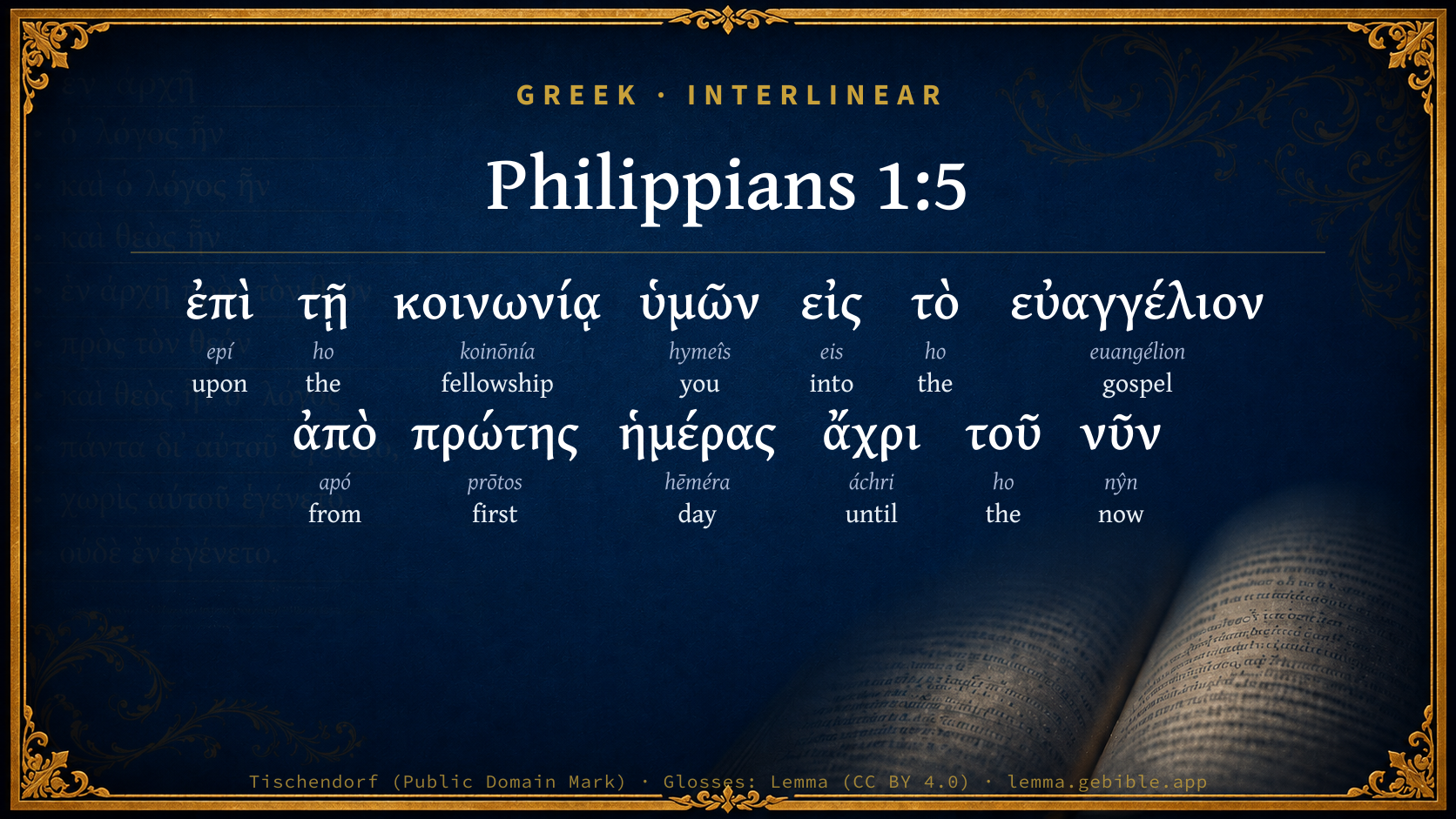
  1. ἐπὶ epí G1909 “upon” Preposition
  2. τῇ ho G3588 “the” Article, Dative, Singular, Feminine
  3. ὑμῶν hymeîs G5210 “you” Personal pronoun, 2nd person, Genitive, Plural
  4. εἰς eis G1519 “into” Preposition
  5. τὸ ho G3588 “the” Article, Accusative, Singular, Neuter
  6. εὐαγγέλιον euangélion G2098 “gospel” Noun, Accusative, Singular, Neuter
  7. ἀπὸ apó G575 “from” Preposition
  8. πρώτης prōtos G4413 “first” Adjective, Genitive, Singular, Feminine, Superlative
  9. ἡμέρας hēméra G2250 “day” Noun, Genitive, Singular, Feminine
  10. ἄχρι áchri G891 “until” Adverb
  11. τοῦ ho G3588 “the” Article, Genitive, Singular, Masculine
  12. νῦν nŷn G3568 “now” Adverb

About this verse

These counts appear in no published source. They are computed here, from the morphology-tagged text and Lemma’s own curated glosses. What Lemma adds →

13
words
11
distinct lemmas
Pauline Epistles
section

Notable vocabulary

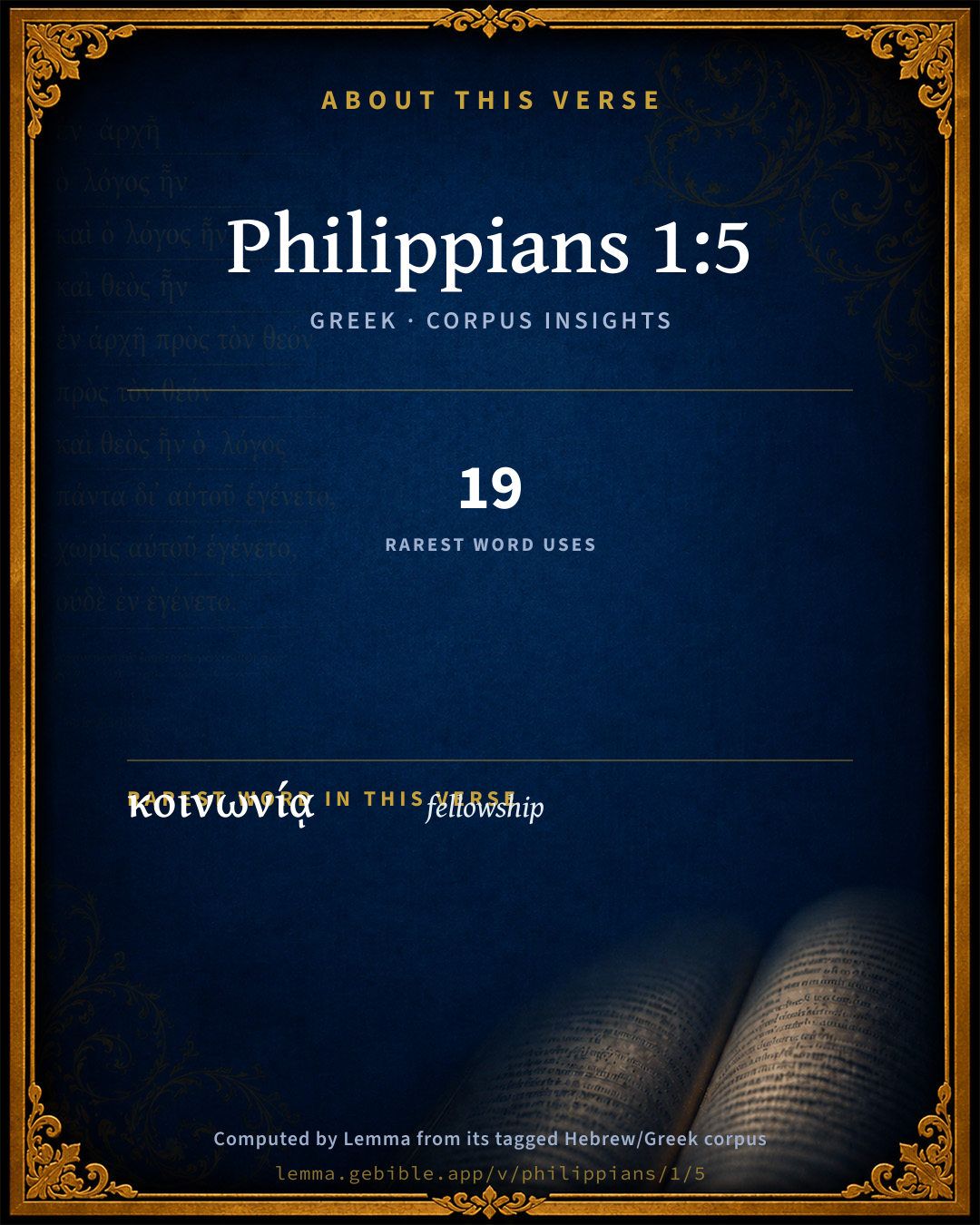
The rarest word here is κοινωνίᾳ fellowship G2842 — appearing just 19 times in the whole Greek New Testament.

Shared distinctive vocabulary

κοινωνίᾳ fellowship G2842 occurs in 17 verses of the Greek New Testament. Also found in:

Repetition

A word recurs within this verse:

Cross-references

17

Topical passages linked to Philippians 1:5 in the Treasury of Scripture Knowledge — connected by theme and wording, ordered by reader-vote popularity; previews shown in the World English Bible.

  • Philippians 4:14–15 However you did well that you shared in my affliction.
  • Philippians 1:7 It is even right for me to think this way on behalf of all of you, because I have you in my heart, because, both in my bonds and in the defense and confirmation of the Gospel, you all are partakers with me of grace.
  • Hebrews 3:14 For we have become partakers of Christ, if we hold fast the beginning of our confidence firm to the end:
  • Philemon 1:17 If then you count me a partner, receive him as you would receive me.
  • 2 Corinthians 8:1 Moreover, brothers, we make known to you the grace of God which has been given in the assemblies of Macedonia;
  • Acts 16:12–40 and from there to Philippi, which is a city of Macedonia, the foremost of the district, a Roman colony. We were staying some days in this city.
  • Ephesians 3:6 that the Gentiles are fellow heirs, and fellow members of the body, and fellow partakers of his promise in Christ Jesus through the Gospel,
  • Colossians 1:21–23 You, being in past times alienated and enemies in your mind in your evil works,
  • 1 John 1:3 that which we have seen and heard we declare to you, that you also may have fellowship with us. Yes, and our fellowship is with the Father, and with his Son, Jesus Christ.
  • Acts 2:42 They continued steadfastly in the apostles' teaching and fellowship, in the breaking of bread, and prayer.
  • Romans 11:17 But if some of the branches were broken off, and you, being a wild olive, were grafted in among them, and became partaker with them of the root and of the richness of the olive tree;
  • Romans 15:26 For it has been the good pleasure of Macedonia and Achaia to make a certain contribution for the poor among the saints who are at Jerusalem.
  • 1 Corinthians 1:9 God is faithful, through whom you were called into the fellowship of his Son, Jesus Christ, our Lord.
  • Philippians 2:12 So then, my beloved, even as you have always obeyed, not only in my presence, but now much more in my absence, work out your own salvation with fear and trembling.
  • 2 Peter 1:1 Simon Peter, a servant and apostle of Jesus Christ, to those who have obtained a like precious faith with us in the righteousness of our God and Savior, Jesus Christ:
  • 1 John 1:7 But if we walk in the light, as he is in the light, we have fellowship with one another, and the blood of Jesus Christ, his Son, cleanses us from all sin.
  • Romans 12:13 contributing to the needs of the saints; given to hospitality.

Cross-references courtesy of OpenBible.info (CC BY 4.0).

Commentary

Notes on Philippians 1:5 from classic Christian and Jewish commentators (each source and its license shown beneath its notes). The classic Christian expositions comment on the surrounding passage and are grouped to its opening verse, so a note may address several verses; the Jewish commentaries on the Tanakh (Rashi and others) are per-verse, so they appear only where the commentator wrote on this verse.

Lemma curates 59 commentaries, every one of them public domain or Creative Commons licensed, each selected and text-cleaned for this edition rather than reprinted as found. About our sources →

Tyndale Open Study Notes

Tyndale Open Resources

1:5 Their partnership included financial support (see 4:10-20).

Tyndale Open Study Notes — © Tyndale Open Resources, licensed CC BY-SA 4.0. Text via the HelloAO Bible API.

Bengel's Gnomon

Johann Albrecht Bengel

Php 1:5. Ἐπὶ, for) Construe with I thank.—κοινωνίᾳ, fellowship) which has come to you from above,[2] and is practised by you in holy liberality, ch. Php 4:10; Php 4:15-16; comp. 2Co 9:13.—ἀπὸ, from) Construe with I thank.—ἡμέρας, day) when ye became partakers of the Gospel.

[2] If only the one or the other part of this fellowship, and that too the latter, must be understood, which is performed by the exercise of liberality, and this is the opinion of some, I scarcely understand how the words ἄχρις ἡμέρας Ἰησοῦ Χριστοῦ, at the end of ver. 6, can be made to agree with it.—E. B.

Bengel's Gnomon of the New Testament — English translation (T&T Clark, Edinburgh, 1860) — public domain. Text from a community e-Sword module.

Meyer's Critical & Exegetical Commentary

Heinrich August Wilhelm Meyer

Php_1:5 f. Ἐπὶ τῇ κοινων. ὑμ. εἰς τὸ εὐαγγ.] is to be taken together with εὐχαριστῶ, Php_1:3 (1Co_1:4), and not with μετὰ χαρ. κ.τ.λ. (Calvin, Grotius, van Hengel, de Wette, Ewald, Weiss, Hofmann); for in that case, with the right explanation of ἐπὶ πάσῃ τ. μν. ὑμ., the specification of the ground for thanks would be entirely wanting, or would at all events result only indirectly, namely, as object of the joy. On account of your fellowship in respect of the gospel; by this Paul means the common brotherly coherence (Act_2:42) which united the Philippians together for the gospel (as the aim to which the κοινωνία has reference), that is, for its furtherance and efficiency. The great cause of the gospel was the end at which, in their mutual coherence, they aimed; and this, therefore, gave to their fellowship with one another its specific character of a holy destination. The correctness of this interpretation is confirmed by the context in Php_1:9, where that which is here expressed by ἡ κοινωνία ὑμῶν is characterized, under the category of the disposition on which this κοινωνία is based, as ἡ ἀγάπη ὑμῶν. As this view is in full harmony with both words and sense, and is not dependent on anything to be supplied, it excludes divergent interpretations. We must therefore reject not only the explanation which refers κοινωνία to the aid sent to Paul (Zeger, Cornelius a Lapide, Estius, Wetstein, Michaelis, Bisping, and others), so that it is to be taken actively as communication (see Fritzsche, ad Rom. III. p. 81, 287), although it is never so used in the N. T. (comp. on Rom_15:26; Gal_6:6; Phm_1:6), but also the view of Theodoret, Luther, Beza, Calvin, Grotius, Heinrichs, and others: quod evangelii participes facti estis, as if it ran τοῦ εὐαγγελίου (Theodoret: κοινωνίαν δὲ τοῦ εὐαγγελίου τὴν πίστιν ἐκάλεσε). Chrysostom and Theophylact, who are followed by most of the recent interpreters (including Schinz, Weiss, Schenkel, Huther, Ellicott, J. B. Lightfoot, Hofmann), understand the fellowship of the Philippians with the apostle, that is, ὅτι κοινωνοί μου γίνεσθε κ. συμμερισταὶ τῶν ἐπὶ τῷ εὐαγγ. πόνων, Theophylact; consequently, their co-operation with him in spreading the gospel, in which case also a reference to the aid rendered is included. In this case, since the text says nothing about a service devoted to the gospel (Hofmann), an addition like μετʼ ἐμοῦ (1Jn_1:3, et al.), or some other more precise definition, like that in Php_1:7, would be an essential elementnot arising (as in Gal_2:9) out of the contextwhich therefore must have been expressed, as indeed Paul must have said so, had he wished to be understood as referring to fellowship with all who had the cause of the gospel at heart (Wiesinger). The absolute your fellowship, if no arbitrary supplement is allowable, can only mean the mutual fellowship of the members of the church themselves.

The article is not repeated after ὑμῶν, because κοινωνία εἰς τὸ εὐαγγ. is conceived as forming a single notion (comp. on κοινωνεῖν εἰς, Php_4:15; Plato, Rep. p. 453 A).

ἀπὸ πρώτης ἡμ. ἄχρι τοῦ νῦν] is usually connected with τῇ κοινωνίᾳ κ.τ.λ. This connection is the true one, for the constancy of the κοινωνία, that has been attested hitherto, is the very thing which not only supplies the motive for the apostles thankfulness, but forms also the ground of his just confidence for the future. The connective article (τῇ before ἀπὸ) is not requisite, as ἐπὶ τῇ κοινωνίᾳ ὑμῶν was construed as ἐπὶ τῷ κοινωνεῖν ὑμᾶς (Winer, p. 128 [E. T. 171]). It cannot be connected with τ. δέησιν ποιούμ. (Weiss), unless ἐπὶ τ. κοινων. κ.τ.λ. is also made to belong hereto. If joined with πεποιθώς (Rilliet, following Lachmann, ed. min.), it would convey an emphatically prefixed definition of the apostles confidence, whereas the whole context concerns the previous conduct of the readers, which by the connection with πεποιθ. would be but indirectly indicated. If connected with εὐχαριστῶ (Beza, Wolf, Bengel), the wordsseeing that the expression πάντοτε ἐν πάσῃ δεήσει has already been used, and then in ἐπὶ τῇ κοινωνίᾳ κ.τ.λ. a transition has already been made to the object of the thankswould contain a definition awkwardly postponed.

The first day is that in which he first preached the gospel to them, which was followed by immediate and decided results, Act_16:13 ff. Comp. Col_1:6.

πεποιθώς] confidence by which Paul knows his εὐχαριστεῖν, Php_1:3-5, to be accompanied. Without due ground, Hofmann confuses the matter by making a new prolonged paragraph begin with πεποιθώς.[51]

αὐτὸ τοῦτο] if taken according to the common usage as the accusative of the object (comp. Php_1:25), would not point to what follows, as if it were τοῦτο merely (Weiss), but would mean, being confident of this very thing, which is being spoken of (Php_2:18; Gal_2:10; 2Co_2:3). But nothing has been yet said of the contents of the confidence, which are to follow. It is therefore to be taken as ob id ipsum,[52] for this very reason (2Pe_1:5; Plato, Symp. p. 204 A, and Stallb. ad loc.; Prot. p. 310 E; Xen. Anab. 1:9. 21, and Kühner in loc., also his Gramm. II. 1, p. 267; see also Winer, p. 135 [E. T. 178], and comp. on Gal_2:10), namely, because your κοινωνία εἰς τὸ εὐαγγ., from the first day until now, is that which alone can warrant and justify my confidence for the future, ὍΤΙ Ὁ ἘΝΑΡΞΆΜΕΝΟς Κ.Τ.Λ.

Ὁ ἘΝΑΡΞΆΜΕΝΟς Κ.Τ.Λ.] God. Comp. Php_2:13. That which He has begun He will complete, namely, by the further operations of His grace. The idea of resistance to this grace, as a human possibility, is not thereby excluded; but Paul has not to fear this on the part of his Philippian converts, as he formerly had in the case of the Galatians, Gal_1:6; Gal_3:3.

ἐν ὑμῖν] That Paul did not intend to say among you (as Hoelemann holds), but in you, in animis vestris (comp. Php_2:13; 1Co_12:6), is shown by ὑπὲρ πάντων ὑμῶν following, by which the language Ὁ ἘΝΑΡΞ. ἘΝ ὙΜΙΝ Κ.Τ.Λ. expresses a confidence felt in respect to all individuals.

ἔργον ἀγαθόν] without article, hence: an excellent work, by which is meant, in conformity with the context, the κοινωνία ὑμ. εἰς τὸ εὐαγγ.

ἄχρις ἡμέρας Ἰ. Χ.] corresponding to the ἈΠῸ ΠΡΏΤΗς ἩΜΈΡ. ἌΧΡΙ ΤΟῦ ΝῦΝ, Php_1:5, presupposes the nearness of the παρουσία (in opposition to Wiesinger, Hofmann, and others), as everywhere in the N. T., and especially in Pauls writings (Weiss, bibl. Theol. p. 297, ed. 2). Comp. Php_1:10; Php_3:20. The device by which the older expositors (see even Pelagius) gratuitously introduce qualifying statements, Perseverat autem in illum usque diem, quicunque perseverat usque ad mortem suam (Estius), whereby is meant not continuitas usque ad illum diem, but terminus et complementum perfectionis, quod habituri isto die erimus (Calovius), is just as un-Pauline as Calvins makeshift, that the dead are still in profectu, because they have not yet reached the goal, and as Matthies philosophical perverting of it into the continual and eternal Parousia.

[51] He makes ver. 6, namely, constitute a protasis, whose apodosis is again divided into the protasis καθώς ἐστιν δίκαιον ἐμοί and the apodosis corresponding thereto. But this apodosis of the apodosis begins with διὰ τὸ ἔχειν με, ver. 7, and yet is only continued after the words μάρτυς γ. ὁ Θεός, ὡς ἐπιποθῶ ὑμᾶς, which are a parenthesis, in vv. 8, 9. Such a dialectically involved and complicated, long-winded period would be most of all out of place in this epistle; and what reader would have been able, without Hofmanns guidance, to detect it and adjust its several parts?

[52] Hofmann also adopts this explanation of αὐτὸ τοῦτο.

Meyer — Critical and Exegetical Commentary on the New Testament — English translation by Peter Christie, edited by Frederick Crombie (T&T Clark, 1880) — public domain. Text from a community e-Sword module.

Expositor's Greek Testament

ed. W. Robertson Nicoll

Phi 1:5 . On what does ἐπί depend? Surely it follows χαρᾶς of preceding clause (so Chr [38] , Th. Mps [39] ) rather than εὐχαριστῶ of Phi 1:3 . It is, at least, awkward to take ἐπί twice with the same verb. μ . χαρᾶς has an emphatic position. Now he gives the reason for his joy. τῇ κοινωνίᾳ . At the first glance κ . seems to refer to their mutual fellowship and harmony as Christians. A closer examination reveals that this whole passage is concerned with Paul’s personal relation to them. And so κ . anticipates συγκοινωνούς (Phi 1:7 ), and will mean their common participation with Paul in spreading the Gospel. This really includes the idea of united action on the one hand, and the concrete expression of their helpfulness, their gift to the Apostle, on the other. Hort ( Christian Ecclesia , p. 44) points out that there is something concrete in the κοινωνία of Act 2:42 . The same is true of Rom 15:26 , 2Co 9:13 , Heb 13:16 . This concrete notion in κ . (almost equiv. to “contribution”) is supported by the use of εἰς , which is employed technically in contexts like this to denote the destination of money-payments, collections, etc. So 1Co 16:1 , τῆς λογίας τῆς εἰς τοὺς ἁγίους ; Act 24:17 , ἐλεημοσύνας ποιήσων εἰς τὸ ἔθνος μου . Important exx. from Papyri in Dsm [40] , BS [41] , pp. 113 114, NBS [42] , p. 23. Cf. on the whole idea the most apt comment of Chr [43] ad loc. : ὅταν γὰρ ἐκεῖνος μὲν κηρύττῃ , σὺ δὲ θεραπεύῃς τὸν κηρύττοντα , κοινωνεῖς αὐτῷ τῶν στεφάνων . ἐπεὶ καὶ ἐν τοῖς ἔξωθεν ἀγῶσιν οὐ τοῦ ἀγωνιζομένου μόνον ἐστὶν ὁ στέφανος ἀλλὰ καὶ τοῦ παιδοτρίβου καὶ τοῦ θεραπεύοντος καὶ πάντων ἀπλῶς τῶν ἀσκούντων τὸν ἀθλητήν . τὸ εὐαγγ . It is unnecessary to narrow this down to the preaching of the Gospel. Used comprehensively. ἀπὸ πρώτης . Cf. the account of their generosity in chap. Phi 4:10 ff. ἄχρι τοῦ νῦν . The same phrase in Rom 8:22 . Cf. Papyr. of Faijûm μέχρ [ ι ] τ [ οῦ ] νῦν in Dsm [44] , NBS [45] , p. 81.

[38] Chrysostom.

[39] Mps. Theodore of Mopsuestia.

[40] Deissmann ( BS. = Bibelstudien, NBS. = Neue Bibelstudien ).

[41] Bibelstudien

[42] Neue Bibelstudien

[43] Chrysostom.

[44] Deissmann ( BS. = Bibelstudien, NBS. = Neue Bibelstudien ).

[45] Neue Bibelstudien

The Expositor's Greek Testament, edited by W. Robertson Nicoll (1897–1910) — public domain. Text from a community e-Sword module.

Geneva Bible (1599)

Geneva Bible translators

Ever since I knew you.

Because that you also are made partakers of the Gospel.

Geneva Bible (1599) marginal notes — public domain. Text via Bolls.life.

Jamieson, Fausset & Brown

Robert Jamieson, A. R. Fausset & David Brown

Ground of his "thanking God" (Phi 1:3): "For your (continued) fellowship (that is, real spiritual participation) in (literally, 'in regard to') the Gospel from the first day (of your becoming partakers in it) until now." Believers have the fellowship of the Son of God (Co1 1:9) and of the Father (Jo1 1:3) in the Gospel, by becoming partakers of "the fellowship of the Holy Ghost" (Co2 13:14), and exercise that fellowship by acts of communion, not only the communion of the Lord's Supper, but holy liberality to brethren and ministers (Phi 4:10, Phi 4:15, "communicated . . . concerning giving"; Co2 9:13; Gal 6:6; Heb 13:16, "To communicate forget not").

Jamieson, Fausset & Brown — Commentary Critical and Explanatory on the Whole Bible (1871) — public domain (CC PDM 1.0). Text via the HelloAO Bible API.

Adam Clarke's Commentary

Verse 5. For your fellowship in the Gospel] if we consider κοινωνια as implying spiritual fellowship or communion, then it signifies, not only their attention to the Gospel, their readiness to continue it, and perseverance in it, but also their unity and affection among themselves. Some understand the word as expressing their liberality to the apostle, and to the Gospel in general; for the term may not only be applied to communion among themselves, but to communications to others. This sense, though followed by Chrysostom and Theophylact, does not appear to be the best; though we know it to be a fact that they were liberal in supplying the apostle's necessities, and, no doubt, in ministering to the support of others.

Adam Clarke's Commentary on the Bible (1810–1826) — public domain. Text from a community e-Sword/MySword module.

John Calvin's Commentaries

5 For your fellowship. He now, passing over the other clause, states the ground of his joy — that they had come into the fellowship of the gospel, that is, had become partakers of the gospel, which, as is well known, is accomplished by means of faith; for the gospel appears as nothing to us, in respect of any enjoyment of it, until we have received it by faith. At the same time the term fellowship may be viewed as referring to the common society of the saints, as though he had said that they had been associated with all the children of God in the faith of the gospel. When he says, from the first day, he commends their promptitude in having shewn themselves teachable immediately upon the doctrine being set before them. The phrase until now denotes their perseverance. Now we know how rare an excellence it is, to follow God immediately upon his calling us, and also to persevere steadfastly unto the end. For many are slow and backward to obey, while there are still more that fall short through fickleness and inconstancy.

John Calvin's Commentaries (1540-1563) — public domain. Text from the Calvin Translation Society English edition (1840s-50s) via the Christian Classics Ethereal Library (ccel.org). Calvin's coverage is partial (roughly two-thirds of the Bible); uncommented books and verses are honest gaps, never fabricated. The 19th-century editor's footnotes and remarks are omitted so the notes are faithfully Calvin's own voice.

Ellicott's Commentary for English Readers

(5) For your fellowship in the gospel.—More properly, towards the gospel, or, as affecting the gospel. The construction is illustrated by the more limited use of the same Greek word (as in Rom_15:26; 2Co_9:13) in the sense of “contribution”; in which case the word “towards” introduces the objects of the almsgiving there specified. Accordingly St. Paul must be taken here to mean the fellow-working of the Philippians in the ministry of the gospel, of which he speaks still more distinctly in Php_1:7. That fellow-working had been shown (see Php_4:15) even “in the beginning of the gospel,” by a contribution to St. Paul’s needs—not perhaps his personal needs only—which from them, and (so far as we know) from them only, he consented to accept.

A Bible Commentary for English Readers, edited by Charles John Ellicott (1878–1897) — public domain. Text from a community e-Sword module.

The Cambridge Bible for Schools and Colleges

gen. ed. J. J. S. Perowne

5. For your fellowship in the gospel] Lit. “on account of your participation unto the Gospel”; i.e. because of your efforts, in union with mine, for the furtherance of the Gospel. See R.V.; and cp. 2Co_2:12, and Php_2:22 below. The immediate reference doubtless is to the pecuniary help sent again and again to the Apostle as a missionary. (See Php_4:10-19.) But the fact and thought would far transcend this speciality.

from the first day until now] See the passage below, just referred to, for comment and explanation.

The Cambridge Bible for Schools and Colleges (gen. ed. J. J. S. Perowne; Cambridge University Press, 1878–1918) — public domain. Text from a community e-Sword module.

John Gill's Exposition

For your fellowship in the Gospel,.... Or "for your communication unto the Gospel"; that is, to the support of it. These Philippians were one of the churches of Macedonia the apostle so highly commends for their liberality in Co2 8:1; they had been very communicative to him, and those that were with him, from the beginning of the Gospel being preached to them: as the instances of Lydia and the jailer show, and which are taken notice of in this epistle, Phi 4:15; And this same generous spirit still continued, of which their present by Epaphroditus was an evidence; and for this the apostle gives thanks, not only that they had an ability to support the Gospel, and assist Gospel ministers, but that they were willing to communicate, and did communicate, readily and cheerfully, largely and liberally; or this may intend their "participation in the Gospel", as the Arabic version renders it. The Gospel was in a very wonderful and providential manner brought unto them, and it was attended with mighty power to the conversion of them; they received it with joy and gladness, and cheerfully submitted to the ordinances of it; they had much light into it, and spiritual knowledge of it; and were made partakers of the blessings of grace, which are revealed and exhibited in it, and of the exceeding great and precious promises of it, for which the apostle gives thanks to God; for all this was from him, and a wonderful instance of his grace it was. Moreover, through the Gospel being thus brought unto them, and succeeded among them, they became a Gospel church, and had, through the Gospel, and the ordinances of it, fellowship one with another; yea, they had fellowship with the Father, and his Son Jesus Christ, unto which they were called by the Gospel; and in this they remained

from the first day until now; they continued in the Gospel which they were made partakers of, and in fellowship with one another, in breaking of bread, and in prayer, and in hearing the word, which they constantly attended to, and were blessed with communion with Father, Son, and Spirit, to that time; and therefore the apostle continued from the first of their receiving the Gospel, to that moment, to give thanks to God for them on that account: for this last clause may be connected with the words in Phi 1:3, "I thank my God", as well as with those immediately preceding, "your fellowship in the Gospel"; and shows not only their perseverance in the Gospel, from the first to the present time, as the Ethiopic version renders it, for which he was abundantly thankful; but the continuance of his thankfulness on that account, from his first acquaintance with them to that time.

John Gill's Exposition of the Whole Bible (1746–1763) — public domain (CC PDM 1.0). Text via the HelloAO Bible API.

Trapp's Complete Commentary

John Trapp

5 For your fellowship in the gospel from the first day until now;

Ver. 5. For your fellowship] A good man cannot tell how to go to heaven alone. No sooner had the Philippians received the gospel, but they were in fellowship to a day. The communion of saints was with them a point of practice as well as an article of belief. The apostles’ creed was anciently briefer than now. The mention of the Father’s being "maker of heaven and earth," the Son’s death and descending into hell, and the communion of saints, being wholly omitted; haply as implied sufficiently in other articles. But surely if the creed were called Symbolum, as a sign or badge to difference Christians from infidels and wicked people, there was little reason to leave out the communion of saints, this being a main distinctive character; there being no such fellowship as among the saints, Son 6:9.

John Trapp, A Commentary or Exposition upon All the Books of the Old and New Testament (1647–1656) — public domain. Text from a community e-Sword module.

Albert Barnes' Notes on the Bible

For your fellowship in the gospel - “For your liberality toward me, a preacher of the gospel.” - Wetstein. There has been, however, no little difference of opinion about the meaning of this phrase. Many - as Doddridge, Koppe, and others - suppose it refers to the fact that they participated in the blessings of the gospel from the first day that he preached it until the time when he wrote this Epistle. Others suppose that it refers to their constancy in the Christian faith. Others - as Pierce, Michaelis, Wetstein, Bloomfield, and Storr - suppose it refers to their liberality in contributing to the support of the gospel; to their participating with others, or sharing what they had in common with others, for the maintenance of the gospel. That this is the true sense seems apparent:

(1) Because it accords with the scope of the Epistle, and what the apostle elsewhere says of their benefactions. He speaks particularly of their liberality, and indeed this was one of the principal occasions of his writing the Epistle; Phi 4:10-12, Phi 4:15-18.

(2) It accords with a frequent meaning of the word rendered “fellowship” - κοινωνία koinōnia. It denotes that which is in common; that of which we participate with others, communion, fellowship; Act 2:42; 1Co 1:9; 1Co 10:16; Phm 1:6; then it means communication, distribution, contribution; Rom 15:26; 2Co 9:13. That it cannot mean “accession to the gospel” as has been supposed (see Robinson’s Lexicon), is apparent from what he adds - “from the first day until now.” The fellowship must have been something constant, and continually manifest - and the general meaning is, that in relation to the gospel - to its support, and privileges, and spirit, they all shared in common. They felt a common interest in every thing that pertained to it, and they showed this in every suitable way, and especially in ministering to the wants of those who were appointed to preach it.

From the first day - The time when it was first preached to them. They had been constant. This is honorable testimony. It is much to say of a church or of an individual Christian, that they have been constant and uniform in the requirements of the gospel. Alas, of how few can this be said. On these verses Phi 1:3-5 we may remark:

(1) That one of the highest joys which a minister of the gospel can have, is that furnished by the holy walk of the people to whom he has ministered; compare 3Jo 1:4. It is joy like that of a farmer when he sees his fields ripe for a rich harvest; like that of a teacher in the good conduct and rapid progress of his scholars; like that of a parent in the virtue, success, and piety of his sons. Yet it is superior to all that. The interests are higher and more important; the results are more far-reaching and pure; and the joy is more disinterested. Probably there is nowhere else on earth any happiness so pure, elevated, consoling, and rich, as that of a pastor in the piety, peace, benevolence, and growing zeal of his people.

(2) It is right to commend Christians when they do well. Paul never hesitated to do this, and never supposed that it would do injury. Flattery would injure - but Paul never flattered. Commendation or praise, in order to do good, and not to injure, should be:

(a)The simple statement of the truth;

(b)It should be without exaggeration;

(c)It should be connected with an equal readiness to rebuke when wrong; to admonish when in error, and to counsel when one goes astray.

Constant fault-finding, scolding, or fretfulness, does no good in a family, a school, or a church. The tendency is to dishearten, irritate, and discourage. To commend a child when he does well, may be as important, and as much a duty, as to rebuke him when he does ill. God is as careful to commend his people when they do well, as he is to rebuke them when they do wrong - and that parent, teacher, or pastor, has much mistaken the path of wisdom, who supposes it to be his duty always to find fault. In this world there is nothing that goes so far in promoting happiness as a willingness to be pleased rather than displeased to be satisfied rather than dissatisfied with the conduct of others.

(3) Our absent friends should be remembered in our prayers. On our knees before God is the best place to remember them. We know not their condition. If they are sick, we cannot minister to their needs; if in danger, we cannot run to their relief; if tempted, we cannot counsel them. But God, who is with them, car do all this; and it is an inestimable privilege thus to be permitted to commend them to his holy care and keeping. Besides, it is a duty to do it. It is one way - and the best way - to repay their kindness. A child may always be repaying the kindness of absent parents by supplicating the divine blessing on them each morning; and a brother may strengthen and continue his love for a sister, and in part repay her tender love, by seeking, when far away, the divine favor to be bestowed on her.

Albert Barnes' Notes on the Bible (1834–1885) — public domain. Text from a community e-Sword/MySword module.

Haydock's Catholic Bible Commentary

For your fellowship. This word is divers times used by St. Paul for a contribution of charitable alms, which it may also signify in this place; though others expound it of their being made partakers of the graces of Christ, by the gospel. (Witham)

George Leo Haydock (1774–1849), Haydock's Catholic Family Bible and Commentary, 1859 edition — public domain. Excludes Psalms (Douay-Rheims chapter numbering differs from Protestant) and Deuterocanonical books (Catholic canon only).

Matthew Poole's English Annotations

Your being joined with us and other Christians in the communion of Christ, and glad tidings of salvation by him, 1Co 10:16,17; 1Pe 4:13; 1Jo 1:3,7; evidenced by the communication of your bounty, Gal 6:6; Heb 13:16; your stedfastness and perseverance in all Christian duties from the first time of your receiving the gospel.

Matthew Poole's English Annotations on the Holy Bible (1683–1685) — public domain. Text from a community e-Sword/MySword module.

Whedon's Commentary on the Bible

Daniel D. Whedon

5. Fellowship—The ground of the thanksgiving is now stated. It is not their fellowship of love with one another, wrought by the gospel, but their fellowship in reference to the gospel, with all who sought its success. It was their warm sympathy and ready interest in every thing pertaining to its service, at home and every-where. This had been one of their marked characteristics from the day when Lydia, their first convert, received the gospel; and a fresh proof of it the apostle had just received by the hand of Epaphroditus.

Daniel D. Whedon (gen. ed.), Commentary on the Old and New Testaments (1874–1909) — public domain. Text from a community e-Sword module.

The Pulpit Commentary

For your fellowship in the gospel from the first day until now; rather, as R.V, for your fellowship in furtherance of the gospel. This verse should be taken in connection with Ver. 3. St. Paul thanks God for their help, their co-operation towards the work of the gospel. They helped forward the work by their prayers, their labors, and their liberal bounty. This fellowship began "in the beginning of the gospel," when the Philippians sent aid to the apostle at Thessalonica and Corinth; it continued "until now" ten years; they had just sent their alms to St. Paul at Rome by phroditus. (Php_4:10)

The Pulpit Commentary (1880–1919), ed. H.D.M. Spence-Jones & Joseph S. Exell — public domain. Text from a community e-Sword module.

John Wesley's Explanatory Notes

The sense is, I thank God for your fellowship with us in all the blessings of the gospel, which I have done from the first day of your receiving it until now.

John Wesley, Explanatory Notes Upon the Whole Bible (1754–1765) — public domain. Text via the GEBible commentary corpus.

The People's New Testament

B. W. Johnson

5. For your fellowship in furtherance of the gospel [Revision]. He is thankful and full of joy that from the first they had constantly sympathized with him and aided in extending the gospel. It was a really missionary church. Until now. See 2:25, and 4:10, 18, for illustrations.

B. W. Johnson's The People's New Testament with Notes (1889–1891) — public domain. Electronic text from the Christian Classics Ethereal Library (CCEL) ThML edition.

Cambridge Greek Testament for Schools and Colleges

5. ἐπὶ τῇ κοινωνίᾳ ὑμῶν. “Over (on account of) your fellowship,” your making yourselves one with me, whether in deed or in spirit. See further just below, Php 1:7 and notes. The immediate but by no means whole reference was no doubt to their generous gifts of money; cp. Php 4:10-19.

εἰς τὸ εὐαγγέλιον. “For the Gospel”; i.e. for its furtherance. For the phrase cp. 2Co 2:12, and below, Php 2:22. For εὐαγγέλιον denoting practically the work of evangelization cp. 2Co 8:18; Gal 2:7; below, Php 2:22, Php 4:3; Php 4:15; 1Th 3:2.

ἀπὸ τῆς πρώτης ἡμέρας. On the reading, see critical note. If ἀπὸ πρ. ἡμ. is read, cp. Act 10:30; Act 20:18, for such absence of the article; it is perhaps an unconscious nuance of idiom, refusing analysis. See Lightfoot however on this verse: “the article is frequently omitted, because the numeral is sufficiently definite in itself.” With this assertion of the Philippians’ original and steady sympathy cp. ch. Php 4:15-16.

Cambridge Greek Testament for Schools and Colleges (Cambridge University Press, 1896; 21 vols, various authors incl. Carr, Maclear, Plummer, Farrar, Lumby, Moule, M. R. James, Simcox) — public domain. Text from a community e-Sword module.

Alford’s Greek Testament

Henry Alford

5.] for (ground of the εὐχ., πάντοτε to ποιούμενος having been epexegetical of it) your fellowship (with one another: entire accord, unanimous action: not your fellowship with me, ὅτι κοινωνοί μου γίνεσθε κ. συμμερισταὶ τῶν ἐπὶ τῷ εὐαγγελίῳ πόνων, Thl.: this must have been further specified, by μετʼ ἐμοῦ (1Jn 1:3) or the like. Still less must we with Estius, Wetst., al. (and nearly so Chrys.), render ἐπὶ τῇ κοινωνίᾳ, pro liberalitate vestra erga me) as regards the Gospel (not ‘in the Gospel,’ as E. V. and Thdrt., κοινωνίαν δὲ τοῦ εὐαγγελίου τὴν πίστιν ἐκάλεσε: but thus it would be the genitive, and εἰς τὸ εὐ. can hardly be taken as equivalent to it: cf. κοινωνεῖν εἰς, ch. 4:15. Their mutual accord was for the purposes of the Gospel—i.e. the perfecting, of which he proceeds to treat. “The article τῇ is not repeated after ὑμῶν, because κοινωνία εἰς τὸ εὐ. is conceived as one idea, together.” Meyer. Ellic. would understand κοιν. as absolute and abstract, ‘fellowship,’ not ‘contribution:’ including, without expressly mentioning, ‘that particular manifestation of it which so especially marked the liberal and warm-hearted Christians of Philippi.’ and it may well be so, even holding my former interpretation: this was the exhibition of their κοινωνία εἰς τὸ εὐαγγ.) from the first day (of your receiving it) until now. This last clause is by Lachm. and Meyer attached to πεποιθώς, but they are surely in error. The reason assigned is, that, if it had belonged to κοινωνίᾳ, &c., the article τῇ would have been repeated. But the same account which I have quoted from Meyer himself above of its omission after ὑμῶν will also apply to its omission here—that the whole κοινωνία from the first is taken as one idea, and therefore this feature of it, that it was ἀπὸ τῆς πρ. ἡμ. ἄχρι τ. νῦν, need not be specially particularized by the definite article. It is St. Paul’s constant habit to place πέποιθα first in the sentence (cf. Rom 2:19; 2Co 2:3; Gal 5:10; ch. 2:24; 2Th 3:4; Phm 1:21: also Mat 27:43), pregnant as it is with emphasis, and including the matter of confidence which follows: and we may certainly say that had this clause referred to πεποιθώς, it would have followed, not preceded it. Besides which, the emphatic αὐτὸ τοῦτο would be rendered altogether vapid, by so long an emphatic clause preceding the verb. Œcum., Beza, and Bengel connect the words with the distantly preceding verb εὐχαριστῶ, which (hardly however, as Ellic., on account of the pres. tense and πάντοτε) is still more improbable.

πεποιθώς] parallel with ποιούμενος—being (i.e. seeing I am) confident of …

αὐτὸ τοῦτο] this very thing (it points out sharply and emphatically, implying, as here, that the very matter of confidence is one which will ensure the success of the δέησις. Conyb. renders it ‘accordingly,’ which is far too weak. As regards the construction, αὐτὸ τοῦτο is only a secondary accusative, of reference, not governed directly by πεποιθώς. It is immediately resolved into ὅτι ὁ ἐν. κ.τ.λ.).

Henry Alford, The Greek Testament (1849–1861) — public domain. Text from a community e-Sword module.

International Critical Commentary

5. ἐπὶ τῇ κοινωνίᾳ ὑμῶν: Connect with εὐχαριστῶ, not with τὴν δενησιν ποιούμενος. For, 1. εὐχαριστῶ would thus be left without an object. 2. The ‘fellowship’ is not the subject of Paul’s prayer, but of his thanksgiving. 3. Εὐχαριστεῖν and similar verbs are used by Paul with ἐπὶ, as 1Co 1:4; 2Co 9:15; but ἐπὶ never occurs with δέησιν ποιούμενος or δεῖσθαι to mark their cause or ground. Neither should ἐπὶ τῇ κοινωνίᾳ be connected with μετὰ χαρᾶς which would require τῆς before ἐπὶ.

κοινωνία: ‘Fellowship’ (κοινὸς, ‘common’). A relation between individuals which involves common and mutual interest and participationin a common object. The word occurs often in Paul and in John’s epistles. Occasionally of the particular form which the spirit of fellowship assumes, as the giving of alms (Rom 15:26; Heb 13:16), but always with an emphasis upon the principle of Christian fellowship which underlies the gift. Here it means sympathetic participation in labor and suffering.

τῇ κοιν. ὑμῶν: ‘your fellowship.’ ‘Not fellowship with you’ (objective genitive); for when Paul uses the objective genitive with κοινωνία, it is to express fellowship with a divine and not a human person (1Co 1:9; 2Co 13:13; Php 2:1). Moreover, when κοινωνία is used of fellowship with (una cum) human persons, the relation is indicated by μετὰ (1Jn 1:3, 1Jn 1:7). Comp. πρὸς, 2Co 6:14. Hence ὑμῶν here is subjective. No defining word indicates their fellowship with him. The meaning is their fellowship with each other in the cause of the gospel. If the reference had been particularly to their fellowship with Paul, μετʼ ἐμοῦ would probably have been added.

εἰς τὸ εὐαγγέλιον: Describes the character and object of the fellowship. For κοινωνία with εἰς, see Rom 15:26; 2Co 9:13; and comp. ἐκοινώνησεν εἰς, Php 4:15. The meaning is not ‘contribution,’ though the thought of their gifts may have been distinctly present to the apostle’s mind (so Ellic. and Lightf.); nor ‘participation’ in the gospel as sharers of its blessings; but ‘your close association in the furtherance of the gospel.’

ἀπὸ τῆς πρώτης ἡμέρας:

WH. and Weiss retain της with א ABP 37. Tisch. omits with DFGKL

‘The first day’ is the day when they received the gospel. (See Act 16:13; Col 1:6.) Connect with τῇ κοινωνίᾳ ὑμῶν, not with πεποιθὼς.

ἄχρι τοῦ νῦν: As Rom 8:22. Only in Paul.

The Commendation and Prayer

International Critical Commentary — older volumes (1896–1929), various authors — public domain. Text from a community e-Sword module.

Vincent's Word Studies in the New Testament

Marvin R. Vincent

For your fellowship [επι τη κοινωνια υμων] . Connect with I thank God. For fellowship, see on 1Jo 1:3. The word sometimes has the meaning of almsgiving, contributions, as Rom 14:26; Heb 13:16. Though here it is used in the larger sense of sympathetic cooperation, yet it is no doubt colored by the other idea, in view of the Philippians' pecuniary contributions to Paul. See ch. Phi 4:10, 15, 16.

In the Gospel (eijv to eujaggelion). Lit., unto the Gospel : Rev., in furtherance of.

Marvin R. Vincent, Word Studies in the New Testament (1887–1900) — public domain. Text from a community e-Sword/MySword module.

Lesson kit

Teaching starters — assembled from the data on this page, not authored interpretation. Every prompt links to the verse data it draws on. Edit before teaching.

Philippians, in the Pauline Epistles, opens this verse with 13 words (11 distinct Greek lemmas). Its most distinctive word is koinōnía (“fellowship”). A historical commentator’s framing appears above. Read the whole chapter for the surrounding context.

Discussion questions

  1. The word koinōnía carries the sense “fellowship.” How does it shape the verse?
  2. How does Acts 2:42, which shares the word «fellowship», read alongside this verse?
  3. What does the repetition of “the” (3× in this one verse) do in this verse?
  4. These translations render this verse differently; the difference is in the English rendering, not the original. What questions does that raise?
  5. Compare how Tyndale Open Study Notes and Bengel's Gnomon read this verse. Where do they agree or differ?

Things to notice

Reading settings

Reading text

Shown beneath each verse's original-language words.

Old Testament
Old Testament edition

Read the OT as the Masoretic Hebrew (MT) or the Greek Septuagint (LXX).

English shown for the Greek Septuagint (in the Hebrew ↔ Greek comparison).

Comparing translations? Open the Compare panel on any verse page to stack up to four side by side.