

1 John 3:2
Greek (Tischendorf 8th ed.) 1 John 3:2 appears in the Greek New Testament. The text above is from the Tischendorf 8th edition. Each word links to its Strong’s number and a concise gloss. Click any word for its full Thayer’s Greek Lexicon entry.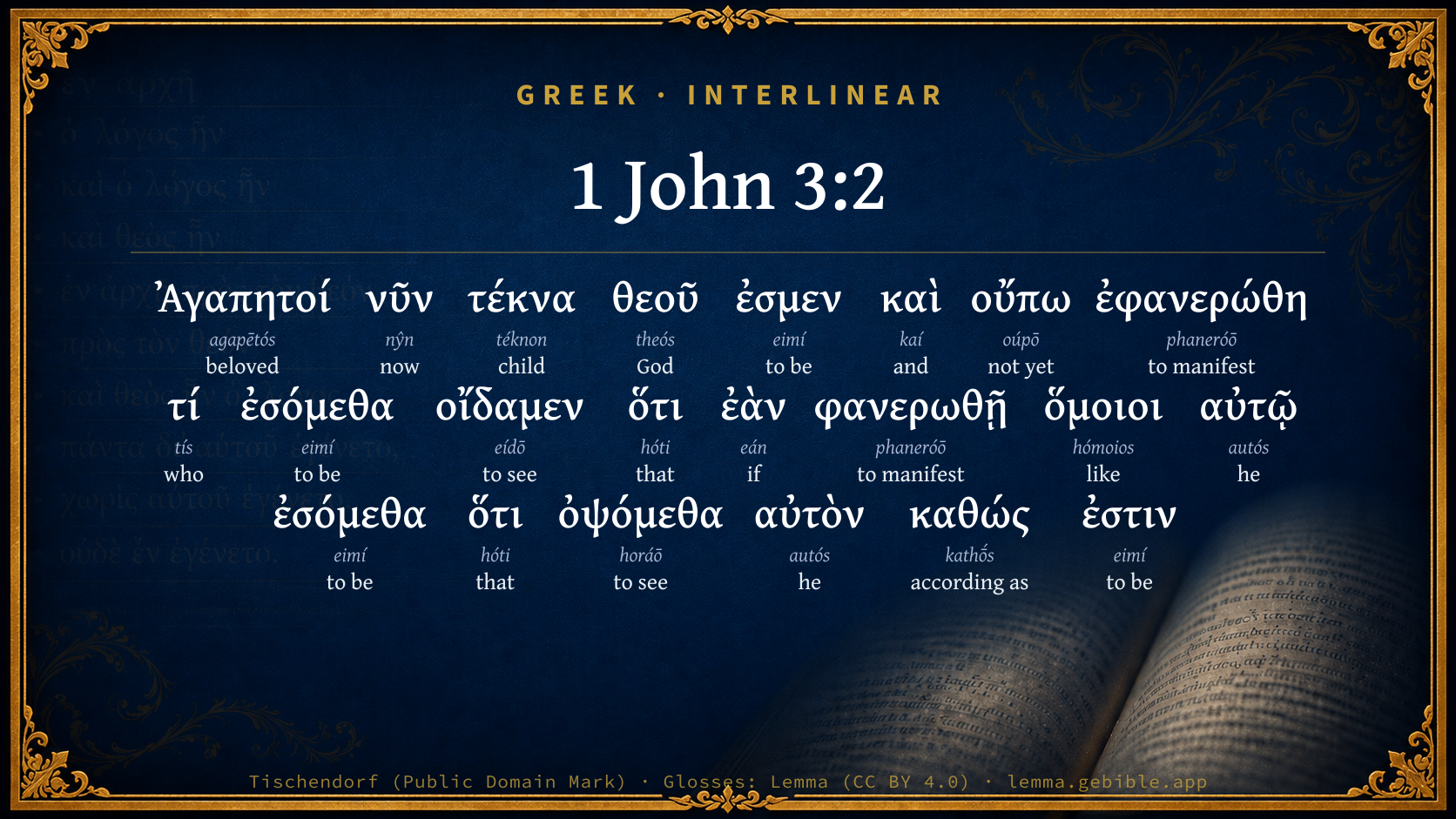
Beloved, now we are children of God, and it is not yet revealed what we will be. But we know that, when he is revealed, we will be like him; for we will see him just as he is.
Download a study sheet
One document with this verse’s original text, its word-by-word gloss line, the meaning frame, cross-references with their text, attributed commentary, and full source and license credits — printable, and it pastes into notes with its structure intact.
This verse Autodidact and up
A passage Seminary Student
Up to 50 verses in one chapter. A passage sheet keeps up to 6 commentary sources and 12 cross-references per verse, in the order this page ranks them, and says so on the sheet whenever that leaves anything out. Ask for a single verse and you get the Autodidact verse sheet above.
Everything on this page stays free to read, with no account — the sheet is a download of what is already on screen, not access to it.
Compare translations 3
The same verse in 3 English versions, stacked beneath the original-language interlinear above. Click any original word for its lexicon entry.
Each is an independent rendering of the whole verse — the interlinear is not word-aligned to these translations.
Highlighted words mark where these versions differ — a whole-verse word diff, not a word-by-word alignment.
-
World English Bible Public Domain
Beloved, now we are children of God, and it is not yet revealed what we will be. But we know that, when he is revealed, we will be like him; for we will see him just as he is.
-
King James Version Public Domain
Beloved, now are we the sons of God, and it doth not yet appear what we shall be: but we know that, when he shall appear, we shall be like him; for we shall see him as he is.
-
unfoldingWord Literal Text CC BY-SA 4.0
Beloved, now we are children of God, and what we will be has not yet been revealed. We know that whenever he appears, we will be like him because we will see him just as he is.
unfoldingWord Literal Text — © unfoldingWord, licensed CC BY-SA 4.0. Word-aligned USFM3 via Door43 (git.door43.org/unfoldingWord/en_ult).
Show all 19 translations
Every available English version of this verse, each an independent rendering of the whole verse.
-
World English Bible Public Domain
Beloved, now we are children of God, and it is not yet revealed what we will be. But we know that, when he is revealed, we will be like him; for we will see him just as he is.
-
Berean Standard Bible Public Domain
Beloved, we are now children of God, and what we will be has not yet been revealed. We know that when Christ appears, we will be like Him, for we will see Him as He is.
-
Majority Standard Bible Public Domain
Beloved, we are now children of God, and what we will be has not yet been revealed. We know that when Christ appears, we will be like Him, for we will see Him as He is.
-
King James Version Public Domain
Beloved, now are we the sons of God, and it doth not yet appear what we shall be: but we know that, when he shall appear, we shall be like him; for we shall see him as he is.
-
American Standard Version (1901) Public Domain
Beloved, now are we children of God, and it is not yet made manifest what we shall be. We know that, if he shall be manifested, we shall be like him; for we shall see him even as he is.
-
Revised Version (1885) Public Domain
Beloved, now are we children of God, and it is not yet made manifest what we shall be. We know that, if he shall be manifested, we shall be like him; for we shall see him even as he is.
-
Geneva Bible (1599) Public Domain
Dearely beloued, nowe are we the sonnes of God, but yet it is not made manifest what we shall be: and we know that when he shalbe made manifest, we shalbe like him: for we shall see him as he is.
-
Douay-Rheims (1899) Public Domain
Dearly beloved, we are now the sons of God; and it hath not yet appeared what we shall be. We know, that, when he shall appear, we shall be like to him: because we shall see him as he is.
-
Young's Literal Translation Public Domain
beloved, now, children of God are we, and it was not yet manifested what we shall be, and we have known that if he may be manifested, like him we shall be, because we shall see him as he is;
-
Literal Standard Version CC BY-SA 4.0
Beloved, now, we are children of God, and it was not yet revealed what we will be. We have known that if He may have appeared, we will be like Him, because we will see Him as He is;
-
Unlocked Literal Bible CC BY-SA 4.0
Beloved, we are now children of God, and it has not yet been revealed what we will be. We know that when Christ appears, we will be like him, for we will see him just as he is.
-
unfoldingWord Literal Text CC BY-SA 4.0
Beloved, now we are children of God, and what we will be has not yet been revealed. We know that whenever he appears, we will be like him because we will see him just as he is.
-
Darby Bible Public Domain
Beloved, now are we children of God, and what we shall be has not yet been manifested; we know that if it is manifested we shall be like him, for we shall see him as he is.
-
World Messianic Bible Public Domain
Beloved, now we are children of God. It is not yet revealed what we will be; but we know that when he is revealed, we will be like him, for we will see him just as he is.
-
Webster's Bible Public Domain
Beloved, now are we the sons of God, and it doth not yet appear what we shall be: but we know that, when he shall appear, we shall be like him; for we shall see him as he is.
-
Free Bible Version CC BY-SA 4.0
My friends, we are already God's children; however what we shall become hasn't been revealed just yet. But we do know that when he appears, we shall be like him, because we shall see him as he really is.
-
Bible in Basic English Public Domain
My loved ones, now we are children of God, and at present it is not clear what we are to be. We are certain that at his revelation we will be like him; for we will see him as he is.
-
Text-Critical English NT CC BY 4.0
Beloved, now we are children of God, and what we will be has not yet been revealed. But we know that when he appears, we will be like him, because we will see him as he is.
-
Tyndale New Testament (1534) Public Domain
Derely beloved now are we the sonnes of God and yet it dothe not appere what we shal be. But we knowe that when it shall appere we shal be lyke him. For we shall se him as he is.
Literal Standard Version (2020), Covenant Press — licensed CC BY-SA 4.0. Text via the HelloAO Bible API (eBible.org). Unlocked Literal Bible (unfoldingWord) — licensed CC BY-SA 4.0. Text via the HelloAO Bible API (eBible.org). unfoldingWord Literal Text — © unfoldingWord, licensed CC BY-SA 4.0. Word-aligned USFM3 via Door43 (git.door43.org/unfoldingWord/en_ult). Free Bible Version, Dr. Jonathan Gallagher — licensed CC BY-SA 4.0. Text via the HelloAO Bible API (eBible.org).
Word by word
More ways to search: Search by grammar → Find every occurrence → Compare this word →
Practice this passage: Drill this verse → Learn its vocabulary →
- Appears 25× in the Greek New Testament
- First appears at Matthew 16:9
- Part of Speech
- Adverb
- Degree
- Negative
Full Thayer's Definition
- Ἀγαπητοί agapētós G27 “beloved” Adjective, Vocative, Plural, Masculine
- νῦν nŷn G3568 “now” Adverb
- τέκνα téknon G5043 “child” Noun, Nominative, Plural, Neuter
- θεοῦ theós G2316 “God” Noun, Genitive, Singular, Masculine
- ἐσμεν eimí G1510 “to be” Verb, Present, Active, Indicative, 1st person, Plural
- καὶ kaí G2532 “and” Conjunction
- οὔπω oúpō G3768 “not yet” Adverb, Negative
- ἐφανερώθη phaneróō G5319 “to manifest” Verb, Aorist, Passive, Indicative, 3rd person, Singular
- τί tís G5101 “who” Interrogative pronoun, Nominative, Singular, Neuter
- ἐσόμεθα eimí G1510 “to be” Verb, Future, Middle deponent, Indicative, 1st person, Plural
- οἴδαμεν eídō G1492 “to see” Verb, Perfect, Active, Indicative, 1st person, Plural
- ὅτι hóti G3754 “that” Conjunction
- ἐὰν eán G1437 “if” Conditional
- φανερωθῇ phaneróō G5319 “to manifest” Verb, Aorist, Passive, Subjunctive, 3rd person, Singular
- ὅμοιοι hómoios G3664 “like” Adjective, Nominative, Plural, Masculine
- αὐτῷ autós G846 “he” Personal pronoun, Dative, Singular, Masculine
- ἐσόμεθα eimí G1510 “to be” Verb, Future, Middle deponent, Indicative, 1st person, Plural
- ὅτι hóti G3754 “that” Conjunction
- ὀψόμεθα horáō G3708 “to see” Verb, Future, Middle deponent, Indicative, 1st person, Plural
- αὐτὸν autós G846 “he” Personal pronoun, Accusative, Singular, Masculine
- καθώς kathṓs G2531 “according as” Adverb
- ἐστιν eimí G1510 “to be” Verb, Present, Active, Indicative, 3rd person, Singular
About this verse
These counts appear in no published source. They are computed here, from the morphology-tagged text and Lemma’s own curated glosses. What Lemma adds →
- 22
- words
- 16
- distinct lemmas
- General Epistles
- section
Cross-references
27Topical passages linked to 1 John 3:2 in the Treasury of Scripture Knowledge — connected by theme and wording, ordered by reader-vote popularity; previews shown in the World English Bible.
- Philippians 3:21 who will change the body of our humiliation to be conformed to the body of his glory, according to the working by which he is able even to subject all things to himself.
- Colossians 3:4 When Christ, our life, is revealed, then you will also be revealed with him in glory.
- 1 Corinthians 13:12 For now we see in a mirror, dimly, but then face to face. Now I know in part, but then I will know fully, even as I was also fully known.
- 2 Corinthians 3:18 But we all, with unveiled face beholding as in a mirror the glory of the Lord, are transformed into the same image from glory to glory, even as from the Lord, the Spirit.
- Psalms 17:15 As for me, I shall see your face in righteousness; I shall be satisfied, when I awake, with seeing your form.
- Romans 8:29 For whom he foreknew, he also predestined to be conformed to the image of his Son, that he might be the firstborn among many brothers.
- 1 Corinthians 15:49 As we have borne the image of those made of dust, let's also bear the image of the heavenly.
- Revelation 22:4 They will see his face, and his name will be on their foreheads.
- 2 Peter 1:4 by which he has granted to us his precious and exceedingly great promises; that through these you may become partakers of the divine nature, having escaped from the corruption that is in the world by lust.
- Romans 8:18 For I consider that the sufferings of this present time are not worthy to be compared with the glory which will be revealed toward us.
- 1 Corinthians 2:9 But as it is written, "Things which an eye didn't see, and an ear didn't hear, Which didn't enter into the heart of man, These God has prepared for those who love him."
- Galatians 4:6 And because you are children, God sent out the Spirit of his Son into your hearts, crying, "Abba, Father!"
- Matthew 5:8 Blessed are the pure in heart, For they shall see God.
- Galatians 3:26 For you are all children of God, through faith in Christ Jesus.
- 1 John 3:1 Behold, how great a love the Father has bestowed on us, that we should be called children of God! For this cause the world doesn't know us, because it didn't know him.
- John 17:24 Father, I desire that they also whom you have given me be with me where I am, that they may see my glory, which you have given me, for you loved me before the foundation of the world.
- Job 19:26 After my skin is destroyed, Then in my flesh shall I see God,
- 2 Corinthians 4:17 For our light affliction, which is for the moment, works for us more and more exceedingly an eternal weight of glory;
- Hebrews 9:28 so Christ also, having been once offered to bear the sins of many, will appear a second time, without sin, to those who are eagerly waiting for him for salvation.
- 1 John 2:28 Now, little children, remain in him, that when he appears, we may have boldness, and not be ashamed before him at his coming.
- Romans 8:14–15 For as many as are led by the Spirit of God, these are children of God.
- 1 John 5:1 Whoever believes that Jesus is the Christ is born of God. Whoever loves the father also loves the child who is born of him.
- Psalms 31:19 Oh how great is your goodness, Which you have laid up for those who fear you, Which you have worked for those who take refuge in you, Before the sons of men!
- 2 Corinthians 5:6–8 Being therefore always of good courage, and knowing that, while we are at home in the body, we are absent from the Lord;
- Psalms 16:11 You will show me the path of life. In your presence is fullness of joy. In your right hand there are pleasures forevermore.
- Isaiah 56:5 To them will I give in my house and within my walls a memorial and a name better than of sons and of daughters; I will give them an everlasting name, that shall not be cut off.
- Malachi 3:2 "But who can endure the day of his coming? And who will stand when he appears? For he is like a refiner's fire, and like launderer's soap;
Cross-references courtesy of OpenBible.info (CC BY 4.0).
Lesson kit
Teaching starters — assembled from the data on this page, not authored interpretation. Every prompt links to the verse data it draws on. Edit before teaching.
1 John, in the General Epistles, opens this verse with 22 words (16 distinct Greek lemmas). Its most distinctive word is oúpō (“not yet”). A historical commentator’s framing appears above. Read the whole chapter for the surrounding context.
Discussion questions
- The word oúpō carries the sense “not yet.” How does it shape the verse?
- How does Matthew 16:9, which shares the word «not yet», read alongside this verse?
- What does the repetition of “to be” (4× in this one verse) do in this verse?
- These translations render this verse differently; the difference is in the English rendering, not the original. What questions does that raise?
- Compare how The Cambridge Bible for Schools and Colleges and The Biblical Illustrator read this verse. Where do they agree or differ?
Things to notice
- These translations choose different wording for 13 words in this verse.
- “to be” occurs 4× in this single verse.
- 16 distinct Greek lemmas span 22 words in this verse.
Commentary
Notes on 1 John 3:2 from classic Christian and Jewish commentators (each source and its license shown beneath its notes). The classic Christian expositions comment on the surrounding passage and are grouped to its opening verse, so a note may address several verses; the Jewish commentaries on the Tanakh (Rashi and others) are per-verse, so they appear only where the commentator wrote on this verse.
Lemma curates 59 commentaries, every one of them public domain or Creative Commons licensed, each selected and text-cleaned for this edition rather than reprinted as found. About our sources →
The Cambridge Bible for Schools and Colleges
gen. ed. J. J. S. Perowne
The Cambridge Bible for Schools and Colleges (gen. ed. J. J. S. Perowne; Cambridge University Press, 1878–1918) — public domain. Text from a community e-Sword module.
The Biblical Illustrator
Joseph S. Exell
The Biblical Illustrator, edited by Joseph S. Exell (c. 1880s–1900s) — public domain. Text from a community e-Sword module.
Joseph Benson's Commentary
Joseph Benson's Commentary on the Old and New Testaments (1811–1818) — public domain. Text from a community e-Sword module.
The Pulpit Commentary
The Pulpit Commentary (1880–1919), ed. H.D.M. Spence-Jones & Joseph S. Exell — public domain. Text from a community e-Sword module.
MacLaren's Expositions of Holy Scripture
Alexander MacLaren
Alexander MacLaren, Expositions of Holy Scripture (1904–1910) — public domain. Text from a community e-Sword module.
Bengel's Gnomon
Johann Albrecht Bengel
Bengel's Gnomon of the New Testament — English translation (T&T Clark, Edinburgh, 1860) — public domain. Text from a community e-Sword module.
Meyer's Critical & Exegetical Commentary
Heinrich August Wilhelm Meyer
Meyer — Critical and Exegetical Commentary on the New Testament — English translation by Peter Christie, edited by Frederick Crombie (T&T Clark, 1880) — public domain. Text from a community e-Sword module.
Expositor's Greek Testament
ed. W. Robertson Nicoll
The Expositor's Greek Testament, edited by W. Robertson Nicoll (1897–1910) — public domain. Text from a community e-Sword module.
Cambridge Greek Testament for Schools and Colleges
Cambridge Greek Testament for Schools and Colleges (Cambridge University Press, 1896; 21 vols, various authors incl. Carr, Maclear, Plummer, Farrar, Lumby, Moule, M. R. James, Simcox) — public domain. Text from a community e-Sword module.
Geneva Bible (1599)
Geneva Bible translators
Geneva Bible (1599) marginal notes — public domain. Text via Bolls.life.
Jamieson, Fausset & Brown
Robert Jamieson, A. R. Fausset & David Brown
Jamieson, Fausset & Brown — Commentary Critical and Explanatory on the Whole Bible (1871) — public domain (CC PDM 1.0). Text via the HelloAO Bible API.
Adam Clarke's Commentary
Adam Clarke's Commentary on the Bible (1810–1826) — public domain. Text from a community e-Sword/MySword module.
John Calvin's Commentaries
John Calvin's Commentaries (1540-1563) — public domain. Text from the Calvin Translation Society English edition (1840s-50s) via the Christian Classics Ethereal Library (ccel.org). Calvin's coverage is partial (roughly two-thirds of the Bible); uncommented books and verses are honest gaps, never fabricated. The 19th-century editor's footnotes and remarks are omitted so the notes are faithfully Calvin's own voice.
John Gill's Exposition
John Gill's Exposition of the Whole Bible (1746–1763) — public domain (CC PDM 1.0). Text via the HelloAO Bible API.
Trapp's Complete Commentary
John Trapp
John Trapp, A Commentary or Exposition upon All the Books of the Old and New Testament (1647–1656) — public domain. Text from a community e-Sword module.
Albert Barnes' Notes on the Bible
Albert Barnes' Notes on the Bible (1834–1885) — public domain. Text from a community e-Sword/MySword module.
Matthew Poole's English Annotations
Matthew Poole's English Annotations on the Holy Bible (1683–1685) — public domain. Text from a community e-Sword/MySword module.
Whedon's Commentary on the Bible
Daniel D. Whedon
Daniel D. Whedon (gen. ed.), Commentary on the Old and New Testaments (1874–1909) — public domain. Text from a community e-Sword module.
John Wesley's Explanatory Notes
John Wesley, Explanatory Notes Upon the Whole Bible (1754–1765) — public domain. Text via the GEBible commentary corpus.
Burkitt's Expository Notes on the New Testament
William Burkitt
William Burkitt's Expository Notes on the New Testament (1700–1703) — public domain. Text from a community e-Sword module.
The People's New Testament
B. W. Johnson
B. W. Johnson's The People's New Testament with Notes (1889–1891) — public domain. Electronic text from the Christian Classics Ethereal Library (CCEL) ThML edition.
Alford’s Greek Testament
Henry Alford
Henry Alford, The Greek Testament (1849–1861) — public domain. Text from a community e-Sword module.
International Critical Commentary
International Critical Commentary — older volumes (1896–1929), various authors — public domain. Text from a community e-Sword module.
Vincent's Word Studies in the New Testament
Marvin R. Vincent
Marvin R. Vincent, Word Studies in the New Testament (1887–1900) — public domain. Text from a community e-Sword/MySword module.
Westcott on Hebrews & the Epistles of John
Brooke Foss Westcott
Brooke Foss Westcott (1825–1901), The Epistle to the Hebrews (1889) and The Epistles of St John (1883) — public domain (pre-1929). Text recovered from Internet Archive / Google Books OCR scans. Westcott’s Gospel of John commentary is not included (its OCR lost the chapter running-heads required for reliable verse-keying). Some Greek quoted in the Hebrews volume is imperfectly rendered by the OCR.