
Acts 4:29

Greek (Tischendorf 8th ed.) Acts 4:29 appears in the Greek New Testament. The text above is from the Tischendorf 8th edition. Each word links to its Strong’s number and a concise gloss. Click any word for its full Thayer’s Greek Lexicon entry.
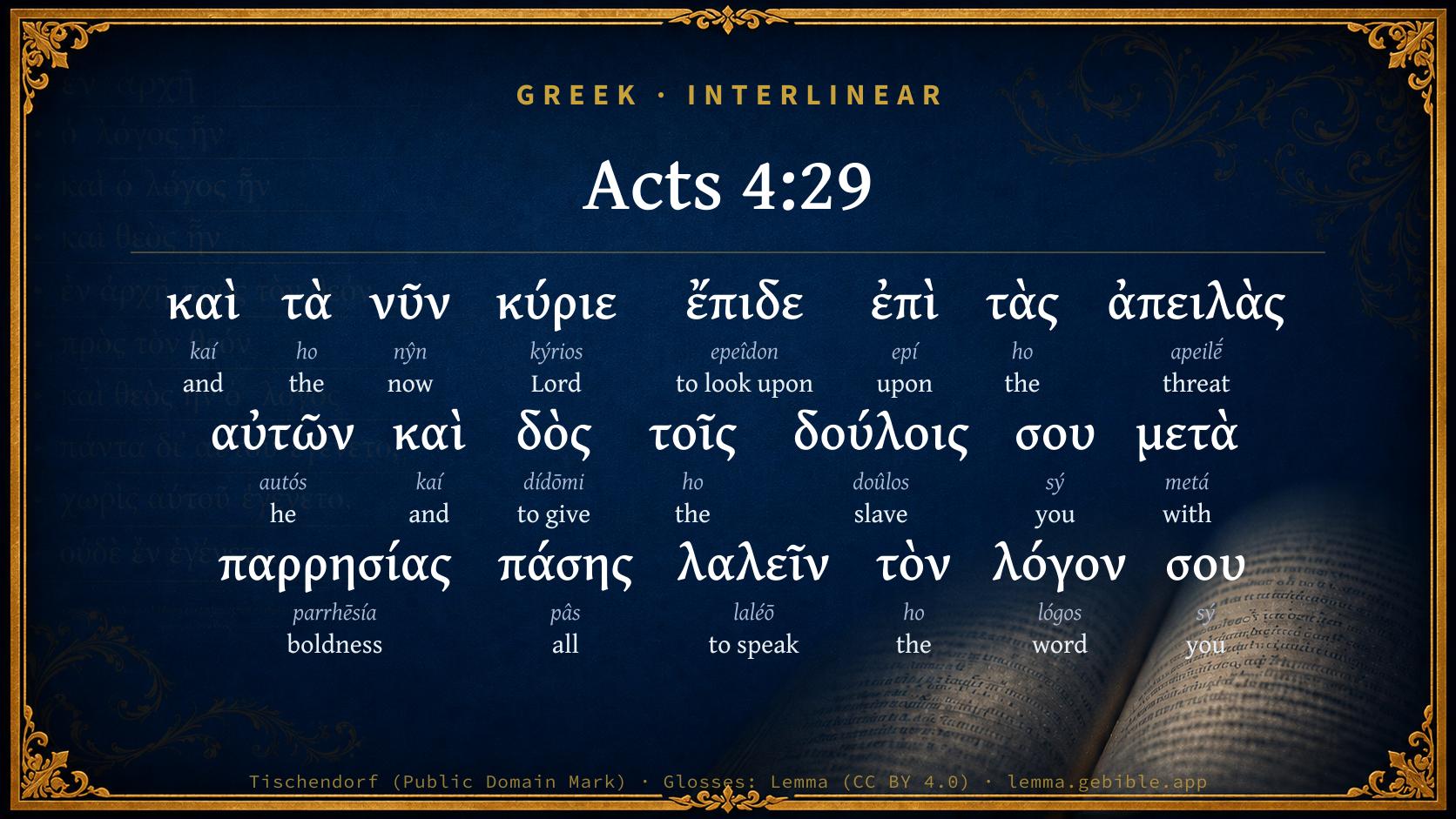
Download image
Cite this verse

Acts 4:29 (World English Bible). Public Domain. Lemma interlinear Bible study tool, https://lemma.gebible.app/v/acts/4/29.

Show BibTeX & RIS
BibTeX
RIS
English Translation
Now, Lord, look at their threats, and grant to your servants to speak your word with all boldness,
World English Bible · Public Domain
Highlights
  • 1 first appearance in the Greek New Testament
Full analysis ↓
Download a study sheet

One document with this verse’s original text, its word-by-word gloss line, the meaning frame, cross-references with their text, attributed commentary, and full source and license credits — printable, and it pastes into notes with its structure intact.

This verse Autodidact and up

Study sheet (.html) Plain text (.txt)

A passage Seminary Student

Up to 50 verses in one chapter. A passage sheet keeps up to 6 commentary sources and 12 cross-references per verse, in the order this page ranks them, and says so on the sheet whenever that leaves anything out. Ask for a single verse and you get the Autodidact verse sheet above.

Everything on this page stays free to read, with no account — the sheet is a download of what is already on screen, not access to it.

Want to remove ads? Support Godless Engineer
Compare translations 3

The same verse in 3 English versions, stacked beneath the original-language interlinear above. Click any original word for its lexicon entry.

Each is an independent rendering of the whole verse — the interlinear is not word-aligned to these translations.

Highlighted words mark where these versions differ — a whole-verse word diff, not a word-by-word alignment.

  • World English Bible Public Domain
    Now, Lord, look at their threats, and grant to your servants to speak your word with all boldness,
  • King James Version Public Domain
    And now, Lord, behold their threatenings: and grant unto thy servants, that with all boldness they may speak thy word,
  • unfoldingWord Literal Text CC BY-SA 4.0
    And now, Lord, look upon their threats and grant to your servants to speak your word with all boldness

unfoldingWord Literal Text — © unfoldingWord, licensed CC BY-SA 4.0. Word-aligned USFM3 via Door43 (git.door43.org/unfoldingWord/en_ult).

Versions to compare (up to 4)

3 of 4 selected

Show all 19 translations

Every available English version of this verse, each an independent rendering of the whole verse.

  • World English Bible Public Domain
    Now, Lord, look at their threats, and grant to your servants to speak your word with all boldness,
  • Berean Standard Bible Public Domain
    And now, Lord, consider their threats, and enable Your servants to speak Your word with complete boldness,
  • Majority Standard Bible Public Domain
    And now, Lord, consider their threats, and enable Your servants to speak Your word with complete boldness,
  • King James Version Public Domain
    And now, Lord, behold their threatenings: and grant unto thy servants, that with all boldness they may speak thy word,
  • American Standard Version (1901) Public Domain
    And now, Lord, look upon their threatenings: and grant unto thy servants to speak thy word with all boldness,
  • Revised Version (1885) Public Domain
    And now, Lord, look upon their threatenings: and grant unto thy servants to speak thy word with all boldness,
  • Geneva Bible (1599) Public Domain
    And nowe, O Lord, beholde their threatnings, and graunt vnto thy seruants with all boldnesse to speake thy word,
  • Douay-Rheims (1899) Public Domain
    And now, Lord, behold their threatenings, and grant unto thy servants, that with all confidence they may speak thy word,
  • Young's Literal Translation Public Domain
    `And now, Lord, look upon their threatenings, and grant to Thy servants with all freedom to speak Thy word,
  • Literal Standard Version CC BY-SA 4.0
    And now, LORD, look on their threatenings, and grant to Your servants to speak Your word with all freedom,
  • Unlocked Literal Bible CC BY-SA 4.0
    Now, Lord, look upon their warnings and grant to your servants to speak your word with all boldness.
  • unfoldingWord Literal Text CC BY-SA 4.0
    And now, Lord, look upon their threats and grant to your servants to speak your word with all boldness
  • Darby Bible Public Domain
    And now, Lord, look upon their threatenings, and give to thy bondmen with all boldness to speak thy word,
  • World Messianic Bible Public Domain
    Now, Lord, look at their threats, and grant to your servants to speak your word with all boldness,
  • Webster's Bible Public Domain
    And now, Lord, behold their threatenings: and grant to thy servants, that with all boldness they may speak thy word,
  • Free Bible Version CC BY-SA 4.0
    Now Lord: look at all their threats against us! Help us your servants to speak your word really boldly.
  • Bible in Basic English Public Domain
    And now, Lord, take note of their cruel words, and give your servants power to be preachers of your word without fear,
  • Text-Critical English NT CC BY 4.0
    And now, Lord, take note of their threats and grant it to yoʋr servants to speak yoʋr word with all boldness,
  • Tyndale New Testament (1534) Public Domain
    And now Lorde beholde their threatenynges and graunte vnto thy servauntes with all confidence to speake thy worde.

Literal Standard Version (2020), Covenant Press — licensed CC BY-SA 4.0. Text via the HelloAO Bible API (eBible.org). Unlocked Literal Bible (unfoldingWord) — licensed CC BY-SA 4.0. Text via the HelloAO Bible API (eBible.org). unfoldingWord Literal Text — © unfoldingWord, licensed CC BY-SA 4.0. Word-aligned USFM3 via Door43 (git.door43.org/unfoldingWord/en_ult). Free Bible Version, Dr. Jonathan Gallagher — licensed CC BY-SA 4.0. Text via the HelloAO Bible API (eBible.org).

Word by word

More ways to search: Search by grammar → Find every occurrence → Compare this word →

Practice this passage: Drill this verse → Learn its vocabulary →

ἔπιδε
epeîdon
G1896
“to look upon”
Verb, Aorist, Active, Imperative, 2nd person, Singular
Part of Speech
Verb
Tense
Aorist
Voice
Active
Mood
Imperative
Person
2nd person
Number
Singular
Full Thayer's Definition

Origin: and other moods and persons of the same tense, from G1909 and G1492

TDNT: None

1. to look upon, to regard
  1. καὶ kaí G2532 “and” Conjunction
  2. τὰ ho G3588 “the” Article, Accusative, Plural, Neuter
  3. νῦν nŷn G3568 “now” Adverb
  4. κύριε kýrios G2962 “Lord” Noun, Vocative, Singular, Masculine
  5. ἐπὶ epí G1909 “upon” Preposition
  6. τὰς ho G3588 “the” Article, Accusative, Plural, Feminine
  7. ἀπειλὰς apeilḗ G547 “threat” Noun, Accusative, Plural, Feminine
  8. αὐτῶν autós G846 “he” Personal pronoun, Genitive, Plural, Masculine
  9. καὶ kaí G2532 “and” Conjunction
  10. δὸς dídōmi G1325 “to give” Verb, Aorist, Active, Imperative, 2nd person, Singular
  11. τοῖς ho G3588 “the” Article, Dative, Plural, Masculine
  12. δούλοις doûlos G1401 “slave” Noun, Dative, Plural, Masculine
  13. σου sý G4771 “you” Personal pronoun, 2nd person, Genitive, Singular
  14. μετὰ metá G3326 “with” Preposition
  15. παρρησίας parrhēsía G3954 “boldness” Noun, Genitive, Singular, Feminine
  16. πάσης pâs G3956 “all” Adjective, Genitive, Singular, Feminine
  17. λαλεῖν laléō G2980 “to speak” Verb, Present, Active, Infinitive
  18. τὸν ho G3588 “the” Article, Accusative, Singular, Masculine
  19. λόγον lógos G3056 “word” Noun, Accusative, Singular, Masculine
  20. σου sý G4771 “you” Personal pronoun, 2nd person, Genitive, Singular

About this verse

These counts appear in no published source. They are computed here, from the morphology-tagged text and Lemma’s own curated glosses. What Lemma adds →

21
words
16
distinct lemmas
Acts
section

Notable vocabulary

The rarest word here is ἔπιδε to look upon G1896 — appearing just 2 times in the whole Greek New Testament.

First appearance in Scripture

This word makes its first canonical appearance in the Greek New Testament here:

  • ἀπειλὰς threat G547

Shared distinctive vocabulary

ἔπιδε to look upon G1896 occurs in 2 verses of the Greek New Testament. Also found in:
Repetition

Words recur within this verse:

Cross-references

24

Topical passages linked to Acts 4:29 in the Treasury of Scripture Knowledge — connected by theme and wording, ordered by reader-vote popularity; previews shown in the World English Bible.

  • Acts 4:13 Now when they saw the boldness of Peter and John, and had perceived that they were unlearned and ignorant men, they marveled. They recognized that they had been with Jesus.
  • Acts 14:3 Therefore they stayed there a long time, speaking boldly in the Lord, who testified to the word of his grace, granting signs and wonders to be done by their hands.
  • Philippians 1:14 and that most of the brothers in the Lord, being confident through my bonds, are more abundantly bold to speak the word of God without fear.
  • Acts 4:31 When they had prayed, the place was shaken where they were gathered together. They were all filled with the Holy Spirit, and they spoke the word of God with boldness.
  • Acts 28:31 preaching the Kingdom of God, and teaching the things concerning the Lord Jesus Christ with all boldness, without hinderance.
  • 2 Timothy 4:17 But the Lord stood by me, and strengthened me, that through me the message might be fully proclaimed, and that all the Gentiles might hear; and I was delivered out of the mouth of the lion.
  • Acts 4:17–18 But so that this spreads no further among the people, let's threaten them, that from now on they don't speak to anyone in this name."
  • Acts 9:27 But Barnabas took him, and brought him to the apostles, and declared to them how he had seen the Lord in the way, and that he had spoken to him, and how at Damascus he had preached boldly in the name of Jesus.
  • Acts 13:46 Paul and Barnabas spoke out boldly, and said, "It was necessary that God's word should be spoken to you first. Since indeed you thrust it from you, and judge yourselves unworthy of eternal life, behold, we turn to the Gentiles.
  • Acts 19:8 He entered into the synagogue, and spoke boldly for a period of three months, reasoning and persuading about the things concerning the Kingdom of God.
  • Ephesians 6:18–20 with all prayer and requests, praying at all times in the Spirit, and being watchful to this end in all perseverance and requests for all the saints:
  • 2 Timothy 1:7–8 For God didn't give us a spirit of fear, but of power, love, and self-control.
  • Ezekiel 2:6 You, son of man, don't be afraid of them, neither be afraid of their words, though briers and thorns are with you, and you do dwell among scorpions: don't be afraid of their words, nor be dismayed at their looks, though they are a rebellious house.
  • Daniel 9:18 My God, turn your ear, and hear; open your eyes, and see our desolations, and the city which is called by your name: for we do not present our petitions before you for our righteousness, but for your great mercies' sake.
  • Acts 4:21 When they had further threatened them, they let them go, finding no way to punish them, because of the people; for everyone glorified God for that which was done.
  • 1 Thessalonians 2:2 but having suffered before and been shamefully treated, as you know, at Philippi, we grew bold in our God to tell you the Gospel of God in much conflict.
  • Isaiah 58:1 Cry aloud, don't spare, lift up your voice like a trumpet, and declare to my people their disobedience, and to the house of Jacob their sins.
  • Isaiah 63:15 Look down from heaven, and see from the habitation of your holiness and of your glory: where are your zeal and your mighty acts? the yearning of your heart and your compassion is restrained toward me.
  • Lamentations 3:50 Until Yahweh look down, and see from heaven.
  • Lamentations 5:1 Remember, Yahweh, what has come on us: Look, and see our reproach.
  • Micah 3:8 But as for me, I am full of power by the Spirit of Yahweh, And of judgment, and of might, To declare to Jacob his disobedience, And to Israel his sin.
  • Acts 20:26–27 Therefore I testify to you this day that I am clean from the blood of all men,
  • Acts 26:26 For the king knows of these things, to whom also I speak freely. For I am persuaded that none of these things is hidden from him, for this has not been done in a corner.
  • Isaiah 37:17–20 Turn your ear, Yahweh, and hear; open your eyes, Yahweh, and behold; and hear all the words of Sennacherib, who has sent to defy the living God.

Cross-references courtesy of OpenBible.info (CC BY 4.0).

Commentary

Notes on Acts 4:29 from classic Christian and Jewish commentators (each source and its license shown beneath its notes). The classic Christian expositions comment on the surrounding passage and are grouped to its opening verse, so a note may address several verses; the Jewish commentaries on the Tanakh (Rashi and others) are per-verse, so they appear only where the commentator wrote on this verse.

Lemma curates 59 commentaries, every one of them public domain or Creative Commons licensed, each selected and text-cleaned for this edition rather than reprinted as found. About our sources →

The Biblical Illustrator

Joseph S. Exell

Act_4:29-30

And now, Lord, behold their threatenings.

How a Christian ought to pray for his enemies

I. Without anxiety and fear: for he prays to the King of kings. If God be for us, who can be against us?

II. Without hatred and malice; for he prays against wickedness, not against the wicked.

III. Without pride and scorn; for he prays not for himself, but for the cause of God. (K. Gerok.)

Grant unto Thy servants that with all boldness they may speak Thy Word.--

The prayer of Christs witnesses

I. That they may speak and not be dumb.

1. Speech is a chief gift of God and prerogative of man. Where there is a living spring it finds a channel, and where a living soul an avenue of egress. Neither can be imprisoned. On the other hand, where there is no spring, no channel is needed, and none is found. Among living creatures accordingly, where there is not a soul there is not speech; but in that one creature into whom God breathed a living soul, there is speech. Reverence human speech. It is the mark of a being who was made, and may be remade, a child of God; it is a Divinely formed capacity for a Divinely prescribed use. Dread false speech, proud, impure, profane speech, for these are the Kings weapons used against Himself.

2. Why should they be silent who have tasted that the Lord is gracious? Let them tell to all what God hath done for their souls. Let the compressed love which glows in renewed hearts find expression in spoken praise.

3. Silence is a sin, if your cry might save a neighbour from stumbling over a precipice; if your neighbours are on the broad path and your word might lead them into the narrow one; if a brother is sliding back and your reproof might urge him on; if a believer is oppressed with doubts and fears, while your lips might pour the consolations of God into his weary heart.

4. The prayer points mainly to a public ministry, and yet nothing is said about sermons, or even preaching. That they may speak. Whether the address be long or short, whether the audience be few or many, whether the style be eloquent or stammering, the pith and marrow of the whole matter is, that one man hoping in Christ and loving his neighbour, speaks to that neighbour about Christs redeeming love. Out of this, as the germ, all true preaching springs. If its whole mass were by some chemical process reduced to its elements, this would be the essential residuum remaining indestructible after all ornaments and accessories had been melted away.

II. That they may speak Thy Word. This supplies alike the authority and material of preaching. The seed is the Word; the sower need not scatter any other in his field. This alone is vital; this alone will grow.

III. With boldness. Yet none assume too readily that he has attained this qualification. Here all is not gold that glitters. Beware of counterfeits. To rasp like a file on other peoples tender points, because you have none of your own, is not the boldness here prayed for, but that of some of the inferior creatures. An essential constituent of courage is tenderness. In feudal times battle courage was only one half of knightly bearing; the other half consisted of a tenderness almost feminine. The boldness of speech Which costs the speaker nothing is neither beautiful nor successful. Paul was a bold man, accusing people of being enemies of the Cross, but he wept as he did so; and the tears did more than the reproving word.

IV. With all boldness. Even courage may be one-sided. That is not true courage which is severe to the poor but quails before the rich. As the water of a reservoir will be lost unless the circle of its lip be kept whole on all sides, all the dignity and power of boldness vanishes when it fails on one point. Perhaps the weakest point of all the circle for every man is himself. A surgeon needs a stout heart when he has to operate on others, he needs a stouter to operate on himself. (W. Arnot, D. D.)

Boldness in preaching

Some preachers are traders from port to port, following the customary and approved course; others adventure over the whole ocean of human concerns. The former are hailed by the common voice of the multitude, whose cause they hold, the latter blamed as idle, often suspected of hiding deep designs, always derided as having lost all guess of the proper course. Yet, of the latter class of preachers was Paul the apostle Such adventurers, under God, this age of the world seems to us especially to want. There are ministers now to hold the flock in pasture and in safety, but where are they to make inroads upon the alien, to bring in the votaries of fashion, of literature, of sentiment, of policy, and of rank?… Where are they to lift up their voice against simony, and acts of policy, and servile dependence upon the great ones of this earth, and shameful seeking of ease and pleasure, and anxious amassing of money, and the whole cohort of evil customs which are overspreading the Church? Truly it is not stagers who take on the customary form of their office and go the beaten round of duty, and then lie down content; but it is daring adventurer who shall eye from the grand eminence of a holy and heavenly mind all the grievances which religion underlies, and all the obstacles which stay her course, and then descend with the self-denial and faith of an apostle to set the battle in array against them. (Edward Irving.)

The servant and the slaves

Thy servant David. Thy holy servant Jesus. Thy servants (Act_4:25; Act_4:27; Act_4:29). A word or two of explanation may be necessary as to the language of our texts. You will observe that, in the second of them, I have followed the Revised Version, which, instead of Thy holy child, as in the Authorised Version, reads Thy holy servant. The alteration is clearly correct. The word, indeed, literally means a child, but, like our own English boy, or even man, or maid, it is used to express the relation of servant, when the desire is to cover over the harsher features of servitude, and to represent the servant as a part of the family. Thus the kindly centurion, who besought Jesus to come and heal his servant, speaks of him as his boy. And that the word is here used in this secondary sense of servant is unmistakable. For there is no discernible reason why, if stress were meant to be laid on Christ as being the Son of God, the recognised expression for that relationship should not have been employed. Again, the Greek translation of the Old Testament, with which the Apostles were familiar, employs the very phrase that is here used as its translation of the well-known Old Testament designation of the Messiah, the servant of the Lord, and the words here are really a quotation from the great prophecies of the second part of the Book of Isaiah. So, then, we have here three figures, the Psalmist-king, the Messiah, the disciples. Christ in the midst, on the one hand a servant with whom He consents to be classed, on the other hand the slaves who, through Him, have become sons. And I think I shall best bring out the intended lessons of these clauses in their connection if I ask you to note these two contrasts, the servants and the Servant; the Servant and the slaves. David Thy servant; Thy holy servant Jesus; us Thy servants.

I. First, then, notice the servants and the Servant. The reason for the application of the name to the Psalmist lies, not so much in his personal character, or in his religious elevation, as in the fact that he is chosen of God for a specific purpose, to carry on the Divine plans some steps towards their realisation. Kings, priests, prophets, the collective Israel, as having a specific function in the world, and being, in some sense, the instruments and embodiments of the will of God amongst men, have in an eminent degree the designation of His servants. But then, whilst this is true, and whilst Jesus Christ comes into this category, and is one of these special men raised up for special service in connection with the carrying out of the Divine purpose, mark how emphatically the line is drawn here between Him and the other members of the class to which, in a certain sense, He does belong. Peter says Thy servant David, but he says Thy holy servant Jesus. There are many imperfect instruments of the Divine will; thinkers and heroes and saints and statesmen and warriors, as well as prophets and priests and kings; but amongst them all there is One who stands in their midst and yet apart from them, because He, and He alone, can say I have done all Thy pleasure, and into My doing of Thy pleasure no bitter leaven of self-regard or by-ends has ever, in the faintest degree, entered. Thy holy servant Jesus, is the unique designation of the Servant of the Lord. And what is the meaning of holy? The word does not primarily refer to character so much as to relation to God. The root idea of holiness is not righteousness nor moral perfectness, but something that lies beyond that--viz., separation for the service and uses of God. The first notion of the word is consecration, and guilt upon that and resulting from it, moral perfection. So then these men, some of whom had lived beside Jesus Christ for all those years, and had seen everything that He did, and studied Him through and through, came away from the close inspection of His character with this thought: He is utterly and entirely devoted to the service of God, and in Him there is neither spot nor wrinkle nor blemish such as is found in all other men. I need not remind you with what strange persistence of affirmation, and yet with what humility of self-consciousness, our Lord Himself always claimed to be in possession of this entire consecration, and complete obedience, and consequent perfection. Think of human lips saying, I do always the things that please Him! There followed in Jesus the morn! perfectness that comes from such uninterrupted and complete consecration of self to God. Thy servant David. What about Bathsheba, David? What about a great many other things in your life? The poet king, with the poet nature so sensitive to all the delights of sense, and so easily moved in the matter of pleasure is but the type of all other servants in the fact of imperfection. In every machine power is lost through friction; and in every man, the noblest and the purest, there is resistance to be overcome ere motion, in conformity with the Divine impulse, can be secured. We pass in review before our minds saints and martyrs and lovely characters by the hundred, and amongst them all there is not a jewel without a flaw, not a mirror without some dint in it where the rays are distorted, or some dark place where the reflecting surface has been rubbed away by the attrition of sin, and there is no reflection of the Divine light. And then we turn to that meek figure that stands there with the question that has been awaiting an answer for eighteen centuries upon His lips, and is unanswered yet: Which of you convinceth Me of sin? The holy Servant, whose consecration and character mark Him off from all the class to which He belongs as the only one of them all who, in His fulness, has executed the Fathers purpose, and has never attempted anything besides! Now there is another step to take, and that is this. The servant who stands out in front of all the group--though the noblest names in the worlds history are included there--could not be the Servant unless He were the Son. This designation, as applied to Jesus Christ, is peculiar to these three or four earlier chapters of the Acts of the Apostles. There is no sign that the proper Sonship and Divinity of our Lord was clear before them at this period. They had the facts but they had not yet come to the distinct apprehension of how much was involved in these. But, if they knew that Jesus Christ had died and had risen again, and if they were certain that in His character of Messiah there had been faultlessness and absolute perfection, then it would not be long before they took the next step, and said, as I say, He cannot be the Servant unless He is more than man. And we may well ask ourselves the question--If we admit, as the world does admit, the moral perfectness of Jesus Christ, how comes it that this Man alone managed to escape failure, and deflections from the right, and sins, and that He only carried through life a stainless garment, and went down to the grave never having needed, and not needing then, the exercise of Divine forgiveness? I venture to say that it is hopeless to account for Jesus Christ on naturalistic principles; and that either you should give up your belief in His sinlessness, or advance, as the Christian Church as a whole advanced, to the other belief, on which alone that perfectness is explicable: Thou art the King of Glory, O Christ. Thou art the everlasting Son of the Father.

II. And so, secondly, let us turn to the other contrast here--the servant and the servants. I said that the humble group of praying, persecuted believers seemed to have wished to take a lower place than their Masters, even whilst they ventured to assume that, in some sense, they too, like Him, were doing the Fathers will. So they chose, by a fine instinct of humility, rather than from any dogmatical prepossessions, the name that expresses, in its most absolute and roughest form, the notion of bondage and servitude. He is the Servant; we standing here are slaves. The true place, then, for a man is to be Gods slave. The harsh, repellent features of that wicked institution assume an altogether different character when they become the features of my relation to Him. Absolute submission, unconditional obedience, on the slaves part; and on the part of the Master complete ownership; the right of life and death; the right of disposing of all goods and chattels; the right of separating husband and wife, parents and children; the right of issuing commandments without a reason; the right to expect that those commandments shall be swiftly, unhesitatingly, punctiliously, and completely performed; these things inhere in our relation to God. Blessed the man who has learned that they do, and has accepted them as his highest glory and the security of his most blessed life! Remember, however, that in the New Testament these names of slave and owner are transferred to Christians and Jesus Christ. The Servant has His slaves; and He who is Gods, and does not His own will, but the Fathers will, has us for His, imposes His will upon us, and we are bound to render to Him the same revenue of entire obedience which He hath laid at His Fathers feet. Such slavery is the only freedom. Liberty does not mean to do as you like, it means to like as you ought, and to do that. He only is free who submits to God in Christ, and thereby overcomes himself and the world and all antagonism, and is able to do that which it is His life to do. The prison out of which we do not desire to go is no restraint, and the will which coincides with law is the only will that is truly free. You talk about the bondage of obedience. Ah! the weight of too much liberty is a far sorer bondage. They are the slaves who say, Let us break His bonds asunder, and cast away His cords from us. In the wicked old empires, as in some of their modern survivals to-day, viziers and prime ministers were mostly drawn from the servile classes. It is so in Gods kingdom. They who make themselves Gods slaves are by Him made kings and priests, and shall reign with Him on earth. If a slave, then a son and an heir of God through Jesus Christ. Remember the alternative. You cannot be your own masters without being your own slaves. Better serve God than the devil; than the world; than the flesh. The Servant-Son makes us slaves and sons. It matters nothing to me that Jesus Christ perfectly fulfilled the law of God. So much the better for Him, but of no value for me, unless He has the power of making me like Himself. (A. Maclaren, D. D)

By stretching forth Thine hand to heal.

The Gospel of Pentecost

I. The healing hand of God is extended. The hand is an emblem of power, and the gospel is the hand or power of God unto salvation. The hand of God is seen in

(1) The works of creation; above, around, beneath--everywhere.

(2) The course of Providence; through all time, among all nations: it governs, guides, supports, defends.

(3) The work of redemption. To this latter the apostles refer--The hand of God stretched out to heal. The gospel--not a sword to destroy, not a rod to rebuke; but a gracious hand to heal. We need to be healed, for we are all bruised with the worries of life--its puzzling problems, its exacting work, its burdens and bereavements, its sins and sorrows.

(a) The gentle ministration of the beauty and bounty of the world.

(b) The sympathy and condolence of social love. He heals us by assuring us that He loves us; by the exhibition of His healing hand in the life of His dear Son; by actual aid; by exceeding great and precious promises. In the gospel Gods hand is stretched out to heal.

II. The thoughtful attention of man is arrested. The apostles prayed that signs and wonders might be wrought. They knew how prone men were to be thoughtless and inattentive, and that it needed some loud bell to be rung in the ears of the world. Under the Old Testament dispensation signs and wonders had been wrought to secure attention to the promulgation of the Law and the proclamations of the Prophets. The apostles were privileged to wield miraculous power, thus arresting the attention of their auditors. These things were

(1) credentials of apostleship and

(2) proofs of the supernatural in Christianity.

III. The peerless name of Christ is exalted. The apostles fell into the background and hid themselves under the shadow of the Cross. In the name of Jesus they found the secret of unfaltering faith. To the glorious company of the apostles the name of Jesus was above every name; that name, as Servant, as the Sent One, the true Messiah, excels all other names of ancient or modern times. Above the names of Peter and Paul, Augustine and Luther, Whitfield and Wesley, rises--Like the sun in his splendour--the name of the worlds great Redeemer, the Essence of light and sweetness, the Symbol of purity and power, the Source of life and salvation. (F. W. Brown.)

That signs and wonders may be done by the name of Thy Holy Child Jesus.

The Eternal Child

I. This description--Child--seems to be an eternally appropriate characterisation of our Lord Jesus Christ.

1. Is it not appropriate to Him as we dwell on the infinite past? Great as the mystery of His pre-existent life is, we cannot accept the authority of Scripture and deny that pre-existence. He was ever Gods holy child.

2. Is it not appropriate of Him as we study His incarnate life o, earth? There are always in His conduct and character the simple beauties we admire in a child--freshness, sensitiveness, wonder, simplicity, even to the point of exquisite artlessness, which is the childs glory. He wanted everybody else to be a child even as He felt He was a child, and, so He said, Except ye become as little children ye cannot enter into the kingdom of God.

3. Is it not appropriate of Him as we contemplate the life He is living now? He lives still, and lives to care for, to help, to bless us. He is able to save to the uttermost them that draw near unto God through Him, seeing He ever liveth to make intercession for us; for such a High Priest became us, who is holy, guileless, undefiled. That guilelessness is the distinctive virtue of Gods holy child Jeans.

II. The history of this child Christ illustrates much in the life of many an one who is also Gods child. As we have seen, Jesus Christ is in some senses unique as Gods child--His only begotten Son. But in many aspects He is the Brother, the Type of every one who is Gods child. He is not ashamed to call us brethren. Remembering that, we notice--

1. Gods child may be born in very lowly circumstances.

2. Gods child is often brought up in the midst of most adverse circumstances. We recall Nazareth where He was brought up who was Gods holy child Jesus.

3. Gods child should early be accustomed to the means of grace. You find it said of Gods holy child Jesus, that His custom was to go to the synagogue at Nazareth.

4. Gods child will be the subject of the highest spiritual consciousness.

5. Gods child will show that he is the subject of this highest consciousness by his daily life.

6. Gods child must develop into a future of beauty and strength. Growth is the law of life. (D. Thomas, D. D.)

The Holy Child Jesus

I. The real humanity of Jesus.

1. While we always contend that Christ is God, let us never lose the firm conviction He is truly man. His humanity was real, for He was born. The gate by which we enter upon the first life, He passed through also. In the circumstances of His birth He is completely human; He is as weak and feeble as any other babe. As He grows up, the very growth shows how completely human He is. He grows in stature, and in favour both with God and man. When He reaches mans estate, He gets the common stamp of manhood upon His brow. In the sweat of thy brow shalt thou eat bread. The carpenters shop must witness to the toils of a Saviour, and when He becomes the preacher still we read such significant words as these--Jesus, being weary, sat thus on the well. We find Him needing to betake Himself to rest in sleep, and if sorrow be the mark of real manhood, certainly Jesus has the truest evidence of being a man. If to hunger and to thirst be signs that His manhood is no fiction, you have these. Since the day when the prince of the power of the air obtained dominion in this world, men are tempted, and He, though born pure and holy, must not be delivered from temptation. If, since we have fallen and must endure temptation, we have need to pray, so had He. Leave out sin, and Christ is the perfect picture of humanity. And lastly, as the whole human race must yield its neck to the great iron-crowned monarch, so must Christ give up the ghost.

2. Having thus insisted upon the humanity of Christ, let us gather a few reflections from it.

1. Let us marvel at His condescension. Cyprian well said, I do not wonder at any miracle, but I do marvel at this, which is a miracle among miracles, that God should become man. That God should make a creature out of nothing is certainly a marvellous manifestation of power, but that God should take that creature into intimate union with His own nature--this is the strangest of all acts of condescending love. A prince who puts aside his crown, and clothes himself with beggars rags to investigate the miseries of his country, is but a worm condescending to his fellow worm. An angel that should lay aside his beauty, and become decrepit, and walk the streets in pain and poverty to bless the race of man, were but a creature humbling himself to creatures a little lower than himself.

2. See the fitness of Christ for His work! He is a perfect man, and so can be touched with the feeling of our infirmities, seeing He was tempted in all points like as we are. Being not ashamed to call us brethren, He can compassionate the ignorant and those who are out of the way.

3. Behold His near relationship and union to His people. He is no stranger, He is our Brother; nay, our Head. Not a head of gold, and feet of clay, or limbs of baser metal; but as we are, so was He, that as He is so might we be.

4. See the glory of manhood now restored! Man was but a little lower than the angels, and had dominion over the fowl of the air, and over the fish of the sea. That royalty he lost. But all this is given back to us. We see Jesus, who was made a little lower than the angels, for the suffering of death, crowned with glory and honour. It is our nature, Jesus in our manhood, who is now Lord of providence, which sits upon the throne of God at this very day.

5. Rejoice that a blessed channel is opened by which Gods mercy can come to us!

6. See what a door of access is thus opened between us and God!

7. See how safe we are! Our souls estate was once put in the hands of Adam; he was a fallible man; how unsafe our salvation was then! The salvation of every believer now is in the hand of a man; it is the man Christ Jesus! But what a man! Can He fail? Can He sin? Can He fall?

8. Here is your adoption! You become sons of God, because Christ becomes a son of man.

9. Here is your acceptance! The man, Christ, is accepted, and you, since He stands for you, are accepted in Him.

II. The humanity as it is here described--Holy Child.

1. Christs humanity was perfectly holy. Upon this doctrine you are well established; but you may well wonder that Jesus was always holy. He is conceived of a woman, and yet no sort of sin cometh from His birth. He is educated in the midst of sinful persons. It could not be otherwise. He goes into the world, and as a physician must mingle with the sick, so He is found in the very worst of society. The harlot may speak to Him, and from the publican He turns not away, yet from none of these did He receive any corrupt influence. He is tempted, but the prince of this world came and had nothing in Christ. Imputation of sin would be the nearest approach to making our Lord a sinner; but let it ever be remembered that though Jehovah made Him to be sin for us, yet He knew no sin, and even in the conflict, when all the powers of hell were let loose against Him, and when God Himself had withdrawn--which would have hardened our hearts, but did not harden His.

2. Christ is called a Holy Child because His character is more aptly pictured by that of a child than that of a man. If you conceive of a perfectly holy child, you have then before you a representation of Christ. There is that in holy childhood which you cannot find even in holy manhood. You note in childhood--

(1) Simplicity, the absence of all cunning. We dare not in manhood usually wear our heart upon our sleeve as children do.

(2) Humbleness. There is a kings daughter, and here is a gipsy child. Leave them in a room and see if they will not be at play together in five minutes. If it had been the queen and the gipsy woman they would have sat as far apart as possible. Christ is King of kings. Yet He is always with the poor and needy. You do not find little children sitting down and planning how they shall win crowns, popularity, or applause. They are quite satisfied to do their fathers will, and live on his smile. It is so with Christ. When they would have made Him a king, He went and hid Himself.

(3) Obedience. Was it not so with Jesus His whole life long?

(4) A forgiving temper. We know that sometimes the blood comes up in the little face, and a little angry quarrel ensues, but it is soon over. Well, with Jesus this characteristic of childhood is carried out to the fullest extent, for His latest words are, Father, forgive them, for they know not what they do.

(5) There is something very sweet in this picture of Christs humanity, because we are none of us afraid to approach a child. Come then, and tell Jesus everything. Whatever your trouble or difficulty may be, stand not back through shame or fear. (C. H. Spurgeon.)

Gods holy Servant

(see Act_3:26):--The term translated in the Authorised Version here, and in verse 21, child is more correctly rendered in verse 25, in regard to David, servant. The word is so given in Mat_12:18, where Isa_13:1 --part of the great prophecy of the Servant of the Lord--is applied to Christ. This prophecy and its fulfilment in Jesus was evidently running in the minds of the apostles throughout these discourses. The term holy in conjunction with servant suggests that God has servants who are--

I. Without holiness--creatures whom God has not endowed with a moral being, and can therefore render neither a holy nor an unholy service. This applies to the laws, forces, substances of nature to sun, moon, stars, the earth, and all its inhabitants except man. These perform an unconscious service.

II. Unholy--creatures in antagonism to the Divine will; devils and evil men. These are servants by right, for God made them for service, equipped them for service, placed them in spheres for service, and gave them a work to do. But their powers and opportunities are occupied in endeavouring to thwart the Divine purpose. Do they succeed? Nay, they are servants in fact as well as by right. Let the conduct of the rulers, fitting types of their class, show this, and Judas also and his confederates in the Crucifixion. Their service is an unwilling service.

III. Imperfectly holy. Such are true Christians, whose lifelong experience is gradual separation from sin and growing approximation to complete consecration to God. In both sides of this experience the Divine and human co-operate. The blood of Jesus Christ is cleansing them from sin, and they are cleansing themselves from all filthiness of flesh and spirit, thus perfecting holiness in the fear of God. The Holy Spirit sanctifies, sets them apart for God. They present themselves living sacrifices, holy, acceptable to God. Their service is a conscious and glad service.

IV. Holy. Such was Adam; such are the angels. But the holiness was not inherent in the first, for he fell; nor in the second, for some of their order fell. Angelic purity is Divinely imparted, and for their Divine work they are Divinely sustained.

V. Divinely holy. Such and such only is Jesus.

1. He is holy by nature--essentially, eternally.

2. His work is perfectly holy without a flaw, and such as God can accept without the least reservation.

3. His merits make the holiest holy. (J. W. Burn.)

The Biblical Illustrator, edited by Joseph S. Exell (c. 1880s–1900s) — public domain. Text from a community e-Sword module.

Joseph Benson's Commentary

Act 4:29-31. And now, Lord — As to what remains to accomplish this important scheme, of raising thy church on the sure foundation of thy Son’s cross; behold their threatenings — With which they are endeavouring to discourage the chosen witnesses of his resurrection; and grant to thy servants, that with all boldness — Παρρησιας πασης, all freedom of speech; they may speak thy word — In the midst of the most violent opposition that can arise; by stretching forth thy hand — Exerting thy power; to heal — The most incurable distempers. And when they had prayed — Or, while they were praying, as δεηθεντων αυτων may be rendered; the place was shaken — Thus miraculously was God pleased to declare his gracious acceptance of their petitions; and they were all filled with the Holy Ghost — Were filled afresh with his sacred, especially his sanctifying and comforting influences; and spake the word with boldness — Wherever they came, renewing their public testimony without any appearance of fear, on the very day on which they had been so solemnly forbidden by the sanhedrim to preach any more in the name of Jesus.

Joseph Benson's Commentary on the Old and New Testaments (1811–1818) — public domain. Text from a community e-Sword module.

MacLaren's Expositions of Holy Scripture

Alexander MacLaren

Acts

OBEDIENT DISOBEDIENCE

THE SERVANT AND THE SLAVES

Act 4:25, Act 4:27, Act 4:29.

I do not often take fragments of Scripture for texts; but though these are fragments, their juxtaposition results in by no means fragmentary thoughts. There is obvious intention in the recurrence of the expression so frequently in so few verses, and to the elucidation of that intention my remarks will be directed. The words are parts of the Church’s prayer on the occasion of its first collision with the civil power. The incident is recorded at full length because it is the first of a long and bloody series, in order that succeeding generations might learn their true weapon and their sure defence. Prayer is the right answer to the world’s hostility, and they who only ask for courage to stand by their confession will never ask in vain. But it is no part of my intention to deal either with the incident or with this noble prayer.

A word or two of explanation may be necessary as to the language of our texts. You will observe that, in the second of them, I have followed the Revised Version, which, instead of ‘Thy holy child,’ as in the Authorised Version, reads ‘Thy holy Servant.’ The alteration is clearly correct. The word, indeed, literally means ‘a child,’ but, like our own English ‘boy,’ or even ‘man,’ or ‘maid,’ it is used to express the relation of servant, when the desire is to cover over the harsher features of servitude, and to represent the servant as a part of the family. Thus the kindly centurion, who besought Jesus to come and heal his servant, speaks of him as his ‘boy.’ And that the word is here used in this secondary sense of ‘servant’ is unmistakable. For there is no discernible reason why, if stress were meant to be laid on Christ as being the Son of God, the recognised expression for that relationship should not have been employed. Again, the Greek translation of the Old Testament, with which the Apostles were familiar, employs the very phrase that is here used as its translation of the well-known Old Testament designation of the Messiah, ‘the Servant of the Lord’ and the words here are really a quotation from the great prophecies of the second part of the Book of Isaiah. Further, the same word is employed in reference to King David and in reference to Jesus Christ. In regard to the former, it is evident that it must have the meaning of ‘servant’; and it would be too harsh to suppose that in the compass of so few verses the same expression should be used, at one time in the one signification, and at another in the other. So, then, David and Jesus are in some sense classified here together as both servants of God. That is the first point that I desire to make.

Then, in regard to the third of my texts, the expression is not the same there as in the other two. The disciples do not venture to take the loftier designation. Rather they prefer the humble one, ‘slaves,’ bondmen, the familiar expression found all through the New Testament as almost a synonym to Christians.

So, then, we have here three figures: the Psalmist-king, the Messiah, the disciples; Christ in the midst, on the one hand a servant with whom He deigns to be classed, on the other hand the slaves who, through Him, have become sons. And I think I shall best bring out the intended lessons of these clauses in their connection if I ask you to note these two contrasts, the servants and the Servant; the Servant and the slaves. ‘David Thy servant’; ‘Thy holy Servant Jesus’; us ‘Thy servants.’

I. First, then, notice the servants and the Servant.

The reason for the application of the name to the Psalmist lies, not so much in his personal character or in his religious elevation, as in the fact that he was chosen of God for a specific purpose, to carry on the divine plans some steps towards their realisation. Kings, priests, prophets, the collective Israel, as having a specific function in the world, and being, in some sense, the instruments and embodiments of the will of God amongst men, have in an eminent degree the designation of His ‘servants.’ And we might widen out the thought and say that all men who, like the heathen Cyrus, are God’s shepherds, though they do not know it-guided by Him, though they understand not whence comes their power, and blindly do His work in the world, being ‘epoch-making’ men, as the fashionable phrase goes now-are really, though in a subordinate sense, entitled to the designation.

But then, whilst this is true, and whilst Jesus Christ comes into this category, and is one of these special men raised up and adapted for special service in connection with the carrying out of the divine purpose, mark how emphatically and broadly the line is drawn here between Him and the other members of the class to which, in a certain sense, He does belong. Peter says, ‘Thy servant David,’ but he says ‘Thy holy Servant Jesus.’ And in the Greek the emphasis is still stronger, because the definite article is employed before the word ‘servant.’ ‘The holy Servant of Thine’-that is His specific and unique designation.

There are many imperfect instruments of the divine will. Thinkers and heroes and saints and statesmen and warriors, as well as prophets and priests and kings, are so regarded in Scripture, and may profitably be so regarded by us; but amongst them all there is One who stands in their midst and yet apart from them, because He, and He alone, can say, ‘I have done all Thy pleasure, and into my doing of Thy pleasure no bitter leaven of self-regard or by-ends has ever, in the faintest degree, entered.’ ‘Thy holy Servant Jesus’ is the unique designation of the Servant of the Lord.

And what is the meaning of holy? The word does not originally and primarily refer to character so much as to relation to God. The root idea of holiness is not righteousness nor moral perfectness, but something that lies behind these-viz, separation for the service and uses of God. The first notion of the word is consecration, and, built upon that and resulting from it, moral perfection. So then these men, some of whom had lived beside Jesus Christ for all those years, and had seen everything that He did, and studied Him through and through, had summered and wintered with Him, came away from the close inspection of His character with this thought; He is utterly and entirely devoted to the service of God, and in Him there is neither spot nor wrinkle nor blemish such as is found in all other men.

I need not remind you with what strange persistence of affirmation, and yet with what humility of self-consciousness, our Lord Himself always claimed to be in possession of this entire consecration, and complete obedience, and consequent perfection. Think of human lips saying, ‘I do always the things that please Him.’ Think of human lips saying, ‘My meat is to do the will of Him that sent me.’ Think of a man whose whole life’s secret was summed up in this: ‘As the Father hath given Me commandment, so’-no more, no less, no otherwise-’so I speak.’ Think of a man whose inspiring principle was, consciously to himself, ‘not My will, but Thine be done’; and who could say that it was so, and not be met by universal ridicule. There followed in Jesus the moral perfectness that comes from such uninterrupted and complete consecration of self to God. ‘Thy servant David,’-what about Bathsheba, David? What about a great many other things in your life? The poet-king, with the poet-nature so sensitive to all the delights of sense, and so easily moved in the matter of pleasure, is but like all God’s other servants in the fact of imperfection. In every machine power is lost through friction; and in every man, the noblest and the purest, there is resistance to be overcome ere motion in conformity with the divine impulse can be secured. We pass in review before our minds saints and martyrs and lovely characters by the hundred, and amongst them all there is not a jewel without a flaw, not a mirror without some dint in it where the rays are distorted, or some dark place where the reflecting surface has been rubbed away by the attrition of sin, and where there is no reflection of the divine light. And then we turn to that meek Figure who stands there with the question that has been awaiting an answer for nineteen centuries upon His lips, and is unanswered yet: ‘Which of you convinceth Me of sin?’ ‘He is the holy Servant,’ whose consecration and character mark Him off from all the class to which He belongs as the only one of them all who, in completeness, has executed the Father’s purpose, and has never attempted anything contrary to it.

Now there is another step to be taken, and it is this. The Servant who stands out in front of all the group-though the noblest names in the world’s history are included therein-could not be the Servant unless He were the Son. This designation, as applied to Jesus Christ, is peculiar to these three or four earlier chapters of the Acts of the Apostles. It is interesting because it occurs over and over again there, and because it never occurs anywhere else in the New Testament. If we recognise what I think must be recognised, that it is a quotation from the ancient prophecies, and is an assertion of the Messianic character of Jesus, then I think we here see the Church in a period of transition in regard to their conceptions of their Lord. There is no sign that the proper Sonship and Divinity of our Lord was clear before them at this period. They had the facts, but they had not yet come to the distinct apprehension of how much was involved in these. But, if they knew that Jesus Christ had died and had risen again-and they knew that, for they had seen Him-and if they believed that He was the Messiah, and if they were certain that in His character of Messiah there had been faultlessness and absolute perfection-and they were certain of that, because they had lived beside Him-then it would not be long before they took the next step, and said, as I say, ‘He cannot be the Servant unless He is more than man.’

And we may well ask ourselves the question, if we admit, as the world does admit, the moral perfectness of Jesus Christ, how comes it that this Man alone managed to escape failures and deflections from the right, and sins, and that He only carried through life a stainless garment, and went down to the grave never having needed, and not needing then, the exercise of divine forgiveness? Brethren, I venture to say that it is hopeless to account for Jesus Christ on naturalistic principles; and that either you must give up your belief in His sinlessness, or advance, as the Christian Church as a whole advanced, to the other belief, on which alone that perfectness is explicable: ‘Thou art the King of Glory, O Christ! Thou art the Everlasting Son of the Father!’

II. And so, secondly, let us turn to the other contrast here-the Servant and the slaves.

I said that the humble group of praying, persecuted believers seemed to have wished to take a lower place than their Master’s, even whilst they ventured to assume that, in some sense, they too, like Him, were doing the Father’s will. So they chose, by a fine instinct of humility rather than from any dogmatical prepossessions, the name that expresses, in its most absolute and roughest form, the notion of bondage and servitude. He is the Servant; we standing here are slaves. And that this is not an overweighting of the word with more than is meant by it seems to be confirmed by the fact that in the first clause of this prayer, we have, for the only time in the New Testament, God addressed as ‘Lord’ by the correlative word to slave, which has been transferred into English, namely, despot.

The true position, then, for a man is to be God’s slave. The harsh, repellent features of that wicked institution assume an altogether different character when they become the features of my relation to Him. Absolute submission, unconditional obedience, on the slave’s part; and on the part of the Master complete ownership, the right of life and death, the right of disposing of all goods and chattels, the right of separating husband and wife, parents and children, the right of issuing commandments without a reason, the right to expect that those commandments shall be swiftly, unhesitatingly, punctiliously, and completely performed-these things inhere in our relation to God. Blessed the man who has learned that they do, and has accepted them as his highest glory and the security of his most blessed life! For, brethren, such submission, absolute and unconditional, the blending and the absorption of my own will in His will, is the secret of all that makes manhood glorious and great and happy.

Remember, however, that in the New Testament these names of slave and owner are transferred to Christians and Jesus Christ. ‘The Servant’ has His slaves; and He who is God’s Servant, and does not His own will but the Father’s will, has us for His servants, imposes His will upon us, and we are bound to render to Him a revenue of entire obedience like that which He hath laid at His Father’s feet.

Such slavery is the only freedom. Liberty does not mean doing as you like, it means liking as you ought, and doing that. He only is free who submits to God in Christ, and thereby overcomes himself and the world and all antagonism, and is able to do that which it is his life to do. A prison out of which we do not desire to go is no restraint, and the will which coincides with law is the only will that is truly free. You talk about the bondage of obedience. Ah! ‘the weight of too much liberty’ is a far sorer bondage. They are the slaves who say, ‘Let us break His bonds asunder, and cast away His cords from us’; and they are the free men who say, ‘Lord, put Thy blessed shackles on my arms, and impose Thy will upon my will, and fill my heart with Thy love; and then will and hands will move freely and delightedly.’ ‘If the Son make you free, ye shall be free indeed.’

Such slavery is the only nobility. In the wicked old empires, as in some of their modern survivals to-day, viziers and prime ministers were mostly drawn from the servile classes. It is so in God’s kingdom. They who make themselves God’s slaves are by Him made kings and priests, and shall reign with Him on earth. If we are slaves, then are we sons and heirs of God through Jesus Christ.

Remember the alternative. You cannot be your own masters without being your own slaves. It is a far worse bondage to live as chartered libertines than to walk in the paths of obedience. Better serve God than the devil, than the world, than the flesh. Whilst they promise men liberty, they make them ‘the most abject and downtrodden vassals of perdition.’

The Servant-Son makes us slaves and sons. It matters nothing to me that Jesus Christ perfectly fulfilled the law of God; it is so much the better for Him, but of no value for me, unless He has the power of making me like Himself. And He has it, and if you will trust yourselves to Him, and give your hearts to Him, and ask Him to govern you, He will govern you; and if you will abandon your false liberty which is servitude, and take the sober freedom which is obedience, then He will bring you to share in His temper of joyful service; and even we may be able to say, ‘My meat and my drink is to do the will of Him that sent me,’ and truly saying that, we shall have the key to all delights, and our feet will be, at least, on the lower rungs of the ladder whose top reaches to Heaven.

‘What fruit had ye in the things of which ye are now ashamed? But being made free from sin, and become the slaves of God, ye have your fruit unto holiness; and the end everlasting life.’ Brethren, I beseech you, by the mercies of God, that ye yield yourselves to Him, crying, ‘O Lord, truly I am Thy servant. Thou hast loosed my bonds.’

Alexander MacLaren, Expositions of Holy Scripture (1904–1910) — public domain. Text from a community e-Sword module.

Bengel's Gnomon

Johann Albrecht Bengel

Act 4:29. Ἀπειλὰς, threatenings) The plural: Act 4:17; Act 4:21.—παῤῥησίας, boldness of speech) whatsoever they may threaten.—λαλεῖν, to speak) They do not ask that they may be allowed to give over speaking, much less that others may be sent (in their stead); for they were sure of their own call to the office.

Bengel's Gnomon of the New Testament — English translation (T&T Clark, Edinburgh, 1860) — public domain. Text from a community e-Sword module.

Meyer's Critical & Exegetical Commentary

Heinrich August Wilhelm Meyer

Act_4:29-30. Καὶ τανὺν] and now, as concerns the present state of things. In the N. T. only in the Book of Acts (Act_5:38, Act_17:30, Act_20:32, Act_27:22); often in classical authors.

ἔφιδε (is to be so written with Tisch. and Lachm., comp. on Php_2:23) ἐπὶ τ. ἀπειλ. αὐτ.: direct thine attention to their threatenings, that they pass not into reality. On ἐφορᾶν in the sense of governing care, see Schaef. App. ad Dem. V. p. 31. Comp. Isa_37:17. αὐτῶν, according to the original meaning of the prayer (see on Act_4:24), refers to the Ἡρώδης … Ἰσραήλ. named in Act_4:27, from whom the followers of Jesus, after His ascension, feared continued persecution. But the apostles then praying, when they uttered the prayer in reference to what had just occurred, gave to it in their conception of it a reference to the threatenings uttered against Peter and John in the Sanhedrim.

τοῖς δούλοις σου] i.e. us apostles. They are the servants of God, who execute His will in the publication of the gospel. But the παῖς Θεοῦ κατʼ ἐξοχήν is Christ. Comp. on Act_3:13. For examples of δός in prayers, see Elsner, p. 381; Ellendt, Lex. Soph. I. p. 427.

μετὰ παῤῥησ. πάσ.] with all possible freedom. See Theile, ad Jac. p. 7; and on Php_1:20.

ἐν τῷ τὴν χεῖρά σου ἐκτείν. κ.τ.λ.] i.e. whilst Thou (for the confirmation of their free-spoken preaching; comp. Act_14:3; Mar_16:20) causest Thy power to be active for (εἰς, of the aim) healing, and that signs and wonders be done through the name (through its utterance), etc.

καὶ σ. κ. τ. γίνεσθαι] is infinitive of the aim, and so parallel to εἰς ἴασιν, attaching the general to the particular; not, however, dependent on εἰς, but standing by itself. To supply ἐν τῷ again after καί (Beza, Bengel) would unnecessarily disturb the simple concatenation of the discourse, and therefore also the clause is not to be connected with δός.

Meyer — Critical and Exegetical Commentary on the New Testament — English translation by Peter Christie, edited by Frederick Crombie (T&T Clark, 1880) — public domain. Text from a community e-Sword module.

Expositor's Greek Testament

ed. W. Robertson Nicoll

Act 4:29 . τὰ νῦν ( cf. Act 3:17 ) only used in the Act 5:38 ; Act 17:30 ; Act 20:32 ; Act 27:22 , but frequently found in classical writers (Wetstein), cf. also 1Ma 7:35 ; 1Ma 9:9 ; 2Ma 15:8 , Klostermann, Vindiciœ Lucanœ , p. 53. As elsewhere St. Peter’s words have a practical bearing and issue, Act 2:16 , Act 3:12 (Felten). ἔπιδε : only used here and in Luk 1:25 , and both times of God; so in Homer, of the gods regarding the affairs of men (and so too in Dem. and Herod.), cf. the use of the simple verb ἰδεῖν in Gen 22:14 , and also of ἐπιδεῖν in Gen 16:13 , 1Ch 17:17 , Psa 30 (Psa 31:7 ), 2Ma 1:27 ; 2Ma 8:2 . τὸν λόγον σου : a characteristic phrase in St. Luke, cf. his use of ὁ λόγ . τοῦ Θεοῦ , Act 4:31 , four times in his Gospel, and twelve times in Acts, as against the use of it once in St. Mark, St. John and St. Matthew, Mat 15:6 (W.H [164] ). The phrase is of frequent occurrence in St. Paul’s Epistles, and it is found several times in the Apocalypse. μετὰ παρρησίας , see above on Act 4:13 . There is an antithesis in the Greek words, for boldness of speech was usually the privilege, not of slaves, but of freemen but it is the duty of those who are in the service of Christ (Humphry, Acts, in loco ).

[164] Westcott and Hort’s The New Testament in Greek: Critical Text and Notes.

The Expositor's Greek Testament, edited by W. Robertson Nicoll (1897–1910) — public domain. Text from a community e-Sword module.

Jamieson, Fausset & Brown

Robert Jamieson, A. R. Fausset & David Brown

now, Lord, behold their threatenings--Recognizing in the threatenings of the Sanhedrim a declaration of war by the combined powers of the world against their infant cause, they seek not enthusiastically to hide from themselves its critical position, but calmly ask the Lord of heaven and earth to "look upon their threatenings."

that with all boldness they may speak thy word--Rising above self, they ask only fearless courage to testify for their Master, and divine attestation to their testimony by miracles of healing, &c., in His name.

Jamieson, Fausset & Brown — Commentary Critical and Explanatory on the Whole Bible (1871) — public domain (CC PDM 1.0). Text via the HelloAO Bible API.

Adam Clarke's Commentary

Verse 29. And now, Lord, behold their threatenings] It is not against us, but against thee, that they conspire: it is not to prevent the success of our preaching, but to bring to nought thy counsel: the whole of their enmity is against thee. Now, Lord, look upon it; consider this.

And grant unto thy servants] While we are endeavouring to fulfil thy counsels, and can do nothing without thee, sustain our courage, that we may proclaim thy truth with boldness and irresistible power.

Adam Clarke's Commentary on the Bible (1810–1826) — public domain. Text from a community e-Sword/MySword module.

John Calvin's Commentaries

29. And now O Lord. They do very well extend that unto themselves which they cited concerning Christ; because he will not, be separated from the gospel; yea, what trouble so ever befalleth his members, he applieth that to his own person. And they crave at God’s hands that he will beat down the cruelty of the adversaries; yet not so much for their own sake that they may live quietly and without vexation, as that they may have liberty to preach the gospel in all places. Neither was it for them to desire a life which they might spend idly, having forsaken their calling. For they add, “Grant unto thy servants, O Lord, that they may speak boldly.” And by the way we must note this speech, that the Lord would behold their threatenings. For seeing it belongeth properly to him to resist the proud, and to throw down their lofty looks; the more proudly they brag and boast, the more do they undoubtedly provoke God to be displeased with them, and it is not to be doubted but that God, being offended with such indignity and cruelty, will redress the same. So Ezechias, to the end he may obtain help in extremity, declareth before the Lord the arrogancy of Sennacherib and his cruel threatenings, (Isaiah 37:14 and 17.) Wherefore let the cruelty and reproaches of our enemies rather stir up in us a desire to pray, than any whit discourage us from going forward in the course of our office.

John Calvin's Commentaries (1540-1563) — public domain. Text from the Calvin Translation Society English edition (1840s-50s) via the Christian Classics Ethereal Library (ccel.org). Calvin's coverage is partial (roughly two-thirds of the Bible); uncommented books and verses are honest gaps, never fabricated. The 19th-century editor's footnotes and remarks are omitted so the notes are faithfully Calvin's own voice.

Ellicott's Commentary for English Readers

(29) And now, Lord, behold their threatenings.—The context shows that the prayer of the Church is addressed to the Father. The Apostles, who had shown “boldness of speech” (Act_4:13), pray, as conscious of their natural weakness, for a yet further bestowal of that gift, as being now more than ever needed, both for themselves and the whole community.

A Bible Commentary for English Readers, edited by Charles John Ellicott (1878–1897) — public domain. Text from a community e-Sword module.

The Cambridge Bible for Schools and Colleges

gen. ed. J. J. S. Perowne

29. behold their threatenings] The Apostles are not disheartened, they are only drawing near to God for aid lest they should be in danger of becoming so.

with all boldness] The same freedom of speech which (Act_4:13) had been afforded to them when they were before the council. Cp. Christ’s promise that this should be so. (Luk_21:15.)

The Cambridge Bible for Schools and Colleges (gen. ed. J. J. S. Perowne; Cambridge University Press, 1878–1918) — public domain. Text from a community e-Sword module.

John Gill's Exposition

And now, Lord, behold their threatenings,.... Meaning not with his eye of omniscience, which he could not but do; but that he would so take notice of them, as in his providence to rebuke them for them, or restrain them, or make them fearless of them:

and grant unto thy servants; the apostles, and all the ministers of the word, who are the servants of the most high God, and who serve him in the Gospel of his Son, with great cheerfulness and faithfulness:

that with all boldness they may speak thy word; and not their own, or another's; the Gospel, which is God's speech, or a word, a message of grace and mercy from him to sinful creatures. The request of the whole church is, that the ministers of the word might not be intimidated by the menaces of the sanhedrim; but go on to declare it with all freedom of expression, with all boldness, courage, and intrepidity of mind, and all openness and faithfulness, and in the most public manner. And such a petition shows, that as it is gift of God to speak his word, or preach his Gospel, so it also is, to speak it freely, boldly, and faithfully, as it should be spoken.

John Gill's Exposition of the Whole Bible (1746–1763) — public domain (CC PDM 1.0). Text via the HelloAO Bible API.

Trapp's Complete Commentary

John Trapp

29 And now, Lord, behold their threatenings: and grant unto thy servants, that with all boldness they may speak thy word,

Ver. 29. Behold their threatenings] The Church fares the better for the menaces and blasphemies of their enemies. Quo magis illi furunt, eo amplius procedo, saith Luther.

John Trapp, A Commentary or Exposition upon All the Books of the Old and New Testament (1647–1656) — public domain. Text from a community e-Sword module.

Albert Barnes' Notes on the Bible

Behold their threatenings - So look upon them as to grant us deliverance. They did not purpose to abandon their undertaking; they resolved to persevere; and they expected that this purpose would involve them in danger. With this purpose they implored the protection of God; they asked that he would not suffer them to be deterred from speaking boldly; and they sought that constant additional proof might be granted of the presence and power of God to confirm the truth of their message.

And grant ... - This is an instance of heroic boldness, and a determination to persevere in doing their duty to God. When we are assailed by those in power; when we are persecuted and in danger, we should commit our way unto God, and seek his aid, that we may not be deterred from the path of duty.

Albert Barnes' Notes on the Bible (1834–1885) — public domain. Text from a community e-Sword/MySword module.

Matthew Poole's English Annotations

Behold their threatenings; they had acknowledged God the Maker of heaven, Act 4:24, and accordingly here they desire that from heaven his dwelling place he would behold them and their sufferings; as all things are visible to such as sit above us.

With all boldness; freeness, or presence of mind, here translated boldness, which in a good cause (for Christ and his truth) is (as all good gifts) from the Father of lights, Jam 1:17; and our Saviour hath promised that it shall be given unto us in that hour what to say, Luk 12:11,12.

Matthew Poole's English Annotations on the Holy Bible (1683–1685) — public domain. Text from a community e-Sword/MySword module.

Whedon's Commentary on the Bible

Daniel D. Whedon

29. And now—Thus far we have had the statement of the case; the petition based upon it now commences. Amid the storm the Church prays not for the destruction of their foes, nor even for refuge or protection, but for boldness, or rather firm freedom in maintaining their sacred cause. It is a heroic martyr prayer.

Daniel D. Whedon (gen. ed.), Commentary on the Old and New Testaments (1874–1909) — public domain. Text from a community e-Sword module.

The Pulpit Commentary

Look upon for behold, A.V.; to speak thy word with all boldness for that with all boldness they may speak thy word, A.V. Lord. This time Kurie (Kyrie), the word in the LXX for Jehovah, and the special designation of Jesus Christ, (Act_2:36, etc.) but here applied to God the Father. Look upon; a more forcible rendering than the A.V. Look upon, for the purpose of frustrating and punishing. The only other place in the New Testament where the word (eJpeidein) occurs is in Luk_1:25, where the Lord "looked upon" Elisabeth to confer a blessing upon her, in 2Ch_24:22, "The Lord look upon it and require it," the LXX have the simple verb idoi instead of ejpidoi. It is beautiful to notice how, in the heat of the unjust persecutions, the Church hands over her quarrel to her Lord, and is only careful that she be not stopped in her work by the threatenings of her enemies. To speak thy word with all boldness (for the word "boldness," see ver. 13, note).

The Pulpit Commentary (1880–1919), ed. H.D.M. Spence-Jones & Joseph S. Exell — public domain. Text from a community e-Sword module.

Kretzmann's Popular Commentary

Paul E. Kretzmann

The conclusion of the prayer and its answer:

v. 29. And now, Lord, behold their threatenings, and grant unto Thy servants that with all boldness they may speak Thy Word,

v. 30. by stretching forth Thine hand to heal; and that signs and wonders may be done by the name of Thy holy Child Jesus.

v. 31. And when they had prayed, the place was shaken where they were assembled together; and they were all filled with the Holy Ghost, and they spake the Word of God with boldness.

The congregation now came to its special petition. The threatenings of the enemies were being concentrated upon their small flock; the storm seemed about to break over them. Of this fact the Lord should take notice, not for the purpose of subduing or removing the trial of faith, if His wisdom should think it best to have the temptations come, but to give to them, His servants, the necessary strength to speak and proclaim His Word with all boldness, without fear or favor. He should, to this end, support the proclamation of His truth by stretching forth His almighty arm and confirming it with miracles of healing, and by showing forth signs and wonders, by having them performed through the name and in the power of His holy Child, His Son Jesus. The name of that very Man whom the Jews despised and crucified was to be magnified among them by these manifestations of His power. These were the two gifts which the congregation and all its members needed at that time: first, the power and the willingness to proclaim the Word with courage and joy, and secondly, the ability to help and to heal, as an evidence that the omnipotent God and the power of the exalted Christ wag with them. While they were still engaged in this prayer, the Lord gave evidence of having heard them. For the place where they were assembled was moved, was agitated, which signified the divine presence. And, in addition, they were all filled with the Holy Ghost; there was a special demonstration of His power, enabling them to speak and proclaim the Word with all boldness and power. This was henceforth a continuous action of the disciples; without the divine power in them the growth of the Church in the face of such opposition could not be explained. Note: The Church of the Lord has ever, amid the raging and threatening of its enemies, sought and found refuge with the almighty God. For God always hears the crying of His harassed children, and grants them power and boldness to proclaim the Gospel in the midst of His enemies.

Paul E. Kretzmann, Popular Commentary of the Bible (1921–1924) — public domain. Text from a community e-Sword module.

McGarvey & Pendleton's Commentaries

J. W. McGarvey

See notes on verse 23

J. W. McGarvey (with Philip Y. Pendleton), Commentaries on the New Testament (The Fourfold Gospel, 1914; Acts; and the epistles) — public domain. Text from a community e-Sword/MySword module.

The People's New Testament

B. W. Johnson

29, 30. And now, Lord, … grant. Note their petition. They do not ask to be saved from pain, persecution, or death. There is nothing asked for themselves personally, but they ask (1) that they may have boldness, in the face of threats, to speak the word, and (2) that God would bear them witness by gifts of miraculous power. Their prayer is all for the work's sake.

B. W. Johnson's The People's New Testament with Notes (1889–1891) — public domain. Electronic text from the Christian Classics Ethereal Library (CCEL) ThML edition.

unfoldingWord translationNotes

Door43 World Missions Community

Connecting Statement:

The believers complete their prayer that they began in Acts 4:24.

look upon their warnings

Here the words "look upon" are a request for God to take notice of the way in which the Jewish leaders threatened the believers. AT: "notice how they threaten to punish us" (See: Idiom)

speak your word with all boldness

The word "word" here is a metonym for God's message. The abstract noun "boldness" can be translated as an adverb. AT: "speak your message boldly" or "be bold when we speak your message" (See: Metonymy)

Stretch out your hand to heal

Here the word "hand" refers to God's power. This is a request for God to show how powerful he is. AT: "while you show your power by healing people" (See: Metonymy)

through the name of your holy servant Jesus

Here the word "name" refers to power and authority. AT: "through the power of your holy servant Jesus" (See: Metonymy)

your holy servant Jesus

"Jesus who serves you faithfully." See how you translated this in Acts 4:27.

the place ... was shaken

This can be stated in active form. AT: "the place ... shook" (See: Active or Passive)

they were all filled with the Holy Spirit

This can be stated in active form. See how you translated this in Acts 2:4. AT: "The Holy Spirit filled them all" (See: Active or Passive)

translationWords

lord

word

bold

cure

miracle

holy

pray

filled with the Holy Spirit

Holy Spirit

word of God

unfoldingWord translationNotes — © Distant Shores Media and the Door43 World Missions Community, licensed CC BY-SA 4.0. Source: git.door43.org/Door43/en_tn.

Cambridge Greek Testament for Schools and Colleges

29. ἔπιδε, look upon. The verb is employed in heathen writings very often of the oversight and notice of the gods, and is common in the LXX. for God’s providential care. Cf. Job 22:12; Psa 112:6; Eze 8:12, and 2Ma 7:6 ὁ κύριος ὁ θεὸς ἐφορᾷ.

δούλοις. The Apostles use this word of themselves, they are Christ’s bond-servants. For Jesus the word is παῖς. Cf. Act 4:30. St Paul constantly calls himself δοῦλος Ἰησοῦ Χριστοῦ or the like. Cf. Rom 1:1; Php 1:1; Tit 1:1, &c.

παρρησίας, boldness, freedom of speech, as above, Act 4:13. Christ had promised that this should be given to them (Luk 21:15), and they are able to feel (cf. below, Act 4:31) that His promise is fulfilled.

Cambridge Greek Testament for Schools and Colleges (Cambridge University Press, 1896; 21 vols, various authors incl. Carr, Maclear, Plummer, Farrar, Lumby, Moule, M. R. James, Simcox) — public domain. Text from a community e-Sword module.

Lesson kit

Teaching starters — assembled from the data on this page, not authored interpretation. Every prompt links to the verse data it draws on. Edit before teaching.

Acts, in the Acts, opens this verse with 21 words (16 distinct Greek lemmas). Its most distinctive word is epeîdon (“to look upon”). A historical commentator’s framing appears above. Read the whole chapter for the surrounding context.

Discussion questions

  1. The word epeîdon carries the sense “to look upon.” How does it shape the verse?
  2. The word “threat” first appears here in Scripture. What is being introduced at this debut?
  3. Luke 1:25 shares the word «to look upon» with this verse. How do the two illuminate each other?
  4. “the” occurs 4× in this one verse. What is the effect of the repetition?
  5. The translations on this page render this verse differently — a whole-verse word diff, not a word-by-word alignment. What might account for the different wordings?
  6. Reading how The Biblical Illustrator and Joseph Benson's Commentary read this verse, where do the two commentators agree and where do they part?

Things to notice

  • 1 word makes its first canonical appearance in Scripture here.
  • These translations choose different wording for 6 words in this verse.
  • “the” occurs 4× in this single verse.
  • 16 distinct Greek lemmas span 21 words in this verse.

Reading settings

Reading text

Shown beneath each verse's original-language words.

Old Testament
Old Testament edition

Read the OT as the Masoretic Hebrew (MT) or the Greek Septuagint (LXX).

English shown for the Greek Septuagint (in the Hebrew ↔ Greek comparison).

Comparing translations? Open the Compare panel on any verse page to stack up to four side by side.