Philippians 3:18

Greek (Tischendorf 8th ed.) Philippians 3:18 appears in the Greek New Testament. The text above is from the Tischendorf 8th edition. Each word links to its Strong’s number and a concise gloss. Click any word for its full Thayer’s Greek Lexicon entry.
Download image
Cite this verse

Philippians 3:18 (World English Bible). Public Domain. Lemma interlinear Bible study tool, https://lemma.gebible.app/v/philippians/3/18.

Show BibTeX & RIS
BibTeX
RIS
English Translation
For many walk, of whom I told you often, and now tell you even weeping, as the enemies of the cross of Christ,
World English Bible · Public Domain
Download a study sheet

One document with this verse’s original text, its word-by-word gloss line, the meaning frame, cross-references with their text, attributed commentary, and full source and license credits — printable, and it pastes into notes with its structure intact.

This verse Autodidact and up

Study sheet (.html) Plain text (.txt)

A passage Seminary Student

Up to 50 verses in one chapter. A passage sheet keeps up to 6 commentary sources and 12 cross-references per verse, in the order this page ranks them, and says so on the sheet whenever that leaves anything out. Ask for a single verse and you get the Autodidact verse sheet above.

Everything on this page stays free to read, with no account — the sheet is a download of what is already on screen, not access to it.

Want to remove ads? Support Godless Engineer
Compare translations 3

The same verse in 3 English versions, stacked beneath the original-language interlinear above. Click any original word for its lexicon entry.

Each is an independent rendering of the whole verse — the interlinear is not word-aligned to these translations.

Highlighted words mark where these versions differ — a whole-verse word diff, not a word-by-word alignment.

  • World English Bible Public Domain
    For many walk, of whom I told you often, and now tell you even weeping, as the enemies of the cross of Christ,
  • King James Version Public Domain
    (For many walk, of whom I have told you often, and now tell you even weeping, that they are the enemies of the cross of Christ:
  • unfoldingWord Literal Text CC BY-SA 4.0
    For many walk—about whom I have often told you, but now even weeping, I say— the enemies of the cross of Christ,

unfoldingWord Literal Text — © unfoldingWord, licensed CC BY-SA 4.0. Word-aligned USFM3 via Door43 (git.door43.org/unfoldingWord/en_ult).

Versions to compare (up to 4)

3 of 4 selected

Show all 19 translations

Every available English version of this verse, each an independent rendering of the whole verse.

  • World English Bible Public Domain
    For many walk, of whom I told you often, and now tell you even weeping, as the enemies of the cross of Christ,
  • Berean Standard Bible Public Domain
    For as I have often told you before, and now say again even with tears: Many live as enemies of the cross of Christ.
  • Majority Standard Bible Public Domain
    For as I have often told you before, and now say again even with tears: Many live as enemies of the cross of Christ.
  • King James Version Public Domain
    (For many walk, of whom I have told you often, and now tell you even weeping, that they are the enemies of the cross of Christ:
  • American Standard Version (1901) Public Domain
    For many walk, of whom I told you often, and now tell you even weeping, `that they are' the enemies of the cross of Christ:
  • Revised Version (1885) Public Domain
    For many walk, of whom I told you often, and now tell you even weeping, that they are the enemies of the cross of Christ:
  • Geneva Bible (1599) Public Domain
    For many walke, of whom I haue told you often, and nowe tell you weeping, that they are the enemies of the Crosse of Christ:
  • Douay-Rheims (1899) Public Domain
    For many walk, of whom I have told you often (and now tell you weeping), that they are enemies of the cross of Christ;
  • Young's Literal Translation Public Domain
    for many walk of whom many times I told you -- and now also weeping tell -- the enemies of the cross of the Christ!
  • Literal Standard Version CC BY-SA 4.0
    for many walk of whom I told you [about] many times—and now also weeping tell—[they are] the enemies of the Cross of the Christ,
  • Unlocked Literal Bible CC BY-SA 4.0
    Many are walking—those about whom I have often told you, and now I am telling you with tears—as enemies of the cross of Christ.
  • unfoldingWord Literal Text CC BY-SA 4.0
    For many walk—about whom I have often told you, but now even weeping, I say— the enemies of the cross of Christ,
  • Darby Bible Public Domain
    (for many walk of whom I have told you often, and now tell you even weeping, that they [are] the enemies of the cross of Christ:
  • World Messianic Bible Public Domain
    For many walk, of whom I told you often, and now tell you even weeping, as the enemies of the cross of Messiah,
  • Webster's Bible Public Domain
    (For many walk, of whom I have told you often, and now tell you even weeping, that they are the enemies of the cross of Christ:
  • Free Bible Version CC BY-SA 4.0
    The way some people live makes them enemies of the cross of Christ—as I've often told you before and repeat again though it pains me so much I want to weep.
  • Bible in Basic English Public Domain
    For there are those, of whom I have given you word before, and do so now with sorrow, who are haters of the cross of Christ;
  • Text-Critical English NT CC BY 4.0
    For I have often told you, and tell you now with tears, that many walk as enemies of the cross of Christ.
  • Tyndale New Testament (1534) Public Domain
    For many walke (of whom I have tolde you often and now tell you wepynge) that they are the enemyes of the crosse of Christ

Literal Standard Version (2020), Covenant Press — licensed CC BY-SA 4.0. Text via the HelloAO Bible API (eBible.org). Unlocked Literal Bible (unfoldingWord) — licensed CC BY-SA 4.0. Text via the HelloAO Bible API (eBible.org). unfoldingWord Literal Text — © unfoldingWord, licensed CC BY-SA 4.0. Word-aligned USFM3 via Door43 (git.door43.org/unfoldingWord/en_ult). Free Bible Version, Dr. Jonathan Gallagher — licensed CC BY-SA 4.0. Text via the HelloAO Bible API (eBible.org).

Word by word

More ways to search: Search by grammar → Find every occurrence → Compare this word →

Practice this passage: Drill this verse → Learn its vocabulary →

πολλάκις
pollákis
G4178
“often”
Adverb
Part of Speech
Adverb
Full Thayer's Definition

Origin: multiplicative adverb from G4183

TDNT: None

1. often, frequently
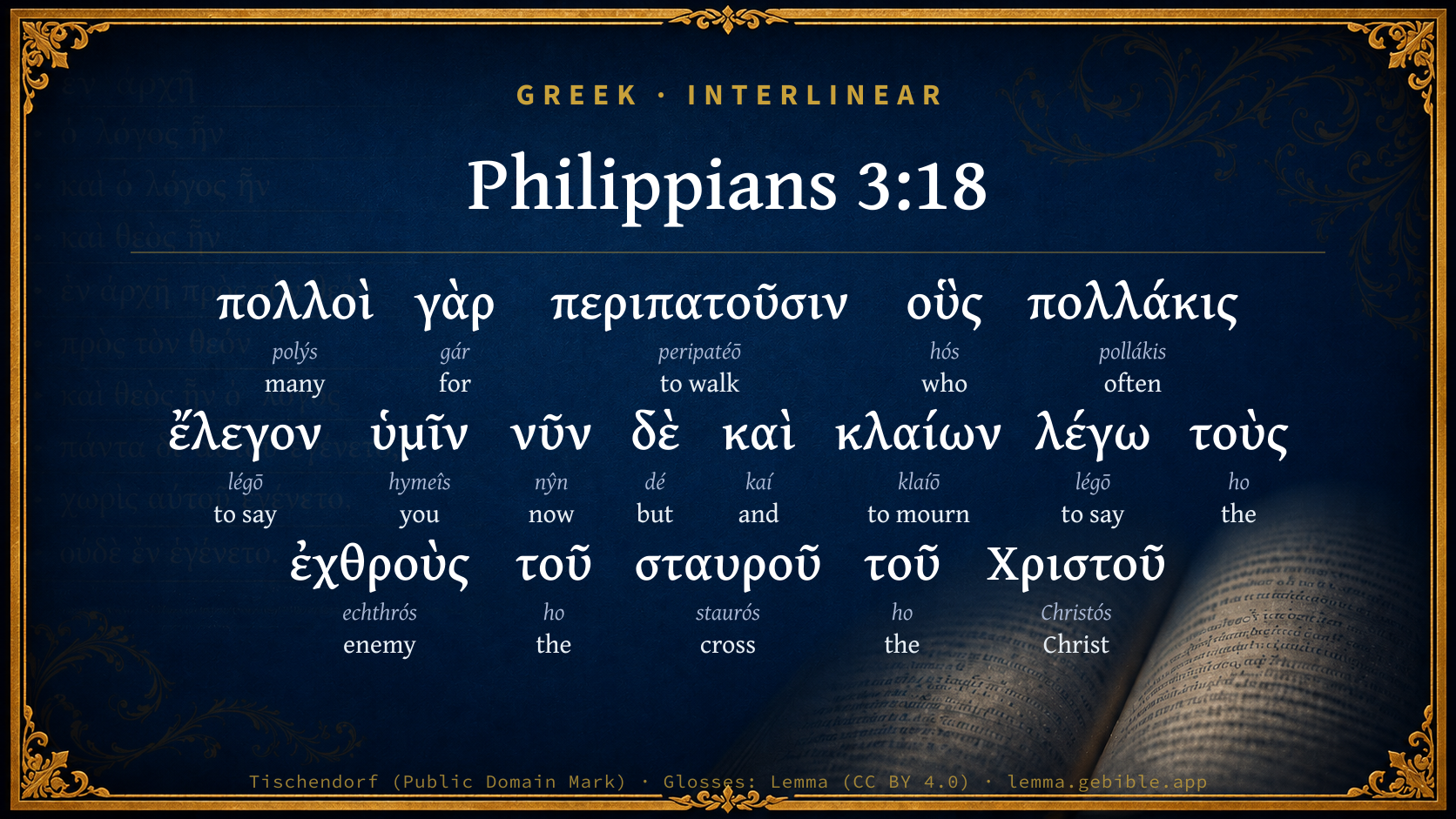
  1. πολλοὶ polýs G4183 “many” Adjective, Nominative, Plural, Masculine
  2. γὰρ gár G1063 “for” Conjunction
  3. περιπατοῦσιν peripatéō G4043 “to walk” Verb, Present, Active, Indicative, 3rd person, Plural
  4. οὓς hós G3739 “who” Relative pronoun, Accusative, Plural, Masculine
  5. ἔλεγον légō G3004 “to say” Verb, Imperfect, Active, Indicative, 1st person, Singular
  6. ὑμῖν hymeîs G5210 “you” Personal pronoun, 2nd person, Dative, Plural
  7. νῦν nŷn G3568 “now” Adverb
  8. δὲ dé G1161 “but” Conjunction
  9. καὶ kaí G2532 “and” Conjunction
  10. κλαίων klaíō G2799 “to mourn” Verb, Present, Active, Participle, Nominative, Singular, Masculine
  11. λέγω légō G3004 “to say” Verb, Present, Active, Indicative, 1st person, Singular
  12. τοὺς ho G3588 “the” Article, Accusative, Plural, Masculine
  13. ἐχθροὺς echthrós G2190 “enemy” Adjective, Accusative, Plural, Masculine
  14. τοῦ ho G3588 “the” Article, Genitive, Singular, Masculine
  15. σταυροῦ staurós G4716 “cross” Noun, Genitive, Singular, Masculine
  16. τοῦ ho G3588 “the” Article, Genitive, Singular, Masculine
  17. Χριστοῦ Christós G5547 “Christ” Noun, Genitive, Singular, Masculine

About this verse

These counts appear in no published source. They are computed here, from the morphology-tagged text and Lemma’s own curated glosses. What Lemma adds →

18
words
15
distinct lemmas
Pauline Epistles
section

Notable vocabulary

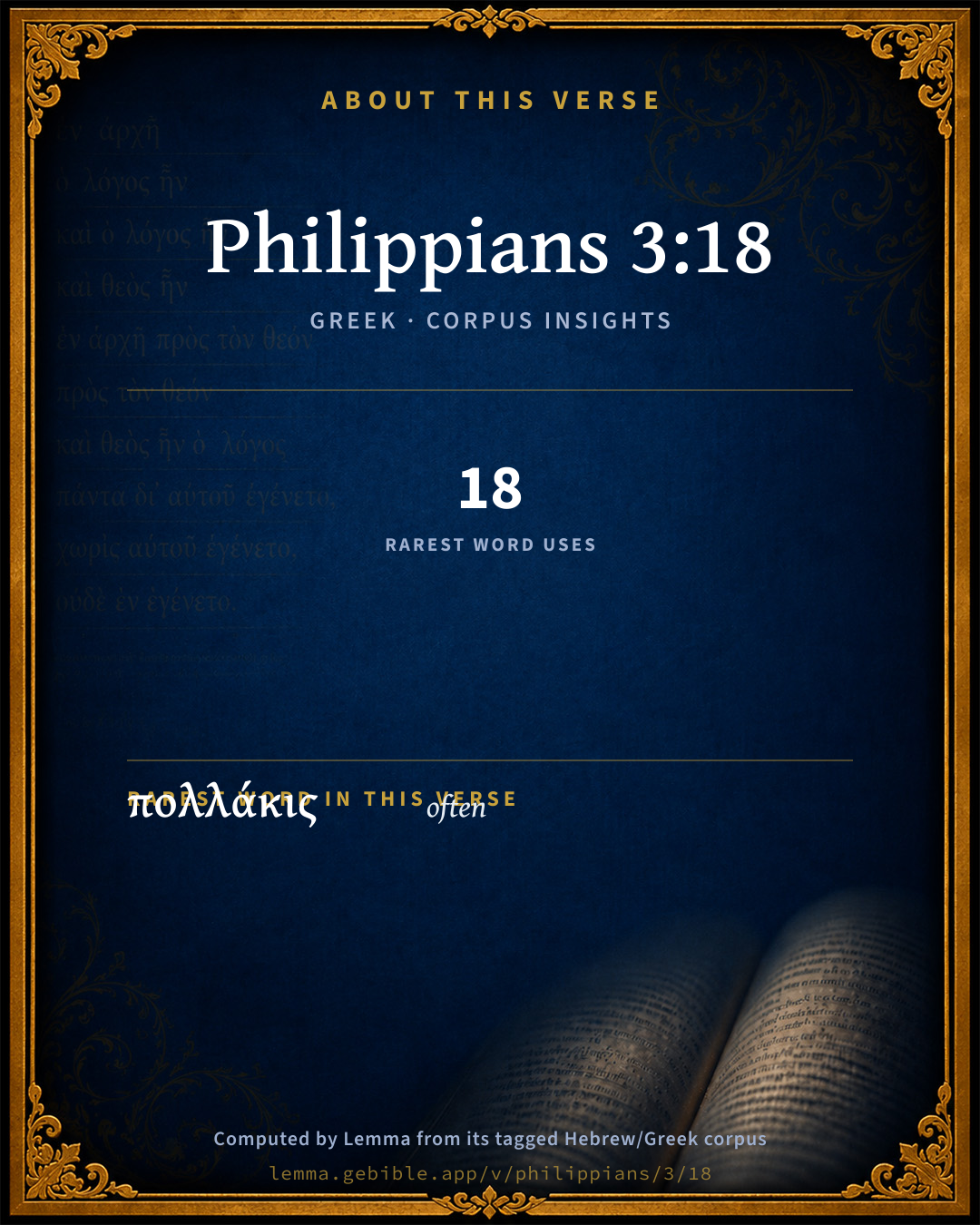
The rarest word here is πολλάκις often G4178 — appearing just 18 times in the whole Greek New Testament.

Shared distinctive vocabulary

πολλάκις often G4178 occurs in 16 verses of the Greek New Testament. Also found in:

Repetition

Words recur within this verse:

  • ἔλεγον to say G3004 ×2
  • τοὺς the G3588 ×3

Cross-references

27

Topical passages linked to Philippians 3:18 in the Treasury of Scripture Knowledge — connected by theme and wording, ordered by reader-vote popularity; previews shown in the World English Bible.

  • Ephesians 4:17 This I say therefore, and testify in the Lord, that you no longer walk as the rest of the Gentiles also walk, in the futility of their mind,
  • Isaiah 8:11 For Yahweh spoke thus to me with a strong hand, and instructed me not to walk in the way of this people, saying,
  • Galatians 6:12 As many as desire to look good in the flesh, they compel you to be circumcised; only that they may not be persecuted for the cross of Christ.
  • Jeremiah 13:17 But if you will not hear it, my soul shall weep in secret for [your] pride; and my eye shall weep sore, and run down with tears, because Yahweh's flock is taken captive.
  • Galatians 1:7 and there isn't another gospel. Only there are some who trouble you, and want to pervert the Gospel of Christ.
  • Galatians 2:14 But when I saw that they didn't walk uprightly according to the truth of the Gospel, I said to Peter before them all, "If you, being a Jew, live as the Gentiles do, and not as the Jews do, why do you compel the Gentiles to live as the Jews do?
  • Ephesians 5:5–6 Know this for sure, that no sexually immoral person, nor unclean person, nor covetous man, who is an idolater, has any inheritance in the Kingdom of Christ and God.
  • Philippians 1:4 always in every request of mine on behalf of you all making my requests with joy,
  • Philippians 1:15–16 Some indeed preach Christ even out of envy and strife, and some also out of good will.
  • 1 Thessalonians 4:6 that no one should take advantage of and wrong a brother or sister in this matter; because the Lord is an avenger in all these things, as also we forewarned you and testified.
  • 2 Peter 2:10 but chiefly those who walk after the flesh in the lust of defilement, and despise authority. Daring, self-willed, they are not afraid to speak evil of dignitaries;
  • Daniel 4:37 Now I, Nebuchadnezzar, praise and extol and honor the King of heaven; for all his works are truth, and his ways justice; and those who walk in pride he is able to abase.
  • Luke 19:41 When he drew near, he saw the city and wept over it,
  • Acts 20:30–31 Men will arise from among your own selves, speaking perverse things, to draw away the disciples after them.
  • Romans 9:2 that I have great sorrow and unceasing pain in my heart.
  • 1 Corinthians 1:18 For the word of the cross is foolishness to those who are dying, but to us who are saved it is the power of God.
  • 1 Corinthians 6:9 Or don't you know that the unrighteous will not inherit the Kingdom of God? Don't be deceived. Neither the sexually immoral, nor idolaters, nor adulterers, nor male prostitutes, nor homosexuals,
  • 2 Corinthians 2:4 For out of much affliction and anguish of heart I wrote to you with many tears, not that you should be made sorry, but that you might know the love that I have so abundantly for you.
  • 2 Corinthians 11:13 For such men are false apostles, deceitful workers, masquerading as Christ's apostles.
  • 2 Corinthians 11:29 Who is weak, and I am not weak? Who is caused to stumble, and I don't burn with indignation?
  • Galatians 2:21 I don't make void the grace of God. For if righteousness is through the law, then Christ died for nothing!"
  • Galatians 5:21 envyings, murders, drunkenness, orgies, and things like these; of which I forewarn you, even as I also forewarned you, that those who practice such things will not inherit the Kingdom of God.
  • Psalms 119:136 Streams of tears run down my eyes, Because they don't observe your law.
  • Jeremiah 9:1 Oh that my head were waters, and my eyes a spring of tears, that I might weep day and night for the slain of the daughter of my people!
  • Acts 20:19 serving the Lord with all humility, with many tears, and with trials which happened to me by the plots of the Jews;
  • 2 Thessalonians 3:11 For we hear of some who walk among you in rebellion, who don't work at all, but are busybodies.
  • Jude 1:13 wild waves of the sea, foaming out their own shame; wandering stars, for whom the blackness of darkness has been reserved forever.

Cross-references courtesy of OpenBible.info (CC BY 4.0).

Commentary

Notes on Philippians 3:18 from classic Christian and Jewish commentators (each source and its license shown beneath its notes). The classic Christian expositions comment on the surrounding passage and are grouped to its opening verse, so a note may address several verses; the Jewish commentaries on the Tanakh (Rashi and others) are per-verse, so they appear only where the commentator wrote on this verse.

Lemma curates 59 commentaries, every one of them public domain or Creative Commons licensed, each selected and text-cleaned for this edition rather than reprinted as found. About our sources →

The Cambridge Bible for Schools and Colleges

gen. ed. J. J. S. Perowne

18. many] Evidently holders of an antinomian parody of the Gospel of grace; see on Php_3:12. That there were such in the primeval Church appears also from Rom_16:17-18 (a warning to Rome, as this from Rome); 1Co_5:6. To them Rom_3:31; Rom_6:1, refer, and Eph_5:6.

There may have been varieties under a common moral likeness; some perhaps taking the view afterwards prominent in Gnosticism—that matter is essentially evil, and that the body therefore is no better for moral control; some (and in the Roman Epistle these surely are in view), pushing the truth of Justification into an isolation which perverted it into deadly error, and teaching that the believer is so accepted in Christ that his personal actions are indifferent in the sight of God. Such growths of error, at once subtle and outrageous, appear to characterize, as by a mysterious law, every great period of spiritual advance and illumination. Compare the phenomena (cent. 16) of the Libertines at Geneva and the Prophets of Zwickau in Germany. Indeed few periods of Christian history have escaped such trials.

The false teachers in view here were no doubt broadly divided from the Judaists, and in most cases honestly and keenly opposed to them. But it is quite possible that in some cases the “the extremes met” in such a way as to account for the mention here of both in one context, in this chapter. The sternest formal legalism has a fatal tendency to slight “the weightier matters of the law,” and heart-purity among them; and history has shewn cases in which it has tolerated a social libertinism of the worst kind, irrevocably condemned by the true Gospel of free grace. Still, the persons referred to in this section were those who positively “gloried in their shame”; and this points to an avowed and dogmatic antinomianism.

The “many” of this verse is an instructive reminder of the formidable internal difficulties of the apostolic Church.

I have told you] Lit. and better, I used to tell you, in the old days of personal intercourse. This makes it the more likely that the antinomians were not of the gnostic type of the later Epistles, but of that of the Ep. to the Romans, perverters of the doctrine of free grace.

weeping] Years had only given him new and bitter experience of the deadly results.—For St Paul’s tears, cp. Act_20:19; Act_20:31; 2Co_2:4. We are reminded of the tears of his Lord, Luk_19:41; tears which like these indicate at once the tenderness of the mourner and the awfulness and certainty of the coming ruin. See a noble sermon by A. Monod (in his series on St Paul), Son Christianisme, ou ses Larmes. An extract is given, Appendix G.

the enemies of the cross] As deluding their followers and themselves into the horrible belief that its purpose was to give the reins to sin, and as thus disgracing it in the eyes of unbelieving observers. “The cross” here, undoubtedly, means the holy propitiation of the Lord’s Death. For the Divine connexion of it as such with holiness of heart and life see the argument of Romans 3-6; Galatians 5.

G. AD. MONOD ON ST PAUL’S TEARS. (Ch. Php_3:18)

“What is the Gospel of St Paul? Is it but a refined deism, announcing as its whole doctrine the existence of God and the immortality of the soul, as its whole revelation the fatherhood of God and the brotherhood of man, as its only mediator Jesus Christ living as prophet and dying as martyr? Or is this Gospel a religion unlike all others (une religion tout à part) … proclaiming a God unknown, promising an indescribable deliverance, demanding a radical change, compassionate and terrible at once, … high as heaven, deep as hell? You need not, for your answer, consult the writings of the Apostle; you have but to see him weeping at your feet.”

Saint Paul, Cinq Discours (ed. 1859), p. 62.

The Cambridge Bible for Schools and Colleges (gen. ed. J. J. S. Perowne; Cambridge University Press, 1878–1918) — public domain. Text from a community e-Sword module.

The Biblical Illustrator

Joseph S. Exell

Php_3:18

And now tell you even weeping that they are enemies to the Cross of Christ

I.

The causes or Pauls grief.

1. Negatively. It was not hatred and ill will to their persons, nor emulation of their credit, nor desire of venting reproaches. Some mens zeal against error is as much to be feared as others lapsing into it. Ithacus had nothing good in him but his hatred of the Priscillianists, and this so far transported him that every zealous man was a Priscillianist.

2. Positively--

(1) Pure zeal for Gods glory (Psa_69:9; Rom_15:3).

(2) The Churchs welfare (Psa_122:9; Isa_62:1; Psa_137:6). Pity to souls, both of the ringleaders and their proselytes.

(3) Clear apprehensions of the mischievous effects of sin.

II. The brand He puts on them over whom He weeps. Enemies of the Cross of Christ.

1. To clear this observe--

(1) That those who profess friendship to Christ may yet be enemies to Him.

(2) That friendship and enmity to Christ is not interpreted so much by external profession as by the constitution of our hearts and the course of our conversation (Luk_6:46; Mat_7:21; 1Pe_1:17).

(3) That the worldly spirit is that constitution of heart which is blank opposite to the Cross.

2. To prove this--

(1) The Scripture expressly asserts it (Jam_4:4; Mat_6:24; 1Jn_2:15).

(2) Experience confirms it.

(a) It was the worldly spirit that caused the Jews to persecute Christ and His servants (Jam_2:5-6; Luk_16:14).

(b) This makes the nominal Christian to be such an opposer of Christs spiritual kingdom, and to content himself with the name of Christianity.

(c) This distinguishes the hypocrites from the sincere.

(d) This hinders the sincere from doing all they would for God.

(3) Reason evidences it.

(a) From the intent of the Cross, which was to be an expiation for sin. To cross this end is to refuse Gods remedy. The Cross also purchased for us that Spirit of power and all those helps of grace by which we overcome the world (Gal_1:4). Now those who mind earthly things defeat the end of the Spirit. The Cross, too, purchased heaven, and those who aim at earthly happiness contradict this. The Cross, too, is a pattern and example of suffering, patience, and a glorious issue, each of which worldliness contemns.

(b) From the nature of the religion founded on the Cross--faith, hope, and love--which a worldly spirit destroys.

III. Uses.

1. To show how mistaken they are who reconcile the love of the world with a profession of godliness (Luk_18:23; 1Pe_5:2; Rom_16:8).

2. To press those who would be sincere Christians to mortify their affections to earthly things.

(1) Christ counts none friends of His who love not His Cross.

(2) The true virtue of Christs Cross is only found by those who are crucified by it to the world.

(3) Till this be done your love to God and hope of heaven are questionable. (T. Manton, D. D.)

The Cross of Christ and its enemies

I. What is the cross? Not simply the instrument of torture, but the sufferings Christ endured and the blessings which result from them. In this enlarged acceptation consider the Cross as--

1. The foundation of our hope as fallen sinners. To the sinner viewing futurity apart from the atonement the prospect is appalling.

2. The source of our spiritual enjoyment, peace, joy, access to and fellowship with God.

3. The main the me of the gospel ministry. It furnishes the preacher with a rich and endless variety of topics, of which it is the harmonizing and illustrative principle.

4. The most legitimate object in which we may triumph, and of which we may make our boast. Some boast of their ancestors, wealth, honours, learning, etc.

5. The pledge of everlasting glory.

II. Who are its enemies?

1. Those who deprive it of its saving virtue.

2. Those who decline its purchased privileges.

3. Those who preach another gospel of which it is not the centre.

4. Those who make their boast of any other object.

5. Those who reject it as the condition of their heavenly crown. (R. Cameron.)

Enemies of the Cross

I. St. Paul was in the habit of repeating the same things to his converts. We learn from this not only that he thought the Philippians should be on their guard against the enemies of the Cross, but that he feared the lesson would be forgotten unless repeated time after time. There is an incessant craving for novelty, so that the preacher is likely to find himself blamed if he dwells chiefly on truths a hundred times told, and yet these simple truths are those which most need being pressed on men.

II. St. Pauls distress at what he had to say. Why did the apostle weep? What is there in the sins of others to cause a righteous man to weep? Nay, he would not be a righteous man if they did not move him to tears. We do not expect it of the wicked. They are not moved by their own sins, it were strange indeed if they were moved by those of their fellows. But if we Christians only think of the wretchedness of the wicked in this life and that to come, there is cause enough to fill the breast of every one of us with grief too mighty for utterance. You who cannot see a fellow creature in pain without feeling pain may witness a scene of such misery as was never found on earth, and be indifferent to it if you can.

III. Those who called forth this tearful and frequent mention. Not enemies of Christ but of His Cross, and therefore those who opposed or disliked the truths associated with the death of our Redeemer. Putting aside the speculative enmity of the Socinian and the profligate who is only the enemy of the Cross as he is the enemy of all religion, we notice--

1. Those who in any measure or degree would set aside the work of mediation and look to their own righteousness for salvation.

2. The inconsistent professor, whose practice is at open variance with the gospel. The Cross is so constructed that it inculcates holiness while it offers pardon.

3. The covetous, who oppose its example of self-sacrifice. (H. Melvill, D. D.)

Enemies of the Cross

The text is a parenthesis enclosing, like some good garden, flowers of apostolic virtue and weeds of Philippian wickedness.

I. The fidelity of the apostle is commended by--

1. His warning, I have told you. As wisdom hath eyes to note evils, so faithfulness hath a tongue to notify them. We are seers of God in respect of our eyes, and prophets in respect of our tongues. We are blind guides if we see not, and dumb dogs if we give not warning of what we see. We should not be like dials or watches to teach the eye, but like clocks and larums to ring in the ear. God will never thank us for keeping His counsel, but for divulging it. The prophet prays, Set a door before my lips, not a wall, but a door that may be seasonably let loose and free when convenience or necessity require it. If I see a blind man walking towards some deep pit and do not warn him, I am not less guilty of his death than if I had thrust him down (Eze_33:7). A sleeping sentinel is the loss of a whole city.

2. The frequence of the warning--not once or seldom, but often. St. Paul feared not tautology, rather like a skilful workman he beats still on the same anvil. There can never be too much warning where there can never be enough heed. Nice ears are all for variety of doctrines; as palates of meats. St. Paul hates to feed this wanton humour, and tells them this single diet is safe for them. We tell over the same coins, and spend night after day in the same game without weariness. There is an itch of the ear which St. Paul foresaw would prove epidemical in latter times. Too many pulpits are full of curious affectations, new crochets, strange mixtures of opinions, insomuch that old and plain forms are grown stale and despicable. There cannot be a more certain argument of a decayed and sickly stomach than the loathing of wholesome and solid food, and longing after new and artificial composition. O foolish Israelites, with whom too much frequence made the food of angels contemptible. The full despiseth the honeycomb, and there are many thus full of the world and sinful corruptions. But for us let not these dainties of heaven lose their worth for their store. Often inculcation of warnings necessarily implies danger, and there is much danger of the infection of evil.

3. The passion--Weeping. What is it that could wring tears from those eyes? Even the same that fetched them from our Saviour, and from all eyes that pretend to holiness--compassion of sinners. What shall I say to such as make merry with sin? O that we should laugh at that for which our Saviour wept and bled. Tears do well in the pulpit. As it is in the buckets of some pumps, that water must be first poured down into them ere they can fetch up water in abundance; so must our tears be let down to fetch up more from our hearers. Worldly men as they have hard hearts have dry eyes, but the tender hearts of Gods children are ever lightly attended with weeping eyes. And if good men spend tears on sinners how much more ought sinners to weep for themselves. See who it was for whom Paul wept: dogs and the concision. So, then, Christs charitable children should not desire or rejoice in the destruction of those who profess hostility against them. Every man can mourn for the fall of a friend, but to be thus deeply affected with the sins or judgments of wicked persons is incident to none but a tender and charitable heart. Gods children are like their Father (1Ti_2:4 : Eze_18:23; Eze_33:11).

II. The wickedness of the false teachers.

1. Their number--many. Note, then, that the rarity of conscionable men should make them more observed and valued, as grains of gold amidst the rubbish of the ore and dust. Paucity is wont to carry contempt with it; but with Christians one is worth more than a thousand. It is better to follow one Noah into the ark than to perish with a world of unbelievers. Many are opposed to us. It is not for us to stand upon the fear of an imputation of singularity: we may not do as the most, but as the best, The world is apt to make an ill use of multitude: on the one side arguing the better part by the greater, on the other arguing mischief tolerable because abetted by many. If the first should hold good paganism would carry it from Christianity, and hell from heaven. Thou shalt not follow a multitude to do evil. What abatement of torment will it be to be condemned with many. If the second, that which heightens evils should plead for their immunity, so none but weak mischiefs should receive opposition. Strong thieves should escape while petty pilferers should be punished. Away with this base pusillanimity. If the devils can say my name is legion, let your powerful commands cast them out.

2. Their motion--walk.

(1) Natural. Walking is living. Every minute is a new pace. None can stop our passage. Whether we do something or nothing we move on by insensible steps toward our long home.

(2) Voluntary. So the wicked ones walk like their setter (Job_1:7). Wickedness is seldom other than active.

(3) Walking implies an ordinary mode of life. It is not a step, or a pace, that can make a walk, but a proceeding on with many shirtings of our feet. It is no judging of a man by one action. The best man may step aside as David and Peter--but their walk was in the ways of Gods commandments. What is the course of mens lives? If drunkenness, debauchery, etc., their walk is an ill way to an evil end; pity those and labour to reclaim them. But if their general course be holy it is not a particular miscarriage that can be a just ground of censure.

3. Their quality--Enemies of the Cross of Christ. But who can but hate that which was the cause of the death of our best Friend. Surely we love not Christ if we hate not what was accessory to His murder. But if we regard it as improved by Christ for man we must love it. The cross was the death that gives us life; so that we cannot be at once enemies of the Cross and friends of the crucified.

(1) As Christ, so His Cross has many false friends who are no other than enemies. Unjust favours are as injurious as derogations. To deify a saint is as bad as devilizing him. Romanists exceed in this way their devotions to the Cross; whose friendship to the altar is a defiance to the sacrifice.

(2) The Philippian Pseudapostles were enemies.

(a) In doctrine, who joined circumcision and other legalities with the Cross, so by a pretended partnership detracting from the virtue of Christs death. And so, now how palpable enemies are they who hold Christs satisfaction imperfect without ours.

(b) In practice, viz., those who shift off persecution by conformity to the present world--caring more for a whole skin than a sound soul--and loose livers. Christs Cross is our redemption from sin; and those who wilfully sin frustrate the Cross and mock at redemption (Gal_2:20).

4. Their end. A woeful condition beyond all thoughts. Here is every circumstance that may add horror to a condition.

(1) Suddenness (Psa_37:2; Isa_5:24; Pro_10:25; Psa_73:19).

(2) Extremity. The wrath of God is as Himself infinite.

(3) Impossibility of release. If the torment might have an end there were some comfort. O mad sinners, that for a little momentary contentment east themselves into everlasting perdition! (Bishop Hall.)

Enemies of the cross

I. There is reason to believe that many professors of religion are enemies to the cross of Christ (Mat_13:24-30; Mat_13:47-50; Mat_7:21; Mat_7:23). But observe in passing--

1. That Christianity is not responsible for hypocrites and self-deceived professors. Religion does not produce nor countenance hypocrisy.

2. Christianity does not stand alone. There are many false friends, patriots, professors of honesty, temperance, etc.

3. We claim for Christianity only the good it has done, and point to the sinners it has reformed.

4. We ask that on this subject the language of discrimination and justice should be used.

II. How may we determine when professors are enemies to the Cross of Christ?

1. When they have not been born again. The carnal mind is enmity with God.

2. When they live in the indulgence of any known sin. It needs no argument to show that the man who is seeking my hurt in any way is my enemy. The man who indulges in known sin shows that he disregards Gods authority, and despises the work of Christ which is to cleanse us from all iniquity.

3. When they pursue a doubtful or undecided course of conduct without any effort to know what is right.

4. When they manifest in their conduct none of the peculiarities of those who truly love Him. These are not morality, good temper, etc., for worldly men have these. Christ did not die that His followers might be like other men, but that they should he a peculiar people.

5. When they have a deeper interest in their worldly affairs than in the cause of their Redeemer (verse 19, Php_2:21; 2Ti_3:2). The proof of this proposition lies in a nutshell.

(1) Christ said, He that is not for Me is against Me.

(2) There is no better way of knowing a mans character than observation of his walk and conversation.

(3) The interests of Christs kingdom are intended to be supreme. He seeks no divided sway (Luk_14:26).

(4) The principles of Christianity cannot lie dormant in the soul. If they exist they will be manifested.

6. When nothing can induce them to give up their worldly concerns for the cause of religion upon Gods demands. We make a great mistake when we speak of our time, talents, property. The affairs of this life, as well as prayer and praise, should be pursued as part of the service we owe to God. The gospel was designed to overcome the love of the world, and to induce men to surrender all when God urges His claims (Luk_9:23; Luk_14:26).

(1) If a professed follower of Christ will not abandon those amusements which are obviously and certainly inconsistent with the gospel, he is the enemy of the Cross of Christ.

(2) So is he who will not surrender his property to God when He demands it for His service.

(3) And he who employs all his time in doing his own will.

7. When they are opposed to all that is peculiar in the doctrines of Christianity.

(1) When the doctrines of the Bible in general are admitted, but in detail are denied.

(2) When those truths which are found in natural religion are acknowledged, but the truths peculiar to the gospel are doubted.

(3) When a man will not examine those doctrines to satisfy his own mind whether they are true or false.

(4) When a man becomes angry when those doctrines are preached.

(5) When in the circle of the worldly he is unwilling that it should be known that he holds them.

8. When they are opposed to the peculiar duties of Christianity.

(1) When the obligations of piety are admitted in general but denied in particular.

(2) When there is no sympathy with the plans of true Christians in the spread of the gospel.

(3) When all the sympathies are on the side of the enemy of Christ.

III. Why is the fact of their being in the Church fitted to excite grief. Because--

1. They are cherishing hopes that will be disappointed, and are exposed to danger that is unfelt (2Co_2:4).

2. Their influence.

(1) The loss of so much positive strength to the cause of the Redeemer.

(2) It tends to discourage the true friends of God.

(3) It is a real hindrance to the cause of God, for he that is not with Me is against Me.

(4) It gives occasion for the reproach and opposition of a wicked world.

(5) It is the occasion of the loss of the souls of men. An ungodly parent adds to his own destruction that of his children.

3. The slender probability that they will ever be saved. The apostle did not anticipate the conversion of those whose end was destruction (Mat_13:30). There is more hope for the open sinner and the heathen than for the self-deluded professor. (A. Barnes, D. D.)

Inconsistency is

I. Common. Many betray their profession by their--

1. Spirit.

2. Temper.

3. Conduct.

II. Enmity to the cross. It--

1. Contradicts its teaching.

2. Puts discredit on its glory.

3. Hinders its success.

III. Matter of regret. The inconsistent--

1. Dishonour Christ.

2. Injure others.

3. Ruin themselves. (J. Lyth, D. D.)

The significance of manly tears

It is an unusual and a distressing thing to see a man weep. Women may not be ashamed of their tears, nor seek to hide them; and when we see them weep, we do not turn away, but hasten to their side, saying, Woman, why weepest thou? But men are ashamed to weep. They brush the failing tear from their eye to hide it, or when they cannot restrain their grief, like Peter, they go from the presence of men to weep bitterly in private. There is something so sacred and so solemn, or else so ludicrous, in the tears of men, that friends feel it kindly not to notice when they fall, or, like the friends of Job, to pause awhile in silence ere they ask, Man, why weepest thou? As a rule, man cannot bear to speak of, nor to be spoken to about, their tears. How strange, then, is the contrast in our text, where Paul is not only seen weeping privately in his prison at Rome, but writing to the distant Church at Philippi to tell them of his tears! Similar examples we find among the prophets. There were times when they did not try to repress nor to hide their tears, but desired, and proclaimed aloud that they desired, to weep, saying, Oh that my head were waters, and mine eyes a fountain of tears, that I might weep day and night! Now, why was it thus? Why was it that strong men desired to weep, and not to hide their tears? The answer is plain and striking. They thus wept, and proclaimed their weeping, not when they wept for themselves, but over others. When they wept for themselves, like Peter, they went out to a secret place to weep alone before their God. But when they saw how evil men ran on in sin, they did not hide, but showed the rivers of tears that ran down their cheeks. There was no shame nor weakness in tears like these. (W. Grant.)

Tears for sinners

It is not so much anger as grief which should be excited in us by the prevalence of iniquity. Nature may make our eyes flash fire, but grace will make them shed tears, as Gods law is broken and His authority defied. (H. Melvill, B. D.)

Saint-like tears

Let no man say that tears argue weakness; even the firmest marble weeps in a resolution of the air. Nay, such tears as these argue strength of piety and heavenly affections. To weep for fear is childish; that is unbeseeming a man; to weep for anger is womanish and weak; to weep for mere grief is human; for sin, Christian; but for true zeal and compassion, is saint-like and Divine: every one of these drops is a pearl. Behold the precious liquor which is reserved, as the dearest relique of heaven, in the bottles of the Almighty; every dram whereof is valued at an eternal weight of glory. Even a cup of cold water shall be rewarded; and, behold, every drop of this warm water is more worth than many cups of cold. Weep thus awhile, and laugh forever; sow thus in tears, and be sure to reap in joy. (Bishop Hall.)

The Biblical Illustrator, edited by Joseph S. Exell (c. 1880s–1900s) — public domain. Text from a community e-Sword module.

The Expositor's Bible

Chapter 15

ENEMIES OF THE CROSS.

Php_3:18-19 (R.V.)

THE New Testament writers, and not least the Apostle Paul, are wont to bring out their conception of the true Christian life by setting it vividly in contrast with the life of the unspiritual man. They seem to say: "If you really mean to say No to the one, and Yes to the other, be sincere and thorough: compromises are not possible here." So: 1Ti_6:10 "The love of money is the root of all evil: which while some coveted after, they have erred from the faith, and pierced themselves through with many sorrows. But thou, O man of God," etc. Or: Jud_1:18 "mockers, walking after their own ungodly lusts. These are they who separate themselves, sensual, having not the Spirit. But ye, beloved," etc. Here in like manner the course of worldliness and self-pleasing life is sketched in concrete instances, that its sin and shame may be felt, and that by contrast the true calling of a Christian may be discerned and may be impressed on the disciples.

It may be taken as certain that the Apostle is not speaking of mere Jews or mere heathen. He is speaking of professing Christians, whose practical life belied their profession. In general they are enemies of the cross of Christ; that is the first thing he thinks fit to say of them. And here it may be asked whether the Apostle has in view, if not Jews, yet the Judaising faction about which he had already said strong things in the beginning of this chapter. Some have thought so; and it must be owned that antagonism to the cross, ignorance of its virtue, and antipathy to its lessons, are exactly what the Apostle was wont to impute to those Judaisers; as may be seen in the Epistle to the Galatians, and in other Pauline writings. But it is preferable, as has been already indicated, to take it that the Apostle has turned from the particular issue with those Judaisers; and having been led to declare emphatically what the life of Christianity was in his own experience and practice, he now sets this life in Christ not merely against the religion of the Judaisers, but in general against all religion which, assuming the name of Christ, denied the power of godliness; which meddled with that worthy name, but only brought reproach upon it. It is quite possible indeed that here he might have in view some of the Judaisers also; for there was a sensual side of popular Judaism which might be represented also among the Judaising Christians. But it is more likely that the Apostles eye is turning mainly to another class of persons. It seems that in the early Churches, especially perhaps at the time when the later Epistles were written, a recognisable tendency to a loose and lawless Christianity was finding representatives. Warning against these was needed; and they embodied a form of evil which might serve to show the Philippians, as in a mirror, the disaster in which an idle, self-satisfied, vainglorious Christianity was like to land its votaries.

What first strikes the Apostle about them is that they are enemies of the cross of Christ. One asks, Does he mean enemies of the doctrine of the cross, or of its practical influence and efficiency? The two are naturally connected. But here perhaps the latter is principally intended. The context, especially what follows in the Apostles description, seems to point that way.

When Christs cross is rightly apprehended, and when the place it claims in the mind has been cordially yielded, it becomes, as we see in the case of Paul himself, a renovating principle, the fountain of a new view and a new course. That immense sacrifice for our redemption from sin decides that we are no more to live the rest of our time in the flesh to the lusts of men. {1Pe_4:1} And that patience of Christ in His lowly love to God and man under all trials, sheds its conclusive light upon the true use and end of life, the true rule, the true inspiration, and the true goal. So regarded, Christs cross. teaches us the slender worth, or the mere worthlessness, of much that we otherwise should idolise; on the other hand it assures us of redemption into His likeness, as a prospect to be realised in the renunciation of the "old man"; and it embodies an incomparable wealth of motive to persuade us to comply, for we find ourselves in fellowship with Love unspeakable.

Under this influence we take up our cross; which is substantially the same as renouncing or denying ourselves {Mat_16:24} carried practically out. It is self-denial for Christs sake and after Christs example, accepted as a principle, and carried out in the forms in which God calls us to it. This, as we have seen, takes place chiefly in our consenting to bear the pain involved in separation from sin and from the life of worldliness, and in carrying on the war against sin and against the world. It includes rejection of known sin; it includes watchfulness and discipline of life with a view to lifes supreme end; and so it includes prudential self-denial, in avoiding undue excitement and over-absorbing pleasure, because experience and Gods word tell us it is not safe for our hearts to be so "overcharged." {Luk_21:34} This cross in many of its applications is hard. Yet in all its genuine applications it is most desirable; for in frankly embracing it we shall find our interest in salvation, and in the love which provides it, brought home with comfort to our hearts. {1Pe_4:14}

It seems, then, that there are professing Christians who are enemies of the cross of Christ. Not that it is always an open and proclaimed hostility; though, indeed, in the case of those whom Paul is thinking of, it would appear to have revealed itself pretty frankly. But at all events it is a real aversion; they would have nothing to do with the cross, or as little as they may. And this proves that the very meaning of salvation, the very end of Christ as a Saviour, is the object of their dislike. But in Christianity the place of the cross is central. It will make itself felt somehow. Hence those who decline or evade it find it difficult to do so quietly and with complacency. Eventually their dislike is apt to be forced into bitter manifestation. They begin, perhaps, with quiet and skilful avoidance; but eventually they become, recognisably, enemies of the cross, and their religious career acquires a darker and more ominous character.

It is, however, an interesting question, What draws to Christianity those who prove to be the enemies of the cross? Nowadays we may explain the adhesion of many such persons to Christian profession by referring to family and social influences. But we can hardly set much down to that score when we are thinking of the days of Paul. It cannot be doubted that some persons were then strongly drawn by Christianity who did not prove amenable to its most vital influence. And that may persuade us that the same phenomenon recurs in all ages and in all Churches. For different minds there are different influences which may operate in this way. Intellectual interest may be stirred by the Christian teachings; the sense of truth and reality may be appealed to by much in the Christian view of men and things; there may be a genuine satisfaction in having life and feelings touched and tinged with the devout emotions which breathe in Christian worship; there may be a veneration, real as far as it goes, for some features of Christian character, as set forth in Scripture and embodied in individual Christians; and, not to dwell on mere particulars, the very goodness of Christian truth and life, which a man will not pay the cost of appropriating to himself, may exert a strong attraction, and draw a man to live upon the borders of it. Nay, such men may go a good long way in willingness to do and bear for the cause they have espoused. Men have run the risk of loss of life and goods for Christianity, who have yet been shipwrecked on some base lust which they could not bring themselves to resign. And who has not known kindly, serviceable men, hanging about the Churches with a real predilection for the suburban life of Zion, -men regarding whom it made the heart sore to form any adverse judgment, and yet men whose life seemed just to omit the cross of Christ?

In the case of those whom Paul thinks of there was no room for doubt as to the real nature of the case; and therefore the Apostle cannot too emphatically bring it out. He puts first the most startling view of it. Their end is destruction. Not salvation, but destruction is before them, although they name the name of Christ. Destruction is the port they are sailing for: that is the tendency of their whole career. Their place must be at last with those on whom the day of the Lord brings sudden destruction, so that they shall not escape. Alas for the Christians whose end is destruction!

"Their God is their belly." Their life was sensual. Most likely, judging from the tone of expression, they were men of coarse and unblushing indulgence. If so, they were only the more outstanding representatives of the sensual life. The things which delight the senses were for them the main things, and ruled them. They might have intellectual and aesthetic interests, they might own family and social connections, they certainly did attach importance to some religious views and some religious ties; but the main object of their life was to seek rest and content for those desires which, may have rest apart from any higher exercise or any higher portion. Their life was ruled and guided by its lower and sensual side. So their belly was their god. Yet they claimed a place in the Christian fellowship, in which Christ has revealed God, and has opened the way to God, and brings us to God. But their thoughts ran, and their plans tended, and their life found its explanation, belly-wards. This was their god. Their trust and their desire were placed in the things which the flesh appreciates. These they served, and of these they took on the likeness. They served not the Lord Jesus Christ, but their own belly. One cannot think of it without grave questions as to the direction in which life preponderates. That would seem to indicate, our god. One does not severely judge "good living." And yet what may "good living" denote in the case of many a professing Christian? In what direction do we find the tides of secret and unrestrained thought. setting?

And they glory in their shame. In this Epistle and elsewhere, one sees the importance attached by the Apostle to that which a man glories in, as marking his character. For himself, Paul gloried in the cross of Christ: he counted all things but loss for the knowledge of Christ. And these men also were, or claimed to be, in Christs Church, in which we are taught to rate things at their true value and to measure them by the authentic standard. But they gloried in their shame. What they valued themselves upon; what they inwardly, at least, rejoiced in, and applauded themselves for; what they would, perhaps, have most cheerfully dwelt upon in congenial company, were things of which they had every reason to be ashamed-no doubt, the resources they had gathered for the worship of this god of theirs, and the success they had had in it. For example, such men would inwardly congratulate themselves on the measure in which they were able to attain the kind of satisfaction at which they aimed. They gloried in the degree in which they succeeded in bringing about a perfect accommodation between themselves and the objects which sense alone appreciates, and in producing a harmonious and balanced life set on that key. Really it should have been to them a cause of grief and shame to find themselves succeeding here, and failing in attaining a right relation to Christ and to the things of Gods kingdom, to righteousness, godliness, faith, love, patience, meekness. So they gloried in their shame. This was seen in their lives. Alas, is there no reason to fear that when the thoughts of all hearts are revealed, too many whose lives are subject to no obvious reproach shall be found to have lived an inward life of evil thought, of base desire, of coarse and low imagination, that can only rank in the same class with these-men whose whole inward life gravitates, and gravitates unchecked, towards vanity and lust?

In a word, their character is summed up in this, that they mind earthly things. That is the region in which their minds are conversant and to which they have regard. The higher world of truths and forces and objects which Christ reveals is for them inoperative. It does not appeal to them, it does not awe them, it does not govern them. Their minds can turn in this direction on particular occasions, or with a view to particular discussions; but their bent lies another way. The home of their hearts, the treasure which they seek, the congenial subjects and interests, are earthly.

Since this whole description is meant to carry its lesson by suggestion of contrast, the clause last referred to brings powerfully before us the place to be given to the spiritual mind in our conception of a true Christian life. In the eighth chapter of the Epistle to the Romans we are told that to be carnally minded-or the minding of the flesh-is death, but the minding of the spirit is life and peace. Care, therefore, is to be taken of our thoughts and of our practical judgments, so that they may be according to the spirit.

Effort in this direction is hopeful effort, because we believe that Christ grants His Spirit to hallow those regions of the inward man by His illuminating and purifying presence. It cannot be doubted that many lives that were capable of yielding much good fruit, have been frittered away and wasted through indulged vanity of thought. Others, that are methodical and energetic enough, are made sterile for Christian ends by the too common absence or the too feeble presence of the spiritual mind. It is not altogether direct meditation on spiritual objects that is here to be enforced. That has its important place; yet certainly, frank converse with the whole range of human interests is legitimately open to the Christian mind. What seems to be essential is that, through all, the regard to the supreme interests shall continue; and that the manner of thinking and of judging, the modes of feeling and impression, shall keep true to faith and love and Christ. The subject recurs in another form at the eighth verse of the following chapter.

Probably, as was said, the Apostle is speaking of a class of men whose faults were gross, so that at least an Apostolic eye could not hesitate to read the verdict that must be passed upon them. But then we must consider that his object in doing this was to address a warning to men to whom he imputed no such gross failings; concerning whom, indeed, he was persuaded far other things, even things that accompany salvation; but whom he knew to be exposed to influences tending in the same direction, and whom he expected to see preserved only in the way of vigilance and diligence. Outstanding failures in Christian profession may startle us by their conspicuous deformity; but they fail to yield us their full lesson unless they suggest the far finer and more subtle forms in which the same evils may enter in, to mar or to annul what seemed to be Christian characters.

The protest against the cross is still maintained even in the company of Christs professed disciples. But this takes place most commonly, and certainly most persuasively, without advancing any plea for conduct grossly offensive, or directly inconsistent with Christian morals. The "enemies of the cross" retreat into a safer region, where they take up positions more capable of defence. "Why have a cross?" they say. "God has not made us spiritual beings only: men ought not to attempt to live as if they were pure intelligences or immaterial spirits. Also, God has made men with a design that they should be happy; they are to embrace and use the elements of enjoyment with which He has so richly surrounded them. He does not mean us to be clouded in perpetual gloom, or to be on our guard against the bright and cheering influences of the earth. He has made all things beautiful in their time; and He has given to us the capacity to recognise this that we may rejoice in it. Instead of scowling on the beauty of Gods works, and the resources for enjoyment they supply, it is more our part to drink in by every sense, from nature and from art, the brightness, and gladness, and music, and grace. Let us seek, as much as may be in this rough world, to have our souls attuned to all things sweet and fair."

There is real truth here; for, no doubt, it lies in the destiny of man to bring the world into experience according to Gods order: if this is not to be done in ways of sin and transgression, it is yet to be done in right ways; and in doing it, man is designed to be gladdened by the beauty of Gods handiwork and by the wealth of His beneficence. And yet such statements can be used to shelter a life of enmity to the cross, and they are often employed to conceal the more momentous half of the truth. As long as the things of earth can become materials by means of which we may be tempted to fall away from the Holy One, and as long as we, being fallen, are corruptly disposed to make idols of them, we cannot escape the obligation to keep our hearts with diligence. So long, also, as we live in a world in which men, with a prevailing consent, work up its resources into a system which shuts God and Christ out; so long as men set in motion, by means of those resources, a stream of worldliness by which we are at all times apt to be whirled away, -so long every man whose ear and heart have become open to Christ will find that as to the things of earth there is a cross to bear. For he must decide whether his practical life is to continue to accept the Christian inspiration. He must make his choice between two things, whether he will principally love and seek a right adjustment with things above, with the objects and influences of the Kingdom of God, or whether he will principally love and seek a right, or at least a comfortable adjustment with things below. He must make this choice not once only, but he must hold himself at all times ready to make it over again, or to maintain it in reiterated applications of it. The grace of Christ who died and rose again is his resource to enable him.

Every legitimate element of human experience, of human culture and attainment, is, doubtless open to the Christian man. Only, in making his personal selection among them, the Christian will keep sight of the goal of his high calling, and will weigh the conditions under which he himself must aim at it. Still every such element is open; and all legitimate satisfaction accruing to men from such sources is to be received with thankfulness. Let all this be recognised. But Christianity, by its very nature, requires us to recognise also, and in a due proportion, something else. It requires us to recognise the evil of sin, the incomparable worth of Christs salvation. Along with these things, duly regarded, let all innocent earthly interests take their place. But if we are conscious that as yet we have very incompletely established the right proportionate regard, is it any wonder if we are obliged to keep watch, lest the treacherous idolatry of things seen and temporal should carry us away, obliged to accept the cross? We are obliged; but in the school of our Master we should learn to do this thing most gladly, not by constraint, but of a ready mind.

The ideal life on earth no doubt would be a life in which all was perfectly harmonised. The antagonism of the interests would have passed away. Loyalty and love to Gods kingdom and to His Son would embody themselves in all human exercise and attainment as in their proper vesture, each promoting each, working together as body and soul. There are Christians who have gone far towards this attainment. They have been so mastered by the mind of Christ that while, on the one hand, they habitually seek the things above, on the other hand there is little trace of bondage or of timorousness in their attitude towards the bright aspects of earthly experience. Some of them were happily carried in early days into so clear a decision for the better part; some emerged later, after conflict, into so bright a land of Beulah that they find it easy, with little conflict and little fear, to make frank use of forms of earthly good which other Christians must treat with more reserve.

This is one of the reasons why we must not judge one another about these things; why we must not lay down absolute rules about them; why even our recommendations must be provisional and prudential only. It is at the same time a reason for the more fidelity in each of us towards himself, to see that we do not trifle with the great trust of regulating our own life. It is possible to give to God and to Christ a recognition which is not consciously dishonest, and yet to fail in admitting any deep and dominant impression of the significance of Christs redemption for human life. So the heart is yielded, the time is surrendered, the strength is given to attractive objects, which are not indeed essentially immoral, but which are suffered to usurp the heart, and to estrange the man from Christ. Such persons prove enemies of the cross of Christ: they mind earthly things.

Since the earthly side of human life, with its sorrow and joy, its work and its leisure, is legitimate and inevitable, questions arise about adjusting details. And in particular those who retain a relation to Christianity while they cherish a worldly spirit, take a delight in raising questions as to the forms of life which are, or are not, in harmony with Christianity, and as to whether various practices and indulgences are to be vindicated or condemned. It is a satisfaction to persons of this sort to have a set of fixed points laid down, with respect to which, if they conform, they may take the credit of doing so, and if they rebel, they may have the comfort of feeling that the case is arguable: as indeed these are often matters upon which one may argue for ever. Now what is clearly prohibited or clearly warranted in Scripture, as permanent instruction for the Church, must be maintained. But beyond that point it is often wisest to refuse to give any specific answer to the questions so raised. The true answer is, Are you a follower of Christ? Then it is laid on your own conscience, at your own responsibility, to answer such questions for yourself. No one can come in your place. You must decide, and you have a right to decide for yourself, what course is, for you, consistent with loyalty to Christ and His cross. Only it may be added that the very spirit in which one puts the question may be significant. One who minds earthly questions will put the question in one way; one whose citizenship is in heaven, in another. And the answer which you attain will be according to the question you have put.

William Robertson Nicoll, ed., The Expositor's Bible (London: Hodder & Stoughton, 1887–1910) — public domain. 65 of 66 books (1 Corinthians is not separately keyed, as that volume carries no machine-parseable verse references); section-level commentary keyed to the opening verse. Introductory and overview sections not keyed to a specific passage are excluded.

Tyndale Open Study Notes

Tyndale Open Resources

3:18 The identity of the enemies is not known; they might have been (1) Jews or Jewish Christians proud of their circumcision (as in 3:2), whose emphasis on observant Judaism contradicted the cross of Christ; (2) pseudo-believers living a worldly, immoral life (cp. 3:19); or (3) professing believers who had rejected Paul’s cross-centered view of the Good News. Christ’s crucifixion as a criminal was scandalous and offensive to many (see 1 Cor 1:23; cp. Rom 9:33; 1 Pet 2:8).

Tyndale Open Study Notes — © Tyndale Open Resources, licensed CC BY-SA 4.0. Text via the HelloAO Bible API.

Bengel's Gnomon

Johann Albrecht Bengel

Php 3:18.[47] Περιπατοῦσιν, walk) before your eyes.—πολλάκις, often) There ought to be a constant demonstration.—κλαίων, weeping) We may suppose that Paul added this word, after he had moistened the epistle with his tears; in joy, there is still sorrow, Rom 9:2.—τοὺς ἐχθροὺς τοῦ σταυροῦ, the enemies of the Cross) Gal 6:12; Gal 6:14.

[47] πολλοὶ, many) To follow many in the way of imitation is dangerous.—V.g.

Bengel's Gnomon of the New Testament — English translation (T&T Clark, Edinburgh, 1860) — public domain. Text from a community e-Sword module.

Meyer's Critical & Exegetical Commentary

Heinrich August Wilhelm Meyer

Php_3:18. Admonitory confirmation of the injunction in Php_3:17.

περιπατοῦσιν] is not to be defined by κακῶς (Oecumenius), or longe aliter (Grotius; comp. Syr.); nor is it to be taken as circulantur (comp. 1Pe_5:8) (Storr, Heinrichs, Flatt), which is at variance with the context in Php_3:17. Calvin, unnaturally breaking up the plan of the discourse, makes the connection: ambulant terrena cogitantes (which is prohibited by the very article before ἐπίγ. φρον.), and puts in a parenthesis what intervenes (so also Erasmus, Schmid, and Wolf); whilst Estius quite arbitrarily overleaps the first relative clause, and takes περιπ. along with ὧν τὸ τέλος κ.τ.λ. Erasmus (see his Annot.) and others, including Rheinwald, van Hengel, Rilliet, de Wette, Wiesinger, and Weiss, consider the discourse as broken off, the introduction of the relative clauses inducing the writer to leave out the modal definition of περιπ. Hofmann transforms the simple λέγειν (comp. Gal_1:9) into the idea of naming, and takes τοὺς ἐχθρούς as its object-predicate, in which case, however, the mode of the περιπατεῖν would not be stated. On the contrary, the construction is a genuine Greek mode of attraction (see Wolf, ad Dem. Lept. 15; Pflugk, ad Eur. Hec. 771; Kühner, II. 2, p. 925; Buttm. Neut. Gr. p. 68 [E. T. 77]), so framed, that instead of saying: many walk as the enemies of the cross, this predicative definition of mode is drawn into the relative clause οὓς πολλάκις κ.τ.λ.[171] and assimilated to the relative; comp. Plat. Rep. p. 402 c., and Stallbaum in loc. It is therefore to be interpreted: Many, of whom I have said that to you often, and now tell you even weeping, walk as the enemies, etc. The πολλάκις, emphatically corresponding with the πολλοί (2Co_8:22), refers to the apostles presence in Philippi; whether, at an earlier date in an epistle (see on Php_3:1), he had thus characterized these enemies of the cross (Flatt, Ewald), must be left undecided. But it is incorrect to make these words include a reference (Matthies) to Php_3:2, as in the two passages different persons (see below) must be described.

νῦν δὲ καὶ κλαίων] διὰ τί; ὅτι ἐπέτεινε τὸ κακὸν, ὅτι δακρύων ἄξιοι οἱ τοιοῦτοι … οὕτως ἐστὶ συμπαθητικὸς, οὕτω φροντίζει πάντων ἀνθρώπων, Chrysostom. The deterioration of these men, which had in the meanwhile increased, now extorts tears from the apostle on account of their own ruin and of their ruinous influence.

τοὺς ἐχθρ. τ. στ. τ. Χ.] The article denotes the class of men characteristically defined. We must explain the designation as referring, not to enemies of the doctrine of the cross (Theodoret: ὡς διδάσκοντας ὅτι δίχα τῆς νομικῆς πολιτείας ἀδύνατον σωτηρίας τυχεῖν, so in substance Luther, Erasmus, Estius, Calovius, Cornelius a Lapide, Wolf, and many others; also Heinrichs, Rheinwald, Matthies), so that passages such as Gal_5:11; Gal_6:12, would have to be compared; but, as required by the context which follows, to Christians of Epicurean tendencies (ἐν ἀνέσει ζῶντες κ. τρυφῇ, Chrysostom; comp. Theophylact and Oecumenius), who, as such, are hostile to the fellowship of the cross of Christ (comp. Php_3:10), whose maxims of life are opposed to the παθήματα τοῦ Χριστοῦ (2Co_1:5), so that it is hateful to them to suffer with Christ (Rom_8:17). Comp. Php_3:10, also Gal_6:14. In opposition to the context, Rilliet and Weiss understand non-Christians, who reject Christianity with hostile disdain, because its founder was crucified (comp. 1Co_1:18; 1Co_1:23), or because the preaching of the cross required the crucifixion of their own lusts (Weiss); Calvin interpreted it generally of hypocritical enemies of the gospel. This misunderstanding ought to have been precluded by the very use of the tragic πολλοί, the melancholy force of which lies in the very fact that they are Christians, but Christians whose conduct is the deterrent contrast to that which is required in Php_3:17. See, besides, in opposition to Weiss, Huther in the Mecklenb. Zeitschr. 1862, p. 630 ff.

We have still to notice that the persons here depicted are not the same as those who were described in Php_3:2 (contrary to the usual view, which is also followed by Schinz and Hilgenfeld); for those were teachers, while these πολλοί are Christians generally. The former might indeed be characterized as ἐχθροὶ τ. σταυροῦ τ. Χ., according to Gal_6:12, but their Judaistic standpoint does not correspond to the Epicureanism which is affirmed of the latter in the words ὧν ὁ Θεὸς ἡ κοιλία, Php_3:19. Hoelemann, de Wette, Lünemann, Wiesinger, Schenkel, and Hofmann have justly pronounced against the identity of the two; Weiss, however, following out his wrong interpretation of κύνες in Php_3:2 (of the heathen), maintains the identity to a certain extent by assuming that the conduct of those κύνες is here described; while Baur makes use of the passage to deny freshness, naturalness, and objectivity to the polemic attack here made on the false teachers.

[171] Hence also the conjecture of Laurent (Neut. Stud. p. 21 f.), that οἳς πολλάκις … ἀπώλεια is a supplementary marginal note inserted by the apostle, is unwarranted.

Meyer — Critical and Exegetical Commentary on the New Testament — English translation by Peter Christie, edited by Frederick Crombie (T&T Clark, 1880) — public domain. Text from a community e-Sword module.

Expositor's Greek Testament

ed. W. Robertson Nicoll

Phi 3:18 . πολλοὶ κ . τ . λ . To whom does he refer? Plainly they were persons inside the Christian Church, although probably not at Philippi. This (against Ws [1] . ) is borne out by the use of περιπατεῖν compared with περιπατοῦντας (Phi 3:17 ) and στοιχεῖν (Phi 3:16 ), by κλαίων which would have no meaning here if not applied to professing Christians, and further by ἐχθρούς which would be a mere platitude if used of heathens or Jews. Some ( e.g. , Schinz, Hort, Cone, etc.) refer this passage to the same persons as he denounces at the beginning of the chapter, the Judaising teachers. And no doubt they might fitly be called ἐχθροὶ τοῦ σταυροῦ ( Cf. Gal 6:12-14 ). But the rest of the description applies far more aptly to professing Christians who allowed their liberty to degenerate into licence (Gal 5:13 ); who, from an altogether superficial view of grace, thought lightly of continuing in sin (Rom 6:1 ; Rom 6:12-13 ; Rom 6:15 ; Rom 6:23 ); who, while bearing the name of Christ, were concerned only with their own self-indulgence (Rom 16:18 ). If there did exist at Philippi any section disposed to look with favour on Judaising tendencies, this might lead others to exaggerate the opposite way of thinking and to become a ready prey to Antinomian reaction. Possibly passages like the present and Rom 16:18 point to the earliest beginnings of that strange medley of doctrines which afterwards developed into Gnosticism. That this is the more natural explanation seems also to follow from the context. The Apostle has had in view, from Phi 3:11 onwards, the advance towards perfection, the point already attained, the kind of course to be imitated. It seems most fitting that he should warn against those who pretended to be on the straight path, but who were really straying on devious by-ways of their own. οὓς πολλάκις ἔλεγον κ . τ . λ . “Whom I often used to call,” etc. (so also Grotius, Heinrichs, Hfm [2] . ). Cf. Æsch., Eumen. , 48, οὔτοι γυναῖκας ἀλλὰ Γοργόνας λέγω . Hatz. ( Einl. , p. 223) remarks that in the Greek islands they say μὲ λέγει or λέγει με = “he names me”. Paul speaks with a depth and vehemence of feeling ( πολλοὶ … πολλάκις … κλαίων ) which suggest his genuine interest in those disloyal Christians who had once seemed to receive his message. If we imagine that the terms he uses are too strong to apply to professing Christians, we must remember that he speaks in a most solemn mood and from the highest point of view. τ . ἐχθροὺς τ . στ . τ . Χ . If we are right in taking λέγω = “call,” “name,” τοὺς ἐχθ . will come in as the remoter accusative. Otherwise it must be regarded as assimilated to the relative clause, as in 1Jn 2:25 . The true Christian is the man who is “crucified with Christ,” who has “crucified the flesh with its affections and lusts”. The Cross is the central principle in his life. “If any man will come after Me, let him deny himself and take up his cross and follow Me.” Those here described, by their unthinking self-indulgence, run directly in the teeth of this principle. The same thing holds good of much that passes for Christianity in modern life. “Who has not known kindly, serviceable men hanging about the Churches with a real predilection for the suburban life of Zion … and yet men whose life just seemed to omit the Cross of Christ” (Rainy, op. cit. , p. 286). It is quite probable that Paul would feel their conduct all the more keenly inasmuch as Judaisers might point to it as the logical consequence of his liberal principles.

[1] . Weiss.

[2] Hofmann.

The Expositor's Greek Testament, edited by W. Robertson Nicoll (1897–1910) — public domain. Text from a community e-Sword module.

Cambridge Greek Testament for Schools and Colleges

18. πολλοὶ. So early did an antinomian travesty of the Gospel of free grace arise and spread. Similar errors are in view in Rom 16:17-18, where he denounces the utterers of unwholesome χρηστολογία καὶ εὐλογία. The moral disorders at Corinth (1 Corinthians 5, 6) were probably defended on such principles. To this class of error Rom 6:1 probably refers, ἐπιμένωμεν τῇ ἁμαρτίᾳ, ἵνα ἡ χάρις πλεονάσῃ: and Eph 5:6, μηδεὶς ὑμᾶς ἀπατάτω κενοῖς λόγοις. There were varieties no doubt under a common moral likeness. Some would hold the tenet prominent later in “Gnosticism,” that matter must be evil, and that the body therefore can never be holy. Others (and these surely are in view in the Roman Epistle, and probably here) would push the truth of free justification into a real isolation from other truth, and so into deadly error; teaching that the πνευματικός is so accepted in Christ that his moral actions matter not to God. Every great period of spiritual upheaval and power is, as by a subtle law, defaced by some such growths of great misbelief. Such were the phenomena, cent. 16, of the Libertines at Geneva, and the Prophets of Zwickau; and in one degree or another such things are continually felt in Christian life and history.

At Philippi, this “school” would be broadly, perhaps bitterly, divided from the Judaists. But the “extremes might meet” so as to account for the mention of both here in a certain connexion. A stern formal legalism has a tendency to slight “the weightier matters of the law,” heart-purity among them. Still, the persons here directly in view (Php 3:18-19) “gloried in their shame”; this must mean a positive and reasoned libertinism.

πολλάκις. Sadly echoing πολλοὶ.

ἔλεγον. “I used to tell you of as.…” As if he would write, πολλάκις ἔλεγον αὐτοὺς τοὐς ἐχθροὺς κτλ. For λέγειν so used cp. e.g. æsch. Eum. 48, οὔτοι γυναῖκας ἀλλὰ Γοργόνας λέγω.—“I used,” in former days, when among you. So very early was the mischief in the air.

νῦν δὲ καὶ κλαίων. “But now actually weeping.” Years had only shewn him more clearly the deplorable mischiefs of the delusion.

For St Paul’s tears, see Act 20:19, δουλεύων τῷ κυρίῳ … μετὰ δακρύων: Act 20:31, οὐκ ἐπαυσάμην μετὰ δακρύων νουθετῶν: 2Co 2:4, ἔγραψα ὑμῖν διὰ πολλῶν δακρύων.—Κλαίειν implies not tears only but lamentation, audible grief, and thus gives a peculiar pathos to a passage like this.—See Appendix M for an extract from a sermon by Adolphe Monod (in his Saint Paul, Cinq Discours), Son Christianisme, ou ses Larmes.

τοὺς ἐχθροὺς τοῦ σταυροῦ. “As the personal enemies of the cross”; deluding themselves and their followers into the horrible belief that the Cross of Atonement, God’s own argument and secret for our holiness, was in effect intended to give security to sin. Possibly the praise of the Cross was much on their lips; but their doctrine and practice made them its most formidable enemies, disgracing it in the world’s eyes.

M. AD. MONOD ON ST PAUL’S TEARS. (CH. Php 3:18)

“WHAT is the Gospel of St Paul? Is it but a refined deism, announcing as its whole doctrine the existence of God and the immortality of the soul, as its whole revelation the fatherhood of God and the brotherhood of man, as its only mediator Jesus Christ living as prophet and dying as martyr? Or is this Gospel a religion unlike all others (une religion tout à part) … proclaiming a God unknown, promising an indescribable deliverance, demanding a radical change, compassionate and terrible at once, … high as heaven, deep as hell? You need not, for your answer, consult the writings of the Apostle; you have but to see him weeping at your feet.”

Saint Paul, Cinq Discours (ed. 1859), p. 62.

Cambridge Greek Testament for Schools and Colleges (Cambridge University Press, 1896; 21 vols, various authors incl. Carr, Maclear, Plummer, Farrar, Lumby, Moule, M. R. James, Simcox) — public domain. Text from a community e-Sword module.

Geneva Bible (1599)

Geneva Bible translators

He painteth out the false apostles in their colors, not upon malice or ambition, but with sorrow and tears, to wit, because that being enemies of the Gospel (for that is joined with affliction) they regard nothing else, but the commodities of this life: that is to say, that flowing in peace, and quietness, and all worldly pleasures, they may live in great estimation amongst men, whose miserable end he forewarned them of.

Geneva Bible (1599) marginal notes — public domain. Text via Bolls.life.

Jamieson, Fausset & Brown

Robert Jamieson, A. R. Fausset & David Brown

many walk--in such a manner. Follow not evildoers, because they are "many" (Exo 23:2). Their numbers are rather a presumption against their being Christ's "little flock" (Luk 12:32).

often--There is need of constant warning.

weeping-- (Rom 9:2). A hard tone in speaking of the inconsistencies of professors is the very opposite of Paul's spirit, and David's (Psa 119:136), and Jeremiah's (Jer 13:17). The Lord and His apostles, at the same time, speak more strongly against empty professors (as the Pharisees), than against open scoffers.

enemies of the cross of Christ--in their practice, not in doctrine (Gal 6:14; Heb 6:6; Heb 10:29).

Jamieson, Fausset & Brown — Commentary Critical and Explanatory on the Whole Bible (1871) — public domain (CC PDM 1.0). Text via the HelloAO Bible API.

Adam Clarke's Commentary

Verse 18. For many walk, c.] The Judaizing teachers continue to preach, who wish to incorporate circumcision, and other ordinances of the law, with the Gospel.

They are the enemies of the cross of Christ] They rather attribute justification to the Levitical sacrifices, than to the sacrificial death of Christ and thus they are enemies to that cross, and will not suffer persecution for its sake. They please the world, and are in no danger of reproach.

Adam Clarke's Commentary on the Bible (1810–1826) — public domain. Text from a community e-Sword/MySword module.

John Calvin's Commentaries

18 For many walk The simple statement, in my opinion, is this — Many walk who mind earthly things, meaning by this, that there are many who creep upon the ground , not feeling the power of God’s kingdom. He mentions, however, in connection with this, the marks by which such persons may be distinguished. These we will examine, each in its order. By earthly things some understand ceremonies, and the outward elements of the world, which cause true piety to be forgotten, I prefer, however, to view the term as referring to carnal affection, as meaning that those who are not regenerated by the Spirit of God think of nothing but the world. This will appear more distinctly from what follows; for he holds them up to odium on this ground — that, being desirous exclusively of their own honor, ease, and gain, they had no regard to the edification of the Church.

Of whom I have told you often He shews that it is not without good reason that he has often warned the Philippians, inasmuch as he now endeavors to remind them by letter of the same things as he had formerly spoken of to them when present with them. His tears, also, are an evidence that he is not influenced by envy or hatred of men, nor by any disposition to revile, nor by insolence of temper, but by pious zeal, inasmuch as he sees that the Church is miserably destroyed by such pests. It becomes us, assuredly, to be affected in such a manner, that on seeing that the place of pastors is occupied by wicked and worthless persons, we shall sigh, and give evidence, at least by our tears, that we feel deeply grieved for the calamity of the Church.

It is of importance, also, to take notice of whom Paul speaks — not of open enemies, who were avowedly desirous that doctrine might be undermined — but of impostors and profligates, who trampled under foot the power of the gospel, for the sake of ambition or of their own belly. And unquestionably persons of this sort, who weaken the influence of the ministry by seeking their own interests, sometimes do more injury than if they openly opposed Christ. We must, therefore, by no means spare them, but must point them out with the finger, as often as there is occasion. Let them complain afterwards, as much as they choose, of our severity, provided they do not allege anything against us that it is not in our power to justify from Paul’s example.

That they are the enemies of the cross of Christ. Some explain cross to mean the whole mystery of redemption, and they explain that this is said of them, because, by preaching the law, they made void the benefit of Christ’s death. Others, however, understand it as meaning, that they shunned the cross, and were not prepared to expose themselves to dangers for the sake of Christ. I understand it, however, in a more general way, as meaning that, while they pretended to be friends, they were, nevertheless, the worst enemies of the gospel. For it is no unusual thing for Paul to employ the term cross to mean the entire preaching of the gospel. For as he says elsewhere,

If any man is in Christ, let him be a new creature. (2 Corinthians 5:17.)

John Calvin's Commentaries (1540-1563) — public domain. Text from the Calvin Translation Society English edition (1840s-50s) via the Christian Classics Ethereal Library (ccel.org). Calvin's coverage is partial (roughly two-thirds of the Bible); uncommented books and verses are honest gaps, never fabricated. The 19th-century editor's footnotes and remarks are omitted so the notes are faithfully Calvin's own voice.

Ellicott's Commentary for English Readers

(18) Even weeping.—The especial sorrow, we cannot doubt, lay in this, that the Antinomian profligacy sheltered itself under his own preaching of liberty and of the superiority of the Spirit to the Law.

The enemies of the cross of Christ.—Here again (as in the application of the epithet “dogs” in Php_3:2) St. Paul seems to retort on those whom he rebuked a name which they may probably have given to their opponents. The Judaising tenets were, indeed, in a true sense, an enmity to that cross, which was “to the Jews a stumbling-block,” because, as St. Paul shows at large in the Galatian and Roman Epistles, they trenched upon faith in the all-sufficient atonement, and so (as he expresses it with startling emphasis) made Christ to “be dead in vain.” But the doctrine of the Cross has two parts, distinct, yet inseparable. There is the cross which He alone bore for us, of which it is our comfort to know that we need only believe in it, and cannot share it. There is also the cross which we are “to take up and follow Him” (Mat_10:38; Mat_16:24), in the “fellowship of His sufferings and conformity to His death,” described above (Php_3:10-11). St. Paul unites both in the striking passage which closes his Galatian Epistle (Gal_6:14). He says, “God forbid that I should glory, save in the cross of the Lord Jesus Christ!” but he adds, “whereby the world is crucified unto me, and I to the world.” Under cover, perhaps, of absolute acceptance of the one form of this great doctrine, the Antinomian party, “continuing in sin that grace might abound,” were, in respect of the other, “enemies of the cross of Christ.”

A Bible Commentary for English Readers, edited by Charles John Ellicott (1878–1897) — public domain. Text from a community e-Sword module.

John Gill's Exposition

Whose end is destruction,.... Everlasting destruction, the destruction of both body and soul in hell, Mat 10:28; and this is the end, the reward and issue of bad principles and practices; the broad roads of sin and error lead to destruction, Mat 7:13; however pleasing such ways may be to men, the end of them is eternal death; destruction and misery are in all the ways of profaneness and heresy; not only immoralities, but heresies, such as strike at the efficacy of Christ's cross, his blood, righteousness, and sacrifice, are damnable ones, and bring upon men swift destruction, Pe2 2:1; and how should it otherwise be, for there is no salvation but by the cross of Christ? and if men are enemies to that, and the efficacy of it, and the way of salvation by it, there is no more, nor any other sacrifice for sin, Heb 10:26, but a fearful looking for of judgment, and fiery indignation, Heb 10:27; and this will be the case of all barren and unfruitful professors, who are like the earth, that brings forth briers and thorns, and is nigh unto cursing, whose end is to be burned, Heb 6:8; for what will the hope of such an one, founded on his profession, though he may have got credit and reputation among men, avail, when God takes away his soul?

whose god is their belly; the belly was the god of the Cyclops, they sacrificed to none but to themselves, and to the greatest of the gods, their own belly (a); as money is the covetous man's god, whom he loves, adores, and puts his confidence in, so the belly is the god of the sensualist, the epicure, and voluptuous person; he has more regard for the service of that, than for the service of God? and of this complexion were these professors; they were lovers of pleasure, more than lovers of God, Ti2 3:4; all their pretensions to religion, to Christ, and his Gospel, were only to serve themselves, their own bellies, and not the Lord Jesus Christ, and to do good to the souls of men: or their belly may be said to be their god, because they placed religion in the observance of meats and drinks, either allowed or forbidden in the law of Moses, which profited not those that were occupied therein, Heb 9:10; for the kingdom of God, the Gospel dispensation, internal religion, and the exercise of it, lies not in these things, but in righteousness, peace, and joy in the Holy Ghost, Rom 14:17,

and whose glory is in their shame; in their evil practices committed in secret, of which it was a shame to speak; in their hidden things of dishonesty, crafty walking, and deceitful handling of the word of God, which were vile and scandalous, Co2 4:2; in corrupting the Gospel, and the churches of Christ, with their false doctrine; in observing and urging the ceremonies of the law, which were dead, and ought to be buried; and particularly circumcision in the flesh, in that part of the body which causes shame, and in this was their glory, Gal 6:13. The idol Baal Peor, and which is no other than the Priapus of the Heathens, is called by this name, Hos 9:10; so the prophets of Baal are in the Septuagint on Kg1 18:19 called the prophets, , "of that shame"; it may be the apostle may have a regard to the secret debaucheries of these persons; or because they made their belly their god, he calls it their shame in which they gloried, and which was the name given to the idols of the Gentiles:

who mind earthly things. The Arabic version renders it, "who entertain earthly opinions"; and some by, "earthly things" understand the ceremonies of the law, called the elements and rudiments of the world, which these false teachers were fond of, and were very diligent to inculcate and urge the observance of; though rather worldly things, such as honour, glory, and popular applause, and wealth, and riches, are meant; for they sought their own things, and not the things of Christ; through covetousness, with feigned words, they made merchandise of men, and amassed to themselves great sums of money; and yet were greedy dogs, could never have enough, everyone looking for his gain from his quarter, Isa 56:11, and now persons of such characters as these were by no means to be followed, but such who are hereafter described,

(a) Euripides.

John Gill's Exposition of the Whole Bible (1746–1763) — public domain (CC PDM 1.0). Text via the HelloAO Bible API.

Trapp's Complete Commentary

John Trapp

18 (For many walk, of whom I have told you often, and now tell you even weeping, that they are the enemies of the cross of Christ:

Ver. 18. And now tell you weeping] Non tam atramento quam lachrymis chartas inficiebat Paulus. {a} Paul was a man of many tears, and might well say here, as Master Fox concludes the story of Lady Jane Grey, Tu quibus illa legas incertum est, Lector ocellis; Ipse quidem siccis scribere non potui.

{a} Lotin in Act 22:19.

John Trapp, A Commentary or Exposition upon All the Books of the Old and New Testament (1647–1656) — public domain. Text from a community e-Sword module.

Albert Barnes' Notes on the Bible

For many walk - Many live, the Christian life being often in the Scriptures compared with a journey. In order to induce them to imitate those who were the most holy, the apostle says that there were many, even in the church, whom it would not be safe for them to imitate. He evidently here refers mainly to the church at Philippi, though it may be that he meant to make the declaration general, and to say that the same thing existed in other churches. There has not probably been any time yet in the Christian church when the same thing might not be said.

Of whom I have told you often - When he preached in Philippi. Paul was not afraid to speak of church members when they did wrong, and to warn others not to imitate their example. He did not attempt to cover up or excuse guilt because it was in the church, or to apologize for the defects and errors of those who professed to be Christians. The true way is, to admit that there are those in the church who do not honor their religion, and to warn others against following their example. But this fact does not make religion any the less true or valuable, anymore than the fact that there is counterfeit money makes all money bad, or makes genuine coin of no value.

And now tell you even weeping - This is the true spirit with which to speak of the errors and faults of Christians. It is not to go and blazon their inconsistencies abroad. It is not to find pleasure in the fact that they are inconsistent. It is not to reproach religion on that account, and to say that all religion is false and hollow, and that all professors are hypocrites. We should rather speak of the fact with tears; for, if there is anything that should make us weep, it is, that there are those in the church who are hypocrites, or who dishonor their profession. We should weep:

(1)Because they are in danger of destroying their own souls;

(2)Because they are destined to certain disappointment when they come to appear before God; and,

(3)Because they injure the cause of religion, and give occasion to the “enemies of the Lord to speak reproachfully.” He who loves religion. will weep over the inconsistencies of its friends; he who does not, will exult and triumph.

That they are the enemies of the cross of Christ - The “cross” was the instrument of death on which the Redeemer died to make atonement for sin. As the atonement made by Christ for sin is that which especially distinguishes his religion from all others, the “cross” comes to be used to denote his religion; and the phrase here means, that they were the enemies of his religion, or were strangers to the gospel. It is not to be supposed that they were open and avowed enemies of the cross, or that they denied that the Lord Jesus died on the cross to make an atonement. The characteristic of those persons mentioned in the following verse is, rather, that they were living in a manner which showed that they were strangers to his pure gospel. An immoral life is enmity to the cross of Christ; for he died to make us holy. A life where there is no evidence that the heart is renewed, is enmity to the cross; for he died that we might be renewed. They are the enemies of the cross, in the church:

(1)Who have never been born again;

(2)Who are living in the indulgence of known sin;

(3)Who manifest none of the peculiarities of those who truly love him;

(4)Who have a deeper interest in worldly affairs than they have in the cause of the Redeemer;

(5)Whom nothing can induce to give up their worldly concerns when God demands it;

(6)Who are opposed to all the unique doctrines of Christianity; and,

(7)Who are opposed to all the special duties of religion, or who live in the habitual neglect of them.

It is to be feared that at all times there are such enemies of the cross in the church, and the language of the apostle implies that it is a proper subject of grief and tears. He wept over it, and so should we. It is from this cause that so much injury is done to the true religion in the world. One secret enemy in a camp may do more harm than fifty men who are open foes; and a single unholy or inconstant member in a church may do much more injury than many men who are avowedly opposed to religion. It is not by infidels, and scoffers, and blasphemers, so much, that injury is done to the cause of religion; it is by the unholy lives of its professed friends - the worldliness, inconsistency, and want of the proper spirit of religion, among those who are in the church. Nearly all the objections that are made to religion are from this quarter; and, if this objection were taken away, the religion of Christ would soon spread its triumphs around the globe.

Albert Barnes' Notes on the Bible (1834–1885) — public domain. Text from a community e-Sword/MySword module.

Matthew Poole's English Annotations

He doth, as in a parenthesis, according to our Bibles, allege reasons for his proposals.

For many walk; there were not a few who did at present walk otherwise, being evil workers, Phi 3:2, not to be imitated or followed, Mat 7:22,23.

Of whom I have told you often; of which, as a faithful watchman, he had again and again given them warning.

And now tell you even weeping; and now also by this present writing, out of great compassion to their immortal souls, he did repeat it again with tears in his eyes.

That they are the enemies of the cross of Christ; they were such who did in the general (whatever they might under a fair show pretend) oppose the gospel of Christ, yea, did in effect under the cloak of profession, that which was in a tendency to evert the true Christian doctrine, discipline, and holiness. They did go about to mingle the law and the gospel, to join Moses with Christ for justification, as Phi 3:4, &c.; Gal 2:21, and so undervalue redemption from the curse, Gal 3:13; 5:2,4. In special, these Epicureans (as it should seem they were by the following character, rather than real Christians) might rightly be called enemies, because they did seem by their sensuality to restore the kingdom to those whom Christ had on his cross openly spoiled of it, Col 2:15, that they might gratify the Jews in urging the necessity of circumcision; so undermining the virtue and merit of Christ’s passion, defirming the end of it, as the Jews did him in it, and in times of trial avoid persecution, Gal 6:12,14, they showed themselves by interpretation really to be enemies to Christ crucified, 1Co 1:23,24; 2:2.

Matthew Poole's English Annotations on the Holy Bible (1683–1685) — public domain. Text from a community e-Sword/MySword module.

Whedon's Commentary on the Bible

Daniel D. Whedon

18. Many walk—In broad contrast with this exemplar were the sensual lives of many in that Church. They are not to be confounded with the false teachers, already spoken of; nor were they pagans. Doctrinally orthodox, their lives proved them to be practically Epicurean, and really enemies of the cross of Christ.

Daniel D. Whedon (gen. ed.), Commentary on the Old and New Testaments (1874–1909) — public domain. Text from a community e-Sword module.

The Pulpit Commentary

For many walk, of whom I have told you often, and now tell you even weeping, that they are the enemies of the cross of Christ; rather, I used to tell you; the tense is imperfect. He used to speak thus of them when he was at Philippi; now, during his absence, the evil has increased, and he repeats his warning with tears. "Paul weeps," says Chrysostom, "for those at whom others laugh; so true is his sympathy, so deep his care for all men." He seems to be speaking here, not of the Jews, but of nominal Christians, who used their liberty for a cloke of licentiousness. Such are enemies of the cross; they hate sell-denial, they will not take up their cross. By their evil lives they bring shame upon the religion of the cross.

Vers. 18, 19. The walk of mere worldly professors.

"For many walk, of whom I told you often, and now tell you even weeping, that they are the enemies of the cross of Christ." The allusion is not to errorists merely, but to the antinomian formalists in the visible communion of the Church.

I MANY PERSONS ARE FOUND IN THE COMMUNION OF THE CHURCH WHO ARE THE ENEMIES OF THE CROSS OF Christ. They were there even in apostolic days, in spite of gifts of discernment and the power of discipline. It is an altogether chimerical idea to think of a perfectly pure Church. There was no such Church in the days of Christ or the apostles. The persons here described appear to be of the same class as those referred to elsewhere as "they who serve not our Lord Jesus Christ, but their own belly"; (Rom_16:18) persons who caused "divisions and offenses," whose life was a practical denial of the principle that they who are Christ"s have crucified the flesh with its affections and lusts". (Gal_5:24)

II MORAL CHARACTERISTICS OF THESE FORMALISTS AND THE DOOM THAT AWAITS THEM.

1. The real object of their worship. "Whose god is their belly." Like those referred to at Rome, they "served not our Lord Jesus Christ, but their own belly". (Rom_16:18) They were sensual and self-indulgent, forgetting that "the kingdom of God is not eating and drinking". (Rom_14:17)

2. The gross perversion of their moral judgments. "Whose glory is in their shame." They gloried, under the name of liberty, in what ought to have inspired feelings of shame, so as to bring upon them the retribution, "I will turn their glory into shame". (Hos_4:7)

3. The earthly cast of their life. "Who mind earthly things.

(1) The apostle does not encourage the neglect of earthly things, much less cast any discredit on those natural feelings which link us to the realities of earthly life.

(2) But he censures the living for this present visible world to the neglect of the invisible kingdom by which we are surrounded. The earthly things may be pleasures, riches, honors, power, place. Seekest thou great things for thyself? seek them not". (Jer_45:5) To mind them is

(a) to desire them; (Col_2:2 Psa_73:25)

(b) to admire them; (Luk_21:5, Luk_21:6)

(c) to labor after them; (Joh_6:27 Mat_6:33)

(d) to concentrate thought and interest upon them.

(3) Reasons for not minding earthly things.

(a) They are beneath the consideration of Christians;

(b) we have higher things to mind; (Php_2:20)

(c) the minding of heaven and earth is an inconsistent service; (Mat_6:24)

(d) earthly things are essentially uncertain, unsatisfying, inconstant, and momentary. (Ecc_1:8 Pro_23:5 Luk_12:20)

4. The doom of these formalists. "Whose end is destruction." Notwithstanding their high professions and their ecclesiastical privileges, their end is eternal death. There is but one cad of such a life: "The end of those things is death"; (Rom_6:21) "Whose end is to be burned"; (Heb_6:8) "Whose end shall be according to their works". (2Co_11:15)

III THE EMOTION OF THE APOSTLE AT THE CONTEMPLATION OF SUCH A CLASS OF SINNERS. "I tell you even weeping." He wept at their wickedness as much as at the thought of their deserved doom.

IV THE NECESSITY OF REPEATED WARNINGS AGAINST EVIL IN THE CHURCH. "Of whom I told you often, and now tell you even weeping." It was needful that the apostle should lift the voice of warning against a tendency as fatal in its ultimate results as the deadliest heresy. T.C.

Vers. 18, 19. Conventional Christians as viewed by genuine.

"For many walk, of whom I have told you often, and now tell you even weeping, that they are the enemies of the cross of Christ: whose end is destruction, whose god is their belly, and whose glory is in their shame, who mind earthly things." The apostle here refers to those who had joined the Christian Church, but whose hearts were unchanged and whose theology was antinomian. In sooth they were mere nominal Christians, having a name to live, but were dead. Observe

I THAT THE CONDUCT OF MERE PROFESSORS OF CHRISTIANITY IS VERY BAD IN THE EYES OF GENUINE CHRISTIANS. To the eye of Paul, who was Christly in spirit, idea, and aim, the conduct of these men was revolting and lamentable. It appeared to him:

1. As and-Christian. "They are the enemies of the cross of Christ." Enemies not to the mere fact of the cross. To this, perhaps, they would have no hostility, but otherwise. But to the spirit of the cross, which was self-sacrificing love, they were practically opposed; they did not "take up the cross" and deny themselves. Theoretically they believed, in it, practically they denied it. For some reasons the greatest "enemies of the cross" are mere conventional Christians; they practically deny that which they profess theoretically to believe. All selfish, carnal, formalistic, ritualistic men are "enemies of the cross of Christ," and they are "many.

2. As ruinous. "Whose end is destruction." The conduct of the genuine Christian is restorative; that of the spurious or conventional, ruinous. Sin, the principle of death, is in it. "When lust hath conceived, it bringeth forth sin: and sin, when it is finished, bringeth forth death.

3. As sensual. Their sensuality is here indicated:

(1) By a particular carnal indulgence. "Whose god is their belly." They ate and drank, not merely to allay the cravings of appetite and to sustain their frame, but in order to gratify their gastric tastes and sensibilities. The table to them was greater than science, literature, the universe; it was their "god.

(2) By a general habit of mind. "Who mind earthly things." No man should disparage "earthly things." The earth is the production, the revelation, and the minister of God, and to appreciate it as a school of instruction, a temple of worship, and a means of subsistence is what all should do. But to "mind earthly things," to live entirely in them and for them, this is the wrong; and conventional Christians as well as heathens and worldlings do this. They "set their affections on them," seek their glory from them, and look for their happiness in them. They are practical materialists, though theoretic spiritualists.

II THAT THE CONDUCT OF MERE PROFESSORS OF CHRISTIANITY IS VERY HEART-DISTRESSING TO GENUINE CHRISTIANS. "Of whom I tell you even weeping." The sight of a genuine tear has an electric force; no eloquence so mighty. Such a tear streaming from the eye of a weak woman is powerful, from a strong man more powerful, from a man of transcendent greatness it is the most mighty moral force. Such a man was Paul, and a greater than Paul never lived; and here he is in tears. "Of whom I tell you even weeping." Such a man must have had a strong reason for such tears. Why did he weep?

1. Because the conduct of such mere conventional Christians was a mal-representation of Christ, the chief object of his love. Nominal Christians are the great slanderers and calumniators of the world"s Redeemer. That man who ignores Christ is a saint compared to him who calumniates him. Such is the mere nominal Christian. All genuine Christians may well weep at the conduct of conventional Christians, who constitute the vast majority of our population, and are the reigning "principalities" in Church and state.

2. Because the conduct of such mere conventional Christians obstructs the progress of spiritual Christianity in the world. As obstructives to the flowing river of spiritual Christianity in the world, the Bradlaughs, as compared to the hireling preachers and the un-Christly members of Churches, are but as small pebbles to huge boulders. The waters roll comparatively smoothly over the former, but are chafed and blocked by the latter.

CONCLUSION. It is time, brothers, for us to estimate truly and to feel deeply the awful incongruity between the spirit of modern Churches and the spirit of Christianity. Talk about converting the world, the first thing to be done is to convert the Church!

The Pulpit Commentary (1880–1919), ed. H.D.M. Spence-Jones & Joseph S. Exell — public domain. Text from a community e-Sword module.

John Wesley's Explanatory Notes

Weeping - As he wrote. Enemies of the cross of Christ - Such are all cowardly, all shamefaced, all delicate Christians.

John Wesley, Explanatory Notes Upon the Whole Bible (1754–1765) — public domain. Text via the GEBible commentary corpus.

Godbey's Commentary on the New Testament

William B. Godbey

CARNAL ECCLESIASTICISM

18. “For many walk around, whom I frequently mention to you, and now speak of them even weeping, the enemies of the cross of Christ.” As Christ was crucified on the cross, so must Adam the first, the body of sin in us, be crucified, so that we will be (dead to sin and free from it. (Rom 6:22.) This is the work of entire sanctification. Hence, all who oppose it “are enemies of the cross of Christ.” If you are not for entire sanctification, you compromise with sin, and consent for it still to live in your soul. This is the awful attitude of all anti-holiness people.

19. “Whose end is destruction.” There is in very soul an irrepressible conflict between sin and spiritual life. If sin dies, you live forever. If sin lives, you die, world without end. “Whose God is their stomach, and their glory is in their shame, who mind earthly things.” These people are blind to what does not glisten, and deaf to what does not jingle. Money will always buy the things of temporal life. Hence, finances with them are all the go. How shall we ever get back to New Testament simplicity? When money comes in, carnality enters. Then the devil is sure to present himself “among the sons of God.” The apostolic Churches owned no edifices, and paid no salaries. Hence, their finances were simple, like our holiness missions. What a pity there ever was a departure from primitive simplicity! In the days of the Methodistic fathers, soul-saving was the great salient work. Now, sad to say, it is raising money. The people are run into legal bondage with human institutions, unheard of in the Bible, with money the ultima thule. The preacher who does not raise the finances is dishonored and discounted, though he may be “a good man” like Barnabas, and “much people added unto the Lord” under his ministry. What is to be the result? for institutions are multiplying and financial burdens increasing every year. Mirabile dictu! The Protestant Churches are going at racehorse speed back to Romanism, constantly magnifying temporal things, to the fatal depreciation of the spiritual. It is an easy matter for an educated sinner, who is a good socialist and financier, to occupy the metropolitan pulpits in any of the denominations with

marvelous acceptability. This is a fearful trend, and who can predict the end?

William B. Godbey, Commentary on the New Testament (1896–1900) — public domain. Text from a community e-Sword module.

The People's New Testament

B. W. Johnson

18. For many walk. There is a class who walk far otherwise, who cause him great sorrow. Of whom I have told you often. Probably, when he was preaching at Philippi, or visiting there (2 Cor. 2:13). This class had come into the church, but had not left off their pagan vices. Now tell you weeping. Because of the evil such offenders do. Enemies. Such persons are the worst enemies of Christ. One church member who arouses a scandal can wound the cause of Christ more than a dozen scoffers.

B. W. Johnson's The People's New Testament with Notes (1889–1891) — public domain. Electronic text from the Christian Classics Ethereal Library (CCEL) ThML edition.

Alford’s Greek Testament

Henry Alford

18.] For (reason for σκοπεῖτε κ.τ.λ. in the form of warning against others who walk differently) many walk (no need to supply any thing, as κακῶς (Œc.), or ‘longe aliter’ (Grot.), nor to understand the word ‘circulantur,’ as 1Pe 5:8 (Storr, al., but inconsistently with ver. 17),—still less with Calv. ‘ambulant terrena cogitantes’ (ungrammatical: οἱ τὰ ἐπίγ. φρ.): or to consider the sentence as broken off by the relative clause (De W., al.); for περιπατοῦσιν is a ‘verbum indifferens,’ as in ver. 17, τοὺς οὕτως περιπ.) whom I many times (answers to πολλοί) mentioned to you (viz. when I was with you) but now mention even weeping (διὰ τί; ὅτι ἐπέτεινε τὸ κακόν, ὅτι δακρύων ἄξιοι οἱ τοιοῦτοι … κλαίει τοίνυν ὁ Παῦλος ἐφʼ οἷς ἕτεροι γελῶσι καὶ σπαταλῶσιν. οὕτως ἐστὶ συμπαθητικός, οὕτω φροντίζει πάντων ἀνθρώπων. Chrys.), the enemies (the article designates the particular class intended) of the cross of Christ (not, as Thdrt., Luth., Erasm., all., of the doctrine of the Cross:—nor is there any reason to identify these with those spoken of ver. 2. Not Judaistic but Epicurean error, not obliquity of creed but of practice, is here stigmatized. And so Chrys.,—ἐπειδή τινες ἦσαν ὑποκρινόμενοι μὲν τὸν χριστιανισμόν, ἐν ἀνέσει δὲ ζῶντες κ. τρυφῇ· τοῦτο δὲ ἐναντίον τῷ σταυρῷ),—of whom perdition (everlasting, at the coining of the Lord: see ch. 1:28) is the (fixed, certain) end; of whom their belly is the god (cf. the boast of the Cyclops, in Eurip. Cycl. 334 ff.,—ἃ ʼγὼ οὔ τινι θύω, πλὴν ἐμοί, θεοῖσι δʼ οὔ, | καὶ τῇ μεγίστῃ γαστρὶ τῇδε δαιμόνων | ὡς τοὐμπιεῖν γε καὶ φαγεῖν τοὐφʼ ἡμέραν, | Ζεὺς οὗτος ἀνθρώποισι τοῖσι σώφροσιν. Seneca de benef. vii. 26, ‘alius abdomini servit’) and their glory in their shame (“ἡ δόξα is subjective,—in the judgment of these men,—and τῇ αἰσχύνῃ objective,—according to the reality of morals. Cf. Polyb. xv. 23. 5, ἐφʼ οἷς ἐχρῆν αἰτχύνεσθαι καθʼ ὑπερβολήν, ἐπὶ τούτοις ὡς καλοῖς σεμνύνεσθαι καὶ μεγαλαυχεῖν. On εἶναι ἐν, ‘versari,’ to be found in, or contained in, any thing, cf. Plato Gorg. 470 e, ἐν τούτῳ ἡ πᾶσα εὐδαιμονία ἐστίν,—Eur. Phœn. 1310,—οὐκ ἐν αἰσχύνῃ τὰ σά.” Meyer.

Ambr., Hil., Pel., Aug., Beng., al., refer the expression to circumcision, taking another meaning for αἰσχύνη (‘venter et pudor sunt affinia.’ Beng.), but without reason; and Chrys., al., disown the meaning), who regard (it is not easy to give φρονεῖν, φρόνημα, in this sense, by one word in English. They betoken the whole aspect, the set of the thoughts and desires: τὰ ἐπίγεια, are the substratum of all their feelings) the things on earth (in opposition to the things above, cf. Col 3:1 ff. The construction is that of logical reference to the subject of the sentence, setting aside the strictness of grammatical connexion: so Thuc. iii. 36,—ἔδοξεν αὐτοῖς … ἐπικαλοῦντες …, and iv. 108; vi. 24; vii. 42: see more examples in Kühner, ii. 377.

The οἱ serves as τούς above, to indicate and individualize the class).

Henry Alford, The Greek Testament (1849–1861) — public domain. Text from a community e-Sword module.

International Critical Commentary

18. πολλοὶ: Precisely who are meant cannot be determined. According to most of the earlier expositors, the Judaisers described in vs. 2. So Lips. Some later authorities, as Weiss and Ril., the heathen. The majority of modern comms., antinomian Libertines of Epicurean tendencies: nominal Christians of immoral life. So Lightf., Mey., Kl., De W., Ellic., Alf., Beet.

Weiss (Am. Journ. of Theol. April, 1897, p. 391) is very severe upon this explanation. He reasons that it is impossible to conceive of such nominal Christians in the beloved Philippian church, and identifies the πολλοὶ with the κύνες of vs. 2, who, according to him, are the heathen. He cites Rev 22:15 for κύνες, and in his latest commentary, 2Pe 2:22. But the latter passage is distinctly of apostate Christians.

περιπατοῦσιν: ‘conduct themselves’; ‘behave,’ as vs. 17. It is unnecessary to supply a qualifying word, as κακῶς.

πολλάκις ἔλεγον: When he was at Philippi, or possibly in former letters. (See on vs. 1.)

νῦν: Contrasted with πολλ. ἒλ.

κλαίων: This deep emotion would more probably be excited by recreant Christians than by heathen whose sensuality and worldliness were familiar to the Apostle. He would be most sorrowfully affected by the reproach and injury to the church wrought by professing Christians, and by their own unhappy and perilous condition.

τοὺς ἐχθροὺς: In apposition with the preceding relative οὓς. (See Win. lix. 7.) The article marks the class which they represent.

τοῦ σταυροῦ τοῦ Χριστοῦ: Comp. Gal 6:12. Σταυρὸς is the usual N.T. word for Christ’s cross. In Act 5:30, Act 10:39, both quotations, ξύλον occurs; also in 1Pe 2:24. Paul uses ξύλον in quotation, Gal 3:13, and in his speech at Pisidian Antioch as reported in Act 13:29. (Comp. Ign. Smyr. i.; Trall. xi.) Different surmises (for they are little more) have been offered as to the particular point at which Paul conceives this enmity to be directed, such as the preaching of the law against the cross (Theo.Mop., Thdrt.); the hatred of the cross through fear of persecution (Grot., Beng.); the hatred of the gospel because the cross is its central truth (Calv., Weiss); hatred of the cross through reluctance to crucify self or to suffer with Christ (Chr., Mey.). Such limitations of the Apostle’s thought are uncalled for. Enmity to the cross might include any or all of these particulars. Assuredly the title ‘enemies of the cross’ was justly applied to such as are described in vs. 19.

These enemies are more specifically described as to their character and destiny. Their destiny is significantly treated first.

International Critical Commentary — older volumes (1896–1929), various authors — public domain. Text from a community e-Sword module.

Vincent's Word Studies in the New Testament

Marvin R. Vincent

Many walk. No word is supplied describing the character of their walk; but this is brought out by enemies of the cross of Christ, and in the details of ver. 19. The persons alluded to were probably those of Epicurean tendencies. This and Judaic formalism were the two prominent errors in the Philippian church.

Marvin R. Vincent, Word Studies in the New Testament (1887–1900) — public domain. Text from a community e-Sword/MySword module.

Lesson kit

Teaching starters — assembled from the data on this page, not authored interpretation. Every prompt links to the verse data it draws on. Edit before teaching.

Philippians, in the Pauline Epistles, opens this verse with 18 words (15 distinct Greek lemmas). Its most distinctive word is pollákis (“often”). A historical commentator’s framing appears above. Read the whole chapter for the surrounding context.

Discussion questions

  1. The word pollákis carries the sense “often.” How does it shape the verse?
  2. How does Matthew 17:15, which shares the word «often», read alongside this verse?
  3. What does the repetition of “to say” (2× in this one verse) do in this verse?
  4. The translations on this page render this verse differently — a whole-verse word diff, not a word-by-word alignment. What might account for the different wordings?
  5. Compare how The Cambridge Bible for Schools and Colleges and The Biblical Illustrator read this verse. Where do they agree or differ?

Things to notice

  • These translations choose different wording for 5 words in this verse.
  • “to say” occurs 2× in this single verse.
  • 15 distinct Greek lemmas span 18 words in this verse.

Reading settings

Reading text

Shown beneath each verse's original-language words.

Old Testament
Old Testament edition

Read the OT as the Masoretic Hebrew (MT) or the Greek Septuagint (LXX).

English shown for the Greek Septuagint (in the Hebrew ↔ Greek comparison).

Comparing translations? Open the Compare panel on any verse page to stack up to four side by side.