

Philippians 2:12
Greek (Tischendorf 8th ed.) Philippians 2:12 appears in the Greek New Testament. The text above is from the Tischendorf 8th edition. Each word links to its Strong’s number and a concise gloss. Click any word for its full Thayer’s Greek Lexicon entry.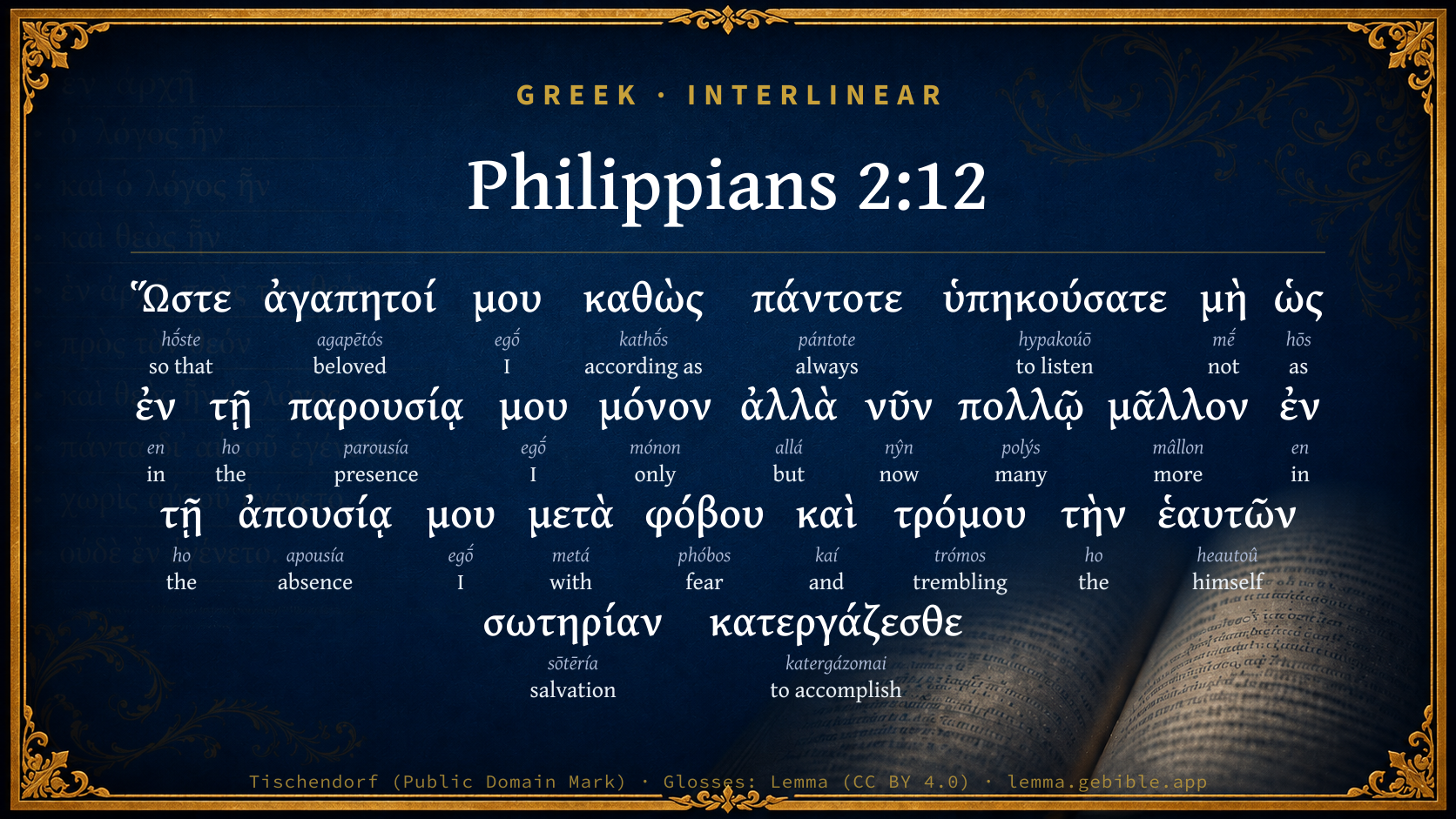
So then, my beloved, even as you have always obeyed, not only in my presence, but now much more in my absence, work out your own salvation with fear and trembling.
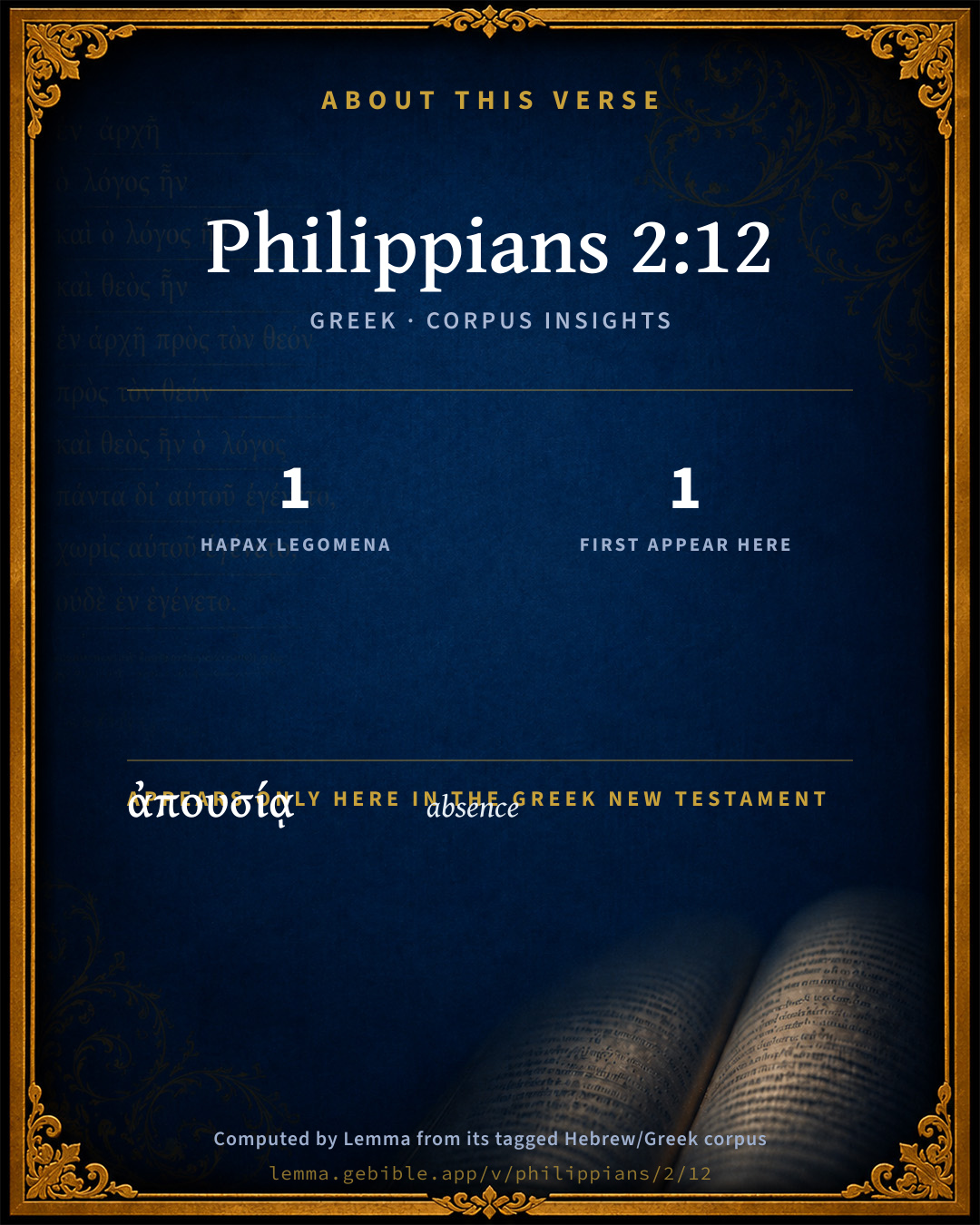
- 1 hapax legomenon — only here in the Greek New Testament
- 1 first appearance in the Greek New Testament
Download a study sheet
One document with this verse’s original text, its word-by-word gloss line, the meaning frame, cross-references with their text, attributed commentary, and full source and license credits — printable, and it pastes into notes with its structure intact.
This verse Autodidact and up
A passage Seminary Student
Up to 50 verses in one chapter. A passage sheet keeps up to 6 commentary sources and 12 cross-references per verse, in the order this page ranks them, and says so on the sheet whenever that leaves anything out. Ask for a single verse and you get the Autodidact verse sheet above.
Everything on this page stays free to read, with no account — the sheet is a download of what is already on screen, not access to it.
Compare translations 3
The same verse in 3 English versions, stacked beneath the original-language interlinear above. Click any original word for its lexicon entry.
Each is an independent rendering of the whole verse — the interlinear is not word-aligned to these translations.
Highlighted words mark where these versions differ — a whole-verse word diff, not a word-by-word alignment.
-
World English Bible Public Domain
So then, my beloved, even as you have always obeyed, not only in my presence, but now much more in my absence, work out your own salvation with fear and trembling.
-
King James Version Public Domain
Wherefore, my beloved, as ye have always obeyed, not as in my presence only, but now much more in my absence, work out your own salvation with fear and trembling.
-
unfoldingWord Literal Text CC BY-SA 4.0
So then, my beloved, just as you always obeyed, not only as in my presence, but now much more in my absence, work out your own salvation with fear and trembling.
unfoldingWord Literal Text — © unfoldingWord, licensed CC BY-SA 4.0. Word-aligned USFM3 via Door43 (git.door43.org/unfoldingWord/en_ult).
Show all 19 translations
Every available English version of this verse, each an independent rendering of the whole verse.
-
World English Bible Public Domain
So then, my beloved, even as you have always obeyed, not only in my presence, but now much more in my absence, work out your own salvation with fear and trembling.
-
Berean Standard Bible Public Domain
Therefore, my beloved, just as you have always obeyed, not only in my presence, but now even more in my absence, continue to work out your salvation with fear and trembling.
-
Majority Standard Bible Public Domain
Therefore, my beloved, just as you have always obeyed, not only in my presence, but now even more in my absence, continue to work out your salvation with fear and trembling.
-
King James Version Public Domain
Wherefore, my beloved, as ye have always obeyed, not as in my presence only, but now much more in my absence, work out your own salvation with fear and trembling.
-
American Standard Version (1901) Public Domain
So then, my beloved, even as ye have always obeyed, not as in my presence only, but now much more in my absence, work out your own salvation with fear and trembling;
-
Revised Version (1885) Public Domain
So then, my beloved, even as ye have always obeyed, not as in my presence only, but now much more in my absence, work out your own salvation with fear and trembling;
-
Geneva Bible (1599) Public Domain
Wherefore my beloued, as ye haue alwayes obeyed me, not as in my presence only, but now much more in mine absence, so make an end of your owne saluation with feare and trembling.
-
Douay-Rheims (1899) Public Domain
Wherefore, my dearly beloved, (as you have always obeyed, not as in my presence only, but much more now in my absence,) with fear and trembling work out your salvation.
-
Young's Literal Translation Public Domain
So that, my beloved, as ye always obey, not as in my presence only, but now much more in my absence, with fear and trembling your own salvation work out,
-
Literal Standard Version CC BY-SA 4.0
So that, my beloved, as you always obey, not as in my presence only, but now much more in my absence, work out your own salvation with fear and trembling,
-
Unlocked Literal Bible CC BY-SA 4.0
So then, my beloved, as you always obey, not only in my presence but now much more in my absence, work out your own salvation with fear and trembling.
-
unfoldingWord Literal Text CC BY-SA 4.0
So then, my beloved, just as you always obeyed, not only as in my presence, but now much more in my absence, work out your own salvation with fear and trembling.
-
Darby Bible Public Domain
So that, my beloved, even as ye have always obeyed, not as in my presence only, but now much rather in my absence, work out your own salvation with fear and trembling,
-
World Messianic Bible Public Domain
So then, my beloved, even as you have always obeyed, not only in my presence, but now much more in my absence, work out your own salvation with fear and trembling.
-
Webster's Bible Public Domain
Wherefore, my beloved, as ye have always obeyed, not as in my presence only, but now much more in my absence, work out your own salvation with fear and trembling.
-
Free Bible Version CC BY-SA 4.0
So, my good friends, continue to work towards the goal of salvation with complete reverence and respect for God, following what you were told—not just when I was with you, but even more so now I'm away from you.
-
Bible in Basic English Public Domain
So then, my loved ones, as you have at all times done what I say, not only when I am present, but now much more when I am not with you, give yourselves to working out your salvation with fear in your hearts;
-
Text-Critical English NT CC BY 4.0
Therefore, my beloved friends, just as you have always obeyed, not only in my presence, but now much more in my absence, work out your own salvation with fear and trembling,
-
Tyndale New Testament (1534) Public Domain
Wherfore my dearly beloved as ye have always obeyed not when I was present only but now moche more in myne absence even so worke out youre awne saluacion with feare and tremblynge.
Literal Standard Version (2020), Covenant Press — licensed CC BY-SA 4.0. Text via the HelloAO Bible API (eBible.org). Unlocked Literal Bible (unfoldingWord) — licensed CC BY-SA 4.0. Text via the HelloAO Bible API (eBible.org). unfoldingWord Literal Text — © unfoldingWord, licensed CC BY-SA 4.0. Word-aligned USFM3 via Door43 (git.door43.org/unfoldingWord/en_ult). Free Bible Version, Dr. Jonathan Gallagher — licensed CC BY-SA 4.0. Text via the HelloAO Bible API (eBible.org).
Word by word
More ways to search: Search by grammar → Find every occurrence → Compare this word →
Practice this passage: Drill this verse → Learn its vocabulary →
- Appears 1× in the Greek New Testament
- First appears here
- Part of Speech
- Noun
- Case
- Dative
- Number
- Singular
- Gender
- Feminine
Full Thayer's Definition
- Ὥστε hṓste G5620 “so that” Conjunction
- ἀγαπητοί agapētós G27 “beloved” Adjective, Vocative, Plural, Masculine
- μου egṓ G1473 “I” Personal pronoun, 1st person, Genitive, Singular
- καθὼς kathṓs G2531 “according as” Adverb
- πάντοτε pántote G3842 “always” Adverb
- ὑπηκούσατε hypakoúō G5219 “to listen” Verb, Aorist, Active, Indicative, 2nd person, Plural
- μὴ mḗ G3361 “not” Particle, Negative
- ὡς hōs G5613 “as” Adverb
- ἐν en G1722 “in” Preposition
- τῇ ho G3588 “the” Article, Dative, Singular, Feminine
- παρουσίᾳ parousía G3952 “presence” Noun, Dative, Singular, Feminine
- μου egṓ G1473 “I” Personal pronoun, 1st person, Genitive, Singular
- μόνον mónon G3440 “only” Adverb
- ἀλλὰ allá G235 “but” Conjunction
- νῦν nŷn G3568 “now” Adverb
- πολλῷ polýs G4183 “many” Adjective, Dative, Singular, Neuter
- μᾶλλον mâllon G3123 “more” Adverb
- ἐν en G1722 “in” Preposition
- τῇ ho G3588 “the” Article, Dative, Singular, Feminine
- ἀπουσίᾳ apousía G666 “absence” Noun, Dative, Singular, Feminine
- μου egṓ G1473 “I” Personal pronoun, 1st person, Genitive, Singular
- μετὰ metá G3326 “with” Preposition
- φόβου phóbos G5401 “fear” Noun, Genitive, Singular, Masculine
- καὶ kaí G2532 “and” Conjunction
- τρόμου trómos G5156 “trembling” Noun, Genitive, Singular, Masculine
- τὴν ho G3588 “the” Article, Accusative, Singular, Feminine
- ἑαυτῶν heautoû G1438 “himself” Reflexive pronoun, 2nd person, Genitive, Plural, Masculine
- σωτηρίαν sōtēría G4991 “salvation” Noun, Accusative, Singular, Feminine
- κατεργάζεσθε katergázomai G2716 “to accomplish” Verb, Present, Middle or Passive deponent, Imperative, 2nd person, Plural
About this verse
These counts appear in no published source. They are computed here, from the morphology-tagged text and Lemma’s own curated glosses. What Lemma adds →
- 29
- words
- 24
- distinct lemmas
- Pauline Epistles
- section
Notable vocabulary
1 hapax legomenon — a word that appears only here in the entire Greek New Testament:
- ἀπουσίᾳ absence G666
First appearance in Scripture
This word makes its first canonical appearance in the Greek New Testament here:
- ἀπουσίᾳ absence G666
Shared distinctive vocabulary
τρόμου trembling G5156 occurs in 5 verses of the Greek New Testament. Also found in:
Cross-references
40Topical passages linked to Philippians 2:12 in the Treasury of Scripture Knowledge — connected by theme and wording, ordered by reader-vote popularity; previews shown in the World English Bible.
- 2 Peter 1:5–10 Yes, and for this very cause adding on your part all diligence, in your faith supply moral excellence; and in moral excellence, knowledge;
- Luke 13:23–24 One said to him, "Lord, are they few who are saved?" He said to them,
- 1 Corinthians 15:58 Therefore, my beloved brothers, be steadfast, immovable, always abounding in the Lord's work, because you know that your labor is not in vain in the Lord.
- Hebrews 4:11 Let us therefore give diligence to enter into that rest, lest anyone fall after the same example of disobedience.
- 1 Peter 2:11 Beloved, I beg you as foreigners and pilgrims, to abstain from fleshly lusts, which war against the soul;
- Philippians 3:13–14 Brothers, I don't regard myself as yet having taken hold, but one thing I do. Forgetting the things which are behind, and stretching forward to the things which are before,
- John 6:27–29 Don't work for the food which perishes, but for the food which remains to eternal life, which the Son of Man will give to you. For God the Father has sealed him."
- Matthew 11:29 Take my yoke upon you, and learn from me, for I am gentle and lowly in heart; and you will find rest for your souls.
- Isaiah 66:2 For all these things has my hand made, and [so] all these things came to be, says Yahweh: but to this man will I look, even to him who is poor and of a contrite spirit, and who trembles at my word.
- Galatians 6:7–9 Don't be deceived. God is not mocked, for whatever a man sows, that will he also reap.
- Philippians 1:27 Only let your manner of life be worthy of the Gospel of Christ, that, whether I come and see you or am absent, I may hear of your state, that you stand firm in one spirit, with one soul striving for the faith of the Gospel;
- Hebrews 5:9 Having been made perfect, he became to all of those who obey him the author of eternal salvation,
- Romans 13:11–14 Do this, knowing the time, that it is already time for you to awaken out of sleep, for salvation is now nearer to us than when we first believed.
- 2 Peter 3:18 But grow in the grace and knowledge of our Lord and Savior Jesus Christ. To him be the glory both now and forever. Amen.
- Hebrews 12:28–29 Therefore, receiving a Kingdom that can't be shaken, let us have grace, through which we serve God acceptably, with reverence and awe,
- Proverbs 13:4 The soul of the sluggard desires, and has nothing, But the desire of the diligent shall be fully satisfied.
- Hebrews 4:1 Let us fear therefore, lest perhaps a promise being left of entering into his rest, anyone of you should seem to have come short of it.
- 2 Timothy 2:10 Therefore I endure all things for the chosen ones' sake, that they also may obtain the salvation which is in Christ Jesus with eternal glory.
- Hebrews 12:1 Therefore let us also, seeing we are surrounded by so great a cloud of witnesses, lay aside every weight and the sin which so easily entangles us, and let us run with patience the race that is set before us,
- Psalms 119:120 My flesh trembles for fear of you. I am afraid of your judgments.
- Romans 2:7 to those who by patience in well-doing seek for glory and honor and incorruptibility, eternal life;
- Philippians 4:1 Therefore, my brothers, beloved and longed for, my joy and crown, so stand firm in the Lord, my beloved.
- Hebrews 6:10–11 For God is not unrighteous, so as to forget your work and the labor of love which you showed toward his name, in that you served the saints, and still do serve them.
- Psalms 2:11 Serve Yahweh with fear, And rejoice with trembling.
- Philippians 1:29 Because it has been granted to you on behalf of Christ, not only to believe in him, but also to suffer on his behalf,
- 1 Thessalonians 1:3 remembering without ceasing your work of faith and labor of love and patience of hope in our Lord Jesus Christ, before our God and Father.
- 1 Corinthians 2:3 I was with you in weakness, in fear, and in much trembling.
- 2 Corinthians 7:15 His affection is more abundantly toward you, while he remembers all of your obedience, how with fear and trembling you received him.
- Ephesians 6:5 Servants, be obedient to those who according to the flesh are your masters, with fear and trembling, in singleness of your heart, as to Christ;
- Proverbs 10:16 The labor of the righteous leads to life. The increase of the wicked leads to sin.
- Isaiah 66:5 Hear the word of Yahweh, you who tremble at his word: Your brothers who hate you, who cast you out for my name's sake, have said, Let Yahweh be glorified, that we may see your joy; but it is those who shall be disappointed.
- 1 Corinthians 9:20–27 To the Jews I became as a Jew, that I might gain Jews; to those who are under the law, as under the law, that I might gain those who are under the law;
- Matthew 11:12 From the days of John the Baptizer until now, the Kingdom of Heaven suffers violence, and the violent take it by force.
- Ezra 10:3 Now therefore let us make a covenant with our God to put away all the wives, and such as are born of them, according to the counsel of my lord, and of those who tremble at the commandment of our God; and let it be done according to the law.
- Acts 9:6 But rise up, and enter into the city, and you will be told what you must do."
- Philippians 1:5 for your partnership in furtherance of the Gospel from the first day until now;
- 1 Corinthians 4:14 I don't write these things to shame you, but to admonish you as my beloved children.
- Philippians 2:19 But I hope in the Lord Jesus to send Timothy to you soon, that I also may be cheered up when I know how you are doing.
- Acts 16:29 He called for lights and sprang in, and, fell down trembling before Paul and Silas,
- Philippians 4:15 You yourselves also know, you Philippians, that in the beginning of the Gospel, when I departed from Macedonia, no assembly shared with me in the matter of giving and receiving but you only.
Cross-references courtesy of OpenBible.info (CC BY 4.0).
Lesson kit
Teaching starters — assembled from the data on this page, not authored interpretation. Every prompt links to the verse data it draws on. Edit before teaching.
Philippians, in the Pauline Epistles, opens this verse with 29 words (24 distinct Greek lemmas). Its most distinctive word is apousía (“absence”). A historical commentator’s framing appears above. Read the whole chapter for the surrounding context.
Discussion questions
- The word apousía carries the sense “absence.” How does it shape the verse?
- This verse holds 1 word here found nowhere else in the Greek New Testament. What might the rare word draw attention to?
- The word “absence” first appears here in Scripture. What is being introduced at this debut?
- Mark 16:8 shares the word «trembling» with this verse. How do the two illuminate each other?
- “I” occurs 3× in this one verse. What is the effect of the repetition?
- The translations on this page render this verse differently — a whole-verse word diff, not a word-by-word alignment. What might account for the different wordings?
- Reading how Matthew Henry's Commentary and Ellicott's Commentary for English Readers read this verse, where do the two commentators agree and where do they part?
Things to notice
- 1 word in this verse appears nowhere else in the Greek New Testament.
- 1 word makes its first canonical appearance in Scripture here.
- These translations choose different wording for 5 words in this verse.
- “I” occurs 3× in this single verse.
- 24 distinct Greek lemmas span 29 words in this verse.
Commentary
Notes on Philippians 2:12 from classic Christian and Jewish commentators (each source and its license shown beneath its notes). The classic Christian expositions comment on the surrounding passage and are grouped to its opening verse, so a note may address several verses; the Jewish commentaries on the Tanakh (Rashi and others) are per-verse, so they appear only where the commentator wrote on this verse.
Lemma curates 59 commentaries, every one of them public domain or Creative Commons licensed, each selected and text-cleaned for this edition rather than reprinted as found. About our sources →
Matthew Henry's Commentary
Matthew Henry's Commentary on the Whole Bible (1708–1710) — public domain (CC PDM 1.0). Text via the HelloAO Bible API.
Ellicott's Commentary for English Readers
A Bible Commentary for English Readers, edited by Charles John Ellicott (1878–1897) — public domain. Text from a community e-Sword module.
The Biblical Illustrator
Joseph S. Exell
The Biblical Illustrator, edited by Joseph S. Exell (c. 1880s–1900s) — public domain. Text from a community e-Sword module.
Whedon's Commentary on the Bible
Daniel D. Whedon
Daniel D. Whedon (gen. ed.), Commentary on the Old and New Testaments (1874–1909) — public domain. Text from a community e-Sword module.
The Preacher's Complete Homiletical Commentary
Joseph S. Exell (gen. ed.)
The Preacher's Complete Homiletical Commentary (gen. ed. Joseph S. Exell; Funk & Wagnalls, c. 1892) — public domain (pre-1929). A full-Bible homiletical/sermon-outline anthology covering 65 of 66 books (2 John is absent from the source module). Text from a community e-Sword module.
Lange's Commentary on the Holy Scriptures
Lange's Commentary on the Holy Scriptures (Critical, Doctrinal, and Homiletical), ed. John Peter Lange, English translation edited by Philip Schaff (1864–1880) — public domain. Text from a community e-Sword module.
MacLaren's Expositions of Holy Scripture
Alexander MacLaren
Alexander MacLaren, Expositions of Holy Scripture (1904–1910) — public domain. Text from a community e-Sword module.
Kretzmann's Popular Commentary
Paul E. Kretzmann
Paul E. Kretzmann, Popular Commentary of the Bible (1921–1924) — public domain. Text from a community e-Sword module.
The Expositor's Bible
William Robertson Nicoll, ed., The Expositor's Bible (London: Hodder & Stoughton, 1887–1910) — public domain. 65 of 66 books (1 Corinthians is not separately keyed, as that volume carries no machine-parseable verse references); section-level commentary keyed to the opening verse. Introductory and overview sections not keyed to a specific passage are excluded.
Tyndale Open Study Notes
Tyndale Open Resources
Tyndale Open Study Notes — © Tyndale Open Resources, licensed CC BY-SA 4.0. Text via the HelloAO Bible API.
Bengel's Gnomon
Johann Albrecht Bengel
Bengel's Gnomon of the New Testament — English translation (T&T Clark, Edinburgh, 1860) — public domain. Text from a community e-Sword module.
Meyer's Critical & Exegetical Commentary
Heinrich August Wilhelm Meyer
Meyer — Critical and Exegetical Commentary on the New Testament — English translation by Peter Christie, edited by Frederick Crombie (T&T Clark, 1880) — public domain. Text from a community e-Sword module.
Expositor's Greek Testament
ed. W. Robertson Nicoll
The Expositor's Greek Testament, edited by W. Robertson Nicoll (1897–1910) — public domain. Text from a community e-Sword module.
Geneva Bible (1599)
Geneva Bible translators
Geneva Bible (1599) marginal notes — public domain. Text via Bolls.life.
Jamieson, Fausset & Brown
Robert Jamieson, A. R. Fausset & David Brown
Jamieson, Fausset & Brown — Commentary Critical and Explanatory on the Whole Bible (1871) — public domain (CC PDM 1.0). Text via the HelloAO Bible API.
Adam Clarke's Commentary
Adam Clarke's Commentary on the Bible (1810–1826) — public domain. Text from a community e-Sword/MySword module.
John Calvin's Commentaries
John Calvin's Commentaries (1540-1563) — public domain. Text from the Calvin Translation Society English edition (1840s-50s) via the Christian Classics Ethereal Library (ccel.org). Calvin's coverage is partial (roughly two-thirds of the Bible); uncommented books and verses are honest gaps, never fabricated. The 19th-century editor's footnotes and remarks are omitted so the notes are faithfully Calvin's own voice.
The Cambridge Bible for Schools and Colleges
gen. ed. J. J. S. Perowne
The Cambridge Bible for Schools and Colleges (gen. ed. J. J. S. Perowne; Cambridge University Press, 1878–1918) — public domain. Text from a community e-Sword module.
John Gill's Exposition
John Gill's Exposition of the Whole Bible (1746–1763) — public domain (CC PDM 1.0). Text via the HelloAO Bible API.
Trapp's Complete Commentary
John Trapp
John Trapp, A Commentary or Exposition upon All the Books of the Old and New Testament (1647–1656) — public domain. Text from a community e-Sword module.
Albert Barnes' Notes on the Bible
Albert Barnes' Notes on the Bible (1834–1885) — public domain. Text from a community e-Sword/MySword module.
Haydock's Catholic Bible Commentary
George Leo Haydock (1774–1849), Haydock's Catholic Family Bible and Commentary, 1859 edition — public domain. Excludes Psalms (Douay-Rheims chapter numbering differs from Protestant) and Deuterocanonical books (Catholic canon only).
Matthew Poole's English Annotations
Matthew Poole's English Annotations on the Holy Bible (1683–1685) — public domain. Text from a community e-Sword/MySword module.
The Pulpit Commentary
The Pulpit Commentary (1880–1919), ed. H.D.M. Spence-Jones & Joseph S. Exell — public domain. Text from a community e-Sword module.
John Wesley's Explanatory Notes
John Wesley, Explanatory Notes Upon the Whole Bible (1754–1765) — public domain. Text via the GEBible commentary corpus.
Scofield Reference Notes
C. I. Scofield
The Scofield Reference Bible (1917 edition), notes by C. I. Scofield — public domain. Text from a community e-Sword module.
Burkitt's Expository Notes on the New Testament
William Burkitt
William Burkitt's Expository Notes on the New Testament (1700–1703) — public domain. Text from a community e-Sword module.
Godbey's Commentary on the New Testament
William B. Godbey
William B. Godbey, Commentary on the New Testament (1896–1900) — public domain. Text from a community e-Sword module.
The People's New Testament
B. W. Johnson
B. W. Johnson's The People's New Testament with Notes (1889–1891) — public domain. Electronic text from the Christian Classics Ethereal Library (CCEL) ThML edition.
unfoldingWord translationNotes
Door43 World Missions Community
unfoldingWord translationNotes — © Distant Shores Media and the Door43 World Missions Community, licensed CC BY-SA 4.0. Source: git.door43.org/Door43/en_tn.
Cambridge Greek Testament for Schools and Colleges
Cambridge Greek Testament for Schools and Colleges (Cambridge University Press, 1896; 21 vols, various authors incl. Carr, Maclear, Plummer, Farrar, Lumby, Moule, M. R. James, Simcox) — public domain. Text from a community e-Sword module.
Alford’s Greek Testament
Henry Alford
Henry Alford, The Greek Testament (1849–1861) — public domain. Text from a community e-Sword module.
International Critical Commentary
International Critical Commentary — older volumes (1896–1929), various authors — public domain. Text from a community e-Sword module.
Vincent's Word Studies in the New Testament
Marvin R. Vincent
Marvin R. Vincent, Word Studies in the New Testament (1887–1900) — public domain. Text from a community e-Sword/MySword module.