1 Peter 2:25

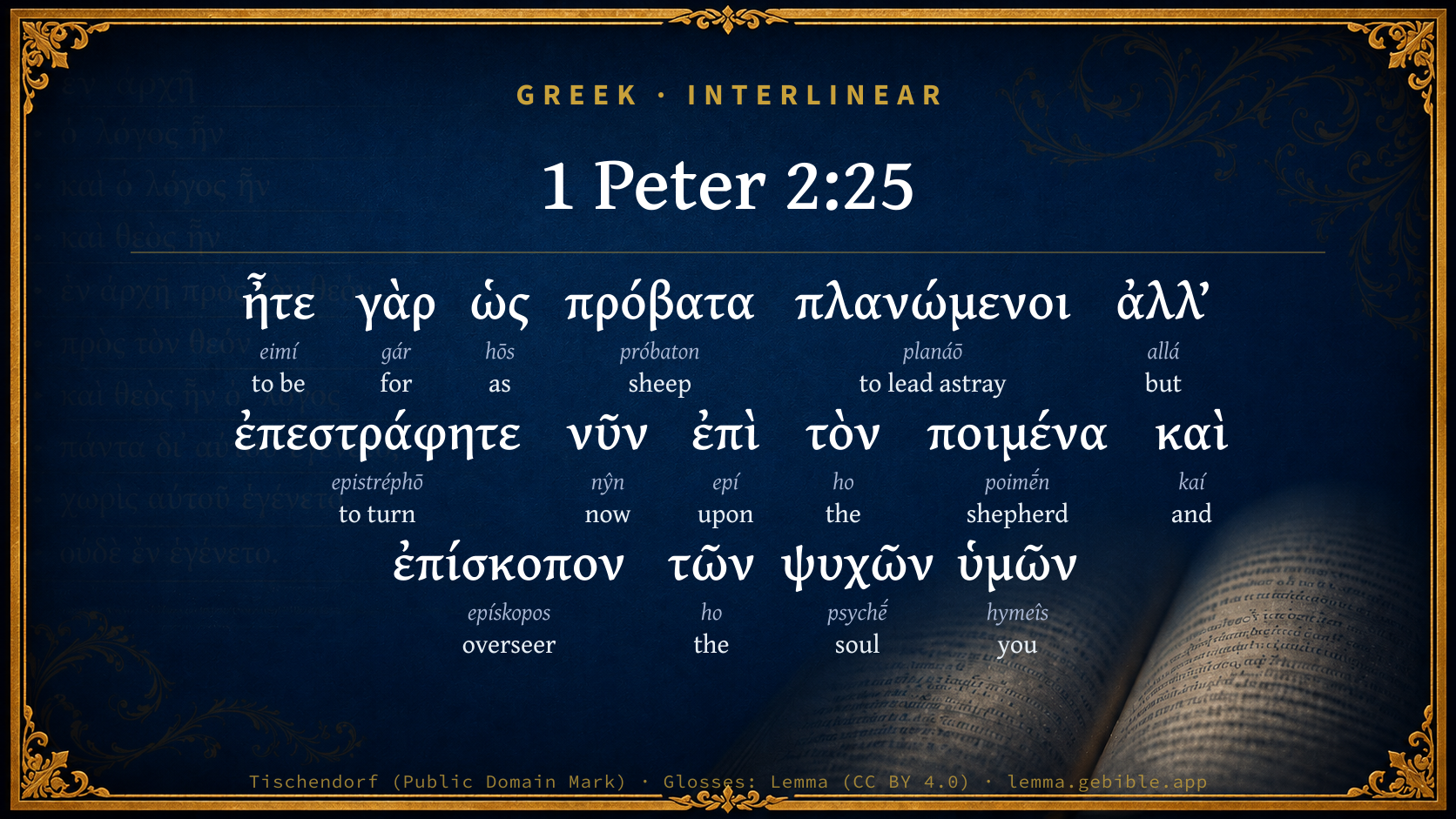
Greek (Tischendorf 8th ed.) 1 Peter 2:25 appears in the Greek New Testament. The text above is from the Tischendorf 8th edition. Each word links to its Strong’s number and a concise gloss. Click any word for its full Thayer’s Greek Lexicon entry.
Download image
Cite this verse

1 Peter 2:25 (World English Bible). Public Domain. Lemma interlinear Bible study tool, https://lemma.gebible.app/v/1-peter/2/25.

Show BibTeX & RIS
BibTeX
RIS
English Translation
For you were going astray like sheep; but are now returned to the Shepherd and Overseer of your souls.
World English Bible · Public Domain
Download a study sheet

One document with this verse’s original text, its word-by-word gloss line, the meaning frame, cross-references with their text, attributed commentary, and full source and license credits — printable, and it pastes into notes with its structure intact.

This verse Autodidact and up

Study sheet (.html) Plain text (.txt)

A passage Seminary Student

Up to 50 verses in one chapter. A passage sheet keeps up to 6 commentary sources and 12 cross-references per verse, in the order this page ranks them, and says so on the sheet whenever that leaves anything out. Ask for a single verse and you get the Autodidact verse sheet above.

Everything on this page stays free to read, with no account — the sheet is a download of what is already on screen, not access to it.

Want to remove ads? Support Godless Engineer
Compare translations 3

The same verse in 3 English versions, stacked beneath the original-language interlinear above. Click any original word for its lexicon entry.

Each is an independent rendering of the whole verse — the interlinear is not word-aligned to these translations.

Highlighted words mark where these versions differ — a whole-verse word diff, not a word-by-word alignment.

  • World English Bible Public Domain
    For you were going astray like sheep; but are now returned to the Shepherd and Overseer of your souls.
  • King James Version Public Domain
    For ye were as sheep going astray; but are now returned unto the Shepherd and Bishop of your souls.
  • unfoldingWord Literal Text CC BY-SA 4.0
    For you were like straying sheep, but now you have been turned back to the shepherd and overseer of your souls.

unfoldingWord Literal Text — © unfoldingWord, licensed CC BY-SA 4.0. Word-aligned USFM3 via Door43 (git.door43.org/unfoldingWord/en_ult).

Versions to compare (up to 4)

3 of 4 selected

Show all 19 translations

Every available English version of this verse, each an independent rendering of the whole verse.

  • World English Bible Public Domain
    For you were going astray like sheep; but are now returned to the Shepherd and Overseer of your souls.
  • Berean Standard Bible Public Domain
    For “you were like sheep going astray,” but now you have returned to the Shepherd and Overseer of your souls.
  • Majority Standard Bible Public Domain
    For “you were like sheep going astray,” but now you have returned to the Shepherd and Overseer of your souls.
  • King James Version Public Domain
    For ye were as sheep going astray; but are now returned unto the Shepherd and Bishop of your souls.
  • American Standard Version (1901) Public Domain
    For ye were going astray like sheep; but are now returned unto the Shepherd and Bishop of your souls.
  • Revised Version (1885) Public Domain
    For ye were going astray like sheep; but are now returned unto the Shepherd and Bishop of your souls.
  • Geneva Bible (1599) Public Domain
    For ye were as sheepe going astray: but are nowe returned vnto the shepheard and Bishop of your soules.
  • Douay-Rheims (1899) Public Domain
    For you were as sheep going astray; but you are now converted to the shepherd and bishop of your souls.
  • Young's Literal Translation Public Domain
    for ye were as sheep going astray, but ye turned back now to the shepherd and overseer of your souls.
  • Literal Standard Version CC BY-SA 4.0
    for you were as sheep going astray, but now you turned back to the Shepherd and Overseer of your souls.
  • Unlocked Literal Bible CC BY-SA 4.0
    All of you had been wandering away like lost sheep, but now you have returned to the shepherd and guardian of your souls.
  • unfoldingWord Literal Text CC BY-SA 4.0
    For you were like straying sheep, but now you have been turned back to the shepherd and overseer of your souls.
  • Darby Bible Public Domain
    For ye were going astray as sheep, but have now returned to the shepherd and overseer of your souls.
  • World Messianic Bible Public Domain
    For you were going astray like sheep; but now you have returned to the Shepherd and Overseer of your souls.
  • Webster's Bible Public Domain
    For ye were as sheep going astray; but are now returned to the Shepherd and Bishop of your souls.
  • Free Bible Version CC BY-SA 4.0
    At one time you were like sheep who had lost their way, but now you've returned to the Shepherd—the one who watches over you.
  • Bible in Basic English Public Domain
    Because, like sheep, you had gone out of the way; but now you have come back to him who keeps watch over your souls.
  • Text-Critical English NT CC BY 4.0
    For you were like sheep going astray, but now you have returned to the Shepherd and Overseer of your souls.
  • Tyndale New Testament (1534) Public Domain
    For ye were as shepe goinge astraye: but are now returned vnto the shepheerd and bisshoppe of youre soules.

Literal Standard Version (2020), Covenant Press — licensed CC BY-SA 4.0. Text via the HelloAO Bible API (eBible.org). Unlocked Literal Bible (unfoldingWord) — licensed CC BY-SA 4.0. Text via the HelloAO Bible API (eBible.org). unfoldingWord Literal Text — © unfoldingWord, licensed CC BY-SA 4.0. Word-aligned USFM3 via Door43 (git.door43.org/unfoldingWord/en_ult). Free Bible Version, Dr. Jonathan Gallagher — licensed CC BY-SA 4.0. Text via the HelloAO Bible API (eBible.org).

Word by word

More ways to search: Search by grammar → Find every occurrence → Compare this word →

Practice this passage: Drill this verse → Learn its vocabulary →

ἐπίσκοπον
epískopos
G1985
“overseer”
Noun, Accusative, Singular, Masculine
Part of Speech
Noun
Case
Accusative
Number
Singular
Gender
Masculine
Full Thayer's Definition

Origin: from G1909 and G4649 (in the sense of G1983 )

TDNT: 12:08,2

1. an overseer a. a man charged with the duty of seeing that things to be done by others are done rightly, any curator, guardian or superintendent b. the superintendent, elder, or overseer of a Christian church
  1. ἦτε eimí G1510 “to be” Verb, Imperfect, Active, Indicative, 2nd person, Plural
  2. γὰρ gár G1063 “for” Conjunction
  3. ὡς hōs G5613 “as” Adverb
  4. πρόβατα próbaton G4263 “sheep” Noun, Nominative, Plural, Neuter
  5. πλανώμενοι planáō G4105 “to lead astray” Verb, Present, Passive, Participle, Nominative, Plural, Masculine
  6. ἀλλ’ allá G235 “but” Conjunction
  7. ἐπεστράφητε epistréphō G1994 “to turn” Verb, Aorist, Passive, Indicative, 2nd person, Plural
  8. νῦν nŷn G3568 “now” Adverb
  9. ἐπὶ epí G1909 “upon” Preposition
  10. τὸν ho G3588 “the” Article, Accusative, Singular, Masculine
  11. ποιμένα poimḗn G4166 “shepherd” Noun, Accusative, Singular, Masculine
  12. καὶ kaí G2532 “and” Conjunction
  13. τῶν ho G3588 “the” Article, Genitive, Plural, Feminine
  14. ψυχῶν psychḗ G5590 “soul” Noun, Genitive, Plural, Feminine
  15. ὑμῶν hymeîs G5210 “you” Personal pronoun, 2nd person, Genitive, Plural

About this verse

These counts appear in no published source. They are computed here, from the morphology-tagged text and Lemma’s own curated glosses. What Lemma adds →

16
words
15
distinct lemmas
General Epistles
section

Notable vocabulary

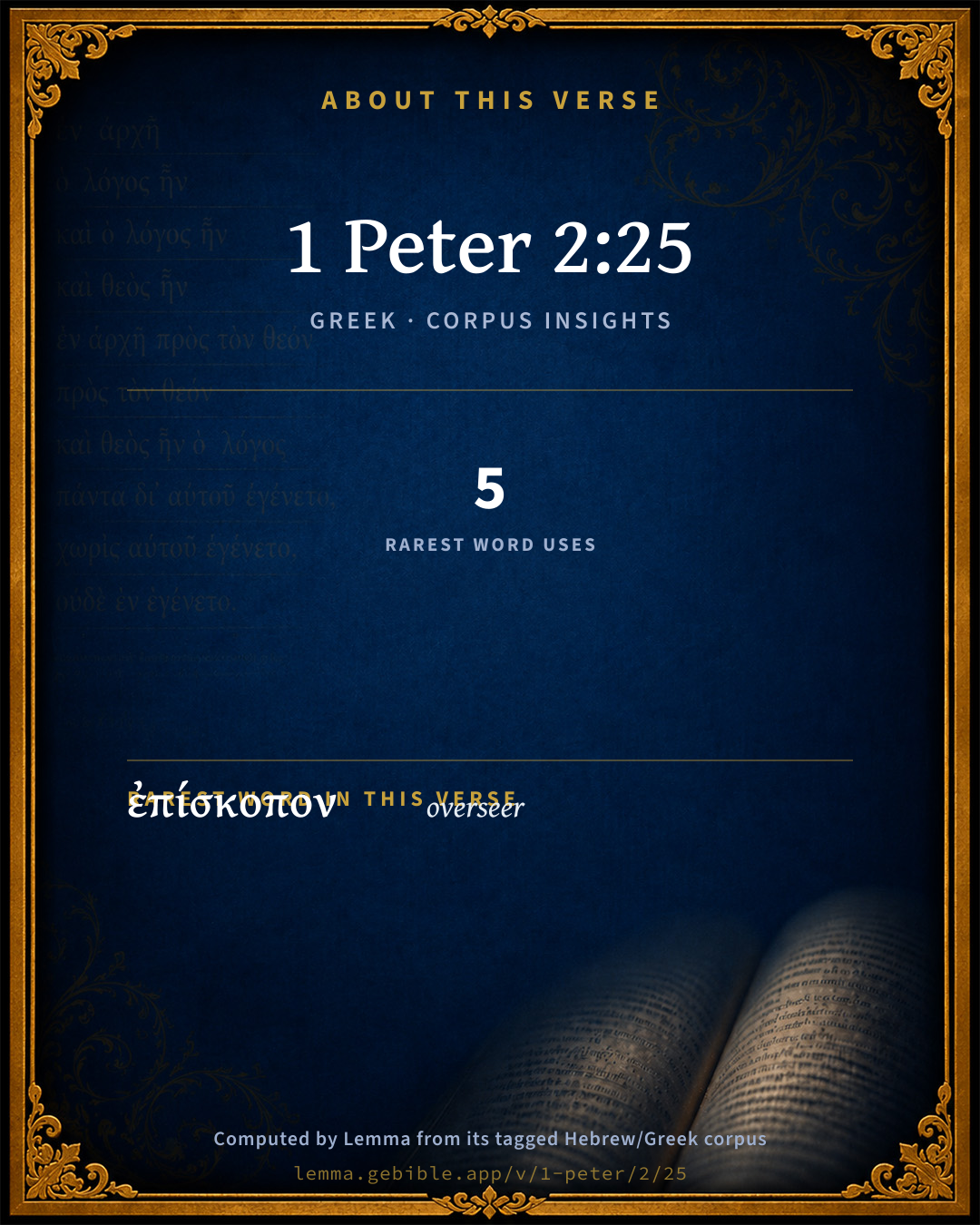
The rarest word here is ἐπίσκοπον overseer G1985 — appearing just 5 times in the whole Greek New Testament.

Shared distinctive vocabulary

ἐπίσκοπον overseer G1985 occurs in 5 verses of the Greek New Testament. Also found in:

Repetition

A word recurs within this verse:

Cross-references

20

Topical passages linked to 1 Peter 2:25 in the Treasury of Scripture Knowledge — connected by theme and wording, ordered by reader-vote popularity; previews shown in the World English Bible.

  • Isaiah 53:6 All we like sheep have gone astray; everyone has turned to his own way; and Yahweh has laid on him the iniquity of us all.
  • Ezekiel 34:6 My sheep wandered through all the mountains, and on every high hill: yes, my sheep were scattered on all the surface of the earth; and there was none who searched or sought.
  • Luke 15:4–6 "Which of you men, if you had one hundred sheep, and lost one of them, wouldn't leave the ninety-nine in the wilderness, and go after the one that was lost, until he found it?
  • Acts 20:28 Take heed, therefore, to yourselves, and to all the flock, in which the Holy Spirit has made you overseers, to shepherd the assembly of the Lord and God which he purchased with his own blood.
  • John 10:11–16 I am the good shepherd. The good shepherd lays down his life for the sheep.
  • Isaiah 40:11 He will feed his flock like a shepherd, he will gather the lambs in his arm, and carry them in his bosom, [and] will gently lead those who have their young.
  • Psalms 119:176 I have gone astray like a lost sheep. Seek your servant, for I don't forget your commandments.
  • Ezekiel 34:11–16 For thus says the Lord Yahweh: Behold, I myself, even I, will search for my sheep, and will seek them out.
  • Matthew 9:36 But when he saw the multitudes, he was moved with compassion for them, because they were harassed and scattered, like sheep without a shepherd.
  • Ezekiel 34:23–24 I will set up one shepherd over them, and he shall feed them, even my servant David; he shall feed them, and he shall be their shepherd.
  • Matthew 18:12 "What do you think? If a man has one hundred sheep, and one of them goes astray, doesn't he leave the ninety-nine, go to the mountains, and seek that which has gone astray?
  • Psalms 23:1–3 Yahweh is my shepherd: I shall lack nothing.
  • 1 Peter 5:4 When the chief Shepherd is revealed, you will receive the crown of glory that doesn't fade away.
  • Hebrews 13:20 Now may the God of peace, who brought again from the dead the great shepherd of the sheep with the blood of an eternal covenant, our Lord Jesus,
  • Jeremiah 23:2 Therefore thus says Yahweh, the God of Israel, against the shepherds who feed my people: You have scattered my flock, and driven them away, and have not visited them; behold, I will visit on you the evil of your doings, says Yahweh.
  • Hebrews 3:1 Therefore, holy brothers, partakers of a heavenly calling, consider the Apostle and High Priest of our confession, Jesus;
  • Song of Solomon 1:7–8 Tell me, you whom my soul loves, Where you graze your flock, Where you rest them at noon; For why should I be as one who is veiled Beside the flocks of your companions? Lover
  • Ezekiel 37:24 My servant David shall be king over them; and they all shall have one shepherd: they shall also walk in my ordinances, and observe my statutes, and do them.
  • Psalms 80:1 Hear us, Shepherd of Israel, You who lead Joseph like a flock, You who sit above the cherubim, shine forth.
  • Zechariah 13:7 "Awake, sword, against my shepherd, And against the man who is close to me," says Yahweh of Hosts. Strike the shepherd, and the sheep will be scattered; And I will turn my hand against the little ones.

Cross-references courtesy of OpenBible.info (CC BY 4.0).

Commentary

Notes on 1 Peter 2:25 from classic Christian and Jewish commentators (each source and its license shown beneath its notes). The classic Christian expositions comment on the surrounding passage and are grouped to its opening verse, so a note may address several verses; the Jewish commentaries on the Tanakh (Rashi and others) are per-verse, so they appear only where the commentator wrote on this verse.

Lemma curates 59 commentaries, every one of them public domain or Creative Commons licensed, each selected and text-cleaned for this edition rather than reprinted as found. About our sources →

Bengel's Gnomon

Johann Albrecht Bengel

1Pe 2:25. Οὑ τῷ μώλωπι αὐτοῦ ἰάθητε ἦτε γὰρ ὡς πρόβατα πλανώμενα, by whose stripe ye were healed; for ye were as sheep going astray) Isa 53:5-6, Septuagint, τῷ μώλωπι αὐτοῦ ἡμεῖς ἰάθημεν· πάντες ὡς πρόβατα ἐπλανήθημεν. A paradox of the apostle: Ye were healed with a stripe. But μώλωψ, a weal, is common on the person of a slave: Sir 23:10.—ποιμένα καὶ ἐπίσκοπον, shepherd and bishop) whom you are bound to obey. Synonymous words. Comp. ch 1Pe 5:2.

Bengel's Gnomon of the New Testament — English translation (T&T Clark, Edinburgh, 1860) — public domain. Text from a community e-Sword module.

Meyer's Critical & Exegetical Commentary

Heinrich August Wilhelm Meyer

1Pe_2:25. ἦτε γὰρ ὡς πρόβατα πλανώμενοι] This explanatory clause (γάρ) points back, as the continuance in it of the direct address (ἰάθητε … ἦτε) shows, in the first instance, to the statement immediately preceding οὗ τῷ μώλωπι ἰάθητε, but at the same time also to the thought ἵνα … τῇ δικαιοσύνῃ ζήσωμεν, to which that assertion is subservient. For the foregoing figure a new one is substituted, after Isa_53:6 : LXX. πάντες ὡς πρόβατα ἐπλανήθημεν; if πλανώμενοι be the correct reading, then from it the nearer definition of πρόβατα is to be supplied, the sheep are to be thought of as those which have no shepherd (Mat_9:36 : ὡσεὶ πρόβατα μὴ ἔχοντα ποιμένα; comp. Num_27:17; 1Ki_22:17).

For the figure describing the state of man separated in his sin from God, comp. Mat_18:12-13; Luk_15:4 ff.

ἀλλʼ ἐπεστράφητε νῦν] ἐπεστράφητε is, in harmony with the uniform usage of Scripture, to be taken not in a passive (Wiesinger, Schott), but in a middle sense: ye have turned yourselves.[164] Luther translates: but ye are now turned. The word ἘΠΙΣΤΡΈΦΕΙΝ means to turn oneself away from (ἈΠΌ, ἘΚ), towards something (ἘΠΊ, ΠΡΌς, ΕἸς), (sometimes equal to: to turn round); but it is not implied in the word itself that the individual has formerly been in that place towards which he has now turned round, and whither he is going (therefore, in Gal_4:9, ΠΆΛΙΝ is expressly added). Weiss (p. 122) is therefore wrong when from this very word he tries to prove that by ΠΟΙΜΉΝ God, and not Christ, is to be understood, although the term sometimes includes in it the secondary idea of back; cf. 2Pe_2:21-22.

ἘΠῚ ΤῸΝ ΠΟΙΜΈΝΑ ΚΑῚ ἘΠΊΣΚΟΠΟΝ ΤῶΝ ΨΥΧῶΝ ὙΜῶΝ] cf. especially Eze_34:11-12; Eze_34:16, LXX.: ἘΓῺ ἘΚΖΗΤΉΣΩ ΤᾺ ΠΡΌΒΑΤΆ ΜΟΥ ΚΑῚ ἘΠΙΣΚΈΨΟΜΑΙ ΑὐΤΆ, ὭΣΠΕΡ ΖΗΤΕῖ Ὁ ΠΟΙΜῊΝ ΤῸ ΠΟΊΜΝΙΟΝ ΑὐΤΟῦ … ΤῸ ΠΛΑΝΏΜΕΝΟΝ ἈΠΟΣΤΡΈΨΩ; besides, with ΠΟΙΜΉΝ, Psa_23:1; Isa_40:11. From the fact that in these passages God is spoken of as the shepherd, it must not be concluded, with Weiss, that ΠΟΙΜῊΝ ΚΑῚ ἘΠΊΣΚΟΠΟς refers not to Christ, but to God. For not only has God, calling Himself a shepherd, promised a shepherd (Eze_34:24, LXX.: ἀναστήσω ἐπʼ αὐτοὺς ποιμένα ἕνα … τὸν δοῦλον μου Δαυίδ, Eze_37:24), but Christ, too, speaks of Himself as the good Shepherd; and Peter himself, in chap. 1Pe_5:4, calls Him ἈΡΧΙΠΟΙΜΉΝ. In comparison with these passages, chap. 1Pe_5:2 is plainly of no account. All interpretersexcept Weissrightly understand the expressions here used as applying to Christ. The designation ἘΠΊΣΚΟΠΟς would all the more naturally occur to the apostle, as it was, like ΠΟΙΜΉΝ, the name of the presidents of the churches who were, so to speak, the representatives of the One Shepherd and Bishop, the Head of the whole church.

ΤῶΝ ΨΥΧῶΝ ὙΜῶΝ belongs, as the omission of the article before ἙΠΊΣΚΟΠΟΝ shows, to both words; with the expression, cf. chap. 1Pe_1:9; 1Pe_1:22.

[164] Schotts counter-remark: The question is not here what they did, but what in Christ was imparted to them, has all the less weight, that conversion, though the personal act of the Christian, must still be regarded as effected by Christ. Hofmann maintains, without the slightest right to do so, that in this passage the chief emphasis lies on the readers own act, though at the same time he correctly understands ἐπεστράφητε in a middle sense.

Meyer — Critical and Exegetical Commentary on the New Testament — English translation by Peter Christie, edited by Frederick Crombie (T&T Clark, 1880) — public domain. Text from a community e-Sword module.

Expositor's Greek Testament

ed. W. Robertson Nicoll

1Pe 2:25 = Isa 53:6 , πάντες ὡς πρόβατα ἐπλανήθημεν combined with Eze 34:6 , where this conception of the people and their teachers ( the shepherds of Israel ) is elaborated and the latter denounced because τὸ πλανώμενον οὐκ ἐπεστρέψατε Further the use of this metaphor in the context presupposes the saying I am the good shepherd.… I lay down my life for the sheep (Joh 12:15 ). ἐπίσκοπον , cf. Eze 34:11 , ἰδοὺ ἐγὼ ἐκζητήσω τὰ πρόβατά μου καὶ ἐπισκέψομαι αὐτά . It is to be noted that the command which Jesus laid on Peter, feeding sheep , comes from Ez. I.c.

The Expositor's Greek Testament, edited by W. Robertson Nicoll (1897–1910) — public domain. Text from a community e-Sword module.

Jamieson, Fausset & Brown

Robert Jamieson, A. R. Fausset & David Brown

(Isa 53:6.)

For--Assigning their natural need of healing (Pe1 2:24).

now--Now that the atonement for all has been made, the foundation is laid for individual conversion: so "ye are returned," or "have become converted to," &c.

Shepherd and Bishop--The designation of the pastors and elders of the Church belongs in its fullest sense to the great Head of the Church, "the good Shepherd." As the "bishop" oversees (as the Greek term means), so "the eyes of the Lord are over the righteous" (Pe1 3:12). He gives us His spirit and feeds and guides us by His word. "Shepherd," Hebrew, "Parnas," is often applied to kings, and enters into the composition of names, as "Pharnabazus."

Next: 1 Peter Chapter 3

Jamieson, Fausset & Brown — Commentary Critical and Explanatory on the Whole Bible (1871) — public domain (CC PDM 1.0). Text via the HelloAO Bible API.

Adam Clarke's Commentary

Verse 25. For ye were as sheep going astray] Formerly ye were not in a better moral condition than your oppressors; ye were like stray sheep, in the wilderness of ignorance and sin, till Christ, the true and merciful Shepherd, called you back from your wanderings, by sending you the Gospel of his grace.

Bishop of your souls.] Unless we consider the word bishop as a corruption of the word επισκοπος episcopos, and that this literally signifies an overseer, an inspector, or one that has the oversight, it can convey to us no meaning of the original. Jesus Christ is the Overseer of souls; he has them continually under his eye; he knows their wants, wishes, dangers, c., and provides for them. As their shepherd, he leads them to the best pastures, defends them from their enemies, and guides them by his eye. Jesus is the good Shepherd that laid down his life for his sheep. All human souls are inexpressibly dear to him, as they are the purchase of his blood. He is still supreme Bishop or Overseer in his Church. He alone is Episcopus episcoporum, "the Bishop of bishops" a title which the Romish pontiffs have blasphemously usurped. But this is not the only attribute of Jesus on which they have laid sacrilegious hands. And besides this, with force and with cruelty have they ruled the sheep: but the Lord is breaking the staff of their pride, and delivering the nations from the bondage of their corruption. Lord, let thy kingdom come!

Adam Clarke's Commentary on the Bible (1810–1826) — public domain. Text from a community e-Sword/MySword module.

John Calvin's Commentaries

25 For ye were as sheep This also has Peter borrowed from Isaiah, except that the Prophet makes it a universal statement,

“All we like sheep have gone astray.” (Isaiah 53:6.)

But on the word sheep there is no particular stress; he indeed compares us to sheep, but the emphasis is on what the Prophet adds, when he says that every one had turned to his own way. The meaning then is, that we are all going astray from the way of salvation, and proceeding in the way of ruin, until Christ brings us back from this wandering.

And this appears still more evident from the clause which follows, but are now returned to the Shepherd, etc.; for all who are not ruled by Christ, are wandering like lost sheep in the ways of error. Thus, then, is condemned the whole wisdom of the world, which does not submit to the government of Christ. But the two titles given here to Christ are remarkable, that he is the Shepherd and Bishop of souls There is then no cause to fear, but that he will faithfully watch over the safety of those who are in his fold and under his care. And it is his office to keep us safe both in body and soul; yet Peter mentions only souls, because this celestial Shepherd keeps us under his own spiritual protection unto eternal life.

John Calvin's Commentaries (1540-1563) — public domain. Text from the Calvin Translation Society English edition (1840s-50s) via the Christian Classics Ethereal Library (ccel.org). Calvin's coverage is partial (roughly two-thirds of the Bible); uncommented books and verses are honest gaps, never fabricated. The 19th-century editor's footnotes and remarks are omitted so the notes are faithfully Calvin's own voice.

Ellicott's Commentary for English Readers

(25) For ye were as sheep going astray.—The right reading does not attach “going astray” to “sheep,” but as predicate of the sentence, “ye were going astray like sheep.” The “for” introduces an explanation of how they came to be in need of “healing.” “I may well say that ye were healed; for Israelites though you are, your consciences and memories tell you that you were as far gone in wilful error as any Gentiles, and needed as complete a conversion.” (Comp. 1Pe_2:10.) Jew and Gentile take different ways, but both alike fulfil the prophecy, “every man to his own way.” The two metaphors, of healing and going astray, do not match very well, but the fact that both are quotations from Isaiah 53 makes their disagreement less harsh. We must notice how deeply that prophecy (the interpretation of which was probably learned from the Baptist) had sunk into St. Peter’s mind. (See 1Pe_1:19.)

But are now returned.—The tense of the original verb points to the actual historical time at which it took place, rather than the position now occupied, “but now ye returned.” The word “now” is used in the same way in 1Pe_2:10, where literally it is, “but now did obtain mercy.” “Returned” does not in the Greek imply that they had at first been under the Shepherd’s care and had left Him. The word is that which is often rendered “were converted,” and only indicates that they turned round and moved in a contrary direction.

The shepherd and bishop of your souls.—Undoubtedly this means Christ. The first of the two titles is of course suggested by the simile of the sheep. The image is so natural and so frequent, that we can not say for certain that it proves St. Peter’s acquaintance with the parable of the Good Shepherd in John 10. More probably, perhaps, he is thinking of Psa_23:3, “He converted my soul” (LXX.), where “the Lord,” as usual, may be taken to mean the Son of God rather than the Father; or else of Eze_34:11; Eze_34:16, where the words rendered “seek them out” in our version is represented in the LXX. by that from which the name of a “bishop” is derived. (Comp. Eze_34:23; Eze_37:24; also Isa_40:11, which last citation comes from a passage which has been in St. Peter’s mind just before, 1Pe_1:24.) It is hardly necessary to add that to the Hebrew mind the thought of superintendence and ruling, not that of giving food, was uppermost when they spoke of shepherds, and that the pastors spoken of in the Old Testament are not the priests or givers of spiritual nutriment, but the kings and princes. Thus it will here be nearly synonymous with the second title of bishop. This name suggests in the first instance not so much overseeing as visiting—i.e., going carefully into the different cases brought under the officer’s notice. (Comp. 1Pe_5:2; 1Pe_5:4, and Act_20:28.) Both words were already familiar as ecclesiastical words already, and as such were especially appropriate to Christ, the Head of the Church; but as they had not yet become stereotyped in that sense, the writer adds, “of your souls,” to show that it was not an outward sovereignty and protectorate which the Messiah had assumed over them. “Soul” is a word of which St. Peter is fond (1Pe_1:9; 1Pe_1:22; 1Pe_2:11; 1Pe_4:19; 2Pe_2:8), but which is, perhaps, never used by St. Paul in this sense. It is to be remarked how St. Peter works almost every section of the Epistle round, so as to end with some encouragement to the readers to cling to Jesus as the Messiah, and to their Christian state, from which they were in danger of receding into Judaism. He makes even the special exhortations lead up to that which is the main exhortation of the Letter.

A Bible Commentary for English Readers, edited by Charles John Ellicott (1878–1897) — public domain. Text from a community e-Sword module.

The Cambridge Bible for Schools and Colleges

gen. ed. J. J. S. Perowne

25. For ye were as sheep going astray] The sequence of thought is suggested by the “all we like sheep have gone astray” of Isa_53:6, but the imagery could scarcely fail to recall to the mind of the Apostle the state of Israel “as sheep that had no shepherd” (Mat_9:36), and the parable of the lost sheep (Mat_18:12-13; Luk_15:4). The image had been a familiar one almost from the earliest times to describe the state of a people plunged into anarchy and confusion by the loss of their true leader (Num_27:17; 1Ki_22:17).

but are now returned unto the Shepherd and Bishop of your souls] We can scarcely fail to connect the words with those which St Peter had once heard as to the “other sheep” who were not of the “fold” of Galilee and Jerusalem (Joh_10:16). In the “strangers of the dispersion” he might well recognise some, at least, of those other sheep. In the thought of Christ as the “Shepherd” we have primarily the echo of the teaching of our Lord just referred to, but the name at least suggests a possible reference to the older utterances of prophecy and devotion in Psa_23:1, Isa_40:11, Eze_34:23; Eze_37:24. In the word for “Bishop” (Episcopos) (better perhaps, looking to the later associations that have gathered round the English term) guardian or protector, we may, possibly, find a reference to the use of the cognate verb in the LXX. of Eze_34:11. It deserves to be noted, however, that the Greek noun is often used in the New Testament in special association with the thought of the Shepherd’s work. Comp. Act_20:28, 1Pe_5:4. So in like manner, “Pastors” or “Shepherds” find their place in the classification of Christian Ministers in Eph_4:11. There is, perhaps, a special stress laid on Christ being the Shepherd of their souls. Their bodies might be subject to the power and caprices of their masters, but their higher nature, that which was their true self, was subject only to the loving care of the Great Shepherd.

The Cambridge Bible for Schools and Colleges (gen. ed. J. J. S. Perowne; Cambridge University Press, 1878–1918) — public domain. Text from a community e-Sword module.

Trapp's Complete Commentary

John Trapp

25 For ye were as sheep going astray; but are now returned unto the Shepherd and Bishop of your souls.

Ver. 25. As sheep] Than the which no creature is more apt to stray, less apt and able to return. The ox knoweth his owner, &c.

John Trapp, A Commentary or Exposition upon All the Books of the Old and New Testament (1647–1656) — public domain. Text from a community e-Sword module.

Albert Barnes' Notes on the Bible

For ye were as sheep going astray - Here also is an allusion to Isa 53:6, “All we like sheep have gone astray.” See the notes at that verse. The figure is plain. We were like a flock without a shepherd. We had wandered far away from the true fold, and were following our own paths. We were without a protector, and were exposed to every kind of danger. This aptly and forcibly expresses the condition of the whole race before God recovers people by the plan of salvation. A flock thus wandering without a shepherd, conductor, or guide, is in a most pitiable condition; and so was man in his wanderings before he was sought out and brought back to the true fold by the Great Shepherd.

But are now returned unto the Shepherd and Bishop of your souls - To Christ, who thus came to seek and save those who were lost. He is often called a Shepherd. See the notes at John 10:1-16. The word rendered “bishop,” (ἐπίσκοπος episkopos,) means “overseer.” It may be applied to one who inspects or oversees anything, as public works, or the execution of treaties; to anyone who is an inspector of wares offered for sale; or, in general, to anyone who is a superintendent. It is applied in the New Testament to those who are appointed to watch over the interests of the church, and especially to the officers of the church. Here it is applied to the Lord Jesus as the great Guardian and Superintendent of his church; and the title of universal Bishop belongs to him alone!

Remarks On 1 Peter 2

In the conclusion of this chapter we may remark:

(1) That there is something very beautiful in the expression “Bishop of souls.” It implies that the soul is the special care of the Saviour; that it is the object of his special interest; and that it is of great value - so great that it is that which mainly deserves regard. He is the Bishop of the soul in a sense quite distinct from any care which he manifests for the body. That too, in the proper way, is the object of his care; but that has no importance compared with the soul. Our care is principally employed in respect to the body; the care of the Redeemer has special reference to the soul.

(2) It follows that the welfare of the soul may be committed to him with confidence. It is the object of his special guardianship, and he will not be unfaithful to the trust reposed in him. There is nothing more safe than the human soul is when it is committed in faith to the keeping of the Son of God. Compare 2Ti 1:12.

(3) As, therefore, he has shown his regard for us in seeking us when we were wandering and lost; as he came on the kind and benevolent errand to find us and bring us back to himself, let us show our gratitude to him by resolving to wander no more. As we regard our own safety and happiness, let us commit ourselves to him as our great Shepherd, to follow where he leads us, and to be ever under his pastoral inspection. We had all wandered away. We had gone where there was no happiness and no protector. We had no one to provide for us, to care for us, to pity us. We were exposed to certain ruin. In that state he pitied us, sought us out, brought us back. If we had remained where we were, or had gone further in our wanderings, we should have gone certainly to destruction. He has sought us out; be has led us back; he has taken us under his own protection and guidance; and we shall be safe as long as we follow where he leads, and no longer. To him then, a Shepherd who never forsakes his flock, let us at all times commit ourselves, following where he leads, feeling that under him our great interests are secure.

(4) We may learn from this chapter, indeed, as we may from every other part of the New Testament, that in doing this we may be called to suffer. We may be reproached and reviled as the great Shepherd himself was. We may become the objects of public scorn on account of our devoted attachment to him. We may suffer in name, in feeling, in property, in our business, by our honest attachment to the principles of his gospel. Many who are his followers may be in circumstances of poverty or oppression. They may be held in bondage; they may be deprived of their rights; they may feel that their lot in life is a hard one, and that the world seems to have conspired against them to do them wrong; but let us in all these circumstances look to Him “who made himself of no reputation, and took upon him the form of a servant, and became obedient unto death, even the death of the cross,” Phi 2:7-8; and let us remember that it is “enough for the disciple that he be as his master, and the servant as his lord,” Mat 10:25. In view of the example of our Master, and of all the promises of support in the Bible, let us bear with patience all the trials of life, whether arising from poverty, an humble condition, or the reproaches of a wicked world. Our trials will soon be ended; and soon, under the direction of the “Shepherd and Bishop of souls,” we shall be brought to a world where trials and sorrows are unknown.

(5) In our trials here, let it be our main object so to live that our sufferings shall not be on account of our own faults. See 1Pe 2:19-22. Our Saviour so lived. He was persecuted, reviled, mocked, condemned to die. But it was for no fault of his. In all his varied and prolonged sufferings, he had the ever-abiding consciousness that he was innocent; he had the firm conviction that it would yet be seen and confessed by all the world that he was “holy, harmless, undefiled,” 1Pe 2:23. His were not the sufferings produced by a guilty conscience, or by the recollection that he had wronged anyone. So, if we must suffer, let our trials come upon us. Be it our first aim to have a conscience void of offence, to wrong no one, to give no occasion for reproaches and revilings, to do our duty faithfully to God and to people. Then, if trials come, we shall feel that we suffer as our Master did; and then we may, as he did, commit our cause “to him that judgeth righteously,” assured that in due time “he will bring forth our righteousness as the light, and our judgment as the noon-day,” Psa 37:6.

Albert Barnes' Notes on the Bible (1834–1885) — public domain. Text from a community e-Sword/MySword module.

Matthew Poole's English Annotations

For ye were, while ye continued in your Judaism, and had not yet received the gospel, as sheep going astray, from Christ the great Shepherd, and the church of believers his flock, and the way of righteousness in which he leads them. Ye were alienated from the life of God, bewildered and lost in the way of sin, Isa 53:6.

But are now returned, in your conversion to the faith,

to the Shepherd; Christ the good Shepherd, Joh 10:11,14,16, that takes care of souls, as a shepherd doth of his sheep.

And Bishop of your souls; superintendent, inspector, or, as the Hebrews phrase it, visitor, i.e. he that with care looks to, inspects, and visits the flock. This he adds for the comfort (as of all believers, so) particularly of servants, that even they, as mean as they were, and as much exposed to injuries, yet were under the care and tuition of Christ.

Matthew Poole's English Annotations on the Holy Bible (1683–1685) — public domain. Text from a community e-Sword/MySword module.

Whedon's Commentary on the Bible

Daniel D. Whedon

25. Going astray—Rather, Ye were straying like sheep. See Isa_53:6. A stray sheep, lost in the wilderness or mountains, without pasture or protection, and exposed to wild beasts and destruction, figures forth the wretched condition of men astray from God and holiness. Such had been the condition of these servants: but now they were returned, and had found Christ a Physician to heal them, a Shepherd to lead and feed them, and the Bishop, the watchful overseer, caring for their souls as a shepherd cares for the sheep.

Daniel D. Whedon (gen. ed.), Commentary on the Old and New Testaments (1874–1909) — public domain. Text from a community e-Sword module.

The Pulpit Commentary

For ye were as sheep going astray; rather, with the best manuscripts, for ye were going astray like sheep. The apostle is probably still thinking of the great prophecy of Isaiah, and here almost reproduces the words of the sixth verse, "All we like sheep have gone astray." He who had been thrice charged to feed the sheep and the lambs of Christ would think also of the parable of the lost sheep, and of the people of Israel who were "as sheep having no shepherd". (Mat_9:36) But are now returned unto the Shepherd and Bishop of your souls; literally, but ye returned (the verb is aorist); that is, at the time of their conversion. The aorist passive, ejpestrafhn, is so frequently used in a middle sense that the translation, "ye were converted," cannot be insisted on. (comp. Mar_5:30 Mat_9:22 Mat_10:13) Christ is the Shepherd of our souls. The quotation from Isaiah doubtless brought before St. Peter"s thoughts the sweet and holy allegory of the good Shepherd, which he had heard from the Savior"s lips (comp. also Isa_40:11 Eze_34:23 Eze_37:24; also Ps 22). The word "bishop" (ejpiskopov) is used in a similar connection in Act_20:28, "Take heed to all the flock over the which the Holy Ghost hath made you overseers (ejpiskopouv);" comp. also Eze_34:11, "I will both search my sheep, and seek them out," where the Greek word for "seek them out" is ejpiskeyomai. The Lord Jesus Christ is the chief Shepherd. (1Pe_5:4) He is also the chief Bishop or Overseer of those souls which he has bought to be his own with his most precious blood.

The Shepherd and Bishop of souls.

This letter is addressed to scattered strangers. But though locally separated, over wide lands, a handful here, a single soul there, they were in spirit united, and, seen truly, were a flock gathered round the one Shepherd. Long ago Peter had heard the great words, "Other sheep I have them also I must bring, and there shall be one flock, and one Shepherd." And in these Gentile Christians, thinly sown over the Asiatic peninsula, he sees the beginning of their fulfillment. They had been wandering sheep. They are now a flock; for the real dividing influence is sin, which drives us apart into the awful solitude of a self-absorbed life, and the real uniting power is Christ, in their common relation to whom men the most widely apart in place, race, condition, or culture, are brought into close union with each other. There is one flock because the sheep cluster round the one Shepherd. These two expressions and "Bishop" of souls cover very much the same ground, but they set forth our Lord"s relation under somewhat different aspects, each blessed, and suggesting different phases of encouragement and exhortation.

I THE SHEPHERD OF SOULS.

It is needless to trace this metaphor through the Old Testament, where it is employed to express the relation of Jehovah to Israel. The most familiar of all the psalms shows us a single devout soul appropriating the whole rest and blessedness of the thought for the nourishment of the individual life of trust. Isaiah"s great prophecy of the Servant of the Lord proclaims the coming of Jehovah to feed his flock like a Shepherd. Ezekiel brings out more plainly still that not only Jehovah, but Jehovah"s "servant David," is to be the Shepherd in a golden future. Zechariah"s mysterious words add dark shades to the picture, and set forth Jehovah"s Shepherd as smitten by Jehovah"s appointment. And all these foreshadowings are interpreted and the scattered beams focused in the words which were as vivid in Peter"s memory as when first spoken, and far better understood than then: "I am the good Shepherd. The good Shepherd giveth his life for his sheep." It is remarkable that, with all this prophecy and teaching from our Lord himself, this text and one verse in Hebrews are the only places where the name is applied to him in the New Testament, especially when we remember how early and how universally the figure came to be employed in the succeeding periods. What aspects of our Lord"s relation to us does it present? The ancient application of the metaphor, not only in Israel, but in other lands, was to kings and rulers; but we cannot confine the meaning thus. The twenty-third psalm and the tenth chapter of John give far deeper and tenderer thoughts than rule. There are mainly three ideas expressed.

1. The first is guidance. The shepherd leads. "When he puts forth his sheep he goeth before them." And under that thought is included all the shaping of outward life, for Christ is the Lord of providence, and the hands that were pierced for us hold the helm of the universe. But our text does not add, "of souls," without a deep meaning. It would have us see the operation of our Shepherd"s care, not only nor chiefly in outward life. And therefore we must think of his guidance as mainly his leading of our souls in paths of righteousness, and "showing us that which is good." His recorded example, the touch of his hand on our wills, the sweet constraint of his love, the wisdom which directs breathed into the soul which lives in fellowship with him, and has silenced the loud voice of self that his voice may be heard, these are the Shepherd"s guidance of the sheep. His sceptre is a simple shepherd"s staff. He says," Come, follow me;" and his sheep walk not in darkness, but have the light of life.

1. The second thought is guardianship. David learned to trust his Shepherd"s care over him in dangers by meditating on his own hazarding his life against the "lion and the bear." Our Shepherd gives his life to drag us from the mouth of the lion. Body and soul are under his care. Himself may sometimes strike a straying sheep with his merciful rod, but he will let no foe touch us, and our sorrows are tokens of his care, not of their power. If we keep within hearing of his voice, sin, which is our only real enemy, will not harm us. Our docile submission is the correlative of his guidance,

2. and our trust should answer to his defense. If he guard, let us press close to the shelter of his presence, and ever look for the benediction of his eye.

3. The third thought is provision. He will not lead where we must starve, but even in the most unpromising situations will show his flock some scattered blades of grass which they may crop. "Their pastures shall be in all high places, the very bareness of the mountain-tops yielding food. He himself is the Pasture as well as the Shepherd of the soul, and ever gives himself to satisfy the hunger of the human heart, which needs a changeless and perfect love, a personal truth, an all-commanding will to feed upon, else it aches with hunger. And for outward wants these too he remembers, and on the lowliest shore will kindle a fire of coals, and himself prepare food for his servants. So let us wait on the Shepherd of our souls, assured that his sheep never "look up, and are not fed.

II CHRIST THE BISHOP OF OUR SOULS.

Undoubtedly the allusion here is to the bishop or elder of the early Church, with distinct reference to the etymological meaning of the word as well as to the functions of the officer. Looking to the later development of these, and to the associations which they have connected with the word, the marginal rendering of the Revised Version ("overseer") is perhaps better than "bishop." How closely the two ideas of "shepherd" and Church "overseer" are connected is clear from Paul"s address to the elders at Ephesus, (Ac 20) and from the exhortations in this Epistle (1Pe_5:1, 1Pe_5:7) to the elders to feed the flock, as well as from the universal use of "pastor" as a synonym. What aspects of Christ"s relation are thus presented?

1. We have the great truth that he is himself the Source from which all Church officers draw at once their authority and their faculty. He gives all gifts to men, and sets them in his Church. If they forget that, and use their offices for themselves, or fancy that they originate the gifts which they but receive, they are usurpers. From him are they all. To him should they all live and serve. There is but one Authority and one Teacher in the Church; the rest are delegates. There is but one Fountain; the others are cisterns. "One is your Master, and all ye are brethren.

1. The original meaning of the word is "overseer," and that suggests the vigilant inspection which he exercises over his Church. The good Shepherd knows each sheep by name, and his watchful eye is on every one of the flock. The title is the condensation into one word of the solemn clause in the apocalyptic vision of the Christ in the midst of the golden lamps, which tells how "his eyes were as a flame of fire," and of the sevenfold "I know

2. thy works," which heralds each message to the Churches. The thought has many sides, according to the spiritual condition of each. To Ephesus which has left its first love, to Sardis ready to die, to Laodicea sinking from lukewarmness to ice, it comes monitory, rebuking and putting to shame, though even in these the clear eye sees for the most part something to commend. To Smyrna, threatened with persecution and martyrdom, it brings courage and the assurance of a crown of life. To Philadelphia, which has kept his Word, it seals the joy of his approbation, which is reward indeed. So to us all, the thought that we walk ever in the light of his countenance and are searched by the flame of those eyes may be a gladness, as bringing the assurance of his perfect knowledge who loves as he knows, and is guided by it in all his care for us and gifts to us. "Search me, O Lord, and know my heart.

3. The thought that Christ discharges for each soul an office of which the elders" in the Church is a shadow, may also be suggested. He teaches and he rules. All authority over and all illumination in our souls are his. And that not merely through men, nor only by the influence of his past life and death as recorded, but by a present and continual operation on our spirits. We have not only a Christ who lived and died, and so declared the Father, but a Christ who lives, and from his throne in the heavens is still declaring him to all listening loving hearts. The present activity of Christ is plainly implied here. Nor have we to think of him as only helping and teaching the collective body, but single souls. He is not here spoken of as the Shepherd of the flock and the Overseer of the Church, blessed as that truth is; but he is held forth as Shepherd and Bishop of each unit in the Church, for he sustains these relations to the individual, and will draw near to each of us, solitary and small, if we will only believe that by his stripes we are healed, and, conquered by his dying love, turn from our wanderings and couch trustful at his feet. A.M.

The strayed sheep recovered.

For the inspired apostle, and for every Christian teacher, no duty or relation of life is too low to be considered; and at the same time, no motive is too high to be urged. Peter is urging bondservants to submission and patience. Their character and conduct were not beneath his regard. In order to influence them aright, he reminds them of the spirit and the example of Christ himself, and exhorts them, remembering their indebtedness to his humility and self-denial, to imitate his conduct.

I A PICTURE OF THE FLOCK.

1. What were those for whom the good Shepherd suffered and died? They were strayed sheep, who had wandered from the pastures of obedience in different directions, but all into positions of danger and beyond power of return.

2. What are they now that God"s mercy has in Christ followed and found them? They have returned from their wanderings, and have re-entered the enclosure of safety; they are enjoying the favor of the Shepherd, the abundance of the pasture, the security of the fold. How true was this of Peter himself, of those to whom he wrote, of every Church gathered, whether from Judaism or from heathenism, to the love and care and fellowship of Christ!

II A PICTURE OF THE SHEPHERD AND OVERSEER OF THE FLOCK.

1. He is represented as seeking and recovering the lost. Thus early Christian art delighted to depict him as on the walls of the catacombs. Christ not only pitied the lost sheep, he actively interposed on their behalf, to save them from destruction. In carrying out his purpose of mercy he suffered on their behalf and in their stead; he laid down his life for his sheep.

2. He is represented as the Overseer of those whom he has recovered. As such, he controls and governs them; he guides them into green pastures and paths of righteousness; he supplies their wants from the abundance of his bounty; he delivers and protects them from all their foes. J.R.T.

The Pulpit Commentary (1880–1919), ed. H.D.M. Spence-Jones & Joseph S. Exell — public domain. Text from a community e-Sword module.

John Wesley's Explanatory Notes

The bishop - The kind observer, inspector, or overseer of your souls.

John Wesley, Explanatory Notes Upon the Whole Bible (1754–1765) — public domain. Text via the GEBible commentary corpus.

Burkitt's Expository Notes on the New Testament

William Burkitt

Observe here, 1. The state and condition in which both Jews and Gentiles were found before their conversion to Christianity; they were like sheep going astray and lost; wandering in the ways of sin and unbelief, to their threatened ruin and destruction.

Observe, 2. The tender care of Christ, that great and good Shepherd, in bringing home these lost sheep upon his shoulders, Isa 40:11 into his fold the church: Ye are now returned to the Shepherd, to him that will feed you in green pastures, and preserve you to his heavenly kingdom. The Shepherd gives life to his sheep, and also lays down his life for his sheep.

Observe, 3. The additional title given to Christ, he is styled the Bishop of our souls; he that with tenderness, care, and diligence, doth inspect and visit all his charge, he is the universal Bishop, the Bishop of bishops, who has the charge of all the flocks, and of the shepherds must become accountable. God Almighty give them all such grace to be faithful, such wisdom to be prudent, that love to himself, that zeal for Christ, that tenderness for souls, such meekness and humility, such patience and charity, such mortification and self-denial, as become persons of their holy character and profession; always remembering, that the salvation of one precious soul, for which the great Shepherd died, is infinitely worth the most indefatigable labours of their whole lives: that, when the chief Shepherd shall appear, they may receive a crown of glory that fadeth not away. Amen.

William Burkitt's Expository Notes on the New Testament (1700–1703) — public domain. Text from a community e-Sword module.

The People's New Testament

B. W. Johnson

25. Ye were as sheep. Led astray by sin. Are now returned. By coming to Christ. The Shepherd and Bishop. The good Shepherd who died for the sheep; the Bishop who watcheth over and careth for them.

B. W. Johnson's The People's New Testament with Notes (1889–1891) — public domain. Electronic text from the Christian Classics Ethereal Library (CCEL) ThML edition.

Cambridge Greek Testament for Schools and Colleges

25. ἦτε γὰρ ὡς πρόβατα πλανώμενοι (T.R. πλανώμενα). St Peter means, You Gentiles may well apply to yourselves the language of Isaiah 53 about those healed by the suffering Servant of the Lord, for you were indeed wandering like lost sheep, as the speakers in that chapter describe themselves.

ποιμένα καὶ ἐπίσκοπον. The Shepherd and overseer or guardian who was all along watching over your lives. You were all along His sheep though previously “not of this fold,” cf. Joh 10:16, your conversion may therefore be described as returning to Him.

For ποιμήν applied to Christ, cf. Joh 10:11; 1Pe 5:4; Heb 13:20; cf. Rev 7:17 “The Lamb shall be their shepherd.”

ἐπίσκοπος. The verb is used of God “seeking out” His sheep in Eze 34:11. In Act 20:28 St Paul tells the elders at Miletus that the Holy Spirit has appointed them as ἐπίσκοποι to shepherd (ποιμαίνειν) the Church of God. In the LXX. ἐπίσκοπος is used of overseers, and so it came to be adopted in the N.T. as a title of those who had the oversight of the Church.

Cambridge Greek Testament for Schools and Colleges (Cambridge University Press, 1896; 21 vols, various authors incl. Carr, Maclear, Plummer, Farrar, Lumby, Moule, M. R. James, Simcox) — public domain. Text from a community e-Sword module.

Alford’s Greek Testament

Henry Alford

25.] For (justification of the last assertion by another allusion to Isa_53) ye were straying like sheep (so in ref. Isa., πάντες ὡς πρόβατα ἐπλανήθημεν): but ye have returned (not, “have been converted:” the 2 aor. pass. ἐπεστράφην occurs often in a middle sense, and it is impossible to press the passive: cf. Matt. (9:22) 10:13; Mar 5:30. Wiesinger’s reason for doing so, that this word corresponds to ἰάθητε, is hardly tenable: it may with just as much plausibility be alleged that it corresponds to ἦτε πλανώμενοι) now unto the Shepherd (cf. ch. 5:4, and the prophecies in Isa 40:11; Eze 34:23, Eze 37:24, also Joh 10:11) and Bishop (there may be a reference to Eze 34:11, ἰδοὺ ἐγὼ ἐκζητήσω τὰ πρόβατά μου καὶ ἐπισκέψομαι αὐτά (not to ref. Job, as some): but the most likely account of the expression is, that the Apostle transfers the well-known name of the elders of the churches, ἐπίσκοποι, to the great Head of the Church, of whom they were all the servants and representatives. On the name and office, see notes, Act 20:17, Act 20:28; Php 1:1) of your souls (so in ch. 1:9, 22, and in ver. 11).

Henry Alford, The Greek Testament (1849–1861) — public domain. Text from a community e-Sword module.

Vincent's Word Studies in the New Testament

Marvin R. Vincent

For ye were as sheep going astray [ητε γαρ ως προβατα πλανωμενοι] ; i e., as commonly understood, ye were like straying sheep. But the ye were should be construed with the participle going astray, the verb and the participle together denoting habitual action or condition. Render, as Rev., ye were going astray like sheep. See on Mr 12:24. Bishop. See on ver. 12.

Marvin R. Vincent, Word Studies in the New Testament (1887–1900) — public domain. Text from a community e-Sword/MySword module.

Lesson kit

Teaching starters — assembled from the data on this page, not authored interpretation. Every prompt links to the verse data it draws on. Edit before teaching.

1 Peter, in the General Epistles, opens this verse with 16 words (15 distinct Greek lemmas). Its most distinctive word is epískopos (“overseer”). A historical commentator’s framing appears above. Read the whole chapter for the surrounding context.

Discussion questions

  1. The word epískopos carries the sense “overseer.” How does it shape the verse?
  2. Acts 20:28 shares the word «overseer» with this verse. How do the two illuminate each other?
  3. “the” occurs 2× in this one verse. What is the effect of the repetition?
  4. The translations on this page render this verse differently — a whole-verse word diff, not a word-by-word alignment. What might account for the different wordings?
  5. Reading how Bengel's Gnomon and Meyer's Critical & Exegetical Commentary read this verse, where do the two commentators agree and where do they part?

Things to notice

Reading settings

Reading text

Shown beneath each verse's original-language words.

Old Testament
Old Testament edition

Read the OT as the Masoretic Hebrew (MT) or the Greek Septuagint (LXX).

English shown for the Greek Septuagint (in the Hebrew ↔ Greek comparison).

Comparing translations? Open the Compare panel on any verse page to stack up to four side by side.