Jude 1:25

Greek (Tischendorf 8th ed.) Jude 1:25 appears in the Greek New Testament. The text above is from the Tischendorf 8th edition. Each word links to its Strong’s number and a concise gloss. Click any word for its full Thayer’s Greek Lexicon entry.
Download image
Cite this verse

Jude 1:25 (World English Bible). Public Domain. Lemma interlinear Bible study tool, https://lemma.gebible.app/v/jude/1/25.

Show BibTeX & RIS
BibTeX
RIS
English Translation
to God our Savior, who alone is wise, be glory and majesty, dominion and power, both now and forever. Amen.
World English Bible · Public Domain
Download a study sheet

One document with this verse’s original text, its word-by-word gloss line, the meaning frame, cross-references with their text, attributed commentary, and full source and license credits — printable, and it pastes into notes with its structure intact.

This verse Autodidact and up

Study sheet (.html) Plain text (.txt)

A passage Seminary Student

Up to 50 verses in one chapter. A passage sheet keeps up to 6 commentary sources and 12 cross-references per verse, in the order this page ranks them, and says so on the sheet whenever that leaves anything out. Ask for a single verse and you get the Autodidact verse sheet above.

Everything on this page stays free to read, with no account — the sheet is a download of what is already on screen, not access to it.

Want to remove ads? Support Godless Engineer
Compare translations 3

The same verse in 3 English versions, stacked beneath the original-language interlinear above. Click any original word for its lexicon entry.

Each is an independent rendering of the whole verse — the interlinear is not word-aligned to these translations.

Highlighted words mark where these versions differ — a whole-verse word diff, not a word-by-word alignment.

  • World English Bible Public Domain
    to God our Savior, who alone is wise, be glory and majesty, dominion and power, both now and forever. Amen.
  • King James Version Public Domain
    To the only wise God our Saviour, be glory and majesty, dominion and power, both now and ever. Amen.
  • unfoldingWord Literal Text CC BY-SA 4.0
    to the only God our Savior through Jesus Christ our Lord, glory, majesty, power, and authority, before all the age and now and to all eternity. Amen!

unfoldingWord Literal Text — © unfoldingWord, licensed CC BY-SA 4.0. Word-aligned USFM3 via Door43 (git.door43.org/unfoldingWord/en_ult).

Versions to compare (up to 4)

3 of 4 selected

Show all 19 translations

Every available English version of this verse, each an independent rendering of the whole verse.

  • World English Bible Public Domain
    to God our Savior, who alone is wise, be glory and majesty, dominion and power, both now and forever. Amen.
  • Berean Standard Bible Public Domain
    to the only God our Savior be glory, majesty, dominion, and authority through Jesus Christ our Lord before all time, and now, and for all eternity. Amen.
  • Majority Standard Bible Public Domain
    to the only wise God our Savior be glory, majesty, dominion and authority both now and for all eternity. Amen.
  • King James Version Public Domain
    To the only wise God our Saviour, be glory and majesty, dominion and power, both now and ever. Amen.
  • American Standard Version (1901) Public Domain
    to the only God our Saviour, through Jesus Christ our Lord, `be' glory, majesty, dominion and power, before all time, and now, and for evermore. Amen.
  • Revised Version (1885) Public Domain
    to the only God our Saviour, through Jesus Christ our Lord, be glory, majesty, dominion and power, before all time, and now, and for evermore. Amen.
  • Geneva Bible (1599) Public Domain
    That is, to God only wise, our Sauiour, be glorie, and maiestie, and dominion, and power, both nowe and for euer, Amen.
  • Douay-Rheims (1899) Public Domain
    To the only God our Saviour through Jesus Christ our Lord, be glory and magnificence, empire and power, before all ages, and now, and for all ages of ages. Amen.
  • Young's Literal Translation Public Domain
    to the only wise God our Saviour, `is' glory and greatness, power and authority, both now and to all the ages! Amen.
  • Literal Standard Version CC BY-SA 4.0
    to the only wise God our Savior, [is] glory and greatness, power and authority, both now and forever! Amen.
  • Unlocked Literal Bible CC BY-SA 4.0
    to the only God our Savior through Jesus Christ our Lord, be glory, majesty, dominion, and power, before all time, now, and forevermore. Amen.
  • unfoldingWord Literal Text CC BY-SA 4.0
    to the only God our Savior through Jesus Christ our Lord, glory, majesty, power, and authority, before all the age and now and to all eternity. Amen!
  • Darby Bible Public Domain
    to the only God our Saviour, through Jesus Christ our Lord, [be] glory, majesty, might, and authority, from before the whole age, and now, and to all the ages. Amen.
  • World Messianic Bible Public Domain
    to God our Savior, who alone is wise, be glory and majesty, dominion and power, both now and forever. Amen.
  • Webster's Bible Public Domain
    To God the only wise, our Savior, be glory and majesty, dominion and power, both now and ever. Amen.
  • Free Bible Version CC BY-SA 4.0
    to the only God our Savior, through Jesus Christ our Lord, be glory, majesty, power, and authority, before all time, now, and forever. Amen.
  • Bible in Basic English Public Domain
    To the only God our Saviour, through Jesus Christ our Lord, let us give glory and honour and authority and power, before all time and now and for ever. So be it.
  • Text-Critical English NT CC BY 4.0
    to the only wise God our Savior, be glory and majesty, power and authority, both now and forevermore. Amen.
  • Tyndale New Testament (1534) Public Domain
    that is to saye to God oure saveour which only is wyse be glory maiestie dominion and power now and for ever. Amen.

Literal Standard Version (2020), Covenant Press — licensed CC BY-SA 4.0. Text via the HelloAO Bible API (eBible.org). Unlocked Literal Bible (unfoldingWord) — licensed CC BY-SA 4.0. Text via the HelloAO Bible API (eBible.org). unfoldingWord Literal Text — © unfoldingWord, licensed CC BY-SA 4.0. Word-aligned USFM3 via Door43 (git.door43.org/unfoldingWord/en_ult). Free Bible Version, Dr. Jonathan Gallagher — licensed CC BY-SA 4.0. Text via the HelloAO Bible API (eBible.org).

Word by word

More ways to search: Search by grammar → Find every occurrence → Compare this word →

Practice this passage: Drill this verse → Learn its vocabulary →

μεγαλωσύνη
megalōsýnē
G3172
“majesty”
Noun, Nominative, Singular, Feminine
Part of Speech
Noun
Case
Nominative
Number
Singular
Gender
Feminine
Full Thayer's Definition

Origin: from G3173

TDNT: 13:04,6

1. majesty a. of the majesty of God
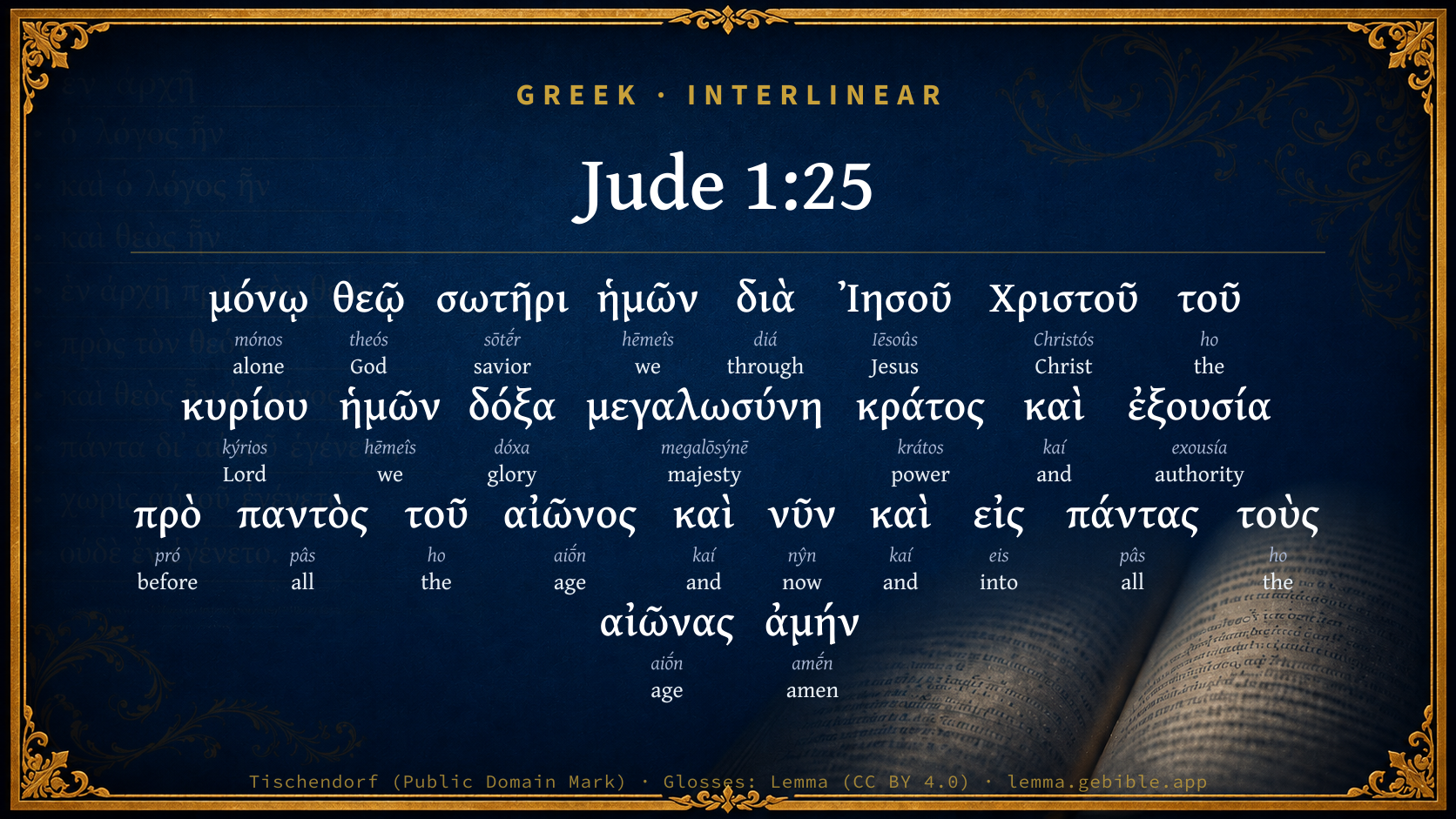
  1. μόνῳ mónos G3441 “alone” Adjective, Dative, Singular, Masculine
  2. θεῷ theós G2316 “God” Noun, Dative, Singular, Masculine
  3. σωτῆρι sōtḗr G4990 “savior” Noun, Dative, Singular, Masculine
  4. ἡμῶν hēmeîs G2249 “we” Personal pronoun, 1st person, Genitive, Plural
  5. διὰ diá G1223 “through” Preposition
  6. Ἰησοῦ Iēsoûs G2424 “Jesus” Noun, Genitive, Singular, Masculine
  7. Χριστοῦ Christós G5547 “Christ” Noun, Genitive, Singular, Masculine
  8. τοῦ ho G3588 “the” Article, Genitive, Singular, Masculine
  9. κυρίου kýrios G2962 “Lord” Noun, Genitive, Singular, Masculine
  10. ἡμῶν hēmeîs G2249 “we” Personal pronoun, 1st person, Genitive, Plural
  11. δόξα dóxa G1391 “glory” Noun, Nominative, Singular, Feminine
  12. κράτος krátos G2904 “power” Noun, Nominative, Singular, Neuter
  13. καὶ kaí G2532 “and” Conjunction
  14. ἐξουσία exousía G1849 “authority” Noun, Nominative, Singular, Feminine
  15. πρὸ pró G4253 “before” Preposition
  16. παντὸς pâs G3956 “all” Adjective, Genitive, Singular, Masculine
  17. τοῦ ho G3588 “the” Article, Genitive, Singular, Masculine
  18. αἰῶνος aiṓn G165 “age” Noun, Genitive, Singular, Masculine
  19. καὶ kaí G2532 “and” Conjunction
  20. νῦν nŷn G3568 “now” Adverb
  21. καὶ kaí G2532 “and” Conjunction
  22. εἰς eis G1519 “into” Preposition
  23. πάντας pâs G3956 “all” Adjective, Accusative, Plural, Masculine
  24. τοὺς ho G3588 “the” Article, Accusative, Plural, Masculine
  25. αἰῶνας aiṓn G165 “age” Noun, Accusative, Plural, Masculine
  26. ἀμήν amḗn G281 “amen” Hebrew transliteration

About this verse

These counts appear in no published source. They are computed here, from the morphology-tagged text and Lemma’s own curated glosses. What Lemma adds →

27
words
20
distinct lemmas
General Epistles
section

Notable vocabulary

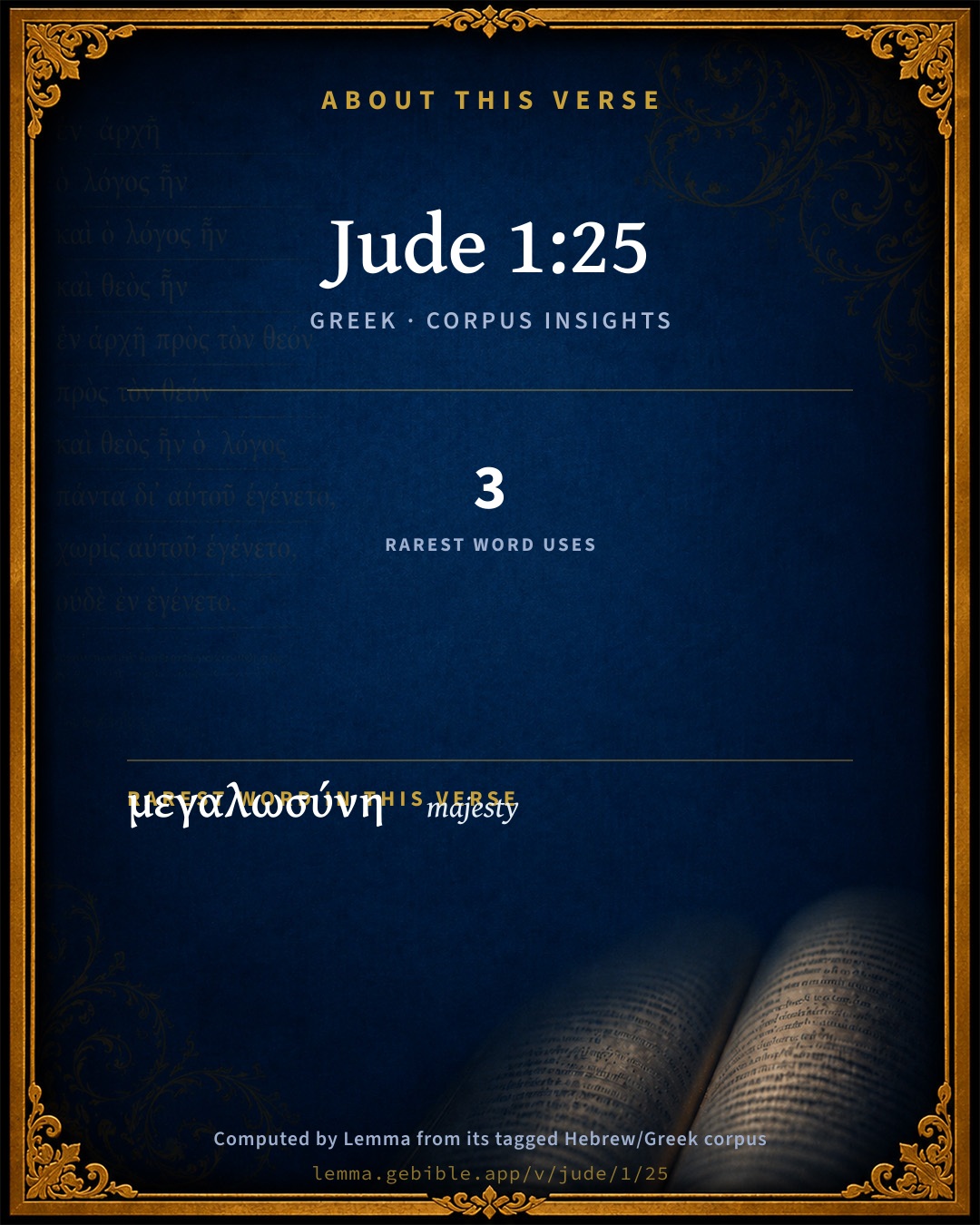
The rarest word here is μεγαλωσύνη majesty G3172 — appearing just 3 times in the whole Greek New Testament.

Shared distinctive vocabulary

μεγαλωσύνη majesty G3172 occurs in 3 verses of the Greek New Testament. Also found in:

Repetition

Words recur within this verse:

  • παντὸς all G3956 ×2
  • αἰῶνος age G165 ×2
  • τοῦ the G3588 ×3
  • καὶ and G2532 ×3
  • ἡμῶν we G2249 ×2

Cross-references

31

Topical passages linked to Jude 1:25 in the Treasury of Scripture Knowledge — connected by theme and wording, ordered by reader-vote popularity; previews shown in the World English Bible.

  • 1 Timothy 1:17 Now to the King eternal, immortal, invisible, to God who alone is wise, be honor and glory forever and ever. Amen.
  • Revelation 5:13–14 I heard every created thing which is in heaven, on the earth, under the earth, on the sea, and everything in them, saying, "To him who sits on the throne, and to the Lamb be the blessing, the honor, the glory, and the dominion, forever and ever! Amen!"
  • John 5:44 How can you believe, who receive glory from one another, and you don't seek the glory that comes from the only God?
  • 1 Peter 5:10–11 But may the God of all grace, who called you to his eternal glory by Christ Jesus, after you have suffered a little while, perfect, establish, strengthen, and settle you.
  • Revelation 4:9–11 When the living creatures give glory, honor, and thanks to him who sits on the throne, to him who lives forever and ever,
  • Romans 11:36 For of him, and through him, and to him, are all things. To him be the glory for ever! Amen.
  • Isaiah 12:2 Behold, God is my salvation. I will trust, and will not be afraid; for Yah, Yahweh, is my strength and song; and he has become my salvation."
  • Psalms 147:5 Great is our Lord, and mighty in power. His understanding is infinite.
  • Revelation 1:6 and he made us to be a Kingdom, priests to his God and Father; to him be the glory and the dominion forever and ever. Amen.
  • Matthew 6:13 Bring us not into temptation, but deliver us from the evil one. For yours is the Kingdom, the power, and the glory forever. Amen.'
  • Titus 2:13 looking for the blessed hope and appearing of the glory of our great God and Savior, Jesus Christ;
  • Hebrews 13:8 Jesus Christ is the same yesterday, today, and forever.
  • 1 Chronicles 29:11 Yours, Yahweh, is the greatness, the power, the glory, the victory, and the majesty: for all that is in the heavens and in the earth is yours. Yours is the kingdom, Yahweh, and you are exalted as head above all.
  • Psalms 72:18–19 Praise be to Yahweh God, the God of Israel, Who alone does marvelous deeds.
  • Daniel 4:37 Now I, Nebuchadnezzar, praise and extol and honor the King of heaven; for all his works are truth, and his ways justice; and those who walk in pride he is able to abase.
  • Romans 16:27
  • Ephesians 3:21 to him be the glory in the assembly and in Christ Jesus to all generations forever and ever. Amen.
  • Isaiah 45:21 Declare you, and bring [it] forth; yes, let them take counsel together: who has shown this from ancient time? who has declared it of old? Haven't I, Yahweh? and there is no God else besides me, a just God and a Savior; there is no one besides me.
  • John 4:22 You worship that which you don't know. We worship that which we know; for salvation is from the Jews.
  • Titus 1:3–4 but in his own time revealed his word in the message with which I was entrusted according to the commandment of God our Savior;
  • Titus 2:10 not stealing, but showing all good fidelity; that they may adorn the doctrine of God, our Savior, in all things.
  • 2 Peter 3:18 But grow in the grace and knowledge of our Lord and Savior Jesus Christ. To him be the glory both now and forever. Amen.
  • Psalms 78:20 Behold, he struck the rock, so that waters gushed out, Streams overflowed. Can he give bread also? Will he provide flesh for his people?"
  • Psalms 104:24 Yahweh, how many are your works! In wisdom have you made them all. The earth is full of your riches.
  • Ephesians 1:8 which he made to abound toward us in all wisdom and prudence,
  • Ephesians 3:10 to the intent that now through the assembly the manifold wisdom of God might be made known to the principalities and the powers in the heavenly places,
  • 1 Timothy 2:3 For this is good and acceptable in the sight of God our Savior;
  • Titus 3:4 But when the kindness of God our Savior and his love toward mankind appeared,
  • 1 Peter 4:11 If any man speaks, let it be as it were oracles of God. If any man serves, let it be as of the strength which God supplies, that in all things God may be glorified through Jesus Christ, to whom belong the glory and the dominion forever and ever. Amen.
  • 2 Peter 1:1 Simon Peter, a servant and apostle of Jesus Christ, to those who have obtained a like precious faith with us in the righteousness of our God and Savior, Jesus Christ:
  • Romans 11:33 Oh the depth of the riches both of the wisdom and the knowledge of God! How unsearchable are his judgments, and his ways past tracing out!

Cross-references courtesy of OpenBible.info (CC BY 4.0).

Where the printed editions differ

3 variants

Places in this verse where the major printed Greek editions disagree on the wording in a way that affects the translation — a comparison of editions, not a manuscript-by-manuscript collation. The editions are the modern critical texts (Nestlé-Aland 28/27, SBL, Westcott-Hort, Tregelles, Tyndale House) and the traditional texts behind the KJV (the Textus Receptus and the Byzantine/Majority text). It is not a claim about which reading is original.

  1. Extra text
    σοφῷ

    “wise”

    In TRByz Not in NA28NA27TynSBLWHTreg

    σοφῷ (sophō) 'wise' is only in traditional manuscripts (TR+Byz)

  2. Extra text
    διὰ Ἰησοῦ Χριστοῦ τοῦ κυρίου ἡμῶν,

    “through Jesus Christ the Lord of us,”

    In NA28NA27TynSBLWHTreg Not in TRByz

    διὰ Ἰησοῦ Χριστοῦ τοῦ κυρίου ἡμῶν, (dia Iēsou Christou tou kuriou hēmōn) 'through Jesus Christ the Lord of us,' is only in older manuscripts (NA28+NA27+Tyn+SBL+WH+Treg)

  3. Extra text
    πρὸ παντὸς τοῦ αἰῶνος

    “before all the age”

    In NA28NA27TynSBLWHTreg Not in TRByz

    πρὸ παντὸς τοῦ αἰῶνος (pro pantos tou aiōnos) 'before all the age' is only in older manuscripts (NA28+NA27+Tyn+SBL+WH+Treg)

Textual data: Translators Amalgamated Greek New Testament (STEPBible TAGNT) · CC BY 4.0.

Commentary

Notes on Jude 1:25 from classic Christian and Jewish commentators (each source and its license shown beneath its notes). The classic Christian expositions comment on the surrounding passage and are grouped to its opening verse, so a note may address several verses; the Jewish commentaries on the Tanakh (Rashi and others) are per-verse, so they appear only where the commentator wrote on this verse.

Lemma curates 59 commentaries, every one of them public domain or Creative Commons licensed, each selected and text-cleaned for this edition rather than reprinted as found. About our sources →

MacLaren's Expositions of Holy Scripture

Alexander MacLaren

Jude

WITHOUT STUMBLING

Jud 1:21, Jud 1:25

I Pointed out in a recent sermon on a former verse of this Epistle that the earlier part of it is occupied with vehement denunciations of the moral corruptions that had crept into the Church, and that the writer turns away from that spectacle earnestly to exhort the Christian community to ‘keep themselves in the love of God,’ by ‘building themselves upon their most holy faith, and praying in the Holy Ghost.’ But that is not all that Jude has to say. It is wise to look round on the dangers and evils that tempt; it is wise to look inward to the weaknesses that may yield to the temptations. But every look on surrounding dangers, and every look at personal weakness, ought to end in a look upwards ‘ to Him that is able to keep’ the weakest ‘from falling’ before the assaults of the strongest foes.

The previous exhortation, which I have discussed, might seem to lay almost too much stress on our own strivings- ‘Keep yourselves in the love of God.’ Here is the complement to it: ‘Unto Him that is able to keep you from falling.’ So denunciations, exhortations, warnings, all end in the peaceful gaze upon God, and the triumphant recognition of what He is able to do for us. We have to work, but we have to remember that ‘ it is He that worketh in us both to will and to do of His own good pleasure.’

I. So I think that, looking at these great words, the first thing to be noted is the solitary, all-sufficient stay for our weakness.

‘To the only wise God our Saviour.’ Now it is to be noticed, as those of you who use the Revised Version will observe, that the word ‘wise’ seems to have crept in here by the reminiscence of another similar doxology in the Epistle to the Romans, and was probably inserted by some scribe who had not grasped the great thought of which the text is the expression. It ought to read, ‘to the only God, our Saviour.’ The writer’s idea seems to be just this-he has been massing in a dark crowd the whole multitudinous mob of corruptions and evils that were threatening the faith and righteousness of professing Christians. And he turns away from all that rabble, multitudinous as they are, to look to the One who is all-sufficient, solitary, and enough. ‘The only God’ is the refuge from the crowds of evils that dog our steps, and from the temptations and foes that assail us at every point.

This is the blessed peculiarity of the Christian faith, that it simplifies our outlook for good, that it brings everything to the one point of possessing the one Person, beyond whom there is never any need that the heart should wander seeking after love, that the mind should depart in its search for truth, or that the will should stray in its quest after authoritative commands. There is no need to seek a multitude of goodly pearls; the gift of Christianity to men’s torn and distracted hearts and lives is that all which makes them rich, and all which makes them blessed, is sphered and included in the one transcendent pearl of price, the ‘only God."

I have been in Turkish mosques, the roofs of which are held up by a bewildering forest of slender pillars. I have been in cathedral chapter-houses, where one strong stone shaft in the centre carries all the beauty of the branching roof; and I know which is the highest work and the fairest. Why should we seek in the manifold for what we can never find, when we can find it all in the One? The mind seeks for unity in truth; the heart seeks for oneness in love; no man is at rest until he has all his heart’s treasures in one person; and no man who foolishly puts all his treasures in one creature-person but is bringing down upon his own head sorrow.

Do you remember that pathetic inscription in one of our country churches, over a little child, whose fair image is left us by the pencil of Reynolds: ‘Her parents put all their wealth in one vessel, and the shipwreck was total’? It is madness to trust to but one refuge, unless that refuge is the only God. If we, like the disciples on the Mount of Transfiguration, are wise, we shall lift up our eyes and ‘see no man any more, save Jesus only.’ He can be our solitary Stay, Refuge, Wealth, and Companion, because He is sufficient, and He abides for ever.

But there is another peculiarity that I would point out in these words, and that is the unusual attribution to God, the Father, of the name ‘Saviour’-’the only God our Saviour.’ The same various reading which strikes out ‘wise’ inserts here, as you will see in the Revised Version, through Jesus Christ our Lord.’ But although the phraseology is almost unique, the meaning is in full harmony with the scope of New Testament teaching. It is a fault of evangelical and orthodox people that they have too often spoken and thought as if Jesus Christ’s work modified and changed the Father’s will, and as if God loved men because Christ died for them. The fact is precisely the converse. Christ died because God loved men; and the fontal source of the salvation, of which the work of Jesus Christ is the channel, bringing it to men, is the eternal, unmotived, infinite love of God the Father. Christ is ‘the well-beloved Son,’ because He is the executor of the Divine purpose, and all which He has done is done in obedience to the Father’s will. If I might use a metaphor, the love of God is, as it were, a deep secluded lake amongst the mountains, and the work of Christ is the stream that comes from it, and brings its waters to be life to the world. Let us never forget that, however we love to turn our gratitude and our praise to Christ the Saviour, my text goes yet deeper into the councils of Eternity when it ascribes the praise ‘ to the only God our Saviour through Jesus Christ our Lord.’

II. And now notice the possibility of firm standing in the slippery present.

‘To Him that is able to keep us from falling.’ Now the word that I rendered ‘from falling’ is even more emphatic, and carries a larger promise. For it literally means’ without stumbling,’ and stumbling is that which precedes falling. We are not only kept from falling, we are kept even from stumbling over the stumblingstones that are in the way. The metaphor, perhaps, was suggested by the words of Isaiah, who, in one of his lovely images, describes God as ‘leading Israel {e 3 through the depths as a horse in the desert, that they stumble not.’ Do you not see the picture? The nervous, susceptible animal, slipping and sliding over the smooth rock, in a sweat of terror, and the owner laying a kindly hand and a firm one on the bridle-rein, and speaking soothing words of encouragement, and leading it safely, that it stumble not. So God is able to lay hold of us when we are in perilous places, and when we cry, ‘My foot slippeth,’ His mercy will hold us up.

Is that rhetoric? Is that merely pulpit talk? Brethren, unless we lay firm hold of this faith, that God can and does touch and influence hearts that wait upon Him, so as by His Spirit and by His Word, which is the sword of the Spirit, to strengthen their feeble good, and to weaken their strong evil, to raise what is low, to illumine what is dark, and to support what is weak, we have not come to understand the whole wealth of possible good and blessedness which lies in the Gospel. This generation has forgotten far too much the place which the work of God’s Holy Spirit on men’s spirits fills in the whole proportioned scheme of New Testament revelation. It is because we believe that so little, in comparison with the clearness and strength of our faith in the work of Jesus Christ, the atoning sacrifice, that so many of us find it so foreign to our experience that any effluences from God come into our hearts, and that our spirits are conscious of being quickened and lifted by His Spirit! Ah! we might feel, far more than any of us do, His hand on the bridle-rein. We might feel, far more than any of us do, His strong upholding, keeping our feet from slipping as well as ‘falling.’ And if we believed and expected a Divine Spirit to enter into our spirits and to touch our hearts, the expectation would not be in vain.

I beseech you; believe that a solid experience and meaning lies in that word ‘able to keep us from stumbling.’ If we have that Divine Spirit moving in our spirits, molding our desires, lifting our thoughts, confirming our wills, then the things that were stumblingstones-that is to say, that appealed to our worst selves, and tempted us to evil-will cease to be so. The higher desires will kill the lower ones, as the sunshine is popularly supposed to put out household fires. If we have God’s upholding help, the stumbling-stone will no more be a stumbling-stone, but a stepping-stone to something higher and better; or like one of those erections that we see outside old-fashioned houses of entertainment, where three or four steps are piled together, in order to enable a man the more easily to mount his horse and go on his way. For every temptation overcome brings strength to the overcomer.

Only let us remember ‘Him that is able to keep.’ Able! What is wanted that the ability may be brought into exercise; that the possibility of which I have spoken, of firm standing amongst those slippery places, shall become a reality? What is wanted? It is of no use to have a stay unless you lean on it. You may have an engine of ever so many horse-power in the engine-house, but unless the power is transmitted by shafts and belting, and brought to the machinery, not a spindle will revolve. He is able to keep us from stumbling, and if you trust Him, the ability will become actuality, and you will be kept from falling. If you do not trust Him, all the ability will lie in the engine house, and the looms and the spindles will stand idle. So the reason why-and the only reason why-with such an abundant, and over-abundant, provision for never falling, Christian men do stumble and fall, is their own lack of faith.

Now remember that this text of mine follows on the heels of that former text which bade us ‘build ourselves,’ and ‘keep ourselves in the love of God.’ So you get the peculiarity of Christian ethics, and the blessedness of Christian effort, that it is not effort only, but effort rising from, and accompanied with, confidence - in God’s keeping hand. There is all the difference between toiling without trust and toiling because we do trust. And whilst, on the one hand, we have to exhort to earnest faith in the upholding hand of God, we have to say on the other, ‘Let that faith lead you to obey the apostolic command, "Stand fast in the evil day . . . taking unto you the whole armour of God."‘

III. Further, we have here the possible final perfecting in the future.

‘To Him that is able ... to present you faultless before the presence of His glory with exceeding joy.’ Now that word rendered ‘faultless’ has a very beautiful meaning. It is originally applied to the requirement that the sacrificial offerings shall be without blemish. It is then applied more than once to our Lord Himself, as expressive of His perfect, immaculate sinlessness. And it is here applied to the future condition of those who have been kept without stumbling; suggesting at once that they are, as it were, presented before God at last, stainless as the sacrificial lamb; and that they are conformed to the image of the Lamb of God ‘without blemish and without spot.’ Moral perfectness, absolute and complete; va standing ‘ before the presence of His glory,’ the realization and the vision of that illustrious light, too dazzling for eyes veiled by flesh to look upon, but of which hereafter the purified souls will be capable, in accordance with that great promise, ‘ Blessed are the pure in heart, for they shall see God’ }*’ with exceeding joy,’ which refers not to the joy of Him that presents, though that is great, but to the joy of them who are presented. So these three things are the possibilities held out before such poor creatures as we. And miraculous as it is, that all stains should melt away from our characters- though I suppose not the remembrance of them from our consciousness-and be shaken off as completely as the foul water of some stagnant pond drops from the white swan-plumage, and leaves no stain; that perfecting is the natural issue of the present being kept from stumbling.

You have seen sometimes in a picture-dealer’s shop window a canvas on which a face is painted, one half of which has been cleaned, and the other half is still covered with some varnish or filth. That is like the Christian character here. But the restoration and the cleansing are going to be finished up yonder; and the great Artist’s ideal will be realized, and each redeemed soul will be perfected in holiness.

But as I said about the former point, so I say about this, He is able to do it. What is wanted to make the ability an actuality? Brethren, if we are to stand perfect, at last, and be without fault before the Throne of God, we must begin by letting Him keep us from stumbling here. Then, and only then, may we expect that issue.

Now I was going to have said a word, in the last place, about the Divine praise which comes from all these dealings, but your time will not allow me to dwell upon it. Only let me remind you that all these things, which in my text are ascribed to God,’ glory and majesty, dominion and power,’ are ascribed to Him because He is our Saviour, and able to keep us from stumbling, and to ‘present us faultless before His glory.’ That is to say, the Divine manifestation of Himself in the work of redemption is the highest of His self-revealing works. Men are not presumptuous when they feel that they are greater than sun and stars; and that there is more in the narrow room of a human heart than in all the immeasurable spaces of the universe, if these are empty of beings who can love and inquire and adore. And we are not wrong when we say that the only evil in the universe is sin. Therefore, we are right when we say that high above all other works of which we have experience is that miracle of love and Divine power which can not only keep such feeble creatures as we are from stumbling, but can present us stainless and faultless before the Throne of God.

So our highest praise, and our deepest thankfulness, ought to arise, and will arise-if the possibility has become, in any measure, an actuality, in ourselves-to Him, because our experience will be that of the Psalmist who sang, ‘When I said, my foot slippeth, Thy mercy, O Lord, held me up.’ Let us take the comfort of believing, ‘He shall not fall, for the Lord is able to make him stand’; and lot us remember the expansion which another Apostle gives us when, with precision, he discriminates and says, ‘Kept by the power of God through faith, unto salvation.’

Alexander MacLaren, Expositions of Holy Scripture (1904–1910) — public domain. Text from a community e-Sword module.

Bengel's Gnomon

Johann Albrecht Bengel

Jud 1:25.[12] ΔΌΞΑ ΚΑῚ ΜΕΓΑΛΩΣΎΝΗ, glory and majesty) This refers to the only God.—κράτος καὶ ἐξουσία, might and power) This refers to, who is able.[13]

[12] The words, διὰ Ἰησοῦ Χριστοῦ τοῦ Κυρίου ἡμῶν, which immediately precede, have been received into the Germ. Version with the sanction of Ed. 2.—E. B. ABC Vulg. support the words. Rec. Text with modern MSS. omit them.—E.

[13] Bengel, J. A. (1866). Vol. 5: Gnomon of the New Testament (M. E. Bengel & J. C. F. Steudel, Ed.) (W. Fletcher, Trans.) (162–171). Edinburgh: T&T Clark.

Bengel's Gnomon of the New Testament — English translation (T&T Clark, Edinburgh, 1860) — public domain. Text from a community e-Sword module.

Expositor's Greek Testament

ed. W. Robertson Nicoll

Jud 1:25 . μόνῳ Θεῷ σωτῆρι ἡμῶν . See above on Jud 1:4 , τὸν μόνον δεσπότην . God is called σωτήρ in Isa 45:15 , σὺ γὰρ εἶ Θεὸς … ὁ Θεὸς τοῦ Ἰσραῆλ σωτήρ , Isa 45:21 , Sir 51:1 , αἰνέσω σε Θεὸν τὸν σωτῆρά μου , Philo, Confus. Ling. §20, 1. p. 418 fin. , τίς δʼ οὐκ ἂν … πρὸς τὸν μόνον σωτῆρα Θεὸν ἐκβοήσῃ (? - σαι ); cf. Luk 1:47 , ἠγαλλίασεν τὸ πνεῦμά μου ἐπὶ τῷ Θεῷ τῷ σωτῆρί μου , elsewhere in N.T. only in Tit 1:3 ; Tit 2:10 ; Tit 3:4 , ὅτε ἡ χρηστότης … ἐπεφάνη τοῦ σωτῆρος ἡμῶν Θεοῦ … κατὰ τὸ αὐτοῦ ἔλωος ἔσωσεν ἡμᾶς διὰ … πνεύματος ἁγίου οὗ ἐξέχεεν ἐφʼ ἡμᾶς πλουσίως διὰ Ἰ . Χ . τοῦ σωτῆρος ἡμῶν , 1Ti 1:1 , Παῦλος ἀπόστολος Ἰ . Χ . κατʼ ἐπιταγὴν Θωοῦ σωτῆρος ἡμῶν καὶ Χ . Ἰ . 1Ti 2:3 ; 1Ti 4:10 . The later writers of the N.T. seem to have felt it needful to insist upon the unity of God, and the saving will of the Father, in opposition to antinomian attacks on the Law.

διὰ Ἰησοῦ Χριστοῦ . It seems best to take διά with δόξα and the following words. The glory of God is manifested through the Word, cf. 1Pe 4:11 , ἵνα ἐν πᾶσιν δοξάζηται ὁ Θεὸς διὰ Ἰ . Χ . ᾦ ἐστιν ἡ δόξα καὶ τὸ κράτος εἰς τοὺς αἰῶνας .

δόξα . The verb is often omitted in these ascriptions, cf. 2 Pet. αὐτῷ ἡ δόξα , Rom 11:36 ; Rom 16:27 , Gal 1:5 , Luk 2:16 , δόξα ἐν ὑψίστοις Θεῷ . In 1Pe 4:11 it is inserted, ᾧ ἐστιν ἡ δόξα καὶ τὸ κράτος , and, as we find no case in which ἔστω is inserted, and the indicative is more subject to ellipse than the imperative, it might seem that we should supply “is” here; but the R. V. gives “be,’ and there are similar phrases expressive of a wish or prayer, as the very common χάρις ὑμῖν καὶ εἰρήνη ἀπὸ Θεοῦ πατρός , where we must supply ἐστω or γένοιτο . De Wette maintained that the following words πρὸ παντὸς τοῦ αἰῶνος , referring to already existing fact, were incompatible with a prayer; but it is sufficient that the prayer has regard mainly to the present and future; the past only comes in to give it a fuller, more joyful tone, reminding us of the eternity of God, as in the psalmist’s words, “I said it is my own infirmity, but I will remember the years of the right hand of the Most High,” and the close of our own doxology “as it was in the beginning, is now, and ever shall be”. I do not see, however, that we need exclude either interpretation. The writer may exult in that which he believes to be already fact in the eternal world, and yet pray for its more perfect realisation in time, as in the Lord’s Prayer, γενηθήτω τὸ θέλημά σου ὡς ἐν οὐρανῷ καὶ ἐπὶ γῆς . The omission of the verb allows of either or both views in varying proportion. δόξα by itself is the commonest of all ascriptions. It is joined with τιμή in 1Ti 1:17 and elsewhere, as here with μεγαλωσύνη . It is joined with κράτος in 1Pe 4:11 ; 1Pe 5:11 , Rev 1:6 . Fuller ascriptions are found in Rev 4:11 , ἄξιος εἶ , ὁ κύριος … λαβεῖν τὴν δόξαν καὶ τὴν τιμὴν καὶ τὴν δύναμιν , Rev 5:13 , τῷ καθημένῳ ἐπὶ τῷ θρόνῳ … ἡ εὐλογία καὶ ἡ τιμὴ καὶ ἡ δόξα καὶ τὸ κράτος εἰς τοὺς αἰῶνας τῶν αἰώνων , Rev 7:12 , ἡ εὐλογία καὶ ἡ δόξα καὶ ἡ σοφία καὶ ἡ εὐχαριστία καἰ ἡ τιμὴ καὶ ἡ δύναμις καὶ ἡ ἰσχὺς τῷ Θεῷ ἡμῶν . Just before (Jud 1:10 ) we have the remarkable ascription ἡ σωτηρία τῷ Θεῷ ἡμῶν . Compare with this the ascription of David (1Ch 29:11 ), σοἰ Κύριε ἡ μεγαλωσύνη καὶ ἡ δύναμις καὶ τὸ καύχημα καὶ ἡ νίκη καὶ ἡ ἰσχύς , ὅτι σὺ παντων τῶν ἐν οὐρανῷ καὶ ἐπὶ γῆς δεσπόζεις . For a similar expression in regard to the future blessedness of man, see Rom 2:10 , δόξα δὲ καὶ τιμὴ καὶ εἰρήνη παντὶ τῷ ἐργαζομένῳ τὸ ἀγαθόν . [804] An unusual form of ascription occurs in Clem. Rom. 59:2, ἡ χάρις τοῦ κυρίου ἡμῶν Ἰησοῦ Χριστοῦ μεθʼ ὑμῶν καὶ μετὰ πάντων πανταχῆ τῶν κεκλημένων ὑπό τοῦ Θεοῦ καὶ διʼ αὐτοῦ · διʼ οὗ αὐτῷ δόξα , τιμή , κράτος καὶ μεγαλωσύνη , θρόνος αἰώνιος ἀπὸ τῶν αἰώνων εἰς τοὺς αἰῶνας τῶν αἰώνων .

[804] For a full account of the early doxologies, see Chase on the Lord’s Prayer ( Texts and Studies , i. 3, p. 68 foll.). He states that the common doxology at the end of the Lord’s Prayer ( σοῦ ἐστιν ἡ βασιλεία καὶ ἡ δύναμις καὶ ἡ δόξα εἰς τοὺς αἰῶνας “appears to be a conflation of two distinct forms,” and “was added to the Prayer in the ‘Syrian’ text of St. Matthew’s Gospel”.

μεγαλωσύνη . Only found elsewhere in N.T. in Heb 1:3 , ἐκάθισεν ἐν δεξιᾷ τῆς μεγαλωσύνης ἐν ὑψηλοῖς , repeated in Heb 8:1 . Dr. Chase notes that it occurs in Enoch Jud 1:4 , κατελαλήσατε μεγάλους καὶ σκληροὺς λόγους ἐν στόματι ἀκαθαρσίας ὑμῶν κατὰ τῆς μεγαλοσύνης αὐτοῦ , xii. 3, τῷ κυρίῳ τῆς μεγαλοσύνης xiv. 16 (a house excelling) ἐν δόξῃ καὶ ἐν τιμῇ καὶ ἑν μεγαλοσύνῃ . It is coupled with δόξα , of which it may be regarded as an extension, in the doxology used by Clem. Rom. 20, 61. I am not aware of any other example of ἐξουσία in a doxology: compare, however, Mat 28:18 , ἐδόθη μοι πᾶσα ἐξουσία ἐν οὐρανῷ καὶ ἐπὶ γῆς .

πρὸ παντὀς τοῦ αἰῶνος . cf. 1Co 2:7 ( τὴν σοφίαν ) ἣν προώρισεν ὁ Θεὸς πρὸ τῶν αἰώνων εἰς δόξαν ἡμῶν , Pro 8:23 , πρὸ τοῦ αἰῶνος ἐθεμελίωσέ με ( i.e. σοφίαν ), ἐν ἀρχῇ πρὸ τοῦ τὴν γῆν ποιῆσαι . An equivalent expression is πρὸ καταβολῆς κόσμου found in Joh 17:24 , ἠγάπησάς με π . κ . κ . also Eph 1:4 , ἐξελέξατο ἡμᾶς ἐν αὐτῷ π . κ . κ . and 1Pe 1:20 ( Χριστοῦ ) προεγνωσμένου μὲν π . κ . κ ., φανερωθέντος δὲ ἐπʼ ἐσχάτου τῶν χρόνων . St. Jude speaks of one past age and of several ages to come. On the other hand St. Paul speaks of many ages in the past (1Co 2:7 ), and St. John of only one age in the future.

εἰς πάντας τοὺς αἰῶνας . This precise phrase is unique in the Bible, but εἰς τοὺς αἰῶνας is common enough, as in Luk 1:33 , Rom 1:25 ; Rom 5:5 ; Rom 11:36 ; Rom 16:27 , 2Co 11:31 , etc., so in LXX, Dan 2:4 ; Dan 2:44 ; Dan 6:6 ; Dan 6:26 . The stronger phrase εἰς τοὺς αἰῶνας τῶν αἰώνων occurs in Gal 1:5 , Php 4:20 , 1Ti 1:17 , 2Ti 4:18 , Heb 13:21 , 1Pe 4:11 ; 1Pe 5:11 , Rev 1:6 , etc. John uses only εἰς τὸν αἰῶνα apparently with the same meaning. Other variations are found in Eph 3:21 , αὐτῷ ἡ δόξα ἐν τῇ ἐκκλησίᾳ καὶ ἐν Χ . Ἰ . εἰς πάσας τὰς γενεὰς τοῦ αἰῶνος τῶν αἰώνων , 2Pe 3:18 , αὐτῷ ἡ δόξα καὶ νῦν καὶ εἰς ἡμέραν αἰῶνος .

The Expositor's Greek Testament, edited by W. Robertson Nicoll (1897–1910) — public domain. Text from a community e-Sword module.

Alford’s Greek Testament

Henry Alford

25.] Concluding Doxology, conceived in terms referring to their state of danger and necessity of divine upholding. But (the δέ, as in Rom 16:25, closes off all other considerations and sums up all in this one. It is not at all given by the “now” of the E. V., which conveys a strictly temporal idea to the hearer) to Him that is able (exactly thus, Rom 16:25) to keep them (the occurrence of αὐτούς (which is almost beyond doubt the true reading instead of ὑμᾶς or ἡμᾶς) can only be accounted for by the supposition that St. Jude writes here, as of all to whom he has been addressing himself, in the third person, as if he was praying to God for them. His reason for not using ὑμᾶς may have been his desire to include also in the term those who might be convicted, rescued from the fire, and compassionated, as well as his more immediate reader. But it is hardly likely, in the solemn close of his Epistle, that he should mean by αὐτούς, those only) without falling (see reff.: and for πταίειν, Jas 2:10, Jas 3:2), and to set (them) before-the-presence-of His glory (which will be revealed when the Son of man shall come, ἐν τῇ δόξῃ αὐτοῦ καὶ τοῦ πατρὸς καὶ τῶν ἁγίων ἀγγέλων, Luk 9:26, in the ἐπιφανείᾳ τῆς δόξης τοῦ μεγάλου θεοῦ καὶ σωτῆρος ἡμῶν Ἰησοῦ χριστοῦ, Tit 2:13) blameless (see reff. and 1Th 3:13) in (element, in which they will be found) great-rejoicing (tripudiatio, the exuberance of triumphant joy: see reff.: and the verb in 1Pe 1:6 reff.), to the only God our Saviour through Jesus Christ our Lord (on the union of θεός with σωτήρ, see Prolegg. to Vol. III., ch. 7 § 1, 34. Observe the qualification here), be (on account of πρὸ παντὸς τοῦ αἰῶνος below, De Wette insists as necessary that ἐστιν, as 1Pe 4:11, not ἔστω, is here to be supplied. But ἔστω might be in the Writer’s mind, while the precise periods embraced by it might rather be left to the fulness of his devout spirit than marked by strict precision) glory, majesty, might, and power, before all time (before the whole age, scil. of the world. Thus we have eternity “a parte ante”), and now (thus, time present), and to all the ages (thus, eternity “a parte post”). Amen (the ordinary conclusion of a doxology: cf. Rom 1:25, 1Pe 4:11 (and 2Pe 3:18, where as here it stands at the end of the Epistle)).

Henry Alford, The Greek Testament (1849–1861) — public domain. Text from a community e-Sword module.

Jamieson, Fausset & Brown

Robert Jamieson, A. R. Fausset & David Brown

To the only . . . God our Saviour--The oldest manuscripts add, "through Jesus Christ our Lord." The transcribers, fancying that "Saviour" applied to Christ alone, omitted the words. The sense is, To the only God (the Father) who is our Saviour through (that is, by the mediation of) Jesus Christ our Lord.

dominion--Greek, "might."

power--authority: legitimate power. The oldest manuscripts and Vulgate, after "power," have "before all the age," that is, before all time as to the past: "and now," as to the present; "and to all the ages," that is, for ever, as to the time to come.

Next: Revelation Introduction

Jamieson, Fausset & Brown — Commentary Critical and Explanatory on the Whole Bible (1871) — public domain (CC PDM 1.0). Text via the HelloAO Bible API.

Adam Clarke's Commentary

Verse 25. To the only wise God] Who alone can teach, who alone has declared the truth; that truth in which ye now stand. See Clarke on Ro 16:27.

Our Saviour] Who has by his blood washed us from our sins, and made us kings and priests unto God the Father.

Be glory] Be ascribed all light, excellence, and splendour.

Majesty] All power, authority, and pre-eminence.

Dominion] All rule and government in the world and in the Church, in earth and in heaven.

And power] All energy and operation to every thing that is wise, great, good, holy, and excellent.

Both now] In the present state of life and things.

And ever.] Εις παντας τους αιωνας· To the end of all states, places, dispensations, and worlds; and to a state which knows no termination, being that ETERNITY in which this glory, majesty, dominion, and power ineffably and incomprehensibly dwell.

Amen.] So let it be, so ought it to be, and so it shall be.

After to the only wise God our Saviour, many excellent MSS. versions, c., add δια Ιησου Χριστου του Κυριου ἡμων, by Jesus Christ our Lord and after dominion and power they add προ παντος του αιωνος, before all time; and both these readings Griesbach has received into the text. The text, therefore, may be read thus: To the only wise God our Saviour, by Christ Jesus our Lord, be glory and majesty, dominion and power, before all time; and now, and through all futurity. Amen. Let the whole creation join in one chorus, issuing in one eternal Amen!

Subscriptions to this epistle in the VERSIONS: -

The Epistle of Jude the apostle, whose intercession be ever with us, Amen. The end. - SYRIAC.

The Epistle of Jude, the brother of James is finished: and glory be to God for ever and ever, Amen. - AETHIOPIC.

Nothing in the VULGATE.

Nothing in the ARABIC.

"This epistle was written A. D. 64, by the Apostle Jude, the brother of James; who is also called Lebbeus and Thaddeus; and who preached (the Gospel) to the Armenians and to the Persians." - This is found at the end of the ARMENIAN Bible, printed in 1698.

The Epistle of Jude the son of Joseph, and brother of James, is ended - A MS. copy of the SYRIAC.

The end of the catholic Epistle of St. Jude. - COMPLUTENSIAN.

The Epistle of Jude the apostle is ended. - IBID. Latin text.

In the MANUSCRIPTS: -

Jude. - Codex Vaticanus, B.

The Epistle of Jude. - Codex Alexandrinus.

The catholic Epistle of Jude. - Codex Ephrem.

The Epistle of the holy Apostle Jude. - Codex G, in Griesbach.

Of how little authority such subscriptions are, we have already had occasion to observe in various cases. Very few of them are ancient; and none of them coeval with the works to which they are appended. They are, in general, the opinions of the scribes who wrote the copies; or of the Churches for whose use they were written. No stress therefore should be laid on them, as if proceeding from Divine authority.

With the Epistle of Jude end all the apostolical epistles, and with it the canon of the New Testament, as to gospels and epistles; for the Apocalypse is a work sui generis, and can rank with neither. It is in general a collection of symbolic prophecies, which do not appear to be yet fully understood by the Christian world, and which can only be known when they are fulfilled.

Finished for a new impression, January 4th, 1832. - A. C.

Adam Clarke's Commentary on the Bible (1810–1826) — public domain. Text from a community e-Sword/MySword module.

The Cambridge Bible for Schools and Colleges

gen. ed. J. J. S. Perowne

25. to the only wise God our Saviour …] The form of the doxology in the Received Text presents a parallelism to that of 1Ti_1:17. The word “wise” is, however, omitted in many of the best MSS. In the use of the word “Saviour” as applied to God we have a parallelism with 1Ti_2:3. The Father, no less than the Son, was thought of by both writers as the Saviour and Preserver of all men. The MSS. that omit “wise” add, for the most part, “through Jesus Christ our Lord.”

be glory and majesty, dominion and power] The Greek has no verb, and the gap may be filled up either with the imperative of ascription or the indicative of assertion. The four words are brought together as expressing the aggregate of the Divine Omnipotence, the last word expressing the “power of authority,” as distinct from that of energy. The better MSS. insert after “power” the words “before all time” (literally, before the whole æon), so that the doxology includes the past eternity as well as the future. In the words “for ever” we have literally unto all the ages, or æons.

The Epistle ends with the “Amen” which was the natural close of a doxology, and, like the Second Epistle of St Peter, contains no special messages or salutations. The letter was strictly a catholic, or encyclical, Epistle.

The Cambridge Bible for Schools and Colleges (gen. ed. J. J. S. Perowne; Cambridge University Press, 1878–1918) — public domain. Text from a community e-Sword module.

John Gill's Exposition

To the only wise God our Saviour,.... By whom is meant, not the Trinity of Persons in general, nor the Father in particular; but the Lord Jesus Christ, who is truly God, though not to the exclusion of the Father and Spirit; and is the wisdom of God, and the author of all wisdom, natural and spiritual; and is the only Saviour of his people; and to him may be, as is ascribed, the

glory of his deity, and divine sonship, of his mediatorial works, and of salvation:

and majesty: which belongs to him as God, and which he has in his human nature, being crowned with glory, and honour, and enthroned and set down at the right hand of God:

dominion; both natural, the kingdom of nature and providence belonging to him, and mediatorial, which is above all, reaches far and wide, and will last for ever:

and power; in making and upholding all things; in redeeming his people; in protecting and defending them, and in destroying his and their enemies; in raising the dead, and judging the world. Though the Alexandrian copy, and some others, and the Vulgate Latin version, read, "to the only God our Saviour, by Jesus Christ our Lord", and leave out the word "wise"; and so they are to be understood of God the Father; but the Ethiopic version reads, "this is the only God our Saviour Jesus Christ, to whom", &c. And all this is to be attributed to him,

both now, and ever; in the present life, and to all eternity,

Amen: which is an assent unto it, that so it should be; and a wish that so it may be; and an expression of faith, and strong asseveration, that so it shall be.

Next: Revelation Introduction

John Gill's Exposition of the Whole Bible (1746–1763) — public domain (CC PDM 1.0). Text via the HelloAO Bible API.

Albert Barnes' Notes on the Bible

To the only wise God - See the Rom 16:27 note; 1Ti 1:17 note.

Our Saviour - The word “Saviour” may be appropriately applied to God as such, because he is the great Author of salvation, though it is commonly applied to the Lord Jesus Christ. That it may have been designed that it should be applied here to the Lord Jesus no one can certainly deny, nor can it be demonstrated that it was; and in these circumstances, as all that is fairly implied in the language may be applied to God as such, it is most natural to give the phrase that interpretation.

Be glory and majesty - 1Ti 1:17 note; Rom 16:17 note.

Dominion and power ... - See Mat 6:13. It is common in the Scriptures to ascribe power, dominion, and glory to God, expressing the feeling that all that is great and good belongs to him, and the desire of the heart that he may reign in heaven and on earth. Compare Rev 4:11; Rev 19:1. With the expression of such a desire it was not inappropriate that this Epistle should be closed - and it is not inappropriate that this volume should be closed with the utterance of the same wish. In all our affections and aspirations, may God be supreme; in all the sin and woe which prevail here below, may we look forward with strong desire to the time when his dominion shall be set up over all the earth; in all our own sins and sorrows, be it ours to look onward to the time when in a purer and happier world his reign may be set up over our own souls, and when we may cast every crown at his feet and say, “Thou art worthy, O Lord, to receive glory, and honor, and power: for thou hast created all things, and for thy pleasure they are and were created. - Alleluia; Salvation, and glory, and honor, and power, unto the Lord our God,” Rev 4:11; Rev 19:1.

Albert Barnes' Notes on the Bible (1834–1885) — public domain. Text from a community e-Sword/MySword module.

Matthew Poole's English Annotations

To the only wise; only wise infinitely, and of himself.

God our Saviour; either God, who is sometimes called by this title, 1Ti 2:3; Tit 1:3; 3:4; or rather Christ.

Be glory: see 1Pe 4:11; 5:11.

And majesty; or, magnificence, Heb 1:3; 8:1; it seems to signify the height and excellency of God’s glory.

Dominion and power; authority, and right to govern, which here is ascribed to God, as well as strength or sufficiency for it.

Matthew Poole's English Annotations on the Holy Bible (1683–1685) — public domain. Text from a community e-Sword/MySword module.

Whedon's Commentary on the Bible

Daniel D. Whedon

25. Wise is to be omitted as being really inserted by copyists from the parallel passage in Rom_16:27. The fourfold creational ascription of glory and majesty belonging to the divine person, and dominion and power his characteristics as divine ruler.

Now—The best reading supplies before this now the clause before all aeon or age. The meaning then would be, that the ascription to God is before the world’s ages begun, during earthly time, and through the endless ages to come. We have, then, the threefold phases of complete eternity, past, present, and future.

Daniel D. Whedon (gen. ed.), Commentary on the Old and New Testaments (1874–1909) — public domain. Text from a community e-Sword module.

Burkitt's Expository Notes on the New Testament

William Burkitt

Our apostle shuts up his epistle (as is usual) with a doxology; where observe, 1. The person to whom the praise is given, to God, the wise God, the only wise God, so called because he is infinitely and transcendantly wise; all the wisdom of the wisest of men is nothing in opposition to his wisdom, nor in comparison with it.

Observe, 2. That Jesus Christ our Saviour is worthy to be accounted the only wise God; as he is God, he is called the wisdom of the Father; and in the book of the Proverbs, he is represented under that title, and spoken of as a person, Proverbs 8. As he was man, all the treasures of wisdom and knowledge were found in him, he received the habits of all created knowledge and wisdom, together with all other graces without measure.

Observe, 3. As the person described to whom the praise is given, so the description of the praise which is given to this person, Glory and majesty, dominion and power; by which understand, the greatness and eminent excellency of the divine nature, which results from his perfections, and whereby the divine nature is infinitely exalted above all other beings.

Learn hence, That we ought to have such a sense of God’s transcendant excellences and perfections as may oblige us to ascribe all things that are honourable and glorious to him, therefore are so many words here used.

Observe, 4. The duration, now and ever. Learn thence, That believers have such large and vast desires for the exaltation of God’s glory, that they would have him glorified everlastingly, and without ceasing, not only in the present, but to eternal ages. To him be glory now and ever. Amen.

William Burkitt's Expository Notes on the New Testament (1700–1703) — public domain. Text from a community e-Sword module.

Godbey's Commentary on the New Testament

William B. Godbey

25. “To God our only Savior, through Jesus Christ our Lord, be glory, majesty, government and power before every age and every name, and to all ages. Amen.” Jude’s benediction is very beautiful, and should be used interchangeably with all the others which are found at the conclusion of all the Epistles. It is a great mistake to use 2Co 13:14 till it becomes monotonous. The Holy Ghost gave us all of these benedictions for our edification in the kingdom of God.

William B. Godbey, Commentary on the New Testament (1896–1900) — public domain. Text from a community e-Sword module.

The People's New Testament

B. W. Johnson

25. The only God our Savior. Our Savior “through Jesus Christ.” Be glory. Not only glory forever and ever, but eternal and universal dominion.

B. W. Johnson's The People's New Testament with Notes (1889–1891) — public domain. Electronic text from the Christian Classics Ethereal Library (CCEL) ThML edition.

Cambridge Greek Testament for Schools and Colleges

25. μόνῳ θεῷ σωτῆρι ἡμῶν, cf. τὸν μόνον δεσπότην Jud 1:4, Rom 16:27. Θεὸς σωτὴρ occurs in the Magnificat Luk 1:47 and in 1Ti 1:1; 1Ti 2:3; 1Ti 4:10. μόνῳ perhaps emphasized because false teachers held that the God of the Jews, the Creator, was distinct from the true God.

διὰ Ἰ. Χ. (cf. Rom 1:8) is best taken with what follows, “glory to God through Jesus Christ,” not “God, our Saviour through Jesus Christ.” In 1Pe 4:11 it is said “that God may in all things be glorified through Jesus Christ.”

μεγαλωσύνη occurs several times in the Greek fragment of Enoch but in N.T. only in Heb 1:3 “sat down on the right hand of the majesty on high.”

ἐξουσία, cf. Rev 12:10 ἄρτι ἐγένετο ἡ σωτηρία καὶ ἡ δύναμις καὶ ἡ βασιλεία τοῦ θεοῦ ἡμῶν καὶ ἡ ἐξουσία τοῦ χριστοῦ αὐτοῦ, which however is a statement of what has happened, not an ascription of praise. It does not occur elsewhere in doxologies (Mayor), though δύναμις and ἰσχύς do.

πρὸ παντὸς τοῦ αἰῶνος stands by itself: we have πρὸ τῶν αἰώνων in 1Co 2:7, and in Pro 8:23 Wisdom says “God founded me πρὸ τοῦ αἰῶνος.”

εἰς πάντας τοὔς αἰῶνας again is a unique variant of the ordinary εἰς τοὺς αἰῶνας τῶν αἰώνων.

Cambridge Greek Testament for Schools and Colleges (Cambridge University Press, 1896; 21 vols, various authors incl. Carr, Maclear, Plummer, Farrar, Lumby, Moule, M. R. James, Simcox) — public domain. Text from a community e-Sword module.

International Critical Commentary

25. K L P and the Textus Receptus insert σοφῷ before Θεῷ, probably from Rom 16:27; the same MSS. make the same addition in 1Ti 1:17. K P and Oecumenius omit διὰ Ἰησοῦ Χριστοῦ τοῦ Κυρίον ἡμῶν: the clause, though so familiar in the late doxologies, is found only here, Rom 16:27, and (in substance though not exactly in form) 1Pe 4:11, and may possibly have been inserted with σοφῷ from Romans. On the other hand, Jude may be quoting Romans, or both St. Paul and St. Jude may be using a current form. K P again omit πρὸ παντὸς τοῦ αἰῶνος. These words remind us of the later “ut erat in principio,” and are not found in any other apostolic doxology. א, three cursives, and the Coptic omit πάντας. L, four cursives, and some Latin MSS. have αἰῶνας τῶν αἰώνων. Two cursives and Cassiodorus omit ἀμήν. The text has clearly been affected by liturgical influence.

μόνῳ Θεῷ σωτῆρι ἡμῶν. Σωτήρ is used of God eight times in the New Testament, Luk 1:47; 1Ti 1:1, 1Ti 1:2:3, 1Ti 1:4:10; Tit 1:3, Tit 1:2:10, Tit 1:4, and here. Of these instances six are in the Pastoral Epistles. The word is used of Christ in fifteen places, of which five are in 2 Peter, five in Luke, John and Acts, one in Philippians, four in the Pastoral Epistles. Both uses are found in the ancient Hebrew documents used by St. Luke (1:47, 2:11). For μόνος Θεός see Joh 5:44, δόξαν παρὰ ἀλλήλων λαμβάνοντες, καὶ τὴν δόξαν τὴν παρὰ τοῦ μόνου Θεοῦ οὐ ζητεῖτε, where, in spite of the antithesis to παρὰ ἀλλήλων, the words appear to mean “the only God”; Rom 16:27, μόνῳ σοφῷ Θεῷ, “to the only wise God”; here the first attribute qualifies the second, “to God who alone is wise”; 1Ti 1:17, μόνῳ Θεῷ, “the only God,” “who alone is God.” In the present passage it is open to question whether Jude means “to the only God,” or “to God alone,” but the commentators seem to be unanimous in preferring the former rendering. “The only God” is, as Spitta points out, an expression directed against the polytheism of the Gentiles. A close parallel in sense is to be found 1Ti 6:15, 1Ti 6:16. We must take such passages in connexion with others such as Joh 1:1; Rom 9:5; 2Pe 1:1; Jud 1:4, Jud 1:21, or the doxologies addressed to Christ, or the uses of Κύριος or of Σωτήρ.

Kühl, Schott, von Soden, Spitta connect σωτῆρι with διὰ Ἰησοῦ Χριστοῦ, “God who is our Saviour through Jesus Christ,” but this construction is unexampled and barely possible; we should have expected τῷ σώσαντι ἡμᾶς. The use of διά in the doxologies is strongly in favour of translating, “Glory to God through Jesus Christ.”

δόξα is ascribed to God or Christ in all the doxologies except 1Ti 6:16: μεγαλωσύνη (a late word which occurs also in Heb 1:3, Heb 8:1, and several times in Enoch, 5:4, 9, 12:3, 14:16; see Dr. Chase’s article on Jude in Hastings’ Dictionary of the Bible) only here; for κράτος see 1Ti 6:16; 1Pe 4:11, 1Pe 4:5:11; Rev 1:6, Rev 5:13. Compare the doxologies of Clement of Rome and of the Martyrium Polycarpi given in the Introduction. Ἐξουσία, which generally signifies subordinate and delegated authority, is used of the power of God, Luk 12:5; Act 1:7. Πρὸ παντὸς τοῦ αἰῶνος. “Before all eternity” glory was to God through Jesus Christ, and “now” is, and “to all the eternities” will be. Words could hardly express more clearly Jude’s belief in the pre-existence and eternity of Christ.

ἀμήν. See note on 1Pe 4:11.

International Critical Commentary — older volumes (1896–1929), various authors — public domain. Text from a community e-Sword module.

Vincent's Word Studies in the New Testament

Marvin R. Vincent

Both now and ever [και νυν και εις παντας του, ς αιωνας] . Lit., both now and unto all the ages. The best texts add pro pantov tou aijwnov, before all time.

LIST OF GREEK WORDS USED BY Jude ONLY

- - - - - - - - - - ajpodiorizw, to separate, 19 aptaistov, without falling, 24 goggusthv, murmurer, 16 deigma, example, 7 ejkporneuw, to give over to fornication, 7 ejnupniazw, to dream, 8 ejpagwnizomai, earnestly contend, 3 ejpafrizw to foam out, 13 memyimoirov, complainer, 16 pareisduw to creep in unawares, 4 planhthv a wanderer, 13 spilav, rock, 12 uJpecw, to suffer, undergo, 7 fqinopwrinov autumnal, 12 fusikwv, naturally, 10

Marvin R. Vincent, Word Studies in the New Testament (1887–1900) — public domain. Text from a community e-Sword/MySword module.

Lesson kit

Teaching starters — assembled from the data on this page, not authored interpretation. Every prompt links to the verse data it draws on. Edit before teaching.

Jude, in the General Epistles, opens this verse with 27 words (20 distinct Greek lemmas). Its most distinctive word is megalōsýnē (“majesty”). A historical commentator’s framing appears above. Read the whole chapter for the surrounding context.

Discussion questions

  1. What does “majesty” (megalōsýnē) contribute to the verse as a whole?
  2. Hebrews 1:3 shares the word «majesty» with this verse. How do the two illuminate each other?
  3. “all” occurs 2× in this one verse. What is the effect of the repetition?
  4. These translations render this verse differently; the difference is in the English rendering, not the original. What questions does that raise?
  5. Reading how MacLaren's Expositions of Holy Scripture and Bengel's Gnomon read this verse, where do the two commentators agree and where do they part?

Things to notice

Reading settings

Reading text

Shown beneath each verse's original-language words.

Old Testament
Old Testament edition

Read the OT as the Masoretic Hebrew (MT) or the Greek Septuagint (LXX).

English shown for the Greek Septuagint (in the Hebrew ↔ Greek comparison).

Comparing translations? Open the Compare panel on any verse page to stack up to four side by side.