Ruth 3:2

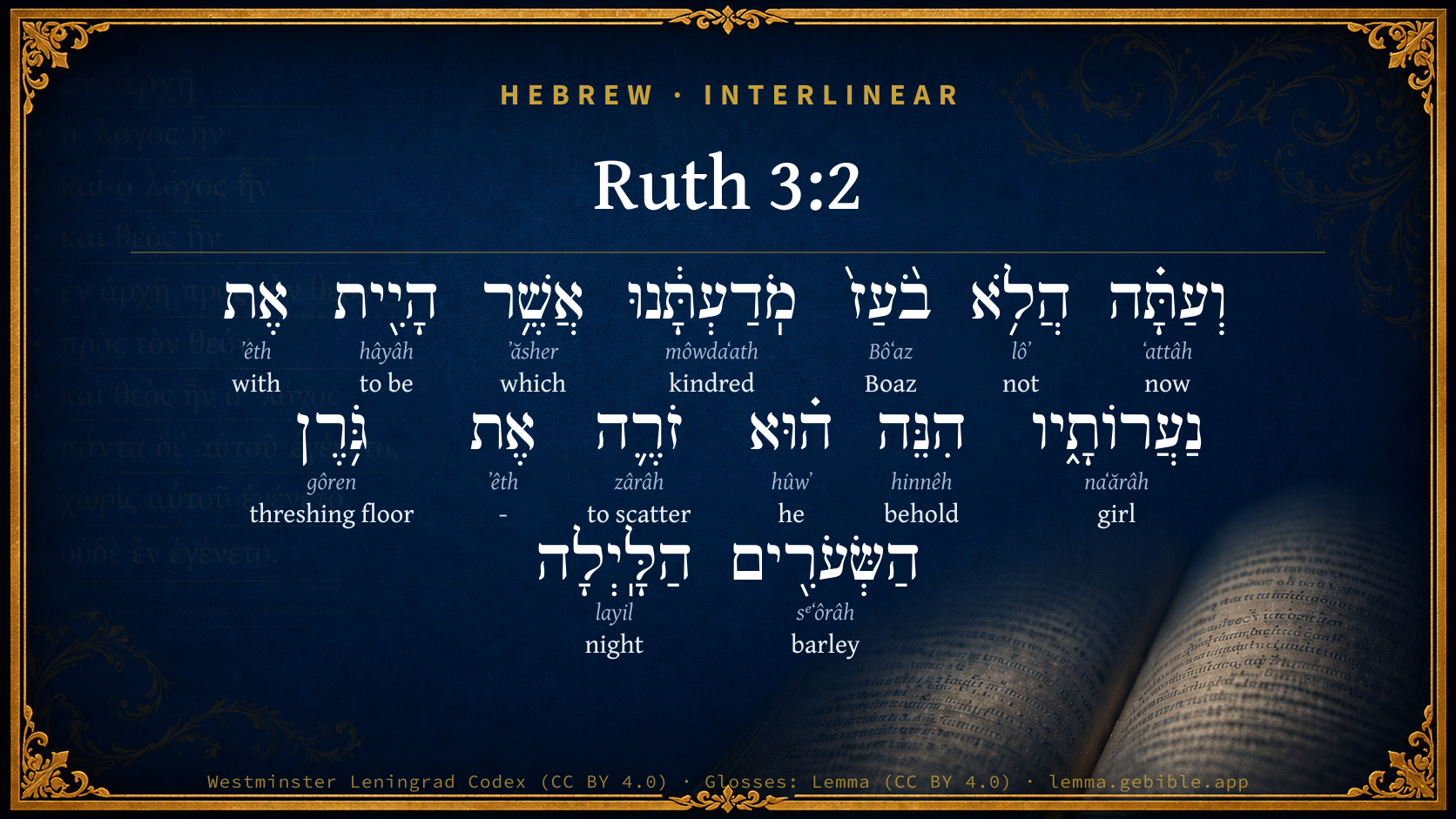
Hebrew (Westminster Leningrad Codex) Ruth 3:2 appears in the Hebrew Old Testament. The text above is from the Westminster Leningrad Codex. Each word links to its Strong’s number, a concise gloss, and parsing drawn from the Open Scriptures Hebrew Bible morphology. Click any word for its full Brown-Driver-Briggs (BDB) entry.
Download image
Cite this verse

Ruth 3:2 (World English Bible). Public Domain. Lemma interlinear Bible study tool, https://lemma.gebible.app/v/ruth/3/2.

Show BibTeX & RIS
BibTeX
RIS
English Translation
Now isn't Boaz our kinsman, with whose maidens you were? Behold, he winnows barley tonight in the threshing floor.
World English Bible · Public Domain
Highlights
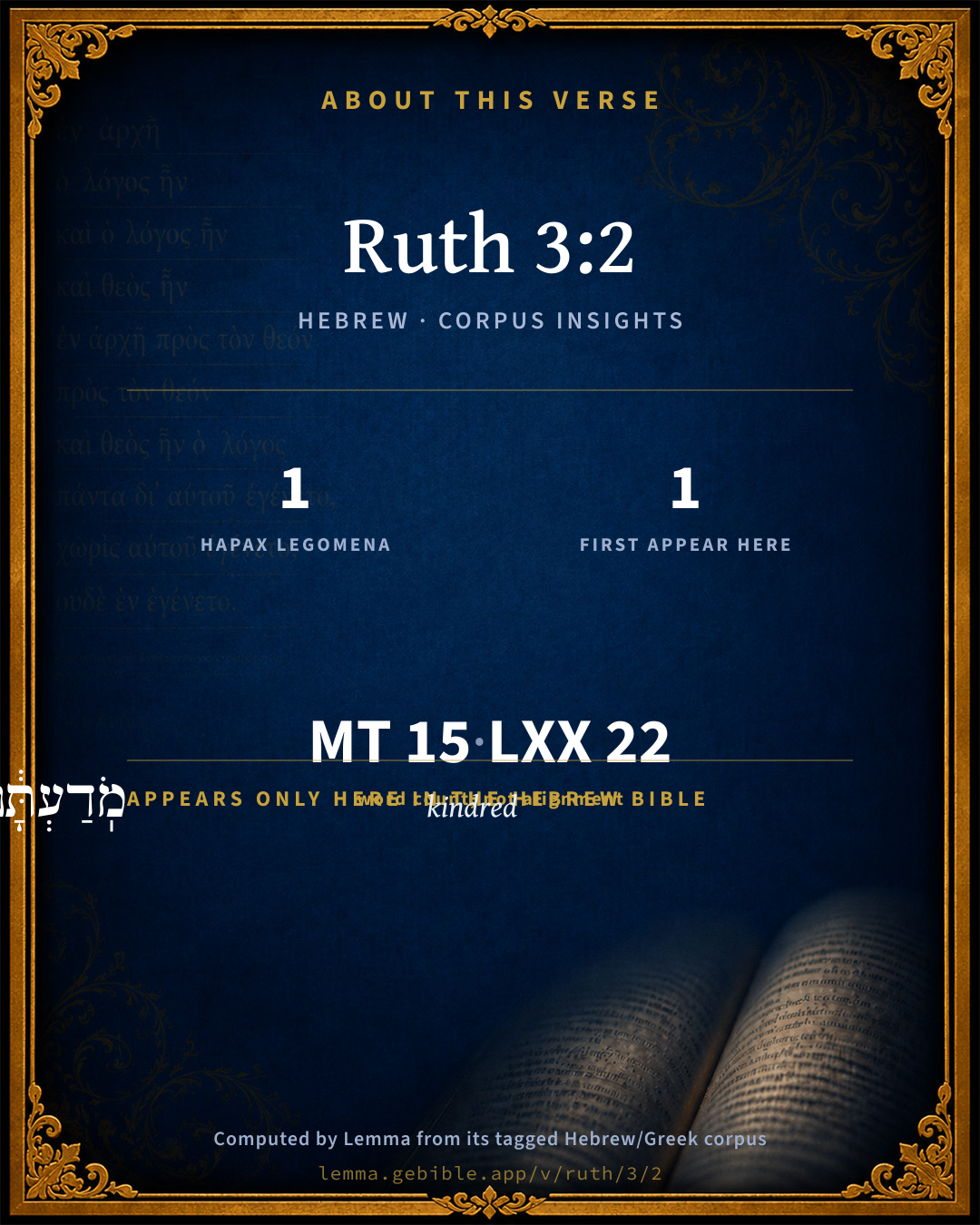
  • 1 hapax legomenon — only here in the Hebrew Bible
  • 1 first appearance in the Hebrew Bible
Full analysis ↓
Download a study sheet

One document with this verse’s original text, its word-by-word gloss line, the meaning frame, cross-references with their text, attributed commentary, and full source and license credits — printable, and it pastes into notes with its structure intact.

This verse Autodidact and up

Study sheet (.html) Plain text (.txt)

A passage Seminary Student

Up to 50 verses in one chapter. A passage sheet keeps up to 6 commentary sources and 12 cross-references per verse, in the order this page ranks them, and says so on the sheet whenever that leaves anything out. Ask for a single verse and you get the Autodidact verse sheet above.

Everything on this page stays free to read, with no account — the sheet is a download of what is already on screen, not access to it.

Want to remove ads? Support Godless Engineer
Compare translations 3

The same verse in 3 English versions, stacked beneath the original-language interlinear above. Click any original word for its lexicon entry.

Each is an independent rendering of the whole verse — the interlinear is not word-aligned to these translations.

Highlighted words mark where these versions differ — a whole-verse word diff, not a word-by-word alignment.

  • World English Bible Public Domain
    Now isn't Boaz our kinsman, with whose maidens you were? Behold, he winnows barley tonight in the threshing floor.
  • King James Version Public Domain
    And now is not Boaz of our kindred, with whose maidens thou wast? Behold, he winnoweth barley to night in the threshingfloor.
  • unfoldingWord Literal Text CC BY-SA 4.0
    So now, is not Boaz our relative, the one with whose young female workers you have been working? Behold, he will be winnowing barley at the threshing floor tonight.

unfoldingWord Literal Text — © unfoldingWord, licensed CC BY-SA 4.0. Word-aligned USFM3 via Door43 (git.door43.org/unfoldingWord/en_ult).

Versions to compare (up to 4)

3 of 4 selected

Show all 18 translations

Every available English version of this verse, each an independent rendering of the whole verse.

  • World English Bible Public Domain
    Now isn't Boaz our kinsman, with whose maidens you were? Behold, he winnows barley tonight in the threshing floor.
  • Berean Standard Bible Public Domain
    Now is not Boaz, with whose servant girls you have been working, a relative of ours? In fact, tonight he is winnowing barley on the threshing floor.
  • Majority Standard Bible Public Domain
    Now is not Boaz, with whose servant girls you have been working, a relative of ours? In fact, tonight he is winnowing barley on the threshing floor.
  • King James Version Public Domain
    And now is not Boaz of our kindred, with whose maidens thou wast? Behold, he winnoweth barley to night in the threshingfloor.
  • American Standard Version (1901) Public Domain
    And now is not Boaz our kinsman, with whose maidens thou wast? Behold, he winnoweth barley to-night in the threshing-floor.
  • Revised Version (1885) Public Domain
    And now is there not Boaz our kinsman, with whose maidens thou wast? Behold, he winnoweth barley to-night in the threshing-floor.
  • Geneva Bible (1599) Public Domain
    Now also is not Boaz our kinsman, with whose maides thou wast? beholde, he winoweth barly to night in the floore.
  • Douay-Rheims (1899) Public Domain
    This Booz, with whose maids thou wast joined in the field, is our near kinsman, and behold this night he winnoweth barley in the threshingfloor.
  • Young's Literal Translation Public Domain
    and now, is not Boaz of our acquaintance, with whose young women thou hast been? lo, he is winnowing the threshing-floor of barley to-night,
  • Literal Standard Version CC BY-SA 4.0
    And now, is not Boaz of our acquaintance, with whose young women you have been? Behold, he is winnowing the threshing-floor of barley tonight,
  • Unlocked Literal Bible CC BY-SA 4.0
    Now Boaz, the man whose young female workers you have been with, is he not our kinsman? Look, he will be winnowing barley tonight at the threshing floor.
  • unfoldingWord Literal Text CC BY-SA 4.0
    So now, is not Boaz our relative, the one with whose young female workers you have been working? Behold, he will be winnowing barley at the threshing floor tonight.
  • Darby Bible Public Domain
    And now, is not Boaz of our kindred, with whose maidens thou wast? Behold, he is winnowing barley in the threshing-floor to-night.
  • World Messianic Bible Public Domain
    Now isn’t Boaz our kinsman, with whose maidens you were? Behold, he will be winnowing barley tonight on the threshing floor.
  • Webster's Bible Public Domain
    And now is not Boaz of our kindred, with whose maidens thou wast? Behold, he winnoweth barley to-night in the threshing-floor.
  • Free Bible Version CC BY-SA 4.0
    Don't ignore the fact that Boaz, whose women you worked with, is closely related to us. Now tonight he will be busy winnowing grain on the threshing floor.
  • Bible in Basic English Public Domain
    And now, is there not Boaz, our relation, with whose young women you were? See, tonight he is separating the grain from the waste in his grain-floor.
  • JPS Tanakh (1917) Public Domain
    And now is there not Boaz our kinsman, with whose maidens thou wast? Behold, he winnoweth barley to-night in the threshing-floor.

Literal Standard Version (2020), Covenant Press — licensed CC BY-SA 4.0. Text via the HelloAO Bible API (eBible.org). Unlocked Literal Bible (unfoldingWord) — licensed CC BY-SA 4.0. Text via the HelloAO Bible API (eBible.org). unfoldingWord Literal Text — © unfoldingWord, licensed CC BY-SA 4.0. Word-aligned USFM3 via Door43 (git.door43.org/unfoldingWord/en_ult). Free Bible Version, Dr. Jonathan Gallagher — licensed CC BY-SA 4.0. Text via the HelloAO Bible API (eBible.org).

Word by word

More ways to search: Search by grammar → Find every occurrence → Compare this word →

Practice this passage: Drill this verse → Learn its vocabulary →

מֹֽדַעְתָּ֔נוּ
môwdaʻath
H4130
“kindred · our”
Noun, Common, Feminine, Singular, Construct + Suffix, Personal, 1st Person, Common, Plural
Part of Speech
Noun
Type
Common
Gender
Feminine
Number
Singular
State
Construct
Full BDB Definition

Origin: from H3045

TWOT: 848f

kindred, kinship
  1. וְעַתָּ֗ה ʻattâh H6258 “and · now” Conjunction + Adverb
  2. הֲלֹ֥א lôʼ H3808 “not” Particle, Interrogative + Particle, Negative
  3. בֹ֨עַז֙ Bôʻaz H1162 “Boaz” Noun, Proper
  4. אֲשֶׁ֥ר ʼăsher H834 “which” Particle, Relative
  5. הָיִ֖ית hâyâh H1961 “to be” Verb, Qal, Perfect, 2nd Person, Feminine, Singular
  6. אֶת ʼêth H854 “with” Preposition
  7. נַעֲרוֹתָ֑יו naʻărâh H5291 “girls · his” Noun, Common, Feminine, Plural, Construct + Suffix, Personal, 3rd Person, Masculine, Singular
  8. הִנֵּה hinnêh H2009 “behold” Particle, Demonstrative
  9. ה֗וּא hûwʼ H1931 “he” Pronoun, Personal, 3rd Person, Masculine, Singular
  10. זֹרֶ֛ה zârâh H2219 “scattering” Verb, Qal, Participle Active, Masculine, Singular, Absolute
  11. אֶת ʼêth H853 “-” Particle, Direct Object
  12. גֹּ֥רֶן gôren H1637 “threshing floor of” Noun, Common, Both, Singular, Construct
  13. הַשְּׂעֹרִ֖ים sᵉʻôrâh H8184 “the · barley” Particle, Definite Article + Noun, Common, Feminine, Plural, Absolute
  14. הַלָּֽיְלָה layil H3915 “the · night” Particle, Definite Article + Noun, Common, Masculine, Singular, Absolute

About this verse

These counts appear in no published source. They are computed here, from the morphology-tagged text and Lemma’s own curated glosses. What Lemma adds →

15
words
15
distinct lemmas
Historical
section

Notable vocabulary

1 hapax legomenon — a word that appears only here in the entire Hebrew Bible:

  • מֹֽדַעְתָּ֔נוּ kindred H4130

First appearance in Scripture

This word makes its first canonical appearance in the Hebrew Bible here:

  • מֹֽדַעְתָּ֔נוּ kindred H4130

Shared distinctive vocabulary

בֹ֨עַז֙ Boaz H1162 occurs in 22 verses of the Hebrew Bible. Also found in:

Grammatical profile

  • 2 verbs
  • 6 nouns
  • 1 pronoun
  • 1 preposition
  • 1 adverb
  • 4 particles

Verb forms

  • הָיִ֖ית Qal · Perfect
  • זֹרֶ֛ה Qal · Participle Active

Hebrew & Septuagint length

In English translation the verse runs 19 words from the Hebrew and 21 from the Septuagint (LXX English) — closely comparable.

A rough comparison of the two English renderings, which tokenize alike — not a word-level alignment.

Word counts can differ between the Hebrew and the Greek without any difference in meaning — e.g. the Hebrew direct-object marker אֵת has no separate Greek word, and Greek often adds the article ὁ.

In the original languages it is 15 Hebrew tokens and 22 Greek tokens — but the two are counted differently (Hebrew bundles its prefixes and suffixes into one token; the Greek is in lemma form), so that isn’t a like-for-like length.

Cross-references

5

Topical passages linked to Ruth 3:2 in the Treasury of Scripture Knowledge — connected by theme and wording, ordered by reader-vote popularity; previews shown in the World English Bible.

  • Deuteronomy 25:5–10 If brothers dwell together, and one of them die, and have no son, the wife of the dead shall not be married outside to a stranger: her husband's brother shall go in to her, and take her to him as wife, and perform the duty of a husband's brother to her.
  • Ruth 2:20–23 Naomi said to her daughter-in-law, Blessed be he of Yahweh, who has not left off his kindness to the living and to the dead. Naomi said to her, The man is a close relative to us, one of our near kinsmen.
  • Ruth 2:1 Naomi had a kinsman of her husband's, a mighty man of wealth, of the family of Elimelech, and his name was Boaz.
  • Ruth 2:8 Then said Boaz to Ruth, Don't you hear, my daughter? Don't go to glean in another field, neither pass from hence, but abide here fast by my maidens.
  • Hebrews 2:11–14 For both he who sanctifies and those who are sanctified are all from one, for which cause he is not ashamed to call them brothers,

Cross-references courtesy of OpenBible.info (CC BY 4.0).

Hebrew and Greek witnesses Masoretic Hebrew ↔ Greek Septuagint

The same verse in the two great witnesses to the Old Testament, shown verse-for-verse.

These are two independent witnesses, not word-aligned to each other, and the Septuagint is shown in lemma (dictionary) form.

Hebrew Ruth 3:2 Masoretic · Westminster Leningrad Codex

וְעַתָּ֗ה הֲלֹ֥א בֹ֨עַז֙ מֹֽדַעְתָּ֔נוּ אֲשֶׁ֥ר הָיִ֖ית אֶת נַעֲרוֹתָ֑יו הִנֵּה ה֗וּא זֹרֶ֛ה אֶת גֹּ֥רֶן הַשְּׂעֹרִ֖ים הַלָּֽיְלָה

Now isn't Boaz our kinsman, with whose maidens you were? Behold, he winnows barley tonight in the threshing floor.

World English Bible · Public Domain

Greek LXX Ruth 3:2 Septuagint · lemma form

καί νῦν οὐ βοος γνώριμος ἐγώ ὅς εἰμί μετά ὁ κοράσιον αὐτός ἰδού αὐτός λικμάω ὁ ἅλων ὁ κριθή οὗτος ὁ νύξ

And now is not Booz our kinsman, with whose damsels you were? behold, he winnows barley this night in the floor.

LXX2012 (modern English Septuagint) · Public Domain

Hebrew: Westminster Leningrad Codex (CC BY 4.0). Greek: Septuagint (public domain); English from LXX2012 (modern English Septuagint) (Public Domain). How the Septuagint differs from the Hebrew →

Commentary

Notes on Ruth 3:2 from classic Christian and Jewish commentators (each source and its license shown beneath its notes). The classic Christian expositions comment on the surrounding passage and are grouped to its opening verse, so a note may address several verses; the Jewish commentaries on the Tanakh (Rashi and others) are per-verse, so they appear only where the commentator wrote on this verse.

Lemma curates 59 commentaries, every one of them public domain or Creative Commons licensed, each selected and text-cleaned for this edition rather than reprinted as found. About our sources →

Trapp's Complete Commentary

John Trapp

Rth 3:2 And now [is] not Boaz of our kindred, with whose maidens thou wast? Behold, he winnoweth barley to night in the threshingfloor.

Ver. 2. Behold, he winnoweth barley tonight.] By night they winnowed, ad auram nocturnam, as the Chaldee here hath it: (1.) Because more cool, as Gen 3:8; (2.) Because then they had a better wind. Naomi remindeth Ruth of this opportunity, and willeth her to improve it. A well chosen season is one of the best advantages of any action. It may seem that Boaz himself had a hand in the work, howsoever an oversight. See Rth 2:4. He might be of the mind of that Emperor {a} who said, Quo maior fuero, tanto plus laborabo: the greater I am, the more pains I will take.

{a} Maximinus.

John Trapp, A Commentary or Exposition upon All the Books of the Old and New Testament (1647–1656) — public domain. Text from a community e-Sword module.

Tyndale Open Study Notes

Tyndale Open Resources

3:2 As a close relative, Boaz might act as a redeemer for Ruth and Naomi (see study notes on 2:20; 3:9). • The threshing floor was a flat surface of stone or hardened earth. The farmer spread sheaves of grain over its surface and beat them to separate the grain from the straw. Then the farmer would begin winnowing by throwing the mixed straw and grain into the air with a wooden fork or shovel. The breeze carried the lighter straw and chaff downwind, while the heavier grains fell to the threshing floor.

Tyndale Open Study Notes — © Tyndale Open Resources, licensed CC BY-SA 4.0. Text via the HelloAO Bible API.

Geneva Bible (1599)

Geneva Bible translators

Or, in the barn.

Geneva Bible (1599) marginal notes — public domain. Text via Bolls.life.

Adam Clarke's Commentary

Verse 2. He winnoweth barley tonight] It is very likely that the winnowing of grain was effected by taking up, in a broad thin vessel or sieve, a portion of the corn, and letting it down slowly in the wind; thus the grain would, by its own weight, fall in one place, while the chaff, c., would be carried to a distance by the wind. It is said here that this was done at night probably what was threshed out in the day was winnowed in the evening, when the sea breeze set in, which was common in Palestine; and as this took place in the evening only, that was the time in which they would naturally winnow their corn.

Adam Clarke's Commentary on the Bible (1810–1826) — public domain. Text from a community e-Sword/MySword module.

The Cambridge Bible for Schools and Colleges

gen. ed. J. J. S. Perowne

2. our kinsman] See on Rth_2:1, a different word from near kinsman (go’el) in Rth_3:9. His relationship to Elimelech, and the friendly disposition which he had shewn, led Naomi to think of Boaz in considering ‘a resting place’ for Ruth. He might be willing to do the kinsman’s part; at any rate, she made up her mind to act courageously and in a spirit of faith. In her plan for a next of kin marriage Naomi’s only concern is for Ruth’s future; the perpetuation of the name of her dead childless son is left for Boaz to mention (Rth_4:5; Rth_4:10).

to-night] when the wind blows (Targ.), and the weather is cool. In Palestine a wind rises from the sea at about four o’clock in the afternoon, and lasts till half an hour before sunset. For the threshing-floor an exposed, open spot was chosen on the side or summit of a hill; here it must have lain outside the village, and to reach it Ruth had to go down the hills on which Beth-lehem stands.

The Cambridge Bible for Schools and Colleges (gen. ed. J. J. S. Perowne; Cambridge University Press, 1878–1918) — public domain. Text from a community e-Sword module.

John Gill's Exposition

And now is not Boaz of our kindred, with whose maidens thou wast?.... He was, and her question supposes and concludes it, and which she observes, that Ruth might take notice of it, and encouragement from it; and the rather, since she had been admitted into the company and conversation of his maidens; and which was more, though not mentioned, into the company and conversation of himself, and whom Ruth knew full well; and who being, Naomi thought, the next nearest kinsman, and obliged by the law in Deu 25:5 to marry Ruth, with which view his relation is mentioned:

behold, he winnoweth barley tonight in the threshingfloor; which afforded a fit opportunity of meeting with him, being at night, and out of the city, from his own house, and alone, and after a feast for his reapers and threshers of corn, seems, from Rut 2:7 as it was usual to have threshingfloors in an open place without the city, so to winnow at them, whereby the chaff was more easily separated from the corn, and that, in the evening, when in those countries there were the strongest breezes of wind to carry it off; hence the Targum here has it,"behold, he is winnowing the barley floor with the wind, which is in the night.''For before the invention and use of fans in winnowing, it was only done by the wind carrying off the chaff, as the oxen trod the corn, for it was done in the threshingfloor, as here: hence Hesiod (m) advises that the threshingfloors should be , in a place exposed to wind; and so Varro (n) observes, the floor should be in the higher part of the field, that the wind might blow through it; to this manner of winnowing Virgil (o) has respect. Nor was it unusual for great personages, owners of farms and fields, to attend and overlook such service. Pliny (p) reports, that Sextus Pomponius, father of the praetor and prince of the hither Spain, presided over the winnowing of his reapers; so Gideon, another judge Israel, was found threshing wheat, Jdg 6:11.

(m) Opera & Dies, l. 2. ver. 221. (n) De re Rustica, l. 1. c. 41. (o) "Cum graviter tunsis", &c. Georgic. l. 3. Vid. Homer. Iliad 5. ver. 499. & Iliad, 13. ver. 588, &c. (p) Nat. Hist. l. 22. c. 25.

John Gill's Exposition of the Whole Bible (1746–1763) — public domain (CC PDM 1.0). Text via the HelloAO Bible API.

Albert Barnes' Notes on the Bible

Behold, he winnoweth barley ... - The simple manners of Boaz and his times are here before us. This “mighty man of wealth” assists personally in the winnowing of his barley, which lies in a great heap on the floor Rth 3:15, and sleeps in the open threshing-floor to protect his grain from depredation.

Tonight - For the sake of the breeze which springs up at sunset, and greatly facilitates the “cleansing” (separation) of the grain tossed up across the wind.

Albert Barnes' Notes on the Bible (1834–1885) — public domain. Text from a community e-Sword/MySword module.

Haydock's Catholic Bible Commentary

Night. In Palestine, and other maritime countries, a breeze generally arises from the sea in the evening. It was then that Booz seized the opportunity of winnowing his barley; so that, at an early hour, he gave Ruth six measures, and retired to rest, beside some of the remaining sheaves (Calmet) in an adjoining apartment, erected for the protection of the reapers during the great heats, and to contain the corn in case of a shower. (Columella, i. 7. and ii. 51.) This shade was probably in the same field where Ruth had been gleaning. (Calmet) --- She might lawfully seize this opportunity (Haydock) to obtain an honest marriage. (Du Hamel)

George Leo Haydock (1774–1849), Haydock's Catholic Family Bible and Commentary, 1859 edition — public domain. Excludes Psalms (Douay-Rheims chapter numbering differs from Protestant) and Deuterocanonical books (Catholic canon only).

Matthew Poole's English Annotations

Which was in a place covered at the top, but open elsewhere, whither Ruth might easily come. And this work of winnowing corn was usually begun or ended with a feast, as may be gathered both from Rth 3:7, and from other instances, wherein they used to do so upon like occasions; and this work was to begin this evening, and, as some think, was done only in the evenings, when the heat grew less, and the wind began to blow. See Gen 3:8.

Matthew Poole's English Annotations on the Holy Bible (1683–1685) — public domain. Text from a community e-Sword/MySword module.

Whedon's Commentary on the Bible

Daniel D. Whedon

2. He winnoweth barley to-night — The night was chosen for the purpose because of the breeze which usually set in with the cool of the day. “The winnowing was performed by throwing up the grain with a fork against the wind, by which the broken straw and chaff were dispersed, and the grain fell to the ground. The grain was afterwards passed through a sieve to separate the morsels of earth and other impurities, and it then underwent a final purification by being tossed up with wooden scoops or short-handled shovels, such as we see figured in the monuments of Egypt.” — Kitto.

The threshingfloor — This was a level plot of ground of a circular shape, generally about fifty feet in diameter, and beaten down to a hard, smooth surface. Upon this the sheaves of grain were thrown, and the threshing was usually performed by driving cattle over them: the Scriptural mode of “treading out the corn.”

Daniel D. Whedon (gen. ed.), Commentary on the Old and New Testaments (1874–1909) — public domain. Text from a community e-Sword module.

The Pulpit Commentary

And now is not Boaz, with whose young women thou wast, our relatives. Naomi opens her case. She had been studying Boaz all through the harvest season. She had been studying Ruth too. She saw unmistakable evidence of mutual responsiveness and attachment. And now she had a matured scheme in her head. Hence she brings up Boaz"s name at once, and says, "Is he not our relative?" tdwOm, an abstract term used concretely, meaning literally" acquaintance," but here "relative," or "kinsman". (see Rth_2:1) Lo, he is winnowing barley on the threshing-floor tonight. Literally, Lo, he is winnowing the threshing-floor of barley." The Hebrews could idiomatically speak of "the threshing-floor of barley," meaning "the threshing-floor-full of barley." The barley lay heaped up in Boaz"s threshing-floor, and he was changed in winnowing it. He threw up against the wind the mingled mass that was on his floor, after the stalks had been carefully trodden or beaten. "Not far," says Dr. Horatio Hackett, "from the site of ancient Corinth, I passed a heap of grain, which some laborers were employed in winnowing. They used for throwing up the mingled wheat and chaff a three-pronged wooden fork, having a handle three or four feet long" ("Illustrations," p. 106). "The winnowing," says Dr. Kitto, was performed by throwing up the grain with a fork against the wind, by which the chaff and broken straw were dispersed, and the grain fell to the ground. The grain was afterwards passed through a sieve to separate the morsels of earth and other impurities, and it then underwent a final purification by being tossed up with wooden scoops, or shorthanded shovels, such as we see sculptured on the monuments of Egypt" ("Illustrations," in loc., p. 40). In some of the Egyptian sculptures the winnowers are represented as having scoops in both hands. hlyLh, tonight (Scottice, "the nicht"). The agriculturist in Palestine and the surrounding districts would often carry on his winnowing operations after sunset, taking advantage of the evening breeze that then blows. The Chaldee Targumist makes express reference to this breeze, explaining the word tonight as meaning in the wind which blows by night.

Vers. 2-4. Naomi"s solicitude for her devoted daughter-in-law is beautiful and motherly. But the form into which it ran and took shape can never recur in the midst of the culture and customs of European society. Even the method of winnowing the golden grain of the harvest-field, as referred to in ver. 2, is antique and obsolete. So, too, is the method which Boaz adopted to watch over his cereal treasures. He constituted himself his own watchman and policeman.

Diligence in business.

Boaz is an example of a thorough man of business. He was wont himself to see to it that the land was well tilled and well reaped. He was personally acquainted with the laborers. He even noticed the gleaners. He watched the reaping. He superintended the winnowing. He slept on the winnowing-floor, to protect his corn from the designs of robbers.

I A RELIGIOUS MAN IS BOUND TO ATTEND TO THE CALLING HE EXERCISES. Whether a landowner, a farmer, a merchant, a tradesman, or a professional man, he ought to give his attention to his occupation, and not to neglect his own business to be a meddler in that of others. His business is thus more likely to prosper, and his example to younger men will be influential and beneficial.

II AN EMPLOYER OF LABOR IS BOUND TO STUDY THE WELFARE OF HIS SERVANTS. The present state of society is very different from that in the time of Boaz. Society is less patriarchal, and more democratic. But there is still room, both in the household and in commercial and agricultural and manufacturing life, for the exercise of wise and kindly supervision over those who are employed to labor.

III DILIGENCE IN BUSINESS PROCURES A MAN MANY ADVANTAGES. It is foolish to despise wealth, though it is easy to overestimate it. From the narrative it is clear that the wealth of Boaz enabled him to secure a charming and virtuous wife, gave him great consideration amongst his neighbors and fellow-townsmen. If a man neglects the opportunity of acquiring property in order to pursue learning, or to do good, he deserves respect; but if from sloth and heedlessness, he is despised. Wealth is good if it be used for good purposes- for the education of children, for the encouragement of learning and virtue, for the wellbeing of the people at large. T.

The work of winnowing.

"Behold, he winnoweth barley tonight." A world-old process this, the winnowing of the chaff from the wheat. Customs change, and commercial life increases and creates ever new demands; but the agricultural life is still the basis of all. You may make new threshing-machines, but you must still have bread. It may be winnowed by steam or hand, but it must be winnowed. A pleasant Eastern sight: work done in the cool of the evening

I WORK IS EVER ASSOCIATED BY GOD WITH HIS BLESSINGS TO MAN. We must plant and dig and reap. God sends the sunshine, the sweet air, and the shower. If a man will not work, neither shall he eat. A paradise of idlers would soon be a Gehenna indeed. No curse can come to a nation so sad as this: "Abundance of idleness was in her sons and her daughters.

II WORK IS NEVER UNDIGNIFIED OR TO BE DISDAINED. A gentleman is gentle in his work not because he does no work. It is a false pride that dislikes handiwork. Many of the diseases which darken the brain come from the unwise neglect of physical exercise. What is sweeter than the fragrance of the upturned soil? What is more beneficent than the law of labor, which calls forth the exercise of body, mind, and spirit?

III WORK OF WINNOWING IS A DIVINE WORK ALSO. God uses his tribulum in our history, and the tribulation-work produces experience, patience, hope. When we are mourning over some sorrow or loss, it is the bruising flail of God"s correction. And this comes at all seasons of life, even in the evening of the day. For we shall need chastisement even unto the end. What a doom is that without chastisement. W.M.S.

The Pulpit Commentary (1880–1919), ed. H.D.M. Spence-Jones & Joseph S. Exell — public domain. Text from a community e-Sword module.

John Wesley's Explanatory Notes

Threshing-floor - Which was in a place covered at the top, but open elsewhere, whither Ruth might easily come. And this work of winnowing corn was usually ended with a feast.

John Wesley, Explanatory Notes Upon the Whole Bible (1754–1765) — public domain. Text via the GEBible commentary corpus.

Rashi

Rabbi Shlomo Yitzchaki (Rashi)

our kinsman Heb. מוֹדַעְתָּנוּ our kinsman.

is winnowing the chaff, vanner in French.

tonight because the generation was unrestrained in theft and robbery; and he would sleep in his threshing-floor to guard his threshing-floor.

Rashi on the Tanakh — English translations: “The Judaica Press complete Tanach with Rashi, translated by A. J. Rosenberg” (CC BY 4.0); “Pentateuch with Rashi's commentary by M. Rosenbaum and A.M. Silbermann, 1929-1934” (public domain); “The Metsudah Tanach series, Lakewood, N.J” (CC BY 4.0); and “The Book of Joshua, Metsudah Publications, 1997” (CC BY 4.0). Text via Sefaria.

Lesson kit

Teaching starters — assembled from the data on this page, not authored interpretation. Every prompt links to the verse data it draws on. Edit before teaching.

Ruth, in the Historical, opens this verse with 15 words (15 distinct Hebrew lemmas). Its most distinctive word is môwdaʻath (“kindred”). A historical commentator’s framing appears above. Read the whole chapter for the surrounding context.

Discussion questions

  1. The word môwdaʻath carries the sense “kindred.” How does it shape the verse?
  2. This verse holds 1 word here found nowhere else in the Hebrew Bible. What might the rare word draw attention to?
  3. The word “kindred” first appears here in Scripture. What is being introduced at this debut?
  4. Ruth 2:1 shares the word «Boaz» with this verse. How do the two illuminate each other?
  5. These translations render this verse differently. What is at stake in choosing one wording over another?
  6. The verb «הָיִ֖ית» is Qal Perfect. How does its form color the action?
  7. Reading how Trapp's Complete Commentary and Tyndale Open Study Notes read this verse, where do the two commentators agree and where do they part?

Things to notice

Reading settings

Reading text

Shown beneath each verse's original-language words.

Old Testament
Old Testament edition

Read the OT as the Masoretic Hebrew (MT) or the Greek Septuagint (LXX).

English shown for the Greek Septuagint (in the Hebrew ↔ Greek comparison).

Comparing translations? Open the Compare panel on any verse page to stack up to four side by side.