
Galatians 4:25

Greek (Tischendorf 8th ed.) Galatians 4:25 appears in the Greek New Testament. The text above is from the Tischendorf 8th edition. Each word links to its Strong’s number and a concise gloss. Click any word for its full Thayer’s Greek Lexicon entry.
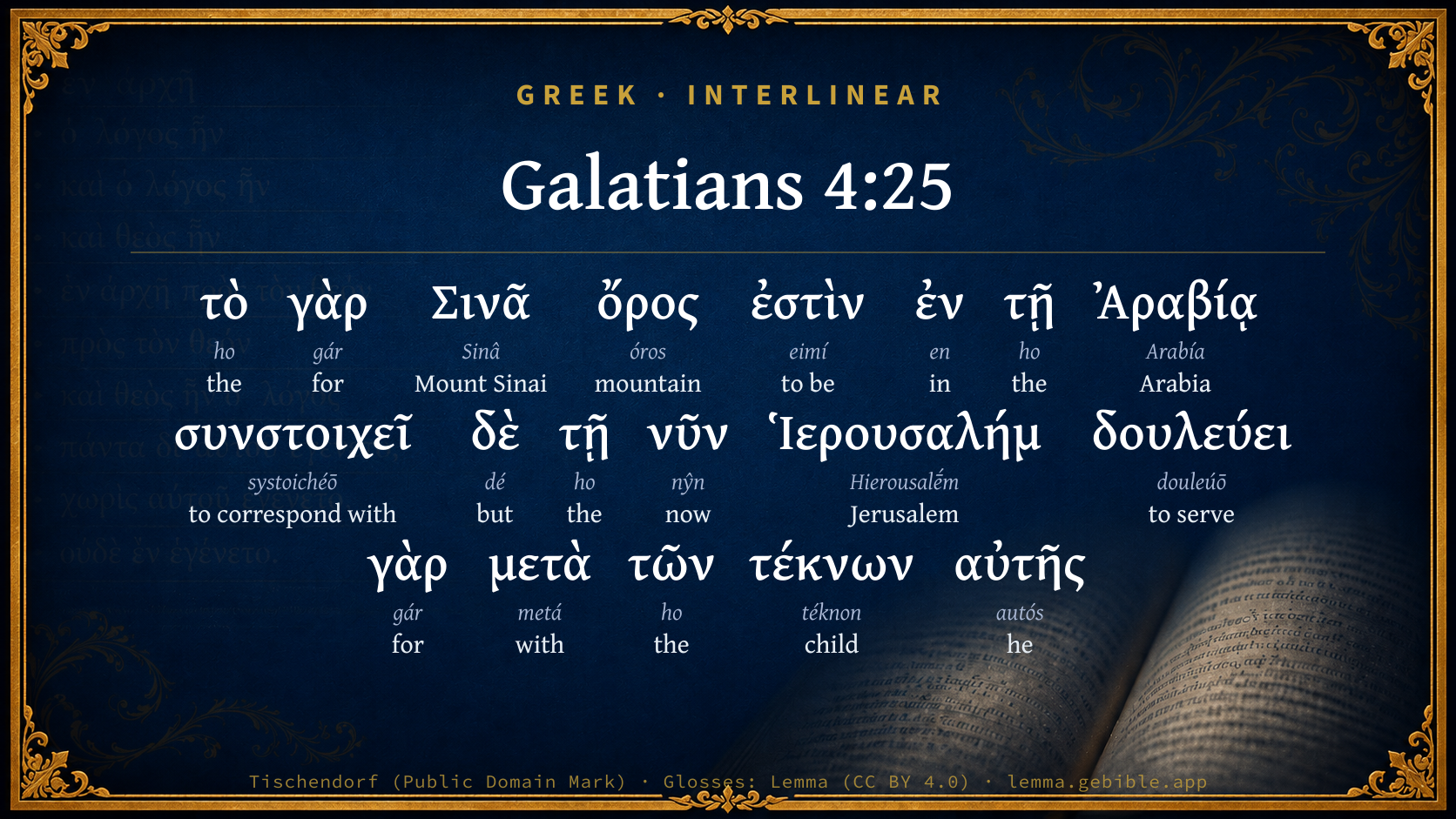
Download image
Cite this verse

Galatians 4:25 (World English Bible). Public Domain. Lemma interlinear Bible study tool, https://lemma.gebible.app/v/galatians/4/25.

Show BibTeX & RIS
BibTeX
RIS
English Translation
For this Hagar is Mount Sinai in Arabia, and answers to the Jerusalem that exists now, for she is in bondage with her children.
World English Bible · Public Domain
Highlights
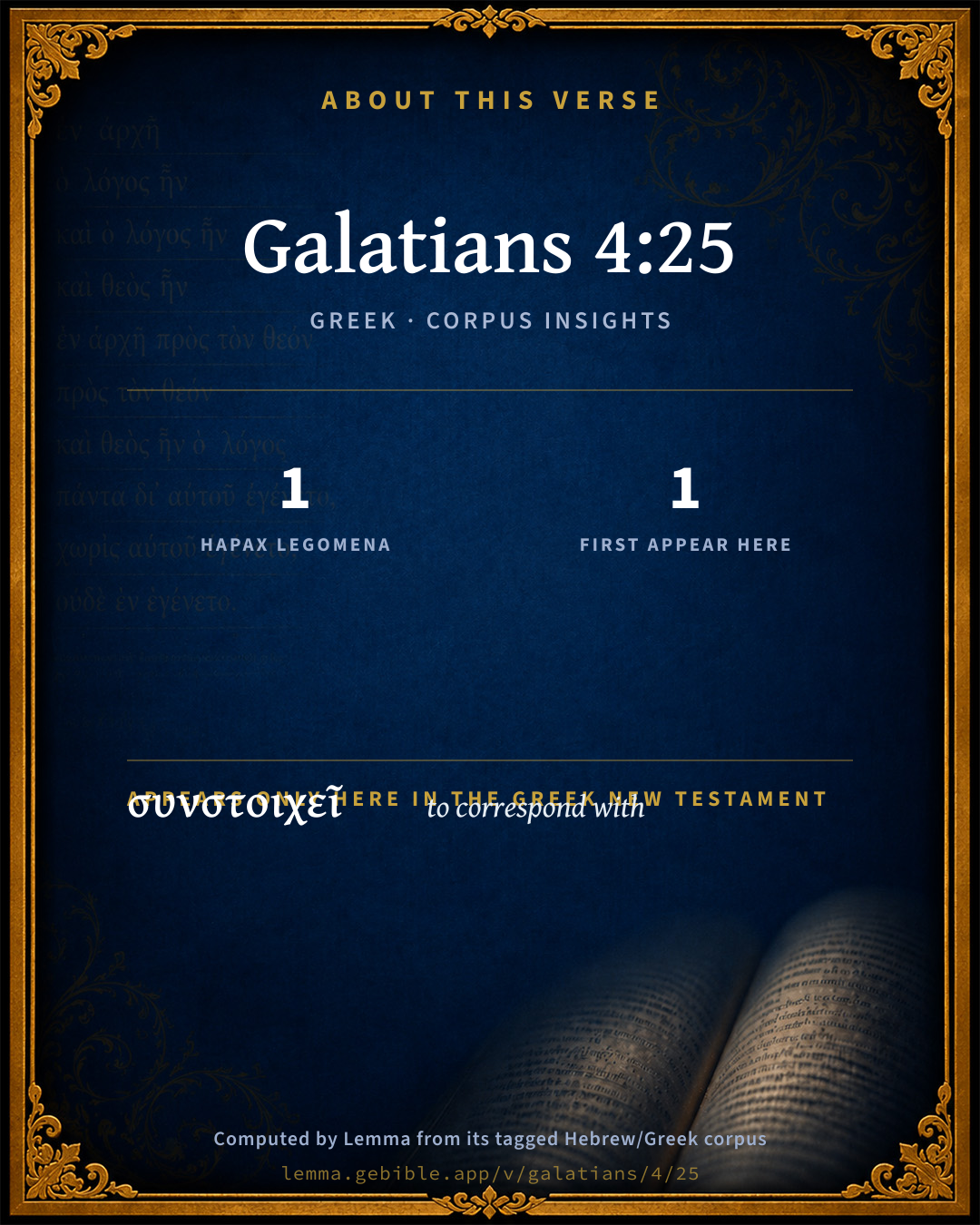
  • 1 hapax legomenon — only here in the Greek New Testament
  • 1 first appearance in the Greek New Testament
Full analysis ↓
Download a study sheet

One document with this verse’s original text, its word-by-word gloss line, the meaning frame, cross-references with their text, attributed commentary, and full source and license credits — printable, and it pastes into notes with its structure intact.

This verse Autodidact and up

Study sheet (.html) Plain text (.txt)

A passage Seminary Student

Up to 50 verses in one chapter. A passage sheet keeps up to 6 commentary sources and 12 cross-references per verse, in the order this page ranks them, and says so on the sheet whenever that leaves anything out. Ask for a single verse and you get the Autodidact verse sheet above.

Everything on this page stays free to read, with no account — the sheet is a download of what is already on screen, not access to it.

Want to remove ads? Support Godless Engineer
Compare translations 3

The same verse in 3 English versions, stacked beneath the original-language interlinear above. Click any original word for its lexicon entry.

Each is an independent rendering of the whole verse — the interlinear is not word-aligned to these translations.

Highlighted words mark where these versions differ — a whole-verse word diff, not a word-by-word alignment.

  • World English Bible Public Domain
    For this Hagar is Mount Sinai in Arabia, and answers to the Jerusalem that exists now, for she is in bondage with her children.
  • King James Version Public Domain
    For this Agar is mount Sinai in Arabia, and answereth to Jerusalem which now is, and is in bondage with her children.
  • unfoldingWord Literal Text CC BY-SA 4.0
    Now Hagar is Mount Sinai in Arabia, and corresponds to the present Jerusalem, for she is in slavery with her children.

unfoldingWord Literal Text — © unfoldingWord, licensed CC BY-SA 4.0. Word-aligned USFM3 via Door43 (git.door43.org/unfoldingWord/en_ult).

Versions to compare (up to 4)

3 of 4 selected

Show all 19 translations

Every available English version of this verse, each an independent rendering of the whole verse.

  • World English Bible Public Domain
    For this Hagar is Mount Sinai in Arabia, and answers to the Jerusalem that exists now, for she is in bondage with her children.
  • Berean Standard Bible Public Domain
    Now Hagar stands for Mount Sinai in Arabia and corresponds to the present-day Jerusalem, because she is in slavery with her children.
  • Majority Standard Bible Public Domain
    For Hagar stands for Mount Sinai in Arabia and corresponds to the present-day Jerusalem, and she is in slavery with her children.
  • King James Version Public Domain
    For this Agar is mount Sinai in Arabia, and answereth to Jerusalem which now is, and is in bondage with her children.
  • American Standard Version (1901) Public Domain
    Now this Hagar is mount Sinai in Arabia and answereth to the Jerusalem that now is: for she is in bondage with her children.
  • Revised Version (1885) Public Domain
    Now this Hagar is mount Sinai in Arabia, and answereth to the Jerusalem that now is: for she is in bondage with her children.
  • Geneva Bible (1599) Public Domain
    (For Agar or Sina is a mountaine in Arabia, and it answereth to Hierusalem which nowe is) and she is in bondage with her children.
  • Douay-Rheims (1899) Public Domain
    For Sina is a mountain in Arabia, which hath affinity to that Jerusalem which now is, and is in bondage with her children.
  • Young's Literal Translation Public Domain
    for this Hagar is mount Sinai in Arabia, and doth correspond to the Jerusalem that now `is', and is in servitude with her children,
  • Literal Standard Version CC BY-SA 4.0
    for this Hagar is Mount Sinai in Arabia, and corresponds to the Jerusalem that now [is], and is in servitude with her children,
  • Unlocked Literal Bible CC BY-SA 4.0
    Now Hagar represents Mount Sinai in Arabia; and she represents the present Jerusalem, for she is in slavery with her children.
  • unfoldingWord Literal Text CC BY-SA 4.0
    Now Hagar is Mount Sinai in Arabia, and corresponds to the present Jerusalem, for she is in slavery with her children.
  • Darby Bible Public Domain
    For Hagar is mount Sinai in Arabia, and corresponds to Jerusalem which [is] now, for she is in bondage with her children;
  • World Messianic Bible Public Domain
    For this Hagar is Mount Sinai in Arabia, and answers to the Jerusalem that exists now, for she is in bondage with her children.
  • Webster's Bible Public Domain
    For this Agar is mount Sinai in Arabia, and answereth to Jerusalem which now is, and is in bondage with her children.
  • Free Bible Version CC BY-SA 4.0
    Hagar symbolizes Mount Sinai in Arabia, and corresponds to the current Jerusalem, because she is in slavery with her children.
  • Bible in Basic English Public Domain
    Now this Hagar is the mountain Sinai in Arabia, and is the image of the Jerusalem which now is: which is a servant with her children.
  • Text-Critical English NT CC BY 4.0
    For Hagar is Mount Sinai in Arabia and corresponds to the present Jerusalem; she is in slavery with her children.
  • Tyndale New Testament (1534) Public Domain
    For mounte Sina is called Agar in Arabia and bordreth vpo the citie which is now Ierusalem and is in bondage with her chyldren.

Literal Standard Version (2020), Covenant Press — licensed CC BY-SA 4.0. Text via the HelloAO Bible API (eBible.org). Unlocked Literal Bible (unfoldingWord) — licensed CC BY-SA 4.0. Text via the HelloAO Bible API (eBible.org). unfoldingWord Literal Text — © unfoldingWord, licensed CC BY-SA 4.0. Word-aligned USFM3 via Door43 (git.door43.org/unfoldingWord/en_ult). Free Bible Version, Dr. Jonathan Gallagher — licensed CC BY-SA 4.0. Text via the HelloAO Bible API (eBible.org).

Word by word

More ways to search: Search by grammar → Find every occurrence → Compare this word →

Practice this passage: Drill this verse → Learn its vocabulary →

συνστοιχεῖ
systoichéō
G4960
“to correspond with”
Verb, Present, Active, Indicative, 3rd person, Singular
Part of Speech
Verb
Tense
Present
Voice
Active
Mood
Indicative
Person
3rd person
Number
Singular
Full Thayer's Definition

Origin: from G4862 and G4748

TDNT: 18:09,1

1. to stand or march in the same row (file) with a. of soldiers b. to stand over against, be parallel with c. to answer to, resemble 1. so once of a type in the OT which answers to the antitype in the NT
  1. τὸ ho G3588 “the” Article, Nominative, Singular, Neuter
  2. γὰρ gár G1063 “for” Conjunction
  3. Σινᾶ Sinâ G4614 “Mount Sinai” Noun, Proper, indeclinable
  4. ὄρος óros G3735 “mountain” Noun, Nominative, Singular, Neuter
  5. ἐστὶν eimí G1510 “to be” Verb, Present, Active, Indicative, 3rd person, Singular
  6. ἐν en G1722 “in” Preposition
  7. τῇ ho G3588 “the” Article, Dative, Singular, Feminine
  8. Ἀραβίᾳ Arabía G688 “Arabia” Noun, Dative, Singular, Feminine
  9. δὲ dé G1161 “but” Conjunction
  10. τῇ ho G3588 “the” Article, Dative, Singular, Feminine
  11. νῦν nŷn G3568 “now” Adverb
  12. Ἱερουσαλήμ Hierousalḗm G2419 “Jerusalem” Noun, Proper, indeclinable
  13. δουλεύει douleúō G1398 “to serve” Verb, Present, Active, Indicative, 3rd person, Singular
  14. γὰρ gár G1063 “for” Conjunction
  15. μετὰ metá G3326 “with” Preposition
  16. τῶν ho G3588 “the” Article, Genitive, Plural, Neuter
  17. τέκνων téknon G5043 “child” Noun, Genitive, Plural, Neuter
  18. αὐτῆς autós G846 “he” Personal pronoun, Genitive, Singular, Feminine

About this verse

These counts appear in no published source. They are computed here, from the morphology-tagged text and Lemma’s own curated glosses. What Lemma adds →

19
words
15
distinct lemmas
Pauline Epistles
section

Notable vocabulary

1 hapax legomenon — a word that appears only here in the entire Greek New Testament:

  • συνστοιχεῖ to correspond with G4960

First appearance in Scripture

This word makes its first canonical appearance in the Greek New Testament here:

  • συνστοιχεῖ to correspond with G4960

Shared distinctive vocabulary

Ἀραβίᾳ Arabia G688 occurs in 2 verses of the Greek New Testament. Also found in:
Repetition

Words recur within this verse:

Cross-references

10

Topical passages linked to Galatians 4:25 in the Treasury of Scripture Knowledge — connected by theme and wording, ordered by reader-vote popularity; previews shown in the World English Bible.

  • Psalms 68:17 The chariots of God are tens of thousands and thousands of thousands. The Lord is among them, from Sinai, into the sanctuary.
  • Matthew 23:37 "Jerusalem, Jerusalem, who kills the prophets, and stones those who are sent to her! How often would I have gathered your children together, even as a hen gathers her chickens under her wings, and you would not!
  • Galatians 1:17 nor did I go up to Jerusalem to those who were apostles before me, but I went away into Arabia. Then I returned to Damascus.
  • Deuteronomy 33:2 He said, Yahweh came from Sinai, Rose from Seir to them; He shined forth from Mount Paran, He came from the ten thousands of holy ones: At his right hand was a fiery law for them.
  • Judges 5:5 The mountains quaked at the presence of Yahweh, Even yon Sinai at the presence of Yahweh, the God of Israel.
  • Psalms 68:8 The earth trembled. The sky also poured down rain at the presence of the God of Sinai-- At the presence of God, the God of Israel.
  • Luke 13:34 "Jerusalem, Jerusalem, that kills the prophets, and stones those who are sent to her! How often I wanted to gather your children together, like a hen gathers her own brood under her wings, and you refused!
  • Luke 19:44 and will dash you and your children within you to the ground. They will not leave in you one stone on another, because you didn't know the time of your visitation."
  • Acts 1:11 who also said, "You men of Galilee, why do you stand looking into the sky? This Jesus, who was received up from you into the sky will come back in the same way as you saw him going into the sky."
  • Hebrews 12:18 For you have not come to a mountain that might be touched, and that burned with fire, and to blackness, darkness, tempest,

Cross-references courtesy of OpenBible.info (CC BY 4.0).

Commentary

Notes on Galatians 4:25 from classic Christian and Jewish commentators (each source and its license shown beneath its notes). The classic Christian expositions comment on the surrounding passage and are grouped to its opening verse, so a note may address several verses; the Jewish commentaries on the Tanakh (Rashi and others) are per-verse, so they appear only where the commentator wrote on this verse.

Lemma curates 59 commentaries, every one of them public domain or Creative Commons licensed, each selected and text-cleaned for this edition rather than reprinted as found. About our sources →

Ellicott's Commentary for English Readers

(25) For this Agar is mount Sinai in Arabia.—This clause will be, perhaps, best dealt with in an excursus, of which we will at present merely summarise the result by saying that the true (or, rather, most probable) reading appears to be: Now this Agar is Mount Sinai in Arabia; and the sense: “By the word Hagar is meant Mount Sinai in Arabia.” There appears to be sufficient evidence to show that Hagar may be regarded as the Arabic name for Sinai, so that there would be a special reason for identifying Hagar allegorically with the old covenant. For a fuller discussion see Excursus B (p. 467).

Answereth to Jerusalem which now is.—The word for “answereth” is a technical term in philosophy, applied to the parallel columns containing such antithetical pairs as good—evil; one—many; finite—infinite, &c. Here it will be illustrated by the parallel arrangement of the different points of the allegory given above. “Answereth to” will thus mean “stands in the same column with.” Hagar, Sinai, the old covenant, the Jewish nation, or the earthly Jerusalem, all stand upon the same side of the antithesis. They are arranged one above another, or, in other words, they rank in the same line, which is the primitive meaning of the word.

Jerusalem which now is.—The present Jerusalem—i.e., the Jewish people still subject to the Law. It is opposed to “Jerusalem which is above,” as the pre-Messianic to the Messianic system.

And is in bondage with her children.—The true reading is, for she is in bondage with her children. Jerusalem is, as it were, personified, so that “with her Children” means “all who are dependent upon her”—the Jewish system and all who belong to it.

EXCURSUS B: ON THE PASSAGE (Gal_4:25),

“FOR THIS AGAR IS MOUNT SINAI IN ARABIA.”

The words “For this Agar is Mount Sinai in Arabia” present difficulties which seem to need a somewhat longer and more technical discussion than could properly be given to them in the body of the Commentary, and it has seemed the more desirable to devote to them a short excursus, as the view taken is one that, in this instance, diverges from that adopted by more than one of the best authorities, and conspicuously by Dr. Lightfoot.

The first question is one of reading. The words appear in no less than four different forms. Two of these, however, may be set aside at once. For the two that remain the authorities are nearly equally balanced. The simple reading “For Sinai is a mountain in Arabia” has in its favour the Sinaitic MS.; the Codex Ephraem; the Codex Augiensis, in the library of Trinity College, Cambridge; and another Dresden MS., which usually agrees with it, and seems to have been derived from the same copy; a good—perhaps the best—cursive; quotations in Origen and Epiphanius; and the Latin authorities generally. The other reading, “Now this Agar is Mount Sinai in Arabia,” is supported by the Vatican, Alexandrine, and Claromontane MSS., and by a fourth MS., now at Paris, which bears to the Claromontane a somewhat similar relation to that which the Dresden Codex bears to the Augiensis; a good cursive (somewhat inferior to that on the other side); and the Memphitic version. Balancing these authorities, the preponderance would seem—if we may venture to say so, where Dr. Lightfoot thinks differently—to be with the longer reading last mentioned. It is true that the list on the other side is more copious, and represents a wider diffusion of text; but, taking the two groups together, we believe that the second represents the older and purer form of text, and that its readings will be verified in the greater number of instances. It is indeed just that very group, headed by the Codex Sinaiticus, which comes in to mark the first stage of corruption—one of the very first and earliest forms of corruption, it is true, and one that is most nearly allied to the true text, but still a corruption and deviation from the original.

But if the external evidence bears in this direction, internal evidence would seem to confirm it. No doubt internal evidence is a treacherous and double-edged weapon, and it is very often as easy to turn it to one side as to the other. It has been quoted here in support of the shorter reading, and something, perhaps, is to be said for that view. Still, the simpler and more obvious considerations (which should be chiefly looked to) seem to tell rather decidedly the other way. The longer reading is much the more difficult; but it is one of the chief canons of internal evidence that the more difficult reading is to be preferred. It is also easy to see in the form of the Greek phrase what would induce an ignorant scribe to change, and by changing to simplify it. Or even failing this, there is never anything very forced in the hypothesis of an omission which is always one of the most natural of accidents.

The reading of the Received text (with the slight change of “now” instead of “for”) would seem, then, upon the whole, to be the more probable; and the next question would be, Assuming this reading, what sense is to be placed upon it? There is an Arabic word corresponding very nearly (though not quite) in sound to “Hagar,” with the meaning “stone.” Hence Chrysostom, in his exposition of this Epistle, assumes that St. Paul is playing upon this similarity of sound. He says that Sinai “is so called (or translated) in the native tongue” of the Arabs, and he speaks of the mountain as “bearing the same name with the bondmaid.” This statement of Chrysostom does not appear to have received much independent corroboration, though one traveller (Harant), in the sixteenth century, makes the same assertion. Still, even if Sinai were not called in a special sense “the stone” or “rock,” the identity of the Arabic word for “rock” might possibly have suggested to St. Paul a play on words so very much in his style. “The very word Hagar,” we may imagine him arguing, “itself the name for ‘rock,’ suggests the propriety of the analogy which I am applying. It points to the parallel between the stem and relentless legislation of Sinai and the history of Hagar the bondwoman and her son, who persecuted the child of promise.” The literary methods of the present day are different, and such an explanation will seem far-fetched. It may be thought a conclusive argument against it that, whether St. Paul himself knew the Arabic signification of “Hagar” or not, he could not expect a Celtic people like the Galatians to know it. But even this argument is less conclusive when applied to one who is so fond of following the course of his own thought as St. Paul. And yet it must be admitted that there are too many elements of uncertainly for the explanation to be pressed at all strongly: it must remain a possibility—not more. On the other hand, even if it should break down, it would not necessarily follow that the reading would have to be abandoned—it would only lose something of its point. We should then have simply an assertion where otherwise there would be also an argument. “This Hagar—the Hagar of which I am speaking—stands for Mount Sinai which is in Arabia, the country of Hagar. The scene of the Mosaic legislation was part of the domains of the Ishmaelites, the children of Hagar, so that the two may very well be compared.” This interpretation has the authority of Theodore of Mopsuestia and Theodoret, and it is, perhaps, the safest to fall back upon. At the same time there may be something of the additional point which Chrysostom and those who have followed him in modern times have supposed.

A Bible Commentary for English Readers, edited by Charles John Ellicott (1878–1897) — public domain. Text from a community e-Sword module.

Joseph Benson's Commentary

Gal 4:25-27. For this Agar is mount Sinai — That is, is a type of that mount. The whole of that mountainous ridge in Arabia Petrea, of which Sinai was a part, was called Horeb, probably on account of its excessive dryness. It was called by Moses, the mountain of God, (Exo 3:1,) because on it God gave the law to the Israelites. Grotius says, Sinai is called Hagar, or Agar, synecdochically, because in that mountain there was a city which bare Hagar’s name. It is by Pliny called Agra, and by Dio, Agara, and its inhabitants were named Hagarenes, Psa 83:6. Whitby thinks the allusion is taken from the meaning of the word Hagar, which, in the Hebrew, signifies a rock. And answereth — Namely, in the allegory; or resembles, Jerusalem, which now is, and is in bondage — As being in subjection to so many ritual observances, and under a sentence of wrath on the commission of the least wilful offence, and as being also in bondage to the Romans. But Jerusalem, which is above — The church of Christ, so called, because its most perfect state will be in heaven; is free —

Ελευθερα εστι, is the free woman, that is, is represented by Sarah; who is the mother of us all — Who believe. The Jerusalem above, the spiritual Jerusalem, or church of Christ, consisting of believers of all nations, with the covenant on which it is formed, is fitly typified by Isaac, and his mother Sarah, the free-woman, because she was constituted by God the mother of all believers, on account of her bringing forth Isaac supernaturally, by virtue of the promise. For it is written, &c. — As if he had said, My interpretation of the things respecting Abraham’s wives and sons is not new; it is alluded to by Isa 54:1; Rejoice, thou barren, that bearest not — Ye heathen nations, who, like a barren woman, were destitute for many ages of a seed to serve the Lord; break forth, &c., thou that, in former ages, travailest not, for such is now thy happy state, that the desolate, &c. — Ye, that were so long utterly desolate, shall at length bear more children than the Jewish Church, which was of old espoused to God.

Joseph Benson's Commentary on the Old and New Testaments (1811–1818) — public domain. Text from a community e-Sword module.

Tyndale Open Study Notes

Tyndale Open Resources

4:25 Both Hagar and Mount Sinai were symbols of Jerusalem, which stood for Judaism in Paul’s day. Judaism continued to trust in the law and in physical descent from Abraham for their status before God (cp. John 8:31-59); they rejected Christ and continued to live in slavery to the law (Gal 3:23-24; 4:1-3). • Mount Sinai in Arabia: The traditional location for Mount Sinai is in the Sinai Peninsula in Egypt. However, some have suggested that in Arabia means that Mount Sinai was in Midian, where Moses once lived (see Exod 3:1).

Tyndale Open Study Notes — © Tyndale Open Resources, licensed CC BY-SA 4.0. Text via the HelloAO Bible API.

Bengel's Gnomon

Johann Albrecht Bengel

Gal 4:25. Τὸ γὰρ Σινᾶ ὄρος, κ.τ.λ., for Sinai is a mountain in Arabia, and [but] answereth to Jerusalem that now is, for it is in bondage with her children) Hagar, Gal 4:24, and Isaac, Gal 4:28, are opposed to each other, where we must observe, that Hagar is mentioned by her own name, not so Sarah; and yet Isaac is named, whilst Ishmael is not; inasmuch as the child follows [and is included under] the mother, a bond-maid; but the son of the free woman is distinguished [is taken into account] by his own name. Thus the introduction of Hagar in this section stands on a clear and well-defined footing. In the meantime, the covenant from Mount Sinai, and the promise, are opposed to each other in Gal 4:24; Gal 4:28; in like manner, at Gal 4:25-26, Jerusalem that now is, and Jerusalem above. Some consider these words, Σινᾶ ὄρος ἐστὶν ἐν τῇ Ἀραβίᾳ, which are found in all the copies, as a gloss; but they are wrong. For thus Paul’s argument is weakened, when he brings forward the bondage engendered from Mount Sinai [as answering] to that of Jerusalem, which now is; Gal 4:24-25. Proper copies, quoted in the Apparatus, and τὸ, the neuter gender of the article, show, that the word Hagar rather was brought from Gal 4:24 to Gal 4:25; for Hagar is feminine, but Sinai is neuter.[40] Nor do those words, for she is in bondage with her children, require Hagar to be mentioned: For [with] her is to be referred, as not to Sinai in the neuter, so much the less to Hagar, but to Jerusalem which now is. The former (Hagar) had a son, but the latter (Jerusalem) had sons. These remarks relate to the whole passage; we shall now observe some things on each portion in detail.—Σινᾶ ὄρος, Sinai, a mountain) Gal 4:24 has from the Mount Sinai; now the order of the words is changed [Sinai going before mount here; but mount before Sinai in Gal 4:24] (comp. Eph 2:1, note). In the former passage, more regard is had to the mountain, inasmuch as it was upon it that the law was given, whatever name it might have [the name Sinai not being taken into account there]; afterwards, it is rather considered as Sinai [the name Sinai being the prominent idea], a mountain in Arabia.—συστοιχεῖ δὲ) δὲ, and yet [but], although it is in Arabia; συστοιχεῖν is used of that which agrees with something else in a comparison. This agreement is evident in itself, for it is one and the same people that received the law on Mount Sinai, and that inhabit the city of Jerusalem; and the people at both periods stand on the same footing.[41] It is to be added, that Sinai and Jerusalem were nearly under the same meridian, and were united with slight interruption almost by the same chain of mountains.—τῇ νῦν, that now is) The antithesis is, that is above.—νῦν, now, refers to time, above to place; the antithesis of either must be supplied from the other in the semiduplex[42] oratio. The Jerusalem which is present [“that now is”], and earthly; the Jerusalem which is above, and eternal. The expression, which is above, is said with the greater propriety on this account, that it alludes to the higher and nobler part of Jerusalem, and rises above Mount Sinai: and the Jerusalem which is above, inasmuch as she is already our mother, could not be suitably spoken of as future [as that which is about to be, in antithesis to the Jerusalem that now is]; not only is she future [“about to be,” as regards the future], but also more ancient [as regards the past], than ἡ νῦν, [the Jerusalem] which now is, inasmuch as the latter has not existed for a long period, nor will it exist in time to come.—δουλεύει, is in bondage) As Hagar was in bondage to her mistress, so Jerusalem, that now is, is in bondage to the law, and also to the Romans,—her civil state thus being in accordance with her spiritual state.

[40] Hence the omission of the word “Αγαρ in this verse, not so much approved of on the margin of the larger Ed., is reckoned among the fixed readings by the margin of the 2d Ed., in which the Germ. Vers. concurs. But the things deserve to be compared which Michaelis has in der Einleitung, T. i. p. m. 646, where he shows that Hagar in the Arabic idiom denotes a rock, and therefore the words τὸ Ἄγαρ Σινᾶ ὄρος ἐστὶν ἐν τῇ Ἀραβίᾳ ought to be thus translated: “The word Hagar signifies in Arabic the Mount Sinai.”—E. B.

[41] “Eadem populi utroque tempore ratio.” What holds good of the people at the one time, holds good of them at the other, as to their status and principles.—ED.

[42] See App. An abbreviated mode of expression, when two members of a sentence stand in such a relation, that each needs to supply some words from the other.—ED.

Lachm. read Τὸ γὰρ Σινᾶ with CGg Vulg., omitting Ἄγαρ; Tiscliend., Τὸ γὰρ Ἄγαρ Σινᾶ, with both Syr. Versions and Rec. Text. B also has Τὸ Ἄγαρ. AD(Δ) Memph. read τὸ δὲ Ἄγαρ.—ED.

Bengel's Gnomon of the New Testament — English translation (T&T Clark, Edinburgh, 1860) — public domain. Text from a community e-Sword module.

Meyer's Critical & Exegetical Commentary

Heinrich August Wilhelm Meyer

Gal_4:25. The ἥτις ἐστὶν Ἄγαρ, just said, has now a reason assigned for it, from the identity of the name Hagar with that of Mount Sinai. Τὸ γὰρ Ἄγαρ … Ἀραβίᾳ, however, is not to be placed in a parenthesis, because neither in the construction nor in a logical point of view does any interruption occur; but with συστοιχεῖ δέ a new sentence is to be commenced. This covenant is the Hagar of that allegorical historya fact which is confirmed by the similarity of the name of this woman with the Arabian designation of Mount Sinai. Not of a different nature, however,to indicate now the corresponding relation, according to which no characteristic dissimilarity may exist between this woman and the community belonging to the Sinaitic covenant, because otherwise that ἥτις ἐστὶν Ἄγαρ would be destitute of inner truthnot of a different nature, however, but of a similar nature is Hagar with the present Jerusalem, that is, with the Jewish state; because the latter is, as Hagar once was, in slavery together with those who belong to it. This paraphrase at the same time shows what importance belongs to the position of συστοιχεῖ at the head of the sentence.

τὸ γὰρ Ἄγαρ Σινᾶ ὄρος ἐστιν ἐν τ. Ἀραβ.] That the name Hagar (τὸ Ἄγαρ denotes this; see Eph_4:9; Kühner, II. p. 137) accorded with the Arabic name of Sinai, could not but be a fact welcome to the allegorizing Paul in support of his ἥτις ἐστὶν Ἄγαρ. Comp. Joh_9:6.

He now writes Σινᾶ ὄρος, and not ὄρος Σινᾶ as in Gal_4:24, because Ἄγαρ and Σινᾶ are intended to stand in juxtaposition on account of the coincidence of the two names. In Arabic means lapis; and although no further ancient evidence is preserved that the Arabs called Sinai κατʼ ἐξοχήν the stone,[214] yet Chrysostom in his day says that in their native tongue the name Sinai was thus interpreted; and indeed Büsching, Erdbeschr. V. p. 535, quotes the testimony of Harant the traveller that the Arabs still give the name Hadschar to Mount Sinai,a statement not supported by the evidence of any other travellers. Perhaps it was (and is) merely a provincial name current in the vicinity of the mountain, easily explained from the granitic nature of the peaks (Robinson, I. p. 170 f.), with which also the probable signification of the Hebrew סִינַי, the pointed (see Knobel on Ex. p. 190), harmonizes,[215] and which became known to the apostle, if not through some other channel previously, by means of his sojourn in Arabia (Gal_1:17). Comp. also Ewald, p. 495; Reiche, p. 63. It is true that the name of Hagar (הָגָר) does not properly correspond with the word ּׁ (חגר), but with וּׁ fugit; but the allegorizing interpretation of names is too little bound to literal strictness not to find the very similarity of the word and the substantial resemblance of sound enough for its purpose, of which we have still stronger and bolder examples in Mat_2:23, Joh_9:6. Beza, Calvin, Castalio, Estius, Wolff, and others, interpret, for Hagar is a type of Mount Sinai in Arabia;[216] but against this view the neuter τὸ Ἄγαρ is decisive.

ἘΝ ἈΡΑΒΊᾼ] not in Arabia situm (Schott and older expositors)for how idle would be this topographical remark[217] in the case of a mountain so universally known!nor equivalent to ἀραβιστί, so that ἈΡΑΒ. would be an adjective and ΔΙΑΛΈΚΤῼ would have to be supplied (Matthias); but: in Arabia the name Hagar signifies the Mount Sinai.[218] So Chrysostom, Theophylact, Luther (for Agar means in Arabia the Mount Sinai), Morus, Koppe, Reiche, Reithmayr, and others.

συστοιχεῖ] The subject is, as Theodore of Mopsuestia rightly has it, Hagar, not Mount Sinai (Vulgate, Jerome, Ambrose, Chrysostom and his followers, Thomas, Erasmus, Luther, Calvin, Estius, Wolf, Bengel, and others; also Hofmann now),a view which runs entirely counter to the context, according to which the two women are the subjects of the allegorical interpretation, while τὸ γὰρ Ἄγαρ Σινᾶ ὄρος ἐστιν ἐν τῇ Ἀραβ. was merely a collateral remark by way of confirmation. Incorrectly also Studer and Usteri, de Wette, Baumgarten-Crusius (also Hofmann formerly), Windischmann, Reithmayr, hold that the subject is still μία μὲν ἀπὸ ὄρους Σινᾶ, the Sinaitic constitution. In this way there would be brought out no comparison at all between the subject of συστοιχεῖ and the present Jerusalem; and yet such, according to the signification of συστοιχεῖν (see afterwards), there must necessarily be, so that in δουλεύει γάρ κ.τ.λ. lies the tertium comparationis. The Sinaitic διαθήκη is not of a similar nature with the present Jerusalem, but is itself the constitution of it; on that very account, however, according to the allegorical comparison Hagar corresponds to the present Jerusalem. συστοιχεῖν means to stand in the same row (see Polyb. x. 21. 7, and Wetstein); that is, here, to stand in the same category (συστοιχία, Aristot. Metaph. i. 5, pp. 986, 1004), to be of the same nature and species, σύστοιχον εἶναι (Theophr. c. pl. vi. 4. 2; Arist. Meteor, i. 3; Lucian, q. hist. conscr. 43). Consequently: Hagar belongs to the same category with the present Jerusalem, is of a like nature with it (comp. Polyb. xiii. 8. Galatians 1 : ὅμοια καὶ σύστοιχα), has in common with it the same characteristic relation, in so far namely that, as Hagar was a bond-woman, the present Jerusalem with its children is also in bondage. See below. Thus συστ. expresses the correspondence. But it is incorrect to take it as: she confronts as parallel (Rückert, Winer).[219] This must have been expressed by ἀντιστοιχεῖ (Xen. Symp. 2. 20, Anab. v. 4. 12; comp. ἀντίστοιχος, Eur. Andr. 746, and ἀντιστοιχία, Plut. Mor. p. 474 A). Many of those who regard Sinai as the subject (see above) interpret: it extends as far as Jerusalem (Vulgate, Jerome, Ambrose, Chrysostom, Theophylact, Erasmus, Luther, Wolf, and others). This would have to be more exactly defined with Genebrardus, ad Psa_133:3, following out the literal meaning of the word συστοιχεῖ: perpetuo dorso sese versus Sionis montes exporrigit. But even granting the geographical reality of the description, and setting aside the fact that Sinai is not the subject, Paul must have named, instead of τῇ νῦν Ἱερονσ., Mount Zion. Hofmann, in reference to the position of Sinai in Arabia and of Jerusalem in the land of promise, interprets the expression locally indeed, but as indicative of the non-local relation, that the present Jerusalem belongs to the same category with the mountain although Arabian, which has it side by side on the same line in the order of the history of salvation. An artificial consequence of the geographical contrast introduced as regards ἐν Ἀραβ., as well as of the erroneous assumption that Mount Sinai is the subject. At the same time a turn is given to the interpretation, as if Paul had written ΣΥΣΤΟΙΧΕῖ ΔῈ ΑὐΤῷ Ἡ ΝῦΝ ἹΕΡΟΥΣ.

Τῇ ΝῦΝ ἹΕΡΟΥΣΑΛΉΜ] does not stand in contrast to the former Salem (Erasmus, Michaelis), but in Pauls view means the present Jerusalem belonging to the pre-Messianic period, as opposed to ἡ ἄνω Ἱερουσ. (ver 26), which after the ΠΑΡΟΥΣΊΑ will take its place. See on Gal_4:26. Moreover, the present Jerusalem and its children (inhabitants; see Mat_23:37, Psa_149:2) represent the Israelitic commonwealth and its members. Comp. Isa_40:2.

δουλεύει γὰρ κ.τ.λ.] namely, to the Mosaic law. The bondage to Rome (Pelagius) is not, according to the context, referred to either alone (Castalio, Ewald) or jointly (Bengel). The subject is ἡ νῦν Ἱερουσ., and not ἌΓΑΡ (Cornelius a Lapide, Grotius, and others). Looking at the usage both of classical authors and the N.T., there is nothing surprising in the change of subject (Stallbaum, ad Plat. Gorg. p. 510 C; Winer, p. 586 [E. T. 787 f.]). Lachmann (also Ewald) has incorrectly placed the words δουλεύει … αὐτῆς in a parenthesis.

[214] We may add that ּׁ occurs elsewhere as a geographical proper name in Arabia Petraea. Thus the Chald. Paraphr. always gives the name חגרא to the wilderness called in the Hebr. שׁוּר. As to the town ּׁ, which is, however, to be pronounced Hidschr and not Hadschr, and, on account of its too remote site, cannot come into consideration here (in opposition to Grotius and others), see Ewald, p. 493 f., and Jahrb. VIII. p. 290.

[215] As to the mineralogical beauty of the mountain, see Fraas, Aus d. Orient geolog. Beobacht. 1867.

[216] At the same time Calvin and others remark on ἐν Ἀραβίᾳ: hoc est extra limites terrae sanctae, quae symbolum est aeternae haereditatis. This reference is also discovered by Wieseler, who, with Lachmann, reads only τὸ γ. Σινᾶ ὄρος ἐστὶν ἐν τ. Ἀραβ., for the Sinai mountain lies beyond the Holy Land, and indeed in Arabia, where also the alien Hagar is at home. In his view, Paul meant to say that, through their alien nature, the Sinaitic διαθήκη and Hagar showed themselves to answer to each other,namely, as intervenient elements in the history of salvation. But this Paul has not said; the substance of it would have to be read between the lines. How very natural it would have been for him at least to have written, instead of or in addition to ἑν τ. Ἀραβ., ἴξω (or μακρὰν ἀπό) τῆς γῆς Χαναάν, in order thus at least to give some intimation that the alien character was the point! This also applies against the view of Hofmann (comp. also his Schriftbew. II. 2, p. 70 f.), who likewise follows the reading omitting Ἄγαρ, and agrees in substance with Wieselers explanation, taking Mount Sinai as contrast to Sion, and Arabia as contrast to the land of promise. Comp. also, in opposition to this exposition, which imports elements wholly gratuitous, Ewald, Jahrb. X. p. 239.

[217] Which is not (with Bengel) to be brought into an antithetical relation to συστοιχεῖ δέ (the Mount Sinai is indeed situated in Arabia, but corresponds, etc.), as if it were accompanied by a μέν (and with the adoption of Lachmanns reading); for in this case the allegorical signification of the Hagar would not be based on any ground.

[218] Observe that the apostle does not at all wish to say that Hagar is in the Arabic language generally the name of Sinai; but, on the contrary, by ἐν τῇ Ἀραβίᾳ, he characterizes that name as a name used in the country, provincial. Hofmann unjustly finds in the words according to our reading absurdity.

[219] Comp. also Wieseler: corresponds to it; not, however, at a like, but at a different stage, whereby the idea of a type is expressed. This view is not to be supported by Polyb. x. 21. 7, where συζυγοῦντας καὶ συστοιχοῦντας διαμένειν means to remain in rank and file (servare ordines secundum παραστάτας et ἐπιβάτας, Schweighäuser), so that as well the συζυγοῦντες as the συστοιχοῦντες always form one row with one another.

Note.

If the reading of Bengel and Lachmann, τὸ γ. Σινᾶ ὄρος ἐστὶν ἐν τ. Ἀραβ., be adopted, the interpretation would simply be: for the Sinai-Mount is in Arabia; so that ἐν τῇ Ἀραβ. would serve to support the allegorical relation of Hagar to Sinai, seeing that Hagar also was in Arabia and the ancestress of the Arabians. This certainly forms a ground of support much too vague, and not befitting the dialectic acuteness of the apostle. In the case of the Recepta also, ἐν τῇ Ἀραβ., taken as a geographical notice, is so superfluous and aimless, that Schotts uncritical conjecture, treating the words τὸ γ. Ἄγ. ὄρ. Σ. ἐ. ἐν τ. Ἀραβ. as a double gloss, is not surprising. Bentley, who is followed by Mill, Proleg. § 1306, even wished to retain nothing of the passage but τὸ δὲ Ἄγαρ συστοιχεῖ τῇ νῦν Ἱερουσ. κ.τ.λ. Against the interpretation of ἐν τῇʼ Αραβ. by Wieseler and Hofmann, see above.

Meyer — Critical and Exegetical Commentary on the New Testament — English translation by Peter Christie, edited by Frederick Crombie (T&T Clark, 1880) — public domain. Text from a community e-Sword module.

Expositor's Greek Testament

ed. W. Robertson Nicoll

Gal 4:25 . τὸ γὰρ . The variety of readings in the MSS., το Αγαρ , το γαρ Αγαρ , το δε Αγαρ , το γαρ , indicates some primitive error of transcription. It is hardly possible to extract any reasonable sense from the three first: for τὸ Ἅγαρ cannot mean Hagar herself: it denotes the name Hagar, and Stanley’s attempt to connect this name with Sinai proved futile. How then can the statement be understood that the name Hagar is Sinai, or that it answers to Jerusalem? How again can the superfluous description of Sinai as a mountain in Arabia be explained? Moreover, the reading τὸ Ἅγαρ without any connecting particle is intolerable in Greek language, and δέ or γάρ was probably added to correct the solecism. Hence I conclude that Ἅγαρ was probably an error in transcription for the original γάρ , suggested by its occurrence immediately before.

The statement in the text on the contrary, For Sinai is a mountain in Arabia , is full of meaning when it is remembered that Hagar had no connection with Sinai itself, but that she found a home for herself and her children in Arabia. συστοιχεῖ . The previous clause τὸ γὰρ … Ἀραβίᾳ is a parenthesis, ἥτις is therefore the subject of συστοιχεῖ . The Apostle finds in the actual state of Jerusalem and her children the same characteristic feature of slavery as in the covenant of Sinai.

The Expositor's Greek Testament, edited by W. Robertson Nicoll (1897–1910) — public domain. Text from a community e-Sword module.

Cambridge Greek Testament for Schools and Colleges

25. τὸ δὲ Ἅγαρ Σινὰ ὄρος ἐστὶν ABDgr syrHarcl. marg. Σινὰ omitted by d and Ambrosiaster Com. (ut videtur). τὸ γὰρ Σινὰ ὄρος ἐστὶν אCG vulg. Orig. and so Lightfoot, W.H. margin, and Westcott in notes on select readings. Observe that the first two readings “differ only by the presence or absence of Δεα.” τὸ γὰρ Ἅγαρ Σινὰ ὄρος ἐστιν Text. Rec. with KLP syrpesh. Harcl. text

NOTE A

Arabia in Gal 1:17 and Gal 4:25

THE terms Arabia and Arabians, as used during the first century A.D., referred not only to the peninsula proper including the Sinaitic peninsula (Gal 4:25), but also especially to the kingdom of the Nabathaeans. So Josephus expressly in Antt. I. 12. 4 § 221. He also speaks of Arabia being on the east of Peraea (B.J. III. 3. 3 [§ 47]), of its being visible from the Temple towers (B. J. v. 4. 3 [§ 160]), and of its limit in the country of Gamalitis (Antt. XVIII. 5. 1§ 113). The Nabathaeans, who presumably came from a more southern part, were settled in Petra B.C. 312 (if not even earlier, in the first half of the 5th cent. B.C. see Mal 1:3), and from that time came into frequent touch with the Seleucid, Egyptian, Jewish, and Roman rulers, holding their own with some ease, on account of the natural difficulties of their country. The limits of their kingdom changed, but in the first century A.D. extended as far north as the neighbourhood of Damascus. Damascus itself was under the suzerainty of Rome, but the cessation of Roman coinage there after 33–34 until 62 A.D. makes it probable that during those years it was in the hands of the Arabians, probably ceded to Aretas IV. by Caligula. Thus St Paul’s notice, 2Co 11:32, is so far confirmed. See further Schürer, English Translation, I. ii., pp. 345 sqq., C. H. Turner in Hastings, D.B. I. 416, and Nöldeke in Hastings-Selbie, D.B. s.v. Arabia.

It is then clear, if the language of Josephus is sufficient guide, that when St Paul speaks of spending two years in Arabia he may mean anywhere in the kingdom of the Nabathaeans, from near Damascus down to the Sinaitic peninsula. As he does not give any closer definition he probably wandered from place to place. He may even have gone as far south as Mt Sinai, but we know too little of the possibilities of travelling at that time in Petra and the districts bordering upon it to be able to say that he could do so. It may be doubted whether the sentimental reason of visiting the scene of the giving of the Law would have appealed to him just after his conversion. The case of Elijah was wholly different: to him the revelation to Moses was the highest conceivable; not so to St Paul.

25. τὸ δὲ Ἅγαρ Σινὰ ὄρος ἐστὶν ἐν τῇ Ἀραβίᾳ. See notes on Textual Criticism.

(1) So W.H. text, which we shall consider first. “Now Hagar is Mt Sinai in Arabia.”

(a) This has been explained since the time of Chrysostom by saying that the word “Hagar” means Mt Sinai on the lips of Arabians. For “ḥagar” (חגר) in Arabic = rock, stone. But Hagar (הגר) is from a different root.

(b) It is therefore better to accept the following explanation. The thought “Hagar” (not the word and not the woman as such, but the thought of bondage suggested by her) corresponds to Mt Sinai, situated in a desert land and far away from the land of promise generally, and Jerusalem in particular. For τὸ δὲ introducing a thought rather than a word see Eph 4:9. No doubt the connexion of “Hagar” with Mt Sinai would the more readily suggest itself in that Hagar and her son went into Arabia. It is doubtful whether the Hagarenes (Psa 83:6), or Hagrites (1Ch 5:10; 1Ch 5:19-20), were of Aramaean or Arabian origin.

(2) W.H. marg. τὸ γὰρ Σινὰ ὄρος ἐστὶν ἐν τῇʼ Αραβία̣. This must be explained on the same lines as (1) (b). I say Hagar is the mother of slaves, for Mt Sinai, the place whence the first covenant (Hagar) came, is in a desert place far away from the land of promise generally, and Jerusalem in particular.

On Arabia see Gal 1:17, where, as here, the distance from Jerusalem, and, also apparently, its non-Jewish associations, are in St Paul’s mind. See also Appendix, Note A.

συνστοιχεῖ δὲ. συνστ.[134], cf. στοιχεῖν Gal 5:25, Gal 6:16 and στοιχεῖα Gal 4:3; Gal 4:9, “is in the same rank with,” i.e. the same category. Polybius uses συνστοιχεῖν literally of soldiers, συζυγοῦντας καὶ συστοιχοῦντας διαμένειν (x. 23 [21]. 7). Compare σύστοιχος of the same class, e.g. ὁ γλυκὺς καὶ λιπαρὸς καὶ ὅσοι σύστοιχοι τούτοις (Theophr. de Caus. Plant. 6. 4. 2). “The place of the giving of the Law belongs to the same grade or stratum of the development of the world as the present Jerusalem, the metropolis of the Jews, and not to the higher grade, on which stands the future Jerusalem, the Jerusalem that now exists in heaven” (Zahn, p. 236). The force of the δέ is: But though distant it corresponds in character with etc.

[134] Is affixed it means that all the passages are mentioned where the word occurs in the Greek Bible.

τῇ νῦν Ἰερουσαλήμ. νῦν the earthly and visible, not without reference to the position of enmity towards Christ taken by its representatives. In this and the following verse the Hebrew form of the name is used (see Gal 1:17 note) because of its sacred and theological associations.

δουλεύει γὰρ. Although in strict grammar the subject is Hagar or the first διαθήκη, yet, as neither could be said to be in bondage, the thought is of Jerusalem, subservient to Rome, typical of worse bondage under the Law, and indeed to an evil master (cf. Joh 8:31-35).

μετὰ τῶν τέκνων αὐτῆς, i.e. with those who belong spiritually to her.

Cambridge Greek Testament for Schools and Colleges (Cambridge University Press, 1896; 21 vols, various authors incl. Carr, Maclear, Plummer, Farrar, Lumby, Moule, M. R. James, Simcox) — public domain. Text from a community e-Sword module.

Geneva Bible (1599)

Geneva Bible translators

Look how the case standeth betwixt Hagar and her children, even so standeth it between Jerusalem and hers.

That is, Sinai.

Geneva Bible (1599) marginal notes — public domain. Text via Bolls.life.

Jamieson, Fausset & Brown

Robert Jamieson, A. R. Fausset & David Brown

Translate, "For this word, Hagar, is (imports) Mount Sinai in Arabia (that is, among the Arabians--in the Arabian tongue)." So CHRYSOSTOM explains. Haraut, the traveller, says that to this day the Arabians call Sinai, "Hadschar," that is, Hagar, meaning a rock or stone. Hagar twice fled into the desert of Arabia (Gen. 16:1-16; Gen 21:9-21): from her the mountain and city took its name, and the people were called Hagarenes. Sinai, with its rugged rocks, far removed from the promised land, was well suited to represent the law which inspires with terror, and the spirit of bondage.

answereth--literally, "stands in the same rank with"; "she corresponds to."

Jerusalem which now is--that is, the Jerusalem of the Jews, having only a present temporary existence, in contrast with the spiritual Jerusalem of the Gospel, which in germ, under the form of the promise, existed ages before, and shall be for ever in ages to come.

and--The oldest manuscripts read, "For she is in bondage." As Hagar was in bondage to her mistress, so Jerusalem that now is, is in bondage to the law, and also to the Romans: her civil state thus being in accordance with her spiritual state [BENGEL].

Jamieson, Fausset & Brown — Commentary Critical and Explanatory on the Whole Bible (1871) — public domain (CC PDM 1.0). Text via the HelloAO Bible API.

Adam Clarke's Commentary

Verse 25. For this Agar is Mount Sinai in Arabia] Το γαρ Αγαρ Σινα ορος εστιν εν τη Αραβια. This is the common reading; but it is read differently in some of the most respectable MSS., versions, and fathers; thus: το γαρ Σινα ορος εστιν εν τῃ Αραβια, for this Sinai is a mountain of Arabia; the word Αγαρ, Agar, being omitted. This reading is supported by CFG, some others, the AEthiopic, Armenian, Vulgate, and one copy of the Itala; by Epiphanius, Damascenus, Ambrosiaster, Jerome, Augustine, Hilary, Sedulius, and Bede; and the word is sometimes, though not always, omitted by Cyril and Origen, which proves that in their time there were doubts concerning the common reading.

Of the word Agar in this verse, which renders the passage very obscure and difficult, Professor White says, forsitan delendum, "probably it should be expunged." Griesbach has left it in the text with a note of doubtfulness.

Answereth to Jerusalem] Hagar, the bond maid, bringing forth children in a state of slavery, answereth to Jerusalem that now is, συστοιχει, points out, or, bears a similitude to, Jerusalem in her present state of subjection; which, with her children-her citizens, is not only in bondage to the Romans, but in a worse bondage to the law, to its oppressive ordinances, and to the heavy curse which it has pronounced against all those who do not keep them.

Adam Clarke's Commentary on the Bible (1810–1826) — public domain. Text from a community e-Sword/MySword module.

John Calvin's Commentaries

25. For Agar is mount Sinai I shall not waste time in refuting the expositions of other writers; for Jerome’s conjecture, that Mount Sinai had two names, is trifling; and the disquisitions of Chrysostom about the agreement of the names are equally unworthy of notice. Sinai is called Hagar, because it is a type or figure, as the Passover was Christ. The situation of the mountain is mentioned by way of contempt. It lies in Arabia, beyond the limits of the holy land, by which the eternal inheritance was prefigured. The wonder is, that in so familiar a matter they erred so egregiously.

And answers, on the other hand. The Vulgate translates it, is joined (conjunctus est) to Jerusalem; and Erasmus makes it, borders on (confinis) Jerusalem; but I have adopted the phrase, on the other hand, (ex adverso,) in order to avoid obscurity. For the apostle certainly does not refer to nearness, or relative position, but to resemblance, as respects the present comparison. The word, σύστοιχα, which is translated corresponding to, denotes those things which are so arranged as to have a mutual relation to each other, and a similar word, συατοιχία, when applied to trees and other objects, conveys the idea of their following in regular order. Mount Sinai is said (συστοιχεῖν) to correspond to that which is now Jerusalem, in the same sense as Aristotle says that Rhetoric is (ἀντίστροφος) the counterpart to Logic, by a metaphor borrowed from lyric compositions, which were usually arranged in two parts, so adapted as to be sung in harmony. In short, the word, συστοιχεῖ, corresponds, means nothing more than that it belongs to the same class.

But why does Paul compare the present Jerusalem with Mount Sinai? Though I was once of a different opinion, yet I agree with Chrysostom and Ambrose, who explain it as referring to the earthly Jerusalem, and who interpret the words, which now is, τὣ νῦν ̔ιερουσαλὴμ, as marking the slavish doctrine and worship into which it had degenerated. It ought to have been a lively image of the new Jerusalem, and a representation of its character. But such as it now is, it is rather related to Mount Sinai. Though the two places may be widely distant from each other, they are perfectly alike in all their most important features. This is a heavy reproach against the Jews, whose real mother was not Sarah but the spurious Jerusalem, twin sister of Hagar; who were therefore slaves born of a slave, though they haughtily boasted that they were the sons of Abraham.

John Calvin's Commentaries (1540-1563) — public domain. Text from the Calvin Translation Society English edition (1840s-50s) via the Christian Classics Ethereal Library (ccel.org). Calvin's coverage is partial (roughly two-thirds of the Bible); uncommented books and verses are honest gaps, never fabricated. The 19th-century editor's footnotes and remarks are omitted so the notes are faithfully Calvin's own voice.

The Cambridge Bible for Schools and Colleges

gen. ed. J. J. S. Perowne

25. The reading, the construction and the meaning of the first clause of this verse are uncertain, and have afforded matter for considerable discussion. The genuineness of the word ‘Hagar’ is doubtful. If it is retained, the sense will be, ‘For (or, as some copies read, ‘now’) this term Hagar is the name by which Mount Sinai is called in Arabia’, it therefore represents Mount Sinai, which is in Arabia, the country to which Hagar fled and which her descendants inhabit. ‘The word Hagar in Arabic means “a rock”, and some authorities tell us that Mount Sinai is so called by the Arabs’. Conybeare and Howson. But it is better to omit it, and the sense will then be, ‘For Mount Sinai is in Arabia’, the country of Ishmael’s descendants, the offspring of the bondwoman. In any case the clause is parenthetical, and the following words refer to Hagar in the preceding verse:—‘and this is Hagar (for Mount Sinai is situated in Arabia—the country of the Ishmaelites) and it (the covenant) corresponds to Jerusalem &c.’

and answereth] ‘belongs to the same row or category, corresponds to’, see note Gal_4:22.

Jerusalem which now is] Here, from the addition of the phrase ‘with her children’ (comp. Mat_23:37), it is evident that Jerusalem stands for the whole Jewish people, nationally considered. It is contrasted not, as might have been expected, with ‘Jerusalem which shall be’, but with ‘Jerusalem which is from above’; but the antithesis is not weakened. The Heavenly Jerusalem (Heb_12:2) is the same as the ‘new Jerusalem’ (Rev_21:2) of the prophetic vision, which is even now the city and the home of every true believer (Php_3:20). It is in heaven (or above) until the number of God’s elect shall be accomplished, and then it will ‘come down from God out of heaven’, not like a bondwoman and an outcast, but ‘as a bride adorned for her husband’.

and is in bondage] The reference is probably to the legal bondage to which every Jew, as such, was subject. But Jerusalem was at this time literally a conquered city, subject to the Imperial power of Rome.

The Cambridge Bible for Schools and Colleges (gen. ed. J. J. S. Perowne; Cambridge University Press, 1878–1918) — public domain. Text from a community e-Sword module.

John Gill's Exposition

But Jerusalem which is above,.... This Sarah was a type and figure of; she answered to, and agreed with this; which is to be understood, not of the church triumphant in heaven, but of the Gospel church state under the administration of the new covenant; and that, not as in the latter day glory, when the new Jerusalem shall descend from God out of heaven, but as it then was in the apostle's time, and has been since. Particular respect may be had to the first Gospel church at Jerusalem, which consisted of persons born from above, was blessed with a Gospel spirit, which is a spirit of liberty, out of which the Gospel went into all the world, and from among whom the apostles and first preachers of the word went forth everywhere, and were the means of the conversion of multitudes, both among Jews and Gentiles, and so might be truly said to be the mother of us all. The church in general, under the Gospel, may be, as it often is, called Jerusalem, because of its name, the vision of peace; being under the government of the Prince of peace; the members of it are sons of peace, who are called to peace, and enjoy it; the Gospel is the Gospel of peace, and the ordinances of it are paths of peace; and the new covenant, under the administration of which the saints are, is a covenant of peace. Jerusalem was the object of God's choice, the palace of the great King, the place of divine worship, was compact together, and well fortified: the Gospel church state consists of persons, who, in general, are the elect of God, among whom the Lord dwells, as in his temple. Here his worship is observed, his word is preached, and his ordinances administered; saints laid on the foundation, Christ, and being fitly framed together, grow up unto an holy temple in him, and are surrounded by him, as Jerusalem was with mountains, and are kept by his power unto salvation. This is said to be above, to distinguish it from the earthly Jerusalem, the inhabitants of which were chiefly men of the world, carnal men; but this heavenly Jerusalem, or Gospel church state, chiefly consists of persons born from above, called with an heavenly calling, and who bear the image of the heavenly one, whose conversation is in heaven, who are seeking things above, and in a little time will be there themselves; its constitution and form of government are from above, and so are its doctrines, and its ordinances. The Jews often Speak of

, or or , "Jerusalem above" (x), as distinguished from Jerusalem below: and to this distinction the apostle seems to have respect here, who further says concerning this Jerusalem, that she

is free; from the servitude of sin, Satan, and the world, from the yoke of the law, and from a spirit of bondage; having the Spirit of God, the spirit of adoption, who is a free spirit, and makes such free that enjoy him; and where he is, there is true liberty. He adds,

which is the mother of us all; that are born again, whether Jews or Gentiles, as particularly the church at Jerusalem was, and the Gospel church state in general may be said to be; since here souls are born and brought forth to Christ, are nursed up at her side, and nourished with her breasts of consolation, the word and ordinances. This form of speech is also Jewish: thus it is said (y) that

"Zion, , "the mother of Israel", shall bring forth her sons, and Jerusalem shall receive the children of the captivity.''

Again, explaining Pro 28:24 it is observed (z), that there is no father but the ever blessed God, , "and no mother" but the congregation of Israel. Some copies leave out the word "all"; and so do the Vulgate Latin, Syriac, and Ethiopic versions, and only read, "the mother of us", or "our mother".

(x) Zohar in Gen. fol. 13. 2. & 16. 2. & 75. 4. & 77. 1. & 78. 2. & 114. 3. & 121. 1. & in Exod. fol. 6. 1. & 92. 2. T. Bab. Taanith, fol. 5. 1. Gloss. in T. Bab. Sanhedrin, fol. 97. 2. Caphtor, fol. 14. 2. & 25. 2. & 65. 1. & 68. 2. & 71. 2. & 118. 2. Raziel, fol. 13. 1. & 27. 1. Tzeror Hammor, fol. 61. 3. & 150. 3. Nishmat Chayim, fol. 26. 2. Kimchi in Hos. xi. 19. (y) Targum in Cant. 8. 5. (z) Sithre Tora in Zohar in Gen. fol. 55. 2. & Raya Mehimna in Zohar in Lev. fol. 34. 1.

John Gill's Exposition of the Whole Bible (1746–1763) — public domain (CC PDM 1.0). Text via the HelloAO Bible API.

Trapp's Complete Commentary

John Trapp

25 For this Agar is mount Sinai in Arabia, and answereth to Jerusalem which now is, and is in bondage with her children.

Ver. 25. For this Agar is mount] The Arabians call Mount Sinai, Agar. Twice Hagar fled thither, Gen 16:7; Gen 16:14; Gen 21:14, it being in her way home to Egypt. From her the Arabians are called Hagarenes, and since (for more honour’ sake) Saracens, of Sarah, Hagar’s mistress.

Answereth to Jerusalem] That is, to the Jewish synagogue, born to bondage, as Tiberius said of the Romans, that they were homines ad servitutem parati. men prepared for slavery.

John Trapp, A Commentary or Exposition upon All the Books of the Old and New Testament (1647–1656) — public domain. Text from a community e-Sword module.

Albert Barnes' Notes on the Bible

For this Agar is Mount Sinai - This Hagar well represents the Law given on Mount Sinai. No one can believe that Paul meant to say that Hagar was literally Mount Sinai. A great deal of perplexity has been felt in regard to this passage, and Bentley proposed to cancel it altogether as an interpolation. But there is no good authority for this. Several manuscripts and versions read it, “For this Sinai is a mountain in Arabia;” others, “to this Hagar Jerusalem answereth,” etc. Griesbach has placed these readings in the margin, and has marked them as not to be rejected as certainly false, but as worthy of a more attentive examination; as sustained by some plausible arguments, though not in the whole satisfactory. The word Hagar in Arabic is said to signify a rock; and it has been supposed that the name was appropriately given to Mount Sinai, because it was a pile of rocks, and that Paul had allusion to this meaning of the word here. So Chandler, Rosenmuller, and others interpret it. But I cannot find in Castell or Gesenius that the word Hagar in Arabic has this signification; still less is there evidence that the name was ever given to Mount Sinai by the Arabs, or that such a signification was known to Paul. The plainest and most obvious sense of a passage is generally the true sense; and the obvious sense here is, that Hagar was a fair representation of Mount Sinai, and of the Law given there.

In Arabia - Mount Sinai is situated in Arabia Petraea, or the Rocky. Rosenmuller says that this means “in the Arabic language;” but probably in this interpretation he stands alone.

And answereth to Jerusalem - Margin, “Is in the same rank with.” The margin is the better translation. The meaning is, it is just like it, or corresponds with it. Jerusalem as it is now (that is, in the days of Paul), is like Mount Sinai. It is subject to laws, and rites, and customs; bound by a state of servitude, and fear, and trembling, such as existed when the Law was given on Mount Sinai. There is no freedom; there are no great and liberal views; there is none of the liberty which the gospel imparts to men. The word συστοιχεῖ sustoichei, “answereth to,” means properly to advance in order together; to go together with, as soldiers march along in the same rank; and then to correspond to. It means here that Mount Sinai and Jerusalem as it then was would be suited to march together in the same platoon or rank. In marshalling an army, care is taken to place soldiers of the same height, and size, and skill, and courage, if possible, together. So here it means that they were alike. Both were connected with bondage, like Hagar. On the one, a law was given that led to bondage; and the other was in fact under a miserable servitude of rites and forms.

Which now is - As it exists now; that is, a slave to rites and forms, as it was in fact in the time of Paul.

And is in bondage - To laws and customs. She was under hard and oppressive rites, like slavery. She was also in bondage to sin Joh 8:33-34; but this does not seem to be the idea here.

With her children - Her inhabitants. She is represented as a mother, and her inhabitants, the Jews, are in the condition of the son of Hagar. On this passage compare the notes at 1Co 10:4, for a more full illustration of the principles involved here.

Albert Barnes' Notes on the Bible (1834–1885) — public domain. Text from a community e-Sword/MySword module.

Haydock's Catholic Bible Commentary

===============================

[BIBLIOGRAPHY]

Qui conjunctus est ei, quæ nunc est Jerusalem, Greek: sustoichei te nun Ierousalem. See Budæus, Estius, Mr. Legh, &c.

====================

George Leo Haydock (1774–1849), Haydock's Catholic Family Bible and Commentary, 1859 edition — public domain. Excludes Psalms (Douay-Rheims chapter numbering differs from Protestant) and Deuterocanonical books (Catholic canon only).

Matthew Poole's English Annotations

Agar, the bondwoman, fitly represented

Mount Sinai, the mountain in Arabia, from which the law was given: and

Jerusalem which now is answereth to Mount Sinai; for as in Mount Sinai the law was given in a terrible manner, so now Jerusalem is the seat of the scribes and Pharisees, who are the doctors of that law, and rigidly press the observation of it, by which the Jews are kept

in bondage. The apostle speaketh not here of the civil servitude that the Jews were in under the Romans, to whom they were now tributaries, but of that religious servitude in which the scribes and Pharisees kept them to their legal services.

Matthew Poole's English Annotations on the Holy Bible (1683–1685) — public domain. Text from a community e-Sword/MySword module.

Whedon's Commentary on the Bible

Daniel D. Whedon

25. For—To give proof of this correspondence.

This Agar—The this is the Greek article in the neuter gender, and can agree with Hagar only as a thing; that is, as an element or factor in this allegory.

Is—Represents. The neuter verb often implies representation; as “the candlesticks are the seven Churches,” “the stars are the angels of the Churches.” And in Christ’s words, this bread is my body.

Answereth—Co-ordinates with, or stands in parallel row with.

Jerusalem—St. Paul here uses the old Hebrew word for Jerusalem, not the modern Greek form, indicating thereby that he speaks not so much of the present concrete Jerusalem—of walls and houses—as of the conceptual Jerusalem, symbolized by this material Jerusalem, namely, fallen Judaism, the obsolete theocracy.

Now is—Not the Jerusalem of the holy old past, nor of the future; but the faded Jerusalem of the present, deserted by God, effete and enslaved, and bound to a speedy destruction.

In bondage—Bound in the fetters of the law, after the grace and glory in the law have departed.

Her children—The Judaistic apostles and their Galatian converts. Of the clause this Agar is mount Sinai in Arabia, we have given what we conceive to be the true interpretation.

But, 1. By another reading, adopted by Lightfoot, the first words of the verse are, For the mountain Sinai is in Arabia. The phrase in Arabia, is then made to signify that the connexion between Hagar and Sinai is, that both are Arabian. To the Sinaitic peninsula, apparently, Hagar fled, Gen_16:7-14. The Arabians are called sons of Hagar, (Bar_3:23;) Hagar’s name is illustrious in Arabian legends; and Arab tribes are called Hagarenes, Psa_83:7, and Hagarites, 1Ch_5:19. Hence Hagar represents Sinai, as both being Arabian. All this is far-fetched and feeble. 2. Chrysostom is quoted as saying that Hagar means rock, and thus Sinai is named Hagar—rock in the Arabic language. Hence it is said, that in Arabia, means in the language of Arabia; and so St. Paul identifies Hagar and Sinai here by oneness of name. But, first, there is no sufficient proof that Sinai was called Hagar in Arabic, and the word Hagar does not etymologically signify rock, but one who flees, being cognate with hegira, the term for the flight of Mohammed. The word for rock is not Hagar, but Chagar. See Lightfoot’s learned dissertation.

Daniel D. Whedon (gen. ed.), Commentary on the Old and New Testaments (1874–1909) — public domain. Text from a community e-Sword module.

The Pulpit Commentary

For this Hagar is Mount Sinai in Arabia. This clause has been the subject of much conflicting opinion. The reading of the Greek text is itself much debated, and in the original authorities (manuscripts, versions, and Fathers) it appears in a great variety of forms. A detailed discussion of the latter point would be out of place here; and for the premisses from which the critical judgment is to be drawn, the reader is referred to Alford, and to a detached note which Bishop Lightfoot adds in his "Commentary," at the end of this fourth chapter. Only the main result needs to be stated. There are two forms of the text, between which the choice lies. One is that of the Textus Receptus, namely, To gar Agar Sina orov ejstia," For the word Hagar is Mount Sinai in Arabia." This is maintained by Meyer, Alford, Ellicott, and San-day. The other, omitting the word Agar, runs thus: To gar Sina orov ejstia, For Sinai is a mountain in Arabia." This is accepted by Bentley, Lachmann, Tregelles, Tischendorf (latterly), Bengel, De Wette, Windischmann, Howson, and Lightfoot. In respect to the original authorities, there is not generally thought to exist any great preponderance in the evidence for either the retention or the omission of the word Hagar. " The decision, therefore, depends chiefly upon a comparison of the internal probabilities. In order to this, we must gain as clear a view as we can of the meaning of the above two readings. That of the Textus Receptus, To gar Agar Sina orov ejstia, according to Chrysostom, as well as modern critics, means this: "For the word Hagar is represents in Arabia Mount Sinai." Chrysostom remarks, Hagar is the word for Mount Sinai in the language of that country; "and again, "That mountain where the old covenant was delivered, hath a name in common with the bondwoman." Critics make reference to Gal_1:17, "I went away into Arabia." "It is difficult," says Dean Stanley, "Sinai and Palestine," p. 50." to resist the thought that he St. Paul too may have stood upon the rocks of Sinai, and heard from Arab lips the often-repeated Ha jar, rock, suggesting the double meaning to which the text alludes." But the Arabic word for "rock" is chajar, differing from Hajar, the Arabic form of the bondwoman"s name, by having eheth for its initial letter instead of he. Further, the Arabs would have used the word only as a common noun, rock," and not as a proper noun, the name of the mountain. St. Paul could not have mistaken the one for the other. There is no evidence at all to substantiate Chrysostom"s assertion that the Arabs did name the mountain Hagar; he apparently thought so only because the apostle seemed to him to affirm it. See Lightfoot further on this point. Moreover, the sentence, "The word Hagar is Mount Sinai in Arabia," is not what St. Paul would have written to express this idea; either, instead of "in Arabia" he would have written "in the language of the country;" or else, "for the Mount Sinai is called Hagar in Arabia." Another objection to this reading is the order in which the words Sina and orov stand. Elsewhere where the words are conjoined the order is, as in ver. 24, orov Sina. The passages are these: Exo_19:18, 20 24:2-6 31:18 34:2; Neh_9:13; rov Act_7:30. The reversal of the order here indicates that Sina is the subject, and o belongs to the predicate; that is, that Agar must be expunged from the text, and that we adopt the other reading, To gar Sina orov ejstia, "For Sinai is a mountain in Arabia," the well-known land of Hagar and her descendants; Gen_16:7 Gen_21:21 Gen_25:18 (see Mr. Peele"s articles on "Hagar" and "Shur" in the "Dictionary of the Bible") The article is prefixed to Sina as having been already just mentioned; as if it were "for this Sina is," etc. The purpose of the clause, however it be read, is plainly to make more colourable the allegorical exposition; it explains why the locality of the giving of the Law has been referred to in the words, "one, from Mount Sinai a local specification quite alien to the apostle"s usual manner in referring to the old covenant, and only had recourse to here for this particular object. And answereth to (or, is in the same rank with) Jerusalem which now is (sustoicei dem); and standeth in the same class (literally, in the same column) with the Jerusalem that now is. The use of the verb sustoicein the reader will find amply illustrated in Liddell and Scott"s "Lexicon." In the military language of Greece, illustrated out of Polybius, oiJ sustoicountev were those standing in the same file or column, one behind another (as oiJ suzugountev were those standing side by side in the same rank). Hence, as if tabulated on a board, ideas belonging to the same class, both types and antitypes, were conceived of as if placed in a vertical line in column, and so were called sustoicountev: whilst ideas belonging to a class contrasted with the former, both types and antitypes, were conceived of as placed horizontally opposite to the former in another column; the two sets of contrasted ideas being ajntistoica to each other. Thus in the present instance we have two columns

Hagar, slave mother; Sarah, freewoman.

Ishmael, slave child; Believers, free children.

Covenant from Sinai; Promise.

Jerusalem that now is; etc. Jerusalem that is above; etc.

(Compare Erasmus"s note in Peele"s "Synopsis.") It is not improbable, as Bishop Lightfoot observes, that St. Paul is alluding to some mode of representation common with Jewish teachers employed to exhibit similar allegories (see Bengel"s note above referred to). We may, therefore, conclude that the subject of the verb sustoicei, whatever it is, is regarded by the apostle as standing in the same category with the now subsisting Jerusalem, especially in the particular respect which he presently insists upon; namely, as being characterized by slavery. For this is the main point of this whole allegorical illustration; that Judaism is slavery and the Christian state liberty. It is not clear whether the subject of this verb, "standeth in the same column with," is "the covenant from Mount Sinai," or "Hagar," or "Sinai." If either of the two former, then the first clause of this verse is a parenthesis. The construction runs the most smoothly by adopting the third view, which takes" Sinai" as the subject. Sinai, that gave forth the covenant which is represented by Hagar, "stands in the same column" with "the Jerusalem that now is;" for Sinai is the starting-place of the covenant which has now its central abode in Jerusalem; the people that was there is now here; and the condition of slavery into which Sinai"s covenant brought them marks them now at Jerusalem. And is in bondage with her children (douleuei gar Receptus, douleuei de metaknwn aujthv); for she is in bondage with her children. The reading gar is substituted for de by the editors with general consent. That the subject of the verb "is in bondage" is "the Jerusalem that now is," is apparent from the contrasted sentence which next follows, "but the Jerusalem that is above is free." "With her children;" repeatedly did our Lord group Jerusalem with" her children (Mat_23:37; Luk_13:35 Luk_19:44) having, however, in view the city itself with its inhabitants; while St. Paul probably regards Jerusalem more in idea, as representing Judaism in its central manifestation; "her children" being consequently these who were living under the Law. The apostle here assumes that this mystical Jerusalem with her children was in bondage, making the fact a ground for identifying her with Hagar. That the fact was so St. Paul knew, both from his own experience and from his observation of others. The religious life of Judaism consisted of a servile obedience to a letter Law of ceremonialism, interpreted by the rabbins with an infinity of hair-splitting rules, the exact observance of which was bound upon the conscience of its votaries as of the essence of true piety. The apostle also probably took account of the slavish spirit which very largely characterized the religious teaching of the ruling doctors of Judaism; their bondage, that is, not only to the letter of the Law, but to the traditions also of men; that spirit which those who heard the teaching of the Lord Jesus felt to be so strongly contrasted by his manner of conceiving and presenting religious truth. "He taught as one having authority, and not as the scribes." But the main point now contemplated by the apostle was bondage to ceremonialism.

The Pulpit Commentary (1880–1919), ed. H.D.M. Spence-Jones & Joseph S. Exell — public domain. Text from a community e-Sword module.

John Wesley's Explanatory Notes

For this is Mount Sinai in Arabia - That is, the type of Mount Sinai. And answereth to - Resembles Jerusalem that now is, and is in bondage - Like Agar, both to the law and to the Romans.

John Wesley, Explanatory Notes Upon the Whole Bible (1754–1765) — public domain. Text via the GEBible commentary corpus.

Luther on Galatians

Martin Luther

VERSE 25. And answereth to Jerusalem which now is, and is in bondage with her children.

A little while ago Paul called Mount Sinai, Hagar. He would now gladly make Jerusalem the Sarah of the New Testament, but he cannot. The earthly Jerusalem is not Sarah, but a part of Hagar. Hagar lives there in the home of the Law, the Temple, the priesthood, the ceremonies, and whatever else was ordained in the Law at Mount Sinai.

I would have been tempted to call Jerusalem, Sarah, or the New Testament. I would have been pleased with this turn of the allegory. It goes to show that not everybody has the gift of allegory. Would you not think it perfectly proper to call Sinai Hagar and Jerusalem Sarah? True, Paul does call Sarah Jerusalem. But he has the spiritual and heavenly Jerusalem in mind, not the earthly Jerusalem. Sarah represents that spiritual Jerusalem where there is no Law but only the promise, and where the inhabitants are free.

To show that the Law has been quite abolished, the earthly Jerusalem was completely destroyed with all her ornaments, temples, and ceremonies.

Martin Luther — Commentary on the Epistle to the Galatians (1535), English translation by Theodore Graebner (Zondervan, 1939) — public domain (U.S. copyright not renewed). Text from a community e-Sword module.

Scofield Reference Notes

C. I. Scofield

Agar

Hagar.

The Scofield Reference Bible (1917 edition), notes by C. I. Scofield — public domain. Text from a community e-Sword module.

McGarvey & Pendleton's Commentaries

J. W. McGarvey

Now this Hagar is mount Sinai in Arabia and answereth to the Jerusalem that now is: for she is in bondage with her children.

J. W. McGarvey (with Philip Y. Pendleton), Commentaries on the New Testament (The Fourfold Gospel, 1914; Acts; and the epistles) — public domain. Text from a community e-Sword/MySword module.

The People's New Testament

B. W. Johnson

25. For this Agar is Mount Sinai. Represents Sinai. This Mount Sinai is in Arabia, the very home of Ishmael and his race. Some also add that one name of the mountain is Hagar, but this is not certain. Answereth to. Represents the earthly Jerusalem, under bondage, bondage to the law herself, and also her children, as Hagar and her child were under bondage.

B. W. Johnson's The People's New Testament with Notes (1889–1891) — public domain. Electronic text from the Christian Classics Ethereal Library (CCEL) ThML edition.

Alford’s Greek Testament

Henry Alford

25.] (No parenthesis: συστοιχεῖ δέ begins a new clause.) For the word Agar (when the neuter article precedes a noun of another gender, not the import of that noun, but the noun itself, is designated,—so Demosth. p. 255. 4, τὸ δʼ ὑμεῖς ὅταν εἴπω, τὴν πόλιν λέγω. Kühner ii. 137) is (imports) Mount Sina, in Arabia (i.e. among the Arabians. This rendering, which is Chrysostom’s,—τὸ δὲ Σινᾶ ὄρος οὕτω μεθερμηνεύεται τῇ ἐπιχωρίῳ αὐτῶν γλώττῃ (so also Thl., Luther), is I conceive necessitated by the arrangement of the sentence, as well as by τὸ Ἄγαρ. Had the Apostle intended merely to localize Σινᾶ ὄρος by the words ἐν τῇ Ἀρ., he could hardly but have written τὸ ἐν τῇ Ἀρ., or have placed ἐν τ. Ἀρ. before ἐστιν. Had he again, adopting the reading τὸ γὰρ Σινᾶ ὄρος ἐστὶν ἐν τῇ Ἀραβίᾳ, intended to say (as Windischmann), ‘for Mount Sina is in Arabia, where Hagar’s descendants likewise are,’ the sentence would more naturally have stood τὸ γὰρ Σινᾶ ὄρ. ἐν τῆ Ἀρ. ἐστίν, or καὶ γὰρ Σινᾶ ὄρ. ἐν τ. Ἀρ. ἐστίν. As it is, the law of emphasis would require it to be rendered, ‘For Sina is a mountain in Arabia,’ information which the judaizing Galatians would hardly require. As to the fact itself, Meyer states, “حَجَرُ in Arabic, is a stone: and though we have no further testimony that Mount Sina was thus named κατʼ ἐξοχήν by the Arabians, we have that of Chrysostom; and Büsching, Erdbeschreibung, v. p. 535, adduces that of the traveller Haraut, that they to this day call Sinai, Hadschar. Certainly we have Hagar as a geographical proper name in Arabia Petræa: the Chaldee paraphrast always calls the wilderness of Shur, חגרא.” So that Jowett certainly speaks too strongly when he says, “the old explanations, that Hagar is the Arabic word for a rock or the Arabic noun for Mount Sinai, are destitute of foundation.” As to the improbability at which he hints, of St. Paul quoting Arabic words in writing to the Galatians, I cannot see how it is greater than that of his making the covert allusion contained in his own interpretation. We may well suppose St. Paul to have become familiarized, during his sojourn there, with this name for the granite peaks of Sinai), but (δέ marks the latent contrast that the addition of a new fact brings with it: so Ellic.) corresponds (viz. Agar, which is the subject, not Mount Sina, see below. “συστοιχεῖν is ‘to stand in the same rank:’ hence ‘to belong to the same category,’ ‘to be homogeneous with:’ see Polyb. xiii. 8. 1, ὅμοια κ. σύστοιχα.” Mey., Chrys., all., and the Vulg. (conjunctus est), take it literally, and understand it, γειτνιάζει, ἅπτεται, ‘is joined, by a continuous range of mountain-tops,’ understanding Sina as the subject) with the present Jerusalem (i.e. Jerusalem under the law, the Jerusalem of the Jews, as contrasted with the Jerusalem of the Messiah’s Kingdom), for she (ἡ νῦν Ἱερουσ., not Ἄγαρ) is in slavery with her children.

Henry Alford, The Greek Testament (1849–1861) — public domain. Text from a community e-Sword module.

International Critical Commentary

25. τὸ δὲ Ἅγαρ Σινὰ ὄρος ἐστὶν ἐν τῇ Ἀραβίᾳ, “Now Hagar is Mount Sinai in Arabia.” It is not the woman Hagar (ἡ Ἅγαρ) of whom the statement is made, either as a historical person or as a character in the narrative to which he is giving an allegorical interpretation, but either the word, in which case ἐστίν affirms the equivalence of the two expressions Ἅγαρ and Σινὰ ὂρος (note the neuter article; cf. W. XVIII 3; Rob. 766), or, by association of ὄρος after Σινά with both Ἅγαρ and Σινά, the mountain (cf. WH. vol. II, ad loc., citing as parallel cases Rom 2:28ff. Rom 2:3:29). The clause accordingly implies that Mount Sinai was sometimes, directly or by implication, called Hagar or something sufficiently similar in sound to be so represented in Greek. Whether the statement is from the apostle or, as is on the whole more probable, a gloss from the hand of a scribe (see below, in discussion of the text), its intent is to confirm the previously affirmed identification of Hagar with the covenant proceeding from Sinai. Such a double name of the mountain has from the historical point of view no real value, of course, as proving a relation between Hagar and the Mount Sinai covenant; still less as proving that the favour of God rests on the spiritual followers of Abraham’s faith rather than on his physical descendants. But the statement is consonant with the allegorical method of interpretation which the whole paragraph illustrates. If it is a gloss, it is by that fact a parenthesis, and is probably so in any case. The use of δέ (rather than γάρ) is probably due to the fact that as a parenthesis it is felt to be additional and incidental rather than a part of the main argument. Cf. Th. s. v. 6, and, as illustrating the approximation of δέ and γάρ in meaning which led to their interchange, see 1:11.

The following are the readings of the first clause attested by ancient evidence:

(a) τὸ γὰρ Σινὰ ὄρος ἐστίν: אCFG 33 (but 33* app. τὸ δέ) f g Vg. Arm. Aeth. Orig. (both Lat. tr. and Gr. as testified by Athan.; see Zahn, p. 296, citing Goltz.). Sah. reads: quae vero mons Sina est. Goth. omits γάρ. It is important to note, however, that א adds ὄν reading: τὸ γὰρ Σινὰ ὄρος ἐστὶν ὂν ἐν τῇ Ἀραβίᾳ “For Sinai is a mountain, being in Arabia.” But since without Ἅγαρ there would be no occasion to insert ὄν, the probability is that Ἅγαρ has fallen out, and that the testimony of א is really in favour of the presence of Ἅγαρ in the text. (b) τὸ γὰρ Ἅγαρ Σινὰ ὄρος ἐστίν: KL P 33** al. pler. Syr. (psh. et harcl. txt.) Arm. Chrys. Theod. Mops. Thdrt. Thphyl. (c) τὸ γὰρ Ἅγαρ ὂρος ἐστίν: d. (d) τὸ δὲ Ἅγαρ Σινὰ ὄρος ἐστίν: ABD 31, 442, 436, 40 lect. Syr. (harcl. mg.). Boh.: Ἅγαρ δὲ Σινά etc., some mss. omitting δέ.

Of these readings both the character of the witnesses to (b) and its apparently conflate character indicate that it is derivative; (c) is too slightly attested to be considered. Modern editors are divided between (a) and (d), Westcott, Ltft., Zahn adopting (a), Hort, Ws. Sief. (d). The latter seems, on the whole, best supported. If the presence of ὄν in א in effect makes that ms. a witness not against but for a text containing Ἅγαρ (cf. Sief. ad loc.), the external evidence is distinctly more favourable to (d) than to (a); and transcriptional probability is likewise in favour of (d), since whether through the accidental omission of ΔEA, or through a feeling of the difficulty of this reading, (d) is easily susceptible of modification into (a) while there is nothing in the form or meaning of (a) to make its conversion into (d) likely.

The difficulty of interpretation, especially the absence of definite evidence of any usage that would account for the identification of Hagar and Sinai, either as names or places suggests the possibility of an interpolation at this point. Bentley (Letter to Mill, p. 45; according to Ellis, Bentleii Crit. Sac., he afterwards changed his mind and adopted reading (a)) suggested that the words Σινὰ ὄρος ἐστὶν ἐν τῇ Ἀραβίᾳ were a marginal gloss afterwards introduced into the text; and Holsten, Das Evangelium des Paulus, I. 1, p. 171, et al., conjecture that the whole sentence τὸ δὲ … Ἀραβίᾳ is an interpolation. Cf. Clemen, Einheitlichkeit der Paulinischen Briefe, pp. 118 f.

Either of these conjectural emendations would remove the obscurity of the passage as representing the thought of Paul, and transfer the words to another writer who would perhaps feel no necessity for a better basis for this additional piece of allegorising than his own imagination, or who may have heard Mount Sinai called Ἅγαρ or the like. Of the two suggestions that of Holsten is the simpler and more probable, and, in view of the process by which the Pauline epistles were collected and transmitted, not in itself improbable. See notes on 3:16b and 3:20.

Precisely what the fact was of which the apostle thus avails himself (if he wrote the sentence) we do not with certainty know. It may have been that he was aware that the Arabians or certain tribes of them were called sons of Hagar (הַגְרִים, Ἁγγαρηνοί, Psa 83:7; הִגְרִיאִים, Ἁγαρηνοί, 1Ch 5:19, cf. Ltft. ad loc.). Or he may have had in mind that there is an Arabic word, ḥagar, which may be reproduced in Hebrew as חגר and signifies “cliff, rock”; it is possible that the word may have been applied by the Arabs to that particular mountain which in Paul’s day was regarded as the scene of the giving of the law. To this it is no serious objection that the name of the mountain was on this theory חגר, while that of the woman was הגר, for scientific exactness in such a matter is not to be expected of an ancient writer. In the absence of definite evidence, however, that the word Ἅγαρ, or anything closely resembling it, was applied to a mountain also known as Σινά, all such suggestions must remain conjectures only. See Ltft., detached note, pp. 197ff. This fact has

influenced Ltft. Wies. Zahn, et al., to adopt the otherwise inferiorly attested reading τὸ γὰρ Σινὰ ὄρος ἐστὶν ἐν τῇ Ἀραβίᾳ, interpreting it, however, variously. Ltft. translates: “For Sinai is a mountain in Arabia,” i. e., in the land of bondsmen themselves descended from Hagar, and finds in this statement a confirmation not of ἥτις ἐστὶν Ἅγαρ, but of εἰς δουλείαν γεννῶσα. Zahn interprets “For Mount Sinai is in Arabia,” i. e., not in the promised land, the possession of which is the central element of the divine promise; from which it follows that the Sinai covenant does not involve the fulfilment of the promise, but, on the contrary, the enslavement of those to whom it is given. Both interpretations perhaps involve Paul’s assuming a knowledge on the part of the Galatians hardly likely to be possessed by them; but the decisive reasons are against the text rather than against the interpretation. See textual note. Ell. and Sief. reading τὸ δὲ Ἅγαρ understand the words ἐν τῇ Ἀραβίᾳ as defining not the location of Mount Sinai, but the region in which the name Hagar is applied to Sinai. This would be entirely possible if, instead of ἐστίν, Paul had written καλεῖται (with the necessary change in the order of the words preceding ὄρος), but of such a geographical expression used in this sense in such a sentence as this no example is cited.

συνστοιχεῖ δὲ τῇ νῦν Ἰερουσαλήμ, “and corresponds to the Jerusalem that now is.” Best understood as continuing ἥτις ἐστὶν Ἅγαρ after the parenthetical τὸ δὲ Ἅγαρ … Ἀραβίᾳ. Yet the logical subject of συνστοιχεῖ is rather Ἅγαρ than ἥτις ( = μία διαθήκη), as δουλεύει γάρ indicates. The words continue the allegorical explanation of the O. T. passage, point by point. “The Jerusalem that now is” is manifestly used by metonymy for that Judaism of which Jerusalem was the centre.

The military use of συνστοιχεῖν, “to stand in the same file” (Polyb. 10. 23 (21) 7) suggests that the two terms referred to are in the same column, on the same side of the parallelism. Thus Ltft., who represents the thought thus:

Hagar, the bond woman. Sarah, the freewoman.

Ishmael, the child after the flesh. Isaac, the child of promise.

The old covenant. The new covenant.

The earthly Jerusalem. The heavenly Jerusalem.

But the language of the apostle (note the use of the singular number and the term-by-term parallelism) indicates that he is not simply putting things into two columns, one containing all that falls on the side of the bond and the other all that belongs to the free, but is pointing out the equivalents of the several elements of the narrative allegorically treated. If, then, it is necessary to take the word in the precise sense suggested by Polybius, the following would seem to be the diagram that would represent the thought, the items 1, 2, 3, 4, at the head of the several columns representing the four elements of the narrative on which the apostle puts an allegorical interpretation, and the items below each of these representing the things for which they stand.

(1) (2) (3) (4)

Hagar, the bond woman, bearing children unto bondage. Ishmael, born after the flesh, born unto bondage. Sarah, the freewoman (bearing free children). Isaac, born according to promise.

(a) (a)

The covenant from Sinai. The new covenant.

(b) (b)

The Jerusalem that now is. The children of Jerusalem in bondage to legalism. Jerusalem that is above. The children of Jerusalem above, according to promise, free.

Yet it is doubtful whether our interpretation should be so strictly governed by the Polybius passage (which is itself not perfectly clear, and to which no parallel has been cited). The use of the verb in Musonius (cf. L.&S.) in a less technical sense, and the use of συστοιχία in Aristotle (Metaph. 1. 5, 6 (986a23), et al., ) to denote the relation of the members of a correlative pair, such as “odd and even,” “right and left,” suggests that Paul here meant simply “is correlative to,” “in the parallelism between narrative and its allegorical significance is the corresponding term.” The statement of Sief. that this sense would require ἀντιστοιχεῖ is true only in the sense that if the apostle had had in mind two columns in one of which stood the terms of the narrative itself and in the other antithetically term for term their spiritual significates, he would probably have used ἀντιστοιχεῖ. But the idea of correspondence, equivalence, calls not for ἀντιστοιχεῖ but συνστοιχεῖ.

δουλεύει γὰρ μετὰ τῶν τέκνων αὐτῆς· “for she is in bondage with her children”: justification of the parallelism just affirmed between Hagar and Jerusalem. As Hagar, a slave, bore children that by that birth passed into slavery, so the Jerusalem that now is and her children, viz., all the adherents of legalistic Judaism which has its centre in Jersualem, are in bondage to law.

International Critical Commentary — older volumes (1896–1929), various authors — public domain. Text from a community e-Sword module.

Lesson kit

Teaching starters — assembled from the data on this page, not authored interpretation. Every prompt links to the verse data it draws on. Edit before teaching.

Galatians, in the Pauline Epistles, opens this verse with 19 words (15 distinct Greek lemmas). Its most distinctive word is systoichéō (“to correspond with”). A historical commentator’s framing appears above. Read the whole chapter for the surrounding context.

Discussion questions

  1. What does “to correspond with” (systoichéō) contribute to the verse as a whole?
  2. 1 word here appears nowhere else in the Greek New Testament. Why might the author reach for such rare wording?
  3. This is the first place “to correspond with” appears in Scripture (first appears here). What does its debut here establish?
  4. How does Galatians 1:17, which shares the word «Arabia», read alongside this verse?
  5. What does the repetition of “the” (4× in this one verse) do in this verse?
  6. These translations render this verse differently; the difference is in the English rendering, not the original. What questions does that raise?
  7. Compare how Ellicott's Commentary for English Readers and Joseph Benson's Commentary read this verse. Where do they agree or differ?

Things to notice

  • 1 word in this verse appears nowhere else in the Greek New Testament.
  • 1 word makes its first canonical appearance in Scripture here.
  • These translations choose different wording for 10 words in this verse.
  • “the” occurs 4× in this single verse.
  • 15 distinct Greek lemmas span 19 words in this verse.

Reading settings

Reading text

Shown beneath each verse's original-language words.

Old Testament
Old Testament edition

Read the OT as the Masoretic Hebrew (MT) or the Greek Septuagint (LXX).

English shown for the Greek Septuagint (in the Hebrew ↔ Greek comparison).

Comparing translations? Open the Compare panel on any verse page to stack up to four side by side.