
James 4:16

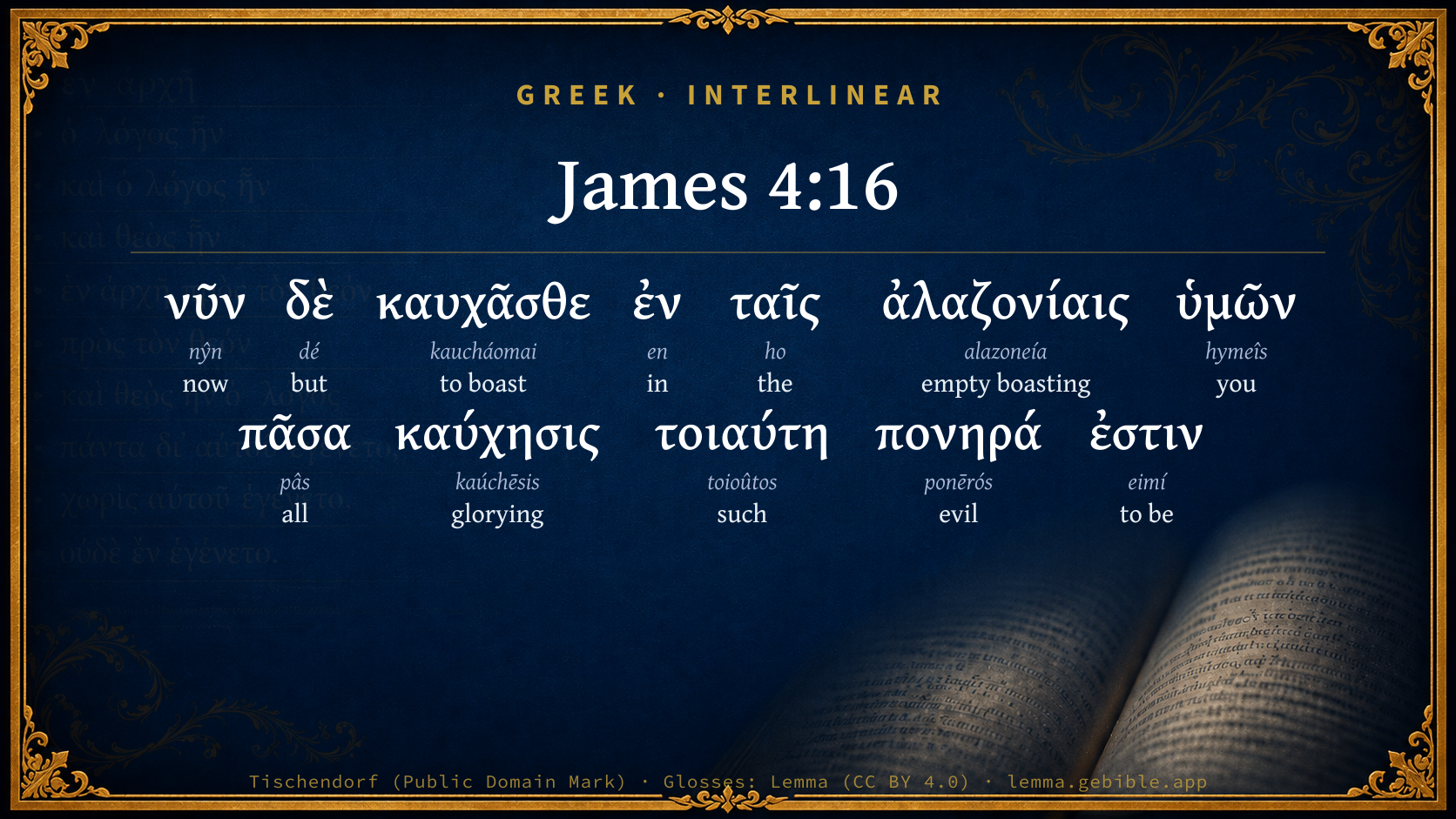
Greek (Tischendorf 8th ed.) James 4:16 appears in the Greek New Testament. The text above is from the Tischendorf 8th edition. Each word links to its Strong’s number and a concise gloss. Click any word for its full Thayer’s Greek Lexicon entry.
Download image
Cite this verse

James 4:16 (World English Bible). Public Domain. Lemma interlinear Bible study tool, https://lemma.gebible.app/v/james/4/16.

Show BibTeX & RIS
BibTeX
RIS
English Translation
But now you glory in your boasting. All such boasting is evil.
World English Bible · Public Domain
Highlights
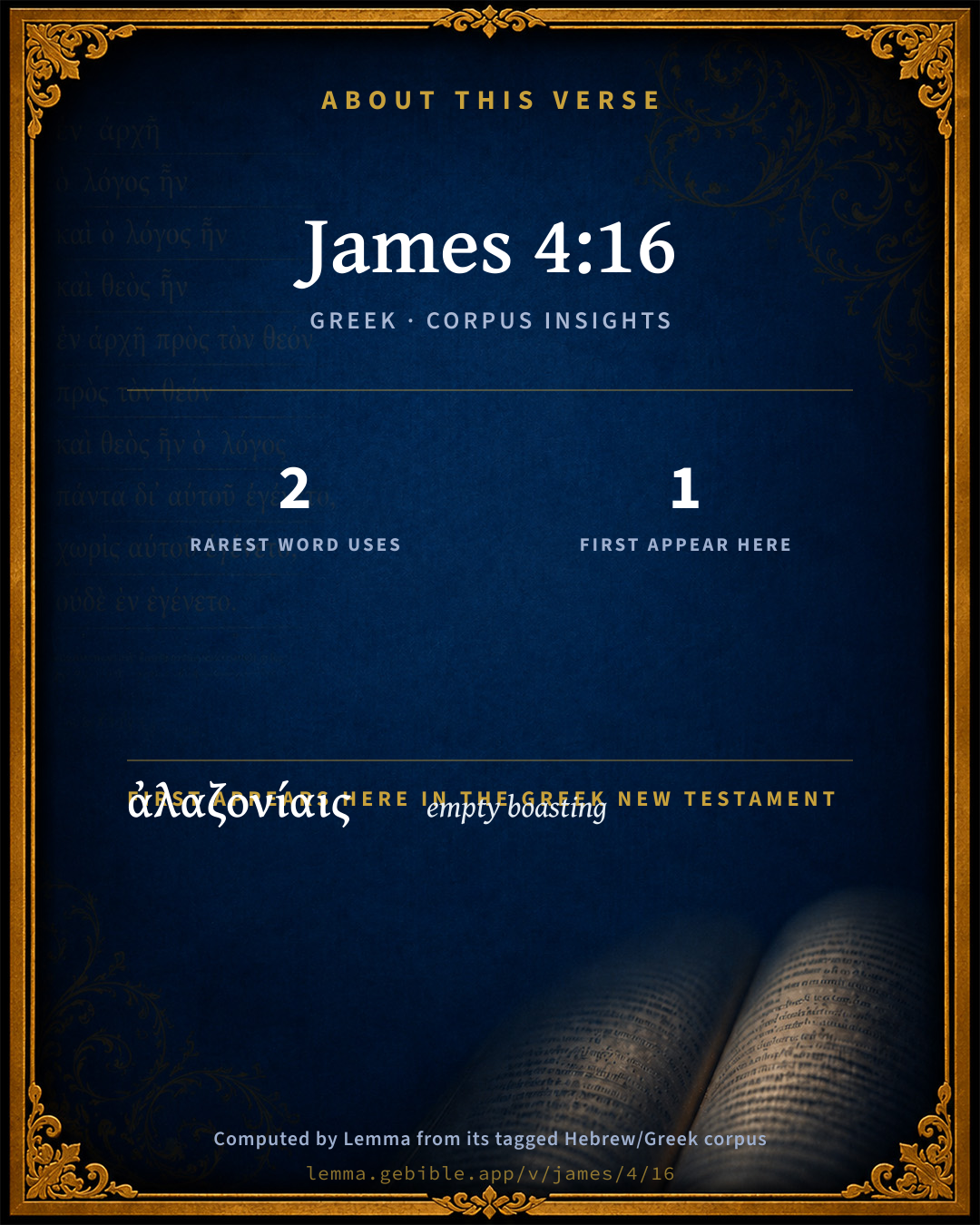
  • 1 first appearance in the Greek New Testament
Full analysis ↓
Download a study sheet

One document with this verse’s original text, its word-by-word gloss line, the meaning frame, cross-references with their text, attributed commentary, and full source and license credits — printable, and it pastes into notes with its structure intact.

This verse Autodidact and up

Study sheet (.html) Plain text (.txt)

A passage Seminary Student

Up to 50 verses in one chapter. A passage sheet keeps up to 6 commentary sources and 12 cross-references per verse, in the order this page ranks them, and says so on the sheet whenever that leaves anything out. Ask for a single verse and you get the Autodidact verse sheet above.

Everything on this page stays free to read, with no account — the sheet is a download of what is already on screen, not access to it.

Want to remove ads? Support Godless Engineer
Compare translations 3

The same verse in 3 English versions, stacked beneath the original-language interlinear above. Click any original word for its lexicon entry.

Each is an independent rendering of the whole verse — the interlinear is not word-aligned to these translations.

Highlighted words mark where these versions differ — a whole-verse word diff, not a word-by-word alignment.

  • World English Bible Public Domain
    But now you glory in your boasting. All such boasting is evil.
  • King James Version Public Domain
    But now ye rejoice in your boastings: all such rejoicing is evil.
  • unfoldingWord Literal Text CC BY-SA 4.0
    But now you are boasting in your pretensions. All such boasting is evil.

unfoldingWord Literal Text — © unfoldingWord, licensed CC BY-SA 4.0. Word-aligned USFM3 via Door43 (git.door43.org/unfoldingWord/en_ult).

Versions to compare (up to 4)

3 of 4 selected

Show all 19 translations

Every available English version of this verse, each an independent rendering of the whole verse.

  • World English Bible Public Domain
    But now you glory in your boasting. All such boasting is evil.
  • Berean Standard Bible Public Domain
    As it is, you boast in your proud intentions. All such boasting is evil.
  • Majority Standard Bible Public Domain
    As it is, you boast in your proud intentions. All such boasting is evil.
  • King James Version Public Domain
    But now ye rejoice in your boastings: all such rejoicing is evil.
  • American Standard Version (1901) Public Domain
    But now ye glory in your vauntings: all such glorying is evil.
  • Revised Version (1885) Public Domain
    But now ye glory in your vauntings: all such glorying is evil.
  • Geneva Bible (1599) Public Domain
    But now ye reioyce in your boastings: all such reioycing is euill.
  • Douay-Rheims (1899) Public Domain
    But now you rejoice in your arrogancies. All such rejoicing is wicked.
  • Young's Literal Translation Public Domain
    and now ye glory in your pride; all such glorying is evil;
  • Literal Standard Version CC BY-SA 4.0
    but now you glory in your pride; all such glorying is evil;
  • Unlocked Literal Bible CC BY-SA 4.0
    But now you are boasting about your arrogant plans. All such boasting is evil.
  • unfoldingWord Literal Text CC BY-SA 4.0
    But now you are boasting in your pretensions. All such boasting is evil.
  • Darby Bible Public Domain
    But now ye glory in your vauntings: all such glorying is evil.
  • World Messianic Bible Public Domain
    But now you glory in your boasting. All such boasting is evil.
  • Webster's Bible Public Domain
    But now ye rejoice in your boastings: all such rejoicing is evil.
  • Free Bible Version CC BY-SA 4.0
    But right now you're caught up in your vain ideas. All this boasting is evil.
  • Bible in Basic English Public Domain
    But now you go on glorying in your pride: and all such glorying is evil.
  • Text-Critical English NT CC BY 4.0
    But as it is, you boast in your arrogance; all such boasting is evil.
  • Tyndale New Testament (1534) Public Domain
    But nowe ye reioyce in youre bostinges. All soche reioysynge is evyll.

Literal Standard Version (2020), Covenant Press — licensed CC BY-SA 4.0. Text via the HelloAO Bible API (eBible.org). Unlocked Literal Bible (unfoldingWord) — licensed CC BY-SA 4.0. Text via the HelloAO Bible API (eBible.org). unfoldingWord Literal Text — © unfoldingWord, licensed CC BY-SA 4.0. Word-aligned USFM3 via Door43 (git.door43.org/unfoldingWord/en_ult). Free Bible Version, Dr. Jonathan Gallagher — licensed CC BY-SA 4.0. Text via the HelloAO Bible API (eBible.org).

Word by word

More ways to search: Search by grammar → Find every occurrence → Compare this word →

Practice this passage: Drill this verse → Learn its vocabulary →

ἀλαζονίαις
alazoneía
G212
“empty boasting”
Noun, Dative, Plural, Feminine
Part of Speech
Noun
Case
Dative
Number
Plural
Gender
Feminine
Full Thayer's Definition

Origin: from G213

TDNT: 04:46,4

1. empty, braggart talk 2. an insolent and empty assurance, which trusts in its own power and resources and shamefully despises and violates divine laws and human rights 3. an impious and empty presumption which trusts in the stability of earthy things
  1. νῦν nŷn G3568 “now” Adverb
  2. δὲ dé G1161 “but” Conjunction
  3. καυχᾶσθε kaucháomai G2744 “to boast” Verb, Present, Middle or Passive deponent, Indicative, 2nd person, Plural
  4. ἐν en G1722 “in” Preposition
  5. ταῖς ho G3588 “the” Article, Dative, Plural, Feminine
  6. ὑμῶν hymeîs G5210 “you” Personal pronoun, 2nd person, Genitive, Plural
  7. πᾶσα pâs G3956 “all” Adjective, Nominative, Singular, Feminine
  8. καύχησις kaúchēsis G2746 “glorying” Noun, Nominative, Singular, Feminine
  9. τοιαύτη toioûtos G5108 “such” Demonstrative pronoun, Nominative, Singular, Feminine
  10. πονηρά ponērós G4190 “evil” Adjective, Nominative, Singular, Feminine
  11. ἐστιν eimí G1510 “to be” Verb, Present, Active, Indicative, 3rd person, Singular

About this verse

These counts appear in no published source. They are computed here, from the morphology-tagged text and Lemma’s own curated glosses. What Lemma adds →

12
words
12
distinct lemmas
General Epistles
section

Notable vocabulary

The rarest word here is ἀλαζονίαις empty boasting G212 — appearing just 2 times in the whole Greek New Testament.

First appearance in Scripture

This word makes its first canonical appearance in the Greek New Testament here:

  • ἀλαζονίαις empty boasting G212

Shared distinctive vocabulary

ἀλαζονίαις empty boasting G212 occurs in 2 verses of the Greek New Testament. Also found in:
Cross-references

10

Topical passages linked to James 4:16 in the Treasury of Scripture Knowledge — connected by theme and wording, ordered by reader-vote popularity; previews shown in the World English Bible.

  • Proverbs 27:1 Don't boast about tomorrow; For you don't know what a day may bring forth.
  • 1 Corinthians 5:6 Your boasting is not good. Don't you know that a little yeast leavens the whole lump?
  • Psalms 52:7 "Behold, this is the man who didn't make God his strength, But trusted in the abundance of his riches, And strengthened himself in his wickedness."
  • Proverbs 25:14 As clouds and wind without rain, So is he who boasts of gifts deceptively.
  • Psalms 52:1 Why do you boast of mischief, mighty man? God's loving kindness endures continually.
  • Isaiah 47:10 For you have trusted in your wickedness; you have said, None sees me; your wisdom and your knowledge, it has perverted you, and you have said in your heart, I am, and there is none else besides me.
  • 1 Corinthians 4:7–8 For who makes you different? And what do you have that you didn't receive? But if you did receive it, why do you boast as if you had not received it?
  • James 3:14 But if you have bitter jealousy and selfish ambition in your heart, don't boast and don't lie against the truth.
  • Revelation 18:7 However much she glorified herself, and grew wanton, so much give her of torment and mourning. For she says in her heart, 'I sit a queen, and am no widow, and will in no way see mourning.'
  • Isaiah 47:7–8 You said, I shall be mistress forever; so that you did not lay these things to your heart, neither did remember the latter end of it.

Cross-references courtesy of OpenBible.info (CC BY 4.0).

Commentary

Notes on James 4:16 from classic Christian and Jewish commentators (each source and its license shown beneath its notes). The classic Christian expositions comment on the surrounding passage and are grouped to its opening verse, so a note may address several verses; the Jewish commentaries on the Tanakh (Rashi and others) are per-verse, so they appear only where the commentator wrote on this verse.

Lemma curates 59 commentaries, every one of them public domain or Creative Commons licensed, each selected and text-cleaned for this edition rather than reprinted as found. About our sources →

Joseph Benson's Commentary

Jas 4:16-17. Now ye rejoice — Καυχασθε, ye glory, in your boastings — Ye please yourselves in the vain thoughts which you entertain of these worldly projects and successes, and you boast of them. All such rejoicing — Or glorying, is evil — The delight you take in these expectations argues either a strange want of consideration, or gross stupidity. Therefore to him that knoweth to do good, and doeth it not — That knows what is right and is his duty, and does not practise it; to him it is sin — His knowledge does not prevent but increase his condemnation. As if he had said, Since you cannot but know better, as you have the oracles of God, and profess to believe them, if you do not act answerably thereto, you are guilty of the greater sin. “Because this is true with respect to all who act contrary to knowledge and conscience. Beza and Estius consider it as a general conclusion, enforcing the whole of the reproofs given to the Jews for acting contrary to the divine revelation, of which they were the keepers.” — Macknight.

Joseph Benson's Commentary on the Old and New Testaments (1811–1818) — public domain. Text from a community e-Sword module.

Tyndale Open Study Notes

Tyndale Open Resources

4:16 Christians may boast about what God has done (1:9-10), but not about their own arrogant plans, which assume that God has no claim or authority over their lives.

Tyndale Open Study Notes — © Tyndale Open Resources, licensed CC BY-SA 4.0. Text via the HelloAO Bible API.

Bengel's Gnomon

Johann Albrecht Bengel

Jas 4:16. Καυχᾶσθε ἐν ταῖς ἀλαζονείαις, ye boast in your arrogant pretensions) Their arrogance is expressed in the words, we will go—we will get gain; their boasting is implied in their presuming upon the time.—πονηρὰ, evil) The opposite is good, Jas 4:17.

Bengel's Gnomon of the New Testament — English translation (T&T Clark, Edinburgh, 1860) — public domain. Text from a community e-Sword module.

Meyer's Critical & Exegetical Commentary

Heinrich August Wilhelm Meyer

Jam_4:16 expresses the conduct of those addressed in contrast to Jam_4:15; and in such a manner that the judgment upon that conduct is also expressed.

νῦν δέ] here, as frequently, where the reality in opposition to what is set before a person is emphasized; see 1Co_5:11; 1Co_14:6.

καυχᾶσθε ἐν ταῖς ἀλαζονείαις ὑμῶν] By ἀλαζονεία is to be understood the arrogant self-reliance on the duration of earthly prosperity; see explanation of 1Jn_2:16. De Wette inaccurately explains it by bragging; Theile, by arroganter facta, dicta; Schneckenburger, by pertness; Wiesinger, by those arrogant expressions affecting complete independence; Lange, by vain and arrogant self-exaltation; and others differently. The plural is used, because such haughtiness manifests itself differently under different circumstances.

ἐν] here used differently than in chap. Jam_1:9 : the ἀλαζονείαι are not the object, but the reason of the boasting, that from which it proceeds (against Wiesinger), and καυχᾶσθαι is designated from the standpoint of James: that haughty and presumptuous language in Jam_4:13; comp. Pro_27:1.

With the following words: πᾶσα καύχησις κ.τ.λ.] James definitely expresses his reprobation.

τοιαύτη] not every boasting in itself (chap. Jam_1:9), but every boasting which proceeds from ἀλαζονεία, which is founded in it and connected with it, is wicked.

Meyer — Critical and Exegetical Commentary on the New Testament — English translation by Peter Christie, edited by Frederick Crombie (T&T Clark, 1880) — public domain. Text from a community e-Sword module.

Expositor's Greek Testament

ed. W. Robertson Nicoll

Jas 4:16 . νῦν δὲ : “but now,” i.e. , as things are; cf. 1Co 14:6 , νῦν δὲ , ἀδελφοί , ἐὰν ἔλθω … καυχᾶσθε ἐν ταῖς ἀλαζονίαις ὑμῶν : those vauntings were, of course, not on account of following out their own will in despite of the divine will, but because of the thoughtlessness which did not take God’s will into account, and therefore boasted of the ability of following one’s own bent. Both are bad, but conscious opposition to the will of God would, of the two, be worse. Ἀλαζονίαις comes from ἀλαζών which is literally a “wanderer,” then it comes to mean one who makes pretensions. Cf. Pro 27:1 , μὴ καυχῶ τὰ εἰς αὔριον , f1οὐ γὰρ γινώσκεις τί τέξεται ἡ ἐπιοῦσα : the word occurs only here and in 1Jn 2:16 ( ἡ ἀλαζονεία τοῦ βίου ) in the N.T. πᾶσα καύχησις τοιαύτη …: boasting of this kind must be evil because it forgets God, and unduly exalts self.

The Expositor's Greek Testament, edited by W. Robertson Nicoll (1897–1910) — public domain. Text from a community e-Sword module.

Jamieson, Fausset & Brown

Robert Jamieson, A. R. Fausset & David Brown

now--as it is.

rejoice in . . . boastings--"ye boast in arrogant presumptions," namely, vain confident fancies that the future is certain to you (Jam 4:13).

rejoicing--boasting [BENGEL].

Jamieson, Fausset & Brown — Commentary Critical and Explanatory on the Whole Bible (1871) — public domain (CC PDM 1.0). Text via the HelloAO Bible API.

Adam Clarke's Commentary

Verse 16. But now ye rejoice in your boastings] Ye glory in your proud and self-sufficient conduct, exulting that ye are free from the trammels of superstition, and that ye can live independently of God Almighty. All such boasting is wicked, πονηραεστιν, is impious. In an old English work, entitled, The godly man's picture drawn by a Scripture pencil, there are these words: "Some of those who despise religion say, Thank God we are not of this holy number! They who thank God for their unholiness had best go ring the bells for joy that they shall never see God."

Adam Clarke's Commentary on the Bible (1810–1826) — public domain. Text from a community e-Sword/MySword module.

John Calvin's Commentaries

16 But now ye rejoice, or, glory. We may learn from these words that James condemned something more than a passing speech. Ye rejoice, or, glory, he says, in your empty boastings. Though they robbed God of his government, they yet flattered themselves; not that they openly set themselves up as superior to God, though they were especially inflated with confidence in themselves, but that their minds were inebriated with vanity so as to disregard God. And as warnings of this kind are usually received with contempt by ungodly men — nay, this answer is immediately given, “known to ourselves is what is offered to us, so that there is no need of such a warning;” — he alleges against them this knowledge in which they gloried, and declares that they sinned the more grievously, because they did not sin through ignorance, but through contempt.

John Calvin's Commentaries (1540-1563) — public domain. Text from the Calvin Translation Society English edition (1840s-50s) via the Christian Classics Ethereal Library (ccel.org). Calvin's coverage is partial (roughly two-thirds of the Bible); uncommented books and verses are honest gaps, never fabricated. The 19th-century editor's footnotes and remarks are omitted so the notes are faithfully Calvin's own voice.

Ellicott's Commentary for English Readers

(16) But now . . . .—How different is the case with you, cries St. James; you actually glory and delight in your own self-confidence and presumption, and every such rejoicing is evil. The word for “boastings” is the same as that translated “the pride of life” in 1Jn_2:16—i.e., its braggart boastfulness, not the innocent gladness of living. It is the trust of the “ungodly” (Psa_10:6, “There shall no harm happen unto me”), and the mistaken confidence of even such godly men as Job (Job_29:18, “shall die in my nest”), before the Almighty instructs them by trouble, and loss, and pain.

A Bible Commentary for English Readers, edited by Charles John Ellicott (1878–1897) — public domain. Text from a community e-Sword module.

The Cambridge Bible for Schools and Colleges

gen. ed. J. J. S. Perowne

16. But now ye rejoice in your boastings] Better, ye exult in your vain glories. If the words were not too familiar, ye glory in your braggings would, perhaps, be a still nearer equivalent. The noun is found in 1Jn_2:16 (“the pride of life”), and not elsewhere in the New Testament. It is defined by Aristotle (Eth. Nicom. iv. 13) as the character of the man who lays claim to what will bring him credit when the claim is either altogether false or grossly exaggerated. He contrasts it with the “irony” which deliberately, with good or bad motive, understates its claims. The “now” is more or less emphatic, = “as things are.”

The Cambridge Bible for Schools and Colleges (gen. ed. J. J. S. Perowne; Cambridge University Press, 1878–1918) — public domain. Text from a community e-Sword module.

John Gill's Exposition

But now ye rejoice in your boastings,.... Of tomorrow, and of the continuance of life, and of going to such a place, and abiding there for such a time, and of trading and trafficking with great success, to the obtaining of much gain and riches; see Pro 27:1

all such rejoicing is evil; wicked and atheistical, as expressing a neglect of and independence on Providence; arrogating and ascribing too much to themselves, their power and will, as if they had their lives and fortunes in their own hands, and at their own dispose, when all depend upon the will of God. The Syriac version renders it, "all such rejoicing is from evil"; from an evil heart, and from the evil one, Satan.

John Gill's Exposition of the Whole Bible (1746–1763) — public domain (CC PDM 1.0). Text via the HelloAO Bible API.

Trapp's Complete Commentary

John Trapp

16 But now ye rejoice in your boastings: all such rejoicing is evil.

Ver. 16. In your boastings] Of long life and suitable success. God will shoot an arrow at such suddenly, Psa 64:9, as he did at the rich fool, Nebuchadnezzar, Haman, Herod, Sennacherib, and other braggarts.

John Trapp, A Commentary or Exposition upon All the Books of the Old and New Testament (1647–1656) — public domain. Text from a community e-Sword module.

Albert Barnes' Notes on the Bible

But now ye rejoice in your boastings - That is, probably, in your boastings of what you can do; your reliance on your own skill and sagacity. You form your plans for the future as if with consummate wisdom, and are confident of success. You do not anticipate a failure; you do not see how plans so skilfully formed can fail. You form them as if you were certain that you would live; as if secure from the numberless casualties which may defeat your schemes.

All such rejoicing is evil - It is founded on a wrong view of yourselves and of what may occur. It shows a spirit forgetful of our dependence on God; forgetful of the uncertainty of life; forgetful of the many ways by which the best-laid plans may be defeated. We should never boast of any wisdom or skill in regard to the future. A day, an hour may defeat our best-concerted plans, and show us that we have not the slightest power to control coming events.

Albert Barnes' Notes on the Bible (1834–1885) — public domain. Text from a community e-Sword/MySword module.

Matthew Poole's English Annotations

But now ye rejoice, or, glory; ye please yourselves with them.

In your boastings; viz. of your carnal projects, and hopes of what you intend to do, and expect to get: q.d. You vainly boast of your designs and successes, without taking notice of God’s providence, under the government of which you and your affairs all are.

All such rejoicing is evil; both as being contrary to the word, which assures us so often that it is vain to promise ourselves long life, or prosperity in our worldly business, without God’s leave and blessing, Psa 127:1; Pro 16:9,33; and likewise as proceeding from pride and security.

Matthew Poole's English Annotations on the Holy Bible (1683–1685) — public domain. Text from a community e-Sword/MySword module.

Whedon's Commentary on the Bible

Daniel D. Whedon

16. Now—As your present habit is.

Rejoice—Rather, glory—are proud of.

Your boastings—Your presumptuous proclaiming what you will do to be cut off, perhaps, by failure and by death.

Daniel D. Whedon (gen. ed.), Commentary on the Old and New Testaments (1874–1909) — public domain. Text from a community e-Sword module.

The Pulpit Commentary

But now. As is actually the case, "ye glory in your vauntings." jAlazoneiA: only here and in 1Jn_2:16; in the LXX, in RAPC 2Macc 9:8 and RAPC Wis 5:8. It is a favorite word with St. Clement of Rome. On its meaning and distinction from uJperhfania and other kindred words, see Trench on "Synonyms," p. 95; and cf. Westcott on the "Epistles of St. John," p. 64. The vice of the ajlazwn "centers in self and is consummated in his absolute self-exaltation, while the uJperhfanov shows his character by his overweening treatment of others. The ajlazwn sins most against truth; the uJperhfanov sins most against love." This extract will serve to show the fitness of ajlazoneia rather than uJperhfania in the passage before us. The verse should be rendered, as in R.V, "But now ye glory (kaucasqe) in your vauntings: all such glorying (kauchsiv) is evil." Kauchsiv is the act, not the matter (kauchma), of glorying.

The Pulpit Commentary (1880–1919), ed. H.D.M. Spence-Jones & Joseph S. Exell — public domain. Text from a community e-Sword module.

The People's New Testament

B. W. Johnson

16. Ye rejoice in your boastings. It was a boastful manner to use such a language as that of verse 13 in stating plans.

B. W. Johnson's The People's New Testament with Notes (1889–1891) — public domain. Electronic text from the Christian Classics Ethereal Library (CCEL) ThML edition.

Cambridge Greek Testament for Schools and Colleges

16. νῦν δέ, but now, as it is.

ἐν ταῖς ἀλαζονείαις ὑμῶν, in your boastful or presumptuous talk, or your false pretensions. ἀλαζ. from ἀλαζών lit. a wanderer, then of a boastful pretender. Aristotle defines the ἀλαζών as ὁ μείζω τῶν ὑπαρχόντων προσποιούμενος, Eth. N. IV. vii. 10 (‘a man who pretends to have greater things than he possesses’), adding according to the probable reading εἰ δʼ ἕνεκά τινος ὁ μὲν δόξης ἢ τιμῆς οὐ λίαν ψαλτὸς ὁ ἀλάζων, ὁ δὲ ἀργυρίου ἢ ὅσα εἰς ἀργύριον ἀσχημονέστερος. It is probably with this last reference in the word that the Apostle uses it. ἀλαζονείαις would thus signify the deception used to increase the value of goods—the tricks of trade.

Perhaps however ἐν ἀλαζονείαις is simply the presumptuous talk which forms plans and projects without reference to God’s will.

Cambridge Greek Testament for Schools and Colleges (Cambridge University Press, 1896; 21 vols, various authors incl. Carr, Maclear, Plummer, Farrar, Lumby, Moule, M. R. James, Simcox) — public domain. Text from a community e-Sword module.

Alford’s Greek Testament

Henry Alford

16.] But (contrast to the spirit of resignation to the divine will just recommended) now (as things now are, see 1Co 5:11; 1Co 14:6) ye boast in (not, as in ch. 1:9, “make your boast in:” the ἐν indicates the state, as in ch. 3:18, and 4:3 especially. The ἀλαζονεία is the source, but not the material of the boasting) your vain-gloriousnesses (see note on ref. 1 John. Here ἀλαζονεία is the self-deceived and groundless confidence in the stability of life and health on which the worldly pride themselves. On this, as on its foundation, your boastful speeches, σήμερον καὶ αὔριον κ.τ.λ., are built): all such boasting (all boasting so made and so grounded) is wicked.

Henry Alford, The Greek Testament (1849–1861) — public domain. Text from a community e-Sword module.

International Critical Commentary

16. νῦν δέ, “but actually, in point of fact,” in contrast to what they ought to do.

καυχᾶσθε ἐν ταῖς ἀλαζονίαις ὑμῶν, “glory in these your acts of presumption.” καυχᾶσθε is thrown into strong emphasis by νῦν δέ. Instead of humility toward God, their attitude is one of boasting.

ἀλαζονίαις refers to the attitude described in v. 13 (οἱ λέγοντες), καυχᾶσθε (which carries the emphasis) signifies an aggravation of it, viz. the pride which they take in their own overweening self-confidence and presumption. ἐν indicates that ἀλαζονίαι are the ground of the glorying, cf. 1:9.

Another view takes καυχᾶσθε of the arrogant talk itself, described in v. 13, and understands ἐν as merely giving the presumptuous manner of it (Mayor: “the manner in which glorying was shown, ‘in your self-confident speeches or imaginations’ = ἀλαζονευόμενοι”), cf. Clem. Rom. 21:5 ἀνθρώποις ἐγκαυχωμένοις ἐν ἀλαζονίᾳ τοῦ λόγου. This is possible, but is repetitious, and gives no such advance in the thought as the emphatic νῦν δέ seems to call for.

ἀλαζονία, “braggart talk,” or, more inclusively, “presumptuous assurance,” “vainglory” (so 1Jn 2:16 [R.V.]); much like ὑπερηφανία, with which it is frequently associated, cf. Rom 1:30, 2Ti 3:2, 2Ti 3:2 Macc. 9:8 (v. l.).

It is stronger than καυχᾶσθαι, and has the idea of emptiness and insolence, cf. Wisd. 2:16, 5:8, 4 Macc. 1:26, 2:15, 8:19 τὴν κενοδοξίαν ταύτην καὶ ὀλεθροφόρον ἀλαζονίαν. See the full discussion in Trench, Synonyms, § xxix. ἀλαζών and its derivatives are found twelve times in the Greek O. T. Cf. Test. XII Patr. Dan 1:6, Joseph 17:8; Teles (ed. Hense2), p. 40.

πονηρά, “wrong.” Cf. Jas 2:4, Mat 15:19, Joh 3:19, Joh 3:7:7, 1Jn 3:12, Col 1:21, Act 25:18.

There is no distinction drawn in vv. 16, 17 between πονηρά and ἁμαρτία.

International Critical Commentary — older volumes (1896–1929), various authors — public domain. Text from a community e-Sword module.

Vincent's Word Studies in the New Testament

Marvin R. Vincent

Ye rejoice [καυχασθε] . Rev., glory. See on ch. Jas 2:13.

Boastings [αλαζονειαις] . Only here and 1Jo 2:16. The kindred word ajlazwn a boaster, is derived from alh, a wandering or roaming; hence, primarily, a vagabond, a quack, a mountebank. From the empty boasts of such concerning the cures and wonders they could perform, the word passed into the sense of boaster. One may boast truthfully; but ajlazoneia, is false and swaggering boasting. Rev. renders vauntings, and rightly, since vaunt is from the Latin vanus, empty, and therefore expresses idle or vain boasting.

Marvin R. Vincent, Word Studies in the New Testament (1887–1900) — public domain. Text from a community e-Sword/MySword module.

Lesson kit

Teaching starters — assembled from the data on this page, not authored interpretation. Every prompt links to the verse data it draws on. Edit before teaching.

James, in the General Epistles, opens this verse with 12 words (12 distinct Greek lemmas). Its most distinctive word is alazoneía (“empty boasting”). A historical commentator’s framing appears above. Read the whole chapter for the surrounding context.

Discussion questions

  1. How does “empty boasting” (alazoneía) shape what this verse is saying?
  2. This is the first place “empty boasting” appears in Scripture (first appears here). What does its debut here establish?
  3. How does 1 John 2:16, which shares the word «empty boasting», read alongside this verse?
  4. The translations on this page render this verse differently — a whole-verse word diff, not a word-by-word alignment. What might account for the different wordings?
  5. Compare how Joseph Benson's Commentary and Tyndale Open Study Notes read this verse. Where do they agree or differ?

Things to notice

  • 1 word makes its first canonical appearance in Scripture here.
  • These translations choose different wording for 7 words in this verse.
  • 12 distinct Greek lemmas span 12 words in this verse.

Reading settings

Reading text

Shown beneath each verse's original-language words.

Old Testament
Old Testament edition

Read the OT as the Masoretic Hebrew (MT) or the Greek Septuagint (LXX).

English shown for the Greek Septuagint (in the Hebrew ↔ Greek comparison).

Comparing translations? Open the Compare panel on any verse page to stack up to four side by side.