Isaiah 28:9

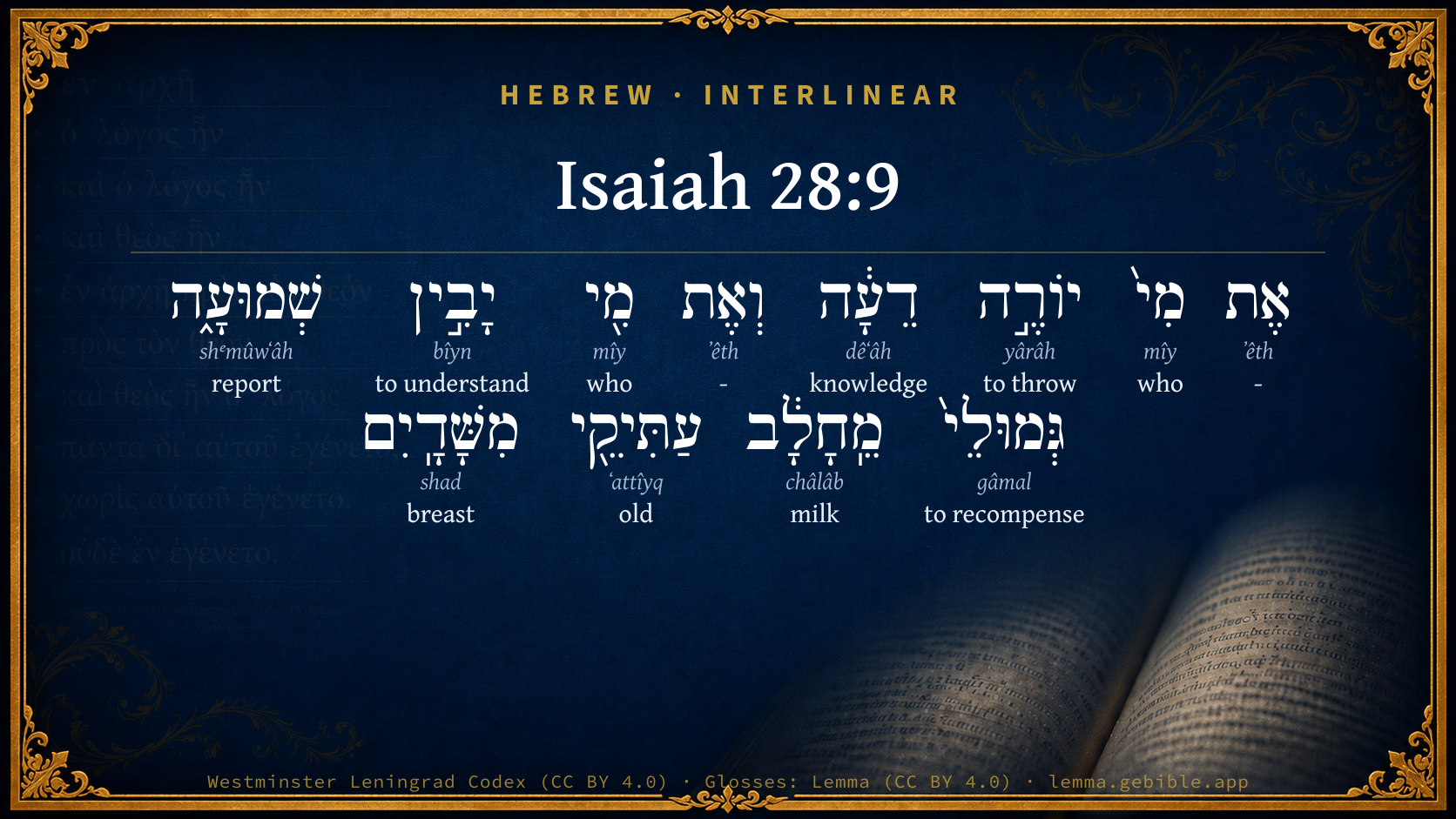
Hebrew (Westminster Leningrad Codex) Isaiah 28:9 appears in the Hebrew Old Testament. The text above is from the Westminster Leningrad Codex. Each word links to its Strong’s number, a concise gloss, and parsing drawn from the Open Scriptures Hebrew Bible morphology. Click any word for its full Brown-Driver-Briggs (BDB) entry.
Download image
Cite this verse

Isaiah 28:9 (World English Bible). Public Domain. Lemma interlinear Bible study tool, https://lemma.gebible.app/v/isaiah/28/9.

Show BibTeX & RIS
BibTeX
RIS
English Translation
Whom will he teach knowledge? and whom will he make to understand the message? those who are weaned from the milk, and drawn from the breasts?
World English Bible · Public Domain
Download a study sheet

One document with this verse’s original text, its word-by-word gloss line, the meaning frame, cross-references with their text, attributed commentary, and full source and license credits — printable, and it pastes into notes with its structure intact.

This verse Autodidact and up

Study sheet (.html) Plain text (.txt)

A passage Seminary Student

Up to 50 verses in one chapter. A passage sheet keeps up to 6 commentary sources and 12 cross-references per verse, in the order this page ranks them, and says so on the sheet whenever that leaves anything out. Ask for a single verse and you get the Autodidact verse sheet above.

Everything on this page stays free to read, with no account — the sheet is a download of what is already on screen, not access to it.

Want to remove ads? Support Godless Engineer
Compare translations 3

The same verse in 3 English versions, stacked beneath the original-language interlinear above. Click any original word for its lexicon entry.

Each is an independent rendering of the whole verse — the interlinear is not word-aligned to these translations.

Highlighted words mark where these versions differ — a whole-verse word diff, not a word-by-word alignment.

  • World English Bible Public Domain
    Whom will he teach knowledge? and whom will he make to understand the message? those who are weaned from the milk, and drawn from the breasts?
  • King James Version Public Domain
    Whom shall he teach knowledge? and whom shall he make to understand doctrine? them that are weaned from the milk, and drawn from the breasts.
  • unfoldingWord Literal Text CC BY-SA 4.0
    “Whom will he teach knowledge, and whom will he make understand the report? The ones weaned from milk, the ones withdrawn from the breasts?

unfoldingWord Literal Text — © unfoldingWord, licensed CC BY-SA 4.0. Word-aligned USFM3 via Door43 (git.door43.org/unfoldingWord/en_ult).

Versions to compare (up to 4)

3 of 4 selected

Show all 18 translations

Every available English version of this verse, each an independent rendering of the whole verse.

  • World English Bible Public Domain
    Whom will he teach knowledge? and whom will he make to understand the message? those who are weaned from the milk, and drawn from the breasts?
  • Berean Standard Bible Public Domain
    Whom is He trying to teach? To whom is He explaining His message? To infants just weaned from milk? To babies removed from the breast?
  • Majority Standard Bible Public Domain
    Whom is He trying to teach? To whom is He explaining His message? To infants just weaned from milk? To babies removed from the breast?
  • King James Version Public Domain
    Whom shall he teach knowledge? and whom shall he make to understand doctrine? them that are weaned from the milk, and drawn from the breasts.
  • American Standard Version (1901) Public Domain
    Whom will he teach knowledge? and whom will he make to understand the message? them that are weaned from the milk, and drawn from the breasts?
  • Revised Version (1885) Public Domain
    Whom will he teach knowledge? and whom will he make to understand the message? them that are weaned from the milk, and drawn from the breasts?
  • Geneva Bible (1599) Public Domain
    Whome shall he teache knowledge? and whome shall he make to vnderstand the thinges that hee heareth? them that are weyned from the milke, and drawen from the breastes.
  • Douay-Rheims (1899) Public Domain
    Whom shall he teach knowledge? and whom shall he make to understand the hearing? them that are weaned from the milk, that are drawn away from the breasts.
  • Young's Literal Translation Public Domain
    By whom doth He teach knowledge? And by whom doth He cause to understand the report? The weaned from milk, the removed from breasts,
  • Literal Standard Version CC BY-SA 4.0
    By whom does He teach knowledge? And by whom does He cause to understand the report? The weaned from milk, the removed from breasts,
  • Unlocked Literal Bible CC BY-SA 4.0
    To whom will he teach knowledge, and to whom will he explain the message? To those who are weaned from milk or to those just taken from the breasts?
  • unfoldingWord Literal Text CC BY-SA 4.0
    “Whom will he teach knowledge, and whom will he make understand the report? The ones weaned from milk, the ones withdrawn from the breasts?
  • Darby Bible Public Domain
    Whom shall he teach knowledge? and whom shall he make to understand the report? Them that are weaned from the milk, withdrawn from the breasts?
  • World Messianic Bible Public Domain
    Whom will he teach knowledge? To whom will he explain the message? Those who are weaned from the milk, and drawn from the breasts?
  • Webster's Bible Public Domain
    Whom shall he teach knowledge? and whom shall he make to understand doctrine? them that are weaned from the milk, and drawn from the breasts.
  • Free Bible Version CC BY-SA 4.0
    “Just who is he trying to teach knowledge to?” they ask. “Who is he explaining his message to? To children just weaned from milk, to babies just removed from the breast?
  • Bible in Basic English Public Domain
    To whom will he give knowledge? and to whom will he make clear the word? Will it be to those who have newly given up milk, and who have only now been taken from the breast?
  • JPS Tanakh (1917) Public Domain
    Whom shall one teach knowledge? And whom shall one make to understand the message? Them that are weaned from the milk, them that are drawn from the breasts?

Literal Standard Version (2020), Covenant Press — licensed CC BY-SA 4.0. Text via the HelloAO Bible API (eBible.org). Unlocked Literal Bible (unfoldingWord) — licensed CC BY-SA 4.0. Text via the HelloAO Bible API (eBible.org). unfoldingWord Literal Text — © unfoldingWord, licensed CC BY-SA 4.0. Word-aligned USFM3 via Door43 (git.door43.org/unfoldingWord/en_ult). Free Bible Version, Dr. Jonathan Gallagher — licensed CC BY-SA 4.0. Text via the HelloAO Bible API (eBible.org).

Word by word

More ways to search: Search by grammar → Find every occurrence → Compare this word →

Practice this passage: Drill this verse → Learn its vocabulary →

עַתִּיקֵ֖י
ʻattîyq
H6267
“old of”
Adjective, Adjective, Masculine, Plural, Construct
Part of Speech
Adjective
Type
Adjective
Gender
Masculine
Number
Plural
State
Construct
Full BDB Definition

Origin: from H6275

TWOT: 1721d

removed, weaned, old, ancient, taken away - removed, weaned - old, ancient
  1. אֶת ʼêth H853 “-” Particle, Direct Object
  2. מִי֙ mîy H4310 “who” Particle, Interrogative
  3. יוֹרֶ֣ה yârâh H3384 “to throw” Verb, Hiphil, Imperfect, 3rd Person, Masculine, Singular
  4. דֵעָ֔ה dêʻâh H1844 “knowledge” Noun, Common, Feminine, Singular, Absolute
  5. וְאֶת ʼêth H853 “and · -” Conjunction + Particle, Direct Object
  6. מִ֖י mîy H4310 “who” Particle, Interrogative
  7. יָבִ֣ין bîyn H995 “to understand” Verb, Hiphil, Imperfect, 3rd Person, Masculine, Singular
  8. שְׁמוּעָ֑ה shᵉmûwʻâh H8052 “report” Noun, Common, Feminine, Singular, Absolute
  9. גְּמוּלֵי֙ gâmal H1580 “recompensed” Verb, Qal, Participle Passive, Masculine, Plural, Construct
  10. מֵֽחָלָ֔ב châlâb H2461 “from · milk” Preposition + Noun, Common, Masculine, Singular, Absolute
  11. מִשָּׁדָֽיִם shad H7699 “from · breasts” Preposition + Noun, Common, Masculine, Dual, Absolute

About this verse

These counts appear in no published source. They are computed here, from the morphology-tagged text and Lemma’s own curated glosses. What Lemma adds →

12
words
10
distinct lemmas
Prophets
section

Notable vocabulary

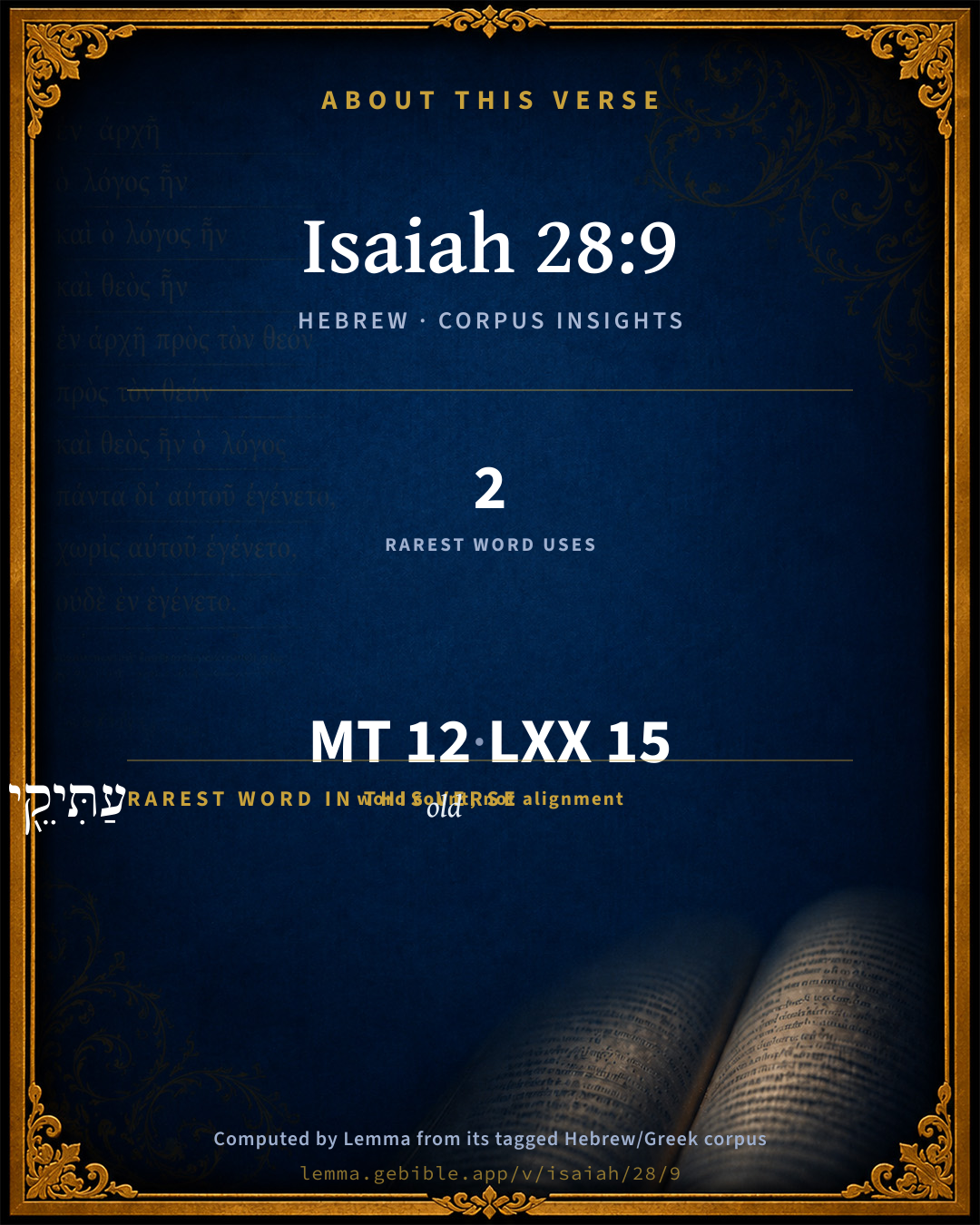
The rarest word here is עַתִּיקֵ֖י old H6267 — appearing just 2 times in the whole Hebrew Bible.

Shared distinctive vocabulary

עַתִּיקֵ֖י old H6267 occurs in 2 verses of the Hebrew Bible. Also found in:

Grammatical profile

  • 3 verbs
  • 4 nouns
  • 1 adjective
  • 4 particles

Verb forms

  • יוֹרֶ֣ה Hiphil · Imperfect
  • יָבִ֣ין Hiphil · Imperfect
  • גְּמוּלֵי֙ Qal · Participle Passive

Repetition

A word recurs within this verse — often emphatic in Hebrew:

Hebrew & Septuagint length

In English translation the verse runs 26 words from the Hebrew and 29 from the Septuagint (LXX English) — closely comparable.

A rough comparison of the two English renderings, which tokenize alike — not a word-level alignment.

Word counts can differ between the Hebrew and the Greek without any difference in meaning — e.g. the Hebrew direct-object marker אֵת has no separate Greek word, and Greek often adds the article ὁ.

In the original languages it is 12 Hebrew tokens and 15 Greek tokens — but the two are counted differently (Hebrew bundles its prefixes and suffixes into one token; the Greek is in lemma form), so that isn’t a like-for-like length.

Cross-references

19

Topical passages linked to Isaiah 28:9 in the Treasury of Scripture Knowledge — connected by theme and wording, ordered by reader-vote popularity; previews shown in the World English Bible.

  • Psalms 131:2 Surely I have stilled and quieted my soul, Like a weaned child with his mother, Like a weaned child is my soul within me.
  • Jeremiah 6:10 To whom shall I speak and testify, that they may hear? behold, their ear is uncircumcised, and they can't listen: behold, the word of Yahweh is become to them a reproach; they have no delight in it.
  • John 12:38 that the word of Isaiah the prophet might be fulfilled, which he spoke, "Lord, who has believed our report? To whom has the arm of the Lord been revealed?"
  • Matthew 11:25 At that time, Jesus answered, "I thank you, Father, Lord of heaven and earth, that you hid these things from the wise and understanding, and revealed them to infants.
  • Matthew 21:15–16 But when the chief priests and the scribes saw the wonderful things that he did, and the children who were crying in the temple and saying, "Hosanna to the son of David!" they were indignant,
  • Isaiah 53:1 Who has believed our message? and to whom has the arm of Yahweh been revealed?
  • Isaiah 54:13 All your children shall be taught of Yahweh; and great shall be the peace of your children.
  • Jeremiah 5:31 the prophets prophesy falsely, and the priests bear rule by their means; and my people love to have it so: and what will you do in the end of it?
  • John 3:19 This is the judgment, that the light has come into the world, and men loved the darkness rather than the light; for their works were evil.
  • 1 Peter 2:2 as newborn babes, long for the pure milk of the Word, that you may grow thereby,
  • Psalms 50:17 Seeing you hate instruction, And throw my words behind you?
  • Proverbs 1:29 Because they hated knowledge, And didn't choose the fear of Yahweh.
  • Isaiah 30:10–12 who tell the seers, "Don't see;" and to the prophets, "Don't prophesy to us right things, speak to us smooth things, prophesy deceits,
  • Isaiah 50:4 The Lord Yahweh has given me the tongue of those who are taught, that I may know how to sustain with words him who is weary: he wakens morning by morning, he wakens my ear to hear as those who are taught.
  • Mark 10:15 Most assuredly I tell you, whoever will not receive the Kingdom of God like a little child, he will in no way enter into it."
  • John 12:47–48 If anyone listens to my sayings, and doesn't believe, I don't judge him. For I came not to judge the world, but to save the world.
  • Isaiah 48:17 Thus says Yahweh, your Redeemer, the Holy One of Israel: I am Yahweh your God, who teaches you to profit, who leads you by the way that you should go.
  • Isaiah 28:26 For his God does instruct him aright, [and] does teach him.
  • Isaiah 30:20 Though the Lord give you the bread of adversity and the water of affliction, yet shall not your teachers be hidden anymore, but your eyes shall see your teachers;

Cross-references courtesy of OpenBible.info (CC BY 4.0).

Hebrew and Greek witnesses Masoretic Hebrew ↔ Greek Septuagint

The same verse in the two great witnesses to the Old Testament, shown verse-for-verse.

These are two independent witnesses, not word-aligned to each other, and the Septuagint is shown in lemma (dictionary) form.

Hebrew Isaiah 28:9 Masoretic · Westminster Leningrad Codex

אֶת מִי֙ יוֹרֶ֣ה דֵעָ֔ה וְאֶת מִ֖י יָבִ֣ין שְׁמוּעָ֑ה גְּמוּלֵי֙ מֵֽחָלָ֔ב עַתִּיקֵ֖י מִשָּׁדָֽיִם

Whom will he teach knowledge? and whom will he make to understand the message? those who are weaned from the milk, and drawn from the breasts?

World English Bible · Public Domain

Greek LXX Isaiah 28:9 Septuagint · lemma form

τίς ἀναἀγγέλλω κακός καί τίς ἀναἀγγέλλω ἀγγελία ὁ ἀπογαλακτίζω ἀπό γάλα ὁ ἀποσπάω ἀπό μαστός

To whom have we reported evils? and to whom have we reported a message? even to those that are weaned from the milk, who are drawn from the breast.

LXX2012 (modern English Septuagint) · Public Domain

Hebrew: Westminster Leningrad Codex (CC BY 4.0). Greek: Septuagint (public domain); English from LXX2012 (modern English Septuagint) (Public Domain). How the Septuagint differs from the Hebrew →

Targum (Aramaic paraphrase)

1

The Targum is the ancient Jewish Aramaic paraphrase of the Hebrew Scriptures — an interpretive translation, not the Hebrew text itself. Onkelos (literal) and Pseudo-Jonathan (expansive) render the Torah, and Jonathan the Prophets. Coverage is partial: where no permissively-licensed English translation exists for a verse, only the Aramaic is shown. This is verse-level text, not a word-by-word alignment to the Hebrew.

  1. Targum Jonathan Prophets (Joshua–Malachi)
    לְמַן אִתְיְהִיבַת אוֹרַיְתָא וּמַן אִתְפְּקַד לְמִסְבַּר חוּכְמָא הֲלָא לְבֵית יִשְׂרָאֵל דִרְחִימִין מִכָּל עַמְמַיָא וַחֲבִיבִין מִכָּל מַלְכְּוָתָא:

    To whom was the law given? and to whom was the command given to understand wisdom? Was it not to the house of Israel, who were beloved above all nations, and beloved above all the kingdoms?

    Targum Jonathan — Aramaic: “Mikraot Gedolot” (public domain). English: “Sefaria Community Translation” (CC0 1.0 (public-domain dedication)); “London "Chaldee Paraphrase," 1871” (public domain). Text via Sefaria.

Commentary

Notes on Isaiah 28:9 from classic Christian and Jewish commentators (each source and its license shown beneath its notes). The classic Christian expositions comment on the surrounding passage and are grouped to its opening verse, so a note may address several verses; the Jewish commentaries on the Tanakh (Rashi and others) are per-verse, so they appear only where the commentator wrote on this verse.

Lemma curates 59 commentaries, every one of them public domain or Creative Commons licensed, each selected and text-cleaned for this edition rather than reprinted as found. About our sources →

Matthew Henry's Commentary

The prophet here complains of the wretched stupidity of this people, that they were unteachable and made no improvement of the means of grace which they possessed; they still continued as they were, their mistakes not rectified, their hearts not renewed, nor their lives reformed. Observe,

I. What it was that their prophets and ministers designed and aimed at. It was to teach them knowledge, the knowledge of God and his will, and to make them understand doctrine, Isa 28:9. This is God's way of dealing with men, to enlighten men's minds first with the knowledge of his truth, and thus to gain their affections, and bring their wills into a compliance with his laws; thus he enters in by the door, whereas the thief and the robber climb up another way.

II. What method they took, in pursuance of this design. They left no means untried to do them good, but taught them as children are taught, little children that are beginning to learn, that are taken from the breast to the book (Isa 28:9), for among the Jews it was common for mothers to nurse their children till they were three years old, and almost ready to go to school. And it is good to begin betimes with children, to teach them, as they are capable, the good knowledge of the Lord, and to instruct them even when they are but newly weaned from the milk. The prophets taught them as children are taught; for, 1. They were constant and industrious in teaching them. They took great pains with them, and with great prudence, teaching them as they needed it and were able to bear it (Isa 28:10): Precept upon precept. It must be so, or (as some read) it has been so. They have been taught, as children are taught to read, by precept upon precept, and taught to write by line upon line, a little here and a little there, a little of one thing and a little of another, that the variety of instructions might be pleasing and inviting, - a little at one time and a little at another, that they might not have their memories overcharged, - a little from one prophet and a little from another, that every one might be pleased with his friend and him whom he admired. Note, For our instruction in the things of God it is requisite that we have precept upon precept and line upon line, that one precept and line should be followed, and so enforced by another; the precept of justice must be upon the precept of piety, and the precept of charity upon that of justice. Nay, it is necessary that the same precept and the same line should be often repeated and inculcated upon us, that we may the better understand them and the more easily recollect them when we have occasion for them. Teachers should accommodate themselves to the capacity of the learners, give them what they most need and can best bear, and a little at a time, Deu 6:6, Deu 6:7. 2. They courted and persuaded them to learn, Isa 28:12. God, by his prophets, said to them, "This way that we are directing you to, and directing you in, is the rest, the only rest, wherewith you may cause the weary to rest; and this will be the refreshing of your own souls, and will bring rest to your country from the wars and other calamities with which it has been long harassed." Note, God by his word calls us to nothing but what is really for our advantage; for the service of God is the only true rest for those that are weary of the service of sin and there is no refreshing but under the easy yoke of the Lord Jesus.

III. What little effect all this had upon the people. They were as unapt to learn as young children newly weaned from the milk, and it was as impossible to fasten any thing upon them (Isa 28:9): nay, one would choose rather to teach a child of two years old than undertake to teach them; for they have not only (like such a child) no capacity to receive what is taught them, but they are prejudiced against it. As children, they have need of milk, and cannot bear strong meat, Heb 5:12. 1. They would not hear (Isa 28:12), no, not that which would be rest and refreshing to them. They had no mind to hear it. The word of God commanded their serious attention, but could not gain it; they were where it was preached, but they turned a deaf ear to it, or as it came in at one ear it went out at the other. 2. They would not heed. It was unto them precept upon precept, and line upon line (Isa 28:13); they went on in a road of external performances; they kept up the old custom of attending upon the prophet's preaching and it was continually sounding in their ears, but that was all; it made no impression upon them; they had the letter of the precept, but no experience of the power and spirit of it; it was continually beating upon them, but it beat nothing into them. Nay, 3. It should seem, they ridiculed the prophet's preaching, and bantered it. The word of the Lord was unto them Tsau latsau, kau lakau; in the original it is in rhyme; they made a song of the prophet's words, and sang it when they were merry over their wine. David was the song of the drunkards. It is great impiety, and a high affront to God, thus to make a jest of sacred things, to speak of that vainly which should make us serious.

IV. How severely God would reckon with them for this. 1. He would deprive them of the privilege of plain preaching, and speak to them with stammering lips and another tongue, Isa 28:11. Those that will not understand what is plain and level to their capacity, but despise it as mean and trifling, are justly amused with that which is above them. Or God will send foreign armies among them, whose language they understand not, to lay their country waste. Those that will not hear the comfortable voice of God's word shall be made to hear the dreadful voice of his rod. Or these words may be taken as denoting God's gracious condescension to their capacity in his dealing with them; he lisped to them in their own language, as nurses do to their children, with stammering lips, to humor them; he changed his voice, tried first one way and then another; the apostle quotes it as a favour (Co1 14:21), applying it to the gift of tongues, and complaining that yet for all this they would not hear. 2. He would bring utter ruin upon them. By their profane contempt of God and his word they are but hastening on their own ruin, and ripening themselves for it; it is that they may go and fall backward, may grow worse and worse, may depart further and further from God, and proceed from one sin to another, till they be quite broken, and snared, and taken, and ruined, Isa 28:13. They have here a little and there a little of the word of God; they think it too much, and say to the seers, See not; but it proves too little to convert them, and will prove enough to condemn them. If it be not a savour of life unto life, it will be a savour of death unto death.

Matthew Henry's Commentary on the Whole Bible (1708–1710) — public domain (CC PDM 1.0). Text via the HelloAO Bible API.

Adam Clarke's Commentary

Verse 9. Whom shall he teach knowledge? - "Whom, say they, would he teach knowledge?"] The scoffers mentioned below, Isa 28:14, are here introduced as uttering their sententious speeches; they treat God's method of dealing with them, and warning them by his prophets, with contempt and derision. What, say they, doth he treat us as mere infants just weaned? doth he teach us like little children, perpetually inculcating the same elementary lessons, the mere rudiments of knowledge; precept after precept, line after line, here and there, by little and little? imitating at the same time, and ridiculing, in Isa 28:10, the concise prophetical manner. God, by his prophet, retorts upon them with great severity their own contemptuous mockery, turning it to a sense quite different from what they intended. Yes, saith he, it shall be in fact as you say; ye shall be taught by a strange tongue and a stammering lip; in a strange country; ye shall be carried into captivity by a people whose language shall be unintelligible to you, and which ye shall be forced to learn like children. And my dealing with you shall be according to your own words: it shall be command upon command for your punishment; it shall be line upon line, stretched over you to mark your destruction, (compare 2Kg 21:13;) it shall come upon you at different times, and by different degrees, till the judgments, with which from time to time I have threatened you, shall have their full accomplishment.

Jerome seems to have rightly understood the general design of this passage as expressing the manner in which the scoffers, by their sententious speeches, turned into ridicule the warnings of God by his prophets, though he has not so well explained the meaning of the repetition of their speech in Isa 28:13. His words are on Isa 28:9 - "Solebant hoc ex persona prophetarum ludentes dicere:" and on Isa 28:14 - "Quod supra diximus, cum irrisione solitos principes Judaeorum prophetis dicere, manda, remanda, et caetera his similia, per quae ostenditur, nequaquam eos prophetarum credidisse sermonibus, sed prophetiam habuisse despectui, praesens ostendit capitulum, per quod appellantur viri illusores." Hieron. in loc.

And so Jarchi interprets the word משלים mishelim in the next verse: Qui dicunt verba irrisionis parabolice." And the Chaldee paraphrases Isa 28:11 to the same purpose, understanding it as spoken, not of God, but of the people deriding his prophets: "Quoniam in mutatione loquelae et in lingua subsannationis irridebant contra prophetas, qui prophetabant populo huic." - L.

Adam Clarke's Commentary on the Bible (1810–1826) — public domain. Text from a community e-Sword/MySword module.

Trapp's Complete Commentary

John Trapp

Isa 28:9 Whom shall he teach knowledge? and whom shall he make to understand doctrine? [them that are] weaned from the milk, [and] drawn from the breasts.

Ver. 9. Whom shall he teach knowledge?] Quem docebit scientiam? Doceo governeth two accusative cases. Ministers must have (1.) Quem, Whom to teach; and (2.) Quid, What to teach - sc., knowledge. Isaiah had no want of knowledge, as being apt and able to teach; but he wanted a fit audience, as having to do with a sort of drunken sots that were unteachable, incapable. So, Eze 47:11, when the waters of the sanctuary flowed, the miry places could not be healed. Think the same also of those that are drunk with pride {as Isa 28:1} and self-conceitedness; who make divinity only a matter of discourse, or that come to sit as judges or critics on their ministers’ gifts, &c. It will be long enough ere such will be taught anything. One may as good undertake to teach a young weanling void of understanding, and in some respects better, for these to their natural corruption and impotence have added habitual hardness and obstinace, to their sinews of iron, brows of brass, {Isa 48:4} and what hope can there be of working upon such?

John Trapp, A Commentary or Exposition upon All the Books of the Old and New Testament (1647–1656) — public domain. Text from a community e-Sword module.

Albert Barnes' Notes on the Bible

whom shall he teach knowledge? - This verse commences a statement respecting another form of sin that prevailed among the people of Judah. That sin was contempt for the manner in which God instructed them by the prophets, and a disregard for his communications as if they were suited to children and not to adults. That “scoffing” was the principal sin aimed at in these verses, is apparent from Isa 28:14. Vitringa supposes that these words Isa 28:9-10 are designed to describe the manner of teaching by the priests and the prophets as being puerile and silly, and adapted to children. Michaelis supposes that the prophet means to signify that it would be a vain and fruitless labor to attempt to instruct these persons who were given to wine, because they were unaccustomed to sound and true doctrine. Others have supposed that he means that these persons who were thus given to wine and strong drink were disqualified to instruct others, since their teachings were senseless and incoherent, and resembled the talk of children. But the true sense of the passage has undoubtedly been suggested by Lowth. According to this interpretation, the prophet speaks of them as deriders of the manner in which God had spoken to them by his messengers. ‘What!’ say they, ‘does God treat us as children? Does he deal with us as we deal with infants just weaned, perpetually repeating and inculcating the same elementary lessons, and teaching the mere rudiments of knowledge?’ The expression, therefore, ‘whom shall he teach knowledge?’ or, ‘whom does he teach?’ is an expression of contempt supposed to be spoken by the intemperate priests and prophets - the leaders of the people. ‘whom does God take us to be? Does he regard us as mere children? Why are we treated as children with an endless repetition of the same elementary instruction?’

To understand doctrine - Hebrew as Margin, ‘Hearing,’ or ‘report’ Isa 53:1. The sense is, For whom is that instruction intended? whom does he wish to be taught by it?

Them that are weaned from the milk ... - Does he regard and treat us as mere babes?

Albert Barnes' Notes on the Bible (1834–1885) — public domain. Text from a community e-Sword/MySword module.

The Biblical Illustrator

Joseph S. Exell

Isa_28:9-13

Whom shall He teach knowledge?

--

The scoffing drunkards

They scoff at the prophet, that intolerable moralist. They are full-grown and free; he need not teach them knowledge Isa_11:9), and explain his preaching to them; they know of old what he is driving at. Are they mere weaned babes, who need to be tutored? (F. Delitzsch.)

The occasion

The occasion of this remarkable encounter was probably a feast held to celebrate the renunciation of allegiance to Assyria. Isaiah has surprised the drunkards over their cups, and administered some such rebuke as we read in verses 7, 8. (J. Skinner, D. D.)

The angry false priests and prophets

What really angered these burly scorners was that the prophet treated them as though they were children only lust weaned, and not as masters in Israel, giving them the most elementary instruction in the simplest words--words of one syllable, as they put it. They were weary of hearing him repeat the first rudiments of morality, and apply them to the sins and needs of the time. How dared he tutor them who were themselves teachers! How dared he treat them as babes who were grown men, distinguished men, the foremost men and statesmen of the empire! A pretty figure he made too! No one listened to him, or hardly anyone. It was their advice which was taken, not his; their policy which was followed, not his. And yet he dared come to them, day after day, with the same simple message, the same trite moralities, the same dismal warnings and rebukes! (S. Cox, D. D.)

Isaiahs righteous indignation

In effect he said to them You mock at the simple Divine words I have been moved to speak, and lisp out your base and drunken imitations of them,--you, who should be the first to welcome and enforce the word of God. Know, then, that God will punish your sin by a people of lisping lips and an alien tongue. He has taught you, by the words you deride, where you might find rest and freedom, how you might give peace to the people who are weary of war and its calamities; but you would not hearken and do. The word of the Lord has become to you a mere bid and bid, forbid and forbid, at which you jest. Know, then, that that word, which might have been a light to your path, shall blaze up into a consuming fire. (S. Cox, D. D.)

Retribution

The prediction was fulfilled. The fierce Assyrians, when they heard that the Hebrews had allied themselves with Egypt, once more swept through the land. The very men who had lisped their scornful imitations of Isaiahs words, who had affected to think that he used the broken and imperfect dialect which mothers employ to their babes, were destroyed or taken captive by the Assyrian troops, whose language, while it closely resembled that of the Hebrews, had just those differences which made it sound to them like an imperfect and barbarous dialect. So terrible and so exact was the retribution that fell on their sin. (S. Cox, D. D.)

With another tongue

They shall have change of ministry; the Assyrians do not talk piously, whiningly; they do not give precept upon precept; theirs is a terse eloquence, a bullock-like rhetoric; when they come they will make these drunkards sober by the power of terror. This is Gods way in all providence; if we will not hear the gentle voice, the interpreting, persuasive, gospel voice, we shall have to listen to thunder, and feed our souls upon lightning. O Jerusalem, Jerusalem, thou that killest the prophets, and stonest them which are sent unto thee,. . .your house is left unto you desolate. (J. Parker, D. D.)

Divine wisdom

That the soul be without knowledge, it is not good. A lamentable instance of this truth is exemplified in the preceding part of the chapter.

I. THE CHARACTER OF THE TEACHER. God, whose wisdom is infinite, is our only teacher; for whatever others we may possess, either in the works of nature, of providence, or of grace, originate entirely from His bounty.

II. THE SUBJECT OF INSTRUCTION. Two things are to be learned, namely, knowledge and doctrine; the one that we may know ourselves, the other that we may know God.

III. THE PERSONS TO BE TAUGHT. Them that are weaned, etc. We must be like little children in humility of mind and teachableness of disposition. (J. Wright, B. A.)

The Biblical Illustrator, edited by Joseph S. Exell (c. 1880s–1900s) — public domain. Text from a community e-Sword module.

Joseph Benson's Commentary

Isa 28:9-10. Whom shall he — Namely, God, or his prophet, or minister; teach knowledge? and whom shall he make to understand doctrine? — Who is there among this people, that are capable and willing to be taught the good knowledge of God? them that are wearied from the milk, &c. — A minister may as soon teach a young child as these men. For precept must be upon precept, &c. — They must be taught like little children, slowly, and with leisure, the same things being often repeated, because of their great dulness. Line upon line — One line of the book after another, as children are taught to read.

Joseph Benson's Commentary on the Old and New Testaments (1811–1818) — public domain. Text from a community e-Sword module.

The Preacher's Complete Homiletical Commentary

Joseph S. Exell (gen. ed.)

EARLY RELIGIOUS TRAINING

(Sunday School Anniversary Sermon.)

Isa_28:9-10. Whom shall He teach knowledge? &c.

Whether we regard these verses as the language of the drunkards of Ephraim, deriding the Lord’s messengers for the plainness and urgency of their unwelcome instructions, or as the language of the prophet himself affirming interrogatively the spiritual ignorance and imbecility of the people, with their prophets and priests, they suggest the importance of earnestly instructing the young in the knowledge of our relations to God and eternity. We may turn to them more hopefully than to the old. Youth is the time for learning. In the first ten years of life are laid the foundations of the social and religious character which every man carries to the grave. Therefore we should not leave them to be laid haphazard, but should do our utmost to bring it to pass that they shall be such that on them can be built the structure of a holy life. To accomplish this we must instruct them in the revealed will of God.

1. The youth learns nothing good until he is taught. Though wise to do evil, to do good he has no knowledge.

2. The young mind is susceptible of deep and enduring impressions (H. E. I., 775, 776, 786).

3. Scriptural knowledge is not only of surpassing value, but is more easily imparted to the young than most of that human knowledge for which the opening powers are often severely taxed. If difficulties arise from immaturity and levity of mind, they are more than balanced by freedom from the prejudices of age, and the perplexing cares of life; by their docility and instinctive desire to penetrate the unknown; by the eagerness with which they seize upon the explanations of facts in nature and providence, or on similitudes and allegories; and by their unsuspecting confidence in the ability of their appointed teachers. Their natural aversion to God is but partially developed, and waits the coming of riper years to mature its strong resistance to the Divine claims.

4. The weightiest obligations rest on parents to give their children religious instruction (H. E. I., 803–806). When parents are unable to do so personally, through defect of ability, or the urgency of paramount duties, it is their privilege to do so through the kind offices of others.

5. A failure in the discharge of parental obligations to children imposes on others who fear God the duty of teaching them knowledge. They are immortal; for them Christ died. Of the fulness and glory of the results of a faithful performance of this duty no adequate conception can be formed by us on this side of heaven.—R. S. Storrs, D.D.: American National Preacher, xix. 121–141.

THE POWER OF LITTLES

Isa_28:10. Here a little and there a little.

The application of this text is first of all to the impressions produced by the Word of God and the efficacy of constant religious instruction. But it is in this same way, by little and little, that all great and lasting impressions are made and the mightiest results accomplished.

I. The processes of nature.—Mighty and sudden changes are not the rule, but gradual and prepared ones. The seasons, the months, day into night, night into day—how gradual and imperceptible the transitions. The germination of seed, &c.

II. The formation of character.—Little by little every man’s character is formed (H. E. I., 709–711, 1836–1851) or spoiled (H. E. I., 4521–4523, 4720–4725). All the steps, successively, that lead either to heaven or hell are small, one by one, except in great crimes, and even then there has been a gradual preparation for them (H. E. I., 428, 429). So conversion, that great change of the soul, is prepared for imperceptibly (H. E. I., 1462). From minute and commonplace thoughts, words, actions, results character for eternity!

III. Christian service.—Called not to acts of heroism, but to a faithful discharge of commonplace duties (H. E. I., 4149).

IV. Christian work.—It is by little and little that, in such a world as this, we must do the greater part of the good that we ever accomplish (H. E. I., 1725).

V. The training of children.—Heavenly habits are to be formed in them by the influence upon them of daily, familiar, minute, but ever-recurring examples set before them (H. E. I., 777–779, 790, 802).

VI. Preparation for heaven.—Try to gain a little for God, a little for heaven, a little more of grace every day. Do this in little things and you will accomplish great things. Here a little and there a little will carry you on from step to step, from grace to glory (H. E. I., 2512, 2537).—G. B. Cheever, D.D.: American National Preacher, xxvi. 145–152.

The Preacher's Complete Homiletical Commentary (gen. ed. Joseph S. Exell; Funk & Wagnalls, c. 1892) — public domain (pre-1929). A full-Bible homiletical/sermon-outline anthology covering 65 of 66 books (2 John is absent from the source module). Text from a community e-Sword module.

Tyndale Open Study Notes

Tyndale Open Resources

28:9-10 The people had become hardened to God’s revelation (1 Cor 14:21).

Tyndale Open Study Notes — © Tyndale Open Resources, licensed CC BY-SA 4.0. Text via the HelloAO Bible API.

Geneva Bible (1599)

Geneva Bible translators

For there was none that was able to understand any good doctrine: but were foolish and as unmeet as young babes.

Geneva Bible (1599) marginal notes — public domain. Text via Bolls.life.

Jamieson, Fausset & Brown

Robert Jamieson, A. R. Fausset & David Brown

Here the drunkards are introduced as scoffingly commenting on Isaiah's warnings: "Whom will he (does Isaiah presume to) teach knowledge? And whom will He make to understand instruction? Is it those (that is, does he take us to be) just weaned, &c.? For (he is constantly repeating, as if to little children) precept upon precept," &c.

line--a rule or law. [MAURER]. The repetition of sounds in Hebrew tzav latzav, tzav latzav, qav laqav, qav laquav, expresses the scorn of the imitators of Isaiah's speaking; he spoke stammering (Isa 28:11). God's mode of teaching offends by its simplicity the pride of sinners (Kg2 5:11-12; Co1 1:23). Stammerers as they were by drunkenness, and children in knowledge of God, they needed to be spoken to in the language of children, and "with stammering lips" (compare Mat 13:13). A just and merciful retribution.

Jamieson, Fausset & Brown — Commentary Critical and Explanatory on the Whole Bible (1871) — public domain (CC PDM 1.0). Text via the HelloAO Bible API.

Ellicott's Commentary for English Readers

(9) Whom shall he teach knowledge?—The two verses that follow reproduce the language of the drunkards as they talk scornfully of the prophet. “To whom does he come with what he calls his ‘knowledge’ and his ‘doctrine?’ (better, message, as in Isa_28:19). Does he think that they are boys just weaned, who are to be taught the first elements of the religion of the infant school?” Then in their mockery they describe (Isa_28:10) his teaching, with what was to them its wearisome iteration, “Always precept upon precept, line upon line . . .”—petty rebukes and puerile harping upon the same note, semper eandem canens cantilenam. We can scarcely doubt that Isaiah was indignantly reproducing, as St. Paul does in 2Co_10:10; 2Co_11:16-17; the very words, almost the drunken accents, in which the priests and false prophets had spoken of him.

A Bible Commentary for English Readers, edited by Charles John Ellicott (1878–1897) — public domain. Text from a community e-Sword module.

The Cambridge Bible for Schools and Colleges

gen. ed. J. J. S. Perowne

9. The retort of the revellers to Isaiah’s recriminations. The meaning is: “Who are we that we should thus be lectured by this man? Are we newly-weaned infants, &c.?” (cf. R.V.). Whom will he teach knowledge? expresses the injured self-consciousness of the priests; whom will he make to understand doctrine? that of the prophets. For doctrine R.V. has the message; the word commonly means “report,” but here it denotes “that which is heard” (by prophetic audition) from the Lord, as in Isa_28:19; ch. Isa_53:1; Jer_49:14; Oba_1:1.

9–13. The occasion of this remarkable encounter was probably a feast held to celebrate the renunciation of allegiance to Assyria. Isaiah has surprised the drunkards over their cups and administered some such rebuke as we read in Isa_28:7-8. (On the excesses that often accompanied sacrificial meals, see 1Sa_1:13 f.; Amo_2:8.)

The Cambridge Bible for Schools and Colleges (gen. ed. J. J. S. Perowne; Cambridge University Press, 1878–1918) — public domain. Text from a community e-Sword module.

John Gill's Exposition

For precept must be upon precept, precept upon precept,.... Signifying, that they must be dealt with as children were, when first instructed in the rudiments of a language, first had one rule given them, and then another, and so one after another till they had gone through the whole:

line upon line, line upon line; who are taught first to write one line, and then another; or to draw one line, and write after that, and then another; or where to begin one line, and, when finished, where to begin another; for the allusion is to writing by line, and not to a line used in building, as Kimchi and Ben Melech think:

here a little, and there a little; a small lesson out of one book, and a small lesson out of another; a little one day, and a little on the next, and so on, that their memories may not be overburdened.

John Gill's Exposition of the Whole Bible (1746–1763) — public domain (CC PDM 1.0). Text via the HelloAO Bible API.

Haydock's Catholic Bible Commentary

Breasts? St. Paul seems to allude to this text, 1 Corinthians iii. 2. (Calmet) --- The abandoned Jews ask contemptuously, if they be to be taught like children? (Haydock)

George Leo Haydock (1774–1849), Haydock's Catholic Family Bible and Commentary, 1859 edition — public domain. Excludes Psalms (Douay-Rheims chapter numbering differs from Protestant) and Deuterocanonical books (Catholic canon only).

Matthew Poole's English Annotations

Whom shall he, to wit, the teacher, which is easily understood out of the following verb; either God, or his prophets, or ministers;

teach knowledge? who is there among this people that are capable and willing to be taught the good knowledge of God? A minister may as soon teach a young child as these men.

Matthew Poole's English Annotations on the Holy Bible (1683–1685) — public domain. Text from a community e-Sword/MySword module.

Whedon's Commentary on the Bible

Daniel D. Whedon

9, 10. These verses appear to imply an interruption on the part of those against whom the prophet is inveighing. They seem to reply scornfully.

Whom shall he teach knowledge — “He, the intolerable moralist: does he mean us, already advanced in understanding? We need it not. We are through with our tuition in the schools. We want no more of precept upon precept… line upon line… here a little and there a little. We want no more of his elementary teachings, his petty teasings; no more of the many repetitions of his excited, high toned addresses.” Perhaps they attempted to mimic him, but were only able to speak (hic) (being then well drunken) in stammering (hic) words. Among the several explanations of these verses, this, which was first hinted by Jerome, and later accepted by Lowth, Ewald, and Delitzsch, seems the best.

Daniel D. Whedon (gen. ed.), Commentary on the Old and New Testaments (1874–1909) — public domain. Text from a community e-Sword module.

The Pulpit Commentary

Whom shall he teach? A sudden and abrupt transition. The best explanation seems to be that suggested by Jerome, and followed by Bishop Lowth and most commentators, viz. that the prophet dramatically introduces his adversaries as replying to him with taunting speeches. "Whom does he think he is teaching?" they ask. "Mere children, just weaned from their mother"s milk, and taken away from the breast? Does he forget that we are grown men nay, priests and prophets? And what poor teaching it is! What "endless petty feazing"! (Delitzsch) precept upon precept," etc. The intention is to throw ridicule upon the smallness and vexatious character of the prophet"s interminable and uninterrupted chidings (Delitzsch). Knowledge... doctrine. Technical terms in Isaiah"s teaching, which his adversaries seem to have ridiculed as "catch-words." The term translated "doctrine" means properly "tidings," and involves the idea that the prophet obtained the teaching so designated by direct revelation from God.

Vers. 9, 10. The objections of unbelievers to such as preach the truth.

The argumentum ad hominem, to which Isaiah"s adversaries had recourse, is one very generally employed by those who are indisposed to receive religious teaching. "Who are you," the teacher is asked, "that you should set yourself up to teach us? On what grounds do you suppose that you are so much wiser than we? We are not babes not tied to our mothers" apron-strings, not mere children without experience of life. We think that probably we know quite as much on any religious subject as you. Why should you imagine that we do not?" It is difficult to meet this objection. By setting up to be a religious teacher a man does certainly claim to be wiser than his neighbors, and a prima facie objection of undue self-assertion most decidedly lies against him. He can only meet this objection by disclaiming all personal merit, and declaring himself a mere mouthpiece of One infinitely above him, whose doctrine he is commissioned to spread. The objectors will then have to question either the fact of his commission or the authority of the Person who gave it. Another line of argument, and a very common one, is to turn the doctrine itself into ridicule. Has the teacher nothing more to say than what has been heard so often? nothing but little rules, petty precepts, minute directions for conduct, a touch here, a touch there, tiresome trivialities? Has he no new grand scheme to propound, no flesh way of salvation, no interesting "Church of the Future?" Surely it is idle to repeat, over and over again, the same stale maxims, the same well-worn rules! Who will listen to a harper who harps always on one string? Something new, something lively, something out of the common, is wanted, if the preacher is to secure attention; still more, if he is to affect conduct. Unfortunately, what is new is seldom true; and though, no doubt, novelty in treatment is to a certain extent desirable, since the "instructed scribe" should know how "to bring out of his treasure things old and new", (Mat_13:52) yet it is the old truths which alone have power, which alone can save; and these need to be perpetually impressed on men, "in season and out of season," dinned into their ears, forced on their attention, cut into their hearts by stroke after stroke, even at the risk of its wearying them.

Vers. 9-13. Indocility.

When God speaks man may well listen, whatsoever strains the Divine Teacher may employ. But man is often found to be, not only an inapt, but even an unwilling, scholar. Such were they who are here terribly rebuked.

I THE DESIGN OF GOD"S TEACHING. God had been saying, "This is the rest," etc. (ver. 12). The end of all God"s instruction is to give rest to his human scholars. Peace was the promise of the old covenant. (Num_6:26 Num_25:12) Rest was the offer of the great Teacher. (Mat_11:28, Mat_11:29) Rest of heart in the favor and love of God was the high and elevated hope held out for all who would learn and be obedient; and this is still the desire and the design of God in all his teaching and in all his correction.

II MAN"S OBJECTION TO GOD"S METHOD. "To whom," they complain, "shall he teach knowledge... to them that are weaned... must it be precept upon precept?" etc. (vers. 9, 10). Are we such little children that we are to be treated thus by Jehovah? Men have always been found who object to God"s ways of guiding them. It is too plain and palpable, or it is too mysterious; it demands no effort of the intellect, or it taxes the thought too severely; it is too commonplace, or it is too startling, or it is too hard; were he to adopt some other method, to come to them in some other way, they would listen and obey; but as he speaks they will not hear. Especially are men slow to learn the simple and repeated lessons by which God teaches them in his providence the lessons which come with every morning light and with every evening shade, with the continued lovingkindnesses of the passing hour, with the changes of the seasons, with the passage of neighbors and friends to another world; these reiterated teachings are disregarded, and the one great lesson of reverence and of devotedness is unlearned.

III GOD"S INDIGNATION AT HUMAN CONTUMACY. The strain of the prophet is one outpouring of intense indignation and keen rebuke; the anger of Jehovah is kindled against them. We may understand that persistent indocility is a very serious sin in the estimate of God. Not to hearken when he speaks to us, whether he speaks in providence, in his Word, or in Christian ordinances, is to place ourselves beneath his very high displeasure.

IV DIVINE RETRIBUTION. The penalty of their perverse indocility shall be that they will have to learn by far less agreeable methods than the one which they despised; the repeated elementary instruction of the Hebrew prophet should give place to the barbarous sounds of a foreign tongue. Guilty folly often finds that punishment awaits it which corresponds only too painfully with the sin. The Jews demand a king because they prefer the visible to the invisible, the physical to the spiritual; and they gain one who is chosen on this cherished principle of theirs, and his bodily stature and visible form prove to be a sorry substitute for the wisdom of the invisible Sovereign: the penalty is paid in the same coin as the transgression. David"s unholy interference with domestic right is punished by saddest add most serious disappointments in his own family. Retribution, not general only, but that which is particularly appropriate to our sin, awaits us a little further on. Disobedience and emphatically indocility leads to misery and shame. Hearken intelligently, however and whenever God may speak, and hasten cheerfully to obey. C.

The Pulpit Commentary (1880–1919), ed. H.D.M. Spence-Jones & Joseph S. Exell — public domain. Text from a community e-Sword module.

John Wesley's Explanatory Notes

He - God. Them - Who is there among this people that are willing to be taught the knowledge of God? A minister may as soon teach an infant as these men.

John Wesley, Explanatory Notes Upon the Whole Bible (1754–1765) — public domain. Text via the GEBible commentary corpus.

Keil & Delitzsch

C. F. Keil & F. Delitzsch

"Whom then would he teach knowledge? And to whom make preaching intelligible? To those weaned from the milk? To those removed from the breast? For precept upon precept, precept upon precept, line upon line, line upon line, a little here, a little there!" They sneer at the prophet, that intolerable moralist. They are of age, and free; and he does not need to bring knowledge to them (da‛ath as in Isa 11:9), or make them understand the proclamation. They know of old to what he would lead. Are they little children that have just been weaned (on the constructives, see Isa 9:2; Isa 5:11; Isa 30:18; Ges. 114, 1), and who must let themselves be tutored? For the things he preaches are nothing but endless petty teazings. The short words (tsâv, as in Hos 5:11), together with the diminutive זעיר (equivalent to the Arabic sugayyir, mean, from sagı̄r, small), are intended to throw ridicule upon the smallness and vexatious character of the prophet's interminable and uninterrupted chidings, as ל (= על, אל; comp. יסף ל, Isa 26:15) implies that they are; just as the philosophers in Act 17:18 call Paul a σπερμολόγος, a collector of seeds, i.e., a dealer in trifles. And in the repetition of the short words we may hear the heavy babbling language of the drunken scoffers.

Keil & Delitzsch — Biblical Commentary on the Old Testament (1861–1891) — public domain (CC PDM 1.0). Text via the HelloAO Bible API. (Old Testament only.)

J. A. Alexander on Isaiah

Joseph Addison Alexander

“Whom will He teach knowledge? And whom will He make to understand doctrine? Those weaned from the milk and removed from the breasts.” The older Christian writers understand this as descriptive of the persons whom Jehovah, or the Prophet acting in his name, would choose as proper subjects of instruction, viz. simple and childlike disciples, who as new-born babes desire the sincere milk of the word (1Pe 2:2). But the children here described are weanlings not sucklings, and on this hypothesis the weaning, which is so particularly mentioned, would have no significancy. Besides, this explanation of the words would not suit the context, either before or after. It is therefore commonly agreed, that the last clause must be taken in a contemptuous or unfavorable sense, as denoting children not in malice merely but in understanding (1Co 14:20). The verse has been explained by some, as the language not of the Prophet but of the wicked men before described, expressing their indignation and contempt at the Prophet’s undertaking to instruct them as if they were mere children. Whom does he undertake to teach? and whom would he make to understand his doctrine? Children weaned from the milk and removed from the breast? This interpretation has in substance been adopted by all later writers, as affording a good sense and one admirably suited both to the foregoing and the following context. It seems to be liable to only two objections; first, that it gratuitously gives the passage a dramatic form by supposing a new speaker to be introduced without any intimation in the text; and then, that it arbitrarily continues the interrogation through the sentence. The last objection may be obviated by adopting the construction, which supposes them to ask not whom he would but whom he ought to teach, and then to answer, little children just weaned from the breast, not men of mature age and equal to himself. The other objection, being wholly negative, must yield of course to the positive arguments in favor of an exposition which is otherwise coherent, satisfactory and suited to the context.

Joseph Addison Alexander, The Prophecies of Isaiah (1846–1847; New York: Scribner, 1870–1878) — public domain. Text from a community e-Sword module.

unfoldingWord translationNotes

Door43 World Missions Community

To whom will he teach knowledge, and to whom will he explain the message?

The drunk prophets and priests use a question to criticize Isaiah, who is trying to correct them. AT: "The drunk prophets and priests say, 'Isaiah should not be trying to teach us about Yahweh's message!'" (See: Rhetorical Question)

To those who are weaned from milk or to those just taken from the breasts?

The drunk prophets and priests use a question to criticize Isaiah, because they feel that he is treating them like babies. AT: "He should not treat us like babies!" (See: Rhetorical Question and Active or Passive)

For it is command upon command, command upon command; rule upon rule, rule upon rule; here a little, there a little

The drunk prophets and priests criticize Isaiah because they feel that Isaiah is repeating simple commands as if he were talking to a child.

translationWords

know

command

unfoldingWord translationNotes — © Distant Shores Media and the Door43 World Missions Community, licensed CC BY-SA 4.0. Source: git.door43.org/Door43/en_tn.

Rashi

Rabbi Shlomo Yitzchaki (Rashi)

Whom shall he teach knowledge Perhaps to babes who know not to understand, since the adults have turned to an evil way?

those weaned from milk separated from milk.

removed from breasts (עַתִּיקֵי) an expression similar to (Gen. 12:8), “And he removed (וַיַּעְתֵּק) from there.” Alternatively, separated from the Torah, which is called milk, and removed from breasts, removed from before Torah scholars.

Rashi on the Tanakh — English translations: “The Judaica Press complete Tanach with Rashi, translated by A. J. Rosenberg” (CC BY 4.0); “Pentateuch with Rashi's commentary by M. Rosenbaum and A.M. Silbermann, 1929-1934” (public domain); “The Metsudah Tanach series, Lakewood, N.J” (CC BY 4.0); and “The Book of Joshua, Metsudah Publications, 1997” (CC BY 4.0). Text via Sefaria.

Ibn Ezra

Rabbi Abraham ibn Ezra

Whom shall he teach knowledge, etc. When the prophet is about to reprove them, no one understands him; for because of the wine they have not their reason; they are like little children.

שמועה Doctrine. A noun.

גמולי Those that are weaned. This form can be both the absolute state of the noun as well as the construct; comp. השכוני באהלים they that dwell in tents (Judg. viii., 11). Note 2.

עתיקי Drawn. An adjective of the same root as ויעתק and he removed (Gen. xii., 8)

Ibn Ezra on the Tanakh — English translations: “Sefaria Community Translation” (CC0 1.0 (public-domain dedication)); “Yalkut, Sifsei Chachomim Chumash, Metsudah Publications, 2009” (CC BY 4.0); and “Commentary of Ibn Ezra on Isaiah - trans. by M. Friedlander, 1873” (public domain). Text via Sefaria.

Lesson kit

Teaching starters — assembled from the data on this page, not authored interpretation. Every prompt links to the verse data it draws on. Edit before teaching.

Isaiah, in the Prophets, opens this verse with 12 words (10 distinct Hebrew lemmas). Its most distinctive word is ʻattîyq (“old”). A historical commentator’s framing appears above. Read the whole chapter for the surrounding context.

Discussion questions

  1. What does “old” (ʻattîyq) contribute to the verse as a whole?
  2. 1 Chronicles 4:22 shares the word «old» with this verse. How do the two illuminate each other?
  3. “who” occurs 2× in this one verse. What is the effect of the repetition?
  4. These translations render this verse differently. What is at stake in choosing one wording over another?
  5. The verb «יוֹרֶ֣ה» is Hiphil Imperfect. How does its form color the action?
  6. Reading how Matthew Henry's Commentary and Adam Clarke's Commentary read this verse, where do the two commentators agree and where do they part?

Things to notice

Reading settings

Reading text

Shown beneath each verse's original-language words.

Old Testament
Old Testament edition

Read the OT as the Masoretic Hebrew (MT) or the Greek Septuagint (LXX).

English shown for the Greek Septuagint (in the Hebrew ↔ Greek comparison).

Comparing translations? Open the Compare panel on any verse page to stack up to four side by side.