
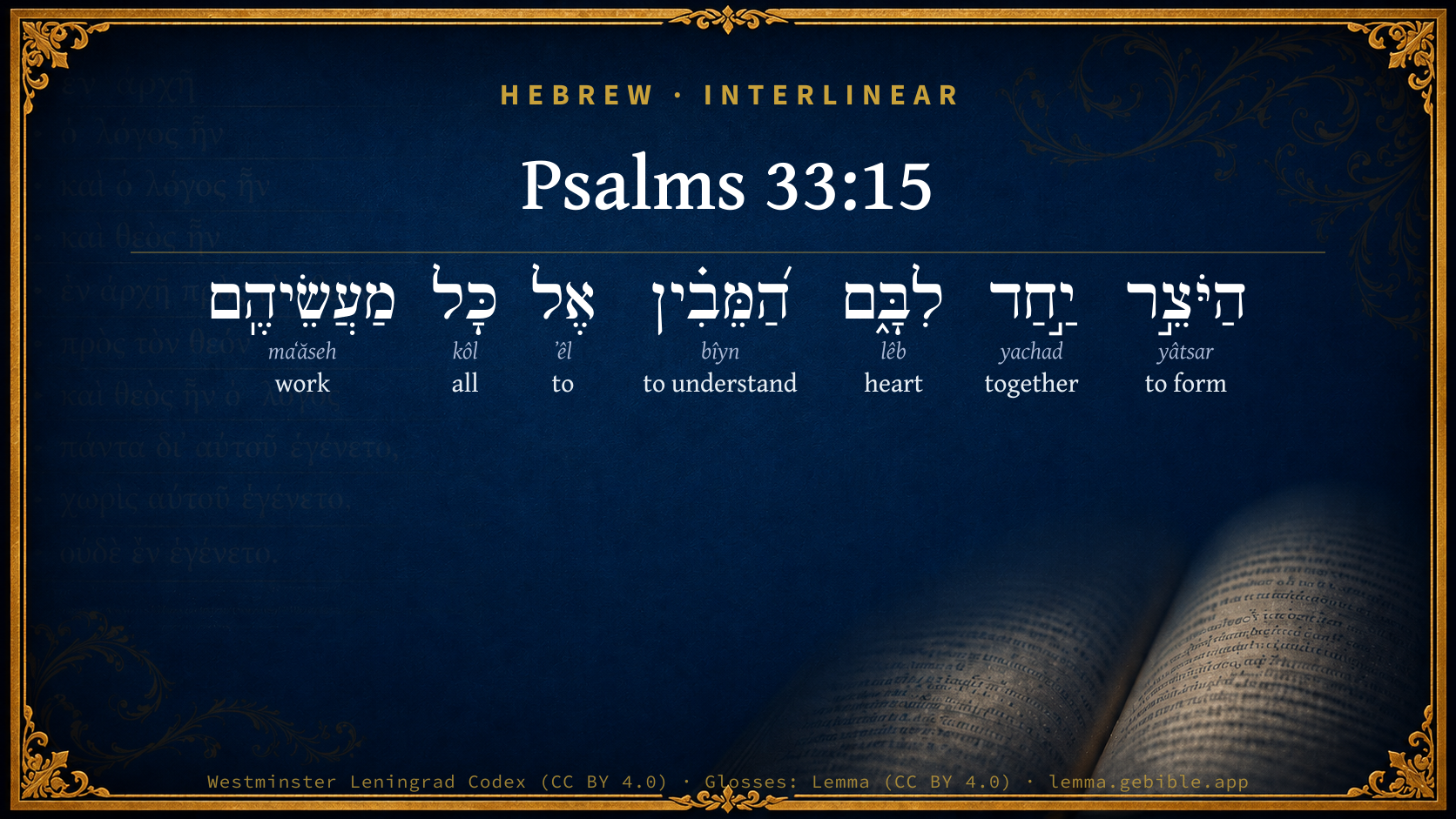
Psalms 33:15

Hebrew (Westminster Leningrad Codex) Psalms 33:15 appears in the Hebrew Old Testament. The text above is from the Westminster Leningrad Codex. Each word links to its Strong’s number, a concise gloss, and parsing drawn from the Open Scriptures Hebrew Bible morphology. Click any word for its full Brown-Driver-Briggs (BDB) entry.
Download image
Cite this verse

Psalms 33:15 (World English Bible). Public Domain. Lemma interlinear Bible study tool, https://lemma.gebible.app/v/psalms/33/15.

Show BibTeX & RIS
BibTeX
RIS
English Translation
He who fashions all of their hearts; And he considers all of their works.
World English Bible · Public Domain
Download a study sheet

One document with this verse’s original text, its word-by-word gloss line, the meaning frame, cross-references with their text, attributed commentary, and full source and license credits — printable, and it pastes into notes with its structure intact.

This verse Autodidact and up

Study sheet (.html) Plain text (.txt)

A passage Seminary Student

Up to 50 verses in one chapter. A passage sheet keeps up to 6 commentary sources and 12 cross-references per verse, in the order this page ranks them, and says so on the sheet whenever that leaves anything out. Ask for a single verse and you get the Autodidact verse sheet above.

Everything on this page stays free to read, with no account — the sheet is a download of what is already on screen, not access to it.

Want to remove ads? Support Godless Engineer
Compare translations 3

The same verse in 3 English versions, stacked beneath the original-language interlinear above. Click any original word for its lexicon entry.

Each is an independent rendering of the whole verse — the interlinear is not word-aligned to these translations.

Highlighted words mark where these versions differ — a whole-verse word diff, not a word-by-word alignment.

  • World English Bible Public Domain
    He who fashions all of their hearts; And he considers all of their works.
  • King James Version Public Domain
    He fashioneth their hearts alike; he considereth all their works.
  • unfoldingWord Literal Text CC BY-SA 4.0
    the one forming their hearts together, the one understanding all of their works.

unfoldingWord Literal Text — © unfoldingWord, licensed CC BY-SA 4.0. Word-aligned USFM3 via Door43 (git.door43.org/unfoldingWord/en_ult).

Versions to compare (up to 4)

3 of 4 selected

Show all 18 translations

Every available English version of this verse, each an independent rendering of the whole verse.

  • World English Bible Public Domain
    He who fashions all of their hearts; And he considers all of their works.
  • Berean Standard Bible Public Domain
    He shapes the hearts of each; He considers all their works.
  • Majority Standard Bible Public Domain
    He shapes the hearts of each; He considers all their works.
  • King James Version Public Domain
    He fashioneth their hearts alike; he considereth all their works.
  • American Standard Version (1901) Public Domain
    He that fashioneth the hearts of them all, That considereth all their works.
  • Revised Version (1885) Public Domain
    He that fashioneth the hearts of them all, that considereth all their works.
  • Geneva Bible (1599) Public Domain
    He facioneth their hearts euery one, and vnderstandeth all their workes.
  • Douay-Rheims (1899) Public Domain
    He who hath made the hearts of every one of them: who understandeth all their works.
  • Young's Literal Translation Public Domain
    Who is forming their hearts together, Who is attending unto all their works.
  • Literal Standard Version CC BY-SA 4.0
    Who is forming their hearts together, || Who is attending to all their works.
  • Unlocked Literal Bible CC BY-SA 4.0
    He who shapes the hearts of them all observes all their deeds.
  • unfoldingWord Literal Text CC BY-SA 4.0
    the one forming their hearts together, the one understanding all of their works.
  • Darby Bible Public Domain
    He who fashioneth the hearts of them all, who considereth all their works.
  • World Messianic Bible Public Domain
    he who fashions all of their hearts; and he considers all of their works.
  • Webster's Bible Public Domain
    He fashioneth their hearts alike; he considereth all their works.
  • Free Bible Version CC BY-SA 4.0
    He created their minds, so he knows everything they do.
  • Bible in Basic English Public Domain
    He makes all their hearts; their works are clear to him.
  • JPS Tanakh (1917) Public Domain
    He that fashioneth the hearts of them all, that considereth all their doings.

Literal Standard Version (2020), Covenant Press — licensed CC BY-SA 4.0. Text via the HelloAO Bible API (eBible.org). Unlocked Literal Bible (unfoldingWord) — licensed CC BY-SA 4.0. Text via the HelloAO Bible API (eBible.org). unfoldingWord Literal Text — © unfoldingWord, licensed CC BY-SA 4.0. Word-aligned USFM3 via Door43 (git.door43.org/unfoldingWord/en_ult). Free Bible Version, Dr. Jonathan Gallagher — licensed CC BY-SA 4.0. Text via the HelloAO Bible API (eBible.org).

Word by word

More ways to search: Search by grammar → Find every occurrence → Compare this word →

Practice this passage: Drill this verse → Learn its vocabulary →

הַיֹּצֵ֣ר
yâtsar
H3335
“the · forming”
Particle, Definite Article + Verb, Qal, Participle Active, Masculine, Singular, Absolute
Part of Speech
Particle + Verb
Stem
Qal
Form
Participle Active
Gender
Masculine
Number
Singular
State
Absolute
Full BDB Definition

Origin: probably identical with H3334 (through the squeezing into shape), ([compare H3331 ])

TWOT: 898

to form, fashion, frame - (Qal) to form, fashion - of human activity - of divine activity - of creation - of original creation - of individuals at conception - of Israel as a people - to frame, pre-ordain, plan (figuratively of divine) purpose of a situation) - (Niphal) to be formed, be created - (Pual) to be predetermined, be pre-ordained - (Hophal) to be formed
  1. יַ֣חַד yachad H3162 “together” Adverb
  2. לִבָּ֑ם lêb H3820 “heart · their” Noun, Common, Masculine, Singular, Construct + Suffix, Personal, 3rd Person, Masculine, Plural
  3. הַ֝מֵּבִ֗ין bîyn H995 “the · understanding” Particle, Definite Article + Verb, Hiphil, Participle Active, Masculine, Singular, Absolute
  4. אֶל ʼêl H413 “to” Preposition
  5. כָּל kôl H3605 “all of” Noun, Common, Masculine, Singular, Construct
  6. מַעֲשֵׂיהֶֽם maʻăseh H4639 “works · their” Noun, Common, Masculine, Plural, Construct + Suffix, Personal, 3rd Person, Masculine, Plural

About this verse

These counts appear in no published source. They are computed here, from the morphology-tagged text and Lemma’s own curated glosses. What Lemma adds →

7
words
7
distinct lemmas
Wisdom
section

Grammatical profile

  • 2 verbs
  • 3 nouns
  • 1 preposition
  • 1 adverb

Verb forms

  • הַיֹּצֵ֣ר Qal · Participle Active
  • הַ֝מֵּבִ֗ין Hiphil · Participle Active

Hebrew & Septuagint length

In English translation the verse runs 14 words from the Hebrew and 10 from the Septuagint (LXX English) — closely comparable.

A rough comparison of the two English renderings, which tokenize alike — not a word-level alignment.

Word counts can differ between the Hebrew and the Greek without any difference in meaning — e.g. the Hebrew direct-object marker אֵת has no separate Greek word, and Greek often adds the article ὁ.

Cross-references

13

Topical passages linked to Psalms 33:15 in the Treasury of Scripture Knowledge — connected by theme and wording, ordered by reader-vote popularity; previews shown in the World English Bible.

  • Jeremiah 32:19 great in counsel, and mighty in work; whose eyes are open on all the ways of the sons of men, to give everyone according to his ways, and according to the fruit of his doings:
  • Psalms 44:21 Won't God search this out? For he knows the secrets of the heart.
  • Hosea 7:2 They don't consider in their hearts that I remember all their wickedness. Now their own deeds have engulfed them. They are before my face.
  • 1 Corinthians 4:5 Therefore judge nothing before the time, until the Lord comes, who will both bring to light the hidden things of darkness, and reveal the counsels of the hearts. Then each man will get his praise from God.
  • Job 10:8 'Your hands have framed me and fashioned me altogether; Yet you destroy me.
  • Job 11:11 For he knows false men. He sees iniquity also, even though he doesn't consider it.
  • Proverbs 22:2 The rich and the poor have this in common: Yahweh is the maker of them all.
  • Proverbs 24:12 If you say, "Behold, we didn't know this;" Doesn't he who weighs the hearts consider it? He who keeps your soul, doesn't he know it? Shall he not render to every man according to his work?
  • Proverbs 27:19 As water reflects a face, So a man's heart reflects the man.
  • Ecclesiastes 7:29 Behold, this only have I found: that God made man upright; but they search for many schemes.
  • Isaiah 64:8 But now, Yahweh, you are our Father; we are the clay, and you our potter; and we all are the work of your hand.
  • Acts 17:26 He made from one blood every nation of men to dwell on all the surface of the earth, having determined appointed seasons, and the boundaries of their dwellings,
  • Job 34:21–22 "For his eyes are on the ways of a man, He sees all his goings.

Cross-references courtesy of OpenBible.info (CC BY 4.0).

Hebrew and Greek witnesses Masoretic Hebrew ↔ Greek Septuagint

The same verse in the two great witnesses to the Old Testament, shown verse-for-verse.

You’re reading Greek Psalm 32 (Hebrew Psalm 33). The Septuagint counts the superscription, so verse numbers can differ from the Hebrew — chapter-level alignment, not verse-by-verse. Numbering follows Rahlfs.

These are two independent witnesses, not word-aligned to each other, and the Septuagint is shown in lemma (dictionary) form.

Hebrew Psalms 33:15 Masoretic · Westminster Leningrad Codex

הַיֹּצֵ֣ר יַ֣חַד לִבָּ֑ם הַ֝מֵּבִ֗ין אֶל כָּל מַעֲשֵׂיהֶֽם

He who fashions all of their hearts; And he considers all of their works.

World English Bible · Public Domain

Greek LXX Greek Psalm 32:15 Septuagint · lemma form

ὁ πλάσσω κατά μόνος ὁ καρδία αὐτός ὁ συνἵημι εἰς πᾶς ὁ ἔργον αὐτός

who fashioned their hearts alone; who understands all their works.

LXX2012 (modern English Septuagint) · Public Domain

Hebrew: Westminster Leningrad Codex (CC BY 4.0). Greek: Septuagint (public domain); English from LXX2012 (modern English Septuagint) (Public Domain). How the Septuagint differs from the Hebrew →

Commentary

Notes on Psalms 33:15 from classic Christian and Jewish commentators (each source and its license shown beneath its notes). The classic Christian expositions comment on the surrounding passage and are grouped to its opening verse, so a note may address several verses; the Jewish commentaries on the Tanakh (Rashi and others) are per-verse, so they appear only where the commentator wrote on this verse.

Lemma curates 59 commentaries, every one of them public domain or Creative Commons licensed, each selected and text-cleaned for this edition rather than reprinted as found. About our sources →

Trapp's Complete Commentary

John Trapp

Psa 33:15 He fashioneth their hearts alike; he considereth all their works.

Ver. 15. He fashioneth their hearts alike] i.e. One’s as well as another’s. Unum pariter ac aliud (Kimchi). The Arabic hath it, Format sigillatim, he fashioneth them severally one after another; and not all souls together, as the Origenists and some Jewish doctors held.

He considereth all their works] Their hearts are not hid from him (since he made them, as is said before), much less their works. These God considereth, and therefore men had need consider them, and turn their feet to his testimonies, Psa 119:59.

John Trapp, A Commentary or Exposition upon All the Books of the Old and New Testament (1647–1656) — public domain. Text from a community e-Sword module.

The Biblical Illustrator

Joseph S. Exell

Psa_33:15

He fashioneth their hearts alike.

The moral identity of human hearts

He fashioneth their hearts alike. All have certain instincts, passions, emotions with which conventional differences have nothing to do. One touch of Nature makes the whole world kin.

I. God hath fashioned our hearts alike in respect of this, that we are all self-conscious, I can think of myself as myself and no other--as one individual unit. I am myself a world, into which the great world cannot penetrate; and, in the light of my own consciousness, i am as effectually hidden as though I did not exist at all. And this does not break up the race. It unifies it. For it is the same with all.

II. In close connection with this we must take the moral sense, that is, the conviction that some things are right and some wrong. Take the rudest savage, one whose ideas as to what is right and what is wrong are all jumbled together; still he feels that there is a difference. In this also God fashioneth our hearts alike. Its universality makes it the foundation of law, the approver of right, and the avenger of wrong, even when human law fails to detect the criminal.

III. God has made us all for friendship, affection, mutual dependence and mutual help. God setteth us in families. None of us, king or subject, prince or peasant, is sufficient for himself. The whole civilization and beneficence of the world have sprung from this objective character of man. Give a man nothing to do, and he is miserable. Give a man nothing to love, and he is miserable.

IV. this outward seeking can never be fully satisfied with anything created. In order to full satisfaction it must go forward and upward to God. It calls for the infinite. In this sense, too, God hath fashioned our hearts alike. He has so made us that He Himself is necessary to us. The eye is not satisfied with seeing, and not all the resources of this manifold world can fill the void in the human heart, and lead it to say--It is enough. There is something unanswered still, and there ever will be till we rest in God. (A. L. Simpson, D. D)

The Biblical Illustrator, edited by Joseph S. Exell (c. 1880s–1900s) — public domain. Text from a community e-Sword module.

J. A. Alexander on Psalms

Joseph Addison Alexander

15. (Psa 33:15) The (God) forming all their hearts, the (God) attending to all their deeds. The article agrees with the subject of the verb understood, and this construction it is necessary to retain, in order to connect the sentence as closely with the one before it as in the original. Forming implies knowing, which is more distinctly expressed, in reference to their outward conduct, in the other clause. God is also described as the creator of the human soul in Zec 12:1. Compare Num 16:22; Num 27:16. His control of it is expressly affirmed in reference to kings, Pro 21:1.

Joseph Addison Alexander, The Psalms Translated and Explained (1850) — public domain. Text from a community e-Sword module.

Geneva Bible (1599)

Geneva Bible translators

Therefore he knoweth their wicked enterprises.

Geneva Bible (1599) marginal notes — public domain. Text via Bolls.life.

Jamieson, Fausset & Brown

Robert Jamieson, A. R. Fausset & David Brown

fashioneth--or, "forms," and hence knows and controls (Pro 21:1).

alike--without exception.

considereth--or, "understands"; God knows men's motives.

Jamieson, Fausset & Brown — Commentary Critical and Explanatory on the Whole Bible (1871) — public domain (CC PDM 1.0). Text via the HelloAO Bible API.

Adam Clarke's Commentary

Verse 15. He fashioneth their hearts alike] He forms their hearts in unity; he has formed them alike; they are all the works of his hands: and he has formed them with the same powers, faculties, passions, c. body and spirit having the same essential properties in every human being.

Adam Clarke's Commentary on the Bible (1810–1826) — public domain. Text from a community e-Sword/MySword module.

John Calvin's Commentaries

15. He who fashioned their hearts altogether. It appears that this is added for the express purpose of assuredly persuading believers, that, however the wicked might craftily, deceitfully, and by secret stratagems, attempt to withdraw themselves from God’s sight, and hide themselves in caverns, yet his eyes would penetrate into their dark hiding-places. And the Psalmist argues from the very creation that God cannot but bring men’s devices and doings into reckoning and judgment; because, though each man has intricate recesses concealed in his bosom, so that there is a wonderful diversity of different minds in this respect, and this great variety creates a most confounding obscurity; yet the eyes of God cannot be dazzled and darkened, so that he may not be a competent judge and take cognisance of his own work. By the adverb together, therefore, he does not mean that the hearts of men were formed at the same moment of time; but that all of them were fashioned even to one, and without a single exception; so that those manifest great folly who attempt to hide, or to withdraw the knowledge of their hearts from him who framed them. The discourse may also be understood as meaning, that men cannot, by the erring devices of their own thoughts, diminish the authority of God over them, so that he may not govern by his secret providence the events which seem to them to happen by chance. We see, indeed, he in forming their vain hopes, they despoil God of his power, and transfer it to the creatures, at one time to this object, and at another time to that, conceiving that they have no need of his aid, so long as they are furnished with outward means and helps to protect themselves.

John Calvin's Commentaries (1540-1563) — public domain. Text from the Calvin Translation Society English edition (1840s-50s) via the Christian Classics Ethereal Library (ccel.org). Calvin's coverage is partial (roughly two-thirds of the Bible); uncommented books and verses are honest gaps, never fabricated. The 19th-century editor's footnotes and remarks are omitted so the notes are faithfully Calvin's own voice.

Ellicott's Commentary for English Readers

(15) He fashioneth.—Better,

“Moulding their hearts for all,

Observing all their deeds.”

The Hebrew word rendered “fashion” is that used of a potter moulding clay.

A Bible Commentary for English Readers, edited by Charles John Ellicott (1878–1897) — public domain. Text from a community e-Sword module.

The Cambridge Bible for Schools and Colleges

gen. ed. J. J. S. Perowne

15. Even he who formeth the hearts of them all,

Who considereth all their works.

He Who created man must know man’s heart (Psa_94:9). As God ‘formed’ man originally (Gen_2:7-8), so He continues to ‘form the hearts’ of individuals and of races (Zec_12:1). All are in some sense subservient to His plan and purpose.

The Cambridge Bible for Schools and Colleges (gen. ed. J. J. S. Perowne; Cambridge University Press, 1878–1918) — public domain. Text from a community e-Sword module.

John Gill's Exposition

He fashioneth their hearts alike,.... The Lord is the former and fashioner of the heart, spirit, or soul of man, even of all hearts and spirits; whence he is called the Father of spirits, Heb 12:9; see Zac 12:1; and he is the former of them alike; which seems to intimate as if all seals were alike, as they are made by the Lord; and it may be the difference there appears to be between them afterwards, nay be owing to the make and constitution of their bodies, to their education, and different situation, circumstances, and advantages in life, whereby the hearts of some may be more opened and enlarged than others. Some render it "together", or "altogether" (g); which must not be understood of time, as if they were all made at once, but of equality; the one was made by him as well as the other; he is the fashioner of one and all of them, every whit of them; they are wholly fashioned by him, and all that is in them, all the powers and faculties of the soul; and by him only, and not by the instrumentality of another; for souls are created, not generated; they are produced out of nothing, and not out of pre-existent matter, as bodies; parents contribute somewhat to the bodies of their children, but not anything to their souls. God only "is the God of the spirits of all flesh", Num 16:22; some translate the word "singly" (h); one by one, one after another in the several ages of time; for he continues to fashion them, and is always doing it; see Zac 12:1. And he forms the hearts of his own people anew for himself, for his own glory; he forms Christ in them, and every grace of his Spirit; he forms them into one, and knits and unites them together in love, and makes them like to one another; for as face answers to face in water, so do the hearts and experiences of the saints one to another, Pro 27:19; all which he does wholly and alone; and since he fashions the hearts of all men in every sense, he must know them, which is the design of this expression; he knows the hearts of wicked men, and all the wickedness that is in them; he knows the hearts of good men, the worst that is in them, and also the best, which he himself has put there;

he considereth all their works; the works of evil men, not only their more open ones, but their more secret ones, and will bring them into judgment; and the works of good men, even their good works, which he will remember and reward in a way of grace.

(g) "simul", Musculus, Gejerus; so Ainsworth. (h) Sept. "sigillatim", V. L.

John Gill's Exposition of the Whole Bible (1746–1763) — public domain (CC PDM 1.0). Text via the HelloAO Bible API.

Albert Barnes' Notes on the Bible

He fashioneth their hearts alike - That is, one as well as another; or, one as really as another. No one is exempt from his control, or from all that is implied in the word “fashioneth.” The meaning is not that their hearts are made to “resemble” each other, or to be “like” each other, whether in goodness or in wickedness - but that all alike “are” made by him. The idea in the word “fashioneth” here is not that of “creating,” in the sense that He “makes” the heart by his own power what it is, whether good or bad; but that, as he has “formed” the hearts of all people, he must see what is in the heart, or must behold all the purposes and thoughts of people. The Maker of the human heart must understand what is in it; and, therefore, He must have a clear understanding of the purposes and designs of human beings. This idea is carried out in the latter member of the sentence, “he considereth all their works,” and is substantially the same as in the expression Psa 94:9, “He that planted the ear, shall he not hear? He that formed the eye, shall he not see?”

He considereth all their works - He understands all that they do; he marks, or attends to, all that is done by them. The purpose here is to state the universal sovereignty of God. He made all things; He presides over all things; He sees all things; He is the source of safety and protection to all.

Albert Barnes' Notes on the Bible (1834–1885) — public domain. Text from a community e-Sword/MySword module.

Matthew Poole's English Annotations

Fashioneth, or fashioned, or made, or formeth. For this may relate either,

1. To the work of creation. So he proves what he said Psa 33:13,14, that God beheld all men, because he made them; yea, even their hearts, the most secret piece of them. Or,

2. To the works of his providence. Having said that God sees and observes all men, he now adds that he rules and governs them; yea, even their hearts, which are most masterless and unmanageable, and yet he frameth and disposeth and inclineth them, this way or that, according to the counsel of his will: see Exo 34:24; Psa 105:25.

Alike; or, equally, one as well as another; whether they be Jews or Gentiles, bond or free, princes or peasants; all are alike subject to his jurisdiction.

All their works, both outward and inward; all the workings of their minds and affections, and all their endeavours and actions.

Matthew Poole's English Annotations on the Holy Bible (1683–1685) — public domain. Text from a community e-Sword/MySword module.

The Treasury of David

Charles H. Spurgeon

Ver. 15. He fashioneth their hearts alike. By which is meant that all hearts are equally fashioned by the Lord, kings' hearts as well as the hearts of beggars. The text does not mean that all hearts are created originally alike by God, such a statement would scarcely be true, since there is the utmost variety in the constitutions and dispositions of men. All men equally owe the possession of life to the Creator, and have therefore no reason to boast themselves. What reason has the vessel to glorify itself in presence of the potter? He considereth all their words. Not in vain doth God see men's acts: he ponders and judges them. He reads the secret design in the outward behaviour, and resolves the apparent good into its real elements. This consideration foretokens a judgment when the results of the divine thoughts will be meted out in measures of happiness or woe. Consider thy ways, O man, for God considereth them!

Ver. 15. He fashioneth their hearts alike. As an illustration of the passage as it stands in our version, we append the following: -- "Every circumstance concurs in proving that mankind are not composed of species essentially different from each other; that, on the contrary, there was originally but one species, which, after multiplying and spreading over the whole surface of the earth, has undergone various changes, from the influence of climate, food, mode of living, diseases, and mixture of dissimilar individuals; that at first these changes were not so conspicuous, and produced only individual varieties; that these varieties became afterward more specific, because they were rendered more general, more strongly marked, and more permanent, by the continual action of the same causes; and that they are transmitted from generation to generation." G. L. Leclerc, Comte de Buffon, 1707-1788.

Ver. 15. The Creator of all things fashioneth their hearts alike; the word (dxy), which signifies together at once, intimating that the hearts of all men though separated from one another by never so vast a gulf of time or place, are as exactly alike in respect of their original inclinations, as if they had been all moulded at the same time. The worship of a God and then some kind of religion, is necessary to us, we cannot shift it off. William Pinke, 1631.

Ver. 15. (last clause). Two men give to the poor, one seeketh his reward in heaven, the other the praise of men. Thou in two seest one thing, God understandeth two. For he understandeth what is within, and knoweth what is within; their ends he seeth, their base intentions he seeth. He understandeth all their works. Augustine.

Ver. 15. God's acquaintance with men hearts, and his estimate of their actions.

The similarity of human nature.

Psalms 33:16*

Charles H. Spurgeon's The Treasury of David (1869–1885) — public domain. Psalms only. Text from a community e-Sword/MySword module.

The Pulpit Commentary

He fashioneth their hearts alike; rather, he mouldeth the hearts of them all. The hearts of all men are in God"s keeping, and his gracious influences are exerted to "mould" them aright. Some hearts are too stubborn to yield themselves up to his fashioning, and refuse to take the impress which he desires to impart; but all, or almost all, owe it to him that they are not worse than they are. He considereth all their works; rather, he understandeth all their works estimates, i.e. , all they do at its just value, knowing the true nature of each act, its motive, aim, essence.

The Pulpit Commentary (1880–1919), ed. H.D.M. Spence-Jones & Joseph S. Exell — public domain. Text from a community e-Sword module.

John Wesley's Explanatory Notes

Fashioneth - Having said that God sees and observes all men, he now adds, that he rules and governs them; yea, even the hearts which are most unmanageable, he disposes and inclines according to the counsel of his will. Alike - Or, equally, one as well as another: whether they be Jews or Gentiles, princes or peasants; all are alike subject to his jurisdiction. Their works - Both outward and inward, all the workings of their minds and actions, and all their endeavours and actions.

John Wesley, Explanatory Notes Upon the Whole Bible (1754–1765) — public domain. Text via the GEBible commentary corpus.

Rashi

Rabbi Shlomo Yitzchaki (Rashi)

He Who forms their hearts together All of their hearts together and knows all the thoughts. Our Sages, however, explain that it refers back to “From His dwelling place, the Creator oversees their hearts together,” and they derived from here that all are examined with a single glance (Rosh Hashana 18a).

Rashi on the Tanakh — English translations: “The Judaica Press complete Tanach with Rashi, translated by A. J. Rosenberg” (CC BY 4.0); “Pentateuch with Rashi's commentary by M. Rosenbaum and A.M. Silbermann, 1929-1934” (public domain); “The Metsudah Tanach series, Lakewood, N.J” (CC BY 4.0); and “The Book of Joshua, Metsudah Publications, 1997” (CC BY 4.0). Text via Sefaria.

Lesson kit

Teaching starters — assembled from the data on this page, not authored interpretation. Every prompt links to the verse data it draws on. Edit before teaching.

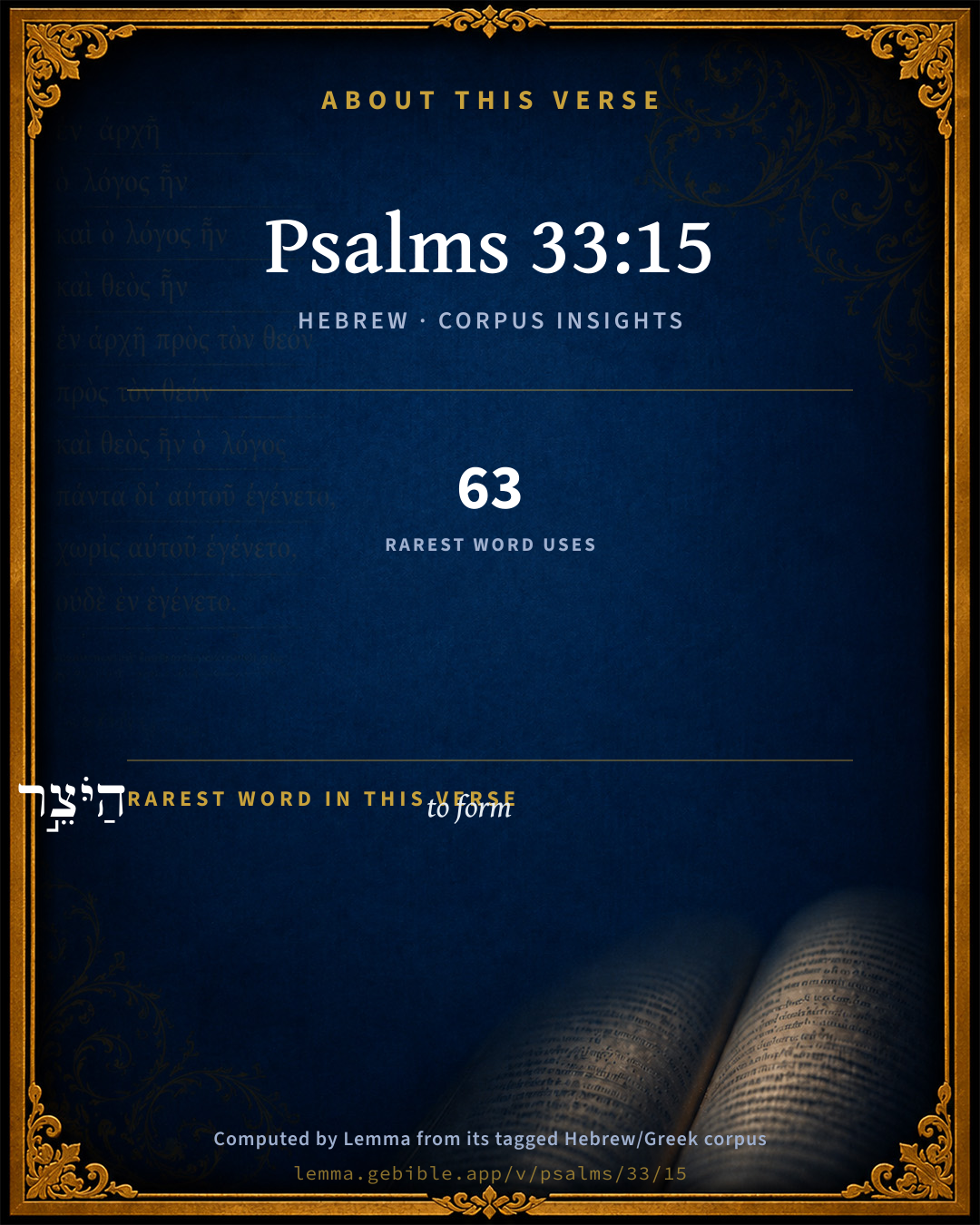
Psalms, in the Wisdom, opens this verse with 7 words (7 distinct Hebrew lemmas). Its most distinctive word is yâtsar (“to form”). A historical commentator’s framing appears above. Read the whole chapter for the surrounding context.

Discussion questions

  1. What does “to form” (yâtsar) contribute to the verse as a whole?
  2. Jeremiah 32:19 shares this passage’s theme. How do the two illuminate each other?
  3. The translations on this page render this verse differently — a whole-verse word diff, not a word-by-word alignment. What might account for the different wordings?
  4. The verb «הַיֹּצֵ֣ר» is Qal Participle Active. How does its form color the action?
  5. Reading how Trapp's Complete Commentary and The Biblical Illustrator read this verse, where do the two commentators agree and where do they part?

Things to notice

Reading settings

Reading text

Shown beneath each verse's original-language words.

Old Testament
Old Testament edition

Read the OT as the Masoretic Hebrew (MT) or the Greek Septuagint (LXX).

English shown for the Greek Septuagint (in the Hebrew ↔ Greek comparison).

Comparing translations? Open the Compare panel on any verse page to stack up to four side by side.