
Jeremiah 23:20

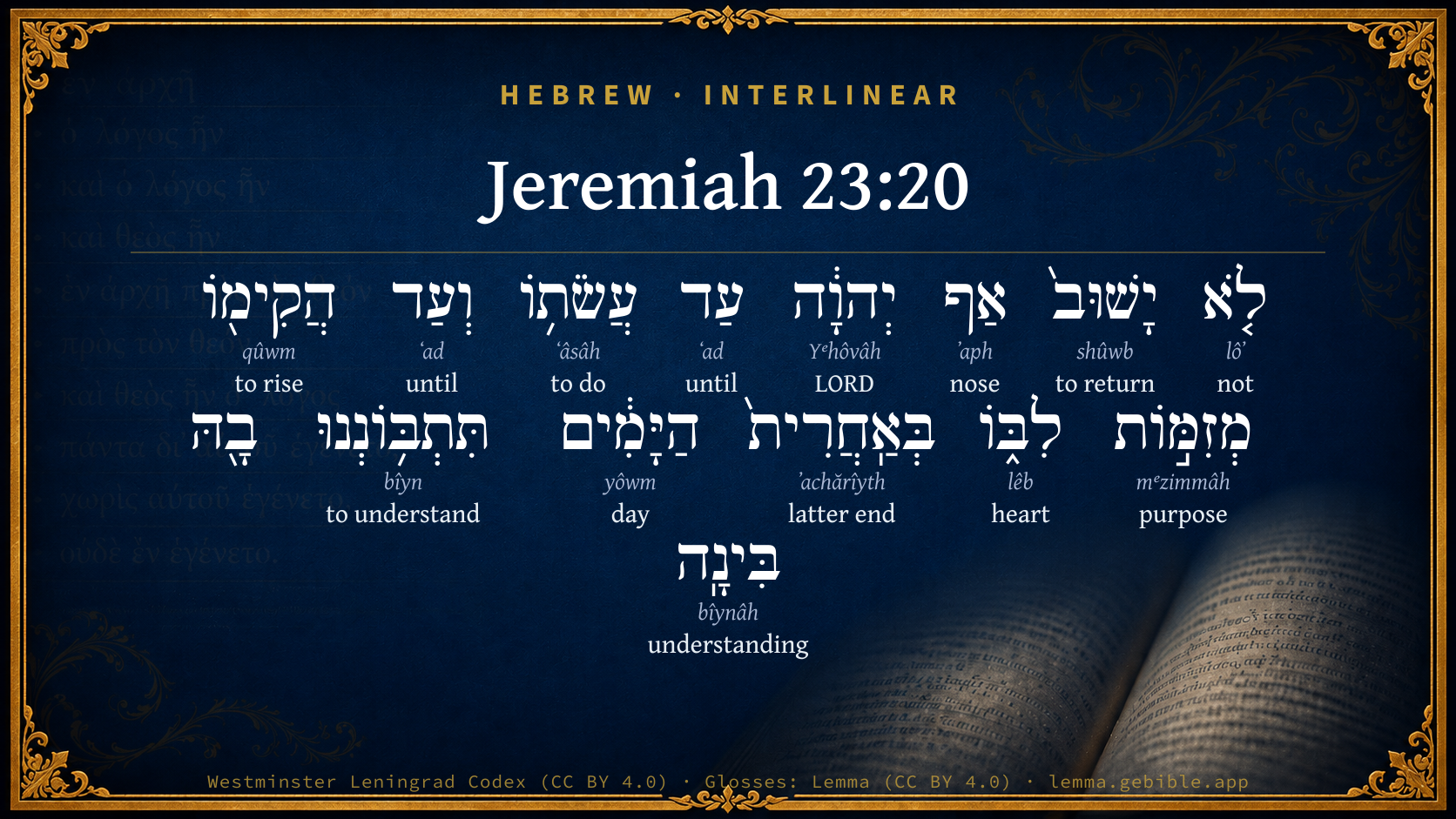
Hebrew (Westminster Leningrad Codex) Jeremiah 23:20 appears in the Hebrew Old Testament. The text above is from the Westminster Leningrad Codex. Each word links to its Strong’s number, a concise gloss, and parsing drawn from the Open Scriptures Hebrew Bible morphology. Click any word for its full Brown-Driver-Briggs (BDB) entry.
Download image
Cite this verse

Jeremiah 23:20 (World English Bible). Public Domain. Lemma interlinear Bible study tool, https://lemma.gebible.app/v/jeremiah/23/20.

Show BibTeX & RIS
BibTeX
RIS
English Translation
The anger of Yahweh shall not return, until he has executed, and until he have performed the intents of his heart: in the latter days you shall understand it perfectly.
World English Bible · Public Domain
Download a study sheet

One document with this verse’s original text, its word-by-word gloss line, the meaning frame, cross-references with their text, attributed commentary, and full source and license credits — printable, and it pastes into notes with its structure intact.

This verse Autodidact and up

Study sheet (.html) Plain text (.txt)

A passage Seminary Student

Up to 50 verses in one chapter. A passage sheet keeps up to 6 commentary sources and 12 cross-references per verse, in the order this page ranks them, and says so on the sheet whenever that leaves anything out. Ask for a single verse and you get the Autodidact verse sheet above.

Everything on this page stays free to read, with no account — the sheet is a download of what is already on screen, not access to it.

Want to remove ads? Support Godless Engineer
Compare translations 3

The same verse in 3 English versions, stacked beneath the original-language interlinear above. Click any original word for its lexicon entry.

Each is an independent rendering of the whole verse — the interlinear is not word-aligned to these translations.

Highlighted words mark where these versions differ — a whole-verse word diff, not a word-by-word alignment.

  • World English Bible Public Domain
    The anger of Yahweh shall not return, until he has executed, and until he have performed the intents of his heart: in the latter days you shall understand it perfectly.
  • King James Version Public Domain
    The anger of the LORD shall not return, until he have executed, and till he have performed the thoughts of his heart: in the latter days ye shall consider it perfectly.
  • unfoldingWord Literal Text CC BY-SA 4.0
    The nose of Yahweh will not turn back until he has done and until he has established the intentions of his heart. In the latter days you will understand it with understanding. q1

unfoldingWord Literal Text — © unfoldingWord, licensed CC BY-SA 4.0. Word-aligned USFM3 via Door43 (git.door43.org/unfoldingWord/en_ult).

Versions to compare (up to 4)

3 of 4 selected

Show all 18 translations

Every available English version of this verse, each an independent rendering of the whole verse.

  • World English Bible Public Domain
    The anger of Yahweh shall not return, until he has executed, and until he have performed the intents of his heart: in the latter days you shall understand it perfectly.
  • Berean Standard Bible Public Domain
    The anger of the LORD will not turn back until He has fully accomplished the purposes of His heart. In the days to come you will understand this clearly.
  • Majority Standard Bible Public Domain
    The anger of the LORD will not turn back until He has fully accomplished the purposes of His heart. In the days to come you will understand this clearly.
  • King James Version Public Domain
    The anger of the LORD shall not return, until he have executed, and till he have performed the thoughts of his heart: in the latter days ye shall consider it perfectly.
  • American Standard Version (1901) Public Domain
    The anger of Jehovah shall not return, until he have executed, and till he have performed the intents of his heart: in the latter days ye shall understand it perfectly.
  • Revised Version (1885) Public Domain
    The anger of the LORD shall not return, until he have executed, and till he have performed the intents of his heart: in the latter days ye shall understand it perfectly.
  • Geneva Bible (1599) Public Domain
    The anger of the Lord shall not returne vntill he haue executed, and till he haue perfourmed the thoughts of his heart: in the latter dayes ye shall vnderstande it plainely.
  • Douay-Rheims (1899) Public Domain
    The wrath of the Lord shall not return till he execute it, and till he accomplish the thought of his heart: in the latter days you shall understand his counsel.
  • Young's Literal Translation Public Domain
    The anger of Jehovah doth not turn back Till His doing, and till His establishing, The thoughts of His heart, In the latter end of the days ye attend to it With understanding.
  • Literal Standard Version CC BY-SA 4.0
    The anger of YHWH does not turn back || Until His doing, and until His establishing, || The thoughts of His heart, || In the latter end of the days || You attend to it with understanding.
  • Unlocked Literal Bible CC BY-SA 4.0
    Yahweh's wrath will not return until it has carried out and brought into being his heart's intentions. In the final days, you will understand it.
  • unfoldingWord Literal Text CC BY-SA 4.0
    The nose of Yahweh will not turn back until he has done and until he has established the intentions of his heart. In the latter days you will understand it with understanding. q1
  • Darby Bible Public Domain
    The anger of Jehovah shall not return, until he have executed, and until he have performed the purposes of his heart: at the end of the days ye shall understand it clearly.
  • World Messianic Bible Public Domain
    The LORD’s anger will not return until he has executed and performed the intents of his heart. In the latter days, you will understand it perfectly.
  • Webster's Bible Public Domain
    The anger of the LORD shall not return, until he shall have executed, and till he shall have performed the thoughts of his heart: in the latter days ye shall consider it perfectly.
  • Free Bible Version CC BY-SA 4.0
    The Lord's anger won't fade until he's finished doing everything he wants. Only then will you really understand.
  • Bible in Basic English Public Domain
    The wrath of the Lord will not be turned back till he has done, till he has put into effect, the purposes of his heart: in days to come you will have full knowledge of this.
  • JPS Tanakh (1917) Public Domain
    The anger of the LORD shall not return, until He have executed, and till He have performed the purposes of His heart; in the end of days ye shall consider it perfectly.

Literal Standard Version (2020), Covenant Press — licensed CC BY-SA 4.0. Text via the HelloAO Bible API (eBible.org). Unlocked Literal Bible (unfoldingWord) — licensed CC BY-SA 4.0. Text via the HelloAO Bible API (eBible.org). unfoldingWord Literal Text — © unfoldingWord, licensed CC BY-SA 4.0. Word-aligned USFM3 via Door43 (git.door43.org/unfoldingWord/en_ult). Free Bible Version, Dr. Jonathan Gallagher — licensed CC BY-SA 4.0. Text via the HelloAO Bible API (eBible.org).

Word by word

More ways to search: Search by grammar → Find every occurrence → Compare this word →

Practice this passage: Drill this verse → Learn its vocabulary →

מְזִמּ֣וֹת
mᵉzimmâh
H4209
“purposes of”
Noun, Common, Feminine, Plural, Construct
Part of Speech
Noun
Type
Common
Gender
Feminine
Number
Plural
State
Construct
Full BDB Definition

Origin: from H2161

TWOT: 556c

purpose, discretion, device, plot - purpose - discretion - devices (evil)
  1. לֹ֤א lôʼ H3808 “not” Particle, Negative
  2. יָשׁוּב֙ shûwb H7725 “to return” Verb, Qal, Imperfect, 3rd Person, Masculine, Singular
  3. אַף ʼaph H639 “nose” Particle, Accusative
  4. יְהוָ֔ה Yᵉhôvâh H3068 “LORD” Noun, Proper
  5. עַד ʻad H5704 “until” Preposition
  6. עֲשֹׂת֥וֹ ʻâsâh H6213 “to do · him” Verb, Qal, Infinitive Construct + Suffix, Personal, 3rd Person, Masculine, Singular
  7. וְעַד ʻad H5704 “and · until” Conjunction + Preposition
  8. הֲקִימ֖וֹ qûwm H6965 “to rise · him” Verb, Hiphil, Infinitive Construct + Suffix, Personal, 3rd Person, Masculine, Singular
  9. לִבּ֑וֹ lêb H3820 “heart · his” Noun, Common, Masculine, Singular, Construct + Suffix, Personal, 3rd Person, Masculine, Singular
  10. בְּאַֽחֲרִית֙ ʼachărîyth H319 “in/at · latter end of” Preposition + Noun, Common, Feminine, Singular, Construct
  11. הַיָּמִ֔ים yôwm H3117 “the · days” Particle, Definite Article + Noun, Common, Masculine, Plural, Absolute
  12. תִּתְבּ֥וֹנְנוּ bîyn H995 “to understand” Verb, Hithpolel, Imperfect, 2nd Person, Masculine, Plural
  13. בִּינָֽה bîynâh H998 “understanding” Noun, Common, Feminine, Singular, Absolute

About this verse

These counts appear in no published source. They are computed here, from the morphology-tagged text and Lemma’s own curated glosses. What Lemma adds →

15
words
13
distinct lemmas
Prophets
section

Notable vocabulary

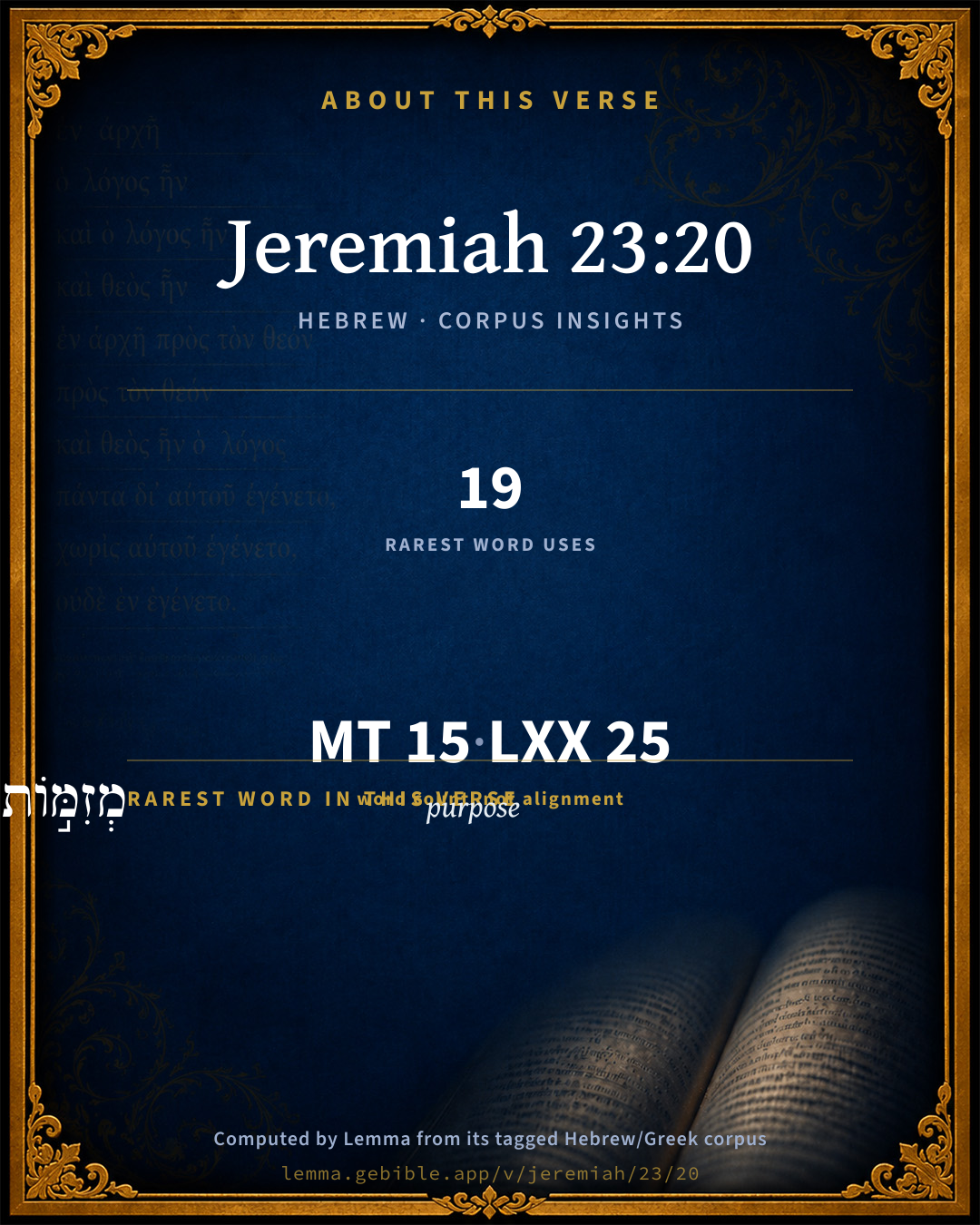
The rarest word here is מְזִמּ֣וֹת purpose H4209 — appearing just 19 times in the whole Hebrew Bible.

Shared distinctive vocabulary

מְזִמּ֣וֹת purpose H4209 occurs in 19 verses of the Hebrew Bible. Also found in:

Grammatical profile

  • 4 verbs
  • 6 nouns
  • 3 prepositions
  • 2 particles

Verb forms

  • יָשׁוּב֙ Qal · Imperfect
  • עֲשֹׂת֥וֹ Qal · Infinitive Construct
  • הֲקִימ֖וֹ Hiphil · Infinitive Construct
  • תִּתְבּ֥וֹנְנוּ Hithpolel · Imperfect

Repetition

A word recurs within this verse — often emphatic in Hebrew:

Hebrew & Septuagint length

In the original languages it is 15 Hebrew tokens and 25 Greek tokens — but the two are counted differently (Hebrew bundles its prefixes and suffixes into one token; the Greek is in lemma form), so that isn’t a like-for-like length.

Cross-references

12

Topical passages linked to Jeremiah 23:20 in the Treasury of Scripture Knowledge — connected by theme and wording, ordered by reader-vote popularity; previews shown in the World English Bible.

  • Jeremiah 30:24 The fierce anger of Yahweh shall not return, until he has executed, and until he have performed the intents of his heart: in the latter days you shall understand it.
  • Isaiah 55:11 so shall my word be that goes forth out of my mouth: it shall not return to me void, but it shall accomplish that which I please, and it shall prosper in the thing whereto I sent it.
  • Genesis 49:1 Jacob called to his sons, and said: "Gather yourselves together, that I may tell you that which will happen to you in the days to come.
  • Proverbs 21:30 There is no wisdom nor understanding Nor counsel against Yahweh.
  • Isaiah 14:24 Yahweh of Hosts has sworn, saying, Surely, as I have thought, so shall it happen; and as I have purposed, so shall it stand:
  • Zechariah 1:6 But my words and my decrees, which I commanded my servants the prophets, didn't they overtake your fathers? "Then they repented and said, 'Just as Yahweh of Hosts determined to do to us, according to our ways, and according to our practices, so he has dealt with us.'"
  • Deuteronomy 31:29–30 For I know that after my death you will utterly corrupt yourselves, and turn aside from the way which I have commanded you; and evil will happen to you in the latter days; because you will do that which is evil in the sight of Yahweh, to provoke him to anger through the work of your hands.
  • 1 Kings 8:47 yet if they shall repent themselves in the land where they are carried captive, and turn again, and make supplication to you in the land of those who carried them captive, saying, We have sinned, and have done perversely, we have dealt wickedly;
  • 2 Kings 23:26 Notwithstanding, Yahweh didn't turn from the fierceness of his great wrath, with which his anger was kindled against Judah, because of all the provocation with which Manasseh had provoked him.
  • Proverbs 5:11–14 You will groan at your latter end, When your flesh and your body are consumed,
  • Hosea 3:4–5 For the children of Israel shall abide many days without king, and without prince, and without sacrifice, and without sacred stone, and without ephod or idols.
  • Zechariah 8:14–15 For thus says Yahweh of hosts: "As I thought to do evil to you, when your fathers provoked me to wrath," says Yahweh of Hosts, "and I didn't repent;

Cross-references courtesy of OpenBible.info (CC BY 4.0).

Hebrew and Greek witnesses Masoretic Hebrew ↔ Greek Septuagint

The same verse in the two great witnesses to the Old Testament, shown verse-for-verse.

These are two independent witnesses, not word-aligned to each other, and the Septuagint is shown in lemma (dictionary) form.

Hebrew Jeremiah 23:20 Masoretic · Westminster Leningrad Codex

לֹ֤א יָשׁוּב֙ אַף יְהוָ֔ה עַד עֲשֹׂת֥וֹ וְעַד הֲקִימ֖וֹ מְזִמּ֣וֹת לִבּ֑וֹ בְּאַֽחֲרִית֙ הַיָּמִ֔ים תִּתְבּ֥וֹנְנוּ בָ֖הּ בִּינָֽה

The anger of Yahweh shall not return, until he has executed, and until he have performed the intents of his heart: in the latter days you shall understand it perfectly.

World English Bible · Public Domain

Greek LXX Structure differs

In the Septuagint, Jeremiah is about an eighth shorter than the Hebrew and arranges its material differently — the Oracles Against the Nations (Hebrew chapters 46–51) appear in the middle of the Greek book, after 25:13. Because the chapter and verse boundaries do not line up, a verse-for-verse comparison with the Hebrew is not shown.

A verse-for-verse comparison isn’t shown here because the chapters and verses don’t line up. Switch to the LXX edition with the MT / LXX toggle above to read the Greek directly.

Hebrew: Westminster Leningrad Codex (CC BY 4.0). Greek: Septuagint (public domain); English from a public-domain English Septuagint. How the Septuagint differs from the Hebrew →

Targum (Aramaic paraphrase)

1

The Targum is the ancient Jewish Aramaic paraphrase of the Hebrew Scriptures — an interpretive translation, not the Hebrew text itself. Onkelos (literal) and Pseudo-Jonathan (expansive) render the Torah, and Jonathan the Prophets. Coverage is partial: where no permissively-licensed English translation exists for a verse, only the Aramaic is shown. This is verse-level text, not a word-by-word alignment to the Hebrew.

  1. Targum Jonathan Prophets (Joshua–Malachi)
    לָא יֵתוּב רוּגְזָא דַייָ עַד דְיַעְבֵד וְעַד דִיקַיֵם מַחְשְׁבַת רְעוּתֵיהּ בְּסוֹף יוֹמַיָא תִּסְתַּכְּלוּן בָּהּ אִסְתַּכָּלָא:

    (no public-domain English translation for this verse)

    Targum Jonathan — Aramaic: “Mikraot Gedolot” (public domain). English: “Sefaria Community Translation” (CC0 1.0 (public-domain dedication)); “London "Chaldee Paraphrase," 1871” (public domain). Text via Sefaria.

Commentary

Notes on Jeremiah 23:20 from classic Christian and Jewish commentators (each source and its license shown beneath its notes). The classic Christian expositions comment on the surrounding passage and are grouped to its opening verse, so a note may address several verses; the Jewish commentaries on the Tanakh (Rashi and others) are per-verse, so they appear only where the commentator wrote on this verse.

Lemma curates 59 commentaries, every one of them public domain or Creative Commons licensed, each selected and text-cleaned for this edition rather than reprinted as found. About our sources →

Trapp's Complete Commentary

John Trapp

Jer 23:20 The anger of the LORD shall not return, until he have executed, and till he have performed the thoughts of his heart: in the latter days ye shall consider it perfectly.

Ver. 20. In the latter days ye shall consider it perfectly.] All too late ye shall subscribe to the truth of these threats, which now ye take as uttered in terror only, and will not believe till you feel. Sero, inquit Nero. Too late Nero said. Epimetheus, that after wit, had too many fellows. Sero sapiunt Phryges. The Pyyges understand too late.

John Trapp, A Commentary or Exposition upon All the Books of the Old and New Testament (1647–1656) — public domain. Text from a community e-Sword module.

Geneva Bible (1599)

Geneva Bible translators

Both that God hath sent me, and that my words shall be true.

Geneva Bible (1599) marginal notes — public domain. Text via Bolls.life.

Jamieson, Fausset & Brown

Robert Jamieson, A. R. Fausset & David Brown

in . . . latter days--that is, "the year of their visitation" (Jer 23:12). Primarily the meaning is: the Jews will not "consider" now God's warnings (Deu 32:29); but when the prophecies shall be fulfilled in their Babylonish exile, they will consider and see, by bitter experience, their sinful folly. The ultimate scope of the prophecy is: the Jews, in their final dispersion, shall at last "consider" their sin and turn to Messiah "perfectly" (Hos 3:5; Zac 12:5, Zac 12:10-14; Luk 13:35).

Jamieson, Fausset & Brown — Commentary Critical and Explanatory on the Whole Bible (1871) — public domain (CC PDM 1.0). Text via the HelloAO Bible API.

Adam Clarke's Commentary

Verse 20. In the latter days ye shall consider it] I give you warning: and this punishment which I now threaten shall surely take place; a short time will determine it; ye shall not escape.

Adam Clarke's Commentary on the Bible (1810–1826) — public domain. Text from a community e-Sword/MySword module.

John Calvin's Commentaries

He confirms what he had said, lest the hypocrites, with whom he had to do, should think that their punishment would be light and soon pass away. For though they may have seen that God’s hand was armed against them, yet they took comfort, because they expected that it would only be for a short time. Hence Jeremiah here reminds them that they were much deceived if they thought that they could dissipate as a cloud the vengeance that, was at hand; for God would not cease to punish them until he had destroyed them.

There was another security which deceived the ungodly: they were not terrified by threatenings of the Prophet, because they thought that God was in a manner dallying with them whenever he denounced ruin. And, doubtless, the wicked could not have so securely indulged themselves, had it not been that they did not believe that God’s word would be fulfilled. As, then, God’s threatenings did not strike hypocrites with terror, the Prophet here declares that there was no reason for them to harbor the vain hope that God only uttered words, and that there would be no execution of his vengeance.

Turn back, he says, shall not the anger of Jehovah until he has performed and confirmed the thoughts of his heart Jeremiah shews that God had not spoken in vain by his servants, according to what is done by men, who often speak rashly, for their tongue frequently outruns their purpose. But he reminds them here that God is far different from men, for he ever speaks in earnest, and his prophetic word is a sure evidence of his hidden purpose, as it will again be presently declared. This is the reason why he mentions the thoughts of his heart

We must not yet think that God is like us, as though he reflected on this thing and on that, and formed many purposes, while one thing or another comes into his mind; no, such a gross idea as this cannot be entertained, and cannot be consistent with the nature of God.

But Jeremiah calls, by a kind of metaphor, the counsel of God his thoughts, even that fixed and unchangeable counsel, which he declared by his prophets. Sometimes, indeed, God threatened, in order to restore men to repentance; but we must bear in mind that he neither varies himself nor changes his purpose. Whatever, then, the prophets announced in his name, flowed from his hidden purpose, and it was the same as though he had made known to us his own heart. And it is no small commendation to prophetic doctrine that God as it were connected his heart with his mouth. The mouth of God is the doctrine itself; and he says now that it had proceeded from the depth of his heart. It hence follows that there is nothing frustratory, (deceptive,) as they say, in God’s word; for he here declares that whatever he had committed to his servants were the thoughts of his heart. And to confirm, or establish, must be applied to the execution of his thoughts.

The sum of the whole is, that God now pronounces a sentence against the people, which could not be reversed; for he had once for all decreed to destroy the men who were obstinate in their sins.

But he seems to refer to the word יחול, ichul, which means, as I have said, to fall, and also to abide or to lie upon. According to this meaning, he says now, that the anger of God would not return, so as to change its course, until it had completed what had already been decreed, even what God had resolved respecting the destruction of the people.

Then he adds, In the extremity of days ye shall understand the knowledge of this thing So it is literally; but we may give a simpler version, “Ye shall perceive the knowledge of this matter,” or “Ye shall know what this means.” The Prophet, no doubt, exults over the insensibility of those who could not be moved by such awful warnings. We know how great is the hardness of the ungodly, especially when Satan possesses their minds and hearts. There is, indeed, no iron and no stone which has so much hardness as there is in the perversely wicked; and they in a manner assail God with the greatest obstinacy, as though they were victorious, for they despise all his warnings and threatenings. Hence the Prophet derides their insolence, or rather their madness, and. says, “Ye shall understand,” but too late; for by extremity of days, he means the time which God had appointed for his anger. But yet God had in due time warned them that they might repent before his judgment came. It was now then the same as though he left them in their own stupor, and said that they could not, however, escape the hand of God by their perverseness, according to what Paul says,

“Let him who is ignorant, be ignorant.” (1 Corinthians 14:38.)

He no doubt checks the arrogance of those who rejected every sound doctrine and all right counsels.

So, then, the Prophet teaches us here that hypocrites gain nothing by setting up their own contumacy and arrogance in opposition to God, for they will find, though too late, that God has not spoken in vain. We then see that by extremity of days is to be understood that time when the door shall be closed, because they did not in due time respond to God when he invited them to himself, and set before them the hope of salvation.

There is also another truth taught us here, that we are to seek God while he may be found, and call upon him while he is near. (Isaiah 55:6.) For if we abuse his forbearance and despise him who speaks to us today, we shall find out too late, and not without the most grievous sorrow, that we have been deceived by the devil, because we did not attend to God calling us. It follows, —

John Calvin's Commentaries (1540-1563) — public domain. Text from the Calvin Translation Society English edition (1840s-50s) via the Christian Classics Ethereal Library (ccel.org). Calvin's coverage is partial (roughly two-thirds of the Bible); uncommented books and verses are honest gaps, never fabricated. The 19th-century editor's footnotes and remarks are omitted so the notes are faithfully Calvin's own voice.

Ellicott's Commentary for English Readers

(20) Shall not return . . .—i.e., shall not turn back from its purpose. Men should look back on it in the “latter days”—literally, the end of the days (Gen_49:1; Num_24:14; Deu_4:30; Deu_31:29), i.e., in the then distant future of the exile and the return—and should see that it had done its work both of chastisement and discipline. (Comp. Eze_14:22-23.)

A Bible Commentary for English Readers, edited by Charles John Ellicott (1878–1897) — public domain. Text from a community e-Sword module.

The Cambridge Bible for Schools and Colleges

gen. ed. J. J. S. Perowne

20. the latter days] a prophetic phrase denoting the final period of the history so far as the speaker’s perspective reaches; e.g. Israel’s return to God after adversity (so the parallel passage Jer_30:24; cp. Deu_4:30). We find the expression again, Jer_48:47, Jer_49:39.

understand] mg. (less well) consider.

The Cambridge Bible for Schools and Colleges (gen. ed. J. J. S. Perowne; Cambridge University Press, 1878–1918) — public domain. Text from a community e-Sword module.

John Gill's Exposition

The anger of the Lord shall not return,.... Having a commission from him, and being sent forth on an errand to do business for him, it shall not return to him, without having done it; as a servant sent by his master does not return till he has finished what he was sent about:

until he have executed, and till he have performed the thoughts of his heart; all his counsels, purposes, and designs, respecting those his anger kindled against, the false prophets and wicked Jews:

in the latter days ye shall consider it perfectly; when too late to avert it by repentance and reformation when all this shall be fulfilled, and the seventy years captivity take place; or, "in the end of days" (d); in the latter part off time, when the Jews shall be converted, and seek the Lord their God, Hos 3:5; then "shall they understand it with an understanding" (e), as it may be rendered; when they shall have the veil removed from them, and turn to the Lord; then they shall have a true and thorough understanding of these things; of the cause and reason of them; and of the mind of God in them, and the ends to be answered by them. Kimchi says this will be in the times of the Messiah.

(d) "in extremo dierum", Cocceius; "in extremitate dierum", Calvin, Piscator, Schmidt. (e) "intelligetis hoc inteliigentia", Calvin, Gataker.

John Gill's Exposition of the Whole Bible (1746–1763) — public domain (CC PDM 1.0). Text via the HelloAO Bible API.

Albert Barnes' Notes on the Bible

The latter days - The proper and final development of any event or series of events. Thus, the expression is used of the Christian dispensation as the full development of the Jewish Church. Here it means the destruction of Jerusalem, as the result of the sins of the Jews.

Consider - Rather, understand. When Jerusalem is destroyed, the exiles - taught by adversity - will understand that it was sin which brought ruin upon their country.

Albert Barnes' Notes on the Bible (1834–1885) — public domain. Text from a community e-Sword/MySword module.

Matthew Poole's English Annotations

It is therefore called a continuing whirlwind, Jer 30:23. The prophet speaks of the judgment as of a messenger, which coming from God, should not return till it had done its errand, and executed what it came for, even whatever God had resolved it should effect. Men are ready to flatter themselves that they shall either outride or outlive the storms of Divine vengeance. No, (saith the prophet,) the anger of the Lord shall bring to pass whatsoever the just will of God is. And though you will not now believe it, but flatter yourselves with idle, vain hopes, yet hereafter, when it shall be too late, (which is the usual folly of sinners,) then you shall consider it perfectly.

Matthew Poole's English Annotations on the Holy Bible (1683–1685) — public domain. Text from a community e-Sword/MySword module.

Whedon's Commentary on the Bible

Daniel D. Whedon

20. Anger of the Lord — This wrath of God is resistless. He will certainly perform the thoughts of his heart. And when these plans of God are actually wrought out into completion they will be understood.

Daniel D. Whedon (gen. ed.), Commentary on the Old and New Testaments (1874–1909) — public domain. Text from a community e-Sword module.

The Pulpit Commentary

The anger of the Lord. The prophet"s interpretation of the image. It is the judicial anger of Jehovah, personified as Divine manifestations so often are (hence "shall not return"). The form of the verse reminds us of Isa_55:11. In the latter days; rather, in future days, as Dr. Henderson rightly renders. It seems better to restrict the term "latter days" to the Messianic period, ("the coming age," Mat_12:32) to which, in fact, it is often applied. (e.g. Isa_2:2 Hos_3:5) The phrase in itself simply means "in the sequel of the days," i.e. in the future; its Messianic reference, when this exists, is inferred solely from the context. In the passage before us, and in Deu_4:30 Deu_30:2-9, there can be no intention of pointing to the Messianic age. Precisely the same phrase occurs in an Assyrian inscription, where its meaning is clear from the context (aria akhrat yumi irib, "For a sequel of days i.e., for a future time I deposited"). In the present case it is no distant period to which the prophet refers, for he continues, Ye shall consider it, etc., or rather, ye shall understand it clearly, viz. that the calamities which will have come upon you are the Divine judgment upon your sins.

The Pulpit Commentary (1880–1919), ed. H.D.M. Spence-Jones & Joseph S. Exell — public domain. Text from a community e-Sword module.

John Wesley's Explanatory Notes

The anger - The prophet speaks of the judgment as of a messenger, which should not return till it had done its errand, and executed what God had resolved it should effect. Ye shall consider - And though you will not now believe it, yet hereafter when it shall be too late, you shall consider it perfectly.

John Wesley, Explanatory Notes Upon the Whole Bible (1754–1765) — public domain. Text via the GEBible commentary corpus.

Rashi

Rabbi Shlomo Yitzchaki (Rashi)

the plans of an expression of thought.

Rashi on the Tanakh — English translations: “The Judaica Press complete Tanach with Rashi, translated by A. J. Rosenberg” (CC BY 4.0); “Pentateuch with Rashi's commentary by M. Rosenbaum and A.M. Silbermann, 1929-1934” (public domain); “The Metsudah Tanach series, Lakewood, N.J” (CC BY 4.0); and “The Book of Joshua, Metsudah Publications, 1997” (CC BY 4.0). Text via Sefaria.

Lesson kit

Teaching starters — assembled from the data on this page, not authored interpretation. Every prompt links to the verse data it draws on. Edit before teaching.

Jeremiah, in the Prophets, opens this verse with 15 words (13 distinct Hebrew lemmas). Its most distinctive word is mᵉzimmâh (“purpose”). A historical commentator’s framing appears above. Read the whole chapter for the surrounding context.

Discussion questions

  1. How does “purpose” (mᵉzimmâh) shape what this verse is saying?
  2. Job 21:27 shares the word «purpose» with this verse. How do the two illuminate each other?
  3. “until” occurs 2× in this one verse. What is the effect of the repetition?
  4. These translations render this verse differently. What is at stake in choosing one wording over another?
  5. The verb «יָשׁוּב֙» is Qal Imperfect. How does its form color the action?
  6. Reading how Trapp's Complete Commentary and Geneva Bible (1599) read this verse, where do the two commentators agree and where do they part?

Things to notice

Reading settings

Reading text

Shown beneath each verse's original-language words.

Old Testament
Old Testament edition

Read the OT as the Masoretic Hebrew (MT) or the Greek Septuagint (LXX).

English shown for the Greek Septuagint (in the Hebrew ↔ Greek comparison).

Comparing translations? Open the Compare panel on any verse page to stack up to four side by side.