
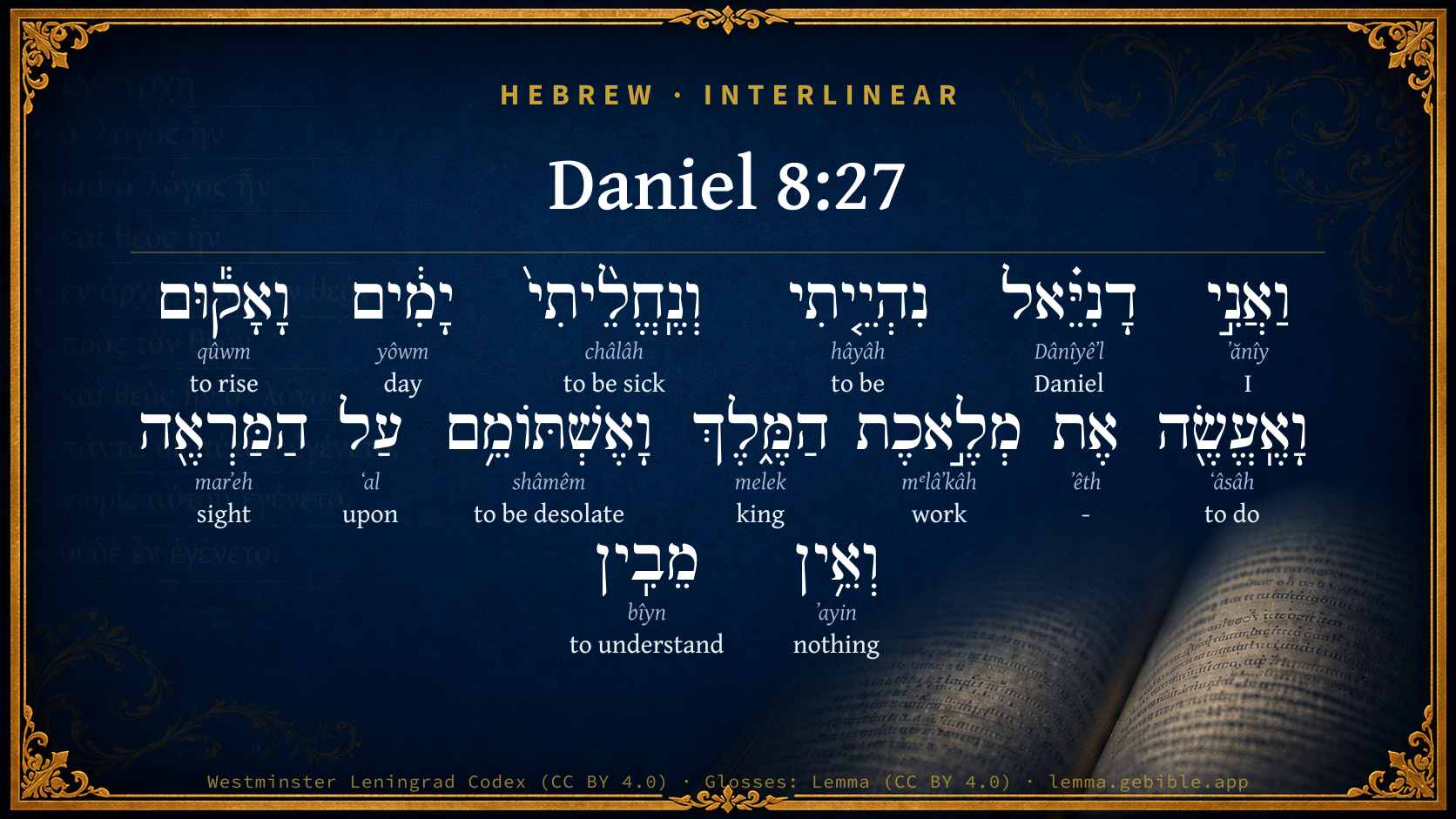
Daniel 8:27

Hebrew (Westminster Leningrad Codex) Daniel 8:27 appears in the Hebrew Old Testament. The text above is from the Westminster Leningrad Codex. Each word links to its Strong’s number, a concise gloss, and parsing drawn from the Open Scriptures Hebrew Bible morphology. Click any word for its full Brown-Driver-Briggs (BDB) entry.
Download image
Cite this verse

Daniel 8:27 (World English Bible). Public Domain. Lemma interlinear Bible study tool, https://lemma.gebible.app/v/daniel/8/27.

Show BibTeX & RIS
BibTeX
RIS
English Translation
I, Daniel, fainted, and was sick certain days; then I rose up, and did the king's business: and I wondered at the vision, but none understood it.
World English Bible · Public Domain
Download a study sheet

One document with this verse’s original text, its word-by-word gloss line, the meaning frame, cross-references with their text, attributed commentary, and full source and license credits — printable, and it pastes into notes with its structure intact.

This verse Autodidact and up

Study sheet (.html) Plain text (.txt)

A passage Seminary Student

Up to 50 verses in one chapter. A passage sheet keeps up to 6 commentary sources and 12 cross-references per verse, in the order this page ranks them, and says so on the sheet whenever that leaves anything out. Ask for a single verse and you get the Autodidact verse sheet above.

Everything on this page stays free to read, with no account — the sheet is a download of what is already on screen, not access to it.

Want to remove ads? Support Godless Engineer
Compare translations 3

The same verse in 3 English versions, stacked beneath the original-language interlinear above. Click any original word for its lexicon entry.

Each is an independent rendering of the whole verse — the interlinear is not word-aligned to these translations.

Highlighted words mark where these versions differ — a whole-verse word diff, not a word-by-word alignment.

  • World English Bible Public Domain
    I, Daniel, fainted, and was sick certain days; then I rose up, and did the king's business: and I wondered at the vision, but none understood it.
  • King James Version Public Domain
    And I Daniel fainted, and was sick certain days; afterward I rose up, and did the king's business; and I was astonished at the vision, but none understood it.
  • unfoldingWord Literal Text CC BY-SA 4.0
    Then I, Daniel, was overcome and lay sick for days. Then I got up, and went about the business of the king. But I was appalled by the vision, and there was no one to explain it.

unfoldingWord Literal Text — © unfoldingWord, licensed CC BY-SA 4.0. Word-aligned USFM3 via Door43 (git.door43.org/unfoldingWord/en_ult).

Versions to compare (up to 4)

3 of 4 selected

Show all 18 translations

Every available English version of this verse, each an independent rendering of the whole verse.

  • World English Bible Public Domain
    I, Daniel, fainted, and was sick certain days; then I rose up, and did the king's business: and I wondered at the vision, but none understood it.
  • Berean Standard Bible Public Domain
    I, Daniel, was exhausted and lay ill for days. Then I got up and went about the king’s business. I was confounded by the vision; it was beyond understanding.
  • Majority Standard Bible Public Domain
    I, Daniel, was exhausted and lay ill for days. Then I got up and went about the king’s business. I was confounded by the vision; it was beyond understanding.
  • King James Version Public Domain
    And I Daniel fainted, and was sick certain days; afterward I rose up, and did the king's business; and I was astonished at the vision, but none understood it.
  • American Standard Version (1901) Public Domain
    And I, Daniel, fainted, and was sick certain days; then I rose up, and did the king's business: and I wondered at the vision, but none understood it.
  • Revised Version (1885) Public Domain
    And I Daniel fainted, and was sick certain days; then I rose up, and did the king’s business: and I was astonished at the vision, but none understood it.
  • Geneva Bible (1599) Public Domain
    And I Daniel was striken and sicke certaine dayes: but when I rose vp, I did the Kings busines, and I was astonished at the vision, but none vnderstood it.
  • Douay-Rheims (1899) Public Domain
    And I Daniel languished, and was sick for some days: and when I was risen up, I did the king's business, and I was astonished at the vision, and there was none that could interpret it.
  • Young's Literal Translation Public Domain
    And I, Daniel, have been, yea, I became sick `for' days, and I rise, and do the king's work, and am astonished at the appearance, and there is none understanding.
  • Literal Standard Version CC BY-SA 4.0
    And I, Daniel, have been, indeed, I became sick [for] days, and I rise, and do the king’s work, and am astonished at the appearance, and there is none understanding.”
  • Unlocked Literal Bible CC BY-SA 4.0
    Then I, Daniel, was overcome and lay weak for several days. Then I got up, and went about the king's business. But I was appalled by the vision, and there was no one who understood it.
  • unfoldingWord Literal Text CC BY-SA 4.0
    Then I, Daniel, was overcome and lay sick for days. Then I got up, and went about the business of the king. But I was appalled by the vision, and there was no one to explain it.
  • Darby Bible Public Domain
    And I Daniel fainted, and was sick [certain] days: then I rose up, and did the king's business. And I was astonished at the vision, but none understood [it].
  • World Messianic Bible Public Domain
    I, Daniel, fainted, and was sick for some days. Then I rose up and did the king’s business. I wondered at the vision, but no one understood it.
  • Webster's Bible Public Domain
    And I Daniel fainted, and was sick certain days; afterward I rose, and did the king's business; and I was astonished at the vision, but none understood it.
  • Free Bible Version CC BY-SA 4.0
    After this, I, Daniel, became exhausted, and I was sick for days. Then I got up and went back to working for the king, but I was devastated at what I'd seen in vision and I couldn't understand it.
  • Bible in Basic English Public Domain
    And I, Daniel, was ill for some days; then I got up and did the king's business: and I was full of wonder at the vision, but no one was able to give the sense of it.
  • JPS Tanakh (1917) Public Domain
    And I Daniel fainted, and was sick certain days; then I rose up, and did the king's business; and I was appalled at the vision, but understood it not.

Literal Standard Version (2020), Covenant Press — licensed CC BY-SA 4.0. Text via the HelloAO Bible API (eBible.org). Unlocked Literal Bible (unfoldingWord) — licensed CC BY-SA 4.0. Text via the HelloAO Bible API (eBible.org). unfoldingWord Literal Text — © unfoldingWord, licensed CC BY-SA 4.0. Word-aligned USFM3 via Door43 (git.door43.org/unfoldingWord/en_ult). Free Bible Version, Dr. Jonathan Gallagher — licensed CC BY-SA 4.0. Text via the HelloAO Bible API (eBible.org).

Word by word

More ways to search: Search by grammar → Find every occurrence → Compare this word →

Practice this passage: Drill this verse → Learn its vocabulary →

דָנִיֵּ֗אל
Dânîyêʼl
H1840
“Daniel”
Noun, Proper
Part of Speech
Noun
Type
Proper
Full BDB Definition

Origin: from H1835 and H410

TWOT: None

Daniel = "God is my judge" - the 2nd son of David, by Abigail the Carmelitess - the 4th of the greater prophets, taken as hostage in the first deportation to Babylon, because of the gift of God of the interpretation of dreams, he became the 2nd in command of the Babylon empire and lasted through the end of the Babylonian empire and into the Persian empire. His prophecies are the key to the understanding of end time events. Noted for his purity and holiness by contemporary prophet, Ezekiel - a priest of the line of Ithamar who sealed the covenant with Nehemiah
  1. וַאֲנִ֣י ʼănîy H589 “and · I” Conjunction + Pronoun, Personal, 1st Person, Common, Singular
  2. נִהְיֵ֤יתִי hâyâh H1961 “to be” Verb, Niphal, Perfect, 1st Person, Common, Singular
  3. וְנֶֽחֱלֵ֨יתִי֙ châlâh H2470 “and · to be sick” Conjunction + Verb, Niphal, Perfect, 1st Person, Common, Singular
  4. יָמִ֔ים yôwm H3117 “days” Noun, Common, Masculine, Plural, Absolute
  5. וָאָק֕וּם qûwm H6965 “and · to rise” Conjunction + Verb, Qal, Sequential Imperfect, 1st Person, Common, Singular
  6. וָאֶֽעֱשֶׂ֖ה ʻâsâh H6213 “and · to do” Conjunction + Verb, Qal, Sequential Imperfect, 1st Person, Common, Singular
  7. אֶת ʼêth H853 “-” Particle, Direct Object
  8. מְלֶ֣אכֶת mᵉlâʼkâh H4399 “work of” Noun, Common, Feminine, Singular, Construct
  9. הַמֶּ֑לֶךְ melek H4428 “the · king” Particle, Definite Article + Noun, Common, Masculine, Singular, Absolute
  10. וָאֶשְׁתּוֹמֵ֥ם shâmêm H8074 “and · to be desolate” Conjunction + Verb, Hithpolel, Sequential Imperfect, 1st Person, Common, Singular
  11. עַל ʻal H5921 “upon” Preposition
  12. הַמַּרְאֶ֖ה marʼeh H4758 “the · sight” Particle, Definite Article + Noun, Common, Masculine, Singular, Absolute
  13. וְאֵ֥ין ʼayin H369 “and · nothing” Conjunction + Particle, Negative
  14. מֵבִֽין bîyn H995 “understanding” Verb, Hiphil, Participle Active, Masculine, Singular, Absolute

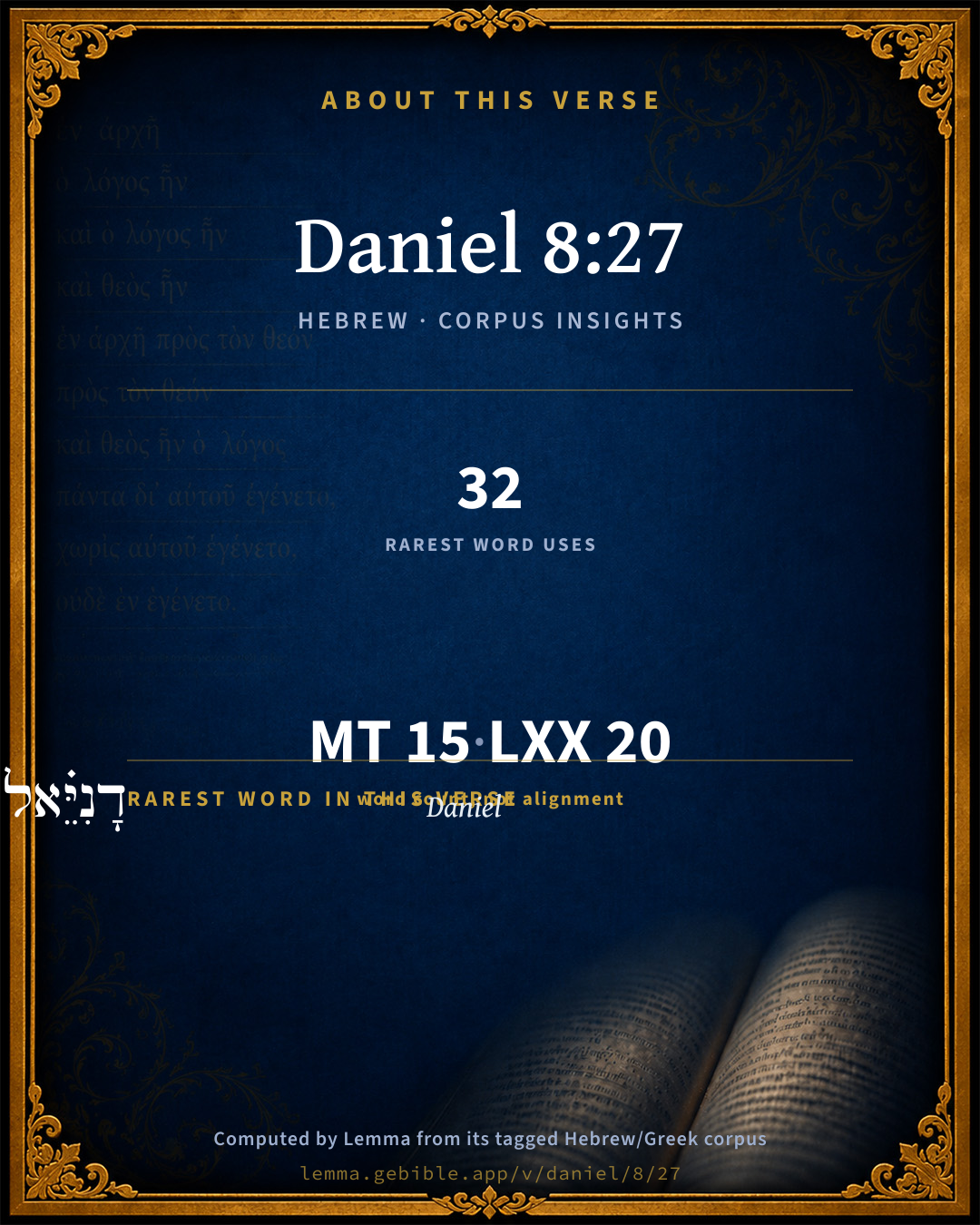
About this verse

These counts appear in no published source. They are computed here, from the morphology-tagged text and Lemma’s own curated glosses. What Lemma adds →

15
words
15
distinct lemmas
Prophets
section

Shared distinctive vocabulary

דָנִיֵּ֗אל Daniel H1840 occurs in 28 verses of the Hebrew Bible. Also found in:

Grammatical profile

  • 6 verbs
  • 5 nouns
  • 1 pronoun
  • 1 preposition
  • 2 particles

Verb forms

  • נִהְיֵ֤יתִי Niphal · Perfect
  • וְנֶֽחֱלֵ֨יתִי֙ Niphal · Perfect
  • וָאָק֕וּם Qal · Sequential Imperfect
  • וָאֶֽעֱשֶׂ֖ה Qal · Sequential Imperfect
  • וָאֶשְׁתּוֹמֵ֥ם Hithpolel · Sequential Imperfect
  • מֵבִֽין Hiphil · Participle Active

Hebrew & Septuagint length

In English translation the verse runs 27 words from the Hebrew and 29 from the Septuagint (LXX English) — closely comparable.

A rough comparison of the two English renderings, which tokenize alike — not a word-level alignment.

Word counts can differ between the Hebrew and the Greek without any difference in meaning — e.g. the Hebrew direct-object marker אֵת has no separate Greek word, and Greek often adds the article ὁ.

In the original languages it is 15 Hebrew tokens and 20 Greek tokens — but the two are counted differently (Hebrew bundles its prefixes and suffixes into one token; the Greek is in lemma form), so that isn’t a like-for-like length.

Cross-references

10

Topical passages linked to Daniel 8:27 in the Treasury of Scripture Knowledge — connected by theme and wording, ordered by reader-vote popularity; previews shown in the World English Bible.

  • Daniel 7:28 Here is the end of the matter. As for me, Daniel, my thoughts much troubled me, and my face was changed in me: but I kept the matter in my heart.
  • Habakkuk 3:16 I heard, and my body trembled. My lips quivered at the voice. Rottenness enters into my bones, and I tremble in my place, Because I must wait quietly for the day of trouble, For the coming up of the people who invade us.
  • 1 Samuel 3:15 Samuel lay until the morning, and opened the doors of the house of Yahweh. Samuel feared to show Eli the vision.
  • Daniel 2:48–49 Then the king made Daniel great, and gave him many great gifts, and made him to rule over the whole province of Babylon, and to be chief governor over all the wise men of Babylon.
  • Daniel 5:14 I have heard of you, that the spirit of the gods is in you, and that light and understanding and excellent wisdom are found in you.
  • Daniel 6:2–3 and over them three presidents, of whom Daniel was one; that these satraps might give account to them, and that the king should have no damage.
  • Daniel 8:2 I saw in the vision; now it was so, that when I saw, I was in Shushan the palace, which is in the province of Elam; and I saw in the vision, and I was by the river Ulai.
  • Daniel 8:7 I saw him come close to the ram, and he was moved with anger against him, and struck the ram, and broke his two horns; and there was no power in the ram to stand before him; but he cast him down to the ground, and trampled on him; and there was none who could deliver the ram out of his hand.
  • Daniel 10:8 So I was left alone, and saw this great vision, and there remained no strength in me; for my comeliness was turned in me into corruption, and I retained no strength.
  • Daniel 10:16 Behold, one in the likeness of the sons of men touched my lips: then I opened my mouth, and spoke and said to him who stood before me, my lord, by reason of the vision my sorrows are turned on me, and I retain no strength.

Cross-references courtesy of OpenBible.info (CC BY 4.0).

Hebrew and Greek witnesses Masoretic Hebrew ↔ Greek Septuagint

The same verse in the two great witnesses to the Old Testament, shown verse-for-verse.

These are two independent witnesses, not word-aligned to each other, and the Septuagint is shown in lemma (dictionary) form.

Hebrew Daniel 8:27 Masoretic · Westminster Leningrad Codex

וַאֲנִ֣י דָנִיֵּ֗אל נִהְיֵ֤יתִי וְנֶֽחֱלֵ֨יתִי֙ יָמִ֔ים וָאָק֕וּם וָאֶֽעֱשֶׂ֖ה אֶת מְלֶ֣אכֶת הַמֶּ֑לֶךְ וָאֶשְׁתּוֹמֵ֥ם עַל הַמַּרְאֶ֖ה וְאֵ֥ין מֵבִֽין

I, Daniel, fainted, and was sick certain days; then I rose up, and did the king's business: and I wondered at the vision, but none understood it.

World English Bible · Public Domain

Greek LXX Daniel 8:27 Septuagint · lemma form

ἐγώ δανιηλ ἀσθενέω ἡμέρα πολύς καί ἀναἵστημι πραγματεύομαι πάλιν βασιλικός καί ἐκλύω ἐπί ὁ ὅραμα καί οὐδείς εἰμί ὁ διανοέομαι

And I Daniel fell asleep, and was sick: then I arose, and did the king's business; and I wondered at the vision, and there was none that understood it.

LXX2012 (modern English Septuagint) · Public Domain

On this verse, The Pulpit Commentary discusses the Septuagint’s reading. Read the note in Commentary ↓

Hebrew: Westminster Leningrad Codex (CC BY 4.0). Greek: Septuagint (public domain); English from LXX2012 (modern English Septuagint) (Public Domain). How the Septuagint differs from the Hebrew →

Commentary

Notes on Daniel 8:27 from classic Christian and Jewish commentators (each source and its license shown beneath its notes). The classic Christian expositions comment on the surrounding passage and are grouped to its opening verse, so a note may address several verses; the Jewish commentaries on the Tanakh (Rashi and others) are per-verse, so they appear only where the commentator wrote on this verse.

Lemma curates 59 commentaries, every one of them public domain or Creative Commons licensed, each selected and text-cleaned for this edition rather than reprinted as found. About our sources →

Trapp's Complete Commentary

John Trapp

Dan 8:27 And I Daniel fainted, and was sick [certain] days; afterward I rose up, and did the king’s business; and I was astonished at the vision, but none understood [it].

Ver. 27. And I Daniel fainted, and was sick.] So deeply affected was he with the vision, and should we be with the word preached; it should work upon our very bowels, and go to the hearts of us. {Jer 4:19 Act 2:37}

Afterwards I rose up, and did the king’s business.] viz., King Belshazzar’s, with whom, though he was out of grace, yet not out of office under him, and will not therefore be indiligent. Malo mihi male esse, quam molliter, {a} Let us not neglect the work of the Lord, though less able to perform it. A sick child’s service is doubly accepted.

But none understood it.] Daniel disguised his sorrow for Zion before scorners. {Est 5:1} Taciturnity is no contemptible virtue.

{a} Seneca.

John Trapp, A Commentary or Exposition upon All the Books of the Old and New Testament (1647–1656) — public domain. Text from a community e-Sword module.

Joseph Benson's Commentary

Dan 8:27. And I Daniel fainted — Rather, languished, or pined, being overwhelmed with grief at the calamities which I learned by the vision were to come upon my countrymen, and also for the profanation of the temple in those days. And I was astonished at the vision, but none understood it — The meaning of this clause seems to be, that though Daniel was greatly troubled at this vision, even after he rose and went about the king’s business, yet he took care to conceal it, so that none might take notice of it.

In the explication of this vision, the usurpations of Antiochus have been referred to, for the primary sense of the ravages committed by the little horn; yet, at the same time, it has been hinted, that there are some strong features in the vision, which favour the opinion of those who refer it to later times, particularly to the rule and dominion of antichrist. “I am of opinion,” says Mr. Wintle, “that, in the spirit of prophecy, both applications were meant to be comprehended; and I see no reason for not extending the prophetic visions, or revelations, to events, to which, by the rules of fair and just interpretation, they shall be found applicable. The only sure way of knowing the meaning of a prophecy is, by comparing it with the accomplishment; and if successions of events shall, in more than one instance, be found to agree, and square exactly with a single series of predicted circumstances, I should be inclined to make the improvement as extensive as may be, consistently with truth and justice; and to acknowledge the wisdom and prescience of the Divine Contriver, who is acquainted with all his works from the foundation of the world, and who could adapt human language, in one form, to such an admirable variety of purposes, thus making his own strength perfect in weakness.”

Joseph Benson's Commentary on the Old and New Testaments (1811–1818) — public domain. Text from a community e-Sword module.

Geneva Bible (1599)

Geneva Bible translators

For fear and astonishment.

Geneva Bible (1599) marginal notes — public domain. Text via Bolls.life.

Jamieson, Fausset & Brown

Robert Jamieson, A. R. Fausset & David Brown

I . . . was sick--through grief at the calamities coming on my people and the Church of God (compare Psa 102:14).

afterward I . . . did the king's business--He who holds nearest communion with heaven can best discharge the duties of common life.

none understood it--He had heard of kings, but knew not their names; He foresaw the events, but not the time when they were to take place; thereupon he could only feel "astonished," and leave all with the omniscient God [JEROME].

The world powers here recede from view; Israel, and the salvation by Messiah promised to it, are the subject of revelation. Israel had naturally expected salvation at the end of the captivity. Daniel is therefore told, that, after the seventy years of the captivity, seventy times seven must elapse, and that even then Messiah would not come in glory as the Jews might through misunderstanding expect from the earlier prophets, but by dying would put away sin. This ninth chapter (Messianic prophecy) stands between the two visions of the Old Testament Antichrist, to comfort "the wise." In the interval between Antiochus and Christ, no further revelation was needed; therefore, as in the first part of the book, so in the second, Christ and Antichrist in connection are the theme.

Next: Daniel Chapter 9

Jamieson, Fausset & Brown — Commentary Critical and Explanatory on the Whole Bible (1871) — public domain (CC PDM 1.0). Text via the HelloAO Bible API.

Adam Clarke's Commentary

Verse 27. Daniel fainted] To foresee the desolations that were coming on the land, the city, the temple, and the people.

Did the king's business] Transacted the affairs of state that belonged to my department, after having been sick for certain days through the effects of this vision. He had a pious and feeling heart; and he was distressed for the desolations that were coming upon his people.

Adam Clarke's Commentary on the Bible (1810–1826) — public domain. Text from a community e-Sword/MySword module.

John Calvin's Commentaries

Again, Daniel shews himself to have been so touched with the secret instinct of God, that he knew for certain this vision to have been divinely presented to him. For God wished so to affect his servant, that he might embrace with greater reverence what he both heard and saw. I have already referred to our want of attention in listening to God’s word as it deserves unless some kind of fear precedes it which may rouse our minds by some means from their torpor; but this prophecy had a special intention. In an ordinary case, God did not humble his servant; but by the disease which is here mentioned, he wishes to show how this prediction related to some event of serious magnitude. Daniel, therefore, states himself to have been astonished, as if suffering under some defect, and afflicted by disease This disease did not happen to the Prophet naturally, but it fell upon him in consequence of his being suddenly terrified. And he afterwards shews this, by saying, no one understood the prediction. Here, then, he admonishes all the pious, neither to hear nor read this narrative with carelessness, but to summon up their utmost attention, and to perceive that God here shews them things of the greatest importance, and which vitally concern their salvation. This forms a reason why Daniel ought to suffer dejection and to be afflicted by disease. He next says, he returned to the king’s business, meaning his ordinary occupation. We infer from this expression, the grievous error of those who think him to have been in Persia at this period, because he could not return to his duties, unless he were present in the king’s palace. But why is this added? To assure us that the Prophet was not drawn off from the duties which the king had assigned to him, although God had chosen him to perform the peculiar office of Prophet and teacher of his Church. This is a rare instance, and ought not to be drawn into a precedent, according to the usual phrase. Which of us, for instance, would be sufficient for those duties of political government assigned to Daniel, and also for those incumbent upon a pastor and teacher? But God made use of his servant Daniel in an extraordinary way, because he had many reasons for wishing him occupied in the king’s palace. We have previously seen how God’s glory was illustrated by his position, for Daniel admonished Belshazzar of his approaching death, when his enemies had already partially captured the city. And the utility of this was proved by Cyrus and Darius sparing the Jews. As long as the Chaldeans held the supreme power, Daniel was of no slight benefit to those miserable exiles; for even if he lived under cruel tyrants, yet he had some authority remaining, and this enabled him to alleviate many of the sufferings of his nation. God, therefore, was consulting the advantage of the whole people, when he desired Daniel to proceed in the course of his usual duties. Besides this, he wished to confer upon him the extraordinary gift of prophecy, an endowment, as I have said, peculiar to Daniel. It now follows, —

John Calvin's Commentaries (1540-1563) — public domain. Text from the Calvin Translation Society English edition (1840s-50s) via the Christian Classics Ethereal Library (ccel.org). Calvin's coverage is partial (roughly two-thirds of the Bible); uncommented books and verses are honest gaps, never fabricated. The 19th-century editor's footnotes and remarks are omitted so the notes are faithfully Calvin's own voice.

The Cambridge Bible for Schools and Colleges

gen. ed. J. J. S. Perowne

27. fainted] The expression is peculiar: if correct, it must mean I was done with, exhausted, the verb being the same that is used in Dan_2:1 in the passage ‘his sleep was done with upon him.’ It does not occur in this sense elsewhere in the O. T.

for (some) days] so Gen_40:4 (A.V., R.V., ‘a season’); Neh_1:4.

rose up] from his bed of sickness, as Psa_41:8.

the king’s business] what business is not stated; nor can we be sure (cf. Dan_5:13) that the writer pictured him as still holding the office to which Nebuchadnezzar had appointed him some 60 years previously (Dan_2:48). For the expression, cf. Est_9:3.

was astonished] cf. on Dan_4:19.

but none understood it] The expression is strange, and difficult to reconcile with what has preceded: if the vision was to be ‘shut up,’ the remark that no one understood it would seem to be superfluous. Perhaps ‘none’ may be used as in Dan_8:5; and Daniel himself may be really meant (cf. Dan_12:8): the meaning will then be that, though the vision had been partly explained to him, he did not understand it fully: Dan_8:23-25 are, for instance, expressed enigmatically, and without any name being given (Hitz., Bevan). Other renderings are, but no one perceived it (cf. 1Sa_3:8 Heb.), i.e. no one perceived that Daniel had had a vision, or of what nature it was (Meinh.); or but no one gave heed (cf. Isa_57:1 Heb.; A.V. ‘considering’), viz. to Daniel’s astonishment (Behrm.).

The Cambridge Bible for Schools and Colleges (gen. ed. J. J. S. Perowne; Cambridge University Press, 1878–1918) — public domain. Text from a community e-Sword module.

John Gill's Exposition

And I Daniel fainted and was sick certain days,.... Or, "then I Daniel fainted" (x); after he had seen the vision, and had thought upon it, and considered the afflictions that were to come upon the people of God, and the condition the temple, and the worship of it, would be in; these so affected his mind, that he not only fainted away, and was struck with a kind of stupor and amazement, but had a fit of illness upon him, which continued some days; such a nearness and sympathy there are between the soul and body:

afterwards I rose up; from the bed in which he had laid some days ill:

and did the king's business; by which it appears, that, upon the death of Nebuchadnezzar, Daniel was as yet continued in the service of the king of Babylon, though perhaps not in the same posts as before, and was not a favourite at court, and so much known as he had been; and also that he was not in reality at Shushan, when he had this vision, but at Babylon:

and I was astonished at the vision; at the things contained in it, which were of so much importance, respecting the kingdoms of the earth, especially the Persian and Grecian empires, and the state of his own people the Jews:

but none understood it: to whom he showed it; none but himself, who was made to understand it by the angel, Dan 8:16.

(x) So Noldius, Concord. Ebr. Part. p. 309.

Next: Daniel Chapter 9

John Gill's Exposition of the Whole Bible (1746–1763) — public domain (CC PDM 1.0). Text via the HelloAO Bible API.

Albert Barnes' Notes on the Bible

And I Daniel fainted - Hebrew, “I was “ - נהייתי nı̂heyēythı̂y. Compare Dan 2:1. The meaning, according to Gesenius (“Lexicon”), is, “I was done up, and was sick:” - I was done over, etc. Perhaps the “reason” of his using this verb here is, that he represents himself as “having been sick,” and then as fainting away, as if his life had departed. The Latin Vulgate renders it langui. Theodotion, ἐκοιμήθην ekoimēthēn - “ was laid in my bed.” The general idea is plain, that he was overcome and prostrate at the effect of the vision. He had been permitted to look into the future, and the scenes were so appalling - the changes that were to occur were so great - the calamities were so fearful in their character - and, above all, his mind was so affected that the daily sacrifice was to cease, and the worship of God be suspended, that he was entirely overcome. And who of us, probably, could “bear” a revelation of what is to occur hereafter? Where is there strength that could endure the disclosure of what may happen even in a few years?

And was sick certain days - The exact time is not specified. The natural interpretation is, that it was for a considerable period.

Afterward I rose up, and did the king’s business - Compare the notes at Dan 8:2. From this it would appear that he had been sent to Shushan on some business pertaining to the government. What it was we are not informed. As a matter of fact, he was sent there for a more important purpose than any which pertained to the government at Babylon - to receive disclosure of most momentous events that were to occur in distant times. Yet this did not prevent him from attending faithfully to the business entrusted to him - as no views which we take of heavenly things, and no disclosures made to our souls, and no absorption in the duties and enjoyments of religion, should prevent us from attending with fidelity to whatever secular duties may be entrusted to us. Sickness justifies us, of course, in not attending to them; the highest views which we may have of God and of religious truth should only make us more faithful in the discharge of our duties to our fellow-men, to our country, and in all the relations of life. He who has been favored with the clearest views of Divine things will be none the less prepared to discharge with faithfulness the duties of this life; he who is permitted and enabled to look far into the future will be none the less likely to be diligent, faithful, and laborious in meeting the responsibilites of the present moment. If a man could see all that there is in heaven, it would only serve to impress him with a deeper conviction of his obligations in every relation; if he could see all that there is to come in the vast eternity before him, it would only impress him with a profounder sense of the consequences which may follow from the discharge of the present duty.

And I was astonished at the vision - He was stupified - he was overcome - at the splendid appearance, and the momentous nature of the disclosures. Compare the notes at Dan 4:19.

But none understood it - It would seem probable from this, that he communicated it to others, but no one was able to explain it. Its general features were plain, but no one could follow out the details, and tell “precisely” what would occur, before the vision was fulfilled. This is the general nature of prophecy; and if neither Daniel nor any of his friends could explain this vision in detail, are we to hope that we shall be successful in disclosing the full meaning of those which are not yet fulfilled? The truth is, that in all such revelations of the future, there must be much in detail which is not now fully understood. The general features may be plain - as, in this case, it was clear that a mighty king would rise; that he would be a tyrant; that he would oppress the people of God; that he would invade the holy land; that he would for a time put a period to the offering of the daily sacrifice; and that this would continue for a definite period; and that then he would be cut off without human instrumentality: but who from this would have been able to draw out, in detail, all the events which in fact occurred? Who could have told precisely how these things would come to pass? Who could have ventured on a biography of Antiochus Epiphanes? Yet these three things are true in regard to this:

(1) That no one by human sagacity could have foreseen these events so as to have been able to furnish these sketches of what was to be;

(2) That these were sufficient to apprise those who were interested particularly of what would occur; and

(3) That when these events occurred, it was plain to all persons that the prophecy had reference to them.

So plain is this - so clear is the application of the predictions in this book, that Porphyry maintained that it was written after the events had occurred, and that the book must have been forged.

Albert Barnes' Notes on the Bible (1834–1885) — public domain. Text from a community e-Sword/MySword module.

Haydock's Catholic Bible Commentary

Business, at Susa. Nabuchodonosor had given him the province of Babylon. --- It. All prophecies have a degree of obscurity before they be accomplished. Hebrew may intimate that none could tell the cause of his anxiety. (Calmet)

George Leo Haydock (1774–1849), Haydock's Catholic Family Bible and Commentary, 1859 edition — public domain. Excludes Psalms (Douay-Rheims chapter numbering differs from Protestant) and Deuterocanonical books (Catholic canon only).

Matthew Poole's English Annotations

Was sick certain days; greatly afflicted, to consider the sad calamity that should befall the poor people of God. This he did in compassion and sympathy with his people, upon whom these sufferings should fall.

2. Under the dreadful apprehensions of God’s wrath, provoked by his people’s sins, which made it an act of justice in God to punish them thus severely.

3. That Daniel should not be lifted up with this vision and revelation.

4. That hereby Daniel might be in a due frame of humiliation and posture for prayer.

5. To show the powerful operations and impressions of the mind upon the bodies of men by the passions chiefly of fear and grief, causing often faintings, and consternation, which appear most in thoughtful, good men, whereof are many instances in Scripture, Hab 3:16; Rom 9:1-3. Having digested his grief, and recovered strength, he minded his place, duty, and trust, and concealed the whole, that they might not see it by his countenance; though he had deep thoughts of heart about it.

Matthew Poole's English Annotations on the Holy Bible (1683–1685) — public domain. Text from a community e-Sword/MySword module.

Whedon's Commentary on the Bible

Daniel D. Whedon

27. Sick — Sickness is no proof of God’s displeasure. It may be the result of highest spiritual revelations. He whom God loved most, even the “Man of sorrows,” was “made perfect through suffering” (Heb_2:10; Heb_5:8).

None understood it — Probably (against Behrmann), I was no understander thereof, or (R.V., margin) “there was none to make it understood.”

Daniel D. Whedon (gen. ed.), Commentary on the Old and New Testaments (1874–1909) — public domain. Text from a community e-Sword module.

The Pulpit Commentary

And I Daniel fainted, and was sick certain days; afterward I rose up, and did the king"s business; and I was astonished at the vision, but none understood it. The Septuagint omits "fainted," but otherwise agrees with the above. Theodotion evidently has lind the Massoretic text before him; but he has not understood, and has slavishly rendered it word for word. The Peshitta represents also a text practically identical with that of the Massoretes. Jerome also agrees with the received text; he renders the last clause, non erat qui interpretaretur. That Daniel should faint, and remain sick for days days," says the LXX is quite in accordance with what we might imagine to be the natural effect of intercourse with the spiritual world. The mental strain and the intense excitement incident upon such an occurrence would necessarily produce a reaction. Afterward I rose up, and did the kings business. We have no distinct evidence of what the business was that took Daniel to Susa, if he was there in reality, and not merely in vision; but we may surmise that it was about the advance of Cyrus Elam and Media were both embraced in the dominion of Cyrus very early. Cyrus had overthrown the Umman-Manda, and delivered Babylon. At that time there seems to have been somewhat of a rapprochement between Nabu-nahid and Cyrus; but at the time before us, Cyrus must have begun to realize his destiny, and possibly would not be easy to on. at with. Daniel may have been plenipotentiary of Babylon at the court of Cyrus, endeavouring to secure a treaty. At the same time, aware that Croesus, the rival of Cyrus, might be called in, he continues the negotiation. I was astonished at the vision, but none understood it. The idea of the word translated "astonished" is "benumbed;" it may be exegetic of the first clause, explaining the cause of the fainting and subsequent sickness. It is clear that Daniel did not regard the command "to guard (satham) the vision" as implying that he should keep it secret. We see, as we said above, that his complaint is that no one understood the vision. Behrmann maintains that ybime (maybeen), "to understand," ought to be translated "marked," "observed," but dy; would be the natural verb to use in such a connection, not yb. Hitzig explains this by saying, "He had imparted the vision to no one." If Daniel had indulged in statements of float kind, the word before us would not have inaugurated a new form of literature. Professor Bevan"s interpretation is as farfetched, "And I was no understander thereof." The example he brings forward of ver. 5 is not to the purpose, because the distinction between the first person and the third is too great. Moses Stuart has the same view.

The effects of visions Divine.

I Daniel fainted," etc. We have here the effects of visions Divine

I ON THE BODY. Even the prophets were but men like ourselves. Daniel was utterly prostrated by this overpowering vision. Became ill for a long time. In our present state we can only bear so much.

II ON THE MIND. "I was astonished at the vision .... Arid there was none who understood it.

1. Fulfilled prophecy is an open book.

1. Unfulfilled, a book only partly open. There should, then, be:

1. Devout inquiry.

2. The glad acquisition of some knowledge. But:

3. No dogmatism.

Even a prophet, who had with his own eyes seen the glory, had to grope along the path of daily duty, with only the common dim and partial light.

III ON THE LIFE. "I rose up, and did the kings business. " These grand disclosures of things heavenly, of things future, of things Divine, to his soul; the high enjoyments of religion; only disposed him to be more faithful in meeting present obligations. There is no proper separation between deepest spirituality and the faithful plodding on the path of duty, which so much becomes us. "He who has been favoured with the clearest views of Divine things will be none the less prepared to discharge with faithfulness the duties of this life. He who is permitted and enabled to look into the future will be none the less likely to be diligent, faithful, laborious in meeting the responsibilities of the present moment. If a man could see all that there is in heaven, it would only serve to inspire him with a deeper conviction of his obligations in every relation. If he could see all that there is to come in the vast eternity before him, it would only inspire him with a profounder sense of the consequences which may follow from the discharge of the present duty. R.

The Pulpit Commentary (1880–1919), ed. H.D.M. Spence-Jones & Joseph S. Exell — public domain. Text from a community e-Sword module.

John Wesley's Explanatory Notes

Was sick - Being overwhelmed by a sense of the calamity that should befall the people of God. Did the king's business - Having recovered strength, he minded his place, duty and trust, and concealed the whole, that they might not see it by his countenance.

John Wesley, Explanatory Notes Upon the Whole Bible (1754–1765) — public domain. Text via the GEBible commentary corpus.

unfoldingWord translationNotes

Door43 World Missions Community

was overcome and lay weak for several days

"was exhausted and lay in bed sick for several days"

went about the king's business

"did the work that the king had assigned to me"

I was appalled by the vision

"I was dismayed by the vision" or "I was very confused by the vision"

translationWords

Daniel

king

unfoldingWord translationNotes — © Distant Shores Media and the Door43 World Missions Community, licensed CC BY-SA 4.0. Source: git.door43.org/Door43/en_tn.

Rashi

Rabbi Shlomo Yitzchaki (Rashi)

became broken Heb. נִהְיֵיתִי, an expression of calamity (הוָה) and breach; i.e., I was pained because of this trouble and I was depressed.

the king’s work for I was appointed over the assignment of the work of the government of Belshazzar’s kingdom, for Nebuchadnezzar his father had appointed him, as is written in the beginning of the Book (2:48): “...and gave him dominion over all the capital cities of Babylon.”

and I was terrified about the vision Heb. וָאֶשְׁתּוֹמֵם עַל הַמַרְאֶה.

but no one realized that I was terrified because I restrained myself before the princes.

Rashi on the Tanakh — English translations: “The Judaica Press complete Tanach with Rashi, translated by A. J. Rosenberg” (CC BY 4.0); “Pentateuch with Rashi's commentary by M. Rosenbaum and A.M. Silbermann, 1929-1934” (public domain); “The Metsudah Tanach series, Lakewood, N.J” (CC BY 4.0); and “The Book of Joshua, Metsudah Publications, 1997” (CC BY 4.0). Text via Sefaria.

Lesson kit

Teaching starters — assembled from the data on this page, not authored interpretation. Every prompt links to the verse data it draws on. Edit before teaching.

Daniel, in the Prophets, opens this verse with 15 words (15 distinct Hebrew lemmas). Its most distinctive word is Dânîyêʼl (“Daniel”). A historical commentator’s framing appears above. Read the whole chapter for the surrounding context.

Discussion questions

  1. How does “Daniel” (Dânîyêʼl) shape what this verse is saying?
  2. 1 Chronicles 3:1 shares the word «Daniel» with this verse. How do the two illuminate each other?
  3. These translations render this verse differently. What is at stake in choosing one wording over another?
  4. The verb «נִהְיֵ֤יתִי» is Niphal Perfect. How does its form color the action?
  5. Reading how Trapp's Complete Commentary and Joseph Benson's Commentary read this verse, where do the two commentators agree and where do they part?

Things to notice

Reading settings

Reading text

Shown beneath each verse's original-language words.

Old Testament
Old Testament edition

Read the OT as the Masoretic Hebrew (MT) or the Greek Septuagint (LXX).

English shown for the Greek Septuagint (in the Hebrew ↔ Greek comparison).

Comparing translations? Open the Compare panel on any verse page to stack up to four side by side.