
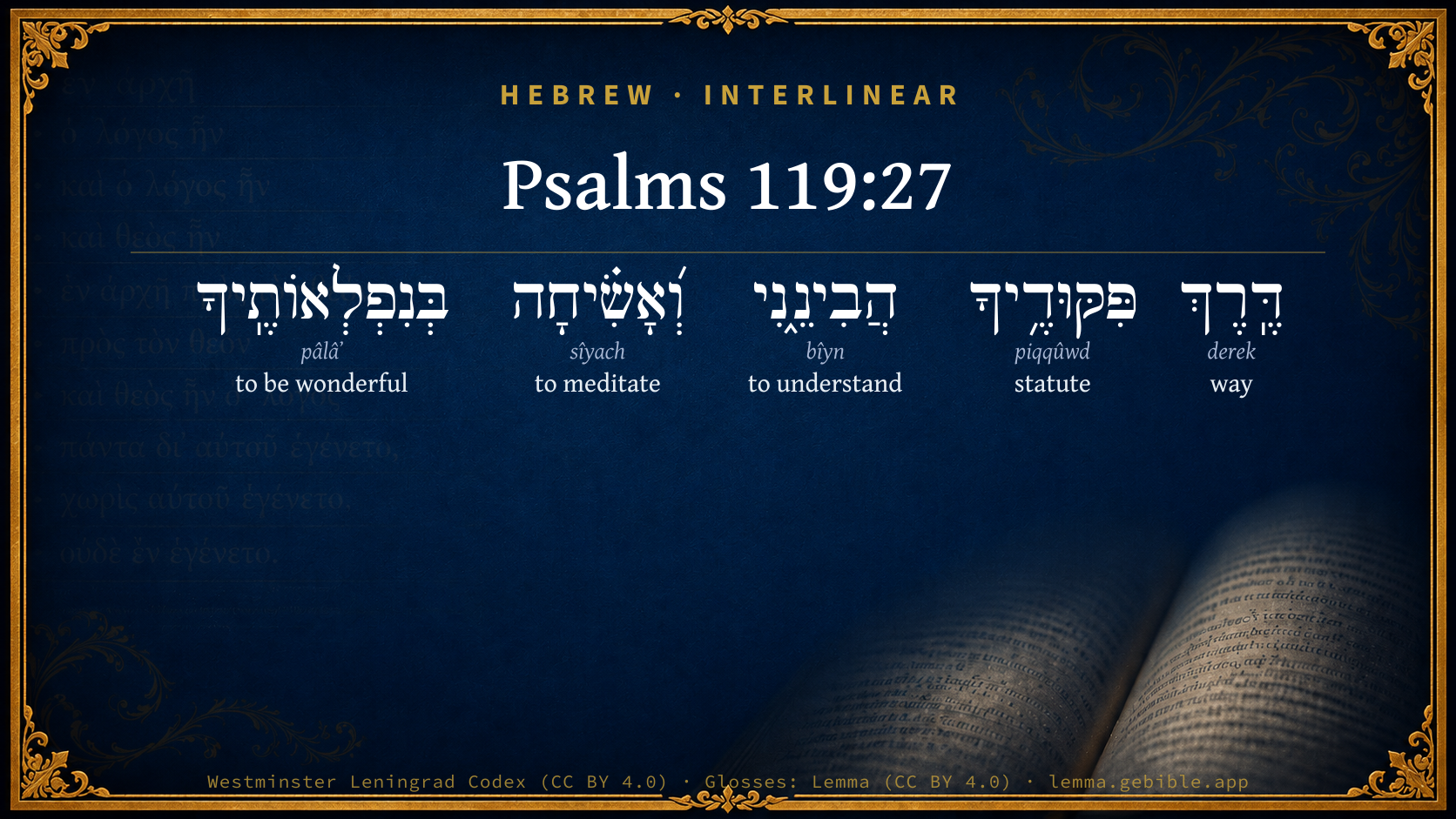
Psalms 119:27

Hebrew (Westminster Leningrad Codex) Psalms 119:27 appears in the Hebrew Old Testament. The text above is from the Westminster Leningrad Codex. Each word links to its Strong’s number, a concise gloss, and parsing drawn from the Open Scriptures Hebrew Bible morphology. Click any word for its full Brown-Driver-Briggs (BDB) entry.
Download image
Cite this verse

Psalms 119:27 (World English Bible). Public Domain. Lemma interlinear Bible study tool, https://lemma.gebible.app/v/psalms/119/27.

Show BibTeX & RIS
BibTeX
RIS
English Translation
Let me understand the teaching of your precepts! Then I will meditate on your wondrous works.
World English Bible · Public Domain
Download a study sheet

One document with this verse’s original text, its word-by-word gloss line, the meaning frame, cross-references with their text, attributed commentary, and full source and license credits — printable, and it pastes into notes with its structure intact.

This verse Autodidact and up

Study sheet (.html) Plain text (.txt)

A passage Seminary Student

Up to 50 verses in one chapter. A passage sheet keeps up to 6 commentary sources and 12 cross-references per verse, in the order this page ranks them, and says so on the sheet whenever that leaves anything out. Ask for a single verse and you get the Autodidact verse sheet above.

Everything on this page stays free to read, with no account — the sheet is a download of what is already on screen, not access to it.

Want to remove ads? Support Godless Engineer
Compare translations 3

The same verse in 3 English versions, stacked beneath the original-language interlinear above. Click any original word for its lexicon entry.

Each is an independent rendering of the whole verse — the interlinear is not word-aligned to these translations.

Highlighted words mark where these versions differ — a whole-verse word diff, not a word-by-word alignment.

  • World English Bible Public Domain
    Let me understand the teaching of your precepts! Then I will meditate on your wondrous works.
  • King James Version Public Domain
    Make me to understand the way of thy precepts: so shall I talk of thy wondrous works.
  • unfoldingWord Literal Text CC BY-SA 4.0
    Make me understand the way of your precepts, so that I can meditate on your wonders.

unfoldingWord Literal Text — © unfoldingWord, licensed CC BY-SA 4.0. Word-aligned USFM3 via Door43 (git.door43.org/unfoldingWord/en_ult).

Versions to compare (up to 4)

3 of 4 selected

Show all 17 translations

Every available English version of this verse, each an independent rendering of the whole verse.

  • World English Bible Public Domain
    Let me understand the teaching of your precepts! Then I will meditate on your wondrous works.
  • Berean Standard Bible Public Domain
    Make clear to me the way of Your precepts; then I will meditate on Your wonders.
  • Majority Standard Bible Public Domain
    Make clear to me the way of Your precepts; then I will meditate on Your wonders.
  • King James Version Public Domain
    Make me to understand the way of thy precepts: so shall I talk of thy wondrous works.
  • American Standard Version (1901) Public Domain
    Make me to understand the way of thy precepts: So shall I meditate on thy wondrous works.
  • Revised Version (1885) Public Domain
    Make me to understand the way of thy precepts: so shall I meditate of thy wondrous works.
  • Geneva Bible (1599) Public Domain
    Make me to vnderstand ye way of thy precepts, and I will meditate in thy wondrous workes.
  • Young's Literal Translation Public Domain
    The way of Thy precepts cause me to understand, And I meditate in Thy wonders.
  • Literal Standard Version CC BY-SA 4.0
    Cause me to understand the way of Your precepts, || And I meditate on Your wonders.
  • Unlocked Literal Bible CC BY-SA 4.0
    Make me understand the ways of your instructions, so that I can meditate on your wondrous teachings.
  • unfoldingWord Literal Text CC BY-SA 4.0
    Make me understand the way of your precepts, so that I can meditate on your wonders.
  • Darby Bible Public Domain
    Make me to understand the way of thy precepts, and I will meditate upon thy wondrous works.
  • World Messianic Bible Public Domain
    Let me understand the teaching of your precepts! Then I will meditate on your wondrous works.
  • Webster's Bible Public Domain
    Make me to understand the way of thy precepts: so shall I talk of thy wondrous works.
  • Free Bible Version CC BY-SA 4.0
    Help me understand what your laws mean, and I will meditate on the wonderful things you do.
  • Bible in Basic English Public Domain
    Make the way of your orders clear to me; then my thoughts will be ever on your wonders.
  • JPS Tanakh (1917) Public Domain
    Make me to understand the way of Thy precepts, that I may talk of Thy wondrous works.

Literal Standard Version (2020), Covenant Press — licensed CC BY-SA 4.0. Text via the HelloAO Bible API (eBible.org). Unlocked Literal Bible (unfoldingWord) — licensed CC BY-SA 4.0. Text via the HelloAO Bible API (eBible.org). unfoldingWord Literal Text — © unfoldingWord, licensed CC BY-SA 4.0. Word-aligned USFM3 via Door43 (git.door43.org/unfoldingWord/en_ult). Free Bible Version, Dr. Jonathan Gallagher — licensed CC BY-SA 4.0. Text via the HelloAO Bible API (eBible.org).

Word by word

More ways to search: Search by grammar → Find every occurrence → Compare this word →

Practice this passage: Drill this verse → Learn its vocabulary →

וְ֝אָשִׂ֗יחָה
sîyach
H7878
“and · to meditate”
Conjunction + Verb, Qal, Cohortative, 1st Person, Common, Singular
Part of Speech
Conjunction + Verb
Stem
Qal
Form
Cohortative
Person
1st Person
Gender
Common
Number
Singular
Full BDB Definition

Origin: a primitive root

TWOT: 2255

to put forth, mediate, muse, commune, speak, complain, ponder, sing - (Qal) - to complain - to muse, meditate upon, study, ponder - to talk, sing, speak - (Polel) to meditate, consider, put forth thoughts
  1. דֶּֽרֶךְ derek H1870 “way of” Noun, Common, Both, Singular, Construct
  2. פִּקּוּדֶ֥יךָ piqqûwd H6490 “statutes · your” Noun, Common, Masculine, Plural, Construct + Suffix, Personal, 2nd Person, Masculine, Singular
  3. הֲבִינֵ֑נִי bîyn H995 “understand · me” Verb, Hiphil, Imperative, 2nd Person, Masculine, Singular + Suffix, Personal, 1st Person, Common, Singular
  4. בְּנִפְלְאוֹתֶֽיךָ pâlâʼ H6381 “in/at · being wonderful · you” Preposition + Verb, Niphal, Participle Active, Feminine, Plural, Construct + Suffix, Personal, 2nd Person, Masculine, Singular

About this verse

These counts appear in no published source. They are computed here, from the morphology-tagged text and Lemma’s own curated glosses. What Lemma adds →

5
words
5
distinct lemmas
Wisdom
section

Notable vocabulary

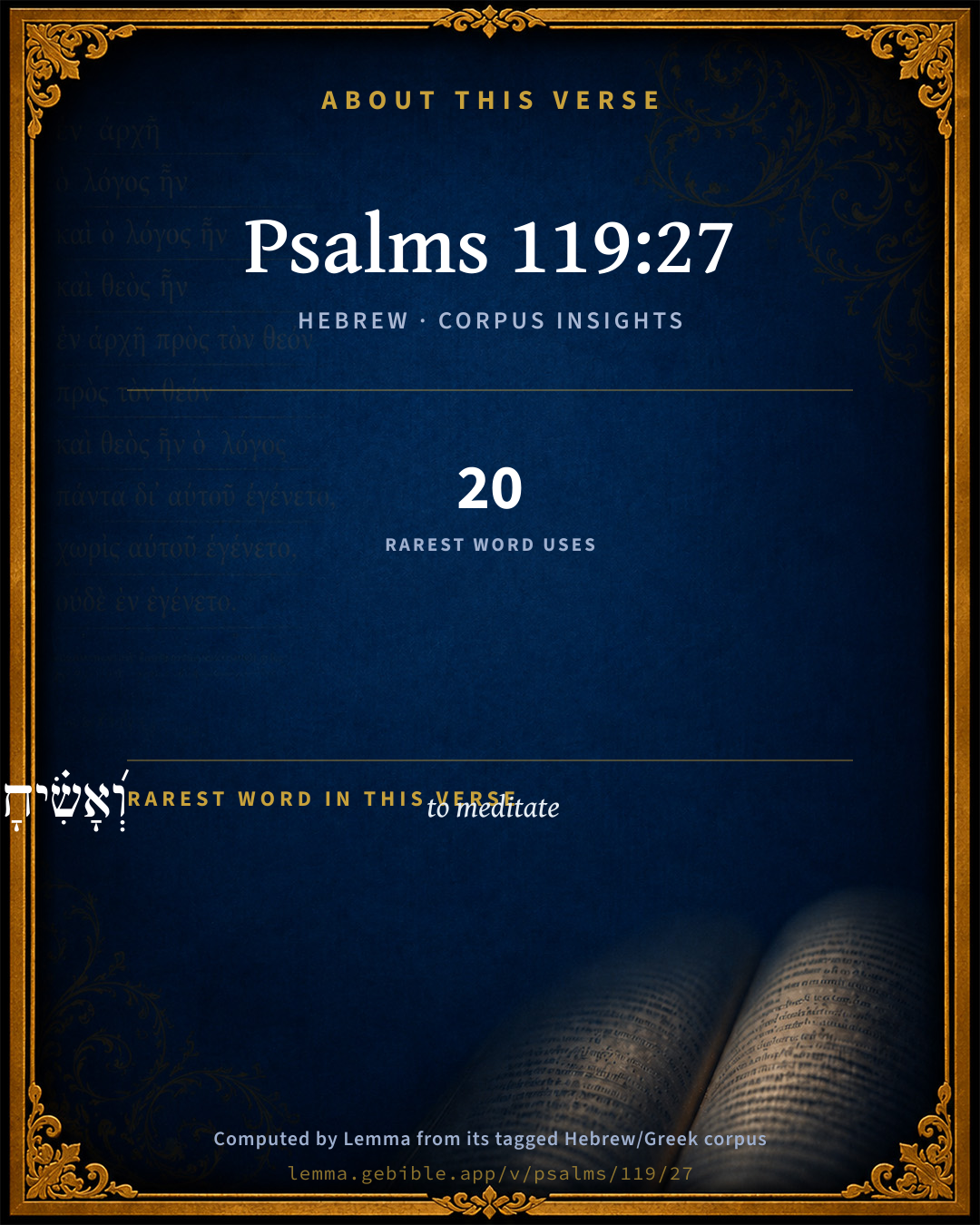
The rarest word here is וְ֝אָשִׂ֗יחָה to meditate H7878 — appearing just 20 times in the whole Hebrew Bible.

Shared distinctive vocabulary

וְ֝אָשִׂ֗יחָה to meditate H7878 occurs in 20 verses of the Hebrew Bible. Also found in:

Grammatical profile

  • 3 verbs
  • 2 nouns

Verb forms

  • הֲבִינֵ֑נִי Hiphil · Imperative
  • וְ֝אָשִׂ֗יחָה Qal · Cohortative
  • בְּנִפְלְאוֹתֶֽיךָ Niphal · Participle Active

Hebrew & Septuagint length

In English translation the verse runs 16 words from the Hebrew and 16 from the Septuagint (LXX English) — the same length.

A rough comparison of the two English renderings, which tokenize alike — not a word-level alignment.

Word counts can differ between the Hebrew and the Greek without any difference in meaning — e.g. the Hebrew direct-object marker אֵת has no separate Greek word, and Greek often adds the article ὁ.

Cross-references

9

Topical passages linked to Psalms 119:27 in the Treasury of Scripture Knowledge — connected by theme and wording, ordered by reader-vote popularity; previews shown in the World English Bible.

  • Psalms 145:5–6 Of the glorious majesty of your honor, Of your wondrous works, I will meditate.
  • Psalms 105:2 Sing to him, sing praises to him! Tell of all his marvelous works.
  • Psalms 71:17 God, you have taught me from my youth. Until now, I have declared your wondrous works.
  • Revelation 15:3 They sang the song of Moses, the servant of God, and the song of the Lamb, saying, "Great and marvelous are your works, Lord God, the Almighty; Righteous and true are your ways, you King of the nations.
  • Psalms 78:4 We will not hide them from their children, Telling to the generation to come the praises of Yahweh, His strength, and his wondrous works that he has done.
  • Psalms 111:4 He has caused his wonderful works to be remembered. Yahweh is gracious and merciful.
  • Acts 2:11 Cretans and Arabians: we hear them speaking in our languages the mighty works of God!"
  • Exodus 13:14–15 It shall be, when your son asks you in time to come, saying, 'What is this?' that you shall tell him, 'By strength of hand Yahweh brought us out from Egypt, from the house of bondage;
  • Joshua 4:6–7 that this may be a sign among you, that when your children ask in time to come, saying, What do you mean by these stones?

Cross-references courtesy of OpenBible.info (CC BY 4.0).

Hebrew and Greek witnesses Masoretic Hebrew ↔ Greek Septuagint

The same verse in the two great witnesses to the Old Testament, shown verse-for-verse.

You’re reading Greek Psalm 118 (Hebrew Psalm 119). The Septuagint counts the superscription, so verse numbers can differ from the Hebrew — chapter-level alignment, not verse-by-verse. Numbering follows Rahlfs.

These are two independent witnesses, not word-aligned to each other, and the Septuagint is shown in lemma (dictionary) form.

Hebrew Psalms 119:27 Masoretic · Westminster Leningrad Codex

דֶּֽרֶךְ פִּקּוּדֶ֥יךָ הֲבִינֵ֑נִי וְ֝אָשִׂ֗יחָה בְּנִפְלְאוֹתֶֽיךָ

Let me understand the teaching of your precepts! Then I will meditate on your wondrous works.

World English Bible · Public Domain

Greek LXX Greek Psalm 118:27 Septuagint · lemma form

ὁδός δικαίωμα σύ συνετίζω ἐγώ καί ἀδολεσχέω ἐν ὁ θαυμάσιος σύ

Instruct me in the way of your ordinances; and I will meditate on your wondrous works.

LXX2012 (modern English Septuagint) · Public Domain

Hebrew: Westminster Leningrad Codex (CC BY 4.0). Greek: Septuagint (public domain); English from LXX2012 (modern English Septuagint) (Public Domain). How the Septuagint differs from the Hebrew →

Commentary

Notes on Psalms 119:27 from classic Christian and Jewish commentators (each source and its license shown beneath its notes). The classic Christian expositions comment on the surrounding passage and are grouped to its opening verse, so a note may address several verses; the Jewish commentaries on the Tanakh (Rashi and others) are per-verse, so they appear only where the commentator wrote on this verse.

Lemma curates 59 commentaries, every one of them public domain or Creative Commons licensed, each selected and text-cleaned for this edition rather than reprinted as found. About our sources →

Trapp's Complete Commentary

John Trapp

Psa 119:27 Make me to understand the way of thy precepts: so shall I talk of thy wondrous works.

Ver. 27. Make me to understand, &c.] Give me a mouth and wisdom, that I may not talk at random of thy words and works; but understandingly and fruitfully.

John Trapp, A Commentary or Exposition upon All the Books of the Old and New Testament (1647–1656) — public domain. Text from a community e-Sword module.

The Biblical Illustrator

Joseph S. Exell

Psa_119:27

Make me to understand the way of Thy precepts; so shall I talk of Thy wondrous works.

The students prayer

I. The students prayer. I hope that we are all students in the school of Christ--all disciples or scholars--and I trust we shall adopt the students prayer as our own: Make me to understand the way of Thy precepts. Prayer is to study what fire is to the sacrifice.

1. The students prayer deals with the main subject of the conversation which is to be that students occupation, namely, the way of Gods precepts. It is well for us to know exactly what the law teaches, and what the law designs; why we were made subject to its prescript, and how we may be delivered from its penalties. Great need too have we to understand the way of Gods Gospel precepts--what these precepts are: repent, believe, be converted, and the like; to be able to see their relation, where they stand, not as means to an end, but as results of Divine grace--commands but yet promises, the duty of man but yet the gift of God. The way of Gods precepts! Does not that mean that we ought to be acquainted with the relative position which the precepts occupy, for it is very easy, unless God gives us understanding, to preach up one precept to the neglect of another. It is possible for a ministry and a teaching to be lop-sided, and those who follow it may become rather the caricatures of Christianity than Christians harmoniously proportioned.

2. Very obviously here a confession is implied. Make me to understand the way of Thy precepts. It means just this. Lord, I do not understand it of myself. I am ignorant and foolish, and if I follow my own judgment--if I take to my own thinkings, I shall be sure to go wrong. Lord, make me to understand. Who can put wisdom in the inward parts but the Lord? Or who can give understanding to the heart but God Most High?

II. The occupation of the instructed man. When the Lord has taught a man the way of His precepts, it behoves him rightly to use his sacred privileges: So shall I talk of Thy wondrous works. As a faithful teacher let him testify of Gods works--His wondrous works. There are two works, especially, that you Christian people must talk about to others--the work of Christ for us and the work of the Holy Ghost in us. These are themes that will never be exhausted. Some men are far more interested in stating their own crotchets than in unfolding Gods counsels. If we understand the way of Gods precepts, acquire the language of it, get into the groove of it, then we shall talk with understanding; and there will be a harmony and a wisdom about our utterances which will be blest to the edification of the hearers.

III. The intimate relation between the prayer of the student and the pursuit that he subsequently followed. Make me to understand the way of Thy precepts: so shall I talk of Thy wondrous works. The connection lies partly in the enchantment of this knowledge and the passion to communicate it. A man who understands Christ and His mediatorial work, and the Spirit and His sanctifying work, cannot be silent. The fire once kindled, the flames will spread. Woe is me if I preach not the Gospel. (C. H. Spurgeon.)

The teacher must first be taught

There is not really any grave duty a man can be called on to discharge, no responsible office he may be elected to fill, nor even any plan or purpose he lays it on his heart to accomplish, which does not require diligent preparation on his own part to fit himself, to train his faculties, and to discipline his mind. What you call unskilled labour may possibly be utilized by efficient officers, but unskilful labour is a sheer waste of power. How much more imperative the demand that we should be endowed with the requisite faculties and qualified by suitable instruction if we have any work to do for God, or any office, however humble, in the service of the great King! Zeal without knowledge would only betray us into reckless presumption. When called to talk of Gods wondrous works, we ought not to rush upon that exercise at once unfitted and unprepared, but we should wait upon the Lord, that the eyes of our understanding may be enlightened, that our stammering tongues may be unloosed, and that our lips may be attuned to tell the noble tale in grateful strains. We must first obtain for ourselves an understanding of the way of the Lords precepts before we can make it plain to others. He who tries to teach, but has never been taught himself, will make a sorry mess of it. He who has no understanding, and yet wants to make others understand, must assuredly fail. Some there are who cannot teach and will not learn, and it is because they will not learn that they cannot teach. I believe aptness for being taught is at the bottom of aptness to teach. The psalmist had both. He says, Make me to understand the way of Thy statutes. There he would be taught. Then, saith he, I shall talk of Thy wondrous works. There he would be teaching. (C. H. Spurgeon.)

The Spirit of God gives understanding of the Word

I remember once I was travelling in Germany--I was a student in one of the universities there--and was making a tour of certain caves with some companions. One day we met the village postman. He said, Would you not like to see a cave that is not down in the guide book? We said, Yes; so away we struck through the brush and came to the cave. It was dark as midnight. He said, It is perfectly beautiful. Every formation is an altar of the Druidical times, and so forth and so on. Look curl there is a hole right there, and nobody has ever found the bottom of it. We looked up; we were afraid we would be the first to find the bottom. There was nothing at all pleasant about it; everything was dark and uncanny. But our guide just took a bit of magnesium and lit it, and suddenly the dark, cold, forbidding, dangerous place became luminous, and the stalactites came down from the ceiling to meet the stalagmites as they came up from the floor. Every one was an altar, not a Druidical altar, as they supposed, but an altar built by the hand of God. It was a place of marvellous beauty. It is just so with the Word of God. How often we come to a passage which looks dark, forbidding, and dangerous. You are often afraid that you will fall into some pitfall, but just look up to God in prayer, and let that passage be illuminated with the light of the Holy Ghost, and it becomes full of beauty, transcendent and glorious. (B. A. Torrey, D. D.)

The Biblical Illustrator, edited by Joseph S. Exell (c. 1880s–1900s) — public domain. Text from a community e-Sword module.

J. A. Alexander on Psalms

Joseph Addison Alexander

27. (Psa 119:27) The way of thy precepts make me understand, and I will muse of thy wonders. The first clause expresses the same wish, arising from the same consciousness of weakness, as in Psa 119:26. The verb in the last clause is one of those in the usage of which the ideas of speech and meditation run continually into one another. See on Psa 69:12; Psa 74:3; Psa 74:6; Psa 105:2.

Joseph Addison Alexander, The Psalms Translated and Explained (1850) — public domain. Text from a community e-Sword module.

Ellicott's Commentary for English Readers

(27) Make me to understand.—Only the Israelite truly loyal to the covenant was considered worthy to enquire into the marvels of the dealings of God. (See Psa_106:2, Note.) Perhaps we might extend the thought so far as to say that a true historical insight is possible only to one whose moral sense is rightly trained and directed.

A Bible Commentary for English Readers, edited by Charles John Ellicott (1878–1897) — public domain. Text from a community e-Sword module.

The Cambridge Bible for Schools and Colleges

gen. ed. J. J. S. Perowne

27. The prayer of 26 b is further developed. This prayer for deeper insight recurs in Psa_119:34; Psa_119:73; Psa_119:125; Psa_119:144; Psa_119:169.

so shall I talk of thy wondrous works] Rather, that I may meditate (as in Psa_119:15; Psa_119:23) on thy wonders, the mysteries of God’s Will revealed in His law (Psa_119:18).

The Cambridge Bible for Schools and Colleges (gen. ed. J. J. S. Perowne; Cambridge University Press, 1878–1918) — public domain. Text from a community e-Sword module.

John Gill's Exposition

Remove from me the way of lying,.... Not the sin of lying to men, and a course of it, which David was not addicted to; but a "false way", or "way of falsehood" (b); as it may be rendered, and so the Targum; and is the same with what he expresses his abhorrence of, Psa 119:128; and is opposed to the way of truth in Psa 119:30; and designs all false doctrine and false worship, all errors and heresies, superstition and idolatry; which he desired to be at the utmost distance from, and those from him, as having a dislike and abhorrence of them; and as knowing how prejudicial they would be to him, and how contrary to the glory of God;

and grant me thy law graciously; not the fiery law, which works wrath, curses and condemns; the voice of words, which they that heard entreated they might hear no more; and which to have is no act of grace and favour, unless as fulfilled in Christ, and as it is a rule of walk and conversation in his hands: but rather "doctrine", as the word signifies; the doctrine of the Gospel, the law or doctrine of faith; which to have and understand is a gift of grace; it is the Gospel of the grace of God, the grace of God itself; and instructs in it, and shows that salvation is purely by it.

(b) "viam falsitatis", Junius & Tremellius, Piscator, Cocceius, Gejerus, Michaelis.

John Gill's Exposition of the Whole Bible (1746–1763) — public domain (CC PDM 1.0). Text via the HelloAO Bible API.

Albert Barnes' Notes on the Bible

Make me to understand ... - See the notes at Psa 119:18.

So shall I talk of thy wondrous works - The things in thy works - thy providential dealings - that are wondrous. That is, with a heart full of the subject, he could not but speak of those things - for “out of the abundance of the heart the mouth speaketh.” See the notes at Psa 39:2-4.

Albert Barnes' Notes on the Bible (1834–1885) — public domain. Text from a community e-Sword/MySword module.

Matthew Poole's English Annotations

Make me to understand, more thoroughly and more practically, the way of thy precepts; either,

1. The full mind and meaning of thy precepts, which are exceeding broad, as he saith afterwards; or,

2. The way wherein I may walk according to thy precepts; how to demean myself in all the varieties of my condition, and in all my affairs and actions, so as is most agreeable to thy precepts.

Thy wondrous works; even the wonders of the law mentioned before, Psa 119:18.

Matthew Poole's English Annotations on the Holy Bible (1683–1685) — public domain. Text from a community e-Sword/MySword module.

The Treasury of David

Charles H. Spurgeon

Ver. 27. Make me to understand the way of thy precepts. Give me a deep insight into the practical meaning of thy word; let me get a clear idea of the tone and tenor of thy law. Blind obedience has but small beauty; God would have us follow him with our eyes open. To obey the letter of the word is all that the ignorant can hope for; if we wish to keep God's precepts in their spirit we must come to an understanding of them, and that can be gained nowhere but at the Lord's hands. Our understanding needs enlightenment and direction: he who made our understanding must also make us understand. The last sentence was, "teach me thy statutes, "and the words, "make me to understand, "are an instructive enlargement and exposition of that sentence: we need to be so taught that we understand what we learn. It is to be noted that the Psalmist is not anxious to understand the prophecies, but the precepts, and he is not concerned about the subtleties of the law, but the commonplaces and everyday rules of it, which are described as "the way of thy precepts."

So shall I talk of thy wondrous works. It is ill talking of what we do not understand. We must be taught of God till we understand, and then we may hope to communicate our knowledge to others with a hope of profiting them. Talk without intelligence is mere talk, and idle talk; but the words of the instructed are as pearls which adorn the ears of them that hear. When our heart has been opened to understand, our lips should be opened to impart knowledge; and we may hope to be taught ourselves when we feel in our hearts a willingness to teach the way of the Lord to those among whom we dwell.

Thy wondrous works. Remark that the clearest understanding does not cause us to cease from wondering at the ways and works of God. The fact is that the more we know of God's doings the more we admire them, and the more ready we are to speak upon them. Half the wonder in the world is born of ignorance, but holy wonder is the child of understanding. When a man understands the way of the divine precepts he never talks of his own works, and as the tongue must have some theme to speak upon, he begins to extol the works of the all perfect Lord.

Some in this place read "meditate" or "muse" instead of "talk"; it is singular that the words should be so near of kin, and yet it is right that they should be, for none but foolish people will talk without thinking. If we read the passage in this sense, we take it to mean that in proportion as David understood the word of God he would meditate upon it more and more. It is usually so; the thoughtless care not to know the inner meaning of the Scriptures, while those who know them best are the very men who strive after a greater familiarity with them, and therefore give themselves up to musing upon them.

Observe the third verse of the last eight (19), and see how the sense is akin to this. There he was a stranger in the earth, and here he prays to know his way; there, too, he prayed that the word might not be hid from himself, and here he promises that he will not hide it from others.

Ver. 27. Make me to understand. Natural blindness is an obstinate disease, and hardly cured: therefore again and again we had need to pray, "Open mine eyes"; "Teach me thy statutes"; Make me to understand the way of thy precepts. Our ignorance is great even when it is cured in part. The clouds of temptation and carnal affection cause it to return upon us, so that we know not what we know. Therefore he cries, "open my eyes; cause me to understand." Yea, the more we know the more is our ignorance discovered to us: "Surely I am more brutish than any man, and have not the understanding of a man. I neither learned wisdom, nor have the knowledge of the holy" (Pr 30:2-3). "I have heard of thee by the hearing of the ear, but now mine eye seeth thee; wherefore I abhor myself, and repent in dust and ashes" (Job 42:5-6). Alas, a poor, little, hearsay knowledge availeth not; they abhor themselves when they have more intimate acquaintance. None so confident as a young professor that knoweth a few truths, but in a weak and imperfect manner: the more we know indeed, the more sensible we are of our ignorance, and how liable to this mistake and that, so that we dare not trust ourselves for an hour. Thomas Mantels.

Ver. 27. Understated the way... so shall I talk. We can talk with a better grace of God's "wondrous works, "the wonders of providence, and especially the wonders of redeeming love, when we understand the way of God's precepts, and walk in that way. Matthew Henry

Ver. 27. The way of they precepts. He desireth that God would, partly by his Spirit, partly by his ministers, partly by affliction, partly by study and labour, make him to have a right and sound understanding, not only of his statutes, but of the way of his statutes, that is, after what sort and order he may live and direct his life, according to those things which God hath commanded him in his law. Learn here how hard a thing it is for man overweening himself in his own wisdom, to know God's will till God make him to know. Richard Greenham.

Ver. 27. So shall I talk of thy wondrous works. He that is sensible of the wondrous things that are in God's word? will be talking of them. 1. It will be so. 2. It should be so.

1. It will be so. When the heart is deeply affected, the tongue cannot hold, but will run out in expressions of it; "for out of the abundance of the heart the mouth speaketh." When cheered and revived in their afflictions saints are transported with the thought of the excellency of God. "Come, and I will tell you what God hath done for my soul" (Ps 66:15). The woman, when she had found the lost groat, calleth her neighbours to rejoice with her. He that hath but a cold knowledge, will not be so full of good discourse.

2. It should be so in a threefold respect: for the honour of God; the edification of others; and for our own profit.

(a) For the honour of God, to whom we are so much indebted,

to bring him into request with those about us.

Experience deserveth praise; when you have found the

Messiah, call another to him: "Andrew calleth Peter, and

saith unto him, We have found the Messias: and Philip

called Nathanael and saith unto him, We have found him,

of whom Moses in the law, and the prophets, did write,

Jesus of Nazareth, the son of Joseph"

(Joh 1:41-45).

(b) For the edification of others: "And thou, being

converted, strengthen thy brethren" (Lu 22:32).

True grace is communicative as fire, etc.

(c) For our own profit. He that useth his knowledge shall

have more. Whereas, on the contrary, full breasts, if

not sucked, become dry. In the dividing, the loaves

increased. All gifts, but much more spiritual, which are

the best, are improved by exercise. Thomas Manton.

Ver. 27. So shall I talk, etc. Desire of knowledge should not be for satisfying of curiosity, or for ostentation, or for worldly gain, but to edify ourselves and others in wisdom... Thy wondrous works. The works of creation, redemption and providence, either set down in Scripture, or observed in our own experience, transcend our capacity, and cannot but draw admiration from them that see them well. David Dickson.

Ver. 27. So shall I talk. It is a frequent complaint with Christians, that they are straitened in religious conversation, and often feel unable to speak "to the use of edifying, that they may minister grace to the hearers, "Eph 4:29. Here, then, is the secret disclosed, by which we shall be kept from the danger of dealing in unfelt truths, for "out of the abundance of the heart our mouths shall speak, "Mt 12:34. Seek to have the heart searched, cleansed, filled with the graces of the Spirit. Humility, teachability, simplicity, will bring light unto the understanding, influence the heart, "open the lips, "and unite every member that we have in the service and praise of God. Charles Bridges.

Ver. 27. I shall talk of. There is a close affinity between all the duties of religion. The same word is rendered pray, meditate, and talk of. We think of God's excellent majesty; we cry to him in humble prayer; we study his word until our souls are filled with gladness and admiration; and then how can we but talk of his wondrous works? William S. Plumer.

Ver. 27.

1. A student's prayer.

1. It deals with the main subject of the conversation which is to be that student's occupation "the way of God's precepts."

2. A confession is implied: "Make me, "etc.

3. A great boon is asked to understand, to know, thy statutes.

4. The Fountain of all wisdom is applied to.

2. The occupation of the instructed man.

1. He testifies of God's works his wondrous works Christ's work for us; the Holy Spirit's work in us. The wonderful character of these works of God, a wide field for devout study.

2. He speaks very plainly: "I will talk, "etc.

3. He will speak very frequently: "I will talk."

4. He will speak to the point: "So" i.e., according to understanding.

3. The intimate relation between the prayer of the student and the pursuit that he subsequently followed. See "Spurgeon's Sermons, "No. 1344: "The Student's Prayer."

Ver. 27. Education for the ministry.

1. The student at college: "Make me to understand." His lesson. His instructor. His application.

2. The preacher at his work: "So shall I talk, "etc. His qualification. His theme. His manner. C.A.D.

Psalms 119:28*

Charles H. Spurgeon's The Treasury of David (1869–1885) — public domain. Psalms only. Text from a community e-Sword/MySword module.

The Pulpit Commentary

Make me to understand the way of thy precepts. Exegetical of the last clause of ver. 26. What the psalmist longs for is to have a perfect knowledge of God"s Law in all its breadth (ver. 96) and depth (Psa_92:5) and fullness. So shall I talk of thy wondrous works; rather, so will I muse upon thy marvels (so Kay, Cheyne, and the Revised Version). The "marvels" spoken of are "the wondrous things of God"s Law" (ver. 18).

The Pulpit Commentary (1880–1919), ed. H.D.M. Spence-Jones & Joseph S. Exell — public domain. Text from a community e-Sword module.

John Wesley's Explanatory Notes

Understand - More throughly.

John Wesley, Explanatory Notes Upon the Whole Bible (1754–1765) — public domain. Text via the GEBible commentary corpus.

unfoldingWord translationNotes

Door43 World Missions Community

wondrous teachings

"amazing teachings"

with grief

"because I am so sad"

Strengthen me

"Make me strong." This may refer to physical strength or spiritual strength.

translationWords

meditate

unfoldingWord translationNotes — © Distant Shores Media and the Door43 World Missions Community, licensed CC BY-SA 4.0. Source: git.door43.org/Door43/en_tn.

Lesson kit

Teaching starters — assembled from the data on this page, not authored interpretation. Every prompt links to the verse data it draws on. Edit before teaching.

Psalms, in the Wisdom, opens this verse with 5 words (5 distinct Hebrew lemmas). Its most distinctive word is sîyach (“to meditate”). A historical commentator’s framing appears above. Read the whole chapter for the surrounding context.

Discussion questions

  1. The word sîyach carries the sense “to meditate.” How does it shape the verse?
  2. Judges 5:10 shares the word «to meditate» with this verse. How do the two illuminate each other?
  3. These translations render this verse differently; the difference is in the English rendering, not the original. What questions does that raise?
  4. The verb «הֲבִינֵ֑נִי» is Hiphil Imperative. How does its form color the action?
  5. Reading how Trapp's Complete Commentary and The Biblical Illustrator read this verse, where do the two commentators agree and where do they part?

Things to notice

Reading settings

Reading text

Shown beneath each verse's original-language words.

Old Testament
Old Testament edition

Read the OT as the Masoretic Hebrew (MT) or the Greek Septuagint (LXX).

English shown for the Greek Septuagint (in the Hebrew ↔ Greek comparison).

Comparing translations? Open the Compare panel on any verse page to stack up to four side by side.