
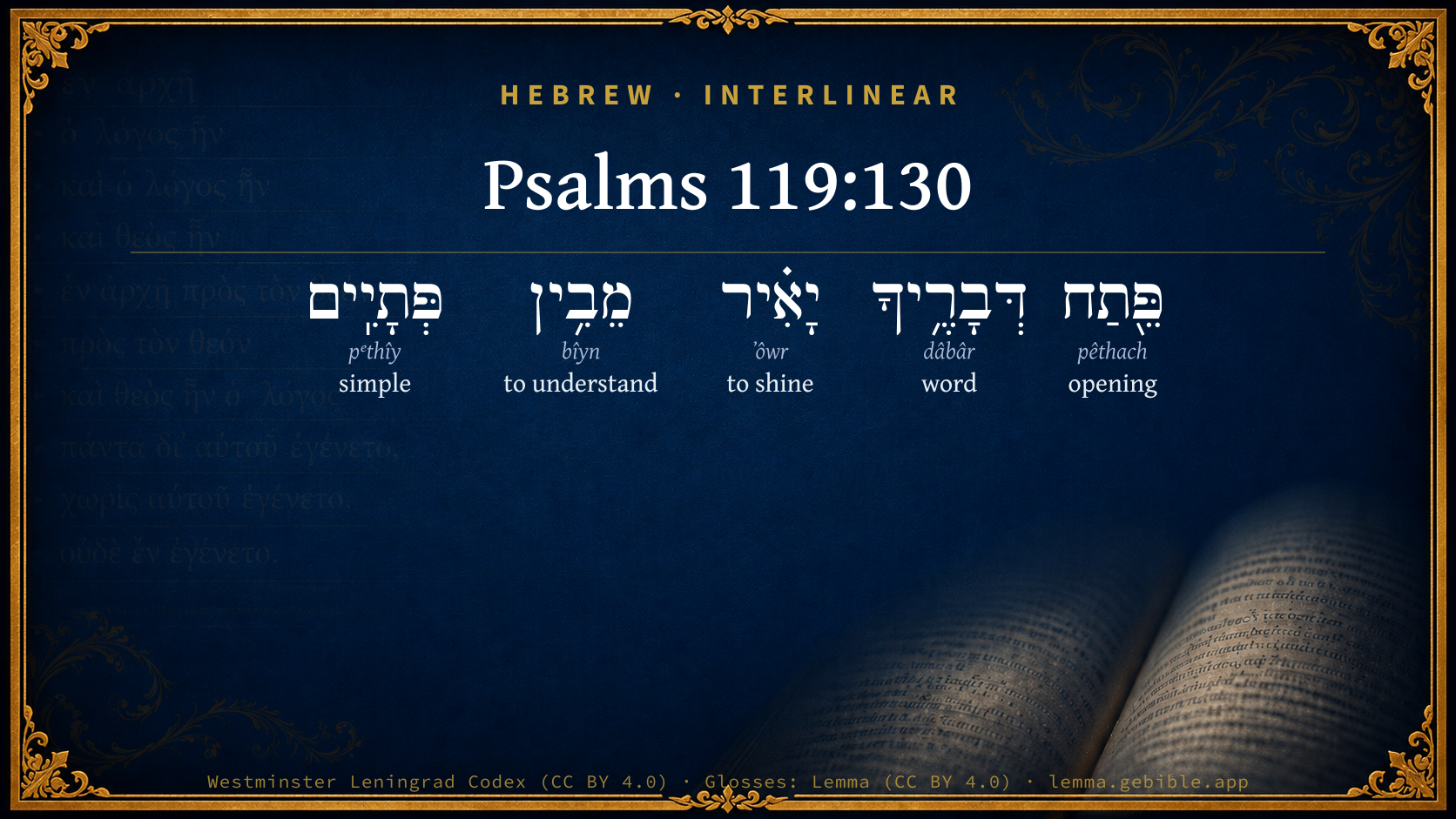
Psalms 119:130

Hebrew (Westminster Leningrad Codex) Psalms 119:130 appears in the Hebrew Old Testament. The text above is from the Westminster Leningrad Codex. Each word links to its Strong’s number, a concise gloss, and parsing drawn from the Open Scriptures Hebrew Bible morphology. Click any word for its full Brown-Driver-Briggs (BDB) entry.
Download image
Cite this verse

Psalms 119:130 (World English Bible). Public Domain. Lemma interlinear Bible study tool, https://lemma.gebible.app/v/psalms/119/130.

Show BibTeX & RIS
BibTeX
RIS
English Translation
The entrance of your words gives light. It gives understanding to the simple.
World English Bible · Public Domain
Highlights
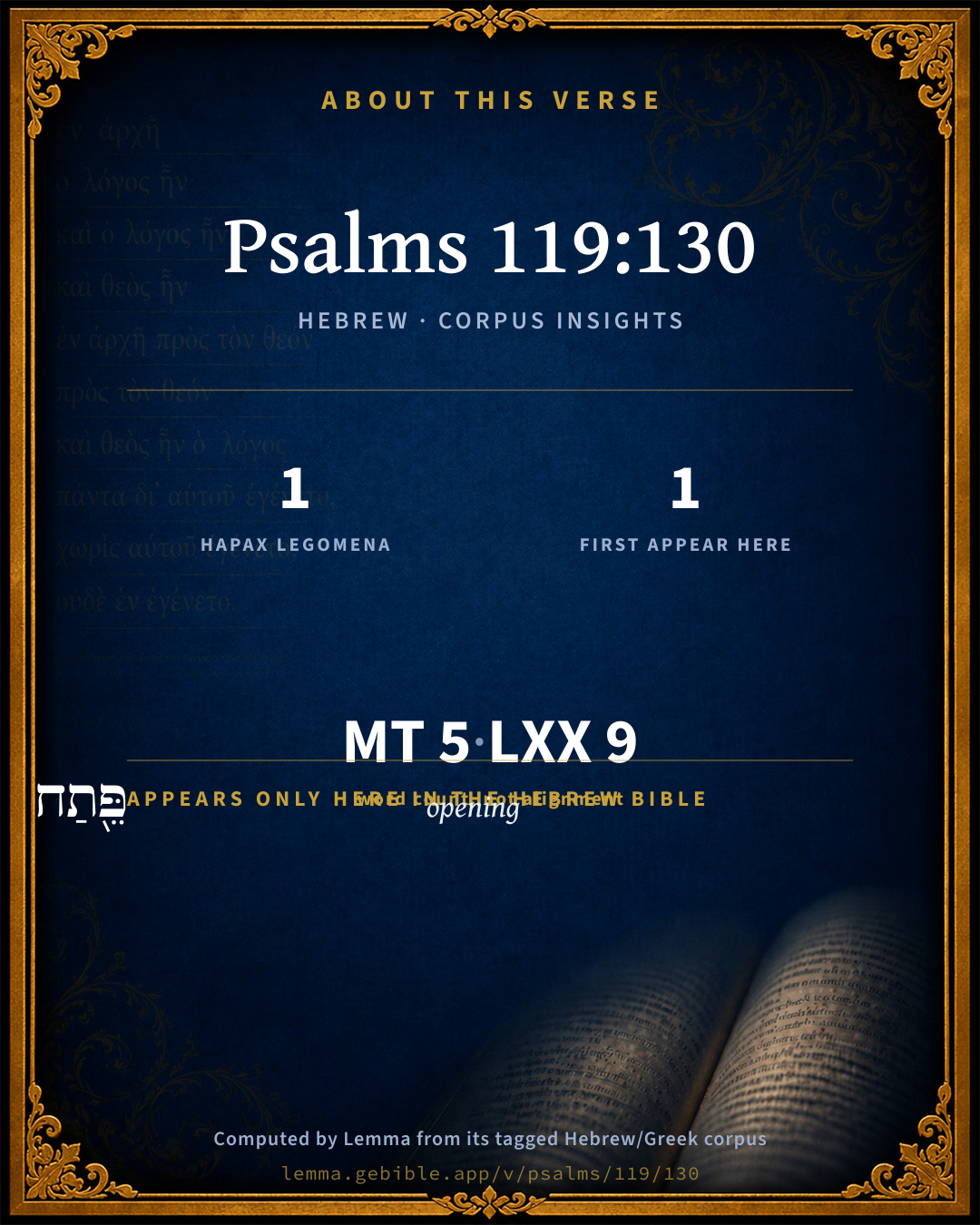
  • 1 hapax legomenon — only here in the Hebrew Bible
  • 1 first appearance in the Hebrew Bible
Full analysis ↓
Download a study sheet

One document with this verse’s original text, its word-by-word gloss line, the meaning frame, cross-references with their text, attributed commentary, and full source and license credits — printable, and it pastes into notes with its structure intact.

This verse Autodidact and up

Study sheet (.html) Plain text (.txt)

A passage Seminary Student

Up to 50 verses in one chapter. A passage sheet keeps up to 6 commentary sources and 12 cross-references per verse, in the order this page ranks them, and says so on the sheet whenever that leaves anything out. Ask for a single verse and you get the Autodidact verse sheet above.

Everything on this page stays free to read, with no account — the sheet is a download of what is already on screen, not access to it.

Want to remove ads? Support Godless Engineer
Compare translations 3

The same verse in 3 English versions, stacked beneath the original-language interlinear above. Click any original word for its lexicon entry.

Each is an independent rendering of the whole verse — the interlinear is not word-aligned to these translations.

Highlighted words mark where these versions differ — a whole-verse word diff, not a word-by-word alignment.

  • World English Bible Public Domain
    The entrance of your words gives light. It gives understanding to the simple.
  • King James Version Public Domain
    The entrance of thy words giveth light; it giveth understanding unto the simple.
  • unfoldingWord Literal Text CC BY-SA 4.0
    The doorway of your words gives light, giving understanding to the simple.

unfoldingWord Literal Text — © unfoldingWord, licensed CC BY-SA 4.0. Word-aligned USFM3 via Door43 (git.door43.org/unfoldingWord/en_ult).

Versions to compare (up to 4)

3 of 4 selected

Show all 17 translations

Every available English version of this verse, each an independent rendering of the whole verse.

  • World English Bible Public Domain
    The entrance of your words gives light. It gives understanding to the simple.
  • Berean Standard Bible Public Domain
    The unfolding of Your words gives light; it informs the simple.
  • Majority Standard Bible Public Domain
    The unfolding of Your words gives light; it informs the simple.
  • King James Version Public Domain
    The entrance of thy words giveth light; it giveth understanding unto the simple.
  • American Standard Version (1901) Public Domain
    The opening of thy words giveth light; It giveth understanding unto the simple.
  • Revised Version (1885) Public Domain
    The opening of thy words giveth light; it giveth understanding unto the simple.
  • Geneva Bible (1599) Public Domain
    The entrance into thy wordes sheweth light, and giueth vnderstanding to the simple.
  • Young's Literal Translation Public Domain
    The opening of Thy words enlighteneth, Instructing the simple.
  • Literal Standard Version CC BY-SA 4.0
    The opening of Your words enlightens, || Instructing the simple.
  • Unlocked Literal Bible CC BY-SA 4.0
    The unfolding of your words gives light; it gives understanding to the untrained.
  • unfoldingWord Literal Text CC BY-SA 4.0
    The doorway of your words gives light, giving understanding to the simple.
  • Darby Bible Public Domain
    The entrance of thy words giveth light, giving understanding unto the simple.
  • World Messianic Bible Public Domain
    The entrance of your words gives light. It gives understanding to the simple.
  • Webster's Bible Public Domain
    The entrance of thy words giveth light; it giveth understanding to the simple.
  • Free Bible Version CC BY-SA 4.0
    Studying your words brings light so that even the uneducated can understand.
  • Bible in Basic English Public Domain
    The opening of your words gives light; it gives good sense to the simple.
  • JPS Tanakh (1917) Public Domain
    The opening of Thy words giveth light; it giveth understanding unto the simple.

Literal Standard Version (2020), Covenant Press — licensed CC BY-SA 4.0. Text via the HelloAO Bible API (eBible.org). Unlocked Literal Bible (unfoldingWord) — licensed CC BY-SA 4.0. Text via the HelloAO Bible API (eBible.org). unfoldingWord Literal Text — © unfoldingWord, licensed CC BY-SA 4.0. Word-aligned USFM3 via Door43 (git.door43.org/unfoldingWord/en_ult). Free Bible Version, Dr. Jonathan Gallagher — licensed CC BY-SA 4.0. Text via the HelloAO Bible API (eBible.org).

Word by word

More ways to search: Search by grammar → Find every occurrence → Compare this word →

Practice this passage: Drill this verse → Learn its vocabulary →

About this verse

These counts appear in no published source. They are computed here, from the morphology-tagged text and Lemma’s own curated glosses. What Lemma adds →

5
words
5
distinct lemmas
Wisdom
section

Notable vocabulary

1 hapax legomenon — a word that appears only here in the entire Hebrew Bible:

  • פֵּ֖תַח opening H6608

First appearance in Scripture

This word makes its first canonical appearance in the Hebrew Bible here:

  • פֵּ֖תַח opening H6608

Shared distinctive vocabulary

פְּתָיִֽים simple H6612 occurs in 18 verses of the Hebrew Bible. Also found in:

Grammatical profile

  • 2 verbs
  • 3 nouns

Verb forms

  • יָאִ֗יר Hiphil · Imperfect
  • מֵבִ֥ין Hiphil · Participle Active

Hebrew & Septuagint length

In English translation the verse runs 13 words from the Hebrew and 11 from the Septuagint (LXX English) — closely comparable.

A rough comparison of the two English renderings, which tokenize alike — not a word-level alignment.

Word counts can differ between the Hebrew and the Greek without any difference in meaning — e.g. the Hebrew direct-object marker אֵת has no separate Greek word, and Greek often adds the article ὁ.

In the original languages it is 5 Hebrew tokens and 9 Greek tokens — but the two are counted differently (Hebrew bundles its prefixes and suffixes into one token; the Greek is in lemma form), so that isn’t a like-for-like length.

Cross-references

15

Topical passages linked to Psalms 119:130 in the Treasury of Scripture Knowledge — connected by theme and wording, ordered by reader-vote popularity; previews shown in the World English Bible.

  • Psalms 119:105 Your word is a lamp to my feet, And a light for my path.
  • Proverbs 6:23 For the commandment is a lamp, And the law is light. Reproofs of instruction are the way of life,
  • 2 Corinthians 4:6 seeing it is God who said, "Light will shine out of darkness," who has shone in our hearts, to give the light of the knowledge of the glory of God in the face of Jesus Christ.
  • Acts 26:18 to open their eyes, that they may turn from darkness to light and from the power of Satan to God, that they may receive remission of sins and an inheritance among those who are sanctified by faith in me.'
  • Psalms 19:7 Yahweh's law is perfect, restoring the soul. Yahweh's testimony is sure, making wise the simple.
  • Luke 1:77–79 To give knowledge of salvation to his people by the remission of their sins,
  • 2 Peter 1:19 We have the more sure word of prophecy; whereunto you do well that you take heed, as to a lamp shining in a dark place, until the day dawns, and the day star arises in your hearts:
  • Proverbs 1:22–23 "How long, you simple ones, will you love simplicity? How long will mockers delight themselves in mockery, And fools hate knowledge?
  • Ephesians 5:13–14 But all things, when they are reproved, are revealed by the light, for everything that is revealed is light.
  • 2 Corinthians 4:4 in whom the god of this world has blinded the minds of the unbelieving, that the light of the Gospel of the glory of Christ, who is the image of God, should not dawn on them.
  • Isaiah 8:20 To the law and to the testimony! if they don't speak according to this word, surely there is no morning for them.
  • 2 Timothy 3:15–17 From infancy, you have known the sacred writings which are able to make you wise for salvation through faith, which is in Christ Jesus.
  • Proverbs 1:4 To give prudence to the simple, Knowledge and discretion to the young man:
  • Proverbs 9:4–6 "Whoever is simple, let him turn in here!" As for him who is void of understanding, she says to him,
  • Romans 16:18–19 For those who are such don't serve our Lord, Jesus Christ, but their own belly; and by their smooth and flattering speech, they deceive the hearts of the innocent.

Cross-references courtesy of OpenBible.info (CC BY 4.0).

Hebrew and Greek witnesses Masoretic Hebrew ↔ Greek Septuagint

The same verse in the two great witnesses to the Old Testament, shown verse-for-verse.

You’re reading Greek Psalm 118 (Hebrew Psalm 119). The Septuagint counts the superscription, so verse numbers can differ from the Hebrew — chapter-level alignment, not verse-by-verse. Numbering follows Rahlfs.

These are two independent witnesses, not word-aligned to each other, and the Septuagint is shown in lemma (dictionary) form.

Hebrew Psalms 119:130 Masoretic · Westminster Leningrad Codex

פֵּ֖תַח דְּבָרֶ֥יךָ יָאִ֗יר מֵבִ֥ין פְּתָיִֽים

The entrance of your words gives light. It gives understanding to the simple.

World English Bible · Public Domain

Greek LXX Greek Psalm 118:130 Septuagint · lemma form

ὁ δήλωσις ὁ λόγος σύ φωτίζω καί συνετίζω νήπιος

The manifestation of your words will enlighten, and instruct the simple.

LXX2012 (modern English Septuagint) · Public Domain

On this verse, Ellicott's Commentary for English Readers discusses the Septuagint’s reading. Read the note in Commentary ↓

Hebrew: Westminster Leningrad Codex (CC BY 4.0). Greek: Septuagint (public domain); English from LXX2012 (modern English Septuagint) (Public Domain). How the Septuagint differs from the Hebrew →

Commentary

Notes on Psalms 119:130 from classic Christian and Jewish commentators (each source and its license shown beneath its notes). The classic Christian expositions comment on the surrounding passage and are grouped to its opening verse, so a note may address several verses; the Jewish commentaries on the Tanakh (Rashi and others) are per-verse, so they appear only where the commentator wrote on this verse.

Lemma curates 59 commentaries, every one of them public domain or Creative Commons licensed, each selected and text-cleaned for this edition rather than reprinted as found. About our sources →

Trapp's Complete Commentary

John Trapp

Psa 119:130 The entrance of thy words giveth light; it giveth understanding unto the simple.

Ver. 130. The entrance of thy words giveth light] So soon as men are over the threshold of thy house, sese lux quaedam inenarrabilis conspiciendam offert, a marvellous light shineth about them; so little cause is there that any should accuse God’s word of darkness and hardness; or give way to negligence and carelessness of the Scriptures, because they are wonderful. Lex, lux, the law is a light, Pro 6:23, and the gospel a great light, Mat 4:16 2Pe 1:19.

It giveth understanding to the simple] And maketh them subtle, Pro 1:4, so they be but docible. The very first rudiments of religion make wise the rude, so they be not refractory.

John Trapp, A Commentary or Exposition upon All the Books of the Old and New Testament (1647–1656) — public domain. Text from a community e-Sword module.

The Biblical Illustrator

Joseph S. Exell

Psa_119:130

The entrance of Thy words giveth light: it giveth understanding unto the.

The power of the Word

I. The entrance of the word.

1. Generally Thy Word, as used in the text, includes the whole of Divine revelation from its fret announcement in Genesis of a Redeemer to the last vision of the Heavenly Sanctuary by the beloved John on the Isle of Patmos.

2. Specifically, the entrance of Thy Word is the gift of the Son of God (Joh_1:1-14).

II. The effect of the word.

1. The Word gives us light doctrinally.

(1) As to a satisfactory explanation of the world of nature and her laws.

(2) As to the power and dignity of man.

(3) As to the problem of evil.

(4) As to the method of redemption.

2. The Word gives light practically as to the duty of nations and individuals.

(1) By the ethical and judicial law which Gods Word reveals.

(2) By a better civilization which it ushers in under a new national spirit.

3. The entrance of Thy Word gives us light experimentally.

(1) Reveals our moral condition, dead in trespasses and sin.

(2) As to our personal salvation and regeneration. Here we get the full light of Gods promises.

(3) As to Christian duties to God and our fellow-men. (A. A. Johnson, D. D.)

The light of Gods Word

1. The light-giving quality of Gods Word. It is significant to find that the old saints found in the earlier revelation they received in the Old Testament precisely the same peerless power of holy illumination as we can testify to in the perfected message in Jesus Christ. There is nothing that more strikingly reveals the underlying unity and identity of the sacred Scriptures. The volume and momentum of the revelation have varied, but its essential power to quicken and enkindle the human soul has been steadfastly maintained from the first wonderful utterance of the Divine voice in its sacred pages.

11. This quality furnishes a high test of its divinity. The opening of Thy Word giveth light means not only that Gods Word gives light, but that this light divinely grows with the growing revelation or understanding of the Word. As the Word opens before the soul the Divine shines forth from it more clearly, and the glory of the present God becomes more wonderful. And the more we know of the Gospel of Christ, the more irresistibly Divine and beautiful will it prove itself to be.

III. The Word of God imparts this light by the divinest means. The Word translated giveth light is the same Word which is used concerning God in verse 135--Make Thy face to shine upon Thy servant. As His face shines upon us, He makes our hearts shine back upon Him and upon the world. He does not illuminate our path mechanically, but sets His light within us livingly. He does not use us as passive reflectors of His brightness, but as burning and shining lights. (J. Thomas, M. A.)

Revelation and conversion

Trees are known by their fruit, and books by their effect upon the mind. It is not the elegance of its diction but the excellence of its influence by which a book is to be estimated.

I. The work of the Word of God in conversion. Not apart from the Spirit, but as it is used by the Spirit for divers ends, all needful to salvation.

1. To convince men of sin: they see what perfection is, that God demands it, and that they are far from it.

2. To drive men from false methods of seeking salvation, to bring them to self-despair, and to shut them up to Gods method of saving them.

3. To reveal the way of salvation, by grace, through Christ, by faith.

4. To enable the soul to embrace Christ as its all in all. By setting forth promises and invitations, which are opened up to the understanding and sealed to the heart, etc.

5. To bring the heart nearer and nearer to God. Emotions of love, desires for holiness, devotion, self-searching, love to men, humility, etc.

these are all excited, sustained, and perfected in the heart by the Word of God.

6. To restore the soul when it has wandered. Renewing tenderness, hope, love, joy, etc., by its gentle reminders.

7. To perfect the nature. The highest flights of holy enjoyment are not above or beyond the Word. Nothing is purer or more elevated than Holy Scripture. The Word also slays all sin, promotes every virtue, prepares for every duty, etc.

II. The excellence of this work done by the Word. The operations of grace by the Word are altogether good and not evil; and they are timed and balanced with infinite discretion. The Word of the Lord works marvellously, perfectly, and surely.

1. It removes despair without quenching repentance.

2. Gives pardon, but does not create presumption.

3. Gives rest, but excites the soul to progress.

4. Breathes security, but engenders watchfulness.

5. Bestows strength and holiness, but begets no boasting.

6. Gives harmony to duties, emotions, hopes, and enjoyments.

7. Brings the man to live for God, before God, and with God; and yet makes him none the less fitted for the daily duties of life.

III. The consequent excellence of the Word.

1. We need not add to it if we would secure conversion in any special case, or on the largest scale.

2. We need not keep back any doctrine for fear of damping the flame of a true revival.

3. We need not extraordinary gifts with which to preach it: the Word will do its own work.

4. We have but to follow the Word to be converted. It fits a mans needs as a key fits a lock.

5. We have but to keep to it to become truly wise: wise as the aged, wise as necessity requires, wise as the age, wise as eternity demands, wise with the wisdom of Christ.

(1) Cling to the Scripture.

(2) Study the whole revelation of God.

(3) Use it as your chief instrument in all holy service. (C. H. Spurgeon.)

The light of truth

I. The words of God are a light. No effect can rise higher than its cause, and nothing can impart what it does not possess; that which gives light on its entrance into the human heart, must be light, or at least have the property of communicating light. The sun in the firmament diffuses its beams, but has no power of giving sight: a man who is born blind, or who has lost the faculty of seeing, is strictly in darkness, notwithstanding the existence of day. In like manner, the holy Scriptures are a light from Heaven; they spread the most essential knowledge, and are adapted to produce the most beneficial effects; but multitudes are not savingly benefited by them: their minds are still dark, and their hearts remain impenitent and unholy.

II. Something hinders the admission of this light into the heart.

1. Principally it is sin; the love of sin: these are opposed to every dictate of heavenly truth, and counteract its salutary effects.

2. The influence of the world.

3. Unbelief.

4. Prejudice.

III. These hindrances may be removed. By whom and in what way is this change produced? God, who commanded the light to shine out of darkness, hath shined in our hearts. The Spirit applies the truth with almighty energy. By His agency the Word becomes effectual in them that believe, so that every obstacle is removed, every barrier subdued.

IV. When obstacles are removed, and the word of truth enters, the most beneficial effects are produced.

1. The right knowledge of ourselves.

2. The true knowledge of God.

3. The knowledge of Jesus Christ.

4. The way of salvation by the Cross of Christ is learnt.

5. It discovers to us the snares and dangers of the wilderness through which we pass; it informs us of the enemies we have to encounter, and the numerous evils to which we are exposed.

6. Its entrance in the heart helps us to form a just estimate of earthly things: it detects the emptiness and vanity of the present world, and all its concerns, and makes us acquainted with what is infinitely better--heavenly and eternal good. (T. Kidd.)

Value of Gods Word

I. A great blessing.

1. Light is the chief means of knowledge.

2. Another effect of light is cheerfulness (Ecc_11:7).

3. Light is productive of healthy growth.

II. The means of its communication. What is the psalmists idea? Is it the glory of the daybreak--the opening of the earth, and air, and sky by the beams of the rising sun? Or the opening as of the seed-sprout, or the bud that unfolds its mysterious and beauteous pleats to the light of day? The opening of Thy words, i.e. the hearing them and getting at their secret meaning, the blessed messages of love, of pardon, peace. Where are these words of God? All around us in His works and ways! (J. E. Flower, M. A.)

Gods truth clear and simple

The powerlessness of philosophy consists in the fact that it is profound and obscure; the strength of Christianity that it is profound and clear. One of the most illustrious German thinkers said on his death-bed, I carry one regret with me to the grave, that of having been understood by but one man in the world; and he has only half understood me. A system like that was not destined to live, and Hegelianism is already dead. But Jesus Christ made every truth to shine, and herein consisted His greatness.

The Scriptures for the common people

A priest observing to William Tyndale, We are better without Gods law than the Popes, I defy the Pope and all his laws, Tyndale replied; and added, If God spare my life, ere many years I will cause the boy which driveth the plough to know more of Scripture than you do. (Quarterly Review.)

The Biblical Illustrator, edited by Joseph S. Exell (c. 1880s–1900s) — public domain. Text from a community e-Sword module.

Joseph Benson's Commentary

Psa 119:130. The entrance of thy words — Into the heart of man; that is, the receiving of them in faith, and love, and meekness; giveth light — To those that were before in darkness, even the light of true and saving knowledge. Hereby we learn our origin and our end, what we are by nature, and what we must be made by grace, in order to our final salvation; what God hath done for us, and the returns he expects from us; the enemies we have to encounter, and how we may be enabled to prevail against them; the mercy and justice, the love and wrath, the goodness and holiness of Jehovah, the joys of heaven, and the pains of hell. But the words פתח דבריךְ, are rendered by many ancient and modern interpreters, the opening of thy words; that is, the unfolding and explaining of them, opening the true sense, and showing thy mind and will therein. “Thy words are no sooner opened than there streams a light from them.” It giveth understanding to the simple — To the most ignorant and unlearned persons, who are but willing to learn.

Joseph Benson's Commentary on the Old and New Testaments (1811–1818) — public domain. Text from a community e-Sword module.

J. A. Alexander on Psalms

Joseph Addison Alexander

130. (Psa 119:130) The opening of thy words enlightens, making the simple understand. The common version of the first word (entrance) is inaccurate, and the one here given, though exact, is ambiguous. The clause does not refer to the mechanical opening of the book by the reader, but to the spiritual opening of its true sense, by divine illumination, to the mind which naturally cannot discern it. For the Scriptural usage of the word translated simple, see above, on Psa 19:7; Psa 116:6.

Joseph Addison Alexander, The Psalms Translated and Explained (1850) — public domain. Text from a community e-Sword module.

Geneva Bible (1599)

Geneva Bible translators

The simple idiots that submit themselves to God, have their eyes opened and their minds illuminated, so soon as they begin to read God’s word.

Geneva Bible (1599) marginal notes — public domain. Text via Bolls.life.

Matthew Henry's Commentary

Here is, 1. The great use for which the word of God was intended, to give light, that is, to give understanding, to give us to understand that which will be of use to us in our travels through this world; and it is the outward and ordinary means by which the Spirit of God enlightens the understanding of all that are sanctified. God's testimonies are not only wonderful for the greatness of them, but useful, as a light in a dark place. 2. Its efficacy for this purpose. It admirably answers the end; for, (1.) Even the entrance of God's word gives light. If we begin at the beginning, and take it before us, we shall find that the very first verses of the Bible give us surprising and yet satisfying discoveries of the origin of the universe, about which, without that, the world is utterly in the dark. As soon as the word of God enters into us, and has a place in us, it enlightens us; we find we begin to see when we begin to study the word of God. The very first principles of the oracles of God, the plainest truths, the milk appointed for the babes, bring a great light into the soul, much more will the soul be illuminated by the sublime mysteries that are found there. "The exposition or explication of thy word gives light;" then it is most profitable when ministers do their part in giving the sense, Neh 8:8. Some understand it of the New Testament, which is the opening or unfolding of the Old, which would give light concerning life and immortality. (2.) It would give understanding even to the simple, to the weakest capacities; for it shows us a way to heaven so plain that the wayfaring men, though fools, shall not err therein.

Matthew Henry's Commentary on the Whole Bible (1708–1710) — public domain (CC PDM 1.0). Text via the HelloAO Bible API.

Adam Clarke's Commentary

Verse 130. The entrance of thy words giveth light] פתח pethach, the opening of it: when I open my Bible to read, light springs up in my mind. Every sermon, every prayer, every act of faith, is an opening by which light is let into the seeking soul.

Adam Clarke's Commentary on the Bible (1810–1826) — public domain. Text from a community e-Sword/MySword module.

John Calvin's Commentaries

130. The entrance of thy word is light. The amount is, that the light of the truth revealed in God’s word, is so distinct that the very first sight of it illuminates the mind. The word פתח pethach, properly signifies an opening, “פתה pethach, ‘the opening of thy words giveth light:’ when I open my Bible to read, light springs up in my mind.” — Dr. Adam Clarke. The corresponding word in Syriac signifies to enlighten, and in Arabic to explain. Hence, in the opinion of some, פתח, pethach, is the expounding of thy word.

In the second clause the Prophet unfolds his meaning more fully. By little ones he denotes such as neither excel in ingenuity nor are endued with wisdom, but rather are unskilled in letters, and unrefined by education. Of such he affirms that, as soon as they have learned the first principles of the law of God, they will be endued with understanding. It ought to have a most powerful influence in exciting in us an earnest desire to become acquainted with the law of God, when we are told that even those who, in the estimation of the world, are fools, and contemptible simpletons, provided they apply their minds to this subject, acquire from it wisdom sufficient to lead them to eternal salvation. Although it is not given to all men to attain to the highest degree in this wisdom, yet it is common to all the godly to profit so far as to know the certain and unerring rule by which to regulate their life. Thus no man who surrenders himself to the teaching of God, will loose his labor in his school, for from his first entrance he will reap inestimable fruit. Meanwhile we are warned, that all who follow their own understanding, wander in darkness. By affirming that the little ones are enlightened, David intimates, that it is only when men, divested of all self confidence, submit themselves with humble and docile minds to God, that they are in a proper state for becoming proficient scholars in the study of the divine law. Let the Papists mock, as they are accustomed to do, because we would have the Scriptures to be read by all men without exception; yet it is no falsehood which God utters by the mouth of David, when he affirms that the light of his truth is exhibited to fools. God will not, therefore, disappoint the desire of such as acknowledge their own ignorance, and submit themselves humbly to his teaching.

John Calvin's Commentaries (1540-1563) — public domain. Text from the Calvin Translation Society English edition (1840s-50s) via the Christian Classics Ethereal Library (ccel.org). Calvin's coverage is partial (roughly two-thirds of the Bible); uncommented books and verses are honest gaps, never fabricated. The 19th-century editor's footnotes and remarks are omitted so the notes are faithfully Calvin's own voice.

Ellicott's Commentary for English Readers

PE.

(130) Entrance.—Literally, opening, which the LXX. and Vulg. better represent by “manifestation,” “declaration.” (Comp. “opening and alleging,” Act_17:3.)

A Bible Commentary for English Readers, edited by Charles John Ellicott (1878–1897) — public domain. Text from a community e-Sword module.

The Cambridge Bible for Schools and Colleges

gen. ed. J. J. S. Perowne

130. The entrance of thy words] R.V. the opening of thy words, the setting forth or unfolding of them. Cp. the use of the cognate verb in Psa_49:4. P.B.V. when thy word goeth forth follows Luther’s earlier rendering wenn dein Wort ausgehet.

the simple] Who need instruction to enable them to discern between right and wrong. Cp. Psa_19:7 note; Psa_116:6; Pro_1:4.

The Cambridge Bible for Schools and Colleges (gen. ed. J. J. S. Perowne; Cambridge University Press, 1878–1918) — public domain. Text from a community e-Sword module.

John Gill's Exposition

Deliver me from the oppression of man,.... Of any man, of proud and haughty men, as in Psa 119:122; the psalmist always desired rather to fall into the hands of God than into the hands of wicked men, whose tender mercies are cruel. Some render it, "from the oppression of Adam", as Jarchi observes; and Arama interprets it of the sin of Adam, and as a prayer to be delivered or redeemed from it; as the Lord's people are by the blood of Christ: Jarchi understands it of the evil imagination or corruption of nature, which oppresses men; which sense Arama also makes mention of;

so will I keep thy precepts: being delivered out of the hands of wicked men, and free from their snares and temptations; see Psa 119:115, Luk 1:74.

John Gill's Exposition of the Whole Bible (1746–1763) — public domain (CC PDM 1.0). Text via the HelloAO Bible API.

Albert Barnes' Notes on the Bible

The entrance of thy words giveth light - The Septuagint translates this, “the manifestation (or declaration) - ἡ δήλωσις hē dēlōsis - of thy words enlightens.” So the Vulgate. Luther renders it, “When thy word is revealed, so it delivers us, and makes the simple wise.” DeWette, “The opening (revelation) of thy word,” etc. The Hebrew word - פתח pethach - means an “opening” or “entrance” - as of a gate, Jos 20:4; Jdg 9:35; and then “a door,” as of a tent or the temple, Gen 18:1; 1Ki 6:8; or the gate of a city, Isa 3:26; and then it means opening, insight, instruction. The word as used here seems to denote the opening or unfolding of the word of God; the revelation of that word to the mind. A door is open so that we enter into a house; a gate, so that we enter into a city; and thus the meaning of the word of God is “opened” to us, so that we may, as it were, enter in and see its beauty. The language does not, therefore, denote the entrance of that word into the mind, but, its being made open to us so that we may perceive its beauty, or may ourselves “enter” into its meaning, its mysteries, and its beauties.

It giveth understanding unto the simple - The word rendered “simple” literally means “those who are open to persuasion,” or who are easily enticed or seduced. Then it refers to the credulous, Pro 14:15, and then to the “inexperienced.” See Psa 19:7, note; Psa 116:6, note.

Albert Barnes' Notes on the Bible (1834–1885) — public domain. Text from a community e-Sword/MySword module.

Matthew Poole's English Annotations

The entrance of thy words; the very beginnings and rudiments of them; the first discoveries of those sacred mysteries; and much more the depths of them, in which their chief excellency consists. Or, as others both ancient and later interpreters render the place, The opening of thy words; by which may be understood, either,

1. The opening of men’s minds by the word of God; but that seems to be the same thing with giving light, which here follows; or,

2. The opening or declaration of God’s mind made in and by his word.

Unto the simple; to the most ignorant and unlearned persons, who are but willing to learn.

Matthew Poole's English Annotations on the Holy Bible (1683–1685) — public domain. Text from a community e-Sword/MySword module.

The Treasury of David

Charles H. Spurgeon

Ver. 130. The entrance of thy words giveth light. No sooner do they gain admission into the soul than they enlighten it: what light may be expected from their prolonged indwelling! Their very entrance floods the mind with instruction for they are so full, so clear; but, on the other hand, there must be such an "entrance, "or there will be no illumination. The mere hearing of the word with the external car is of small value by itself, but when the words of God enter into the chambers of the heart then light is scattered on all sides. The word finds no entrance into some minds because they are blocked up with self conceit, or prejudice, or indifference; but where due attention is given, divine illumination must surely follow upon a knowledge of the mind of God. Oh, that thy words, like the beams of the sun, may enter through the window of my understanding, and dispel the darkness of my mind!

It giveth understanding unto the simple. The sincere and candid are the true disciples of the word. To such it gives not only knowledge, but understanding. These simple hearted ones are frequently despised, and their simplicity has another meaning infused into it, so as to be made the theme of ridicule; but what matters it? Those whom the world dubs as fools are among the truly wise if they are taught of God. What a divine power rests in the word of God, since it not only bestows light, but gives that very mental eye by which the light is received "It giveth understanding." Hence the value of the words of God to the simple, who cannot receive mysterious truth unless their minds are aided to see it and prepared to grasp it.

Ver. 130. The opening of thy words enlightens, making the simple understand. The common version of the first word (entrance) is inaccurate, and the one here given, though exact, is ambiguous. The clause does not refer to the mechanical opening of the book by the reader, but to the spiritual opening of its true sense by divine illumination, to the mind which naturally cannot discern it. Joseph Addison Alexander.

Ver. 130. Entrance, lit. opening, i.e. unfolding or unveiling. J.J Stewart Perowne.

Ver. 130. The entrance of thy words giveth light. The first entrance, or vestibule: for the Psalmist wishes to point out that only the beginnings are apprehended in this life; and that these beginnings are to be preferred to all human wisdom. Henricus Mollerus.

Ver. 130. The entrance of thy words giveth light, etc. The beginning of them; the first three chapters in Genesis, what light do they give into the origin of all things; the creation of man, his state of innocence; his fall through the temptations of Satan, and his recovery and salvation by Christ, the seed of the woman! The first principles of the oracles of God, the rudiments of religion, the elements of the world, the rites of the ceremonial law gave great light unto Gospel mysteries. John Gill.

Ver. 130. The entrance of thy words giveth light. A profane shop man crams into his pocket a leaf of a Bible, and reads the last words of Daniel: "Go thou thy way, till the end be, for thou shalt rest and stand in thy lot at the end of the days, "and begins to think what Iris own lot will be when days are ended. A Gottingen Professor opens a big printed Bible to see if he has eyesight enough to read it, and alights on the passage, "I will bring the blind by a way that they knew not, "and in reading in the eyes of his understanding are enlightened. Cromwell's soldier opens his Bible to see how far the musket ball has pierced, and finds it stopped at the verse: "Rejoice, O young man, in thy youth, and let thy heart cheer thee in the days of thy youth; and walk in the ways of thine heart and the sight of thine eyes; but know thou that for all these things God will bring thee into judgment." And in a frolic the Kentish soldier opens the Bible which his broken hearted mother had sent him, and the first sentence that turns up is the text so familiar in boyish days: "Come unto me, all ye that labour and are heavy laden, "and the weary profligate repairs for rest to Jesus Christ. James Hamilton, 1814-1867.

Ver. 130. He amplifies this praise of the word of God when he saith that the entrance thereof, the first operant of the door of the word, gives light: for if the first entrance to it give light, what will the progress and continuance thereof do? This accuseth the age wherein we live, who now of a long time hath been taught by the word of God so clearly, that in regard of time they might have been teachers of others, yet are they but children in knowledge and understanding. But to whom doth the word give understanding? David saith to the "simple": not to such as are high minded, or double in heart, or wise in their own eyes, who will examine the mysteries of godliness by the quickness of natural reason. No: to such as deny themselves, as captive their natural understanding, and like humble disciples submit themselves, not to ask, but to hear; not to reason, but to believe. And if for this cause, naturalists who want this humility cannot profit by the word; what marvel that Papists far less become wise by it, who have their hearts so full of prejudices concerning it, that they spare not to utter blasphemies against it, calling it not unprofitable, but pernicious to the simple and to the idiots.

And again, where they charge it with difficulty, that simple men and idiots should not be suffered to read it, because it is obscure; all these frivolous allegations of men are annulled by this one testimony of God, that it gives light to the simple. William Cowper.

Ver. 130. Light. This "light" hath excellent properties. 1. It is lux manifestans, it manifests itself and all things else. How do I see the sun, but by the sun, by its own light? How do I know the Scripture to be the word of God, but by the light that shineth in it, commending itself to my conscience! So it manifests all things else; it layeth open all frauds and impostures of Satan, the vanity of worldly things, the deceits of the heart, the odiousness of sin. 2. It is lux dirigens, a directing light, that we may see our way and work. As the sun lighteth man to his labour, so doth this direct us in all our conditions: Ps 119:105. It directs us how to manage ourselves in all conditions. 3. It is lux vivificans, a quickening light. "I am the light of the world: he that followeth me shall not walk in darkness, but shall have the light of life": Joh 8:12. "Awake thou that sleepest, and arise from the dead, and Christ shall give thee light": Eph 5:14. That light was the life of men: so is this spiritual life; it not only discovereth the object, but helpeth the faculty, filleth the soul with life and strength. 4. It is lux exhilarans, a comforting, refreshing, cheering light; and that in two respects. (1) Because it presents us with excellent grounds of comfort. (2) Because it is a soul satisfying light. Condensed from Manton.

Ver. 130. It giveth understanding. If all the books in the world were assembled together, the Bible would as much take the lead in disciplining the understanding as in directing the soul. It will not make astronomers, chemists, or linguists; but there is a great difference between strengthening the mind and storing it with information. Henry Melvill.

Ver. 130. It giveth understanding to the simple. There are none so knowing that God cannot blind; none so blind and ignorant whose mind and heart his Spirit cannot open. He who, by his incubation upon the waters at the creation, hatched that rude mass into the beautiful form we now see, and out of that dark chaos made the glorious heavens, and garnished them with so many orient stars, can move upon thy dark soul and enlighten it, though it be as void of knowledge as the evening of the world's first day was of light. The schoolmaster sometimes sends home the child, and bids his father to put him to another trade, because not able, with all his art, to make a scholar of him; but if the Spirit of God be master, thou shalt learn, though a dunce: "The entrance of thy word giveth light, it giveth understanding to the simple.": No sooner is the soul entered into the Spirit's school, than he becomes a proficient. William Gurrnall.

Ver. 130. To the simple. He does not say, "giveth understanding" to the wise and prudent, to learned men, and to those skilled in letters; but to the "simple." Wolfgang Musculus.

Ver. 130. To the simple. This is one great characteristic of the word of God, however incomprehensible to the carnal mind, it is adapted to every grade of enlightened intelligence. W. Wilson.

Ver. 130. The simple. The word is used sometimes in a good sense, and sometimes in a bad sense. It is used in a good sense, First, for the sincere and plain hearted: "The Lord preserveth the simple: I was brought low, and he helped me": Ps 116:6. "For our rejoicing is this, the testimony of our conscience, that in simplicity and godly sincerity, not with fleshly wisdom, but by the grace of God, we have had our conversation in the world, and more abundantly toward you": 2Co 1:12. Secondly, for those that do not oppose the presumption of carnal wisdom to the pure light of the word: so we must all be simple, or fools, that we may be wise: "If any man among you seemeth to be wise in this world, let him become a fool, that he may be wise" (1Co 3:18); that is, in simplicity of heart submitting to God's conduct, and believing what he hath revealed. Thomas Manton

Ver. 130.

1. The essential light of the word.

2. The dawn of it in the soul.

3. The great benefit of its advancing day.

Ver. 130.

1. The source of divine light to man: "Thy words."

2. Its force. It forces an entrance into the heart.

3. Its direction: "unto the simple."

4. Its effect: "it giveth understanding." G.R.

Ver. 130. A Bible Society Sermon.

1. Evidence from history and from personal experience that God's word has imparted the light of civilization, liberty, holiness.

2. Argument drawn from hence for the further spread of the word of God. G.A.D.

Ver. 130. The Self evidencing Virtue of God's Word.

1. Prove it. "Entrance of thy word giveth light." If this be true, God's word is light for only light can give light. But light is self evidencing; it needs nothing to show its presence and its value but itself; so the word of God, show its own truth and divinity to the believer.

(a) His conscience it; in its convictions of sin; in its

peace through the stoning blood.

(b) heart proves it; in its outgoings of love to the God,

the Christ, and righteousness revealed.

(c) His experience in affliction and temptation it; in the

solace and in the strength given by the word.

2. Answer an objection. "If God's word were self evidencing as light is, then everyone would acknowledge it to be truth." Answer, No; for the law holds good universal experience, that the "entrance" only of light gives light. Light cannot enter a blind man.

(a) The Scriptures teach that men by nature blind.

(b) If all men did perceive, by merely reading and hearing

word, that it was light and truth, paradoxical as it may

seem, the would not be truth.

(c) Hence the want of universal acknowledgment is an

objection, but a confirmation.

3. Show its importance.

(a) It the believer independent of church authority for his

faith.

(b) He need trouble to examine books of evidence; his faith

is valid enough them.

(c) He who receives the word into his soul shall be

satisfied of truth and value. J.F.

Psalms 119:131*

Charles H. Spurgeon's The Treasury of David (1869–1885) — public domain. Psalms only. Text from a community e-Sword/MySword module.

The Pulpit Commentary

The entrance of thy words giveth light; rather, the opening (or opening up) of thy words. Their full exposition and interpretation (comp. vers. 98-100, 104, 105, etc.). It giveth understanding to the simple. (comp. Psa_19:7 Pro_1:4)

The Pulpit Commentary (1880–1919), ed. H.D.M. Spence-Jones & Joseph S. Exell — public domain. Text from a community e-Sword module.

Rashi

Rabbi Shlomo Yitzchaki (Rashi)

The commencement of Your words enlightens The beginning of your words enlightened the heart of Israel, that You understated the simple, by Your statement (Exod. 20:2): “I am...Who took you out.” You let them know the favor that You did for them—that You acquired them from the house of bondageto know that You are their Master, and they should accept Your kingdom upon themselves. (Exod. 20:3): “You shall not have another god, etc.” and afterwards You made Your decrees (Cf. Mechilta ad loc.). Another explanation: The commencement of Your words enlightens The beginning of Your words in the Creation was (Gen. 1:3): “Let there be light.”

You make the simple understand From there, everyone will understand and will commence with words of Torah. Tanchuma (Vayakhel 6).

Rashi on the Tanakh — English translations: “The Judaica Press complete Tanach with Rashi, translated by A. J. Rosenberg” (CC BY 4.0); “Pentateuch with Rashi's commentary by M. Rosenbaum and A.M. Silbermann, 1929-1934” (public domain); “The Metsudah Tanach series, Lakewood, N.J” (CC BY 4.0); and “The Book of Joshua, Metsudah Publications, 1997” (CC BY 4.0). Text via Sefaria.

Lesson kit

Teaching starters — assembled from the data on this page, not authored interpretation. Every prompt links to the verse data it draws on. Edit before teaching.

Psalms, in the Wisdom, opens this verse with 5 words (5 distinct Hebrew lemmas). Its most distinctive word is pêthach (“opening”). A historical commentator’s framing appears above. Read the whole chapter for the surrounding context.

Discussion questions

  1. The word pêthach carries the sense “opening.” How does it shape the verse?
  2. 1 word here appears nowhere else in the Hebrew Bible. Why might the author reach for such rare wording?
  3. This is the first place “opening” appears in Scripture (first appears here). What does its debut here establish?
  4. How does Psalms 19:7, which shares the word «simple», read alongside this verse?
  5. The translations on this page render this verse differently — a whole-verse word diff, not a word-by-word alignment. What might account for the different wordings?
  6. «יָאִ֗יר» is a Hiphil Imperfect verb. How does that grammatical form shape the action described?
  7. Compare how Trapp's Complete Commentary and The Biblical Illustrator read this verse. Where do they agree or differ?

Things to notice

Reading settings

Reading text

Shown beneath each verse's original-language words.

Old Testament
Old Testament edition

Read the OT as the Masoretic Hebrew (MT) or the Greek Septuagint (LXX).

English shown for the Greek Septuagint (in the Hebrew ↔ Greek comparison).

Comparing translations? Open the Compare panel on any verse page to stack up to four side by side.