Daniel 9:22

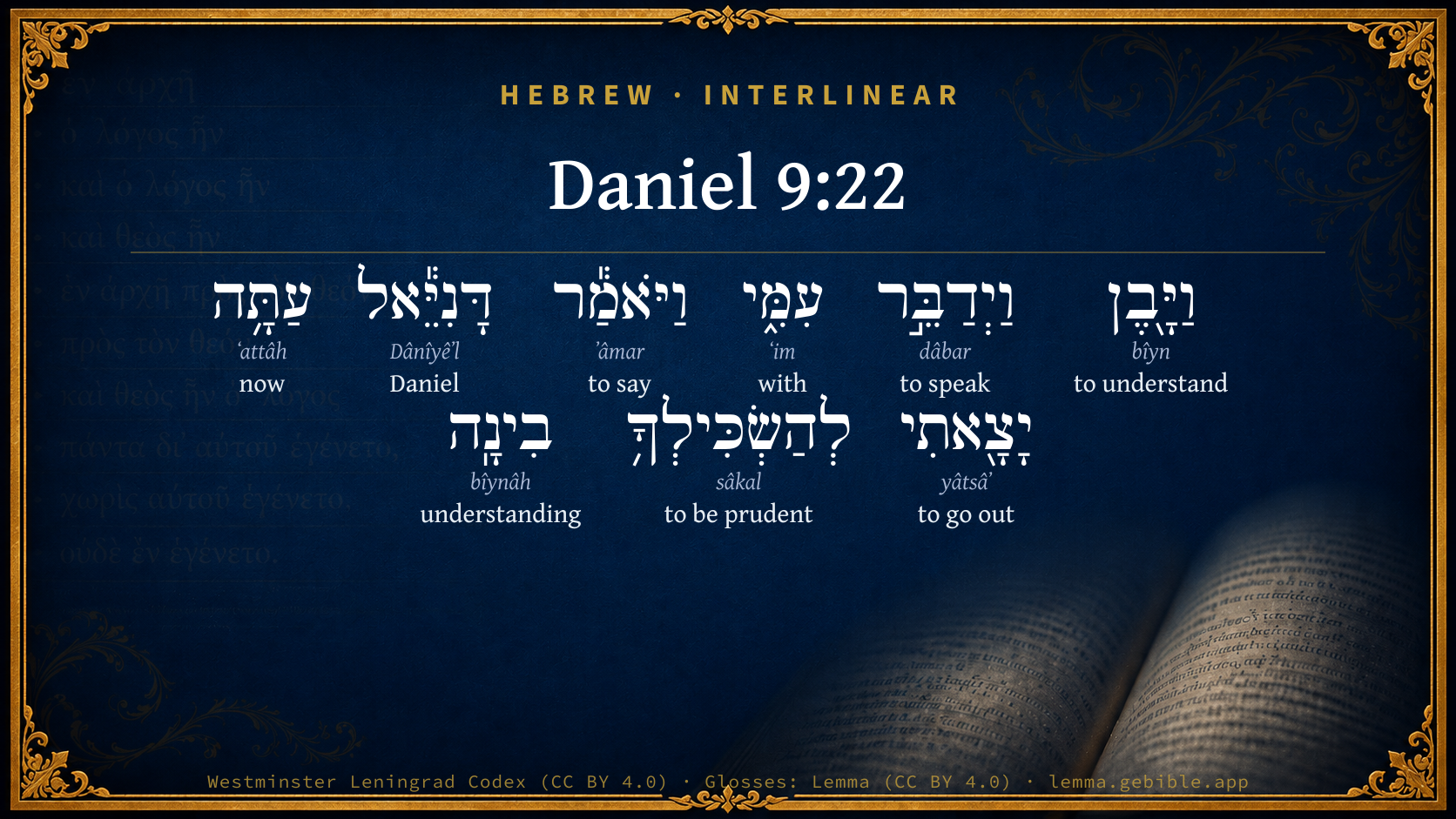
Hebrew (Westminster Leningrad Codex) Daniel 9:22 appears in the Hebrew Old Testament. The text above is from the Westminster Leningrad Codex. Each word links to its Strong’s number, a concise gloss, and parsing drawn from the Open Scriptures Hebrew Bible morphology. Click any word for its full Brown-Driver-Briggs (BDB) entry.
Download image
Cite this verse

Daniel 9:22 (World English Bible). Public Domain. Lemma interlinear Bible study tool, https://lemma.gebible.app/v/daniel/9/22.

Show BibTeX & RIS
BibTeX
RIS
English Translation
He instructed me, and talked with me, and said, Daniel, I am now come forth to give you wisdom and understanding.
World English Bible · Public Domain
Download a study sheet

One document with this verse’s original text, its word-by-word gloss line, the meaning frame, cross-references with their text, attributed commentary, and full source and license credits — printable, and it pastes into notes with its structure intact.

This verse Autodidact and up

Study sheet (.html) Plain text (.txt)

A passage Seminary Student

Up to 50 verses in one chapter. A passage sheet keeps up to 6 commentary sources and 12 cross-references per verse, in the order this page ranks them, and says so on the sheet whenever that leaves anything out. Ask for a single verse and you get the Autodidact verse sheet above.

Everything on this page stays free to read, with no account — the sheet is a download of what is already on screen, not access to it.

Want to remove ads? Support Godless Engineer
Compare translations 3

The same verse in 3 English versions, stacked beneath the original-language interlinear above. Click any original word for its lexicon entry.

Each is an independent rendering of the whole verse — the interlinear is not word-aligned to these translations.

Highlighted words mark where these versions differ — a whole-verse word diff, not a word-by-word alignment.

  • World English Bible Public Domain
    He instructed me, and talked with me, and said, Daniel, I am now come forth to give you wisdom and understanding.
  • King James Version Public Domain
    And he informed me, and talked with me, and said, O Daniel, I am now come forth to give thee skill and understanding.
  • unfoldingWord Literal Text CC BY-SA 4.0
    He gave me understanding and spoke with me and said, “O Daniel, I have now come out to give you insight and understanding.

unfoldingWord Literal Text — © unfoldingWord, licensed CC BY-SA 4.0. Word-aligned USFM3 via Door43 (git.door43.org/unfoldingWord/en_ult).

Versions to compare (up to 4)

3 of 4 selected

Show all 18 translations

Every available English version of this verse, each an independent rendering of the whole verse.

  • World English Bible Public Domain
    He instructed me, and talked with me, and said, Daniel, I am now come forth to give you wisdom and understanding.
  • Berean Standard Bible Public Domain
    He instructed me and spoke with me, saying: “O Daniel, I have come now to give you insight and understanding.
  • Majority Standard Bible Public Domain
    He instructed me and spoke with me, saying: “O Daniel, I have come now to give you insight and understanding.
  • King James Version Public Domain
    And he informed me, and talked with me, and said, O Daniel, I am now come forth to give thee skill and understanding.
  • American Standard Version (1901) Public Domain
    And he instructed me, and talked with me, and said, O Daniel, I am now come forth to give thee wisdom and understanding.
  • Revised Version (1885) Public Domain
    And he instructed me, and talked with me, and said, O Daniel, I am now come forth to make thee skilful of understanding.
  • Geneva Bible (1599) Public Domain
    And he informed me, and talked with me, and sayd, O Daniel, I am now come forth to giue thee knowledge and vnderstanding.
  • Douay-Rheims (1899) Public Domain
    And he instructed me, and spoke to me, and said: O Daniel, I am now come forth to teach thee, and that thou mightest understand.
  • Young's Literal Translation Public Domain
    And he giveth understanding, and speaketh with me, and saith, `O Daniel, now I have come forth to cause thee to consider understanding wisely;
  • Literal Standard Version CC BY-SA 4.0
    And he gives understanding, and speaks with me, and says, O Daniel, now I have come forth to cause you to consider understanding wisely;
  • Unlocked Literal Bible CC BY-SA 4.0
    He gave me understanding and said to me, “Daniel, I have now come out to give you insight and understanding.
  • unfoldingWord Literal Text CC BY-SA 4.0
    He gave me understanding and spoke with me and said, “O Daniel, I have now come out to give you insight and understanding.
  • Darby Bible Public Domain
    And he informed [me], and talked with me, and said, Daniel, I am now come forth to make thee skilful of understanding.
  • World Messianic Bible Public Domain
    He instructed me and talked with me, and said, “Daniel, I have now come to give you wisdom and understanding.
  • Webster's Bible Public Domain
    And he informed me, and talked with me, and said, O Daniel, I am now come forth to give thee skill and understanding.
  • Free Bible Version CC BY-SA 4.0
    He gave me the following explanation, saying, “Daniel, I've come to give you insight and understanding.
  • Bible in Basic English Public Domain
    And teaching me and talking to me he said, O Daniel, I have come now to give you wisdom.
  • JPS Tanakh (1917) Public Domain
    And he made me to understand, and talked with me, and said: 'O Daniel, I am now come forth to make thee skilful of understanding.

Literal Standard Version (2020), Covenant Press — licensed CC BY-SA 4.0. Text via the HelloAO Bible API (eBible.org). Unlocked Literal Bible (unfoldingWord) — licensed CC BY-SA 4.0. Text via the HelloAO Bible API (eBible.org). unfoldingWord Literal Text — © unfoldingWord, licensed CC BY-SA 4.0. Word-aligned USFM3 via Door43 (git.door43.org/unfoldingWord/en_ult). Free Bible Version, Dr. Jonathan Gallagher — licensed CC BY-SA 4.0. Text via the HelloAO Bible API (eBible.org).

Word by word

More ways to search: Search by grammar → Find every occurrence → Compare this word →

Practice this passage: Drill this verse → Learn its vocabulary →

דָּנִיֵּ֕אל
Dânîyêʼl
H1840
“Daniel”
Noun, Proper
Part of Speech
Noun
Type
Proper
Full BDB Definition

Origin: from H1835 and H410

TWOT: None

Daniel = "God is my judge" - the 2nd son of David, by Abigail the Carmelitess - the 4th of the greater prophets, taken as hostage in the first deportation to Babylon, because of the gift of God of the interpretation of dreams, he became the 2nd in command of the Babylon empire and lasted through the end of the Babylonian empire and into the Persian empire. His prophecies are the key to the understanding of end time events. Noted for his purity and holiness by contemporary prophet, Ezekiel - a priest of the line of Ithamar who sealed the covenant with Nehemiah
  1. וַיָּ֖בֶן bîyn H995 “and · to understand” Conjunction + Verb, Hiphil, Sequential Imperfect, 3rd Person, Masculine, Singular
  2. וַיְדַבֵּ֣ר dâbar H1696 “and · to speak” Conjunction + Verb, Piel, Sequential Imperfect, 3rd Person, Masculine, Singular
  3. עִמִּ֑י ʻim H5973 “with · me” Preposition + Suffix, Personal, 1st Person, Common, Singular
  4. וַיֹּאמַ֕ר ʼâmar H559 “and · to say” Conjunction + Verb, Qal, Sequential Imperfect, 3rd Person, Masculine, Singular
  5. עַתָּ֥ה ʻattâh H6258 “now” Adverb
  6. יָצָ֖אתִי yâtsâʼ H3318 “to go out” Verb, Qal, Perfect, 1st Person, Common, Singular
  7. לְהַשְׂכִּילְךָ֥ sâkal H7919 “to be prudent · you” Preposition + Verb, Hiphil, Infinitive Construct + Suffix, Personal, 2nd Person, Masculine, Singular
  8. בִינָֽה bîynâh H998 “understanding” Noun, Common, Feminine, Singular, Absolute

About this verse

These counts appear in no published source. They are computed here, from the morphology-tagged text and Lemma’s own curated glosses. What Lemma adds →

9
words
9
distinct lemmas
Prophets
section

Shared distinctive vocabulary

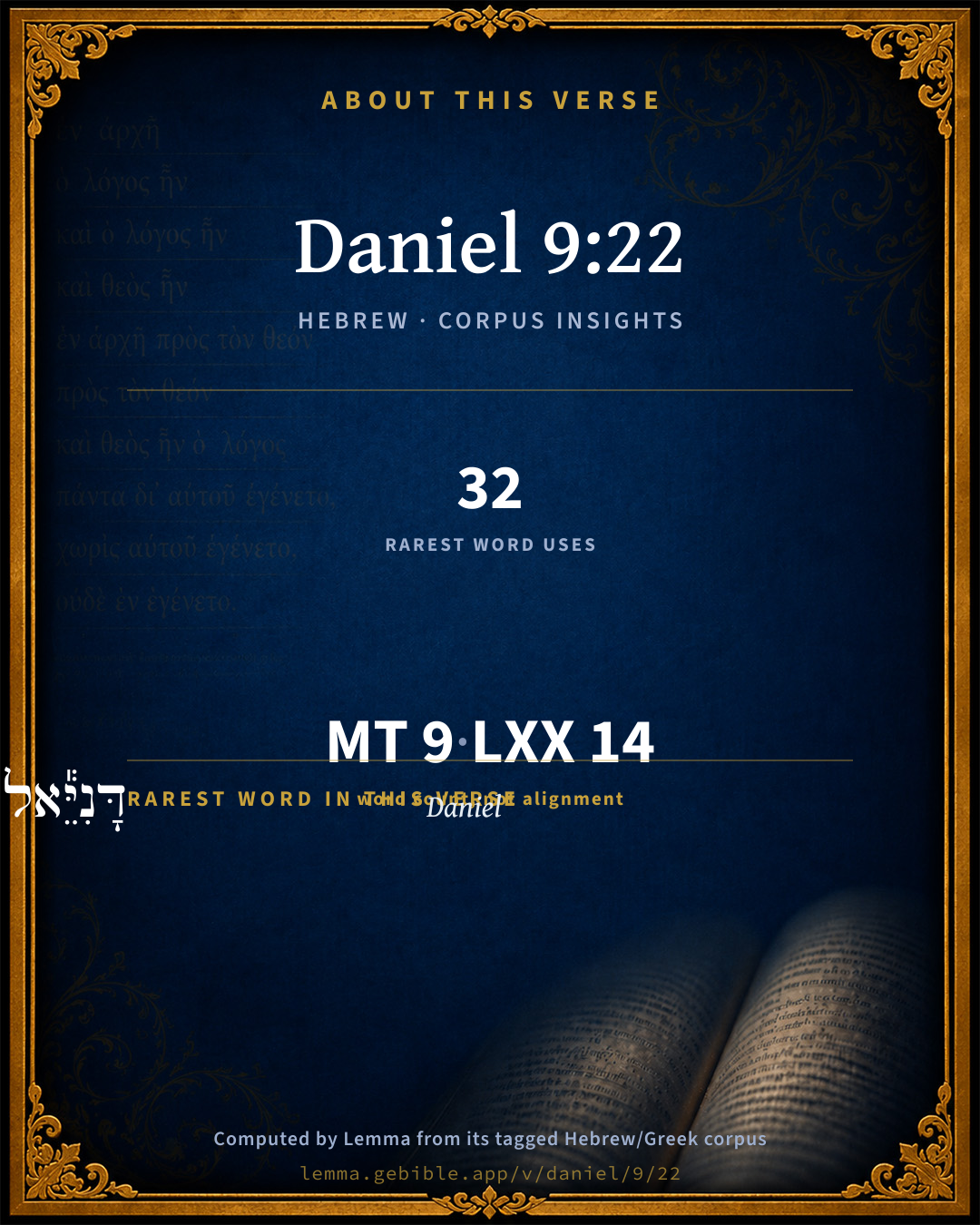
דָּנִיֵּ֕אל Daniel H1840 occurs in 28 verses of the Hebrew Bible. Also found in:

Grammatical profile

  • 5 verbs
  • 2 nouns
  • 1 preposition
  • 1 adverb

Verb forms

  • וַיָּ֖בֶן Hiphil · Sequential Imperfect
  • וַיְדַבֵּ֣ר Piel · Sequential Imperfect
  • וַיֹּאמַ֕ר Qal · Sequential Imperfect
  • יָצָ֖אתִי Qal · Perfect
  • לְהַשְׂכִּילְךָ֥ Hiphil · Infinitive Construct

Hebrew & Septuagint length

In English translation the verse runs 21 words from the Hebrew and 22 from the Septuagint (LXX English) — closely comparable.

A rough comparison of the two English renderings, which tokenize alike — not a word-level alignment.

Word counts can differ between the Hebrew and the Greek without any difference in meaning — e.g. the Hebrew direct-object marker אֵת has no separate Greek word, and Greek often adds the article ὁ.

In the original languages it is 9 Hebrew tokens and 14 Greek tokens — but the two are counted differently (Hebrew bundles its prefixes and suffixes into one token; the Greek is in lemma form), so that isn’t a like-for-like length.

Cross-references

7

Topical passages linked to Daniel 9:22 in the Treasury of Scripture Knowledge — connected by theme and wording, ordered by reader-vote popularity; previews shown in the World English Bible.

  • Daniel 9:24–27 Seventy weeks are decreed on your people and on your holy city, to finish disobedience, and to make an end of sins, and to make reconciliation for iniquity, and to bring in everlasting righteousness, and to seal up vision and prophecy, and to anoint the most holy.
  • Daniel 8:16 I heard a man's voice between [the banks of] the Ulai, which called, and said, Gabriel, make this man to understand the vision.
  • Daniel 10:21 But I will tell you that which is inscribed in the writing of truth: and there is none who holds with me against these, but Michael your prince."
  • Zechariah 1:9 Then I asked, 'My lord, what are these?'" The angel who talked with me said to me, "I will show you what these are."
  • Zechariah 1:14 So the angel who talked with me said to me, "Proclaim, saying, 'Thus says Yahweh of Hosts: "I am jealous for Jerusalem and for Zion with a great jealousy.
  • Zechariah 6:4–5 Then I asked the angel who talked with me, "What are these, my lord?"
  • Revelation 4:1 After these things I looked and saw a door opened in heaven, and the first voice that I heard, like a trumpet speaking with me, was one saying, "Come up here, and I will show you the things which must happen after this."

Cross-references courtesy of OpenBible.info (CC BY 4.0).

Hebrew and Greek witnesses Masoretic Hebrew ↔ Greek Septuagint

The same verse in the two great witnesses to the Old Testament, shown verse-for-verse.

These are two independent witnesses, not word-aligned to each other, and the Septuagint is shown in lemma (dictionary) form.

Hebrew Daniel 9:22 Masoretic · Westminster Leningrad Codex

וַיָּ֖בֶן וַיְדַבֵּ֣ר עִמִּ֑י וַיֹּאמַ֕ר דָּנִיֵּ֕אל עַתָּ֥ה יָצָ֖אתִי לְהַשְׂכִּילְךָ֥ בִינָֽה

He instructed me, and talked with me, and said, Daniel, I am now come forth to give you wisdom and understanding.

World English Bible · Public Domain

Greek LXX Daniel 9:22 Septuagint · lemma form

καί προςἔρχομαι καί λαλέω μετά ἐγώ καί εἶπον δανιηλ ἄρτι ἐκἔρχομαι ὑποδεικνύω σύ διάνοια

And he instructed me, and spoke with me, and said, O Daniel, I am now come forth to impart to you understanding.

LXX2012 (modern English Septuagint) · Public Domain

On this verse, The Cambridge Bible for Schools and Colleges discusses the Septuagint’s reading. Read the note in Commentary ↓

Hebrew: Westminster Leningrad Codex (CC BY 4.0). Greek: Septuagint (public domain); English from LXX2012 (modern English Septuagint) (Public Domain). How the Septuagint differs from the Hebrew →

Commentary

Notes on Daniel 9:22 from classic Christian and Jewish commentators (each source and its license shown beneath its notes). The classic Christian expositions comment on the surrounding passage and are grouped to its opening verse, so a note may address several verses; the Jewish commentaries on the Tanakh (Rashi and others) are per-verse, so they appear only where the commentator wrote on this verse.

Lemma curates 59 commentaries, every one of them public domain or Creative Commons licensed, each selected and text-cleaned for this edition rather than reprinted as found. About our sources →

Trapp's Complete Commentary

John Trapp

Dan 9:22 And he informed [me], and talked with me, and said, O Daniel, I am now come forth to give thee skill and understanding.

Ver. 22. And he informed me, and talked with me.] Rather than the saints shall want information and comfort, God will spare one out of his own train to do them any good office; {Luk 1:19 Gal 3:19} neither will the greatest angel in heaven grudge to serve them.

I am now come forth to give thee skill.] Not by infusion, for so the Holy Ghost only, but by instruction, as was before noted. It is well observed by one, that this following oration of the angel containeth an abridgment of the New Testament, and a light to the Old; for confirming Daniel, as touching the ensuing deliverance out of Babylon’s captivity, he further advertiseth and assureth him of the spiritual deliverance which Christ shall effect by his gospel at his coming; and therefore, describing the times most accurately, he plainly setteth forth the salvation of the Church Christian, and the destruction of the stubborn and rebellious Jews, who judge themselves unworthy of eternal life.

John Trapp, A Commentary or Exposition upon All the Books of the Old and New Testament (1647–1656) — public domain. Text from a community e-Sword module.

Joseph Benson's Commentary

Dan 9:22-23. And he informed me — Namely, on what errand he came; and talked with me — That is, familiarly, as one friend talks with another. And said, O Daniel, I am come to give thee skill and understanding — To reveal to thee things of infinite importance, and to make thee understand them. Mr. Wintle reads this verse in connection with the preceding, as follows: “Even as I was yet speaking — the man Gabriel — reached me, about the time of the evening oblation; when he brought information, and talked with me, and said, O Daniel, I am now come forth to improve thee in understanding.” At the beginning of thy supplication the commandment came forth — God’s command to me, to instruct thee further in what should hereafter befall the city and temple of Jerusalem, in the behalf of which thou didst pour forth thy supplications. Here was a remarkable completion of that promise, Isa 65:24, While they are yet speaking I will hear. For thou art greatly beloved — Learned men have observed a near affinity between the prophecy of Daniel and the Revelation of St. John; and we may take notice that much the same title is given to both. Daniel is styled here, and chap. Dan 10:11; Dan 10:19, a man greatly beloved; and the character given to St. John is, that of the disciple whom Jesus loved, Joh 21:20; Joh 21:24. Therefore, understand the matter, and consider the vision — Apply thy mind carefully to what is said, for this prophecy contains in it truths of the greatest importance. Our Saviour plainly refers to these words, which are repeated Dan 9:25, when, explaining the latter part of this prophecy of the final destruction of Jerusalem, he adds, Let him that readeth understand, Matthew 24.

Joseph Benson's Commentary on the Old and New Testaments (1811–1818) — public domain. Text from a community e-Sword module.

Tyndale Open Study Notes

Tyndale Open Resources

9:22 In the book of Daniel, insight and understanding are key words that often refer to the meaning of God’s revelation (cp. 1:4; 9:13, 25; 11:33, 35). God did not promise Daniel the answers to all of his questions, but rather, a basic grasp of the issues. God is in charge of history.

Tyndale Open Study Notes — © Tyndale Open Resources, licensed CC BY-SA 4.0. Text via the HelloAO Bible API.

Jamieson, Fausset & Brown

Robert Jamieson, A. R. Fausset & David Brown

to give thee . . . understanding-- Dan 8:16; Dan 8:26 shows that the symbolical vision had not been understood. God therefore now gives "information" directly, instead of by symbol, which required interpretation.

Jamieson, Fausset & Brown — Commentary Critical and Explanatory on the Whole Bible (1871) — public domain (CC PDM 1.0). Text via the HelloAO Bible API.

John Calvin's Commentaries

Here the angel prepares the Prophet’s mind by saying, he came from heaven to teach him. I went forth, says he, to cause thee to understand. For Daniel ought to understand from this angel’s duty, what he ought himself to do. As God had deigned to honor him so highly by setting before him one of his angels as his master and teacher, the Prophet ought not to neglect so singular a favor, lest he should seem ungrateful to God. We now understand why the angel testifies to his coming to teach the Prophet And we also ought to reflect upon this whenever we enter God’s Temple, or read any passage of holy Scripture, and acknowledge teachers to be sent to us from God to assist us in our ignorance, and to interpret the Scriptures for us. We ought also to admit Scripture to be given to us to enable us to find there whatever would otherwise be hidden from us. For God opens, as it were, his own heart to us, when he makes known to us his secrets by means of the Law, and the Prophets, and his Apostles also. Thus, Paul shews the gospel to be preached for the obedience of the faith, (Romans 1:5;) as if he had said, we shall not escape with impunity, unless we obediently embrace the doctrine of the gospel; otherwise, we do our utmost to frustrate the designs of God and elude his counsels, unless we faithfully obey his word. It follows, —

John Calvin's Commentaries (1540-1563) — public domain. Text from the Calvin Translation Society English edition (1840s-50s) via the Christian Classics Ethereal Library (ccel.org). Calvin's coverage is partial (roughly two-thirds of the Bible); uncommented books and verses are honest gaps, never fabricated. The 19th-century editor's footnotes and remarks are omitted so the notes are faithfully Calvin's own voice.

Ellicott's Commentary for English Readers

(22) He informed me—i.e., gave me understanding (as Dan_9:2, Dan_8:16). The angel gave Daniel understanding in the perplexing words of Jeremiah, showing him that what affected his people was a period of seventy weeks that were yet to come, rather than seventy years which were already passed.

A Bible Commentary for English Readers, edited by Charles John Ellicott (1878–1897) — public domain. Text from a community e-Sword module.

The Cambridge Bible for Schools and Colleges

gen. ed. J. J. S. Perowne

22. and he informed me] better, made (me) to understand, as in Dan_8:16. But the pron. is (in the Heb.) much desiderated; and very probably we should read, with LXX, Pesh., And he came (ויבא for ויבן): so Bevan, Behrm., Marti.

to give thee skill and understanding] R.V. (from A.V. marg.) to make thee skilful (cf. Dan_1:4; Dan_1:17) of understanding. The verb might also be rendered to give thee discernment or make thee wise (cf. Dan_9:13 end).

The Cambridge Bible for Schools and Colleges (gen. ed. J. J. S. Perowne; Cambridge University Press, 1878–1918) — public domain. Text from a community e-Sword module.

John Gill's Exposition

And he informed me, and talked with me,.... He informed him, by talking with him, of the will of God, to restore the captivity of his people, to rebuild Jerusalem and the temple, and of the coming of the Messiah: or, "he caused me to attend" (n), "and talked with me"; he excited his attention to what he had to say, and caused him to advert to his discourse, in order to understand it:

and said, O Daniel, I am now come forth; just now come from heaven, from the presence of God, and by his order:

to give thee skill and understanding; or, "to instruct thee in understanding" (o); to teach thee the knowledge and give thee the understanding of secret things, which otherwise could not be known; such as particularly the time of the coming of Christ, which the angels themselves knew not till it was revealed; and being made acquainted with it, one of them is employed to make it known to Daniel; who is the only prophet that fixes the exact time of it, and was favoured with this divine and heavenly skill of knowing it, and of being the publisher of it to others.

(n) "attendere fecit", Michaelis. (o) "ad imbuendum te intelligentia", Piscator; "ad docendum te intelligentiam", Micaelis.

John Gill's Exposition of the Whole Bible (1746–1763) — public domain (CC PDM 1.0). Text via the HelloAO Bible API.

Albert Barnes' Notes on the Bible

And he informed me - Hebrew, Gave me intelligence or understanding. That is, about the design of his visit, and about what would be hereafter.

And talked with me - Spake unto me.

O Daniel, I am now come forth to give thee skill - Margin, “make thee skillful of.” The Hebrew is, literally, “to make thee skillful, or wise, in understanding.” The design was to give him information as to what was to occur.

Albert Barnes' Notes on the Bible (1834–1885) — public domain. Text from a community e-Sword/MySword module.

Matthew Poole's English Annotations

That is, to make thee know great and secret things concerning the city and sanctuary of Jerusalem, of the rebuilding of it, and of the Messiah, &c.

Matthew Poole's English Annotations on the Holy Bible (1683–1685) — public domain. Text from a community e-Sword/MySword module.

Whedon's Commentary on the Bible

Daniel D. Whedon

22. Daniel knew concerning the seventy years of the Babylonian captivity and its end (Dan_9:2); but the angel is now to make him “skillful of understanding” (R.V.) concerning the larger deliverance which shall come in the Messianic era.

Daniel D. Whedon (gen. ed.), Commentary on the Old and New Testaments (1874–1909) — public domain. Text from a community e-Sword module.

The Pulpit Commentary

And he informed me, and talked with me, and said, O Daniel, I am now come forth to give thee skill and understanding. The LXX and Peshitta render the first clause, "And he approached and talked with me." It is difficult to understand how that reading could have arisen from the Massoretic text, or how, on the other hand, the Massoretie text could have arisen from that behind the Septuagint. The rendering of the Septuagint in the last clause is better than that in our Authorized Version, and is in accordance with our Revised, "to make thee skilful of understanding." Theodotion agrees with the Massoretic. Although Daniel was highly endowed, and although he had before him the inspired words of Jeremiah, he had need of yet higher endowments to understand the secrets of the Divine plan. He knew that if he reckoned seventy years from the time when he himself had been carried captive, then the period was drawing to a close: but the sins of the people were still there. It might be that God would restrain the fulfilment of his promise; the more so that, if the prophecy of Jeremiah were reckoned from the fall of Jerusalem, twenty years would yet have to run. Daniel is concerned about the sins of his people, knowing that, unless they were removed, renewed punishment would befall them.

The Pulpit Commentary (1880–1919), ed. H.D.M. Spence-Jones & Joseph S. Exell — public domain. Text from a community e-Sword module.

Keil & Delitzsch

C. F. Keil & F. Delitzsch

ויּבן, he gave understanding, insight, as Dan 8:16. The words point back to Dan 9:2. First of all Gabriel speaks of the design and the circumstances of his coming. עתּה יצאתי, now, viz., in consequence of thy morning prayer, I am come, sc. from the throne of God. להשׂכּילך בינה, to instruct thee in knowledge. This is more particularly declared in Dan 9:23. At the beginning of Daniel's prayer a word, i.e., a communication from God, came forth, which he brought. דּבר, not a commandment, or the divine commandment to Gabriel to go to Daniel, but a word of God, and particularly the word which he announced to Daniel, Dan 9:24-27. The sentence, "for thou art a man greatly beloved" (חמוּדות = חמוּדות אישׁ, Dan 10:11, Dan 10:19, vir desideriorum, desideratissimus), does not contain the reason for Gabriel's coming in haste, but for the principal thought of the verse, the going forth of the word of God immediately at the beginning of Daniel's prayer. המּראה stands not for revelation, but is the vision, the appearance of the angel by whom the word of God was communicated to the prophet. מראה is accordingly not the contents of the word spoken, but the form for its communication to Daniel. To both - the word and the form of its revelation - Daniel must give heed. This revelation was, moreover, not communicated to him in a vision, but while in the state of natural consciousness.

Keil & Delitzsch — Biblical Commentary on the Old Testament (1861–1891) — public domain (CC PDM 1.0). Text via the HelloAO Bible API. (Old Testament only.)

unfoldingWord translationNotes

Door43 World Missions Community

insight and understanding

The words "insight" and "understanding" mean the same thing and emphasize that Gabriel will help Daniel to understand the message completely. (See: Doublet)

the order was given

This can be stated in active form. AT: "God gave the order" (See: Active or Passive)

consider this word

"think about this message"

the revelation

This refers back to the prophesy of Jeremiah in Daniel 9:2.

translationWords

Daniel

plea

mercy

love

word

reveal

unfoldingWord translationNotes — © Distant Shores Media and the Door43 World Missions Community, licensed CC BY-SA 4.0. Source: git.door43.org/Door43/en_tn.

Rashi

Rabbi Shlomo Yitzchaki (Rashi)

And he enabled me to understand Heb. וַיָבֶן.

Rashi on the Tanakh — English translations: “The Judaica Press complete Tanach with Rashi, translated by A. J. Rosenberg” (CC BY 4.0); “Pentateuch with Rashi's commentary by M. Rosenbaum and A.M. Silbermann, 1929-1934” (public domain); “The Metsudah Tanach series, Lakewood, N.J” (CC BY 4.0); and “The Book of Joshua, Metsudah Publications, 1997” (CC BY 4.0). Text via Sefaria.

Lesson kit

Teaching starters — assembled from the data on this page, not authored interpretation. Every prompt links to the verse data it draws on. Edit before teaching.

Daniel, in the Prophets, opens this verse with 9 words (9 distinct Hebrew lemmas). Its most distinctive word is Dânîyêʼl (“Daniel”). A historical commentator’s framing appears above. Read the whole chapter for the surrounding context.

Discussion questions

  1. The word Dânîyêʼl carries the sense “Daniel.” How does it shape the verse?
  2. 1 Chronicles 3:1 shares the word «Daniel» with this verse. How do the two illuminate each other?
  3. These translations render this verse differently; the difference is in the English rendering, not the original. What questions does that raise?
  4. The verb «וַיָּ֖בֶן» is Hiphil Sequential Imperfect. How does its form color the action?
  5. Reading how Trapp's Complete Commentary and Joseph Benson's Commentary read this verse, where do the two commentators agree and where do they part?

Things to notice

Reading settings

Reading text

Shown beneath each verse's original-language words.

Old Testament
Old Testament edition

Read the OT as the Masoretic Hebrew (MT) or the Greek Septuagint (LXX).

English shown for the Greek Septuagint (in the Hebrew ↔ Greek comparison).

Comparing translations? Open the Compare panel on any verse page to stack up to four side by side.