
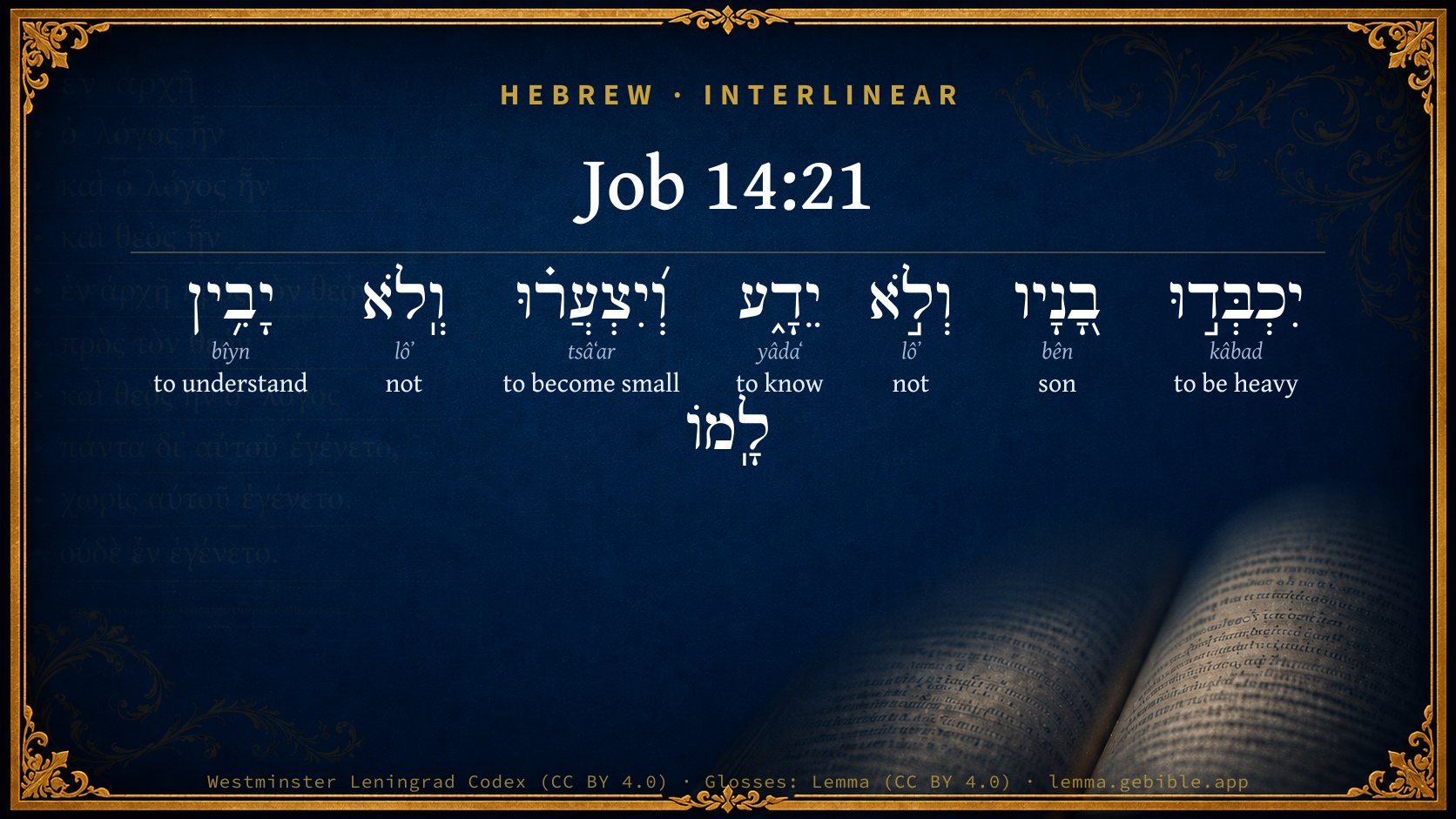
Job 14:21

Hebrew (Westminster Leningrad Codex) Job 14:21 appears in the Hebrew Old Testament. The text above is from the Westminster Leningrad Codex. Each word links to its Strong’s number, a concise gloss, and parsing drawn from the Open Scriptures Hebrew Bible morphology. Click any word for its full Brown-Driver-Briggs (BDB) entry.
Download image
Cite this verse

Job 14:21 (World English Bible). Public Domain. Lemma interlinear Bible study tool, https://lemma.gebible.app/v/job/14/21.

Show BibTeX & RIS
BibTeX
RIS
English Translation
His sons come to honor, and he doesn't know it; They are brought low, but he doesn't perceive it of them.
World English Bible · Public Domain
Highlights
  • 1 first appearance in the Hebrew Bible
Full analysis ↓
Download a study sheet

One document with this verse’s original text, its word-by-word gloss line, the meaning frame, cross-references with their text, attributed commentary, and full source and license credits — printable, and it pastes into notes with its structure intact.

This verse Autodidact and up

Study sheet (.html) Plain text (.txt)

A passage Seminary Student

Up to 50 verses in one chapter. A passage sheet keeps up to 6 commentary sources and 12 cross-references per verse, in the order this page ranks them, and says so on the sheet whenever that leaves anything out. Ask for a single verse and you get the Autodidact verse sheet above.

Everything on this page stays free to read, with no account — the sheet is a download of what is already on screen, not access to it.

Want to remove ads? Support Godless Engineer
Compare translations 3

The same verse in 3 English versions, stacked beneath the original-language interlinear above. Click any original word for its lexicon entry.

Each is an independent rendering of the whole verse — the interlinear is not word-aligned to these translations.

Highlighted words mark where these versions differ — a whole-verse word diff, not a word-by-word alignment.

  • World English Bible Public Domain
    His sons come to honor, and he doesn't know it; They are brought low, but he doesn't perceive it of them.
  • King James Version Public Domain
    His sons come to honour, and he knoweth it not; and they are brought low, but he perceiveth it not of them.
  • unfoldingWord Literal Text CC BY-SA 4.0
    His sons achieve honor and he does not know, or they become insignificant and he does not perceive them.

unfoldingWord Literal Text — © unfoldingWord, licensed CC BY-SA 4.0. Word-aligned USFM3 via Door43 (git.door43.org/unfoldingWord/en_ult).

Versions to compare (up to 4)

3 of 4 selected

Show all 18 translations

Every available English version of this verse, each an independent rendering of the whole verse.

  • World English Bible Public Domain
    His sons come to honor, and he doesn't know it; They are brought low, but he doesn't perceive it of them.
  • Berean Standard Bible Public Domain
    If his sons receive honor, he does not know it; if they are brought low, he is unaware.
  • Majority Standard Bible Public Domain
    If his sons receive honor, he does not know it; if they are brought low, he is unaware.
  • King James Version Public Domain
    His sons come to honour, and he knoweth it not; and they are brought low, but he perceiveth it not of them.
  • American Standard Version (1901) Public Domain
    His sons come to honor, and he knoweth it not; And they are brought low, but he perceiveth it not of them.
  • Revised Version (1885) Public Domain
    His sons come to honour, and he knoweth it not; and they are brought low, but he perceiveth it not of them.
  • Geneva Bible (1599) Public Domain
    And he knoweth not if his sonnes shall be honourable, neither shall he vnderstand concerning them, whether they shalbe of lowe degree,
  • Douay-Rheims (1899) Public Domain
    Whether his children come to honour or dishonour, he shall not understand.
  • Young's Literal Translation Public Domain
    Honoured are his sons, and he knoweth not; And they are little, and he attendeth not to them.
  • Literal Standard Version CC BY-SA 4.0
    His sons are honored, and he does not know; And they are little, and he does not attend to them.
  • Unlocked Literal Bible CC BY-SA 4.0
    If his sons are honored, he does not know it; and if they are brought low, he does not see it.
  • unfoldingWord Literal Text CC BY-SA 4.0
    His sons achieve honor and he does not know, or they become insignificant and he does not perceive them.
  • Darby Bible Public Domain
    His sons come to honour, and he knoweth it not; and they are brought low, and he perceiveth it not.
  • World Messianic Bible Public Domain
    His sons come to honor, and he doesn’t know it. They are brought low, but he doesn’t perceive it of them.
  • Webster's Bible Public Domain
    His sons come to honor, and he knoweth it not; and they are brought low, but he perceiveth it not of them.
  • Free Bible Version CC BY-SA 4.0
    Their children may become important or fall from their positions, but they don't know or see any of this.
  • Bible in Basic English Public Domain
    His sons come to honour, and he has no knowledge of it; they are made low, but he is not conscious of it.
  • JPS Tanakh (1917) Public Domain
    His sons come to honour, and he knoweth it not; and they are brought low, but he regardeth them not.

Literal Standard Version (2020), Covenant Press — licensed CC BY-SA 4.0. Text via the HelloAO Bible API (eBible.org). Unlocked Literal Bible (unfoldingWord) — licensed CC BY-SA 4.0. Text via the HelloAO Bible API (eBible.org). unfoldingWord Literal Text — © unfoldingWord, licensed CC BY-SA 4.0. Word-aligned USFM3 via Door43 (git.door43.org/unfoldingWord/en_ult). Free Bible Version, Dr. Jonathan Gallagher — licensed CC BY-SA 4.0. Text via the HelloAO Bible API (eBible.org).

Word by word

More ways to search: Search by grammar → Find every occurrence → Compare this word →

Practice this passage: Drill this verse → Learn its vocabulary →

About this verse

These counts appear in no published source. They are computed here, from the morphology-tagged text and Lemma’s own curated glosses. What Lemma adds →

8
words
6
distinct lemmas
Wisdom
section

Notable vocabulary

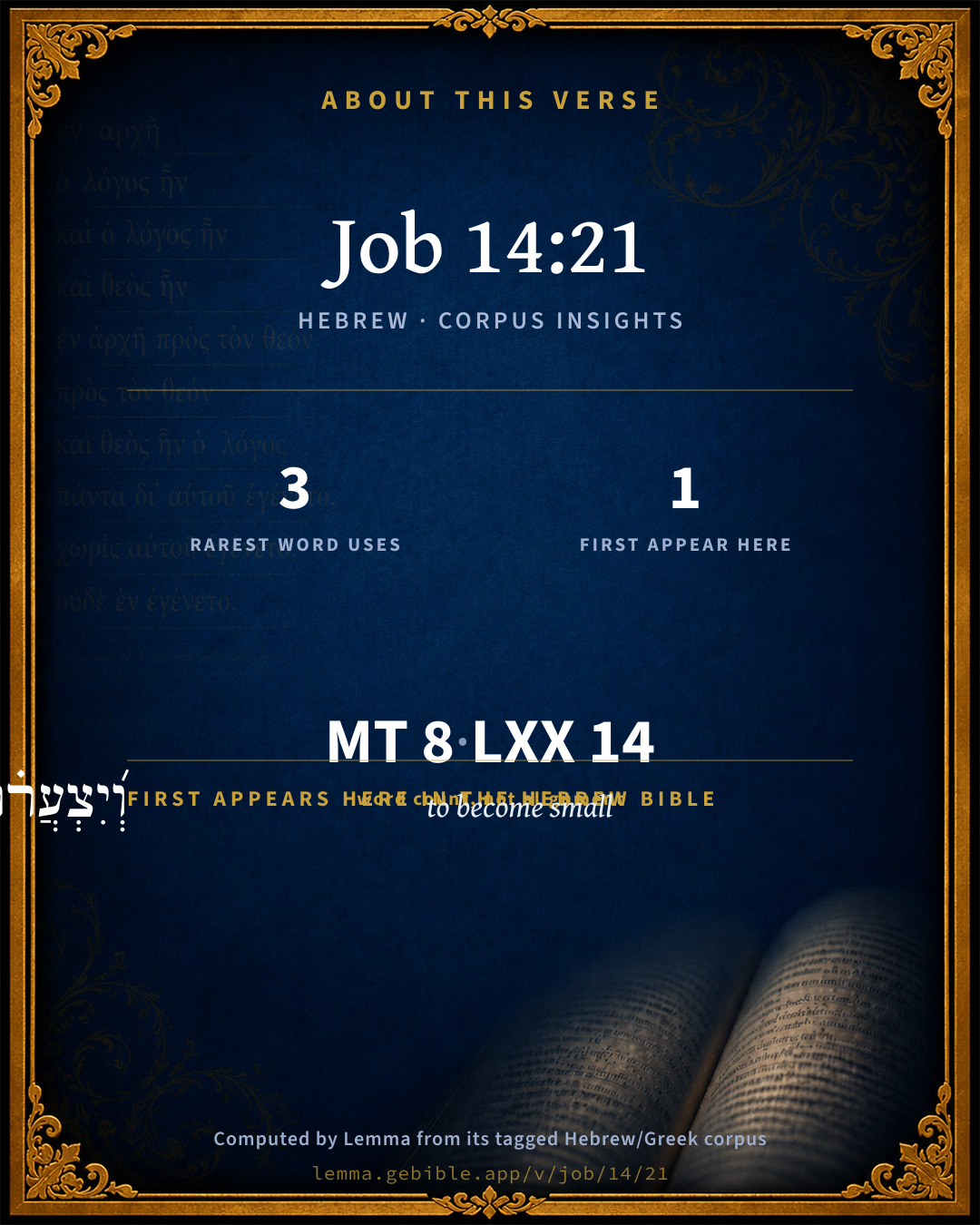
The rarest word here is וְ֝יִצְעֲר֗וּ to become small H6819 — appearing just 3 times in the whole Hebrew Bible.

First appearance in Scripture

This word makes its first canonical appearance in the Hebrew Bible here:

  • וְ֝יִצְעֲר֗וּ to become small H6819

Shared distinctive vocabulary

וְ֝יִצְעֲר֗וּ to become small H6819 occurs in 3 verses of the Hebrew Bible. Also found in:

Grammatical profile

  • 4 verbs
  • 1 noun
  • 1 preposition
  • 2 particles

Verb forms

  • יִכְבְּד֣וּ Qal · Imperfect
  • יֵדָ֑ע Qal · Imperfect
  • וְ֝יִצְעֲר֗וּ Qal · Imperfect
  • יָבִ֥ין Qal · Imperfect

Repetition

A word recurs within this verse — often emphatic in Hebrew:

  • וְלֹ֣א not H3808 ×2

Hebrew & Septuagint length

In English translation the verse runs 21 words from the Hebrew and 19 from the Septuagint (LXX English) — closely comparable.

A rough comparison of the two English renderings, which tokenize alike — not a word-level alignment.

Word counts can differ between the Hebrew and the Greek without any difference in meaning — e.g. the Hebrew direct-object marker אֵת has no separate Greek word, and Greek often adds the article ὁ.

In the original languages it is 8 Hebrew tokens and 14 Greek tokens — but the two are counted differently (Hebrew bundles its prefixes and suffixes into one token; the Greek is in lemma form), so that isn’t a like-for-like length.

Cross-references

6

Topical passages linked to Job 14:21 in the Treasury of Scripture Knowledge — connected by theme and wording, ordered by reader-vote popularity; previews shown in the World English Bible.

  • Ecclesiastes 9:5 For the living know that they will die, but the dead don't know anything, neither do they have any more a reward; for the memory of them is forgotten.
  • Ecclesiastes 2:18–19 I hated all my labor in which I labored under the sun, seeing that I must leave it to the man who comes after me.
  • Isaiah 63:16 For you are our Father, though Abraham doesn't know us, and Israel does not acknowledge us: you, Yahweh, are our Father; our Redeemer from everlasting is your name.
  • 1 Samuel 4:20 About the time of her death the women who stood by her said to her, Don't be afraid; for you have brought forth a son. But she didn't answer, neither did she regard it.
  • Psalms 39:6 "Surely every man walks like a shadow. Surely they busy themselves in vain. He heaps up, and doesn't know who shall gather.
  • Isaiah 39:7–8 Of your sons who shall issue from you, whom you shall father, shall they take away; and they shall be eunuchs in the palace of the king of Babylon.

Cross-references courtesy of OpenBible.info (CC BY 4.0).

Hebrew and Greek witnesses Masoretic Hebrew ↔ Greek Septuagint

The same verse in the two great witnesses to the Old Testament, shown verse-for-verse.

These are two independent witnesses, not word-aligned to each other, and the Septuagint is shown in lemma (dictionary) form.

Hebrew Job 14:21 Masoretic · Westminster Leningrad Codex

יִכְבְּד֣וּ בָ֭נָיו וְלֹ֣א יֵדָ֑ע וְ֝יִצְעֲר֗וּ וְֽלֹא יָבִ֥ין לָֽמוֹ

His sons come to honor, and he doesn't know it; They are brought low, but he doesn't perceive it of them.

World English Bible · Public Domain

Greek LXX Job 14:21 Septuagint · lemma form

πολύς δέ γίγνομαι ὁ υἱός αὐτός οὐ οἶδα ἐάν δέ ὀλίγος γίγνομαι οὐ ἐπίσταμαι

and though his children be multiplied, he knows it not; and if they be few, he is not aware.

LXX2012 (modern English Septuagint) · Public Domain

On this verse, Joseph Benson's Commentary discusses the Septuagint’s reading. Read the note in Commentary ↓

Hebrew: Westminster Leningrad Codex (CC BY 4.0). Greek: Septuagint (public domain); English from LXX2012 (modern English Septuagint) (Public Domain). How the Septuagint differs from the Hebrew →

Commentary

Notes on Job 14:21 from classic Christian and Jewish commentators (each source and its license shown beneath its notes). The classic Christian expositions comment on the surrounding passage and are grouped to its opening verse, so a note may address several verses; the Jewish commentaries on the Tanakh (Rashi and others) are per-verse, so they appear only where the commentator wrote on this verse.

Lemma curates 59 commentaries, every one of them public domain or Creative Commons licensed, each selected and text-cleaned for this edition rather than reprinted as found. About our sources →

Trapp's Complete Commentary

John Trapp

Job 14:21 His sons come to honour, and he knoweth [it] not; and they are brought low, but he perceiveth [it] not of them.

Ver. 21. His sons come to honour, and he knoweth it not] While he lieth sick, he regardeth no earthly thing, no, not what becometh of his children (formerly his greatest care), whether they be advanced or impaired in their outward condition, Omnis hi Ascanio churi stat cura parentis (Vir.). As when he is dead he can take no knowledge of anything done in this world, Isa 63:16 Ecc 2:19; Ecc 9:6, be his children or friends rich or poor, high or low, he is both ignorant and insensible. It was a base slander, published by a Jesuit, some years after Queen Elizabeth’s death, That as she died without sense or feeling of God’s mercies, so that she wished she might after her death hang a while in the air, to see what striving would be for her kingdom. As for that opinion of some Papists, That the dead do sometimes return into the land of the living, that they know how things go here, and make report thereof to those in heaven, it is contrary to the whole Scripture.

John Trapp, A Commentary or Exposition upon All the Books of the Old and New Testament (1647–1656) — public domain. Text from a community e-Sword module.

Joseph Benson's Commentary

Job 14:21. His sons come to honour — Hebrews יכבדו, jicbedu: increase either in number or in greatness. The LXX. render it, πολλων δε γενομενων, become many; and the word ויצערו, vejitzgnaru, and they are brought low, they interpret in the opposite sense, εαν δε ολιγοι γενωνται, if they be diminished, or become few. He knoweth it not, &c. — Either, 1st, He is ignorant of all such events; or, 2d, Is not concerned nor affected with them. A dead or dying man minds not these things. The consideration of this should moderate our cares concerning our children and families. God will know what becomes of them or happens to them, when we are gone. To him, therefore, let us commit them: with him let us leave them; and not burden ourselves with needless, fruitless cares concerning them.

Joseph Benson's Commentary on the Old and New Testaments (1811–1818) — public domain. Text from a community e-Sword module.

Jamieson, Fausset & Brown

Robert Jamieson, A. R. Fausset & David Brown

One striking trait is selected from the sad picture of the severance of the dead from all that passes in the world (Ecc 9:5), namely, the utter separation of parents and children.

Jamieson, Fausset & Brown — Commentary Critical and Explanatory on the Whole Bible (1871) — public domain (CC PDM 1.0). Text via the HelloAO Bible API.

Adam Clarke's Commentary

Verse 21. His sons come to honour] When dead, he is equally indifferent and unconscious whether his children have met with a splendid or oppressive lot in life; for as to this world, when man dies, in that day all his thoughts perish.

Adam Clarke's Commentary on the Bible (1810–1826) — public domain. Text from a community e-Sword/MySword module.

The Cambridge Bible for Schools and Colleges

gen. ed. J. J. S. Perowne

21. “The dead know not anything … also their love … is now perished,” Ecc_9:5-6.

The Cambridge Bible for Schools and Colleges (gen. ed. J. J. S. Perowne; Cambridge University Press, 1878–1918) — public domain. Text from a community e-Sword module.

John Gill's Exposition

His sons come to honour,.... Or "are multiplied" (s), see Nah 3:15; their families increase like a flock, become very numerous, which was reckoned a great blessing; or "become heavy" (t); being loaded with gold and silver, with riches and honour, raised to great grandeur and dignity, and possessed of much wealth and large estates:

and he knoweth it not; the man whose countenance is changed and sent away into another world; for the dead know nothing of the affairs of this life; a good man indeed after death knows more of God and Christ, of the doctrines of grace, and mysteries of Providence; but he knows nothing of the affairs of his family he has left behind: some understand this of a man on his death bed while alive, who, when he is told of the promotion of his sons to honour, or of the increase of their worldly substance, takes no notice of it; either being deprived of his senses by the disease upon him; or through the greatness of his pains and agonies, or the intenseness of his thoughts about a future state, does not notice what is told him, nor rejoice at it; which in the time of health would have been pleasing to him: but the first sense seems best:

and they are brought low, that is, his sons; or "are diminished" (u); lessened in their numbers, one taken off after another, and so his family decreases; or they come into low circumstances of life, are reduced in the world, and brought to straits and difficulties, to want and poverty:

but he perceiveth it not of them; he is not sensible of their troubles, and so not grieved at them; see Isa 63:16; or when he is told of them on his death bed, he does not take notice of them, or regard them, having enough to grapple with himself, and his mind intent on his everlasting state, or carried above them in the views of the love, grace, and covenant of God; see Sa2 23:5.

(s) , Sept. "multiplicabuntur", Vatablus, Bolducius. (t) "Multi vel graves sunt", Drusius; "graves erunt et onusti", Mercerus. (u) , Sept. "minuuntur, numero pauci sunt", Drusius.

John Gill's Exposition of the Whole Bible (1746–1763) — public domain (CC PDM 1.0). Text via the HelloAO Bible API.

Albert Barnes' Notes on the Bible

His sons come to honour, and he knoweth it not - He is unacquainted with what is passing on the earth. Even should that occur which is most gratifying to a parent’s heart; should his children rise to stations of honor and influence, he would not be permitted to enjoy the happiness which every father feels when his sons do well. This is suggested as one of the evils of death.

They are brought low, but he perceiveth it not of them - He is not permitted to sympathize with them, or to sustain them in their trials. This is another of the evils of death. When his children need his counsel and advice, he is not permitted to give it. He is taken away from his family, and revisits them no more.

Albert Barnes' Notes on the Bible (1834–1885) — public domain. Text from a community e-Sword/MySword module.

Haydock's Catholic Bible Commentary

Or dishonour. He cannot naturally be informed. (Menochius) --- God may, however, reveal to souls departed, what may increase their accidental happiness or misery. (Haydock) --- Hence the Church prays to the saints. Job is speaking chiefly of the body in the grave, and of what appear exteriorly. During life man cannot foresee the state of his children; not in the other world, would their condition render him happy or otherwise. (Calmet) (Mercer) --- Septuagint, "If his sons be many,...or....few, he knows not." (Haydock) --- He is not affected in the same manner as he would be, if living. (Worthington)

George Leo Haydock (1774–1849), Haydock's Catholic Family Bible and Commentary, 1859 edition — public domain. Excludes Psalms (Douay-Rheims chapter numbering differs from Protestant) and Deuterocanonical books (Catholic canon only).

Matthew Poole's English Annotations

He knoweth it not; either,

1. Is ignorant of all such events; or,

2. Is not concerned nor affected with them. A dead or dying man minds not these things.

Matthew Poole's English Annotations on the Holy Bible (1683–1685) — public domain. Text from a community e-Sword/MySword module.

Whedon's Commentary on the Bible

Daniel D. Whedon

21. He knoweth it not — The dead are ignorant of what takes place among the living. Compare Ecc_9:5-6. The poet laureate has transferred to his page the painful thought of Job.

His little daughter, whose sweet face

He kissed, taking his last embrace,

Becomes dishonour to her race —

His sons grow up that bear his name,

Some grow to honour, some to shame;

But he is chill to praise or blame.

— TENNYSON — Two Voices.

On the contrary, the religion of Confucius, which consists of the worship of ancestors, hinges upon the knowledge that the dead still retain of the living. “They are regarded as watching with affectionate interest all the varied fortunes of their progeny, and urging them along the beaten road of duty to a higher and happier state of being.” — HARDWICKE, Christ, etc. This dogma, apparently harmless, deteriorated into the dethronement of Deity and the worship of the dead. The ethics of Aristotle (i, chap. ix) read almost like a comment upon our text. He argues that “if any thing does pierce the veil and reach them, it must be something trivial and small, either in itself or to them.”

Daniel D. Whedon (gen. ed.), Commentary on the Old and New Testaments (1874–1909) — public domain. Text from a community e-Sword module.

The Pulpit Commentary

His sons come to honour, and he knoweth it not. The meaning seems to be, "If his sons come to honour, it is of no advantage to him; in the remote and wholly separate region of Sheol he will not be aware of it." The view is more dismal than that of Aristotle, who argues that the fate of those whom they have loved and left on earth will be sure to penetrate, in course of time (epi tina cronon ) to the departed, and cause them a certain amount of joy or sorrow ("Eth. Nic.," 1:11). And they are brought low, but he perceiveth it not of them. Equally, in the opposite case, if his sons are brought low, he is ignorant of it, and unaffected by their fate.

The Pulpit Commentary (1880–1919), ed. H.D.M. Spence-Jones & Joseph S. Exell — public domain. Text from a community e-Sword module.

John Wesley's Explanatory Notes

Knoweth not - Either is ignorant of all such events: or, is not concerned or affected with them. A dead or dying man minds not these things.

John Wesley, Explanatory Notes Upon the Whole Bible (1754–1765) — public domain. Text via the GEBible commentary corpus.

Rashi

Rabbi Shlomo Yitzchaki (Rashi)

become wealthy Heb. יכבדו, lit. they will become heavy. They will become heavy with silver and gold, but he will not know.

and they become poor And they have little of any good, but he will not understand it.

Rashi on the Tanakh — English translations: “The Judaica Press complete Tanach with Rashi, translated by A. J. Rosenberg” (CC BY 4.0); “Pentateuch with Rashi's commentary by M. Rosenbaum and A.M. Silbermann, 1929-1934” (public domain); “The Metsudah Tanach series, Lakewood, N.J” (CC BY 4.0); and “The Book of Joshua, Metsudah Publications, 1997” (CC BY 4.0). Text via Sefaria.

Lesson kit

Teaching starters — assembled from the data on this page, not authored interpretation. Every prompt links to the verse data it draws on. Edit before teaching.

Job, in the Wisdom, opens this verse with 8 words (6 distinct Hebrew lemmas). Its most distinctive word is tsâʻar (“to become small”). A historical commentator’s framing appears above. Read the whole chapter for the surrounding context.

Discussion questions

  1. What does “to become small” (tsâʻar) contribute to the verse as a whole?
  2. This is the first place “to become small” appears in Scripture (first appears here). What does its debut here establish?
  3. How does Jeremiah 30:19, which shares the word «to become small», read alongside this verse?
  4. What does the repetition of “not” (2× in this one verse) do in this verse?
  5. The translations on this page render this verse differently — a whole-verse word diff, not a word-by-word alignment. What might account for the different wordings?
  6. «יִכְבְּד֣וּ» is a Qal Imperfect verb. How does that grammatical form shape the action described?
  7. Compare how Trapp's Complete Commentary and Joseph Benson's Commentary read this verse. Where do they agree or differ?

Things to notice

Reading settings

Reading text

Shown beneath each verse's original-language words.

Old Testament
Old Testament edition

Read the OT as the Masoretic Hebrew (MT) or the Greek Septuagint (LXX).

English shown for the Greek Septuagint (in the Hebrew ↔ Greek comparison).

Comparing translations? Open the Compare panel on any verse page to stack up to four side by side.