
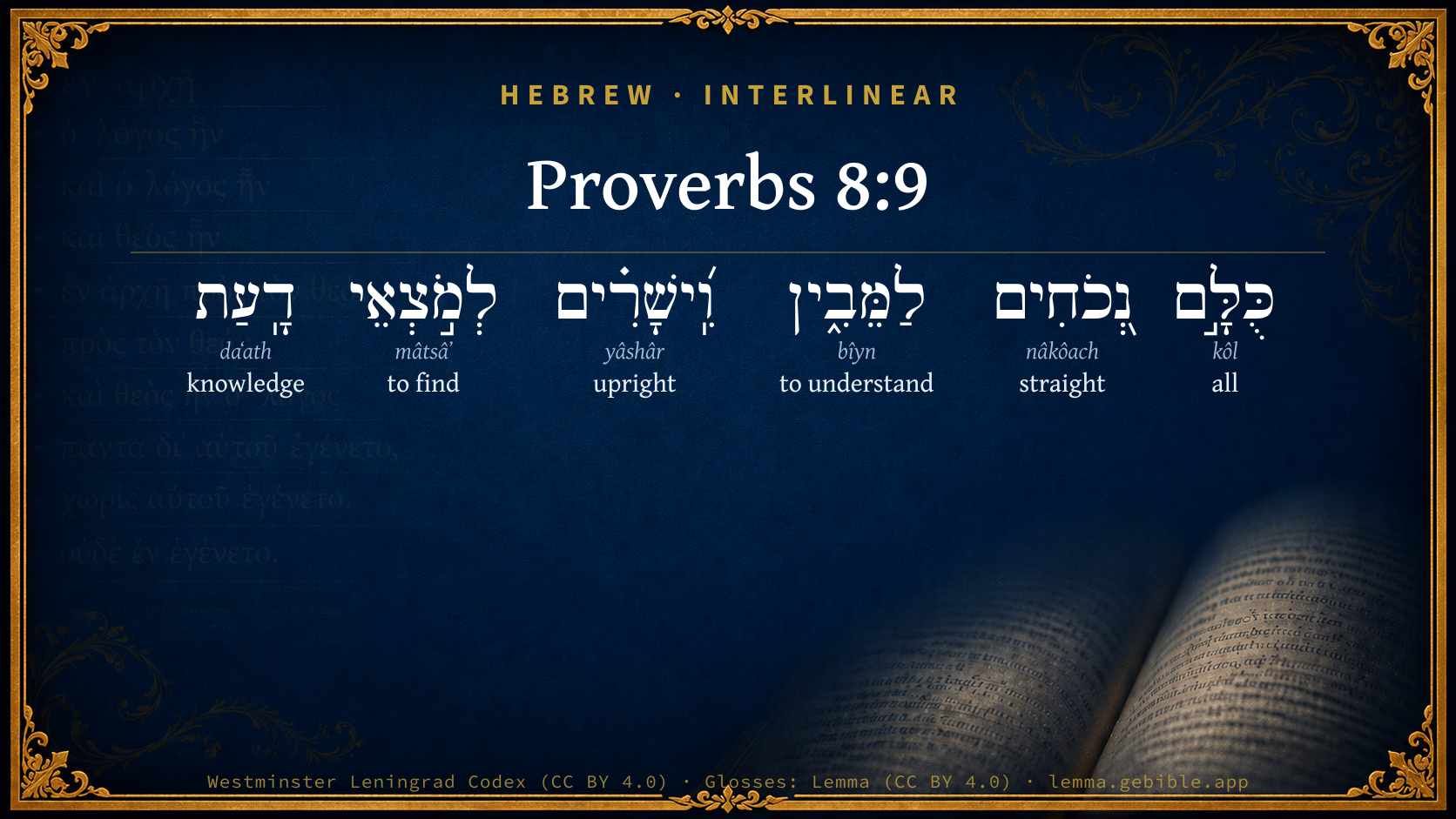
Proverbs 8:9

Hebrew (Westminster Leningrad Codex) Proverbs 8:9 appears in the Hebrew Old Testament. The text above is from the Westminster Leningrad Codex. Each word links to its Strong’s number, a concise gloss, and parsing drawn from the Open Scriptures Hebrew Bible morphology. Click any word for its full Brown-Driver-Briggs (BDB) entry.
Download image
Cite this verse

Proverbs 8:9 (World English Bible). Public Domain. Lemma interlinear Bible study tool, https://lemma.gebible.app/v/proverbs/8/9.

Show BibTeX & RIS
BibTeX
RIS
English Translation
They are all plain to him who understands, Right to those who find knowledge.
World English Bible · Public Domain
Download a study sheet

One document with this verse’s original text, its word-by-word gloss line, the meaning frame, cross-references with their text, attributed commentary, and full source and license credits — printable, and it pastes into notes with its structure intact.

This verse Autodidact and up

Study sheet (.html) Plain text (.txt)

A passage Seminary Student

Up to 50 verses in one chapter. A passage sheet keeps up to 6 commentary sources and 12 cross-references per verse, in the order this page ranks them, and says so on the sheet whenever that leaves anything out. Ask for a single verse and you get the Autodidact verse sheet above.

Everything on this page stays free to read, with no account — the sheet is a download of what is already on screen, not access to it.

Want to remove ads? Support Godless Engineer
Compare translations 3

The same verse in 3 English versions, stacked beneath the original-language interlinear above. Click any original word for its lexicon entry.

Each is an independent rendering of the whole verse — the interlinear is not word-aligned to these translations.

Highlighted words mark where these versions differ — a whole-verse word diff, not a word-by-word alignment.

  • World English Bible Public Domain
    They are all plain to him who understands, Right to those who find knowledge.
  • King James Version Public Domain
    They are all plain to him that understandeth, and right to them that find knowledge.
  • unfoldingWord Literal Text CC BY-SA 4.0
    All of them straightforward things for the understanding one and upright things for finders of knowledge.

unfoldingWord Literal Text — © unfoldingWord, licensed CC BY-SA 4.0. Word-aligned USFM3 via Door43 (git.door43.org/unfoldingWord/en_ult).

Versions to compare (up to 4)

3 of 4 selected

Show all 18 translations

Every available English version of this verse, each an independent rendering of the whole verse.

  • World English Bible Public Domain
    They are all plain to him who understands, Right to those who find knowledge.
  • Berean Standard Bible Public Domain
    They are all plain to the discerning, and upright to those who find knowledge.
  • Majority Standard Bible Public Domain
    They are all plain to the discerning, and upright to those who find knowledge.
  • King James Version Public Domain
    They are all plain to him that understandeth, and right to them that find knowledge.
  • American Standard Version (1901) Public Domain
    They are all plain to him that understandeth, And right to them that find knowledge.
  • Revised Version (1885) Public Domain
    They are all plain to him that understandeth, and right to them that find knowledge.
  • Geneva Bible (1599) Public Domain
    They are all plaine to him that will vnderstande, and streight to them that woulde finde knowledge.
  • Douay-Rheims (1899) Public Domain
    They are right to them that understand, and just to them that find knowledge.
  • Young's Literal Translation Public Domain
    All of them `are' plain to the intelligent, And upright to those finding knowledge.
  • Literal Standard Version CC BY-SA 4.0
    All of them [are] plain to the intelligent, || And upright to those finding knowledge.
  • Unlocked Literal Bible CC BY-SA 4.0
    All of them are straight for the person who understands; my words are upright for those who find knowledge.
  • unfoldingWord Literal Text CC BY-SA 4.0
    All of them straightforward things for the understanding one and upright things for finders of knowledge.
  • Darby Bible Public Domain
    They are all plain to him that understandeth, and right to them that find knowledge.
  • World Messianic Bible Public Domain
    They are all plain to him who understands, right to those who find knowledge.
  • Webster's Bible Public Domain
    They are all plain to him that understandeth, and right to them that find knowledge.
  • Free Bible Version CC BY-SA 4.0
    My words are straightforward to anyone with understanding; they are correct to those who have knowledge.
  • Bible in Basic English Public Domain
    They are all true to him whose mind is awake, and straightforward to those who get knowledge.
  • JPS Tanakh (1917) Public Domain
    They are all plain to him that understandeth, and right to them that find knowledge.

Literal Standard Version (2020), Covenant Press — licensed CC BY-SA 4.0. Text via the HelloAO Bible API (eBible.org). Unlocked Literal Bible (unfoldingWord) — licensed CC BY-SA 4.0. Text via the HelloAO Bible API (eBible.org). unfoldingWord Literal Text — © unfoldingWord, licensed CC BY-SA 4.0. Word-aligned USFM3 via Door43 (git.door43.org/unfoldingWord/en_ult). Free Bible Version, Dr. Jonathan Gallagher — licensed CC BY-SA 4.0. Text via the HelloAO Bible API (eBible.org).

Word by word

More ways to search: Search by grammar → Find every occurrence → Compare this word →

Practice this passage: Drill this verse → Learn its vocabulary →

About this verse

These counts appear in no published source. They are computed here, from the morphology-tagged text and Lemma’s own curated glosses. What Lemma adds →

6
words
6
distinct lemmas
Wisdom
section

Notable vocabulary

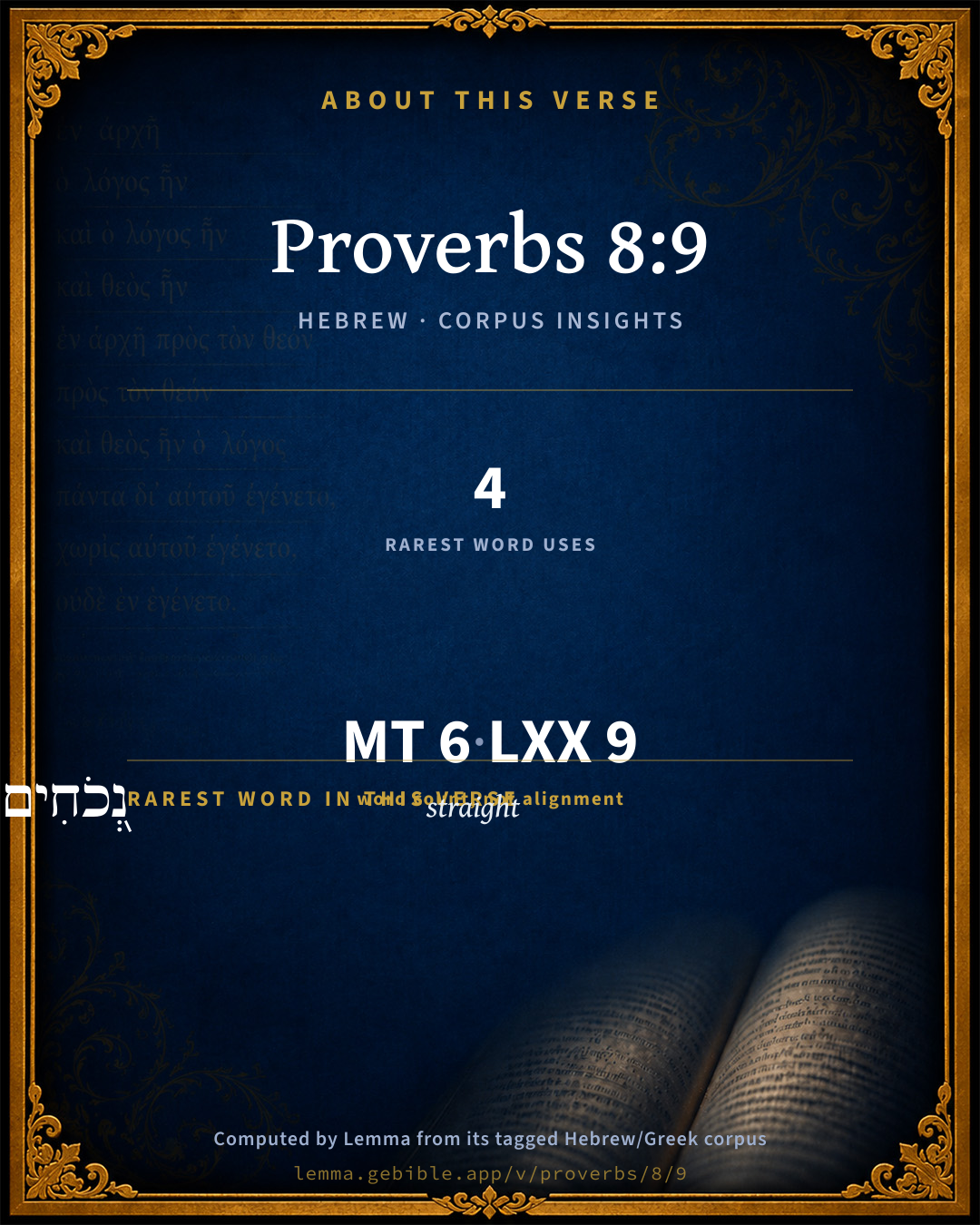
The rarest word here is נְ֭כֹחִים straight H5228 — appearing just 4 times in the whole Hebrew Bible.

Shared distinctive vocabulary

נְ֭כֹחִים straight H5228 occurs in 4 verses of the Hebrew Bible. Also found in:

Grammatical profile

  • 2 verbs
  • 2 nouns
  • 2 adjectives

Verb forms

  • לַמֵּבִ֑ין Hiphil · Participle Active
  • לְמֹ֣צְאֵי Qal · Participle Active

Hebrew & Septuagint length

In English translation the verse runs 14 words from the Hebrew and 15 from the Septuagint (LXX English) — closely comparable.

A rough comparison of the two English renderings, which tokenize alike — not a word-level alignment.

Word counts can differ between the Hebrew and the Greek without any difference in meaning — e.g. the Hebrew direct-object marker אֵת has no separate Greek word, and Greek often adds the article ὁ.

In the original languages it is 6 Hebrew tokens and 9 Greek tokens — but the two are counted differently (Hebrew bundles its prefixes and suffixes into one token; the Greek is in lemma form), so that isn’t a like-for-like length.

Cross-references

16

Topical passages linked to Proverbs 8:9 in the Treasury of Scripture Knowledge — connected by theme and wording, ordered by reader-vote popularity; previews shown in the World English Bible.

  • Proverbs 14:6 A scoffer seeks wisdom, and doesn't find it, But knowledge comes easily to a discerning person.
  • John 7:17 If anyone desires to do his will, he will know about the teaching, whether it is from God, or if I am speaking from myself.
  • James 1:5 But if any of you lacks wisdom, let him ask of God, who gives to all liberally and without reproach; and it will be given to him.
  • Psalms 25:12–14 What man is he who fears Yahweh? He shall instruct him in the way that he shall choose.
  • John 6:45 It is written in the prophets, 'They will all be taught by God.' Therefore everyone who hears from the Father, and has learned, comes to me.
  • Proverbs 15:24 The path of life leads upward for the wise, To keep him from going downward to Sheol.
  • Proverbs 18:1–2 An unfriendly man pursues selfishness, And defies all sound judgment.
  • Matthew 13:11–12 He answered them, "To you it is given to know the mysteries of the Kingdom of Heaven, but it is not given to them.
  • Psalms 19:7–8 Yahweh's law is perfect, restoring the soul. Yahweh's testimony is sure, making wise the simple.
  • Psalms 119:98–100 Your commandments make me wiser than my enemies, For your commandments are always with me.
  • Proverbs 15:14 The heart of one who has understanding seeks knowledge, But the mouths of fools feed on folly.
  • Proverbs 17:24 Wisdom is before the face of one who has understanding, But the eyes of a fool wander to the ends of the earth.
  • Proverbs 18:15 The heart of the discerning gets knowledge. The ear of the wise seeks knowledge.
  • Isaiah 35:8 A highway shall be there, and a way, and it shall be called The way of holiness. The unclean shall not pass over it, but is shall be for for him who walks in the Way. Wicked fools will not go there.
  • Micah 2:7 Shall it be said, O house of Jacob: "Is the Spirit of Yahweh angry? Are these his doings? Don't my words do good to him who walks blamelessly?"
  • 1 Corinthians 2:14–15 Now the natural man doesn't receive the things of God's Spirit, for they are foolishness to him, and he can't know them, because they are spiritually discerned.

Cross-references courtesy of OpenBible.info (CC BY 4.0).

Hebrew and Greek witnesses Masoretic Hebrew ↔ Greek Septuagint

The same verse in the two great witnesses to the Old Testament, shown verse-for-verse.

These are two independent witnesses, not word-aligned to each other, and the Septuagint is shown in lemma (dictionary) form.

Hebrew Proverbs 8:9 Masoretic · Westminster Leningrad Codex

כֻּלָּ֣ם נְ֭כֹחִים לַמֵּבִ֑ין וִֽ֝ישָׁרִ֗ים לְמֹ֣צְאֵי דָֽעַת

They are all plain to him who understands, Right to those who find knowledge.

World English Bible · Public Domain

Greek LXX Proverbs 8:9 Septuagint · lemma form

πᾶς ἐνώπιος ὁ συνἵημι καί ὀρθός ὁ εὑρίσκω γνῶσις

They are all evident to those that understand, and right to those that find knowledge.

LXX2012 (modern English Septuagint) · Public Domain

On this verse, The Pulpit Commentary discusses the Septuagint’s reading. Read the note in Commentary ↓

Hebrew: Westminster Leningrad Codex (CC BY 4.0). Greek: Septuagint (public domain); English from LXX2012 (modern English Septuagint) (Public Domain). How the Septuagint differs from the Hebrew →

Commentary

Notes on Proverbs 8:9 from classic Christian and Jewish commentators (each source and its license shown beneath its notes). The classic Christian expositions comment on the surrounding passage and are grouped to its opening verse, so a note may address several verses; the Jewish commentaries on the Tanakh (Rashi and others) are per-verse, so they appear only where the commentator wrote on this verse.

Lemma curates 59 commentaries, every one of them public domain or Creative Commons licensed, each selected and text-cleaned for this edition rather than reprinted as found. About our sources →

Trapp's Complete Commentary

John Trapp

Pro 8:9 They [are] all plain to him that understandeth, and right to them that find knowledge.

Ver. 9. They are all plain to him that understandeth.] Plain in things necessary to salvation; for as all duties, so all truths do not concern all men. God doth not expect or require that every man should be a doctor in the chair; but those points that direct to duty here, and salvation hereafter, are clear, express, and obvious to them that desire to understand them; for some there are, qui ut liberius peccent, libenter ignorant. {a} It was a smart answer which M. Durant, a witty and learned minister of the Reformed Church of Paris, gave to a lady of suspected chastity, and now revolted: when she pretended the hardness of the Scripture, Why, said he, madam, what can be more plain than "Thou shalt not commit adultery?" Had she not been failing in the practice of what she could not but know, she had found no cause to complain of the difficulty of that which she could not know.

{a} Bernard.

John Trapp, A Commentary or Exposition upon All the Books of the Old and New Testament (1647–1656) — public domain. Text from a community e-Sword module.

Geneva Bible (1599)

Geneva Bible translators

Meaning, that the word of God is easy unto all that have a desire unto it, and which are not blinded by the prince of this world.

Geneva Bible (1599) marginal notes — public domain. Text via Bolls.life.

Jamieson, Fausset & Brown

Robert Jamieson, A. R. Fausset & David Brown

plain . . . understandeth--easily seen by those who apply their minds.

that find--implying search.

Jamieson, Fausset & Brown — Commentary Critical and Explanatory on the Whole Bible (1871) — public domain (CC PDM 1.0). Text via the HelloAO Bible API.

Adam Clarke's Commentary

Verse 9. They are all plain] נכחים nechochim, straight forward, over against every man, level to every capacity. This is true of all that concerns the salvation of the soul.

To them that find knowledge.] When a man gets the knowledge of himself, then he sees all the threatenings of God to be right. When he obtains the knowledge of GOD in Christ, then he finds that all the promises of God are right - yea and amen.

Adam Clarke's Commentary on the Bible (1810–1826) — public domain. Text from a community e-Sword/MySword module.

Ellicott's Commentary for English Readers

(9) They are all plain . . .—Because “the secret of the Lord is (only) with them that fear Him “(Psa_25:14), and God reveals such things unto them by His Spirit (1Co_2:10), while the “natural man receiveth not the things of the Spirit of God, for they are foolishness unto him” (ibid., Pro_8:14).

A Bible Commentary for English Readers, edited by Charles John Ellicott (1878–1897) — public domain. Text from a community e-Sword module.

The Cambridge Bible for Schools and Colleges

gen. ed. J. J. S. Perowne

9. Comp. Mat_13:11; Mat_13:16.

Pro_8:10-11. The treasures she offers.

In place of gold and silver and precious stones and whatever else men covet, wisdom offers “durable riches,” intellectual, moral, spiritual treasures, and offers them in and with herself in responsive love to all who love and seek her.

The Cambridge Bible for Schools and Colleges (gen. ed. J. J. S. Perowne; Cambridge University Press, 1878–1918) — public domain. Text from a community e-Sword module.

John Gill's Exposition

They are all plain to him that understandeth,.... Whose understanding is enlightened by the Spirit of God; who is a spiritual man, that has a discerning, and can judge of spiritual things: as for the carnal man, let him have what natural knowledge or wisdom he will, he cannot know these things; for they are spiritually discerned, and can only be discerned by spiritual men. The Bible is a sealed book to others, learned or unlearned; the mysteries or doctrines of the Gospel are hid in parables from such; but those to whom Christ has given an understanding to know him, these know them, and they are plain unto them: for though there are some things hard to he understood in the Scriptures, as in Paul's epistles, and some sublime truths in the Gospel; yet those which are necessary to salvation are easily understood; that faithful saying, and worthy of all acceptation, that Jesus Christ came into the world to save the chief of sinners, is a very plain one;

and right to them that find knowledge; a spiritual and experimental knowledge of Christ and his truths. The Targum is,

"to them who desire knowledge;''

and so the Syriac version; that seek for it heartily and diligently, in a right way, in the use of proper means, under the direction and by the assistance of the Spirit of God.

John Gill's Exposition of the Whole Bible (1746–1763) — public domain (CC PDM 1.0). Text via the HelloAO Bible API.

Matthew Poole's English Annotations

Plain; evident and clear to their minds; or, right, just and good.

To him that understandeth; either to him who with an honest mind applies himself to the study of them in the diligent use of all the means appointed by God to that end; or to him whose mind God hath enlightened by his Spirit, though they seem otherwise to ignorant and carnal-minded men.

That find knowledge; that are truly wise and discerning persons, and taught of God.

Matthew Poole's English Annotations on the Holy Bible (1683–1685) — public domain. Text from a community e-Sword/MySword module.

Whedon's Commentary on the Bible

Daniel D. Whedon

9. Plain — Rather, in front of one; hence easily seen.

To them that find knowledge — Or, have found; that is, those possessing knowledge; the intelligent, the educated. However obscure these teachings may be to the untaught, gross, and sensual, they will be readily apprehended by well disposed and disciplined minds.

Daniel D. Whedon (gen. ed.), Commentary on the Old and New Testaments (1874–1909) — public domain. Text from a community e-Sword module.

The Pulpit Commentary

They are all plain to him that understandeth. The man who listens to and imbibes the teaching of Wisdom finds these words intelligible, and "to the point." Opening his heart to receive Divine instruction, he is rewarded by having his understanding enlightened; for while "the natural man receiveth not the things of the Spirit of God", (1Co_2:14) yet "the secret of the Lord is with them that fear him", (Psa_25:14) and "mysteries are revealed unto the meek" (Ecc_3:19, Complutensian a*). Right to them that find knowledge (ver. 10).

They form an even path without stumbling blocks for those who have learned to discern right from wrong, and are seeking to direct their lives in accordance with high motives. Septuagint, "They are all present (enwpia ) to those that understand, and right (orya ) to those that find knowledge.

Plain words.

The words of wisdom are here described as "plain words." This expression has been so often abused that it is almost as important to see what it does not mean as to consider what it does mean.

I WHAT THE EXPRESSION DOES NOT MEAN.

1. Lack of grace. A mistake arising from the confusion of two meanings of the term "plain" has been pointed out by Archbishop Whately, and yet it is often repeated. "Plain" means smooth, simple, easy, intelligible; "plain" also means bare, unadorned, unbeautiful. The two meanings are quite distinct. But some have thought that a plain sermon must be a sermon wanting in all grace of style and beauty of illustration. This is an inappropriate use of the word "plain." The words of Christ were plain, i.e. clear and simple; yet they were very beautiful and full of living illustrations. The duty to be plain is no excuse for slovenliness of speech.

2. Intellectual feebleness. Some people insist on having a "simple gospel" in a way that leads one to think they would condemn all vigour of thought. They forget that the teaching of St. Paul, which they admire so much, teemed with the highest intellectuality, and that he regarded the truth of the crucified Christ as the wisdom of God, and only as falsely mistaken for foolishness by the Greeks. It is the charm of the highest thinking that it can simplify difficulties. We sometimes fail to detect the great intellectual power of a writer just because this has been so perfect as to disguise all effort and make the result of processes of thought clear; while the laboured attempts of weaker minds induce us to mistake obscurity for profundity. Any subject looks simple in the hands of a master.

3. Rudeness and offensiveness. Disagreeable people make a virtue of being plain spoken when they are really harsh and inconsiderate. There is no unkindness about the plain words of the Bible. The Christian teacher should remember the admonitions, "Be pitiful, be courteous.

II WHAT THE EXPRESSION DOES MEAN.

1. It signifies that the words of wisdom are intelligible. The first object of revelation, of course, is to reveal. The first object of speech is to declare thoughts. It is the neglect of this simple point that has given an excuse for the sarcasm that "words were invented to conceal thoughts." The first duty of the speaker is to be plain. Afterwards he may be ornate if he will. But when the decorations of speech encumber its free movement and prevent it from accomplishing its practical ends, they are altogether encumbrances. And when intellectual power is wasted on a mere display of its own exercise, or confined to inventing difficulties and making obscure what was originally clear and simple, this also is misdirected. The Divine wisdom of the Bible claims to be intelligible. It is true that many people find. great difficulties in its pages, and all of us must confess that they are not to be fully measured and sounded. But

(1) they who approach them in a right way, having spiritual mind, so necessary for the discernment of spiritual things, will be able to understand the main, most important truths of Christianity; and

(2) whatever disputes may be raised about the meaning of the more abstract doctrines, the directions of duty and the indications of the things we are to do for our soul"s welfare are plain; indeed, the obscurity of religious subjects varies proportionately with their abstractness, with their separation from our life and duty.

2. It signifies that the words of wisdom indicate a plain sad simple course of action. They are "right," or rather "straight to those that find knowledge." We are not called to any complicated course of action. The intricacies of casuistry are not to be found in the Book of Proverbs nor anywhere else in the Bible. The way of duty is simple and straightforward.

The Pulpit Commentary (1880–1919), ed. H.D.M. Spence-Jones & Joseph S. Exell — public domain. Text from a community e-Sword module.

John Wesley's Explanatory Notes

To him - Whose mind God hath enlightened. To them - That are truly wise.

John Wesley, Explanatory Notes Upon the Whole Bible (1754–1765) — public domain. Text via the GEBible commentary corpus.

Lesson kit

Teaching starters — assembled from the data on this page, not authored interpretation. Every prompt links to the verse data it draws on. Edit before teaching.

Proverbs, in the Wisdom, opens this verse with 6 words (6 distinct Hebrew lemmas). Its most distinctive word is nâkôach (“straight”). A historical commentator’s framing appears above. Read the whole chapter for the surrounding context.

Discussion questions

  1. What does “straight” (nâkôach) contribute to the verse as a whole?
  2. 2 Samuel 15:3 shares the word «straight» with this verse. How do the two illuminate each other?
  3. These translations render this verse differently; the difference is in the English rendering, not the original. What questions does that raise?
  4. The verb «לַמֵּבִ֑ין» is Hiphil Participle Active. How does its form color the action?
  5. Reading how Trapp's Complete Commentary and Geneva Bible (1599) read this verse, where do the two commentators agree and where do they part?

Things to notice

Reading settings

Reading text

Shown beneath each verse's original-language words.

Old Testament
Old Testament edition

Read the OT as the Masoretic Hebrew (MT) or the Greek Septuagint (LXX).

English shown for the Greek Septuagint (in the Hebrew ↔ Greek comparison).

Comparing translations? Open the Compare panel on any verse page to stack up to four side by side.