
Isaiah 29:16

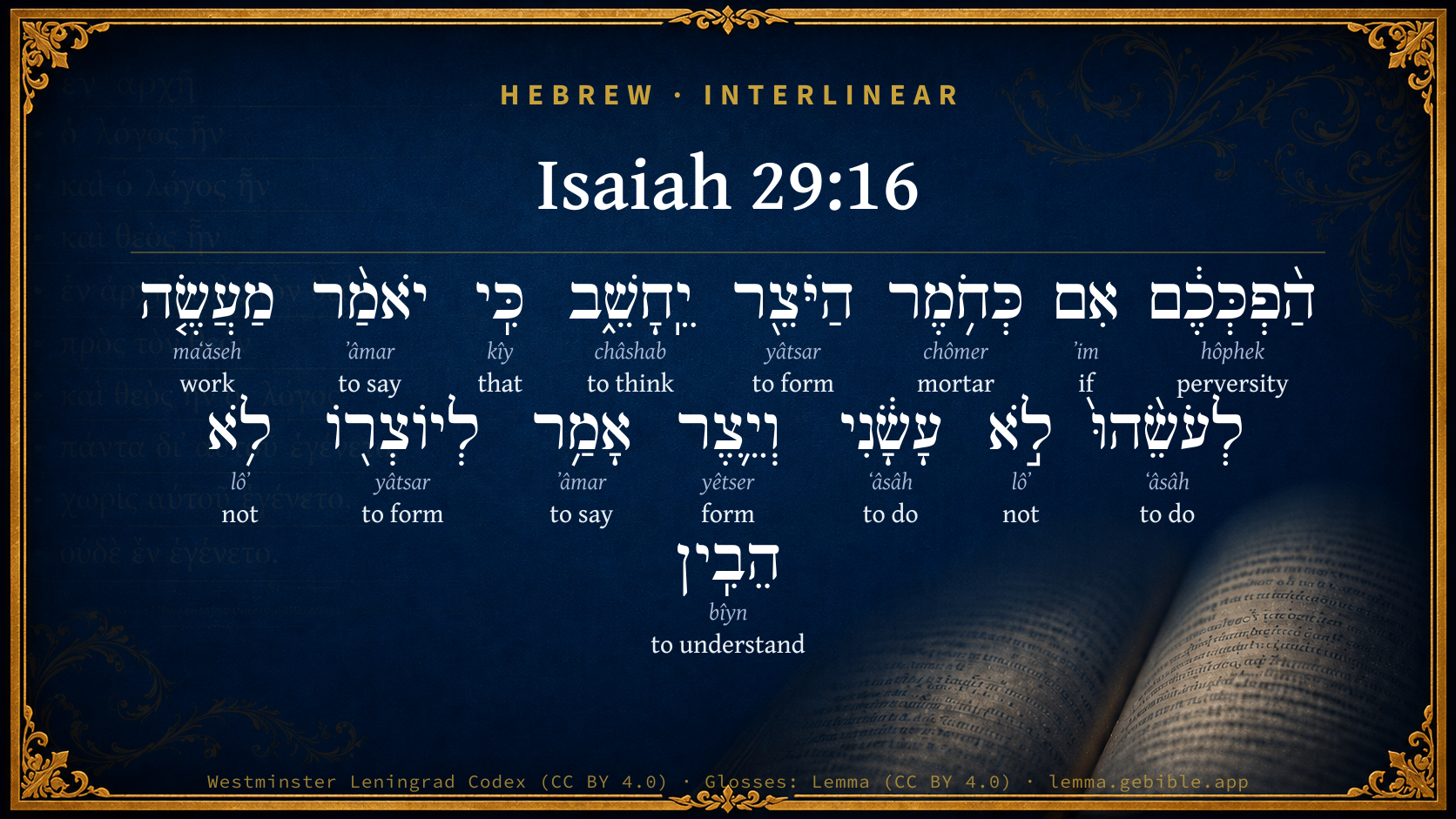
Hebrew (Westminster Leningrad Codex) Isaiah 29:16 appears in the Hebrew Old Testament. The text above is from the Westminster Leningrad Codex. Each word links to its Strong’s number, a concise gloss, and parsing drawn from the Open Scriptures Hebrew Bible morphology. Click any word for its full Brown-Driver-Briggs (BDB) entry.
Download image
Cite this verse

Isaiah 29:16 (World English Bible). Public Domain. Lemma interlinear Bible study tool, https://lemma.gebible.app/v/isaiah/29/16.

Show BibTeX & RIS
BibTeX
RIS
English Translation
You turn things upside down! Shall the potter be esteemed as clay; that the thing made should say of him who made it, He didn't make me; or the thing formed say of him who formed it, He has no understanding?
World English Bible · Public Domain
Highlights
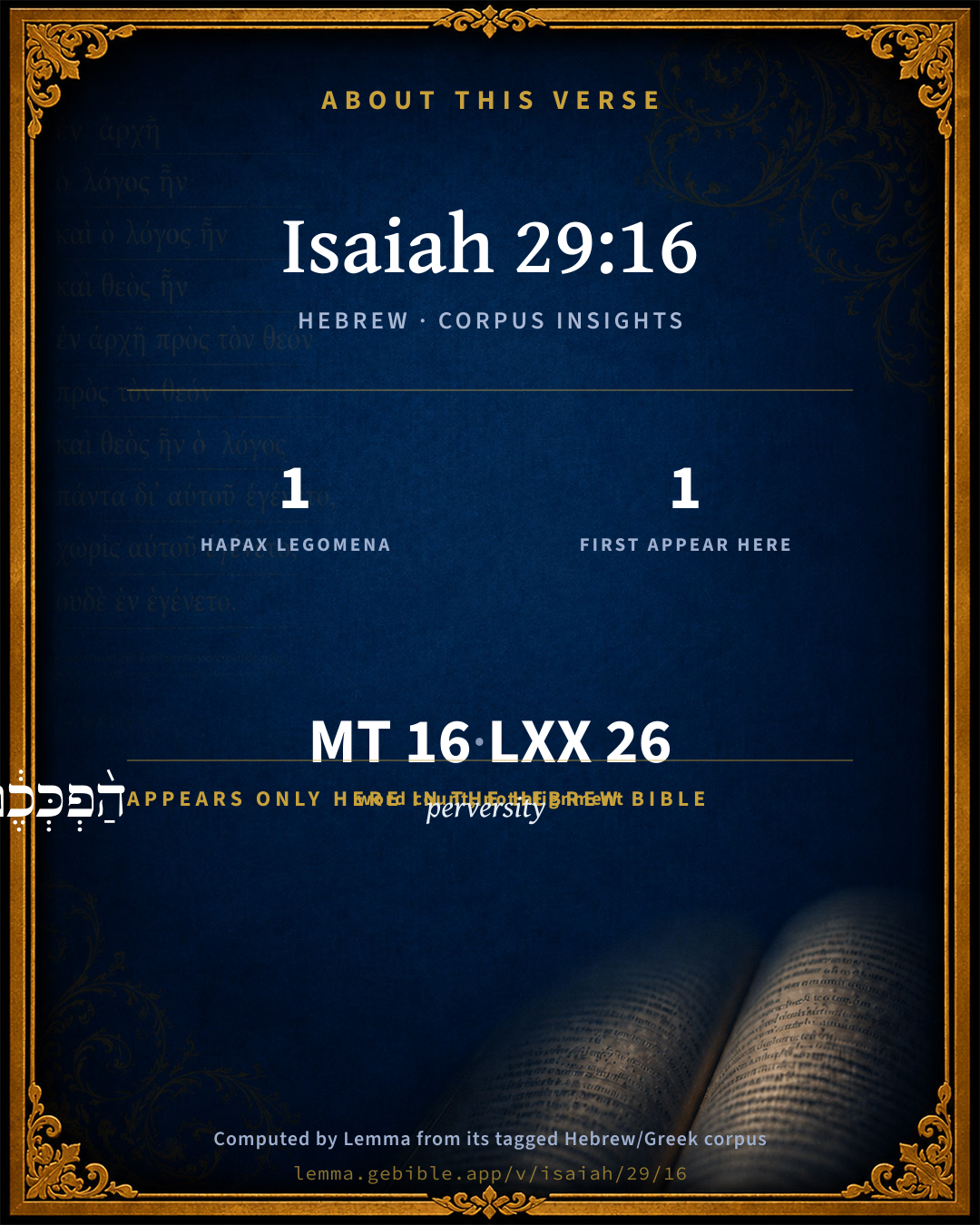
  • 1 hapax legomenon — only here in the Hebrew Bible
  • 1 first appearance in the Hebrew Bible
Full analysis ↓
Download a study sheet

One document with this verse’s original text, its word-by-word gloss line, the meaning frame, cross-references with their text, attributed commentary, and full source and license credits — printable, and it pastes into notes with its structure intact.

This verse Autodidact and up

Study sheet (.html) Plain text (.txt)

A passage Seminary Student

Up to 50 verses in one chapter. A passage sheet keeps up to 6 commentary sources and 12 cross-references per verse, in the order this page ranks them, and says so on the sheet whenever that leaves anything out. Ask for a single verse and you get the Autodidact verse sheet above.

Everything on this page stays free to read, with no account — the sheet is a download of what is already on screen, not access to it.

Want to remove ads? Support Godless Engineer
Compare translations 3

The same verse in 3 English versions, stacked beneath the original-language interlinear above. Click any original word for its lexicon entry.

Each is an independent rendering of the whole verse — the interlinear is not word-aligned to these translations.

Highlighted words mark where these versions differ — a whole-verse word diff, not a word-by-word alignment.

  • World English Bible Public Domain
    You turn things upside down! Shall the potter be esteemed as clay; that the thing made should say of him who made it, He didn't make me; or the thing formed say of him who formed it, He has no understanding?
  • King James Version Public Domain
    Surely your turning of things upside down shall be esteemed as the potter's clay: for shall the work say of him that made it, He made me not? or shall the thing framed say of him that framed it, He had no understanding?
  • unfoldingWord Literal Text CC BY-SA 4.0
    Your overturning! If the potter should be regarded as the clay, that the make should say of its Maker, “He did not make me,” or the form should say of its Former, “He does not understand”?

unfoldingWord Literal Text — © unfoldingWord, licensed CC BY-SA 4.0. Word-aligned USFM3 via Door43 (git.door43.org/unfoldingWord/en_ult).

Versions to compare (up to 4)

3 of 4 selected

Show all 18 translations

Every available English version of this verse, each an independent rendering of the whole verse.

  • World English Bible Public Domain
    You turn things upside down! Shall the potter be esteemed as clay; that the thing made should say of him who made it, He didn't make me; or the thing formed say of him who formed it, He has no understanding?
  • Berean Standard Bible Public Domain
    You have turned things upside down, as if the potter were regarded as clay. Shall what is formed say to him who formed it, “He did not make me”? Can the pottery say of the potter, “He has no understanding”?
  • Majority Standard Bible Public Domain
    You have turned things upside down, as if the potter were regarded as clay. Shall what is formed say to him who formed it, “He did not make me”? Can the pottery say of the potter, “He has no understanding”?
  • King James Version Public Domain
    Surely your turning of things upside down shall be esteemed as the potter's clay: for shall the work say of him that made it, He made me not? or shall the thing framed say of him that framed it, He had no understanding?
  • American Standard Version (1901) Public Domain
    Ye turn things upside down! Shall the potter be esteemed as clay; that the thing made should say of him that made it, He made me not; or the thing formed say of him that formed it, He hath no understanding?
  • Revised Version (1885) Public Domain
    Ye turn things upside down! Shall the potter be counted as clay; that the thing made should say of him that made it, He made me not; or the thing framed say of him that framed it, He hath no understanding?
  • Geneva Bible (1599) Public Domain
    Your turning of deuises shall it not be esteemed as the potters clay? for shall the worke say of him that made it, Hee made me not? or the thing formed, say of him that facioned it, He had none vnderstanding?
  • Douay-Rheims (1899) Public Domain
    This thought of yours is perverse: as if the clay should think against the potter, and the work should say to the maker thereof: Thou madest me not: or the thing framed should say to him that fashioned it: Thou understandest not.
  • Young's Literal Translation Public Domain
    Your perversion! as clay is the potter esteemed? That the work saith of its maker, `He hath not made me?' And the framed thing said of its framer, `He did not understand?'
  • Literal Standard Version CC BY-SA 4.0
    Your perversion! Is the potter esteemed as clay, || That the work says of its maker, “He has not made me?” And the framed thing said of its framer, “He did not understand?”
  • Unlocked Literal Bible CC BY-SA 4.0
    You turn things upside down! Should the potter be considered like clay, so that the thing that is made should say about him who made it, “He did not make me,” or the thing formed say about him who formed it, “He does not understand”?
  • unfoldingWord Literal Text CC BY-SA 4.0
    Your overturning! If the potter should be regarded as the clay, that the make should say of its Maker, “He did not make me,” or the form should say of its Former, “He does not understand”?
  • Darby Bible Public Domain
    [Oh] your perverseness! -- Shall the potter be esteemed as the clay, so that the work should say of him that made it, He made me not; or the thing formed say of him that formed it, He hath no understanding?
  • World Messianic Bible Public Domain
    You turn things upside down! Should the potter be thought to be like clay, that the thing made should say about him who made it, “He didn’t make me;” or the thing formed say of him who formed it, “He has no understanding”?
  • Webster's Bible Public Domain
    Surely your turning of things upside down shall be esteemed as the potter's clay: for shall the work say of him that made it, He made me not? or shall the thing framed say of him that framed it, He had no understanding?
  • Free Bible Version CC BY-SA 4.0
    How perverse you are! It's as if the clay was thought of as making the potter! Should something made say to its maker, “You didn't make me”? Can the pot tell the potter, “You don't understand anything”?
  • Bible in Basic English Public Domain
    You are turning things upside down! Is the wet earth the same to you as the one who is forming it? will the thing made say of him who made it, He made me not: or the thing formed say of him who gave it form, He has no knowledge?
  • JPS Tanakh (1917) Public Domain
    O your perversity! Shall the potter be esteemed as clay; that the thing made should say of him that made it: 'He made me not'; or the thing framed say of him that framed it: 'He hath no understanding?'

Literal Standard Version (2020), Covenant Press — licensed CC BY-SA 4.0. Text via the HelloAO Bible API (eBible.org). Unlocked Literal Bible (unfoldingWord) — licensed CC BY-SA 4.0. Text via the HelloAO Bible API (eBible.org). unfoldingWord Literal Text — © unfoldingWord, licensed CC BY-SA 4.0. Word-aligned USFM3 via Door43 (git.door43.org/unfoldingWord/en_ult). Free Bible Version, Dr. Jonathan Gallagher — licensed CC BY-SA 4.0. Text via the HelloAO Bible API (eBible.org).

Word by word

More ways to search: Search by grammar → Find every occurrence → Compare this word →

Practice this passage: Drill this verse → Learn its vocabulary →

הַ֨פְכְּכֶ֔ם
hôphek
H2017
“perversity · your”
Noun, Common, Masculine, Singular, Construct + Suffix, Personal, 2nd Person, Masculine, Plural
Part of Speech
Noun
Type
Common
Gender
Masculine
Number
Singular
State
Construct
Full BDB Definition

Origin: from H2015

TWOT: 512 ?

(Qal) perverseness, perversity
  1. אִם ʼim H518 “if” Conjunction
  2. כְּחֹ֥מֶר chômer H2563 “like/as · mortar of” Preposition + Noun, Common, Masculine, Singular, Construct
  3. הַיֹּצֵ֖ר yâtsar H3335 “the · potter” Particle, Definite Article + Noun, Common, Masculine, Singular, Absolute
  4. יֵֽחָשֵׁ֑ב châshab H2803 “to think” Verb, Niphal, Imperfect, 3rd Person, Masculine, Singular
  5. כִּֽי kîy H3588 “that” Conjunction
  6. יֹאמַ֨ר ʼâmar H559 “to say” Verb, Qal, Imperfect, 3rd Person, Masculine, Singular
  7. מַעֲשֶׂ֤ה maʻăseh H4639 “work” Noun, Common, Masculine, Singular, Absolute
  8. לְעֹשֵׂ֨הוּ֙ ʻâsâh H6213 “to/for · doing · him” Preposition + Verb, Qal, Participle Active, Masculine, Singular, Construct + Suffix, Personal, 3rd Person, Masculine, Singular
  9. לֹ֣א lôʼ H3808 “not” Particle, Negative
  10. עָשָׂ֔נִי ʻâsâh H6213 “to do · me” Verb, Qal, Perfect, 3rd Person, Masculine, Singular + Suffix, Personal, 1st Person, Common, Singular
  11. וְיֵ֛צֶר yêtser H3336 “and · form” Conjunction + Noun, Common, Masculine, Singular, Absolute
  12. אָמַ֥ר ʼâmar H559 “to say” Verb, Qal, Perfect, 3rd Person, Masculine, Singular
  13. לְיוֹצְר֖וֹ yâtsar H3335 “to/for · forming · him” Preposition + Verb, Qal, Participle Active, Masculine, Singular, Construct + Suffix, Personal, 3rd Person, Masculine, Singular
  14. לֹ֥א lôʼ H3808 “not” Particle, Negative
  15. הֵבִֽין bîyn H995 “to understand” Verb, Hiphil, Perfect, 3rd Person, Masculine, Singular

About this verse

These counts appear in no published source. They are computed here, from the morphology-tagged text and Lemma’s own curated glosses. What Lemma adds →

16
words
12
distinct lemmas
Prophets
section

Notable vocabulary

1 hapax legomenon — a word that appears only here in the entire Hebrew Bible:

  • הַ֨פְכְּכֶ֔ם perversity H2017

First appearance in Scripture

This word makes its first canonical appearance in the Hebrew Bible here:

  • הַ֨פְכְּכֶ֔ם perversity H2017

Shared distinctive vocabulary

וְיֵ֛צֶר form H3336 occurs in 9 verses of the Hebrew Bible. Also found in:

Grammatical profile

  • 7 verbs
  • 5 nouns
  • 2 conjunctions
  • 2 particles

Verb forms

  • יֵֽחָשֵׁ֑ב Niphal · Imperfect
  • יֹאמַ֨ר Qal · Imperfect
  • לְעֹשֵׂ֨הוּ֙ Qal · Participle Active
  • עָשָׂ֔נִי Qal · Perfect
  • אָמַ֥ר Qal · Perfect
  • לְיוֹצְר֖וֹ Qal · Participle Active
  • הֵבִֽין Hiphil · Perfect

Repetition

Words recur within this verse — often emphatic in Hebrew:

  • הַיֹּצֵ֖ר to form H3335 ×2
  • יֹאמַ֨ר to say H559 ×2
  • לְעֹשֵׂ֨הוּ֙ to do H6213 ×2
  • לֹ֣א not H3808 ×2

Hebrew & Septuagint length

In English translation the verse runs 41 words from the Hebrew and 37 from the Septuagint (LXX English) — closely comparable.

A rough comparison of the two English renderings, which tokenize alike — not a word-level alignment.

Word counts can differ between the Hebrew and the Greek without any difference in meaning — e.g. the Hebrew direct-object marker אֵת has no separate Greek word, and Greek often adds the article ὁ.

In the original languages it is 16 Hebrew tokens and 26 Greek tokens — but the two are counted differently (Hebrew bundles its prefixes and suffixes into one token; the Greek is in lemma form), so that isn’t a like-for-like length.

Cross-references

6

Topical passages linked to Isaiah 29:16 in the Treasury of Scripture Knowledge — connected by theme and wording, ordered by reader-vote popularity; previews shown in the World English Bible.

  • Romans 9:19–21 You will say then to me, "Why does he still find fault? For who withstands his will?"
  • Isaiah 64:8 But now, Yahweh, you are our Father; we are the clay, and you our potter; and we all are the work of your hand.
  • Isaiah 45:9–11 Woe to him who strives with his Maker--a potsherd among the potsherds of the earth! Shall the clay ask him who fashions it, "What are you making?" or your work, "He has no hands?"
  • Psalms 94:8–9 Consider, you senseless among the people; You fools, when will you be wise?
  • Jeremiah 18:1–10 The word which came to Jeremiah from Yahweh, saying,
  • Isaiah 24:1 Behold, Yahweh makes the earth empty, and makes it waste, and turns it upside down, and scatters abroad the inhabitants of it.

Cross-references courtesy of OpenBible.info (CC BY 4.0).

Hebrew and Greek witnesses Masoretic Hebrew ↔ Greek Septuagint

The same verse in the two great witnesses to the Old Testament, shown verse-for-verse.

These are two independent witnesses, not word-aligned to each other, and the Septuagint is shown in lemma (dictionary) form.

Hebrew Isaiah 29:16 Masoretic · Westminster Leningrad Codex

הַ֨פְכְּכֶ֔ם אִם כְּחֹ֥מֶר הַיֹּצֵ֖ר יֵֽחָשֵׁ֑ב כִּֽי יֹאמַ֨ר מַעֲשֶׂ֤ה לְעֹשֵׂ֨הוּ֙ לֹ֣א עָשָׂ֔נִי וְיֵ֛צֶר אָמַ֥ר לְיוֹצְר֖וֹ לֹ֥א הֵבִֽין

You turn things upside down! Shall the potter be esteemed as clay; that the thing made should say of him who made it, He didn't make me; or the thing formed say of him who formed it, He has no understanding?

World English Bible · Public Domain

Greek LXX Isaiah 29:16 Septuagint · lemma form

οὐ ὡς ὁ πηλός ὁ κεραμεύς λογίζομαι μή εἶπον ὁ πλάσμα ὁ πλάσσω οὐ σύ ἐγώ πλάσσω ἤ ὁ ποίημα ὁ ποιέω οὐ συνετῶς ἐγώ ποιέω

Shall you⌃ not be counted as clay of the potter? Shall the thing formed say to him that formed it, You did not form me? or the work to the maker, You have not made me wisely?

LXX2012 (modern English Septuagint) · Public Domain

On this verse, John Gill's Exposition discusses the Septuagint’s reading. Read the note in Commentary ↓

Hebrew: Westminster Leningrad Codex (CC BY 4.0). Greek: Septuagint (public domain); English from LXX2012 (modern English Septuagint) (Public Domain). How the Septuagint differs from the Hebrew →

Targum (Aramaic paraphrase)

1

The Targum is the ancient Jewish Aramaic paraphrase of the Hebrew Scriptures — an interpretive translation, not the Hebrew text itself. Onkelos (literal) and Pseudo-Jonathan (expansive) render the Torah, and Jonathan the Prophets. Coverage is partial: where no permissively-licensed English translation exists for a verse, only the Aramaic is shown. This is verse-level text, not a word-by-word alignment to the Hebrew.

  1. Targum Jonathan Prophets (Joshua–Malachi)
    הַלְמֶהְפַּךְ עוֹבָדֵיכוֹן אַתּוּן בָּעָן הָא כְמָא דְטִינָא בְּיַד פָּחֲרָא כֵּן אַתּוּן חֲשִׁיבִין קֳדָמַי הַאֶפְשַׁר דְיֵימַר טִינָא לְעָבְדֵיהּ לָא עֲבַדְתָּנִי וּבִרְיְתָא דְתֵימַר לְבָרָהָא לָא חַכֵּימְתָּא לִי:

    Why do ye seek to pervert your works? Behold, as the clay in the hand of the potter, thus are ye accounted before me. Is it possible that the clay should say to its maker, Thou hast not made me? or should the creature say to its creator, Thou dost not understand me?

    Targum Jonathan — Aramaic: “Mikraot Gedolot” (public domain). English: “Sefaria Community Translation” (CC0 1.0 (public-domain dedication)); “London "Chaldee Paraphrase," 1871” (public domain). Text via Sefaria.

Commentary

Notes on Isaiah 29:16 from classic Christian and Jewish commentators (each source and its license shown beneath its notes). The classic Christian expositions comment on the surrounding passage and are grouped to its opening verse, so a note may address several verses; the Jewish commentaries on the Tanakh (Rashi and others) are per-verse, so they appear only where the commentator wrote on this verse.

Lemma curates 59 commentaries, every one of them public domain or Creative Commons licensed, each selected and text-cleaned for this edition rather than reprinted as found. About our sources →

Trapp's Complete Commentary

John Trapp

Isa 29:16 Surely your turning of things upside down shall be esteemed as the potter’s clay: for shall the work say of him that made it, He made me not? or shall the thing framed say of him that framed it, He had no understanding?

Ver. 16. Surely your turning of things upside down.] Heb., Invertere vestrum. Your denying the divine providence and omniscience, whereby ye go about to pervert the whole course of nature, and to put all into a confusion.

Shall be esteemed as the potter’s clay.] Shall be confuted by a very familiar comparison. Calvin readeth it thus: "Shall be esteemed as the potter’s clay," i.e., is as easily effected as he maketh a vessel at his pleasure.

For shall the work say of him that made it, He made me not?] It should say so upon the matter, by denying his knowledge of it. The watchmaker knoweth every pin and wheel in it; so the heartmaker knoweth every turning and winding in it, were they more than they are.

John Trapp, A Commentary or Exposition upon All the Books of the Old and New Testament (1647–1656) — public domain. Text from a community e-Sword module.

Tyndale Open Study Notes

Tyndale Open Resources

29:16 Potter . . . clay: The Lord’s sovereignty is beyond challenge. Scripture does not discourage asking God hard questions, but there is no place for resistance to God’s will (see 10:15; 45:9; 64:8; Rom 9:20). • He didn’t make me: Such claims against God demonstrate a total unwillingness to recognize God’s intimate involvement with every aspect of a person’s life.

Tyndale Open Study Notes — © Tyndale Open Resources, licensed CC BY-SA 4.0. Text via the HelloAO Bible API.

Geneva Bible (1599)

Geneva Bible translators

For all your craft saith the Lord, you cannot be able to escape mine hands no more than the clay, that is in the potter’s hands, hath power to deliver itself.

Geneva Bible (1599) marginal notes — public domain. Text via Bolls.life.

Jamieson, Fausset & Brown

Robert Jamieson, A. R. Fausset & David Brown

Rather, "Ah! your perverseness! just as if the potter should be esteemed as the clay!" [MAURER]. Or, "Ye invert (turn upside down) the order of things, putting yourselves instead of God," and vice versa, just as if the potter should be esteemed as the clay [HORSLEY], (Isa 45:9; Isa 64:8).

Jamieson, Fausset & Brown — Commentary Critical and Explanatory on the Whole Bible (1871) — public domain (CC PDM 1.0). Text via the HelloAO Bible API.

Ellicott's Commentary for English Readers

(16) Surely your turning of things upside down.—The words are better taken as exclamatory, O your perversity! Isaiah was indignant at that habit of always taking things at their wrong end, and looking on them from the wrong side.

Shall be esteemed as the potter’s clay . . .—Better, Shall the potter be counted as the clay? The Authorised version is scarcely intelligible. Taken as a question, the words bring out the character of the perversity, the upside-downness, of which the prophet speaks. The men whom he condemns were inverting the relations of the Creator and the creature, the potter and the clay, acting practically as atheists, denying that there was a Divine order of which they formed a part.

A Bible Commentary for English Readers, edited by Charles John Ellicott (1878–1897) — public domain. Text from a community e-Sword module.

The Cambridge Bible for Schools and Colleges

gen. ed. J. J. S. Perowne

16. Shall the creature attempt to outwit the Creator?

Surely your turning … clay] Render as R.V. marg.: O your perversity! Shall the potter be counted as clay? “Is there no difference between maker and thing made?” On the image of the clay and the potter, cf. ch. Isa_45:9, Isa_64:8; Jer_18:6; Rom_9:21 ff.

The Cambridge Bible for Schools and Colleges (gen. ed. J. J. S. Perowne; Cambridge University Press, 1878–1918) — public domain. Text from a community e-Sword module.

John Gill's Exposition

Surely your turning of things upside down,.... Revolving things in their minds, throwing them into different shapes, forming various schemes, and inverting the order of things by their deep counsels, and seeking to hide things from the Lord: or, "O the perverseness of you" (z); in imagining and saying that no eye saw, nor anyone knew, what they did, not the Lord himself. So the Vulgate Latin version, "this is your perverse thought"; namely, what is before related. The Targum is,

"do you seek to pervert your works?''

Our version joins it with what follows; though a stop should be made here, because of the accent:

shall be esteemed as the potter's clay: their perverse counsels and designs shall be made of no more account with God, and be as easily turned about and brought to nought, as the clay can be formed, and shaped, and marred by the potter, at his pleasure: "if" or "surely as the potter's clay shall it be esteemed", as the words may be rendered; or it may refer to their persons, as well as their counsels. So the Septuagint version, "shall ye not be reckoned as the potter's clay?" ye shall. To which agrees the Targum,

"behold, as the clay in the hand of the potter, so are ye accounted before me;''

who could do with them just as seemed good in his sight. De Dieu renders them, "shall the potter be reckoned as the clay?" Such was the stupidity and perverseness of the Jews, in endeavouring to hide their counsels from the Lord, and in fancying that he did not see and know them, that they thought God was like themselves; which is all one as if the potter was reckoned as the clay, for they were the clay, and God the potter. The Vulgate Latin version is, "as if the clay could think against the potter"; contrive schemes to counterwork him; which, to imagine, was not more stupid, than to think they could do anything against the Lord:

for shall the work say of him that made it, He made me not? to say that God does not know what is done by his creatures, is in effect to say that he did not make them; for he that made them must needs know their actions, and even the very thoughts of their hearts; as he that makes a watch knows all that is in it, and the motions of it:

or shall the thing framed say of him that framed it, He had no understanding? or judgment, did not know how to make it as it should be. So the Septuagint version, "thou hast not made me wisely"; or he did not understand the work itself, the make and fashion of it. So the Targum,

"thou does not understand me.''

This might as well be said, as for a creature to pretend that God does not know what and where he is, or what he is doing.

(z) So some in Gataker; "subversio vestra", Pagninus, Montanus.

John Gill's Exposition of the Whole Bible (1746–1763) — public domain (CC PDM 1.0). Text via the HelloAO Bible API.

Albert Barnes' Notes on the Bible

Surely your turning of things upside down - Your perversion of all things. They had no just views of truth. They deemed mere formality to be all that was required. They attempted to conceal their plans even from Yahweh; and everything in the opinions and practice of the nation had become perverted and erroneous. There has been much diversity in rendering this phrase. Luther renders it, ‘O how perverse ye are.’ Lowth renders it,

‘Perverse as ye are! shall the potter be esteemed as the clay?’

Rosenmuller also accords with this interpretation, and renders it, ‘O your perversity,’ etc. The sense of the passage seems to be this: ‘Your “changing of things” is just as absurd as it would be for the thing formed to say to him that formed it, why hast thou made me thus? It is as absurd for you to find fault with the government of God as it would be for the clay to complain of want of skill in the potter. You complain of God’s laws, and worship Him according to the commandments of people. You complain of his requirements, and offer to him the service of the mouth and the lip, and witchold the heart. You suppose that God does not see you, and do your deeds in darkness. All this supposes that God is destitute of wisdom, and cannot see what is done, and it is just as absurd as it would be in the clay to complain that the potter who fashions it has no understanding.’

Shall be esteemed ... - The “literal” translation of this passage would be, ‘Your perverseness is as if the potter should be esteemed as the clay;’ that is, as if he was no more qualified to form anything than the clay itself.

For shall the work ... - This passage is quoted by the apostle Paul Rom 9:20-21 to show the right which God has to do with his creatures as shall seem good in his sight, and the impropriety of complaining of his distinguishing mercy in choosing to life those whom he pleases. The sense of the passage is, that it would be absurd for that which is made to complain of the maker as having no intelligence, and no right to make it as he does. It would be absurd in the piece of pottery to complain of the potter as if he had no skill; and it is equally absurd in a man to complain of God, or to regard him as destitute of wisdom.

Albert Barnes' Notes on the Bible (1834–1885) — public domain. Text from a community e-Sword/MySword module.

Haydock's Catholic Bible Commentary

Not. So it is in vain to think that your hypocrisy or excuses will deceive God, chap. xxviii. 15. (Haydock)

George Leo Haydock (1774–1849), Haydock's Catholic Family Bible and Commentary, 1859 edition — public domain. Excludes Psalms (Douay-Rheims chapter numbering differs from Protestant) and Deuterocanonical books (Catholic canon only).

Matthew Poole's English Annotations

Your turning of things upside down; all your subtle devices, by which you turn yourselves into all shapes; and turn your thoughts hither and thither, and pervert the order which God hath appointed.

Shall be esteemed as the potter’s clay; it is no more to me than the clay is to the potter, who can not only discern it thoroughly, but alter and dispose it as he seeth fit.

Shall the work say of him that made it, He made me not, & c.? and no less absurd and ridiculous is your conceit, that I, your Maker and supreme Governor, cannot discover and control all your artifices at my pleasure.

Matthew Poole's English Annotations on the Holy Bible (1683–1685) — public domain. Text from a community e-Sword/MySword module.

Whedon's Commentary on the Bible

Daniel D. Whedon

16. Your turning… things upside down — Or, “O such perversion!” Fools! to suppose God knows no more than to put your profane, formal pretension of piety on a par with genuine religion; to suppose him easily deluded by you. This means the proverb-like comparison or illustration in frequent use among the Jews. See Isa_45:9; Isa_64:8; Jer_18:5; Jer_18:7; Rom_9:20.

Daniel D. Whedon (gen. ed.), Commentary on the Old and New Testaments (1874–1909) — public domain. Text from a community e-Sword module.

The Pulpit Commentary

Surely your turning of things upside down shall be esteemed as the potter"s clay; rather, O for your perverseness! Shall the potter be reckoned as clay? They were so perverse and wrong-headed that they inverted the relation in which they stood to God and God to them. God was to be passive, or merely give opportunities of action, and they were to mould their own plans and carve out their own destinies. For shall the work say, etc.? rather, for the work saith. Taking their destinies into their own hands was equivalent to saying that they were their own masters, which they could not be if God made them. Shall the thing framed say, etc.? rather, yea, the thing formed hath said. To refuse to take counsel of God, and direct the national policy by the light of their own reason, was to tax God with having no understanding.

The Pulpit Commentary (1880–1919), ed. H.D.M. Spence-Jones & Joseph S. Exell — public domain. Text from a community e-Sword module.

John Wesley's Explanatory Notes

Surely - All your subtle devices, by which you turn yourselves into all shapes. As clay - It is no more to me, than the clay is to the potter, who can alter and dispose it as he sees fit.

John Wesley, Explanatory Notes Upon the Whole Bible (1754–1765) — public domain. Text via the GEBible commentary corpus.

J. A. Alexander on Isaiah

Joseph Addison Alexander

“Your perversion! Is the potter to be reckoned as the clay that the thing made should say of its maker, he made me not, and the thing formed say of its former, he does not understand?” The attempt to hide anything from God implies that He has not a perfect knowledge of His creatures, which is practically to reduce the maker and the thing made to a level. With this inversion or perversion of the natural relation between God and man, the Prophet charges them in one word. Most of the recent writers are agreed in construing the first word as an exclamation, ‘oh your perverseness!’ (i.e., how perverse you are!) in which sense it had long before been paraphrased by Luther. Both the derivation of the word, however, and the context here seem to demand the sense perversion rather than perverseness. The verse seems intended not so much to rebuke their perverse disposition, as to show that by their conduct they subverted the distinction between creature and creator, or placed them in a preposterous relation to each other. Thus understood, the word may be thus paraphrased: (this is) your (own) perversion (of the truth, or of the true relation between God and man).

Joseph Addison Alexander, The Prophecies of Isaiah (1846–1847; New York: Scribner, 1870–1878) — public domain. Text from a community e-Sword module.

unfoldingWord translationNotes

Door43 World Missions Community

You turn things upside down

This is an idiom that means to distort what is true. AT: "You make things opposite of the way they should be" or "You distort the truth" (See: Idiom)

Should the potter be considered like clay, so that the thing that is made should say about him who made it ... "He does not understand"?

Yahweh who created humans is spoken of as if he were a potter and humans were the clay. This metaphor emphasizes that it is foolish for humans to reject or criticize the one who created them. AT: "Should you consider me, your maker, to be like the clay rather than the potter? It is as if a potter created something, and that thing said about the potter, 'He did not make me,' or 'He does not understand.'" (See: Metaphor)

Should the potter be considered like clay ... "He does not understand"?

This question is used to scold the people of Jerusalem. AT: "Obviously, the potter should not be considered like clay ... 'He does not understand.'" (See: Rhetorical Question)

unfoldingWord translationNotes — © Distant Shores Media and the Door43 World Missions Community, licensed CC BY-SA 4.0. Source: git.door43.org/Door43/en_tn.

Rashi

Rabbi Shlomo Yitzchaki (Rashi)

Shall your perversion be regarded like the potter’s clay (Heb. הָפְכְּכֶם) Your perversions. Do you know this, that it is like the potter’s clay? Just as the clay cannot say of its maker, “He did not make me,” so you cannot say that I do not understand your deeds.

Shall...like the potter’s clay, etc. This is an expression of a question, but there are questions to be answered in the affirmative.

of him who made it (לְעֹשֵׂהוּ, lit. to him who made it.) Like עַל עֹשֵׂהוּ. Comp. (Ex. 14:3) “And Pharaoh shall say of the children of Israel (וְלִבְנֵי יִשְׂרָאֵל).” (Jud. 9:54) “Lest they say of me (לִי), ‘A woman killed him.’”

and the impulse say concerning the One Who formed it, “He does not understand”? Did he say concerning the One Who formed it, “He does not understand what is in my impulse”? Did He not build the hidden recesses, the inner chambers, and the thoughts?

Rashi on the Tanakh — English translations: “The Judaica Press complete Tanach with Rashi, translated by A. J. Rosenberg” (CC BY 4.0); “Pentateuch with Rashi's commentary by M. Rosenbaum and A.M. Silbermann, 1929-1934” (public domain); “The Metsudah Tanach series, Lakewood, N.J” (CC BY 4.0); and “The Book of Joshua, Metsudah Publications, 1997” (CC BY 4.0). Text via Sefaria.

Ibn Ezra

Rabbi Abraham ibn Ezra

הפככם You are going from the truth.

אם כחמר היוצר יחשב Shall man be esteemed as the potter’s clay.

ויצר And the thing framed. It is derived from יצר to form. ליצרו Of him that framed it. Comp. לי of me (Gen. 20:13)

Ibn Ezra on the Tanakh — English translations: “Sefaria Community Translation” (CC0 1.0 (public-domain dedication)); “Yalkut, Sifsei Chachomim Chumash, Metsudah Publications, 2009” (CC BY 4.0); and “Commentary of Ibn Ezra on Isaiah - trans. by M. Friedlander, 1873” (public domain). Text via Sefaria.

Lesson kit

Teaching starters — assembled from the data on this page, not authored interpretation. Every prompt links to the verse data it draws on. Edit before teaching.

Isaiah, in the Prophets, opens this verse with 16 words (12 distinct Hebrew lemmas). Its most distinctive word is hôphek (“perversity”). A historical commentator’s framing appears above. Read the whole chapter for the surrounding context.

Discussion questions

  1. The word hôphek carries the sense “perversity.” How does it shape the verse?
  2. 1 word here appears nowhere else in the Hebrew Bible. Why might the author reach for such rare wording?
  3. This is the first place “perversity” appears in Scripture (first appears here). What does its debut here establish?
  4. How does Genesis 6:5, which shares the word «form», read alongside this verse?
  5. What does the repetition of “to form” (2× in this one verse) do in this verse?
  6. The translations on this page render this verse differently — a whole-verse word diff, not a word-by-word alignment. What might account for the different wordings?
  7. «יֵֽחָשֵׁ֑ב» is a Niphal Imperfect verb. How does that grammatical form shape the action described?
  8. Compare how Trapp's Complete Commentary and Tyndale Open Study Notes read this verse. Where do they agree or differ?

Things to notice

  • 1 word in this verse appears nowhere else in the Hebrew Bible.
  • 1 word makes its first canonical appearance in Scripture here.
  • This verse counts 16 Hebrew ↔ 26 Greek words.
  • These translations choose different wording for 32 words in this verse.
  • “to form” occurs 2× in this single verse.

Reading settings

Reading text

Shown beneath each verse's original-language words.

Old Testament
Old Testament edition

Read the OT as the Masoretic Hebrew (MT) or the Greek Septuagint (LXX).

English shown for the Greek Septuagint (in the Hebrew ↔ Greek comparison).

Comparing translations? Open the Compare panel on any verse page to stack up to four side by side.