

Psalms 119:169

Hebrew (Westminster Leningrad Codex) Psalms 119:169 appears in the Hebrew Old Testament. The text above is from the Westminster Leningrad Codex. Each word links to its Strong’s number, a concise gloss, and parsing drawn from the Open Scriptures Hebrew Bible morphology. Click any word for its full Brown-Driver-Briggs (BDB) entry.
Download image
Cite this verse

Psalms 119:169 (World English Bible). Public Domain. Lemma interlinear Bible study tool, https://lemma.gebible.app/v/psalms/119/169.

Show BibTeX & RIS
BibTeX
RIS
English Translation
Let my cry come before you, Yahweh. Give me understanding according to your word.
World English Bible · Public Domain
Download a study sheet

One document with this verse’s original text, its word-by-word gloss line, the meaning frame, cross-references with their text, attributed commentary, and full source and license credits — printable, and it pastes into notes with its structure intact.

This verse Autodidact and up

Study sheet (.html) Plain text (.txt)

A passage Seminary Student

Up to 50 verses in one chapter. A passage sheet keeps up to 6 commentary sources and 12 cross-references per verse, in the order this page ranks them, and says so on the sheet whenever that leaves anything out. Ask for a single verse and you get the Autodidact verse sheet above.

Everything on this page stays free to read, with no account — the sheet is a download of what is already on screen, not access to it.

Want to remove ads? Support Godless Engineer
Compare translations 3

The same verse in 3 English versions, stacked beneath the original-language interlinear above. Click any original word for its lexicon entry.

Each is an independent rendering of the whole verse — the interlinear is not word-aligned to these translations.

Highlighted words mark where these versions differ — a whole-verse word diff, not a word-by-word alignment.

  • World English Bible Public Domain
    Let my cry come before you, Yahweh. Give me understanding according to your word.
  • King James Version Public Domain
    Let my cry come near before thee, O LORD: give me understanding according to thy word.
  • unfoldingWord Literal Text CC BY-SA 4.0
    May my cry come near to your face, Yahweh; according to your word, give me understanding.

unfoldingWord Literal Text — © unfoldingWord, licensed CC BY-SA 4.0. Word-aligned USFM3 via Door43 (git.door43.org/unfoldingWord/en_ult).

Versions to compare (up to 4)

3 of 4 selected

Show all 17 translations

Every available English version of this verse, each an independent rendering of the whole verse.

  • World English Bible Public Domain
    Let my cry come before you, Yahweh. Give me understanding according to your word.
  • Berean Standard Bible Public Domain
    May my cry come before You, O LORD; give me understanding according to Your word.
  • Majority Standard Bible Public Domain
    May my cry come before You, O LORD; give me understanding according to Your word.
  • King James Version Public Domain
    Let my cry come near before thee, O LORD: give me understanding according to thy word.
  • American Standard Version (1901) Public Domain
    TAV. Let my cry come near before thee, O Jehovah: Give me understanding according to thy word.
  • Revised Version (1885) Public Domain
    Let my cry come near before thee, O LORD: give me understanding according to thy word.
  • Geneva Bible (1599) Public Domain
    TAV. Let my complaint come before thee, O Lord, and giue me vnderstanding, according vnto thy worde.
  • Young's Literal Translation Public Domain
    `Taw.' My loud cry cometh near before Thee, O Jehovah; According to Thy word cause me to understand.
  • Literal Standard Version CC BY-SA 4.0
    [TAW] My loud cry comes near before You, O YHWH; Cause me to understand according to Your word.
  • Unlocked Literal Bible CC BY-SA 4.0
    Listen to my cry for help, Yahweh; give me understanding into your word.
  • unfoldingWord Literal Text CC BY-SA 4.0
    May my cry come near to your face, Yahweh; according to your word, give me understanding.
  • Darby Bible Public Domain
    TAU. Let my cry come near before thee, Jehovah: give me understanding according to thy word.
  • World Messianic Bible Public Domain
    Let my cry come before you, LORD. Give me understanding according to your word.
  • Webster's Bible Public Domain
    TAU. Let my cry come near before thee, O LORD: give me understanding according to thy word.
  • Free Bible Version CC BY-SA 4.0
    Lord, please listen to my sad cry; help me to understand, as you promised.
  • Bible in Basic English Public Domain
    TAU Let my cry come before you, O Lord; give me wisdom in keeping with your word.
  • JPS Tanakh (1917) Public Domain
    TAV. Let my cry come near before Thee, O LORD; give me understanding according to Thy word.

Literal Standard Version (2020), Covenant Press — licensed CC BY-SA 4.0. Text via the HelloAO Bible API (eBible.org). Unlocked Literal Bible (unfoldingWord) — licensed CC BY-SA 4.0. Text via the HelloAO Bible API (eBible.org). unfoldingWord Literal Text — © unfoldingWord, licensed CC BY-SA 4.0. Word-aligned USFM3 via Door43 (git.door43.org/unfoldingWord/en_ult). Free Bible Version, Dr. Jonathan Gallagher — licensed CC BY-SA 4.0. Text via the HelloAO Bible API (eBible.org).

Word by word

More ways to search: Search by grammar → Find every occurrence → Compare this word →

Practice this passage: Drill this verse → Learn its vocabulary →

About this verse

These counts appear in no published source. They are computed here, from the morphology-tagged text and Lemma’s own curated glosses. What Lemma adds →

6
words
6
distinct lemmas
Wisdom
section

Shared distinctive vocabulary

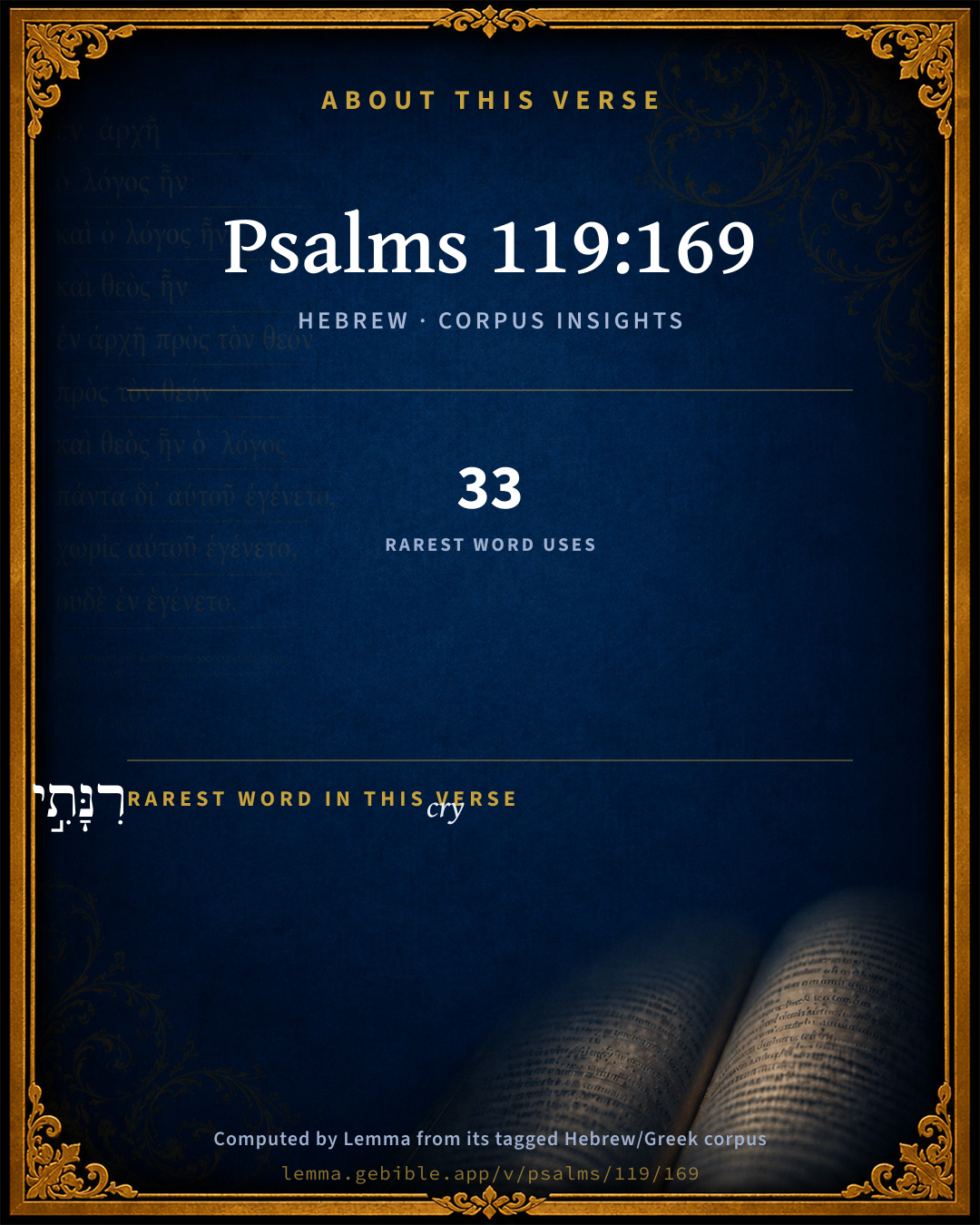
רִנָּתִ֣י cry H7440 occurs in 33 verses of the Hebrew Bible. Also found in:

Grammatical profile

  • 2 verbs
  • 4 nouns

Verb forms

  • תִּקְרַ֤ב Qal · Imperfect
  • הֲבִינֵֽנִי Hiphil · Imperative

Hebrew & Septuagint length

In English translation the verse runs 14 words from the Hebrew and 15 from the Septuagint (LXX English) — closely comparable.

A rough comparison of the two English renderings, which tokenize alike — not a word-level alignment.

Word counts can differ between the Hebrew and the Greek without any difference in meaning — e.g. the Hebrew direct-object marker אֵת has no separate Greek word, and Greek often adds the article ὁ.

Cross-references

8

Topical passages linked to Psalms 119:169 in the Treasury of Scripture Knowledge — connected by theme and wording, ordered by reader-vote popularity; previews shown in the World English Bible.

  • James 1:5 But if any of you lacks wisdom, let him ask of God, who gives to all liberally and without reproach; and it will be given to him.
  • Psalms 119:144–145 Your testimonies are righteous forever. Give me understanding, that I may live.
  • Psalms 18:6 In my distress I called on Yahweh, And cried to my God. He heard my voice out of his temple, My cry before him came into his ears.
  • Proverbs 2:3–5 Yes, if you call out for discernment, And lift up your voice for understanding;
  • 2 Chronicles 1:10 Give me now wisdom and knowledge, that I may go out and come in before this people; for who can judge this your people, that is so great?
  • 1 Chronicles 22:12 May Yahweh give you discretion and understanding, and put you in charge of Israel; that so you may keep the law of Yahweh your God.
  • 2 Chronicles 30:27 Then the priests the Levites arose and blessed the people: and their voice was heard, and their prayer came up to his holy habitation, even to heaven.
  • Daniel 2:21 He changes the times and the seasons; he removes kings, and sets up kings; he gives wisdom to the wise, and knowledge to those who have understanding;

Cross-references courtesy of OpenBible.info (CC BY 4.0).

Hebrew and Greek witnesses Masoretic Hebrew ↔ Greek Septuagint

The same verse in the two great witnesses to the Old Testament, shown verse-for-verse.

You’re reading Greek Psalm 118 (Hebrew Psalm 119). The Septuagint counts the superscription, so verse numbers can differ from the Hebrew — chapter-level alignment, not verse-by-verse. Numbering follows Rahlfs.

These are two independent witnesses, not word-aligned to each other, and the Septuagint is shown in lemma (dictionary) form.

Hebrew Psalms 119:169 Masoretic · Westminster Leningrad Codex

תִּקְרַ֤ב רִנָּתִ֣י לְפָנֶ֣יךָ יְהוָ֑ה כִּדְבָרְךָ֥ הֲבִינֵֽנִי

Let my cry come before you, Yahweh. Give me understanding according to your word.

World English Bible · Public Domain

Greek LXX Greek Psalm 118:169 Septuagint · lemma form

θαυ ἐγγίζω ὁ δέησις ἐγώ ἐνώπιον σύ κύριος κατά ὁ λόγιον σύ συνέτιζω ἐγώ

Let my supplication come near before you, o Lord; instruct me according to your oracle.

LXX2012 (modern English Septuagint) · Public Domain

Hebrew: Westminster Leningrad Codex (CC BY 4.0). Greek: Septuagint (public domain); English from LXX2012 (modern English Septuagint) (Public Domain). How the Septuagint differs from the Hebrew →

Commentary

Notes on Psalms 119:169 from classic Christian and Jewish commentators (each source and its license shown beneath its notes). The classic Christian expositions comment on the surrounding passage and are grouped to its opening verse, so a note may address several verses; the Jewish commentaries on the Tanakh (Rashi and others) are per-verse, so they appear only where the commentator wrote on this verse.

Lemma curates 59 commentaries, every one of them public domain or Creative Commons licensed, each selected and text-cleaned for this edition rather than reprinted as found. About our sources →

Trapp's Complete Commentary

John Trapp

Psa 119:169 TAU. Let my cry come near before thee, O LORD: give me understanding according to thy word.

Ver. 169. Let my cry come near before thee, O Lord] That is, as some will have it, let this whole preceding psalm, and all the petitions (whereof we have here a repetition) therein contained, be highly accepted in heaven.

John Trapp, A Commentary or Exposition upon All the Books of the Old and New Testament (1647–1656) — public domain. Text from a community e-Sword module.

The Biblical Illustrator

Joseph S. Exell

Psa_119:169-176

Let my cry come near before Thee, O Lord: give me understanding according to Thy Word.

A model prayer

I. The earnestness it breathes. Let my cry come near before Thee, O Lord. This prayer is not a statement, not an address, but a cry denoting great fervency. Importunacy is the essential characteristic of true prayer. The effectual fervent prayer of a righteous man availeth much.

II. The mercies it invokes.

1. Spiritual light. Give me understanding according to Thy Word. In a moral sense we are blind and foolish.

2. Soul deliverance. Deliver me according to Thy Word. Through the fall, souls are embarrassed, imperilled, and enslaved.

3. Divine help. Let Thine hand help me. We talk of self-helpfulness. This alone is a fiction, a dream. No hand can really help us but the hand of God.

4. Continued existence (verse 175). He wishes to live, not for any selfish ends, but in order to praise the Lord.

III. The pleas it urges.

1. The testimony he pleads is the testimony of God. He prays for what was Divinely promised. All true prayer must be guided by the Divine Word.

2. He pleads his resolution to praise God (verses 171, 172). He resolves to lay out the remainder of his days in the service of his Maker. Unto Him be glory, etc.

3. He pleads his delight in the Divine law (verse 174). Those who fully appreciate what they have from God are warranted to expect, and qualified to receive, more.

IV. The confession it makes (verse 176). This is true of all (Luk_15:4; Mat_18:12-13). Gone whence? From the knowledge, the image, the companionship of God. Whither? Into the wilderness of moral darkness and confusion. This is our helpless condition. Christ came to seek and to save the lost, blessed be His name! (Homilist.)

The Biblical Illustrator, edited by Joseph S. Exell (c. 1880s–1900s) — public domain. Text from a community e-Sword module.

J. A. Alexander on Psalms

Joseph Addison Alexander

169. (Psa 119:169) Let my cry come near before thee, O Jehovah; according to thy word, make me understand. The first noun denotes an audible expression of strong feeling, whether sorrowful or joyful. See above, on Psa 17:1; Psa 30:5. Come near before thee, not only near enough to be heard, but into thy presence, so that he who utters it may be seen. According to thy word, thy commandment which requires, and thy promise which secures, the understanding of thy will. See above, Psa 119:25; Psa 119:65; Psa 119:107, and compare Deu 30:6.

Joseph Addison Alexander, The Psalms Translated and Explained (1850) — public domain. Text from a community e-Sword module.

Tyndale Open Study Notes

Tyndale Open Resources

119:169-176 Taw (ת): God’s servant petitions the Lord one final time; he still feels like a lost sheep.

Tyndale Open Study Notes — © Tyndale Open Resources, licensed CC BY-SA 4.0. Text via the HelloAO Bible API.

Geneva Bible (1599)

Geneva Bible translators

As thou hast promised to be the schoolmaster unto all them that depend upon thee.

Geneva Bible (1599) marginal notes — public domain. Text via Bolls.life.

Matthew Henry's Commentary

Here we have, I. A general petition for audience repeated: Let my cry come near before thee; and again, Let my supplication come before thee. He calls his prayer his cry, which denotes the fervency and vehemence of it, and his supplication, which denotes the humility of it. We must come to God as beggars come to our doors for an alms. He is concerned that his prayer might come before God, might come near before him, that is, that he might have grace and strength by faith and fervency to lift up his prayers, that no guilt might interpose to shut out his prayers and to separate between him and God, and that God would graciously receive his prayers and take notice of them. His prayer that his supplication might come before God implied a deep sense of his unworthiness, and a holy fear that his prayer should come short or miscarry, as not fit to come before God; nor would any of out prayers have had access to God if Jesus Christ had not approached to him as an advocate for us.

II. Two particular requests, which he is thus earnest to present: - 1. That God, by his grace, would give him wisdom to conduct himself well under his troubles: Give me understanding; he means that wisdom of the prudent which is to understand his way; "Give me to know thee and myself, and my duty to thee." 2. That God, by his providence, would rescue him out of his troubles: Deliver me, that is, with the temptation make a way to escape, Co1 10:13.

III. The same general plea to enforce these requests - according to thy word. This directs and limits his desires: "Lord, give me such an understanding as thou hast promised and such a deliverance as thou hast promised; I ask for no other." It also encourages his faith and expectation: "Lord, that which I pray for is what thou hast promised, and wilt not thou be as good as thy word?"

Matthew Henry's Commentary on the Whole Bible (1708–1710) — public domain (CC PDM 1.0). Text via the HelloAO Bible API.

Adam Clarke's Commentary

LETTER ת TAU. - Twenty-second Division

Verse 169. Let my cry come near before thee] This is really a fine image; it is of frequent occurrence, and is little heeded. Here the psalmists cry for deliverance is personified; made an intelligent being, and sent up to the throne of grace to negotiate in his behalf. He pursues this prosopopoeia in the next verse, and sends his supplication in the same way. I have already had occasion to refer to a similar figure in Homer, where prayers are represented as the daughters of Jupiter. See on Ps 88:2.

Adam Clarke's Commentary on the Bible (1810–1826) — public domain. Text from a community e-Sword/MySword module.

John Calvin's Commentaries

169. Let my cry come As has been observed by some critics, the Psalmist’s cry for deliverance is here personified. He represents it as if an intelligent being, and as sent up by him to heaven, there to plead his cause in the presence of God. The same elegant poetical figure is used in the following verse, and it is of frequent occurrence in the Book of Psalms.

John Calvin's Commentaries (1540-1563) — public domain. Text from the Calvin Translation Society English edition (1840s-50s) via the Christian Classics Ethereal Library (ccel.org). Calvin's coverage is partial (roughly two-thirds of the Bible); uncommented books and verses are honest gaps, never fabricated. The 19th-century editor's footnotes and remarks are omitted so the notes are faithfully Calvin's own voice.

The Cambridge Bible for Schools and Colleges

gen. ed. J. J. S. Perowne

169, 170. These verses are closely connected. My cry denotes literally the outward expression of urgent entreaty in a shrill passionate outcry (cp. Psa_17:1 note): my supplication for favour refers to the substance of his prayer. Once more he prays for fuller understanding or discernment, and for the freedom of outward circumstance which will enable him to use it. As the ground of both prayers he pleads God’s word of promise.

169–176. Tâv. Concluding petitions for understanding and deliverance, for the grace of thankfulness, for help and guidance.

The Cambridge Bible for Schools and Colleges (gen. ed. J. J. S. Perowne; Cambridge University Press, 1878–1918) — public domain. Text from a community e-Sword module.

John Gill's Exposition

I have longed for thy salvation, O Lord,.... For temporal salvation and deliverance from enemies; and for spiritual and eternal salvation by the Messiah; and for the Messiah himself, the author of it: Kimchi interprets it of the salvation of the soul in the world to come; see Psa 119:81;

and thy law is my delight; or "delights" (n); his exceeding great delight, as being pure and perfect, holy, just, and good; a transcript of the divine nature, a revelation of the divine will; as in the hands of Christ, his surety and Saviour, who had engaged to fulfil it for him; and as written in his heart; and as delivered from the curse and condemnation of it, through the suretyship engagements of Christ.

(n) "deliciae meae", Montanus, Tigurine version.

John Gill's Exposition of the Whole Bible (1746–1763) — public domain (CC PDM 1.0). Text via the HelloAO Bible API.

Albert Barnes' Notes on the Bible

Let my cry come near before thee, O Lord - This commences a new division of the psalm, indicated by the last letter of the Hebrew alphabet, the letter Tau (ט ṭ), corresponding to our “t,” or “th.” The petition here is, that his prayer might be heard; that it might come into the very presence of God; that there might be no obstructions to its reaching where God was. Let nothing from my unworthiness, from my past sins, from my ignorance, prevent its coming before thee. Something often apparently hinders our prayers so that they do not reach the ear of God. The psalmist prays here that there may be no such hindrance in the prayer which he now offers.

Give me understanding according to thy word - According to the promises of thy word; or, give me the same views of truth which are set forth in thy word. This prayer had been several times offered before, and it shows how earnest was his desire to know the truth. See Psa 119:34, Psa 119:73,Psa 119:144.

Albert Barnes' Notes on the Bible (1834–1885) — public domain. Text from a community e-Sword/MySword module.

Matthew Poole's English Annotations

TAU

Near before thee; which at present thou seemest to shut out, as the church complained, Lam 3:8.

Understanding; whereby I may both know and perform my duty in all particulars.

Matthew Poole's English Annotations on the Holy Bible (1683–1685) — public domain. Text from a community e-Sword/MySword module.

The Treasury of David

Charles H. Spurgeon

Ver. 169. Let my cry come near before thee, O LORD. He is tremblingly afraid lest he should not be heard. He is conscious that his prayer is nothing better than the cry of a poor child, or the groan of a wounded beast. He dreads lest it should be shut out from the ear of the Most High, but he very boldly prays that it may come before God, that it may be in his sight, under his notice, and looked upon with his acceptance; yea, he goes further, and entreats, "Let my cry come near before thee, O Lord." He wants the Lord's attention to his prayer to be very close and considerate. He uses a figure of speech and personifies his prayer. We may picture his prayer as Esther, venturing into the royal presence, entreating an audience, and begging to find favour in the sight of the blessed and only Potentate. It is a very sweet thing to a suppliant when he knows of a surety that his prayer has obtained audience, when it has trodden the sea of glass before the throne, and has come even to the footstool of the glorious seat around which heaven and earth adore. It is to Jehovah that this prayer is expressed with trembling earnestness our translators, filled with holy reverence, translate the word, "O LORD." We crave audience of none else, for we have confidence in none beside.

Give we understanding according to thy word. This is the prayer about which the Psalmist is so exceedingly anxious. With all his gettings he would get understanding, and whatever he misses he is resolved not to miss this priceless boon. He desires spiritual light and understanding as it is promised in God's word, as it proceeds from God's word, and as it produces obedience to God's word. He pleads as though he had no understanding whatever of his own, and asks to have one given to him. "Give me understanding." In truth, he had an understanding according to the judgment of men, but what he sought was an understanding according to God's word, which is quite another thing. To understand spiritual things is the gift of God. To have a judgment enlightened by heavenly light and conformed to divine truth is a privilege which only grace can give. Many a man who is accounted wise after the manner of this world is a fool according to the word of the Lord. May we be among those happy children who shall all be taught of the Lord.

This commences a new division of the psalm, indicated by the last letter of the Hebrew alphabet, the letter Tau, corresponding to our "t, "or "th." Albert Barnes.

Ver. 169. Let my cry come near before thee, O LORD. That is, as some will have it, Let this whole preceding Psalm, and all the petitions (whereof we have here a repetition) therein contained, be highly accepted in heaven. John Trapp.

Ver. 169. Let my cry come near before thee, O LORD. We are now come to the last section of this psalm, wherein we see David more fervent in prayer than he was in the first, as ye shall easily observe by comparing them both together. The godly, the longer they speak to God, are the more fervent and earnest to speak to him; so that unless necessity compel them, they desire never to intermit conference with him.

Many prayers hath he made to God in this psalm: now in the end he prays for his prayers, that the Lord would let them come before him. Some men send out prayers, but God turns them into sin, and puts them away back from him: therefore David seeks favour to his prayers. William Cowper.

Ver. 169. Give me understanding. This was the prayer of Solomon (1Ki 3:9), and we are told that it pleased the Lord, and as a reward he added temporal prosperity, which the young king had not asked. Yet Solomon meant less by his prayer than his father David did; for we see in him little trace of the deep devotion for which his father was so remarkable. The Psalmist here prays a deep prayer which can only be answered by the Holy Ghost himself enlightening the soul. The understanding is a most important member of our spiritual frame. Conscience is the understanding exercised upon moral questions, and if that be not right, where shall we be? Our understanding of the word of God comes by teaching, but also through experience: we understand hardly anything till we experience it. Such an enlightening experience is the gift of God, and to him we must look for it in prayer. C.H.S.

Ver. 169. Give we understanding. The especial work of the Holy Spirit in the illumination of our minds unto the understanding of the Scripture is called "understanding." The Psalmist prays "Give me understanding, and I shall keep thy law" (verse 34). So the apostle speaks to Timothy: "Consider what I say; and the Lord give thee understanding in all things": 2Ti 2:7. Besides his own consideration of what was proposed unto him, which includes the due and diligent use of all outward means, it was moreover necessary that God should give him understanding by an inward effectual work of his Spirit, that he might comprehend the things wherein he was instructed. And the desire hereof, as of that without which there can be no saving knowledge of the word, for advantage by it, the Psalmist expresses emphatically, with great fervency of spirit in verse 144: "The righteousness of thy testimony is everlasting: give me understanding, and I shall live." Without this he knew that he could have no benefit by the everlasting righteousness of the testimonies of God. All understanding, indeed, however it be abused by the most, is the work and effect of the Holy Ghost for "the inspiration of the Almighty giveth understanding": Job 32:8. So is this spiritual understanding in an especial manner the gift of God. In this "understanding" both the ability of our mind and the due exercise of it is included. This one consideration, that the saints of God have with so much earnestness prayed that God would give them understanding as to his mind and will as revealed in the word, with his reiterated promises that he would so do, is of more weight with me than all the disputes of men to the contrary. No farther argument is necessary to prove that men do not understand the mind of God in the Scripture in a due manner, than their supposal and confidence that so they can do without the communication of a spiritual understanding unto them by the Holy Spirit. This self confidence is directly contrary unto the plain, express testimonies of the word. John Owen.

Ver. 169. Give me understanding. Why should the man of God here pray for understanding? Had he not often prayed for it before? Was he a novice in knowledge, being a prophet? Doth not our Saviour Christ reprehend repetitions and babbling in prayer? True it is our Saviour Christ doth reprehend that babbling which is without faith and knowledge and a feeling of our wants; but he speaketh not against those serious repetitions which proceed from a plentiful knowledge, abundant faith, and lively feeling of our necessities. Again, although it cannot be denied but lie was a man of God, and had received great grace, yet God giveth knowledge to his dearest saints in this life but in part, and the most which we see and know is but little. Besides, when we have knowledge, and knowledge must be brought into practice, we shall find such difficulties, such waywardness, such forgetfulness, such wants, that although we have had with the prophet a very good direction in the general things of the word, which are universal and few, yet we shall find many distractions in our practices, which must be particular and many; and we shall either fail in memory by forgetfulness, or in judgment by blindness, or in affection by dulness. So easily may we slip when we think we may hold our journey on. Wherefore the man of God, through that examination which he took of his heart and affections, seeing those manifold straits and difficulties, prayeth in the verse following, not for the renewing of men in general in their troubles, but for the considering of his own particular condition. Richard Greenham.

Ver. 169. According to the word. David here seeks understanding not carnally, for the wisdom of the flesh is death: but he seeks understanding according to God's word. Without this the wisdom of man is foolishness; and the more subtil he seems to be in his ways, the more deeply he involves himself in the snare of the devil. "They have rejected the word of the Lord; and what wisdom is in them?" Jer 8:9. But seeing he was an excellent prophet, and protested before that he had more understanding than the ancients, yea, than his teachers; how is it that he still prays for understanding? In answer to this we are to know, that there is a great difference between the gifts of nature and grace. Nature ofttimes gives to man very excellent gifts, as rare memory, knowledge, quick wit, strength, external beauty; but therewithal it teacheth not man to consider that in which he is wanting; whereof it comes to pass, that he waxeth proud of that which he hath. This is a common thing to men in the state of nature, that of small gifts they conceive a great pride: but grace, as it gives to man more excellent gifts than nature can afford, so it teacheth him to look unto that which he wants, that he be not puffed up by considering that which he hath, but carried in all humility of heart to pray for that which he wants. Abraham Wright.

Outlines Upon Keywords of the Psalm, By Pastor C. A. Davis.

Verses 169-176. The concluding cry. Bespeaking audience for his the Psalmist asks for understanding and deliverance (ver. 169, 170); raises to praise God (ver. 171), and to speak of God (ver. 172), and cries for help (ver. 173), salvation (ver. 174), life (ver. 175), and (ver. 176).

Ver. 169,170.

1. The singular dignity of prayer. We are on earth, but our prayers pass the seraphim and "come near before God."

2. The powerful right of prayer to urge with God his own word: "according to thy word."

3. The triumphant possibilities of prayer. Blessing us in mind and estate. For time and eternity. "Give me understanding." "Deliver me."

4. The amazing license accorded to prayer. To double and reiterate its requests (as here).

W.B.H.

Ver. 169.

1. Admission to the royal court.

2. Instruction from the royal throne.

3. Reliance on the royal word.

Psalms 119:170*

Charles H. Spurgeon's The Treasury of David (1869–1885) — public domain. Psalms only. Text from a community e-Sword/MySword module.

Whedon's Commentary on the Bible

Daniel D. Whedon

ת, Tav.

169-176. Let thine hand help me—Finally, the two great wants of man, strength of soul to live righteously and deliverance from outward evils, are rehearsed. The writer is persecuted for his faith. He wishes to keep the faith. He prays also for rest from persecution. The last verse should probably be, “If I go astray like a lost sheep, seek thy servant.” Not that he means to stray, but he knows his own weakness. With this humble cry the long meditation ends. In such form as this the law presented itself to a religious mind in the age of Ezra and Nehemiah. Under this view of it, Israel was revived and men were raised up who contended earnestly for the faith until the Messiah came and the grace of the gospel was proclaimed!

In the condensed foregoing notes, the leading object has been to show that the long text is not a repetition of synonymes, but, like Ecclesiastes, moves forward, not indeed in a direct line, but with shifts and changes, presenting, under a large variety of experiences, the one source of strength and comfort—the divine law.

Daniel D. Whedon (gen. ed.), Commentary on the Old and New Testaments (1874–1909) — public domain. Text from a community e-Sword module.

The Pulpit Commentary

tTAU.

Let my cry come near before thee, O Lord. The "cry" is probably for deliverance from his enemies (see ver. 166); but this, he feels, depends upon his own faithfulness. Hence the prayer in the second clause, Give me understanding according to thy Word (comp. ver. 144).

Vers. 169-176. God"s salvation.

These verses may bring before us the successive stages of salvation.

I SEEKING AFTER GOD. (Vers. 169, 170, 174) The heart "longs for salvation;" it "cries for deliverance;" it looks to God under a deep and strong sense of danger and of need. Then comes

II OUR CHOICE. (Ver. 173) The decisive hour comes when we have finally and fixedly to determine whether we will or will not accept Jesus Christ for our Divine Lord and Savior; whether or not we will spend our days and our powers in his service. The crisis of our cause is past when we can say, "I have chosen thy precepts;" I have chosen to do "the will of God in Christ Jesus.

III A LIFE OF SUSTAINED DEVOTION. As the psalmist"s prayer intersperses his other utterances, so should devotion blend with our outward life, sanctifying and ennobling it. Especially should we be constantly looking for Divine help (ver. 173), that we may be enabled to do our duty faithfully, to bear our burden meekly, to resist temptation manfully and successfully, to use our opportunity wisely and devotedly.

IV OUR CONFESSION OF PARTIAL FAILURE. (Ver. 176) This wandering (of the text) is not the first departure of the soul from God, the going away into the "far country" of estrangement or rebellion; it is rather the deviation of the good man from the straight line of holy service, calling for recognition and return to the favor of God. "If we (Christian disciples) say we have no sin, we deceive ourselves, and the truth is not in us." If, when we thus err, when we "go astray," we "confess our sin, he is faithful and just to forgive us our sin, and to cleanse us from all unrighteousness." "For this shall every one that is godly pray unto thee". (Psa_32:6) It is a very great point in Christian life to understand and to acknowledge our error, our partial failure, our need of the Divine hand to lead us back into the path of righteousness and wisdom.

V OUR STUDY OF GOD"S WILL AS REVEALED IN HIS WORD. (Vers. 174, 175)

VI OUR SERVICE OF SPEECH AND SONG. (Vers. 171, 172, 175)

1. Recognizing the supreme excellency of Divine truth, its intrinsic worth, and its power to save and heal, "our tongue will speak God"s Word." From the sustained and prepared discourse to the humble dialogue and the parting word of warning or encouragement, true service may be rendered to our Lord.

2. Taught God"s will by his Spirit as well as his Word, our soul as well as our body alive because quickened by Divine power, our heart and our mouth will be filled with praise. Prayer and praise will be the two accompaniments that will never fail, along all the path of life, until the witness is borne, and the work is done, and the reward is ready.

Vers. 169-176. The humility of holiness.

We suppose no one can have gone through this psalm but must have come more and more to the conviction that the writer of it was a true saint of God. The signs and tokens of true holiness of character could scarcely be more manifest than they are in this psalm. But now that he comes to the close, instead of there being any note of exultation or glorying because of his attainments in holiness, there is the profoundest humility. We might have expected a tone of triumph and elation, but it is quite the reverse that we find. There is impassioned fervor in prayer, but no glorying; there is the same constant longing for deeper understanding of God"s Word, which we have met with all through; but no self-congratulation that he has gained it; there is the same confession of his need and prayer for deliverance, for help, for life; and there is a lowlier confession still; for in the last verse of the psalm he speaks not merely as an afflicted soul, but as one who has gone astray like a lost sheep, and who therefore craves that God should seek after him. And the different sentences of this prayer are all in keeping with this humility of heart which characterizes this great saint of God. He speaks of his prayer as his "cry," as his "supplication that which a beggar would present to one who could befriend him. He disclaims the possession of understanding of God"s Word, but prays that it may be given him. He takes the position of one who has no right to come before God, and asks that he may "come near," He makes no plea of merit or goodness of his own, but his hope is ever "according to thy Word." He deems himself powerless to praise God until taught of God. It is all of a piece, all the utterance of a profoundly humble soul. Now, concerning this humility, note

I WHENCE IT SPRINGS.

1. From the effect on the mind of his afflictions. If we would have the grace of humility, we must be content to be humbled; and so precious is this grace in God"s sight, that he sends affliction for this very end.

2. From his advance in the knowledge of God. No human soul can thus perseveringly seek God without coming into very close contact and converse with him; but the result of that is ever the prostration of the soul in adoring humility. (cf. Isa 6 Luk_5:8 Re 1) The vision of God"s infinite holiness and glory bows down the soul of the beholder. But such vision had often been before the mind of the psalmist seems to have been especially so here, when drawing to the close of this psalm.

3. From the longing after Gods salvation. Earnest desire is ever lowly.

II HOW BEAUTIFUL IT IS!

1. Because it is just and becoming to man in relation to God. It is what it should be. The opposite of it is revolting to the mind.

2. Because we are made instinctively to admire it.

III AND HOW DESIRABLE!

1. It has ever been a distinguishing mark of Gods saints.

2. It is well pleasing to God. He delights in it; will dwell with him in whom it is.

3. It is such sure safeguard for all other virtues of holy character. S.C.

The Pulpit Commentary (1880–1919), ed. H.D.M. Spence-Jones & Joseph S. Exell — public domain. Text from a community e-Sword module.

Keil & Delitzsch

C. F. Keil & F. Delitzsch

The eightfold Tav. May God answer this his supplication as He has heard his praise, and interest Himself on behalf of His servant, the sheep that is exposed to great danger. The petitions "give me understanding" and "deliver me" go hand-in-hand, because the poet is one who is persecuted for the sake of his faith, and is just as much in need of the fortifying of his faith as of deliverance from the outward restraint that is put upon him. רנּה is a shrill audible prayer; תּחנּה, a fervent and urgent prayer. ענה, prop. to answer, signifies in Psa 119:172 to begin, strike up, attune (as does ἀποκρίνεσθαι also sometimes). According to the rule in Psa 50:23 the poet bases his petition for help upon the purpose of thankful praise of God and of His word. Knowing how to value rightly what he possesses, he is warranted in further supplicating and hoping for the good that he does not as yet possess. The "salvation" for which he longs (תּאב as in Psa 119:40, Psa 119:20) is redemption from the evil world, in which the life of his own soul is imperilled. May then God's judgments (defective plural, as in Psa 119:43, Psa 119:149, which the Syriac only takes a singular) succour him (יעזּרני, not יעזרני). God's hand, Psa 119:173, and God's word afford him succour; the two are involved in one another, the word is the medium of His hand. After this relationship of the poet to God's word, which is attested a hundredfold in the Psalm, it may seem strange that he can say of himself תּעיתי כּשׂה אבד; and perhaps the accentuation is correct when it does not allow itself to be determined by Isa 53:6, but interprets: If I have gone astray - seek Thou like a lost sheep Thy servant. שׂה אבד is a sheep that is lost (cf. אבדים as an appellation of the dispersion, Isa 27:13) and in imminent danger of total destruction (cf. Psa 31:13 with Lev 26:38). In connection with that interpretation which is followed by the interpunction, Psa 119:176 is also more easily connected with what precedes: his going astray is no apostasy; his home, to which he longs to return when he has been betrayed into by-ways, is beside the Lord.

Keil & Delitzsch — Biblical Commentary on the Old Testament (1861–1891) — public domain (CC PDM 1.0). Text via the HelloAO Bible API. (Old Testament only.)

Kretzmann's Popular Commentary

Paul E. Kretzmann

Tau. Concluding Appeal. —

v. 169. Let my cry come near before Thee, O Lord, with no obstructions to hinder it in its course; give me understanding according to Thy Word, since the Word alone is the source of all true knowledge.

v. 170. Let my supplication come before Thee, be brought into His presence for favorable consideration; deliver me according to Thy Word, the psalmist’s appeal time and again being to the mercy and to the promise of the Lord.

v. 171. My lips shall utter praise, proclaiming His glory, when Thou hast taught me Thy statutes, leading him ever more deeply into the glories of His Word.

v. 172. My tongue shall speak of Thy Word, being constrained so to do by the miracles related in the Word; for all Thy commandments are righteousness, in full agreement with eternal right and truth.

v. 173. Let Thine hand help me, literally, "Be Thy hand for my help"; for I have chosen Thy precepts, thereby placing himself entirely on the side of the Lord, with the right to expect help from Him.

v. 174. I have longed for Thy salvation, O Lord; thus his eagerness once more causes him to exclaim; and Thy Law is my delight, he finds his greatest pleasure in the knowledge of the Word.

v. 175. Let my soul live, in full fellowship with the heavenly Father, to whom he has appealed in his wonderful prayer, and it shall praise Thee, and let Thy judgments help me, sustaining him in all trials and leading him safely to the home of the Father.

v. 176. I have gone astray like a lost sheep, apparently all forsaken in the midst of a host of enemies; seek Thy servant, to bring him back to rest and shelter; for I do not forget Thy commandments. On the side of men there is ever erring and getting lost; on the part of God there is ever seeking and finding and taking home to the enjoyment of eternal blessings.

Paul E. Kretzmann, Popular Commentary of the Bible (1921–1924) — public domain. Text from a community e-Sword module.

unfoldingWord translationNotes

Door43 World Missions Community

TAV

This is the name of the twenty-second letter of the Hebrew alphabet. In the Hebrew language, each line of verses 169-176 begins with this letter.

give me understanding into your word

The psalmist speaks of the ability to understand as if it were a solid object. AT: "help me understand your word" (See: Metaphor)

May my plea come before you

The psalmist speaks of the words he says in prayer as if they were people who want to speak to a king. AT: "May you hear my prayer" (See: Metaphor)

translationWords

Yahweh

understand

word of God

plea

promise

unfoldingWord translationNotes — © Distant Shores Media and the Door43 World Missions Community, licensed CC BY-SA 4.0. Source: git.door43.org/Door43/en_tn.

Rashi

Rabbi Shlomo Yitzchaki (Rashi)

according to Your word, enable me to understand the words of Your Torah; according to their law and in the order in which they stand.

Rashi on the Tanakh — English translations: “The Judaica Press complete Tanach with Rashi, translated by A. J. Rosenberg” (CC BY 4.0); “Pentateuch with Rashi's commentary by M. Rosenbaum and A.M. Silbermann, 1929-1934” (public domain); “The Metsudah Tanach series, Lakewood, N.J” (CC BY 4.0); and “The Book of Joshua, Metsudah Publications, 1997” (CC BY 4.0). Text via Sefaria.

Lesson kit

Teaching starters — assembled from the data on this page, not authored interpretation. Every prompt links to the verse data it draws on. Edit before teaching.

Psalms, in the Wisdom, opens this verse with 6 words (6 distinct Hebrew lemmas). Its most distinctive word is rinnâh (“cry”). A historical commentator’s framing appears above. Read the whole chapter for the surrounding context.

Discussion questions

  1. The word rinnâh carries the sense “cry.” How does it shape the verse?
  2. How does 1 Kings 8:28, which shares the word «cry», read alongside this verse?
  3. The translations on this page render this verse differently — a whole-verse word diff, not a word-by-word alignment. What might account for the different wordings?
  4. «תִּקְרַ֤ב» is a Qal Imperfect verb. How does that grammatical form shape the action described?
  5. Compare how Trapp's Complete Commentary and The Biblical Illustrator read this verse. Where do they agree or differ?

Things to notice

Reading settings

Reading text

Shown beneath each verse's original-language words.

Old Testament
Old Testament edition

Read the OT as the Masoretic Hebrew (MT) or the Greek Septuagint (LXX).

English shown for the Greek Septuagint (in the Hebrew ↔ Greek comparison).

Comparing translations? Open the Compare panel on any verse page to stack up to four side by side.