
Jeremiah 4:22

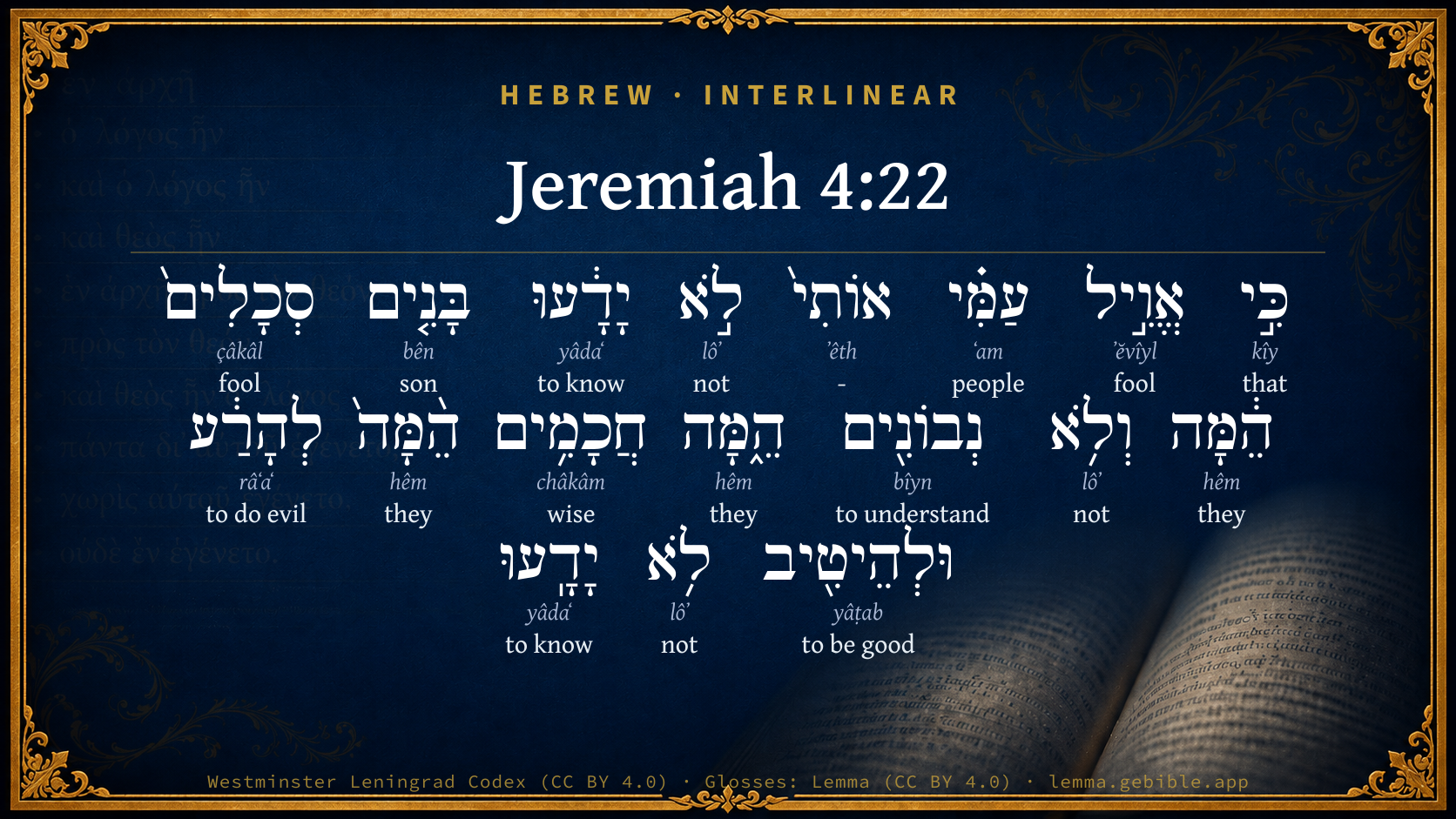
Hebrew (Westminster Leningrad Codex) Jeremiah 4:22 appears in the Hebrew Old Testament. The text above is from the Westminster Leningrad Codex. Each word links to its Strong’s number, a concise gloss, and parsing drawn from the Open Scriptures Hebrew Bible morphology. Click any word for its full Brown-Driver-Briggs (BDB) entry.
Download image
Cite this verse

Jeremiah 4:22 (World English Bible). Public Domain. Lemma interlinear Bible study tool, https://lemma.gebible.app/v/jeremiah/4/22.

Show BibTeX & RIS
BibTeX
RIS
English Translation
For my people are foolish, they don't know me; they are foolish children, and they have no understanding; they are wise to do evil, but to do good they have no knowledge.
World English Bible · Public Domain
Download a study sheet

One document with this verse’s original text, its word-by-word gloss line, the meaning frame, cross-references with their text, attributed commentary, and full source and license credits — printable, and it pastes into notes with its structure intact.

This verse Autodidact and up

Study sheet (.html) Plain text (.txt)

A passage Seminary Student

Up to 50 verses in one chapter. A passage sheet keeps up to 6 commentary sources and 12 cross-references per verse, in the order this page ranks them, and says so on the sheet whenever that leaves anything out. Ask for a single verse and you get the Autodidact verse sheet above.

Everything on this page stays free to read, with no account — the sheet is a download of what is already on screen, not access to it.

Want to remove ads? Support Godless Engineer
Compare translations 3

The same verse in 3 English versions, stacked beneath the original-language interlinear above. Click any original word for its lexicon entry.

Each is an independent rendering of the whole verse — the interlinear is not word-aligned to these translations.

Highlighted words mark where these versions differ — a whole-verse word diff, not a word-by-word alignment.

  • World English Bible Public Domain
    For my people are foolish, they don't know me; they are foolish children, and they have no understanding; they are wise to do evil, but to do good they have no knowledge.
  • King James Version Public Domain
    For my people is foolish, they have not known me; they are sottish children, and they have none understanding: they are wise to do evil, but to do good they have no knowledge.
  • unfoldingWord Literal Text CC BY-SA 4.0
    For my people foolish; they do not know me. They foolish sons and they have no understanding. They wise to do evil, but do not know to do good. ts\*

unfoldingWord Literal Text — © unfoldingWord, licensed CC BY-SA 4.0. Word-aligned USFM3 via Door43 (git.door43.org/unfoldingWord/en_ult).

Versions to compare (up to 4)

3 of 4 selected

Show all 18 translations

Every available English version of this verse, each an independent rendering of the whole verse.

  • World English Bible Public Domain
    For my people are foolish, they don't know me; they are foolish children, and they have no understanding; they are wise to do evil, but to do good they have no knowledge.
  • Berean Standard Bible Public Domain
    “For My people are fools; they have not known Me. They are foolish children, without understanding. They are skilled in doing evil, but they know not how to do good.”
  • Majority Standard Bible Public Domain
    “For My people are fools; they have not known Me. They are foolish children, without understanding. They are skilled in doing evil, but they know not how to do good.”
  • King James Version Public Domain
    For my people is foolish, they have not known me; they are sottish children, and they have none understanding: they are wise to do evil, but to do good they have no knowledge.
  • American Standard Version (1901) Public Domain
    For my people are foolish, they know me not; they are sottish children, and they have no understanding; they are wise to do evil, but to do good they have no knowledge.
  • Revised Version (1885) Public Domain
    For my people is foolish, they know me not; they are sottish children, and they have none understanding: they are wise to do evil, but to do good they have no knowledge.
  • Geneva Bible (1599) Public Domain
    For my people is foolish, they haue not knowen me: they are foolish children, and haue none vnderstanding: they are wise to doe euill, but to doe well they haue no knowledge.
  • Douay-Rheims (1899) Public Domain
    For my foolish people have not known me: they are foolish and senseless children: they are wise to do evil, but to do good they have no knowledge.
  • Young's Literal Translation Public Domain
    For my people `are' foolish, me they have not known, Foolish sons `are' they, yea, they `are' not intelligent, Wise `are' they to do evil, And to do good they have not known.
  • Literal Standard Version CC BY-SA 4.0
    “For My people [are] foolish, || They have not known Me, || They [are] foolish sons, || Indeed, they [are] not intelligent, || They [are] wise to do evil, || And they have not known to do good.”
  • Unlocked Literal Bible CC BY-SA 4.0
    For the foolishness of my people—they do not know me. They are idiotic people and they have no understanding. They have skill at evil, but do not know to do good.
  • unfoldingWord Literal Text CC BY-SA 4.0
    For my people foolish; they do not know me. They foolish sons and they have no understanding. They wise to do evil, but do not know to do good. ts\*
  • Darby Bible Public Domain
    For my people is foolish, they have not known me; they are sottish children, and they have no intelligence; they are wise to do evil, but to do good they have no knowledge.
  • World Messianic Bible Public Domain
    “For my people are foolish. They don’t know me. They are foolish children, and they have no understanding. They are skillful in doing evil, but they don’t know how to do good.”
  • Webster's Bible Public Domain
    For my people are foolish, they have not known me; they are sottish children, and they have no understanding: they are wise to do evil, but to do good they have no knowledge.
  • Free Bible Version CC BY-SA 4.0
    “My people are stupid; they don't know me. They are foolish children who just don't understand. They're experts at doing evil, but they don't know how to do good.”
  • Bible in Basic English Public Domain
    For my people are foolish, they have no knowledge of me; they are evil-minded children, without sense, all of them: they are wise in evil-doing, but have no knowledge of doing good.
  • JPS Tanakh (1917) Public Domain
    For My people is foolish, they know Me not; they are sottish children, and they have no understanding; they are wise to do evil, but to do good they have no knowledge.

Literal Standard Version (2020), Covenant Press — licensed CC BY-SA 4.0. Text via the HelloAO Bible API (eBible.org). Unlocked Literal Bible (unfoldingWord) — licensed CC BY-SA 4.0. Text via the HelloAO Bible API (eBible.org). unfoldingWord Literal Text — © unfoldingWord, licensed CC BY-SA 4.0. Word-aligned USFM3 via Door43 (git.door43.org/unfoldingWord/en_ult). Free Bible Version, Dr. Jonathan Gallagher — licensed CC BY-SA 4.0. Text via the HelloAO Bible API (eBible.org).

Word by word

More ways to search: Search by grammar → Find every occurrence → Compare this word →

Practice this passage: Drill this verse → Learn its vocabulary →

סְכָלִים֙
çâkâl
H5530
“fools”
Noun, Common, Masculine, Plural, Absolute
Part of Speech
Noun
Type
Common
Gender
Masculine
Number
Plural
State
Absolute
Full BDB Definition

Origin: from H5528

TWOT: 1493a

fool
  1. כִּ֣י kîy H3588 “that” Conjunction
  2. אֱוִ֣יל ʼĕvîyl H191 “fool” Adjective, Adjective, Masculine, Singular, Absolute
  3. עַמִּ֗י ʻam H5971 “people · my” Noun, Common, Masculine, Singular, Construct + Suffix, Personal, 1st Person, Common, Singular
  4. אוֹתִי֙ ʼêth H853 “- · me” Particle, Direct Object + Suffix, Personal, 1st Person, Common, Singular
  5. לֹ֣א lôʼ H3808 “not” Particle, Negative
  6. יָדָ֔עוּ yâdaʻ H3045 “to know” Verb, Qal, Perfect, 3rd Person, Common, Plural
  7. בָּנִ֤ים bên H1121 “sons” Noun, Common, Masculine, Plural, Absolute
  8. הֵ֔מָּה hêm H1992 “they” Pronoun, Personal, 3rd Person, Masculine, Plural
  9. וְלֹ֥א lôʼ H3808 “and · not” Conjunction + Particle, Negative
  10. נְבוֹנִ֖ים bîyn H995 “understood” Verb, Niphal, Participle Passive, Masculine, Plural, Absolute
  11. הֵ֑מָּה hêm H1992 “they” Pronoun, Personal, 3rd Person, Masculine, Plural
  12. חֲכָמִ֥ים châkâm H2450 “wise” Adjective, Adjective, Masculine, Plural, Absolute
  13. הֵ֨מָּה֙ hêm H1992 “they” Pronoun, Personal, 3rd Person, Masculine, Plural
  14. לְהָרַ֔ע râʻaʻ H7489 “to do evil” Preposition + Verb, Hiphil, Infinitive Construct
  15. וּלְהֵיטִ֖יב yâṭab H3190 “and · to be good” Conjunction + Preposition + Verb, Hiphil, Infinitive Construct
  16. לֹ֥א lôʼ H3808 “not” Particle, Negative
  17. יָדָֽעוּ yâdaʻ H3045 “to know” Verb, Qal, Perfect, 3rd Person, Common, Plural

About this verse

These counts appear in no published source. They are computed here, from the morphology-tagged text and Lemma’s own curated glosses. What Lemma adds →

18
words
13
distinct lemmas
Prophets
section

Notable vocabulary

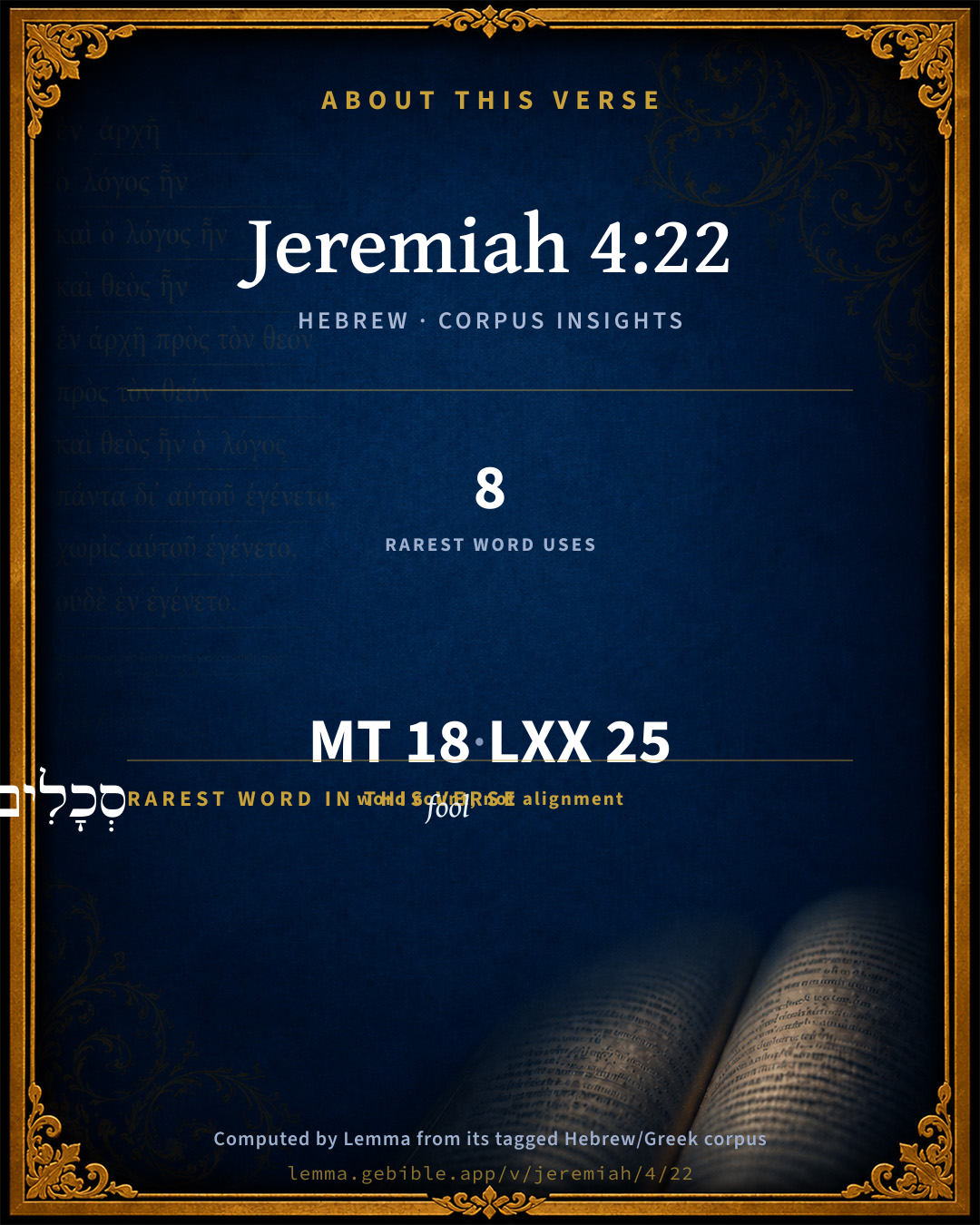
The rarest word here is סְכָלִים֙ fool H5530 — appearing just 8 times in the whole Hebrew Bible.

Shared distinctive vocabulary

סְכָלִים֙ fool H5530 occurs in 6 verses of the Hebrew Bible. Also found in:

Grammatical profile

  • 5 verbs
  • 3 nouns
  • 2 adjectives
  • 3 pronouns
  • 1 conjunction
  • 4 particles

Verb forms

  • יָדָ֔עוּ Qal · Perfect
  • נְבוֹנִ֖ים Niphal · Participle Passive
  • לְהָרַ֔ע Hiphil · Infinitive Construct
  • וּלְהֵיטִ֖יב Hiphil · Infinitive Construct
  • יָדָֽעוּ Qal · Perfect

Repetition

Words recur within this verse — often emphatic in Hebrew:

  • יָדָ֔עוּ to know H3045 ×2
  • לֹ֣א not H3808 ×3
  • הֵ֔מָּה they H1992 ×3

Hebrew & Septuagint length

In the original languages it is 18 Hebrew tokens and 25 Greek tokens — but the two are counted differently (Hebrew bundles its prefixes and suffixes into one token; the Greek is in lemma form), so that isn’t a like-for-like length.

Cross-references

28

Topical passages linked to Jeremiah 4:22 in the Treasury of Scripture Knowledge — connected by theme and wording, ordered by reader-vote popularity; previews shown in the World English Bible.

  • 1 Corinthians 14:20 Brothers, don't be children in thoughts, yet in malice be babies, but in thoughts be mature.
  • Romans 16:19 For your obedience has become known to all. I rejoice therefore over you. But I desire to have you wise in that which is good, but innocent in that which is evil.
  • Jeremiah 5:21 Hear now this, foolish people, and without understanding; who have eyes, and don't see; who have ears, and don't hear:
  • Hosea 4:6 My people are destroyed for lack of knowledge. Because you have rejected knowledge, I will also reject you, That you may be no priest to me. Because you have your God's law, I will also forget your children.
  • Romans 3:11 There is no one who understands. There is no one who seeks after God.
  • Romans 1:22 Professing themselves to be wise, they became fools,
  • Hosea 5:4 Their deeds won't allow them to turn to their God; For the spirit of prostitution is within them, And they don't know Yahweh.
  • Micah 2:1 Woe to those who devise iniquity And work evil on their beds! When the morning is light, they practice it, Because it is in the power of their hand.
  • John 16:3 They will do these things because they have not known the Father, nor me.
  • Deuteronomy 32:28 For they are a nation void of counsel, There is no understanding in them.
  • Isaiah 6:9–10 He said, "Go, and tell this people, 'You hear indeed, But don't understand; And you see indeed, But don't perceive.'
  • Romans 1:28 Even as they refused to have God in their knowledge, God gave them up to a reprobate mind, to do those things which are not fitting;
  • Isaiah 27:11 When the boughs of it are withered, they shall be broken off; the women shall come, and set them on fire; for it is a people of no understanding: therefore he who made them will not have compassion on them, and he who formed them will show them no favor.
  • Jeremiah 13:23 Can the Ethiopian change his skin, or the leopard his spots? then may you also do good, who are accustomed to do evil.
  • Isaiah 1:3 The ox knows his owner, And the donkey his master's crib; But Israel doesn't know, My people don't consider.
  • Jeremiah 10:8 But they are together brutish and foolish: the instruction of idols! it is but a stock.
  • Psalms 14:1–4 The fool has said in his heart, "There is no God." They are corrupt. They have done abominable works. There is none who does good.
  • Isaiah 42:19–20 Who is blind, but my servant? or deaf, as my messenger whom I send? Who is blind as he who is at peace, and blind as Yahweh's servant?
  • Jeremiah 5:4 Then I said, Surely these are poor; they are foolish; for they don't know the way of Yahweh, nor the law of their God:
  • 1 Corinthians 1:20–21 Where is the wise? Where is the scribe? Where is the lawyer of this world? Hasn't God made foolish the wisdom of this world?
  • Deuteronomy 32:6 Do you thus requite Yahweh, Foolish people and unwise? Isn't he your father who has bought you? He has made you, and established you.
  • 2 Samuel 16:21–23 Ahithophel said to Absalom, Go in to your father's concubines, that he has left to keep the house; and all Israel will hear that you are abhorred of your father: then will the hands of all who are with you be strong.
  • Isaiah 29:10–12 For Yahweh has poured out on you the spirit of deep sleep, and has closed your eyes, the prophets; and your heads, the seers, has he covered.
  • Jeremiah 8:7–9 Yes, the stork in the sky knows her appointed times; and the turtle-dove and the swallow and the crane observe the time of their coming; but my people don't know Yahweh's law.
  • Hosea 4:1 Hear the word of Yahweh, you children of Israel; For Yahweh has a charge against the inhabitants of the land: "Indeed there is no truth, Nor goodness, Nor knowledge of God in the land.
  • Matthew 23:16–26 "Woe to you, you blind guides, who say, 'Whoever swears by the temple, it is nothing; but whoever swears by the gold of the temple, he is obligated.'
  • Luke 16:8 "His lord commended the dishonest manager because he had done wisely, for the children of this world are, in their own generation, wiser than the children of the light.
  • 2 Samuel 13:3 But Amnon had a friend, whose name was Jonadab, the son of Shimeah, David's brother; and Jonadab was a very subtle man.

Cross-references courtesy of OpenBible.info (CC BY 4.0).

Hebrew and Greek witnesses Masoretic Hebrew ↔ Greek Septuagint

The same verse in the two great witnesses to the Old Testament, shown verse-for-verse.

These are two independent witnesses, not word-aligned to each other, and the Septuagint is shown in lemma (dictionary) form.

Hebrew Jeremiah 4:22 Masoretic · Westminster Leningrad Codex

כִּ֣י אֱוִ֣יל עַמִּ֗י אוֹתִי֙ לֹ֣א יָדָ֔עוּ בָּנִ֤ים סְכָלִים֙ הֵ֔מָּה וְלֹ֥א נְבוֹנִ֖ים הֵ֑מָּה חֲכָמִ֥ים הֵ֨מָּה֙ לְהָרַ֔ע וּלְהֵיטִ֖יב לֹ֥א יָדָֽעוּ

For my people are foolish, they don't know me; they are foolish children, and they have no understanding; they are wise to do evil, but to do good they have no knowledge.

World English Bible · Public Domain

Greek LXX Structure differs

In the Septuagint, Jeremiah is about an eighth shorter than the Hebrew and arranges its material differently — the Oracles Against the Nations (Hebrew chapters 46–51) appear in the middle of the Greek book, after 25:13. Because the chapter and verse boundaries do not line up, a verse-for-verse comparison with the Hebrew is not shown.

A verse-for-verse comparison isn’t shown here because the chapters and verses don’t line up. Switch to the LXX edition with the MT / LXX toggle above to read the Greek directly.

Hebrew: Westminster Leningrad Codex (CC BY 4.0). Greek: Septuagint (public domain); English from a public-domain English Septuagint. How the Septuagint differs from the Hebrew →

Targum (Aramaic paraphrase)

1

The Targum is the ancient Jewish Aramaic paraphrase of the Hebrew Scriptures — an interpretive translation, not the Hebrew text itself. Onkelos (literal) and Pseudo-Jonathan (expansive) render the Torah, and Jonathan the Prophets. Coverage is partial: where no permissively-licensed English translation exists for a verse, only the Aramaic is shown. This is verse-level text, not a word-by-word alignment to the Hebrew.

  1. Targum Jonathan Prophets (Joshua–Malachi)
    אֲרֵי אִטַפָּשׁוּ עַמִי מִידַע דְחַלְתִּי לָא אֲלִיפוּ בְּנִין טַפְשִׁין אִינוּן וְלָא סוּכְלְתָנִין אִינוּן חַכִּימִין אִינוּן לְאַבְאָשָׁא וּלְאוֹטָבָא לֵית אִינוּן יָדְעִין:

    (no public-domain English translation for this verse)

    Targum Jonathan — Aramaic: “Mikraot Gedolot” (public domain). English: “Sefaria Community Translation” (CC0 1.0 (public-domain dedication)); “London "Chaldee Paraphrase," 1871” (public domain). Text via Sefaria.

Commentary

Notes on Jeremiah 4:22 from classic Christian and Jewish commentators (each source and its license shown beneath its notes). The classic Christian expositions comment on the surrounding passage and are grouped to its opening verse, so a note may address several verses; the Jewish commentaries on the Tanakh (Rashi and others) are per-verse, so they appear only where the commentator wrote on this verse.

Lemma curates 59 commentaries, every one of them public domain or Creative Commons licensed, each selected and text-cleaned for this edition rather than reprinted as found. About our sources →

Trapp's Complete Commentary

John Trapp

Jer 4:22 For my people [is] foolish, they have not known me; they [are] sottish children, and they have none understanding: they [are] wise to do evil, but to do good they have no knowledge.

Ver. 22. For my people is foolish, they have not known me.] To know and to worship God aright, is the only true wisdom, saith Lactantius. {a}

They are wise to do evil, but to do good they have no knowledge.] In terrenis lyncei, in caelestibus talpae. Wise the wicked are in their generation, subtle and sly; but so is the serpent, or the fox. The swine that wandereth can make better shift to get home than the sheep can to the fold. They have received "the spirit of this world"; {1Co 2:12} the devil also worketh effectually in them, as a smith in his forge. {Eph 2:2} Hence they are "wise to do evil." Elymas was a sorcerer, subtle fellow, but the devil’s child, and so the more dangerous. {Act 13:10} Magnum ingenium et magna tentatio, saith Vincentius Lirinensis, concerning Origen, who had a great wit, but proved a great scandal to the Church. The devil covets to be adorned by thee, said Augustine to one that was wittily wicked. Surely as jet gathereth dross and refuse things to itself, but lets go gold and precious things; so do the world’s wizards.

{a} Lib. iii. cap. 30.

John Trapp, A Commentary or Exposition upon All the Books of the Old and New Testament (1647–1656) — public domain. Text from a community e-Sword module.

Geneva Bible (1599)

Geneva Bible translators

Their wisdom and policy tend to their own destruction and pulleth them from God.

Geneva Bible (1599) marginal notes — public domain. Text via Bolls.life.

Jamieson, Fausset & Brown

Robert Jamieson, A. R. Fausset & David Brown

Jehovah's reply; they cannot be otherwise than miserable, since they persevere in sin. The repetition of clauses gives greater force to the sentiment.

wise . . . evil . . . to do good . . . no knowledge--reversing the rule (Rom 16:19) "wise unto . . . good, simple concerning evil."

Jamieson, Fausset & Brown — Commentary Critical and Explanatory on the Whole Bible (1871) — public domain (CC PDM 1.0). Text via the HelloAO Bible API.

John Calvin's Commentaries

The Prophet again teaches us, that the cause of these evils arose from the people themselves, and was to be found in them, so that they could not transfer it to anybody else. Hence he says, My people are foolish. He speaks here in the person of God; for it immediately follows, Me have they not known: this could not have been said by Jeremiah. God then complains here of the folly of his people; whom he so calls, not by way of honor, but that he might double their reproach; for nothing could have been more disgraceful than that the people, whom God had chosen as his peculiar inheritance, should be thus demented: for why had God chosen the seed of Abraham as his adopted children, but that they might be as lamps, carrying through the world the light of salvation?

“What people in the world, “says Moses, “are so noble, who have gods so near them?” He says also, “This is thy knowledge and wisdom.” (Deuteronomy 4:6, 7.)

God then shews here that it was a monstrous thing, which all should regard with abhorrence, that his people should be foolish; as though he had said, “Can it be that a people whom I have chosen for myself, and with whom I have deposited the covenant of eternal salvation, whom I have instructed by my word — that this people should so madly ruin themselves?”

The people, then, are foolish, because they have not known me. He here expresses what was the cause of the foolishness or blindness of the people, even because they did not know God; for the knowledge of him is true wisdom. Now God thus shews that the madness of the people was inexcusable. How so? because he had made himself so familiarly known to them, that the Israelites had no occasion to ask, as Moses says, Who shall ascend into heaven, or who shall descend into the deep? for the word was set before them. (Deuteronomy 30:12-14.) As, then, God had so kindly manifested himself to the Jews, he justly complains that he was not known by them.

There are then here two things to be noticed; first, the kind of madness that is here mentioned, — the people did not know God. And we hence learn that then only are we wise when we fear God, and that we are always mad and senseless when we regard him not. This is one thing. Secondly, we must know that no excuse of ignorance or mistake was allowed to that people, for God had made himself known to them. And this may be applied to us: God will justly upbraid us at the last day, that we have been foolish and mad, if we are without the knowledge of him; for we have the means, as I have said, of knowing him; and there is no excuse that we can plead for our ignorance, since God has not spoken to us in an obscure manner. God in these words accused the Jews of ingratitude, and of deliberate wickedness, because they knew him not. But since God has at this day made himself more fully known to us, it is, as I have said, a heavier condemnation to us, and our punishment will thus be doubled, if we know not God, who is so kind to us, and deals with us so graciously.

Then he adds, that they were foolish children, and not intelligent. The antithesis in Hebrew is more emphatical than in Greek and Latin; for to say, “He is foolish, and not wise, “would be in Greek and Latin frigid, as the last clause would be weaker than the former. But in Hebrew it is different; for in this way is conveyed the idea, that they were so foolish that not even the least portion of a sound mind remained in them. Even those who are foolish and senseless do yet retain some knowledge, however small it may be: hence they say, that the foolish often speak what is suitable. But the Prophet means another thing, — that the Jews were not only senseless and stupid, but that they were so destitute of all knowledge, that they were like stones or brute animals, and that they had not a particle of sound mind or of rational knowledge remaining in them. The rest we shall defer to another time.

John Calvin's Commentaries (1540-1563) — public domain. Text from the Calvin Translation Society English edition (1840s-50s) via the Christian Classics Ethereal Library (ccel.org). Calvin's coverage is partial (roughly two-thirds of the Bible); uncommented books and verses are honest gaps, never fabricated. The 19th-century editor's footnotes and remarks are omitted so the notes are faithfully Calvin's own voice.

Ellicott's Commentary for English Readers

(22) For my people is foolish.—Jehovah answers the prophet’s question. The misery comes to punish the folly and sottishness of the people. It shall last as long as they last, or till it has accomplished its work of chastisement.

A Bible Commentary for English Readers, edited by Charles John Ellicott (1878–1897) — public domain. Text from a community e-Sword module.

The Cambridge Bible for Schools and Colleges

gen. ed. J. J. S. Perowne

22. know] have regard to. Cp. Isa_1:3.

The Cambridge Bible for Schools and Colleges (gen. ed. J. J. S. Perowne; Cambridge University Press, 1878–1918) — public domain. Text from a community e-Sword module.

John Gill's Exposition

For my people is foolish,.... This, as Kimchi says, is the answer of the Lord to the prophet; for not the prophet says this, but the Lord to the prophet, giving a reason why this sore destruction came upon the people of the Jews, and so reconciling his mind to the providence; seeing those whom he had chosen to be his people, above all people upon the face of the earth, and who professed themselves to be his people, had acted such a foolish part as they had done, in backsliding from him, revolting from his ways and worship, rebelling against him, and in committing such gross idolatries as they had been guilty of. So a people may be a professing people, and yet a foolish one; there are foolish professors of religion; such who take up a profession foolishly, without an experience of the grace of God; without any true faith in Christ; without having on the wedding garment of his righteousness; without laying it upon a good foundation; and without considering the cost and charge of a profession, and the difficulties and troubles attending it; and such are they who foolishly trust in it, when they have taken it up; and hold it foolishly, very remissly, and in a wavering manner; and who walk not agreeably to it, and at last foolishly drop it:

they have not known me; men may be the people of God by profession, and yet not know him; not know him so as to glorify him; not know him as their God, truly and experimentally; not know him in Christ, and have communion with him through him; not know the Lord Christ himself, the worth, glory, and excellency of him; their need of him; of his blood to cleanse them from sin; of his righteousness to justify them; of his sacrifice to atone for them; and of his fulness to supply their need; nor know the way of life, peace, and salvation by him, or at most only notionally, not experimentally; whereas the only true wisdom is to know Christ, and God in him; this is real and solid knowledge; it is science truly so called; it is delightful and satisfactory; it is useful and profitable, and is what issues in eternal life; and let men know what they will else, if they know not the Lord, they are "sottish children"; they are children indeed in understanding; and though they may be the children of God by profession, they are not the true and genuine children of God, since they know neither the Father nor the Son:

and they have no understanding; though they are not without a natural understanding, or an understanding of things natural and civil, yet they have no spiritual understanding, or an understanding of spiritual things; and at best only in a speculative, and not in an experimental way and manner:

they are wise to do evil; cunning inventors of evil things, crafty schemers that way, may be full of all wicked subtlety, and expert at over reaching and defrauding their brethren; when professors of religion especially ought to be wise unto that which is good, and simple concerning evil, Rom 16:19,

but to do good they have no knowledge; to do good, or to do a good thing well, is to do it according to the revealed will of God, from a principle of love to him, in the exercise of faith upon him, in the name and strength of Christ, and with a view to the glory of God; to do good in this sense, and in such a way and manner, carnal men and carnal professors have no knowledge, no practical knowledge; they have no inclination to it, but the reverse; nor do they, nor can they, perform it: if they had a knowledge how to do it, or a power to perform it, there would have been, in one age or another, some, more or fewer, that would have done it; but there is none of all Adam's descendants that does good, no, not one, Rom 3:9, the grace of God is absolutely necessary to the right doing of a good work, and the knowledge of it.

John Gill's Exposition of the Whole Bible (1746–1763) — public domain (CC PDM 1.0). Text via the HelloAO Bible API.

Haydock's Catholic Bible Commentary

Me, practically. They have not honoured me as they ought. (Calmet) --- If they were indeed devoid of sense, they would be excused. (Worthington)

George Leo Haydock (1774–1849), Haydock's Catholic Family Bible and Commentary, 1859 edition — public domain. Excludes Psalms (Douay-Rheims chapter numbering differs from Protestant) and Deuterocanonical books (Catholic canon only).

Matthew Poole's English Annotations

For my people is foolish: though God show them here that the cause of all these calamities is their folly, Jer 2:17,19; Psa 38:3,5, yet he owns them for his people, Jer 2:11,31,32.

They have not known me; which is indeed the only true wisdom; they have not studied my disposition or mildness toward them; they are so sottish, that they have neither regarded my counsels nor threats, but utterly stupid; they know not what is for their own good, have no understanding.

They have no knowledge, i.e. their knowledge is as bad or worse than none, it is very ill employed in doing evil, only witty here, crafty and subtle. See 2Sa 13:3. But how to do any good they know not, Jer 9:3; Luk 16:8; this the apostle dehorts from, 1Co 14:20.

Matthew Poole's English Annotations on the Holy Bible (1683–1685) — public domain. Text from a community e-Sword/MySword module.

Whedon's Commentary on the Bible

Daniel D. Whedon

22. My people… foolish — The answer to the question in the preceding verse. The statement substantially implies — This trouble is not fortuitous, neither is it unjust, but has come from Israel’s wickedness.

Daniel D. Whedon (gen. ed.), Commentary on the Old and New Testaments (1874–1909) — public domain. Text from a community e-Sword module.

The Pulpit Commentary

For my people is foolish. The Lord gives no direct answer to the complaining question in ver. 21. He simply states the moral ground for Judah"s calamity, and implies that this will last so long as the people continue to be "foolish," i.e. virtual deniers of the true God.

The folly of misdirected wisdom.

I WICKEDNESS IS FOLLY. The fool," according to Scripture, is both morally corrupt and intellectually imbecile. (e.g. Psa_107:17) There is a truth underlying the saying of Socrates, that "Virtue is knowledge, and vice is ignorance." It is apparent, indeed, that men may have an intellectual conception of the right while they do wrong, as also that good men may fall into error. But, on the other hand:

1. We cannot progress in goodness till we discern the way; we must know God to love him, recognize the good to choose it.

2. Immorality deadens the faculty of spiritual intuition; purity purges the vision of the soul.

3. Wisdom is not mere intelligence, but applied intelligence, practical intelligence. It is not perfected till it is practiced. He who knows the good is not wise until he does it; and he who does right from instinct, habit, or mere inclination is not really performing a moral action. An action is moral when it is performed with an intelligent regard to principle, i.e. when it is under the direction of spiritual wisdom.

II THE FOLLY OF WICKEDNESS MAY BE ASSOCIATED WITH MISDIRECTED WISDOM. The "fool" in spiritual things may be a worldly wise man and clever in the execution of wickedness. Ironical as is the language of the text, it may often find a literal application. Shrewd business men may be spiritually blind. Men who are wakeful and eager in material concerns become dull and listless when they touch higher interests. This may be explained by two considerations.

1. We develop most wisdom in regard to those things which interest us most. Interest rouses attention, quickens perception, excites inquiry, stimulates intellectual activity; while lack of interest leaves the mind in a slumberous condition, working at half-power. If we feel no interest in goodness, we shall be dull and foolish in regard to it.

2. Spiritual wisdom depends upon a spiritual tone of mind. The greatest intelligence is not capable of detecting subtle harmonies and discords if it is not accompanied by "an ear for music." The cold intellect, which is but a huge calculating-machine, has not the fitting powers of perception for discerning spiritual truth. This requires a spiritual sympathy. (1Co_2:14) Therefore

(1) let the man of conscious intellectual power beware of the danger of assuming to judge spiritual questions before he has acquired the requisite spiritual qualification; and

(2) let us all beware of attaching too much weight to the religious motives of people who may be able business men, clever literary critics, and even profound students of science, and yet in moral regions "blind leaders of the blind.

III MISDIRECTED WISDOM IS THE HEIGHT OF FOLLY. The very ability, misapplied, witnesses for the foolishness which permitted so gross a mistake. These people who are "wise to do evil" are on the whole "foolish," "sottish," and "have no understanding." The man who is prudent enough to exercise forethought for this life only enhances his folly in having none for the future life. (Luk_12:16-21) He who knows much of worldly things is convicted of grossest darkness in not knowing God. The born fool is excused by his misfortune of nature. But how foolish for the man who shows himself capable of wisdom to neglect the highest wisdom! Note, in conclusion,

(1) the common mistake of honoring men for their intellectual ability rather than for their moral character;

(2) the error of those who pride themselves in "knowing the world,"* while they are ignorant of God; (Rom_16:19) and

(3) the need to turn from intellectual pride to childlike trust for the source of true wisdom. (Mat_11:25)

The wisdom of this world.

That there is such a thing we may well believe, for Christ himself noticed and commended it: "The children of this world are wiser in their generation than the children of light." Within a certain range it is often seen to the disadvantage of the "wisdom that is from above.

I IT IS GREAT IN QUESTIONS OF MEANS, METHODS, AND POLICY. Attention is directed to these continually. A certain pride is exhibited in skill and power of manipulation. There is something very attractive to a certain order of mind in the opportunities the world affords for maneuver, dexterity, intrigue. The world prizes and encourages cleverness in practical, external matters. It can even appreciate the business qualities and the reliable character of Christians, when their inspiring principle is utterly ignored or intensely disliked. How much has the Church of today to learn of the world in merely practical concerns, knowledge of human nature, and adaptation of herself to her surroundings!

II IT IS MARKED BY:

1. Dislike to what is worthy and good. Disillusion from worldly dreams may coexist with this. But men without lofty ideals cannot be happy or satisfied.

2. Heedlessness as to the impending judgments of God and the eternal future.

3. Consciousness of worthlessness and uselessness of its own efforts. M.

Those who are wise to do evil.

This description of "my people" has a curious resemblance to the exhortation of our Lord when he told his friends to be wise as serpents and harmless as doves. These people, according to Jeremiah"s observation, had all the wisdom of the serpent, but it was for serpentine purposes. And the worst of it was that they hurt themselves the most. Note

I THE REFERENCE TO MAN"S GREAT POWERS. Even in his headlong, infatuated descent to ruin, the great powers are manifest. It is the very perversion and ruin of what is so noble in its original constitution that helps to give one an insight, deep even though melancholy, into all that makes up the nobility. A temple in ruins fills one with thoughts which could never be excited by looking at a dilapidated shed. Jeremiah looks upon Jerusalem and the men who are leaders there (ver. 9), and their great human faculties cannot he concealed from him. When man sinks into sin, this does not destroy the great human powers; it simply distorts their operation. We look at men as they are, and whatever the sad reflections coming into our minds, we still see the supremacy in terrestrial creation, the power to adapt means to ends, and all that strength and suppleness of intellect which are so much more than the greatest strength of a brute.

II THESE GREAT POWERS MUST BE USED. The human intellect cannot be left to lie like a dead sword in the scabbard. In one sense the intellect is but an instrument. having in itself no character either for good or evil, any more than a piece of machinery. Everything depends on the disposition and intents of the man using it. But then the intellect, instrumental as it is, is not a mere instrument, but has a living connection with the rest of human nature. It must act, with more or less energy, according to the individuality of its possessor. These faculties must be used, if not for good, then for evil. History abounds in instances of wicked and selfish men who have achieved their mischievous ends by that very intellectual force which was given for something very different. Hence the importance of early training and direction, so far as one will can alter the course of another. Every individual whose faculties are diverted from good purposes is so much gain to the powers of evil. There is no neutral ground to which to retire. To go out of the one path is to go into the other. This was the sad thought that, even while Jerusalem was going down, lower, lower, towards the hour of its capture and desolation, there were yet in it many men who had the power, if only their hearts had been fight, to do much towards saving and blessing their country. But all their thoughts, their utmost acuteness of mind, were given to build and enrich self. Y.

The Pulpit Commentary (1880–1919), ed. H.D.M. Spence-Jones & Joseph S. Exell — public domain. Text from a community e-Sword module.

Lesson kit

Teaching starters — assembled from the data on this page, not authored interpretation. Every prompt links to the verse data it draws on. Edit before teaching.

Jeremiah, in the Prophets, opens this verse with 18 words (13 distinct Hebrew lemmas). Its most distinctive word is çâkâl (“fool”). A historical commentator’s framing appears above. Read the whole chapter for the surrounding context.

Discussion questions

  1. How does “fool” (çâkâl) shape what this verse is saying?
  2. How does Ecclesiastes 2:19, which shares the word «fool», read alongside this verse?
  3. What does the repetition of “to know” (2× in this one verse) do in this verse?
  4. These translations render this verse differently. What is at stake in choosing one wording over another?
  5. «יָדָ֔עוּ» is a Qal Perfect verb. How does that grammatical form shape the action described?
  6. Compare how Trapp's Complete Commentary and Geneva Bible (1599) read this verse. Where do they agree or differ?

Things to notice

Reading settings

Reading text

Shown beneath each verse's original-language words.

Old Testament
Old Testament edition

Read the OT as the Masoretic Hebrew (MT) or the Greek Septuagint (LXX).

English shown for the Greek Septuagint (in the Hebrew ↔ Greek comparison).

Comparing translations? Open the Compare panel on any verse page to stack up to four side by side.