
Isaiah 10:13

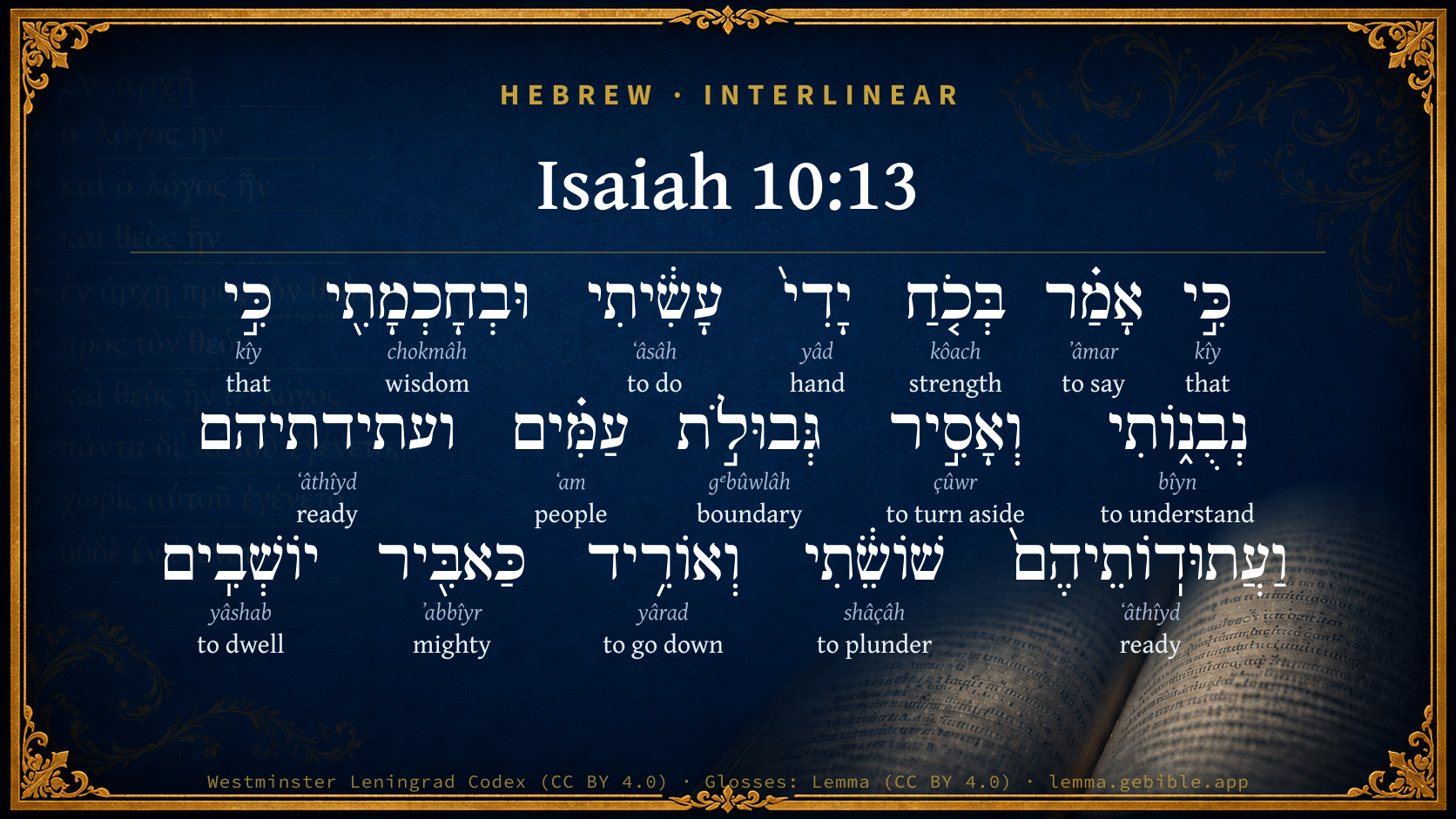
Hebrew (Westminster Leningrad Codex) Isaiah 10:13 appears in the Hebrew Old Testament. The text above is from the Westminster Leningrad Codex. Each word links to its Strong’s number, a concise gloss, and parsing drawn from the Open Scriptures Hebrew Bible morphology. Click any word for its full Brown-Driver-Briggs (BDB) entry.
Download image
Cite this verse

Isaiah 10:13 (World English Bible). Public Domain. Lemma interlinear Bible study tool, https://lemma.gebible.app/v/isaiah/10/13.

Show BibTeX & RIS
BibTeX
RIS
English Translation
For he has said, By the strength of my hand I have done it, and by my wisdom; for I have understanding: and I have removed the bounds of the peoples, and have robbed their treasures, and like a valiant man I have brought down those who sit [on thrones]:
World English Bible · Public Domain
Download a study sheet

One document with this verse’s original text, its word-by-word gloss line, the meaning frame, cross-references with their text, attributed commentary, and full source and license credits — printable, and it pastes into notes with its structure intact.

This verse Autodidact and up

Study sheet (.html) Plain text (.txt)

A passage Seminary Student

Up to 50 verses in one chapter. A passage sheet keeps up to 6 commentary sources and 12 cross-references per verse, in the order this page ranks them, and says so on the sheet whenever that leaves anything out. Ask for a single verse and you get the Autodidact verse sheet above.

Everything on this page stays free to read, with no account — the sheet is a download of what is already on screen, not access to it.

Want to remove ads? Support Godless Engineer
Compare translations 3

The same verse in 3 English versions, stacked beneath the original-language interlinear above. Click any original word for its lexicon entry.

Each is an independent rendering of the whole verse — the interlinear is not word-aligned to these translations.

Highlighted words mark where these versions differ — a whole-verse word diff, not a word-by-word alignment.

  • World English Bible Public Domain
    For he has said, By the strength of my hand I have done it, and by my wisdom; for I have understanding: and I have removed the bounds of the peoples, and have robbed their treasures, and like a valiant man I have brought down those who sit [on thrones]:
  • King James Version Public Domain
    For he saith, By the strength of my hand I have done it, and by my wisdom; for I am prudent: and I have removed the bounds of the people, and have robbed their treasures, and I have put down the inhabitants like a valiant man:
  • unfoldingWord Literal Text CC BY-SA 4.0
    For he has said, “By the strength of my hand I have done, and by my wisdom, for I understand. And I have removed the borders of peoples, and I have plundered their treasures, and like a mighty, I have brought down the sitters.

unfoldingWord Literal Text — © unfoldingWord, licensed CC BY-SA 4.0. Word-aligned USFM3 via Door43 (git.door43.org/unfoldingWord/en_ult).

Versions to compare (up to 4)

3 of 4 selected

Show all 18 translations

Every available English version of this verse, each an independent rendering of the whole verse.

  • World English Bible Public Domain
    For he has said, By the strength of my hand I have done it, and by my wisdom; for I have understanding: and I have removed the bounds of the peoples, and have robbed their treasures, and like a valiant man I have brought down those who sit [on thrones]:
  • Berean Standard Bible Public Domain
    For he says: ‘By the strength of my hand I have done this, and by my wisdom, for I am clever. I have removed the boundaries of nations and plundered their treasures; like a mighty one I subdued their rulers.
  • Majority Standard Bible Public Domain
    For he says: ‘By the strength of my hand I have done this, and by my wisdom, for I am clever. I have removed the boundaries of nations and plundered their treasures; like a mighty one I subdued their rulers.
  • King James Version Public Domain
    For he saith, By the strength of my hand I have done it, and by my wisdom; for I am prudent: and I have removed the bounds of the people, and have robbed their treasures, and I have put down the inhabitants like a valiant man:
  • American Standard Version (1901) Public Domain
    For he hath said, By the strength of my hand I have done it, and by my wisdom; for I have understanding: and I have removed the bounds of the peoples, and have robbed their treasures, and like a valiant man I have brought down them that sit `on thrones':
  • Revised Version (1885) Public Domain
    For he hath said, By the strength of my hand I have done it, and by my wisdom; for I am prudent: and I have removed the bounds of the peoples, and have robbed their treasures, and I have brought down as a valiant man them that sit on thrones:
  • Geneva Bible (1599) Public Domain
    Because he said, By ye power of mine owne hand haue I done it, and by my wisdome, because I am wise: therefore I haue remooued the borders of the people, and haue spoyled their treasures, and haue pulled downe the inhabitants like a valiant man.
  • Douay-Rheims (1899) Public Domain
    For he hath said: By the strength of my own hand I have done it, and by my own wisdom I have understood: and I have removed the bounds of the people, and have taken the spoils of the princes, and as a mighty man hath pulled down them that sat on high.
  • Young's Literal Translation Public Domain
    For he hath said, `By the power of my hand I have wrought, And by my wisdom, for I have been intelligent, And I remove borders of the peoples, And their chief ones I have spoiled, And I put down as a mighty one the inhabitants,
  • Literal Standard Version CC BY-SA 4.0
    For he has said, “I have worked by the power of my hand, || And by my wisdom, for I have been intelligent, || And I remove borders of the peoples, || And I have spoiled their chief ones, || And I put down the inhabitants as a mighty one,
  • Unlocked Literal Bible CC BY-SA 4.0
    For he says, “By my strength and by my wisdom I acted. I have understanding, and I have removed the boundaries of the peoples. I have stolen their treasures, and like a bull I have brought down the inhabitants.
  • unfoldingWord Literal Text CC BY-SA 4.0
    For he has said, “By the strength of my hand I have done, and by my wisdom, for I understand. And I have removed the borders of peoples, and I have plundered their treasures, and like a mighty, I have brought down the sitters.
  • Darby Bible Public Domain
    For he saith, By the strength of my hand I have done [it], and by my wisdom, for I am intelligent; and I have removed the bounds of the peoples, and have robbed their treasures, and, like a valiant man, I have brought down them that sit [on thrones];
  • World Messianic Bible Public Domain
    For he has said, “By the strength of my hand I have done it, and by my wisdom, for I have understanding. I have removed the boundaries of the peoples, and have robbed their treasures. Like a valiant man I have brought down their rulers.
  • Webster's Bible Public Domain
    For he saith, By the strength of my hand I have done it, and by my wisdom; for I am prudent: and I have removed the bounds of the people, and have robbed their treasures, and I have put down the inhabitants like a valiant man:
  • Free Bible Version CC BY-SA 4.0
    For the king of Assyria says: “I have done this in my own strength. It was through my wisdom, because I'm clever. I have wiped out the boundaries of nations and looted their treasures. Like a bull I knocked their rulers off their thrones.
  • Bible in Basic English Public Domain
    For he has said, By the strength of my hand I have done it, and by my knowledge, for I am wise: and I have taken away the limits of the peoples' lands, and the stores of their wealth have become mine; and I have made towns low in the dust, sending destruction on those living in them;
  • JPS Tanakh (1917) Public Domain
    For he hath said: by the strength of my hand I have done it, and by my wisdom, for I am prudent; in that I have removed the bounds of the peoples, and have robbed their treasures, and have brought down as one mighty the inhabitants;

Literal Standard Version (2020), Covenant Press — licensed CC BY-SA 4.0. Text via the HelloAO Bible API (eBible.org). Unlocked Literal Bible (unfoldingWord) — licensed CC BY-SA 4.0. Text via the HelloAO Bible API (eBible.org). unfoldingWord Literal Text — © unfoldingWord, licensed CC BY-SA 4.0. Word-aligned USFM3 via Door43 (git.door43.org/unfoldingWord/en_ult). Free Bible Version, Dr. Jonathan Gallagher — licensed CC BY-SA 4.0. Text via the HelloAO Bible API (eBible.org).

Word by word

More ways to search: Search by grammar → Find every occurrence → Compare this word →

Practice this passage: Drill this verse → Learn its vocabulary →

ועתידתיהם
ʻâthîyd
H6264
“and · ready · their”
Conjunction + Adjective, Adjective, Masculine, Plural, Construct + Suffix, Personal, 3rd Person, Masculine, Plural
Part of Speech
Conjunction + Adjective
Type
Adjective
Gender
Masculine
Number
Plural
State
Construct
Full BDB Definition

Origin: from H6257

TWOT: 1719a

ready, prepared - ready - ready, skilled - prepared, impending - prepared, stored up, treasure
  1. כִּ֣י kîy H3588 “that” Conjunction
  2. אָמַ֗ר ʼâmar H559 “to say” Verb, Qal, Perfect, 3rd Person, Masculine, Singular
  3. בְּכֹ֤חַ kôach H3581 “in/at · strength of” Preposition + Noun, Common, Masculine, Singular, Construct
  4. יָדִי֙ yâd H3027 “hand · my” Noun, Common, Both, Singular, Construct + Suffix, Personal, 1st Person, Common, Singular
  5. עָשִׂ֔יתִי ʻâsâh H6213 “to do” Verb, Qal, Perfect, 1st Person, Common, Singular
  6. וּבְחָכְמָתִ֖י chokmâh H2451 “and · in/at · wisdom · my” Conjunction + Preposition + Noun, Common, Feminine, Singular, Construct + Suffix, Personal, 1st Person, Common, Singular
  7. כִּ֣י kîy H3588 “that” Conjunction
  8. נְבֻנ֑וֹתִי bîyn H995 “to understand” Verb, Niphal, Perfect, 1st Person, Common, Singular
  9. וְאָסִ֣יר çûwr H5493 “and · to turn aside” Conjunction + Verb, Hiphil, Imperfect, 1st Person, Common, Singular
  10. גְּבוּלֹ֣ת gᵉbûwlâh H1367 “boundaries of” Noun, Common, Feminine, Plural, Construct
  11. עַמִּ֗ים ʻam H5971 “peoples” Noun, Common, Masculine, Plural, Absolute
  12. וַעֲתוּדֽוֹתֵיהֶם֙ ʻâthîyd H6264 “and · ready · their” Conjunction + Adjective, Adjective, Masculine, Plural, Construct + Suffix, Personal, 3rd Person, Masculine, Plural
  13. שׁוֹשֵׂ֔תִי shâçâh H8154 “to plunder” Verb, Poel, Perfect, 1st Person, Common, Singular
  14. וְאוֹרִ֥יד yârad H3381 “and · to go down” Conjunction + Verb, Hiphil, Imperfect, 1st Person, Common, Singular
  15. כַּאבִּ֖יר ʼabbîyr H47 “like/as · mighty” Preposition + Adjective, Adjective, Masculine, Singular, Absolute
  16. יוֹשְׁבִֽים yâshab H3427 “dwelling” Verb, Qal, Participle Active, Masculine, Plural, Absolute

About this verse

These counts appear in no published source. They are computed here, from the morphology-tagged text and Lemma’s own curated glosses. What Lemma adds →

17
words
15
distinct lemmas
Prophets
section

Notable vocabulary

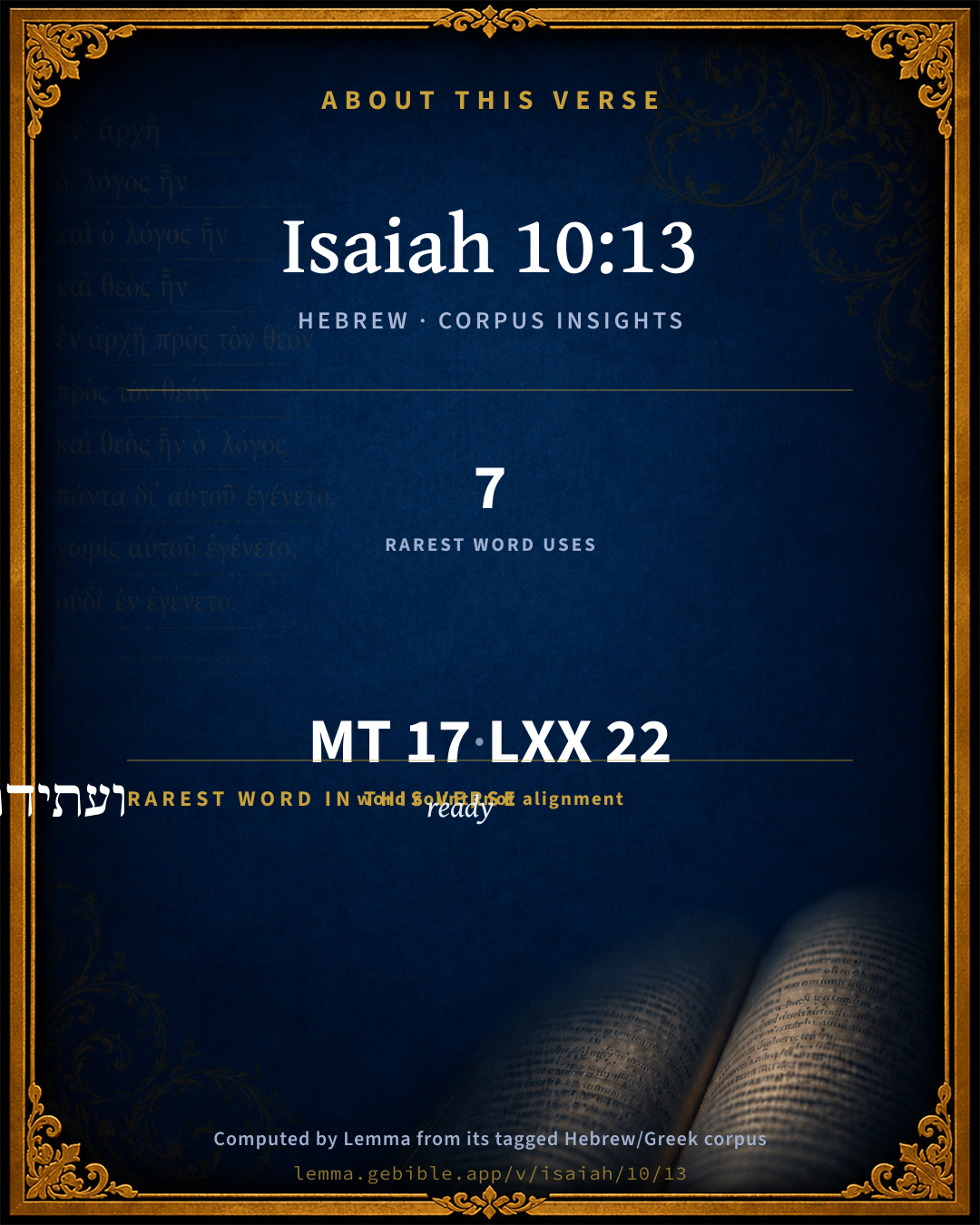
The rarest word here is ועתידתיהם ready H6264 — appearing just 7 times in the whole Hebrew Bible.

Shared distinctive vocabulary

ועתידתיהם ready H6264 occurs in 6 verses of the Hebrew Bible. Also found in:

Grammatical profile

  • 7 verbs
  • 5 nouns
  • 3 adjectives
  • 2 conjunctions

Verb forms

  • אָמַ֗ר Qal · Perfect
  • עָשִׂ֔יתִי Qal · Perfect
  • נְבֻנ֑וֹתִי Niphal · Perfect
  • וְאָסִ֣יר Hiphil · Imperfect
  • שׁוֹשֵׂ֔תִי Poel · Perfect
  • וְאוֹרִ֥יד Hiphil · Imperfect
  • יוֹשְׁבִֽים Qal · Participle Active

Repetition

Words recur within this verse — often emphatic in Hebrew:

  • ועתידתיהם ready H6264 ×2
  • כִּ֣י that H3588 ×2

Hebrew & Septuagint length

In English translation the verse runs 50 words from the Hebrew and 27 from the Septuagint (LXX English) — the Septuagint runs noticeably shorter here. See the side-by-side →

A rough comparison of the two English renderings, which tokenize alike — not a word-level alignment.

Word counts can differ between the Hebrew and the Greek without any difference in meaning — e.g. the Hebrew direct-object marker אֵת has no separate Greek word, and Greek often adds the article ὁ.

In the original languages it is 17 Hebrew tokens and 22 Greek tokens — but the two are counted differently (Hebrew bundles its prefixes and suffixes into one token; the Greek is in lemma form), so that isn’t a like-for-like length.

Cross-references

21

Topical passages linked to Isaiah 10:13 in the Treasury of Scripture Knowledge — connected by theme and wording, ordered by reader-vote popularity; previews shown in the World English Bible.

  • Deuteronomy 8:17 and [lest] you say in your heart, My power and the might of my hand has gotten me this wealth.
  • Daniel 4:30 The king spoke and said, Is not this great Babylon, which I have built for the royal dwelling-place, by the might of my power and for the glory of my majesty?
  • 2 Kings 15:29 In the days of Pekah king of Israel came Tiglath Pileser king of Assyria, and took Ijon, and Abel Beth Maacah, and Janoah, and Kedesh, and Hazor, and Gilead, and Galilee, all the land of Naphtali; and he carried them captive to Assyria.
  • 2 Kings 16:8 Ahaz took the silver and gold that was found in the house of Yahweh, and in the treasures of the king's house, and sent it for a present to the king of Assyria.
  • 2 Kings 17:6 In the ninth year of Hoshea the king of Assyria took Samaria, and carried Israel away to Assyria, and placed them in Halah, and on the Habor, the river of Gozan, and in the cities of the Medes.
  • 2 Kings 17:24 The king of Assyria brought men from Babylon, and from Cuthah, and from Avva, and from Hamath and Sepharvaim, and placed them in the cities of Samaria instead of the children of Israel; and they possessed Samaria, and lived in the cities of it.
  • 2 Kings 18:11 The king of Assyria carried Israel away to Assyria, and put them in Halah, and on the Habor, the river of Gozan, and in the cities of the Medes,
  • 2 Kings 18:15 Hezekiah gave [him] all the silver that was found in the house of Yahweh, and in the treasures of the king's house.
  • 2 Kings 18:32 Until I come and take you away to a land like your own land, a land of grain and new wine, a land of bread and vineyards, a land of olive trees and of honey, that you may live, and not die: and don't listen to Hezekiah, when he persuades you, saying, Yahweh will deliver us.
  • 2 Kings 19:22–24 Whom have you defied and blasphemed? and against whom have you exalted your voice and lifted up your eyes on high? [even] against the Holy One of Israel.
  • 1 Chronicles 5:26 The God of Israel stirred up the spirit of Pul king of Assyria, and the spirit of Tilgath Pilneser king of Assyria, and he carried them away, even the Reubenites, and the Gadites, and the half-tribe of Manasseh, and brought them to Halah, and Habor, and Hara, and to the river of Gozan, to this day.
  • Isaiah 10:8 For he says, Aren't my princes all of them kings?
  • Isaiah 37:23–25 Whom have you defied and blasphemed? and against whom have you exalted your voice and lifted up your eyes on high? [even] against the Holy One of Israel.
  • Ezekiel 25:3 and tell the children of Ammon, Hear the word of the Lord Yahweh: Thus says the Lord Yahweh, Because you said, Aha, against my sanctuary, when it was profaned; and against the land of Israel, when it was made desolate; and against the house of Judah, when they went into captivity:
  • Ezekiel 26:2 Son of man, because Tyre has said against Jerusalem, Aha, she is broken: the gate of the peoples; she is turned to me; I shall be replenished, now that she is laid waste:
  • Ezekiel 28:2–9 Son of man, tell the prince of Tyre, Thus says the Lord Yahweh: Because your heart is lifted up, and you have said, I am a god, I sit in the seat of God, in the midst of the seas; yet you are man, and not God, though you did set your heart as the heart of God;-
  • Ezekiel 29:3 speak, and say, Thus says the Lord Yahweh: Behold, I am against you, Pharaoh king of Egypt, the great monster that lies in the midst of his rivers, that has said, My river is my own, and I have made it for myself.
  • Hosea 13:15–16 Though he is fruitful among his brothers, an east wind will come, The breath of Yahweh coming up from the wilderness; And his spring will become dry, And his fountain will be dried up. He will plunder the storehouse of treasure.
  • Amos 5:27–6:2 Therefore will I cause you to go into captivity beyond Damascus," says Yahweh, whose name is the God of hosts.
  • Amos 6:13 You who rejoice in a thing of nothing, who say, 'Haven't we taken for ourselves horns by our own strength?'
  • Habakkuk 1:16 Therefore he sacrifices to his net, and burns incense to his dragnet, because by them his life is luxurious, and his food is good.

Cross-references courtesy of OpenBible.info (CC BY 4.0).

Hebrew and Greek witnesses Masoretic Hebrew ↔ Greek Septuagint

The same verse in the two great witnesses to the Old Testament, shown verse-for-verse.

Here the Septuagint runs noticeably shorter than the Hebrew — LXX2012 (modern English Septuagint) 27 words vs World English Bible 50. A rough length comparison of the two English translations, not a word-level alignment — read both below.

These are two independent witnesses, not word-aligned to each other, and the Septuagint is shown in lemma (dictionary) form.

Hebrew Isaiah 10:13 Masoretic · Westminster Leningrad Codex

כִּ֣י אָמַ֗ר בְּכֹ֤חַ יָדִי֙ עָשִׂ֔יתִי וּבְחָכְמָתִ֖י כִּ֣י נְבֻנ֑וֹתִי וְאָסִ֣יר גְּבוּלֹ֣ת עַמִּ֗ים ועתידתיהם וַעֲתוּדֽוֹתֵיהֶם֙ שׁוֹשֵׂ֔תִי וְאוֹרִ֥יד כַּאבִּ֖יר יוֹשְׁבִֽים

For he has said, By the strength of my hand I have done it, and by my wisdom; for I have understanding: and I have removed the bounds of the peoples, and have robbed their treasures, and like a valiant man I have brought down those who sit [on thrones]:

World English Bible · Public Domain

Greek LXX Isaiah 10:13 Septuagint · lemma form

εἶπον γάρ ὁ ἰσχύς ποιέω καί ὁ σοφία ὁ σύνεσις ἀποαἱρέω ὅριον ἔθνος καί ὁ ἰσχύς αὐτός προνομεύω καί σείω πόλις καταοἰκέω

For he said, I will act in strength, and in the wisdom of my understanding I will remove the boundaries of nations, and will spoil their strength.

LXX2012 (modern English Septuagint) · Public Domain

On this verse, The Cambridge Bible for Schools and Colleges discusses the Septuagint’s reading. Read the note in Commentary ↓

Hebrew: Westminster Leningrad Codex (CC BY 4.0). Greek: Septuagint (public domain); English from LXX2012 (modern English Septuagint) (Public Domain). How the Septuagint differs from the Hebrew →

Targum (Aramaic paraphrase)

1

The Targum is the ancient Jewish Aramaic paraphrase of the Hebrew Scriptures — an interpretive translation, not the Hebrew text itself. Onkelos (literal) and Pseudo-Jonathan (expansive) render the Torah, and Jonathan the Prophets. Coverage is partial: where no permissively-licensed English translation exists for a verse, only the Aramaic is shown. This is verse-level text, not a word-by-word alignment to the Hebrew.

  1. Targum Jonathan Prophets (Joshua–Malachi)
    אֲרֵי אֲמַר בִּתְקוֹף יְדִי עֲבָדִית וּבְחוּכְמְתִי אֲרֵי סוּכְלְתָן אֲנָא וְאַגְלֵיתִי עַמְמַיָא מִמְדִינָא לִמְדִינָא וְקִרְוֵי תּוּשְׁבְּחַתְהוֹן בְּזֵיתִי וַאֲחָתֵית בִּתְקוֹף יַת יַתְבֵי כְּרַכִּין תַּקִיפִין:

    For he saith, By the strength of my hand I have done it, and by my wisdom; for I am prudent: and I have led nations into captivity from province to province; and the cities of their glory I have plundered; and I have brought down with strength those that dwell in fortified places.

    Targum Jonathan — Aramaic: “Mikraot Gedolot” (public domain). English: “Sefaria Community Translation” (CC0 1.0 (public-domain dedication)); “London "Chaldee Paraphrase," 1871” (public domain). Text via Sefaria.

Commentary

Notes on Isaiah 10:13 from classic Christian and Jewish commentators (each source and its license shown beneath its notes). The classic Christian expositions comment on the surrounding passage and are grouped to its opening verse, so a note may address several verses; the Jewish commentaries on the Tanakh (Rashi and others) are per-verse, so they appear only where the commentator wrote on this verse.

Lemma curates 59 commentaries, every one of them public domain or Creative Commons licensed, each selected and text-cleaned for this edition rather than reprinted as found. About our sources →

Trapp's Complete Commentary

John Trapp

Isa 10:13 For he saith, By the strength of my hand I have done [it], and by my wisdom; for I am prudent: and I have removed the bounds of the people, and have robbed their treasures, and I have put down the inhabitants like a valiant [man]:

Ver. 13. For he saith, By the strength of my hand, &c.] Viva haec est istius Veiovis Latialis, hoc est Pontificis pictura, saith Scultetus - i.e., Here we have a lively picture of Antichrist, who speaketh great things and blasphemies, {Rev 13:5} arrogates to himself all power and wisdom, disposeth of kingdoms at his pleasure robbeth their treasures, &c.

John Trapp, A Commentary or Exposition upon All the Books of the Old and New Testament (1647–1656) — public domain. Text from a community e-Sword module.

The Biblical Illustrator

Joseph S. Exell

Isa_10:13

For he saith, By the strength of my hand I have done it

The ungodliness of worldly pursuits

1.

Let us reflect on the total forgetfulness of God, and the unwillingness to recognise His power and presence, with which objects of human interest and ambition are frequently prosecuted and enjoyed.

2. Let us dwell on the spirit with which worldly men engage in the pursuit of their favourite objects, the temper and disposition of mind with which they encounter disappointment, and the kind of happiness which they derive from the success of their enterprises.

(1) The ardour with which they prosecute these is virtually a declaration that they are determined to be happy independently of God; the firmness and perseverance with which they struggle with adversity, and labour to retrieve their losses, are so many attempts to dispute with Him the determination of events, and to wrest from His hand the government of the universe; and when they have been successful almost or altogether to the extent of their expectations, and when they contrast the success that has rewarded them with the failure and disappointment that have befallen others in similar circumstances,--the principle which lies at the foundation of all their enjoyments, and gives zest to every other gratification, is substantially that which is expressed in our text, By the strength of my hand I have done it, and by my wisdom, for I am prudent.

(2) It is not, however, to those only who place their chief good in a given portion of this worlds wealth, that these observations are applicable. They will be found to hold equally true in the case of those who can find in the exercise of high intellectual endowments a gratification which mere worldly wealth never could furnish,--but who have not yet acquired any capacity for the purer and more permanent happiness of a growing conformity to the Divine image in this world, and the enjoyment of eternal communion with God in the world to come. Elevated as such pursuits may be, and profound as is the homage of respect which the world is called upon, and readily consents to pay to them, yet, wherever they constitute the only portion that the soul seeks after, and occupy that place in the affections which God claims as His own, then they bear upon them the same impress of ungodliness which characterises the schemes of worldly aggrandisement, and may ultimately be traced to the very same principle.

(3) The same remark is applicable also to the man who, by the benevolence of his character and the irreproachable regularity of his life, has secured the worlds respect, and who builds with confidence on his many virtues as a sure foundation of hope for the future; for when such a man contrasts his own character with that of multitudes around him, it will be with feelings of self-complacency.

3. It would be easy, by entering on the detail of particular cases, to show how the principle in the text pervades all the business and the pleasures of an unregenerate world.

4. The sentiment is as foolish with regard to the sinner, as it is impious with respect to the Almighty; for as well might it be supposed that the movements of the material universe would remain undisturbed, though the principle that is essential to its stability were annihilated, as that an intelligent and moral creature could be permanently blessed, if released from the law of dependence on his Creator. (R. Gordon, D. D.)

Remover of boundaries

A title assumed by the Assyrian kings. They claimed to be king of kings, and lord paramount or superior. (B. Blake, B. D.)

Robbing treasure

Great conquerors are many times no better than great robbers. (Matthew Henry.)

The Biblical Illustrator, edited by Joseph S. Exell (c. 1880s–1900s) — public domain. Text from a community e-Sword module.

Joseph Benson's Commentary

Isa 10:13-14. For he saith, &c. — “From hence to the twentieth verse we have a more full exposition and confirmation of what had gone before, particularly the pride of the Assyrian and his vain boasting in these verses; a refutation thereof in Isa 10:15; and the punishment ordained for him by God, in Isa 10:16-19. By the strength of my hand I have done it, &c. — Here the prophet sets forth his insolent boasting of the greatness of his deeds, the prosperity of his empire, and the success of his warlike expeditions, all which are ascribed by him to the prudence of his own counsels, and the valour and strength of his forces; but without any the least acknowledgment of any superior and overruling power.” I have removed the bounds of the people — I have invaded their lands, and added them to my own dominions, Pro 22:28. And have robbed their treasures — Hebrew, עתודתיהם, their prepared things, their gold and silver, and other precious things, which they had been long preparing and laying up in store. And I have put down the inhabitants — Deprived them of their former glory and power. And my hand hath found as a nest — As one finds young birds in a nest; and as one gathereth eggs — Which the dam hath left in her nest; have I gathered all the earth — All the riches of the earth: an hyperbole not unusual in the mouths of such boasters. “The comparison is elegant; and nothing could more strongly or significantly describe the insolent boasting of the Assyrian. It is remarkable, that birds, after they have laid their eggs in their nests, are most diligent in their care of them; and if, at any time, they are obliged, for fear of the spoiler, to forsake them, they hover about their nests, and flutter around, moving their wings, and peeping, chirping, or lamenting; thus imitating the affections of the human mind. The prophet elegantly implies by this simile the extreme dread of this proud and oppressing king which reigned in the minds of the conquered people, and we find that the mighty tyrants and conquerors of Asia did spread such terror.” See Lowth’s Twelfth Prelection, and Dodd.

Joseph Benson's Commentary on the Old and New Testaments (1811–1818) — public domain. Text from a community e-Sword module.

Tyndale Open Study Notes

Tyndale Open Resources

10:13 my own powerful arm . . . my own shrewd wisdom (cp. 10:5): God alone is all-powerful and wise. He plans the future, and he determines which nations will rise to power and which will be defeated.

Tyndale Open Study Notes — © Tyndale Open Resources, licensed CC BY-SA 4.0. Text via the HelloAO Bible API.

Jamieson, Fausset & Brown

Robert Jamieson, A. R. Fausset & David Brown

I am prudent--He ascribes his success to his own prudence, not to God's providence.

removed the bounds--set aside old, and substituted new boundaries of kingdoms at will. A criminal act, as Jehovah Himself had appointed the boundaries of the nations (Deu 32:8).

treasures--"hoarded treasures" [HORSLEY].

put down . . . inhabitants like, &c.--rather, "as a valiant man, I have brought down (from their seats) those seated" (namely, "on thrones"; as in Psa 2:4; Psa 29:10; Psa 55:19. The Hebrew for "He that abideth," is He that sitteth on a throne); otherwise, "I have brought down (as captives into Assyria, which lay lower than Judea; therefore 'brought down,' compare Isa 36:1, Isa 36:10), the inhabitants" [MAURER].

Jamieson, Fausset & Brown — Commentary Critical and Explanatory on the Whole Bible (1871) — public domain (CC PDM 1.0). Text via the HelloAO Bible API.

Adam Clarke's Commentary

Verse 13. Like a valiant man - "Strongly seated." Twelve MSS. agree with the Keri in reading כביר kabbir, without the א aleph. And Sal. ben Melec and Kimchi thus explain it: "them who dwelled in a great and strong place I have brought down to the ground."

Adam Clarke's Commentary on the Bible (1810–1826) — public domain. Text from a community e-Sword/MySword module.

Ellicott's Commentary for English Readers

(13) For he saith, By the strength of my hand . . .—Another reproduction of the style of the royal inscriptions of Assyria. (Comp. Isa_37:10-13.)

I have removed the bounds of the people.—The practice has, of course, more or less characterised the conquerors of all ages in their attempts to merge independent nationalities into one great empire; but it was pursued more systematically by Assyria than by most others. To be “a remover of boundaries and landmarks “was the title in which an Assyrian king most exulted. (Comp. inscription of Rimmon-nirari, in Smith’s Assyrian Discoveries, pp. 243, 244. Records of the Past, xi. 3).

I have put down the inhabitants like a valiant man.—Better, I have put down those that sat firmly. The Hebrew word for “valiant man” means primarily a “bull,” and then figuratively, as in Isa xxxiv, 7; Psa_22:12, a “mighty one.” The fact that the bull appears so frequently in Assyrian monuments as a symbol of sovereignty, mates it probable that the word is used in that symbolic sense here. In Psa_78:25, the “mighty ones” to whom it is applied are those of the host of heaven, the angels of God.

A Bible Commentary for English Readers, edited by Charles John Ellicott (1878–1897) — public domain. Text from a community e-Sword module.

The Cambridge Bible for Schools and Colleges

gen. ed. J. J. S. Perowne

13. I am prudent] Better, I have insight.

I have removed the bounds of the people] (peoples as R.V.). It was the policy of the later Assyrian Empire to obliterate national distinctions, partly by welding the separate states under a single administration and partly by wholesale deportation of conquered populations. In the view of antiquity this was a violation of the divinely constituted order of the world (see Deu_32:8). Even in the Messianic age, Isaiah anticipates that the political integrity of different nationalities will be preserved (ch. Isa_2:2-4).

their treasures] lit. parata, “things prepared.”

put down the inhabitants] R.V. has brought down … them that sit (on thrones). Vulg. “in sublimi residentes.” That translation is suggested by the verb “bring down,” which seems to imply that those referred to were previously exalted. The text is possibly defective. LXX. reads σείσω πόλεις κατοικουμένας.

like a valiant man] The Qĕrê (kabbîr, a word found only in Isaiah and Job) means “a great one” (Job_34:17 [R.V.], 24, Isa_36:5, of God). It is difficult to see why in this case the consonantal text was departed from. It has kì’abbîr, either “like a strong one” (Kaph veritatis) or “like a bull.” See on ch. Isa_1:24. The bull as a symbol of strength figures largely in Assyrian art.

13, 14. The second imaginary speech of the king of Assyria. He ascribes his successes (and how easy have they been! Isa_10:14) solely to his own power and wisdom. Comp. the self-glorification of the prince of Tyre in Ezekiel 28.

The Cambridge Bible for Schools and Colleges (gen. ed. J. J. S. Perowne; Cambridge University Press, 1878–1918) — public domain. Text from a community e-Sword module.

John Gill's Exposition

And my hand hath found as a nest the riches of the people,.... With that ease as a man finds a nest of birds, and takes them:

and as one gathereth eggs that are left; by the bird, who not sitting upon them, there is none to protect them; whereas, when they are sat upon by the bird, she will flutter with her wings, and strike with her bill, and preserve them as well as she can:

have I gathered all the earth; the kingdoms and inhabitants of it, there being none to resist, or that dared to do it, as follows:

and there was none that moved the wing; as a bird will do, when its young or eggs are taken away from it:

or opened the mouth, or peeped; chattered, clucked, or expressed any grief, uneasiness, or resentment; the Targum is,

"that opened his mouth, and spoke a word.''

John Gill's Exposition of the Whole Bible (1746–1763) — public domain (CC PDM 1.0). Text via the HelloAO Bible API.

Albert Barnes' Notes on the Bible

For he saith - The king of Assyria saith. This verse and the following are designed to show the reason why the king of Assyria should be thus punished. It was on account of his pride, and wicked plans. He sought not the glory of God, but purposed to do evil.

For I am prudent - I am wise; attributing his success to his own understanding, rather than to God.

I have removed the bounds of the people - That is, ‘I have changed the limits of kingdoms; I have taken away the old boundaries, and made new ones at my pleasure. I have divided them into kingdoms and provinces as I pleased.’ No higher assumption of power could have been made than thus to have changed the ancient limits of empires, and remodelled them at his will. It was claiming that he had so extended his own empire, as to have effectually blotted out the ancient lines which had existed, so that they were now all one, and under his control. So a man who buys farms, and annexes them to his own, takes away the ancient limits; he runs new lines as he pleases, and unites them all into one. This was the claim which Sennacherib set up over the nations.

Have robbed their treasures - Their hoarded wealth. This was another instance of the claim which he set up, of power and dominion. The treasures of kingdoms which had been hoarded for purposes of peace or war, he had plundered, and appropriated to his own use; compare the note at Isa 46:3.

I have put down the inhabitants - I have subdued them; have vanquished them.

As a valiant man - כאביר ka'bbı̂yr. Margin, ‘Many people.’ The Keri, or Hebrew marginal reading, is כביר kabbı̂yr without the Hebrew letter א, ‘a mighty or, strong man.’ The sense is not materially different. It is a claim that he had evinced might and valor in bringing down nations. Lowth renders it, ‘Them that were strongly seated.’ Noyes, ‘Them that sat upon thrones.’ The Chaldee renders the verse, not literally, but according to the sense, ‘I have made people to migrate from province to province, and have plundered the cities that were the subjects of praise, and have brought down by strength those who dwelt in fortified places. Our translation has given the sense correctly.

Albert Barnes' Notes on the Bible (1834–1885) — public domain. Text from a community e-Sword/MySword module.

Matthew Poole's English Annotations

He saith, not only within himself, but before his courtiers and others.

By the strength of my hand I have done it, and by my wisdom; I owe all my successes to my own power, and valour, and wise conduct, and to no other god or man.

I have removed the bounds; I have invaded their lands, and added them to my own dominions, as this phrase is used, Pro 22:28; Hos 5:10.

Their treasures, Heb. their prepared things, their gold and silver, and other precious things, which they had long been preparing and laying in store.

I have put down; deprived of their former glory and power.

Matthew Poole's English Annotations on the Holy Bible (1683–1685) — public domain. Text from a community e-Sword/MySword module.

Whedon's Commentary on the Bible

Daniel D. Whedon

13. In what he further says, the Assyrian is represented as acting in accordance with his proper character.

By the strength of my hand — Being a successful great world-power, Assyria is seen as always confident of her strength.

I have done it — All the verbs here are to be taken as expressing customary action — the Greek and German imperfect tense. “I do it,” or “I am,” as a habit, as is customary with me, and in accordance with my ability and my character, doing it.

And I have removed — Or, and I remove.

Have put down — I bring down, as a mighty one, them that are on thrones.

Daniel D. Whedon (gen. ed.), Commentary on the Old and New Testaments (1874–1909) — public domain. Text from a community e-Sword module.

The Pulpit Commentary

For he saith. Neither this speech nor that in vers. 8-11, nor again that given in Isa_37:24, Isa_37:25, is to be regarded as historical in the sense of being the actual utterance of any Assyrian monarch. All are imaginary, speeches, composed by the prophet, whereby he expresses in his own language the thoughts which Assyrian kings entertained in their hearts. I have removed the bounds of the people; rather, of peoples. Assyrian monarchs take as one of their titles "the remover of boundaries and landmarks" (G. Smith"s "Assyrian Discoveries," pp. 243, 244). And have robbed their treasures. (comp. 2Ki_15:19 2Ki_18:14-16) The plunder of conquered countries is constantly recorded by the Assyrian monarchs as one of the most important results of each successful expedition. It is not infrequently represented in the sculptures (see "Ancient Monarchies," vol. 2. p. 85). I have put down the inhabitants like a valiant man. The passage is obscure; and many different renderings have been given. Perhaps the best is that of Mr. Cheyne, "I have brought down, like a mighty one, those that sat on thrones." Abbir, however, the word translated "a mighty one," as often means "a bull". (see Psa_22:12 Psa_68:30 Isa_34:7 Jer_1:11)

The Pulpit Commentary (1880–1919), ed. H.D.M. Spence-Jones & Joseph S. Exell — public domain. Text from a community e-Sword module.

John Wesley's Explanatory Notes

Removed - I have invaded their lands, and added them to my own dominions, Prov. xxii, 28. Put down - Deprived of their former glory and power.

John Wesley, Explanatory Notes Upon the Whole Bible (1754–1765) — public domain. Text via the GEBible commentary corpus.

Keil & Delitzsch

C. F. Keil & F. Delitzsch

When Jehovah had punished to such an extent that He could not go any further without destroying Israel - a result which would be opposed to His mercy and truth - His punishing would turn against the instrument of punishment, which would fall under the curse of all ungodly selfishness. "For he hath said, By the strength of my hand I have done it, and by my own wisdom; for I am prudent: and I removed the bounds of the nations, and I plundered their stores, and threw down rulers

(Note: Thronende, lit., those who sat (on thrones).)

like a bull. And my hand extracted the wealth of the nations like a nest: and as men sweep up forsaken eggs, have I swept the whole earth; there was none that moved the wing, and opened the mouth, and chirped." The futures may be taken most safely as regulated by the preterites, and used, like German imperfects, to express that which occurs not once merely, but several times. The second of these preterites, שׁושׂיתי, is the only example of a poel of verbs ל ה; possibly a mixed form from שׁסס (poel of שסס) and שהסה (piel of שסה). The object to this, viz., ‛athidoth (chethib) or ‛athudoth (keri), is sometimes used in the sense of τὰ μέλλοντα ; sometimes, as in this instance, in the sense of τὰ ὑπάρχοντα . According to the keri, the passage is to be rendered, "And I, a mighty one, threw down kings" (those sitting on thrones), cabbir being taken in the same sense as in Job 34:17, Job 34:24; Job 36:5. But the chethib câ'abbı̄r is to be preferred as more significant, and not to be rendered "as a hero" (to which the Caph similitudinis is so little suitable, that it would be necessary to take it, as in Isa 13:6, as Caph veritatis), but "as a bull," 'abbı̄r as in Psa 68:31; Psa 22:13; Psa 50:13. A bull, as the excavations show, was an emblem of royalty among the Assyrians. In Isa 10:14, the more stringent Vav conv. is introduced before the third pers. fem. The Kingdoms of the nations are compared here to birds' nests, which the Assyrian took for himself ('âsaph, as in Hab 2:5); and their possessions to single eggs. The mother bird was away, so that there was not even a sign of resistance; and in the nest itself not one of the young birds moved a wing to defend itself, or opened its beak to scare the intruder away. Seb. Schmid has interpreted to correctly, "nulla alam movet ad defendendum aut os aperit ad terrendum." Thus proudly did Asshur look back upon its course of victory, and thus contemptuously did it look down upon the conquered kingdoms.

Keil & Delitzsch — Biblical Commentary on the Old Testament (1861–1891) — public domain (CC PDM 1.0). Text via the HelloAO Bible API. (Old Testament only.)

J. A. Alexander on Isaiah

Joseph Addison Alexander

The Assyrian is again introduced as speaking, and as arrogating to himself the two most necessary qualities of a successful ruler, energy and wisdom, military prowess and political sagacity. The last clause gives the proofs of the assertion in the first, and mentions three things which the boaster had disposed of at his pleasure, political arrangements, money, and men. “For he saith (in heart and life, if not in words), by the strength of my (own) hand I have done (all this), and by my (own) wisdom, for I am wise (as well as strong), and (in the exercise of these two attributes) I remove the bounds of the nations, and rob their hoards, and bring down, like a mighty man (as I am), the inhabitants.” By removing the bounds is to be understood destroying the distinctions between nations by incorporation in a single empire.

Joseph Addison Alexander, The Prophecies of Isaiah (1846–1847; New York: Scribner, 1870–1878) — public domain. Text from a community e-Sword module.

Rashi

Rabbi Shlomo Yitzchaki (Rashi)

For he said, With the strength of my hand I accomplished this None of my might is from the Holy One, blessed be He.

I am clever [More exactly,] I have become clever.

and their positions Heb. וַעֲתוּדֹתֵיהֶם, their stand and their position.

and I lowered I lowered them from their greatness.

many inhabitants Heb. כַּאבִּיר יוֹשְׁבִים, plousors in O.F., several.

Rashi on the Tanakh — English translations: “The Judaica Press complete Tanach with Rashi, translated by A. J. Rosenberg” (CC BY 4.0); “Pentateuch with Rashi's commentary by M. Rosenbaum and A.M. Silbermann, 1929-1934” (public domain); “The Metsudah Tanach series, Lakewood, N.J” (CC BY 4.0); and “The Book of Joshua, Metsudah Publications, 1997” (CC BY 4.0). Text via Sefaria.

Ibn Ezra

Rabbi Abraham ibn Ezra

עשיתי I have acted valiantly. Supply גבורה valour.

נבונותי I am prudent. Niphal of בין, verb ע"י.

ואסיר And I was removing. Future for the imperfect; comp. יעשו they made. Ps. 106:19.

ועתודתיהם And their treasures. Comp. ועתדה And prepare it (Prov. 24:26); the possessions which man provides for himself for the days that are to come.

כאביר Although it is written with Aleph, this letter is pleonastic, and the word means strong, mighty—I subdued those that dwell in strong fortresses. According to R. Moses Hakkohen, who takes the א as radical—comp. אביר the chief (1 Sam. 21:8)—it means like a hero.

Ibn Ezra on the Tanakh — English translations: “Sefaria Community Translation” (CC0 1.0 (public-domain dedication)); “Yalkut, Sifsei Chachomim Chumash, Metsudah Publications, 2009” (CC BY 4.0); and “Commentary of Ibn Ezra on Isaiah - trans. by M. Friedlander, 1873” (public domain). Text via Sefaria.

Lesson kit

Teaching starters — assembled from the data on this page, not authored interpretation. Every prompt links to the verse data it draws on. Edit before teaching.

Isaiah, in the Prophets, opens this verse with 17 words (15 distinct Hebrew lemmas). Its most distinctive word is ʻâthîyd (“ready”). The Greek Septuagint runs shorter here. A historical commentator’s framing appears above. Read the whole chapter for the surrounding context.

Discussion questions

  1. How does “ready” (ʻâthîyd) shape what this verse is saying?
  2. Deuteronomy 32:35 shares the word «ready» with this verse. How do the two illuminate each other?
  3. “ready” occurs 2× in this one verse. What is the effect of the repetition?
  4. Compared with the Hebrew, the Septuagint runs shorter here. What questions does that raise?
  5. These translations render this verse differently. What is at stake in choosing one wording over another?
  6. The verb «אָמַ֗ר» is Qal Perfect. How does its form color the action?
  7. Reading how Trapp's Complete Commentary and The Biblical Illustrator read this verse, where do the two commentators agree and where do they part?

Things to notice

Reading settings

Reading text

Shown beneath each verse's original-language words.

Old Testament
Old Testament edition

Read the OT as the Masoretic Hebrew (MT) or the Greek Septuagint (LXX).

English shown for the Greek Septuagint (in the Hebrew ↔ Greek comparison).

Comparing translations? Open the Compare panel on any verse page to stack up to four side by side.