
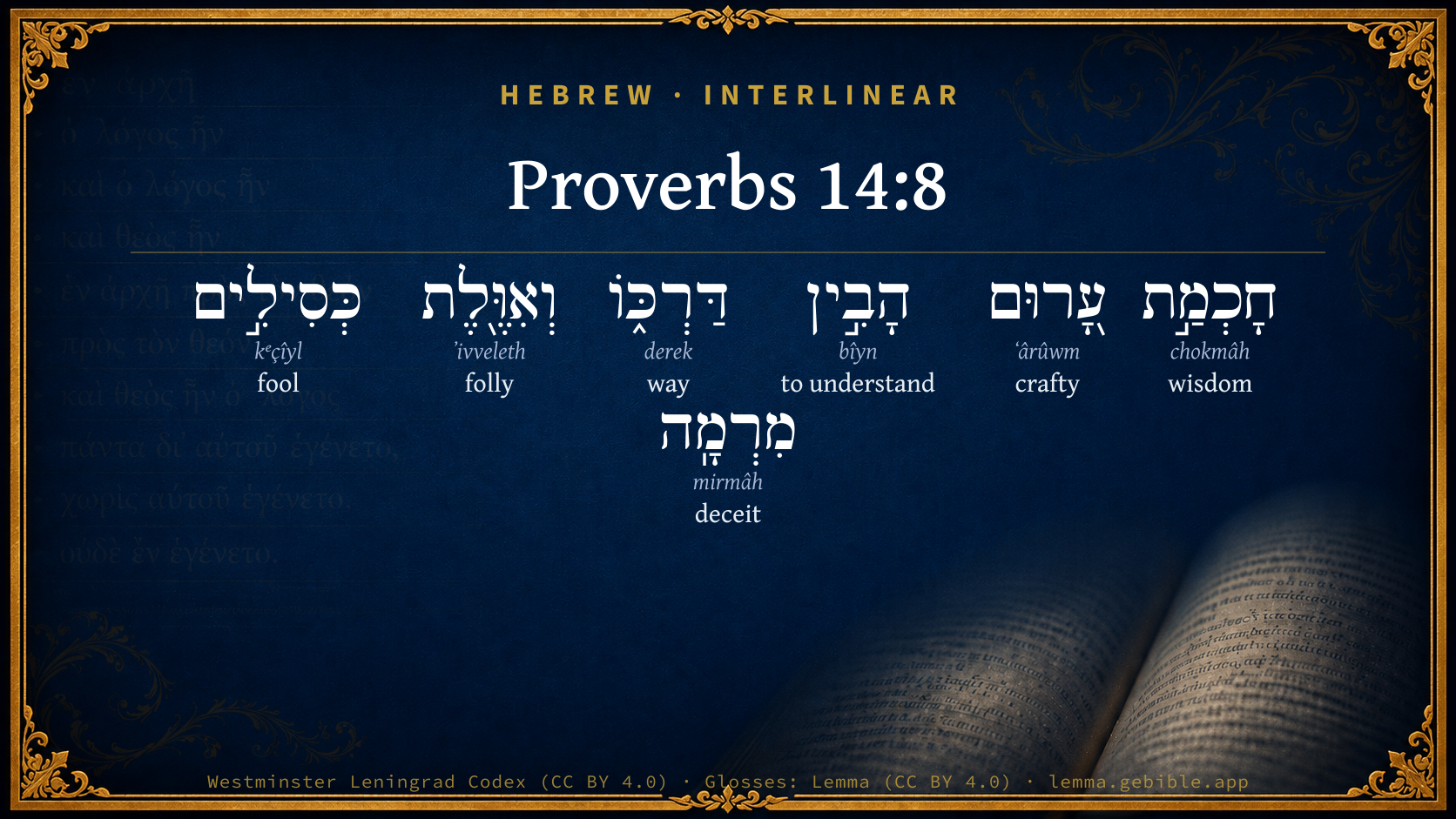
Proverbs 14:8

Hebrew (Westminster Leningrad Codex) Proverbs 14:8 appears in the Hebrew Old Testament. The text above is from the Westminster Leningrad Codex. Each word links to its Strong’s number, a concise gloss, and parsing drawn from the Open Scriptures Hebrew Bible morphology. Click any word for its full Brown-Driver-Briggs (BDB) entry.
Download image
Cite this verse

Proverbs 14:8 (World English Bible). Public Domain. Lemma interlinear Bible study tool, https://lemma.gebible.app/v/proverbs/14/8.

Show BibTeX & RIS
BibTeX
RIS
English Translation
The wisdom of the prudent is to think about his way, But the folly of fools is deceit.
World English Bible · Public Domain
Download a study sheet

One document with this verse’s original text, its word-by-word gloss line, the meaning frame, cross-references with their text, attributed commentary, and full source and license credits — printable, and it pastes into notes with its structure intact.

This verse Autodidact and up

Study sheet (.html) Plain text (.txt)

A passage Seminary Student

Up to 50 verses in one chapter. A passage sheet keeps up to 6 commentary sources and 12 cross-references per verse, in the order this page ranks them, and says so on the sheet whenever that leaves anything out. Ask for a single verse and you get the Autodidact verse sheet above.

Everything on this page stays free to read, with no account — the sheet is a download of what is already on screen, not access to it.

Want to remove ads? Support Godless Engineer
Compare translations 3

The same verse in 3 English versions, stacked beneath the original-language interlinear above. Click any original word for its lexicon entry.

Each is an independent rendering of the whole verse — the interlinear is not word-aligned to these translations.

Highlighted words mark where these versions differ — a whole-verse word diff, not a word-by-word alignment.

  • World English Bible Public Domain
    The wisdom of the prudent is to think about his way, But the folly of fools is deceit.
  • King James Version Public Domain
    The wisdom of the prudent is to understand his way: but the folly of fools is deceit.
  • unfoldingWord Literal Text CC BY-SA 4.0
    The wisdom of a prudent is to understand his way, but the folly of the stupid deceit.

unfoldingWord Literal Text — © unfoldingWord, licensed CC BY-SA 4.0. Word-aligned USFM3 via Door43 (git.door43.org/unfoldingWord/en_ult).

Versions to compare (up to 4)

3 of 4 selected

Show all 18 translations

Every available English version of this verse, each an independent rendering of the whole verse.

  • World English Bible Public Domain
    The wisdom of the prudent is to think about his way, But the folly of fools is deceit.
  • Berean Standard Bible Public Domain
    The wisdom of the prudent is to discern his way, but the folly of fools deceives them.
  • Majority Standard Bible Public Domain
    The wisdom of the prudent is to discern his way, but the folly of fools deceives them.
  • King James Version Public Domain
    The wisdom of the prudent is to understand his way: but the folly of fools is deceit.
  • American Standard Version (1901) Public Domain
    The wisdom of the prudent is to understand his way; But the folly of fools is deceit.
  • Revised Version (1885) Public Domain
    The wisdom of the prudent is to understand his way: but the folly of fools is deceit.
  • Geneva Bible (1599) Public Domain
    The wisdome of ye prudent is to vnderstand his way: but the foolishnes of the fooles is deceite.
  • Douay-Rheims (1899) Public Domain
    The wisdom of a. discreet man is to understand his way: and the imprudence of fools erreth.
  • Young's Literal Translation Public Domain
    The wisdom of the prudent `is' to understand his way, And the folly of fools `is' deceit.
  • Literal Standard Version CC BY-SA 4.0
    The wisdom of the prudent [is] to understand his way, || And the folly of fools [is] deceit.
  • Unlocked Literal Bible CC BY-SA 4.0
    The wisdom of the prudent person is to understand his own way, but the folly of fools is deception.
  • unfoldingWord Literal Text CC BY-SA 4.0
    The wisdom of a prudent is to understand his way, but the folly of the stupid deceit.
  • Darby Bible Public Domain
    The wisdom of the prudent is to discern his way; but the folly of the foolish is deceit.
  • World Messianic Bible Public Domain
    The wisdom of the prudent is to think about his way, but the folly of fools is deceit.
  • Webster's Bible Public Domain
    The wisdom of the prudent is to understand his way: but the folly of fools is deceit.
  • Free Bible Version CC BY-SA 4.0
    Sensible people use their wisdom to decide where they're going, but the foolishness of stupid people is treacherous.
  • Bible in Basic English Public Domain
    The wisdom of the man of good sense makes his way clear; but the unwise behaviour of the foolish is deceit.
  • JPS Tanakh (1917) Public Domain
    The wisdom of the prudent is to look well to his way; but the folly of fools is deceit.

Literal Standard Version (2020), Covenant Press — licensed CC BY-SA 4.0. Text via the HelloAO Bible API (eBible.org). Unlocked Literal Bible (unfoldingWord) — licensed CC BY-SA 4.0. Text via the HelloAO Bible API (eBible.org). unfoldingWord Literal Text — © unfoldingWord, licensed CC BY-SA 4.0. Word-aligned USFM3 via Door43 (git.door43.org/unfoldingWord/en_ult). Free Bible Version, Dr. Jonathan Gallagher — licensed CC BY-SA 4.0. Text via the HelloAO Bible API (eBible.org).

Word by word

More ways to search: Search by grammar → Find every occurrence → Compare this word →

Practice this passage: Drill this verse → Learn its vocabulary →

About this verse

These counts appear in no published source. They are computed here, from the morphology-tagged text and Lemma’s own curated glosses. What Lemma adds →

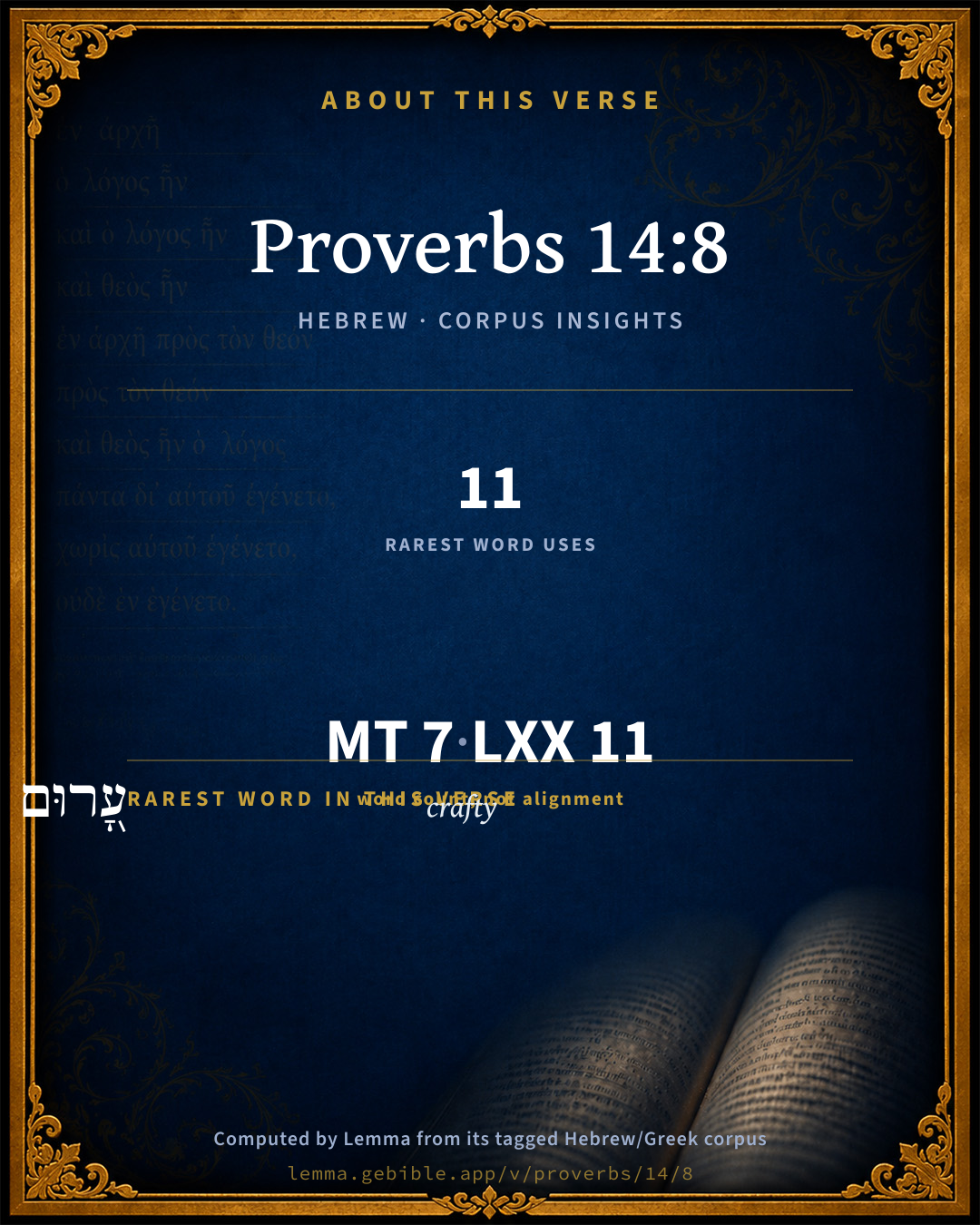
7
words
7
distinct lemmas
Wisdom
section

Notable vocabulary

The rarest word here is עָ֭רוּם crafty H6175 — appearing just 11 times in the whole Hebrew Bible.

Shared distinctive vocabulary

עָ֭רוּם crafty H6175 occurs in 11 verses of the Hebrew Bible. Also found in:

Grammatical profile

  • 1 verb
  • 4 nouns
  • 2 adjectives

Verb forms

  • הָבִ֣ין Hiphil · Infinitive Construct

Hebrew & Septuagint length

In English translation the verse runs 18 words from the Hebrew and 16 from the Septuagint (LXX English) — closely comparable.

A rough comparison of the two English renderings, which tokenize alike — not a word-level alignment.

Word counts can differ between the Hebrew and the Greek without any difference in meaning — e.g. the Hebrew direct-object marker אֵת has no separate Greek word, and Greek often adds the article ὁ.

In the original languages it is 7 Hebrew tokens and 11 Greek tokens — but the two are counted differently (Hebrew bundles its prefixes and suffixes into one token; the Greek is in lemma form), so that isn’t a like-for-like length.

Cross-references

16

Topical passages linked to Proverbs 14:8 in the Treasury of Scripture Knowledge — connected by theme and wording, ordered by reader-vote popularity; previews shown in the World English Bible.

  • Ephesians 5:17 Therefore don't be foolish, but understand what the will of the Lord is.
  • 2 Timothy 3:13 But evil men and impostors will grow worse and worse, deceiving and being deceived.
  • Colossians 1:9–10 For this cause, we also, since the day we heard this, don't cease praying and making requests for you, that you may be filled with the knowledge of his will in all spiritual wisdom and understanding,
  • James 3:13 Who is wise and understanding among you? Let him show by his good conduct that his deeds are done in gentleness of wisdom.
  • Psalms 111:10 The fear of Yahweh is the beginning of wisdom. All those who do his work have a good understanding. His praise endures forever!
  • Psalms 119:5 Oh that my ways were steadfast To obey your statutes!
  • Psalms 119:34–35 Give me understanding, and I will keep your law. Yes, I will obey it with my whole heart.
  • Psalms 119:73 Your hands have made me and formed me. Give me understanding, that I may learn your commandments.
  • Proverbs 2:9 Then you will understand righteousness and justice, Equity and every good path.
  • Proverbs 8:20 I walk in the way of righteousness, In the midst of the paths of justice;
  • Proverbs 11:18 Wicked people earn deceitful wages, But one who sows righteousness reaps a sure reward.
  • Psalms 143:8 Cause me to hear your loving kindness in the morning, For I trust in you. Cause me to know the way in which I should walk, For I lift up my soul to you.
  • Jeremiah 13:20 Lift up your eyes, and see those who come from the north: where is the flock that was given you, your beautiful flock?
  • Luke 12:19–20 I will tell my soul, "Soul, you have many goods laid up for many years. Take your ease, eat, drink, be merry."'
  • Ephesians 4:22 that you put away, as concerning your former way of life, the old man, that grows corrupt after the lusts of deceit;
  • 2 Timothy 3:15–17 From infancy, you have known the sacred writings which are able to make you wise for salvation through faith, which is in Christ Jesus.

Cross-references courtesy of OpenBible.info (CC BY 4.0).

Hebrew and Greek witnesses Masoretic Hebrew ↔ Greek Septuagint

The same verse in the two great witnesses to the Old Testament, shown verse-for-verse.

These are two independent witnesses, not word-aligned to each other, and the Septuagint is shown in lemma (dictionary) form.

Hebrew Proverbs 14:8 Masoretic · Westminster Leningrad Codex

חָכְמַ֣ת עָ֭רוּם הָבִ֣ין דַּרְכּ֑וֹ וְאִוֶּ֖לֶת כְּסִילִ֣ים מִרְמָֽה

The wisdom of the prudent is to think about his way, But the folly of fools is deceit.

World English Bible · Public Domain

Greek LXX Proverbs 14:8 Septuagint · lemma form

σοφία πανοῦργος ἐπιγιγνώσκω ὁ ὁδός αὐτός ἄνοια δέ ἄφρων ἐν πλάνη

The wisdom of the prudent will understand their ways; but the folly of fools leads astray.

LXX2012 (modern English Septuagint) · Public Domain

On this verse, Keil & Delitzsch discusses the Septuagint’s reading. Read the note in Commentary ↓

Hebrew: Westminster Leningrad Codex (CC BY 4.0). Greek: Septuagint (public domain); English from LXX2012 (modern English Septuagint) (Public Domain). How the Septuagint differs from the Hebrew →

Commentary

Notes on Proverbs 14:8 from classic Christian and Jewish commentators (each source and its license shown beneath its notes). The classic Christian expositions comment on the surrounding passage and are grouped to its opening verse, so a note may address several verses; the Jewish commentaries on the Tanakh (Rashi and others) are per-verse, so they appear only where the commentator wrote on this verse.

Lemma curates 59 commentaries, every one of them public domain or Creative Commons licensed, each selected and text-cleaned for this edition rather than reprinted as found. About our sources →

Trapp's Complete Commentary

John Trapp

Pro 14:8 The wisdom of the prudent [is] to understand his way: but the folly of fools [is] deceit.

Ver. 8. The wisdom of the prudent is to understand his way.] His wisdom begins in the right knowledge of himself, and ends in the right knowledge of God, that he may "walk worthy of God in all well pleasing," worthy of the calling wherewith he is called, that high and "heavenly calling" {Heb 3:1} to the fruition of high and heavenly privileges, to an angelical and convincing conversation, such as may draw hearts or daunt them. We use to say of him that knows his place, and carries himself accordingly, such a man understands himself well enough. So here.

But the folly of fools is deceit.] Or, Is to understand deceit, to know the devil’s depths, to search his skull for carnal arguments that they may cum ratione insanire, be mad with show of reason, and deceive the hearts of the simple. "This their way is their folly; yet their posterity" - as wise as their foolsih fathers - "approve their sayings," abet their practices. {Psa 49:13}

John Trapp, A Commentary or Exposition upon All the Books of the Old and New Testament (1647–1656) — public domain. Text from a community e-Sword module.

Joseph Benson's Commentary

Pro 14:8. The wisdom of the prudent is to understand his way — It consists not in vain speculations, nor in a curious prying into other men’s matters, much less in subtle arts of deceiving others, but in a diligent study of his own duty, and of the way to true and eternal happiness; but the folly of fools is deceit — The wit of ungodly men, which, though they account it their wisdom, is really their folly, is employed only in finding out ways of overreaching and deceiving others, and themselves too.

Joseph Benson's Commentary on the Old and New Testaments (1811–1818) — public domain. Text from a community e-Sword module.

Matthew Henry's Commentary

See here, 1. The good conduct of a wise and good man; he manages himself well. it is not the wisdom of the learned, which consists only in speculation, that is here recommended, but the wisdom of the prudent, which is practical, and is of use to direct our counsels and actions. Christian prudence consists in a right understanding of our way; for we are travellers, whose concern it is, not to spy wonders, but to get forward towards their journey's end. It is to understand our own way, not to be critics and busybodies in other men's matters, but to look well to ourselves and ponder the path of our feet, to understand the directions of our way, that we may observe them, the dangers of our way, that we may avoid them, the difficulties of our way, that we may break through them, and the advantages of our way, that we may improve them - to understand the rules we are to walk by and the ends we are to walk towards, and walk accordingly. 2. The bad conduct of a bad man; he puts a cheat upon himself. He does not rightly understand his way; he thinks he does, and so misses his way, and goes on in his mistake: The folly of fools is deceit; it cheats them into their own ruin. The folly of him that built on the sand was deceit.

Matthew Henry's Commentary on the Whole Bible (1708–1710) — public domain (CC PDM 1.0). Text via the HelloAO Bible API.

Jamieson, Fausset & Brown

Robert Jamieson, A. R. Fausset & David Brown

Appearances deceive the thoughtless, but the prudent discriminate.

Jamieson, Fausset & Brown — Commentary Critical and Explanatory on the Whole Bible (1871) — public domain (CC PDM 1.0). Text via the HelloAO Bible API.

Adam Clarke's Commentary

Verse 8. Is to understand his way] Instead of הבין habin, to understand, הכין hachin, to DIRECT his way, is found in one MS. It makes a very good sense.

Adam Clarke's Commentary on the Bible (1810–1826) — public domain. Text from a community e-Sword/MySword module.

Ellicott's Commentary for English Readers

(8) The wisdom of the prudent is to understand his way.—To look to it carefully that it is such as God would have it; but “the folly of fools (stupid persons, as Pro_14:7], is deceit;” it shows itself in trying to cheat others, though they are sure to be detected at last.

A Bible Commentary for English Readers, edited by Charles John Ellicott (1878–1897) — public domain. Text from a community e-Sword module.

The Cambridge Bible for Schools and Colleges

gen. ed. J. J. S. Perowne

8. deceit] It has been questioned whether this means self-deceit, as the parallel might seem to suggest, or deceiving others. But the design of the proverb is to shew that the two things are really one. Whereas the wisdom of the prudent consists in his understanding his own character and conduct, in its relation to God, to his neighbour and to himself, the folly of fools is that being self-deceived, they think they can deceive God and man to their own advantage. Comp. 2Ti_3:13.

The Cambridge Bible for Schools and Colleges (gen. ed. J. J. S. Perowne; Cambridge University Press, 1878–1918) — public domain. Text from a community e-Sword module.

John Gill's Exposition

The wisdom of the prudent is to understand his way,.... The way of his calling, in which he should abide, and how to manage it in the best manner; the way of his duty, that he may walk inoffensively both towards God and men; and the way of life and salvation, which is by Jesus Christ, which to understand and to walk in is the highest wisdom and prudence;

but the folly of fools is deceit: or "the wisdom of fools", which the opposition requires, and is meant, and is what the Holy Ghost calls "folly", as elsewhere, Co1 3:19; this is itself "deceit"; it is science, falsely so called; it lies in tricking and deceiving; and the issue of it is, not only the deceiving of others, but themselves also: such is the folly of the man of sin and followers, which lies in deceiving the inhabitants of the earth with their sorceries and superstitions, with their lying wonders and miracles; see Th2 2:10, Rev 13:14.

John Gill's Exposition of the Whole Bible (1746–1763) — public domain (CC PDM 1.0). Text via the HelloAO Bible API.

Albert Barnes' Notes on the Bible

The Hebrew counterpart to the Greek “Know thyself.” “The highest wisdom is for a person to understand his own way. The most extreme folly is self-deceit.” The word “deceit” may, however, involve fraud practiced upon others. The folly of fools shows itself then in their ceaseless effort to deceive.

Albert Barnes' Notes on the Bible (1834–1885) — public domain. Text from a community e-Sword/MySword module.

Haydock's Catholic Bible Commentary

Way. This science of the saints is the only true wisdom. --- Erreth. They are inconstant. Hebrew, "is deceit." They are bent on it.

George Leo Haydock (1774–1849), Haydock's Catholic Family Bible and Commentary, 1859 edition — public domain. Excludes Psalms (Douay-Rheims chapter numbering differs from Protestant) and Deuterocanonical books (Catholic canon only).

Matthew Poole's English Annotations

The wisdom of the prudent is to understand his way; it consists not in vain speculations, nor in a curious prying into other men’s matters, nor in cunning arts of deceiving others; but in a diligent study of his own duty, and of the way to true and eternal happiness.

The folly of fools is deceit; the wit of ungodly men, which, though they account their wisdom, is really their folly, is employed only in finding out ways of overreaching and deceiving others, and themselves too.

Matthew Poole's English Annotations on the Holy Bible (1683–1685) — public domain. Text from a community e-Sword/MySword module.

Whedon's Commentary on the Bible

Daniel D. Whedon

8. Wisdom of the prudent — The wary, cautious.

Is to understand — Is the discerning of his way; that is, it is the means of doing so; points out the right way to him.

But the folly of fools is deceit — Delusive, deceitful, even to themselves; folly misleads them into wrong paths. “The highest wisdom is for a man to [know,] understand, his own way. The extremest folly is self-deceit.” — Speaker’s Com. Compare Pro_13:16; Luk_12:20; 1Co_3:19; 2Ti_3:13. Some understand by this the deceits or frauds practised upon others. Their folly is seen in their ceaseless efforts to deceive.

Daniel D. Whedon (gen. ed.), Commentary on the Old and New Testaments (1874–1909) — public domain. Text from a community e-Sword module.

The Pulpit Commentary

The wisdom of the prudent is to understand his way. The wisdom of the prudent is shown by his considering whither his actions lead, the motives from which they spring, the results that attend them. As the apostle enjoins, (Eph_5:15) "See that ye walk circumspectly, not as fools, but as wise." Or the clause may be taken as enjoining a wise choice in life, a selection of such a calling or occupation as best suits one"s capabilities, station, and opportunities. The folly of fools is deceit. This is not self-deceit, which the word does not denote, but deceit of others. Stupid persons show their folly in trying to cheat others, though they are sure to be detected, and their fraud recoils on themselves. In the ease of fools, what they would call wisdom is folly; hence the wording of the sentence.

Vers. 8-19. The understanding of one"s way.

I THE GENERAL PRINCIPLE. (Ver. 8) To note, to observe, to take heed to one"s way, is the characteristic of the man who is prudent for time and wise for eternity. And, on the contrary, the very principle of folly is self-deception to be followed in turn by a terrible awakening to sobriety and recognition of the truth. (comp. Psa_7:15 Job_4:8) The right way is illustrated both positively and negatively.

II SOME PARTICULAR ILLUSTRATIONS. (Ver. 9, sqq.)

1. The vanity of mere ritualism. (Ver. 9) According to the probably correct translation, "the guilt offering scorns the fools;" in other words, his worship is useless, missing its aim, failing of God"s favour, while the righteous who has washed and made himself clean, and put away iniquity, (see Isa 1) comes with acceptance before Jehovah.

2. Respect for others" sorrows. (Ver. 10) Acute distress isolates a man; he cannot communicate what he feels. And it is an unkind thing to force counsel on others at a time when they know they cannot be understood, when the sympathy of silence is best. To sit by our friend, to clasp his hand with loving pressure, to mingle our tears with his, will be far more delicate and soothing than to attempt to "charm ache with airs, and agony with words.

3. Consideration of the end. (Vers. 11-13) The old reminder recurs, Respice finem. Perhaps a contrast is intended between the "house of the wicked" as seeming firmer, nevertheless doomed to overthrow, and the "tent of the righteous," seeming more frail, yet destined to "sprout," to flourish, and extend. Again, resuming the image of the way, the seeming right way is not ever the right nor the safe way. It may be broad at first and well travelled, but may narrow by and by, and end in the pathless forest, or the desert waste, or the fatal precipice, To be safe we must still consider the end; and the beginning, which predicts and virtually contains the end. Various are the illusions to which we are subject. One example of this is that the smiling face may hide the aching heart, and the opposite (Ecc_7:4) may also obtain. Boisterous and immoderate mirth is no good symptom; it foretells a sad reaction, or conceals a deep-seated gloom. Human faces and appearances are masks, which hide the real countenance of things from us.

4. Consideration of the sources of enjoyment. (Ver. 14) First the vicious source. The man who has fallen away from God seeks satisfaction out of God, in something practically atheistic, in the fruit of godless, sinful deeds. (Pro_12:14 Pro_13:2 Pro_28:19) But in the matters of the spirit that which is out of God is nothing, emptiness and vanity. He is feasting upon wind. The genuine source of enjoyment is in the spirit itself, in the consciousness, where God is known and realized and loved; in the sense of union and reconciliation of thought and affection with the Divine Object thought of and believed. The kingdom of God is within us, and is "righteousness, peace, and joy in the Holy Ghost.

5. Credulity and caution. (Ver. 15) Credulity is a weakness, and certainly, like every weakness, may become a sin. It is the opposite of genuine faith: it is confidence placed where we have no right to place it. God, who has set up and kindled a light in each breast, requires us to use it, each for himself. To forsake it for any other is a desertion of our trust. Would that we might ever take heed to the light that is within us, and so steer our way! There is no true faith possible which does not begin with this. Again (ver. 16), wisdom is seen in a certain self-distrust in presence of evil. To use an expressive phrase, we should know when to "fight shy" of certain persons or associations, So powerful a passion as fear was not given us for nothing, nor should we be ashamed of a timidity which leads us to give a wide berth to danger, to keep out of the lion"s path. Over-confidence springs from the want of a true estimate of our proper strength and weakness, and the security it begets is false.

6. Passionateness and trickiness. (Ver. 17) The former precipitates men into all follies. Seneca saith well that "anger is like rain, which breaks itself upon that whereon it falls." Anger is certainly a kind of baseness; as it appears well in the weakness of those subjects in whom it reigns children, women, old folks, sick folks. Bitter, unforgivable words, the revelation of secrets, the breaking off of business, such are among the follies which anger constantly perpetrates. But the tricky intriguing man is both foolish and odious. Listen to one of the greatest of Englishmen, when he bears testimony that "the ablest men that ever were born all had an openness and frankness of dealing, and a name of certainty and veracity." There is a fine line between the wisdom of reserve and the vicious cunning of concealment; nothing but the loving and true purpose of the heart can redeem any habit of secrecy from odium.

7. Life a progress in folly or wisdom. (Ver. 18) We are ever gaining, according to the image of the text. The mind has its accretions like those of the tree, A man becomes a greater fool the older he grows, or becomes of deeper sagacity, richer and wider views. All depends on how we start. Admit an error into thought, keep it there after it is proved an error, close the mind in any quarter to the light and keep it closed, and ensure a bigoted and foolish age. Let God into the mind from the first, open daily every window of the soul to the light, and grow old "learning something fresh every day.

8. The ascendancy of goodness. (Ver. 19) The picture is presented of the envoy of a conquered people who kneels at the palace gate of the conqueror and waits on his commands. (compare on the thought, Pro_13:9, 22 Psa_37:25) There is a might in goodness; may we not say the only true might is that of goodness, for it has omnipotence at its back? It is victorious, irresistible, in the end. It is content to be acknowledged in the end by all, the evil as well as the good. Hypocrisy is the homage paid by vice to goodness. J.

Understanding our way.

A man may be "prudent," he may be clever, learned, astute; yet he may miss his way, he may lose his life, he may prove to be a failure. The wisdom of the prudent, that which makes prudence or ability really valuable, that which constitutes its virtue, is the practical understanding of life, the knowledge which enables a man to take the right path and keep it, the discretion which chooses the line of a true success and maintains it to the end. It is to perceive and to pursue the way that is

I FINANCIALLY SOUND; avoiding that which leads to embarrassment and ruin; shunning those which conduct either to a sordid parsimony in one direction or to a wasteful extravagance on the other hand; choosing that which leads to competence and generosity.

II EDUCATIONALLY WINE; forming the habits which strengthen and develop the faculties of the mind, instead of those which dwarf, or narrow, or demoratize them.

III SOCIALLY SATISFACTORY; not going the way of an unwise and unsatisfactory ambition which ends in disappointment and chagrin; seeking the society which is suitable, elevating, honourable.

IV IN ACCORDANCE WITH INDIVIDUAL ENDOWMENT; So that we do not expend all our time and all our powers in a way which cuts against all our individual inclinations, but in one which gives room for our particular aptitudes, and develops the special faculty with which our Creator has endowed our spirit.

V MORALLY SAFE. It is a very great part of "the wisdom of the prudent" for a man to know what he may allow himself to do and where to go; what, on the other hand, he must not permit, and whither he must not wend his way. The path of safety to one man is the road to ruin with another. "Happy is he who condemneth not himself in that thing which he alloweth". (Rom_14:22) Wise is it in those, and well is it for them, who have discerned and who have decided upon those habits of life which are establishing in their hearts all Christian virtues and making to shine in their lives all Christian graces.

VI THE WAY OF HOLY SERVICE. The way of sacred service is so essentially the way of wisdom, that any "prudence" or cleverness that misses it makes the supreme mistake. On the other hand, the wisdom that leads to it and that preserves the soul in it is the wisdom to attain unto. This way, which is the end of our being and the crown of our life, includes

(1) the service of Christ, and

(2) the service of man. C.

The Pulpit Commentary (1880–1919), ed. H.D.M. Spence-Jones & Joseph S. Exell — public domain. Text from a community e-Sword module.

John Wesley's Explanatory Notes

His way - Consists not in vain speculations, but in a diligent study of his duty, and of the way to eternal happiness. The folly - The wit of ungodly men, which is really their folly, is employed only in finding out ways of deceiving.

John Wesley, Explanatory Notes Upon the Whole Bible (1754–1765) — public domain. Text via the GEBible commentary corpus.

Keil & Delitzsch

C. F. Keil & F. Delitzsch

8 The wisdom of the prudent is to observe his way,

And the folly of fools is deceit.

The nearest idea is that of self-deceit, according to which the lxx, Syr., and Jerome render the word error ("Irrsal"). But מרמה is nowhere else used of self-deception, and moreover is not the suitable word for such an idea, since the conception of the dolus malus is constantly associated with it. Thus the contrast will be this: the wisdom of the prudent shows itself in this, that he considers his conduct (הבין as Pro 7:7, cf. Psa 5:2), i.e., regulates it carefully, examining and considering (Pro 13:16) it according to right and duty; and that on the contrary the folly of fools shows itself in this, that they aim at the malevolent deception of their neighbour, and try all kinds of secret ways for the gaining of this end. The former is wisdom, because from the good only good comes; the latter is folly or madness, because deception, however long it may sneak in darkness, yet at last comes to light, and recoils in its destructive effects upon him from whom it proceeds.

Keil & Delitzsch — Biblical Commentary on the Old Testament (1861–1891) — public domain (CC PDM 1.0). Text via the HelloAO Bible API. (Old Testament only.)

Bridges on Proverbs

Charles Bridges

This is not the wisdom of the learned, but of the prudent; not abstract and speculative, but sound and practical. It is self-knowledge and self-control looking upward for Divine guidance. And how much is this wisdom needed to understand our way! The restless professor eagerly follows his own impulse. His constitutional bias interprets Providences, and makes openings for himself. Everything is out of place. He is so "fervent in spirit," that he becomes "slothful in business." He conceives himself to be doing good; the more so, because it is different from his brethren. He pleads the constraint of zeal as an excuse for indiscretion; as if religion was meant to destroy, and not rather to rectify, his judgment.

But "God hath made everything beautiful in his time." (Ecc 3:11 .) Religion is an orderly thing, as wise as it is warm. Whatever be the excitement to an irregular course, more good is done in steady consistency. To break the ranks in disorder; to "busy ourselves in other men’s matters" (1Pe 4:15 . 2Th 3:11-12 ); to be eager to understand our neighbour’s way (Joh 21:21-22 ), obscures the light upon our own. The true wisdom is to understand what belongs to us personally and relatively. (1Ki 3:6-9 . Ecc 8:5 .) "As God hath distributed to every man, so let him walk, and abide with God." (1Co 7:17 ) Let the eye do the work of the eye, and the hand of the hand. If Moses prayed on the Mount, and Joshua fought in the valley (Exo 17:10-11 ), it was not because the one was deficient in courage, or the other in prayer; but because each had his appointed work, and understood his own way. Many steps of our way are different from our neighbour’s, and may often be difficult to discern; being rather involved in the principles, than expressed in the detail, of Scripture. But the wisdom of the prudent will "understand what the will of the Lord is." (Eph 5:17 . Col 1:9-10 .) "A single eye" and a sound heart will make our way plain. (Mat 6:22 .)

But while the attention of a truly wise man is occupied in understanding his way; ’the arts of deceit engross the polluted minds of the wicked.’†1 Their wisdom of deceit is really folly. Gehazi’s overreaching wisdom proved folly in the end. Daniel’s accusers "were taken in their craftiness." (Dan 6:24 . 1Co 3:19 .) Ananias and Sapphira vainly endeavoured to hide their covetousness under the cover of liberality. (Act 5:1-10 .) Who can deceive a heart-searching God? The attempt to do so is fearful provocation, certain confusion.

Footnotes:

†1 French and Skinner’s Translation of Proverbs.

Charles Bridges, An Exposition of the Book of Proverbs (1846) — public domain. Text from a community e-Sword module.

Kretzmann's Popular Commentary

Paul E. Kretzmann

v. 8. The wisdom of the prudent is to understand his way, to observe where he is going, to pay close attention to his conduct; but the folly of fools Is deceit, self-deception, since they are willfully blind to the demands of every situation in which they find themselves, and so invite punishment and destruction upon themselves.

Paul E. Kretzmann, Popular Commentary of the Bible (1921–1924) — public domain. Text from a community e-Sword module.

Rashi

Rabbi Shlomo Yitzchaki (Rashi)

The wisdom of a cunning man Heb. ערום, he who is wise. is to understand his way To weigh his paths.

but the folly of the fools That is the deceit in their hearts. It will ultimately bring them to foolishness.

Rashi on the Tanakh — English translations: “The Judaica Press complete Tanach with Rashi, translated by A. J. Rosenberg” (CC BY 4.0); “Pentateuch with Rashi's commentary by M. Rosenbaum and A.M. Silbermann, 1929-1934” (public domain); “The Metsudah Tanach series, Lakewood, N.J” (CC BY 4.0); and “The Book of Joshua, Metsudah Publications, 1997” (CC BY 4.0). Text via Sefaria.

Lesson kit

Teaching starters — assembled from the data on this page, not authored interpretation. Every prompt links to the verse data it draws on. Edit before teaching.

Proverbs, in the Wisdom, opens this verse with 7 words (7 distinct Hebrew lemmas). Its most distinctive word is ʻârûwm (“crafty”). A historical commentator’s framing appears above. Read the whole chapter for the surrounding context.

Discussion questions

  1. How does “crafty” (ʻârûwm) shape what this verse is saying?
  2. Genesis 3:1 shares the word «crafty» with this verse. How do the two illuminate each other?
  3. These translations render this verse differently; the difference is in the English rendering, not the original. What questions does that raise?
  4. The verb «הָבִ֣ין» is Hiphil Infinitive Construct. How does its form color the action?
  5. Reading how Trapp's Complete Commentary and Joseph Benson's Commentary read this verse, where do the two commentators agree and where do they part?

Things to notice

Reading settings

Reading text

Shown beneath each verse's original-language words.

Old Testament
Old Testament edition

Read the OT as the Masoretic Hebrew (MT) or the Greek Septuagint (LXX).

English shown for the Greek Septuagint (in the Hebrew ↔ Greek comparison).

Comparing translations? Open the Compare panel on any verse page to stack up to four side by side.