
2 Chronicles 11:23

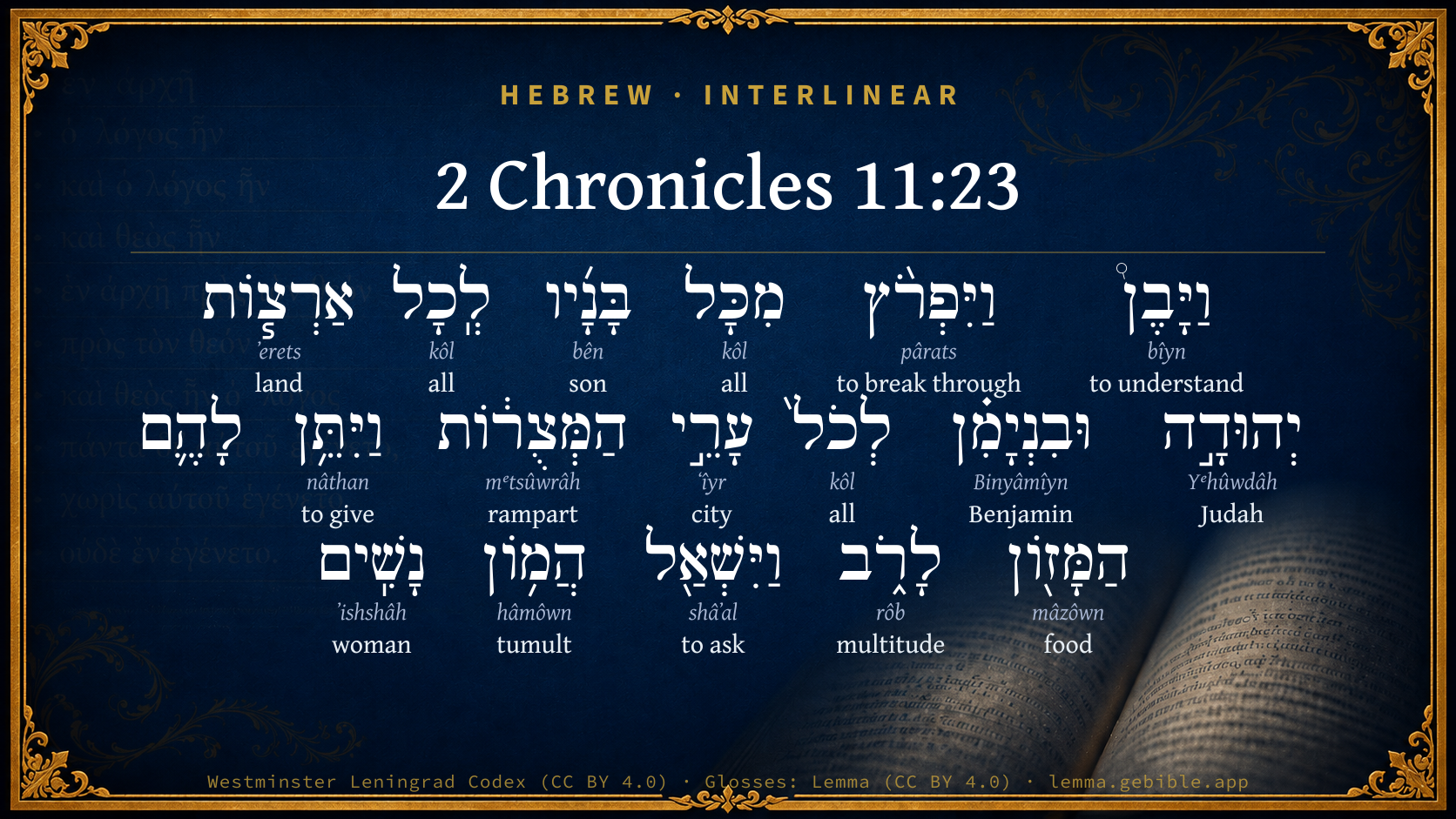
Hebrew (Westminster Leningrad Codex) 2 Chronicles 11:23 appears in the Hebrew Old Testament. The text above is from the Westminster Leningrad Codex. Each word links to its Strong’s number, a concise gloss, and parsing drawn from the Open Scriptures Hebrew Bible morphology. Click any word for its full Brown-Driver-Briggs (BDB) entry.
Download image
Cite this verse

2 Chronicles 11:23 (World English Bible). Public Domain. Lemma interlinear Bible study tool, https://lemma.gebible.app/v/2-chronicles/11/23.

Show BibTeX & RIS
BibTeX
RIS
English Translation
He dealt wisely, and dispersed of all his sons throughout all the lands of Judah and Benjamin, to every fortified city: and he gave them food in abundance. He sought [for them] many wives.
World English Bible · Public Domain
Download a study sheet

One document with this verse’s original text, its word-by-word gloss line, the meaning frame, cross-references with their text, attributed commentary, and full source and license credits — printable, and it pastes into notes with its structure intact.

This verse Autodidact and up

Study sheet (.html) Plain text (.txt)

A passage Seminary Student

Up to 50 verses in one chapter. A passage sheet keeps up to 6 commentary sources and 12 cross-references per verse, in the order this page ranks them, and says so on the sheet whenever that leaves anything out. Ask for a single verse and you get the Autodidact verse sheet above.

Everything on this page stays free to read, with no account — the sheet is a download of what is already on screen, not access to it.

Want to remove ads? Support Godless Engineer
Compare translations 3

The same verse in 3 English versions, stacked beneath the original-language interlinear above. Click any original word for its lexicon entry.

Each is an independent rendering of the whole verse — the interlinear is not word-aligned to these translations.

Highlighted words mark where these versions differ — a whole-verse word diff, not a word-by-word alignment.

  • World English Bible Public Domain
    He dealt wisely, and dispersed of all his sons throughout all the lands of Judah and Benjamin, to every fortified city: and he gave them food in abundance. He sought [for them] many wives.
  • King James Version Public Domain
    And he dealt wisely, and dispersed of all his children throughout all the countries of Judah and Benjamin, unto every fenced city: and he gave them victual in abundance. And he desired many wives.
  • unfoldingWord Literal Text CC BY-SA 4.0
    And he dealt wisely, and he scattered all his sons to all the lands of Judah and Benjamin to all the fortified cities. And he gave to them provisions in abundance, and he asked for a multitude of wives.

unfoldingWord Literal Text — © unfoldingWord, licensed CC BY-SA 4.0. Word-aligned USFM3 via Door43 (git.door43.org/unfoldingWord/en_ult).

Versions to compare (up to 4)

3 of 4 selected

Show all 18 translations

Every available English version of this verse, each an independent rendering of the whole verse.

  • World English Bible Public Domain
    He dealt wisely, and dispersed of all his sons throughout all the lands of Judah and Benjamin, to every fortified city: and he gave them food in abundance. He sought [for them] many wives.
  • Berean Standard Bible Public Domain
    Rehoboam also acted wisely by dispersing some of his sons throughout the districts of Judah and Benjamin, and to all the fortified cities. He gave them abundant provisions and sought many wives for them.
  • Majority Standard Bible Public Domain
    Rehoboam also acted wisely by dispersing some of his sons throughout the districts of Judah and Benjamin, and to all the fortified cities. He gave them abundant provisions and sought many wives for them.
  • King James Version Public Domain
    And he dealt wisely, and dispersed of all his children throughout all the countries of Judah and Benjamin, unto every fenced city: and he gave them victual in abundance. And he desired many wives.
  • American Standard Version (1901) Public Domain
    And he dealt wisely, and dispersed of all his sons throughout all the lands of Judah and Benjamin, unto every fortified city: and he gave them victuals in abundance. And he sought `for them' many wives.
  • Revised Version (1885) Public Domain
    And he dealt wisely, and dispersed of all his sons throughout all the lands of Judah and Benjamin, unto every fenced city: and he gave them victual in abundance. And he sought for them many wives.
  • Geneva Bible (1599) Public Domain
    And he taught him: and dispersed all his sonnes throughout all the countreis of Iudah and Beniamin vnto euery strong citie: and hee gaue them aboundance of vitaile, and desired many wiues.
  • Douay-Rheims (1899) Public Domain
    Because he was wiser and mightier than all his sons, and in all the countries of Juda, and of Benjamin, and in all the walled cities: and he gave them provisions in abundance, and he sought many wives.
  • Young's Literal Translation Public Domain
    And he hath understanding, and spreadeth out of all his sons to all lands of Judah and Benjamin, to all cities of the bulwarks, and giveth to them provision in abundance; and he asketh a multitude of wives.
  • Literal Standard Version CC BY-SA 4.0
    And he has understanding, and disperses from all his sons to all lands of Judah and Benjamin, to all cities of the bulwarks, and gives provision in abundance to them; and he asks for a multitude of wives [for them].
  • Unlocked Literal Bible CC BY-SA 4.0
    Rehoboam ruled wisely; he scattered all his sons throughout all the land of Judah and Benjamin to every fortified city. He also gave them food in abundance and looked for many wives for them.
  • unfoldingWord Literal Text CC BY-SA 4.0
    And he dealt wisely, and he scattered all his sons to all the lands of Judah and Benjamin to all the fortified cities. And he gave to them provisions in abundance, and he asked for a multitude of wives.
  • Darby Bible Public Domain
    And he dealt wisely, and dispersed of all his sons throughout all the lands of Judah and Benjamin, to all the fortified cities; and he gave them food in abundance. And he desired [for them] a multitude of wives.
  • World Messianic Bible Public Domain
    He dealt wisely, and dispersed some of his sons throughout all the lands of Judah and Benjamin, to every fortified city. He gave them food in abundance; and he sought many wives for them.
  • Webster's Bible Public Domain
    And he dealt wisely, and dispersed of all his children throughout all the countries of Judah and Benjamin, to every fortified city: and he gave them provisions in abundance. And he desired many wives.
  • Free Bible Version CC BY-SA 4.0
    Rehoboam was also wise to place some of his sons throughout the land of Judah and Benjamin, and to all the fortified towns. He gave them plenty of supplies and sought many wives for them. He worked to arrange many wives for them.
  • Bible in Basic English Public Domain
    And in his wisdom he had his sons stationed in every walled town through all the lands of Judah and Benjamin; and he gave them a great store of food, and took wives for them.
  • JPS Tanakh (1917) Public Domain
    And he dealt wisely, and dispersed of all his sons throughout all the lands of Judah and Benjamin, unto every fortified city; and he gave them victual in abundance. And he sought for them many wives.

Literal Standard Version (2020), Covenant Press — licensed CC BY-SA 4.0. Text via the HelloAO Bible API (eBible.org). Unlocked Literal Bible (unfoldingWord) — licensed CC BY-SA 4.0. Text via the HelloAO Bible API (eBible.org). unfoldingWord Literal Text — © unfoldingWord, licensed CC BY-SA 4.0. Word-aligned USFM3 via Door43 (git.door43.org/unfoldingWord/en_ult). Free Bible Version, Dr. Jonathan Gallagher — licensed CC BY-SA 4.0. Text via the HelloAO Bible API (eBible.org).

Word by word

More ways to search: Search by grammar → Find every occurrence → Compare this word →

Practice this passage: Drill this verse → Learn its vocabulary →

הַמָּז֖וֹן
mâzôwn
H4202
“the · food”
Particle, Definite Article + Noun, Common, Masculine, Singular, Absolute
Part of Speech
Particle + Noun
Type
Common
Gender
Masculine
Number
Singular
State
Absolute
Full BDB Definition

Origin: from H2109

TWOT: 539a

food, sustenance
  1. וַיָּבֶן֩ bîyn H995 “and · to understand” Conjunction + Verb, Qal, Sequential Imperfect, 3rd Person, Masculine, Singular
  2. וַיִּפְרֹ֨ץ pârats H6555 “and · to break through” Conjunction + Verb, Qal, Sequential Imperfect, 3rd Person, Masculine, Singular
  3. מִכָּל kôl H3605 “from · all of” Preposition + Noun, Common, Masculine, Singular, Construct
  4. בָּנָ֜יו bên H1121 “sons · his” Noun, Common, Masculine, Plural, Construct + Suffix, Personal, 3rd Person, Masculine, Singular
  5. לְֽכָל kôl H3605 “to/for · all of” Preposition + Noun, Common, Masculine, Singular, Construct
  6. אַרְצ֧וֹת ʼerets H776 “lands of” Noun, Common, Both, Plural, Construct
  7. יְהוּדָ֣ה Yᵉhûwdâh H3063 “Judah” Noun, Proper
  8. וּבִנְיָמִ֗ן Binyâmîyn H1144 “and · Benjamin” Conjunction + Noun, Proper
  9. לְכֹל֙ kôl H3605 “to/for · all of” Preposition + Noun, Common, Masculine, Singular, Construct
  10. עָרֵ֣י ʻîyr H5892 “cities of” Noun, Common, Feminine, Plural, Construct
  11. הַמְּצֻר֔וֹת mᵉtsûwrâh H4694 “the · ramparts” Particle, Definite Article + Noun, Common, Feminine, Plural, Absolute
  12. וַיִּתֵּ֥ן nâthan H5414 “and · to give” Conjunction + Verb, Qal, Sequential Imperfect, 3rd Person, Masculine, Singular
  13. לָרֹ֑ב rôb H7230 “to/for · multitude” Preposition + Noun, Common, Both, Singular, Absolute
  14. וַיִּשְׁאַ֖ל shâʼal H7592 “and · to ask” Conjunction + Verb, Qal, Sequential Imperfect, 3rd Person, Masculine, Singular
  15. הֲמ֥וֹן hâmôwn H1995 “tumult of” Noun, Common, Masculine, Singular, Construct
  16. נָשִֽׁים ʼishshâh H802 “women” Noun, Common, Feminine, Plural, Absolute

About this verse

These counts appear in no published source. They are computed here, from the morphology-tagged text and Lemma’s own curated glosses. What Lemma adds →

18
words
15
distinct lemmas
Historical
section

Notable vocabulary

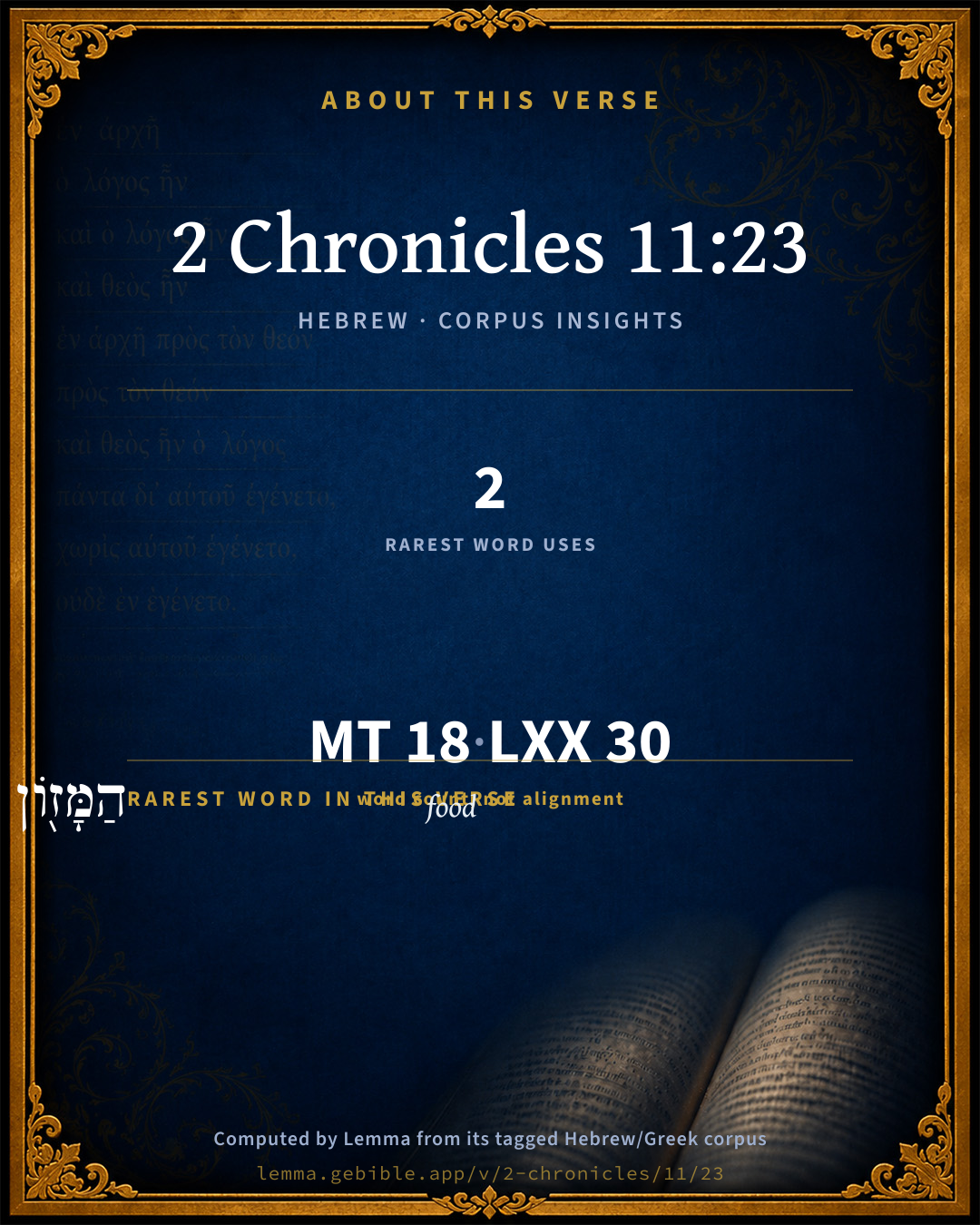
The rarest word here is הַמָּז֖וֹן food H4202 — appearing just 2 times in the whole Hebrew Bible.

Shared distinctive vocabulary

הַמָּז֖וֹן food H4202 occurs in 2 verses of the Hebrew Bible. Also found in:

Grammatical profile

  • 4 verbs
  • 13 nouns
  • 1 preposition

Verb forms

  • וַיָּבֶן֩ Qal · Sequential Imperfect
  • וַיִּפְרֹ֨ץ Qal · Sequential Imperfect
  • וַיִּתֵּ֥ן Qal · Sequential Imperfect
  • וַיִּשְׁאַ֖ל Qal · Sequential Imperfect

Repetition

A word recurs within this verse — often emphatic in Hebrew:

  • מִכָּל all H3605 ×3

Hebrew & Septuagint length

In English translation the verse runs 34 words from the Hebrew and 35 from the Septuagint (LXX English) — closely comparable.

A rough comparison of the two English renderings, which tokenize alike — not a word-level alignment.

Word counts can differ between the Hebrew and the Greek without any difference in meaning — e.g. the Hebrew direct-object marker אֵת has no separate Greek word, and Greek often adds the article ὁ.

In the original languages it is 18 Hebrew tokens and 30 Greek tokens — but the two are counted differently (Hebrew bundles its prefixes and suffixes into one token; the Greek is in lemma form), so that isn’t a like-for-like length.

Cross-references

5

Topical passages linked to 2 Chronicles 11:23 in the Treasury of Scripture Knowledge — connected by theme and wording, ordered by reader-vote popularity; previews shown in the World English Bible.

  • Genesis 25:6 but to the sons of the concubines who Abraham had, Abraham gave gifts. He sent them away from Isaac his son, while he yet lived, eastward, to the east country.
  • 1 Kings 1:5–6 Then Adonijah the son of Haggith exalted himself, saying, I will be king: and he prepared him chariots and horsemen, and fifty men to run before him.
  • 2 Chronicles 10:8–15 But he forsook the counsel of the old men which they had given him, and took counsel with the young men who had grown up with him, who stood before him.
  • 2 Chronicles 21:3 Their father gave them great gifts, of silver, and of gold, and of precious things, with fortified cities in Judah: but the kingdom gave he to Jehoram, because he was the firstborn.
  • Luke 16:8 "His lord commended the dishonest manager because he had done wisely, for the children of this world are, in their own generation, wiser than the children of the light.

Cross-references courtesy of OpenBible.info (CC BY 4.0).

Hebrew and Greek witnesses Masoretic Hebrew ↔ Greek Septuagint

The same verse in the two great witnesses to the Old Testament, shown verse-for-verse.

These are two independent witnesses, not word-aligned to each other, and the Septuagint is shown in lemma (dictionary) form.

Hebrew 2 Chronicles 11:23 Masoretic · Westminster Leningrad Codex

וַיָּבֶן֩ וַיִּפְרֹ֨ץ מִכָּל בָּנָ֜יו לְֽכָל אַרְצ֧וֹת יְהוּדָ֣ה וּבִנְיָמִ֗ן לְכֹל֙ עָרֵ֣י הַמְּצֻר֔וֹת וַיִּתֵּ֥ן לָהֶ֛ם הַמָּז֖וֹן לָרֹ֑ב וַיִּשְׁאַ֖ל הֲמ֥וֹן נָשִֽׁים

He dealt wisely, and dispersed of all his sons throughout all the lands of Judah and Benjamin, to every fortified city: and he gave them food in abundance. He sought [for them] many wives.

World English Bible · Public Domain

Greek LXX 2 Chronicles 11:23 Septuagint · lemma form

καί αὐξάνω παρά πᾶς ὁ υἱός αὐτός ἐν πᾶς ὁ ὅριον ἰουδά καί βενιαμίν καί ἐν ὁ πόλις ὁ ὀχυρός καί δίδωμι αὐτός τροφή πλῆθος πολύς καί αἰτέω πλῆθος γυνή

And he was exalted beyond all his other sons in all the coasts of Juda and Benjamin, and in the strong cities; and he gave them provisions in great abundance: and he desired many wives.

LXX2012 (modern English Septuagint) · Public Domain

On this verse, Haydock's Catholic Bible Commentary discusses the Septuagint’s reading. Read the note in Commentary ↓

Hebrew: Westminster Leningrad Codex (CC BY 4.0). Greek: Septuagint (public domain); English from LXX2012 (modern English Septuagint) (Public Domain). How the Septuagint differs from the Hebrew →

Commentary

Notes on 2 Chronicles 11:23 from classic Christian and Jewish commentators (each source and its license shown beneath its notes). The classic Christian expositions comment on the surrounding passage and are grouped to its opening verse, so a note may address several verses; the Jewish commentaries on the Tanakh (Rashi and others) are per-verse, so they appear only where the commentator wrote on this verse.

Lemma curates 59 commentaries, every one of them public domain or Creative Commons licensed, each selected and text-cleaned for this edition rather than reprinted as found. About our sources →

Trapp's Complete Commentary

John Trapp

2Ch 11:23 And he dealt wisely, and dispersed of all his children throughout all the countries of Judah and Benjamin, unto every fenced city: and he gave them victual in abundance. And he desired many wives.

Ver. 23. And he dealt wisely,] i.e., Politicly, as did after him Jehoshaphat, {2Ch 21:3} for he dispersed his other sons, that they might not conspire against his successor: and he gave them both victuals in abundance, and a multitude of wives, as some understand those words - he asked for a multitude of wives - ut ventri et veneri vacantes, that drowned in sensual delights, they might not aspire to the kingdom.

John Trapp, A Commentary or Exposition upon All the Books of the Old and New Testament (1647–1656) — public domain. Text from a community e-Sword module.

Joseph Benson's Commentary

2Ch 11:23. He dealt wisely, and dispersed his children, &c. — Either, 1st, Lest his other sons should, after his death, unite together against Abijah; or rather, 2d, Because he could repose confidence in them, for the preservation of the public peace and safety, and could trust them with the fenced cities, which he took care to have well victualled, that they might be a defence to the country in case of an invasion. Thus he that dealt foolishly at first, dealt wisely afterward in his affairs.

Joseph Benson's Commentary on the Old and New Testaments (1811–1818) — public domain. Text from a community e-Sword module.

Tyndale Open Study Notes

Tyndale Open Resources

11:23 Rehoboam’s delegation of control to the royal princes extended the reign of the royal family into outlying districts. This provided for a smooth transition of power and also made a revolt or attempted coup less likely. Perhaps this was Rehoboam’s conscious attempt to avoid troubles that God had promised David’s house (2 Sam 12:10-11).

Tyndale Open Study Notes — © Tyndale Open Resources, licensed CC BY-SA 4.0. Text via the HelloAO Bible API.

Geneva Bible (1599)

Geneva Bible translators

He gave himself to have many wives.

Geneva Bible (1599) marginal notes — public domain. Text via Bolls.life.

Jamieson, Fausset & Brown

Robert Jamieson, A. R. Fausset & David Brown

he dealt wisely--that is, with deep and calculating policy (Exo 1:10).

and dispersed of all his children . . . unto every fenced city--The circumstance of twenty-eight sons of the king being made governors of fortresses would, in our quarter of the world, produce jealousy and dissatisfaction. But Eastern monarchs ensure peace and tranquillity to their kingdom by bestowing government offices on their sons and grandsons. They obtain an independent provision, and being kept apart, are not likely to cabal in their father's lifetime. Rehoboam acted thus, and his sagacity will appear still greater if the wives he desired for them belonged to the cities where each son was located. These connections would bind them more closely to their respective places. In the modern countries of the East, particularly Persia and Turkey, younger princes were, till very lately, shut up in the harem during their father's lifetime; and, to prevent competition, they were blinded or killed when their brother ascended the throne. In the former country the old practice of dispersing them through the country as Rehoboam did, has been again revived.

Next: 2 Chronicles Chapter 12

Jamieson, Fausset & Brown — Commentary Critical and Explanatory on the Whole Bible (1871) — public domain (CC PDM 1.0). Text via the HelloAO Bible API.

Adam Clarke's Commentary

Verse 23. He dealt wisely] It was true policy to disperse his own sons through the different provinces who were not likely to form any league with Jeroboam against their father.

He desired many wives.] He was much addicted to women; yet we do not find that he formed any heathenish alliances of this nature. And as no particulars are given, we do not know how far he indulged himself in this propensity. He probably strengthened his political connections by these means.

Adam Clarke's Commentary on the Bible (1810–1826) — public domain. Text from a community e-Sword/MySword module.

Ellicott's Commentary for English Readers

(23) And he dealt wisely.—Rehoboam showed his sagacity by providing each of his sons with an independent position and royal establishment in accordance with the notions of the time. In this way he secured their contentment and obviated quarrels for precedence, and intrigues against his destined successor. (Comp. Gen_25:6; and 2Ch_21:2-3.) As resident prefects of the fortresses of the kingdom the princes were usefully employed. Ewald compares Ps. 14:16.

The countries.—Districts, or territories.

He gave them victual in abundance.—No doubt by assigning to each a district which was bound to supply his wants, as was the manner of the later kings of Persia.

And he desired many wives.—And asked (for them) a multitude of wives. This is mentioned, along with the abundant maintenance, as proof of the princely state which he conferred on his sons, a numerous harem being one of the marks of royalty.

A Bible Commentary for English Readers, edited by Charles John Ellicott (1878–1897) — public domain. Text from a community e-Sword module.

The Cambridge Bible for Schools and Colleges

gen. ed. J. J. S. Perowne

23. his children throughout all the countries] R.V. his sons throughout all the lands, i.e. the territory of Judah; cp. 1Ch_13:2 (R.V. mg.).

And he desired many wives] Render (with R.V. mg.), And he sought a multitude of wives. It is difficult to say whether or no the Chronicler has Deu_17:17 in his mind and is implicitly blaming the king. In any case he goes on in the next verse to say that Rehoboam forsook the law of the Lord. It is however probable that a word has fallen out of the Hebrew text and that the text ran originally thus, And he sought for them (i.e. for his sons) a multitude of wives. Rehoboam’s own conjugal matters have been already described in 2Ch_11:21.

The Cambridge Bible for Schools and Colleges (gen. ed. J. J. S. Perowne; Cambridge University Press, 1878–1918) — public domain. Text from a community e-Sword module.

Albert Barnes' Notes on the Bible

Rehoboam’s wisdom was shown:

(1) In dispersing his other sons instead of allowing them to remain together in Jerusalem, where they might have joined in a plot against Abijah, as Adonijah and his brothers had done against Solomon 1Ki 1:5-10;

(2) In giving his sons positions which might well content them and prevent them from being jealous of Abijah.

He desired many wives - (Compare 2Ch 11:21). Some prefer to connect the words with the preceding words. If so, they denote another point in which Rehoboam was careful to please his sons.

Albert Barnes' Notes on the Bible (1834–1885) — public domain. Text from a community e-Sword/MySword module.

Haydock's Catholic Bible Commentary

Because. Septuagint, "And he was magnified above....and he gave them (cities, Greek: autais) abundance," &c. This may be all understood of Abia. But Hebrew rather speaks of his father: "And he acted wisely, and dispersed all his other children, throughout the countries of Juda;" (Haydock) keeping them at a distance, to prevent any commotion, (Calmet) but making ample provision and procuring wives for them, perhaps at no small cost, as few might wish to be thus prisoners at large. (Tirinus) --- It was probably then the custom to educate the royal children in the noblest families. See 4 Kings x. 1. (Calmet) --- This would also tend to increase their father’s influence, and to make them better acquainted with the country, that they might be able to communicate all necessary intelligence. (Haydock) --- Pagnin and Vatable insinuate, that Roboam "caused to be educated and dispersed some of all his children, throughout all the lands of Juda." (Menochius)

George Leo Haydock (1774–1849), Haydock's Catholic Family Bible and Commentary, 1859 edition — public domain. Excludes Psalms (Douay-Rheims chapter numbering differs from Protestant) and Deuterocanonical books (Catholic canon only).

Matthew Poole's English Annotations

Dispersed of all his children: lest his other sons should after his death unite their counsels and forces together against Abijah, he wisely dispersed them into several and distant places, and under pretence of honouring them with the government of them, he made them prisoners in a sort, appointing several persons to observe their motions, and prevent their combinations.

Unto every fenced city, agreeable to their quality, that their restraint might be more easy to them.

Desired many wives; either,

1. For his children; or rather,

2. For himself, by comparing this with 2Ch 11:21.

Matthew Poole's English Annotations on the Holy Bible (1683–1685) — public domain. Text from a community e-Sword/MySword module.

Whedon's Commentary on the Bible

Daniel D. Whedon

23. He dealt wisely — That is, with his other sons, so as to avert the dangers that might have otherwise accrued. Had he not been shrewd and careful so to scatter his children, and give them princely livings in separate cities, they might have had abundant opportunity to become jealous of Abijah, and to plot rebellion.

Gave them victuals in abundance — So that they might live in princely state, and have no desire to attempt to gain the crown.

He desired many wives — Rather, he asked for a multitude of wives; that is, wives for his sons, that he might thus further promote their pleasure and contentment. In all these measures Rehoboam showed himself a shrewd and skillful ruler.

Daniel D. Whedon (gen. ed.), Commentary on the Old and New Testaments (1874–1909) — public domain. Text from a community e-Sword module.

The Pulpit Commentary

The wise dealing of Rehoboam, fourfold (weakening his children by division, giving them each employment, giving them also abundance of victual, and as is probably the meaning, though not said so either hero or in the Septuagint finding for them many wives), will not, though it were forty-fold, avail to cover his "despising" of the "Law." Rather his wise dealing is an indication that his conscience was not quite at ease, and that he knew he was wrong. Nothing is so liable to blind judgment as personal affection.

The Pulpit Commentary (1880–1919), ed. H.D.M. Spence-Jones & Joseph S. Exell — public domain. Text from a community e-Sword module.

John Wesley's Explanatory Notes

Dispersed - Lest his other sons should after his death unite together against Abijah, he wisely dispersed them into distant places.

John Wesley, Explanatory Notes Upon the Whole Bible (1754–1765) — public domain. Text via the GEBible commentary corpus.

Rashi

Rabbi Shlomo Yitzchaki (Rashi)

and he dispersed He scattered his sons to all the lands of Judah. A similar expression is (I Chron. 4:38): “And their fathers’ houses spread (פָּרְצוּ) exceedingly.”

Rashi on the Tanakh — English translations: “The Judaica Press complete Tanach with Rashi, translated by A. J. Rosenberg” (CC BY 4.0); “Pentateuch with Rashi's commentary by M. Rosenbaum and A.M. Silbermann, 1929-1934” (public domain); “The Metsudah Tanach series, Lakewood, N.J” (CC BY 4.0); and “The Book of Joshua, Metsudah Publications, 1997” (CC BY 4.0). Text via Sefaria.

Lesson kit

Teaching starters — assembled from the data on this page, not authored interpretation. Every prompt links to the verse data it draws on. Edit before teaching.

2 Chronicles, in the Historical, opens this verse with 18 words (15 distinct Hebrew lemmas). Its most distinctive word is mâzôwn (“food”). A historical commentator’s framing appears above. Read the whole chapter for the surrounding context.

Discussion questions

  1. What does “food” (mâzôwn) contribute to the verse as a whole?
  2. How does Genesis 45:23, which shares the word «food», read alongside this verse?
  3. What does the repetition of “all” (3× in this one verse) do in this verse?
  4. The translations on this page render this verse differently — a whole-verse word diff, not a word-by-word alignment. What might account for the different wordings?
  5. «וַיָּבֶן֩» is a Qal Sequential Imperfect verb. How does that grammatical form shape the action described?
  6. Compare how Trapp's Complete Commentary and Joseph Benson's Commentary read this verse. Where do they agree or differ?

Things to notice

Reading settings

Reading text

Shown beneath each verse's original-language words.

Old Testament
Old Testament edition

Read the OT as the Masoretic Hebrew (MT) or the Greek Septuagint (LXX).

English shown for the Greek Septuagint (in the Hebrew ↔ Greek comparison).

Comparing translations? Open the Compare panel on any verse page to stack up to four side by side.