
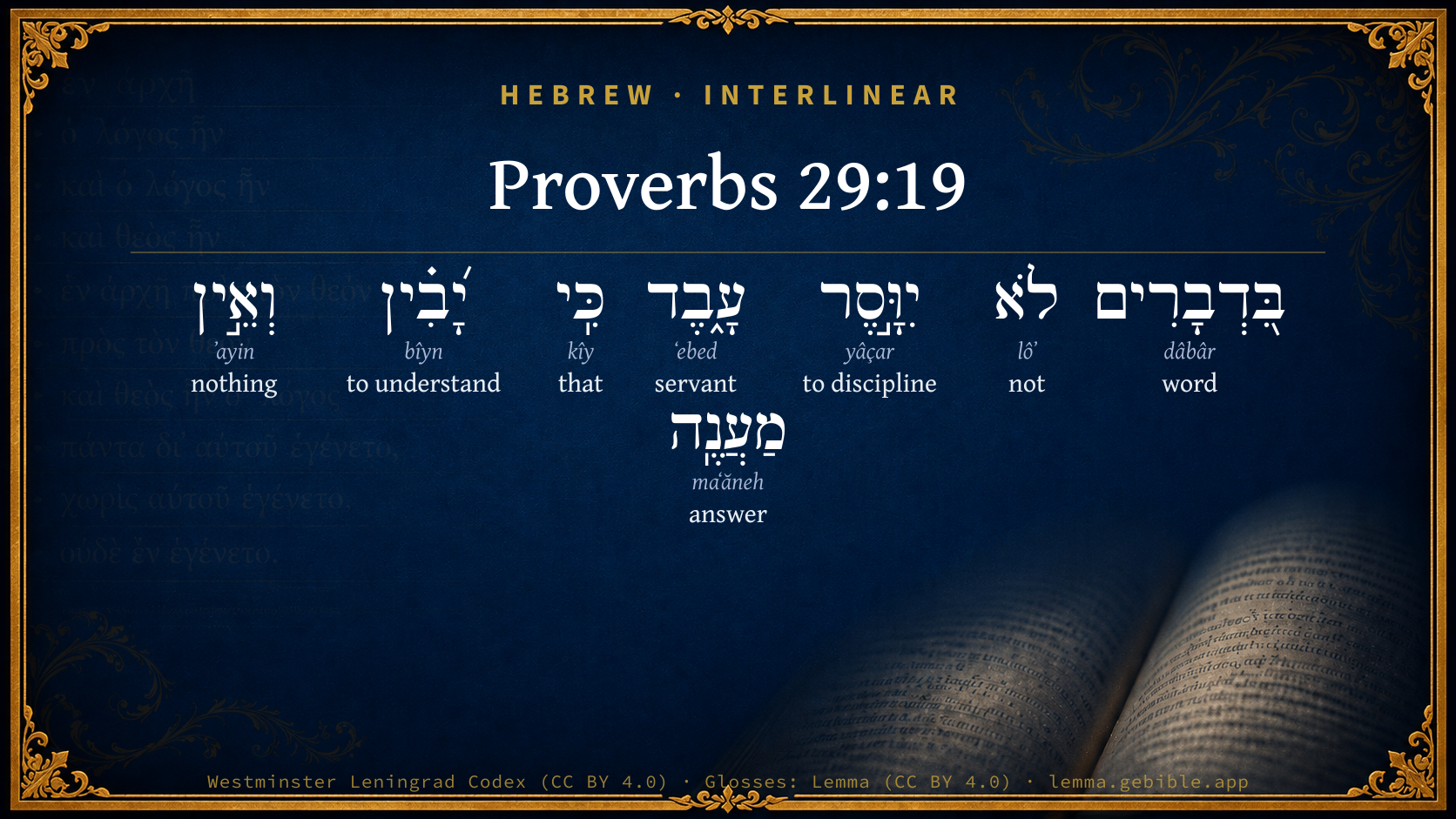
Proverbs 29:19

Hebrew (Westminster Leningrad Codex) Proverbs 29:19 appears in the Hebrew Old Testament. The text above is from the Westminster Leningrad Codex. Each word links to its Strong’s number, a concise gloss, and parsing drawn from the Open Scriptures Hebrew Bible morphology. Click any word for its full Brown-Driver-Briggs (BDB) entry.
Download image
Cite this verse

Proverbs 29:19 (World English Bible). Public Domain. Lemma interlinear Bible study tool, https://lemma.gebible.app/v/proverbs/29/19.

Show BibTeX & RIS
BibTeX
RIS
English Translation
A servant can't be corrected by words. Though he understands, yet he will not respond.
World English Bible · Public Domain
Download a study sheet

One document with this verse’s original text, its word-by-word gloss line, the meaning frame, cross-references with their text, attributed commentary, and full source and license credits — printable, and it pastes into notes with its structure intact.

This verse Autodidact and up

Study sheet (.html) Plain text (.txt)

A passage Seminary Student

Up to 50 verses in one chapter. A passage sheet keeps up to 6 commentary sources and 12 cross-references per verse, in the order this page ranks them, and says so on the sheet whenever that leaves anything out. Ask for a single verse and you get the Autodidact verse sheet above.

Everything on this page stays free to read, with no account — the sheet is a download of what is already on screen, not access to it.

Want to remove ads? Support Godless Engineer
Compare translations 3

The same verse in 3 English versions, stacked beneath the original-language interlinear above. Click any original word for its lexicon entry.

Each is an independent rendering of the whole verse — the interlinear is not word-aligned to these translations.

Highlighted words mark where these versions differ — a whole-verse word diff, not a word-by-word alignment.

  • World English Bible Public Domain
    A servant can't be corrected by words. Though he understands, yet he will not respond.
  • King James Version Public Domain
    A servant will not be corrected by words: for though he understand he will not answer.
  • unfoldingWord Literal Text CC BY-SA 4.0
    A servant will not be instructed by words, for he understands, but there is no answer.

unfoldingWord Literal Text — © unfoldingWord, licensed CC BY-SA 4.0. Word-aligned USFM3 via Door43 (git.door43.org/unfoldingWord/en_ult).

Versions to compare (up to 4)

3 of 4 selected

Show all 18 translations

Every available English version of this verse, each an independent rendering of the whole verse.

  • World English Bible Public Domain
    A servant can't be corrected by words. Though he understands, yet he will not respond.
  • Berean Standard Bible Public Domain
    A servant cannot be corrected by words alone; though he understands, he will not respond.
  • Majority Standard Bible Public Domain
    A servant cannot be corrected by words alone; though he understands, he will not respond.
  • King James Version Public Domain
    A servant will not be corrected by words: for though he understand he will not answer.
  • American Standard Version (1901) Public Domain
    A servant will not be corrected by words; For though he understand, he will not give heed.
  • Revised Version (1885) Public Domain
    A servant will not be corrected by words: for though he understand he will not give heed.
  • Geneva Bible (1599) Public Domain
    A seruant will not be chastised with words: though he vnderstand, yet he will not answere.
  • Douay-Rheims (1899) Public Domain
    A slave will not be corrected by words: because he understandeth what thou sayest, and will not answer.
  • Young's Literal Translation Public Domain
    By words a servant is not instructed though he understand, And there is nothing answering.
  • Literal Standard Version CC BY-SA 4.0
    By words a servant is not instructed though he understand, || And there is nothing answering.
  • Unlocked Literal Bible CC BY-SA 4.0
    A slave will not be corrected by words, for though he understands, there will be no response.
  • unfoldingWord Literal Text CC BY-SA 4.0
    A servant will not be instructed by words, for he understands, but there is no answer.
  • Darby Bible Public Domain
    A servant is not corrected by words: he understandeth indeed, but he will not answer.
  • World Messianic Bible Public Domain
    A servant can’t be corrected by words. Though he understands, yet he will not respond.
  • Webster's Bible Public Domain
    A servant will not be corrected by words: for though he understandeth, he will not answer.
  • Free Bible Version CC BY-SA 4.0
    A servant can't be disciplined by words alone; though they understand, they don't follow what they're told.
  • Bible in Basic English Public Domain
    A servant will not be trained by words; for though the sense of the words is clear to him, he will not give attention.
  • JPS Tanakh (1917) Public Domain
    A servant will not be corrected by words; for though he understand, there will be no response.

Literal Standard Version (2020), Covenant Press — licensed CC BY-SA 4.0. Text via the HelloAO Bible API (eBible.org). Unlocked Literal Bible (unfoldingWord) — licensed CC BY-SA 4.0. Text via the HelloAO Bible API (eBible.org). unfoldingWord Literal Text — © unfoldingWord, licensed CC BY-SA 4.0. Word-aligned USFM3 via Door43 (git.door43.org/unfoldingWord/en_ult). Free Bible Version, Dr. Jonathan Gallagher — licensed CC BY-SA 4.0. Text via the HelloAO Bible API (eBible.org).

Word by word

More ways to search: Search by grammar → Find every occurrence → Compare this word →

Practice this passage: Drill this verse → Learn its vocabulary →

About this verse

These counts appear in no published source. They are computed here, from the morphology-tagged text and Lemma’s own curated glosses. What Lemma adds →

8
words
8
distinct lemmas
Wisdom
section

Notable vocabulary

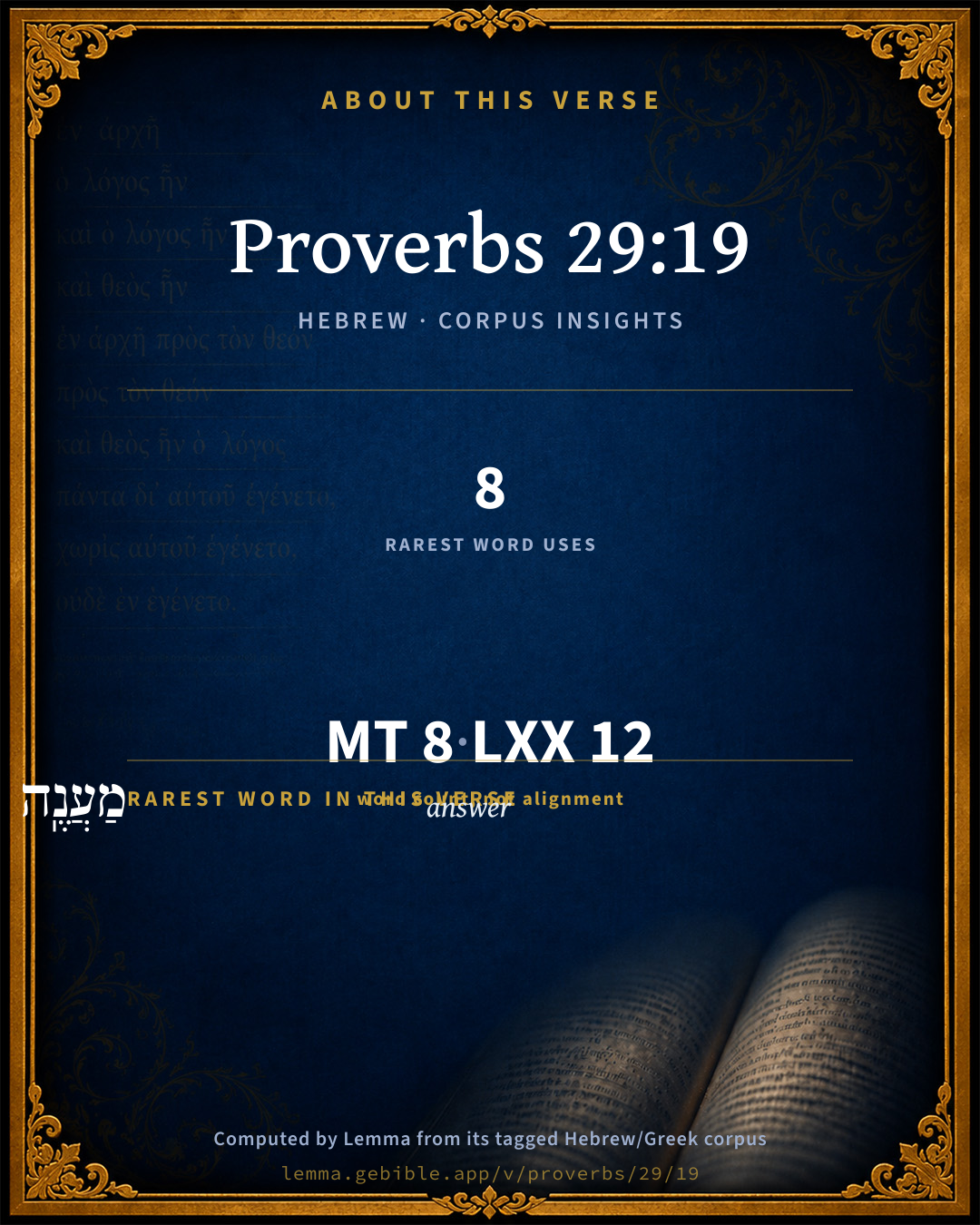
The rarest word here is מַעֲנֶֽה answer H4617 — appearing just 8 times in the whole Hebrew Bible.

Shared distinctive vocabulary

מַעֲנֶֽה answer H4617 occurs in 8 verses of the Hebrew Bible. Also found in:

Grammatical profile

  • 3 verbs
  • 2 nouns
  • 1 conjunction
  • 2 particles

Verb forms

  • יִוָּ֣סֶר Niphal · Imperfect
  • יָ֝בִ֗ין Qal · Imperfect
  • מַעֲנֶֽה Hiphil · Participle Active

Hebrew & Septuagint length

In English translation the verse runs 15 words from the Hebrew and 19 from the Septuagint (LXX English) — closely comparable.

A rough comparison of the two English renderings, which tokenize alike — not a word-level alignment.

Word counts can differ between the Hebrew and the Greek without any difference in meaning — e.g. the Hebrew direct-object marker אֵת has no separate Greek word, and Greek often adds the article ὁ.

In the original languages it is 8 Hebrew tokens and 12 Greek tokens — but the two are counted differently (Hebrew bundles its prefixes and suffixes into one token; the Greek is in lemma form), so that isn’t a like-for-like length.

Cross-references

3

Topical passages linked to Proverbs 29:19 in the Treasury of Scripture Knowledge — connected by theme and wording, ordered by reader-vote popularity; previews shown in the World English Bible.

  • Job 19:16 I call to my servant, and he gives me no answer; I beg him with my mouth.
  • Proverbs 26:3 A whip for the horse, A bridle for the donkey, And a rod for the back of fools!
  • Proverbs 30:22 For a servant when he is king; A fool when he is filled with food;

Cross-references courtesy of OpenBible.info (CC BY 4.0).

Hebrew and Greek witnesses Masoretic Hebrew ↔ Greek Septuagint

The same verse in the two great witnesses to the Old Testament, shown verse-for-verse.

These are two independent witnesses, not word-aligned to each other, and the Septuagint is shown in lemma (dictionary) form.

Hebrew Proverbs 29:19 Masoretic · Westminster Leningrad Codex

בִּ֭דְבָרִים לֹא יִוָּ֣סֶר עָ֑בֶד כִּֽי יָ֝בִ֗ין וְאֵ֣ין מַעֲנֶֽה

A servant can't be corrected by words. Though he understands, yet he will not respond.

World English Bible · Public Domain

Greek LXX Proverbs 29:19 Septuagint · lemma form

λόγος οὐ παιδεύω οἰκέτης σκληρός ἐάν γάρ καί νοέω ἀλλά οὐ ὑποἀκούω

A stubborn servant will not be reproved by words: for even if he understands, still he will not obey.

LXX2012 (modern English Septuagint) · Public Domain

On this verse, Joseph Benson's Commentary discusses the Septuagint’s reading. Read the note in Commentary ↓

Hebrew: Westminster Leningrad Codex (CC BY 4.0). Greek: Septuagint (public domain); English from LXX2012 (modern English Septuagint) (Public Domain). How the Septuagint differs from the Hebrew →

Commentary

Notes on Proverbs 29:19 from classic Christian and Jewish commentators (each source and its license shown beneath its notes). The classic Christian expositions comment on the surrounding passage and are grouped to its opening verse, so a note may address several verses; the Jewish commentaries on the Tanakh (Rashi and others) are per-verse, so they appear only where the commentator wrote on this verse.

Lemma curates 59 commentaries, every one of them public domain or Creative Commons licensed, each selected and text-cleaned for this edition rather than reprinted as found. About our sources →

Trapp's Complete Commentary

John Trapp

Pro 29:19 A servant will not be corrected by words: for though he understand he will not answer.

Ver. 19. A servant will not be corrected by words.] Some servants will not, but must have blows. If words will do, they must be chidden with good words, and not reviled. Christians must be "no brawlers, but gentle, showing all meekness to all men"; {Tit 3:2} and masters must "do the same things, forbearing threatening, knowing that their Master also is in heaven, neither is there respect of persons with him." {Eph 6:9} Severitas nec sit tetra nec tetrica, saith Sidonius. {a} But because some mastigiae are of so servile a disposition, that they must be beaten to their work, like those Phrygians, Qui non nisi flagris castigantur, that will do nothing longer than scourged to it; or the Russian women, that love that husband best that beats them most, and think themselves else not regarded, unless two or three times a day well favouredly swaddled. {b} Therefore let him that knows his Master’s will, and yet, out of stoutness, sullenness, or laziness, will not do it, be beaten with many stripes; let him be "buffeted for his faults," {1Pe 2:20} and made serviceable in all things, "not gainsaying, not purloining." {Tit 2:9-10}

{a} Sidon., Epist.

{b} Heyl., Geog.

John Trapp, A Commentary or Exposition upon All the Books of the Old and New Testament (1647–1656) — public domain. Text from a community e-Sword module.

Joseph Benson's Commentary

Pro 29:19. A servant, &c. — “A slave, and he who is of a servile nature, is not to be amended by reason or persuasion: no, nor by reproofs or threats; for though he hear, and understand too, what you say, yet he will not obey, till he be forced into it by punishment of his disobedience.” The LXX. read, οικετης σκληρος, a stubborn, or obstinate servant will not, &c.

Joseph Benson's Commentary on the Old and New Testaments (1811–1818) — public domain. Text from a community e-Sword module.

The Preacher's Complete Homiletical Commentary

Joseph S. Exell (gen. ed.)

CRITICAL NOTES.—

Pro_29:19. Doth not answer. Rather “there is not an answer,” that is in action, by obedience. Delitzsch translates “does not conform thereto”

Pro_29:21. A son, etc. There are many different translations of this verse, but the general verdict of scholars seems to favour the English rendering. Luther translates the verse, “If a servant is tenderly treated from youth up, he will accordingly become a squire”

MAIN HOMILETICS OF Pro_29:19; Pro_29:21

MASTERS AND SERVANTS

I. Human servants generally need correction. The relation of master and servant is generally, though not always, founded upon some superiority on the one side and inferiority on the other. Where there is any right adjustment of social relations, those who serve are those who lack knowledge of some kind which those who rule are able to impart, and hence arises the necessity of correction on the part of the master and of submission on that of the servant. It is undeniable that there are many inversions of this ideal moral order, but the proverb can only refer to what ought to be, and what often, though not always, is the case.

II. The means of correction ought to be moral means. A servant is a moral and intelligent agent, and not a machine or a brute, and he can and ought to appreciate appeals to his reason and conscience. A wise and humane rider will use his voice to his steed in preference to the whip or the spur, and generally finds it effectual. And words of reproof and encouragement are probably the only successful means of dealing with human nature in this relationship. If these fail, no others will avail, and all benefit from the connection will cease.

III. Therefore human masters need much wisdom. If they are over-indulgent the servant may take undue advantage and claim privileges to which he has no right (Pro_29:21). In the present constitution of things in this world, and probably throughout the universe, there are inequalities of position and rank which no wise man can ignore, and it is kind and wise to those beneath us to maintain these differences and distinctions. But to maintain them without haughtiness, and with that consideration and sympathy which ought to mark all our intercourse with our fellow-creatures, needs much wisdom on the part of superiors. Dr. David Thomas suggests another, and perhaps a pleasanter application of this proverb. “There is another side,” he says, “to the kindness of a master towards is servant, that is, the making of the servant feel towards him all the sympathy and interest of a son.… He who can make his servant feel towards him as a loving, faithful, and dutiful child, will reap the greatest comfort and advantage from his service.” But this happy result can only be brought about where the master is truly wise as well as kind.

For Homiletics on Pro_29:20; Pro_29:22, see on chap. Pro_14:17; Pro_14:29, pages 363 and 386. On Pro_29:23, see on chap. Pro_11:2, page 192, and Pro_16:18, page 482.

The Preacher's Complete Homiletical Commentary (gen. ed. Joseph S. Exell; Funk & Wagnalls, c. 1892) — public domain (pre-1929). A full-Bible homiletical/sermon-outline anthology covering 65 of 66 books (2 John is absent from the source module). Text from a community e-Sword module.

Tyndale Open Study Notes

Tyndale Open Resources

29:19 In some instances of discipline, tangible consequences might need to accompany instructions.

Tyndale Open Study Notes — © Tyndale Open Resources, licensed CC BY-SA 4.0. Text via the HelloAO Bible API.

Geneva Bible (1599)

Geneva Bible translators

Or, regard.

He that is of a servile and rebellious nature.

Geneva Bible (1599) marginal notes — public domain. Text via Bolls.life.

Matthew Henry's Commentary

Here is the description of an unprofitable, slothful, wicked servant, a slave that serves not from conscience, or love, but purely from fear. Let those that have such servants put on patience to bear the vexation and not disturb themselves at it. See their character. 1. No rational words will work upon them; they will not be corrected and reformed, not brought to their business, nor cured of their idleness and laziness, by fair means, no, nor by foul words; even the most gentle master will be forced to use severity with them; no reason will serve their turn, for they are unreasonable. 2. No rational words will be got from them. They are dogged and sullen; and, though they understand the questions you ask them, they will not give you an answer; though you make it ever so plain to them what you expect from them, they will not promise you to mend what is amiss nor to mind their business. See the folly of those servants whose mouth by their silence calls for strokes; they might be corrected by words and save blows, but they will not.

Matthew Henry's Commentary on the Whole Bible (1708–1710) — public domain (CC PDM 1.0). Text via the HelloAO Bible API.

Jamieson, Fausset & Brown

Robert Jamieson, A. R. Fausset & David Brown

A servant--who lacks good principle.

corrected--or discovered.

will not answer--that is, will not obey.

Jamieson, Fausset & Brown — Commentary Critical and Explanatory on the Whole Bible (1871) — public domain (CC PDM 1.0). Text via the HelloAO Bible API.

Ellicott's Commentary for English Readers

(19) A servant will not be corrected with words.—A slave must be corrected by sterner means; it is only fear of punishment which will move him; “for though he understand, he will not answer,” will not reply to your call, or render obedience to your command. The willing obedience of a son, and the grudging obedience of a slave, are contrasted in Rom_8:15.

A Bible Commentary for English Readers, edited by Charles John Ellicott (1878–1897) — public domain. Text from a community e-Sword module.

The Cambridge Bible for Schools and Colleges

gen. ed. J. J. S. Perowne

19. words] He needs sterner measures.

answer] i.e. respond in work and action: give heed, R.V.; οὐχ ὑπακούσεται, LXX. The Vulg. appears to understand it, as do some commentators, literally—he will not even deign to answer you—quia quod dicis intelligit, et respondere contemnit.

The Cambridge Bible for Schools and Colleges (gen. ed. J. J. S. Perowne; Cambridge University Press, 1878–1918) — public domain. Text from a community e-Sword module.

John Gill's Exposition

A servant will not be corrected by words,.... Not by them only, especially one that is of a servile, surly, and untractable disposition; otherwise a good servant, and well disposed to his master, and willing to serve him, and promote his interest, a word is sufficient for such an one; when he is bid to go, he goes; or to come, he comes, Mat 8:9; or if he has done wrong, and his fault is told him, he will amend another time; whereas a rough ill natured servant will not regard words, but must have blows to correct him;

for though he understand; what his master says, and what is his will, and knows he has done wrong, and ought to do otherwise, which is an aggravation of sin:

he will not answer; own his fault and promise to do better for the future; through the surliness of his nature, and contempt of his master, whom he does not think worthy of an answer: so the Vulgate Latin version renders it, "he despises to answer"; thus Job was used by his servants, Job 19:16; There is an answering which is forbidden servants, Tit 2:9; but this what becomes them, and is expressive of their respect and reverence to their masters, and their ready, hearty, and cheerful obedience to them; and which especially should be in Christian servants to Christian masters, Ti1 6:1.

John Gill's Exposition of the Whole Bible (1746–1763) — public domain (CC PDM 1.0). Text via the HelloAO Bible API.

Albert Barnes' Notes on the Bible

Servant - i. e., A slave, whose obedience is reluctant. He may “understand” the words, but they produce no good effect. There is still lacking the true “answer” of obedience.

Albert Barnes' Notes on the Bible (1834–1885) — public domain. Text from a community e-Sword/MySword module.

Matthew Poole's English Annotations

A servant, who is so not only ill condition, but also in the temper of his mind, disingenuous, perverse, and stubborn,

will not be corrected by words; by mere words without blows. Compare Pro 19:29.

Though he understand, though he know thy mind and words, and his own duty,

he will not answer; either by words, expressing his readiness; or by deeds, speedily and cheerfully performing thy commands; but will neglect his duty, pretending that he did not hear or understand thee.

Matthew Poole's English Annotations on the Holy Bible (1683–1685) — public domain. Text from a community e-Sword/MySword module.

Whedon's Commentary on the Bible

Daniel D. Whedon

19. A servant — A bondman, a slave. The language is applied to such only as are “under the yoke,” over whom the master has, or claims, the right of corporal punishment.

Will not be corrected by words — The proverb implies that where involuntary servitude exists, obedience and submission cannot be enforced by words alone. And such seems to have been the judgment of all men who have had to deal with it. All slave codes give the power of corporal punishment to the master; and even the most humane of masters acknowledge it to be sometimes necessary. Slavery takes away the ordinary motives for labour and faithfulness on the part of the servant, and the motive of fear needs to be appealed to in a greater degree. Moreover, slavery usually keeps its victims in a state of ignorance and degradation; mentally, in the state of children; and physically, in the condition of brutes, to be bought and sold, and otherwise treated without respect to their feelings, wishes, or interests.

Not answer — That is, in action — will not obey.

Daniel D. Whedon (gen. ed.), Commentary on the Old and New Testaments (1874–1909) — public domain. Text from a community e-Sword module.

The Pulpit Commentary

A servant will not be corrected by words. Mere words will not suffice to teach a slave, any more than a child, true, practical wisdom. He needs severer measures, even the correction of personal discipline. Septuagint, "By words a stubborn (sklhrov ) slave will not be instructed." The next clause gives an explanation of this necessity. For though he understand he will not answer. The answer is not merely the verbal response to a command, as, "I go, sir;" but it implies obedience in action. The reluctant slave thoroughly understands the order given, but he pays no heed to it, will not trouble himself to execute it, and therefore must meet with stern treatment. (comp. ver. 15; Pro_23:13, etc.; Pro_26:3) "That servant which knew his Lord"s will, and made not ready, nor did according to his will, shall be beaten with many stripes". (Luk_12:47) Septuagint, "For even if he understand, he will not obey."

The Pulpit Commentary (1880–1919), ed. H.D.M. Spence-Jones & Joseph S. Exell — public domain. Text from a community e-Sword module.

John Wesley's Explanatory Notes

A servant - Who is so not only in condition, but also in the temper of his mind, disingenuous, and stubborn. Words - By mere words. Tho' - Though he know thy mind, and his own duty.

John Wesley, Explanatory Notes Upon the Whole Bible (1754–1765) — public domain. Text via the GEBible commentary corpus.

Keil & Delitzsch

C. F. Keil & F. Delitzsch

From the discipline of the people this series of proverbs again returns to the discipline of home:

19 With words a servant will not let himself be bettered;

For he understandeth them, but conformeth not thereto.

The Niph. נוסר becomes a so-called tolerative, for it connects with the idea of happening that of reaching its object: to become truly bettered (taught in wisdom, corrected), and thus to let himself be bettered. With mere words this is not reached; the unreasonable servant needs, in order to be set right, a more radical means of deliverance. This assertion demands confirmation; therefore is the view of von Hofmann (Schriftbew. ii. 2. 404) improbable, that 19b has in view a better-disposed servant: supposing that he is intelligent, in which case he is admonished without cause, then the words are also lost: he will let them pass over him in silence without any reply. This attempted explanation is occasioned by this, that מענה can signify nothing else than a response in words. If this were correct, then without doubt its fundamental meaning would correspond with כּי; for one explains, with Lwenstein, "for he perceives it, and may not answer," i.e., this, that a reply cut off frustrates the moral impression. Or also: for he understands it, but is silent - in praefractum se silentium configit (Schultens); and thus it is with the ancients (Rashi). But why should not ואין מענה itself be the expression of this want of any consequences? מענה cannot certainly mean humiliation

(Note: The Syr. and Targ. also think on ענה, for they translate: "for he knows that he receives no strokes.")

(Meri, after Exo 10:3, הכנעה), but why as an answer in words and not also a response by act (Stuart: a practical answer)? Thus the lxx ἐὰν γὰρ καὶ νοήσῃ, ἀλλ ̓ οὐχ ὑπακούσεται, according to which Luther: for although he at once understands it, he does not yet take it to himself. That מענה tahT . may mean obedience, the Aram. so understood, also at Pro 16:4. It denoted a reply in the most comprehensive meaning of the word, vid., at Pro 16:1. The thought, besides, is the same as if one were to explain: for he understands it, and is silent, i.e., lets thee speak; or: he understands it, but that which he perceives finds no practical echo.

Keil & Delitzsch — Biblical Commentary on the Old Testament (1861–1891) — public domain (CC PDM 1.0). Text via the HelloAO Bible API. (Old Testament only.)

Bridges on Proverbs

Charles Bridges

Discipline must be carried, not only into the family (Pro 29:15, Pro 29:17 ), but throughout the whole household, in order to preserve God’s authority and order. An important hint is here given relative to the management of servants. Though it does not apply to all,†1 it shews a very common temptation to self-will. There is a proud as well as an humble silence; as plain a proof of an unsubdued spirit, as a pert and flippant answer. The patience of Job was sorely exercised by this trial; and that under circumstances, that made the treatment more aggravated. (Job 19:16 .) We must guard against harshness in our spirit.†2 But with servants, as with children, authority must be maintained at any cost. And therefore, if a servant understand the command, and will not answer; if he will not be corrected by words, it were better to dismiss him, than to lower our authority, and countenance evil by yielding to his waywardness.

The Scripture fully sets out the duties of servants — "Not answering again. With good-will doing service, as to the Lord, and not to man."†3 Sullen resistance to reproof is most inconsistent with the profession of a Christian; and, if the offender escapes the correction of an earthly master, he will be visited with the rod of his angry Lord, as a self-deceiver, or backslider from his high obligation.†4

Footnotes:

†1 The LXX renders, but without authority from the original - ’an obstinate servant.’

†2 Lev 25:43. Compare Sir 33:28-29 .

†3 Tit 2:9. Eph 6:7 .

†4 Pro 19:29; Pro 26:3 .

Charles Bridges, An Exposition of the Book of Proverbs (1846) — public domain. Text from a community e-Sword module.

unfoldingWord translationNotes

Door43 World Missions Community

A slave will not be corrected by words

This can be translated in active form."You will not be able to correct a slave simply by talking to him" (See: Active or Passive)

See a man who is hasty in his words?

The writer is using a question to get the reader's attention. AT: "You should notice what happens to a man who is hasty in his words." (See: Rhetorical Question)

translationWords

servant

hope

fool

unfoldingWord translationNotes — © Distant Shores Media and the Door43 World Missions Community, licensed CC BY-SA 4.0. Source: git.door43.org/Door43/en_tn.

Rashi

Rabbi Shlomo Yitzchaki (Rashi)

because he will understand, but without response As soon as he sees him (sic) that the one who was reproving him is silent, he reverts to his sins; therefore, one must chastise him with blows and punishments. He does not speak of an actual slave, but about all who disobey the words of the judges.

Rashi on the Tanakh — English translations: “The Judaica Press complete Tanach with Rashi, translated by A. J. Rosenberg” (CC BY 4.0); “Pentateuch with Rashi's commentary by M. Rosenbaum and A.M. Silbermann, 1929-1934” (public domain); “The Metsudah Tanach series, Lakewood, N.J” (CC BY 4.0); and “The Book of Joshua, Metsudah Publications, 1997” (CC BY 4.0). Text via Sefaria.

Lesson kit

Teaching starters — assembled from the data on this page, not authored interpretation. Every prompt links to the verse data it draws on. Edit before teaching.

Proverbs, in the Wisdom, opens this verse with 8 words (8 distinct Hebrew lemmas). Its most distinctive word is maʻăneh (“answer”). A historical commentator’s framing appears above. Read the whole chapter for the surrounding context.

Discussion questions

  1. How does “answer” (maʻăneh) shape what this verse is saying?
  2. Job 32:3 shares the word «answer» with this verse. How do the two illuminate each other?
  3. The translations on this page render this verse differently — a whole-verse word diff, not a word-by-word alignment. What might account for the different wordings?
  4. The verb «יִוָּ֣סֶר» is Niphal Imperfect. How does its form color the action?
  5. Reading how Trapp's Complete Commentary and Joseph Benson's Commentary read this verse, where do the two commentators agree and where do they part?

Things to notice

Reading settings

Reading text

Shown beneath each verse's original-language words.

Old Testament
Old Testament edition

Read the OT as the Masoretic Hebrew (MT) or the Greek Septuagint (LXX).

English shown for the Greek Septuagint (in the Hebrew ↔ Greek comparison).

Comparing translations? Open the Compare panel on any verse page to stack up to four side by side.