Jeremiah 49:7

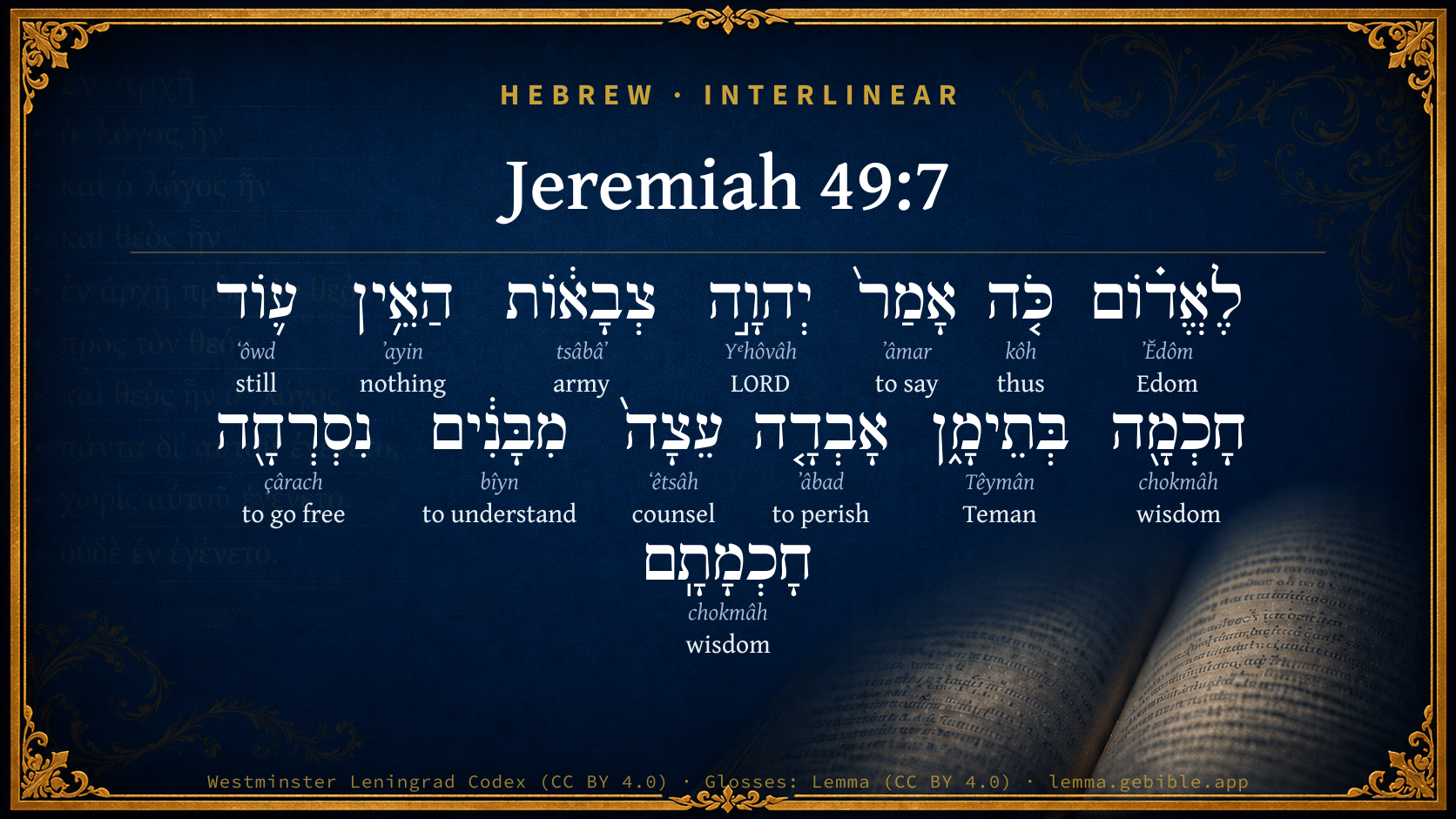
Hebrew (Westminster Leningrad Codex) Jeremiah 49:7 appears in the Hebrew Old Testament. The text above is from the Westminster Leningrad Codex. Each word links to its Strong’s number, a concise gloss, and parsing drawn from the Open Scriptures Hebrew Bible morphology. Click any word for its full Brown-Driver-Briggs (BDB) entry.
Download image
Cite this verse

Jeremiah 49:7 (World English Bible). Public Domain. Lemma interlinear Bible study tool, https://lemma.gebible.app/v/jeremiah/49/7.

Show BibTeX & RIS
BibTeX
RIS
English Translation
Of Edom. Thus says Yahweh of Hosts: Is wisdom no more in Teman? is counsel perished from the prudent? is their wisdom vanished?
World English Bible · Public Domain
Download a study sheet

One document with this verse’s original text, its word-by-word gloss line, the meaning frame, cross-references with their text, attributed commentary, and full source and license credits — printable, and it pastes into notes with its structure intact.

This verse Autodidact and up

Study sheet (.html) Plain text (.txt)

A passage Seminary Student

Up to 50 verses in one chapter. A passage sheet keeps up to 6 commentary sources and 12 cross-references per verse, in the order this page ranks them, and says so on the sheet whenever that leaves anything out. Ask for a single verse and you get the Autodidact verse sheet above.

Everything on this page stays free to read, with no account — the sheet is a download of what is already on screen, not access to it.

Want to remove ads? Support Godless Engineer
Compare translations 3

The same verse in 3 English versions, stacked beneath the original-language interlinear above. Click any original word for its lexicon entry.

Each is an independent rendering of the whole verse — the interlinear is not word-aligned to these translations.

Highlighted words mark where these versions differ — a whole-verse word diff, not a word-by-word alignment.

  • World English Bible Public Domain
    Of Edom. Thus says Yahweh of Hosts: Is wisdom no more in Teman? is counsel perished from the prudent? is their wisdom vanished?
  • King James Version Public Domain
    Concerning Edom, thus saith the LORD of hosts; Is wisdom no more in Teman? is counsel perished from the prudent? is their wisdom vanished?
  • unfoldingWord Literal Text CC BY-SA 4.0
    About Edom, Yahweh of hosts says this, “Is there no longer any wisdom to be found in Teman? Has good advice disappeared from those who have understanding? Has their wisdom become corrupted?

unfoldingWord Literal Text — © unfoldingWord, licensed CC BY-SA 4.0. Word-aligned USFM3 via Door43 (git.door43.org/unfoldingWord/en_ult).

Versions to compare (up to 4)

3 of 4 selected

Show all 18 translations

Every available English version of this verse, each an independent rendering of the whole verse.

  • World English Bible Public Domain
    Of Edom. Thus says Yahweh of Hosts: Is wisdom no more in Teman? is counsel perished from the prudent? is their wisdom vanished?
  • Berean Standard Bible Public Domain
    Concerning Edom, this is what the LORD of Hosts says: “Is there no longer wisdom in Teman? Has counsel perished from the prudent? Has their wisdom decayed?
  • Majority Standard Bible Public Domain
    Concerning Edom, this is what the LORD of Hosts says: “Is there no longer wisdom in Teman? Has counsel perished from the prudent? Has their wisdom decayed?
  • King James Version Public Domain
    Concerning Edom, thus saith the LORD of hosts; Is wisdom no more in Teman? is counsel perished from the prudent? is their wisdom vanished?
  • American Standard Version (1901) Public Domain
    Of Edom. Thus saith Jehovah of hosts: Is wisdom no more in Teman? is counsel perished from the prudent? is their wisdom vanished?
  • Revised Version (1885) Public Domain
    Of Edom. Thus saith the LORD of hosts: Is wisdom no more in Teman? is counsel perished from the prudent? is their wisdom vanished?
  • Geneva Bible (1599) Public Domain
    To Edom thus sayeth the Lord of hostes: Is wisdome no more in Teman? is counsel perished from their children? is their wisdome vanished?
  • Douay-Rheims (1899) Public Domain
    Against Edom. Thus saith the Lord of hosts: Is wisdom no more in Theman? counsel is perished from her children: their wisdom is become unprofitable.
  • Young's Literal Translation Public Domain
    Concerning Edom: `Thus said Jehovah of Hosts: Is wisdom no more in Teman? Perished hath counsel from the intelligent? Vanished hath their wisdom?
  • Literal Standard Version CC BY-SA 4.0
    Concerning Edom: “Thus said YHWH of Hosts: Is wisdom no longer in Teman? Has counsel perished from the intelligent? Has their wisdom vanished?
  • Unlocked Literal Bible CC BY-SA 4.0
    About Edom, Yahweh of hosts says this, “Is there no longer any wisdom to be found in Teman? Has good advice disappeared from those who have understanding? Has their wisdom become corrupted?
  • unfoldingWord Literal Text CC BY-SA 4.0
    About Edom, Yahweh of hosts says this, “Is there no longer any wisdom to be found in Teman? Has good advice disappeared from those who have understanding? Has their wisdom become corrupted?
  • Darby Bible Public Domain
    Concerning Edom. Thus saith Jehovah of hosts: Is there no more wisdom in Teman? is counsel perished from the prudent? is their wisdom spent?
  • World Messianic Bible Public Domain
    Of Edom, the LORD of Hosts says: “Is wisdom no more in Teman? Has counsel perished from the prudent? Has their wisdom vanished?
  • Webster's Bible Public Domain
    Concerning Edom, thus saith the LORD of hosts; Is wisdom no more in Teman? hath counsel perished from the prudent? hath their wisdom vanished?
  • Free Bible Version CC BY-SA 4.0
    This is what the Lord Almighty says about Edom: Aren't there any wise people left in Teman? Isn't there any good advice from those with insight? Has their wisdom rotted away?
  • Bible in Basic English Public Domain
    About Edom. This is what the Lord of armies has said. Is there no more wisdom in Teman? have wise suggestions come to an end among men of good sense? has their wisdom completely gone?
  • JPS Tanakh (1917) Public Domain
    Of Edom. Thus saith the LORD of hosts: Is wisdom no more in Teman? Is counsel perished from the prudent? Is their wisdom vanished?

Literal Standard Version (2020), Covenant Press — licensed CC BY-SA 4.0. Text via the HelloAO Bible API (eBible.org). Unlocked Literal Bible (unfoldingWord) — licensed CC BY-SA 4.0. Text via the HelloAO Bible API (eBible.org). unfoldingWord Literal Text — © unfoldingWord, licensed CC BY-SA 4.0. Word-aligned USFM3 via Door43 (git.door43.org/unfoldingWord/en_ult). Free Bible Version, Dr. Jonathan Gallagher — licensed CC BY-SA 4.0. Text via the HelloAO Bible API (eBible.org).

Word by word

More ways to search: Search by grammar → Find every occurrence → Compare this word →

Practice this passage: Drill this verse → Learn its vocabulary →

נִסְרְחָ֖ה
çârach
H5628
“to go free”
Verb, Niphal, Perfect, 3rd Person, Feminine, Singular
Part of Speech
Verb
Stem
Niphal
Form
Perfect
Person
3rd Person
Gender
Feminine
Number
Singular
Full BDB Definition

Origin: a primitive root

TWOT: 1543

to go free, be unrestrained, be overrun, exceed, overhang, grow luxuriously - (Qal) - to go free, be unrestrained, sprawl - overrunning, spreading (participle) - to overhang - (Niphal) to be let loose or dismissed or gone
  1. לֶאֱד֗וֹם ʼĔdôm H123 “to/for · Edom” Preposition + Noun, Proper
  2. כֹּ֤ה kôh H3541 “thus” Adverb
  3. אָמַר֙ ʼâmar H559 “to say” Verb, Qal, Perfect, 3rd Person, Masculine, Singular
  4. יְהוָ֣ה Yᵉhôvâh H3068 “LORD” Noun, Proper
  5. צְבָא֔וֹת tsâbâʼ H6635 “armies” Noun, Common, Both, Plural, Absolute
  6. הַאֵ֥ין ʼayin H369 “nothing” Particle, Interrogative + Particle, Negative
  7. ע֛וֹד ʻôwd H5750 “still” Adverb
  8. חָכְמָ֖ה chokmâh H2451 “wisdom” Noun, Common, Feminine, Singular, Absolute
  9. בְּתֵימָ֑ן Têymân H8487 “in/at · Teman” Preposition + Noun, Proper
  10. אָבְדָ֤ה ʼâbad H6 “to perish” Verb, Qal, Perfect, 3rd Person, Feminine, Singular
  11. עֵצָה֙ ʻêtsâh H6098 “counsel” Noun, Common, Feminine, Singular, Absolute
  12. מִבָּנִ֔ים bîyn H995 “from · understanding” Preposition + Verb, Qal, Participle Active, Masculine, Plural, Absolute
  13. חָכְמָתָֽם chokmâh H2451 “wisdom · their” Noun, Common, Feminine, Singular, Construct + Suffix, Personal, 3rd Person, Masculine, Plural

About this verse

These counts appear in no published source. They are computed here, from the morphology-tagged text and Lemma’s own curated glosses. What Lemma adds →

14
words
13
distinct lemmas
Prophets
section

Notable vocabulary

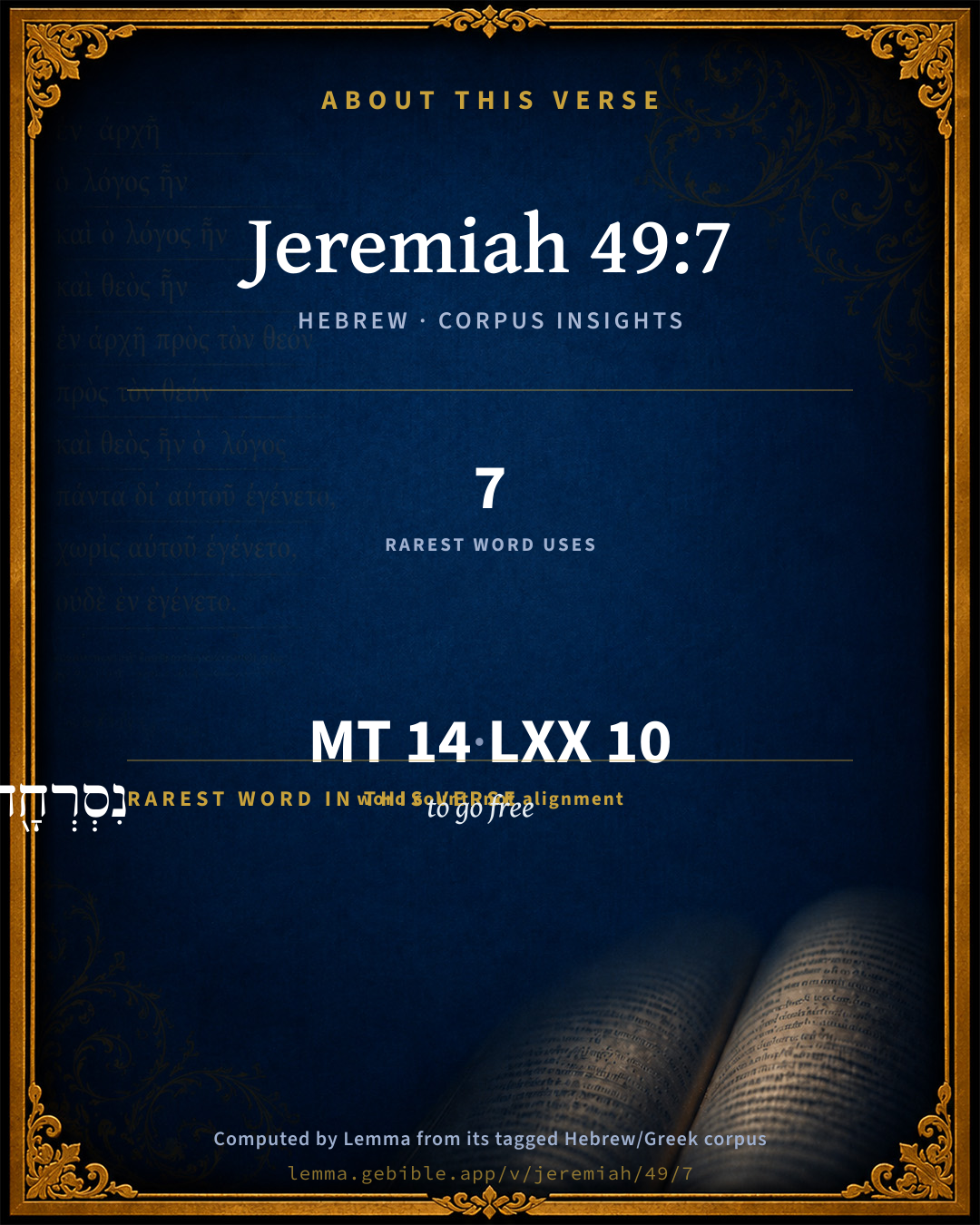
The rarest word here is נִסְרְחָ֖ה to go free H5628 — appearing just 7 times in the whole Hebrew Bible.

Shared distinctive vocabulary

נִסְרְחָ֖ה to go free H5628 occurs in 7 verses of the Hebrew Bible. Also found in:

Grammatical profile

  • 4 verbs
  • 7 nouns
  • 2 adverbs
  • 1 particle

Verb forms

  • אָמַר֙ Qal · Perfect
  • אָבְדָ֤ה Qal · Perfect
  • מִבָּנִ֔ים Qal · Participle Active
  • נִסְרְחָ֖ה Niphal · Perfect

Repetition

A word recurs within this verse — often emphatic in Hebrew:

  • חָכְמָ֖ה wisdom H2451 ×2

Hebrew & Septuagint length

In the original languages it is 14 Hebrew tokens and 10 Greek tokens — but the two are counted differently (Hebrew bundles its prefixes and suffixes into one token; the Greek is in lemma form), so that isn’t a like-for-like length.

Cross-references

32

Topical passages linked to Jeremiah 49:7 in the Treasury of Scripture Knowledge — connected by theme and wording, ordered by reader-vote popularity; previews shown in the World English Bible.

  • Amos 1:11–12 Thus says Yahweh: "For three transgressions of Edom, yes, for four, I will not turn away its punishment; Because he pursued his brother with the sword, And cast off all pity, And his anger raged continually, And he kept his wrath forever;
  • Genesis 25:30 Esau said to Jacob, "Please feed me with that same red stew, for I am famished." Therefore his name was called Edom.
  • Genesis 36:15 These are the chiefs of the sons of Esau: the sons of Eliphaz the firstborn of Esau: chief Teman, chief Omar, chief Zepho, chief Kenaz,
  • Jeremiah 25:21 Edom, and Moab, and the children of Ammon;
  • Jeremiah 49:20 Therefore hear the counsel of Yahweh, that he has taken against Edom; and his purposes, that he has purposed against the inhabitants of Teman: Surely they shall drag them away, [even] the little ones of the flock; surely he shall make their habitation desolate over them.
  • Ezekiel 25:12–14 Thus says the Lord Yahweh: Because Edom has dealt against the house of Judah by taking vengeance, and has greatly offended, and revenged himself on them;
  • Genesis 36:11 The sons of Eliphaz were Teman, Omar, Zepho, and Gatam, and Kenaz.
  • Job 2:11 Now when Job's three friends heard of all this evil that had come on him, they each came from his own place: Eliphaz the Temanite, Bildad the Shuhite, and Zophar the Naamathite, and they made an appointment together to come to sympathize with him and to comfort him.
  • Genesis 27:41 Esau hated Jacob because of the blessing with which his father blessed him. Esau said in his heart, "The days of mourning for my father are at hand. Then I will kill my brother Jacob."
  • Genesis 36:8 Esau lived in the hill country of Seir. Esau is Edom.
  • Genesis 36:34 Jobab died, and Husham of the land of the Temanites reigned in his place.
  • Numbers 20:14–21 Moses sent messengers from Kadesh to the king of Edom, Thus says your brother Israel, You know all the travail that has happened to us:
  • Numbers 24:17–18 I see him, but not now; I see him, but not near: There shall come forth a star out of Jacob, A scepter shall rise out of Israel, Shall strike through the corners of Moab, Break down all the sons of tumult.
  • Deuteronomy 23:7 You shall not abhor an Edomite; for he is your brother: you shall not abhor an Egyptian, because you lived as a foreigner in his land.
  • 1 Chronicles 1:53 chief Kenaz, chief Teman, chief Mibzar,
  • Job 4:1 Then Eliphaz the Temanite answered,
  • Job 5:12–14 He frustrates the devices of the crafty, So that their hands can't perform their enterprise.
  • Psalms 83:4–10 "Come," they say, "and let's destroy them as a nation, That the name of Israel may be remembered no more."
  • Psalms 137:7 Remember, Yahweh, against the children of Edom, The day of Jerusalem; Who said, "Raze it! Raze it even to its foundation!"
  • Isaiah 19:11–13 The princes of Zoan are utterly foolish; the counsel of the wisest counselors of Pharaoh is become brutish: how do you say to Pharaoh, I am the son of the wise, the son of ancient kings?
  • Isaiah 29:14 therefore, behold, I will proceed to do a marvelous work among this people, even a marvelous work and a wonder; and the wisdom of their wise men shall perish, and the understanding of their prudent men shall be hid.
  • Isaiah 34:1–17 Come near, you nations, to hear; and listen, you peoples: let the earth hear, and the fullness of it; the world, and all things that come forth from it.
  • Isaiah 63:1–6 Who is this who comes from Edom, with dyed garments from Bozrah? this who is glorious in his clothing, marching in the greatness of his strength? I who speak in righteousness, mighty to save.
  • Jeremiah 18:18 Then said they, Come, and let us devise devices against Jeremiah; for the law shall not perish from the priest, nor counsel from the wise, nor the word from the prophet. Come, and let us strike him with the tongue, and let us not give heed to any of his words.
  • Jeremiah 25:9 behold, I will send and take all the families of the north, says Yahweh, and [I will send] to Nebuchadrezzar the king of Babylon, my servant, and will bring them against this land, and against the inhabitants of it, and against all these nations round about; and I will utterly destroy them, and make them an astonishment, and a hissing, and perpetual desolations.
  • Ezekiel 35:1–15 Moreover the word of Yahweh came to me, saying,
  • Daniel 11:41 He shall enter also into the glorious land, and many [countries] shall be overthrown; but these shall be delivered out of his hand: Edom, and Moab, and the chief of the children of Ammon.
  • Joel 3:19 Egypt will be a desolation, And Edom will be a desolate wilderness, For the violence done to the children of Judah, Because they have shed innocent blood in their land.
  • Obadiah 1:1–21 The vision of Obadiah. This is what the Lord Yahweh says about Edom. We have heard news from Yahweh, and an ambassador is sent among the nations, saying, "Arise, and let's rise up against her in battle.
  • Habakkuk 3:3 God came from Teman, The Holy One from Mount Paran. Selah. His glory covered the heavens, And his praise filled the earth.
  • Malachi 1:3–4 but Esau I hated, and made his mountains a desolation, and gave his heritage to the jackals of the wilderness."
  • Romans 1:22–23 Professing themselves to be wise, they became fools,

Cross-references courtesy of OpenBible.info (CC BY 4.0).

Hebrew and Greek witnesses Masoretic Hebrew ↔ Greek Septuagint

The same verse in the two great witnesses to the Old Testament, shown verse-for-verse.

These are two independent witnesses, not word-aligned to each other, and the Septuagint is shown in lemma (dictionary) form.

Hebrew Jeremiah 49:7 Masoretic · Westminster Leningrad Codex

לֶאֱד֗וֹם כֹּ֤ה אָמַר֙ יְהוָ֣ה צְבָא֔וֹת הַאֵ֥ין ע֛וֹד חָכְמָ֖ה בְּתֵימָ֑ן אָבְדָ֤ה עֵצָה֙ מִבָּנִ֔ים נִסְרְחָ֖ה חָכְמָתָֽם

Of Edom. Thus says Yahweh of Hosts: Is wisdom no more in Teman? is counsel perished from the prudent? is their wisdom vanished?

World English Bible · Public Domain

Greek LXX Structure differs

In the Septuagint, Jeremiah is about an eighth shorter than the Hebrew and arranges its material differently — the Oracles Against the Nations (Hebrew chapters 46–51) appear in the middle of the Greek book, after 25:13. Because the chapter and verse boundaries do not line up, a verse-for-verse comparison with the Hebrew is not shown.

A verse-for-verse comparison isn’t shown here because the chapters and verses don’t line up. Switch to the LXX edition with the MT / LXX toggle above to read the Greek directly.

On this verse, The Cambridge Bible for Schools and Colleges discusses the Septuagint’s reading. Read the note in Commentary ↓

Hebrew: Westminster Leningrad Codex (CC BY 4.0). Greek: Septuagint (public domain); English from a public-domain English Septuagint. How the Septuagint differs from the Hebrew →

Targum (Aramaic paraphrase)

1

The Targum is the ancient Jewish Aramaic paraphrase of the Hebrew Scriptures — an interpretive translation, not the Hebrew text itself. Onkelos (literal) and Pseudo-Jonathan (expansive) render the Torah, and Jonathan the Prophets. Coverage is partial: where no permissively-licensed English translation exists for a verse, only the Aramaic is shown. This is verse-level text, not a word-by-word alignment to the Hebrew.

  1. Targum Jonathan Prophets (Joshua–Malachi)
    לֶאֱדוֹם כִּדְנַן אֲמַר יְיָ צְבָאוֹת הֲלֵית עוֹד חוּכְמָא בְּדָרוֹמָא פְסַק מַלְכָּא מִבְּנַיָא אִתְקַלְקָלַת חוּכְמַתְהוֹן:

    (no public-domain English translation for this verse)

    Targum Jonathan — Aramaic: “Mikraot Gedolot” (public domain). English: “Sefaria Community Translation” (CC0 1.0 (public-domain dedication)); “London "Chaldee Paraphrase," 1871” (public domain). Text via Sefaria.

Commentary

Notes on Jeremiah 49:7 from classic Christian and Jewish commentators (each source and its license shown beneath its notes). The classic Christian expositions comment on the surrounding passage and are grouped to its opening verse, so a note may address several verses; the Jewish commentaries on the Tanakh (Rashi and others) are per-verse, so they appear only where the commentator wrote on this verse.

Lemma curates 59 commentaries, every one of them public domain or Creative Commons licensed, each selected and text-cleaned for this edition rather than reprinted as found. About our sources →

Matthew Henry's Commentary

The Edomites come next to receive their doom from God, by the mouth of Jeremiah: they also were old enemies to the Israel of God; but their day will come to be reckoned with, and it is now at hand, and is foretold, not only for warning to them, but for comfort to the Israel of God, whose afflictions were very much aggravated by their triumphs over them and joy in their calamity, Psa 137:7. Many of the expressions used in this prophecy concerning Edom are borrowed from the prophecy of Obadiah, which is concerning Edom; for, all the prophets being inspired by one and the same Spirit, there must needs be a wonderful harmony and agreement in their predictions. Now here it is foretold,

I. That the country of Edom should be all wasted and made desolate, that the calamity of Esau should be brought upon him, the calamity he has deserved, and God has long designed him, for his old sins, Jer 49:8. The time is at hand when God will visit him, and call him to an account, and then they shall flee from the sword, turn back from the battle, and dwell deep in some close caverns, where they shall hide themselves. All they have shall be carried off by the conqueror; whereas grape-gatherers will leave some gleanings, and even thieves know when they have enough and will destroy no further, those that destroy them shall never be satiated, (Jer 49:9, Jer 49:10); they shall make Esau quite bare, shall strip the Edomites of all they have, shall find out ways and means to come at their most hidden treasure, shall discover even the secret places where they thought to secure their wealth, and rifle them, so that they shall none of them save their wealth, no, nor save themselves nor their children, that might be concealed in a little room: He shall not be able to hide himself, and his seed too is spoiled. His brethren the Moabites, and his neighbours the Philistines, whom he might have expected succours from, or at least shelter with, are spoiled as well as he and disabled to do him any service. And he is not, or there is not he, there is none to him, none left him, that may say what follows (Jer 49:11), Leave thy fatherless children, I will preserve them alive. When they are flying, or dying, there shall be none left, no relation, no friend, no, not so much as any parish officers to take care of their wives and children that they leave behind. Edom is not, he is cut off and gone; nor is there any to say, Leave me thy orphans. If the master of a family be cut off, or forced away, it is some comfort if he have a friend to leave his family with, whom he can confide in; but they shall have none such, for they shall all be involved in the same calamity. The Chaldee makes these to be the words of God to his people, distinguishing them from the Edomites in this calamity; and they read it, "But you, O house of Israel! you shall not leave your orphans; I will secure them, and let your widows rest on my word. Whatever becomes of the widows and fatherless of the Edomites, I will take care of yours." Note, it is an unspeakable comfort to the people of God, when they are dying, that they may leave their surviving relations with God, may, in faith, commit them to him and encourage them to trust in him; and, though they cannot promise themselves great things in the world for them, yet they may hope that he will preserve them alive, always, provided that they trust in him. Let the Edomites, for their part, count upon no other than to be made a desolation and a reproach; for the decree has gone forth; God hath sworn it by himself (Jer 49:13), that their cities shall be wasted, nay, they shall be perpetual wastes, they shall be made mean and despicable; they had made a mighty figure, but God will make them small among the heathen; and those that despised God's people shall themselves be despised among men (Jer 49:15, Oba 1:2), nay, they shall be made monstrous, and even a prodigy (Jer 49:17): Edom shall be such a desolation that every one who goes by shall be astonished; nay, worse yet, they shall be made a terror; Edom shall be made like Sodom and Gomorrah, none shall care for coming near the ruins of it, no man shall abide there (Jer 49:18), such a frightful place shall it be made.

II. That the instruments of this destruction should be very resolute and formidable. They have their commission from God; he summons them into this service (Jer 49:14): I have heard a rumour, or report, from the Lord, heard it by the prophecy of Obadiah, heard it by a whisper to myself, that an ambassador, or herald, or messenger, is sent to the Gentiles, who are to lay Edom waste, saying, Gather you together, muster all the forces you can, and come against her; for (Jer 49:20) this is the counsel that he hath taken against Edom. The matter is settled, the decree has gone forth, and there is no resisting it. God has determined that Edom shall be laid waste, and then he that is to be employed in wasting it shall come swiftly and strongly. Nebuchadnezzar is he or whom it is here foretold, 1. That he shall come up like a lion, with fierceness and fury, like a lion enraged by the swelling of Jordan overflowing his banks, which forces him out of his covert by the water-side into the higher grounds, Jer 49:19. He shall come roaring, come to devour all that come in his way. He shall come against the habitation of the strong, the forts and castles; and I will cause him to come suddenly into the land (so the next words might well be read), so as to find them unprovided with necessaries for a defence; for I will look out a chosen man to appoint over her, to do this execution, a man fit for the purpose, one chosen out of the people; for when God has work to do he will find out the fittest instruments to be employed in doing it: "Who is like me for choosing the instruments, and spiriting them for the work? And who will appoint me the time? Who will challenge me, and fix a time and place to meet me? Who will join issue with me in battle? And, when I send a lion into the flock, who is that shepherd that can, or dare, stand before me, or against me, to oppose that lion, and think to rescue any of the flock?" Note, When God has work to do of any kind he will soon find those that are able to engage in it, and all the world cannot find those that are able to engage against it. Nay, if God will have Edom destroyed, and their peopled dislodged, there needs not a lion, a fierce lion to do it: Even the least of the flock shall draw them out (Jer 49:20); the meanest servant in Nebuchadnezzar's retinue, the weakest of all that follow his camp, shall draw them out for the slaughter, shall force them to flee, or to surrender, and make their habitations desolate with them. God can bring to pass the greatest works by instruments least likely. When the Chaldean army comes against the Edomites all hands shall be employed and the poorest soldier in it shall have a pluck at them. 2. Nebuchadnezzar shall come, not only like a lion, the king of beasts, but like an eagle, the king of birds (Jer 49:22): He shall fly as the eagle upon his prey, so swiftly, so strongly, shall clap his wings upon Bozrah, to secure it for himself (as before, Jer 48:40), and immediately the hearts of the mighty men shall fail them, for they shall see he is an enemy that it is in vain to struggle with.

III. That the Edomites' confidences should all fail them in the day of their distress. 1. They trusted to their wisdom, but that shall stand them in no stead. This is the first thing fastened upon in this prophecy against Edom, Jer 49:7. That nation used to be famous for wisdom, and their statesmen were thought to excel in politics; and yet now they shall take such wrong measures in all their counsels, and be so baffled in all their designs, that people shall ask, with wonder, What is the matter with the Edomites? Is wisdom no more in Teman? Have the wise men of the east country (Kg1 4:30) become fools? Are those at their wits' end that were thought to have the monopoly of prudence? Has counsel perished from the understanding men? It is so, when God is designing the ruin of a people; for whom he will destroy he infatuates. See Job 12:20. Has their wisdom vanished? Is it tired? (so some); is it worn out? (so others); has it become useless? so others. Yes, it will do them no service when God comes forth to contend with them. 2. They trusted to their strength, but neither shall that avail them, Jer 49:16. They had been a terror to all their neighbours; every body feared them and truckled to them, and this made them proud and conceited of themselves and their own strength, and very secure; because no neighbouring nation durst meddle with them, they thought no nation in the world durst. Their country was much of it mountainous, having many passes which they thought themselves able to make good against any invader; but this terribleness of theirs deceived them, and so did their imaginary inaccessibleness; they did not prove so strong as they were formidable, nor so safe as they were secure. High as they are, God will bring them down; for, as there is no wisdom, so there is no might against the Lord, See these expressions, Oba 1:3, Oba 1:4, Oba 1:8.

IV. That their destruction should be inevitable and very remarkable. 1. God hath determined it (Jer 49:12); he hath said it; nay (Jer 49:13), he hath sworn it, that the Edomites shall not go unpunished, but that they shall drink the cup of trembling, which is put into the hands of all their neighbours; even those whose judgment, or doom, was not to drink of the cup, who had not so well deserved it as they had done, nations that had not been such enemies to Israel as they had been, or Israel itself, that was God's peculiar people, and among whom there were many, very many, who kept his ordinances, upon which account they might have expected an exemption; and yet they had been made to drink of the bitter cup; and shall the Edomites think to pass it? No; they shall surely drink of it. Note, When God punishes the less guilty it is folly for the more guilty to promise themselves impunity; and when judgment begins at God's house it will reach the strangers. 2. All the world shall take notice of it (Jer 49:21): The earth is moved, and all the nations are put into a concern, at the noise of their fall; the news of it shall make them tremble. The noise of the outcry is heard to the Red Sea, which flowed upon the coasts of Edom. So loud shall be the shouts of the conquerors and the shrieks of the conquered, and such a mighty noise shall the news of this destruction of Idumea make in the nations, that is shall be heard among the ships that lie in the Red Sea to take in lading (Kg1 9:26), and then they shall carry the news of it to the remotest shore. Note, The fall of those who have affected to make a noise with their pomp and power will make so much the greater noise.

Matthew Henry's Commentary on the Whole Bible (1708–1710) — public domain (CC PDM 1.0). Text via the HelloAO Bible API.

The Cambridge Bible for Schools and Colleges

gen. ed. J. J. S. Perowne

7. If Oba_1:8 is a later insertion there (so Wellhausen), it may have been introduced from this passage. Eliphaz the Temanite (Job_2:11, etc.) has been thought to illustrate a reputation for wisdom on the part of Teman.

Is wisdom no more in Teman?] This and the succeeding questions are a pointed way of calling attention to the stupefying suddenness and completeness of the calamity.

Teman] a district in the N. of Edom. Cp. Eze_25:13; Amo_1:12.

7–22 (= LXX. Ch. Jer_29:8-23). Prophecy against Edom

The fact that there is a great similarity with Obadiah (Jer_49:7; Jer_49:9-10 a, and 14–16 corresponding respectively with Oba_1:8; Oba_1:5 f., 1–4) raises a difficult question as to the origin of the passages common to the two prophecies. The two main views are as follows: (a) that both are based on an older prophecy, Ob. preserving a more original form (so Dr., G. A. Smith, and others), and (b) that Ob.’s original work consisted of his Jer_49:1-5; Jer_49:7; Jer_49:10-11; Jer_49:13-15 b, and was not a prophecy of coming ruin, but a description of it as already existent (so Wellhausen, followed by Gi., Du., Co. and others). Ob., as it stands, is evidently (see Jer_49:10 ff.) subsequent to the fall of Jerusalem (b.c. 586). From what we have said above, it follows that the corresponding parts of this section are later, either as an addition to a genuine Jeremianic utterance of the fourth year of Jehoiakim (see introd. note on chs. 46–51), or as forming a part of the section which is wholly post-exilic; the former of these two hypotheses being on the whole preferable. Co. points out the skill with which (on the former hypothesis) the incorporator of the Ob. passages avoided all references (so Oba_1:10 ff.) to the overthrow of Jerusalem. The expansion in later times of a Jeremianic prophecy against Edom is a priori likely for reasons similar to those mentioned in introd. note to Jer_48:1-10.

The bitterness of the tone in which Edom is addressed finds parallels in Lam_4:21, as also in Psa_137:7; Eze_25:12-14; Eze_35:15; Oba_1:10-16, and is no doubt based upon a sense of the closeness of the tie of kinship between Edom and Israel.

The contents of the section may be summarized as follows.

(i) Jer_49:7-12. Have the prudent of Teman lost their wisdom? Flee into hiding from coming troubles, ye people of Dedan. Ye shall be utterly despoiled. Leave to Jehovah the charge of your widows and orphans. Ye shall yourselves assuredly drink the wine of destruction. (ii) Jer_49:13-22. Bozrah and the other cities shall be laid waste. The nations are summoned to fight against her. She shall be held in contempt, though erst so proud. She shall be brought down from her loftiness and jeered at, overthrown and without inhabitant as were Sodom and Gomorrah. The foe as a lion shall drive her away. Such is Jehovah’s purpose. The far-reaching sound of her fall shall make the earth to tremble. At the swoop of the enemy the anguish of Edom shall be great.

The affinity which existed between the two nations made the unnatural exultation of Edom over the fallen fortunes of the Jews most offensive. See, in addition to the above passages, Amo_1:11, and for an apparent reference to the fulfilment of this prophecy against Edom, Mal_1:3.

The Cambridge Bible for Schools and Colleges (gen. ed. J. J. S. Perowne; Cambridge University Press, 1878–1918) — public domain. Text from a community e-Sword module.

Trapp's Complete Commentary

John Trapp

Jer 49:7 Concerning Edom, thus saith the LORD of hosts; [Is] wisdom no more in Teman? is counsel perished from the prudent? is their wisdom vanished?

Ver. 7. Is wisdom nowhere in Teman?] The Edomites, and especially the Temanites (of whom Eliphaz, Job’s friend, was one), were famous for wisdom, {Oba 1:8} which although it be of excellent use for putting things to the best, yet without the fear of God, which is the beginning of wisdom, {Pro 1:7} and his blessing, it proveth not only unprofitable, but pernicious also. It is, saith James, "earthly, sensual, and devilish." See what the Scripture speaketh of it. {Job 12:2; Job 12:12-13 1Co 3:18-21}

John Trapp, A Commentary or Exposition upon All the Books of the Old and New Testament (1647–1656) — public domain. Text from a community e-Sword module.

Albert Barnes' Notes on the Bible

Edom stretched along the south of Judah from the border of Moab on the Dead Sea to the Mediterranean and the Arabian deserts, and held the same relation to Judah which Moab held toward the kingdom of Israel. Although expressly reserved from attack by Moses Deu 2:5, a long feud caused the Edomites to cherish so bitter an enmity against Judah, that they exulted with cruel joy over the capture of Jerusalem by the Chaldaeans, and showed great cruelty toward those why fled to them for refuge.

Of the prophecies against Edom the first eight verses of Obadiah are also found in Jeremiah (see the marginal references). As Jeremiah wrote before the capture of Jerusalem, and Obadiah apparently after it (see Jer 49:13-14), it might seem certain that Obadiah copied from Jeremiah. Others held the reverse view; while some consider that the two prophets may both have made common use of some ancient prediction. See the introduction to Obadiah.

The prophecy is divisible into three strophes. In the first Jer 49:7-13, the prophet describes Edom as terror-stricken.

Jer 49:7

Teman - A strip of land on the northeast of Edom, put here for Edom generally. Its inhabitants were among those “children of the East” famed for wisdom, because of their skill in proverbs and dark sayings.

Jer 49:8

Dwell deep - Jer 49:30. The Dedanites, who were used to travel through the Edomite territory with their caravans, are advised to retire as far as possible into the Arabian deserts to be out of the way of the invaders.

Jer 49:9

Translate it: “If vintagers come to thee, they will not leave any gleaning: if thieves by night, they will destroy their fill.”

Jer 49:10

But - For. The reason why the invaders destroy Edom so completely. His secret places are the hiding-places in the mountains of Seir.

His seed - Esau’s seed, the Edomites; his brethren are the nations joined with him in the possession of the land, Amalek, and perhaps the Simeonites; his neighbors are Dedan, Tema, Buz.

Jer 49:11

As with Moab Jer 48:47, and Ammon Jer 49:6, so there is mercy for Edom. The widows shall be protected, and in the orphans of Edom the nation shall once again revive.

Jer 49:12

Translate it: “Behold they whose rule was not to drink of the cup shall surely drink etc.” It was not the ordinary manner of God’s people to suffer from His wrath: but now when they are drinking of the wine-cup of fury Jer 25:15, how can those not in covenant with Him hope to escape?

Jer 49:14-18

The second strophe, Edom’s chastisement.

Jer 49:14

Rumour - Or, “revelation.”

Ambassador - Or, messenger, i. e., herald. The business of an ambassador is to negotiate, of a herald to carry a message.

Jer 49:15

Small ... - Rather, small among the nations, i. e., of no political importance.

Jer 49:16

Edom’s “terribleness” consisted in her cities being hewn in the sides of inaccessible rocks, from where she could suddenly descend for predatory warfare, and retire to her fastnesses without fear of reprisals.

The clefts of the rock - Or, the fastnesses of Sela, the rock-city, Petra (see Isa 16:1).

The hill - i. e., Bozrah.

Jer 49:17

Better, “And Edom shall become a terror: every passer by shalt be terrified, and shudder etc.”

Jer 49:18

Neighbour ... - Admah and Zeboim.

A son of man - i. e., “Any man.” From 536 a.d. onward, Petra suddenly vanishes from the pages of history. Only in the present century was its real site discovered.

Jer 49:19-22

Concluding strophe. The fall of Edom is compared to the state of a flock worried by an enemy strong as a lion Jer 4:7, and swift as an eagle.

Jer 49:19

The swelling of Jordan - Or, the pride of Jordan, the thickets on his banks (marginal reference note).

Against the habitation of the strong - Or, to the abiding pasturage. The lion stalks forth from the jungle to attack the fold, sure to find sheep there because of the perennial (evergreen) pasturage: “but I will suddenly make him (the flock, Edom) run away from her (or it, the pasturage).”

And who is a chosen ... - Better, and I will appoint over it, the abandoned land of Edom, him who is chosen, i. e., my chosen ruler Nebuchadnezzar.

Who will appoint me the time? - The plaintiff, in giving notice of a suit, had to mention the time when the defendant must appear (see the margin). Yahweh identifies himself with Nebuchadnezzar Jer 25:9, and shows the hopelessness of Edom’s cause. For who is like Yahweh, His equal in power and might? Who will dare litigate with Him, and question His right? etc.

Jer 49:20

Surely the least ... - Rather, Surely they will worry them, the feeble ones of the flock: surely their pasture shall be terror-stricken over them. No shepherd can resist Nebuchadnezzar Jer 49:19, but all flee, and leave the sheep unprotected. Thereupon, the Chaldaeans enter, and treat the poor feeble flock so barbarously, that the very fold is horrified at their cruelty.

Jer 49:21

Is moved - Quakes.

At the cry ... - The arrangement is much more poetical in the Hebrew, The shriek - to the sea of Suph (Exo 10:19 note) is heard its sound.

Jer 49:22

Nebuchadnezzar shall swoop down like an eagle, the emblem of swiftness.

Albert Barnes' Notes on the Bible (1834–1885) — public domain. Text from a community e-Sword/MySword module.

Joseph Benson's Commentary

Jer 49:7. Concerning Edom — The destruction of Edom, or Idumea, is likewise foretold by Ezekiel, Joel, Amos, and Obadiah: see the margin. Is wisdom no more in Teman — “The eastern part of the world (by which is chiefly meant Arabia and the adjacent countries) was famous for the study of wisdom, or philosophy, as it was called in later times: see 1Ki 4:30. The Edomites put in their claim to this prerogative, as appears from what is said here, and in the parallel place of Obadiah, Jer 49:8, as also from the book of Job, where Eliphaz, one of the disputants, is called the Temanite, as being descended from Teman, Esau’s grandson, who gave name to the city or country of Teman, elsewhere mentioned. Is counsel perished from the prudent? — When God designs a people for destruction, he deprives them of that common prudence and foresight which are requisite for the due management of their affairs.” — Lowth. Here Edom, which boasted itself, and whose fame was spread abroad for wisdom and prudence, is described acting as if all its wisdom and prudence were gone.

Joseph Benson's Commentary on the Old and New Testaments (1811–1818) — public domain. Text from a community e-Sword module.

Whedon's Commentary on the Bible

Daniel D. Whedon

PROPHECY AGAINST EDOM, Jer_49:7-22.

7. Concerning Edom — This prophecy is based on the first nine verses of Obadiah, but with many changes. The country of Edom held a relation to the kingdom of Judah not unlike that which Moab held to Israel. It extended from Moab and the Dead Sea, on the west to the Mediterranean, on the east to the desert, thus skirting the entire southern boundary of Judah. There are signs of a peculiar antipathy between the descendants of Esau and those of Jacob. This was so strong at the time of the giving of the law as to require special enactment, and hence that somewhat singular clause inserted in the Mosaic law, “Thou shalt not abhor an Edomite, for he is thy brother.” Even that most sad and plaintive of all the psalms, commencing, “By the rivers of Babylon,” etc., does not close without giving evidence of the same state of feeling: “Remember, O Lord, the children of Edom in the day of Jerusalem; who said, Rase it, rase it, even to the foundation thereof.” And hence this name of Edom came to be a generic one for the enemies of the Church; so that when the divine Conqueror is described, it is in such language as this: “Who is this that cometh from Edom, with dyed garments from Bozrah?” There are many prophecies directed against Edom, but of only one of these does Jeremiah make use, namely, that in Obadiah, already specified. Teman was in the north-eastern part of Idumea, but is here put for the whole country. It was the home of the wise Eliphaz of the book of Job, and hence, probably, was famed for wisdom; so that here is doubtless somewhat of irony.

Daniel D. Whedon (gen. ed.), Commentary on the Old and New Testaments (1874–1909) — public domain. Text from a community e-Sword module.

Keil & Delitzsch

C. F. Keil & F. Delitzsch

Concerning Edom. - To the Edomites, whom Israel were to leave undisturbed in their possession, since they were a kindred nations (Deu 2:4), Balaam announces that "Edom shall become a possession," i.e., shall be taken possession of by the ruler rising out of Israel. We have shown, in the explanation given of Num 24:18, that up to the time of the exile this utterance had been fulfilled merely by feeble attacks being made, since the Edomites were only temporarily subdued by the Israelites, then soon made themselves independent again, and made war on Israel. On account of their implacable hostility towards the people of God, Ezekiel (Eze 25:12.), as well as Jeremiah in this prophecy, announces ruin to them. The contents of the prophecy before us are as follow: The far-famed wisdom of Teman will not preserve Edom from the destruction with which Jahveh will visit it. The judgment of desolation that has been decreed shall inevitably come on it (Jer 49:7-13). The nations shall wage war against it, and make it small; because of its proud trust in the strength of its dwelling-place, it shall become the laughing-stock of every passer-by (Jer 49:14-18). As a lion from the reedy places of Jordan suddenly attacks a herd, the Lord will drag the Edomites from their rocky dwelling, so that the earth shall quake with the crash of their fall, and the anguish of death shall seize their heroes (Jer 49:19-22). In this prophecy Jeremiah has relied much on Obadiah, Oba 1:1-9, and reproduced much of his expressions regarding the fall of Edom.

(Note: The use made of Obadiah by Jeremiah has been so convincingly proved, especially by Caspari in his commentary on Obadiah, that even Ewald and Graf, who place the prophecy of Obadiah in the time of the exile, acknowledge this use that has been made of it, and therefore hold that the first part of the book of Obadiah is a fragment of an older oracle. This is a hypothesis which we have already shown, in the introduction to Obadiah, to be untenable.)

According to what has been said, his address falls into three strophes. In the first (Jer 49:7-13), the judgment breaking over Edom is depicted as one that cannot be averted, and as having been irrevocably decreed by the Lord; in the second (Jer 49:14-18), it is set forth as to its nature and the occasion of its occurrence; and in the third (Jer 49:19-22), as to its completion and consequences.

Jer 49:7-13

The judgment as inevitable. - Jer 49:7. "Thus saith Jahveh of hosts: Is there no more wisdom in Teman? has wisdom perished from those of understanding? is their wisdom [all] poured out? Jer 49:8. Flee, turn ye! hide yourselves, ye inhabitants of Dedan; for I bring the destruction of Esau upon him, the time [when] I visit him. Jer 49:9. If grape-gatherers come to thee, they will not leave gleanings; if thieves by night, they destroy what suffices them. Jer 49:10. For I have stripped Esau, I have uncovered his secret places, and he cannot cover himself; his seed is destroyed, and his brethren, and his neighbours, and he is not. Jer 49:11. Leave thine orphans, I will keep them alive; and let thy widows trust me. Jer 49:12. For thus saith Jahveh: Behold, they whose judgment was not to drink the cup shall certainly drink it: and art thou he [who] shall be quite unpunished? thou shalt not be unpunished, but shalt certainly drink. Jer 49:13. For by myself have I sworn, saith Jahveh, that Bozrah shall become a desolation, a reproach, a waste, and a curse; and all its cities shall become everlasting wastes."

In order to frighten Edom out of his carnal security, the prophet begins by depicting the horror of the judgment coming down on this people, before which his wise men shall stand not knowing what to advise, and unable to find out any means for averting the evil. Teman, the home of the wise Eliphaz (Job 2:11), is here, as in Amo 1:12, Oba 1:9, the region of that name in Gebalene, the northern district of Idumea; see on Amo 1:12. The question, "Is there no longer wisdom in Teman?" is ironical, and has a negative meaning. The following clauses also are to be taken as questions, not as assent to the question, as Hitzig and Graf infer from the omission of בּנים אם is not the plural of בּן, "son," but the participle of בּוּן fo elpici or בּין, and equivalent to נבנים; cf. Isa 29:14.

Jer 49:8

The Dedanites, whose caravans march in peace through Edom (see on Jer 25:23), must flee, and hide themselves in deeply concealed hiding-places, in order to escape the evil befalling Edom. The form הפנוּ, which only occurs besides in Eze 9:2, in the sense of being "turned, directed," is here preferred to the Hiphil (cf. Jer 49:24, Jer 46:21, etc.), in order to indicate the constraint under which they must change their route. העמיקוּ is also an imperative, in spite of the Segol in the first syllable, which is found there, in some forms, instead of a; cf. Ewald, 226, a. העמיקוּ לשׁבת, "make deep to stay," i.e., withdraw yourselves into deep or hidden places, where the enemy does not see and discover you. "For the destruction of Esau," i.e., the destruction determined on Esau, or Edom, "I bring on him;" on this matter, cf. Eze 46:21.

Jer 49:9-13

Jer 49:9 is a reproduction of Oba 1:5, but in such a way that what Obadiah brings forward as a comparison is directly applied by Jeremiah to the enemy: our prophet represents the enemy as grape-gatherers who leave nothing to glean, and as nocturnal thieves who destroy what is sufficient for them, i.e., destroy till they have enough, drag away and destroy as much as they can. The after-clauses, "they will not leave," etc., "they destroy," etc., are thus not to be taken as questions. The reference to Obadiah does not entitle us to supply הלוא from that passage. The connection here is somewhat different. The following verse is joined by means of כּי, "for;" and the thought, "for I have stripped Esau, I have discovered his secret places," shows that the enemy is to be understood by the grape-gatherers and nocturnal thieves: he will leave nothing to glean - will plunder all the goods and treasures of Edom, even those that have been hidden. On this subject, cf. Oba 1:6. חשׂף, "to strip off leaves, make bare" (Jer 13:26), has been chosen with a regard to נחפּשׂוּ in Obadiah. ונחבּה לא יוּכל, lit., "and he hides himself, he will not be able to do it;" i.e., Esau (Edom) tries to hide himself; he will not be able to do it - he will not remain concealed from the enemy. There are not sufficient grounds for changing the perf. נחבּה =נחבּא into the inf. abs. נחבּה, as Ewald and Graf do. "His seed is destroyed," i.e., his family, the posterity of Esau, the Edomites, his brethren," the descendants of nations related to the family, and of others similar who had intermingled with them, as the Amalekites, Gen 36:12, Horites, Gen 36:20., Simeonites, Ch1 4:42, "and his neighbours," the neighbouring tribes, as Dedan, Jer 49:8, Thema and Buz, Jer 25:23. "And he is not" is added to give intensity, as in Isa 19:7; cf. Jer 31:15. The last idea is made more intensive by Jer 49:11, "Leave your orphans and widows." Edom is addressed, and the imperative expresses what must happen. The men of Edom will be obliged to leave their wives and children, and these will be left behind as widows and orphans, because the men fall in battle. Yet the Lord will care for them, so that they shall not perish. In this comfort there is contained a very bitter truth for the Edomites who hated Jahveh. עזבה is the imperative (Ewald, 228, a), not infinitive (Hitzig); and תּבטחוּ is a rare form of the jussive for תּבטחנה, as in Eze 37:7; cf. Ewald, 191, b. Reasons are given for these threats in Jer 49:12 and Jer 49:13, first in the thought that Edom cannot continue to be the only one unpunished, then in the bringing forward of the solemnly uttered purpose of God. "Those who should not be compelled to drink." Those meant are the Israelites, who, as the people of God, ought to have been free from the penal judgment with which the Lord visits the nations. If, now, these are not left (spared such an infliction), still less can Edom, as a heathen nation, lay claim to exemption. By this Jeremiah does not mean to say that nay injustice befalls the Jews if they are obliged to drink the cup of the wrath of God, but merely that their having been chosen to be the people of God does not give them any right to exemption from the judgments of God on the world, i.e., if they make themselves like the heathen through their sins and vices. The inf. abs. שׁתו for שׁתה intensifies: "ye shall (must) drink." The idea is founded on that pervading Jer 25, and there is use made of the words in Jer 25:29. The כּי in Jer 49:13 is mainly dependent on the clause immediately preceding: "thou shalt certainly drink." On "by myself have I sworn" cf. Jer 22:5. In the threat that Edom shall be laid waste there is an accumulation of words corresponding to the excitement of feeling accompanying an utterance under solemn oath. חרב is used instead of the more common חרבּה; cf. Jer 25:18; Jer 44:22, etc. חרבות עולם, as in Jer 25:9. Bozrah was at that time the capital of the Edomites (cf. Jer 49:22); it lay south from the Dead Sea, on the site of the village Buseireh (Little Bozrah), in Jebal, which is still surrounded by a castle and with ruins of considerable extent, and is situated on an eminence; see on Amo 1:12 and Gen 36:33. "And all its cities," i.e., the rest of the cities of Idumea; cf. וּבנותיה, Jer 49:2.

Jer 49:14-18

The nature and occasion of the judgment decreed. - Jer 49:14. "I have heard tidings from Jahveh, and a messenger has been sent among the nations: Gather yourselves together, and go against her, and arise to the battle! Jer 49:15. For, behold, I have made thee small among the nations, despised among men. Jer 49:16. Thy terribleness hath deceived thee, the pride of thy heart, O thou that dwellest in the hiding-places of the rock, that holdest the height of the hill. Though thou makest thy nest high like the eagle, thence will I bring thee down, saith Jahveh. Jer 49:17. And Edom shall become an astonishment; every passer-by shall be astonished at her, and shall hiss at all her plagues. Jer 49:18. As [it was in] the overthrow of Sodom and Gomorrah, saith Jahveh, no man shall dwell there, nor shall a son of man sojourn there."

This judgment will immediately take place. The nations who are to make Edom small and despised have been already summoned by the Lord to the war. Jeremiah has taken this idea from Oba 1:1, Oba 1:2. The subject in "I have heard" is the prophet, who has heard the information from Jahveh. In Obadiah is found the plural, "we have heard," because the prophet includes himself among the people; this is to show that the news serves as a consolation to Israel, because Edom shall be punished for his crimes committed against Judah. This view was not before the mind of Jeremiah; with him the prevailing representation is, that judgment, from which Edom cannot be excepted, is passed upon all nations. Therefore he has chosen the singular, "I have heard." In the succeeding clause the perf. Pual שׁלּח has been changed into שׁלוּח, as the more usual form. The messenger is to be considered as having been sent by the Lord for the purpose of summoning the nations to war, as he actually does in the second hemistich. The message agrees, in the nature of its contents, with Oba 1:1; but Jeremiah has dealt somewhat freely with its form. The statement with regard to the object of the war, Jer 49:15, agrees pretty exactly with Oba 1:2. The account, too, which is given of the cause of the judgment, i.e., the guilt of Edom arising from his trusting in the impregnable character of his habitation, is derived from Oba 1:3, Oba 1:4. Jeremiah has intensified the idea by the additional use of תּפלצתּך, but has also made certain limitations of the expression by omitting some clauses found in Obadiah. The word just named is ἅπ. λεγ., and has been variously explained. The verb פּלץ occurs only in Job 9:6, with the meaning of quaking, trembling; and the noun פּלּצוּת pretty frequently in the sense of fear, shuddering, horror; further, מפלצת is used in Kg1 15:13; Ch2 15:16, of an idol, monster, object of horror. Hence Rabbinical writers have been inclined to understand תּפלצת as meaning idolatry; in this they are followed by J. D. Michaelis, Meier, and Ngelsbach. The last-named writer translates, "Thy monster (idol) led thee astray." But even though this meaning were better established from the use of language than it is, yet the mention of idolatry, or even of an idol, is quite unsuitable in this passage. The lxx render ἡ παιγνία σου i.e., risus or jocus tuus, Chald. טפשׁוּתך, "thy folly," - evidently a mere guess from the context. The best ascertained translation is, "Thy terror," i.e., the terror which thou dost inspire, or the fear of thee, "hath misled thee, the pride of thine heart," so that "the pride," etc., forms an apposition to "thy terror." The combination of the fem. תּפלצתּך with the verb השּׁיא in the masc. is not decisive against this. Following the example of Schleussner (O arrogantiam tuam), Hitzig and Graf would take the word as an exclamation, "Terror to thee! horror on thee!" and thy point for support to הפכּכם, Isa 29:16. But an exclamation is out of place here, and incompatible with the derivation of the following words from Obadiah. Since Jeremiah appropriates from Obadiah the thought, "thy pride hath misled thee," תּפלצתּך may possibly be meant as a mere intensification of זדוי לבּך. The pride of Edom increased because the other nations were afraid to make war on him in his rocky dwelling, so difficult of access. On שׂכני בּחגוי הסּלע, see on Oba 1:3. The succeeding apposition-clause מרום שׁבתּו, found in Obadiah, is modified by Jeremiah into תּפשׂי מרום גּבעה otni , "thou that seizest, or holdest (as in Jer 40:10), the height of the hill." In the expression חגוי there is perhaps implied an allusion to the rock-city סלע, or Petra, in the Wady Musa (see on Kg2 14:7), and in מרום גּבעה ni dn another allusion to Bozrah, which lay on a hill; see on Jer 49:13. On Jer 49:16, cf. Oba 1:4. Jeremiah has omitted the hyperbolic addition, "among the stars." In Jer 49:17 and Jer 49:18 the devastation of Edom is further portrayed. On Jer 49:17, cf. Jer 25:11, Jer 25:38; with 17b agrees Jer 19:8, almost word for word. The comparison with Sodom, etc., is a reminiscence from Deu 29:22, and is repeated in the prophecy concerning Babylon, 50:40; cf. Isa 13:19; Amo 4:11. "Her neighbours" are Admah and Zeboim, Deu 29:22; Hos 11:8. The comparison with Sodom is not so to be understood as if it indicated that Edom shall be destroyed in the same manner as Sodom; it is merely stated that the land of Edom shall become a desert waste, like the region of the Dead Sea, uninhabited, and with no human beings in it; cf. Jer 49:33 and Jer 50:40.

Jer 49:19-22

"The execution of the judgment, and fall of Edom. - Jer 49:19. "Behold, he shall come up like a lion from the glory of Jordan, to the dwelling or rock: but in a moment will I drive him away from her, and will appoint over her him who is chosen; for who is like me? and who will summon me [before the judge]? and what shepherd shall stand before me? Jer 49:20. Therefore hear the counsel of Jahveh which He hath counselled against Edom, and His purposes which He has purposed against the inhabitants of Teman: Surely they shall drag them about, the little ones of the flock; surely he shall lay waste their dwelling over them. Jer 49:21. At the noise of their fall the earth trembles; a cry - its noise is heard in the Red Sea. Jer 49:22. Behold, he shall come like the eagle and dart after [his prey], and spread his wings over Bozrah; and the heart of the mighty men of Edom in that day shall become like the heart of a woman travailing."

As a lion coming up out of the thicket of reeds at the Jordan (נּאון היּרדּן, see on Jer 12:5) suddenly attacks a flock, so shall he who executes the judgment attack the Edomites in their strong habitations, and at once put them to flight. The foe or general who executes the judgment is here no further pointed out, as in Jer 46:18; Jer 48:20; but he is merely set forth as a lion, and in Jer 49:22 as an eagle that in its flight darts down on its prey. נוה איתן, pasture or dwelling of permanence; as איתן is used in Num 24:21 of the rocky range of Sinai, so is it used here of the rocky range of Seir (חגוי הסּלע, Jer 49:16). The translation "evergreen pasture" (Graf, Ngelsbach) cannot be defended; for neither איתן, "continual, enduring," nor נוה, "pasture-ground, dwelling," includes the notion of green grass. Quite baseless is the assumption of Hitzig, that the former word means the "shepherd" as remaining with the flock. ארגּיעה, "I shall wink," stands for the adverb, "immediately, at once." מעליה אריצנּוּ, "I will make him (Edom) run," i.e., drive him, "from it," his habitation (which is construed as fem. ad sensum). Jahveh sends the lion; Jahveh is not compared with the lion (Hitzig). In מי בּחוּר the former word is not the interrogative pronoun, but the indefinite quicunque, as in Exo 24:14; cf. Ewald, 332, b. And the latter word is not "the valiant shepherd" (Hitzig), but signifies "chosen." אליה is used instead of עליה; and פּקד על means to "set over" something, as the chief, superior. The idea is, that God will frighten away the Edomites out of their land by a lion, and appoint him as the shepherd whom He chooses for that purpose. None can prevent this, for there is none like Jahveh in strength or power, and none can call Him to account for His doing. יעידנּוּ (from יעד), in Hiphil, to "summon before the court of justice," i.e., to call on one to make a defence; cf. Job 9:19. Nor can any shepherd stand before Jahveh, i.e., defend his flock. These words are directed against the rulers of Edom, who foolishly imagined they were secure, and could not be touched in their rock-fortresses. The words, moreover, contain general truths, so that we cannot apply בּחוּר to historical persons, such as Nebuchadnezzar or Alexander the Great.

Jer 49:20

This truth the Edomites are to lay to heart, and to hear, i.e., consider the purpose which the Lord has formed regarding Edom. Teman is not synonymous with Edom, but the inhabitants of Teman are specially named together with Edom in the parallel member, because they were particularly famous for their wisdom (Jer 49:7), and in their pride over this wisdom, held the counsels of God in very small esteem. The counsel of God, the thoughts which He has conceived regarding Edom, follow in the clauses which are introduced with solemn assurance. יסחבוּם is rendered by the Vulgate, si non dejecerint eos parvuli gregis, which Luther follows in his translation, "if the shepherd-boys will not drag them away." And C. B. Michaelis and Hהvernick (on Ezekiel, p. 415) still view the words as meaning that "the least of the flock" will drag away Edom; i.e., the covenant people, weak and miserable though they are, will be victorious over Edom: in support of this rendering they point to Eze 25:14. But though Ezekiel clearly declares that the Lord will satisfy His revenge on Edom by means of His people Israel, yet it does not follow from this that Ezekiel had this passage of Jeremiah in his mind, and sought so to apply it. In spite of the clearness with which the thought is expressed by Obadiah and Ezekiel, that Edom will at last become the prey of the people of God, we would expect to find it in Jeremiah only as a simple inference from his words; for Jeremiah does not, like Obadiah and Ezekiel, mention the enmity of Edom to Israel as the cause of his guilt, but only the pride of his heart. Against taking "the little ones of the flock" as the subject of the clause, we find these considerations: (1) סחב, "to pull, drag away," does not well apply to sheep, but rather points to dogs (Jer 15:3) or lions, which drag away their prey. (2) The context is far from leading us to understand, by the little ones of the sheep, Israel or the people of God, either here or where the words are repeated, 50:45; while Zac 2:7 and Zac 13:7 are passages which cannot be held as regulating this verse. In Jer 49:19 the rulers of Edom are viewed as shepherds: in accordance with this figure, the Edomites are in Jer 49:20 called sheep, and weak, helpless ones too. The subject of יסחבוּם is indefinite: "the enemy will advance like a lion out of the jungle of the Jordan;" the suffix precedes the noun, as in Jer 48:44, etc. The fate of Edom will be so terrible, that their pasture-ground, their habitation will be astonished at it. The Hiphil ישּׁים is formed, like נשּׁים in Num 21:20, from שׁמם; not, however, with the sense of "laying waste," which the construction with על of a person does not suit, but with the meaning of "making astonished," as in Eze 32:10, and only here with the directly causative sense of manifesting, showing astonishment or amazement.

Jer 49:21-22

The fall of Edom will be so fearful, that the earth will tremble, and the cry of anguish from the perishing people will be heard on the Red Sea. נפלם is the inf. Kal with suffix. The threatening concludes, in Jer 49:22, with the same though through which destruction is threatened to the Moabites, Jer 48:40. The comparison of the enemy to an eagle is continued in the expression, "he shall come up;" the coming up, however, does not mean the rising of the eagle into the air, but refers to the enemy: to march as an enemy against Edom.

With reference to the fulfilment of this prophecy, we have already pointed out, on Num 24:18, and at the close of the exposition in Obadiah, that the threatened devastation of the land of Edom was brought about by the Chaldeans, as is clear from Mal 1:3; but the annihilation of the people was commenced by the Maccabeans, and completed by the Romans, about the time of the Jewish war.

Keil & Delitzsch — Biblical Commentary on the Old Testament (1861–1891) — public domain (CC PDM 1.0). Text via the HelloAO Bible API. (Old Testament only.)

The Expositor's Bible

CHAPTER XXI

EDOM

Jer_49:7-22

"Bozrah shall become an astonishment, a reproach, a waste, and a curse."- Jer_49:13

THE prophecy concerning Edom is not formulated along the same line as those which deal with the twin children of Lot, Moab and Ammon. Edom was not merely the cousin, but the brother of Israel. His history, his character and conduct, had marked peculiarities, which received special treatment. Edom had not only intimate relations with Israel as a whole, but was also bound by exceptionally close ties to the Southern Kingdom. The Edomite clan Kenaz had been incorporated in the tribe of Judah; and when Israel broke up into two states. Edom was the one tributary which was retained or reconquered by the House of David, and continued subject to Judah till the reign of Jehoram ben Jehoshaphat. {Cf. 1Ki_22:47; 2Ki_8:20}

Much virtuous indignation is often expressed at the wickedness of Irishmen in contemplating rebellion against England: we cannot therefore be surprised that the Jews resented the successful revolt of Edom, and regarded the hostility of Mount Seir to its former masters as ingratitude and treachery. In moments of hot indignation against the manifold sins of Judah Jeremiah might have announced with great vehemence that Judah should be made a "reproach and a proverb"; but when, as Obadiah tells us, the Edomites stood gazing with eager curiosity on the destruction of Jerusalem, and rejoiced and exulted in the distress of the Jews, and even laid hands on their substance in the day of their calamity, and occupied the roads to catch fugitives and deliver them up to the Chaldeans, then the patriotic fervour of the prophet broke out against Edom. Like Moab and Ammon, he was puffed up with pride, and deluded by baseless confidence into a false security. These hardy mountaineers trusted in their reckless courage and in the strength of their inaccessible mountain fastnesses.

"Men shall shudder at thy fate, the pride of thy heart hath deceived thee,

O thou that dwellest in the clefts of the rock, that boldest the height of the hill.

Though thou shouldest make thy nest as high as the eagle,

I will bring thee down from thence-it is the utterance of Jehovah."

Pliny speaks of the Edomite capital as "oppidum circumdatum montibus inaccessis," and doubtless the children of Esau had often watched from their eyrie Assyrian and Chaldean armies on the march to plunder more defenceless victims, and trusted that their strength, their good fortune, and their ancient and proverbial wisdom would still hold them scatheless. Their neighbours-the Jews amongst the rest-might, be plundered, massacred, and carried away captive, but Edom could look on in careless security, and find its account in the calamities of kindred tribes. If Jerusalem was shattered by the Chaldean tempest, the Edomites would play the part of wreckers. But all this shrewdness was mere folly: how could these Solons of Mount Seir prove so unworthy of their reputation?

"Is wisdom no more in Teman?

Has counsel perished from the prudent?

Has their wisdom vanished?"

They thought that Jehovah would punish Jacob whom He loved, and yet spare Esau whom He hated. But:-

"Thus saith Jehovah:

Behold, they to whom it pertained not to drink of the cup shall assuredly drink.

Art thou he that shall go altogether unpunished?

Thou shalt not go unpunished, but thou shalt assuredly drink". (Jer_49:12)

Aye, and drink to the dregs:-

"If grape gatherers come to thee, would they not leave gleanings?

If thieves came by night, they would only destroy till they had enough.

But I have made Esau bare,

I have stripped him stark naked; he shall not be able to hide himself.

His children, and his brethren, and his neighbours are given up to plunder, and there is an end of him". (Jer_49:9-10)

"I have sworn by Myself-is the utterance of Jehovah-

That Bozrah shall become an astonishment, a reproach, a desolation, and a curse;

All her cities shall beeome perpetual wastes.

I have heard tidings from Jehovah, and an ambassador is sent among the nations, saying,

Gather yourselves together and come against her, arise to battle" (Jer_49:13-14).

There was obviously but one leader who could lead the nations to achieve the overthrow of Edom and lead her little ones away captive, who could come up like a lion from the thickets of Jordan, or "flying like an eagle and spreading his wings against Bozrah" (Jer_49:22)-Nebuchadnezzar, king of Babylon who had come up against Judah with all the kingdoms and peoples of his dominions. {Jer_34:1}

In this picture of chastisement and calamity, there is one apparent touch of pitifulness:-

"Leave thine orphans, I will preserve their lives;

Let thy widows put their trust in Me". (Jer_49:11)

At first sight, at any rate, these seem to be the words of Jehovah. All the adult males of Edom would perish, yet the helpless widows and orphans would not be without a protector. The God of Israel would watch over the lambs of Edom, (Jer_49:20) when they were dragged away into captivity. We are reluctant to surrender this beautiful and touching description of a God, who, though he may visit the iniquity of the fathers upon the children unto the third and fourth generation, yet even in such judgment ever remembers mercy. It is impossible, however, to ignore the fact that such ideas are widely different from the tone and sentiment of the rest of the section. These words may be an immediate sequel to the previous verse, "No Edomite survives to say to his dying brethren, Leave thine orphans to me," or possibly they may be quoted, in bitter irony, from some message from Edom to Jerusalem, inviting the Jews to send their wives and children for safety to Mount Seir. Edom, ungrateful and treacherous Edom, shall utterly perish-Edom that offered an asylum to Jewish refugees, and yet shared the plunder of Jerusalem and betrayed her fugitives to the Chaldeans.

There is no word of restoration. Moab and Ammon and Elam might revive and flourish again, but for Esau, as of old, there should be no place of repentance. For Edom, in the days of the Captivity, trespassed upon the inheritance of Israel more grievously than Ammon and Moab upon Reuben and Gad. The Edomites possessed themselves of the rich pastures of the south of Judah, and the land was thenceforth called Idumea. Thus they earned the undying hatred of the Jews, in whose mouths Edom became a curse and a reproach, a term of opprobrium. Like Babylon, Edom was used as a secret name for Rome, and later on for the Christian Church.

Nevertheless, even in this prophecy, there is a hint that these predictions of utter ruin must not be taken too literally:-

"For, behold. I will make thee small among the nations, Despised among men" (Jer_49:15).

These words are scarcely consistent with the other verses, which imply that, as a people, Edom would utterly perish from off the face of the earth. As a matter of fact, Edom flourished in her new territory till the time of the Maccabees, and when the Messiah came to establish the kingdom of God, instead of "saviours standing on Mount Zion to judge the Mount of Esau," {Oba_1:21} an Edomite dynasty was reigning in Jerusalem.

William Robertson Nicoll, ed., The Expositor's Bible (London: Hodder & Stoughton, 1887–1910) — public domain. 65 of 66 books (1 Corinthians is not separately keyed, as that volume carries no machine-parseable verse references); section-level commentary keyed to the opening verse. Introductory and overview sections not keyed to a specific passage are excluded.

Tyndale Open Study Notes

Tyndale Open Resources

49:7-22 The people of Edom were descendants of Esau, Jacob’s brother (Gen 32:3). The land of Edom lay south of Moab, in the highlands rising east of the Arabah Valley. The divine Judge exercised his right to hold every nation accountable.

49:7-8 Is there no wisdom: Edom was famous for its wise men, but they would suddenly appear foolish because they were unaware of the coming doom. • Teman and Dedan were cities of Edom.

Tyndale Open Study Notes — © Tyndale Open Resources, licensed CC BY-SA 4.0. Text via the HelloAO Bible API.

Geneva Bible (1599)

Geneva Bible translators

Which was a city of Edom, called by the name of Teman Eliphaz’ son, who came of Esau.

Geneva Bible (1599) marginal notes — public domain. Text via Bolls.life.

Jamieson, Fausset & Brown

Robert Jamieson, A. R. Fausset & David Brown

Concerning Edom--a distinct prophecy, copied in part from Obadiah, but with the freedom of one himself inspired and foretelling a later calamity. Obadiah's was fulfilled probably in Sennacherib's time (compare Isa 34:5; Amo 1:11); Jeremiah's about the same time as his preceding prophecies (Jer 49:12; Eze 25:12).

wisdom--for which the Arabs and the people of Teman (a city of Edom) in particular, were famed (Gen 36:15; Kg1 4:30; see Job, everywhere; Oba 1:8).

vanished--literally "poured out," that is, exhausted (compare Isa 19:3, Margin) [MAURER]. Or, as the kindred Ethiopic word means, "worn out" [LUDOVICUS DE DIEU].

Jamieson, Fausset & Brown — Commentary Critical and Explanatory on the Whole Bible (1871) — public domain (CC PDM 1.0). Text via the HelloAO Bible API.

Adam Clarke's Commentary

Verse 7. CONCERNING EDOM] This is a new and separate discourse.

Teman] A part of Idumea, put here for the whole country.

Adam Clarke's Commentary on the Bible (1810–1826) — public domain. Text from a community e-Sword/MySword module.

John Calvin's Commentaries

Here Jeremiah turns to Idumeans, who were most inveterate enemies to the chosen people, though their origin ought to have disposed them to show kindness to them, for they had descended from the same father, even Abraham. The Idumeans also gloried in their holy descent, and had circumcision in common with the Jews. It was then a most impious cruelty that the Idumeans entertained such bitter hatred towards their own blood. Hence our Prophet most severely reproved them, as also did Ezekiel and Obadiah. (Ezekiel 25:12-14; Obadiah 1:1, 8.)

He says first, Is there not wisdom any more in Teman? By these words he intimates, that though the Idumeans thought themselves safe through their own counsels, because they excelled in acuteness, it yet would avail them nothing, for the Lord would blind them and deprive them of a sane mind; for what is put here interrogatively is declared plainly by Obadiah, (Obadiah 1:8.) even in God’s name,

“I will take away wisdom from Teman, and there shall be no understanding in Mount Esau.”

But as Obadiah had preceded Jeremiah, it was necessary that he should speak of this as of a future thing. But our Prophet, as the judgment of which Obadiah was a witness and a herald, was near at hand, boldly exults over the Idumeans, and laughs at their reproach, inasmuch as they were deprived of counsel and understanding when they had most need of them. Teman, no doubt, was the name of a mountain or of a region; and this we learn from the Prophet Habakkuk,

“God shall come from Teman, and the holy one from Mount Paran.” (Habakkuk 3:3)

It was also a chief city, as we learn form other places; and our Prophet sets it forth as the seat of the kingdom, when he says, Is there not wisdom in Teman? and then, Has counsel perished from the intelligent?

I wonder that interpreters, skillful in the language and conversant in it, should render the last word “sons,” for it is unsuitable to the place. The word, no doubt, is derived from בום, bun, to understand, and not from בנה, bene, to build, whence the word, בנים, benim, sons, comes. For how can it suit this passage to say, Is there no more wisdom in Teman? Has counsel perished from the children? that is, as they understand it, “from the children of Esau.” But this is frigid and forced; and the two clauses correspond much better when read thus, “Is there no more wisdom in Teman? has counsel perished from the intelligent?” that is, from those who have hitherto boasted of their intelligence and acuteness.

He then adds, Rotten has become their wisdom. The verb סרח, sarech, means to be superfluous, but some render it here to be putrid, as it is in Niphal I know not whether they have done this, because they did not know another meaning suitable to the context; but we may fitly render it thus, that their wisdom had become superfluous, that is, useless. We may also adopt another meaning, that their wisdom had been hitherto overflowing, that is, superabounded; for they had such wisdom, so as not only to act wisely for themselves, but also to show to others what was right and useful. As then the Idumeans possessed so much wisdom as to direct others, and not to be wise only for themselves, the words would read well were they rendered, that their wisdom had abounded. But in that case the words would be ironical; for the Prophet seems to assign a reason for his astonishment.

I give then this explanation: he first says, Is there wisdom no more in Teman? He exclaims, as though the thing was very strange, “How can this be! is the very fountain of wisdom exhausted? Who could have thought that a city so renowned for wisdom would become so fatuitous as not to know her approaching calamity, so as to meet it, and apply in time the remedy?” And to the same effect he adds, Has counsel perished from the intelligent? At length he subjoins, Abounded has their wisdom; and this he says, in order to show a reason for his astonishment.

But we must notice the sameness and the difference between our Prophet and Obadiah. The latter foretold the blindness of that nation; but our Prophet, as though he wished to rouse from their torpor those who had been inattentive to the prophecy of Obadiah, exclaims, “How has wisdom perished from Teman, and counsel from the intelligent?” We must further observe, that this punishment was by God inflicted on the Idumeans, because they had applied all their thoughts to frauds and intrigues; and it seldom happens, but that they who excel in acuteness become very sharp and fraudulent. As then men are thus wont to abuse for the most part their knowledge, God blinds them, and shews that men cannot of themselves be wise, but as far as it is given them from above. As I have already said, the Prophet enlarges on this judgment, that he might the more effectually rouse the minds of men. For had the Idumeans been rustics, such as dwell among mountains, and had no report prevailed as to their wisdom, no one would have wondered that they were taken and subdued; for simple and unwary men are exposed to the intrigues of their enemies, and cannot escape them. But the Prophet, in order to set forth this judgment of God as wonderful, says that their wisdom had been as it were overflowing, that is, like an abundant treasure, for they administered counsel to others. As, then, the Idumeans so much excelled in intelligence, especially those who dwelt in the city Teman, the Prophet shews by this very circumstance that their blindness proceeded from the manifest vengeance of God, and that such a change did not happen by chance. It follows, —

John Calvin's Commentaries (1540-1563) — public domain. Text from the Calvin Translation Society English edition (1840s-50s) via the Christian Classics Ethereal Library (ccel.org). Calvin's coverage is partial (roughly two-thirds of the Bible); uncommented books and verses are honest gaps, never fabricated. The 19th-century editor's footnotes and remarks are omitted so the notes are faithfully Calvin's own voice.

Ellicott's Commentary for English Readers

(7) Concerning Edom.—A short survey of the past history is necessary that we may enter into the force of the prophet’s words. On the journey of the Israelites to Canaan the Edomites were left unmolested (Num_14:21; Deu_2:4). Conquered by Saul (1Sa_14:47), and yet more completely by David (2Sa_8:14), they made an unsuccessful attempt to throw off the yoke in the time of Solomon (1Ki_11:14-22), but finally revolted with success in that of Joram (2Ki_8:20-22; 2Ch_21:8). Amaziah and Uzziah endeavoured to reassert dominion over them (2Ki_14:7; 2Ki_14:22), but under Ahaz they invaded Judah (2Ch_28:17), and in the reign of Zedekiah appear as an independent power seeking to ally themselves with that king against their common enemy Nebuchadnezzar (Jer_27:3). Soon, however, they allied themselves with the Chaldaeans, and were conspicuous for their triumphant exultation in the destruction of Jerusalem (Psa_137:7; Lam_4:21; Eze_35:15; Eze_36:5). Obadiah had prophesied against them, probably shortly before Jeremiah’s utterance, and what we find here stands in the same relation to his language as the prophecy against Moab in Jeremiah 48 does to Isaiah 15, 16. Possibly, however, as Oba_1:11 seems to indicate, Obadiah was the later of the two. (See Introduction to Obadiah.)

Is wisdom no more in Teman . . .?—The exact locality of Teman has not been determined, but it is always closely connected with Edom, and, as the word means “south,” may describe that region of the Edomite country. Its fame for wisdom seems to have been proverbial. So Eliphaz the Temanite appears as the chief speaker among Job’s three friends (Job_2:11; Job_4:1). So Obadiah (Oba_1:8) speaks of the “wise men” of Edom. So Solomon’s wisdom excelled that of “the children of the East” (1Ki_4:30). The form of the questions implies that all three are to be answered in the affirmative.

A Bible Commentary for English Readers, edited by Charles John Ellicott (1878–1897) — public domain. Text from a community e-Sword module.

John Gill's Exposition

Concerning Edom, thus saith the Lord of hosts,.... Or, "unto Edom" (i), thus saith the Lord; or, "against Edom" (k); all which is true, as observed on Jer 49:1; meaning the Idumeans, the posterity of Esau, who was called Edom. Kimchi thinks this respects time yet future, and points at the destruction of Rome, and the Romans, who with the Jews frequently go by the name of Edom; and Abarbinel is of the same mind. And Cocceius is of opinion that the Jews are meant, and their destruction, with whom the Idumeans were incorporated before the coming of Christ, and had Herod, an Idumean, king over them; but it is best to understand the prophecy properly and literally of the Idumeans themselves;

is wisdom no more in Teman? a city in Edom, which had its name from Teman, a grandson of Esau, Gen 36:11; whose descendants were called Temanites; one of which was Eliphaz, a friend of Job's, Job 2:11; it was a principal city, famous for men of wisdom; such an one was the person just mentioned: perhaps the grand senate of the country, or the chief counsellors, dwelt here; where schemes were formed for the good of the country in times of war or peace; or schools were kept here for the instruction of persons in various arts and sciences; and which had continued to this time, but now would be no more. The Targum is,

"is there no more wisdom in the south?''

but Jarchi better interprets it of Edom, which lay south to the land of Israel;

is counsel perished from the prudent? it was so, even from those that were the most famous for being prudent and understanding men; they were now at their wits' end, and knew not what course to take, nor what advice to give, in this their time of distress. The Targum renders it "from the children"; the sons of the Temanites, strangely degenerated from their ancestors;

is their wisdom vanished? or corrupted, as the Targum; or does it stink? according to the Rabbinical sense of the word; or infatuated, and become good for nothing? verily it was, it was useless, disregarded and despised.

(i) "ad Idumeam", V. L. "ad Edom", Pagninus, Montanus. (k) "Contra", Junius & Tremellius, Piscator, Schmidt.

John Gill's Exposition of the Whole Bible (1746–1763) — public domain (CC PDM 1.0). Text via the HelloAO Bible API.

Haydock's Catholic Bible Commentary

Edom. This nation was involved in the common ruin, for its barbarity towards God’s people, Abdias x., Psalm cxxxvi. 7., and Ezechiel xxv. 12. --- Theman, renowned formerly for wisdom, Job ii. 11. Yet at the approach of danger, all were confounded. (Calmet) --- They were only worldly wise. (Worthington)

George Leo Haydock (1774–1849), Haydock's Catholic Family Bible and Commentary, 1859 edition — public domain. Excludes Psalms (Douay-Rheims chapter numbering differs from Protestant) and Deuterocanonical books (Catholic canon only).

Matthew Poole's English Annotations

The Edomites were the posterity of Esau the eldest son of Isaac, but disinherited, the blessing being given to his younger brother Jacob, who was the head of the twelve tribes of the Israelites, Gen 27:29. God there, Gen 27:39, promised him that he should have a fat and plentiful country, though his brother should be his lord, and foretold that he should break his brother’s yoke from off his neck; the land of Seir was his country, Gen 32:3. The Edomites coasted southward upon Canaan, the Israelites passed by their coasts to go into Canaan; their way lay through Edom, but their king refusing to suffer them to go through, God ordered them to go another way. Balaam prophesied their ruin, Num 24:18. They were enemies to the Israelites in Saul’s time, 1Sa 14:47, and in David’s time, 2Sa 8:14, and in Amaziah’s time, 2Ki 14:7, who slew of them ten thousand, and took Selah, calling it Jokteel. Many of the prophets foretold their ruin. Jeremiah in this place, Eze 25:12-14; Joe 3:19; Amo 9:12; Ob 1,8; Mal 1:4.

Teman was a city of Edom, mentioned also Eze 25:13; Amo 1:12; Oba 1:9. Eliphaz, Job’s friend, was of this place, Job 2:11. It was a place famous for wise and prudent men, of which Eliphaz was not the meanest. The prophet asks what was become of all their counsel and wisdom, for which the Arabians, the Temanites in particular, were so famous. Now they were at their wits’ end.

Matthew Poole's English Annotations on the Holy Bible (1683–1685) — public domain. Text from a community e-Sword/MySword module.

The Pulpit Commentary

Vers. 7-10. A startling picture of the judgment impending over Edom, the severity of which is to be inferred from the behaviour of the sufferers. Observe, no allusion is made by Jeremiah to any special bitter feeling of the Edomites towards the Israelites, such as is implied in Isa 34 Eze 35, and other passages. With regard to the fulfilment of the prophecy, we may fairly quote in the first place Mal_1:2-4. The agents in the desolation there referred to (still fresh in Malachi"s recollection) are probably the Nabathaeans (an Arab race, though writing Aramaic), who, after occupying Edom, dropped their nomad habits, devoted themselves to commerce, and founded the kingdom of Arabia Petraea. Meantime the Edomites maintained an independent existence in the midst of the Jewish colonists, till John Hyrcanus compelled them to accept circumcision about B.C. 130. In spite of this enforced religious and political union, the Edomites remained perfectly conscious of their nationality, and we find them mentioned as a distinct factor in the community in Josephus" account of the great Jewish war. They pass away from history after the destruction of Jerusalem, A.D. 70.

Teman was celebrated for its "wisdom," i.e. for a practical moral philosophy, similar to that which we find in the less distinctly religions portions of the Book of Proverbs. It was this "wisdom" which formed the common element in the higher culture of the Semitic peoples, and of which the sacred narrator speaks when he says that "Solomon"s wisdom excelled the wisdom of all the children of the east country". (1Ki_4:30) One of Job"s friends, Eliphaz, was a Temanite. (Job_2:11) From ver. 20, however, it appears that Teman is here used for Edom in general, of which it formed a part. "Wisdom" was doubtless cultivated throughout Idumaea, (Oba_1:8) the "land of Uz," in which Job dwelt, was probably in the east of Edom. (see on Jer_25:20) Is their wisdom vanished? The Hebrew, with its characteristic love for material symbols, has, "Is their wisdom poured out?" So in Jer_19:7, "I will pour out a different word, however, is used the counsel of Judah." The body being regarded as a vessel, it was natural to represent the principle of life, both physical (Isa_53:12) and intellectual (as here), under the symbol of a liquid.

The failure of wisdom.

Edom, the country of Job, the haunt of ancient lore, is to find that her learning and science will prove no safeguard against the deluge of destruction that is about to burst over the nations. The disaster which fell upon ancient "wise men" of the East may be a warning to the higher intelligences of all ages. The failure of wisdom is twofold negative and positive.

I NEGATIVE; THERE ARE EVILS WITH WHICH WISDOM CANNOT COPE.

1. Physical. Science can do much to avoid troubles into which ignorance falls, to mitigate inevitable disasters, and to devise means of escape from those which are already present. Sanitary science will help to prevent disease, and medical science to cure it. Military science will put a country in a certain state of security; economical science will check dangers of poverty. But how many of the worst things in life are beyond the power of science! The philosopher cannot arrest the hand of the invader. The most terrible diseases are the most fatal. Men have long since given up the vain search for the elixir of life. Science is powerless before death.

2. Moral. Still less can science "minister to the mind diseased" What consolation is a knowledge of the processes of a malady to the mourner, the light of whose eyes is darkened forever by its fatal work? What comfort can science whisper to the widow and the orphan? The great burden of the world"s sorrow, and the weariness of the unceasing cares of life, it does not so much as touch. The deeper evil of sin flows in a foul, black stream, unchecked by science. The mission of science is great and glorious, and we should be profoundly thankful that we live in an age when its bright torch confers many a boon and relieves many a trouble. But we must not ignore the fact that the greatest ills that flesh is heir to are just those which it cannot cure.

II POSITIVE: THERE ARE EVILS WHICH WISDOM INVOKES UPON ITS OWN HEAD. Knowledge is good and Divine, and in itself a blessing of the first order. Yet it brings a snare, and the abuse of it terrible disasters.

1. The knowledge of inevitable evil only increases distress. "Where ignorance is bliss," etc.

2. Superior wisdom may engender pride. Hence arises a false sense of security which only increases danger. The wise man is slow to tread those lowly paths which lead to true rest. It is difficult for him to become as a little child, that he may enter into the kingdom of heaven.

3. Wisdom may come to be trusted to for help that it cannot afford. Men make an idol of science, as though it were a new evangel. The ultimate disappointment must correspond to the grossness of the delusion. We must learn, therefore, while avoiding a foolish depreciation of science and philosophy, to look still for our safety and blessedness to that higher wisdom of God, that gospel of the Crucified, which is still to some as foolishness.

Where is the wise? cf. Oba_1:8 Isa_19:11 Isa_33:18.

Edom, celebrated for its wisdom from of old, (Oba_1:8 Job_11:11 RAPC Bar 3:22, 23) had secured itself in inaccessible fastnesses of the mountains, dwelling in rock-hewn cities. Eliphaz was a Temanite. It was chiefly in international relations that the skill or subtlety of the Idumaeans displayed itself. Their diplomacy was full of craft and falsehood, and could not be relied upon. Their wisdom was essentially of this world cold, calculating, and unscrupulous. Of this it is predicted by Jeremiah that it shall be brought to nought. How did his prophecy fulfill itself? In relation to the kingdom of God.

I IT FAILED TO OVERTURN IT. The Edomites watched the signs of the times, and sided with what promised to be the strongest power, and in the last resort trusted to their own inaccessible position. Their ambassadors were amongst those of neighbouring nations who came to Zedekiah to advise united resistance to Nebuchadnezzar; (Jer_27:3) yet they triumphed over the prostrate city when it was captured by the Chaldeans. (Lam_4:2 Eze_35:15 Eze_36:5 Psa_137:7) Their country had been tributary to Israel under David, but, taking advantage of the Chaldean invasion, they appropriated much of the territory of Israel proper, and extended their territory to the Mediterranean. The same spirit seems to have actuated its remote descendants, the Idumaean princes of the Herodian line. Herod the Great "slaughtered the innocents" in hope of destroying the Christ, but was circumvented by the providence of God; and his son Antipas was the Herod before whom Christ appeared by arrangement with Pilate. (Luk_23:12) In the later years of Christ"s ministry the Herodians were constantly opposed to him, and plotted with the Pharisees against him. So God has defeated the continual antagonism of worldly men, guarding the residue of his Church, and evolving new generations of faith and fresh conquests of truth from the apparent failures and ruins of the past.

II IT FAILED TO SECURE PERMANENT ADVANTAGE TO ITSELF. The prophet declares that it was to drink of the same cup as Israel, but it is not certain as to whether Nebuchadnezzar, or Alexander the Great, or other conquerors are alluded to.

1. The movement westward of the Idumaean power, during the Babylonian exile, was the occasion of its overthrow. The Nabethaean Arabs, ruling a large part of Arabia, seized upon Petraea, and settled down as its occupants. These were in turn conquered by the Romans. In time the country fell under Mohammedan misrule, and lapsed into permanent desolation early in the Christian era. The rock cities of Petraea are amongst the most striking monuments of fulfilled prophecy.

2. The same fate has overtaken all the empires that set themselves against the kingdom of God. Their history is series of dissolving views. Failing to overthrow it, they have themselves been overthrown. And the wisdom which could not subvert has equally shown itself unable to assimilate the "wisdom that cometh from above." The reason for all this is contained in the crowning proof of its folly, viz. that

III IT HAS FAILED TO UNDERSTAND IT. Had the Idumaeans known the might of a spiritual religion, they would not have leagued against Israel. Had the Herodians known the wisdom of God, "they would not have crucified the Lord of glory". (1Co_2:8 Act_3:17 Act_7:51) Had Rome known the power of the truth, it would never have corrupted the religion of the cross, and thus prepared for its own disintegration and decay in the Middle Ages, and the manifold complications of worldly religion in modern times. The whole conception of God"s kingdom its spirituality, other worldliness, and purity is still a strange thing to the wise men of the world. But it continues to grow and to realize itself amongst men; and it is destined to fill the whole earth, absorbing and assimilating its ancient antagonists; for "he must reign until he hath put all enemies under his feet". M. (1Co_15:25)

The Pulpit Commentary (1880–1919), ed. H.D.M. Spence-Jones & Joseph S. Exell — public domain. Text from a community e-Sword module.

John Wesley's Explanatory Notes

Edom - The Edomites were the posterity of Esau the eldest son of Isaac, but disinherited; the blessing being given to his younger brother Jacob, who was head of the twelve tribes of Israel. God promised him that he should have a fat, and plentiful country, tho' his brother should be his Lord; and foretold, that he should break his brother's yoke from off his neck: the land of Seir was his country. The Edomites coasted southward upon Canaan, the Israelites passed by their coasts to go into Canaan, their way lay thro' Edom, but their king refusing to suffer them to go through, God ordered them to go another way. Balaam prophesied their ruin. They were enemies to the Israelites in the time of Saul, 1 Sam. xiv, 47, and David, 2 Sam. viii, 14, and Amaziah, 2 Kings xiv, 17, who slew of them ten thousand, and took Selah, calling it Jokteel. Many of the prophets foretold their ruin, Jeremiah in this place, Ezek xxv, 12-14 Joel iii, 19 Amos ix, 11, 12, and others. Teman - Was a city of Edom.

John Wesley, Explanatory Notes Upon the Whole Bible (1754–1765) — public domain. Text via the GEBible commentary corpus.

Kretzmann's Popular Commentary

Paul E. Kretzmann

Against Edom

v. 7. Concerning Edom, thus saith the Lord of hosts, Is wisdom no more in Teman? a city on the boundary of Idumea and Arabia, the home of Eliphaz, Job 2:11. Is counsel perished from the prudent? from those who formerly showed intelligence. Is their wisdom vanished? The rhetorical question has, of course, a strong negative significance: Wisdom and common sense seem to have disappeared entirely.

v. 8. Flee ye, turn back, dwell deep, hiding in caves and remote places, O inhabitants of Dedan, a nomad tribe tributary to Edom; for I will bring the calamity of Esau upon him, the time that I will visit him, that is, the misfortune which would strike Edom would come upon Dedan as well. Cf Oba 1:1-9.

v. 9. If grape-gatherers, the usual vintagers, come to thee, would they not leave some gleaning grapes? according to the custom of the Orient to leave a few berries for the poor; if thieves by night, they will destroy till they have enough, leaving the rest behind. The Chaldeans, however, would be less considerate in their treatment of Idumea.

v. 10. But I, so Jehovah says, have made Esau bare, by using the Chaldeans as instruments in carrying out His punishment, I have uncovered his secret places, where his treasures were hidden, and he shall not be able to hide himself; his seed is spoiled, his direct descendants ceased from being a nation, and his brethren, the nations related to him, and his neighbors, the nations tributary to him, and he is not. Edom ceased to be a factor politically at the time of the Romans.

v. 11. Leave thy fatherless children, I will preserve them alive; and let thy widows trust in Me; for Jehovah, whom Edom had forsaken for false gods, would be the Help of the orphans and widows after the men would have fallen in battle. The words imply an exhibition of mercy on the part of the Lord toward all those who, in true sorrow over their sins, turn to Him for help.

v. 12. For thus saith the Lord, Behold, they whose judgment was not to drink of the cup, the children of Israel, in whose case it was an abnormal thing to be obliged to drink the cup of God’s wrath, since they were Jehovah’s own people, have assuredly drunken; and art thou he that shall altogether go unpunished? Even the fact that Israel had been chosen as God’s people did not give them exemption and deliverance from God’s punishment if they took part in the idolatry of the heathen; how much more, then, would the heathen be subject to the judgment of Jehovah! Thou shalt not go unpunished, but thou shalt surely drink of it; the punishment had fully been determined upon by God.

v. 13. For I have sworn by Myself, saith the Lord, in His most solemn oath, that Bozrah, at that time the capital of Idumea, shall become a desolation, a reproach, a waste, and a curse, an object of execration; and all the cities thereof, the other towns of Edom, shall be perpetual wastes.

v. 14. I have heard a rumor from the Lord, a report from Jehovah, and an ambassador is sent unto the heathen, saying, Gather ye together, assembling in armies, and come against her, and rise up to the battle, ready for war against Edom.

v. 15. For, lo, so the Lord takes up the message in person, I will make thee small among the heathen and despised among men, in just retribution for Edom’s pride.

v. 16. Thy terrible-ness hath deceived thee, the fact that other nations seemed to stand in awe of Edom had caused him to think that he was really formidable, and the pride of thine heart, insolence usually having this influence upon the heart of the proud, to deceive them, wherefore the Lord now calls out, O thou that dwellest in the clefts of the rock, that boldest the height of the hill, some of the forts of Idumea being situated on almost inaccessible cliffs, though thou shouldest make thy nest as high as the eagle, I will bring thee down from thence, saith the Lord, showing that before Him no stronghold is impregnable.

v. 17. Also Edom shall be a desolation; every one that goeth by it shall be astonished, filled with horrified surprise at the total overthrow of the country, and shall hiss at all the plagues thereof, with a sound expressing derision and mockery.

v. 18. As in the overthrow of Sodom and Gomorrah and the neighbor cities thereof, namely, Admah and Zeboim, saith the Lord, no man shall abide there, neither shall a son of man dwell in it, it would be an uninhabited desert.

v. 19. Behold, he, the conqueror sent by Jehovah, shall come up like a lion from the swelling of Jordan, from his den in the thickets of the river, against the habitation of the strong, into the meadow of the rocks, where Idumea was situated; but I will suddenly make him, Edom, run away from her, from the fine meadow which is his home; and who is a chosen man that I may appoint over her? The Lord would make the man of His choice ruler of Idumea. For who is like Me? And who will appoint Me the time? Who will dare to call Him to account for it? And who is that shepherd that will stand before Me? attempting to protect his flock against the wrath of Jehovah.

v. 20. Therefore hear the counsel of the Lord that He hath taken against Edom, a decree which is already firmly resolved upon, and His purposes that He hath purposed against the inhabitants of Teman, v. 7: Surely the least of the flock shall draw them out, literally, "Most certainly they will be dragged away, the feeble of the flock," the Edomites being helpless before the attack of the invaders; surely he shall make their habitations desolate with them, or, "Certainly their pasturage will be astounded at them," their own land being horrified at the misfortune which had befallen them.

v. 21. The earth is moved at the noise of their fall, quaking with its intensity, at the cry the noise thereof was heard in the Red Sea, or, "a crying—the noise of it is heard at the Red Sea. "

v. 22. Behold, he, the conqueror, shall come up and fly as the eagle and spread his wings over Bozrah, to pounce down upon the whole country; and at that day shall the heart of the mighty men of Edom be as the heart of a woman in her pangs. No matter how impregnable the position of God’s enemies may seem in the eyes of human beings, they will quickly fall before the attack of the Lord.

Paul E. Kretzmann, Popular Commentary of the Bible (1921–1924) — public domain. Text from a community e-Sword module.

unfoldingWord translationNotes

Door43 World Missions Community

Yahweh of hosts says this

Jeremiah often uses these words to introduce an important message from Yahweh. See how you translated this in Jeremiah 6:6.

Is there no longer any wisdom to be found in Teman?

Yahweh uses a question to scold the people of Teman for not acting wisely. This can be translated as a statement. AT: "It seems that there are no longer any wise people in Teman!" (See: Rhetorical Question)

Teman

This is the name of a district in Edom. (See: How to Translate Names)

Has good advice ... understanding? Has their wisdom become corrupted?

The same idea is expressed in two different ways. (See: Parallelism)

Has good advice disappeared from those who have understanding?

Yahweh uses this question to scold the people. It can be translated as a statement. AT: "It seems that there are no longer any wise people in Teman district in Edom!" (See: Rhetorical Question)

Has their wisdom become corrupted?

Yahweh uses this question to scold the people. This question may be translated as a statement. AT: "Their advice is no longer wise." (See: Rhetorical Question)

Dedan

The is the name of a city in Edom. (See: How to Translate Names)

I am bringing the disaster of Esau on him at the time that I punish him

Here "Esau" represents the people of Edom. The Edomites were descendants of Esau. AT: "I will cause the people of Edom to experience disaster when I punish them" (See: Metonymy)

on him ... I punish him

Yahweh is speaking to the people of Edom. This can be stated in second person. AT: "on you ... I punish you" (See: First, Second, or Third Person)

translationWords

Edom

wise

understand

turn

Esau

punish

unfoldingWord translationNotes — © Distant Shores Media and the Door43 World Missions Community, licensed CC BY-SA 4.0. Source: git.door43.org/Door43/en_tn.

Rashi

Rabbi Shlomo Yitzchaki (Rashi)

in the south? Edom is in the south of Eretz Israel, as it is stated. “And your south side shall be from the desert of Zin close by the side of Edom” (Num. 34:3).

from the sons Heb. מבנים, from this generation.

has spoiled Heb. נסרחה.

Rashi on the Tanakh — English translations: “The Judaica Press complete Tanach with Rashi, translated by A. J. Rosenberg” (CC BY 4.0); “Pentateuch with Rashi's commentary by M. Rosenbaum and A.M. Silbermann, 1929-1934” (public domain); “The Metsudah Tanach series, Lakewood, N.J” (CC BY 4.0); and “The Book of Joshua, Metsudah Publications, 1997” (CC BY 4.0). Text via Sefaria.

Lesson kit

Teaching starters — assembled from the data on this page, not authored interpretation. Every prompt links to the verse data it draws on. Edit before teaching.

Jeremiah, in the Prophets, opens this verse with 14 words (13 distinct Hebrew lemmas). Its most distinctive word is çârach (“to go free”). A historical commentator’s framing appears above. Read the whole chapter for the surrounding context.

Discussion questions

  1. What does “to go free” (çârach) contribute to the verse as a whole?
  2. How does Exodus 26:12, which shares the word «to go free», read alongside this verse?
  3. What does the repetition of “wisdom” (2× in this one verse) do in this verse?
  4. These translations render this verse differently; the difference is in the English rendering, not the original. What questions does that raise?
  5. «אָמַר֙» is a Qal Perfect verb. How does that grammatical form shape the action described?
  6. Compare how Matthew Henry's Commentary and The Cambridge Bible for Schools and Colleges read this verse. Where do they agree or differ?

Things to notice

Reading settings

Reading text

Shown beneath each verse's original-language words.

Old Testament
Old Testament edition

Read the OT as the Masoretic Hebrew (MT) or the Greek Septuagint (LXX).

English shown for the Greek Septuagint (in the Hebrew ↔ Greek comparison).

Comparing translations? Open the Compare panel on any verse page to stack up to four side by side.