Job 32:12

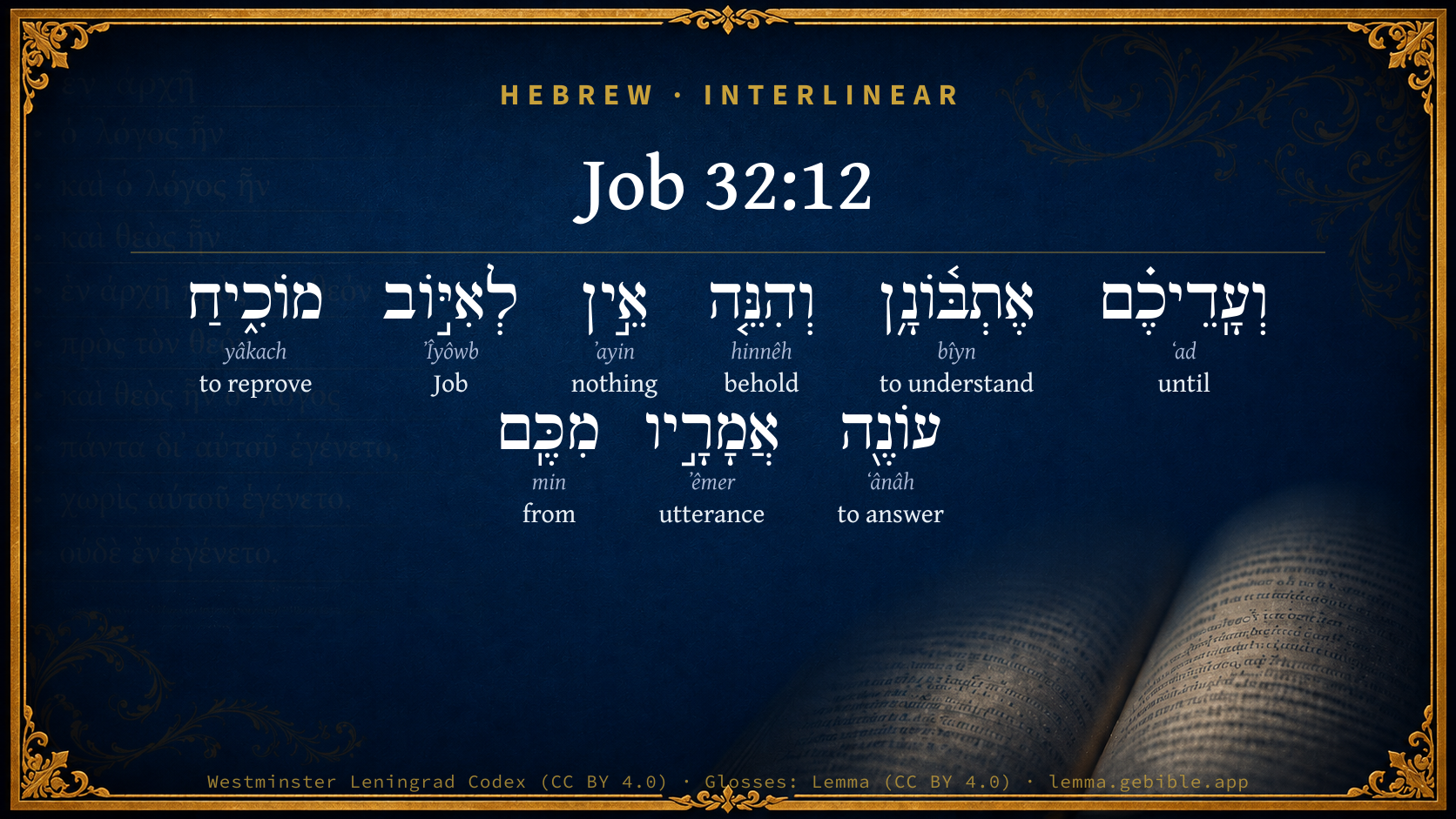
Hebrew (Westminster Leningrad Codex) Job 32:12 appears in the Hebrew Old Testament. The text above is from the Westminster Leningrad Codex. Each word links to its Strong’s number, a concise gloss, and parsing drawn from the Open Scriptures Hebrew Bible morphology. Click any word for its full Brown-Driver-Briggs (BDB) entry.
Download image
Cite this verse

Job 32:12 (World English Bible). Public Domain. Lemma interlinear Bible study tool, https://lemma.gebible.app/v/job/32/12.

Show BibTeX & RIS
BibTeX
RIS
English Translation
Yes, I gave you my full attention, But there was no one who convinced Job, Or who answered his words, among you.
World English Bible · Public Domain
Download a study sheet

One document with this verse’s original text, its word-by-word gloss line, the meaning frame, cross-references with their text, attributed commentary, and full source and license credits — printable, and it pastes into notes with its structure intact.

This verse Autodidact and up

Study sheet (.html) Plain text (.txt)

A passage Seminary Student

Up to 50 verses in one chapter. A passage sheet keeps up to 6 commentary sources and 12 cross-references per verse, in the order this page ranks them, and says so on the sheet whenever that leaves anything out. Ask for a single verse and you get the Autodidact verse sheet above.

Everything on this page stays free to read, with no account — the sheet is a download of what is already on screen, not access to it.

Want to remove ads? Support Godless Engineer
Compare translations 3

The same verse in 3 English versions, stacked beneath the original-language interlinear above. Click any original word for its lexicon entry.

Each is an independent rendering of the whole verse — the interlinear is not word-aligned to these translations.

Highlighted words mark where these versions differ — a whole-verse word diff, not a word-by-word alignment.

  • World English Bible Public Domain
    Yes, I gave you my full attention, But there was no one who convinced Job, Or who answered his words, among you.
  • King James Version Public Domain
    Yea, I attended unto you, and, behold, there was none of you that convinced Job, or that answered his words:
  • unfoldingWord Literal Text CC BY-SA 4.0
    Indeed, I paid attention to you, but behold, there was no one proving Job wrong, of you answering his words,

unfoldingWord Literal Text — © unfoldingWord, licensed CC BY-SA 4.0. Word-aligned USFM3 via Door43 (git.door43.org/unfoldingWord/en_ult).

Versions to compare (up to 4)

3 of 4 selected

Show all 18 translations

Every available English version of this verse, each an independent rendering of the whole verse.

  • World English Bible Public Domain
    Yes, I gave you my full attention, But there was no one who convinced Job, Or who answered his words, among you.
  • Berean Standard Bible Public Domain
    I paid you full attention. But no one proved Job wrong; not one of you rebutted his arguments.
  • Majority Standard Bible Public Domain
    I paid you full attention. But no one proved Job wrong; not one of you rebutted his arguments.
  • King James Version Public Domain
    Yea, I attended unto you, and, behold, there was none of you that convinced Job, or that answered his words:
  • American Standard Version (1901) Public Domain
    Yea, I attended unto you, And, behold, there was none that convinced Job, Or that answered his words, among you.
  • Revised Version (1885) Public Domain
    Yea, I attended unto you, and, behold, there was none that convinced Job, or that answered his words, among you.
  • Geneva Bible (1599) Public Domain
    Yea, when I had considered you, lo, there was none of you that reproued Iob, nor answered his wordes:
  • Douay-Rheims (1899) Public Domain
    And as long as I thought you said some thing, I considered: but, as I see, there is none of you that can convince Job, and answer his words.
  • Young's Literal Translation Public Domain
    And unto you I attend, And lo, there is no reasoner for Job, `Or' answerer of his sayings among you.
  • Literal Standard Version CC BY-SA 4.0
    And to you I attend, || And behold, there is no reasoner for Job, || [Or] answerer of his sayings among you.
  • Unlocked Literal Bible CC BY-SA 4.0
    Indeed, I paid attention to you, but, see, there was not one of you who could convince Job or who could respond to his words.
  • unfoldingWord Literal Text CC BY-SA 4.0
    Indeed, I paid attention to you, but behold, there was no one proving Job wrong, of you answering his words,
  • Darby Bible Public Domain
    Yea, I gave you mine attention, and behold, there was none of you that confuted Job, that answered his words;
  • World Messianic Bible Public Domain
    Yes, I gave you my full attention, but there was no one who convinced Job, or who answered his words, among you.
  • Webster's Bible Public Domain
    Yes, I attended to you, and behold, there was none of you that convinced Job, or that answered his words:
  • Free Bible Version CC BY-SA 4.0
    I paid close attention to all of you, and none of you have proved Job wrong or answered his arguments.
  • Bible in Basic English Public Domain
    I was taking note; and truly not one of you was able to make clear Job's error, or to give an answer to his words.
  • JPS Tanakh (1917) Public Domain
    Yea, I attended unto you, and, behold, there was none that convinced Job, or that answered his words, among you.

Literal Standard Version (2020), Covenant Press — licensed CC BY-SA 4.0. Text via the HelloAO Bible API (eBible.org). Unlocked Literal Bible (unfoldingWord) — licensed CC BY-SA 4.0. Text via the HelloAO Bible API (eBible.org). unfoldingWord Literal Text — © unfoldingWord, licensed CC BY-SA 4.0. Word-aligned USFM3 via Door43 (git.door43.org/unfoldingWord/en_ult). Free Bible Version, Dr. Jonathan Gallagher — licensed CC BY-SA 4.0. Text via the HelloAO Bible API (eBible.org).

Word by word

More ways to search: Search by grammar → Find every occurrence → Compare this word →

Practice this passage: Drill this verse → Learn its vocabulary →

About this verse

These counts appear in no published source. They are computed here, from the morphology-tagged text and Lemma’s own curated glosses. What Lemma adds →

9
words
9
distinct lemmas
Wisdom
section

Shared distinctive vocabulary

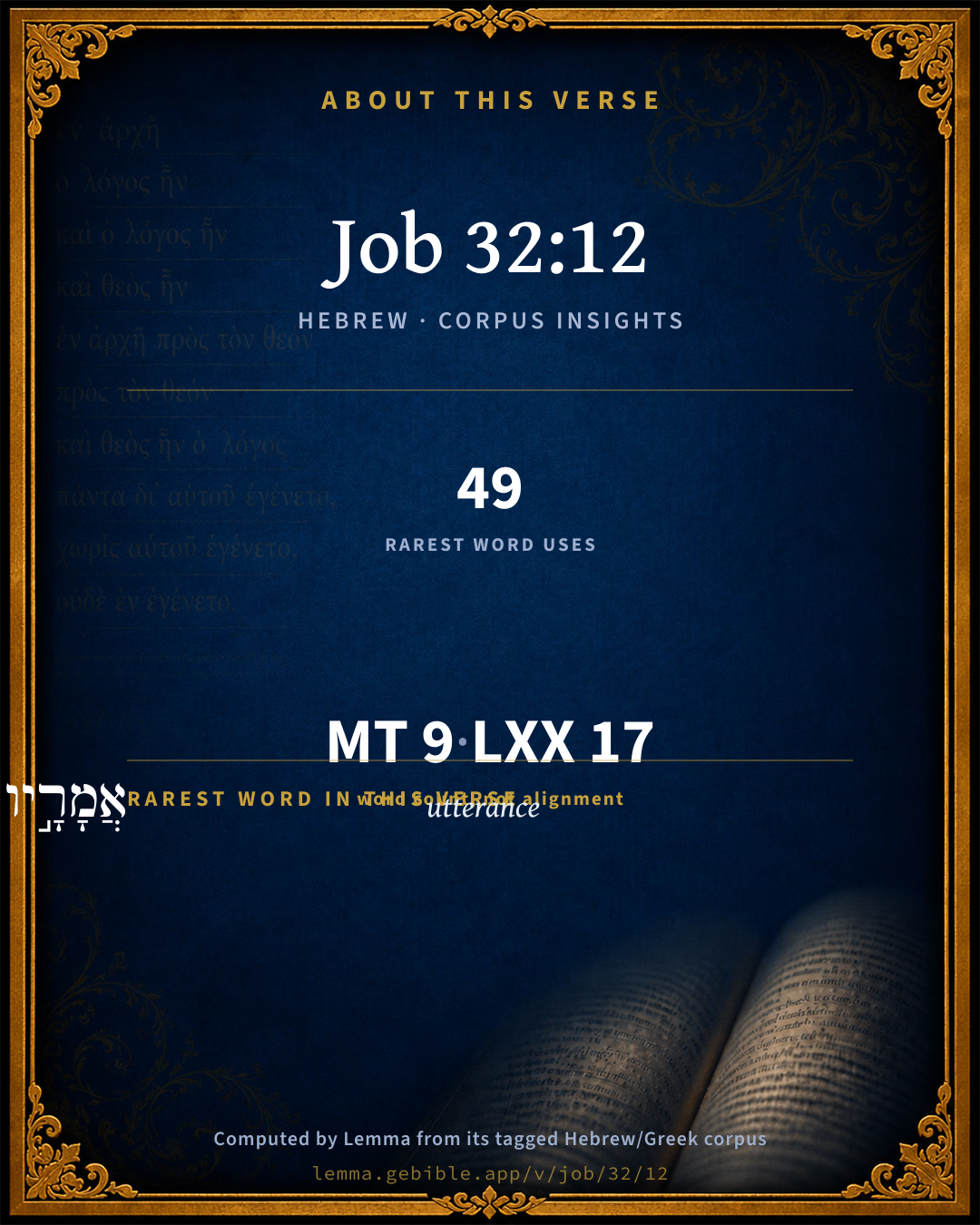
אֲמָרָ֣יו utterance H561 occurs in 47 verses of the Hebrew Bible. Also found in:

Grammatical profile

  • 3 verbs
  • 2 nouns
  • 2 prepositions
  • 2 particles

Verb forms

  • אֶתְבּ֫וֹנָ֥ן Hithpolel · Imperfect
  • מוֹכִ֑יחַ Hiphil · Participle Active
  • עוֹנֶ֖ה Qal · Participle Active

Hebrew & Septuagint length

In English translation the verse runs 22 words from the Hebrew and 23 from the Septuagint (LXX English) — closely comparable.

A rough comparison of the two English renderings, which tokenize alike — not a word-level alignment.

Word counts can differ between the Hebrew and the Greek without any difference in meaning — e.g. the Hebrew direct-object marker אֵת has no separate Greek word, and Greek often adds the article ὁ.

In the original languages it is 9 Hebrew tokens and 17 Greek tokens — but the two are counted differently (Hebrew bundles its prefixes and suffixes into one token; the Greek is in lemma form), so that isn’t a like-for-like length.

Cross-references

2

Topical passages linked to Job 32:12 in the Treasury of Scripture Knowledge — connected by theme and wording, ordered by reader-vote popularity; previews shown in the World English Bible.

  • Job 32:3 Also his wrath was kindled against his three friends, because they had found no answer, and yet had condemned Job.
  • 1 Timothy 1:7 desiring to be teachers of the law, though they understand neither what they say, nor about what they strongly affirm.

Cross-references courtesy of OpenBible.info (CC BY 4.0).

Hebrew and Greek witnesses Masoretic Hebrew ↔ Greek Septuagint

The same verse in the two great witnesses to the Old Testament, shown verse-for-verse.

These are two independent witnesses, not word-aligned to each other, and the Septuagint is shown in lemma (dictionary) form.

Hebrew Job 32:12 Masoretic · Westminster Leningrad Codex

וְעָֽדֵיכֶ֗ם אֶתְבּ֫וֹנָ֥ן וְהִנֵּ֤ה אֵ֣ין לְאִיּ֣וֹב מוֹכִ֑יחַ עוֹנֶ֖ה אֲמָרָ֣יו מִכֶּֽם

Yes, I gave you my full attention, But there was no one who convinced Job, Or who answered his words, among you.

World English Bible · Public Domain

Greek LXX Job 32:12 Septuagint · lemma form

καί μέχρι σύ συνἵημι καί ἰδού οὐ εἰμί ὁ ιωβ ἐλέγχω ἀντι ἀποκρίνω ῥῆμα αὐτός ἐκ σύ

and I shall understand as far as you; and, behold, there was no one of you that answered Job his words in argument,

LXX2012 (modern English Septuagint) · Public Domain

On this verse, Adam Clarke's Commentary discusses the Septuagint’s reading. Read the note in Commentary ↓

Hebrew: Westminster Leningrad Codex (CC BY 4.0). Greek: Septuagint (public domain); English from LXX2012 (modern English Septuagint) (Public Domain). How the Septuagint differs from the Hebrew →

Commentary

Notes on Job 32:12 from classic Christian and Jewish commentators (each source and its license shown beneath its notes). The classic Christian expositions comment on the surrounding passage and are grouped to its opening verse, so a note may address several verses; the Jewish commentaries on the Tanakh (Rashi and others) are per-verse, so they appear only where the commentator wrote on this verse.

Lemma curates 59 commentaries, every one of them public domain or Creative Commons licensed, each selected and text-cleaned for this edition rather than reprinted as found. About our sources →

Trapp's Complete Commentary

John Trapp

Job 32:12 Yea, I attended unto you, and, behold, [there was] none of you that convinced Job, [or] that answered his words:

Ver. 12. Yea, I attended unto you] Et usque ad yes perpendebam, I throughly weighed your words, and rightly considered them (as our Mr Bradshaw was wont to do at the ministers’ meetings, and was therehence called the weighing divine), that you may not think I answer the matter before I understand it, as fools do, to their shame, 2Pe 2:12, daring to reprehend what I do not comprehend, as did that Popish expositor, who calleth Ezekiel’s description of the temple insulsam descriptionem, an absurd description (Sanctius in cap. 40, Ezek. in argum.).

And, behold, there was none of you that convinced Job, or that answered his words] And yet they thought they had done both effectually; and that it was merely his stubbornness to stand out against them. Ready they were to give him up for uncounsellable; and to turn him over to God with a non convertetur, he is past our cure, we can do no good on him; none but God can put him out of his good conceit of himself, &c. Out of all this a good interpreter maketh these following conclusions: 1. That we must diligently hear and weigh what things are spoken by others before we proceed to censure them. 2. That we must not pass a censure upon any one part of a speech, but take it all together, ere we make judgment of it. 3. That when we have weighed everything well and wisely, we must not countenance any error, but freely utter what we do truly and rightly think of it. 4. That we may think things sufficiently refuted by the learned which yet had need to be further inquired into. 5. That one younger man may see further sometimes into a matter than many others of longer standing and experience. 6. That men may be esteemed obstinate and opinionated who are nothing less. 7. That multitude and antiquity are but ciphers in divinity, &c.

John Trapp, A Commentary or Exposition upon All the Books of the Old and New Testament (1647–1656) — public domain. Text from a community e-Sword module.

Joseph Benson's Commentary

Job 32:12-13. Yea, I attended unto you — I have duly considered all you have said; and behold, none of you convinced Job — I must pronounce you have not confuted him, nor advanced any thing to the purpose in answer to his defence of himself. Lest you should say, We have found out wisdom — God has thus left you to your own weakness and mistakes, and shown you your inability to convince him, or even to make good your own arguments by answering his objections, lest you should glory in your own wisdom; lest you should boastingly say, We have discovered and said all that need or can be said in the cause, and what may finally end the controversy; we have said, God thrusteth him down, not man, and by his dreadful judgments upon him, shows him to be a hypocrite, and to be guilty of some gross, though secret sins. Or, as the Hebrew, אל ידפנו, eel jiddepennu, may be properly rendered, God must, or will, confute him, not man; “God only can sift him to the bottom, and know whether his pretences to piety have any thing real in them, or are only hypocritical.” But, says Elihu, this argument does not satisfy me, and therefore bear with me if I seek for a better.

Joseph Benson's Commentary on the Old and New Testaments (1811–1818) — public domain. Text from a community e-Sword module.

Adam Clarke's Commentary

Verse 12. Yea, I attended unto you] Instead of ועדיכם veadeychem, and unto you, one MS. reads the above letters with points that cause it to signify and your testimonies; which is the reading of the Syriac, Arabic, and Septuagint.

Behold, there was none of you that convinced Job] Confuted Job. They spoke multitudes of words, but were unable to overthrow his arguments.

Adam Clarke's Commentary on the Bible (1810–1826) — public domain. Text from a community e-Sword/MySword module.

Ellicott's Commentary for English Readers

(12) There was none of you.—In Elihu’s judgment there was no one who touched the main point of the argument with Job.

A Bible Commentary for English Readers, edited by Charles John Ellicott (1878–1897) — public domain. Text from a community e-Sword module.

John Gill's Exposition

Yea, I attended unto you,.... Very closely, with great application and diligence, endeavouring to get, as it were, within them, and thoroughly understand the meaning of what they said:

and, behold, there was none of you that convinced Job; which was not owing to his obstinacy, but to want of proof in them, their words and arguments; they had charged Job highly, as particularly Eliphaz, Job 22:5; but then they failed in their proof; they produced nothing to support their allegations:

or that answered his words; the arguments and reasons he gave in proof of his own innocence and uprightness, or the instances he produced, showing that God often afflicted good men, and suffered the wicked to prosper; and therefore no argument could be drawn from God's dealings with men, proving they were either of this or the other character, good or bad men.

John Gill's Exposition of the Whole Bible (1746–1763) — public domain (CC PDM 1.0). Text via the HelloAO Bible API.

Albert Barnes' Notes on the Bible

There was none of you that convinced Job - There was no one to produce conviction on his mind, or rather, there was no one to reprove him by answering him - ענה מוכיח môkiyach ‛ânâh. They were completely silenced: and had nothing to reply to the arguments which he had advanced, and to his reflections on the divine government.

Albert Barnes' Notes on the Bible (1834–1885) — public domain. Text from a community e-Sword/MySword module.

Haydock's Catholic Bible Commentary

None. A notorious piece of arrogance, to esteem himself wiser than any of his own sect, or of his adversaries. (Worthington)

George Leo Haydock (1774–1849), Haydock's Catholic Family Bible and Commentary, 1859 edition — public domain. Excludes Psalms (Douay-Rheims chapter numbering differs from Protestant) and Deuterocanonical books (Catholic canon only).

Matthew Poole's English Annotations

By solid and satisfactory answers to his assertions and allegations.

Matthew Poole's English Annotations on the Holy Bible (1683–1685) — public domain. Text from a community e-Sword/MySword module.

The Pulpit Commentary

Yea, I attended unto you or, lent you my attention and, behold, there was none of you that convinced Job; rather, that convicted (or, confuted) Job. Or that answered his words. In Elihu"s opinion, the argumentative value of all the long speeches of the three friends was nil; they had entirely failed to answer Job"s arguments.

The Pulpit Commentary (1880–1919), ed. H.D.M. Spence-Jones & Joseph S. Exell — public domain. Text from a community e-Sword module.

John Wesley's Explanatory Notes

Convinced - By solid and satisfactory answers.

John Wesley, Explanatory Notes Upon the Whole Bible (1754–1765) — public domain. Text via the GEBible commentary corpus.

Rashi

Rabbi Shlomo Yitzchaki (Rashi)

Yea, I attended to you I attended to you, and I saw that there is no one to convince Job.

Rashi on the Tanakh — English translations: “The Judaica Press complete Tanach with Rashi, translated by A. J. Rosenberg” (CC BY 4.0); “Pentateuch with Rashi's commentary by M. Rosenbaum and A.M. Silbermann, 1929-1934” (public domain); “The Metsudah Tanach series, Lakewood, N.J” (CC BY 4.0); and “The Book of Joshua, Metsudah Publications, 1997” (CC BY 4.0). Text via Sefaria.

Lesson kit

Teaching starters — assembled from the data on this page, not authored interpretation. Every prompt links to the verse data it draws on. Edit before teaching.

Job, in the Wisdom, opens this verse with 9 words (9 distinct Hebrew lemmas). Its most distinctive word is ʼêmer (“utterance”). A historical commentator’s framing appears above. Read the whole chapter for the surrounding context.

Discussion questions

  1. What does “utterance” (ʼêmer) contribute to the verse as a whole?
  2. How does Genesis 49:21, which shares the word «utterance», read alongside this verse?
  3. These translations render this verse differently. What is at stake in choosing one wording over another?
  4. «אֶתְבּ֫וֹנָ֥ן» is a Hithpolel Imperfect verb. How does that grammatical form shape the action described?
  5. Compare how Trapp's Complete Commentary and Joseph Benson's Commentary read this verse. Where do they agree or differ?

Things to notice

Reading settings

Reading text

Shown beneath each verse's original-language words.

Old Testament
Old Testament edition

Read the OT as the Masoretic Hebrew (MT) or the Greek Septuagint (LXX).

English shown for the Greek Septuagint (in the Hebrew ↔ Greek comparison).

Comparing translations? Open the Compare panel on any verse page to stack up to four side by side.