Jeremiah 9:17

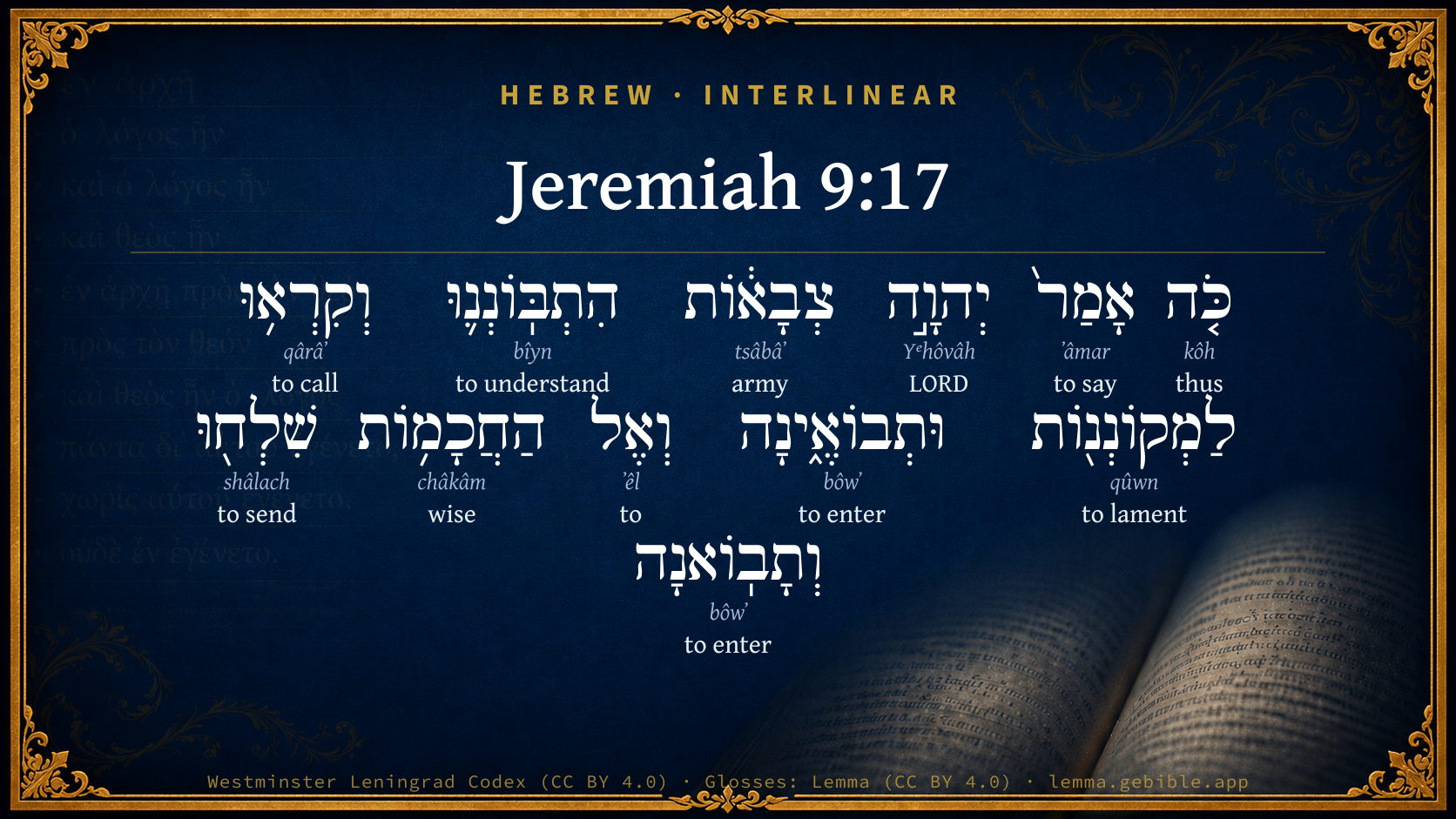
Hebrew (Westminster Leningrad Codex) Jeremiah 9:17 appears in the Hebrew Old Testament. The text above is from the Westminster Leningrad Codex. Each word links to its Strong’s number, a concise gloss, and parsing drawn from the Open Scriptures Hebrew Bible morphology. Click any word for its full Brown-Driver-Briggs (BDB) entry.
Download image
Cite this verse

Jeremiah 9:17 (World English Bible). Public Domain. Lemma interlinear Bible study tool, https://lemma.gebible.app/v/jeremiah/9/17.

Show BibTeX & RIS
BibTeX
RIS
English Translation
Thus says Yahweh of Hosts, Consider you, and call for the mourning women, that they may come; and send for the skillful women, that they may come:
World English Bible · Public Domain
Download a study sheet

One document with this verse’s original text, its word-by-word gloss line, the meaning frame, cross-references with their text, attributed commentary, and full source and license credits — printable, and it pastes into notes with its structure intact.

This verse Autodidact and up

Study sheet (.html) Plain text (.txt)

A passage Seminary Student

Up to 50 verses in one chapter. A passage sheet keeps up to 6 commentary sources and 12 cross-references per verse, in the order this page ranks them, and says so on the sheet whenever that leaves anything out. Ask for a single verse and you get the Autodidact verse sheet above.

Everything on this page stays free to read, with no account — the sheet is a download of what is already on screen, not access to it.

Want to remove ads? Support Godless Engineer
Compare translations 3

The same verse in 3 English versions, stacked beneath the original-language interlinear above. Click any original word for its lexicon entry.

Each is an independent rendering of the whole verse — the interlinear is not word-aligned to these translations.

Highlighted words mark where these versions differ — a whole-verse word diff, not a word-by-word alignment.

  • World English Bible Public Domain
    Thus says Yahweh of Hosts, Consider you, and call for the mourning women, that they may come; and send for the skillful women, that they may come:
  • King James Version Public Domain
    Thus saith the LORD of hosts, Consider ye, and call for the mourning women, that they may come; and send for cunning women, that they may come:
  • unfoldingWord Literal Text CC BY-SA 4.0
    Thus says Yahweh of hosts, “Think about this, and call for the ones who chant laments that they may come, and send for those who are skilled that they may come.

unfoldingWord Literal Text — © unfoldingWord, licensed CC BY-SA 4.0. Word-aligned USFM3 via Door43 (git.door43.org/unfoldingWord/en_ult).

Versions to compare (up to 4)

3 of 4 selected

Show all 18 translations

Every available English version of this verse, each an independent rendering of the whole verse.

  • World English Bible Public Domain
    Thus says Yahweh of Hosts, Consider you, and call for the mourning women, that they may come; and send for the skillful women, that they may come:
  • Berean Standard Bible Public Domain
    This is what the LORD of Hosts says: “Take note, and summon the wailing women; send for the most skillful among them.
  • Majority Standard Bible Public Domain
    This is what the LORD of Hosts says: “Take note, and summon the wailing women; send for the most skillful among them.
  • King James Version Public Domain
    Thus saith the LORD of hosts, Consider ye, and call for the mourning women, that they may come; and send for cunning women, that they may come:
  • American Standard Version (1901) Public Domain
    Thus saith Jehovah of hosts, Consider ye, and call for the mourning women, that they may come; and send for the skilful women, that they may come:
  • Revised Version (1885) Public Domain
    Thus saith the LORD of hosts, Consider ye, and call for the mourning women, that they may come; and send for the cunning women, that they may come:
  • Geneva Bible (1599) Public Domain
    Thus sayeth the Lord of hostes, Take heede, and call for the mourning women, that they may come, and send for skilfull women that they may come,
  • Douay-Rheims (1899) Public Domain
    Thus saith the Lord of hosts the God of Israel: Consider ye, and call for the mourning women, and let them come: and send to them that are wise women, and let them make haste:
  • Young's Literal Translation Public Domain
    Thus said Jehovah of Hosts: Consider ye, and call for mourning women, And they come, And to the wise women send, and they come,
  • Literal Standard Version CC BY-SA 4.0
    Thus said YHWH of Hosts: “Consider, and call for mourning women, || And they come, || And send to the wise women, || And they come,
  • Unlocked Literal Bible CC BY-SA 4.0
    Yahweh of hosts says this, “Think about this: Summon funeral singers; let them come. Send out for women skilled at lamenting; let them come.
  • unfoldingWord Literal Text CC BY-SA 4.0
    Thus says Yahweh of hosts, “Think about this, and call for the ones who chant laments that they may come, and send for those who are skilled that they may come.
  • Darby Bible Public Domain
    Thus saith Jehovah of hosts: Consider, and call for the mourning women, that they may come, and send for the skilful women, that they may come;
  • World Messianic Bible Public Domain
    The LORD of Hosts says, “Consider, and call for the mourning women, that they may come. Send for the skillful women, that they may come.
  • Webster's Bible Public Domain
    Thus saith the LORD of hosts, Consider ye, and call for the mourning women, that they may come; and send for skillful women, that they may come:
  • Free Bible Version CC BY-SA 4.0
    This is what the Lord Almighty says: Be aware of what's happening! Call for the professional women mourners, ask for the best of them.
  • Bible in Basic English Public Domain
    This is what the Lord of armies has said: Take thought and send for the weeping women, so that they may come; and send for the wise women, so that they may come:
  • JPS Tanakh (1917) Public Domain
    (9-16) Thus saith the LORD of hosts: Consider ye, and call for the mourning women, that they may come; and send for the wise women, that they may come;

Literal Standard Version (2020), Covenant Press — licensed CC BY-SA 4.0. Text via the HelloAO Bible API (eBible.org). Unlocked Literal Bible (unfoldingWord) — licensed CC BY-SA 4.0. Text via the HelloAO Bible API (eBible.org). unfoldingWord Literal Text — © unfoldingWord, licensed CC BY-SA 4.0. Word-aligned USFM3 via Door43 (git.door43.org/unfoldingWord/en_ult). Free Bible Version, Dr. Jonathan Gallagher — licensed CC BY-SA 4.0. Text via the HelloAO Bible API (eBible.org).

Word by word

More ways to search: Search by grammar → Find every occurrence → Compare this word →

Practice this passage: Drill this verse → Learn its vocabulary →

לַמְקוֹנְנ֖וֹת
qûwn
H6969
“to/for the · lamenting”
Preposition, Determined + Verb, Polel, Participle Active, Feminine, Plural, Absolute
Part of Speech
Preposition + Verb
Stem
Polel
Form
Participle Active
Gender
Feminine
Number
Plural
State
Absolute
Full BDB Definition

Origin: a primitive root

TWOT: 2018

to chant a dirge, chant, wail, lament - (Polel) to lament
  1. כֹּ֤ה kôh H3541 “thus” Adverb
  2. אָמַר֙ ʼâmar H559 “to say” Verb, Qal, Perfect, 3rd Person, Masculine, Singular
  3. יְהוָ֣ה Yᵉhôvâh H3068 “LORD” Noun, Proper
  4. צְבָא֔וֹת tsâbâʼ H6635 “armies” Noun, Common, Both, Plural, Absolute
  5. הִתְבּֽוֹנְנ֛וּ bîyn H995 “understand” Verb, Hithpolel, Imperative, 2nd Person, Masculine, Plural
  6. וְקִרְא֥וּ qârâʼ H7121 “and · call” Conjunction + Verb, Qal, Imperative, 2nd Person, Masculine, Plural
  7. וּתְבוֹאֶ֑ינָה bôwʼ H935 “and · to enter” Conjunction + Verb, Qal, Imperfect, 3rd Person, Feminine, Plural
  8. וְאֶל ʼêl H413 “and · to” Conjunction + Preposition
  9. הַחֲכָמ֥וֹת châkâm H2450 “the · wise” Particle, Definite Article + Adjective, Adjective, Feminine, Plural, Absolute
  10. שִׁלְח֖וּ shâlach H7971 “send” Verb, Qal, Imperative, 2nd Person, Masculine, Plural
  11. וְתָבֽוֹאנָה bôwʼ H935 “and · to enter” Conjunction + Verb, Qal, Imperfect, 3rd Person, Feminine, Plural

About this verse

These counts appear in no published source. They are computed here, from the morphology-tagged text and Lemma’s own curated glosses. What Lemma adds →

12
words
11
distinct lemmas
Prophets
section

Notable vocabulary

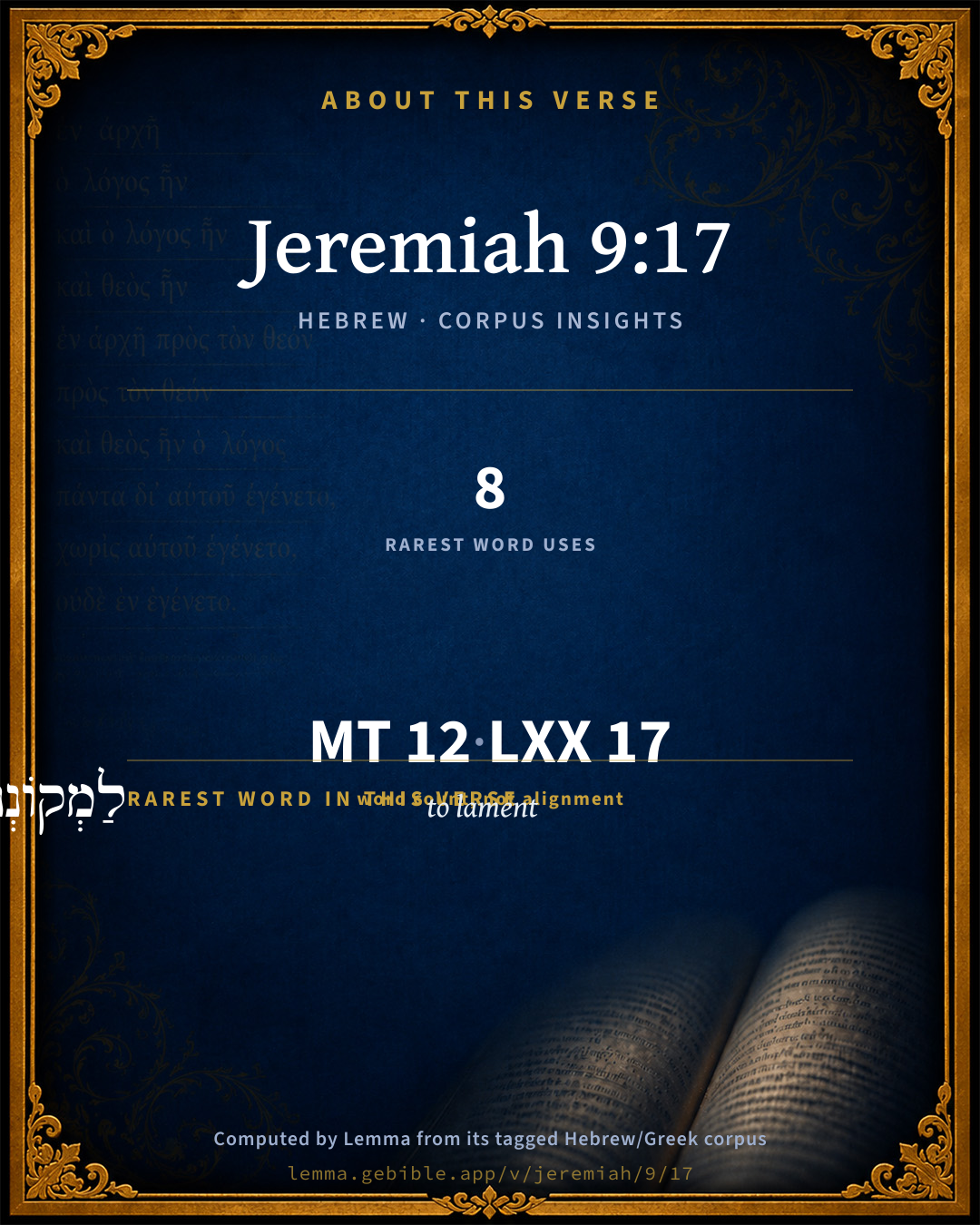
The rarest word here is לַמְקוֹנְנ֖וֹת to lament H6969 — appearing just 8 times in the whole Hebrew Bible.

Shared distinctive vocabulary

לַמְקוֹנְנ֖וֹת to lament H6969 occurs in 6 verses of the Hebrew Bible. Also found in:

Grammatical profile

  • 7 verbs
  • 2 nouns
  • 1 adjective
  • 1 preposition
  • 1 adverb

Verb forms

  • אָמַר֙ Qal · Perfect
  • הִתְבּֽוֹנְנ֛וּ Hithpolel · Imperative
  • וְקִרְא֥וּ Qal · Imperative
  • לַמְקוֹנְנ֖וֹת Polel · Participle Active
  • וּתְבוֹאֶ֑ינָה Qal · Imperfect
  • שִׁלְח֖וּ Qal · Imperative
  • וְתָבֽוֹאנָה Qal · Imperfect

Repetition

A word recurs within this verse — often emphatic in Hebrew:

  • וּתְבוֹאֶ֑ינָה to enter H935 ×2

Hebrew & Septuagint length

In the original languages it is 12 Hebrew tokens and 17 Greek tokens — but the two are counted differently (Hebrew bundles its prefixes and suffixes into one token; the Greek is in lemma form), so that isn’t a like-for-like length.

Cross-references

6

Topical passages linked to Jeremiah 9:17 in the Treasury of Scripture Knowledge — connected by theme and wording, ordered by reader-vote popularity; previews shown in the World English Bible.

  • Amos 5:16–17 Therefore thus says Yahweh, the God of hosts, the Lord: "Wailing will be in all the broad ways; And they will say in all the streets, 'Alas! Alas!' And they will call the farmer to mourning, And those who are skillful in lamentation to wailing.
  • Ecclesiastes 12:5 Yes, they shall be afraid of heights, And terrors will be in the way; And the almond tree shall blossom, And the grasshopper shall be a burden, And desire shall fail; Because man goes to his everlasting home, And the mourners go about the streets:
  • 2 Chronicles 35:25 Jeremiah lamented for Josiah: and all the singing men and singing women spoke of Josiah in their lamentations to this day; and they made them an ordinance in Israel: and, behold, they are written in the lamentations.
  • Job 3:8 Let them curse it who curse the day, Who are ready to rouse up leviathan.
  • Matthew 9:23 When Jesus came into the ruler's house, and saw the flute players, and the crowd in noisy disorder,
  • Mark 5:38 He came to the synagogue ruler's house, and he saw an uproar, weeping, and great wailing.

Cross-references courtesy of OpenBible.info (CC BY 4.0).

Hebrew and Greek witnesses Masoretic Hebrew ↔ Greek Septuagint

The same verse in the two great witnesses to the Old Testament, shown verse-for-verse.

These are two independent witnesses, not word-aligned to each other, and the Septuagint is shown in lemma (dictionary) form.

Hebrew Jeremiah 9:17 Masoretic · Westminster Leningrad Codex

כֹּ֤ה אָמַר֙ יְהוָ֣ה צְבָא֔וֹת הִתְבּֽוֹנְנ֛וּ וְקִרְא֥וּ לַמְקוֹנְנ֖וֹת וּתְבוֹאֶ֑ינָה וְאֶל הַחֲכָמ֥וֹת שִׁלְח֖וּ וְתָבֽוֹאנָה

Thus says Yahweh of Hosts, Consider you, and call for the mourning women, that they may come; and send for the skillful women, that they may come:

World English Bible · Public Domain

Greek LXX Structure differs

In the Septuagint, Jeremiah is about an eighth shorter than the Hebrew and arranges its material differently — the Oracles Against the Nations (Hebrew chapters 46–51) appear in the middle of the Greek book, after 25:13. Because the chapter and verse boundaries do not line up, a verse-for-verse comparison with the Hebrew is not shown.

A verse-for-verse comparison isn’t shown here because the chapters and verses don’t line up. Switch to the LXX edition with the MT / LXX toggle above to read the Greek directly.

Hebrew: Westminster Leningrad Codex (CC BY 4.0). Greek: Septuagint (public domain); English from a public-domain English Septuagint. How the Septuagint differs from the Hebrew →

Targum (Aramaic paraphrase)

1

The Targum is the ancient Jewish Aramaic paraphrase of the Hebrew Scriptures — an interpretive translation, not the Hebrew text itself. Onkelos (literal) and Pseudo-Jonathan (expansive) render the Torah, and Jonathan the Prophets. Coverage is partial: where no permissively-licensed English translation exists for a verse, only the Aramaic is shown. This is verse-level text, not a word-by-word alignment to the Hebrew.

  1. Targum Jonathan Prophets (Joshua–Malachi)
    וְיוֹחֲיָן וְיִטְלַן עֲלָנָא אֶלְיָא וִישַׁגְרַן עֵינָנָא דִמְעִין וְגַלְגַלֵי עֵינָנָא יִגְרוּן מַיָא:

    (no public-domain English translation for this verse)

    Targum Jonathan — Aramaic: “Mikraot Gedolot” (public domain). English: “Sefaria Community Translation” (CC0 1.0 (public-domain dedication)); “London "Chaldee Paraphrase," 1871” (public domain). Text via Sefaria.

Commentary

Notes on Jeremiah 9:17 from classic Christian and Jewish commentators (each source and its license shown beneath its notes). The classic Christian expositions comment on the surrounding passage and are grouped to its opening verse, so a note may address several verses; the Jewish commentaries on the Tanakh (Rashi and others) are per-verse, so they appear only where the commentator wrote on this verse.

Lemma curates 59 commentaries, every one of them public domain or Creative Commons licensed, each selected and text-cleaned for this edition rather than reprinted as found. About our sources →

Trapp's Complete Commentary

John Trapp

Jer 9:17 Thus saith the LORD of hosts, Consider ye, and call for the mourning women, that they may come; and send for cunning [women], that they may come:

Ver. 17. Consider ye.] Intelligentes estote. Is not your hard heartedness such as that ye need such a help to do that wherein you should be forward and free hearted? The Hollanders and French fast, saith one, {a} but, without exprobration be it spoken, they had need to send for mourning women, that by their cunning they may be taught to mourn.

And call for the mourning women.] In planetum et omne pathos faciles, {b} such as could make exquisite lamentation, and cunningly act the part of mourners at funerals, so as to wring tears from the beholders. These the Latins called Praeficas, quia luctui praeficiebantur, because they had the chief hand in funeral mournings; for the better carrying on whereof they both sang doleful ditties, {see 2Ch 35:25} and played on certain heavily sounding instruments, {Mat 9:23} whence the poet -

“ Cantabit maestis tibia funeribus. ” - Ovid.

“He will play with the pipe by a gloomy funeral.”

{a} Spec. Bel. Sac., 209.

{b} Ut flerent oculos erudiere suos. - Ovid.

John Trapp, A Commentary or Exposition upon All the Books of the Old and New Testament (1647–1656) — public domain. Text from a community e-Sword module.

Joseph Benson's Commentary

Jer 9:17. Consider ye, and call for the mourning women — Consider the evil circumstances you are in, which call for mourning and lamentation: and since you yourselves are not sufficiently affected with the dangers that threaten you, send for those women whose profession it is to mourn at funerals, and upon other sorrowful occasions, and let their lamentations excite true sorrow in you. The prophet seems here to compare the Jewish state to a person dead, and going to be buried, and therefore calls upon the people to send for those who used to be hired to make lamentations and wailings at funerals. The reader will observe, “it was an ancient custom of the Hebrews, at funerals, and on other like occasions, to make use of hired mourners, whose profession it was to exhibit in public all the signs and gestures of immoderate and frantic grief, and by their loud outcries and doleful songs to excite a real passion of sorrow in others. Women were generally employed in this office, either because it was an office more suitable to the softness of a female mind, or because the more tender passions being predominant in that sex, they succeeded better in their parts; nor were there ever wanting those artists well instructed in the discipline of mourning, and ready to hire out their lamentations and tears on any emergency. It was the chief excellence of other arts to imitate nature; it was likewise esteemed so in this; their funeral dirges, therefore, were composed in imitation of those which had been poured forth by genuine and sincere grief. Their sentences were short, querulous, pathetic, simple, and unadorned; somewhat laboured indeed, because they were composed in metre, and to be sung to the pipe, as we learn from Mat 9:23; and from Homer,” where, speaking of Hector’s funeral, he says, — — Παρα δ’ εισαν αοιδους,

Θρηνων εξαρχους, οιτε σονοεσσαν αοιδην,

Οι μεν αρ’ εθρηνεον, επι δε σεναχοντο γυναικες. ILIAD, Ω. 720.

A melancholy choir attend around, With plaintive sighs, and music’s solemn sound; Alternately they sing, alternate flow Th’ obedient tears, melodious in their wo. See POPE’S IL., book 24. ver. 900.

Jerome tells us, in his comment on this verse, that the practice was continued in Judea down to his days; “That women, at funerals, with dishevelled hair, and naked breasts, endeavoured, in a modulated voice, to unite others in lamentation with them.” Frequent allusions to this custom are to be met with in Scripture, particularly 2Ch 35:25, where the singing men and singing women are said to have made it a constant rule, after King Josiah’s death, to commemorate that excellent prince in all their future dirges or lamentations, as one in whom the public in general had sustained an irreparable loss. Such were the mourners, mentioned Ecc 12:5, and said to go about the streets; and those whom Amos calls, יודעי נהי, skilful of lamentation; Amo 5:16. And such no doubt were the minstrels and the people making a noise; οχλον θορυβουμενον, whom our Saviour found in the house of the ruler of the synagogue, whose daughter was just dead; who, St. Mark says, wept and wailed greatly, κλαιοντας και αλαλαζοντας πολλα, Mar 5:38. There are especially several traces of this custom to be met with in the prophets, who frequently delivered their predictions of approaching calamities in the form of funeral dirges. The poem before us, from Jer 9:19-22, is both an illustration and confirmation of this, and worthy of the reader’s frequent perusal, on account of its affecting pathos, moral sentiments, and fine images; particularly in Jer 9:21, where death is described in as animated a prosopopœia as can be conceived. See Lowth’s Prelec., Calmet, and Blaney.

Joseph Benson's Commentary on the Old and New Testaments (1811–1818) — public domain. Text from a community e-Sword module.

Tyndale Open Study Notes

Tyndale Open Resources

9:17-26 This series of four short poems and a brief prose passage are messages from the Lord, presumably delivered to the people of Judah by Jeremiah. Three of the poems describe the effects of the Lord’s judgment on the people; the fourth poem is an exhortation. The prose section predicts doom on Judah and her neighboring nations.

9:17 The Lord commanded the people to organize the professional mourners; these individuals commonly performed at ancient Near Eastern funerals (see Amos 5:16; Mark 5:38).

Tyndale Open Study Notes — © Tyndale Open Resources, licensed CC BY-SA 4.0. Text via the HelloAO Bible API.

Geneva Bible (1599)

Geneva Bible translators

Seeing you cannot lament your own sins, call for those foolish women, whom of a superstition you have to lament for the dead, that they by their feigned tears may provoke you to some sorrow.

Geneva Bible (1599) marginal notes — public domain. Text via Bolls.life.

Jamieson, Fausset & Brown

Robert Jamieson, A. R. Fausset & David Brown

mourning women--hired to heighten lamentation by plaintive cries baring the breast, beating the arms, and suffering the hair to flow dishevelled (Ch2 35:25; Ecc 12:5; Mat 9:23).

cunning--skilled in wailing.

Jamieson, Fausset & Brown — Commentary Critical and Explanatory on the Whole Bible (1871) — public domain (CC PDM 1.0). Text via the HelloAO Bible API.

Adam Clarke's Commentary

Verse 17. Call for the mourning women] Those whose office it was to make lamentations at funerals, and to bewail the dead, for which they received pay. This custom continues to the present in Asiatic countries. In Ireland this custom also prevails, which no doubt their ancestors brought from the east. I have often witnessed it, and have given a specimen of this elsewhere. See the note on Mt 9:23. The first lamentations for the dead consisted only in the sudden bursts of inexpressible grief, like that of David over his son Absalom, 2Sa 19:4. But as men grew refined, it was not deemed sufficient for the surviving relatives to vent their sorrows in these natural, artless expressions of wo, but they endeavoured to join others as partners in their sorrows. This gave rise to the custom of hiring persons to weep at funerals, which the Phrygians and Greeks borrowed from the Hebrews. Women were generally employed on these occasions, because the tender passions being predominant in this sex, they succeeded better in their parts; and there were never wanting persons who would let out their services to hire on such occasions. Their lamentations were sung to the pipe as we learn from Mt 9:23. See the funeral ceremonies practiced at the burial of Hector, as described by Homer: -

Οἱ δ' επει εισαγαγον κλυτα δωματα, τον μεν επειτα

Τρητοις εν λεχεεσσι θεσαν, παρα δ' εἱσαν αοιδους,

Θρηνων εξαρχους, οἱ τε στονοεσσαν αοιδην

Οἱ μεν αρ' εθρηνεον, επι δε στεναχοντο γυναικες.

IL. lib. xxiv., ver. 719.

"Arrived within the royal house, they stretched

The breathless Hector on a sumptuous bed,

And singers placed beside him, who should chant

The strain funereal; they with many a groan

The dirge began; and still at every close

The female train with many a groan replied."

COWPER.

St. Jerome tells us that even to his time this custom continued in Judea; that women at funerals, with dishevelled hair and naked breasts, endeavoured in a modulated voice to invite others to lament with them. The poem before us, from the seventeenth to the twenty-second verse, is both an illustration and confirmation of what has been delivered on this subject, and worthy of the reader's frequent perusal, on account of its affecting pathos, moral sentiments, and fine images, particularly in the twenty-first verse, where death is described in as animated a prosopopoeia as can be conceived. See Lowth's twenty-second Prelection, and Dodd. The nineteenth verse is supposed to be the funeral song of the women.

"How are we spoiled!

We are greatly confounded!

For we have forsaken the land;

Because they have destroyed our dwellings."

Adam Clarke's Commentary on the Bible (1810–1826) — public domain. Text from a community e-Sword/MySword module.

John Calvin's Commentaries

In this passage, as in many others, the Prophet endeavors by a striking representation really to touch the hearts of his people, for he saw that they were extremely refractory, insensible, and secure. Since then the threatenings of God were either wholly despised, or had not sufficiently moved the hearts of the people, it was necessary to set forth God’s judgments as present. Therefore the Prophet gives a striking description of what takes place in times of mourning. At the same time he seems to condemn indirectly the Jews for not knowing, through God’s word, that there was a calamity at hand: for God’s word ought indeed to be like a mirror, by which men ought to see God’s goodness in his promises and also his judgment in his threatenings. As then all prophecies were deemed as fables by the people, it was not without some degree of derision that he addressed them in this manner, —

Hearken ye, and call for mourners, that they may come An absurd and a foolish custom has prevailed almost in all ages to hire women as mourners, whom they called proeficoe; they were employed to mourn for others. Heirs no doubt hired these foolish women, in order to shew their reigned piety; they spoke in praise of the dead, and shewed how great a loss was their death. The Prophet does not commend this custom; and we ought to know that Scripture often takes similes from the vices of men, as from filth and dirt. If then any one concludes from these winds of Jeremiah, that lamentations at funerals are not to be condemned, this would be foolish and puerile. The Prophet, on the contrary, does here reprove the Jews, because they heedlessly disregarded all God’s threatenings, and were at the same time soft and tender at those foolish exhibitions, and all mourned at the sight of those women who were hired to lament; as the case is at this time, when a faithful teacher reprobates the prevailing folly of the Papists. For when the unprincipled men, who occupy the pulpits under the Papacy, speak with weeping, though they produce not a syllable from God’s word, but add some spectacle or phantom, by producing the image of the Cross or some like thing, they touch the feelings of the vulgar and cause weeping, according to what actors do on the stage. As then the Papists are seized as it were with an insane feeling, when their deceivers thus gesticulate, so a faithful teacher may say to them, “Let any one come and set before your eyes the image of a dead man, or say, that you must all shortly die and be like the earcase shewn to you, and ye will cry and weep; and yet ye will sot consider how dreadful God’s judgment is, which I declare to you: I shew to you faithfully from the law, from the prophets, and from the Gospel; how dreadful is God’s vengeance, and set before you what ye deserve; yet none of you are moved; but my doctrine is a mockery to you, and also my reproofs and threatenings: go then to your prophets, who shew you pictures and the like trumperies.” So the Prophet says now, “I see that I can do you no good; the Lord will therefore give you no teachers but women.” Of what sort? Even such, he says, as lament, or are hired to mourn.

We now then perceive why the Prophet speaks of hired women. Attend ye, he says; and why? They ought indeed to have been attentive to or to understand (for בן ben, means properly to understand, and in Hithpael it signifies to consider) his words; but as he saw that he was ridiculed or despised, and that all the threatenings which proceeded from God were esteemed as fables, he now says, “Consider ye and call for your lamenters: — as I see such perverseness in you, be taught at least by those women who are commonly invited to lament, and who sell their tears!” Send, he says, for the skilfu1, that they may come By these words he intended more clearly to express, that the calamity which the people feared not was not far distant.

John Calvin's Commentaries (1540-1563) — public domain. Text from the Calvin Translation Society English edition (1840s-50s) via the Christian Classics Ethereal Library (ccel.org). Calvin's coverage is partial (roughly two-thirds of the Bible); uncommented books and verses are honest gaps, never fabricated. The 19th-century editor's footnotes and remarks are omitted so the notes are faithfully Calvin's own voice.

Ellicott's Commentary for English Readers

(17) Mourning women . . . cunning women.—Eastern funerals were, and are, attended by mourners, chiefly women, hired for the purpose. Wailing was reduced to an art, and they who practised it were cunning. There are the “mourners” that “go about the streets” (Ecc_12:5), those that “are skilful of lamentation” (Amo_5:16), those that mourned for Jehoiakim (Jer_22:18), those that “wept and wailed greatly” in the house of Jairus (Mar_5:38). They are summoned as to the funeral, not of a friend or neighbour, but of the nation.

A Bible Commentary for English Readers, edited by Charles John Ellicott (1878–1897) — public domain. Text from a community e-Sword module.

The Cambridge Bible for Schools and Colleges

gen. ed. J. J. S. Perowne

17. cunning] i.e. skilled. Cp. Gen_25:27; 1Sa_16:18; 2Ch_26:15.

17, 18. “There are in every city and community women exceedingly cunning in this business.… When a fresh company of sympathisers comes in, these women ‘make haste’ to ‘take up a wailing’ that the newly come may the more easily unite their tears with the mourners. They know the domestic history of each person, and immediately strike up an impromptu lamentation, in which they introduce the names of their relations who have recently died, touching some tender chord in every heart.” Thomson, p. 103, and see Jer_16:5.

17–22. See summary introducing the section.

The Cambridge Bible for Schools and Colleges (gen. ed. J. J. S. Perowne; Cambridge University Press, 1878–1918) — public domain. Text from a community e-Sword module.

John Gill's Exposition

Thus saith the Lord of hosts, consider ye,.... The punishment that was just coming upon them, as Kimchi; or the words that the Lord was about to say unto them; as follows:

and call for the mourning women, that they may come; the same with the "praeficae" among the Romans; persons that were sent for, and hired by, the relations of the dead, to raise up their mourning; and who, by their dishevelled hair, naked breasts, and beatings thereon, and mournful voice, and what they said in their doleful ditties in praise of the dead, greatly moved upon the affections of the surviving relatives, and produced tears from them. This was a custom that early prevailed among the Jews, and long continued with them; and was so common, that, according to the Misnic doctors (c), the poorest man in Israel, when his wife died, never had less than two pipes, and one mourning woman; See Gill on Mat 9:23. Now, in order to show what a calamity was coming on them, and what mourning there would be, and what occasion for it; the Lord by the prophet, not as approving, but deriding the practice, bids them call for the mourning women to assist them in their lamentations:

and send for cunning women, that they may come; such as were expert in this business, and could mimic mourning well, and had the art of moving the affections with their voice and gestures.

(c) Miss. Cetubot, c. 4. sect. 4.

John Gill's Exposition of the Whole Bible (1746–1763) — public domain (CC PDM 1.0). Text via the HelloAO Bible API.

Haydock's Catholic Bible Commentary

Wise, in composing or singing the Nænia, or mournful songs, recording the praises of the deceased. (Calmet) --- "This custom still subsists in Judea: women go about with dishevelled hair and naked breasts, with mournful tunes, exciting all to tears." (St. Jerome) --- Music was also used, Matthew ix. 23. Thus feigned tears, at least, would supply the want of real ones.

George Leo Haydock (1774–1849), Haydock's Catholic Family Bible and Commentary, 1859 edition — public domain. Excludes Psalms (Douay-Rheims chapter numbering differs from Protestant) and Deuterocanonical books (Catholic canon only).

Matthew Poole's English Annotations

Consider ye; either in how sad a condition you are, what circumstances you are under; or rather, bethink yourselves what course to take: and therefore he puts them upon mourning and bewailing their condition, intimated by the following expression.

The mourning women; a sort of persons, and principally women, as more apt for passions in this kind, which they had among them, 2Ch 35:25; whose work it was, either to compose funeral elegies, or panegyrics in praise of the dead, and to act them in some mournful manner, as tearing their hair, and beating their breasts, with other mourning postures, or to sing them in some doleful tone, thereby artificially to provoke and excite both passions and expressions of grief in the friends of the deceased, rather wringing out tears than shedding them, in which probably they made greater seeming lamentations than those that did really mourn, as being most concerned; not that God calls upon them to do this as approving the formality, (though this foolish custom had obtained in most ages and countries,) any more than other customs that were made use of by way of illustration; as the Olympic games, and possibly that practice mentioned 1Co 15:29; but makes use of it, as being customary, either to excite them to and put them upon true repentance, or to convince them hereby that they were not able themselves sufficiently to bewail so great calamities as were coming upon them, intimating hereby that he would give them occasion for the most unfeigned weeping and lamentation.

Cunning women; such as are most skilful in it, Amo 5:16; wisdom being taken for skill in any arts, as Exo 31:3, and elsewhere.

Matthew Poole's English Annotations on the Holy Bible (1683–1685) — public domain. Text from a community e-Sword/MySword module.

Whedon's Commentary on the Bible

Daniel D. Whedon

17-20. Consider ye, and call — To heighten the poetical effect of this passage Jehovah calls for the mourning women; those women who among the Orientals are hired to make lamentation, because “skilled in the arts of woe,” and so here called cunning. (See Miss ROGER’S Domestic Life in Palestine. pp. 181-184. for a very vivid picture of these mourning ceremonies at the present time.) Here every impressive feature of such a picture is blended: the office of the women themselves, their character, their words, the effect of their lamentations, and finally their fewness as compared with the greatness of the woe, so that they are called upon to teach their arts to others.

Teach your daughters wailing, and every one her neighbour lamentation — The ravages of death have overstepped the resources of mourning, as in the times of fearful pestilence.

17. Because they have forsaken my law — Thus far the challenge to attention: now follows the formal and fearful statement of the people’s sin and misery. They had openly and wilfully and persistently disobeyed the laws of Jehovah. They had deliberately prostituted themselves to the service of Baalim, (see Jer_2:8; Jer_2:23,) and hence the penalty threatened in the law (Lev_26:33) will be inflicted.

Daniel D. Whedon (gen. ed.), Commentary on the Old and New Testaments (1874–1909) — public domain. Text from a community e-Sword module.

The Pulpit Commentary

Vers. 17-22. A new scene is introduced. To give an idea of the greatness of the impending blow, all the skilled mourners are sent for to raise the cry of lamentation. But no, this is not enough. So large will be the number of the dead that all the women must take their part in the doleful office. The description of the mourning women is as true to modem as to ancient life in the East. "And, indeed," says Dr. Shaw, a thoughtful traveler and an ornament of Oxford in the dark eighteenth century, "they perform their parts with such proper sounds, gestures, and commotions, that they rarely fail to work up the assembly into some extraordinary pitch of thoughtfulness and sorrow". ("Travels in Barbary and the Levant," 2nd edit., p. 242; comp. Amo_5:16 Ecc_12:5)

The Pulpit Commentary (1880–1919), ed. H.D.M. Spence-Jones & Joseph S. Exell — public domain. Text from a community e-Sword module.

John Wesley's Explanatory Notes

Women - Who were hired to tear their hair, and beat their breasts, with other mourning postures, a foolish custom which has obtained in most ages and countries. Cunning - Such as are most skilful in it.

John Wesley, Explanatory Notes Upon the Whole Bible (1754–1765) — public domain. Text via the GEBible commentary corpus.

unfoldingWord translationNotes

Door43 World Missions Community

General Information:

Yahweh tells the people of Judah to mourn for the coming destruction of the land.

Yahweh of hosts says this

Jeremiah often uses these words to introduce an important message from Yahweh. See how you translated this in Jeremiah 6:6.

Summon funeral singers; let them come ... Send out for women skilled at lamenting; let them come

These two phrases have the same meaning. They emphasize that they are to call funeral singers to come. AT: "Get women who are trained in mourning and bring those women here" (See: Parallelism)

Summon funeral singers

"Call women who are professional singers at funerals"

let them come

This is an idiom. AT: "tell the women to come" (See: Idiom)

Send out for women skilled at lamenting

The phrase "send out for" is an idiom. AT: "Send people out to get women who are skilled at mourning" (See: Metonymy)

Let them hurry and sing a mournful song ... and our eyelids flow with water

Here Yahweh says what the people of Judah will say when the destruction comes. The words "us" and "our" refer to the people of Judah and does not include Yahweh. This may be written instead as a command from Yahweh to the people. AT: "Tell them to hurry and sing a song to mourn for you, so your eyes may run with tears and your eyelids flow with water" (See: Exclusive and Inclusive "We")

so our eyes may run with tears and our eyelids flow with water

This describes the people crying a lot. AT: "so we will cry very hard with tears flowing from our eyes" (See: Assumed Knowledge and Implicit Information)

translationWords

Yahweh of hosts

send

lament

mourn

unfoldingWord translationNotes — © Distant Shores Media and the Door43 World Missions Community, licensed CC BY-SA 4.0. Source: git.door43.org/Door43/en_tn.

Lesson kit

Teaching starters — assembled from the data on this page, not authored interpretation. Every prompt links to the verse data it draws on. Edit before teaching.

Jeremiah, in the Prophets, opens this verse with 12 words (11 distinct Hebrew lemmas). Its most distinctive word is qûwn (“to lament”). A historical commentator’s framing appears above. Read the whole chapter for the surrounding context.

Discussion questions

  1. How does “to lament” (qûwn) shape what this verse is saying?
  2. 2 Samuel 1:17 shares the word «to lament» with this verse. How do the two illuminate each other?
  3. “to enter” occurs 2× in this one verse. What is the effect of the repetition?
  4. These translations render this verse differently; the difference is in the English rendering, not the original. What questions does that raise?
  5. The verb «אָמַר֙» is Qal Perfect. How does its form color the action?
  6. Reading how Trapp's Complete Commentary and Joseph Benson's Commentary read this verse, where do the two commentators agree and where do they part?

Things to notice

Reading settings

Reading text

Shown beneath each verse's original-language words.

Old Testament
Old Testament edition

Read the OT as the Masoretic Hebrew (MT) or the Greek Septuagint (LXX).

English shown for the Greek Septuagint (in the Hebrew ↔ Greek comparison).

Comparing translations? Open the Compare panel on any verse page to stack up to four side by side.