
Job 28:23

Hebrew (Westminster Leningrad Codex) Job 28:23 appears in the Hebrew Old Testament. The text above is from the Westminster Leningrad Codex. Each word links to its Strong’s number, a concise gloss, and parsing drawn from the Open Scriptures Hebrew Bible morphology. Click any word for its full Brown-Driver-Briggs (BDB) entry.
Download image
Cite this verse

Job 28:23 (World English Bible). Public Domain. Lemma interlinear Bible study tool, https://lemma.gebible.app/v/job/28/23.

Show BibTeX & RIS
BibTeX
RIS
English Translation
"God understands its way, And he knows its place.
World English Bible · Public Domain
Download a study sheet

One document with this verse’s original text, its word-by-word gloss line, the meaning frame, cross-references with their text, attributed commentary, and full source and license credits — printable, and it pastes into notes with its structure intact.

This verse Autodidact and up

Study sheet (.html) Plain text (.txt)

A passage Seminary Student

Up to 50 verses in one chapter. A passage sheet keeps up to 6 commentary sources and 12 cross-references per verse, in the order this page ranks them, and says so on the sheet whenever that leaves anything out. Ask for a single verse and you get the Autodidact verse sheet above.

Everything on this page stays free to read, with no account — the sheet is a download of what is already on screen, not access to it.

Want to remove ads? Support Godless Engineer
Compare translations 3

The same verse in 3 English versions, stacked beneath the original-language interlinear above. Click any original word for its lexicon entry.

Each is an independent rendering of the whole verse — the interlinear is not word-aligned to these translations.

Highlighted words mark where these versions differ — a whole-verse word diff, not a word-by-word alignment.

  • World English Bible Public Domain
    "God understands its way, And he knows its place.
  • King James Version Public Domain
    God understandeth the way thereof, and he knoweth the place thereof.
  • unfoldingWord Literal Text CC BY-SA 4.0
    God understands its way, and he knows its place.

unfoldingWord Literal Text — © unfoldingWord, licensed CC BY-SA 4.0. Word-aligned USFM3 via Door43 (git.door43.org/unfoldingWord/en_ult).

Versions to compare (up to 4)

3 of 4 selected

Show all 18 translations

Every available English version of this verse, each an independent rendering of the whole verse.

  • World English Bible Public Domain
    "God understands its way, And he knows its place.
  • Berean Standard Bible Public Domain
    But God understands its way, and He knows its place.
  • Majority Standard Bible Public Domain
    But God understands its way, and He knows its place.
  • King James Version Public Domain
    God understandeth the way thereof, and he knoweth the place thereof.
  • American Standard Version (1901) Public Domain
    God understandeth the way thereof, And he knoweth the place thereof.
  • Revised Version (1885) Public Domain
    God understandeth the way thereof, and he knoweth the place thereof.
  • Geneva Bible (1599) Public Domain
    But God vnderstandeth the way thereof, and he knoweth the place thereof.
  • Douay-Rheims (1899) Public Domain
    God understandeth the way of it, and he knoweth the place thereof.
  • Young's Literal Translation Public Domain
    God hath understood its way, And He hath known its place.
  • Literal Standard Version CC BY-SA 4.0
    God has understood its way, || And He has known its place.
  • Unlocked Literal Bible CC BY-SA 4.0
    God understands the way to it; he knows its place.
  • unfoldingWord Literal Text CC BY-SA 4.0
    God understands its way, and he knows its place.
  • Darby Bible Public Domain
    God understandeth the way thereof, and he knoweth its place:
  • World Messianic Bible Public Domain
    “God understands its way, and he knows its place.
  • Webster's Bible Public Domain
    God understandeth the way of it, and he knoweth its place.
  • Free Bible Version CC BY-SA 4.0
    Only God understands the path to wisdom; he knows where it is found.
  • Bible in Basic English Public Domain
    God has knowledge of the way to it, and of its resting-place;
  • JPS Tanakh (1917) Public Domain
    God understandeth the way thereof, and He knoweth the place thereof.

Literal Standard Version (2020), Covenant Press — licensed CC BY-SA 4.0. Text via the HelloAO Bible API (eBible.org). Unlocked Literal Bible (unfoldingWord) — licensed CC BY-SA 4.0. Text via the HelloAO Bible API (eBible.org). unfoldingWord Literal Text — © unfoldingWord, licensed CC BY-SA 4.0. Word-aligned USFM3 via Door43 (git.door43.org/unfoldingWord/en_ult). Free Bible Version, Dr. Jonathan Gallagher — licensed CC BY-SA 4.0. Text via the HelloAO Bible API (eBible.org).

Word by word

More ways to search: Search by grammar → Find every occurrence → Compare this word →

Practice this passage: Drill this verse → Learn its vocabulary →

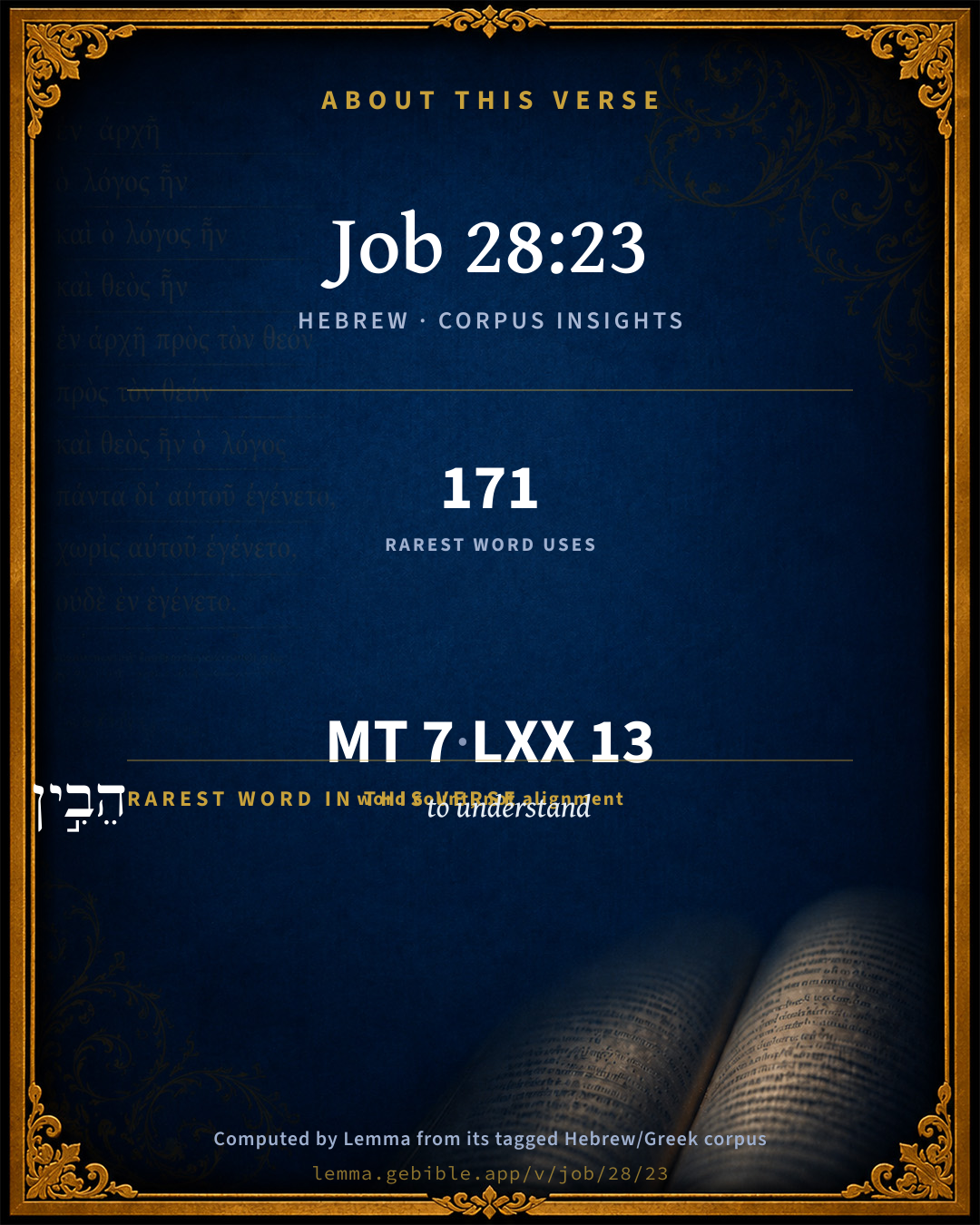
הֵבִ֣ין
bîyn
H995
“to understand”
Verb, Hiphil, Perfect, 3rd Person, Masculine, Singular
Part of Speech
Verb
Stem
Hiphil
Form
Perfect
Person
3rd Person
Gender
Masculine
Number
Singular
Full BDB Definition

Origin: a primitive root

TWOT: 239

to discern, understand, consider - (Qal) - to perceive, discern - to understand, know (with the mind) - to observe, mark, give heed to, distinguish, consider - to have discernment, insight, understanding - (Niphal) to be discerning, intelligent, discreet, have understanding - (Hiphil) - to understand - to cause to understand, give understanding, teach - (Hithpolel) to show oneself discerning or attentive, consider diligently - (Polel) to teach, instruct - (TWOT) prudent, regard
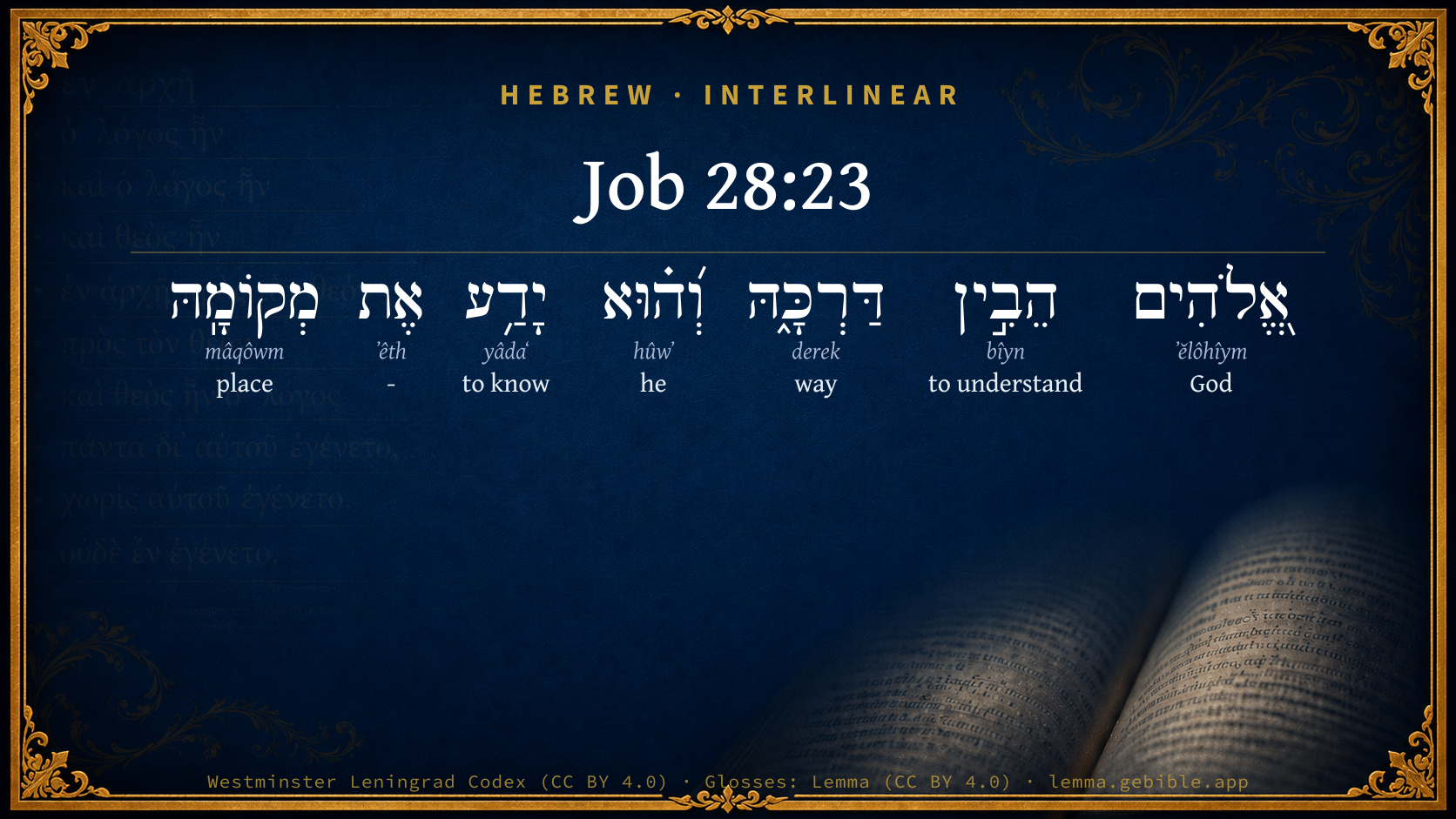
  1. אֱ֭לֹהִים ʼĕlôhîym H430 “God(s)” Noun, Common, Masculine, Plural, Absolute
  2. דַּרְכָּ֑הּ derek H1870 “way · her” Noun, Common, Both, Singular, Construct + Suffix, Personal, 3rd Person, Feminine, Singular
  3. וְ֝ה֗וּא hûwʼ H1931 “and · he” Conjunction + Pronoun, Personal, 3rd Person, Masculine, Singular
  4. יָדַ֥ע yâdaʻ H3045 “to know” Verb, Qal, Perfect, 3rd Person, Masculine, Singular
  5. אֶת ʼêth H853 “-” Particle, Direct Object
  6. מְקוֹמָֽהּ mâqôwm H4725 “place · her” Noun, Common, Masculine, Singular, Construct + Suffix, Personal, 3rd Person, Feminine, Singular

About this verse

These counts appear in no published source. They are computed here, from the morphology-tagged text and Lemma’s own curated glosses. What Lemma adds →

7
words
7
distinct lemmas
Wisdom
section

Grammatical profile

  • 2 verbs
  • 3 nouns
  • 1 pronoun
  • 1 particle

Verb forms

  • הֵבִ֣ין Hiphil · Perfect
  • יָדַ֥ע Qal · Perfect

Hebrew & Septuagint length

In English translation the verse runs 9 words from the Hebrew and 15 from the Septuagint (LXX English) — the Septuagint runs noticeably longer here. See the side-by-side →

A rough comparison of the two English renderings, which tokenize alike — not a word-level alignment.

Word counts can differ between the Hebrew and the Greek without any difference in meaning — e.g. the Hebrew direct-object marker אֵת has no separate Greek word, and Greek often adds the article ὁ.

In the original languages it is 7 Hebrew tokens and 13 Greek tokens — but the two are counted differently (Hebrew bundles its prefixes and suffixes into one token; the Greek is in lemma form), so that isn’t a like-for-like length.

Cross-references

11

Topical passages linked to Job 28:23 in the Treasury of Scripture Knowledge — connected by theme and wording, ordered by reader-vote popularity; previews shown in the World English Bible.

  • Proverbs 8:22–31 "Yahweh possessed me in the beginning of his work, Before his deeds of old.
  • 1 Corinthians 1:30 But of him, you are in Christ Jesus, who was made to us wisdom from God, and righteousness and sanctification, and redemption:
  • Romans 11:33 Oh the depth of the riches both of the wisdom and the knowledge of God! How unsearchable are his judgments, and his ways past tracing out!
  • Jude 1:25 to God our Savior, who alone is wise, be glory and majesty, dominion and power, both now and forever. Amen.
  • Psalms 147:5 Great is our Lord, and mighty in power. His understanding is infinite.
  • Proverbs 2:6 For Yahweh gives wisdom. Out of his mouth comes knowledge and understanding.
  • Psalms 19:7 Yahweh's law is perfect, restoring the soul. Yahweh's testimony is sure, making wise the simple.
  • Proverbs 8:14 Counsel and sound knowledge are mine. I have understanding and power.
  • Matthew 11:27 All things have been delivered to me by my Father. No one knows the Son, except the Father; neither does anyone know the Father, except the Son, and he to whom the Son desires to reveal him.
  • Luke 10:21–22 In that same hour Jesus rejoiced in the Holy Spirit, and said, "I thank you, O Father, Lord of heaven and earth, that you have hidden these things from the wise and understanding, and revealed them to little children. Yes, Father, for so it was well-pleasing in your sight."
  • Acts 15:18 All his works are known to God from eternity.'

Cross-references courtesy of OpenBible.info (CC BY 4.0).

Hebrew and Greek witnesses Masoretic Hebrew ↔ Greek Septuagint

The same verse in the two great witnesses to the Old Testament, shown verse-for-verse.

Here the Septuagint runs noticeably longer than the Hebrew — LXX2012 (modern English Septuagint) 15 words vs World English Bible 9. A rough length comparison of the two English translations, not a word-level alignment — read both below.

These are two independent witnesses, not word-aligned to each other, and the Septuagint is shown in lemma (dictionary) form.

Hebrew Job 28:23 Masoretic · Westminster Leningrad Codex

אֱ֭לֹהִים הֵבִ֣ין דַּרְכָּ֑הּ וְ֝ה֗וּא יָדַ֥ע אֶת מְקוֹמָֽהּ

"God understands its way, And he knows its place.

World English Bible · Public Domain

Greek LXX Job 28:23 Septuagint · lemma form

ὁ θεός εὖ συνἵστημι αὐτός ὁ ὁδός αὐτός δέ οἶδα ὁ τόπος αὐτός

God has well ordered the way of it, and he knows the place of it.

LXX2012 (modern English Septuagint) · Public Domain

On this verse, Adam Clarke's Commentary discusses the Septuagint’s reading. Read the note in Commentary ↓

Hebrew: Westminster Leningrad Codex (CC BY 4.0). Greek: Septuagint (public domain); English from LXX2012 (modern English Septuagint) (Public Domain). How the Septuagint differs from the Hebrew →

Commentary

Notes on Job 28:23 from classic Christian and Jewish commentators (each source and its license shown beneath its notes). The classic Christian expositions comment on the surrounding passage and are grouped to its opening verse, so a note may address several verses; the Jewish commentaries on the Tanakh (Rashi and others) are per-verse, so they appear only where the commentator wrote on this verse.

Lemma curates 59 commentaries, every one of them public domain or Creative Commons licensed, each selected and text-cleaned for this edition rather than reprinted as found. About our sources →

Trapp's Complete Commentary

John Trapp

Job 28:23 God understandeth the way thereof, and he knoweth the place thereof.

Ver. 23. God understandeth the way thereof] The only wise God, who alone knows her price, knows her retreat. Haec sunt inferni et morris verba, saith Brentius; those are the words of hell and of death. But we may better take them, as spoken by Job himself; which yet are to be understood, not as if Job thought that there was any place, apart from God, where his wisdom might be sought; or any way, out of himself, to go to it. But these things are spoken after the manner of men, saith Merlin; for wisdom is in God, yea, God is wisdom itself. For the wisdom of God is nothing else but the most wise God; since whatsoever is in God is God. Therefore seeing he is well known to himself, how can his wisdom be but as well known unto him? His infinite knowledge and understanding is in some sort shadowed out unto us in the words following.

John Trapp, A Commentary or Exposition upon All the Books of the Old and New Testament (1647–1656) — public domain. Text from a community e-Sword module.

Joseph Benson's Commentary

Job 28:23-24. God understandeth the way thereof — God alone knows and can make known the nature and properties, the rules and measures, the plans and designs, the operations and effects, of this wisdom which we inquire after; or, the methods which he takes, in the management of all affairs in the world, together with its reasons, and the ends he has in view in them. And he knoweth the place thereof — Where it dwells, which is only in his own mind. For he looketh to the ends of the earth — He, and he only knows it, because his providence is infinite and universal, reaching to all places and times, past, present, and to come; whereas the most knowing men have narrow understandings, and the wisdom, and justice, and beauty of God’s works are not fully seen till all the parts of them be laid together.

Joseph Benson's Commentary on the Old and New Testaments (1811–1818) — public domain. Text from a community e-Sword module.

Tyndale Open Study Notes

Tyndale Open Resources

28:23-27 When God looks throughout the whole earth (28:23), he sees his own wisdom expressed in his creation. God later showcased his wisdom for Job when he took him on a cosmic tour (chs 38–41).

Tyndale Open Study Notes — © Tyndale Open Resources, licensed CC BY-SA 4.0. Text via the HelloAO Bible API.

Geneva Bible (1599)

Geneva Bible translators

He maketh God only the author of this wisdom, and the giver thereof.

Geneva Bible (1599) marginal notes — public domain. Text via Bolls.life.

Jamieson, Fausset & Brown

Robert Jamieson, A. R. Fausset & David Brown

God hath, and is Himself, wisdom.

Jamieson, Fausset & Brown — Commentary Critical and Explanatory on the Whole Bible (1871) — public domain (CC PDM 1.0). Text via the HelloAO Bible API.

Adam Clarke's Commentary

Verse 23. God understandeth the way thereof] It can only be taught by a revelation from himself. Instead of הבין hebin, understandeth, six MSS. have הכין hechin, disposed or established. This reading is also supported by the Septuagint; Ὁ Θεος ευ συνεστησεν αυτης ὁδον, "God hath well established her way:" falsely rendered bene cognovit, hath well known, in the Latin version of the Septuagint in the London Polyglot; but bene constituit, hath well established, in the Complutensian, Antwerp, and Paris Polyglots.

Adam Clarke's Commentary on the Bible (1810–1826) — public domain. Text from a community e-Sword/MySword module.

Ellicott's Commentary for English Readers

(23) God understandeth the way thereof.—God is the author of wisdom, and His fear is the beginning thereof; so with His infinite knowledge of the universe He cannot but be cognisant of the place and way thereof. It is to be observed that while the foundation of wisdom is said to be coeval with that of the world, the very existence of wisdom in relation to man implied the existence of evil, because except by departing from evil there could for man be no wisdom, though evil itself may undoubtedly involve and imply the deflection from a previously existing right. Wrong, for example, is what is wrung aside from the right. The two ideas which Job starts with are man’s ignorance of the price and the place of wisdom. Neither he nor nature knows the place of it: neither all living, nor the deep, nor the sea; and as for its price, though man is prepared to give any high price for the costly stones and jewels of the earth, yet all that he has to give is not to be mentioned in comparison with the value of wisdom. Wisdom, however, is to be purchased by the poor, as we may infer from the language of the prophet Isaiah (Isa_55:1), or, at all events, that which ranks with wisdom; and in like manner Christ represented the kingdom of heaven as a pearl of great price, which would demand all that a man had to buy it, and yet he represented the poor as those especially to whom it was preached. It is true that the wisdom of which Job speaks (Job_28:28) is in no way connected with the Gospel of the kingdom; but yet, if the words of the wise are indeed given from one Shepherd, it is impossible not to recognise a central thought underlying all such words, if not in the separate minds of the wise at heart, in the original mind of the one Shepherd. So we can see that that which is true of wisdom as described by Job receives its illustration from that which is true of the Gospel of the kingdom and of the evangelical promises of Isaiah.

A Bible Commentary for English Readers, edited by Charles John Ellicott (1878–1897) — public domain. Text from a community e-Sword module.

The Cambridge Bible for Schools and Colleges

gen. ed. J. J. S. Perowne

23. God understandeth the way thereof] i. e. the way thereto (ch. Job_24:18, Gen_3:24). The word God stands emphatically first in the sentence, in opposition to “all living” (Job_28:21); He is in possession of Wisdom. It need not be said that the words “place” and “way” are merely parts of the figure; the verse means, Wisdom is with God alone.

23–28. Wisdom can nowhere be found either by man or by any creature (Job_28:21), only by the Creator. God knoweth the place of it and is in possession of it, for He is the maker and upholder of the universe with all its agencies. And He has assigned to man as his wisdom the fear of the Lord.

The Cambridge Bible for Schools and Colleges (gen. ed. J. J. S. Perowne; Cambridge University Press, 1878–1918) — public domain. Text from a community e-Sword module.

John Gill's Exposition

For he looketh to the ends of the earth,.... In this and some following verses, reasons and are given, which abundantly show that God must know the way and place of wisdom; since all the parts and places of the earth, even to the ends of it, are seen by him, and all creatures and things in it; nor is there anything in heaven, earth, and hell, that is hid from him; and therefore if there is a way to it, or a place for it, he must needs know it; where its direction is, or where it steers its course, and takes up its abode

and seeth under the whole heaven; the fowls of the air, the beasts of the field, the inhabitants of the world, and all that is done in it; everything falls under the eye of his omniscience, and under the notice of his providence, which extends to all creatures and things throughout the whole earth, and under the compass of the heavens; and since all places and persons are obvious to his view, and all subject to his all wise and disposing providence, and are ordered, directed, and governed, according to his sovereign will and pleasure; the path of wisdom, and the place of understanding, he must be acquainted with; and particularly his all seeing eye, and all powerful providence, are concerned in the following things, and in which there are wonderful proofs of his knowledge and wisdom.

John Gill's Exposition of the Whole Bible (1746–1763) — public domain (CC PDM 1.0). Text via the HelloAO Bible API.

Albert Barnes' Notes on the Bible

God understandeth the way thereof - These are doubtless the words of Job. The meaning is, that the reason of the divine dispensations could be known only to God himself. He had given no clew by which man could discover this. He might carry his investigations far into the regions of science; he could penetrate the earth, and look on the stars, but still all his investigations fell short of disclosing the reasons of the divine dispensations. The secret was lodged in his bosom, and he only could communicate it where and when he pleased. It may be added here, that this is as true now as it was in the time of Job. Man has carried the investigations of science almost infinitely further than he had then, but still by the investigations of science he has by no means superseded the necessity of revelation, or shed light on the great questions that have, in all ages, so much perplexed the race. It is only by direct communication, by his word and by his Spirit, that man can be made to understand the reason of the divine doings, and nothing is better established by the course of events than the truth on which Job here so much insists, that science cannot answer the questions of so much interest to man about the divine government.

Albert Barnes' Notes on the Bible (1834–1885) — public domain. Text from a community e-Sword/MySword module.

Haydock's Catholic Bible Commentary

CHAPTER XXVIII.

George Leo Haydock (1774–1849), Haydock's Catholic Family Bible and Commentary, 1859 edition — public domain. Excludes Psalms (Douay-Rheims chapter numbering differs from Protestant) and Deuterocanonical books (Catholic canon only).

Matthew Poole's English Annotations

God, i.e. God alone; as appears by the denial of it to all other things.

The way thereof; either the way how it is to be obtained; or rather, the methods or courses which it takes in the management of all affairs in the world, together with its grounds and ends in them.

The place thereof; where it dwells, which is only in his own breast and mind, and in the best of men but in part, and only as far as it pleaseth him to afford it.

Matthew Poole's English Annotations on the Holy Bible (1683–1685) — public domain. Text from a community e-Sword/MySword module.

Whedon's Commentary on the Bible

Daniel D. Whedon

23. Thereof — To it. God (Elohim) alone understands the way to wisdom. “The ways” and “the place thereof,” as Pareau has well remarked, still carry forward the figure of a costly treasure deposited in a place inaccessible and concealed from all men.

Daniel D. Whedon (gen. ed.), Commentary on the Old and New Testaments (1874–1909) — public domain. Text from a community e-Sword module.

The Pulpit Commentary

God understandeth the way thereof, and he knoweth the place thereof. God only understands what true wisdom is. It is a part of his being, an essential element of his nature. He knows "the way" of it, i.e. how it works and manifests itself; and he knows "the place" of it, i.e. where it dwells, what limits it has, if any, and how far it is communicable to any beside himself. The highest knowledge is all hid in God (Colossians 2-3); and, except so far as God imparts it to him, man can know nothing of it.

God"s access to wisdom.

Wisdom is rare, precious, and costly. Men are skilful and enterprising in mining for the precious metals; but the search for wisdom, though carried on with the utmost assiduity, seems to be more difficult. Nevertheless, what is inaccessible to man is quite within the reach of God. We may fail in attempting to find wisdom, but God possesses it. He knows where it lies hidden from us; he can tread the labyrinth of the mine that leads to it.

I THIS IS A GROUND OF FAITH. If God has true wisdom, we can be Content to leave with him those issues of life which we cannot understand ourselves.

1. In nature. To us many of the processes of nature are unintelligible. Not only cannot we understand the "how," but we are also perplexed about the "why." Apparently aimless and seemingly hurtful processes fill nature with dark mysteries. But these mysteries are all open to God. Of his works we can say, "In wisdom hast thou made them all." The world was not created by a blundering Demiurge, but by an all-wise God.

2. In providence. Our own lives are enigmas to us. We cannot understand why our plans are broken, our hopes scattered, our joys turned to bitterness It all looks wild, chaotic, aimless, sometimes even cruel We can but rest in the thought that God is higher and wiser than we are. "Deep in unfathomable mines Of never-failing skill, He treasures up his bright desirous, And works his sovereign will

Therefore"Judge not the Lord by feeble sense.

3. In redemption. It may not be possible for us to understand the atonement. Theories are all inadequate. There is a mystery at the root of Christianity. But when God devised his great idea of salvation he had access to all wisdom. It must be wise. Our part is to follow it as far as we can see it, and to trust God for the rest.

II THIS IS A KEY TO WISDOM. God knows where the treasure is hidden; he is familiar with the path that leads to it. Then he must be the Guide to wisdom. If we would attain to it we must seek it from God.

1. By prayer. St,. James has said, "If any of you lack wisdom, let him ask of God, that giveth to all men liberally, and upbraideth not; and it shall be given him". (Jam_1:5) It is not only that wisdom is a boon bestowed in answer to prayer; prayer itself is the road to wisdom. St. Paul could see things in a new light when it could be said of him, "Behold, he prayeth." The spirit of prayer opens the windows of heaven and reveals the wisdom of God.

2. By godliness. We must be like God if we would share in God"s wisdom. Sympathy with God will give us eyes to see as God sees. Nearness to him will introduce us to the path that he treads. When we walk with God we shall be led to those deep mines of wisdom to which he penetrates. Thus true wisdom is closely allied to true religion. "The fear of the Lord, that is wisdom" (ver. 28). W.F.A.

The Pulpit Commentary (1880–1919), ed. H.D.M. Spence-Jones & Joseph S. Exell — public domain. Text from a community e-Sword module.

John Wesley's Explanatory Notes

God - God alone. The way - The methods which he takes in the management of all affairs, together with its grounds and ends in them. The place - Where it dwells, which is only in his own mind.

John Wesley, Explanatory Notes Upon the Whole Bible (1754–1765) — public domain. Text via the GEBible commentary corpus.

unfoldingWord translationNotes

Door43 World Missions Community

God understands the way to it; he knows its place

Wisdom is spoken of as if it were in a certain place. AT: "God knows how to find wisdom. He knows where it is" (See: Metaphor)

the very ends of the earth

"the farthest places on the earth"

parceled out the waters by measure

This describes God deciding how much water should be in each place. Possible meanings are that this refers to deciding 1) how much rain should be in each cloud or 2) how much water should be in each sea. AT: "decided how much water should be in each place" (See: Metaphor)

unfoldingWord translationNotes — © Distant Shores Media and the Door43 World Missions Community, licensed CC BY-SA 4.0. Source: git.door43.org/Door43/en_tn.

Rashi

Rabbi Shlomo Yitzchaki (Rashi)

God understood its way, and He knew its place For He knows where it is situated, and they will also praise it and say of it that God understood its way; He looked at it and created the world with its letters in their order and according to their weight. He created all creatures as it is written in the secret of Sefer Yetzirah.

Rashi on the Tanakh — English translations: “The Judaica Press complete Tanach with Rashi, translated by A. J. Rosenberg” (CC BY 4.0); “Pentateuch with Rashi's commentary by M. Rosenbaum and A.M. Silbermann, 1929-1934” (public domain); “The Metsudah Tanach series, Lakewood, N.J” (CC BY 4.0); and “The Book of Joshua, Metsudah Publications, 1997” (CC BY 4.0). Text via Sefaria.

Lesson kit

Teaching starters — assembled from the data on this page, not authored interpretation. Every prompt links to the verse data it draws on. Edit before teaching.

Job, in the Wisdom, opens this verse with 7 words (7 distinct Hebrew lemmas). Its most distinctive word is bîyn (“to understand”). The Greek Septuagint runs longer here. A historical commentator’s framing appears above. Read the whole chapter for the surrounding context.

Discussion questions

  1. What does “to understand” (bîyn) contribute to the verse as a whole?
  2. Proverbs 8:22–31 shares this passage’s theme. How do the two illuminate each other?
  3. Compared with the Hebrew, the Septuagint runs longer here. What questions does that raise?
  4. These translations render this verse differently. What is at stake in choosing one wording over another?
  5. The verb «הֵבִ֣ין» is Hiphil Perfect. How does its form color the action?
  6. Reading how Trapp's Complete Commentary and Joseph Benson's Commentary read this verse, where do the two commentators agree and where do they part?

Things to notice

Reading settings

Reading text

Shown beneath each verse's original-language words.

Old Testament
Old Testament edition

Read the OT as the Masoretic Hebrew (MT) or the Greek Septuagint (LXX).

English shown for the Greek Septuagint (in the Hebrew ↔ Greek comparison).

Comparing translations? Open the Compare panel on any verse page to stack up to four side by side.