
Ezra 8:16

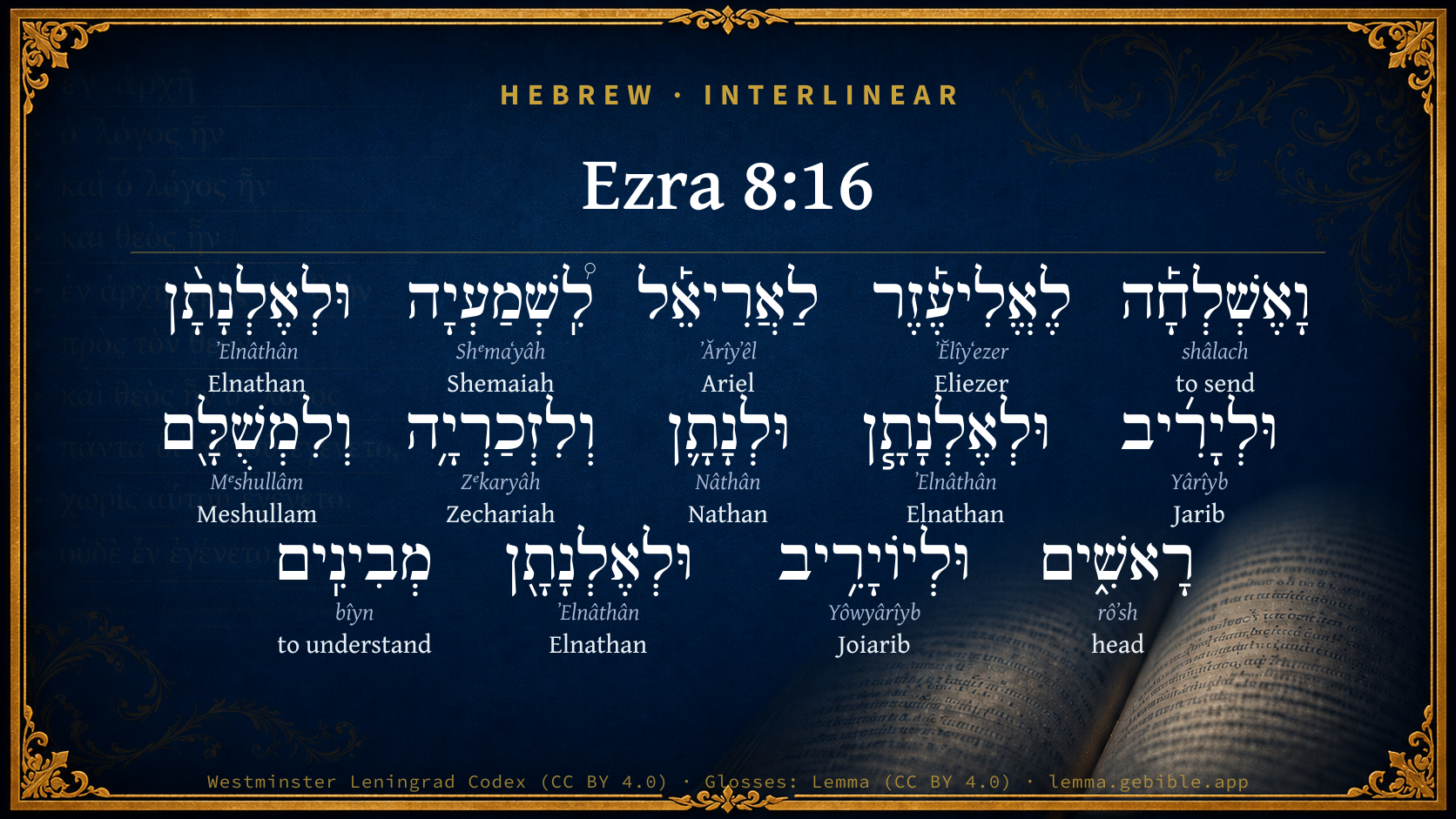
Hebrew (Westminster Leningrad Codex) Ezra 8:16 appears in the Hebrew Old Testament. The text above is from the Westminster Leningrad Codex. Each word links to its Strong’s number, a concise gloss, and parsing drawn from the Open Scriptures Hebrew Bible morphology. Click any word for its full Brown-Driver-Briggs (BDB) entry.
Download image
Cite this verse

Ezra 8:16 (World English Bible). Public Domain. Lemma interlinear Bible study tool, https://lemma.gebible.app/v/ezra/8/16.

Show BibTeX & RIS
BibTeX
RIS
English Translation
Then sent I for Eliezer, for Ariel, for Shemaiah, and for Elnathan, and for Jarib, and for Elnathan, and for Nathan, and for Zechariah, and for Meshullam, chief men; also for Joiarib, and for Elnathan, who were teachers.
World English Bible · Public Domain
Highlights
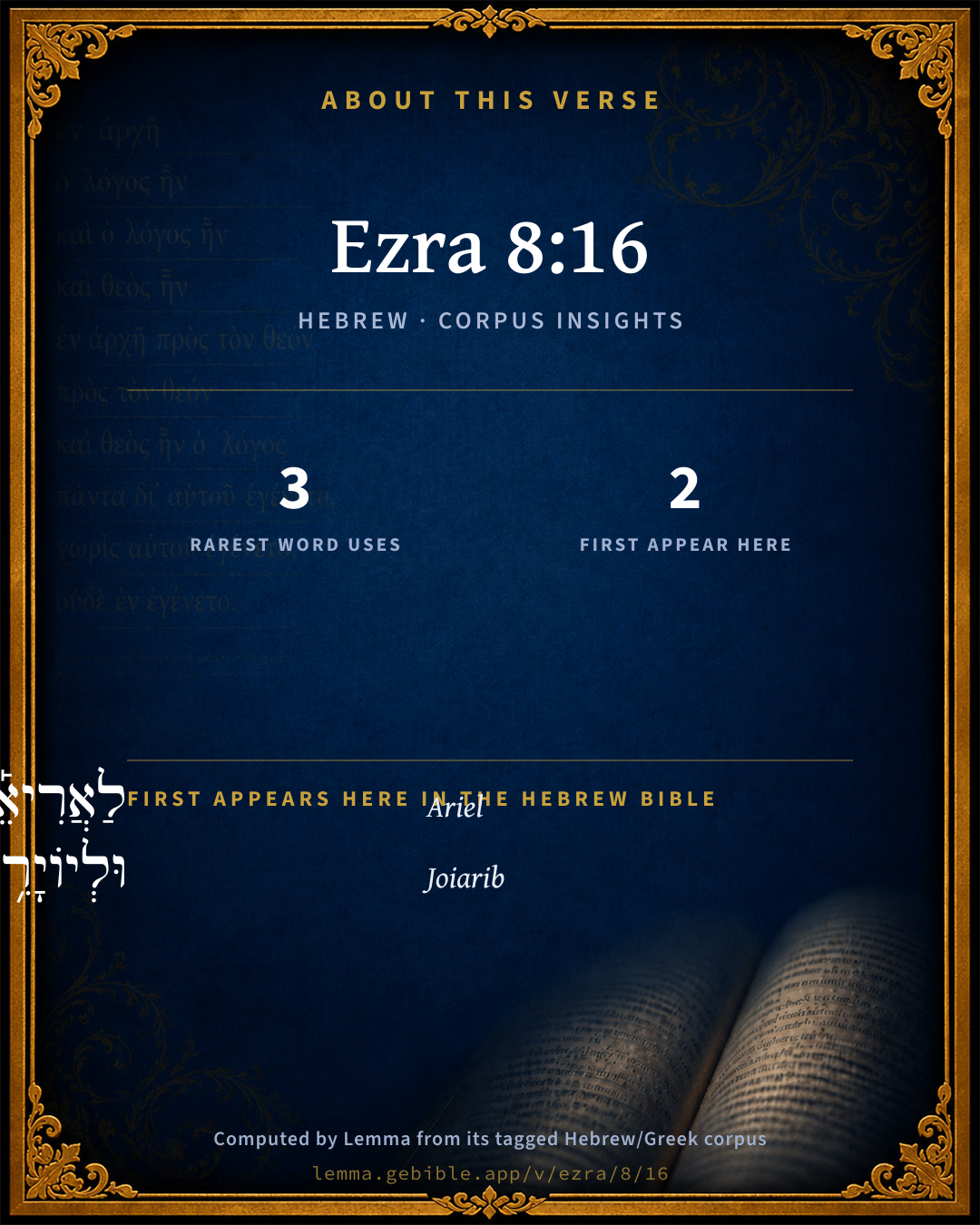
  • 2 first appearances in the Hebrew Bible
Full analysis ↓
Download a study sheet

One document with this verse’s original text, its word-by-word gloss line, the meaning frame, cross-references with their text, attributed commentary, and full source and license credits — printable, and it pastes into notes with its structure intact.

This verse Autodidact and up

Study sheet (.html) Plain text (.txt)

A passage Seminary Student

Up to 50 verses in one chapter. A passage sheet keeps up to 6 commentary sources and 12 cross-references per verse, in the order this page ranks them, and says so on the sheet whenever that leaves anything out. Ask for a single verse and you get the Autodidact verse sheet above.

Everything on this page stays free to read, with no account — the sheet is a download of what is already on screen, not access to it.

Want to remove ads? Support Godless Engineer
Compare translations 3

The same verse in 3 English versions, stacked beneath the original-language interlinear above. Click any original word for its lexicon entry.

Each is an independent rendering of the whole verse — the interlinear is not word-aligned to these translations.

Highlighted words mark where these versions differ — a whole-verse word diff, not a word-by-word alignment.

  • World English Bible Public Domain
    Then sent I for Eliezer, for Ariel, for Shemaiah, and for Elnathan, and for Jarib, and for Elnathan, and for Nathan, and for Zechariah, and for Meshullam, chief men; also for Joiarib, and for Elnathan, who were teachers.
  • King James Version Public Domain
    Then sent I for Eliezer, for Ariel, for Shemaiah, and for Elnathan, and for Jarib, and for Elnathan, and for Nathan, and for Zechariah, and for Meshullam, chief men; also for Joiarib, and for Elnathan, men of understanding.
  • unfoldingWord Literal Text CC BY-SA 4.0
    Then I sent for Eliezer, for Ariel, for Shemaiah, and for Elnathan, and for Jarib, and for Elnathan and for Nathan, and for Zechariah, and for Meshullam, the heads; and for Joiarib, and for Elnathan, men of understanding.

unfoldingWord Literal Text — © unfoldingWord, licensed CC BY-SA 4.0. Word-aligned USFM3 via Door43 (git.door43.org/unfoldingWord/en_ult).

Versions to compare (up to 4)

3 of 4 selected

Show all 18 translations

Every available English version of this verse, each an independent rendering of the whole verse.

  • World English Bible Public Domain
    Then sent I for Eliezer, for Ariel, for Shemaiah, and for Elnathan, and for Jarib, and for Elnathan, and for Nathan, and for Zechariah, and for Meshullam, chief men; also for Joiarib, and for Elnathan, who were teachers.
  • Berean Standard Bible Public Domain
    Then I summoned the leaders: Eliezer, Ariel, Shemaiah, Elnathan, Jarib, Elnathan, Nathan, Zechariah, and Meshullam, as well as the teachers Joiarib and Elnathan.
  • Majority Standard Bible Public Domain
    Then I summoned the leaders: Eliezer, Ariel, Shemaiah, Elnathan, Jarib, Elnathan, Nathan, Zechariah, and Meshullam, as well as the teachers Joiarib and Elnathan.
  • King James Version Public Domain
    Then sent I for Eliezer, for Ariel, for Shemaiah, and for Elnathan, and for Jarib, and for Elnathan, and for Nathan, and for Zechariah, and for Meshullam, chief men; also for Joiarib, and for Elnathan, men of understanding.
  • American Standard Version (1901) Public Domain
    Then sent I for Eliezer, for Ariel, for Shemaiah, and for Elnathan, and for Jarib, and for Elnathan, and for Nathan, and for Zechariah, and for Meshullam, chief men; also for Joiarib, and for Elnathan, who were teachers.
  • Revised Version (1885) Public Domain
    Then sent I for Eliezer, for Ariel, for Shemaiah, and for Elnathan, and for Jarib, and for Elnathan, and for Nathan, and for Zechariah, and for Meshullam, chief men; also for Joiarib, and for Elnathan, which were teachers.
  • Geneva Bible (1599) Public Domain
    Therefore sent I to Eliezer, to Ariel, to Shemeiah, and to Elnathan, and to Iarib, and to Elnathan, and to Nathan, and to Zechariah, and to Meshullam the chiefe, and to Ioiarib and to Elnathan, men of vnderstanding,
  • Douay-Rheims (1899) Public Domain
    So I sent Eliezer, and Ariel, and Semeias, and Elnathan, and Jarib, and another Elnathan, and Nathan, and Zacharias, and Mosollam, chief men: and Joiarib, and Elnathan, wise men.
  • Young's Literal Translation Public Domain
    and I send for Eliezer, for Ariel, for Shemaiah, and for Elnathan, and for Jarib, and for Elnathan, and for Nathan, and for Zechariah, and for Meshullam, heads, and for Joiarib, and for Elnathan, men of understanding;
  • Literal Standard Version CC BY-SA 4.0
    and I send for Eliezer, for Ariel, for Shemaiah, and for Elnathan, and for Jarib, and for Elnathan, and for Nathan, and for Zechariah, and for Meshullam, heads, and for Joiarib, and for Elnathan, men of understanding;
  • Unlocked Literal Bible CC BY-SA 4.0
    So I sent for Eliezer, Ariel, Shemaiah, Elnathan, Jarib, and Elnathan and Nathan, Zechariah, and Meshullam—who were leaders—and for Joiarib and Elnathan—who were teachers.
  • unfoldingWord Literal Text CC BY-SA 4.0
    Then I sent for Eliezer, for Ariel, for Shemaiah, and for Elnathan, and for Jarib, and for Elnathan and for Nathan, and for Zechariah, and for Meshullam, the heads; and for Joiarib, and for Elnathan, men of understanding.
  • Darby Bible Public Domain
    And I sent for Eliezer, for Ariel, for Shemaiah, and for Elnathan, and for Jarib, and for Elnathan, and for Nathan, and for Zechariah, and for Meshullam, chief men, and for Joiarib and for Elnathan, men of understanding.
  • World Messianic Bible Public Domain
    Then I sent for Eliezer, for Ariel, for Shemaiah, for Elnathan, for Jarib, for Elnathan, for Nathan, for Zechariah, and for Meshullam, chief men; also for Joiarib and for Elnathan, who were teachers.
  • Webster's Bible Public Domain
    Then sent I for Eliezer, for Ariel, for Shemaiah, and for Elnathan, and for Jarib, and for Elnathan, and for Nathan, and for Zechariah, and for Meshullam, chief men; also for Joiarib, and for Elnathan, men of understanding.
  • Free Bible Version CC BY-SA 4.0
    so I sent for Eliezer, Ariel, Shemaiah, Elnathan, Jarib, Elnathan, Nathan, Zechariah, and Meshullam, who were leaders, and for Joiarib and Elnathan, who were men with good insight.
  • Bible in Basic English Public Domain
    Then I sent for Eliezer and Ariel and Shemaiah and Elnathan Jarib and Elnathan and Nathan and Zechariah and Meshullam, all responsible men; and for Joiarib and Elnathan, who were wise men.
  • JPS Tanakh (1917) Public Domain
    Then sent I for Eliezer, for Ariel, for Shemaiah, and for Elnathan, and for Jarib, and for Elnathan, and for Nathan, and for Zechariah, and for Meshullam, chief men; also for Joiarib, and for Elnathan, teachers.

Literal Standard Version (2020), Covenant Press — licensed CC BY-SA 4.0. Text via the HelloAO Bible API (eBible.org). Unlocked Literal Bible (unfoldingWord) — licensed CC BY-SA 4.0. Text via the HelloAO Bible API (eBible.org). unfoldingWord Literal Text — © unfoldingWord, licensed CC BY-SA 4.0. Word-aligned USFM3 via Door43 (git.door43.org/unfoldingWord/en_ult). Free Bible Version, Dr. Jonathan Gallagher — licensed CC BY-SA 4.0. Text via the HelloAO Bible API (eBible.org).

Word by word

More ways to search: Search by grammar → Find every occurrence → Compare this word →

Practice this passage: Drill this verse → Learn its vocabulary →

וּלְיָרִ֜יב
Yârîyb
H3402
“and · to/for · Jarib”
Conjunction + Preposition + Noun, Proper
Part of Speech
Conjunction + Preposition + Noun
Type
Proper
Full BDB Definition

Origin: the same as H3401

TWOT: None

Jarib = "he contends" - a son of Simeon - one of the chief men of Israel who returned from exile with Ezra - son of Jozadak and a priest of the house of Jeshua who married a foreign wife and was compelled by Ezra to put her away
  1. וָאֶשְׁלְחָ֡ה shâlach H7971 “and · to send” Conjunction + Verb, Qal, Sequential Imperfect, 1st Person, Common, Singular + Suffix, h
  2. לֶאֱלִיעֶ֡זֶר ʼĔlîyʻezer H461 “to/for · Eliezer” Preposition + Noun, Proper
  3. לַאֲרִיאֵ֡ל ʼĂrîyʼêl H740 “to/for · Ariel” Preposition + Noun, Proper
  4. לִֽ֠שְׁמַעְיָה Shᵉmaʻyâh H8098 “to/for · Shemaiah” Preposition + Noun, Proper
  5. וּלְאֶלְנָתָ֨ן ʼElnâthân H494 “and · to/for · Elnathan” Conjunction + Preposition + Noun, Proper
  6. וּלְאֶלְנָתָ֧ן ʼElnâthân H494 “and · to/for · Elnathan” Conjunction + Preposition + Noun, Proper
  7. וּלְנָתָ֛ן Nâthân H5416 “and · to/for · Nathan” Conjunction + Preposition + Noun, Proper
  8. וְלִזְכַרְיָ֥ה Zᵉkaryâh H2148 “and · to/for · Zechariah” Conjunction + Preposition + Noun, Proper
  9. וְלִמְשֻׁלָּ֖ם Mᵉshullâm H4918 “and · to/for · Meshullam” Conjunction + Preposition + Noun, Proper
  10. רָאשִׁ֑ים rôʼsh H7218 “heads” Noun, Common, Masculine, Plural, Absolute
  11. וּלְיוֹיָרִ֥יב Yôwyârîyb H3114 “and · to/for · Joiarib” Conjunction + Preposition + Noun, Proper
  12. וּלְאֶלְנָתָ֖ן ʼElnâthân H494 “and · to/for · Elnathan” Conjunction + Preposition + Noun, Proper
  13. מְבִינִֽים bîyn H995 “understanding” Verb, Hiphil, Participle Active, Masculine, Plural, Absolute

About this verse

These counts appear in no published source. They are computed here, from the morphology-tagged text and Lemma’s own curated glosses. What Lemma adds →

14
words
12
distinct lemmas
Historical
section

Notable vocabulary

The rarest word here is וּלְיָרִ֜יב Jarib H3402 — appearing just 3 times in the whole Hebrew Bible.

First appearance in Scripture

These words make their first canonical appearance in the Hebrew Bible here:

  • לַאֲרִיאֵ֡ל Ariel H740
  • וּלְיוֹיָרִ֥יב Joiarib H3114

Shared distinctive vocabulary

וּלְיָרִ֜יב Jarib H3402 occurs in 3 verses of the Hebrew Bible. Also found in:

Grammatical profile

  • 2 verbs
  • 12 nouns

Verb forms

  • וָאֶשְׁלְחָ֡ה Qal · Sequential Imperfect
  • מְבִינִֽים Hiphil · Participle Active

Repetition

A word recurs within this verse — often emphatic in Hebrew:

  • וּלְאֶלְנָתָ֨ן Elnathan H494 ×3

Hebrew & Septuagint length

In English translation the verse runs 38 words from the Hebrew and 36 from the Septuagint (LXX English) — closely comparable.

A rough comparison of the two English renderings, which tokenize alike — not a word-level alignment.

Word counts can differ between the Hebrew and the Greek without any difference in meaning — e.g. the Hebrew direct-object marker אֵת has no separate Greek word, and Greek often adds the article ὁ.

Cross-references

14

Topical passages linked to Ezra 8:16 in the Treasury of Scripture Knowledge — connected by theme and wording, ordered by reader-vote popularity; previews shown in the World English Bible.

  • 1 Kings 3:11 God said to him, Because you have asked this thing, and have not asked for yourself long life, neither have asked riches for yourself, nor have asked the life of your enemies, but have asked for yourself understanding to discern justice;
  • 1 Chronicles 12:32 Of the children of Issachar, men who had understanding of the times, to know what Israel ought to do, the heads of them were two hundred; and all their brothers were at their commandment.
  • 1 Chronicles 26:14 The lot eastward fell to Shelemiah. Then for Zechariah his son, a wise counselor, they cast lots; and his lot came out northward.
  • 2 Chronicles 2:12 Huram said moreover, Blessed be Yahweh, the God of Israel, that made heaven and earth, who has given to David the king a wise son, endowed with discretion and understanding, that should build a house for Yahweh, and a house for his kingdom.
  • Ezra 8:13 Of the sons of Adonikam, [who were] the last; and these are their names: Eliphelet, Jeuel, and Shemaiah; and with them sixty males.
  • Ezra 8:18 According to the good hand of our God on us they brought us a man of discretion, of the sons of Mahli, the son of Levi, the son of Israel; and Sherebiah, with his sons and his brothers, eighteen;
  • Ezra 10:21 Of the sons of Harim: Maaseiah, and Elijah, and Shemaiah, and Jehiel, and Uzziah.
  • Ezra 10:39 and Shelemiah, and Nathan, and Adaiah,
  • Proverbs 2:6 For Yahweh gives wisdom. Out of his mouth comes knowledge and understanding.
  • Proverbs 20:5 Counsel in the heart of man is like deep water; But a man of understanding will draw it out.
  • Proverbs 28:2 In rebellion, a land has many rulers, But order is maintained by a man of understanding and knowledge.
  • Daniel 2:21 He changes the times and the seasons; he removes kings, and sets up kings; he gives wisdom to the wise, and knowledge to those who have understanding;
  • 2 Timothy 2:7 Consider what I say, and may the Lord give you understanding in all things.
  • 1 John 5:20 We know that the Son of God has come, and has given us an understanding, that we know him who is true, and we are in him who is true, in his Son Jesus Christ. This is the true God, and eternal life.

Cross-references courtesy of OpenBible.info (CC BY 4.0).

Hebrew and Greek witnesses Masoretic Hebrew ↔ Greek Septuagint

The same verse in the two great witnesses to the Old Testament, shown verse-for-verse.

These are two independent witnesses, not word-aligned to each other, and the Septuagint is shown in lemma (dictionary) form.

Hebrew Ezra 8:16 Masoretic · Westminster Leningrad Codex

וָאֶשְׁלְחָ֡ה לֶאֱלִיעֶ֡זֶר לַאֲרִיאֵ֡ל לִֽ֠שְׁמַעְיָה וּלְאֶלְנָתָ֨ן וּלְיָרִ֜יב וּלְאֶלְנָתָ֧ן וּלְנָתָ֛ן וְלִזְכַרְיָ֥ה וְלִמְשֻׁלָּ֖ם רָאשִׁ֑ים וּלְיוֹיָרִ֥יב וּלְאֶלְנָתָ֖ן מְבִינִֽים

Then sent I for Eliezer, for Ariel, for Shemaiah, and for Elnathan, and for Jarib, and for Elnathan, and for Nathan, and for Zechariah, and for Meshullam, chief men; also for Joiarib, and for Elnathan, who were teachers.

World English Bible · Public Domain

Greek LXX Ezra 8:16 Septuagint · lemma form

καί ἀποστέλλω ὁ ελεαζαρ ὁ αριηλ ὁ σαμαια καί ὁ αλωναμ καί ὁ ιαριβ καί ὁ ελναθαν καί ὁ ναθαν καί ὁ ζαχαρια καί ὁ μεσουλαμ ἀνήρ καί ὁ ιωαριβ καί ὁ ελναθαν συνἵημι

And I sent men of understanding to Eleazar, to Ariel, to Semeias, and to Alonam, and to Jarib, and to Elnatham, and to Nathan, and to Zacharias, and to Mesollam, and to Joarim, and to Elnathan.

LXX2012 (modern English Septuagint) · Public Domain

In the Septuagint this is one book — Esdras B (2 Esdras): Ezra is chapters 1–10, Nehemiah 11–23.

On this verse, The Cambridge Bible for Schools and Colleges discusses the Septuagint’s reading. Read the note in Commentary ↓

Hebrew: Westminster Leningrad Codex (CC BY 4.0). Greek: Septuagint (public domain); English from LXX2012 (modern English Septuagint) (Public Domain). How the Septuagint differs from the Hebrew →

Commentary

Notes on Ezra 8:16 from classic Christian and Jewish commentators (each source and its license shown beneath its notes). The classic Christian expositions comment on the surrounding passage and are grouped to its opening verse, so a note may address several verses; the Jewish commentaries on the Tanakh (Rashi and others) are per-verse, so they appear only where the commentator wrote on this verse.

Lemma curates 59 commentaries, every one of them public domain or Creative Commons licensed, each selected and text-cleaned for this edition rather than reprinted as found. About our sources →

The Cambridge Bible for Schools and Colleges

gen. ed. J. J. S. Perowne

16. Then sent I for Eliezer, &c.] “For”. (a) The preposition in the original is sometimes found as the sign of the object: thus 2Ch_17:7, A.V., “he sent to his princes, even to Ben-hail”, R.V. “he sent his princes, even Benhail”, &c. This is the alternative rendering (“then sent I Eliezer”) of the Vulgate (misi Eliezer et Ariel et Semejam, &c.) and the Syriac, and gives the most natural sense. Ezr_8:16 then gives the general fact, Ezr_8:17 the details of the mission. (b) The rendering of the A.V., R.V. and LXX. (απέστειλα τῷ Ἐλεάζαρ) is quite literal: Ezr_8:16 then contains Ezra’s summons to these leading men: Ezr_8:17 the mission, with which he empowers them, upon their coming into his presence. Of these two renderings the first seems to give the better sense. It hardly seems suited to the context to mention that Ezra, who commanded the whole assembly, summoned to his presence certain leading men before sending them upon an important mission. On the other hand it was quite in keeping with Ezra’s position to despatch such men upon his errand at once; and while the first verse (Ezr_8:16) records the fact of the message and the names of the leading men, whom he sends, the second verse (Ezr_8:17) describes the object and purpose of the mission. The peculiar usage of the preposition is quite in character with the style of the Hebrew in the books. The probability that this is the correct rendering is increased by the variation in the reading of Ezr_8:17 (see note).

chief men] Literally ‘heads’: not ‘the heads’ referred to in Ezr_8:1, but certain leaders.

men of understanding] R.V. which were teachers. Marg. which had understanding. The word in the original occurs in Neh_8:7 (R.V. ‘caused … to understand’); 1Ch_15:22; 1Ch_25:7 (R.V. ‘skilful’); 2Ch_34:12 (R.V. ‘that … could skill of’).

Joiarib and Elnathan receive a distinguishing epithet corresponding to the ‘chief men’ applied to the other names. It is not probable that a merely general epithet describing mental capacity should be given to two out of the party of ten. The word therefore is better rendered “teachers”, describing their position, than ‘men of understanding’, describing their abilities (LXX. συνιέντας, Vulg. sapientes).

The Cambridge Bible for Schools and Colleges (gen. ed. J. J. S. Perowne; Cambridge University Press, 1878–1918) — public domain. Text from a community e-Sword module.

Trapp's Complete Commentary

John Trapp

Ezr 8:16 Then sent I for Eliezer, for Ariel, for Shemaiah, and for Elnathan, and for Jarib, and for Elnathan, and for Nathan, and for Zechariah, and for Meshullam, chief men; also for Joiarib, and for Elnathan, men of understanding.

Ver. 16. Men of understanding] Of special note for their wisdom and eloquence; such as could present to the people good matter well habited, and could well express their expositions of the law, being themselves wise, and willing to wise others, as the Hebrew word signifieth, Dan 12:3. Men of understanding, and ready to instruct many, Dan 11:33. Such a man as this is worth his weight in gold,

John Trapp, A Commentary or Exposition upon All the Books of the Old and New Testament (1647–1656) — public domain. Text from a community e-Sword module.

Joseph Benson's Commentary

Ezr 8:16. Then sent I for Eliezer, &c. — To come to me, and go along with me to Jerusalem. He sent for these eleven persons, that he might employ them in a message to a place where he knew there were a great many Levites, as it follows in the next verse. Also for Joiarib and Elnathan, men of understanding — Who seem to have had more knowledge than pious zeal for God and his house, and solemn worship, which was confined to Jerusalem.

Joseph Benson's Commentary on the Old and New Testaments (1811–1818) — public domain. Text from a community e-Sword module.

Tyndale Open Study Notes

Tyndale Open Resources

8:16-17 The Hebrew term translated men of discernment refers to those who could interpret and explain the Torah. These men were probably respected because of their expertise in Scripture (cp. Neh 8:8-9). Ezra commissioned them to use their influence to recruit more Levites.

Tyndale Open Study Notes — © Tyndale Open Resources, licensed CC BY-SA 4.0. Text via the HelloAO Bible API.

Jamieson, Fausset & Brown

Robert Jamieson, A. R. Fausset & David Brown

then sent I for Eliezer . . . with commandment unto Iddo the chief--Ezra sent this deputation, either by virtue of authority which by his priestly character he had over the Levites, or of the royal commission with which he was invested. The deputation was despatched to Iddo, who was a prince or chief of the Nethinims--for the Persian government allowed the Hebrews during their exile to retain their ecclesiastical government by their own chiefs, as well as to enjoy the privilege of free worship. Iddo's influence procured and brought to the camp at Ahava thirty-eight Levites, and two hundred twenty Nethinims, the descendants of the Gibeonites, who performed the servile duties of the temple.

Jamieson, Fausset & Brown — Commentary Critical and Explanatory on the Whole Bible (1871) — public domain (CC PDM 1.0). Text via the HelloAO Bible API.

Ellicott's Commentary for English Readers

(16) Men of understanding.—Teachers, and perhaps priests. These were joined with nine chief men as a deputation to Iddo.

A Bible Commentary for English Readers, edited by Charles John Ellicott (1878–1897) — public domain. Text from a community e-Sword module.

John Gill's Exposition

Then sent I for Eliezer, for Ariel, for Shemaiah, and for Elnathan, and for Jarib, and for Elnathan, and for Nathan, and for Zechariah, and for Meshullam, chief men; also for Joiarib, and for Elnathan, men of understanding. These were all in the camp, in some part of it, to whom Ezra sent messengers to come unto him; three of them are of the same name; the first nine were men of chief note, rank, and dignity in their family, and the other two were noted for men of good sense, and that could speak to a case well, and so fit to be sent on such an affair as they were.

Then sent I for Eliezer, for Ariel, for Shemaiah, and for Elnathan, and for Jarib, and for Elnathan, and for Nathan, and for Zechariah, and for Meshullam, chief men; also for Joiarib, and for Elnathan, men of understanding. These were all in the camp, in some part of it, to whom Ezra sent messengers to come unto him; three of them are of the same name; the first nine were men of chief note, rank, and dignity in their family, and the other two were noted for men of good sense, and that could speak to a case well, and so fit to be sent on such an affair as they were.

Ezra 8:17

ezr 8:17

ezr 8:17

ezr 8:17And I sent them with commandment unto Iddo the chief, at the place Casiphia,.... Not a place by the Caspian sea, and near the Caspian mountains, as Munster, which was too far off to go and return in the time they must, see Ezr 7:9, but, as Jarchi, a place in Babylon so called, a village near it, or a parish or street in it, where Ezra knew lived many of the Levites and Nethinims, and where Iddo was the chief of the Levites, and over them both:

and I told them what they should say unto Iddo, and to his brethren the Nethinims, at the place Casiphia; but Iddo was not one of the Nethinims; for he was chief of the Levites, and by his authority many of them were sent as well as of the Nethinims; but none of the latter were over the Levites, for they were servants to them, Ezr 8:20, but, according to Jarchi, the Nethinims are not at all intended in this clause, who reads the words:

to Iddo and Achim, (the name of a man with him; perhaps it may be better rendered, "to Iddo and his brother",)

who were appointed, or settled, in the place Casiphia; and with him De Dieu agrees, and so the Syriac version:

who dwelt in Casiphia: that they should bring unto us ministers for the house of our God; both Levites to be singers and porters there, and the Nethinims to wait on them.

John Gill's Exposition of the Whole Bible (1746–1763) — public domain (CC PDM 1.0). Text via the HelloAO Bible API.

Haydock's Catholic Bible Commentary

Sent. Septuagint, "&c., "to Eliezer," &c., in order to give them his orders what to say to Eddo, who presided at Chasphia, as the sequel shews. --- Wise men, instructors of the people, (2 Paralipomenon xxxv. 3.; Calmet) Levites. (Menochius)

George Leo Haydock (1774–1849), Haydock's Catholic Family Bible and Commentary, 1859 edition — public domain. Excludes Psalms (Douay-Rheims chapter numbering differs from Protestant) and Deuterocanonical books (Catholic canon only).

Matthew Poole's English Annotations

Then sent I for Eliezer to come to me, and go along with me to Jerusalem. Men of understanding; who seem to have had more knowledge than pious zeal for God and his house and solemn worship, which was confined to Jerusalem.

Matthew Poole's English Annotations on the Holy Bible (1683–1685) — public domain. Text from a community e-Sword/MySword module.

Whedon's Commentary on the Bible

Daniel D. Whedon

16. Eliezer… Ariel… chief men — These were principal men among Ezra’s companions who had already assembled at Ahava, and whom he used as chief assistants. The nine first named are called chief men, probably from being the most distinguished and influential elders among them; the last two are distinguished as men of understanding, being skilled, probably, in the law, as Ezra was, and competent to instruct the people.

Daniel D. Whedon (gen. ed.), Commentary on the Old and New Testaments (1874–1909) — public domain. Text from a community e-Sword module.

Rashi

Rabbi Shlomo Yitzchaki (Rashi)

And I sent to Eliezer...the heads the great men.

the wise men Heb. מְבִינִים, lit. understanding. They were wise men.

Rashi on the Tanakh — English translations: “The Judaica Press complete Tanach with Rashi, translated by A. J. Rosenberg” (CC BY 4.0); “Pentateuch with Rashi's commentary by M. Rosenbaum and A.M. Silbermann, 1929-1934” (public domain); “The Metsudah Tanach series, Lakewood, N.J” (CC BY 4.0); and “The Book of Joshua, Metsudah Publications, 1997” (CC BY 4.0). Text via Sefaria.

Lesson kit

Teaching starters — assembled from the data on this page, not authored interpretation. Every prompt links to the verse data it draws on. Edit before teaching.

Ezra, in the Historical, opens this verse with 14 words (12 distinct Hebrew lemmas). Its most distinctive word is Yârîyb (“Jarib”). A historical commentator’s framing appears above. Read the whole chapter for the surrounding context.

Discussion questions

  1. How does “Jarib” (Yârîyb) shape what this verse is saying?
  2. 2 words make their first appearance in Scripture here. What does this debut establish?
  3. How does 1 Chronicles 4:24, which shares the word «Jarib», read alongside this verse?
  4. What does the repetition of “Elnathan” (3× in this one verse) do in this verse?
  5. These translations render this verse differently. What is at stake in choosing one wording over another?
  6. «וָאֶשְׁלְחָ֡ה» is a Qal Sequential Imperfect verb. How does that grammatical form shape the action described?
  7. Compare how The Cambridge Bible for Schools and Colleges and Trapp's Complete Commentary read this verse. Where do they agree or differ?

Things to notice

  • 2 words make their first canonical appearance in Scripture here.
  • These translations choose different wording for 6 words in this verse.
  • “Elnathan” occurs 3× in this single verse.
  • 12 distinct Hebrew lemmas span 14 words in this verse.

Reading settings

Reading text

Shown beneath each verse's original-language words.

Old Testament
Old Testament edition

Read the OT as the Masoretic Hebrew (MT) or the Greek Septuagint (LXX).

English shown for the Greek Septuagint (in the Hebrew ↔ Greek comparison).

Comparing translations? Open the Compare panel on any verse page to stack up to four side by side.