
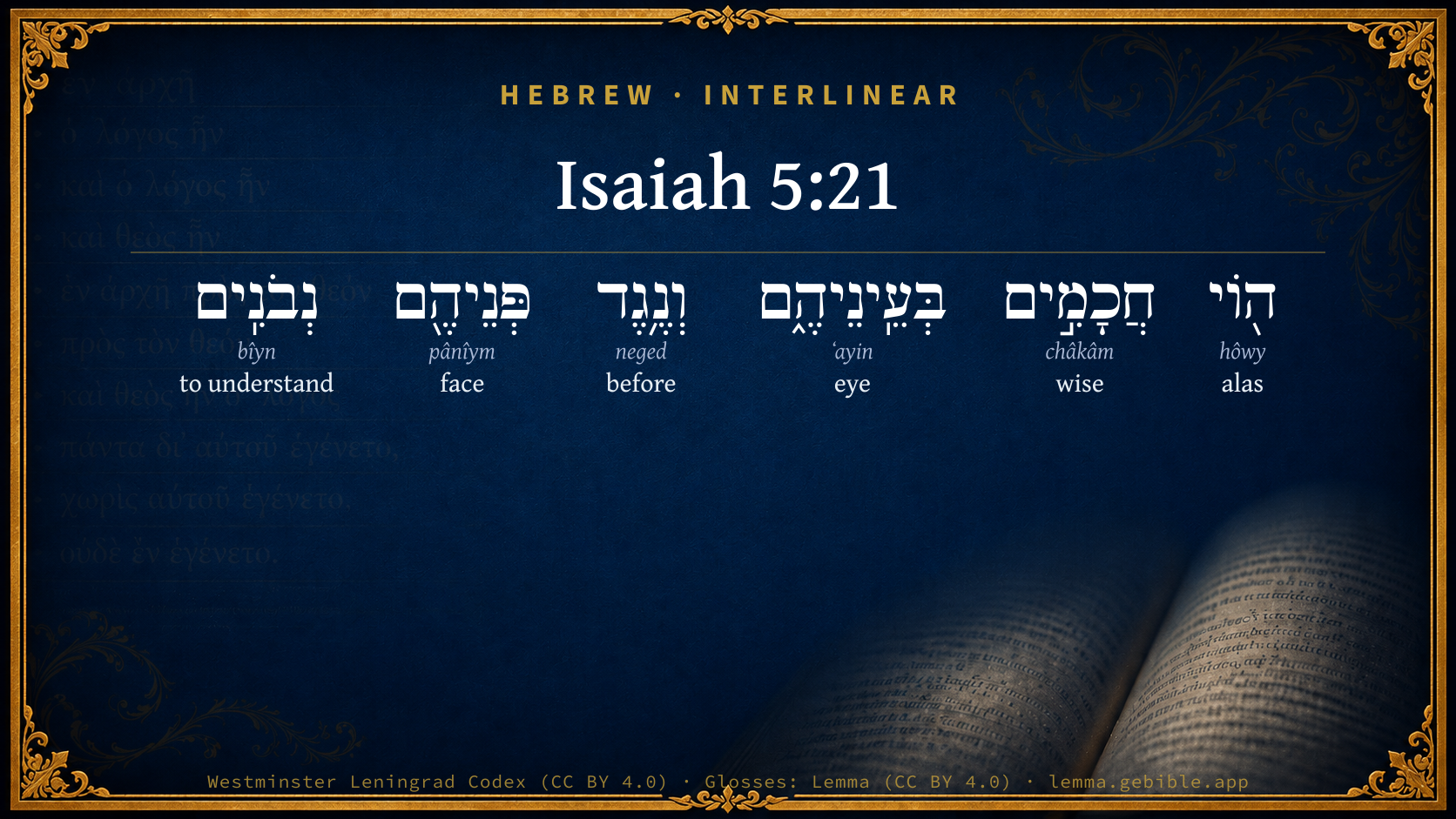
Isaiah 5:21

Hebrew (Westminster Leningrad Codex) Isaiah 5:21 appears in the Hebrew Old Testament. The text above is from the Westminster Leningrad Codex. Each word links to its Strong’s number, a concise gloss, and parsing drawn from the Open Scriptures Hebrew Bible morphology. Click any word for its full Brown-Driver-Briggs (BDB) entry.
Download image
Cite this verse

Isaiah 5:21 (World English Bible). Public Domain. Lemma interlinear Bible study tool, https://lemma.gebible.app/v/isaiah/5/21.

Show BibTeX & RIS
BibTeX
RIS
English Translation
Woe to those who are wise in their own eyes, And prudent in their own sight!
World English Bible · Public Domain
Download a study sheet

One document with this verse’s original text, its word-by-word gloss line, the meaning frame, cross-references with their text, attributed commentary, and full source and license credits — printable, and it pastes into notes with its structure intact.

This verse Autodidact and up

Study sheet (.html) Plain text (.txt)

A passage Seminary Student

Up to 50 verses in one chapter. A passage sheet keeps up to 6 commentary sources and 12 cross-references per verse, in the order this page ranks them, and says so on the sheet whenever that leaves anything out. Ask for a single verse and you get the Autodidact verse sheet above.

Everything on this page stays free to read, with no account — the sheet is a download of what is already on screen, not access to it.

Want to remove ads? Support Godless Engineer
Compare translations 3

The same verse in 3 English versions, stacked beneath the original-language interlinear above. Click any original word for its lexicon entry.

Each is an independent rendering of the whole verse — the interlinear is not word-aligned to these translations.

Highlighted words mark where these versions differ — a whole-verse word diff, not a word-by-word alignment.

  • World English Bible Public Domain
    Woe to those who are wise in their own eyes, And prudent in their own sight!
  • King James Version Public Domain
    Woe unto them that are wise in their own eyes, and prudent in their own sight!
  • unfoldingWord Literal Text CC BY-SA 4.0
    Woe to the wise in their eyes and the ones having understanding before their own faces. q1

unfoldingWord Literal Text — © unfoldingWord, licensed CC BY-SA 4.0. Word-aligned USFM3 via Door43 (git.door43.org/unfoldingWord/en_ult).

Versions to compare (up to 4)

3 of 4 selected

Show all 18 translations

Every available English version of this verse, each an independent rendering of the whole verse.

  • World English Bible Public Domain
    Woe to those who are wise in their own eyes, And prudent in their own sight!
  • Berean Standard Bible Public Domain
    Woe to those who are wise in their own eyes and clever in their own sight.
  • Majority Standard Bible Public Domain
    Woe to those who are wise in their own eyes and clever in their own sight.
  • King James Version Public Domain
    Woe unto them that are wise in their own eyes, and prudent in their own sight!
  • American Standard Version (1901) Public Domain
    Woe unto them that are wise in their own eyes, and prudent in their own sight!
  • Revised Version (1885) Public Domain
    Woe unto them that are wise their own eyes, and prudent in their own sight!
  • Geneva Bible (1599) Public Domain
    Woe vnto them that are wise in their owne eyes, and prudent in their owne sight.
  • Douay-Rheims (1899) Public Domain
    Woe to you that rue wise in your own eyes, and prudent in your own conceits.
  • Young's Literal Translation Public Domain
    Wo `to' the wise in their own eyes, And -- before their own faces -- intelligent!
  • Literal Standard Version CC BY-SA 4.0
    Woe [to] the wise in their own eyes, || And—before their own faces—intelligent!
  • Unlocked Literal Bible CC BY-SA 4.0
    Woe to those who are wise in their own eyes, and prudent in their own understanding!
  • unfoldingWord Literal Text CC BY-SA 4.0
    Woe to the wise in their eyes and the ones having understanding before their own faces. q1
  • Darby Bible Public Domain
    Woe unto them that are wise in their own eyes, and intelligent in their own esteem!
  • World Messianic Bible Public Domain
    Woe to those who are wise in their own eyes, and prudent in their own sight!
  • Webster's Bible Public Domain
    Woe to them that are wise in their own eyes, and prudent in their own sight!
  • Free Bible Version CC BY-SA 4.0
    Tragedy is coming to you who are wise in your own eyes and think you're so clever.
  • Bible in Basic English Public Domain
    Cursed are those who seem wise to themselves, and who take pride in their knowledge!
  • JPS Tanakh (1917) Public Domain
    Woe unto them that are wise in their own eyes, and prudent in their own sight!

Literal Standard Version (2020), Covenant Press — licensed CC BY-SA 4.0. Text via the HelloAO Bible API (eBible.org). Unlocked Literal Bible (unfoldingWord) — licensed CC BY-SA 4.0. Text via the HelloAO Bible API (eBible.org). unfoldingWord Literal Text — © unfoldingWord, licensed CC BY-SA 4.0. Word-aligned USFM3 via Door43 (git.door43.org/unfoldingWord/en_ult). Free Bible Version, Dr. Jonathan Gallagher — licensed CC BY-SA 4.0. Text via the HelloAO Bible API (eBible.org).

Word by word

More ways to search: Search by grammar → Find every occurrence → Compare this word →

Practice this passage: Drill this verse → Learn its vocabulary →

About this verse

These counts appear in no published source. They are computed here, from the morphology-tagged text and Lemma’s own curated glosses. What Lemma adds →

6
words
6
distinct lemmas
Prophets
section

Shared distinctive vocabulary

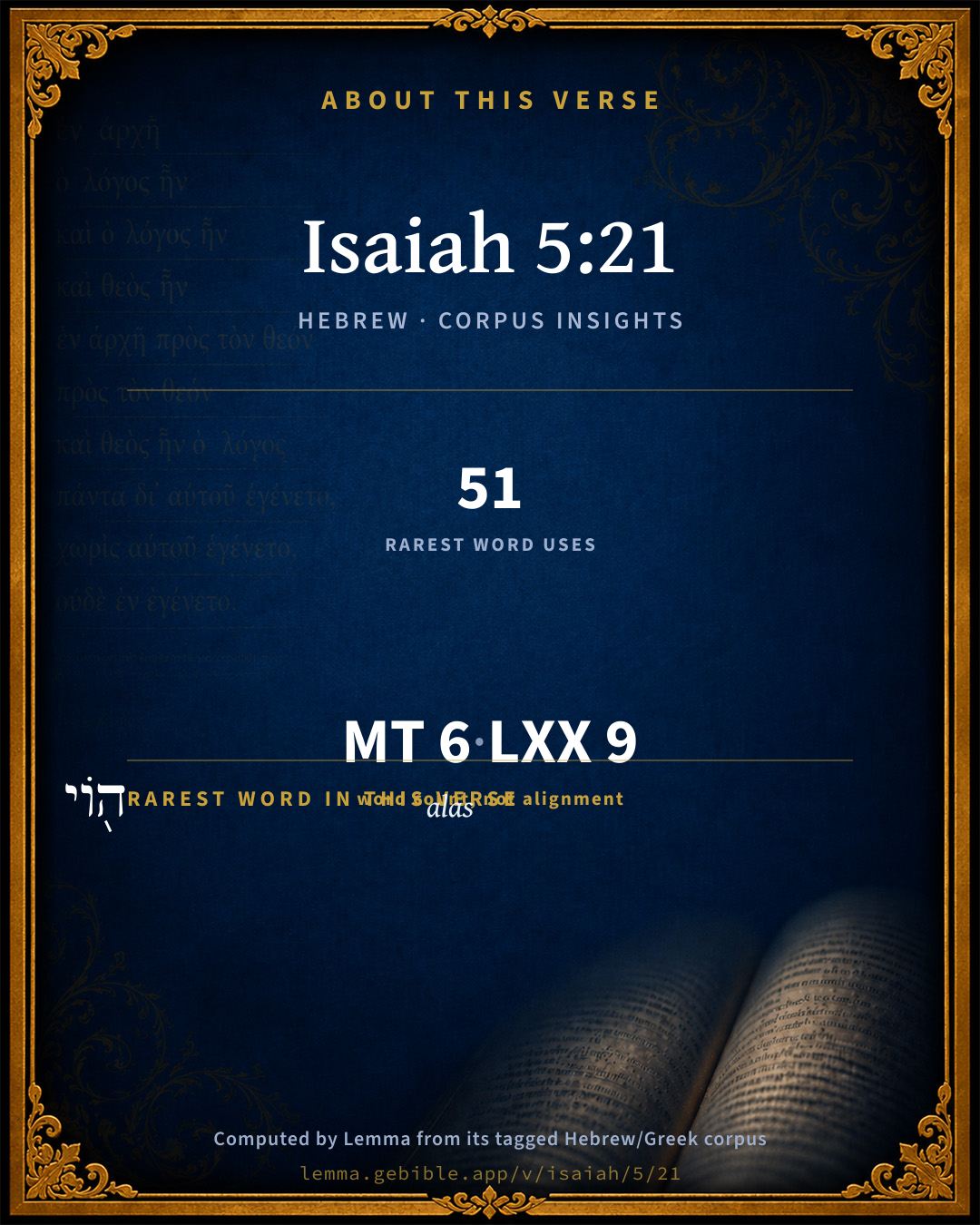
ה֖וֹי alas H1945 occurs in 47 verses of the Hebrew Bible. Also found in:

Grammatical profile

  • 1 verb
  • 2 nouns
  • 1 adjective
  • 1 preposition
  • 1 particle

Verb forms

  • נְבֹנִֽים Niphal · Participle Active

Hebrew & Septuagint length

In English translation the verse runs 16 words from the Hebrew and 16 from the Septuagint (LXX English) — the same length.

A rough comparison of the two English renderings, which tokenize alike — not a word-level alignment.

Word counts can differ between the Hebrew and the Greek without any difference in meaning — e.g. the Hebrew direct-object marker אֵת has no separate Greek word, and Greek often adds the article ὁ.

In the original languages it is 6 Hebrew tokens and 9 Greek tokens — but the two are counted differently (Hebrew bundles its prefixes and suffixes into one token; the Greek is in lemma form), so that isn’t a like-for-like length.

Cross-references

9

Topical passages linked to Isaiah 5:21 in the Treasury of Scripture Knowledge — connected by theme and wording, ordered by reader-vote popularity; previews shown in the World English Bible.

  • 1 Corinthians 3:18–20 Let no one deceive himself. If anyone thinks that he is wise among you in this world, let him become a fool, that he may become wise.
  • Proverbs 3:7 Don't be wise in your own eyes. Fear Yahweh, and depart from evil.
  • Romans 12:16 Be of the same mind one toward another. Don't set your mind on high things, but associate with the humble. Don't be wise in your own conceits.
  • Proverbs 26:12 Do you see a man wise in his own eyes? There is more hope for a fool than for him.
  • Proverbs 26:16 The sluggard is wiser in his own eyes Than seven men who answer with discretion.
  • Job 11:12 But vain man can become wise If a man can be born as a wild donkey's colt.
  • John 9:41 Jesus said to them, "If you were blind, you would have no sin; but now you say, 'We see.' Therefore your sin remains.
  • Romans 1:22 Professing themselves to be wise, they became fools,
  • Romans 11:25 For I don't desire, brothers, to have you ignorant of this mystery, so that you won't be wise in your own conceits, that a partial hardening has happened to Israel, until the fullness of the Gentiles has come in,

Cross-references courtesy of OpenBible.info (CC BY 4.0).

Hebrew and Greek witnesses Masoretic Hebrew ↔ Greek Septuagint

The same verse in the two great witnesses to the Old Testament, shown verse-for-verse.

These are two independent witnesses, not word-aligned to each other, and the Septuagint is shown in lemma (dictionary) form.

Hebrew Isaiah 5:21 Masoretic · Westminster Leningrad Codex

ה֖וֹי חֲכָמִ֣ים בְּעֵֽינֵיהֶ֑ם וְנֶ֥גֶד פְּנֵיהֶ֖ם נְבֹנִֽים

Woe to those who are wise in their own eyes, And prudent in their own sight!

World English Bible · Public Domain

Greek LXX Isaiah 5:21 Septuagint · lemma form

οὐαί ὁ συνετός ἐν ἑαυτοῦ καί ἐνώπιον ἑαυτοῦ ἐπιστήμων

Woe to them that are wise in their own conceit, and knowing in their own sight.

LXX2012 (modern English Septuagint) · Public Domain

Hebrew: Westminster Leningrad Codex (CC BY 4.0). Greek: Septuagint (public domain); English from LXX2012 (modern English Septuagint) (Public Domain). How the Septuagint differs from the Hebrew →

Targum (Aramaic paraphrase)

1

The Targum is the ancient Jewish Aramaic paraphrase of the Hebrew Scriptures — an interpretive translation, not the Hebrew text itself. Onkelos (literal) and Pseudo-Jonathan (expansive) render the Torah, and Jonathan the Prophets. Coverage is partial: where no permissively-licensed English translation exists for a verse, only the Aramaic is shown. This is verse-level text, not a word-by-word alignment to the Hebrew.

  1. Targum Jonathan Prophets (Joshua–Malachi)
    וַי דְחַכִּימִין בְּעֵינֵי נַפְשְׁהוֹן וְקָבֵיל אַפֵּיהוֹן סוּכְלְתָנִין:

    Woe unto them that are wise in their own eyes, and prudent in their own sight!

    Targum Jonathan — Aramaic: “Mikraot Gedolot” (public domain). English: “Sefaria Community Translation” (CC0 1.0 (public-domain dedication)); “London "Chaldee Paraphrase," 1871” (public domain). Text via Sefaria.

Commentary

Notes on Isaiah 5:21 from classic Christian and Jewish commentators (each source and its license shown beneath its notes). The classic Christian expositions comment on the surrounding passage and are grouped to its opening verse, so a note may address several verses; the Jewish commentaries on the Tanakh (Rashi and others) are per-verse, so they appear only where the commentator wrote on this verse.

Lemma curates 59 commentaries, every one of them public domain or Creative Commons licensed, each selected and text-cleaned for this edition rather than reprinted as found. About our sources →

Trapp's Complete Commentary

John Trapp

Isa 5:21 Woe unto [them that are] wise in their own eyes, and prudent in their own sight!

Ver. 21. Woe unto them that are wise in their own eyes.] Wiser than David - as the proud prince of Tyre thought himself {Eze 28:3} - or than any prophet of them all. This self-conceitedness is πασης της προκοπης εγκοπη, said that heathen, the hindrance of all true proficiency, and a mischievous marrer of good; here is a woe hung at the heels of it. And lest any should hold that to be a small matter, let them consider what befell Meroz after that bitter curse pronounced against it {Jdg 5:23} - the very name and memorial of it is utterly extinct and blotted out; as also what befell the barren fig tree when once cursed by Christ - it withered away suddenly, {Mat 21:19-20} both root and branch, though naturally the fig tree is the most juiceful of any tree, and beareth the brunt of winter blasts.

John Trapp, A Commentary or Exposition upon All the Books of the Old and New Testament (1647–1656) — public domain. Text from a community e-Sword module.

The Biblical Illustrator

Joseph S. Exell

Isa_5:21

Woe unto them that are wise in their own eyes

A false estimate of human wisdom

The sin reproved (as Calvin well observes) is not mere frivolous self-conceit, but that delusive estimate of human wisdom which may co-exist with modesty of manners and a high degree of real intellectual merit, but which must be abjured, not only on account of its effects, but also as involving the worst form of pride.

(J. A. Alexander.)

Wisdom and prudence: true and false

1. Persons are accounted wise and prudent who keep in view the most excellent dramas, who govern their potions with moderation, who conduct their affairs with discretion, and proportion their application to their several interests according to the dictates of well-informed minds, and the maxims of sound wisdom. They belong to this description who are possessed of a sound judgment, a quick penetration and extensive knowledge, and improve these accomplishments for attaining the most valuable purposes. The wisdom and prudence of which such persons are possessed cometh down from the Father of lights, with whom is no variableness, neither shadow of turning. According to the apostle James description, it is pure, free from the corruptions of sin and error; it is peaceable, disposing those who act under its influence to live in harmony and concord; it is gentle, bearing with meekness the infirmities and injuries of others; it is easy to be entreated by the persuasion of sound reason and good counsel; it is full of mercy toward the offending and the afflicted; it is without partiality in its operations, and without hypocrisy and dissimulation, being sincere in all its exertions.

2. Persons are said in Scripture to have those qualifications in their own eyes or sight, which they vainly reckon they have acquired. People are said to be wise or prudent in their own sight who flatter themselves that these characters indeed belong to them, until the hatefulness of their iniquity is discovered. Though they know but little, they were never sensible of their ignorance; though, in the view of God, and men of understanding, they are foolish, they never were convinced of their folly. Elated with their supposed excellence on every occasion, and even when there is no occasion, they proclaim their own praises, and applaud their own performance. (R. Macculloch.)

Self-conceit

I. ITS SIGNS. Dogmatism; contempt of others; scepticism.

II. ITS CAUSES. Ignorance; vanity.

III. ITS FOLLY. It makes a man ridiculous; leads him into error.

IV. ITS OFFENSIVENESS TO GOD--in spirit; principle; action.

V. ITS CERTAIN HUMILIATION. (J. Lyth, D. D.)

Prayer for Divine enlightenment

In Dr. Samuel Johnsons diary the following prayer was found, offered in view of his becoming a politician: Enlighten my understanding with the knowledge of right, and govern my will by Thy laws, that no deceit may mislead me, nor temptation corrupt me; that I may always endeavour to do good and hinder evil.

The Biblical Illustrator, edited by Joseph S. Exell (c. 1880s–1900s) — public domain. Text from a community e-Sword module.

Joseph Benson's Commentary

Isa 5:21. Wo unto them that are wise in their own eyes — Who, being puffed up with a high opinion of their own wisdom, despise the counsels and instructions of Jehovah by his prophets, and prefer their own vain imaginations before the decisions of infinite wisdom.

Joseph Benson's Commentary on the Old and New Testaments (1811–1818) — public domain. Text from a community e-Sword module.

Whedon's Commentary on the Bible

Daniel D. Whedon

Fifth woe — on the scornful self-conceit of errorists, Isa_5:21.

21. Wise… prudent — Those who conceive they possess the highest wisdom as against God’s wisdom, (administrative wisdom,) thus upsetting ordained social, civil, and moral law. This picture is more vividly given in Rom_1:18; Rom_1:22-23.

Daniel D. Whedon (gen. ed.), Commentary on the Old and New Testaments (1874–1909) — public domain. Text from a community e-Sword module.

The Preacher's Complete Homiletical Commentary

Joseph S. Exell (gen. ed.)

SELF-CONCEIT

Isa_5:21. Woe unto them that are wise in their own eyes, and prudent in their own sight.

Self-conceit.

I. Its signs: dogmatism; contempt of others; scepticism.

II. Its causes: ignorance [667] vanity.

[667] The truest characters of ignorance

Are vanity, and pride, and arrogance;

As blind men use to bear their noses higher

Than those that have their eyes and sight entire.

—Butler.

By ignorance is pride increased;

Those most assume who know the least:

Their own self-balance gives them weight,

But every other finds them light.

—Gay.

III. Its folly: it makes a man ridiculous; leads him into error.

IV. Its offensiveness to God; in spirit—principle—action. V. Its certain humiliation.—J. Lyth, D.D.

INTELLECTUAL PRIDE

Isa_5:21. Woe unto them that are wise in their own eyes, and prudent in their own sight.

Woe to the intellectually proud. I. To the self-conceited sceptic, who sits in judgment upon the Word of God, and condemns it [670] II. To the self-conceited enthusiast, who substitutes his own fancies for Divine truth. III. To the self-conceited Pharisee, who trusts in his own works. IV. To the self-conceited sinner, who despises instruction. V. Woe! for they shall all perish.—J. Lyth, D.D.

[670] The denial of anything does not falsify it. If a man has swallowed poison, his adopting an opinion that it cannot kill him, contributes nothing to his safety; and it is awful to stand and see his conviction and his death arriving together. Your denying a resurrection, will not hide you for ever in the grave. Your disbelieving a day of retribution, will not keep you from appearing before God. “Their judgment,” says the apostle, “now of a long time lingereth not, and their damnation slumbereth not:” while they reason, it rolls on; every argument brings it one distance nearer.—Jay.

The Preacher's Complete Homiletical Commentary (gen. ed. Joseph S. Exell; Funk & Wagnalls, c. 1892) — public domain (pre-1929). A full-Bible homiletical/sermon-outline anthology covering 65 of 66 books (2 John is absent from the source module). Text from a community e-Sword module.

Tyndale Open Study Notes

Tyndale Open Resources

5:21 What sorrow: The fifth threat of judgment concerned the folly of self-deception.

Tyndale Open Study Notes — © Tyndale Open Resources, licensed CC BY-SA 4.0. Text via the HelloAO Bible API.

Geneva Bible (1599)

Geneva Bible translators

Which are contemners of all doctrine and admonition.

Geneva Bible (1599) marginal notes — public domain. Text via Bolls.life.

Jamieson, Fausset & Brown

Robert Jamieson, A. R. Fausset & David Brown

Fifth Woe--against those who were so "wise in their own eyes" as to think they knew better than the prophet, and therefore rejected his warnings (Isa 29:14-15).

Jamieson, Fausset & Brown — Commentary Critical and Explanatory on the Whole Bible (1871) — public domain (CC PDM 1.0). Text via the HelloAO Bible API.

Ellicott's Commentary for English Readers

(21) Woe unto them that are wise in their own eyes.—Here again the prophet would seem to have definite individual counsellors in his mind. For such men the ideal of statesmanship was a series of shifts and expedients, based upon no principle of righteousness. (Comp. Isa_29:15; Isa_30:1.)

A Bible Commentary for English Readers, edited by Charles John Ellicott (1878–1897) — public domain. Text from a community e-Sword module.

The Cambridge Bible for Schools and Colleges

gen. ed. J. J. S. Perowne

21. The fifth woe, against the self-satisfied astuteness of the politicians. That the prophet has the statesmen in his eye is probable from such passages as Isa_28:9 f., Isa_29:14 f., Isa_30:1; Isa_30:10 f., Isa_31:1 f.

The Cambridge Bible for Schools and Colleges (gen. ed. J. J. S. Perowne; Cambridge University Press, 1878–1918) — public domain. Text from a community e-Sword module.

John Gill's Exposition

Woe unto therm that are wise in their own eyes,.... And yet betray such stupidity and sottishness, as to call things by their wrong names; and make such a perverse judgment of them, as before described. This is a true description of the Scribes and Pharisees in Christ's time; who said, "dost thou teach us? are we blind also?" Joh 9:34.

and prudent in their own sight; being wise above what was written; leaving the word of God, and following the traditions of the elders.

John Gill's Exposition of the Whole Bible (1746–1763) — public domain (CC PDM 1.0). Text via the HelloAO Bible API.

Albert Barnes' Notes on the Bible

Wo unto them that are wise ... - This is the fifth crime specified. It refers to those who are inflated with a false opinion of their own knowledge, and who are, therefore, self-confident and vain. This is expressly forbidden; Pro 3:7 : ‘Be not wise in thine own eyes;’ compare Pro 26:12.

In their own eyes - In their own opinion, or estimation.

And prudent - Knowing; self-conceited. This was, doubtless, one characteristic of the times of Isaiah. It is known to have been strikingly the characteristic of the Jews - particularly the Pharisees - in the time of our Saviour. The evil of this was,

(1) That it evinced and fostered “pride.”

(2) That it rendered them unwilling to be instructed, and especially by the prophets.

As they supposed that they were already wise enough, they refused to listen to others. This is always the effect of such self-confidence: and hence, the Saviour required his disciples to be meek, and humble, and teachable as children.

Albert Barnes' Notes on the Bible (1834–1885) — public domain. Text from a community e-Sword/MySword module.

Haydock's Catholic Bible Commentary

Conceits. Blind guides, Matthew xv. 14.

George Leo Haydock (1774–1849), Haydock's Catholic Family Bible and Commentary, 1859 edition — public domain. Excludes Psalms (Douay-Rheims chapter numbering differs from Protestant) and Deuterocanonical books (Catholic canon only).

Matthew Poole's English Annotations

That being puffed up with an opinion of their own wisdom, despise the counsels and instructions of God by his prophets, and prefer their own vain fancies before the judgment of the all-wise God, as appears by the error before mentioned, Isa 5:20, that they affirmed that to be evil which God had declared to be good.

Matthew Poole's English Annotations on the Holy Bible (1683–1685) — public domain. Text from a community e-Sword/MySword module.

The Pulpit Commentary

Woe unto them that are wise in their own eyes. The fifth woe. Self-conceit is the antithesis of humility; and as humility is, in a certain sense, the crowning virtue, so self-conceit is a sort of finishing touch put to vice. While a man thinks humbly of himself, there is a chance that he may repent and amend. When he is "wise in his own eyes," he does not see why he should change.

The pitiful estate of the proud.

We may well commiserate those who are "wise in their own eyes," inasmuch as

I THEY HAVE A FALSE CONCEPTION AS TO THEIR OWN CAPACITY. They think themselves able to determine what is true and beautiful and good, when they are painfully and pitifully in need of guidance from without; their estimate of themselves is essentially wrong. They "live in a fool"s paradise.

II THEY ARE SHUTTING OUT FROM THEIR MINDS THE TRUTH WHICH WOULD REDEEM AND ENNOBLE THEM. The blessing of the Lord is promised to the humble-hearted, to those who have the docility of the little child. It is they, and they only, who are willing to empty themselves of their own fancies and follies that they may receive the eternal truth of God. The men who think themselves wise can find no room in their minds for those Divine teachings which save, which purify, which enlarge, which transform the heart and life. (see 1Co_3:18)

III THEY ARE IS A SPIRITUAL CONDITION WHICH IS POSITIVELY AND EVEN PECULIARLY OFFENSIVE TO GOD. The Word of God, Old Testament and New, is studded with texts in which the displeasure of Almighty God is revealed against the haughty of heart. God resists" the proud, and causes them to fall. It is the appoint Pharisee who is not justified in the great Teacher"s parable, who is continually rebuked by the Lord of truth, who is repeatedly condemned by the Searcher of souls. We may therefore conclude, concerning those who are prudent in their own sight, that

IV THEY ARE ALL UNREADY FOR THE GREAT DAY OF TRIAL. They will then find themselves rejected instead of being accepted and commended, and to the gloom of condemnation will be added the bitter mortification of being utterly and miserably disappointed. C.

The Pulpit Commentary (1880–1919), ed. H.D.M. Spence-Jones & Joseph S. Exell — public domain. Text from a community e-Sword module.

Keil & Delitzsch

C. F. Keil & F. Delitzsch

The fifth woe: "Woe unto them that are wise in their own eyes, and prudent in their own sight." The third woe had reference to the unbelieving naturalists, the opponents of prophecy (nebuâh); the fourth to the moralists, who threw all into confusion; and to this there is appended, by a very natural association of ideas, the woe denounced upon those whom want of humility rendered inaccessible to that wisdom which went hand in hand with prophecy, and the true foundation of which was the fear of Jehovah (Pro 1:7; Job 28:28; Ecc 12:13). "Be not wise in thine own eyes," is a fundamental rule of this wisdom (Pro 3:7). It was upon this wisdom that that prophetic policy rested, whose warnings, as we read in Isa 28:9-10, they so scornfully rejected. The next woe, which has reference to the administration of justice in the state, shows very clearly that in this woe the prophet had more especially the want of theocratic wisdom in relation to the affairs of state in his mind.

Keil & Delitzsch — Biblical Commentary on the Old Testament (1861–1891) — public domain (CC PDM 1.0). Text via the HelloAO Bible API. (Old Testament only.)

J. A. Alexander on Isaiah

Joseph Addison Alexander

Here, as in the foregoing verse, one sin follows another without any intervening description of punishment. This arrangement may imply a very intimate connection between the sins thus brought into juxtaposition. As presumptuous sin, such as vs. 18, 19 describe, implies a perversion of the moral sense, such as v. 20 describes, so the latter may be said to presuppose an undue reliance upon human reason, which is elsewhere contrasted with the fear of God (Pro 3:7), and is indeed incompatible with it. “Woe unto the wise in their eyes (i.e., their own eyes, which cannot be otherwise expressed in Hebrew) and before their own faces (in their own sight or estimation) prudent,” intelligent, a synonym of wise. The sin reproved, as Calvin well observes, is not mere frivolous self-conceit, but that delusive estimate of human wisdom which may co-exist with modesty of manners and a high degree of real intellectual merit, but which must be abjured, not only on account of its effects, but also as involving the worst form of pride.

Joseph Addison Alexander, The Prophecies of Isaiah (1846–1847; New York: Scribner, 1870–1878) — public domain. Text from a community e-Sword module.

Ibn Ezra

Rabbi Abraham ibn Ezra

Woe unto them that are wise, etc. They do not know how to discern between good and evil, yet think themselves wise.

Ibn Ezra on the Tanakh — English translations: “Sefaria Community Translation” (CC0 1.0 (public-domain dedication)); “Yalkut, Sifsei Chachomim Chumash, Metsudah Publications, 2009” (CC BY 4.0); and “Commentary of Ibn Ezra on Isaiah - trans. by M. Friedlander, 1873” (public domain). Text via Sefaria.

Lesson kit

Teaching starters — assembled from the data on this page, not authored interpretation. Every prompt links to the verse data it draws on. Edit before teaching.

Isaiah, in the Prophets, opens this verse with 6 words (6 distinct Hebrew lemmas). Its most distinctive word is hôwy (“alas”). A historical commentator’s framing appears above. Read the whole chapter for the surrounding context.

Discussion questions

  1. How does “alas” (hôwy) shape what this verse is saying?
  2. How does 1 Kings 13:30, which shares the word «alas», read alongside this verse?
  3. The translations on this page render this verse differently — a whole-verse word diff, not a word-by-word alignment. What might account for the different wordings?
  4. «נְבֹנִֽים» is a Niphal Participle Active verb. How does that grammatical form shape the action described?
  5. Compare how Trapp's Complete Commentary and The Biblical Illustrator read this verse. Where do they agree or differ?

Things to notice

Reading settings

Reading text

Shown beneath each verse's original-language words.

Old Testament
Old Testament edition

Read the OT as the Masoretic Hebrew (MT) or the Greek Septuagint (LXX).

English shown for the Greek Septuagint (in the Hebrew ↔ Greek comparison).

Comparing translations? Open the Compare panel on any verse page to stack up to four side by side.