Isaiah 32:4

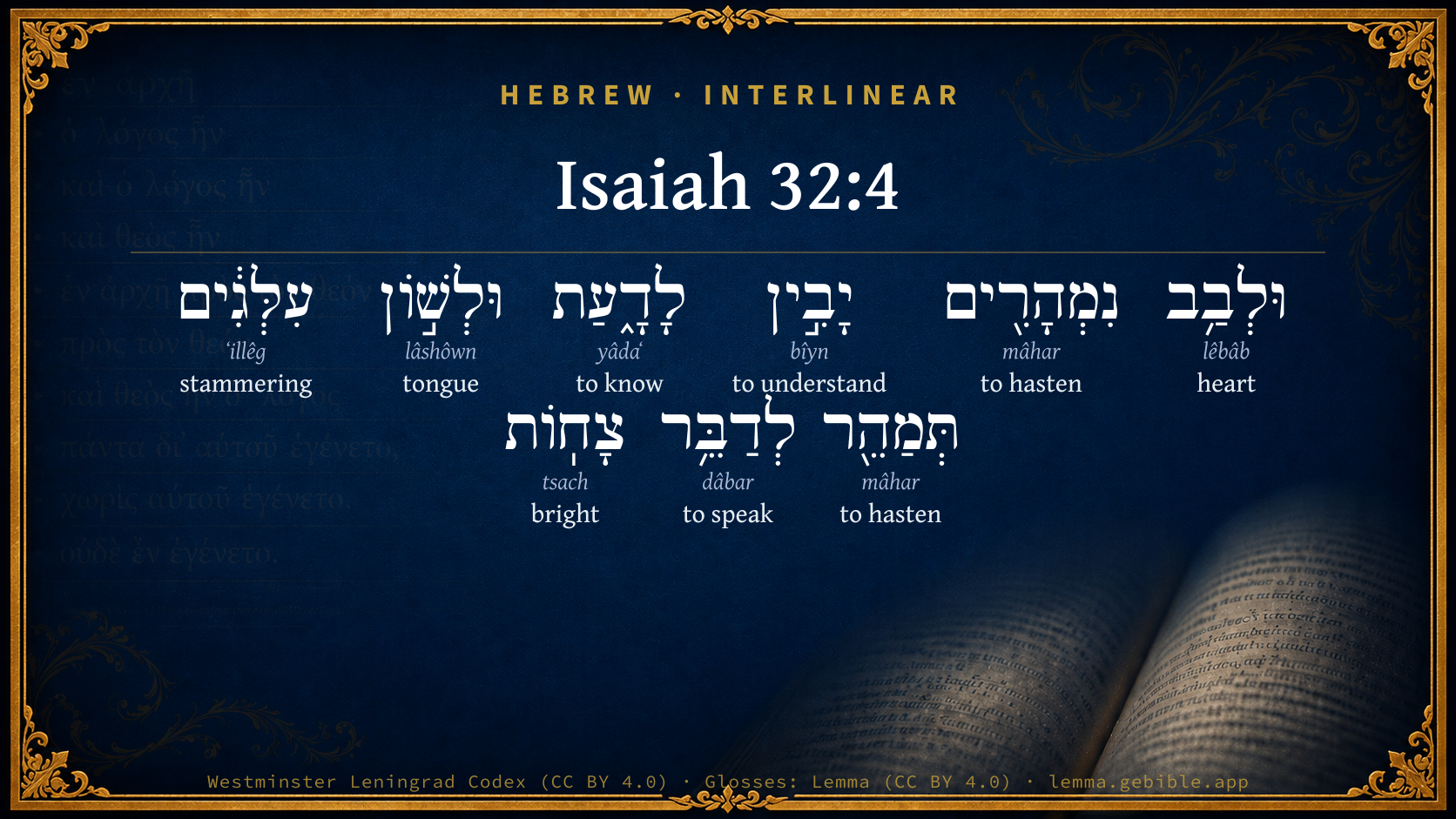
Hebrew (Westminster Leningrad Codex) Isaiah 32:4 appears in the Hebrew Old Testament. The text above is from the Westminster Leningrad Codex. Each word links to its Strong’s number, a concise gloss, and parsing drawn from the Open Scriptures Hebrew Bible morphology. Click any word for its full Brown-Driver-Briggs (BDB) entry.
Download image
Cite this verse

Isaiah 32:4 (World English Bible). Public Domain. Lemma interlinear Bible study tool, https://lemma.gebible.app/v/isaiah/32/4.

Show BibTeX & RIS
BibTeX
RIS
English Translation
The heart of the rash shall understand knowledge, and the tongue of the stammerers shall be ready to speak plainly.
World English Bible · Public Domain
Highlights
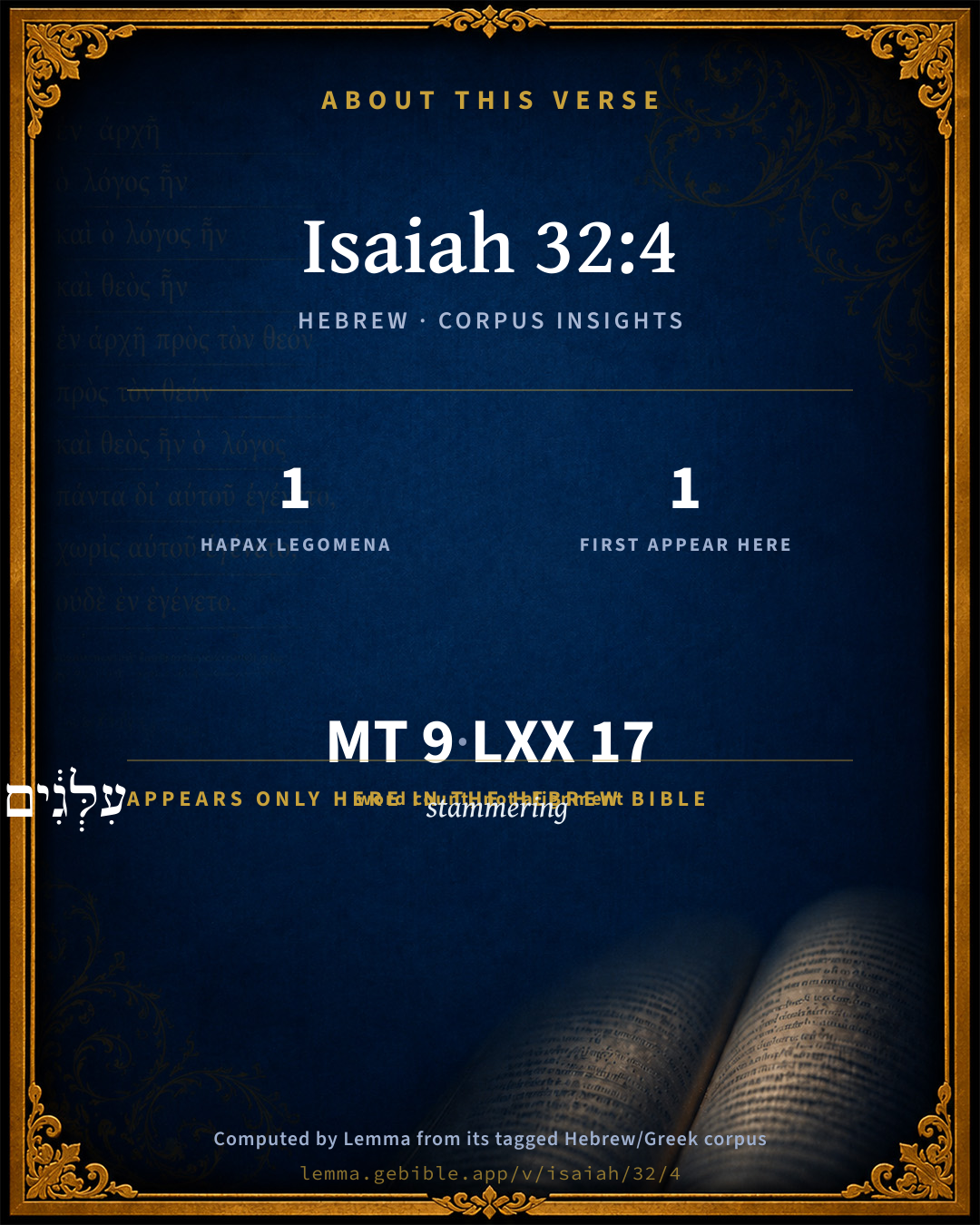
  • 1 hapax legomenon — only here in the Hebrew Bible
  • 1 first appearance in the Hebrew Bible
Full analysis ↓
Download a study sheet

One document with this verse’s original text, its word-by-word gloss line, the meaning frame, cross-references with their text, attributed commentary, and full source and license credits — printable, and it pastes into notes with its structure intact.

This verse Autodidact and up

Study sheet (.html) Plain text (.txt)

A passage Seminary Student

Up to 50 verses in one chapter. A passage sheet keeps up to 6 commentary sources and 12 cross-references per verse, in the order this page ranks them, and says so on the sheet whenever that leaves anything out. Ask for a single verse and you get the Autodidact verse sheet above.

Everything on this page stays free to read, with no account — the sheet is a download of what is already on screen, not access to it.

Want to remove ads? Support Godless Engineer
Compare translations 3

The same verse in 3 English versions, stacked beneath the original-language interlinear above. Click any original word for its lexicon entry.

Each is an independent rendering of the whole verse — the interlinear is not word-aligned to these translations.

Highlighted words mark where these versions differ — a whole-verse word diff, not a word-by-word alignment.

  • World English Bible Public Domain
    The heart of the rash shall understand knowledge, and the tongue of the stammerers shall be ready to speak plainly.
  • King James Version Public Domain
    The heart also of the rash shall understand knowledge, and the tongue of the stammerers shall be ready to speak plainly.
  • unfoldingWord Literal Text CC BY-SA 4.0
    And the heart of the ones hastening themselves will understand knowledge, and the tongue of the stuttering will hasten to speak clearly.

unfoldingWord Literal Text — © unfoldingWord, licensed CC BY-SA 4.0. Word-aligned USFM3 via Door43 (git.door43.org/unfoldingWord/en_ult).

Versions to compare (up to 4)

3 of 4 selected

Show all 18 translations

Every available English version of this verse, each an independent rendering of the whole verse.

  • World English Bible Public Domain
    The heart of the rash shall understand knowledge, and the tongue of the stammerers shall be ready to speak plainly.
  • Berean Standard Bible Public Domain
    The mind of the rash will know and understand, and the stammering tongue will speak clearly and fluently.
  • Majority Standard Bible Public Domain
    The mind of the rash will know and understand, and the stammering tongue will speak clearly and fluently.
  • King James Version Public Domain
    The heart also of the rash shall understand knowledge, and the tongue of the stammerers shall be ready to speak plainly.
  • American Standard Version (1901) Public Domain
    And the heart of the rash shall understand knowledge, and the tongue of the stammerers shall be ready to speak plainly.
  • Revised Version (1885) Public Domain
    The heart also of the rash shall understand knowledge, and the tongue of the stammerers shall be ready to speak plainly.
  • Geneva Bible (1599) Public Domain
    And the heart of the foolish shall vnderstand knowledge, and the tongue of the stutters shalbe ready to speake distinctly.
  • Douay-Rheims (1899) Public Domain
    And the heart of fools shall understand knowledge, and the tongue of stammerers shall speak readily and plain.
  • Young's Literal Translation Public Domain
    And the heart of those hastened Understandeth to know, And the tongue of stammerers hasteth to speak clearly.
  • Literal Standard Version CC BY-SA 4.0
    And the heart of those hurried understands to know, || And the tongue of stammerers hurries to speak clearly.
  • Unlocked Literal Bible CC BY-SA 4.0
    The rash will think carefully with understanding, and the stutterer will speak distinctly and with ease.
  • unfoldingWord Literal Text CC BY-SA 4.0
    And the heart of the ones hastening themselves will understand knowledge, and the tongue of the stuttering will hasten to speak clearly.
  • Darby Bible Public Domain
    and the heart of the rash shall understand knowledge, and the tongue of the stammerers shall be ready to speak plainly.
  • World Messianic Bible Public Domain
    The heart of the rash will understand knowledge, and the tongue of the stammerers will be ready to speak plainly.
  • Webster's Bible Public Domain
    The heart also of the rash shall understand knowledge, and the tongue of the stammerers shall be ready to speak plainly.
  • Free Bible Version CC BY-SA 4.0
    Those whose minds are impulsive will be sensible and think things through; those who stammer will speak clearly.
  • Bible in Basic English Public Domain
    The man of sudden impulses will become wise in heart, and he whose tongue is slow will get the power of talking clearly.
  • JPS Tanakh (1917) Public Domain
    The heart also of the rash shall understand knowledge, and the tongue of the stammerers shall be ready to speak plainly.

Literal Standard Version (2020), Covenant Press — licensed CC BY-SA 4.0. Text via the HelloAO Bible API (eBible.org). Unlocked Literal Bible (unfoldingWord) — licensed CC BY-SA 4.0. Text via the HelloAO Bible API (eBible.org). unfoldingWord Literal Text — © unfoldingWord, licensed CC BY-SA 4.0. Word-aligned USFM3 via Door43 (git.door43.org/unfoldingWord/en_ult). Free Bible Version, Dr. Jonathan Gallagher — licensed CC BY-SA 4.0. Text via the HelloAO Bible API (eBible.org).

Word by word

More ways to search: Search by grammar → Find every occurrence → Compare this word →

Practice this passage: Drill this verse → Learn its vocabulary →

About this verse

These counts appear in no published source. They are computed here, from the morphology-tagged text and Lemma’s own curated glosses. What Lemma adds →

9
words
8
distinct lemmas
Prophets
section

Notable vocabulary

1 hapax legomenon — a word that appears only here in the entire Hebrew Bible:

  • עִלְּגִ֔ים stammering H5926

First appearance in Scripture

This word makes its first canonical appearance in the Hebrew Bible here:

  • עִלְּגִ֔ים stammering H5926

Shared distinctive vocabulary

צָחֽוֹת bright H6703 occurs in 4 verses of the Hebrew Bible. Also found in:

Grammatical profile

  • 5 verbs
  • 2 nouns
  • 2 adjectives

Verb forms

  • נִמְהָרִ֖ים Niphal · Participle Active
  • יָבִ֣ין Qal · Imperfect
  • לָדָ֑עַת Qal · Infinitive Construct
  • תְּמַהֵ֖ר Piel · Imperfect
  • לְדַבֵּ֥ר Piel · Infinitive Construct

Repetition

A word recurs within this verse — often emphatic in Hebrew:

  • נִמְהָרִ֖ים to hasten H4116 ×2

Hebrew & Septuagint length

In English translation the verse runs 20 words from the Hebrew and 21 from the Septuagint (LXX English) — closely comparable.

A rough comparison of the two English renderings, which tokenize alike — not a word-level alignment.

Word counts can differ between the Hebrew and the Greek without any difference in meaning — e.g. the Hebrew direct-object marker אֵת has no separate Greek word, and Greek often adds the article ὁ.

In the original languages it is 9 Hebrew tokens and 17 Greek tokens — but the two are counted differently (Hebrew bundles its prefixes and suffixes into one token; the Greek is in lemma form), so that isn’t a like-for-like length.

Cross-references

12

Topical passages linked to Isaiah 32:4 in the Treasury of Scripture Knowledge — connected by theme and wording, ordered by reader-vote popularity; previews shown in the World English Bible.

  • Isaiah 29:24 They also who err in spirit shall come to understanding, and those who murmur shall receive instruction.
  • Luke 21:14–15 Settle it therefore in your hearts not to meditate beforehand how to answer,
  • Exodus 4:11 Yahweh said to him, "Who made man's mouth? Or who makes one mute, or deaf, or seeing, or blind? Isn't it I, Yahweh?
  • Nehemiah 8:8–12 They read in the book, in the law of God, distinctly; and they gave the sense, so that they understood the reading.
  • Song of Solomon 7:9 Your mouth like the best wine, That goes down smoothly for my beloved, Gliding through the lips of those who are asleep.
  • Matthew 11:25 At that time, Jesus answered, "I thank you, Father, Lord of heaven and earth, that you hid these things from the wise and understanding, and revealed them to infants.
  • Matthew 16:17 Jesus answered him, "Blessed are you, Simon Bar Jonah, for flesh and blood has not revealed this to you, but my Father who is in heaven.
  • Acts 2:4–12 They were all filled with the Holy Spirit, and began to speak with other languages, as the Spirit gave them the ability to speak.
  • Acts 4:13 Now when they saw the boldness of Peter and John, and had perceived that they were unlearned and ignorant men, they marveled. They recognized that they had been with Jesus.
  • Acts 6:7 The word of God increased and the number of the disciples multiplied in Jerusalem exceedingly. A great company of the priests were obedient to the faith.
  • Acts 26:9–11 "I myself most assuredly thought that I ought to do many things contrary to the name of Jesus of Nazareth.
  • Galatians 1:23 but they only heard: "He who once persecuted us now preaches the faith that he once tried to destroy."

Cross-references courtesy of OpenBible.info (CC BY 4.0).

Hebrew and Greek witnesses Masoretic Hebrew ↔ Greek Septuagint

The same verse in the two great witnesses to the Old Testament, shown verse-for-verse.

These are two independent witnesses, not word-aligned to each other, and the Septuagint is shown in lemma (dictionary) form.

Hebrew Isaiah 32:4 Masoretic · Westminster Leningrad Codex

וּלְבַ֥ב נִמְהָרִ֖ים יָבִ֣ין לָדָ֑עַת וּלְשׁ֣וֹן עִלְּגִ֔ים תְּמַהֵ֖ר לְדַבֵּ֥ר צָחֽוֹת

The heart of the rash shall understand knowledge, and the tongue of the stammerers shall be ready to speak plainly.

World English Bible · Public Domain

Greek LXX Isaiah 32:4 Septuagint · lemma form

καί ὁ καρδία ὁ ἀσθενέω προςἔχω ὁ ἀκούω καί ὁ γλῶσσα ὁ ψελλίζω ταχύς μανθάνω λαλέω εἰρήνη

And the heart of the weak ones shall attend to hear, and the stammering tongues shall soon learn to speak peace.

LXX2012 (modern English Septuagint) · Public Domain

Hebrew: Westminster Leningrad Codex (CC BY 4.0). Greek: Septuagint (public domain); English from LXX2012 (modern English Septuagint) (Public Domain). How the Septuagint differs from the Hebrew →

Targum (Aramaic paraphrase)

1

The Targum is the ancient Jewish Aramaic paraphrase of the Hebrew Scriptures — an interpretive translation, not the Hebrew text itself. Onkelos (literal) and Pseudo-Jonathan (expansive) render the Torah, and Jonathan the Prophets. Coverage is partial: where no permissively-licensed English translation exists for a verse, only the Aramaic is shown. This is verse-level text, not a word-by-word alignment to the Hebrew.

  1. Targum Jonathan Prophets (Joshua–Malachi)
    וּלְבַב מְהַרְהֲרִין יְסַבַּר לְמֵידַע וְלִישָׁנְהוֹן דַהֲוָה בְלִים יוֹחִי לְמַלָלָא בְּצַחְצְחָן:

    Even the heart of the rash shall understand knowledge, and the tongue of those that was tied shall be ready to speak plainly.

    Targum Jonathan — Aramaic: “Mikraot Gedolot” (public domain). English: “Sefaria Community Translation” (CC0 1.0 (public-domain dedication)); “London "Chaldee Paraphrase," 1871” (public domain). Text via Sefaria.

Commentary

Notes on Isaiah 32:4 from classic Christian and Jewish commentators (each source and its license shown beneath its notes). The classic Christian expositions comment on the surrounding passage and are grouped to its opening verse, so a note may address several verses; the Jewish commentaries on the Tanakh (Rashi and others) are per-verse, so they appear only where the commentator wrote on this verse.

Lemma curates 59 commentaries, every one of them public domain or Creative Commons licensed, each selected and text-cleaned for this edition rather than reprinted as found. About our sources →

Trapp's Complete Commentary

John Trapp

Isa 32:4 The heart also of the rash shall understand knowledge, and the tongue of the stammerers shall be ready to speak plainly.

Ver. 4. The heart also of the rash.] Heb., Of the hasty ones, such as are headlong and inconsiderate, that weigh not things, that say not, What shall we do in the end thereof?

And the tongue of the stammerers.] That once did but bungle at holy discourse, pronouncing as it were Sibboleth for Shibboleth, and marring a good tale in the telling; as not understanding either what they say, or whereof they affirm. {1Ti 1:7}

Shall be ready to speak plainly.] Shall be forward to speak fruitfully, having a holy dexterity therein. The Corinthians are commended for their utterance; {1Co 1:5} they could express themselves fitly, and they would do it freely.

To speak plainly.] Heb., Neat or clear words; limpida, nitida; a metaphor from clear or fair weather.

John Trapp, A Commentary or Exposition upon All the Books of the Old and New Testament (1647–1656) — public domain. Text from a community e-Sword module.

Jamieson, Fausset & Brown

Robert Jamieson, A. R. Fausset & David Brown

rash--rather, "the hasty"; contrast "shall not make haste" (Isa 28:16); the reckless who will not take time to weigh religious truth aright. Or else, the well-instructed [HORSLEY].

stammers--those who speak confusedly on divine things (compare Exo 4:10-12; Jer 1:6; Mat 10:19-20). Or, rather, those drunken scorners who in stammering style imitated Isaiah's warnings to mock them [MAURER] (Isa 28:7-11, Isa 28:13-14, Isa 28:22; Isa 29:20); in this view, translate, "speak uprightly" (agreeably to the divine law); not as English Version, referring to the distinctness of articulation, "plainly."

Jamieson, Fausset & Brown — Commentary Critical and Explanatory on the Whole Bible (1871) — public domain (CC PDM 1.0). Text via the HelloAO Bible API.

Ellicott's Commentary for English Readers

(4) The heart also of the rash . . .—“Heart,” as in Pro_4:23 and elsewhere, for the intellect rather than the emotions. The “rash” are those that are “hurried,” precipitate, reckless; the “stammerers,” those who have no power to speak clearly of the things of God, who hesitate and are undecided.

A Bible Commentary for English Readers, edited by Charles John Ellicott (1878–1897) — public domain. Text from a community e-Sword module.

The Cambridge Bible for Schools and Colleges

gen. ed. J. J. S. Perowne

4. the rash] i.e. the hasty, inconsiderate person, who constantly blurts out crude and ill-judged opinions. The stammerers, on the other hand, are those who, even when their thoughts are right, lack the gift of clear utterance. To the former class is promised “understanding,” to the latter the power to speak promptly and “plainly” (lit. lucidities). Sound judgment and fluent speech combine to form a good popular orator.

The Cambridge Bible for Schools and Colleges (gen. ed. J. J. S. Perowne; Cambridge University Press, 1878–1918) — public domain. Text from a community e-Sword module.

John Gill's Exposition

The heart also of the rash shall understand knowledge,.... Such who have been hasty and precipitant, as the word (c) signifies; who have not given themselves time to consider what they have read or heard, or has been proposed unto them, and have hastily received every thing that has been suggested to them, especially by carnal sense and reason, shall now sit down, and coolly consider things, and so gain an understanding of divine and spiritual knowledge, of the knowledge of Christ, of his person, offices, grace, righteousness, and salvation; an experimental knowledge and understanding of these things, heart and not head knowledge:

and the tongue of the stammerer shall be ready to speak plainly; or, "shall make haste to speak neatly" (d); elegantly and politely; such who hesitated in their speech, and spoke in a blundering manner, and scarcely intelligibly, especially when they spoke of divine and spiritual things, yet now, without the least hesitation, in the freest and most ready manner, with all plainness and propriety shall talk of these things, to the great delight, satisfaction, and use of those that hear them: this was true of the apostles of Christ, those babes and sucklings, out of whose mouth God ordained praise, and who were most of them Galilaeans, very illiterate and unpolished, and yet these, especially when they had the gift of tongues, spake the great things of God very readily, and in good language; and also is true of other ministers of the word, raised up among the barbarous nations of the world.

(c) "inconsideratorum", Junius & Tremellius, Piscator; "praecipatorum", Montanus. (d) "festinabit loqui nitida", Pagninus; "polite", Munster; "diserte", Calvin; "loqui venusta", Cocceius.

John Gill's Exposition of the Whole Bible (1746–1763) — public domain (CC PDM 1.0). Text via the HelloAO Bible API.

Albert Barnes' Notes on the Bible

The heart also of the rash - Margin, ‘Hasty.’ The Hebrew word denotes those who hasten; that is, those who are precipitate in forming a judgment, or deciding on a course of action. They do not take time to deliberate, and consequently they are led headlong into error, and into improper courses of life.

Shall understand knowledge - They shall take time to deliberate; and they shall consequently form a more enlightened judgment.

And the tongue of the stammerers - The ‘stammerers’ (compare the note at Isa 28:11) seem here to denote those who had indistinct and confused views of subjects, or who were incapable of expressing clear and intelligible views of divine truth.

Shall be ready to speak plainly - Margin, ‘Elegantly.’ The Hebrew is צתות tsâthôth ‘clear,’ ‘white,’ usually applied to a bright, clear, white light. The sense is, that there should be no indistinctness or obscurity in their views and modes of utterance.

Albert Barnes' Notes on the Bible (1834–1885) — public domain. Text from a community e-Sword/MySword module.

Haydock's Catholic Bible Commentary

Plain. Some parts of the prediction relate literally to the Old Testament. But this alludes to the New, when the mysteries of religion are clearly confessed in the Catholic Church. (Worthington) --- Even the most illiterate are guided with security, if they will but hear the Church. (Haydock)

George Leo Haydock (1774–1849), Haydock's Catholic Family Bible and Commentary, 1859 edition — public domain. Excludes Psalms (Douay-Rheims chapter numbering differs from Protestant) and Deuterocanonical books (Catholic canon only).

Matthew Poole's English Annotations

The rash; who were hasty and heady in judging of things; which is an argument of ignorance and folly.

Shall understand knowledge; shall become more knowing and considerate in their judgments and actions.

The stammerers; that used to speak of the things of God darkly, and doubtfully, and unwillingly. As men’s understandings shall then be enlightened, so their speech shall be reformed; which though it was in part fulfilled in Hezekiah; this reformation being effected in some measure by his counsel and example, and by the powerful preaching of the Levites, whom he excited and encouraged to teach the good knowledge of the Lord, as is said, 2Ch 30:22; yet was truly and fully accomplished only by Christ, who wrought this wonderful change in an innumerable company both of Jews and Gentiles.

Matthew Poole's English Annotations on the Holy Bible (1683–1685) — public domain. Text from a community e-Sword/MySword module.

The Pulpit Commentary

The heart also of the rash; i.e. of those who were rash and hasty, who would not give themselves time to understand the warnings addressed to them, or to think of the real character of their actions. These shall, in Messiah"s kingdom, "have the gift of discernment to perceive things in their true nature" (Delitzsch). The tongue of the stammerers. The tongue of those who hitherto have spoken hesitatingly and inconsistently on moral and religions subjects shall be ready i.e., prompt and eager to speak upon them with clearness and elegance. The grace given to the uneducated fishermen of Galilee enabled them to preach and teach gospel truth, not only with clearness, but with refinement.

The Pulpit Commentary (1880–1919), ed. H.D.M. Spence-Jones & Joseph S. Exell — public domain. Text from a community e-Sword module.

John Wesley's Explanatory Notes

The rash - Who were hasty in judging of things; which is an argument of ignorance and folly. The tongue - That used to speak of the things of God, darkly, and doubtfully; which though it was in part fulfilled in Hezekiah, yet was truly and fully accomplished only by Christ, who wrought this wonderful change in an innumerable company both of Jews and Gentiles.

John Wesley, Explanatory Notes Upon the Whole Bible (1754–1765) — public domain. Text via the GEBible commentary corpus.

J. A. Alexander on Isaiah

Joseph Addison Alexander

“And the heart (or mind) of the rash (heedless or reckless) shall understand to know (or understand knowledge), and the tongue of stammerers shall hasten to speak clear things (i.e., shall speak readily and plainly).” The bodily defects here mentioned denote others of an intellectual and spiritual nature, neglect and ignorance of spiritual matters. The minds of men shall begin to be directed to religious truth, and delivered from ignorance and error in relation to it.

Joseph Addison Alexander, The Prophecies of Isaiah (1846–1847; New York: Scribner, 1870–1878) — public domain. Text from a community e-Sword module.

unfoldingWord translationNotes

Door43 World Missions Community

General Information:

Isaiah continues describing the people after God restores righteous rulers in Judah. (See: Isaiah 32:1-3)

The rash ... the stutterer

This refers to people who act rashly and people who stutter. AT: "The rash person ... the stuttering person" (See: Nominal Adjectives)

The fool will no longer be called honorable

This can be stated in active form. AT: "No one will give honor to the fool" (See: Active or Passive)

For the fool speaks folly, and his heart plans evil

"The fool" refers to foolish people. Also, "folly" and "evil" may be expressed as adjectives. AT: "For the foolish person says foolish things and his heart plans evil things" (See: Nominal Adjectives and Abstract Nouns)

his heart plans evil

Here the foolish person is referred to by his heart to emphasize his inner thoughts. AT: "he plans evil things in his heart" (See: Synecdoche)

nor the deceiver called principled

This can be stated in active form. "The deceiver" refers to a person who is deceptive. AT: "nor will anyone show respect to the person who deceives" (See: Active or Passive and Nominal Adjectives)

He makes

The word "he" refers to the foolish person.

the hungry empty

"The hungry" refers to hungry people. They are hungry because they have empty stomachs. AT: "the hungry person have an empty stomach" (See: Nominal Adjectives and Assumed Knowledge and Implicit Information)

the thirsty he causes to lack drink

"The thirsty" refers to people who are thirsty. AT: "he causes the thirsty person to have nothing to drink" (See: Nominal Adjectives)

translationWords

fool

honor

deceive

heart

Yahweh

unfoldingWord translationNotes — © Distant Shores Media and the Door43 World Missions Community, licensed CC BY-SA 4.0. Source: git.door43.org/Door43/en_tn.

Rashi

Rabbi Shlomo Yitzchaki (Rashi)

And the heart of the hasty shall understand to know Not like now, that “this people’s heart is becoming fat” (ibid.).

and the tongue of the stammerers, etc. Not like now, “for with distorted speech” (supra 28:11).

stammerers Anyone who does not know how to direct his speech to be clear is termed עִלֵּג or נִלְעַג.

Rashi on the Tanakh — English translations: “The Judaica Press complete Tanach with Rashi, translated by A. J. Rosenberg” (CC BY 4.0); “Pentateuch with Rashi's commentary by M. Rosenbaum and A.M. Silbermann, 1929-1934” (public domain); “The Metsudah Tanach series, Lakewood, N.J” (CC BY 4.0); and “The Book of Joshua, Metsudah Publications, 1997” (CC BY 4.0). Text via Sefaria.

Ibn Ezra

Rabbi Abraham ibn Ezra

נמהרים The rash. Hasty in a foolish way. It is derived from מהר to be hasty.

עלגים The stammerers. Hap. leg.; in Arabic it means slaves. It is contrasted with to speak plainly (דבר צחות).

צחות Pure words. Supply מלות words; for צחות is an adj., in form and meaning like זכות.

Ibn Ezra on the Tanakh — English translations: “Sefaria Community Translation” (CC0 1.0 (public-domain dedication)); “Yalkut, Sifsei Chachomim Chumash, Metsudah Publications, 2009” (CC BY 4.0); and “Commentary of Ibn Ezra on Isaiah - trans. by M. Friedlander, 1873” (public domain). Text via Sefaria.

Lesson kit

Teaching starters — assembled from the data on this page, not authored interpretation. Every prompt links to the verse data it draws on. Edit before teaching.

Isaiah, in the Prophets, opens this verse with 9 words (8 distinct Hebrew lemmas). Its most distinctive word is ʻillêg (“stammering”). A historical commentator’s framing appears above. Read the whole chapter for the surrounding context.

Discussion questions

  1. What does “stammering” (ʻillêg) contribute to the verse as a whole?
  2. This verse holds 1 word here found nowhere else in the Hebrew Bible. What might the rare word draw attention to?
  3. The word “stammering” first appears here in Scripture. What is being introduced at this debut?
  4. Song of Solomon 5:10 shares the word «bright» with this verse. How do the two illuminate each other?
  5. “to hasten” occurs 2× in this one verse. What is the effect of the repetition?
  6. These translations render this verse differently. What is at stake in choosing one wording over another?
  7. The verb «נִמְהָרִ֖ים» is Niphal Participle Active. How does its form color the action?
  8. Reading how Trapp's Complete Commentary and Jamieson, Fausset & Brown read this verse, where do the two commentators agree and where do they part?

Things to notice

  • 1 word in this verse appears nowhere else in the Hebrew Bible.
  • 1 word makes its first canonical appearance in Scripture here.
  • This verse counts 9 Hebrew ↔ 17 Greek words.
  • These translations choose different wording for 13 words in this verse.
  • “to hasten” occurs 2× in this single verse.

Reading settings

Reading text

Shown beneath each verse's original-language words.

Old Testament
Old Testament edition

Read the OT as the Masoretic Hebrew (MT) or the Greek Septuagint (LXX).

English shown for the Greek Septuagint (in the Hebrew ↔ Greek comparison).

Comparing translations? Open the Compare panel on any verse page to stack up to four side by side.