
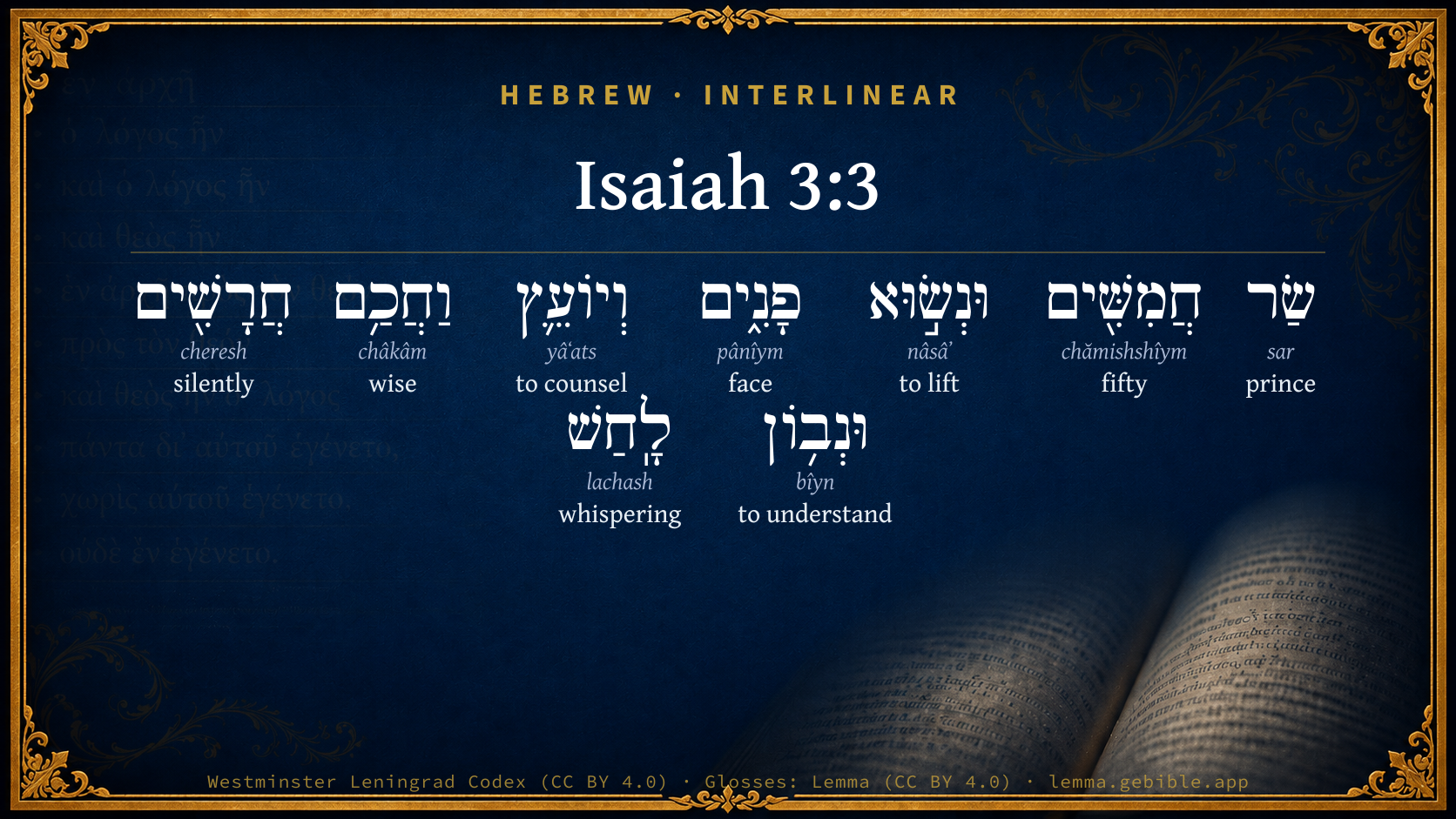
Isaiah 3:3

Hebrew (Westminster Leningrad Codex) Isaiah 3:3 appears in the Hebrew Old Testament. The text above is from the Westminster Leningrad Codex. Each word links to its Strong’s number, a concise gloss, and parsing drawn from the Open Scriptures Hebrew Bible morphology. Click any word for its full Brown-Driver-Briggs (BDB) entry.
Download image
Cite this verse

Isaiah 3:3 (World English Bible). Public Domain. Lemma interlinear Bible study tool, https://lemma.gebible.app/v/isaiah/3/3.

Show BibTeX & RIS
BibTeX
RIS
English Translation
The captain of fifty, The honorable man, The counselor, The skilled craftsman, And the clever enchanter.
World English Bible · Public Domain
Download a study sheet

One document with this verse’s original text, its word-by-word gloss line, the meaning frame, cross-references with their text, attributed commentary, and full source and license credits — printable, and it pastes into notes with its structure intact.

This verse Autodidact and up

Study sheet (.html) Plain text (.txt)

A passage Seminary Student

Up to 50 verses in one chapter. A passage sheet keeps up to 6 commentary sources and 12 cross-references per verse, in the order this page ranks them, and says so on the sheet whenever that leaves anything out. Ask for a single verse and you get the Autodidact verse sheet above.

Everything on this page stays free to read, with no account — the sheet is a download of what is already on screen, not access to it.

Want to remove ads? Support Godless Engineer
Compare translations 3

The same verse in 3 English versions, stacked beneath the original-language interlinear above. Click any original word for its lexicon entry.

Each is an independent rendering of the whole verse — the interlinear is not word-aligned to these translations.

Highlighted words mark where these versions differ — a whole-verse word diff, not a word-by-word alignment.

  • World English Bible Public Domain
    The captain of fifty, The honorable man, The counselor, The skilled craftsman, And the clever enchanter.
  • King James Version Public Domain
    The captain of fifty, and the honourable man, and the counsellor, and the cunning artificer, and the eloquent orator.
  • unfoldingWord Literal Text CC BY-SA 4.0
    commander of fifty and one lifted up face and counselor and wise of crafts and the one instructed of enchantment.

unfoldingWord Literal Text — © unfoldingWord, licensed CC BY-SA 4.0. Word-aligned USFM3 via Door43 (git.door43.org/unfoldingWord/en_ult).

Versions to compare (up to 4)

3 of 4 selected

Show all 18 translations

Every available English version of this verse, each an independent rendering of the whole verse.

  • World English Bible Public Domain
    The captain of fifty, The honorable man, The counselor, The skilled craftsman, And the clever enchanter.
  • Berean Standard Bible Public Domain
    the commander of fifty and the dignitary, the counselor, the cunning magician, and the clever enchanter.
  • Majority Standard Bible Public Domain
    the commander of fifty and the dignitary, the counselor, the cunning magician, and the clever enchanter.
  • King James Version Public Domain
    The captain of fifty, and the honourable man, and the counsellor, and the cunning artificer, and the eloquent orator.
  • American Standard Version (1901) Public Domain
    the captain of fifty, and the honorable man, and the counsellor, and the expert artificer, and the skilful enchanter.
  • Revised Version (1885) Public Domain
    the captain of fifty, and the honourable man, and the counsellor, and the cunning artificer, and the skilful enchanter.
  • Geneva Bible (1599) Public Domain
    The captaine of fiftie, and the honourable, and the counseller, and the cunning artificer, and the eloquent man.
  • Douay-Rheims (1899) Public Domain
    The captain over fifty, and the honourable in countenance, and the counsellor, and the architect, and the skilful in eloquent speech.
  • Young's Literal Translation Public Domain
    Head of fifty, and accepted of faces, And counsellor, and the wise of artificers, And the intelligent of charmers.
  • Literal Standard Version CC BY-SA 4.0
    Head of fifty, and accepted of faces, || And counselor, and wise craftsmen, || And discerning charmer.
  • Unlocked Literal Bible CC BY-SA 4.0
    the captain of fifty and the respected citizen, the counselor, the expert craftsman and the skillful enchanter.
  • unfoldingWord Literal Text CC BY-SA 4.0
    commander of fifty and one lifted up face and counselor and wise of crafts and the one instructed of enchantment.
  • Darby Bible Public Domain
    the captain of fifty, and the honourable man, and the counsellor, and the clever among artificers, and the one versed in enchantments.
  • World Messianic Bible Public Domain
    the captain of fifty, the honorable man, the counselor, the skilled craftsman, and the clever enchanter.
  • Webster's Bible Public Domain
    The captain of fifty, and the honorable man, and the counselor, and the skillful artificer, and the eloquent orator.
  • Free Bible Version CC BY-SA 4.0
    army captains, state officials, counselors, craftsmen, masters of magic, and experts in the occult.
  • Bible in Basic English Public Domain
    The captain of fifty, and the man of high position, and the wise guide, and the wonder-worker, and he who makes use of secret powers.
  • JPS Tanakh (1917) Public Domain
    The captain of fifty, and the man of rank, and the counsellor, and the cunning charmer, and the skilful enchanter.

Literal Standard Version (2020), Covenant Press — licensed CC BY-SA 4.0. Text via the HelloAO Bible API (eBible.org). Unlocked Literal Bible (unfoldingWord) — licensed CC BY-SA 4.0. Text via the HelloAO Bible API (eBible.org). unfoldingWord Literal Text — © unfoldingWord, licensed CC BY-SA 4.0. Word-aligned USFM3 via Door43 (git.door43.org/unfoldingWord/en_ult). Free Bible Version, Dr. Jonathan Gallagher — licensed CC BY-SA 4.0. Text via the HelloAO Bible API (eBible.org).

Word by word

More ways to search: Search by grammar → Find every occurrence → Compare this word →

Practice this passage: Drill this verse → Learn its vocabulary →

About this verse

These counts appear in no published source. They are computed here, from the morphology-tagged text and Lemma’s own curated glosses. What Lemma adds →

9
words
9
distinct lemmas
Prophets
section

Notable vocabulary

The rarest word here is חֲרָשִׁ֖ים silently H2791 — appearing just 3 times in the whole Hebrew Bible.

Shared distinctive vocabulary

חֲרָשִׁ֖ים silently H2791 occurs in 3 verses of the Hebrew Bible. Also found in:

Grammatical profile

  • 3 verbs
  • 4 nouns
  • 2 adjectives

Verb forms

  • וּנְשׂ֣וּא Qal · Participle Passive
  • וְיוֹעֵ֛ץ Qal · Participle Active
  • וּנְב֥וֹן Niphal · Participle Active

Hebrew & Septuagint length

In English translation the verse runs 16 words from the Hebrew and 17 from the Septuagint (LXX English) — closely comparable.

A rough comparison of the two English renderings, which tokenize alike — not a word-level alignment.

Word counts can differ between the Hebrew and the Greek without any difference in meaning — e.g. the Hebrew direct-object marker אֵת has no separate Greek word, and Greek often adds the article ὁ.

In the original languages it is 9 Hebrew tokens and 11 Greek tokens — but the two are counted differently (Hebrew bundles its prefixes and suffixes into one token; the Greek is in lemma form), so that isn’t a like-for-like length.

Cross-references

6

Topical passages linked to Isaiah 3:3 in the Treasury of Scripture Knowledge — connected by theme and wording, ordered by reader-vote popularity; previews shown in the World English Bible.

  • Exodus 18:21 Moreover you shall provide out of all the people able men, such as fear God: men of truth, hating unjust gain; and place such over them, to be rulers of thousands, rulers of hundreds, rulers of fifties, and rulers of tens.
  • Deuteronomy 1:15 So I took the heads of your tribes, wise men, and known, and made them heads over you, captains of thousands, and captains of hundreds, and captains of fifties, and captains of tens, and officers, according to your tribes.
  • Judges 8:18 Then said he to Zebah and Zalmunna, What manner of men were they whom you killed at Tabor? They answered, As you are, so were they; each one resembled the children of a king.
  • 1 Samuel 8:12 and he will appoint them to him for captains of thousands, and captains of fifties; and [he will set some] to plow his ground, and to reap his harvest, and to make his instruments of war, and the instruments of his chariots.
  • Exodus 4:10 Moses said to Yahweh, "Oh, Lord, I am not eloquent, neither before now, nor since you have spoken to your servant; for I am slow of speech, and of a slow tongue."
  • Exodus 4:14–16 The anger of Yahweh was kindled against Moses, and he said, "What about Aaron, your brother, the Levite? I know that he can speak well. Also, behold, he comes forth to meet you. When he sees you, he will be glad in his heart.

Cross-references courtesy of OpenBible.info (CC BY 4.0).

Hebrew and Greek witnesses Masoretic Hebrew ↔ Greek Septuagint

The same verse in the two great witnesses to the Old Testament, shown verse-for-verse.

These are two independent witnesses, not word-aligned to each other, and the Septuagint is shown in lemma (dictionary) form.

Hebrew Isaiah 3:3 Masoretic · Westminster Leningrad Codex

שַׂר חֲמִשִּׁ֖ים וּנְשׂ֣וּא פָנִ֑ים וְיוֹעֵ֛ץ וַחֲכַ֥ם חֲרָשִׁ֖ים וּנְב֥וֹן לָֽחַשׁ

The captain of fifty, The honorable man, The counselor, The skilled craftsman, And the clever enchanter.

World English Bible · Public Domain

Greek LXX Isaiah 3:3 Septuagint · lemma form

καί πεντηκοντάρχος καί θαυμαστός σύμβουλος καί σοφός ἀρχιτέκτων καί συνετός ἀκροατής

the captain of fifty also, and the honorable counsellor, and the wise artificer, and the intelligent hearer.

LXX2012 (modern English Septuagint) · Public Domain

On this verse, John Gill's Exposition discusses the Septuagint’s reading. Read the note in Commentary ↓

Hebrew: Westminster Leningrad Codex (CC BY 4.0). Greek: Septuagint (public domain); English from LXX2012 (modern English Septuagint) (Public Domain). How the Septuagint differs from the Hebrew →

Targum (Aramaic paraphrase)

1

The Targum is the ancient Jewish Aramaic paraphrase of the Hebrew Scriptures — an interpretive translation, not the Hebrew text itself. Onkelos (literal) and Pseudo-Jonathan (expansive) render the Torah, and Jonathan the Prophets. Coverage is partial: where no permissively-licensed English translation exists for a verse, only the Aramaic is shown. This is verse-level text, not a word-by-word alignment to the Hebrew.

  1. Targum Jonathan Prophets (Joshua–Malachi)
    רַב חַמְשִׁין וּנְסֵב אַפִּין וּמָלֵיךְ מֵילַךְ וַאֲמַר וּמִשְׁתְּמַע וְחַכִּים וְסוּכְלְתָן בְּעֵצָה:

    The captain of fifty, and the honourable man, and the counsellor, and he that commands, and he that obeyeth, and the wise in counsel.

    Targum Jonathan — Aramaic: “Mikraot Gedolot” (public domain). English: “Sefaria Community Translation” (CC0 1.0 (public-domain dedication)); “London "Chaldee Paraphrase," 1871” (public domain). Text via Sefaria.

Commentary

Notes on Isaiah 3:3 from classic Christian and Jewish commentators (each source and its license shown beneath its notes). The classic Christian expositions comment on the surrounding passage and are grouped to its opening verse, so a note may address several verses; the Jewish commentaries on the Tanakh (Rashi and others) are per-verse, so they appear only where the commentator wrote on this verse.

Lemma curates 59 commentaries, every one of them public domain or Creative Commons licensed, each selected and text-cleaned for this edition rather than reprinted as found. About our sources →

Trapp's Complete Commentary

John Trapp

Isa 3:3 The captain of fifty, and the honourable man, and the counsellor, and the cunning artificer, and the eloquent orator.

Ver. 3. The captain of fifty.] One of the least and lowest commanders in war; such also shall fail, and therefore all must needs fall to wreck and ruin. This Epaminondas when he was dying foresaw at Thebes, and therefore counselled his countrymen to make peace upon any terms. {a}

And the honourable.] Heb., The man eminent in countenance; Sept., Yαυμαστον, a man of respect and authority. In the eyes of Augustus Caesar sat such a rare majesty, as a man could hardly endure to behold them without closing of his own.

And the cunning artificer.] Such as was Hiram, whom for honour’s sake Solomon called father; Archimedes, and such others who are of great use to a State, for making of engines and instruments.

And the eloquent orator.] Heb., Skilled in charms. Quintilian describes an orator thus: Vir bonus dicendi peritus, A good man well spoken. Ille regit dictis animos et pectora mulcet, He carrieth the people which way he pleaseth. The Athenians called such δημαγωγους, and set a high price upon them, as they did on Pericles, Demosthenes, Phocion, &c. {b}

{a} Plutarch.

{b} Intelligentem, meditatam et gravem orationem. - Oecolamp.

John Trapp, A Commentary or Exposition upon All the Books of the Old and New Testament (1647–1656) — public domain. Text from a community e-Sword module.

Geneva Bible (1599)

Geneva Bible translators

By these he meaneth that God would take away everything that was in any estimation, and wherein they had any occasion to vaunt themselves.

Geneva Bible (1599) marginal notes — public domain. Text via Bolls.life.

Jamieson, Fausset & Brown

Robert Jamieson, A. R. Fausset & David Brown

captain of fifty--not only captains of thousands, and centurions of a hundred, but even semi-centurions of fifty, shall fail.

honourable--literally, "of dignified aspect."

cunning--skilful. The mechanic's business will come to a standstill in the siege and subsequent desolation of the state; artisans are no mean "stay" among a nation's safeguards.

eloquent orator--rather, as Vulgate, "skilled in whispering," that is, incantation (Psa 58:5). See Isa 8:19, below; and on "prudent," see on Isa 3:2.

Jamieson, Fausset & Brown — Commentary Critical and Explanatory on the Whole Bible (1871) — public domain (CC PDM 1.0). Text via the HelloAO Bible API.

Ellicott's Commentary for English Readers

(3) The captain of fifty, and the honourable man.—The first title implies a division like that of Exo_18:21, of which “fifty” was all but the minimum unit. So we have the three “captains of fifty” in 2Ki_1:9-15. The “honourable man” (literally, eminent in countenance) would seem to occupy a position in the civil service of the State analogous to that of the “captain of fifty” in the military.

The counsellor, and the cunning artificer.—From the modern stand-point the two classes seem at opposite extremes of the social order. The latter, however (literally, masters in arts), would seem to have occupied a higher position in the East, like that of military or civil engineers or artists with us. So in 2Ki_24:14, Jer_24:1, the “craftsmen and the smiths” are grouped with the “men of might” who were carried to Babylon by Nebuchadnezzar, and contrasted with the poor who were left behind. The military works of Uzziah had doubtless given a prominence to the “cunning men” who were employed on them (2Ch_26:15). By some critics, however, the word is taken as equal to “magician.”

The eloquent orator.—Literally, skilled in speech. The Authorised Version suggests the idea of the power of such skill in controlling the debates of popular assemblies. Here, however, the thought is rather that of one who says the right words at the right time; or possibly the enchanter who has his formulæ (the word implies the whisper of incantations, as in Isa_8:19) ready at command for all occasions.

A Bible Commentary for English Readers, edited by Charles John Ellicott (1878–1897) — public domain. Text from a community e-Sword module.

The Cambridge Bible for Schools and Colleges

gen. ed. J. J. S. Perowne

3. honourable man] lit. “man of respect”; either one high in the king’s favour (2Ki_5:1) or a man of good social standing, without official rank (Job_22:8).

cunning artificer] lit. “skilled in arts.” It is disputed whether the arts in question are mechanical or magical; hence the alternative “charmer “in R.V. marg. At all events

eloquent orator should be skilful enchanter (R.V.).

The Cambridge Bible for Schools and Colleges (gen. ed. J. J. S. Perowne; Cambridge University Press, 1878–1918) — public domain. Text from a community e-Sword module.

John Gill's Exposition

The captain of fifty,.... A semi-centurion, such an one as in Kg2 1:9. So far should there be from being captains of thousands, and of hundreds, that there should not be one of fifty:

and the honourable man; by birth, breeding, and behaviour, through riches and greatness; and one of power and authority among the people, and in their favour and esteem:

and the counsellor; one able to give advice in matters of moment and difficulty, and in controversy between man and man; it suggests that nothing should be done with advice and counsel, with wisdom and discretion, but all tumult and sedition, as the history of these times shows: the Jews (b) interpret this of one that knows how to intercalate years, and fix the months: and the

cunning artificer: in any kind of metal, old, silver, brass, and iron, and in any sort of wood, and in any kind of manual and mechanical business; which would now be laid aside, shops shuts up, and all trade and business neglected and discouraged, occasioned partly by the siege without, and chiefly by their internal divisions and robberies, and by their zealots and cutthroats, which swarmed among them. The Septuagint render it, "the wise architect", or "masterbuilder"; the same word is used by the apostle in Co1 3:10,

and the eloquent orator; who has the tongue of the learned, and can speak a word in season to the distressed; or who is able to plead at the bar the cause of the injured and oppressed, the widow and the fatherless. Aben Ezra interprets it of one that is skilful in enchanting serpents; that charms wisely, as in Psa 58:5 it may be rendered, "one that understands enchantment" (c): with the Septuagint it is a "prudent hearer"; sad is the case of a nation when men of so much usefulness are taken away from them. See Kg2 24:15.

(b) T. Bab. Chagiga & Jarchi, ut supra. (fol. 14. 1. Jarchi in loc.) (c) "intelligentem incantationis", Vatablus.

John Gill's Exposition of the Whole Bible (1746–1763) — public domain (CC PDM 1.0). Text via the HelloAO Bible API.

Albert Barnes' Notes on the Bible

The captain of fifty - By this was probably denoted an officer in the army. The idea is, that the commanders of the various divisions of the army should be taken away.

The honourable man - Hebrew פנים נשׂוּא nes'û' pânı̂ym. “The man of elevated countenance.” That is, the man high in office. He was so called from the aspect of dignity which a man in office would assume. In the previous chapter, the phrase is used to denote rather the “pride” which attended such officers, than the dignity of the office itself.

And the counselor - Note, Isa 1:26.

The cunning artificer - Hebrew, The man wise in mechanic arts: skilled in architecture, etc.

And the eloquent orator - לחשׁ נבון nebôn lâchash. literally, skilled or learned in whispering, in conjuration, in persuasion. The word לחשׁ lachash denotes properly a whispering, sighing, or calling for help; (Isa 26:16, ‘they have poured out a prayer,’ לחשׁ lachash - a secret speech, a feeble sigh for aid.) It is applied to the charm of the serpents - the secret breathing or gentle noise by which the charm is supposed to be effected; Psa 58:6; Jer 8:17; Ecc 10:11. In Isa 3:20 of this chapter it denotes a charm or amulet worn by females; see the note at that verse. It is also applied to magic, or conjuration - because this was usually done by gentle whispering, or incantation; see the note at Isa 8:19. From this use of the word, it comes to denote one that influences another; one who persuades him in any way, as an orator does by argument and entreaty. Ancient orators also probably sometimes used a species of recitative, or measured cadence, not unlike that employed by those who practiced incantations. Jerome says that it means here, ‘a man who is learned, and acquainted with the law, and the prophets.’ Chaldee, ‘The prudent in council.’ It “may” be used in a good sense here; but if so, it is probably the only place where the word is so used in the Old Testament. A prophecy similar to this occurs in Hos 3:4 : ‘For the children of Israel shall abide many days without a king, and without a prince, and without a sacrifice, and without an image, and without an ephod, and without teraphim.’

Albert Barnes' Notes on the Bible (1834–1885) — public domain. Text from a community e-Sword/MySword module.

Haydock's Catholic Bible Commentary

Countenance. Septuagint, "the admired counsellor," (Haydock) who came into the king’s presence. --- Architect. 4 Kings xxiv. 14. (Calmet) --- Eloquent. Literally, "mystic." (Haydock) --- Aquila and Symmachus, "enchanter."

George Leo Haydock (1774–1849), Haydock's Catholic Family Bible and Commentary, 1859 edition — public domain. Excludes Psalms (Douay-Rheims chapter numbering differs from Protestant) and Deuterocanonical books (Catholic canon only).

Matthew Poole's English Annotations

The captain of fifty; there shall not be a man left able to command and manage fifty soldiers, and much less such as could command hundreds or thousands, which yet were necessary. The honourable man; men of high birth, and place, and power, and reputation. The counsellor; wise and learned statesmen. The cunning artificer, who could make either ornaments for times of peace, or instruments for war; which therefore conquerors took away from those nations whom they subdued, 1Sa 13:19,20; 2Ki 24:14.

The eloquent orator, Heb. the skilful of charm; whereby he understands either,

1. Charmers, whom he threatens to take away, not as if such persons were blessings to a people, or the removing of such were a curse, but only because they made great use of them, and trusted to them. And so he signifies that God would remove all the grounds of their confidence, both right and wrong, and make their case desperate. As, in like manner, and for the same reason, God threatens the Israelites that they should be, as without a sacrifice, so without teraphim, Hos 3:4. Or,

2. As most understand it, such as could powerfully persuade, and, as it were, chain that ungovernable beast, the multitude of common people, by their eloquence, to do those things which were necessary for their peace and safety; for this word may be taken in a good sense, as divination is, Pro 16:10.

Matthew Poole's English Annotations on the Holy Bible (1683–1685) — public domain. Text from a community e-Sword/MySword module.

The Pulpit Commentary

The captain of fifty. "Captains of fifties" were scarcely at this period "civil officers" (Cheyne). They represent simply the lowest grade of officers in the army. (2Ki_1:9, 2Ki_1:11, 2Ki_1:13) Honorable. The same expression is used again in Isa_9:15. It occurs also in 2Ki 5. 1Jo 22:8. The cunning artificer. "All the craftsmen and smiths" in Jerusalem were carried away by Nebuchadnezzar in the captivity of Jehoiachin. (2Ki_24:14; cf. Jer_24:1) They were among the most valuable of the population, in time of war no less than of peace, since on them depended the construction and repair of the military engines which were regarded as of so much importance. (2Ch_26:15) The eloquent orator; rather, the expert enchanter. (comp. Jer_8:17)

The Pulpit Commentary (1880–1919), ed. H.D.M. Spence-Jones & Joseph S. Exell — public domain. Text from a community e-Sword module.

J. A. Alexander on Isaiah

Joseph Addison Alexander

To persons of official rank and influence, the Prophet adds, in order to complete his catalogue, practitioners of those arts upon which the people set most value. As the prophet and diviner stand together in v. 2, so mechanical and magical arts are put together here. The first clause simply finishes the list of public functionaries which had been begun in the preceding verse. The chief of fifty, and the favorite, and the counselor, and the skilful artificer, and the expert enchanter. The first title is derived from the decimal arrangement of the people in the wilderness for judicial purposes (Exo 18:25-26) but is afterwards used only as a military title. The next phrase literally signifies lifted up in countenance, which is commonly understood as a description of an eminent or honorable person. But as the same words are employed to signify respect of persons or judicial partiality, the phrase may here denote one highly favored by a sovereign, a royal favorite, (2Ki 5:1; Lev 19:15; Deu 10:17; Job 13:10; Mal 2:9) or respected, reverenced by the people (Lam 4:16;Deu 28:50). The counselor here meant is not a private or professional adviser, but a public counselor or minister of state. The last word in the verse is taken strictly, as denoting a ‘whisper’ or the act of whispering, by some; but in its secondary sense of incantation, with allusion to the mutterings and whisperings which formed a part of magical ceremonies, by most modern writers.

Joseph Addison Alexander, The Prophecies of Isaiah (1846–1847; New York: Scribner, 1870–1878) — public domain. Text from a community e-Sword module.

Rashi

Rabbi Shlomo Yitzchaki (Rashi)

counsellor One who knows how to intercolate the years and fix the months.

skillful craftsman [explained by the Talmud as “wise of the deaf,” meaning that] when he commences [to speak of] words of Torah, all become as deaf [i.e., unable to refute his statement].

one who understands secrets [The Talmud separates this into two, explaining “understanding” as one capable of deducing a decision from an earlier premise. “Secret” is explained as] one fit to be entrusted with secrets of the Torah, given in whispers, such as the story of Creation and the account of the Celestial Chariot, related in Ezekiel 1.

Rashi on the Tanakh — English translations: “The Judaica Press complete Tanach with Rashi, translated by A. J. Rosenberg” (CC BY 4.0); “Pentateuch with Rashi's commentary by M. Rosenbaum and A.M. Silbermann, 1929-1934” (public domain); “The Metsudah Tanach series, Lakewood, N.J” (CC BY 4.0); and “The Book of Joshua, Metsudah Publications, 1997” (CC BY 4.0). Text via Sefaria.

Ibn Ezra

Rabbi Abraham ibn Ezra

חכם חרשים The cunning artificer.

נבון לחש The charmer. Even he that understands to charm the serpents, will be taken away. According to some, the eloquent orator; comp. מתלחשים whispering (2 Sam. 12:19).

Ibn Ezra on the Tanakh — English translations: “Sefaria Community Translation” (CC0 1.0 (public-domain dedication)); “Yalkut, Sifsei Chachomim Chumash, Metsudah Publications, 2009” (CC BY 4.0); and “Commentary of Ibn Ezra on Isaiah - trans. by M. Friedlander, 1873” (public domain). Text via Sefaria.

Lesson kit

Teaching starters — assembled from the data on this page, not authored interpretation. Every prompt links to the verse data it draws on. Edit before teaching.

Isaiah, in the Prophets, opens this verse with 9 words (9 distinct Hebrew lemmas). Its most distinctive word is cheresh (“silently”). A historical commentator’s framing appears above. Read the whole chapter for the surrounding context.

Discussion questions

  1. The word cheresh carries the sense “silently.” How does it shape the verse?
  2. How does Joshua 2:1, which shares the word «silently», read alongside this verse?
  3. The translations on this page render this verse differently — a whole-verse word diff, not a word-by-word alignment. What might account for the different wordings?
  4. «וּנְשׂ֣וּא» is a Qal Participle Passive verb. How does that grammatical form shape the action described?
  5. Compare how Trapp's Complete Commentary and Geneva Bible (1599) read this verse. Where do they agree or differ?

Things to notice

Reading settings

Reading text

Shown beneath each verse's original-language words.

Old Testament
Old Testament edition

Read the OT as the Masoretic Hebrew (MT) or the Greek Septuagint (LXX).

English shown for the Greek Septuagint (in the Hebrew ↔ Greek comparison).

Comparing translations? Open the Compare panel on any verse page to stack up to four side by side.