
Proverbs 28:2

Hebrew (Westminster Leningrad Codex) Proverbs 28:2 appears in the Hebrew Old Testament. The text above is from the Westminster Leningrad Codex. Each word links to its Strong’s number, a concise gloss, and parsing drawn from the Open Scriptures Hebrew Bible morphology. Click any word for its full Brown-Driver-Briggs (BDB) entry.
Download image
Cite this verse

Proverbs 28:2 (World English Bible). Public Domain. Lemma interlinear Bible study tool, https://lemma.gebible.app/v/proverbs/28/2.

Show BibTeX & RIS
BibTeX
RIS
English Translation
In rebellion, a land has many rulers, But order is maintained by a man of understanding and knowledge.
World English Bible · Public Domain
Download a study sheet

One document with this verse’s original text, its word-by-word gloss line, the meaning frame, cross-references with their text, attributed commentary, and full source and license credits — printable, and it pastes into notes with its structure intact.

This verse Autodidact and up

Study sheet (.html) Plain text (.txt)

A passage Seminary Student

Up to 50 verses in one chapter. A passage sheet keeps up to 6 commentary sources and 12 cross-references per verse, in the order this page ranks them, and says so on the sheet whenever that leaves anything out. Ask for a single verse and you get the Autodidact verse sheet above.

Everything on this page stays free to read, with no account — the sheet is a download of what is already on screen, not access to it.

Want to remove ads? Support Godless Engineer
Compare translations 3

The same verse in 3 English versions, stacked beneath the original-language interlinear above. Click any original word for its lexicon entry.

Each is an independent rendering of the whole verse — the interlinear is not word-aligned to these translations.

Highlighted words mark where these versions differ — a whole-verse word diff, not a word-by-word alignment.

  • World English Bible Public Domain
    In rebellion, a land has many rulers, But order is maintained by a man of understanding and knowledge.
  • King James Version Public Domain
    For the transgression of a land many are the princes thereof: but by a man of understanding and knowledge the state thereof shall be prolonged.
  • unfoldingWord Literal Text CC BY-SA 4.0
    By the transgression of a land many its rulers, but by a man who understands, who knows, so it will endure.

unfoldingWord Literal Text — © unfoldingWord, licensed CC BY-SA 4.0. Word-aligned USFM3 via Door43 (git.door43.org/unfoldingWord/en_ult).

Versions to compare (up to 4)

3 of 4 selected

Show all 18 translations

Every available English version of this verse, each an independent rendering of the whole verse.

  • World English Bible Public Domain
    In rebellion, a land has many rulers, But order is maintained by a man of understanding and knowledge.
  • Berean Standard Bible Public Domain
    A land in rebellion has many rulers, but a man of understanding and knowledge maintains order.
  • Majority Standard Bible Public Domain
    A land in rebellion has many rulers, but a man of understanding and knowledge maintains order.
  • King James Version Public Domain
    For the transgression of a land many are the princes thereof: but by a man of understanding and knowledge the state thereof shall be prolonged.
  • American Standard Version (1901) Public Domain
    For the transgression of a land many are the princes thereof; But by men of understanding `and' knowledge the state `thereof' shall be prolonged.
  • Revised Version (1885) Public Domain
    For the transgression of a land many are the princes thereof: but by men of understanding and knowledge the state thereof shall be prolonged.
  • Geneva Bible (1599) Public Domain
    For the transgression of the land there are many princes thereof: but by a man of vnderstanding and knowledge a realme likewise endureth long.
  • Douay-Rheims (1899) Public Domain
    For the sine of the land many are the princes thereof: and for the wisdom of a man, and the knowledge of those things that are said, the life of the prince shall be prolonged.
  • Young's Literal Translation Public Domain
    By the transgression of a land many `are' its heads. And by an intelligent man, Who knoweth right -- it is prolonged.
  • Literal Standard Version CC BY-SA 4.0
    By the transgression of a land its heads are many, || And by an understanding man, || Who knows right—it is prolonged.
  • Unlocked Literal Bible CC BY-SA 4.0
    Because of the transgression of a land, it has many rulers, but with a man of understanding and knowledge, it will last a long time.
  • unfoldingWord Literal Text CC BY-SA 4.0
    By the transgression of a land many its rulers, but by a man who understands, who knows, so it will endure.
  • Darby Bible Public Domain
    By the transgression of a land many are the princes thereof; but by a man of understanding [and] of knowledge, [its] stability is prolonged.
  • World Messianic Bible Public Domain
    In rebellion, a land has many rulers, but order is maintained by a man of understanding and knowledge.
  • Webster's Bible Public Domain
    For the transgression of a land many are its princes: but by a man of understanding and knowledge the state thereof shall be prolonged.
  • Free Bible Version CC BY-SA 4.0
    When a country is in rebellion, it has many rulers, but a ruler who is wise and knowledgeable provides strength and continuity.
  • Bible in Basic English Public Domain
    Because of the sin of the land, its troubles are increased; but by a man of wisdom and knowledge they will be put out like a fire.
  • JPS Tanakh (1917) Public Domain
    For the transgression of a land many are the princes thereof; but by a man of understanding and knowledge established order shall long continue.

Literal Standard Version (2020), Covenant Press — licensed CC BY-SA 4.0. Text via the HelloAO Bible API (eBible.org). Unlocked Literal Bible (unfoldingWord) — licensed CC BY-SA 4.0. Text via the HelloAO Bible API (eBible.org). unfoldingWord Literal Text — © unfoldingWord, licensed CC BY-SA 4.0. Word-aligned USFM3 via Door43 (git.door43.org/unfoldingWord/en_ult). Free Bible Version, Dr. Jonathan Gallagher — licensed CC BY-SA 4.0. Text via the HelloAO Bible API (eBible.org).

Word by word

More ways to search: Search by grammar → Find every occurrence → Compare this word →

Practice this passage: Drill this verse → Learn its vocabulary →

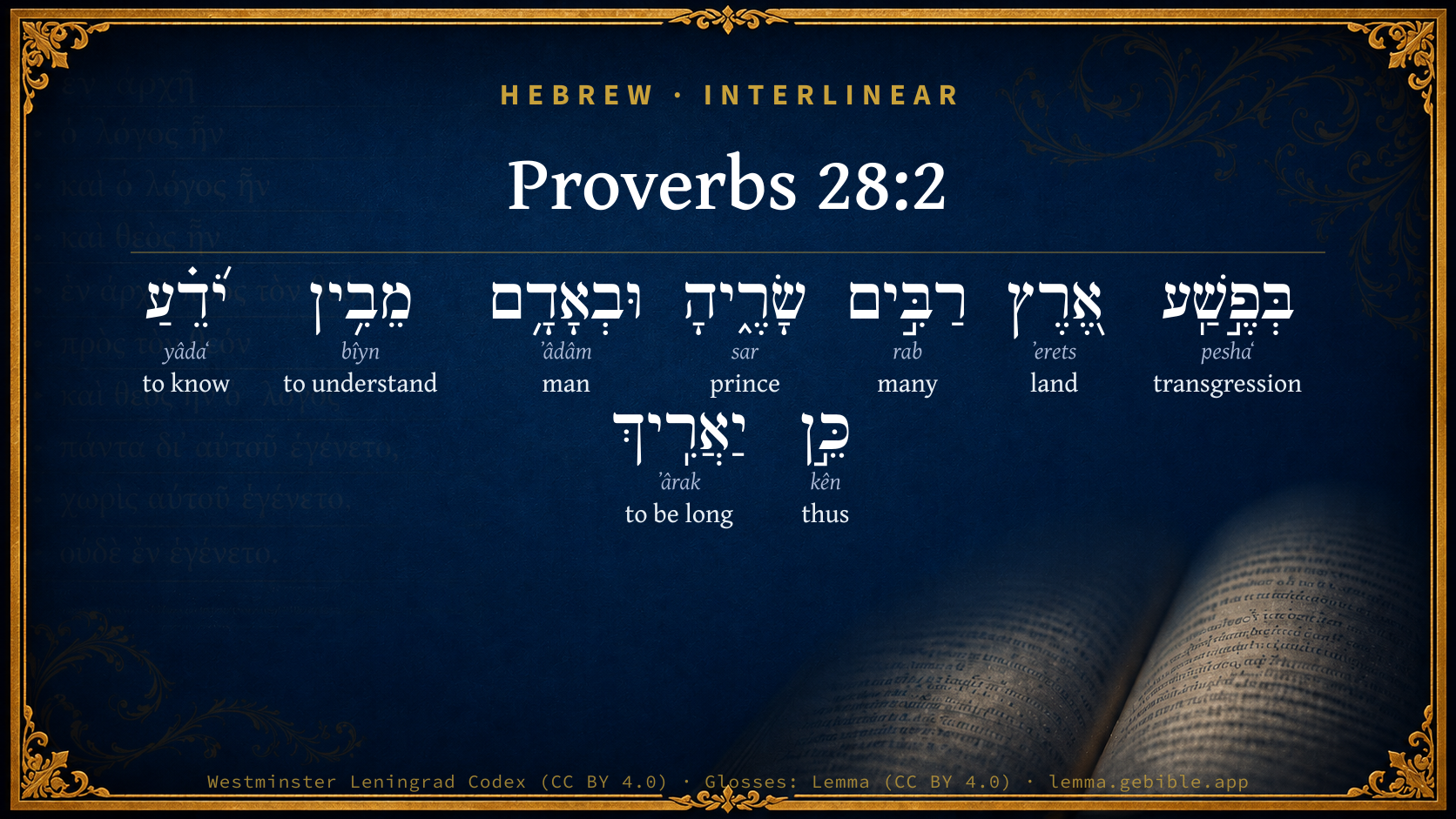
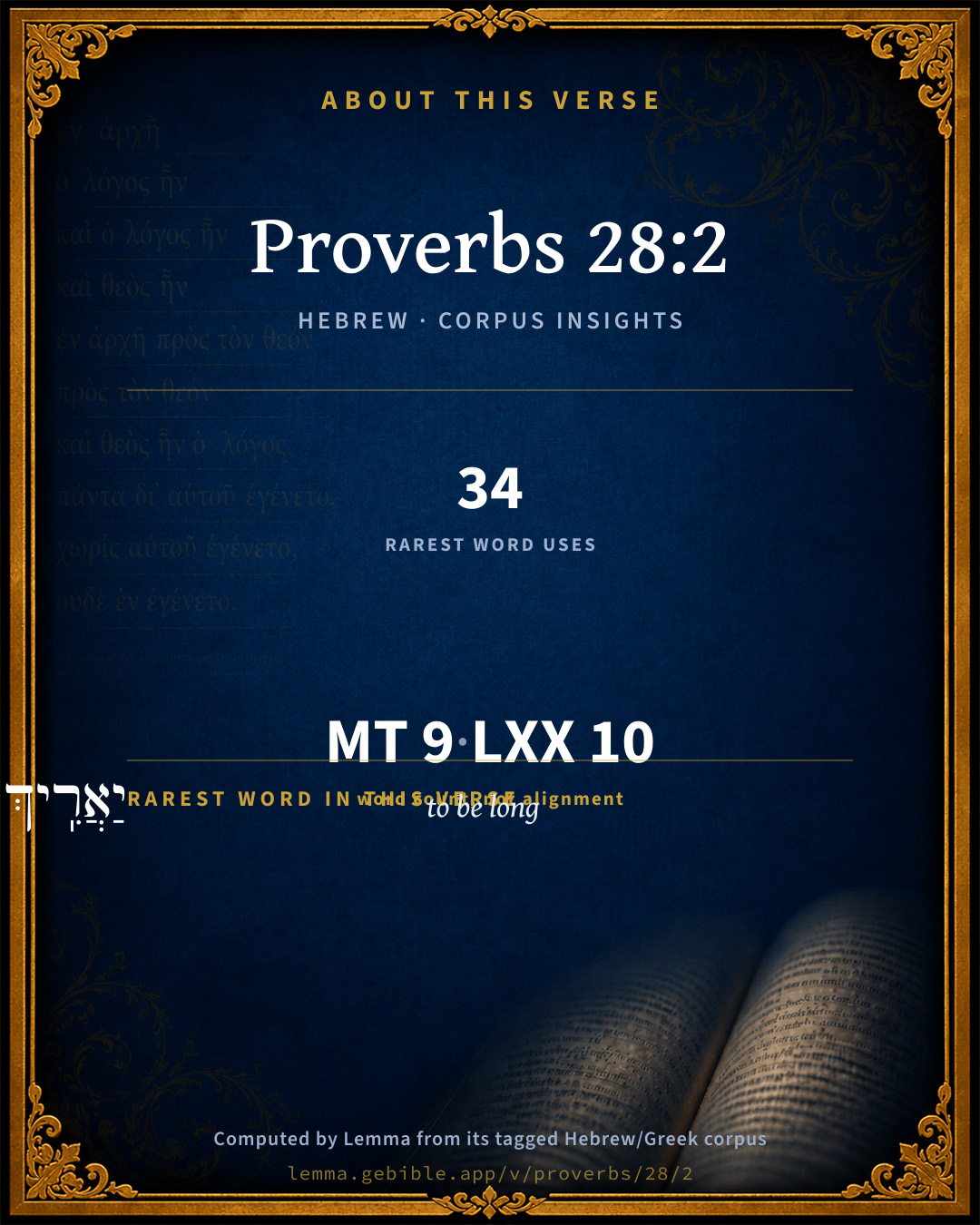
יַאֲרִֽיךְ
ʼârak
H748
“to be long”
Verb, Hiphil, Imperfect, 3rd Person, Masculine, Singular
Part of Speech
Verb
Stem
Hiphil
Form
Imperfect
Person
3rd Person
Gender
Masculine
Number
Singular
Full BDB Definition

Origin: a primitive root

TWOT: 162

to be long, prolong - (Qal) to be long - (Hiphil) - to prolong (days) - to make long (tent cords) - to grow long, continue long
  1. בְּפֶ֣שַֽׁע peshaʻ H6588 “in/at · transgression of” Preposition + Noun, Common, Masculine, Singular, Construct
  2. אֶ֭רֶץ ʼerets H776 “land” Noun, Common, Both, Singular, Absolute
  3. רַבִּ֣ים rab H7227 “many” Adjective, Adjective, Masculine, Plural, Absolute
  4. שָׂרֶ֑יהָ sar H8269 “princes · her” Noun, Common, Masculine, Plural, Construct + Suffix, Personal, 3rd Person, Feminine, Singular
  5. וּבְאָדָ֥ם ʼâdâm H120 “and · in/at · man” Conjunction + Preposition + Noun, Common, Masculine, Singular, Absolute
  6. מֵבִ֥ין bîyn H995 “understanding” Verb, Hiphil, Participle Active, Masculine, Singular, Absolute
  7. יֹ֝דֵ֗עַ yâdaʻ H3045 “knowing” Verb, Qal, Participle Active, Masculine, Singular, Absolute
  8. כֵּ֣ן kên H3651 “thus” Particle, Demonstrative

About this verse

These counts appear in no published source. They are computed here, from the morphology-tagged text and Lemma’s own curated glosses. What Lemma adds →

9
words
9
distinct lemmas
Wisdom
section

Shared distinctive vocabulary

יַאֲרִֽיךְ to be long H748 occurs in 34 verses of the Hebrew Bible. Also found in:

Grammatical profile

  • 3 verbs
  • 4 nouns
  • 1 adjective
  • 1 particle

Verb forms

  • מֵבִ֥ין Hiphil · Participle Active
  • יֹ֝דֵ֗עַ Qal · Participle Active
  • יַאֲרִֽיךְ Hiphil · Imperfect

Hebrew & Septuagint length

In English translation the verse runs 18 words from the Hebrew and 17 from the Septuagint (LXX English) — closely comparable.

A rough comparison of the two English renderings, which tokenize alike — not a word-level alignment.

Word counts can differ between the Hebrew and the Greek without any difference in meaning — e.g. the Hebrew direct-object marker אֵת has no separate Greek word, and Greek often adds the article ὁ.

In the original languages it is 9 Hebrew tokens and 10 Greek tokens — but the two are counted differently (Hebrew bundles its prefixes and suffixes into one token; the Greek is in lemma form), so that isn’t a like-for-like length.

Cross-references

13

Topical passages linked to Proverbs 28:2 in the Treasury of Scripture Knowledge — connected by theme and wording, ordered by reader-vote popularity; previews shown in the World English Bible.

  • 1 Kings 16:8–29 In the twenty-sixth year of Asa king of Judah began Elah the son of Baasha to reign over Israel in Tirzah, [and reigned] two years.
  • Genesis 45:5–8 Now don't be grieved, nor angry with yourselves, that you sold me here, for God sent me before you to preserve life.
  • 1 Kings 15:28 Even in the third year of Asa king of Judah did Baasha kill him, and reigned in his place.
  • 2 Kings 15:8–31 In the thirty-eighth year of Azariah king of Judah did Zechariah the son of Jeroboam reign over Israel in Samaria six months.
  • Job 22:28–30 You shall also decree a thing, and it shall be established to you. Light shall shine on your ways.
  • 1 Kings 15:25 Nadab the son of Jeroboam began to reign over Israel in the second year of Asa king of Judah; and he reigned over Israel two years.
  • 2 Chronicles 32:20–26 Hezekiah the king, and Isaiah the prophet the son of Amoz, prayed because of this, and cried to heaven.
  • 2 Chronicles 36:1–12 Then the people of the land took Jehoahaz the son of Josiah, and made him king in his father's place in Jerusalem.
  • Isaiah 3:1–7 For, behold, the Lord, Yahweh of Hosts, takes away from Jerusalem and from Judah supply and support, The whole supply of bread, And the whole supply of water;
  • Isaiah 58:12 Those who shall be of you shall build the old waste places; you shall raise up the foundations of many generations; and you shall be called The repairer of the breach, The restorer of paths to dwell in.
  • Daniel 4:27 Therefore, O king, let my counsel be acceptable to you, and break off your sins by righteousness, and your iniquities by showing mercy to the poor; if there may be a lengthening of your tranquillity.
  • Hosea 13:11 I have given you a king in my anger, And have taken him away in my wrath.
  • Ecclesiastes 9:15 Now a poor wise man was found in it, and he by his wisdom delivered the city; yet no man remembered that same poor man.

Cross-references courtesy of OpenBible.info (CC BY 4.0).

Hebrew and Greek witnesses Masoretic Hebrew ↔ Greek Septuagint

The same verse in the two great witnesses to the Old Testament, shown verse-for-verse.

These are two independent witnesses, not word-aligned to each other, and the Septuagint is shown in lemma (dictionary) form.

Hebrew Proverbs 28:2 Masoretic · Westminster Leningrad Codex

בְּפֶ֣שַֽׁע אֶ֭רֶץ רַבִּ֣ים שָׂרֶ֑יהָ וּבְאָדָ֥ם מֵבִ֥ין יֹ֝דֵ֗עַ כֵּ֣ן יַאֲרִֽיךְ

In rebellion, a land has many rulers, But order is maintained by a man of understanding and knowledge.

World English Bible · Public Domain

Greek LXX Proverbs 28:2 Septuagint · lemma form

διά ἁμαρτία ἀσεβής κρίσις ἐγείρω ἀνήρ δέ πανοῦργος κατασβέννυμι αὐτός

By reason of the sins of ungodly men quarrels arise; but a wise man will quell them.

LXX2012 (modern English Septuagint) · Public Domain

On this verse, The Pulpit Commentary discusses the Septuagint’s reading. Read the note in Commentary ↓

Hebrew: Westminster Leningrad Codex (CC BY 4.0). Greek: Septuagint (public domain); English from LXX2012 (modern English Septuagint) (Public Domain). How the Septuagint differs from the Hebrew →

Commentary

Notes on Proverbs 28:2 from classic Christian and Jewish commentators (each source and its license shown beneath its notes). The classic Christian expositions comment on the surrounding passage and are grouped to its opening verse, so a note may address several verses; the Jewish commentaries on the Tanakh (Rashi and others) are per-verse, so they appear only where the commentator wrote on this verse.

Lemma curates 59 commentaries, every one of them public domain or Creative Commons licensed, each selected and text-cleaned for this edition rather than reprinted as found. About our sources →

Trapp's Complete Commentary

John Trapp

Pro 28:2 For the transgression of a land many [are] the princes thereof: but by a man of understanding [and] knowledge the state [thereof] shall be prolonged.

Ver. 2. For the transgression of a land, many are the princes.] Either many at once, or many ejecting and succeeding one another, to the great calamity and utter undoing of the people, as may be seen in the books of Judges and Kings, as in the Roman state after Nero’s death, by the succession of Galba, Otho, and Vitellius. What a deal of trouble was here in the time of the heptarchy! {a} and in the dissensions of the two houses of York and Lancaster! causing the death of twice as many natives of England as were lost in the two conquests of France, besides eighty princes of the blood-royal slain. {b} And all this is said to be "for the transgression of a land," thus chastised by the Lord. Elihu tells Job that the hypocrite is set to reign for the people’s sin; {Job 34:30 Lev 26:17} it is threatened as a heavy curse: "If ye still trespass against me, I will set princes over you that shall hate you"; mischievous, odious princes, odious to God, malignant to the people. And, {Isa 3:4} "I will give children to be their princes, and babes shall rule over them." How many kings had the ten tribes after their defection from the house of David, and not one good one among them all! And what got most of the Roman Caesars by their hasty honours nisi ut citius interficerentur, saith one, but to be slain the sooner! Very few of them till Constantine but died unnatural deaths. "If ye do wickedly, ye shall perish, both you and your king." {1Sa 12:25}

But by a man of understanding and knowledge.] As "one sinner may destroy much good," {Ecc 9:18} so by one excellently wise man - called here a man of understanding knowledge; there is no copulative in the original - the state may be prolonged; there may be a lengthening of its tranquillity; it may be "delivered by the pureness of thine hands." {Job 22:30 2Sa 20:16-22 Ecc 9:13-16 Jer 5:1} Religious and prudent princes especially may do much in this case. {2Ki 22:20}

{a} A government by seven rulers

{b} Daniel’s History, 249.

John Trapp, A Commentary or Exposition upon All the Books of the Old and New Testament (1647–1656) — public domain. Text from a community e-Sword module.

Joseph Benson's Commentary

Pro 28:2. For the transgression of a land many are the princes thereof — Contending at the same time for supremacy, or rather succeeding one another. Their princes are soon cut off, and other persons, and frequently persons of other families, come in their stead, which is justly threatened, in the Scriptures, as a curse to a country, because such frequent changes are seldom for the better, but commonly for the worse, and are frequently attended with blood and slaughter, with the change and subversion of laws, with heavy taxes and charges, with the ruin of many families, and with many other mischiefs. But by a man of understanding, &c. — By a wise and good man. This may be understood, 1st, Collectively, according to the translation in the margin, of men of understanding, &c. That is, when the men or people of a land are wise and good: or, rather, 2d, Singularly; of a wise and righteous prince, who, by the good government of himself, and his family, and kingdom; by punishing and preventing the transgressions of the people, turns away God’s wrath, and saves himself and people. Such princes were Asa, Jehoshaphat, Jotham, Hezekiah, and Josiah, who, by their wisdom and piety, were instrumental in averting, for a time, the divine judgments, and prolonging the state and tranquillity of their country; and whose history is the best comment on the latter part of this verse.

Joseph Benson's Commentary on the Old and New Testaments (1811–1818) — public domain. Text from a community e-Sword module.

The Preacher's Complete Homiletical Commentary

Joseph S. Exell (gen. ed.)

MAIN HOMILETICS OF Pro_28:2

THE PENALTY OF REVOLT

As will be seen by a reference to the Critical Notes, the word transgression would be better translated rebellion. The proverb then sets forth,

I. The disadvantages attendant on revolt against the existing government. Whether the rebellion be a lawful one or not—whether the ruler that is dethroned be a tyrant or a wise and just monarch, the result is very much the same. There will be many claimants to the vacant place, and many to support the claims of each aspirant. This is an effect which is almost certain to follow any uprooting of the existing order of things, whether the order be good or bad. If the crew of a vessel put their officers in irons, the difficulty will immediately arise as to who is to guide the vessel. If this is not speedily settled, the ship will be in danger of running upon the rocks while she is drifting on without a guide. It is the same with the vessel of the State. Many justifiable efforts to better the government of a country have broken down at this point—although there has been entire unity of feeling in favour of a change, there has been a great diversity of opinion as to who should inaugurate it and succeed those who have been deprived of authority. The confusion and in security which such a division has caused, has often made way for a return to the old condition of things, and the last state of the land has been worse than the first. But this can hardly be used as an argument against all revolt against existing abuses, but only as a strong incentive to try every other means before resorting to this last extremity.

II. That which makes revolt unnecessary, and consequently conduces to the peace of the commonwealth. Wisdom and prudence on the part of the monarch and his ministers (for the words may be referred to either) will avert such a calamity. That kingdom is highly blest in which the throne is filled with a worthy occupant, and surrounded by men of intellectual ability and moral worth, and therein lies its only real security. For every reasonable man knows that the reins of government must be held by some one, and there is generally a sufficient number of reasonable citizens in a nation to uphold an enlightened administrator of righteous laws, and to keep in check those turbulent spirits to be found everywhere, who, under the name of patriots, only advocate change to serve their own selfish ends.

OUTLINES AND SUGGESTIVE COMMENTS

“Let the children of Zion be joyful in their King.” The kingdom to which they belong has one King; and a king whose reign is permanent as well as unparticipated. There are no rival powers there. If the princes of this world, in the plentitude of their presumption, take upon them to intrude themselves within the precints of His sole jurisdiction, and to intermeddle with what does not belong to them, the subjects of the King of Zion must stand by His prerogative, resist the encroachment, and, at all risks as to this world, refuse obedience. In the spiritual kingdom of which they are subjects, Christ is the only Head; and His word the only authoritative rule.

And there is no succession here. He reigns over the house of Jacob for ever; “and of His kingdom there is no end.” Blessed be God for this! The sceptre of our King can never, even to the end, be wrested out of his hands; and He never dies. He must reign, till all His people are saved with an everlasting salvation, and all His enemies are put under His feet.—Wardlaw.

The Preacher's Complete Homiletical Commentary (gen. ed. Joseph S. Exell; Funk & Wagnalls, c. 1892) — public domain (pre-1929). A full-Bible homiletical/sermon-outline anthology covering 65 of 66 books (2 John is absent from the source module). Text from a community e-Sword module.

Tyndale Open Study Notes

Tyndale Open Resources

28:2 Wise . . . leaders rule justly and effectively (8:15-16).

Tyndale Open Study Notes — © Tyndale Open Resources, licensed CC BY-SA 4.0. Text via the HelloAO Bible API.

Geneva Bible (1599)

Geneva Bible translators

The state of the commonweal is oftentimes changed.

Geneva Bible (1599) marginal notes — public domain. Text via Bolls.life.

Matthew Henry's Commentary

Note, 1. National sins bring national disorders and the disturbance of the public repose: For the transgression of a land, and a general defection from God and religion to idolatry, profaneness, or immorality, many are the princes thereof, many at the same time pretending to the sovereignty and contending for it, by which the people are crumbled into parties and factions, biting and devouring one another, or many successively, in a little time, one cutting off another, as Kg1 16:8, etc., or soon cut off by the hand of God or of a foreign enemy, as Kg2 24:5, etc. As the people suffer for the sins of the prince,

Delirant reges, plectuntur Achivi -

Kings play the madmen, and their people suffer for it,

so the government sometimes suffers for the sins of the people. 2. Wisdom will prevent or redress these grievances: By a man, that is, by a people, of understanding, that come again to themselves and their right mind, things are kept in a good order, or, if disturbed, brought back to the old channel again. Or, By a prince of understanding and knowledge, a privy-counsellor, or minister of state, that will restrain or suppress the transgression of the land, and take the right methods of healing the state thereof, the good estate of it will be prolonged. We cannot imagine what a great deal of service one wise man may do to a nation in a critical juncture.

Matthew Henry's Commentary on the Whole Bible (1708–1710) — public domain (CC PDM 1.0). Text via the HelloAO Bible API.

Jamieson, Fausset & Brown

Robert Jamieson, A. R. Fausset & David Brown

Anarchy producing contending rulers shortens the reign of each.

but by a man . . . prolonged--or, "by a man of understanding--that is, a good ruler--he who knows or regards the right, that is, a good citizen, shall prolong (his days)." Good rulers are a blessing to the people. Bad government as a punishment for evil is contrasted with good as blessing to the good.

Jamieson, Fausset & Brown — Commentary Critical and Explanatory on the Whole Bible (1871) — public domain (CC PDM 1.0). Text via the HelloAO Bible API.

Adam Clarke's Commentary

Verse 2. Many are the princes] Nations, as nations, cannot be judged in a future world; therefore, God judges them here. And where the people are very wicked, and the constitution very bad, the succession of princes is frequent-they are generally taken off by an untimely death. Where the people know that the constitution is in their favour, they seldom disturb the prince, as they consider him the guardian of their privileges.

But by a man of understanding] Whether he be a king, or the king's prime minister, the prosperity of the state is advanced by his counsels.

Adam Clarke's Commentary on the Bible (1810–1826) — public domain. Text from a community e-Sword/MySword module.

Ellicott's Commentary for English Readers

(2) For the transgression of a land many are the princes thereof.—Comp. 1Ki_15:27, sqq., and indeed the whole history of the kingdom of Israel as compared with the regular succession of the family of David in accordance with the promise of Psa_89:33.

The state thereof shall be prolonged—i.e., its settled condition. Or it may signify “right” (i.e., authority)” continues.”

A Bible Commentary for English Readers, edited by Charles John Ellicott (1878–1897) — public domain. Text from a community e-Sword module.

The Cambridge Bible for Schools and Colleges

gen. ed. J. J. S. Perowne

2. a man] This is better taken collectively, and rendered men, as in R.V. text.

the state thereof] i.e. its stability. This rendering is retained in R.V. Others render (taking the word state in its more usual sense as an adverb) so, on that condition, sc. of its possessing men of understanding and knowledge, it (the land) shall be continued. But there seems hardly sufficient reason for laying such stress upon the condition, nor is there much force in saying the land shall continue.

The proverb is abundantly illustrated by the history of Israel. See, for example, 1Ki_16:8-28.

The Cambridge Bible for Schools and Colleges (gen. ed. J. J. S. Perowne; Cambridge University Press, 1878–1918) — public domain. Text from a community e-Sword module.

John Gill's Exposition

For the transgression of a land many are the princes thereof,.... Either together; that is, reigning princes, such as lay claim to the crown, and usurp it; otherwise it is a happiness to a nation to have many princes of the blood, to inherit in succession, to support the crown in their family, and defend a nation, and study the good of it; but it is a judgment to a nation when many rise up as competitors for rule, or do rule, as at Athens, where thirty tyrants sprung up at once; by which factions and parties are made, and which issue in oppression, rapine, and murder: or successively, very quickly, one after another, being dethroned the one by the other: or removed by death, as in the land of Israel, in the times of the judges, and of the kings of Israel and Judah, after the revolt of the ten tribes; which frequent changes produce different administrations, new laws, and fresh taxes, disagreeable to the people; and oftentimes children come to be their princes, which is always reckoned an infelicity to a nation; see Ecc 10:16; and all this is usually for some national sin or sins indulged to, which draw upon a people the divine resentment, and provoke God to suffer such changes among there;

but by a man of understanding and knowledge the state thereof shall be prolonged, either by a set of wise and understanding, good and virtuous men, who will oppose the growing vice and immoralities of a people, and form themselves into societies for the reformation of manners; the word "man" being taken collectively for a body of men: or by a wise and prudent minister or ministry, or a set of civil magistrates, who will show themselves to be terrors to evildoers, and a praise to them that do well: or by a wise and prudent prince, who seeks to establish his throne by judgment and mercy; who will take care that justice and judgment be executed in the land, and that vice and profaneness be discouraged; by means of such, the state of a kingdom, which seemed near to ruin, will be prolonged, and the happiness and prosperity of it secured and established; and God, in mercy to it, may long preserve the life of their king, will being a good one, a long reign is always a happiness to a nation. And to this sense is the Vulgate Latin version, "the life of the prince shall be longer"; and the Targum, which is,

"and the sons of men that understand knowledge shall endure;''

see Ecc 9:15.

John Gill's Exposition of the Whole Bible (1746–1763) — public domain (CC PDM 1.0). Text via the HelloAO Bible API.

Albert Barnes' Notes on the Bible

Transgression - Better, rebellion. A revolt against a ruler leads to rapid changes of dynasty (the whole history of the kingdom of Israel was a proof of this), but “with men of understanding and knowledge thus shall he (the prince) continue.” True wisdom will lead people to maintain an existing order. The King James Version implies that political disorders may come as the punishment of any national sin.

The state - Better, it (the land) shall surely prolong its days in stability.

Albert Barnes' Notes on the Bible (1834–1885) — public domain. Text from a community e-Sword/MySword module.

Haydock's Catholic Bible Commentary

Princes. Who each contend for the sovereign power. (Calmet)

George Leo Haydock (1774–1849), Haydock's Catholic Family Bible and Commentary, 1859 edition — public domain. Excludes Psalms (Douay-Rheims chapter numbering differs from Protestant) and Deuterocanonical books (Catholic canon only).

Matthew Poole's English Annotations

Many are the princes thereof; either,

1. Together, contending for supremacy. Or rather,

2. Successively, as appears from the following clause. Their princes are soon cut off, and other persons, and ofttimes persons of other families, come in their stead, which is justly threatened as a curse, because such frequent changes are seldom for the better, and commonly for the worse, and are frequently attended with blood and slaughter, with the change and subversion of laws, with heavy taxes and charges, with the ruin of many families, and with many other mischiefs.

By a man of understanding and knowledge; by a wise and good man; which may be understood either,

1. Collectively, for

men of understanding, & c., as it is rendered in the margin. i.e. when the men or people of a land are wise and good. Or rather,

2. Singularly; and that either,

1. Of a wise and righteous prince, who by the good government of himself, and his family, and kingdom, by punishing and preventing the transgressions of the people, turns away God’s wrath, and saves himself and people. Or,

2. Of any other man of eminent wisdom or piety, who prevents this judgment, either by his good counsels given to the prince and people, and entertained by them, or by his intercession to God; for God hath sometimes spared a people for the sake of one man, as he did Zoar for Lot, Gen 19:20,21. and the Israelites for Moses, Psa 106:23.

The state thereof shall be prolonged; the land shall enjoy its former state and tranquillity, and the life of their good prince shall be prolonged.

Matthew Poole's English Annotations on the Holy Bible (1683–1685) — public domain. Text from a community e-Sword/MySword module.

Whedon's Commentary on the Bible

Daniel D. Whedon

2. For the transgression of a land — Or, on account of rebellion or revolt, etc.

Many are the princes — That is, they are short lived or short reigned, or several reigning at the same time in opposition, producing confusion, lawlessness, and bloodshed. “May Allah multiply your sheiks!” is a fearful Arab malediction. The latter part of this verse is obscure and variously translated. “But because of a man of understanding, (that is, a prince of intelligence,) he who regards what is right shall prolong his days.”

— Stuart. “So soon as men become intelligent and knowing, then he (the prince) lives long.” — Bertheau. “But with discerning and knowing men there may be permanence.” — Conant. “In the sin of a land many are its leaders, but by the plainest man who imparts discernment, it makes itself endure.” — Miller. Noyes gives the sense of the verse to be, “Through the rebellion of a land, many are its rulers; but through men of prudence and understanding it shall long endure.” National wickedness results in national ruin, the overthrow of the constituted authority, of order and law, in which case the people are apt to become victims of many petty tyrants, who often rapidly succeed each other, robbing and murdering the people. This is frequently the result of maladministration and injustice or incompetency on the part of the sovereign and his counsellors. But intelligence and a regard to what is right on the part of rulers may prevent these disasters, and both prolong the reign and the life of the ruler, and the stability and order of the State.

Daniel D. Whedon (gen. ed.), Commentary on the Old and New Testaments (1874–1909) — public domain. Text from a community e-Sword module.

The Pulpit Commentary

For the transgression of a land many are the princes thereof. This implies that the wickedness of a nation is punished by frequent changes of rulers, who impose new laws, taxes, and other burdens, which greatly oppress the people; but regarding the antithesis in the second hemistich, we take the meaning to be that when iniquity, injustice, apostasy, and other evils abound, a country becomes the prey of pretenders and partisans striving for the supremacy. The history of the northern kingdom of Israel, especially in the disastrous period succeeding the death of Jeroboam II, affords proof of the truth of the statement. (comp. Hos_8:4) Septuagint, "Owing to the sins of ungodly men, quarrels (kriseiv , lawsuits) arise." But by a man of understanding and knowledge the state thereof shall be prolonged. "The state" is the stability, the settled condition of the country. The word is ke (ken), here a substantive, equivalent to "station," "base." Umbreit, Nowack, and others translate it, "justice," "authority," "order." When a wise and religious man is at the helm of state, justice continues, lives, and works; such a man introduces a clement of enduring good into a land. (comp. Pro_21:22 Ecc_9:15) The good kings Ass, Jehoshaphat, Uzziah, and Hezekiah had long and prosperous reigns. Septuagint, "But a clever man (panourgov ) will quench them (quarrels)."

The Pulpit Commentary (1880–1919), ed. H.D.M. Spence-Jones & Joseph S. Exell — public domain. Text from a community e-Sword module.

John Wesley's Explanatory Notes

But - By a wise and good prince.

John Wesley, Explanatory Notes Upon the Whole Bible (1754–1765) — public domain. Text via the GEBible commentary corpus.

Keil & Delitzsch

C. F. Keil & F. Delitzsch

There now follows a royal proverb, whose key-note is the same as that struck at Pro 25:2, which states how a country falls into the οὐκ ἀγαθόν of the rule of the many:

Through the wickedness of a land the rulers become many;

And through a man of wisdom, of knowledge, authority continues.

If the text presented בּפשׁע as Hitzig corrects, then one might think of a political revolt, according to the usage of the word, Kg1 12:19, etc.; but the word is בּפּשׁע,

(Note: Thus to be written with Gaja here and at Pro 29:6, after the rule of Metheg-Setzung, 42.)

and פּשׁע (from פּשׁע, dirumpere) is the breaking through of limits fixed by God, apostasy, irreligion, e.g., Mic 1:5. But that many rulers for a land arise from such a cause, shows a glance into the Book of Hosea, e.g., Hos 7:16 : "They return, but not to the Most High (sursum); they are become like a deceitful bow; their princes shall then fall by the sword;" and Hos 8:4 : "They set up kings, but not by me; they have made princes, and I knew it not." The history of the kingdom of Israel shows that a land which apostatizes from revealed religion becomes at once the victim of party spirit, and a subject of contention to many would-be rulers, whether the fate of the king whom it has rejected be merited or not. But what is now the contrast which 2b brings forward? The translation by Bertheau and also by Zckler is impossible: "but through intelligent, prudent men, he (the prince) continueth long." For 2a does not mean a frequent changing of the throne, which in itself may not be a punishment for the sins of the people, but the appearance at the same time of many pretenders to the throne, as was the case in the kingdom of Israel during the interregnum after the death of Jeroboam II, or in Rome at the time of the thirty tyrants; יאריך must thus refer to one of these "many" who usurp for a time the throne. בּאדם may also mean, Pro 23:28, inter homines; but אדם, with the adjective following, e.g., Pro 11:7; Pro 12:23; Pro 17:18; Pro 21:16, always denotes one; and that translation also changes the כּן into a "so," "then" introducing the concluding clause, which it altogether disregards as untranslatable. But equally impossible is Bttcher's: "among intelligent, prudent people, one continues (in the government)," for then the subject-conception on which it depends would be slurred over. Without doubt כּן is here a substantive, and just this subject-conception. That it may be a substantive has been already shown at Pro 11:19. There it denoted integrity (properly that which is right or genuine); and accordingly it means here, not the status quo (Fleischer: idem rerum status), but continuance, and that in a full sense: the jurisdiction (properly that which is upright and right), i.e., this, that right continues and is carried on in the land. Similarly Heidenheim, for he glosses כן by מכון הארץ; and Umbreit, who, however, unwarned by the accent, subordinates this כן [in the sense of "right"] to ידע as its object. Zckler, with Bertheau, finds a difficulty in the asyndeton מבין ידע. But these words also, Neh 10:29, stand together as a formula; and that this formula is in the spirit and style of the Book of Proverbs, passages such as Pro 19:25; Pro 29:7

(Note: The three connected words ובאדם מבין ידע have, in Lwenstein, the accents Mercha, Mercha, Mugrash; but the Venetian, 1515, 20, Athias, v. d. Hooght, and Hahn, have rightly Tarcha, Mercha, Mugrash, - to place two Merchas in Ben-Naphtali's manner.)

show. A practical man, and one who is at the same time furnished with thorough knowledge, is thus spoken of, and prudence and knowledge of religious moral character and worth are meant. What a single man may do under certain circumstances is shown in Pro 21:22; Ecc 9:15. Here one has to think of a man of understanding and spirit at the helm of the State, perhaps as the nearest counsellor of the king. By means of such an one, right continues long (we do not need to supply להיות after "continues long"). If, on the one side, the State falls asunder by the evil conduct of the inhabitants of the land, on the other hand a single man who unites in himself sound understanding and higher knowledge, for a long time holds it together.

Keil & Delitzsch — Biblical Commentary on the Old Testament (1861–1891) — public domain (CC PDM 1.0). Text via the HelloAO Bible API. (Old Testament only.)

Bridges on Proverbs

Charles Bridges

Is God concerned in the falling of a sparrow? (Mat 10:29 .) Surely then much more in the control of kingdoms. (Dan 4:25 .) Did we realize more deeply our national dependence, we should see the clouds of anarchy and confusion working his wise, mysterious, or gracious purposes. Rival princes desolate the land with the horrors of civil war. (1Ki 12:16-21 .) A quick succession of princes rises by treason, usurpation, or natural course. (Zec 11:8 .) Hence a change of laws, spoliation of privileges, imposition of new burdens, or wasteful expenditure of treasure or blood. Man traces these evils to political causes. But God’s voice speaks from the cloud — "This thing is from me." (1Ki 12:24 .) For the transgression of a land many are the princes thereof. The bloody contentions in our early history, which swept away the flower of our nobility; and those of a later date, which overturned for a time our long-established institutions — did they not betoken the same awful scourge of national transgression? Would that the nation had learnt from her own records of by-gone days, the sound and practical lessons of repentance with all its blessed fruits!†1

But not less must we acknowledge the Divine Hand in the prolongation of the state by men of understanding and knowledge. By a man of this high character the state of Egypt was prolonged by preservation from famine. (Gen 41:38-39 .) The long and prosperous reigns of the godly kings of Judah strongly contrast with the records of Israel after the revolt.†2 And perhaps this may be a mark of the Lord’s controversy with us; that the detached political parties present few — if any — master-minds — men of understanding and knowledge — men — like Mr. Pitt — of surpassing power or grasp of mind; evidently raised up at a grand national crisis for the prolongation of the state. Such men guided by Christian principle, we would pray might be the counselors of our beloved Sovereign, that her state be prolonged "in all godly quietness." (1Ti 2:1-2 .)

Footnotes:

†1 Thus wrote Jeremy Taylor of his own sorrowful times, in his fervid coloring, and deep-toned instructiveness; and with some solemn application to later times. ’It is a sad calamity to see a kingdom spoiled, and a Church afflicted; priests slain with the sword, and the blood of nobles mingled with the cheaper sand; religion made the cause of trouble, and the best of men most cruelly persecuted; government turned, and laws ashamed; judges decreeing in fear and covetousness, and the ministers of holy things setting themselves against all that is sacred. And what shall make recompense for this heap of sorrows, when God shall send such swords of fire? Even the mercies of God, that shall then be made public, when the people shall have suffered for their sins. For I have known a luxuriant vine swell into irregular twigs and bold exrescences, and spend itself in leaves and little rings, and afford but little clusters to the wine-press. But when the Lord of the vine has caused the dressers to cut the wilder plant, and make it bleed; it grew temperate in its vain expense of useless leaves, and knotted into fair and juicy branches, and made account of that loss of blood by the return of fruit. It is thus of an afflicted kingdom, cured of its surfeits, and punished for its sins. It bleeds for its long riot, and is left ungoverned for its disobedience, and chastised for its wantonness. And when the sword hath let forth the corrupted blood, and the fire hath purged the rest, then it enters into the double joys of restitution, and gives God thanks for his rod, and confesses the mercies of God in making the smoke to be changed into fire, and his anger into mercy.’ — Works, vi. 182.

†2 1Ki 15:25-34 ; 1Ki 16:8-29 . 2Ki 15:8-31, with 1Ki 15:10 . 2Ch 17:1-5 ; 2Ch 32:20-26 .

Charles Bridges, An Exposition of the Book of Proverbs (1846) — public domain. Text from a community e-Sword module.

Rashi

Rabbi Shlomo Yitzchaki (Rashi)

Because of the sin of a land, its princes are many This is the punishment of a land, viz. that it has many princes, and they do not respond to any man.

but because of an understanding... man But because of an understanding man, the retribution will be delayed from coming.

Rashi on the Tanakh — English translations: “The Judaica Press complete Tanach with Rashi, translated by A. J. Rosenberg” (CC BY 4.0); “Pentateuch with Rashi's commentary by M. Rosenbaum and A.M. Silbermann, 1929-1934” (public domain); “The Metsudah Tanach series, Lakewood, N.J” (CC BY 4.0); and “The Book of Joshua, Metsudah Publications, 1997” (CC BY 4.0). Text via Sefaria.

Lesson kit

Teaching starters — assembled from the data on this page, not authored interpretation. Every prompt links to the verse data it draws on. Edit before teaching.

Proverbs, in the Wisdom, opens this verse with 9 words (9 distinct Hebrew lemmas). Its most distinctive word is ʼârak (“to be long”). A historical commentator’s framing appears above. Read the whole chapter for the surrounding context.

Discussion questions

  1. The word ʼârak carries the sense “to be long.” How does it shape the verse?
  2. How does Genesis 26:8, which shares the word «to be long», read alongside this verse?
  3. The translations on this page render this verse differently — a whole-verse word diff, not a word-by-word alignment. What might account for the different wordings?
  4. «מֵבִ֥ין» is a Hiphil Participle Active verb. How does that grammatical form shape the action described?
  5. Compare how Trapp's Complete Commentary and Joseph Benson's Commentary read this verse. Where do they agree or differ?

Things to notice

Reading settings

Reading text

Shown beneath each verse's original-language words.

Old Testament
Old Testament edition

Read the OT as the Masoretic Hebrew (MT) or the Greek Septuagint (LXX).

English shown for the Greek Septuagint (in the Hebrew ↔ Greek comparison).

Comparing translations? Open the Compare panel on any verse page to stack up to four side by side.