
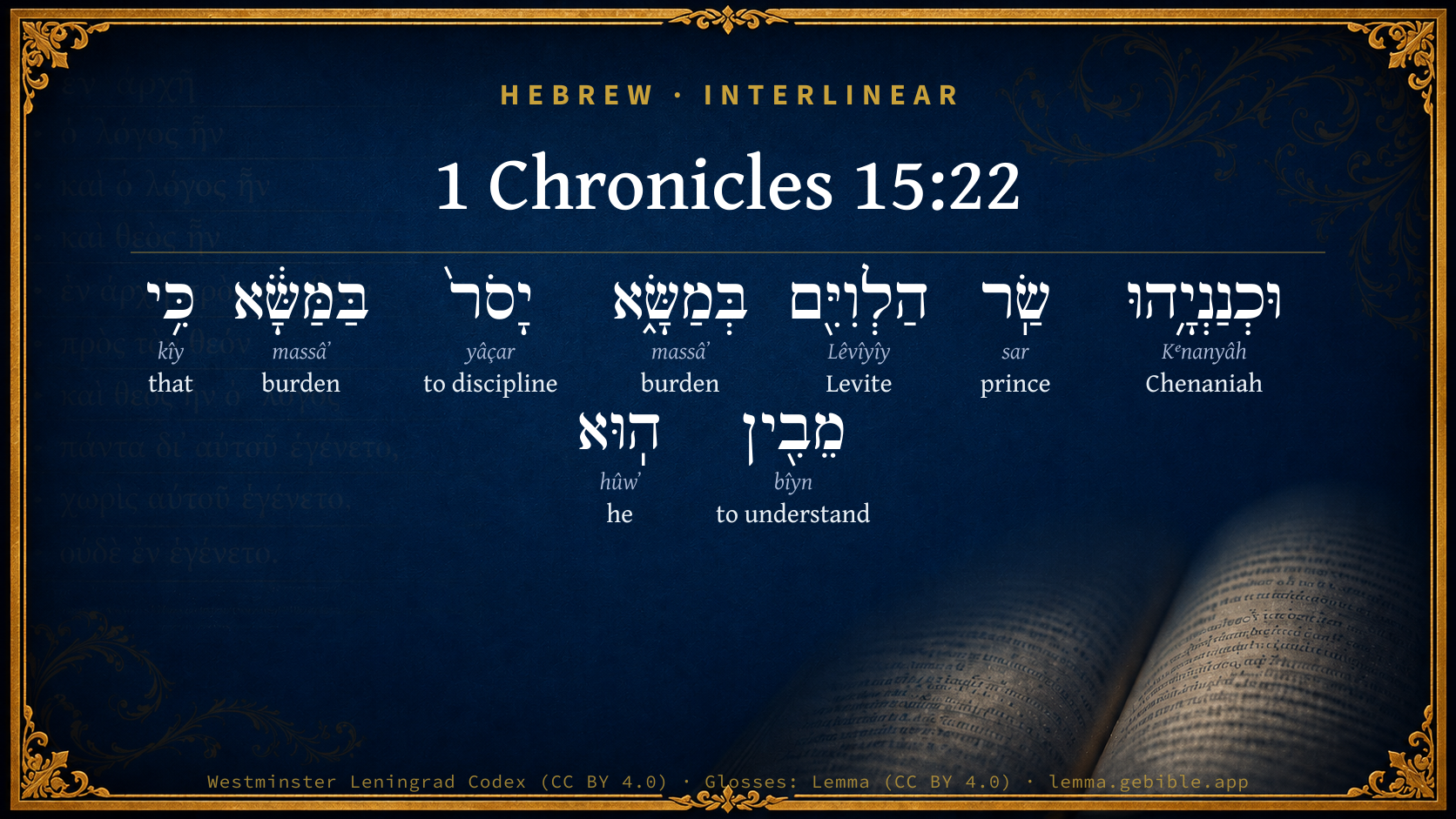
1 Chronicles 15:22

Hebrew (Westminster Leningrad Codex) 1 Chronicles 15:22 appears in the Hebrew Old Testament. The text above is from the Westminster Leningrad Codex. Each word links to its Strong’s number, a concise gloss, and parsing drawn from the Open Scriptures Hebrew Bible morphology. Click any word for its full Brown-Driver-Briggs (BDB) entry.
Download image
Cite this verse

1 Chronicles 15:22 (World English Bible). Public Domain. Lemma interlinear Bible study tool, https://lemma.gebible.app/v/1-chronicles/15/22.

Show BibTeX & RIS
BibTeX
RIS
English Translation
Chenaniah, chief of the Levites, was over the song: he instructed about the song, because he was skillful.
World English Bible · Public Domain
Highlights
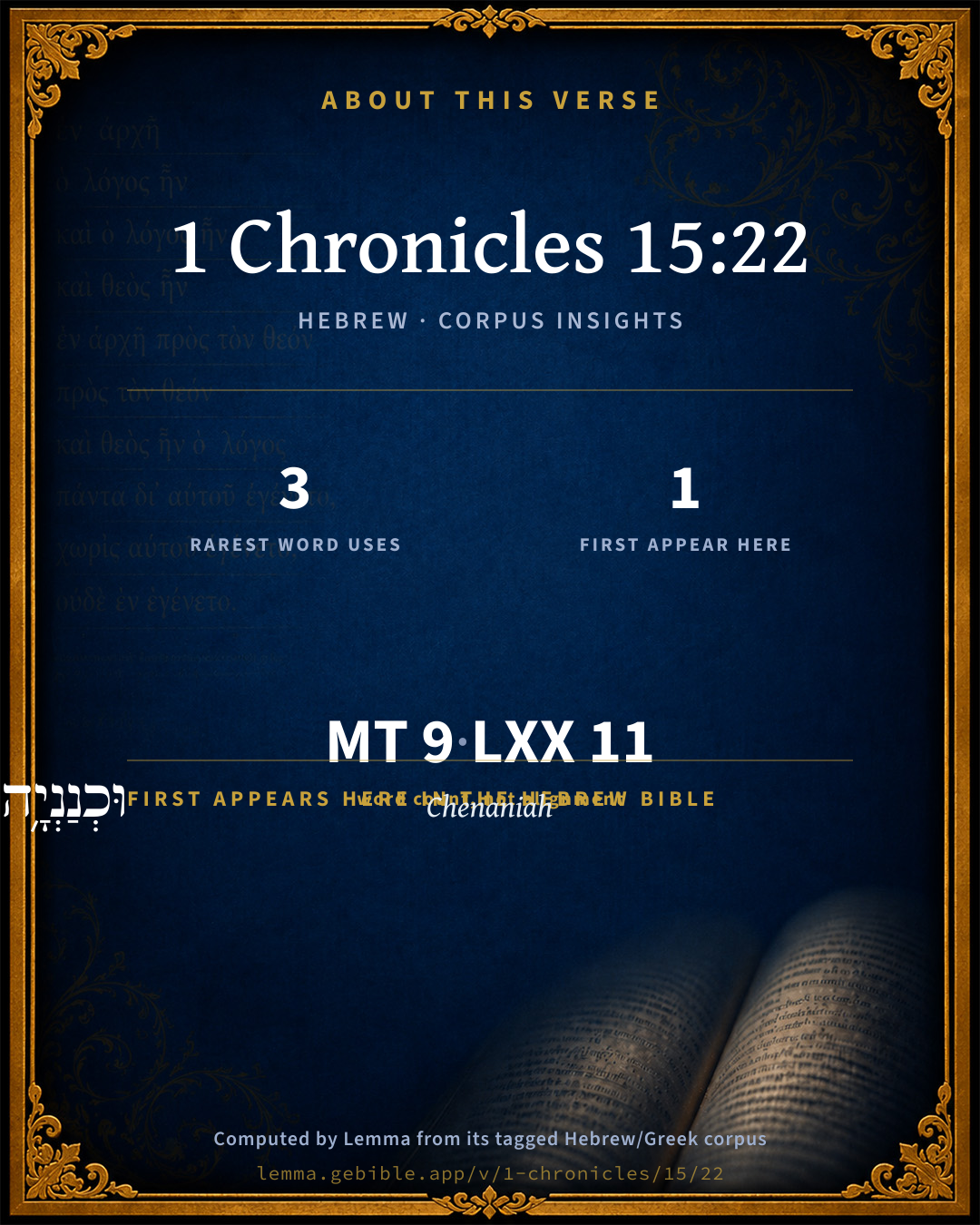
  • 1 first appearance in the Hebrew Bible
Full analysis ↓
Download a study sheet

One document with this verse’s original text, its word-by-word gloss line, the meaning frame, cross-references with their text, attributed commentary, and full source and license credits — printable, and it pastes into notes with its structure intact.

This verse Autodidact and up

Study sheet (.html) Plain text (.txt)

A passage Seminary Student

Up to 50 verses in one chapter. A passage sheet keeps up to 6 commentary sources and 12 cross-references per verse, in the order this page ranks them, and says so on the sheet whenever that leaves anything out. Ask for a single verse and you get the Autodidact verse sheet above.

Everything on this page stays free to read, with no account — the sheet is a download of what is already on screen, not access to it.

Want to remove ads? Support Godless Engineer
Compare translations 3

The same verse in 3 English versions, stacked beneath the original-language interlinear above. Click any original word for its lexicon entry.

Each is an independent rendering of the whole verse — the interlinear is not word-aligned to these translations.

Highlighted words mark where these versions differ — a whole-verse word diff, not a word-by-word alignment.

  • World English Bible Public Domain
    Chenaniah, chief of the Levites, was over the song: he instructed about the song, because he was skillful.
  • King James Version Public Domain
    And Chenaniah, chief of the Levites, was for song: he instructed about the song, because he was skillful.
  • unfoldingWord Literal Text CC BY-SA 4.0
    And Kenaniah, the chief of the Levites, in lifting up, to instruct in lifting up, for he was understanding.

unfoldingWord Literal Text — © unfoldingWord, licensed CC BY-SA 4.0. Word-aligned USFM3 via Door43 (git.door43.org/unfoldingWord/en_ult).

Versions to compare (up to 4)

3 of 4 selected

Show all 18 translations

Every available English version of this verse, each an independent rendering of the whole verse.

  • World English Bible Public Domain
    Chenaniah, chief of the Levites, was over the song: he instructed about the song, because he was skillful.
  • Berean Standard Bible Public Domain
    Chenaniah the head Levite was the director of the music because he was highly skilled.
  • Majority Standard Bible Public Domain
    Chenaniah the head Levite was the director of the music because he was highly skilled.
  • King James Version Public Domain
    And Chenaniah, chief of the Levites, was for song: he instructed about the song, because he was skillful.
  • American Standard Version (1901) Public Domain
    And Chenaniah, chief of the Levites, was over the song: he instructed about the song, because he was skilful.
  • Revised Version (1885) Public Domain
    And Chenaniah, chief of the Levites, was over the song: he instructed about the song, because he was skilful.
  • Geneva Bible (1599) Public Domain
    But Chenaniah the chiefe of the Leuites had the charge, bearing ye burden in the charge, for he was able to instruct.
  • Douay-Rheims (1899) Public Domain
    And Chonenias chief of the Levites, presided over the prophecy, to give out the tunes: for he was very skilful.
  • Young's Literal Translation Public Domain
    And Chenaniah, head of the Levites, `is' over the burden; he instructeth about the burden, for he `is' intelligent.
  • Literal Standard Version CC BY-SA 4.0
    And Chenaniah, head of the Levites, [is] over the burden; he instructs about the burden, for he [is] intelligent.
  • Unlocked Literal Bible CC BY-SA 4.0
    Kenaniah, leader of the Levites, was the director of the singing because he was a teacher of music.
  • unfoldingWord Literal Text CC BY-SA 4.0
    And Kenaniah, the chief of the Levites, in lifting up, to instruct in lifting up, for he was understanding.
  • Darby Bible Public Domain
    And Chenaniah, chief of the Levites for the music, gave instruction in music, for he was skilful.
  • World Messianic Bible Public Domain
    Chenaniah, chief of the Levites, was over the singing. He taught the singers, because he was skillful.
  • Webster's Bible Public Domain
    And Chenaniah, chief of the Levites, was for song: he instructed about the song, because he was skillful.
  • Free Bible Version CC BY-SA 4.0
    Kenaniah, the leader of the Levites in singing, was chosen to lead the music because of his ability.
  • Bible in Basic English Public Domain
    And Chenaniah, chief of the Levites, was master of the music: he gave directions about the song, because he was expert.
  • JPS Tanakh (1917) Public Domain
    And Chenaniah, chief of the Levites, was over the song; he was master in the song, because he was skilful.

Literal Standard Version (2020), Covenant Press — licensed CC BY-SA 4.0. Text via the HelloAO Bible API (eBible.org). Unlocked Literal Bible (unfoldingWord) — licensed CC BY-SA 4.0. Text via the HelloAO Bible API (eBible.org). unfoldingWord Literal Text — © unfoldingWord, licensed CC BY-SA 4.0. Word-aligned USFM3 via Door43 (git.door43.org/unfoldingWord/en_ult). Free Bible Version, Dr. Jonathan Gallagher — licensed CC BY-SA 4.0. Text via the HelloAO Bible API (eBible.org).

Word by word

More ways to search: Search by grammar → Find every occurrence → Compare this word →

Practice this passage: Drill this verse → Learn its vocabulary →

About this verse

These counts appear in no published source. They are computed here, from the morphology-tagged text and Lemma’s own curated glosses. What Lemma adds →

9
words
8
distinct lemmas
Historical
section

Notable vocabulary

The rarest word here is וּכְנַנְיָ֥הוּ Chenaniah H3663 — appearing just 3 times in the whole Hebrew Bible.

First appearance in Scripture

This word makes its first canonical appearance in the Hebrew Bible here:

  • וּכְנַנְיָ֥הוּ Chenaniah H3663

Shared distinctive vocabulary

וּכְנַנְיָ֥הוּ Chenaniah H3663 occurs in 3 verses of the Hebrew Bible. Also found in:

Grammatical profile

  • 2 verbs
  • 5 nouns
  • 1 pronoun
  • 1 conjunction

Verb forms

  • יָסֹר֙ Qal · Infinitive Absolute
  • מֵבִ֖ין Hiphil · Participle Active

Repetition

A word recurs within this verse — often emphatic in Hebrew:

  • בְּמַשָּׂ֑א burden H4853 ×2

Hebrew & Septuagint length

In English translation the verse runs 18 words from the Hebrew and 15 from the Septuagint (LXX English) — closely comparable.

A rough comparison of the two English renderings, which tokenize alike — not a word-level alignment.

Word counts can differ between the Hebrew and the Greek without any difference in meaning — e.g. the Hebrew direct-object marker אֵת has no separate Greek word, and Greek often adds the article ὁ.

In the original languages it is 9 Hebrew tokens and 11 Greek tokens — but the two are counted differently (Hebrew bundles its prefixes and suffixes into one token; the Greek is in lemma form), so that isn’t a like-for-like length.

Cross-references

3

Topical passages linked to 1 Chronicles 15:22 in the Treasury of Scripture Knowledge — connected by theme and wording, ordered by reader-vote popularity; previews shown in the World English Bible.

  • 1 Chronicles 15:16 David spoke to the chief of the Levites to appoint their brothers the singers, with instruments of music, psalteries and harps and cymbals, sounding aloud and lifting up the voice with joy.
  • 1 Chronicles 15:27 David was clothed with a robe of fine linen, and all the Levites who bore the ark, and the singers, and Chenaniah the master of the song [with] the singers: and David had on him an ephod of linen.
  • 1 Chronicles 25:7–8 The number of them, with their brothers who were instructed in singing to Yahweh, even all who were skillful, was two hundred eighty-eight.

Cross-references courtesy of OpenBible.info (CC BY 4.0).

Hebrew and Greek witnesses Masoretic Hebrew ↔ Greek Septuagint

The same verse in the two great witnesses to the Old Testament, shown verse-for-verse.

These are two independent witnesses, not word-aligned to each other, and the Septuagint is shown in lemma (dictionary) form.

Hebrew 1 Chronicles 15:22 Masoretic · Westminster Leningrad Codex

וּכְנַנְיָ֥הוּ שַֽׂר הַלְוִיִּ֖ם בְּמַשָּׂ֑א יָסֹר֙ בַּמַּשָּׂ֔א כִּ֥י מֵבִ֖ין הֽוּא

Chenaniah, chief of the Levites, was over the song: he instructed about the song, because he was skillful.

World English Bible · Public Domain

Greek LXX 1 Chronicles 15:22 Septuagint · lemma form

καί χωνενια ἄρχων ὁ λευίτης ἄρχων ὁ ᾠδή ὅτι συνετός εἰμί

And Chonenia chief of the Levites was master of the bands, because he was skillful.

LXX2012 (modern English Septuagint) · Public Domain

On this verse, Ellicott's Commentary for English Readers discusses the Septuagint’s reading. Read the note in Commentary ↓

Hebrew: Westminster Leningrad Codex (CC BY 4.0). Greek: Septuagint (public domain); English from LXX2012 (modern English Septuagint) (Public Domain). How the Septuagint differs from the Hebrew →

Commentary

Notes on 1 Chronicles 15:22 from classic Christian and Jewish commentators (each source and its license shown beneath its notes). The classic Christian expositions comment on the surrounding passage and are grouped to its opening verse, so a note may address several verses; the Jewish commentaries on the Tanakh (Rashi and others) are per-verse, so they appear only where the commentator wrote on this verse.

Lemma curates 59 commentaries, every one of them public domain or Creative Commons licensed, each selected and text-cleaned for this edition rather than reprinted as found. About our sources →

Trapp's Complete Commentary

John Trapp

1Ch 15:22 And Chenaniah, chief of the Levites, [was] for song: he instructed about the song, because he [was] skilful.

Ver. 22. Because he was skilful.] In music: and haply in other arts also.

John Trapp, A Commentary or Exposition upon All the Books of the Old and New Testament (1647–1656) — public domain. Text from a community e-Sword module.

Joseph Benson's Commentary

1Ch 15:22. Chenaniah was for song — Or, as it may be translated, was for the carriage, namely, of the voice. He was the moderator of the music, instructing them when and how to lift up their voice, change their notes, or make stops. Accordingly, the following words tell us, he instructed about song — Or taught them how to sing; because he was skilful — Was a great artist in singing.

Joseph Benson's Commentary on the Old and New Testaments (1811–1818) — public domain. Text from a community e-Sword module.

Geneva Bible (1599)

Geneva Bible translators

To wit, to appoint Psalms, and songs to them that sung.

Geneva Bible (1599) marginal notes — public domain. Text via Bolls.life.

Jamieson, Fausset & Brown

Robert Jamieson, A. R. Fausset & David Brown

Chenaniah, chief of the Levites--He was not of the six heads of the Levitical families, but a chief in consequence of his office, which required learning, without regard to birth or family.

instructed about the song--He directed all these bands as to the proper time when each was to strike in or change their notes; or, as some render the passage, "He led the burdens, for he was skilled," that is, in the custom which it was necessary to observe in the carriage of the holy things [BERTHEAU].

Jamieson, Fausset & Brown — Commentary Critical and Explanatory on the Whole Bible (1871) — public domain (CC PDM 1.0). Text via the HelloAO Bible API.

Adam Clarke's Commentary

Verse 22. Chenaniah - he instructed about the song] This appears to have been the master singer; he gave the key and the time, for he presided במשא bemassa, in the elevation, probably meaning what is called pitching the tune, for he was skilful in music, and powerful in his voice, and well qualified to lead the band: be might have been precentor,

Adam Clarke's Commentary on the Bible (1810–1826) — public domain. Text from a community e-Sword/MySword module.

Ellicott's Commentary for English Readers

(22) Rather, And Chenaniah, captain (i.e., conductor) of the Levites in bearing (that is, the sacred vessels), was conducting the bearing, because he was skilled—scil., in the traditional regulations connected with bearing the Ark duly and rightly.

Chenaniah.—1Ch_15:27, and 1Ch_26:29.

Chief of the Levites.—Not one of the six princes (1Ch_15:5-10), or heads of houses, but president of the carriage of the Ark.

Was for song.—So the LXX., which reads “leader of the songs;” but the Syriac has “bore the burden daily” and although the word massâ—i.e., “lifting up,” or “bearing”—might mean “lifting up the voice,” (1) the context is against that meaning here, for Heman, Asaph, and Ethan were conductors of the singing and music; (2) Chenaniah is nowhere else associated with music (see Note on 1Ch_26:29); (3) the word massâ, “bearing,” has the sense we have given it when used in relation to Levites (Num_4:19; 2Ch_35:3).

He instructed.—The Hebrew has an ambiguous form, which may be an infinitive—instructing, correcting (yâsar); or an imperfect of a different verb—was prince over, superintendent of (sârar).

He was skilful.—Comp. 1Ch_25:7; 2Ch_34:12.

A Bible Commentary for English Readers, edited by Charles John Ellicott (1878–1897) — public domain. Text from a community e-Sword module.

The Cambridge Bible for Schools and Colleges

gen. ed. J. J. S. Perowne

22. was for song] The Heb. word (massa) used here twice for “song” (lit. “burden”) means sometimes “burden” in a physical sense; hence R.V. mg. was over the carrying of the ark.

The Cambridge Bible for Schools and Colleges (gen. ed. J. J. S. Perowne; Cambridge University Press, 1878–1918) — public domain. Text from a community e-Sword module.

John Gill's Exposition

And Chenaniah chief of the Levites was for song,.... But the chief for the song were Heman, Asaph, and Ethan; rather

for the burden, as the Targum; for the lifting up and bearing the ark:

he instructed about the song; or about the taking up and bearing the burden, the ark; directing when to take it up, and how far to go with it, and then rest:

because he was skilful; a wise and prudent man in all things, and so proper to direct in this business.

John Gill's Exposition of the Whole Bible (1746–1763) — public domain (CC PDM 1.0). Text via the HelloAO Bible API.

Albert Barnes' Notes on the Bible

For song - See the margin. Hebraists are still at variance as to the meaning of this passage, some supposing elevation or, delivery of the voice, others elevation of the ark, to be intended.

Albert Barnes' Notes on the Bible (1834–1885) — public domain. Text from a community e-Sword/MySword module.

Haydock's Catholic Bible Commentary

The prophecy. Singing praises to God is here called prophecy: the more, because these singers were often inspired men. (Challoner) --- Hebrew Massa signifies a song, (Haydock) elevation, (Calmet) burden. (Syriac) So the Vulgate has onus Moab, &c., the burden or dreadful prediction against Moab. (Calmet) --- Prophecy often denotes no more than a melodious canticle, 1 Kings x. 10. (Haydock) --- Chonenias directed all this music. Septuagint simply style him "prince of the Levites, prince of the musicians" (Calmet) or Greek: archon ton odon (who gave out the songs) "because he was intelligent." (Haydock)

George Leo Haydock (1774–1849), Haydock's Catholic Family Bible and Commentary, 1859 edition — public domain. Excludes Psalms (Douay-Rheims chapter numbering differs from Protestant) and Deuterocanonical books (Catholic canon only).

Matthew Poole's English Annotations

Was for song, Heb. was for lifting up; either,

1. Of the ark; he was for carriage of the ark, being appointed to instruct or direct the time and manner of carrying the ark, and when they should make a stand or a change in the bearers. Or rather,

2. Of the voice; he was the moderator of the music, instructing them when and how to lift up their voices, or change their notes, or make their stops, which best agrees with the following reason, because he was skillful; for this required far more skill than the carriage of the ark, which any man of common discretion could easily govern; and with 1Ch 15:27, where this same Chenaniah is joined with the singers.

Matthew Poole's English Annotations on the Holy Bible (1683–1685) — public domain. Text from a community e-Sword/MySword module.

Whedon's Commentary on the Bible

Daniel D. Whedon

22. Chenaniah, chief of the Levites, was for song — Chenaniah was not chief of the Levitical singers, for we have just been told that Heman, Asaph, and Ethan, were the leaders in that department. Hence we regard the rendering for song as an error. The Hebrew is במשׂא, in the burden; that is, the burden of bearing the ark. In Num_4:15, the duty of bearing the sanctuary and its sacred vessels is expressly called “the burden (משׂא) of the sons of Kohath.”

He instructed about the song — Rather, he gave instruction about the burden; that is, he gave the proper orders and instructions about the bearing of the ark. The whole verse should accordingly be rendered: Chenaniah, a prince of the Levites, was in charge of the burden; he gave instruction in respect to the burden, for he was skillful. David carefully guarded this time against carelessness and ignorance in the matter of removing the ark, by putting the matter in charge of a prince of the Levites who possessed the requisite knowledge and skill to superintend the responsible burden.

Daniel D. Whedon (gen. ed.), Commentary on the Old and New Testaments (1874–1909) — public domain. Text from a community e-Sword module.

The Pulpit Commentary

For song. There is considerable diversity of opinion as to the meaning of this word. Some think its meaning to be "in the carrying (aCMB)" i.e. of the ark. Its exact position here seems not unfavourable to such interpretation. On the other hand, its position in ver. 27 seems conclusively to point to the translation of the Septuagint and of our Authorized Version in this place as the correct one. Dr. Murphy, however, to escape this, thinks "with the singers" in ver. 27 to be a "copyist"s inadvertent repetition."

The Pulpit Commentary (1880–1919), ed. H.D.M. Spence-Jones & Joseph S. Exell — public domain. Text from a community e-Sword module.

John Wesley's Explanatory Notes

For song - He was the moderator of the musick, instructing them when and how to lift up their voices, or change their notes, or make their stops.

John Wesley, Explanatory Notes Upon the Whole Bible (1754–1765) — public domain. Text via the GEBible commentary corpus.

Keil & Delitzsch

C. F. Keil & F. Delitzsch

And Chenaniah chief of the Levites was for song,.... But the chief for the song were Heman, Asaph, and Ethan; rather

for the burden, as the Targum; for the lifting up and bearing the ark:

he instructed about the song; or about the taking up and bearing the burden, the ark; directing when to take it up, and how far to go with it, and then rest:

because he was skilful; a wise and prudent man in all things, and so proper to direct in this business.

Keil & Delitzsch — Biblical Commentary on the Old Testament (1861–1891) — public domain (CC PDM 1.0). Text via the HelloAO Bible API. (Old Testament only.)

unfoldingWord translationNotes

Door43 World Missions Community

Connecting Statement:

This continues the list of men whom the Levites appointed to sing and play music as the people brought the ark to Jerusalem. (See: How to Translate Names)

translationWords

priest

trumpet

unfoldingWord translationNotes — © Distant Shores Media and the Door43 World Missions Community, licensed CC BY-SA 4.0. Source: git.door43.org/Door43/en_tn.

Rashi

Rabbi Shlomo Yitzchaki (Rashi)

And Chenaniah, the leader of the Levites in song In what was he a leader? In בַּמַּשָּׂא, in raising [the voice in]song.

he would chastise in song He would chastise and reprove them concerning raising the voice in the melody of the song, whether to raise the voice or lower [it].

because he was an expert in raising [the voice] in the melody, and the expression of מֵבִין applies to the study of voice. A similar instance is found (below 25:7): “And their number with their brethren, trained in song to the Lord, every expert (מֵבִין) etc.,” and it is written (ibid. verse 8): “and they cast lots, etc.,...expert (מֵבִין) with student.”

Rashi on the Tanakh — English translations: “The Judaica Press complete Tanach with Rashi, translated by A. J. Rosenberg” (CC BY 4.0); “Pentateuch with Rashi's commentary by M. Rosenbaum and A.M. Silbermann, 1929-1934” (public domain); “The Metsudah Tanach series, Lakewood, N.J” (CC BY 4.0); and “The Book of Joshua, Metsudah Publications, 1997” (CC BY 4.0). Text via Sefaria.

Lesson kit

Teaching starters — assembled from the data on this page, not authored interpretation. Every prompt links to the verse data it draws on. Edit before teaching.

1 Chronicles, in the Historical, opens this verse with 9 words (8 distinct Hebrew lemmas). Its most distinctive word is Kᵉnanyâh (“Chenaniah”). A historical commentator’s framing appears above. Read the whole chapter for the surrounding context.

Discussion questions

  1. What does “Chenaniah” (Kᵉnanyâh) contribute to the verse as a whole?
  2. This is the first place “Chenaniah” appears in Scripture (first appears here). What does its debut here establish?
  3. How does 1 Chronicles 15:27, which shares the word «Chenaniah», read alongside this verse?
  4. What does the repetition of “burden” (2× in this one verse) do in this verse?
  5. These translations render this verse differently. What is at stake in choosing one wording over another?
  6. «יָסֹר֙» is a Qal Infinitive Absolute verb. How does that grammatical form shape the action described?
  7. Compare how Trapp's Complete Commentary and Joseph Benson's Commentary read this verse. Where do they agree or differ?

Things to notice

Reading settings

Reading text

Shown beneath each verse's original-language words.

Old Testament
Old Testament edition

Read the OT as the Masoretic Hebrew (MT) or the Greek Septuagint (LXX).

English shown for the Greek Septuagint (in the Hebrew ↔ Greek comparison).

Comparing translations? Open the Compare panel on any verse page to stack up to four side by side.