Psalms 32:9

Hebrew (Westminster Leningrad Codex) Psalms 32:9 appears in the Hebrew Old Testament. The text above is from the Westminster Leningrad Codex. Each word links to its Strong’s number, a concise gloss, and parsing drawn from the Open Scriptures Hebrew Bible morphology. Click any word for its full Brown-Driver-Briggs (BDB) entry.
Download image
Cite this verse

Psalms 32:9 (World English Bible). Public Domain. Lemma interlinear Bible study tool, https://lemma.gebible.app/v/psalms/32/9.

Show BibTeX & RIS
BibTeX
RIS
English Translation
Don't be like the horse, or like the mule, which have no understanding, Who are controlled by bit and bridle, or else they will not come near to you.
World English Bible · Public Domain
Highlights
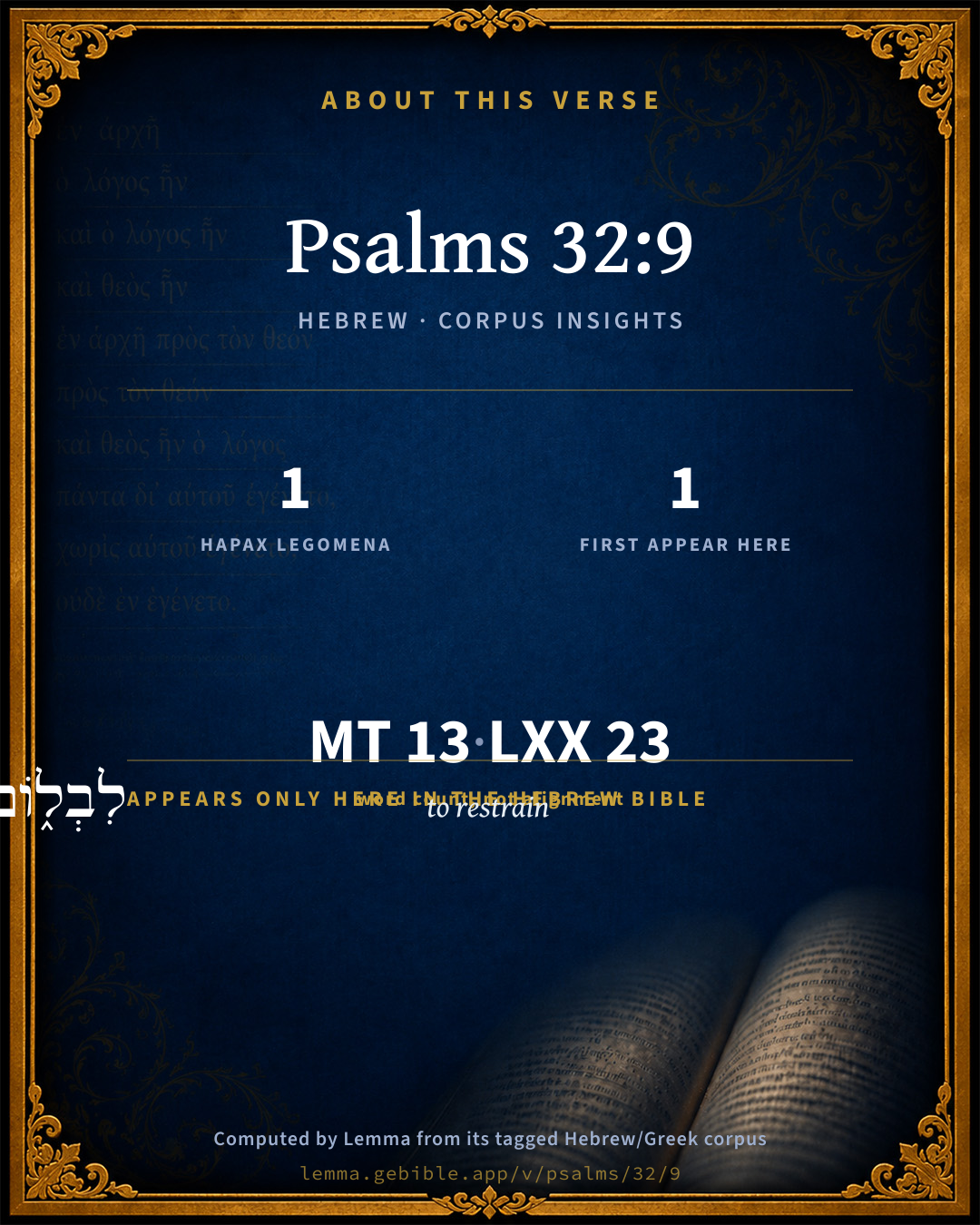
  • 1 hapax legomenon — only here in the Hebrew Bible
  • 1 first appearance in the Hebrew Bible
Full analysis ↓
Download a study sheet

One document with this verse’s original text, its word-by-word gloss line, the meaning frame, cross-references with their text, attributed commentary, and full source and license credits — printable, and it pastes into notes with its structure intact.

This verse Autodidact and up

Study sheet (.html) Plain text (.txt)

A passage Seminary Student

Up to 50 verses in one chapter. A passage sheet keeps up to 6 commentary sources and 12 cross-references per verse, in the order this page ranks them, and says so on the sheet whenever that leaves anything out. Ask for a single verse and you get the Autodidact verse sheet above.

Everything on this page stays free to read, with no account — the sheet is a download of what is already on screen, not access to it.

Want to remove ads? Support Godless Engineer
Compare translations 3

The same verse in 3 English versions, stacked beneath the original-language interlinear above. Click any original word for its lexicon entry.

Each is an independent rendering of the whole verse — the interlinear is not word-aligned to these translations.

Highlighted words mark where these versions differ — a whole-verse word diff, not a word-by-word alignment.

  • World English Bible Public Domain
    Don't be like the horse, or like the mule, which have no understanding, Who are controlled by bit and bridle, or else they will not come near to you.
  • King James Version Public Domain
    Be ye not as the horse, or as the mule, which have no understanding: whose mouth must be held in with bit and bridle, lest they come near unto thee.
  • unfoldingWord Literal Text CC BY-SA 4.0
    Do not be like a horse like a mule without understanding; ornament of him to curb with bit and bridle, or else they will not come near to you.

unfoldingWord Literal Text — © unfoldingWord, licensed CC BY-SA 4.0. Word-aligned USFM3 via Door43 (git.door43.org/unfoldingWord/en_ult).

Versions to compare (up to 4)

3 of 4 selected

Show all 18 translations

Every available English version of this verse, each an independent rendering of the whole verse.

  • World English Bible Public Domain
    Don't be like the horse, or like the mule, which have no understanding, Who are controlled by bit and bridle, or else they will not come near to you.
  • Berean Standard Bible Public Domain
    Do not be like the horse or mule, which have no understanding; they must be controlled with bit and bridle to make them come to you.
  • Majority Standard Bible Public Domain
    Do not be like the horse or mule, which have no understanding; they must be controlled with bit and bridle to make them come to you.
  • King James Version Public Domain
    Be ye not as the horse, or as the mule, which have no understanding: whose mouth must be held in with bit and bridle, lest they come near unto thee.
  • American Standard Version (1901) Public Domain
    Be ye not as the horse, or as the mule, which have no understanding; Whose trappings must be bit and bridle to hold them in, `Else' they will not come near unto thee.
  • Revised Version (1885) Public Domain
    Be ye not as the horse, or as the mule, which have no understanding: whose trappings must be bit and bridle to hold them in, else they will not come near unto thee.
  • Geneva Bible (1599) Public Domain
    Be ye not like an horse, or like a mule, which vnderstand not: whose mouthes thou doest binde with bit and bridle, least they come neere thee.
  • Douay-Rheims (1899) Public Domain
    Do not become like the horse and the mule, who have no understanding. With bit and bridle bind fast their jaws, who come not near unto thee.
  • Young's Literal Translation Public Domain
    Be ye not as a horse -- as a mule, Without understanding, With bridle and bit, its ornaments, to curb, Not to come near unto thee.
  • Literal Standard Version CC BY-SA 4.0
    Do not be as a horse—as a mule, || Without understanding, || With bridle and bit, its ornaments, to curb, || Not to come near to you.
  • Unlocked Literal Bible CC BY-SA 4.0
    Do not be like a horse or like a mule, which have no understanding; it is only with bridle and bit to control them that they will go where you want them to.
  • unfoldingWord Literal Text CC BY-SA 4.0
    Do not be like a horse like a mule without understanding; ornament of him to curb with bit and bridle, or else they will not come near to you.
  • Darby Bible Public Domain
    Be ye not as a horse, as a mule, which have no understanding: whose trappings must be bit and bridle, for restraint, or they will not come unto thee.
  • World Messianic Bible Public Domain
    Don’t be like the horse, or like the mule, which have no understanding, who are controlled by bit and bridle, or else they will not come near to you.
  • Webster's Bible Public Domain
    Be ye not as the horse, or as the mule, which have no understanding: whose mouth must be held in with bit and bridle, lest they come near to thee.
  • Free Bible Version CC BY-SA 4.0
    You mustn't be like a horse or a mule that doesn't know which way to go without a bit or a bridle. Otherwise they can't be controlled.”
  • Bible in Basic English Public Domain
    Do not be like the horse or the ass, without sense;...
  • JPS Tanakh (1917) Public Domain
    Be ye not as the horse, or as the mule, which have no understanding; whose mouth must be held in with bit and bridle, that they come not near unto thee.

Literal Standard Version (2020), Covenant Press — licensed CC BY-SA 4.0. Text via the HelloAO Bible API (eBible.org). Unlocked Literal Bible (unfoldingWord) — licensed CC BY-SA 4.0. Text via the HelloAO Bible API (eBible.org). unfoldingWord Literal Text — © unfoldingWord, licensed CC BY-SA 4.0. Word-aligned USFM3 via Door43 (git.door43.org/unfoldingWord/en_ult). Free Bible Version, Dr. Jonathan Gallagher — licensed CC BY-SA 4.0. Text via the HelloAO Bible API (eBible.org).

Word by word

More ways to search: Search by grammar → Find every occurrence → Compare this word →

Practice this passage: Drill this verse → Learn its vocabulary →

לִבְל֑וֹם
bâlam
H1102
“to restrain”
Preposition + Verb, Qal, Infinitive Construct
Part of Speech
Preposition + Verb
Stem
Qal
Form
Infinitive Construct
Full BDB Definition

Origin: a primitive root

TWOT: 249

(Qal) to curb, hold in, restrain
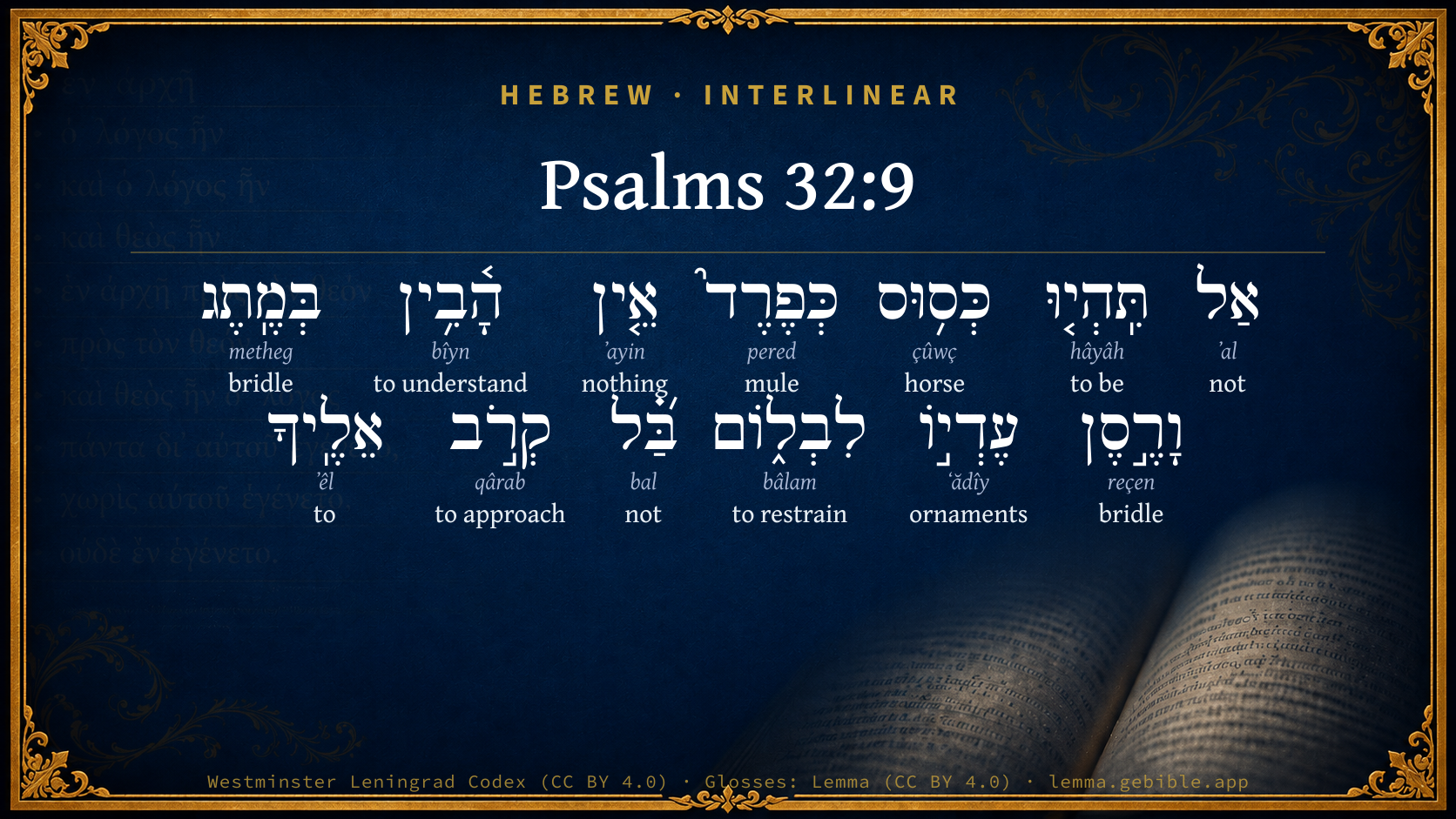
  1. אַל ʼal H408 “not” Particle, Negative
  2. תִּֽהְי֤וּ hâyâh H1961 “to be” Verb, Qal, Jussive, 2nd Person, Masculine, Plural
  3. כְּס֥וּס çûwç H5483 “like/as · horse” Preposition + Noun, Common, Masculine, Singular, Absolute
  4. כְּפֶרֶד֮ pered H6505 “like/as · mule” Preposition + Noun, Common, Masculine, Singular, Absolute
  5. אֵ֤ין ʼayin H369 “nothing” Particle, Negative
  6. הָ֫בִ֥ין bîyn H995 “to understand” Verb, Hiphil, Infinitive Construct
  7. בְּמֶֽתֶג metheg H4964 “in/at · bridle” Preposition + Noun, Common, Masculine, Singular, Absolute
  8. וָרֶ֣סֶן reçen H7448 “and · bridle” Conjunction + Noun, Common, Masculine, Singular, Absolute
  9. עֶדְי֣וֹ ʻădîy H5716 “ornaments · his” Noun, Common, Masculine, Singular, Construct + Suffix, Personal, 3rd Person, Masculine, Singular
  10. בַּ֝֗ל bal H1077 “not” Particle, Negative
  11. קְרֹ֣ב qârab H7126 “to approach” Verb, Qal, Infinitive Construct
  12. אֵלֶֽיךָ ʼêl H413 “to · you” Preposition + Suffix, Personal, 2nd Person, Masculine, Singular

About this verse

These counts appear in no published source. They are computed here, from the morphology-tagged text and Lemma’s own curated glosses. What Lemma adds →

13
words
13
distinct lemmas
Wisdom
section

Notable vocabulary

1 hapax legomenon — a word that appears only here in the entire Hebrew Bible:

  • לִבְל֑וֹם to restrain H1102

First appearance in Scripture

This word makes its first canonical appearance in the Hebrew Bible here:

  • לִבְל֑וֹם to restrain H1102

Shared distinctive vocabulary

בְּמֶֽתֶג bridle H4964 occurs in 4 verses of the Hebrew Bible. Also found in:

Grammatical profile

  • 4 verbs
  • 5 nouns
  • 1 preposition
  • 3 particles

Verb forms

  • תִּֽהְי֤וּ Qal · Jussive
  • הָ֫בִ֥ין Hiphil · Infinitive Construct
  • לִבְל֑וֹם Qal · Infinitive Construct
  • קְרֹ֣ב Qal · Infinitive Construct

Hebrew & Septuagint length

In English translation the verse runs 29 words from the Hebrew and 28 from the Septuagint (LXX English) — closely comparable.

A rough comparison of the two English renderings, which tokenize alike — not a word-level alignment.

Word counts can differ between the Hebrew and the Greek without any difference in meaning — e.g. the Hebrew direct-object marker אֵת has no separate Greek word, and Greek often adds the article ὁ.

In the original languages it is 13 Hebrew tokens and 23 Greek tokens — but the two are counted differently (Hebrew bundles its prefixes and suffixes into one token; the Greek is in lemma form), so that isn’t a like-for-like length.

Cross-references

7

Topical passages linked to Psalms 32:9 in the Treasury of Scripture Knowledge — connected by theme and wording, ordered by reader-vote popularity; previews shown in the World English Bible.

  • Proverbs 26:3 A whip for the horse, A bridle for the donkey, And a rod for the back of fools!
  • Jeremiah 4:22 For my people are foolish, they don't know me; they are foolish children, and they have no understanding; they are wise to do evil, but to do good they have no knowledge.
  • Job 35:11 Who teaches us more than the animals of the earth, And makes us wiser than the birds of the sky?'
  • Jeremiah 8:6–7 I listened and heard, but they didn't speak aright: no man repents him of his wickedness, saying, What have I done? everyone turns to his course, as a horse that rushes headlong in the battle.
  • James 3:3 Indeed, we put bits into the horses' mouths so that they may obey us, and we guide their whole body.
  • James 4:7–10 Be subject therefore to God. But resist the devil, and he will flee from you.
  • Jeremiah 31:18 I have surely heard Ephraim bemoaning himself [thus], You have chastised me, and I was chastised, as a calf unaccustomed [to the yoke]: turn you me, and I shall be turned; for you are Yahweh my God.

Cross-references courtesy of OpenBible.info (CC BY 4.0).

Hebrew and Greek witnesses Masoretic Hebrew ↔ Greek Septuagint

The same verse in the two great witnesses to the Old Testament, shown verse-for-verse.

You’re reading Greek Psalm 31 (Hebrew Psalm 32). The Septuagint counts the superscription, so verse numbers can differ from the Hebrew — chapter-level alignment, not verse-by-verse. Numbering follows Rahlfs.

These are two independent witnesses, not word-aligned to each other, and the Septuagint is shown in lemma (dictionary) form.

Hebrew Psalms 32:9 Masoretic · Westminster Leningrad Codex

אַל תִּֽהְי֤וּ כְּס֥וּס כְּפֶרֶד֮ אֵ֤ין הָ֫בִ֥ין בְּמֶֽתֶג וָרֶ֣סֶן עֶדְי֣וֹ לִבְל֑וֹם בַּ֝֗ל קְרֹ֣ב אֵלֶֽיךָ

Don't be like the horse, or like the mule, which have no understanding, Who are controlled by bit and bridle, or else they will not come near to you.

World English Bible · Public Domain

Greek LXX Greek Psalm 31:9 Septuagint · lemma form

μή γίγνομαι ὡς ἵππος καί ἡμίονος ὅς οὐ εἰμί σύνεσις ἐν χαλινός καί κημός ὁ σιαγών αὐτός ἄγχω ὁ μή ἐγγίζω πρός σύ

Be you⌃ not as horse and mule, which have no understanding; but you must constrain their jaws with bit and curb, lest they should come near to you.

LXX2012 (modern English Septuagint) · Public Domain

On this verse, Ellicott's Commentary for English Readers discusses the Septuagint’s reading. Read the note in Commentary ↓

Hebrew: Westminster Leningrad Codex (CC BY 4.0). Greek: Septuagint (public domain); English from LXX2012 (modern English Septuagint) (Public Domain). How the Septuagint differs from the Hebrew →

Commentary

Notes on Psalms 32:9 from classic Christian and Jewish commentators (each source and its license shown beneath its notes). The classic Christian expositions comment on the surrounding passage and are grouped to its opening verse, so a note may address several verses; the Jewish commentaries on the Tanakh (Rashi and others) are per-verse, so they appear only where the commentator wrote on this verse.

Lemma curates 59 commentaries, every one of them public domain or Creative Commons licensed, each selected and text-cleaned for this edition rather than reprinted as found. About our sources →

Trapp's Complete Commentary

John Trapp

Psa 32:9 Be ye not as the horse, [or] as the mule, [which] have no understanding: whose mouth must be held in with bit and bridle, lest they come near unto thee.

Ver. 9. Be ye not as the horse, or as the mule] David having, according to the title Maschil, promised to teach, useth this preface to bespeak attention. Be not uncounsellable, irreclaimable, such as Basil (Ad Evag. Epist. 10) complaineth of, qui neque quid sit verum sciunt, neque sustinent discere, who neither knew, nor would be taught, what was true, and fit to be practised. Of the rhinoceros some write, that slain he may be, caught he cannot be. Others, that he is animal animo indomito, a most untameable creature; for if he be taken, he presently dieth of sullenness. Such spirits we meet with not a few, who yet would take it in foul scorn to be reckoned horses and asses, that have no understanding, neither will be taught any. To these the psalmist here saith, Ne obstupescite, et obbrutescite ad exercitationes Dei, &c. Be not as horse or mule, lest ye be led through a fool’s paradise into a true prison. Be not headlong, headstrong, untameable, untractable, &c. The horse and mule are instanced, as well known among the Jews, and used to be ridden on.

Which have no understanding] And yet the horse knoweth his owner, &c. Strange things are reported of Bucephalus, and Julius Caesar’s great horse. Of the Egyptian Mamelukes’ horses it is reported, that they were so docible, that at certain signs or speeches of the rider they would with their teeth reach him up from the ground a lance, an arrow, or such like thing; and as if they had known the enemy, run upon him with open mouth, and lash at him with their heels; and had by nature and custom learned not to be afraid of anything.

Whose mouth must be held in with bit and bridle] Lest they kick and bite thee, Ne mordeat nocentve tibi (Jun.). Such is the mad world’s wages and usage of the most faithful preachers. B. Ridley lamented it in his time; the great ones spurned privily against those that went about most busily and wholesomely to cure their sore backs. As for Latimer, Lever, Bradford, Knox, saith he, their tongues were so sharp, they ripped in so deep to their galled backs, to let out the filthy matter, that they could never abide them. Thus he, and much more concerning King Edward VI’s courtiers (Acts and Mon. 1616). The words may be read thus, Whose mouth, except it be held with bit and bridle, they will not come nigh unto thee, that is, thou wilt not be able to rule them. It is a good observation of a modern divine, Not the unruly colt only, but the horse that is broken, hath a bit and bridle also. So even the godly need the bridle of the law, ne spiritum sessorem excutiant, lest they cast their rider.

John Trapp, A Commentary or Exposition upon All the Books of the Old and New Testament (1647–1656) — public domain. Text from a community e-Sword module.

The Biblical Illustrator

Joseph S. Exell

Psa_32:9

Be ye not as the horse, or as the mule, which have no understanding.

Bit and bridle: how to escape them

I. A privilege to be sought.

1. This guidance is very full in its nature.

(1) God is prepared to give you an inward understanding of spiritual things; for His instruction is intensely effectual upon the mind.

(2) God adds the precept to the doctrine, and instructs us in both.

(3) Here is fellowship as well as instruction; for the guide goes with the traveller, and thus will God, in the process of our instruction, give us fellowship with Himself.

2. This teaching is divine in its source. Our Lord may instruct us by men who are taught of Himself; but, after all, the best of His servants cannot teach us anything profitably except the Lord Himself teaches by them and through them. What a wonderful condescension it is that the Lord should become a teacher!

3. Observe how wonderfully personal is this promised guidance. The Infinite focusses Himself upon the insignificant!

4. This teaching is delightfully tender.

5. This teaching is constant.

II. A character to be avoided.

1. We are not to imitate creatures of which we are the superiors. One said, in my hearing, as an excuse for a passionate speech, I could not help it. If you tread on a worm it will turn. Is a worm to be the example for a saint?

2. We must mind that we do not imitate creatures to whom we are so near akin. A large part of us is animal, and its tendency is to drag down that part which is more than angelic. How abject, and yet how august is man! Brother go the worm, and yet akin to Deity. Immortal and yea a child of dust. Be ye not the prey of your lower natures.

3. We are not to imitate creatures devoid of reason. Be sensitive to the Spirit of God. Give me understanding and I shall keep Thy law.

III. As infliction to be escaped. DO not drive your Saviour to be stern with you. Do not choose the way of hardness--the brutish way. Be ye not as the horse, or as the mule, which have no understanding, for then you will become sad, gloomy, dull, stupid, and full of disquietude.

IV. A freedom to be attained. There are children of God who wear no bit or bridle: the Lord has loosed their bonds. To them obedience is delight: they keep His commands with their whole heart. The Son has made them free, and they are free indeed.

1. They are free, because they are in touch with God. Gods will is their will. They answer to the Lord as the echo to the voice.

2. Because tutored.

3. Because always trusting.

4. Because tender. (C. H. Spurgeon.)

That reason is an insufficient guide

That the will of man stands in need of restraint and control is an acknowledged truth: but it has been of late discovered that reason is all-sufficient in itself; that it wants no spur to stimulate, or curb to check it; but that, if left to take its own course, it is liable to no error--it never fails--it never injures others, or itself. Before this new doctrine be admitted, it must be subjected to the test of time and trial;--it must, like all other theories, be reduced to practice. What is religion, but the guide of reason and the controller of the will? What is law, but the restraint of individual will for the good of all? What is education, but the art of forming the will to obedience, of correcting its errors, and training it to virtue?

I. religion cheeks the vices, follies, and passions of mankind, by inculcating a belief that there is a Superior Power which created us, such as we are;--that set good and evil before us, for our free will to choose; but promised a reward for the one, and a punishment for the other. All religion, therefore, stands upon the supposition that reason left to itself is insufficient to direct us;--for if we should all choose the good of our own accord, reward and punishment must be superfluous: even false religion supposes this; nay, even a religion in the hands of the magistrate,--a political religion,--the avowed invention of man,--the product of reason itself, imputes error to reason, and preaches up the necessity of control.

II. The very existence of LAW in the world is a testimony of the universal suffrage of mankind against the power of reason. If all men acted right of their own accord there would be no need of law to restrain them.

III. education, though applied first to the individual, is the last resource of society. Men form themselves into society, from their mutual fears, for mutual protection. Their notions of a Deity may be derived from tradition or revelation. But, in the ordinary course of things, both religion and law exist before education. It is from reflection that men begin to perceive that the rising generation may be trained to habits suitable to the society of which they are to become members; and if education could act in proportion to its design, it would prevent the commission of those crimes which the law must punish.

IV. but do we really hope to stem the torrent by religion, law, and education? Yes--if they have not lost their effect upon the mind of man. (M. R. Vincent, D. D.)

The Biblical Illustrator, edited by Joseph S. Exell (c. 1880s–1900s) — public domain. Text from a community e-Sword module.

Joseph Benson's Commentary

Psa 32:9. Be not as the horse, or as the mule — God hath endowed you with reason, both to inform you what you ought to do. and to check you when you do amiss, and hath made you capable also of receiving good admonitions from others; do not therefore follow your own unbridled lusts and appetites; much less be refractory and untractable, when God would reduce you from the error of your ways; as if you were not men, but headstrong horses and mules, which can by no means be curbed or governed, without bit and bridle. Houbigant renders the last clause, very properly, Or they will not come near thee; for, as horses and mules are not dangerous beasts, whose common practice it is to kick or bite, the word lest is extremely improper. Nor is it the proper use of a bit, or bridle, to keep them from so doing, but rather to bring them nearer to the rider, for his use, and to keep them under his power and management.

Joseph Benson's Commentary on the Old and New Testaments (1811–1818) — public domain. Text from a community e-Sword module.

The Pulpit Commentary

Be ye not as the horse, or as the mule, which have no understanding. The singular is exchanged for the plural, since the "instruction" is now intended, not for the godly man only, but for all. Israel had been always stiff-necked, (Exo_32:9 Exo_33:3, 5 34:9 Deu_9:6, 13 10:16 2Ch_30:8 Act_7:51) like a restive horse or mule. David exhorts them to be so no more. The horse and mule are excusable, since they "have no understanding or, "no discernment Israel would be inexcusable, since it had the gift of reason. Whose mouth must be held in with bit and bridle; rather, whose adornings are with bit and bridle to hold them in (compare the Revised Version). Lest they come near unto thee. This clause is obscure. It may mean, "Lest they come too near to thee," so as to do thee damage, as when a riding horse tosses his head and strikes the rider in the face, or when a chariot horse rears and falls back upon the driver; or it may mean, "Else they will not come near to thee," i.e. until they are trapped with bit and bridle, they will refuse to come near to thee.

The Pulpit Commentary (1880–1919), ed. H.D.M. Spence-Jones & Joseph S. Exell — public domain. Text from a community e-Sword module.

J. A. Alexander on Psalms

Joseph Addison Alexander

9. (Psa 32:9) Be ye not as a horse (or) as a mule (in which) there is no understanding—in bridle and bit (consists) its ornament, to muzzle it, (because of its) not approaching to thee. The counsel or advice, which was promised in the previous verse, is here imparted. The plural form does not imply a change in the object of instruction, but merely shews that the individual addressed in Psa 32:8 was the representative of a whole class, namely, that described by the collective phrase, every gracious (person), in Psa 32:6.—The mule is, among various nations, a proverbial type of stubborn persistency in evil, and we find analogous allusions to the horse in Jer 5:8; Jer 8:6. The reason for using a comparison with brutes is intimated in the second clause, to wit, that the debased irrationality of sin might be distinctly brought into view. The analogy is carried out with no small subtilty by representing that what seems to be the trappings or mere decoration of these brutes is really intended to coerce them, just as that in which men pride themselves may be, and if necessary will be used by God for their restraint and subjugation. The common version of the last clause—lest they come near unto thee—would be suitable enough in speaking of a wild beast, but in reference to a mule or horse the words can only mean, because they will not follow or obey thee of their own accord, they must be constantly coerced, in the way both of compulsion and restraint.

Joseph Addison Alexander, The Psalms Translated and Explained (1850) — public domain. Text from a community e-Sword module.

Tyndale Open Study Notes

Tyndale Open Resources

32:9 The senseless person is not wise. Rejecting the Lord’s counsel ruins life and makes one like an animal (see Isa 1:3; Jas 3:3).

Tyndale Open Study Notes — © Tyndale Open Resources, licensed CC BY-SA 4.0. Text via the HelloAO Bible API.

Geneva Bible (1599)

Geneva Bible translators

If men can rule brute beasts, think they that God will not bridle and tame their rage?

Geneva Bible (1599) marginal notes — public domain. Text via Bolls.life.

Jamieson, Fausset & Brown

Robert Jamieson, A. R. Fausset & David Brown

The latter clause, more literally, "in that they come not near thee"; that is, because they will not come, &c., unless forced by bit and bridle.

Jamieson, Fausset & Brown — Commentary Critical and Explanatory on the Whole Bible (1871) — public domain (CC PDM 1.0). Text via the HelloAO Bible API.

Adam Clarke's Commentary

Verse 9. Be ye not as the horse or as the mule] They will only act by force and constraint; be not like them; give a willing service to your Maker. "They have no understanding;" you have a rational soul, made to be guided and influenced by reason. The service of your God is a reasonable service; act, therefore, as a rational being. The horse and the mule are turned with difficulty; they must be constrained with bit and bridle. Do not be like them; do not oblige your Maker to have continual recourse to afflictions, trials, and severe dispensations of providence, to keep you in the way, or to recover you after you have gone out of it.

Adam Clarke's Commentary on the Bible (1810–1826) — public domain. Text from a community e-Sword/MySword module.

John Calvin's Commentaries

9. Be not like the horse or mule. David now briefly explains the amount of the counsel which he formerly said he would give. He exhorts all to learn with quietness, to lay aside stubbornness, and to put on the spirit of meekness. There is much wisdom, too, in the advice which he gives to the godly to correct their hardihood; for if we were as attentive to God’s corrections as we ought, every one would eagerly hasten to seek his favor. Whence is so much slowness to be found in all, but that we are either stupid or refractory? By likening the refractory, therefore, to brute beasts, David puts them to shame, and at the same time declares that it will avail them nothing to “kick against the pricks.” Men, says he, know how to tame the fierceness of horses by bridles and bits; what then do they think God will do when he finds them intractable?

John Calvin's Commentaries (1540-1563) — public domain. Text from the Calvin Translation Society English edition (1840s-50s) via the Christian Classics Ethereal Library (ccel.org). Calvin's coverage is partial (roughly two-thirds of the Bible); uncommented books and verses are honest gaps, never fabricated. The 19th-century editor's footnotes and remarks are omitted so the notes are faithfully Calvin's own voice.

Ellicott's Commentary for English Readers

(9) Whose mouth.—Here the text has evidently suffered, and the exact meaning is lost. There are also verbal difficulties. The word translated “mouth” elsewhere (except Psa_103:5, where see Note) means “ornament,” and the literal rendering of the text as it stands is, with bit and bridle his ornament to hold, not approaching to thee. This may mean that the animal is harnessed, either “that it may not approach,” or “because without harness it will not approach.” In either case the general application is the same. Horses and mules can only be rendered obedient by restraints that are unworthy of a rational creature. The LXX. and Vulg. have “jaws” instead of “mouth,” and Ewald follows them, and renders the last clause, “of those who approach thee unfriendly.”

A Bible Commentary for English Readers, edited by Charles John Ellicott (1878–1897) — public domain. Text from a community e-Sword module.

The Cambridge Bible for Schools and Colleges

gen. ed. J. J. S. Perowne

9, 10. A warning addressed to all not to resist God’s will, and neglect instruction.

Be not like horse like mule with no understanding,

With trappings of bit and bridle must they be curbed:

Else will they not come near unto thee.

The Heb. is obscure and possibly corrupt in some points; but the general sense is clear. Brute animals without reason must be controlled and compelled by force to learn to submit to man’s will. If man will not draw near to God and obey Him of his own free will, he lowers himself to the level of a brute, and must expect to be treated accordingly and disciplined by judgment (Isa_26:9-11).

For the thought that man who will not listen to God’s teaching ‘becomes brutish’ see Jer_10:14; Jer_10:21; Psa_49:10; Psa_49:12; Psa_49:20; Psa_73:22. The word rendered mouth in A.V., trappings in R.V., is of doubtful meaning. Some explain, whose wild spirit must be curbed &c.; but this is less probable. The A.V. of the last line, lest they come near unto thee, to hurt thee, gives no suitable point of comparison, and must certainly be rejected.

The Cambridge Bible for Schools and Colleges (gen. ed. J. J. S. Perowne; Cambridge University Press, 1878–1918) — public domain. Text from a community e-Sword module.

John Gill's Exposition

Be ye not as the horse, or as the mule, which have no understanding,.... The design of this exhortation is to direct men how to behave under the instructions given; not as brutes, which have no rational faculties, but as men; that they should not show themselves thoughtless, stupid, and unteachable, as these animals, or worse than they; nor stubborn and obstinate, refractory and untractable, resolving not to be taught, stopping the ear, and pulling away the shoulder; nor ill natured and mischievous; not only hating instruction, casting away the law of the Lord, but kicking and spurning at, and persecuting such who undertake to instruct them; as these creatures sometimes attempt to throw their riders, and, when down, kick at them;

whose mouth must be held in with bit and bridle, lest they come near unto thee; to do mischief, bite or kick; or "because they do not come near to thee" (t); and that they may come near, and be brought into subjection, and become obedient; therefore such methods are used; see Jam 3:3; there is in the words a tacit intimation, that men are commonly, and for the most part, like these creatures, stupid, stubborn, and mischievous; and therefore severe methods are used by the Lord, sore chastenings, to humble and instruct them; see Jer 31:18; the mule, more especially, is remarkable for its stupidity (u); and though the horse is docile, yet he is sometimes stubborn and refractory.

(t) "quia non accedunt ad te", Grotius. (u) "Mule, nihil sentis----", Catullus.

John Gill's Exposition of the Whole Bible (1746–1763) — public domain (CC PDM 1.0). Text via the HelloAO Bible API.

Albert Barnes' Notes on the Bible

Be ye not as the horse - The horse as it is by nature - wild, ungoverned, unwilling to be caught and made obedient. The counsel referred to in the previous verse is here given; and it is, that one who wishes to obtain the favor of God should not be as the wild and unbroken horse, an animal that can be subdued only by a curb, but should evince a calm, submissive spirit - a spirit “disposed” to obey and submit. If he becomes a subject of God’s government, he is not to be subdued and held as the horse is - by mere force; there must be the cheerful submission of the will. People are not brought into the service of God by physical power; they are not kept there by an iron “curb.” They come and yield themselves willingly to his law; they “must” come with that spirit if they would find the favor of God.

Or as the mule - The mule is distinguished for its obstinacy, and this is evidently the ground of comparison here. The meaning is, be tractable, gentle, yielding; submit to the guidance and direction of God and his truth.

Which have no understanding - That cannot be controlled by reason and conscience. They are governed only by power and by fear. People have reason and conscience, and they should allow themselves to be controlled by appeals TO their reason and to their moral sense. They are not made to be governed as brutes are. Since they have a higher nature, they should permit themselves to be governed by it.

Whose mouth must be held in with bit and bridle - More literally, “in bit and bridle is their ornament to restrain them;” that is, the trappings or the ornaments of the horse and the mule consist of the bridle and the bit, the purpose of which is to restrain or control them. The allusion, however, is not to the bit and bridle as an “ornament,” but as the ordinary trappings of the mule and the horse.

Lest they come near unto thee - Or rather, “because of its not approaching thee;” that is, because the horse and the mule will not come to thee of their own accord, but must be restrained and controlled.

Albert Barnes' Notes on the Bible (1834–1885) — public domain. Text from a community e-Sword/MySword module.

Matthew Poole's English Annotations

Be ye not as the horse, or as the mule; be not such brutish and sottish creatures as I have been, not having reason or grace to govern yourselves, nor hearkening to the counsels and admonitions of others. Lest they come near unto thee; lest they should come too near to thee, so as to bite or kick thee. But neither is this the common practice of horses or mules, of which he seems to speak; nor is this the proper use of a bit or bridle, to keep them from so doing; but rather to bring them nearer to the rider for his use, and to keep them under his conduct and power, from whom they are otherwise apt to run away. The words therefore are and may be otherwise rendered, because they do not or will not come near unto thee, to wit, for thy service, unless they be forced to it by a bit or bridle. And so all the ancient translators understand it.

Matthew Poole's English Annotations on the Holy Bible (1683–1685) — public domain. Text from a community e-Sword/MySword module.

The Treasury of David

Charles H. Spurgeon

Ver. 9. Be ye not as the horse, or as the mule, which have no understanding. Understanding separates man from a brutelet us not act as if we were devoid of it. Men should take counsel and advice, and be ready to run where wisdom points them the way. Alas! we need to be cautioned against stupidity of heart, for we are very apt to fall into it. We who ought to be as the angels, readily become as the beasts. Whose mouth must be held in with bit and bridle, lest they come near unto thee. It is much to be deplored that we so often need to be severely chastened before we will obey. We ought to be as a feather in the wind, wafted readily in the breath of the Holy Spirit, but alas! we lie like motionless logs, and stir not with heaven itself in view. Those cutting bits of affliction show how hard mouthed we are, those bridles of infirmity manifest our headstrong and wilful manners. We should not be treated like mules if there was not so much of the ass about us. If we will be fractious, we must expect to be kept in with a tight rein. Oh, for grace to obey the Lord willingly, lest like the wilful servant, we are beaten with many stripes. Calvin renders the last words, "Lest they kick against thee, "a version more probable and more natural, but the passage is confessedly obscurenot however, in its general sense.

Ver. 9. Be ye not as the horse, or as the mule, etc. How many run mad of this cause, inordinate and furious lusts! The prophet Jeremiah, Jer 2:24, compares Israel to "a swift dromedary, traversing her ways, "and to "a wild ass used to the wilderness, that snuffeth up the wind at her pleasure." Be ye not, said the psalmographer, "as the horse, or as the mule, which have no understanding: whose mouth must be held in with bit and bridle." Men have understanding, not beasts; yet when the frenzy of lust overwhelms their senses, we may take up the word of the prophet and pour it on them: "Every man is a beast by his own knowledge." And therefore "man that is in honour and understandeth not, is like unto beasts that perish" Ps 49:20. Did not the bridle of God's overruling providence restrain their madness, they would cast off the saddle of reason, and kick nature itself in the face. Thomas Adams.

Ver. 9. Be ye not as the horse, or as the mule, etc. According to the several natures of these two beasts, the fathers and other expositors have made several interpretations; at least, several allusions. They consider the horse and the mule to admit any rider, any burden, without discretion or difference, without debate or consideration; they never ask whether their rider be noble or base, nor whether their load be gold for the treasure, or roots for the market. And those expositors find the same indifference in an habitual sinner to any kind of sin; whether he sin for pleasure, or sin for profit, or sin but for company, still he sins. They consider in the mule, that one of his parents being more ignoble than the other, he is like the worst, he hath more of the ass than of the horse in him; and they find in us, that all our actions and thoughts taste more of the more ignoble part of the earth than of heaven. St. Hierome thinks fierceness and rashness to be presented in the horse, and sloth in the mule. And St. Augustine carries these two qualities far; he thinks that in this fierceness of the horse the Gentiles are represented, which ran far from the knowledge of Christianity; and by the laziness of the mule the Jews, who came nothing so fast, as they were invited by their former helps to the embracing thereof. They have gone far in these allusions and applications; and they might have gone as far further as it had pleased them; they have sea room enough, that will compare a beast and a sinner together; and they shall find many times, in the way, the beast the better man. John Donne.

Ver. 9. Be ye not as the horse, or as the mule, etc. Consider the causes why a broken leg is incurable in a horse, and easily curable in a man. The horse is incapable of counsel to submit himself to the farrier; and therefore in case his leg be set he flings, flounces, and flies out, unjointing it again by his misemployed mettle, counting all binding to be shackles and fetters unto him: whereas a man willingly resigns himself to be ordered by the surgeon, preferring rather to be a prisoner for some days, than a cripple all his life. Be ye not as the horse, or as the mule, which have no understanding; but "let patience have its perfect work in thee." Jas 1:4. Thomas Fuller.

Ver. 9. Bit and bridle (Norw-ntk) The LXX render the first of these two words by calinw, the second by kemw. The word calinos signifies the iron of the common bridle, which is put into the horse's mouth, the bit, or curb. But kemoz was something like a muzzle, which was put upon mischievous horses or mules to keep them from biting. Xenephon says, that it allowed them to breathe, but kept the mouth shut, so that they could not bite. Not knowing the term of art for this contrivance, I call it a muzzle. The verb (brq) is a military term, and signifies to advance, as an enemy, to attack. The "coming near, "therefore, intended here, is a coming near to do mischief. The admonition given by the psalmist to his companions, is to submit to the instruction and guidance graciously promised from heaven, and not to resemble, in a refractory disposition, those ill conditioned colts which are not to be governed by a simple bridle; but, unless their jaws are confined by a muzzle, will attack the rider as he attempts to mount, or the groom as he leads them to the pasture and the stable. Samuel Horsley.

Ver. 9. Lest they come near unto thee. The common version of this clause would be suitable enough in speaking of a wild beast, but in reference to a mule or a horse the words can only mean, because they will not follow or obey thee of their own accord; they must be constantly coerced, in the way both of compulsion and restraint. J. A. Alexander.

Ver. 9. "Be ye not like a horse or mule, which have no understanding, and whose ornament is a bridle and bit, to hold them: they do not come unto thee of themselves." Charles Carter, in "The Book of Psalms." 1869. A new Translation.

Ver. 9. God's bits and bridles, the mules who need them, and reasons why we ought not to be of the number.

Ver. 9. How far in our actions we are better, and how far worse than horses and mules.

Psalms 32:10*

Charles H. Spurgeon's The Treasury of David (1869–1885) — public domain. Psalms only. Text from a community e-Sword/MySword module.

Whedon's Commentary on the Bible

Daniel D. Whedon

9. Bit and bridle—That is, by harsh and forcible means. A different class is here addressed, and the language and figures are correspondent. They cannot be trusted upon the ground of reasonableness or moral obligation, but must be governed by force or powerful constraints. Pro_26:3.

Mouth—The Hebrew word almost always means ornament, but it is absurd to force this sense upon it here, as some do. In Psa_103:5 it means “mouth,” and the whole connexion and imagery of the present text require the same signification here.

Lest they come near unto thee— “[Otherwise] they come not near to thee.” The coming “near” is not to be understood as for injury, but for submission and service. “Irrational and obstinate animals do not approach men unless tamed by compulsory means.”—Moll. The point of the exhortation is, that we should submit to God, and obey freely from rational conviction, not requiring, as in the case of brute animals, that compulsory force or physical chastisements should be applied. Jas_3:3

Daniel D. Whedon (gen. ed.), Commentary on the Old and New Testaments (1874–1909) — public domain. Text from a community e-Sword module.

John Wesley's Explanatory Notes

Will not - Unless they be forced to it by a bit or bridle. And so all the ancient translators understand it.

John Wesley, Explanatory Notes Upon the Whole Bible (1754–1765) — public domain. Text via the GEBible commentary corpus.

unfoldingWord translationNotes

Door43 World Missions Community

Do not be like a horse ... no understanding

The writer compares people with no understanding to horses and mules. Possible meanings are 1) the writer is speaking Yahweh's words to his readers, "You all must not be like a horse ... no understanding" or 2) Yahweh is speaking to the writer as though to a group of people. (See: Simile)

bridle and bit

Two tools that are used by people to guide horses and mules go where the rider wants them to go.

where you want them to

"where anyone wants them to go." The "you" here is singular and refers to no one in particular.

Yahweh's covenant faithfulness will surround the one who trusts in him

Yahweh being faithful to a person and protecting that person is spoken of as if Yahweh's covenant faithfulness surrounded the person. The abstract noun "faithfulness" can be translated as an adjective. AT: "Because Yahweh is faithful to his covenant, he will protect the one who trusts in him" (See: Metaphor and Abstract Nouns)

translationWords

horse

donkey

understand

evil

covenant faithfulness

trust

unfoldingWord translationNotes — © Distant Shores Media and the Door43 World Missions Community, licensed CC BY-SA 4.0. Source: git.door43.org/Door43/en_tn.

Rashi

Rabbi Shlomo Yitzchaki (Rashi)

Be not like a horse, like a mule which does not discern between one who benefits him and one who does him harm, for when you insert a bit into his mouth, he closes his mouth and shakes his bridle, and when you curry him and brush him, you must close his mouth and chastise him with a bit and bridle while you adorn him and groom him.

so that...he does not come near you So that he should not come near you to hurt you while you groom him, with bit and bridle (when he is being groomed, to close his mouth. When he is being groomedwhile you curry him and brush himyou must close his mouth with a bit and bridle so that he does not come near you.) בלימה is an expression of closing in the language of the Mishnah: Its mouth is closed (בלום), its feet are closed (מבלמות), in Tractate Bechoroth (40b). (Menachem associated לבלום, and also בלימה [Job 26:7] as an expression of regulating [p. 45].)

Rashi on the Tanakh — English translations: “The Judaica Press complete Tanach with Rashi, translated by A. J. Rosenberg” (CC BY 4.0); “Pentateuch with Rashi's commentary by M. Rosenbaum and A.M. Silbermann, 1929-1934” (public domain); “The Metsudah Tanach series, Lakewood, N.J” (CC BY 4.0); and “The Book of Joshua, Metsudah Publications, 1997” (CC BY 4.0). Text via Sefaria.

Lesson kit

Teaching starters — assembled from the data on this page, not authored interpretation. Every prompt links to the verse data it draws on. Edit before teaching.

Psalms, in the Wisdom, opens this verse with 13 words (13 distinct Hebrew lemmas). Its most distinctive word is bâlam (“to restrain”). A historical commentator’s framing appears above. Read the whole chapter for the surrounding context.

Discussion questions

  1. The word bâlam carries the sense “to restrain.” How does it shape the verse?
  2. This verse holds 1 word here found nowhere else in the Hebrew Bible. What might the rare word draw attention to?
  3. The word “to restrain” first appears here in Scripture. What is being introduced at this debut?
  4. 2 Kings 19:28 shares the word «bridle» with this verse. How do the two illuminate each other?
  5. The translations on this page render this verse differently — a whole-verse word diff, not a word-by-word alignment. What might account for the different wordings?
  6. The verb «תִּֽהְי֤וּ» is Qal Jussive. How does its form color the action?
  7. Reading how Trapp's Complete Commentary and The Biblical Illustrator read this verse, where do the two commentators agree and where do they part?

Things to notice

Reading settings

Reading text

Shown beneath each verse's original-language words.

Old Testament
Old Testament edition

Read the OT as the Masoretic Hebrew (MT) or the Greek Septuagint (LXX).

English shown for the Greek Septuagint (in the Hebrew ↔ Greek comparison).

Comparing translations? Open the Compare panel on any verse page to stack up to four side by side.