
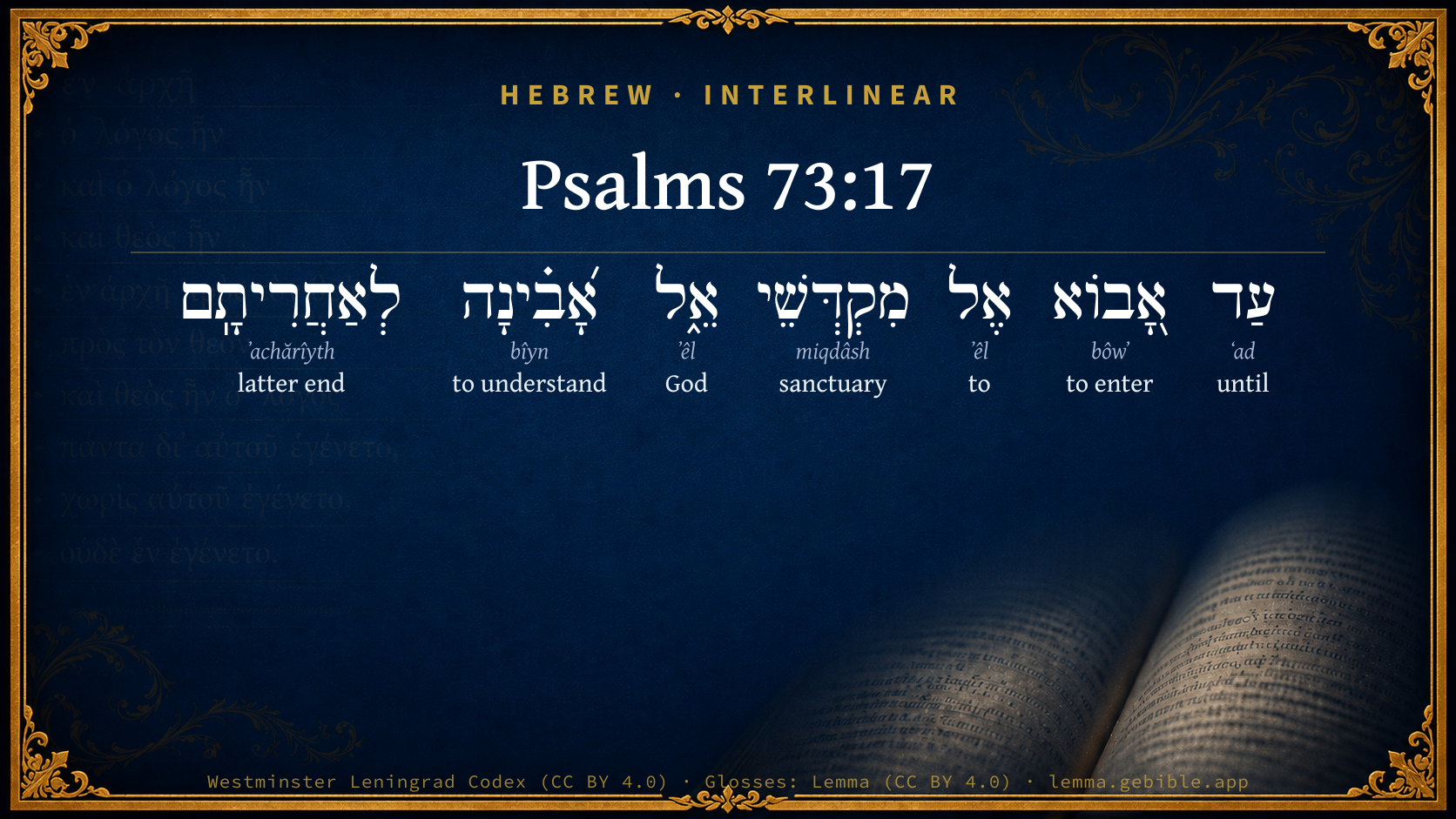
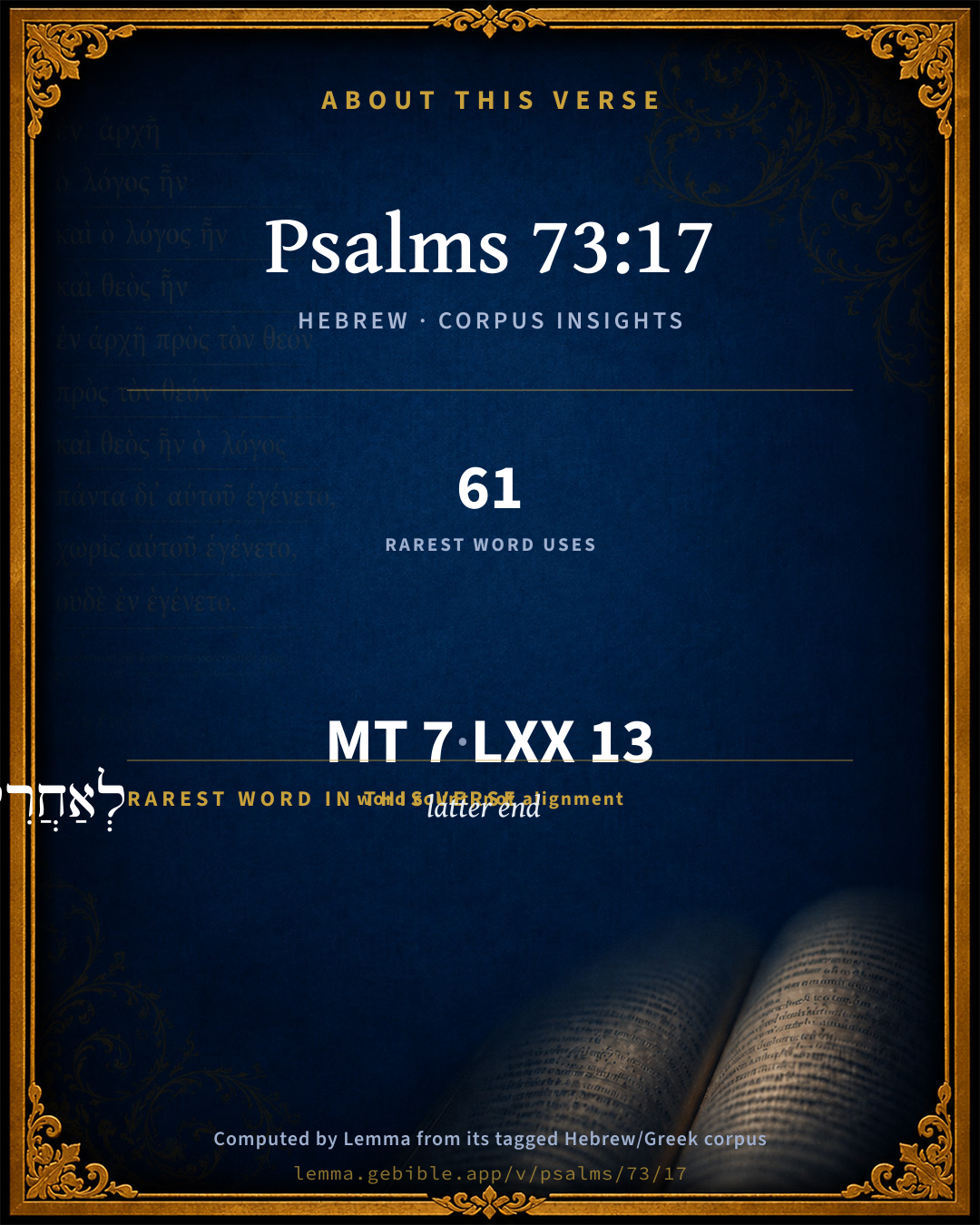
Psalms 73:17

Hebrew (Westminster Leningrad Codex) Psalms 73:17 appears in the Hebrew Old Testament. The text above is from the Westminster Leningrad Codex. Each word links to its Strong’s number, a concise gloss, and parsing drawn from the Open Scriptures Hebrew Bible morphology. Click any word for its full Brown-Driver-Briggs (BDB) entry.
Download image
Cite this verse

Psalms 73:17 (World English Bible). Public Domain. Lemma interlinear Bible study tool, https://lemma.gebible.app/v/psalms/73/17.

Show BibTeX & RIS
BibTeX
RIS
English Translation
Until I entered God's sanctuary, And considered their latter end.
World English Bible · Public Domain
Download a study sheet

One document with this verse’s original text, its word-by-word gloss line, the meaning frame, cross-references with their text, attributed commentary, and full source and license credits — printable, and it pastes into notes with its structure intact.

This verse Autodidact and up

Study sheet (.html) Plain text (.txt)

A passage Seminary Student

Up to 50 verses in one chapter. A passage sheet keeps up to 6 commentary sources and 12 cross-references per verse, in the order this page ranks them, and says so on the sheet whenever that leaves anything out. Ask for a single verse and you get the Autodidact verse sheet above.

Everything on this page stays free to read, with no account — the sheet is a download of what is already on screen, not access to it.

Want to remove ads? Support Godless Engineer
Compare translations 3

The same verse in 3 English versions, stacked beneath the original-language interlinear above. Click any original word for its lexicon entry.

Each is an independent rendering of the whole verse — the interlinear is not word-aligned to these translations.

Highlighted words mark where these versions differ — a whole-verse word diff, not a word-by-word alignment.

  • World English Bible Public Domain
    Until I entered God's sanctuary, And considered their latter end.
  • King James Version Public Domain
    Until I went into the sanctuary of God; then understood I their end.
  • unfoldingWord Literal Text CC BY-SA 4.0
    until I went into the sanctuaries of God, I discerned their end.

unfoldingWord Literal Text — © unfoldingWord, licensed CC BY-SA 4.0. Word-aligned USFM3 via Door43 (git.door43.org/unfoldingWord/en_ult).

Versions to compare (up to 4)

3 of 4 selected

Show all 18 translations

Every available English version of this verse, each an independent rendering of the whole verse.

  • World English Bible Public Domain
    Until I entered God's sanctuary, And considered their latter end.
  • Berean Standard Bible Public Domain
    until I entered God’s sanctuary; then I discerned their end.
  • Majority Standard Bible Public Domain
    until I entered God’s sanctuary; then I discerned their end.
  • King James Version Public Domain
    Until I went into the sanctuary of God; then understood I their end.
  • American Standard Version (1901) Public Domain
    Until I went into the sanctuary of God, And considered their latter end.
  • Revised Version (1885) Public Domain
    Until I went into the sanctuary of God, and considered their latter end.
  • Geneva Bible (1599) Public Domain
    Vntill I went into the Sanctuarie of God: then vnderstoode I their ende.
  • Douay-Rheims (1899) Public Domain
    Until I go into the sanctuary of God, and understand concerning their last ends.
  • Young's Literal Translation Public Domain
    Till I come in to the sanctuaries of God, I attend to their latter end.
  • Literal Standard Version CC BY-SA 4.0
    Until I come into the sanctuaries of God, || I attend to their latter end.
  • Unlocked Literal Bible CC BY-SA 4.0
    Then I went into God's sanctuary and came to understand their fate.
  • unfoldingWord Literal Text CC BY-SA 4.0
    until I went into the sanctuaries of God, I discerned their end.
  • Darby Bible Public Domain
    Until I went into the sanctuaries of ùGod; [then] understood I their end.
  • World Messianic Bible Public Domain
    until I entered God’s sanctuary, and considered their latter end.
  • Webster's Bible Public Domain
    Until I went into the sanctuary of God; then I understood their end.
  • Free Bible Version CC BY-SA 4.0
    until I went into God's Temple. Then I understood what happens to the wicked in the end.
  • Bible in Basic English Public Domain
    Till I went into God's holy place, and saw the end of the evil-doers.
  • JPS Tanakh (1917) Public Domain
    Until I entered into the sanctuary of God, and considered their end.

Literal Standard Version (2020), Covenant Press — licensed CC BY-SA 4.0. Text via the HelloAO Bible API (eBible.org). Unlocked Literal Bible (unfoldingWord) — licensed CC BY-SA 4.0. Text via the HelloAO Bible API (eBible.org). unfoldingWord Literal Text — © unfoldingWord, licensed CC BY-SA 4.0. Word-aligned USFM3 via Door43 (git.door43.org/unfoldingWord/en_ult). Free Bible Version, Dr. Jonathan Gallagher — licensed CC BY-SA 4.0. Text via the HelloAO Bible API (eBible.org).

Word by word

More ways to search: Search by grammar → Find every occurrence → Compare this word →

Practice this passage: Drill this verse → Learn its vocabulary →

About this verse

These counts appear in no published source. They are computed here, from the morphology-tagged text and Lemma’s own curated glosses. What Lemma adds →

7
words
7
distinct lemmas
Wisdom
section

Grammatical profile

  • 2 verbs
  • 3 nouns
  • 2 prepositions

Verb forms

  • אָ֭בוֹא Qal · Imperfect
  • אָ֝בִ֗ינָה Qal · Cohortative

Hebrew & Septuagint length

In English translation the verse runs 10 words from the Hebrew and 14 from the Septuagint (LXX English) — closely comparable.

A rough comparison of the two English renderings, which tokenize alike — not a word-level alignment.

Word counts can differ between the Hebrew and the Greek without any difference in meaning — e.g. the Hebrew direct-object marker אֵת has no separate Greek word, and Greek often adds the article ὁ.

In the original languages it is 7 Hebrew tokens and 13 Greek tokens — but the two are counted differently (Hebrew bundles its prefixes and suffixes into one token; the Greek is in lemma form), so that isn’t a like-for-like length.

Cross-references

11

Topical passages linked to Psalms 73:17 in the Treasury of Scripture Knowledge — connected by theme and wording, ordered by reader-vote popularity; previews shown in the World English Bible.

  • Psalms 77:13 Your way, God, is in the sanctuary. What god is great like God?
  • Luke 12:20 "But God said to him, 'You foolish one, tonight your soul is required of you. The things which you have prepared--whose will they be?'
  • Psalms 27:4 One thing I have asked of Yahweh, that I will seek after, That I may dwell in the house of Yahweh all the days of my life, To see Yahweh's beauty, And to inquire in his temple.
  • Ecclesiastes 8:12–13 Though a sinner commits crimes a hundred times, and lives long, yet surely I know that it will be better with those who fear God, who are reverent before him.
  • Psalms 37:37–38 Mark the perfect man, and see the upright, For there is a future for the man of peace.
  • Psalms 63:2 So I have seen you in the sanctuary, Watching your power and your glory.
  • Psalms 119:24 Indeed your statutes are my delight, And my counselors.
  • Job 27:8 For what is the hope of the godless, when he is cut off, When God takes away his life?
  • Psalms 119:130 The entrance of your words gives light. It gives understanding to the simple.
  • Jeremiah 5:31 the prophets prophesy falsely, and the priests bear rule by their means; and my people love to have it so: and what will you do in the end of it?
  • Luke 16:22–23 It happened that the beggar died, and that he was carried away by the angels to Abraham's bosom. The rich man also died, and was buried.

Cross-references courtesy of OpenBible.info (CC BY 4.0).

Hebrew and Greek witnesses Masoretic Hebrew ↔ Greek Septuagint

The same verse in the two great witnesses to the Old Testament, shown verse-for-verse.

You’re reading Greek Psalm 72 (Hebrew Psalm 73). The Septuagint counts the superscription, so verse numbers can differ from the Hebrew — chapter-level alignment, not verse-by-verse. Numbering follows Rahlfs.

These are two independent witnesses, not word-aligned to each other, and the Septuagint is shown in lemma (dictionary) form.

Hebrew Psalms 73:17 Masoretic · Westminster Leningrad Codex

עַד אָ֭בוֹא אֶל מִקְדְּשֵׁי אֵ֑ל אָ֝בִ֗ינָה לְאַחֲרִיתָֽם

Until I entered God's sanctuary, And considered their latter end.

World English Bible · Public Domain

Greek LXX Greek Psalm 72:17 Septuagint · lemma form

ἕως εἰςἔρχομαι εἰς ὁ ἁγιαστήριον ὁ θεός καί συνἵημι εἰς ὁ ἔσχατος αὐτός

until I go into the sanctuary of God; and so understand the latter end.

LXX2012 (modern English Septuagint) · Public Domain

Hebrew: Westminster Leningrad Codex (CC BY 4.0). Greek: Septuagint (public domain); English from LXX2012 (modern English Septuagint) (Public Domain). How the Septuagint differs from the Hebrew →

Commentary

Notes on Psalms 73:17 from classic Christian and Jewish commentators (each source and its license shown beneath its notes). The classic Christian expositions comment on the surrounding passage and are grouped to its opening verse, so a note may address several verses; the Jewish commentaries on the Tanakh (Rashi and others) are per-verse, so they appear only where the commentator wrote on this verse.

Lemma curates 59 commentaries, every one of them public domain or Creative Commons licensed, each selected and text-cleaned for this edition rather than reprinted as found. About our sources →

Trapp's Complete Commentary

John Trapp

Psa 73:17 Until I went into the sanctuary of God; [then] understood I their end.

Ver. 17. Until I went into the sanctuary of God] And there consulted with the Scriptures, heard the lectures of the law, prayed, went through all the exercises of God’s school.

Then understood I their end] To be such as God pronounceth of them in the Scriptures, and as the effect and common experience sometimes declareth. For some wicked God punisheth here, lest his providence, but not all, lest his patience and promise of judgment, should be called into question, saith Austin, in Psa 36:12

John Trapp, A Commentary or Exposition upon All the Books of the Old and New Testament (1647–1656) — public domain. Text from a community e-Sword module.

Joseph Benson's Commentary

Psa 73:17. Until I went into the sanctuary of God — Till I consulted with the oracle, or word of God. He alludes to the practice of those times, which was in dark and difficult cases to resort to God’s sanctuary, and the oracle in it, for satisfaction. Then understood I their end — There I learned that their prosperity was short, and would quickly have an end, and that a most terrible one; that their fair morning would be followed with a black and dreadful evening, and an everlasting night. “This is the third argument, with which we may repress the spirit of murmuring and distrust, so apt to be excited by the prosperity of the wicked; and it is one communicated to us by the word of God, which alone can acquaint us with what shall be the end, the final portion of sinners. This is an arrow from the heavenly quiver, which brings down our enemy at once, and lays Dagon prostrate before the ark.”

Joseph Benson's Commentary on the Old and New Testaments (1811–1818) — public domain. Text from a community e-Sword module.

J. A. Alexander on Psalms

Joseph Addison Alexander

Psa 73:17. Until I come to the sanctuaries of God, I will consider (or observe) their end. The futures have reference, as in Psa 73:3; Psa 73:5, to the date of the anterior experience here recorded. "But I said to myself, I will wait till I come into God's presence and inquire of him, and then, or in the mean time, I will look at or attend to the end as well as the beginning and the progress of their lives." The plural form holy places, is the same as in Psa 68:35. It denotes the sanctuary in its whole extent, as the earthly residence of God, and the place where he communed with his people. See above, on Psa 28:2.

Joseph Addison Alexander, The Psalms Translated and Explained (1850) — public domain. Text from a community e-Sword module.

Tyndale Open Study Notes

Tyndale Open Resources

73:17-20 At this time, God’s sanctuary was the Temple in Jerusalem. There, in God’s presence, the psalmist receives special insight (cp. 18:6). • God deals with the wicked over the long term. He waits patiently and gives them time to repent (Ezek 33:11; 2 Pet 3:9); those who do not repent will get what they deserve.

Tyndale Open Study Notes — © Tyndale Open Resources, licensed CC BY-SA 4.0. Text via the HelloAO Bible API.

Geneva Bible (1599)

Geneva Bible translators

Until I entered into thy school and learned by thy word and holy Spirit, that thou orderest all things most wisely and justly.

Geneva Bible (1599) marginal notes — public domain. Text via Bolls.life.

Adam Clarke's Commentary

Verse 17. Until I went into the sanctuary] Until, in the use of thy ordinances, I entered into a deep consideration of thy secret counsels, and considered the future state of the righteous and the wicked; that the unequal distribution of temporal good and evil argued a future judgment; that the present is a state of trial; and that God exercises his followers according to his godly wisdom and tender mercy. Then light sprang up in my mind, and I was assured that all these exercises were for our benefit, and that the prosperity of the wicked here was a prelude to their destruction. And this I saw to be their end.

That this Psalm was written during the captivity, there is little room to doubt. How then can the psalmist speak of the sanctuary? There was none at Babylon; and at Jerusalem it had been long since destroyed? There is no way to solve this difficulty but by considering that מקדשי mikdeshey may be taken in the sense of holy places-places set apart for prayer and meditation. And that the captives had such places in their captivity, there can be no doubt; and the place that is set apart to meet God in, for prayer, supplication, confession of sin, and meditation, is holy unto the Lord; and is, therefore, his sanctuary, whether a house or the open field. Calmet thinks by holy meditations a view of the Divine secrets, to which he refers, Ps 73:24, is here meant.

Adam Clarke's Commentary on the Bible (1810–1826) — public domain. Text from a community e-Sword/MySword module.

John Calvin's Commentaries

By the sanctuaries of God some, even among the Hebrews, understand the celestial mansions in which the spirits of the just and angels dwell; as if David had said, This was a painful thing in my sight, until I came to acknowledge in good earnest that men are not created to flourish for a short time in this world, and to luxuriate in pleasures while in it, but that their condition here is that of pilgrims, whose aspirations, during their earthly pilgrimage, should be towards heaven. I readily admit that no man can form a right judgment of the providence of God; but he who elevates his mind above the earth; but it is more simple and natural to understand the word sanctuary as denoting celestial doctrine. As the book of the law was laid up in the sanctuary, from which the oracles of heaven were to be obtained, that is to say, the declaration of the will of God, and as this was the true way of acquiring profitable instruction, David very properly puts entering into the sanctuaries, for coming to the school of God, as if his meaning were this, Until God become my schoolmaster, and until I learn by his word what otherwise my mind, when I come to consider the government of the world, cannot comprehend, I stop short all at once, and understand nothing about the subject. When, therefore, we are here told that men are unfit for contemplating the arrangements of Divine Providence until they obtain wisdom elsewhere than from themselves, how can we attain to wisdom but by submissively receiving what God teaches us both by his Word and by his Holy Spirit? David by the word sanctuary alludes to the external manner of teaching, which God had appointed among his ancient people; but along with the Word he comprehends the secret illumination of the Holy Spirit.

By the end of the wicked is not meant their exit from the world, or their departure from the present life, which is seen of all men — for what need was there to enter into the sanctuaries of God to understand that? — but the word end is to be regarded as referring to the judgments of God, by which he makes it manifest that, even when he is commonly thought to be asleep, he only delays to a convenient time the execution of the punishment which the wicked deserve. This must be explained at greater length. If we would learn from God what is the condition of the ungodly, he teaches us, that after having flourished for some short time, they suddenly decay; and that although they may happen to enjoy a continued course of prosperity until death, yet all that is nothing, since their life itself is nothing. As, then, God declares that all the wicked shall miserably perish, if we behold him executing manifest vengeance upon them in this life, let us remember that it is the judgment of God. If, on the contrary, we do not perceive any punishment inflicted on them in this world, let us beware of thinking that they have escaped, or that they are the objects of the Divine favor and approbation; but let us rather suspend our judgment, since the end or the last day has not yet arrived. In short, if we would profit aright, when we address ourselves to the consideration of the works of God, we must first beseech him to open our eyes, (for these are sheer fools who would of themselves be clear-sighted, and of a penetrating judgment;) and, secondly, we must also give all due respect to his word, by assigning to it that authority to which it is entitled.

John Calvin's Commentaries (1540-1563) — public domain. Text from the Calvin Translation Society English edition (1840s-50s) via the Christian Classics Ethereal Library (ccel.org). Calvin's coverage is partial (roughly two-thirds of the Bible); uncommented books and verses are honest gaps, never fabricated. The 19th-century editor's footnotes and remarks are omitted so the notes are faithfully Calvin's own voice.

Ellicott's Commentary for English Readers

(17) Then understood I . . .—Rather, I considered their end. The Temple service, with its blessings on righteousness, and stern warnings against wickedness, as they were read from the Book of the Law or from one of the prophets, or were chanted from some ancient song, gave the needed turn to the psalmist’s speculations. He began to think not of the present, but the future; not of the advantages of sin, but its consequences—but still consequences in this world, the thought of a hereafter not having established itself sufficiently to have an ethical force.

A Bible Commentary for English Readers, edited by Charles John Ellicott (1878–1897) — public domain. Text from a community e-Sword module.

John Gill's Exposition

Until I went into the sanctuary of God,.... The tabernacle or house of God, where the Word of God was read and explained, prayer was made, and sacrifices offered up, and where fellowship was had with the saints, and communion with God himself; which for one hour or moment is preferable to all the prosperity of the wicked, during their whole life. This shows that though the psalmist was beset with the temptation, yet not overcome; it did not so far prevail as to cause him to neglect public worship, and relinquish the house of God, and the ordinances of it; and it is right, under temptations, doubts, and difficulties, to attend the public ministrations, which is the way and means to have relief under temptations, to have doubts resolved, and difficulties removed: some by "the sanctuary of God" understand the Scriptures, which are holy and of God, and are profitable for instruction, and are to be consulted and entered into by a serious reading of and deep meditation on them; whereby may be known the happiness that is prepared for the saints in the other world, and the misery of the wicked, and hereby judgment may be made of the present case and condition of each: others interpret it of the world of spirits, which may be entered into by contemplation; when it may be observed that the spirits of just men upon their dissolution possess unspeakable joys and glories, and the souls of the wicked are in inconceivable torments:

then understood I their end; both of the godly and of the wicked; that the end of the righteous is peace, rest, salvation, and eternal life, and the end of the wicked is ruin, destruction, and death; see Psa 37:35.

John Gill's Exposition of the Whole Bible (1746–1763) — public domain (CC PDM 1.0). Text via the HelloAO Bible API.

Albert Barnes' Notes on the Bible

Until I went into the sanctuary of God - The word “sanctuary” we now apply to a place of public worship; and, thus understood, the passage here would mean that he learned the truth on the subject only by the statements and disclosures made there in regard to the divine plans and dealings, and the results of human conduct. This interpretation makes good sense, and is in itself true, but it is not the idea in the original. The word “sanctuary” in the Old Testament, in the singular number, is applied to the tabernacle, or the temple, or, more especially to the most holy place in the tabernacle or the temple; the place of the unique dwelling of God. Thus understood the idea would be that he learned the solution of the mystery “there.” But these were not places of instruction, and it cannot be supposed that the reference is to either of them. The word in the original is in the plural number - sanctuaries - things that God regarded as holy; and the meaning seems to be, that the only solution of the case was to be learned from those things which pertained to God’s most holy and secret places; or in those places which were nearest to him, and where he most clearly manifested himself. The difficulty was not to be solved by any mere human reasoning - by the powers of man, away from God; it was to be learned in the presence of God himself, and in the disclosures which He made about his divine plans and purposes. The psalmist had tried his own powers of reason, and the subject was above his reach. The only solution of the difficulty was to be obtained by a near approach to God himself. There the mystery could be solved, and there it was solved. The “end” of all this, as disclosed by God, would determine why, it was permitted, and would remove the perplexity of the mind.

Then understood I their end - literally, their after things; that is, the things which will occur to them hereafter. That solves all the difficulty. There will be a judgment hereafter, and dark as things may now appear, it will be seen in the end, or in the result, that exact and equal justice will be done to all.

Albert Barnes' Notes on the Bible (1834–1885) — public domain. Text from a community e-Sword/MySword module.

Matthew Poole's English Annotations

Till I consulted with the oracle, or word of God. He alludes to the practice of those times, which was, in dark and difficult cases, to resort to God’s sanctuary, and the oracle in it, for satisfaction.

Then understood I their end; there I learned that their posterity was short, and would quickly have an end, and that a most dismal and terrible one; that their fair morn would be followed with a black and dreadful evening, and an everlasting night.

Matthew Poole's English Annotations on the Holy Bible (1683–1685) — public domain. Text from a community e-Sword/MySword module.

The Treasury of David

Charles H. Spurgeon

Ver. 17. Until I went into the sanctuary of God. His mind entered the eternity where God dwells as in a holy place, he left the things of sense for the things invisible, his heart gazed within the veil, he stood where the thrice holy God stands. Thus he shifted his point of view, and apparent disorder resolved itself into harmony. The motions of the planets appear most discordant from this world which is itself a planet; they appear as "progressive, retrograde, and standing still; "but could we fix our observatory in the sun, which is the centre of the system, we should perceive all the planets moving in perfect circle around the head of the great solar family.

Then understood I their end. He had seen too little to be able to judge; a wider view changed his judgment; he saw with his mind's enlightened eye the future of the wicked, and his soul was in debate no longer as to the happiness of their condition. No envy gnaws now at his heart, but a holy horror both of their impending doom, and of their present guilt, fills his soul. He recoils from being dealt with in the same manner as the proud sinners, whom just now he regarded with admiration.

Ver. 17. By the sanctuaries of God some, even among the Hebrews, understand the celestial mansions in which the spirits of the just and angels dwell; as if David had said, This was a painful thing in my sight, until I came to acknowledge in good earnest that men are not created to flourish for a short time in this world, and to luxuriate in pleasures while in it, but that their condition here is that of pilgrims, whose aspirations, during their earthly pilgrimage, should be towards heaven. I readily admit that no man can form a right judgment of the providence of God but he who elevates his mind above the earth; but it is more simple and natural to understand the word sanctuary as denoting celestial doctrine. As the book of the law was laid up in the sanctuary, from which the oracles of heaven were to be obtained, that is to say, the declaration of the will of God; and as this was the true way of acquiring profitable instruction, David very properly puts entering into the sanctuaries for coming to the school of God, as if his meaning were this: Until God become my schoolmaster, and until I learn by his word what otherwise my mind, when I come to consider the government of the world, cannot comprehend, I stop short all at once, and understand nothing about the subject. When, therefore, we are here told that men are unfit for contemplating the arrangements of divine providence, until they obtain wisdom elsewhere than from themselves, how can we attain to wisdom but by submissively receiving what God teaches us, both by his word and by his Holy Spirit? David by the word sanctuary alludes to the external manner of teaching, which God had appointed among his ancient people; but along with the word he comprehends the secret illumination of the Holy Spirit. John Calvin.

Ver. 17. The joy of a wicked man is imperfect in itself, because it is not so as it seems to be, or it is not sincerely so. It is not pure gold, but alloyed and adulterated with sorrow. It may look well to one that is blear eyed, but it will not pass for good to one that looks well to it. Let any one consider and weigh it well in the balance of the sanctuary, whither David went to fetch the scales for the same purpose, and he will find it too light by many grains. It is not so inside as it is without; no more than a mud wall that is plastered with white, or a stinking grave covered with a glorious monument. It is upouloz, looking fair and smooth, like true joy; as a wounded member that is healed too soon (and you know how God by the prophet complains of the hurt of his people that was slightly healed, Jer 6:14), and it looks as well as any other part of the body; but, underneath, there is still a sore, which festers so much more, and is the worse, for that the outside is so well. Where pretences, and cloaks, and disguises are the fairest; there the knavery, and the poison, and the evil concealed are usually foulest. Zachary Bogan (1625-1659), in "Meditations of the Mirth of a Christian Life."

Ver. 17. Then understood I. There is a famous story of providence in Bradwardine to this purpose. A certain hermit that was much tempted, and was utterly unsatisfied concerning the providence of God, resolved to journey from place to place till he met with some who could satisfy him. An angel in the shape of a man joined himself with him as he was journeying, telling him that he was sent from God to satisfy him in his doubts of providence. The first night they lodged at the house of a very holy man, and they spent their time in discourses of heaven, and praises of God, and were entertained with a great deal of freedom and joy. In the morning, when they departed, the angel took with him a great cup of gold. The next night they came to the house of another holy man, who made them very welcome, and exceedingly rejoiced in their society and discourse; the angel, notwithstanding, at his departure killed an infant in the cradle, which was his only son, he having been for many years before childless, and, therefore, was a very fond father of this child. The third night they came to another house, where they had like free entertainment as before. The master of the family had a steward whom he highly prized, and told them how happy he accounted himself in having such a faithful servant. Next morning he sent his steward with them part of their way, to direct them therein. As they were going over the bridge the angel flung the steward into the river and drowned him. The last night they came to a very wicked man's house, where they had very untoward entertainment, yet the angel, next morning, gave him the cup of gold. All this being done, the angel asked the hermit whether he understood those things? He answered, his doubts of providence were increased, not resolved, for he could not understand why he should deal so hardly with those holy men, who received them with so much love and joy, and yet give such a gift to that wicked man who used them so unworthily. The angel said, I will now expound these things unto you. The first house where we came the master of it was a holy man; yet, drinking in that cup every morning, it being too large, it did somewhat unfit him for holy duties, though not so much that others or himself did perceive it; so I took it away, since it is better for him to lose the cup of gold than his temperance. The master of the family where we lay the second night was a man given much to prayer and meditation, and spent much time in holy duties, and was very liberal to the poor all the time he was childless; but as soon as he had a son he grew so fond of it, and spent so much time in playing with it, that he exceedingly neglected his former holy exercise, and gave but little to the poor, thinking he could never lay up enough for his child; therefore I have taken the infant to heaven, and left him to serve God better upon earth. The steward whom I did drown had plotted to kill his master the night following; and as to that wicked man to whom I gave the cup of gold, he was to have nothing in the other world, I therefore gave him something in this, which, notwithstanding, will prove a snare to him, for he will be more intemperate; and "let him that is filthy be filthy still." The truth of this story I affirm not, but the moral is very good, for it shows that God is an indulgent Father to the saints when he most afflicts them; and that when he sets the wicked on high he sets them also in slippery places, and their prosperity is their ruin. Pr 1:32. Thomas White, in "A Treatise of the Power of Godliness." 1658.

Ver. 17. Their end. Providence is often mysterious and a source of perplexity to us. Walking in Hyde Park one day, I saw a piece of paper on the grass. I picked it up; it was a part of a letter; the beginning was wanting, the end was not there; I could make nothing of it. Such is providence. You cannot see beginning or end, only a part. When you can see the whole, then the mystery will be unveiled. Thomas Jones. 1871.

Ver. 17.

I. Entrance into the place of fellowship with God, it

privileges, and the way thereto.

II. Lessons learned in that hallowed place; the text

mentions one.

III. Practical influence of the fellowship, and the

instruction.

Ver. 17-18. The sinner's end; See "Spurgeon's Sermons, "No. 486.

Psalms 73:18*

Ver. 17-18. The sinner's end; See "Spurgeon's Sermons, "No. 486.

Charles H. Spurgeon's The Treasury of David (1869–1885) — public domain. Psalms only. Text from a community e-Sword/MySword module.

Whedon's Commentary on the Bible

Daniel D. Whedon

17. I went into the sanctuary of God—The word “sanctuary” is in the plural in Hebrew, which indicates that there were holy places where the word of God was read and taught. It may signify the total collection of the temple buildings, or other sacred places in the land for synagogue services. But the age of synagogues dates later than the occasion we have assigned to this psalm. If Psalms 74 belongs to the time of Nebuchadnezzar’s conquest of Judea, as is quite probable, then Psa_73:8 proves that synagogues were earlier than the captivity. But the holy places of the text were probably the places within the temple buildings assigned for public teaching. It was here, in the sanctuaries, that the psalmist obtained the explanation of God’s equal ways with men.

Then understood I their end—The “end,” here, is the period following the termination of life, that future where the results of this life are reached. The Hebrew word is clearly marked with this eschatological signification. See Psa_37:37-38; Pro_16:25; Pro_19:20; Pro_5:4-11, (English version, at the last.)

Daniel D. Whedon (gen. ed.), Commentary on the Old and New Testaments (1874–1909) — public domain. Text from a community e-Sword module.

The Pulpit Commentary

Until I went into the sanctuary of God; literally, the sanctuaries. (comp. Psa_68:35 Psa_84:1 Psa_132:7) The three subdivisions of both the tabernacle and the first temple, viz. the court, the holy place, and the holy of holies, constituted three sanctuaries. The psalmist, in his perplexity, took his doubts into the sanctuary of God, and there, "in the calmness of the sacred court" (Kay), reconsidered the hard problem. Compare Hezekiah"s action with the perplexing letter of Sennacherib. (2Ki_19:14) Then understood I their end. There came to him in the sanctuary the thought that, to judge aright of the happiness or misery of any man, it is necessary to await the end (comp. Herod., 1:32; Soph., "OEd. Tyr.," ad fin.; Eurip., "Andromach.," 50:100; Aristot., "Eth. Nic.," 1:10).

The Pulpit Commentary (1880–1919), ed. H.D.M. Spence-Jones & Joseph S. Exell — public domain. Text from a community e-Sword module.

John Wesley's Explanatory Notes

Until - 'Till I consulted the word of God. He alludes to the practice of those times, which was, in difficult cases to resort to God's sanctuary, and the oracle therein. Their end - There I learned that their prosperity was short.

John Wesley, Explanatory Notes Upon the Whole Bible (1754–1765) — public domain. Text via the GEBible commentary corpus.

Rashi

Rabbi Shlomo Yitzchaki (Rashi)

Until I came to the sanctuaries of God, which are in Jerusalem, and saw what happened to Sennacherib. Then I understood the end of the wicked, that it is to destruction. Then I said, “All the good that comes to them is only slippery places; for the Holy One, blessed be He, makes their way slippery, that it should be easy and smooth, so that they should not put their heart to return to Him, and they should perish.”

Rashi on the Tanakh — English translations: “The Judaica Press complete Tanach with Rashi, translated by A. J. Rosenberg” (CC BY 4.0); “Pentateuch with Rashi's commentary by M. Rosenbaum and A.M. Silbermann, 1929-1934” (public domain); “The Metsudah Tanach series, Lakewood, N.J” (CC BY 4.0); and “The Book of Joshua, Metsudah Publications, 1997” (CC BY 4.0). Text via Sefaria.

Lesson kit

Teaching starters — assembled from the data on this page, not authored interpretation. Every prompt links to the verse data it draws on. Edit before teaching.

Psalms, in the Wisdom, opens this verse with 7 words (7 distinct Hebrew lemmas). Its most distinctive word is ʼachărîyth (“latter end”). A historical commentator’s framing appears above. Read the whole chapter for the surrounding context.

Discussion questions

  1. How does “latter end” (ʼachărîyth) shape what this verse is saying?
  2. Psalms 77:13 shares this passage’s theme. How do the two illuminate each other?
  3. The translations on this page render this verse differently — a whole-verse word diff, not a word-by-word alignment. What might account for the different wordings?
  4. The verb «אָ֭בוֹא» is Qal Imperfect. How does its form color the action?
  5. Reading how Trapp's Complete Commentary and Joseph Benson's Commentary read this verse, where do the two commentators agree and where do they part?

Things to notice

Reading settings

Reading text

Shown beneath each verse's original-language words.

Old Testament
Old Testament edition

Read the OT as the Masoretic Hebrew (MT) or the Greek Septuagint (LXX).

English shown for the Greek Septuagint (in the Hebrew ↔ Greek comparison).

Comparing translations? Open the Compare panel on any verse page to stack up to four side by side.