
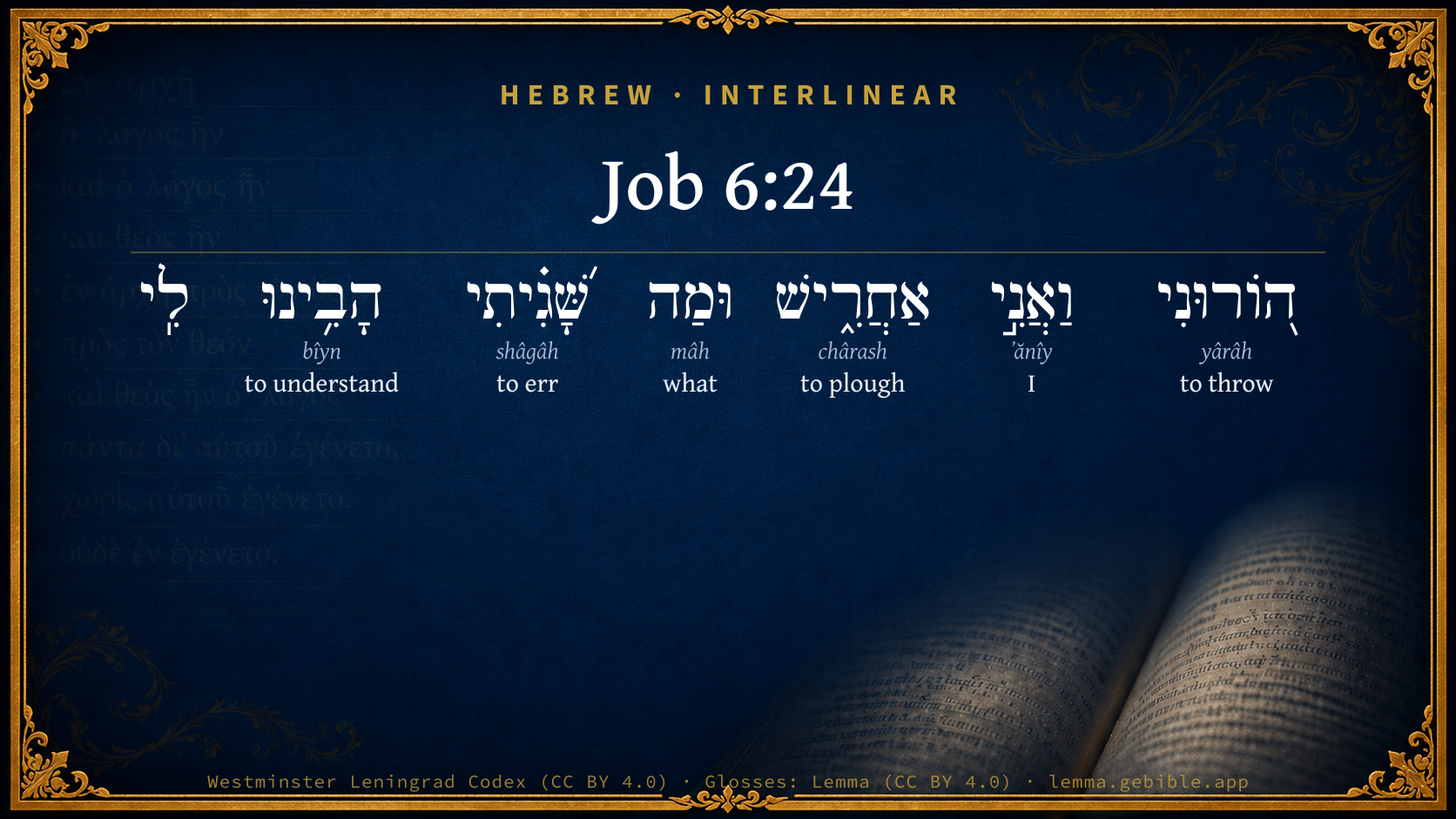
Job 6:24

Hebrew (Westminster Leningrad Codex) Job 6:24 appears in the Hebrew Old Testament. The text above is from the Westminster Leningrad Codex. Each word links to its Strong’s number, a concise gloss, and parsing drawn from the Open Scriptures Hebrew Bible morphology. Click any word for its full Brown-Driver-Briggs (BDB) entry.
Download image
Cite this verse

Job 6:24 (World English Bible). Public Domain. Lemma interlinear Bible study tool, https://lemma.gebible.app/v/job/6/24.

Show BibTeX & RIS
BibTeX
RIS
English Translation
"Teach me, and I will hold my peace; Cause me to understand wherein I have erred.
World English Bible · Public Domain
Download a study sheet

One document with this verse’s original text, its word-by-word gloss line, the meaning frame, cross-references with their text, attributed commentary, and full source and license credits — printable, and it pastes into notes with its structure intact.

This verse Autodidact and up

Study sheet (.html) Plain text (.txt)

A passage Seminary Student

Up to 50 verses in one chapter. A passage sheet keeps up to 6 commentary sources and 12 cross-references per verse, in the order this page ranks them, and says so on the sheet whenever that leaves anything out. Ask for a single verse and you get the Autodidact verse sheet above.

Everything on this page stays free to read, with no account — the sheet is a download of what is already on screen, not access to it.

Want to remove ads? Support Godless Engineer
Compare translations 3

The same verse in 3 English versions, stacked beneath the original-language interlinear above. Click any original word for its lexicon entry.

Each is an independent rendering of the whole verse — the interlinear is not word-aligned to these translations.

Highlighted words mark where these versions differ — a whole-verse word diff, not a word-by-word alignment.

  • World English Bible Public Domain
    "Teach me, and I will hold my peace; Cause me to understand wherein I have erred.
  • King James Version Public Domain
    Teach me, and I will hold my tongue: and cause me to understand wherein I have erred.
  • unfoldingWord Literal Text CC BY-SA 4.0
    Teach me, and I will be silent, and how I have strayed, make me understand.

unfoldingWord Literal Text — © unfoldingWord, licensed CC BY-SA 4.0. Word-aligned USFM3 via Door43 (git.door43.org/unfoldingWord/en_ult).

Versions to compare (up to 4)

3 of 4 selected

Show all 18 translations

Every available English version of this verse, each an independent rendering of the whole verse.

  • World English Bible Public Domain
    "Teach me, and I will hold my peace; Cause me to understand wherein I have erred.
  • Berean Standard Bible Public Domain
    Teach me, and I will be silent. Help me understand how I have erred.
  • Majority Standard Bible Public Domain
    Teach me, and I will be silent. Help me understand how I have erred.
  • King James Version Public Domain
    Teach me, and I will hold my tongue: and cause me to understand wherein I have erred.
  • American Standard Version (1901) Public Domain
    Teach me, and I will hold my peace; And cause me to understand wherein I have erred.
  • Revised Version (1885) Public Domain
    Teach me, and I will hold my peace: and cause me to understand wherein I have erred.
  • Geneva Bible (1599) Public Domain
    Teach me, and I wil hold my tongue: and cause me to vnderstande, wherein I haue erred.
  • Douay-Rheims (1899) Public Domain
    Teach me, and I will hold my peace: and if I have been ignorant in any thing, instruct me.
  • Young's Literal Translation Public Domain
    Shew me, and I -- I keep silent, And what I have erred, let me understand.
  • Literal Standard Version CC BY-SA 4.0
    Show me, and I keep silent, || And what I have erred, let me understand.
  • Unlocked Literal Bible CC BY-SA 4.0
    Teach me, and I will hold my peace; make me understand where I have been wrong.
  • unfoldingWord Literal Text CC BY-SA 4.0
    Teach me, and I will be silent, and how I have strayed, make me understand.
  • Darby Bible Public Domain
    Teach me, and I will hold my tongue; and cause me to understand wherein I have erred.
  • World Messianic Bible Public Domain
    “Teach me, and I will hold my peace. Cause me to understand my error.
  • Webster's Bible Public Domain
    Teach me, and I will hold my tongue: and cause me to understand in what I have erred.
  • Free Bible Version CC BY-SA 4.0
    Explain this to me, and I'll be quiet. Show me where I'm wrong.
  • Bible in Basic English Public Domain
    Give me teaching and I will be quiet; and make me see my error.
  • JPS Tanakh (1917) Public Domain
    Teach me, and I will hold my peace; and cause me to understand wherein I have erred.

Literal Standard Version (2020), Covenant Press — licensed CC BY-SA 4.0. Text via the HelloAO Bible API (eBible.org). Unlocked Literal Bible (unfoldingWord) — licensed CC BY-SA 4.0. Text via the HelloAO Bible API (eBible.org). unfoldingWord Literal Text — © unfoldingWord, licensed CC BY-SA 4.0. Word-aligned USFM3 via Door43 (git.door43.org/unfoldingWord/en_ult). Free Bible Version, Dr. Jonathan Gallagher — licensed CC BY-SA 4.0. Text via the HelloAO Bible API (eBible.org).

Word by word

More ways to search: Search by grammar → Find every occurrence → Compare this word →

Practice this passage: Drill this verse → Learn its vocabulary →

שָּׁ֝גִ֗יתִי
shâgâh
H7686
“to err”
Verb, Qal, Perfect, 1st Person, Common, Singular
Part of Speech
Verb
Stem
Qal
Form
Perfect
Person
1st Person
Gender
Common
Number
Singular
Full BDB Definition

Origin: a primitive root

TWOT: 2325

to go astray, stray, err - (Qal) - to err, stray - to swerve, meander, reel, roll, be intoxicated, err (in drunkenness) - to go astray (morally) - to commit sin of ignorance or inadvertence, err (ignorantly) - (Hiphil) - to lead astray - to lead astray, mislead (mentally) - to lead astray (morally)
  1. ה֭וֹרוּנִי yârâh H3384 “throw · me” Verb, Hiphil, Imperative, 2nd Person, Masculine, Plural + Suffix, Personal, 1st Person, Common, Singular
  2. וַאֲנִ֣י ʼănîy H589 “and · I” Conjunction + Pronoun, Personal, 1st Person, Common, Singular
  3. אַחֲרִ֑ישׁ chârash H2790 “to plough” Verb, Hiphil, Imperfect, 1st Person, Common, Singular
  4. וּמַה mâh H4100 “and · what” Conjunction + Particle, Interrogative
  5. הָבִ֥ינוּ bîyn H995 “understand” Verb, Hiphil, Imperative, 2nd Person, Masculine, Plural

About this verse

These counts appear in no published source. They are computed here, from the morphology-tagged text and Lemma’s own curated glosses. What Lemma adds →

7
words
6
distinct lemmas
Wisdom
section

Notable vocabulary

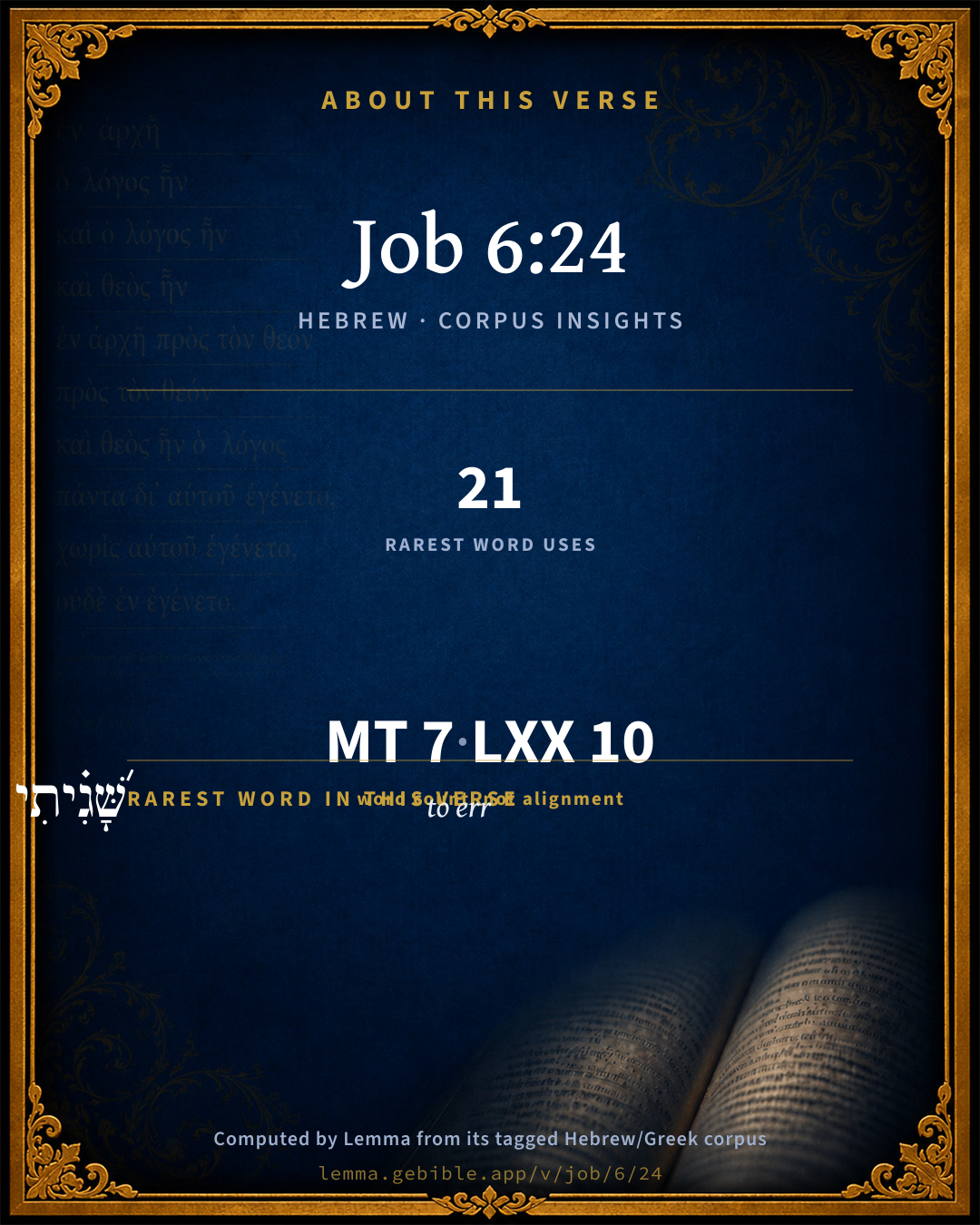
The rarest word here is שָּׁ֝גִ֗יתִי to err H7686 — appearing just 21 times in the whole Hebrew Bible.

Shared distinctive vocabulary

שָּׁ֝גִ֗יתִי to err H7686 occurs in 19 verses of the Hebrew Bible. Also found in:

Grammatical profile

  • 4 verbs
  • 1 pronoun
  • 1 preposition
  • 1 particle

Verb forms

  • ה֭וֹרוּנִי Hiphil · Imperative
  • אַחֲרִ֑ישׁ Hiphil · Imperfect
  • שָּׁ֝גִ֗יתִי Qal · Perfect
  • הָבִ֥ינוּ Hiphil · Imperative

Hebrew & Septuagint length

In English translation the verse runs 16 words from the Hebrew and 16 from the Septuagint (LXX English) — the same length.

A rough comparison of the two English renderings, which tokenize alike — not a word-level alignment.

Word counts can differ between the Hebrew and the Greek without any difference in meaning — e.g. the Hebrew direct-object marker אֵת has no separate Greek word, and Greek often adds the article ὁ.

In the original languages it is 7 Hebrew tokens and 10 Greek tokens — but the two are counted differently (Hebrew bundles its prefixes and suffixes into one token; the Greek is in lemma form), so that isn’t a like-for-like length.

Cross-references

14

Topical passages linked to Job 6:24 in the Treasury of Scripture Knowledge — connected by theme and wording, ordered by reader-vote popularity; previews shown in the World English Bible.

  • Proverbs 9:9 Instruct a wise man, and he will be still wiser. Teach a righteous man, and he will increase in learning.
  • James 3:2 For in many things we all stumble. If anyone doesn't stumble in word, the same is a perfect man, able to bridle the whole body also.
  • Job 10:2 I will tell God, 'Do not condemn me, Show me why you contend with me.
  • Psalms 39:1–2 I said, "I will watch my ways, so that I don't sin with my tongue. I will keep my mouth with a bridle while the wicked is before me."
  • Job 5:27 Look this, we have searched it, so it is; Hear it, and know it for your good."
  • Job 33:1 "However, Job, Please hear my speech, And listen to all my words.
  • Job 34:32 Teach me that which I don't see. If I have done iniquity, I will do it no more'?
  • Psalms 19:12 Who can discern his errors? Forgive me from hidden errors.
  • Psalms 32:8 I will instruct you and teach you in the way which you shall go. I will counsel you with my eye on you.
  • Job 32:11 "Behold, I waited for your words, And I listened for your reasoning, While you searched out what to say.
  • Job 32:15–16 "They are amazed. They answer no more. They don't have a word to say.
  • Job 33:31–33 Mark well, Job, and listen to me: Hold your peace, and I will speak.
  • Proverbs 25:12 As an ear-ring of gold, and an ornament of fine gold, So is a wise reprover to an obedient ear.
  • James 1:19 So, then, my beloved brothers, let every man be swift to hear, slow to speak, and slow to anger;

Cross-references courtesy of OpenBible.info (CC BY 4.0).

Hebrew and Greek witnesses Masoretic Hebrew ↔ Greek Septuagint

The same verse in the two great witnesses to the Old Testament, shown verse-for-verse.

These are two independent witnesses, not word-aligned to each other, and the Septuagint is shown in lemma (dictionary) form.

Hebrew Job 6:24 Masoretic · Westminster Leningrad Codex

ה֭וֹרוּנִי וַאֲנִ֣י אַחֲרִ֑ישׁ וּמַה שָּׁ֝גִ֗יתִי הָבִ֥ינוּ לִֽי

"Teach me, and I will hold my peace; Cause me to understand wherein I have erred.

World English Bible · Public Domain

Greek LXX Job 6:24 Septuagint · lemma form

διδάσκω ἐγώ ἐγώ δέ κωφεύω εἰ τις πλανάω φράζω ἐγώ

Teach you⌃ me, and I will be silent: if in anything I have erred, tell me.

LXX2012 (modern English Septuagint) · Public Domain

Hebrew: Westminster Leningrad Codex (CC BY 4.0). Greek: Septuagint (public domain); English from LXX2012 (modern English Septuagint) (Public Domain). How the Septuagint differs from the Hebrew →

Commentary

Notes on Job 6:24 from classic Christian and Jewish commentators (each source and its license shown beneath its notes). The classic Christian expositions comment on the surrounding passage and are grouped to its opening verse, so a note may address several verses; the Jewish commentaries on the Tanakh (Rashi and others) are per-verse, so they appear only where the commentator wrote on this verse.

Lemma curates 59 commentaries, every one of them public domain or Creative Commons licensed, each selected and text-cleaned for this edition rather than reprinted as found. About our sources →

Trapp's Complete Commentary

John Trapp

Job 6:24 Teach me, and I will hold my tongue: and cause me to understand wherein I have erred.

Ver. 24. Teach me, and I will hold my tongue] If I be in an error, I am willing to be rectified. Hitherto you have mistook my case; and so your speech hath been to small purpose. But if you will come home to my case indeed, and weigh things in an even balance, I shall gladly submit to your more mature judgment and direction. Teach me, and you shall find that I am not indocible, that I am not as "horse and mule that have no understanding," Psa 32:9, nor will learn any; much less than the creature called rhinoceros, untameable and untractable. It shall appear to you that I am not utterly uncounselable, as those of whom Basil complaineth, qui quid verum sit neque sciunt, neque sustinent discere, that neither know what truth and right is, nor will endure to be taught it (Epist. ad Euagr. 10). Job was not to be told that it was easier to deal with 20 men’s reasons than with one man’s will; he promiseth therefore not to stand out against his friends, because he will stand out. It is not my will, saith he, that opposeth what you have spoken, but my understanding. I am a slave to right reason; and if convinced thereby, I shall soon lay down the bucklers. Teach me, and I will hold my tongue, and not strive for the last word to lengthen out the contention; I am willing to reason, but not to wrangle. See Pro 30:32.

Cause me to understand wherein I have erred] A humble man will never be a heretic; err he may (that is common to mankind, triste mortalitatis privilegium); but convince him by solid reasons and good arguments, and he will not long stand out: a little child shall lead him, Isa 11:6. It is by pride that contention cometh, Pro 13:10, for it maketh a man drunk with his own conceit, Hab 2:5; and who so wilful, so quarrelsome, as he that is drunk? A heretic may be condemned of himself, Tit 3:10, but he will not be convinced by another (such is his pertinacy, or rather obstinacy), no, though he be stoned with hardest arguments, holden out of that crystal book of the Holy Scriptures, he stands as a stake in the midst of a stream; and you may as soon move a rock as cause him to understand wherein he is out of his judgment of practice: Lapidandi sunt haeretici (Athan.).

John Trapp, A Commentary or Exposition upon All the Books of the Old and New Testament (1647–1656) — public domain. Text from a community e-Sword module.

The Biblical Illustrator

Joseph S. Exell

Job_6:24

Teach me, and I will hold my tongue.

The virtue of silence

This is the passionate outcry of a soul in trouble. Misfortune and loss have fallen heavily upon Job. His spirit is sorely stricken. The presence of Eliphaz and his many words of advice bring neither comfort nor hope, and almost in angry defiance the cry bursts from his lip. Teach me, and I will hold my tongue. Cause me to understand wherein I have erred. How forcible are right words! but what doth your arguing reprove? Angrily and hopelessly Job describes himself as one that is desperate. His eager demand is to know whether the trials and calamities that have come upon him are in reality due to exceeding wickedness and special sinfulness on his part. Let us take the words, Teach me, and I will hold my tongue, as the prayer of the earnest soul in the presence of God. In the experience of every Christian man occasions arise--alas, how often!--when words of unrestrained anger are allowed to escape from the lips--bitter, biting words that wound many a heart, that work havoc in the home, that make others wonder and even stumble, that bring discredit on the Christian profession. Truly the words of the apostle James are not the language of exaggeration. The tongue is a fire; it is an unruly evil, full of deadly poison. Well may our prayer to God daily be, Teach me, and I will hold my tongue. Or, again, is not the same prayer needed in regard to our common conversation? Our speech is not always with grace, and, apart altogether from words of wrath and bitterness, there is a general carelessness which is to be deplored. Through sheer thoughtlessness incalculable harm is often done. The prayer is indeed necessary. Teach me, and I will hold my tongue. Usefully, however, as this text may be employed in enforcing common Christian duties and graces, my chief aim is to apply it to the culture of our deeper spiritual experience. The golden virtue of silence is not much in demand at the present time. On all hands the tendency is towards speech. It is a superficial age. Loudness and self-advertisement are in evidence rather than quietness and contemplation. Now I submit that when the prayer for Divine teaching is earnestly offered, there will be greater readiness to keep silence, greater desire for the quieter side of Christian life, greater longing for that deeper spirituality which does not always, or even chiefly, manifest itself in words. Even in the ordinary affairs of life the instructed man is not the man most eager to speak. Knowledge should bring humility, and a deepening sense of the tasks yet to be achieved. It is the man of little knowledge who is generally most eager to parade his opinions. In the spiritual culture of men it is not those who have passed through the deepest experiences that are most ready to speak of such things. The Divine teaching emphasises the importance and the value of silence quite as much as of speech. It enforces the need for quietness and meditation. How weary one often grows of the way in which Christ and Christianity are talked about on every side! How terrible is the lack of serious thought, or the presence of empty and complacent speech! Dr. Martineau has well said, If theological gossip were the measure of religious faith, we should be the devoutest of all human generations. I fear not! Curiosity, rather than reality, is the note that is sounded. Even in our Churches we must surely be grieved, and sometimes alarmed, by the lack of depth and seriousness. Earnest thought and prayerful aspiration are not too much in evidence. We talk too much: we strive too much. With our many organisations, societies, schemes, we are in danger of putting too high a value on the power of speech to the depreciation of the spirit that waits in silence and communes with God. Our aim seems largely to be to make speakers. Now I know well the need that exists for such help. Far be it from me to depreciate it! Yet I feel strongly that we are confronted by the peril of overestimating this kind of service. We are only too apt to forget the value of the man of quiet spirit, and to exalt unduly the man of many words and ready speech. I want to enter a plea on behalf of the silent man. There are undoubtedly in all the Churches many who could not give utterance to the deep thoughts and lofty aspirations stirring within them, and yet whose lives have in them the very spirit of Jesus Christ, and stamped upon them what is none other than the beauty of holiness. The time of difficulty and crisis clearly reveals their strength and their value. Great, indeed, is our loss when we fail to appreciate the man of few words, but of real spiritual power. One of our besetting dangers today is that of words outrunning experience. This peril must always prevail where speech is unduly exalted and praised. Where all are encouraged and frequently over persuaded to speak, utterance and conviction will find considerable difficulty in keeping company. Let the expression exceed the experience, and the spirit of unreality will creep in and will soon rule. Unreality will in the end beget contempt for the things professed, and indifference towards them. This is undoubtedly one of the explanations of the falling away of some in our Churches whose zeal has, for a time, been greatly in evidence. On the other hand we often find, especially among young people, that some of the very best of them are reserved in speech on religious matters, unwilling to discuss what is most sacred to them, unprepared as yet to reveal their deepest thoughts and experiences. The forcing house has no attraction for them, and they shrink back from what seems undue familiarity with Divine things. Too often such are looked upon with suspicion, or spoken of with censure, by many glib of tongue yet unworthy to stand by their side. Let it be borne in mind, then, that while the Divine illumination may make men preachers and teachers, yet its result in producing silence and meditation is not to be overlooked nor lightly regarded. An intense hatred of sin, a clear conception of pardon, an earnest meditation on the wonders of grace and redemption, a tarrying long at the Cross of Calvary and dwelling on its mystery and glory--such vital experiences may well produce in the soul humility, awe, and silence. The quietness of the Divine method must not, then, be lost sight of. The virtue of silence must be more highly prized. Growth should be steady, not sudden; regular, not spasmodic. To this end personal communion with God, individual fellowship with Him is indispensable. The soul that waits in silence learns the deepest lessons, finds the richest treasures. Christ Himself found His truest strength in His solitary companionship with the Father. Silence has its place, therefore, in spiritual development. Speech is not to be underestimated. But there is little danger of that mistake being made. Far greater is the peril of an undue exaltation of the value of speech, and a corresponding depreciation of the virtue of silence. Teach me, and I will hold my peace, is a prayer full of promise for the common days and common ways of life, as well as for its special experiences and special crises. (H. P. Young.)

And cause me to understand wherein I have erred.--

Man liable to error

1. Man is subject to error. To error in speech, to error in practice, to error in judgment. Man by nature can do nothing else but err. All his goings are goings astray, and all his knowledge is bottomed upon an heap of false principles. All his works (by nature) are errata, and the whole edition of his life a continued mistake.

2. That man is in a fair way to truth, who acknowledgeth he may err.

3. An error strictly and properly taken is that which we hold or do out of bare ignorance of the truth.

4. That an erring brother or friend must not be importuned barely to leave his error, but he must be made to understand his error. (J. Caryl.)

The Biblical Illustrator, edited by Joseph S. Exell (c. 1880s–1900s) — public domain. Text from a community e-Sword module.

Joseph Benson's Commentary

Job 6:24-25. Teach me — Instead of censuring and reproaching, instruct and convince me by solid arguments; and I will hold my tongue — I will patiently hear and gladly receive your counsels; and cause me to understand wherein I have erred — Show me my mistakes and miscarriages; for I am ready to receive your reproofs, and humbly to submit to them. How forcible are right words! — The words of truth and solid argument have a marvellous power to convince and persuade a man; and, if yours were such, I should readily yield to them. But what doth your arguing reprove? — There is no truth in your assertions, nor weight in your arguments, and therefore they are of no account, and have no power with me.

Joseph Benson's Commentary on the Old and New Testaments (1811–1818) — public domain. Text from a community e-Sword module.

Whedon's Commentary on the Bible

Daniel D. Whedon

Second strophe — Their words, far from being forcible, have in them the elements of cruelty, Job_6:24-27.

24. Teach me — If they really believe that he has been guilty of some great wrong, as their looks probably showed during the seven days of formal sorrow, it is their duty now to show him the wrong. Eliphaz had taken advantage of “the wrath” of Job to charge him with folly. Having disposed, as he thinks, of this charge, Job now demands other reasons for their cruel treatment.

Daniel D. Whedon (gen. ed.), Commentary on the Old and New Testaments (1874–1909) — public domain. Text from a community e-Sword module.

Geneva Bible (1599)

Geneva Bible translators

Show me wherein I have erred, and I will confess my fault.

Geneva Bible (1599) marginal notes — public domain. Text via Bolls.life.

Jamieson, Fausset & Brown

Robert Jamieson, A. R. Fausset & David Brown

Irony. If you can "teach me" the right view, I am willing to be set right, and "hold my tongue"; and to be made to see my error. But then if your words be really the right words, how is it that they are so feeble? "Yet how feeble are the words of what you call the right view." So the Hebrew is used (in Mic 2:10; Mic 1:9). The English Version, "How powerful," &c., does not agree so well with the last clause of the verse.

Jamieson, Fausset & Brown — Commentary Critical and Explanatory on the Whole Bible (1871) — public domain (CC PDM 1.0). Text via the HelloAO Bible API.

Adam Clarke's Commentary

Verse 24. Teach me] Show me where I am mistaken. Bring proper arguments to convince me of my errors; and you will soon find that I shall gladly receive your counsels, and abandon the errors of which I may be convicted.

Adam Clarke's Commentary on the Bible (1810–1826) — public domain. Text from a community e-Sword/MySword module.

The Cambridge Bible for Schools and Colleges

gen. ed. J. J. S. Perowne

24–27. In answer to their covert insinuations Job demands that they should bring home to him the sins of which they suspected him.

The Cambridge Bible for Schools and Colleges (gen. ed. J. J. S. Perowne; Cambridge University Press, 1878–1918) — public domain. Text from a community e-Sword module.

John Gill's Exposition

How forcible are right words!.... That are according to right reason; such as may be called strong reasons, or bony arguments, as in Isa 41:21; there are strength and weight in such words, reasonings, and arguments; they bring evidence and conviction with them, and are very powerful to persuade the mind to an assent unto them, and have great influence to engage to a profession or practice of what they are used for; such are more especially the words of God, the Scriptures of truth, the doctrines of the Gospel; these are right words, see Pro 8:6; they are not contrary to right reason, although above it; and are agreeably to sanctified reason, and received by it; they are according to the perfections of God, even his righteousness and holiness, and according to the law of God, and in no wise repugnant to it, which is the rule of righteousness; and they are doctrines according to godliness, and are far from encouraging licentiousness; and they are all strictly true, and must be right: and there is a force and strength in those words; they come with weight, especially when they come in demonstration of the Spirit and power of God; they are mighty, through God, for the pulling down the strong holds of sin, Satan, and self, and for the bringing of men to the obedience of Christ; to the quickening dead sinners, enlightening dark minds, softening hard hearts; renewing, changing, and transforming men into quite another temper and disposition of mind they formerly had; for the comforting and relieving souls in distress, and saints under affliction; and have so very wonderful an influence on the lives and conversations of those to whom they come, not in word only, but in power and in the Holy Ghost, as to teach them to deny all sin and ungodliness, and to live soberly, righteously, and godly: or, "how forcible are the words of an upright man!" (a) that is, sincere, impartial, and faithful; which Job suggests his friends were not: some think Job has respect to his own words, and render the clause, "what hardness", or "harshness", have "right words!" (b) Such as he believed his own were, and in which there were nothing hard and harsh, sharp and severe, or which might give just offence; such as his cursing the day in which he was born, or charging his friends with treachery and deceit: but rather he tacitly reflects upon the words and arguments of his friends; intimating, that though there is force and strength in right words, theirs were neither right nor forcible, but partial and unjust, and weak and impotent; which had no strength of reasoning in them, nor carried any conviction with them, as follows:

but what doth your arguing reprove? their arguments they had used with him had no strength in them; they were of no avail; they did not reprove or convince of any evil he had been guilty of, or any mistake he had made; they were weak, impertinent, and useless, and fell with no weight upon him, nor wrought any conviction in him.

(a) So Aquila apud Drusium. (b) "quid duritiei habent verba rectitudinis", Schmidt; so Luther.

John Gill's Exposition of the Whole Bible (1746–1763) — public domain (CC PDM 1.0). Text via the HelloAO Bible API.

Albert Barnes' Notes on the Bible

Teach me, and I will hold my tongue - That is, give me any real instruction, or show me what is my duty, and I will be silent. By this he means that Eliphaz had really imparted no instruction, but had dealt only in the language of reproof. The sense is, “I would willingly sit and listen where truth is imparted, and where I could be enabled to see the reason of the divine dealings. If I could be made to understand where I have erred, I would acquiesce.”

Albert Barnes' Notes on the Bible (1834–1885) — public domain. Text from a community e-Sword/MySword module.

Matthew Poole's English Annotations

Teach me; instead of censuring and reproaching, instruct and convince me by solid arguments.

I will hold my tongue; I will patiently hear and gladly receive your counsels; or, I will be silent; I will neither contradict you, nor complain of my own griefs. Compare Job 40:4,5; Pr 30:32.

Wherein I have erred, i.e. my mistakes and miscarriages.

Matthew Poole's English Annotations on the Holy Bible (1683–1685) — public domain. Text from a community e-Sword/MySword module.

The Pulpit Commentary

Teach me, and I will hold my tongue. Job is willing to be taught, if his friends have any instruction to give. He is willing to be reproved. But not in such sort as he has been reproved by Eliphas. His words were not "words of uprightness." Cause me to understand wherein I have erred. Point out, that is, in what my assumed guilt consists. You maintain that my afflictions are deserved. Point out what in my conduct has deserved them. I am quite ready to be convinced.

The Pulpit Commentary (1880–1919), ed. H.D.M. Spence-Jones & Joseph S. Exell — public domain. Text from a community e-Sword module.

John Wesley's Explanatory Notes

Teach - Convince me by solid arguments. I will - I will patiently hear and gladly receive your counsels.

John Wesley, Explanatory Notes Upon the Whole Bible (1754–1765) — public domain. Text via the GEBible commentary corpus.

Keil & Delitzsch

C. F. Keil & F. Delitzsch

24 Teach me, and I will be silent,

And cause me to understand wherein I have failed.

25 How forcible are words in accordance with truth!

But what doth reproof from you reprove?

26 Do you think to reprove words?

The words of one in despair belong to the wind.

27 Ye would even cast lots for the orphan,

And traffic about your friend.

נמרצוּ, Job 6:25, in the signification of נמלצוּ (Psa 119:103), would suit very well: how smooth, delicate, sweet, are, etc. (Hirz., Ew., Schlottm.); but this meaning does not suit Job 16:3. Hupfeld, by comparison with mar, bitter, translates: quantumvis acerba; but מה may signify quidquid, though not quantumvis. Hahn compares the Arabic verb to be sick, and translates: in what respect are right words bad; but physical disease and ethical badness are not such nearly related ideas. Ebrard: honest words are not taken amiss; but with an inadmissible application of Job 16:3. Von Gerl. is best: how strong or forcible are, etc. מרץ is taken as related to פּרץ, in the signification to penetrate; Hiph. to goad; Niph. to be furnished with the property of penetrating, - used here of penetrating speech; Kg1 2:8, of a curse inevitably carried out; Mic 2:10, of unsparing destruction. Words which keep the straight way to truth, go to the heart; on the contrary, what avails the reproving from you, i.e., which proceeds from you? הוכח, inf. absol. as Pro 25:27, and in but a few other passages as subject; מכּם, as Job 5:15, the sword going forth out of their mouth. In Job 6:26 the waw introduces a subordinate adverbial clause: while, however, the words of one in despair belong to the wind, that they may be carried away by it, not to the judgment which retains and analyzes them, without considering the mood of which they are the hasty expression. The futt. express the extent to which their want of feeling would go, if the circumstances for it only existed; they are subjunctive, as Job 3:13, Job 3:16. גּורל, the lot, is to be supplied to תּפּילוּ, as Sa1 14:42. The verb כּרה, however, does not here signify to dig, so that שׁחת, a pit, should be supplied (Heiligst.), still less: dig out earth, and cast it on any one (Ebrard); but has the signification of buying and selling with על of the object, exactly like Job 39:27.

Keil & Delitzsch — Biblical Commentary on the Old Testament (1861–1891) — public domain (CC PDM 1.0). Text via the HelloAO Bible API. (Old Testament only.)

unfoldingWord translationNotes

Door43 World Missions Community

Teach me ... make me

These verbs "teach" and "make" are second person plural and are spoken to his friends. (See: Forms of You)

I will hold my peace

This is an idiom. AT: "I will be silent" (See: Idiom)

How painful are truthful words! But your arguments, how do they actually rebuke me?

The exact meaning of the original language is uncertain. Some Bibles translate "How painful" as "How pleasant." AT: "When a person speaks the truth, it harms no one. But your arguments are not true, so how do they actually rebuke me?"

But your arguments, how do they actually rebuke me?

Job is using this question to rebuke his friends and to emphasize that what they are saying does not apply to him. This question can be written as a statement. AT: "Your reasons for rebuking me do not apply to me even though you sternly correct me." or "But your arguments against me are not true, so they do not actually rebuke me!" (See: Rhetorical Question)

your arguments

"your reasons" or "your claims"

translationWords

true

word

rebuke

unfoldingWord translationNotes — © Distant Shores Media and the Door43 World Missions Community, licensed CC BY-SA 4.0. Source: git.door43.org/Door43/en_tn.

Lesson kit

Teaching starters — assembled from the data on this page, not authored interpretation. Every prompt links to the verse data it draws on. Edit before teaching.

Job, in the Wisdom, opens this verse with 7 words (6 distinct Hebrew lemmas). Its most distinctive word is shâgâh (“to err”). A historical commentator’s framing appears above. Read the whole chapter for the surrounding context.

Discussion questions

  1. How does “to err” (shâgâh) shape what this verse is saying?
  2. How does Leviticus 4:13, which shares the word «to err», read alongside this verse?
  3. The translations on this page render this verse differently — a whole-verse word diff, not a word-by-word alignment. What might account for the different wordings?
  4. «ה֭וֹרוּנִי» is a Hiphil Imperative verb. How does that grammatical form shape the action described?
  5. Compare how Trapp's Complete Commentary and The Biblical Illustrator read this verse. Where do they agree or differ?

Things to notice

Reading settings

Reading text

Shown beneath each verse's original-language words.

Old Testament
Old Testament edition

Read the OT as the Masoretic Hebrew (MT) or the Greek Septuagint (LXX).

English shown for the Greek Septuagint (in the Hebrew ↔ Greek comparison).

Comparing translations? Open the Compare panel on any verse page to stack up to four side by side.