
Proverbs 1:6

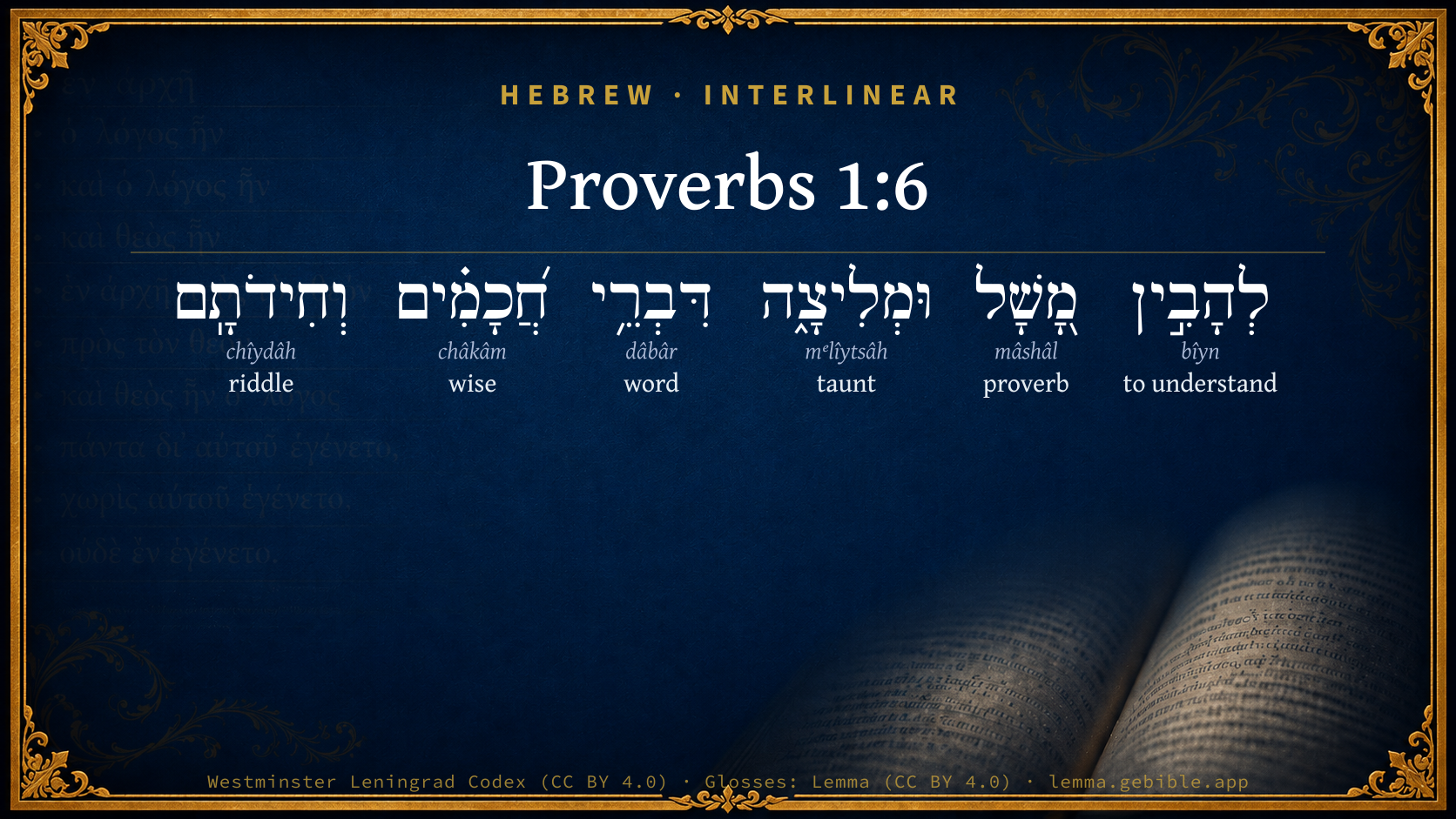
Hebrew (Westminster Leningrad Codex) Proverbs 1:6 appears in the Hebrew Old Testament. The text above is from the Westminster Leningrad Codex. Each word links to its Strong’s number, a concise gloss, and parsing drawn from the Open Scriptures Hebrew Bible morphology. Click any word for its full Brown-Driver-Briggs (BDB) entry.
Download image
Cite this verse

Proverbs 1:6 (World English Bible). Public Domain. Lemma interlinear Bible study tool, https://lemma.gebible.app/v/proverbs/1/6.

Show BibTeX & RIS
BibTeX
RIS
English Translation
To understand a proverb, and parables, The words and riddles of the wise.
World English Bible · Public Domain
Highlights
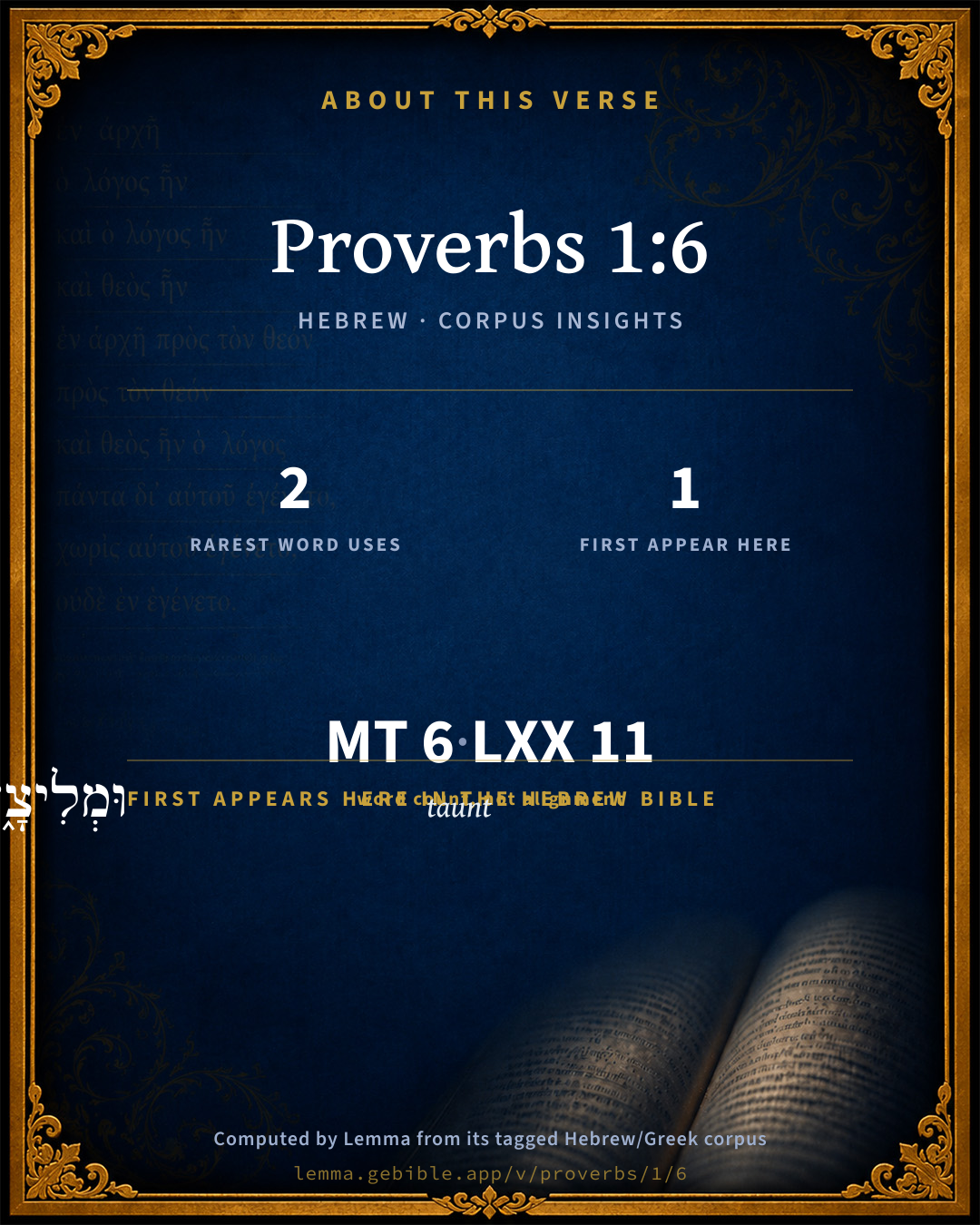
  • 1 first appearance in the Hebrew Bible
Full analysis ↓
Download a study sheet

One document with this verse’s original text, its word-by-word gloss line, the meaning frame, cross-references with their text, attributed commentary, and full source and license credits — printable, and it pastes into notes with its structure intact.

This verse Autodidact and up

Study sheet (.html) Plain text (.txt)

A passage Seminary Student

Up to 50 verses in one chapter. A passage sheet keeps up to 6 commentary sources and 12 cross-references per verse, in the order this page ranks them, and says so on the sheet whenever that leaves anything out. Ask for a single verse and you get the Autodidact verse sheet above.

Everything on this page stays free to read, with no account — the sheet is a download of what is already on screen, not access to it.

Want to remove ads? Support Godless Engineer
Compare translations 3

The same verse in 3 English versions, stacked beneath the original-language interlinear above. Click any original word for its lexicon entry.

Each is an independent rendering of the whole verse — the interlinear is not word-aligned to these translations.

Highlighted words mark where these versions differ — a whole-verse word diff, not a word-by-word alignment.

  • World English Bible Public Domain
    To understand a proverb, and parables, The words and riddles of the wise.
  • King James Version Public Domain
    To understand a proverb, and the interpretation; the words of the wise, and their dark sayings.
  • unfoldingWord Literal Text CC BY-SA 4.0
    to understand a proverb and a parable, the words of the wise ones and their riddles.

unfoldingWord Literal Text — © unfoldingWord, licensed CC BY-SA 4.0. Word-aligned USFM3 via Door43 (git.door43.org/unfoldingWord/en_ult).

Versions to compare (up to 4)

3 of 4 selected

Show all 18 translations

Every available English version of this verse, each an independent rendering of the whole verse.

  • World English Bible Public Domain
    To understand a proverb, and parables, The words and riddles of the wise.
  • Berean Standard Bible Public Domain
    by understanding the proverbs and parables, the sayings and riddles of the wise.
  • Majority Standard Bible Public Domain
    by understanding the proverbs and parables, the sayings and riddles of the wise.
  • King James Version Public Domain
    To understand a proverb, and the interpretation; the words of the wise, and their dark sayings.
  • American Standard Version (1901) Public Domain
    To understand a proverb, and a figure, The words of the wise, and their dark sayings.
  • Revised Version (1885) Public Domain
    To understand a proverb, and a figure; the words of the wise, and their dark sayings.
  • Geneva Bible (1599) Public Domain
    To vnderstand a parable, and the interpretation, the wordes of ye wise, and their darke sayings.
  • Douay-Rheims (1899) Public Domain
    He shall understand a parable, and the interpretation, the words of the wise, and their mysterious sayings.
  • Young's Literal Translation Public Domain
    For understanding a proverb and its sweetness, Words of the wise and their acute sayings.
  • Literal Standard Version CC BY-SA 4.0
    For understanding a proverb and its sweetness, || Words of the wise and their acute sayings.
  • Unlocked Literal Bible CC BY-SA 4.0
    to understand proverbs, sayings, and words of wise people and their riddles.
  • unfoldingWord Literal Text CC BY-SA 4.0
    to understand a proverb and a parable, the words of the wise ones and their riddles.
  • Darby Bible Public Domain
    to understand a proverb and an allegory, the words of the wise and their enigmas.
  • World Messianic Bible Public Domain
    to understand a proverb and parables, the words and riddles of the wise.
  • Webster's Bible Public Domain
    To understand a proverb, and the interpretation; the words of the wise, and their dark sayings.
  • Free Bible Version CC BY-SA 4.0
    understanding the proverbs and puzzles, the sayings and questions of the wise.
  • Bible in Basic English Public Domain
    To get the sense of wise sayings and secrets, and of the words of the wise and their dark sayings.
  • JPS Tanakh (1917) Public Domain
    To understand a proverb, and a figure; the words of the wise, and their dark sayings.

Literal Standard Version (2020), Covenant Press — licensed CC BY-SA 4.0. Text via the HelloAO Bible API (eBible.org). Unlocked Literal Bible (unfoldingWord) — licensed CC BY-SA 4.0. Text via the HelloAO Bible API (eBible.org). unfoldingWord Literal Text — © unfoldingWord, licensed CC BY-SA 4.0. Word-aligned USFM3 via Door43 (git.door43.org/unfoldingWord/en_ult). Free Bible Version, Dr. Jonathan Gallagher — licensed CC BY-SA 4.0. Text via the HelloAO Bible API (eBible.org).

Word by word

More ways to search: Search by grammar → Find every occurrence → Compare this word →

Practice this passage: Drill this verse → Learn its vocabulary →

About this verse

These counts appear in no published source. They are computed here, from the morphology-tagged text and Lemma’s own curated glosses. What Lemma adds →

6
words
6
distinct lemmas
Wisdom
section

Notable vocabulary

The rarest word here is וּמְלִיצָ֑ה taunt H4426 — appearing just 2 times in the whole Hebrew Bible.

First appearance in Scripture

This word makes its first canonical appearance in the Hebrew Bible here:

  • וּמְלִיצָ֑ה taunt H4426

Shared distinctive vocabulary

וּמְלִיצָ֑ה taunt H4426 occurs in 2 verses of the Hebrew Bible. Also found in:

Grammatical profile

  • 1 verb
  • 4 nouns
  • 1 adjective

Verb forms

  • לְהָבִ֣ין Hiphil · Infinitive Construct

Hebrew & Septuagint length

In English translation the verse runs 13 words from the Hebrew and 17 from the Septuagint (LXX English) — closely comparable.

A rough comparison of the two English renderings, which tokenize alike — not a word-level alignment.

Word counts can differ between the Hebrew and the Greek without any difference in meaning — e.g. the Hebrew direct-object marker אֵת has no separate Greek word, and Greek often adds the article ὁ.

In the original languages it is 6 Hebrew tokens and 11 Greek tokens — but the two are counted differently (Hebrew bundles its prefixes and suffixes into one token; the Greek is in lemma form), so that isn’t a like-for-like length.

Cross-references

12

Topical passages linked to Proverbs 1:6 in the Treasury of Scripture Knowledge — connected by theme and wording, ordered by reader-vote popularity; previews shown in the World English Bible.

  • Psalms 78:2 I will open my mouth in a parable. I will utter dark sayings of old,
  • Mark 4:11 He said to them, "To you is given the mystery of the Kingdom of God, but to those who are outside, all things are done in parables,
  • Psalms 49:4 I will incline my ear to a proverb. I will open my riddle on the harp.
  • Mark 4:34 Without a parable he didn't speak to them; but privately to his own disciples he explained all things.
  • Acts 8:30–31 Philip ran to him, and heard him reading Isaiah the prophet, and said, "Do you understand what you are reading?"
  • Hebrews 5:14 But solid food is for those who are full grown, who by reason of use have their senses exercised to discern good and evil.
  • Ecclesiastes 12:11 The words of the wise are like goads; and like nails well fastened are words from the masters of assemblies, which are given from one shepherd.
  • Matthew 13:10–17 The disciples came, and said to him, "Why do you speak to them in parables?"
  • Matthew 13:34–35 Jesus spoke all these things in parables to the multitudes; and without a parable, he didn't speak to them,
  • Matthew 13:51–52 Jesus said to them, "Have you understood all these things?" They answered him, "Yes, Lord."
  • 2 Peter 3:16 as also in all of his letters, speaking in them of these things. In those are some things hard to be understood, which the ignorant and unsettled twist, as they also do to the other Scriptures, to their own destruction.
  • Numbers 12:8 with him will I speak mouth to mouth, even manifestly, and not in dark speeches; and the form of Yahweh shall he see: why then were you not afraid to speak against my servant, against Moses?

Cross-references courtesy of OpenBible.info (CC BY 4.0).

Hebrew and Greek witnesses Masoretic Hebrew ↔ Greek Septuagint

The same verse in the two great witnesses to the Old Testament, shown verse-for-verse.

These are two independent witnesses, not word-aligned to each other, and the Septuagint is shown in lemma (dictionary) form.

Hebrew Proverbs 1:6 Masoretic · Westminster Leningrad Codex

לְהָבִ֣ין מָ֭שָׁל וּמְלִיצָ֑ה דִּבְרֵ֥י חֲ֝כָמִ֗ים וְחִידֹתָֽם

To understand a proverb, and parables, The words and riddles of the wise.

World English Bible · Public Domain

Greek LXX Proverbs 1:6 Septuagint · lemma form

νοέω τε παραβολή καί σκοτεινός λόγος ῥῆσις τε σοφός καί αἴνιγμα

and will understand a parable, and a dark speech; the saying of the wise also, and riddles.

LXX2012 (modern English Septuagint) · Public Domain

On this verse, The Cambridge Bible for Schools and Colleges discusses the Septuagint’s reading. Read the note in Commentary ↓

Hebrew: Westminster Leningrad Codex (CC BY 4.0). Greek: Septuagint (public domain); English from LXX2012 (modern English Septuagint) (Public Domain). How the Septuagint differs from the Hebrew →

Commentary

Notes on Proverbs 1:6 from classic Christian and Jewish commentators (each source and its license shown beneath its notes). The classic Christian expositions comment on the surrounding passage and are grouped to its opening verse, so a note may address several verses; the Jewish commentaries on the Tanakh (Rashi and others) are per-verse, so they appear only where the commentator wrote on this verse.

Lemma curates 59 commentaries, every one of them public domain or Creative Commons licensed, each selected and text-cleaned for this edition rather than reprinted as found. About our sources →

Trapp's Complete Commentary

John Trapp

Pro 1:6 To understand a proverb, and the interpretation; the words of the wise, and their dark sayings.

Ver. 6. To understand a proverb, and the interpretation.] Or, The sweetness thereof; there being nothing so sweet to a good soul as the knowledge of dark and deep mysteries. See Psa 119:103 where the same word is used. {a} The little book of the Revelation was in John’s mouth sweet as honey. {Rev 10:9-10} {See Trapp on "Rev 10:9"} {See Trapp on "Rev 10:10"}

And their dark sayings.] Dark to those that are acute obtusi, that have not their "senses exercised to discern both good and evil." {Heb 5:14} Legum obscuritates non assignemus culpae scribentium sed inscitiae non assequentium, saith he in Gellius. If the law be dark to any, the fault is not in the lawgiver, but in those that should better understand it.

{a} Heb. Melitsah; unde fortasse Graecum μελι, et Latinum mel. - Rivet.

John Trapp, A Commentary or Exposition upon All the Books of the Old and New Testament (1647–1656) — public domain. Text from a community e-Sword module.

The Biblical Illustrator

Joseph S. Exell

Pro_1:6

The words of the wise and their dark sayings.

The words of the wise

Nothing can give a deeper insight into the character and genius of people than their household words--those current maxims and sayings which influence their everyday life, the popular proverbs which pass from mouth to mouth. These are the expression of a peoples inward life. It does not belong to a high state of civilisation to originate proverbs. One of our most homely maxims or proverbial sayings, will stir the soul to its very centre and depth, and do more to regulate the life and manners, than all the enactments in all the statute books of the world. In the Book of Proverbs we have nothing but the lessons of practical wisdom. They rest on great principles as their basis--those principles which enter into the eternal reason of things, and which are as unchangeable as God Himself. It follows that the maxims of this book are adapted to all time, all countries, and all people. Humanity is one. The writers, whoever they were, had a profound knowledge of men and things; and we have here the results of no narrow experience. Principles are stated with great clearness; the rule of conduct is laid down with consummate skill and precision, and the lofty aim of the whole is to allure men, and especially the young and inexperienced, into the way of happiness and peace.

1. Some maxims concern the relations which subsist between the young and the old. The young are to take part in the progress and development of the race. They are not only to be the fathers and mothers of a future generation, but also their teachers, and their models. To prepare and qualify them for this, they must have in them the elements of knowledge and of goodness. Youth is the period of acquisition. The present is always more or less dependent on the past. We cannot sever ourselves from those who have gone before us, nor break the bond which connects us with those who are coming after us. The young are to give the impression of their own intellectual and moral life to the generations following.

2. These maxims, though not set forth as coming immediately from the mind or spirit of God, are in harmony with Infinite Wisdom. They have in them nothing of a merely individual character. They contemplate man as man, independently of all outward arrangements and institutions, and deal with that which is common to the race. The Book of Proverbs stands unequalled among all the writings which the world has ever produced. They are human sayings, but possessed of Divine authority; and they have in them all those principles which can ennoble and dignify the character of man, clothing him with true greatness in this world, and in the world to come crowning him with glory everlasting.

The following findings seem to come as near as may be to the end or object of the writer:--

1. That a certain degree of instruction and knowledge is essential to intercourse with the more intelligent and better-informed classes.

2. That discretion, uprightness, and unyielding attachment to justice, are qualities of which youth stands most in need, and which enter into all integrity of character.

3. That youth being the period of greater simplicity and inexperience, it needs increased reflection and sagacity to lead to the apprehension and discovery of approaching temptation and danger, and of the best means of escape.

4. That even the wisest and best informed of men have ever something new to learn, and may by listening to the great oracle of truth, increase their knowledge and power of perception without limit.

5. That true wisdom has its basis in true piety, and that there can be no greater folly than to reject this highest form of knowledge. (R. Ferguson, LL.D.)

The dark sayings of the wise

Dark sayings mean properly enigmas or riddles. These were used of old as one of the methods of conveying instruction. It was conceived that by giving exercise to the understanding in finding out the solution of the enigma, it was calculated to deepen on the mind the impression of the lesson which was wrapt up in it. This was not done for mere amusement, but for imparting serious instruction; although, to the young, there might in some instances be the blending of an intellectual attainment with the conveyance of useful information, or salutary counsel. (R. Wardlaw, D. D.)

The Biblical Illustrator, edited by Joseph S. Exell (c. 1880s–1900s) — public domain. Text from a community e-Sword module.

Tyndale Open Study Notes

Tyndale Open Resources

1:6 Proverbs help the wise person to understand riddles. Here the Hebrew word (khidoth) indicates enigmas or paradoxes—difficult sayings that require interpretation (cp. Judg 14:14).

Tyndale Open Study Notes — © Tyndale Open Resources, licensed CC BY-SA 4.0. Text via the HelloAO Bible API.

Jamieson, Fausset & Brown

Robert Jamieson, A. R. Fausset & David Brown

To understand--so as to . . . such will be the result.

interpretation--(Compare Margin).

words of the wise--(Compare Pro 1:2).

dark sayings--(Compare Psa 49:4; Joh 16:25; and see Introduction, Part I).

Jamieson, Fausset & Brown — Commentary Critical and Explanatory on the Whole Bible (1871) — public domain (CC PDM 1.0). Text via the HelloAO Bible API.

Adam Clarke's Commentary

Verse 6. Dark sayings.] חידת chidoth, enigmas or riddles, in which the Asiatics abounded. I believe parables, such as those delivered by our Lord, nearly express the meaning of the original.

Adam Clarke's Commentary on the Bible (1810–1826) — public domain. Text from a community e-Sword/MySword module.

Ellicott's Commentary for English Readers

(6) Interpretation.—Or an obscure thing which needs interpretation, so corresponding to “dark sayings.”

Dark sayings.—Literally knots, intricate sayings, like Samson’s riddle (Jdg_14:12).

A Bible Commentary for English Readers, edited by Charles John Ellicott (1878–1897) — public domain. Text from a community e-Sword module.

The Cambridge Bible for Schools and Colleges

gen. ed. J. J. S. Perowne

6. This verse intimates that the aim of the Book is to confer an initiation which will make its possessor free of all the mysteries of the Wise. By understanding these proverbs he will acquire the power of understanding all proverbs. (See Mar_4:13, and Speaker’s Comm. on this verse.)

interpretation] So R.V. marg., and Vulg. interpretationem. So too Gesenius, “properly, interpretation, and so what needs an interpretation, an enigma.” But it is better to render, a figure, R.V. text. σκοτεινὸν λόγον, LXX. aculeate dicta, Maur. Comp. Hab_2:6, the only other place where the Heb. word occurs.

the wise] Lit. wise men. There is no article. But perhaps the reference is to a recognised class of what we should call philosophers. See Introd. ch. i. p. 9. Comp. Pro_22:17, Pro_24:23.

dark sayings] Or, riddles, R.V. marg. The word is rendered riddle both by A.V. and R.V. in Eze_17:2. The LXX. has αἰνίγματα in Proverbs and διήγημα in Ezekiel. The Vulg. has œnigma in both places.

The Cambridge Bible for Schools and Colleges (gen. ed. J. J. S. Perowne; Cambridge University Press, 1878–1918) — public domain. Text from a community e-Sword module.

John Gill's Exposition

To understand a proverb, and the interpretation,.... This may be connected either with the first verse, "the proverbs of Solomon", &c. are written, as for the above ends and purposes, so for these; or with Pro 1:5, a wise and understanding man, by hearkening and attending to what is here delivered, will not only attain to wise counsels, but to the understanding of proverbial sayings, and to see into the "elegancy" (m), the eloquence and beauty of them, as the word signifies; and be able to interpret them to others in a clear, plain, way and manner;

the words of the wise, and their dark sayings; the words and doctrines, not of the wise philosophers and sages of the Heathen world, but of men truly wise and good; and especially of the wise inspired writers of the Scriptures, whose words come from one Shepherd, Ecc 12:11; and the enigmas or riddles contained in their writings, which are so to a natural man, obscure phrases and expressions, things hard and difficult to be understood, yet to a spiritual man, that judgeth all things, plain and easy, Co1 2:14.

(m) "facundiam", Montanus; "eloquentiam", Tigurine version; "elocutionem", Mercerus, Gejerus.

John Gill's Exposition of the Whole Bible (1746–1763) — public domain (CC PDM 1.0). Text via the HelloAO Bible API.

Albert Barnes' Notes on the Bible

The book has yet a further scope; these proverbs are to form a habit of mind. To gain through them the power of entering into the deeper meaning of other proverbs, is the end kept in view. Compare Matt. 13.

The rendering “interpretation” spoils the parallelism of the two clauses, and fails to express the Hebrew. In Hab 2:6, it is rendered “taunting proverb.” Here “riddle” or “enigma” would better express the meaning.

Albert Barnes' Notes on the Bible (1834–1885) — public domain. Text from a community e-Sword/MySword module.

Haydock's Catholic Bible Commentary

Sayings. This science was much esteemed, 3 Kings x. l., and Ecclesiasticus xxxix. 2.

George Leo Haydock (1774–1849), Haydock's Catholic Family Bible and Commentary, 1859 edition — public domain. Excludes Psalms (Douay-Rheims chapter numbering differs from Protestant) and Deuterocanonical books (Catholic canon only).

Matthew Poole's English Annotations

The interpretation, i.e. the interpretation of a proverb, by a figure called hendiaduo, or the meaning and use of the wise sayings of God, or of men; to know this practically, and for his direction and benefit; for practice is the great design of this book. Dark savings; such as are hard to be understood by inconsiderate and ungodly men, but to be found out by diligent and humble inquiry.

Matthew Poole's English Annotations on the Holy Bible (1683–1685) — public domain. Text from a community e-Sword/MySword module.

Whedon's Commentary on the Bible

Daniel D. Whedon

6. To understand a proverb — Mashal, (see note on Pro_1:1;) perhaps taken here for all the various kinds of composition under that name, such as poems, allegories, enigmas, apothegms, and metaphorical discourse in general — all studied and elegant compositions.

The interpretation — A doubtful rendering of מליצה, melitsah, which is probably used by metonymy for that which needs interpretation, an enigma or obscure maxim; or, as in the marginal reading, an eloquent speech. It stands in parallelism with חידתם, hhidhotham, their dark sayings, or sharp, keen utterances; riddles, enigmas; Jdg_14:12; Eze_17:2. Many of the passages in this book are enigmas or riddles, intentionally obscure and difficult for the purpose of exercising thought and ingenuity; or the words are susceptible of more than one meaning; one, perhaps, more obvious, and the other occult, and only to be found by research. This is an educational book, and contains its exercises of skill. The only other place where melitsah is found is in Hab_2:6, there rendered taunting proverb. The general meaning of this verse is, that he shall attain to excellence in comprehending the force and beauty of the higher forms of discourse and composition, such as are used by poets and sages. This he cannot do without possessing a high cultivation himself, and hence it is another way of saying that he shall rise to an eminent degree of intellectual accomplishment. Here, then, is the object which the regal sage proposes to himself and his pupils in the composition of this work. (See Excursus I.)

Daniel D. Whedon (gen. ed.), Commentary on the Old and New Testaments (1874–1909) — public domain. Text from a community e-Sword module.

The Pulpit Commentary

To understand a proverb. This verse carries on the idea which is stated in ver. 5. The end of the wise and intelligent man"s increase in learning and prudence is that he may be thus enabled to understand other proverbs. Schultens, followed by Holden, takes the verb ybihl (l"havin) as a gerund, intelligendo sententias. This rendering does not represent the end, but points to the proverbs, etc., as means by which the wise generally attain to learning and prudence. And the interpretation; Hebrew, hxylim (m"litsah). It is difficult to determine the exact meaning of this word. By Gesenius it is rendered "enigma, riddle;" by Bertheau and Hitzig, "discourse requiring interpretation:" by Delitzsch, "symbol; by Havernick and Keil, "brilliant and pleasing discourse;" and by Fuerst, "figurative and involved discourse." By comparing it with the corresponding words, "dark sayings," it may be regarded as designating that which is obscure and involved in meaning; compare skoteinogov (LXX). It only occurs here and in Hab_2:6, where it is rendered "taunting proverb." The marginal reading is "an eloquent speech," equivalent to facundia, "eloquence." Vatablus says that the Hebrews understood it as "mensuram et pondus verbi." The words of the wise; i.e. the utterances of the khakhamim ( This expression occurs again in Pro_22:17, and also in Ecc_9:1-9 and Ecc_12:11. In the latter they are described as "goads and as nails fastened by the ministers of assemblies" (i.e. "authors of compilations," as Mendelssohn), because they cannot fail to make an impression on everybody good or bad. The expression, as used in Pro_22:17, implies that other than Solomonic proverbs are included in this collection. And their dark sayings; Hebrew, (vkhidotham). The Hebrew khidah (hdyji), as mlitsah (hxylim) , its parallel in the preceding hemistich, designates obscure, involved utterances. It plainly has the sense of "enigma" (Fleischer, apud Delitzsch). Compare ainigmata (LXX), and aenigmata (Vulgate), which latter is followed by the Chaldea Paraphrase and Syriac. (see also Psa_78:2, "I will open my mouth in parables, I will utter dark sayings of old Gesenius derives it from the root dWj (khud), "to tie knots," and hence arrives at its meaning as an involved or twisted sententious expression, an enigma.

"The prosperity of fools.

"The prosperity of fools shall destroy them." Few men fear prosperity; but if they had enough wisdom to know their own weakness, they would see that there was nothing which they had so much reason to dread. We approach the truth of the text by seeing

I THAT IT IS IN OUR HUMAN NATURE TO ASPIRE TO PROSPERITY AND TO STRIVE AFTER IT. The Author of our nature has made us hunger fur success as the food of the soul.

II THAT THE PROSPERITY OF THE WISE IS AN EMINENTLY DESIRABLE THING. For it

(1) will do them no harm, and

(2) will multiply their influence for good.

III THAT THE PROSPERITY OF THE FOOLISH IS A CALAMITOUS THING.

1. It results in ruin to other people often their temporal, still more often their spiritual, ruin.

2. It ends in their own destruction. It leads down to death; for:

(1) It fosters pride, and "pride comes before a fall.

(2) It ministers to passion, and passion conducts to the grave in every sense.

(3) It induces worldliness, and the man who loses himself in the cares, engagements, and excitements of the world is "dead while he lives.

The conclusion of the matter is this:

1. Let those to whom God has denied prosperity cheerfully accept their lowliness. In their humble position they are comparatively safe. They live where many arrows of destruction do not fly.

2. Let those who have attained prosperity ever recognize that the post of honour and of power is the place of danger, and that they need peculiar grace from God that they may not fall,

3. Let those who are being injured by their prosperity beware lest they go down fast to utter and irretrievable ruin. C. Proverbs.

It is not surprising to see that proverbs, which are found more or less in the traditional lore of almost all nations, and flourish most abundantly in the East, also enter into the circle of the inspired literature of the Jews. The general characteristics of this portion of the sacred Scriptures are well worthy of our study.

I THE PROVERBS ARE ALL CONCISE UTTERANCES. In the present age, when time is more precious than ever, it is to be wished that public teachers would correct their prolixity by following the example of these sayings, which certainly contain "the soul of wit.

1. The conciseness of the proverbs renders them striking. It is not enough to state a truth; we must make it tell. Men"s ears are dull to spiritual ideas. In order to penetrate, words must have point, incisiveness, force.

2. The conciseness also greatly assists memory. Proverbs can be handed from one to another like coins. A truth that is worth uttering is worth remembering.

II MANY OF THE PROVERBS ARE ILLUSTRATIVE SAYINGS. They are "figures." The proverb runs into the parable; indeed, a parable is but an expanded proverb. Either by way of arbitrary illustration, or by reason of real correspondence between the material and the spiritual nature, a proverb will often afford lessons of spiritual truth which are more fresh and interesting than bare abstract statements. The popular mind naturally turns to the concrete. What strikes the senses is felt to be most forcible. How well our Lord knew this fact of human nature, and how graciously he condescended to accommodate himself to it, is seen in his own rich picture gallery of parabolic teaching. He who can discern "sermons in stones" and "books in the running brooks" will have his eyes opened to see "good in everything.

III SOME OF THE PROVERBS ARE SUGGESTIVE rather than direct teachings. They are "dark sayings possibly because the truth is so profound that it can only be approached by those who grope after it in difficult research. But more simple truth may be wrapped in enigmatic phrases for the express purpose of testing the genuineness of the desire to possess it, exciting interest, exercising the powers of thought in the learner, and becoming itself a more intelligible and more valuable thing when it is once found. (see Mat_13:10-17) Let no man think that the best treasures of thought are scattered prodigally on the surface of life for swine to trample underfoot. They lie deep, and must often be sought with toil and anguish of soul. Yet to the honest seeker after light, if only he follow the Light of the world, it will surely dawn, though for a season "The intellectual power, through words and things, Went sounding on, a dim and perilous way.

IV THE PROVERBS TREAT OF HUMAN CONDUCT.

1. Next to theology, the highest knowledge is that of human life and duty.The triumphs of physical discovery seem to have thrown us into the opposite extreme from that to which Socrates tended. Surely whatever other studies we may pursue, "the proper study of mankind is man." No other topic is more profoundly interesting, none requires so much light, none is so replete with practical issues.

2. The wisdom of the proverbs is practical. It deals with conduct which, as Mr. Matthew Arnold says, "is three-fourths of life." What we know is of service to us chiefly as it affects what we do.

3. This wisdom concerns itself with the moral and religious guides to practice. We find here no Machiavellian maxims of dishonest expediency, no mere worldly advice in the school of Lord Chesterfield, no Jesuistic cesuistry. Righteousness among men and the fear of God are the leading principles set forth. The least exalted precepts are pure and honest. The highest reach the level of Christian ethics. Though much of the Book of Proverbs falls short of the lofty requirements of the New Testament, many passages in it read like anticipations of the Sermon on the Mount. Thus are we taught that the highest wisdom is one with the purest morality and the noblest religion.

V THE PROVERBS ORIGINATED IN WISDOM, AND NEED WISDOM FOR THEIR INTERPRETATION. They are words of the wise. Inspiration does not dispense with intelligence; it quickens it. Wisdom is itself a gift of the Spirit of God. (Jam_1:5) The most simple truth is often the product of the most difficult thinking which has triumphed in thus making plain what was previously obscure. Let us see, however, that the clear utterance is a word of the wise; for there is a tendency to accept a saying because of its neat and apt form, without regard to its truth or falseness. Wisdom is therefore needed in understanding proverbs and in "discerning spirits." It is not enough that the grammarian explains the words. Higher wisdom is necessary to see where the isolated truth fits into other truths, by what it is qualified, and how it is to be applied; for it is one of the disadvantages of the proverb that its very terseness gives to it an unnatural isolation, and excludes the addition of counterbalancing truths.

The Pulpit Commentary (1880–1919), ed. H.D.M. Spence-Jones & Joseph S. Exell — public domain. Text from a community e-Sword module.

Rashi

Rabbi Shlomo Yitzchaki (Rashi)

to understand an allegory and a figure That they should direct their attention to understand the verses through two methods: the allegory and the figure. They should understand what he compares to the figure, but they should not neglect the figure itself, for that, too, requires understanding. When he states, “To save you from a strange woman and a foreign one” (2:16), idolatry is meant; this is the allegory, and also the figure—for he expressed his allegory in terms of a woman—should be understood by it, [meaning that] you shall beware of a strange woman (other editions: a harlot).

the words of the wise and their riddles Those who interpret the Torah metaphorically, full verses and elliptical ones, allusions, comparisons and riddles.

Rashi on the Tanakh — English translations: “The Judaica Press complete Tanach with Rashi, translated by A. J. Rosenberg” (CC BY 4.0); “Pentateuch with Rashi's commentary by M. Rosenbaum and A.M. Silbermann, 1929-1934” (public domain); “The Metsudah Tanach series, Lakewood, N.J” (CC BY 4.0); and “The Book of Joshua, Metsudah Publications, 1997” (CC BY 4.0). Text via Sefaria.

Lesson kit

Teaching starters — assembled from the data on this page, not authored interpretation. Every prompt links to the verse data it draws on. Edit before teaching.

Proverbs, in the Wisdom, opens this verse with 6 words (6 distinct Hebrew lemmas). Its most distinctive word is mᵉlîytsâh (“taunt”). A historical commentator’s framing appears above. Read the whole chapter for the surrounding context.

Discussion questions

  1. The word mᵉlîytsâh carries the sense “taunt.” How does it shape the verse?
  2. The word “taunt” first appears here in Scripture. What is being introduced at this debut?
  3. Habakkuk 2:6 shares the word «taunt» with this verse. How do the two illuminate each other?
  4. These translations render this verse differently. What is at stake in choosing one wording over another?
  5. The verb «לְהָבִ֣ין» is Hiphil Infinitive Construct. How does its form color the action?
  6. Reading how Trapp's Complete Commentary and The Biblical Illustrator read this verse, where do the two commentators agree and where do they part?

Things to notice

Reading settings

Reading text

Shown beneath each verse's original-language words.

Old Testament
Old Testament edition

Read the OT as the Masoretic Hebrew (MT) or the Greek Septuagint (LXX).

English shown for the Greek Septuagint (in the Hebrew ↔ Greek comparison).

Comparing translations? Open the Compare panel on any verse page to stack up to four side by side.