
Job 30:20

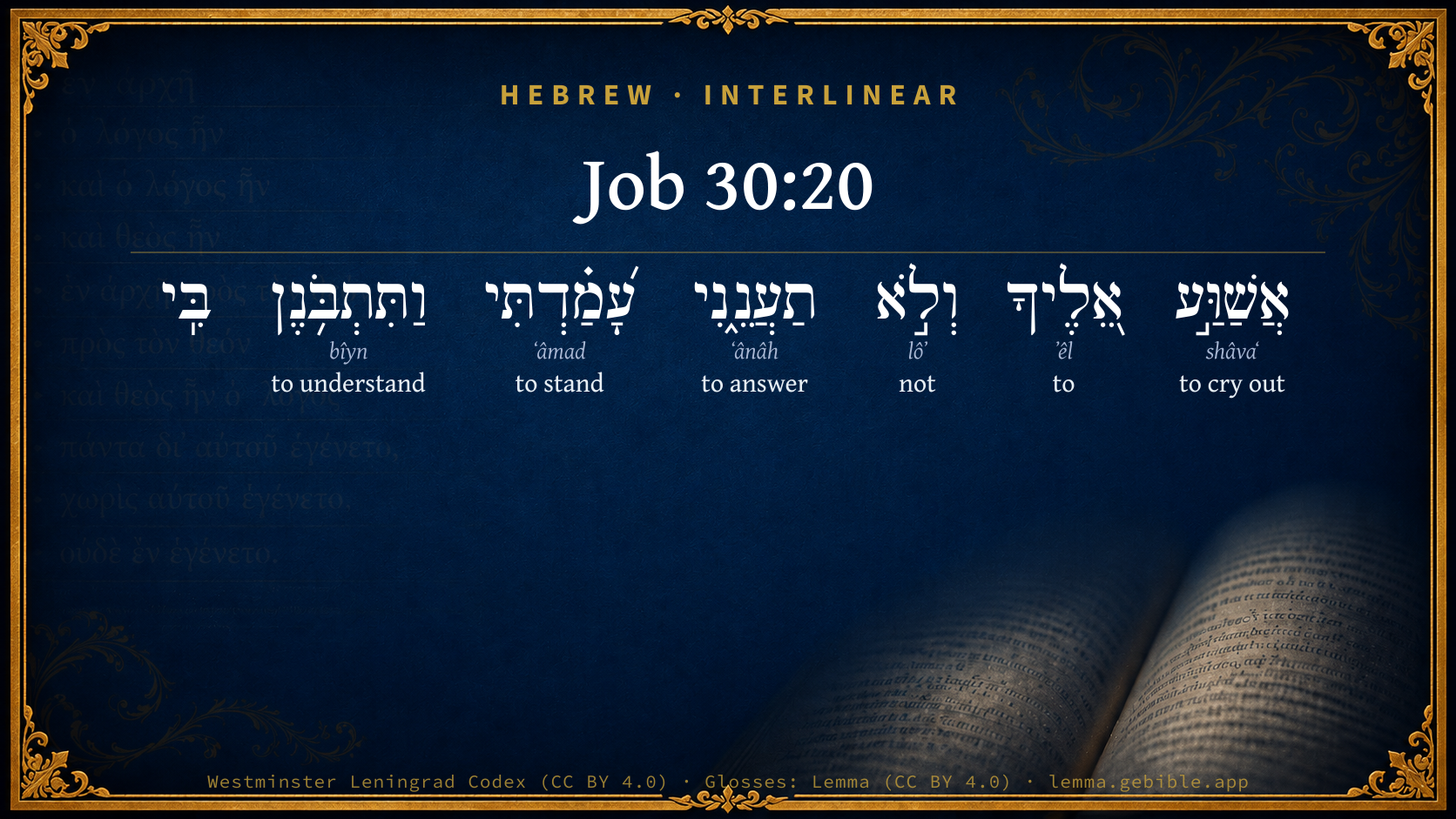
Hebrew (Westminster Leningrad Codex) Job 30:20 appears in the Hebrew Old Testament. The text above is from the Westminster Leningrad Codex. Each word links to its Strong’s number, a concise gloss, and parsing drawn from the Open Scriptures Hebrew Bible morphology. Click any word for its full Brown-Driver-Briggs (BDB) entry.
Download image
Cite this verse

Job 30:20 (World English Bible). Public Domain. Lemma interlinear Bible study tool, https://lemma.gebible.app/v/job/30/20.

Show BibTeX & RIS
BibTeX
RIS
English Translation
I cry to you, and you do not answer me. I stand up, and you gaze at me.
World English Bible · Public Domain
Download a study sheet

One document with this verse’s original text, its word-by-word gloss line, the meaning frame, cross-references with their text, attributed commentary, and full source and license credits — printable, and it pastes into notes with its structure intact.

This verse Autodidact and up

Study sheet (.html) Plain text (.txt)

A passage Seminary Student

Up to 50 verses in one chapter. A passage sheet keeps up to 6 commentary sources and 12 cross-references per verse, in the order this page ranks them, and says so on the sheet whenever that leaves anything out. Ask for a single verse and you get the Autodidact verse sheet above.

Everything on this page stays free to read, with no account — the sheet is a download of what is already on screen, not access to it.

Want to remove ads? Support Godless Engineer
Compare translations 3

The same verse in 3 English versions, stacked beneath the original-language interlinear above. Click any original word for its lexicon entry.

Each is an independent rendering of the whole verse — the interlinear is not word-aligned to these translations.

Highlighted words mark where these versions differ — a whole-verse word diff, not a word-by-word alignment.

  • World English Bible Public Domain
    I cry to you, and you do not answer me. I stand up, and you gaze at me.
  • King James Version Public Domain
    I cry unto thee, and thou dost not hear me: I stand up, and thou regardest me not.
  • unfoldingWord Literal Text CC BY-SA 4.0
    I cry to you, but you do not answer me; I stand, but you gaze at me.

unfoldingWord Literal Text — © unfoldingWord, licensed CC BY-SA 4.0. Word-aligned USFM3 via Door43 (git.door43.org/unfoldingWord/en_ult).

Versions to compare (up to 4)

3 of 4 selected

Show all 18 translations

Every available English version of this verse, each an independent rendering of the whole verse.

  • World English Bible Public Domain
    I cry to you, and you do not answer me. I stand up, and you gaze at me.
  • Berean Standard Bible Public Domain
    I cry out to You for help, but You do not answer; when I stand up, You merely look at me.
  • Majority Standard Bible Public Domain
    I cry out to You for help, but You do not answer; when I stand up, You merely look at me.
  • King James Version Public Domain
    I cry unto thee, and thou dost not hear me: I stand up, and thou regardest me not.
  • American Standard Version (1901) Public Domain
    I cry unto thee, and thou dost not answer me: I stand up, and thou gazest at me.
  • Revised Version (1885) Public Domain
    I cry unto thee, and thou dost not answer me: I stand up, and thou lookest at me.
  • Geneva Bible (1599) Public Domain
    Whe I cry vnto thee, thou doest not heare me, neither regardest me, when I stand vp.
  • Douay-Rheims (1899) Public Domain
    I cry to thee, and thou hearest me not: I stand up, and thou dost not regard me.
  • Young's Literal Translation Public Domain
    I cry unto Thee, And Thou dost not answer me, I have stood, and Thou dost consider me.
  • Literal Standard Version CC BY-SA 4.0
    I cry to You, || And You do not answer me, I have stood, and You consider me.
  • Unlocked Literal Bible CC BY-SA 4.0
    I cry to you, God, but you do not answer me; I stand up, and you merely look at me.
  • unfoldingWord Literal Text CC BY-SA 4.0
    I cry to you, but you do not answer me; I stand, but you gaze at me.
  • Darby Bible Public Domain
    I cry unto thee, and thou answerest me not; I stand up, and thou lookest at me.
  • World Messianic Bible Public Domain
    I cry to you, and you do not answer me. I stand up, and you gaze at me.
  • Webster's Bible Public Domain
    I cry to thee, and thou dost not hear me: I stand up, and thou regardest me not.
  • Free Bible Version CC BY-SA 4.0
    God, I cry to you but you don't answer; I stand before you, but you don't even notice me.
  • Bible in Basic English Public Domain
    You give no answer to my cry, and take no note of my prayer.
  • JPS Tanakh (1917) Public Domain
    I cry unto Thee, and Thou dost not answer me; I stand up, and Thou lookest at me.

Literal Standard Version (2020), Covenant Press — licensed CC BY-SA 4.0. Text via the HelloAO Bible API (eBible.org). Unlocked Literal Bible (unfoldingWord) — licensed CC BY-SA 4.0. Text via the HelloAO Bible API (eBible.org). unfoldingWord Literal Text — © unfoldingWord, licensed CC BY-SA 4.0. Word-aligned USFM3 via Door43 (git.door43.org/unfoldingWord/en_ult). Free Bible Version, Dr. Jonathan Gallagher — licensed CC BY-SA 4.0. Text via the HelloAO Bible API (eBible.org).

Word by word

More ways to search: Search by grammar → Find every occurrence → Compare this word →

Practice this passage: Drill this verse → Learn its vocabulary →

About this verse

These counts appear in no published source. They are computed here, from the morphology-tagged text and Lemma’s own curated glosses. What Lemma adds →

7
words
6
distinct lemmas
Wisdom
section

Notable vocabulary

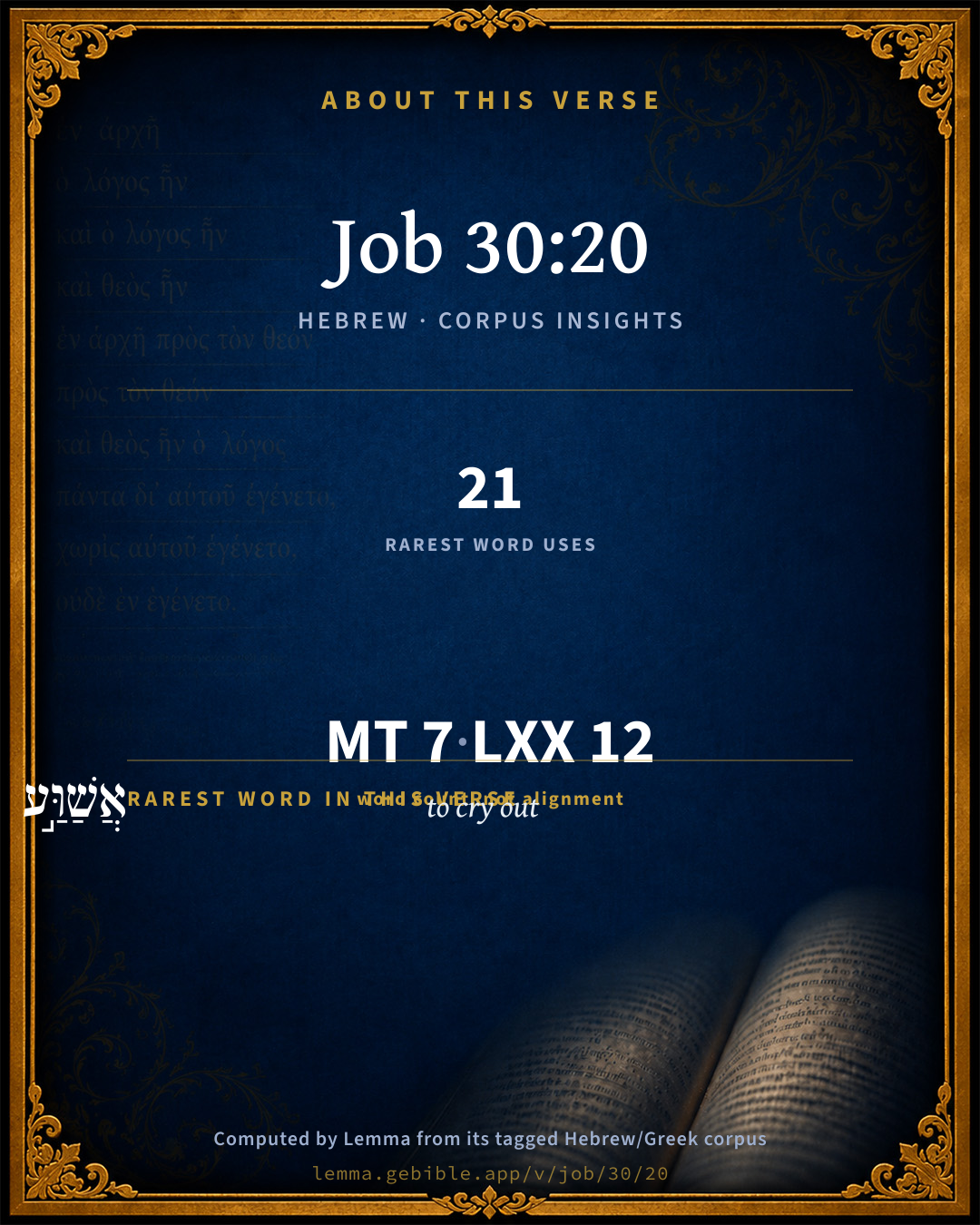
The rarest word here is אֲשַׁוַּ֣ע to cry out H7768 — appearing just 21 times in the whole Hebrew Bible.

Shared distinctive vocabulary

אֲשַׁוַּ֣ע to cry out H7768 occurs in 21 verses of the Hebrew Bible. Also found in:

Grammatical profile

  • 4 verbs
  • 2 prepositions
  • 1 particle

Verb forms

  • אֲשַׁוַּ֣ע Piel · Imperfect
  • תַעֲנֵ֑נִי Qal · Imperfect
  • עָ֝מַ֗דְתִּי Qal · Perfect
  • וַתִּתְבֹּ֥נֶן Hithpolel · Sequential Imperfect

Hebrew & Septuagint length

In English translation the verse runs 18 words from the Hebrew and 18 from the Septuagint (LXX English) — the same length.

A rough comparison of the two English renderings, which tokenize alike — not a word-level alignment.

Word counts can differ between the Hebrew and the Greek without any difference in meaning — e.g. the Hebrew direct-object marker אֵת has no separate Greek word, and Greek often adds the article ὁ.

In the original languages it is 7 Hebrew tokens and 12 Greek tokens — but the two are counted differently (Hebrew bundles its prefixes and suffixes into one token; the Greek is in lemma form), so that isn’t a like-for-like length.

Cross-references

7

Topical passages linked to Job 30:20 in the Treasury of Scripture Knowledge — connected by theme and wording, ordered by reader-vote popularity; previews shown in the World English Bible.

  • Job 19:7 "Behold, I cry out of wrong, but I am not heard: I cry for help, but there is no justice.
  • Psalms 22:2 My God, I cry in the daytime, but you don't answer; In the night season, and am not silent.
  • Psalms 80:4–5 Yahweh God of hosts, How long will you be angry against the prayer of your people?
  • Lamentations 3:8 Yes, when I cry, and call for help, he shuts out my prayer.
  • Job 27:9 Will God hear his cry, When trouble comes on him?
  • Lamentations 3:44 You have covered yourself with a cloud, so that no prayer can pass through.
  • Matthew 15:23 But he answered her not a word. His disciples came and begged him, saying, "Send her away; for she cries after us."

Cross-references courtesy of OpenBible.info (CC BY 4.0).

Hebrew and Greek witnesses Masoretic Hebrew ↔ Greek Septuagint

The same verse in the two great witnesses to the Old Testament, shown verse-for-verse.

These are two independent witnesses, not word-aligned to each other, and the Septuagint is shown in lemma (dictionary) form.

Hebrew Job 30:20 Masoretic · Westminster Leningrad Codex

אֲשַׁוַּ֣ע אֵ֭לֶיךָ וְלֹ֣א תַעֲנֵ֑נִי עָ֝מַ֗דְתִּי וַתִּתְבֹּ֥נֶן בִּֽי

I cry to you, and you do not answer me. I stand up, and you gaze at me.

World English Bible · Public Domain

Greek LXX Job 30:20 Septuagint · lemma form

κράζω δέ πρός σύ καί οὐ εἰςἀκούω ἐγώ ἵστημι καί κατανοέω ἐγώ

And I have cried to you, but you hear me not: but they stood still, and observed me.

LXX2012 (modern English Septuagint) · Public Domain

On this verse, Keil & Delitzsch discusses the Septuagint’s reading. Read the note in Commentary ↓

Hebrew: Westminster Leningrad Codex (CC BY 4.0). Greek: Septuagint (public domain); English from LXX2012 (modern English Septuagint) (Public Domain). How the Septuagint differs from the Hebrew →

Commentary

Notes on Job 30:20 from classic Christian and Jewish commentators (each source and its license shown beneath its notes). The classic Christian expositions comment on the surrounding passage and are grouped to its opening verse, so a note may address several verses; the Jewish commentaries on the Tanakh (Rashi and others) are per-verse, so they appear only where the commentator wrote on this verse.

Lemma curates 59 commentaries, every one of them public domain or Creative Commons licensed, each selected and text-cleaned for this edition rather than reprinted as found. About our sources →

Trapp's Complete Commentary

John Trapp

Job 30:20 I cry unto thee, and thou dost not hear me: I stand up, and thou regardest me [not].

Ver. 20. I cry unto thee, and thou dost not hear me] This was a sore trial, that God should cast him into straits, and there leave him. His enemies indeed he usually dealeth so by, Eze 22:20; Eze 29:5, but not by his servants, Heb 13:5. Or if he do leave them, yet he will not forsake them. The mother leaves her child sometimes, but when he setteth up his note and crieth lustily, she hasteneth to help him. So doth God: but now Job cried unto him, and was not heard or answered, to his thinking at least, and that was a great cut to him, as Psa 22:2.

I stand up] sc. To make supplication to my judge, as Haman stood up to make request for his life, Est 7:7, as the publican stood and prayed, Luk 18:13, and as Moses and Samuel are supposed to stand before God in prayer for their people, Jer 15:1. Hence that proverb among the Jews, Absque stationibus, non staret mundus, Did not the saints stand in prayer, the world could not stand.

And thou regardest me not] This was but a mistake in Job, for the eyes of the Lord are upon the righteous, and his ears are open to their prayers. Only God answereth our prayer, non secundum voluntatem, tamen ad utilitatem. Not always or as soon as we would, but doth that which is better for us, and takes it ill to be misconstrued, as he was by Job; witness the next words, bloody words indeed, and not far from blasphemy. Accusat ergo Iob Dominum mendacii (Brent.). Contumeliosus videri potest (Merl.).

John Trapp, A Commentary or Exposition upon All the Books of the Old and New Testament (1647–1656) — public domain. Text from a community e-Sword module.

The Biblical Illustrator

Joseph S. Exell

Job_30:20

I cry unto Thee, and Thou dost not hear me.

Unanswered prayer

1. There is no state so low but a godly man may have a freedom with God in prayer. Though a poor soul be in the mire, though he be but dust and ashes, yet he hath access to the throne of grace.

2. It is our duty to pray most, and usually we pray best, when it is worst with us; when we are nigh the mire and dust, prayer is not only most seasonable, but most pure.

3. Affliction provokes a soul to pray to the utmost, to pray not only in sincerity, but with fervency, not only to pray with faith, but with a holy passion, or passionately.

4. When prayer is sent out with a cry to God in affliction, it is a wonder if it be not presently heard.

5. Not to be heard in a day of trouble and affliction is more troublesome to a gracious heart than all his afflictions. Job thought he was not heard, because he had not present deliverance; and in that sense, indeed, he was not heard. And thus many of the saints may pray and not be heard; that is, they may pray, and not have present deliverance. How may we know that we are heard at any time?

(1) By the quietness of our spirits.

(2) Though we receive not the mercy presently, yet if we receive fresh strength to bear the want of it, that is an answer.

(3) We are answered when, though the evil be not removed, yet we have faith and patience to wait and tarry the Lords leisure for the removal of it.

(4) He is answered in prayer that is more heavenly, or more in heaven after prayer. He that is edified in his holy faith, hath certainly prayed in the Holy Ghost, and, sure enough, every such prayer is heard. Godly men are always heard of God, yet they often think that they are not heard. (Joseph Caryl.)

The Biblical Illustrator, edited by Joseph S. Exell (c. 1880s–1900s) — public domain. Text from a community e-Sword module.

Joseph Benson's Commentary

Job 30:20-21. Thou dost not hear me — Namely, so as to answer or help me. I stand up — Namely, before thee: I pray importunately and continually, as thou requirest; and thou regardest me not — Notwithstanding all my griefs and cries, thou dost not pity and help me, but rather seemest to take pleasure in beholding my calamities, as the following words imply; Thou art become cruel to me — Hebrew, תהפךְ, tehapheck, Thou art turned to be cruel, as if thou hadst changed thy very nature; which is kind, merciful, and gracious; and such thou hast formerly been in thy carriage to me; but now thou art grown severe, rigorous, and inexorable. Thou opposest thyself against me — Thy power, wherewith I expected that thou wouldest have supported me under my troubles, thou usest against me.

Joseph Benson's Commentary on the Old and New Testaments (1811–1818) — public domain. Text from a community e-Sword module.

Keil & Delitzsch

C. F. Keil & F. Delitzsch

20 I cry to Thee for help, and Thou answerest not;

I stand there, and Thou lookest fixedly at me.

21 Thou changest Thyself to a cruel being towards me,

With the strength of Thy hand Thou makest war upon me.

22 Thou raisest me upon the stormy wind,

Thou causest me to drive along And vanish in the roaring of the storm.

23 For I know: Thou wilt bring me back to death,

Into the house of assembly for all living.

If he cries for help, his cry remains unanswered; if he stands there looking up reverentially to God (perhaps עמד, with משּׁוּע to be supplied, has the sense of desisting or restraining, as Gen 29:35; Gen 30:9), the troubling, fixed look of God, who looks fixedly and hostilely upon him, anything but ready to help (comp. Job 7:20; Job 16:9), meets his upturned eye. התבּנן, to look consideringly upon anything, is elsewhere joined with אל, על, עד, or even with the acc; here, where a motionless fixed look is intended, with בּ (= fi). It is impossible to draw the לא, Job 30:20, over to ותּתבּנן (Jer., Saad., Umbr., Welte, and others), both on account of the Waw consec. (Ew. 351a), and on account of the separation by the new antecedent עמדתּי. On the reading of two Codd. ותתכנן ("Thou settest Thyself against me"), which Houbigant and Ew. prefer, Rosenm. has correctly pronounced judgment: est potius pro mendo habenda. Instead of consolingly answering his prayer, and instead of showing Himself willing to help, God, who was formerly so kind towards him, changes towards him, His creature, into a cruel being, saevum (אכזר in the book of Job only here and Job 41:2, where it signifies "foolhardy;" comp. לאויב in the dependent passage, Isa 63:10), and makes war upon him (שׂטם as Job 16:9) by causing him to feel the strength of His omnipotent hand (עצם יד as Deu 8:17, synon. חזק).

It is not necessary in Job 30:22 to forsake the accentuation, and to translate: Thou raisest me up, Thou causest me go in the wind (Ew., Hirz., and others); the accentuation of רוח is indeed not a disjunctive Dech, but a conjunctive Tarcha, but preceded by Munach, which, according to the rule, Psalter ii. 500, 5, here, where two conjunctives come together, has a smaller conjunctive value. Therefore: elevas me in ventum, equitare facis me, viz., super ventum (Dachselt), for one does not only say הרכּיב על, Ch1 13:7, or ל, Psa 66:12, but also אל, Sa2 6:3; and accordingly תּשּׂאני אל־רוּח is also not to be translated: Thou snatchest me into the wind or storm (Hahn, Schlottm.), but: Thou raisest me up to the wind or storm, as upon an animal for riding (Umbr., Olsh.). According to Oriental tradition, Solomon rode upon the east wind, and in Arabic they say of one who hurried rapidly by, racab al-genâhai er-rih, he rides upon the wings of the wind; in the present passage, the point of comparison is the being absolutely passively hurried forth from the enjoyment of a healthy and happy life to a dizzy height, whence a sudden overthrow threatens him who is unwillingly removed (comp. Psa 102:11, Thou hast lifted me up and hurled me forth).

The lot which threatens him from this painful suspense Job expresses (Job 30:22) in the puzzling words: וּתמגגני תשׁיּה. Thus the Keri, after which lxx transl. (if it has not read מישׁוּעה), καὶ ἀπέῤῥηιψάς με ἀπὸ σωτηρίας. The modern expositors who follow the Keri, by taking ותמגגני for ותמגג לי (according to Ges. 121, 4), translate: Thou causest counsel and understanding (Welte), happiness (Blumenf.), and the like, to vanish from me; continuance, existence, duration would be better (vid., Job 6:13, and especially on Job 26:3). The thought it appropriate, but the expression is halting. Jerome, who translates valide, points to the correct thing, and Buxtorf (Lex. col. 2342f.) by interpreting the not less puzzling Targum translation in fundamento = funditus or in essentia = essentialiter, has, without intending it, hit upon the idea of the Hebr. Keri; תשׁיּה is intended as a closer defining, or adverbial, accusative: Thou causest me to vanish as to existence, ita ut tota essentia pereat h.e. totaliter et omnino. Perhaps this was really the meaning of the poet: most completely, most thoroughly, altogether, like the Arab. ḥaqqan. But it is unfavourable to this Keri, that תושׁיה (from the verb ושׁי), as might be expected, is always written plene elsewhere; the correction of the תשׁוה is violent, and moreover this form, correctly read, gives a sense far more consistent with the figure, Job 30:22. Ges., Umbr., and Carey falsely read תּשׁוּה, terres me; this verb is unknown in Hebr., and even in Chaldee is only used in Ithpeal, אשׁתּוי (= Hebr. חרד); for a similar reason Bttcher's תּשׁוה (which is intended to mean: in despair) is also not to be used. Even Stuhlmann perceived that תשׁוה is equivalent to תּשׁוּאה; it is, with Ew. and Olsh., to be read תּשׁוּה (not with Pareau and Hirz. תּשׁוה without the Dag.), and this form signifies, as תשׁואה, Job 36:29, from שׁוא = שׁאה, from which it is derived by change of consonants, the crash of thunder, or even the rumbling or roar as of a storm or a falling in (procellae sive ruinae). The meaning is hardly, that he who rides away upon the stormy wind melts and trickles down like drops of rain among the pealing of the thunder, when the thunder-storm, whose harbinger is the stormy wind, gathers; but that in the storm itself, which increases in fury to the howling of a tempest, he dissolves away. תּשׁוּה for בּתּשׁוּה, comp. Psa 107:26 : their soul melted away (dissolved) בּרעה. The compulsory journey in the air, therefore, passes into nothing or nearly nothing, as Job is well aware, Job 30:23 : "for I know: (without כּי, as Job 19:25; Ps. 9:21) Thou wilt bring me back to death" (acc. of the goal, or locative without any sign). If תּשׁיבני is taken in its most natural signification reduces, death is represented as essentially one with the dust of death (comp. Job 1:21 with Gen 3:19), or even with non-existence, out of which man is come into being; nevertheless השׁיב can also, by obliterating the notion of return, like redigere, have only the signification of the turn of destiny and change of condition that is effected. The assertion that שׁוּב always includes an "again," and retains it inexorably (vid., Khler on Zac 13:7, S. 239), is untenable. In post-biblical Hebrew, at least, it is certain that שׁוּב signifies not only "to become again," but also "to become," as Arab. ‛âd is used as synon. of jâ'in, devenir.

(Note: Vid., my Anekdota der mittelalterlichen Scholastik unter Juden und Moslemen, S. 347.)

With מות, the designation of the condition, is coupled the designation of the place: Hades (under the notion of which that of the grave is included) is the great involuntary rendezvous of all who live in this world.

Keil & Delitzsch — Biblical Commentary on the Old Testament (1861–1891) — public domain (CC PDM 1.0). Text via the HelloAO Bible API. (Old Testament only.)

Tyndale Open Study Notes

Tyndale Open Resources

30:20-21 you don’t answer: This was Job’s frequent complaint (9:16; 19:7; 23:2-9; 31:35), which God soon answered (38:1).

Tyndale Open Study Notes — © Tyndale Open Resources, licensed CC BY-SA 4.0. Text via the HelloAO Bible API.

Jamieson, Fausset & Brown

Robert Jamieson, A. R. Fausset & David Brown

stand up--the reverential attitude of a suppliant before a king (Kg1 8:14; Luk 18:11-13).

not--supplied from the first clause. But the intervening affirmative "stand" makes this ellipsis unlikely. Rather, as in Job 16:9 (not only dost thou refuse aid to me "standing" as a suppliant, but), thou dost regard me with a frown: eye me sternly.

Jamieson, Fausset & Brown — Commentary Critical and Explanatory on the Whole Bible (1871) — public domain (CC PDM 1.0). Text via the HelloAO Bible API.

Adam Clarke's Commentary

Verse 20. I cry unto thee] I am persecuted by man, afflicted with sore disease, and apparently forsaken of God.

I stand up] Or, as some translate, "I persevere, and thou lookest upon me." Thou seest my desolate, afflicted state; but thine eye doth not affect thy heart. Thou leavest me unsupported to struggle with my adversities.

Adam Clarke's Commentary on the Bible (1810–1826) — public domain. Text from a community e-Sword/MySword module.

Ellicott's Commentary for English Readers

(20) Thou regardest me not.—The Authorised Version understands that the negative of the first clause must be supplied in the second, as is the case in Psa_9:18 : “The needy shall not always be forgotten; the expectation of the poor shall not perish for ever.” Others understand it, “I stand up (i.e., to pray) in the attitude of prayer, and Thou lookest at me,” i.e., and doest no more with mute indifference.

A Bible Commentary for English Readers, edited by Charles John Ellicott (1878–1897) — public domain. Text from a community e-Sword module.

The Cambridge Bible for Schools and Colleges

gen. ed. J. J. S. Perowne

20. This verse reads,

I cry unto thee and thou dost not hear me,

I stand up, and thou lookest at me.

The second clause describes Job’s importunity in his appeal, but the only reply is that God “looketh” at him, i. e. with silent indifference, or in stern severity.

The Cambridge Bible for Schools and Colleges (gen. ed. J. J. S. Perowne; Cambridge University Press, 1878–1918) — public domain. Text from a community e-Sword module.

John Gill's Exposition

I cry unto thee, and thou dost not hear me,.... Which added greatly to his affliction, that though he cried to the Lord for help and deliverance, yet he turned a deaf ear to him; and though he heard him, as undoubtedly he did, he did not answer him immediately; at least not in the way in which he desired and expected he would: crying is expressive of prayer, and supposes distress, and denotes vehemence of spirit:

I stand up; in prayer, standing being a prayer gesture, as many observe from Jer 15:1; See Gill on Mat 6:5; or he persisted in it, he continued praying, was incessant in it, and yet could obtain no answer; or this signifies silence, as some (f) interpret it; he cried, and then ceased, waiting for an answer; but whether he prayed, or whether he was silent, it was the same thing:

and thou regardest me not; the word "not" is not in this clause, but is repeated from the preceding, as it is by Ben Gersom and others; but some read it without it, and give the sense either thus, thou considerest me whether it is fit to receive my prayer or not, so Sephorno; or to renew my strokes, to add new afflictions to me, as Jarchi and Bar Tzemach; or thou lookest upon me as one pleased with the sight of me in such a miserable condition, so far from helping me; wherefore it follows.

(f) Jarchi, Ben Gersom, and Bar Tzemach.

John Gill's Exposition of the Whole Bible (1746–1763) — public domain (CC PDM 1.0). Text via the HelloAO Bible API.

Albert Barnes' Notes on the Bible

I cry unto thee, and thou dost not hear me - This was a complaint which Job often made, that he could not get the ear of God; that his prayer was not regarded, and that he could not get his cause before him; compare Job 13:3, Job 13:19 ff, and Job 27:9.

I stand up - Standing was a common posture of prayer among the ancients; see Heb 11:21; 1Ki 8:14, 1Ki 8:55; Neh 9:2. The meaning is, that when Job stood up to pray, God did not regard his prayer.

Albert Barnes' Notes on the Bible (1834–1885) — public domain. Text from a community e-Sword/MySword module.

Haydock's Catholic Bible Commentary

Not is supplied by Protestants in the second part of the verse from the first; (Haydock) as this construction is not unusual in the Hebrew. Septuagint, "they have stood up, and have considered me," (Calmet) to procure my entire ruin. (Haydock)

George Leo Haydock (1774–1849), Haydock's Catholic Family Bible and Commentary, 1859 edition — public domain. Excludes Psalms (Douay-Rheims chapter numbering differs from Protestant) and Deuterocanonical books (Catholic canon only).

Matthew Poole's English Annotations

Thou dost not hear me, to wit, so as to answer or help me.

I stand up, or, I stand, to wit, before thee, i.e. I pray, as this phrase signifies, Jer 15:1; 18:20, this being a gesture of prayer, Mat 6:5. And so the same thing is here repeated in other words, after the manner. Or, I persist or persevere in praying; I pray importunately and continually, as thou requirest.

Thou regardest me not; so the particle not is supplied out of the former clause. Or without the negation, thou knowest or observest me, and all my griefs and cries, and yet dost not pity nor help me, but rather takest pleasure in the contemplation of my calamities, as the following words imply. Or it may be taken interrogatively, Dost thou regard me? i.e. thou dost not.

Matthew Poole's English Annotations on the Holy Bible (1683–1685) — public domain. Text from a community e-Sword/MySword module.

Whedon's Commentary on the Bible

Daniel D. Whedon

20. Hear — Rather, answer. Regardest me (omit not) — Job takes the reverential attitude of a suppliant, and God looks upon him calmly and pitilessly.

Daniel D. Whedon (gen. ed.), Commentary on the Old and New Testaments (1874–1909) — public domain. Text from a community e-Sword module.

The Pulpit Commentary

I cry unto thee, and thou dost not hear me. It is the worst of all calamities to be God-forsaken, as Job believed himself to be, because he had no immediate answer to his prayers. The bitterest cry upon the cross was "Eli, Eli, lama sabachthani?" But no good man is ever really God-forsaken, and no rightful and earnest prayers are ever really unheard. Job "had need of patience", (Heb_10:36) patient as he was. (Jam_5:11) He should have trusted God more, and complained less. I stand up, and thou regardest me not; rather, I stand up, as the manner of the Jews usually was in prayer, (Luk_18:11) and thou lookest at me (see the Revised Version). Job"s complaint is that, when he stands up and stretches out his hands to God in prayer, God simply looks on, does nothing, gives him no help.

The Pulpit Commentary (1880–1919), ed. H.D.M. Spence-Jones & Joseph S. Exell — public domain. Text from a community e-Sword module.

John Wesley's Explanatory Notes

I stand - I pray importunately and continually.

John Wesley, Explanatory Notes Upon the Whole Bible (1754–1765) — public domain. Text via the GEBible commentary corpus.

unfoldingWord translationNotes

Door43 World Missions Community

cruel

This word means unkind.

with the strength of your hand you persecute me

The word "hand" represents God's power. AT: "you persecute me with your power" (See: Metonymy)

translationWords

power

hand

persecute

unfoldingWord translationNotes — © Distant Shores Media and the Door43 World Missions Community, licensed CC BY-SA 4.0. Source: git.door43.org/Door43/en_tn.

Rashi

Rabbi Shlomo Yitzchaki (Rashi)

I stood to see, to remain silent, and to understand, as in (Neh. 8:5), “And when he opened [it], all the people stood,” and no longer replied.

and You ponder me You think about me to change my plagues.

Rashi on the Tanakh — English translations: “The Judaica Press complete Tanach with Rashi, translated by A. J. Rosenberg” (CC BY 4.0); “Pentateuch with Rashi's commentary by M. Rosenbaum and A.M. Silbermann, 1929-1934” (public domain); “The Metsudah Tanach series, Lakewood, N.J” (CC BY 4.0); and “The Book of Joshua, Metsudah Publications, 1997” (CC BY 4.0). Text via Sefaria.

Lesson kit

Teaching starters — assembled from the data on this page, not authored interpretation. Every prompt links to the verse data it draws on. Edit before teaching.

Job, in the Wisdom, opens this verse with 7 words (6 distinct Hebrew lemmas). Its most distinctive word is shâvaʻ (“to cry out”). A historical commentator’s framing appears above. Read the whole chapter for the surrounding context.

Discussion questions

  1. The word shâvaʻ carries the sense “to cry out.” How does it shape the verse?
  2. Job 19:7 shares the word «to cry out» with this verse. How do the two illuminate each other?
  3. These translations render this verse differently; the difference is in the English rendering, not the original. What questions does that raise?
  4. The verb «אֲשַׁוַּ֣ע» is Piel Imperfect. How does its form color the action?
  5. Reading how Trapp's Complete Commentary and The Biblical Illustrator read this verse, where do the two commentators agree and where do they part?

Things to notice

Reading settings

Reading text

Shown beneath each verse's original-language words.

Old Testament
Old Testament edition

Read the OT as the Masoretic Hebrew (MT) or the Greek Septuagint (LXX).

English shown for the Greek Septuagint (in the Hebrew ↔ Greek comparison).

Comparing translations? Open the Compare panel on any verse page to stack up to four side by side.