
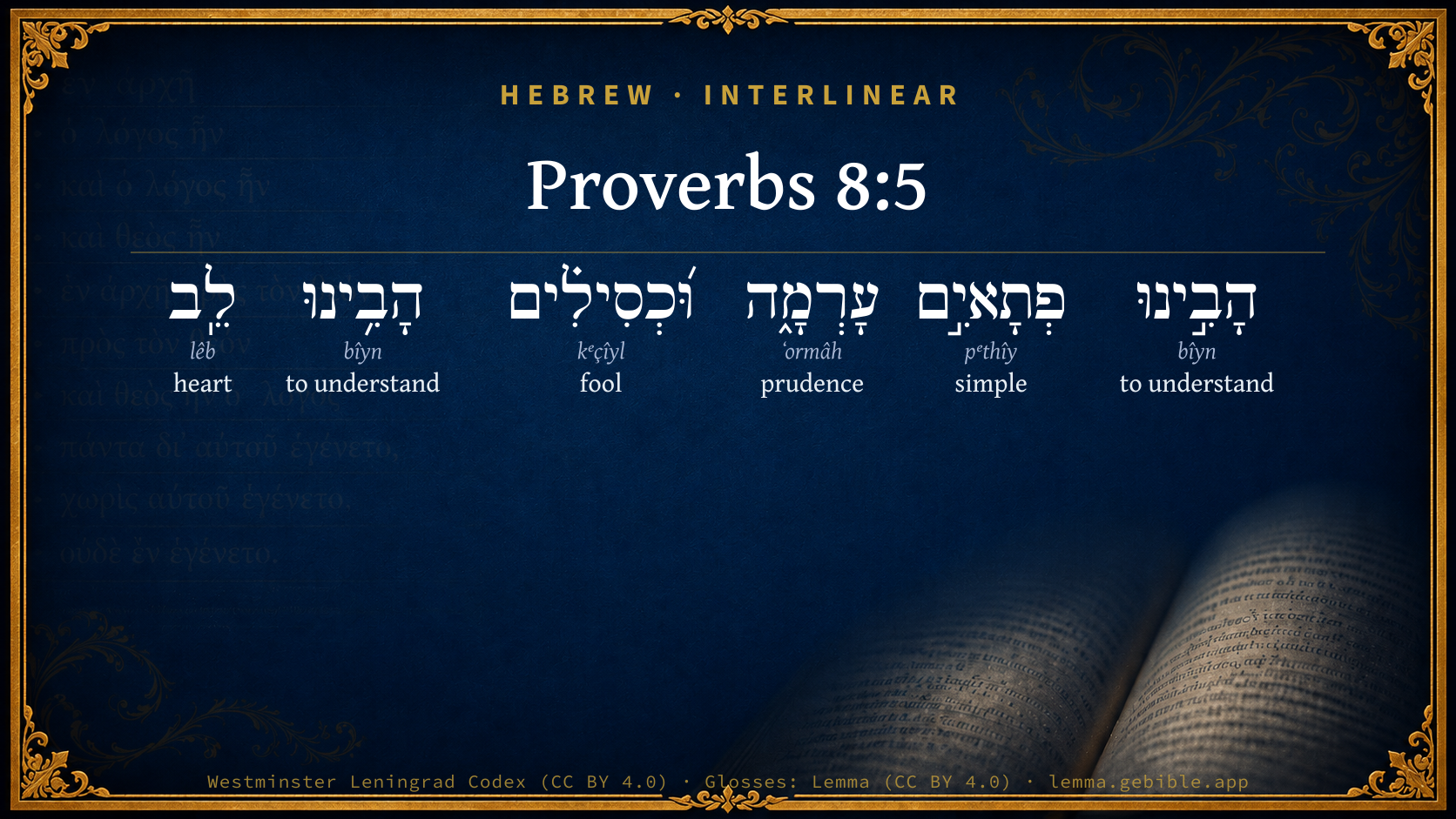
Proverbs 8:5

Hebrew (Westminster Leningrad Codex) Proverbs 8:5 appears in the Hebrew Old Testament. The text above is from the Westminster Leningrad Codex. Each word links to its Strong’s number, a concise gloss, and parsing drawn from the Open Scriptures Hebrew Bible morphology. Click any word for its full Brown-Driver-Briggs (BDB) entry.
Download image
Cite this verse

Proverbs 8:5 (World English Bible). Public Domain. Lemma interlinear Bible study tool, https://lemma.gebible.app/v/proverbs/8/5.

Show BibTeX & RIS
BibTeX
RIS
English Translation
You simple, understand prudence. You fools, be of an understanding heart.
World English Bible · Public Domain
Download a study sheet

One document with this verse’s original text, its word-by-word gloss line, the meaning frame, cross-references with their text, attributed commentary, and full source and license credits — printable, and it pastes into notes with its structure intact.

This verse Autodidact and up

Study sheet (.html) Plain text (.txt)

A passage Seminary Student

Up to 50 verses in one chapter. A passage sheet keeps up to 6 commentary sources and 12 cross-references per verse, in the order this page ranks them, and says so on the sheet whenever that leaves anything out. Ask for a single verse and you get the Autodidact verse sheet above.

Everything on this page stays free to read, with no account — the sheet is a download of what is already on screen, not access to it.

Want to remove ads? Support Godless Engineer
Compare translations 3

The same verse in 3 English versions, stacked beneath the original-language interlinear above. Click any original word for its lexicon entry.

Each is an independent rendering of the whole verse — the interlinear is not word-aligned to these translations.

Highlighted words mark where these versions differ — a whole-verse word diff, not a word-by-word alignment.

  • World English Bible Public Domain
    You simple, understand prudence. You fools, be of an understanding heart.
  • King James Version Public Domain
    O ye simple, understand wisdom: and, ye fools, be ye of an understanding heart.
  • unfoldingWord Literal Text CC BY-SA 4.0
    Understand prudence, naive ones, and stupid ones, understand heart.

unfoldingWord Literal Text — © unfoldingWord, licensed CC BY-SA 4.0. Word-aligned USFM3 via Door43 (git.door43.org/unfoldingWord/en_ult).

Versions to compare (up to 4)

3 of 4 selected

Show all 18 translations

Every available English version of this verse, each an independent rendering of the whole verse.

  • World English Bible Public Domain
    You simple, understand prudence. You fools, be of an understanding heart.
  • Berean Standard Bible Public Domain
    O simple ones, learn to be shrewd; O fools, gain understanding.
  • Majority Standard Bible Public Domain
    O simple ones, learn to be shrewd; O fools, gain understanding.
  • King James Version Public Domain
    O ye simple, understand wisdom: and, ye fools, be ye of an understanding heart.
  • American Standard Version (1901) Public Domain
    O ye simple, understand prudence; And, ye fools, be of an understanding heart.
  • Revised Version (1885) Public Domain
    O ye simple, understand subtilty; and, ye fools, be ye of an understanding heart.
  • Geneva Bible (1599) Public Domain
    O ye foolish men, vnderstand wisedome, and ye, O fooles, be wise in heart.
  • Douay-Rheims (1899) Public Domain
    O little ones, understand subtilty, and ye unwise, take notice.
  • Young's Literal Translation Public Domain
    Understand, ye simple ones, prudence, And ye fools, understand the heart,
  • Literal Standard Version CC BY-SA 4.0
    Understand, you simple ones, prudence, || And you fools, understand the heart,
  • Unlocked Literal Bible CC BY-SA 4.0
    You who are naive, learn wisdom; and you who are foolish, you must get an understanding mind.
  • unfoldingWord Literal Text CC BY-SA 4.0
    Understand prudence, naive ones, and stupid ones, understand heart.
  • Darby Bible Public Domain
    O ye simple, understand prudence; and ye foolish, understand sense.
  • World Messianic Bible Public Domain
    You simple, understand prudence! You fools, be of an understanding heart!
  • Webster's Bible Public Domain
    O ye simple, understand wisdom: and ye fools, be ye of an understanding heart.
  • Free Bible Version CC BY-SA 4.0
    If you're immature, learn how to grow up. If you're stupid, learn what makes good sense.
  • Bible in Basic English Public Domain
    Become expert in reason, O you simple ones; you foolish ones, take training to heart.
  • JPS Tanakh (1917) Public Domain
    O ye thoughtless, understand prudence, and, ye fools, be ye of an understanding heart.

Literal Standard Version (2020), Covenant Press — licensed CC BY-SA 4.0. Text via the HelloAO Bible API (eBible.org). Unlocked Literal Bible (unfoldingWord) — licensed CC BY-SA 4.0. Text via the HelloAO Bible API (eBible.org). unfoldingWord Literal Text — © unfoldingWord, licensed CC BY-SA 4.0. Word-aligned USFM3 via Door43 (git.door43.org/unfoldingWord/en_ult). Free Bible Version, Dr. Jonathan Gallagher — licensed CC BY-SA 4.0. Text via the HelloAO Bible API (eBible.org).

Word by word

More ways to search: Search by grammar → Find every occurrence → Compare this word →

Practice this passage: Drill this verse → Learn its vocabulary →

About this verse

These counts appear in no published source. They are computed here, from the morphology-tagged text and Lemma’s own curated glosses. What Lemma adds →

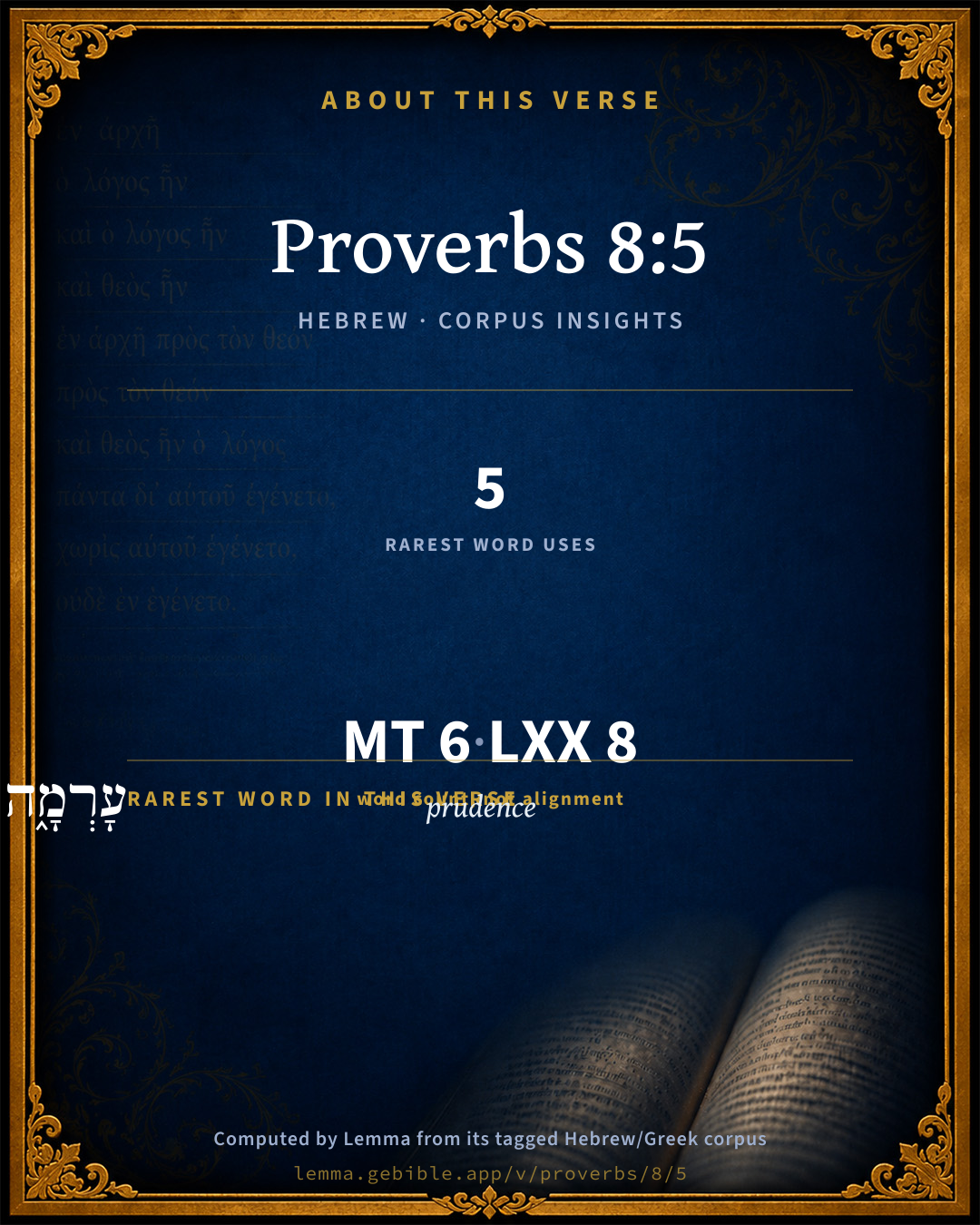
6
words
5
distinct lemmas
Wisdom
section

Notable vocabulary

The rarest word here is עָרְמָ֑ה prudence H6195 — appearing just 5 times in the whole Hebrew Bible.

Shared distinctive vocabulary

עָרְמָ֑ה prudence H6195 occurs in 5 verses of the Hebrew Bible. Also found in:

Grammatical profile

  • 2 verbs
  • 3 nouns
  • 1 adjective

Verb forms

  • הָבִ֣ינוּ Hiphil · Imperative
  • הָבִ֥ינוּ Hiphil · Imperative

Repetition

A word recurs within this verse — often emphatic in Hebrew:

  • הָבִ֣ינוּ to understand H995 ×2

Hebrew & Septuagint length

In English translation the verse runs 11 words from the Hebrew and 12 from the Septuagint (LXX English) — closely comparable.

A rough comparison of the two English renderings, which tokenize alike — not a word-level alignment.

Word counts can differ between the Hebrew and the Greek without any difference in meaning — e.g. the Hebrew direct-object marker אֵת has no separate Greek word, and Greek often adds the article ὁ.

In the original languages it is 6 Hebrew tokens and 8 Greek tokens — but the two are counted differently (Hebrew bundles its prefixes and suffixes into one token; the Greek is in lemma form), so that isn’t a like-for-like length.

Cross-references

11

Topical passages linked to Proverbs 8:5 in the Treasury of Scripture Knowledge — connected by theme and wording, ordered by reader-vote popularity; previews shown in the World English Bible.

  • Proverbs 1:22 "How long, you simple ones, will you love simplicity? How long will mockers delight themselves in mockery, And fools hate knowledge?
  • Proverbs 9:4 "Whoever is simple, let him turn in here!" As for him who is void of understanding, she says to him,
  • Acts 26:18 to open their eyes, that they may turn from darkness to light and from the power of Satan to God, that they may receive remission of sins and an inheritance among those who are sanctified by faith in me.'
  • Revelation 3:17–18 Because you say, 'I am rich, and have gotten riches, and have need of nothing;' and don't know that you are the wretched one, miserable, poor, blind, and naked;
  • Psalms 19:7 Yahweh's law is perfect, restoring the soul. Yahweh's testimony is sure, making wise the simple.
  • Proverbs 1:4 To give prudence to the simple, Knowledge and discretion to the young man:
  • 1 Corinthians 6:9–11 Or don't you know that the unrighteous will not inherit the Kingdom of God? Don't be deceived. Neither the sexually immoral, nor idolaters, nor adulterers, nor male prostitutes, nor homosexuals,
  • Psalms 94:8 Consider, you senseless among the people; You fools, when will you be wise?
  • Isaiah 42:13 Yahweh will go forth as a mighty man; he will stir up [his] zeal like a man of war: he will cry, yes, he will shout aloud; he will do mightily against his enemies.
  • Isaiah 55:1–3 Ho, everyone who thirsts, come you to the waters, and he who has no money; come you, buy, and eat; yes, come, buy wine and milk without money and without price.
  • 1 Corinthians 1:28 and God chose the lowly things of the world, and the things that are despised, and the things that are not, that he might bring to nothing the things that are:

Cross-references courtesy of OpenBible.info (CC BY 4.0).

Hebrew and Greek witnesses Masoretic Hebrew ↔ Greek Septuagint

The same verse in the two great witnesses to the Old Testament, shown verse-for-verse.

These are two independent witnesses, not word-aligned to each other, and the Septuagint is shown in lemma (dictionary) form.

Hebrew Proverbs 8:5 Masoretic · Westminster Leningrad Codex

הָבִ֣ינוּ פְתָאיִ֣ם עָרְמָ֑ה וּ֝כְסִילִ֗ים הָבִ֥ינוּ לֵֽב

You simple, understand prudence. You fools, be of an understanding heart.

World English Bible · Public Domain

Greek LXX Proverbs 8:5 Septuagint · lemma form

νοέω ἄκακος πανουργία ὁ δέ ἀπαίδευτος ἐντίθημι καρδία

O you⌃ simple, understand subtlety, and you⌃ that are untaught, imbibe knowledge.

LXX2012 (modern English Septuagint) · Public Domain

On this verse, The Pulpit Commentary discusses the Septuagint’s reading. Read the note in Commentary ↓

Hebrew: Westminster Leningrad Codex (CC BY 4.0). Greek: Septuagint (public domain); English from LXX2012 (modern English Septuagint) (Public Domain). How the Septuagint differs from the Hebrew →

Commentary

Notes on Proverbs 8:5 from classic Christian and Jewish commentators (each source and its license shown beneath its notes). The classic Christian expositions comment on the surrounding passage and are grouped to its opening verse, so a note may address several verses; the Jewish commentaries on the Tanakh (Rashi and others) are per-verse, so they appear only where the commentator wrote on this verse.

Lemma curates 59 commentaries, every one of them public domain or Creative Commons licensed, each selected and text-cleaned for this edition rather than reprinted as found. About our sources →

Trapp's Complete Commentary

John Trapp

Pro 8:5 O ye simple, understand wisdom: and, ye fools, be ye of an understanding heart.

Ver. 5. O ye simple.] If ye be not set in sin, resolved of your way, as good as ye mean to be; if yet there be any place left for persuasion. {See Trapp on "Pro 1:4"}

And ye fools.] Ye that have already made your conclusion, and are wiser in your own conceit than seven men that can render a reason.

John Trapp, A Commentary or Exposition upon All the Books of the Old and New Testament (1647–1656) — public domain. Text from a community e-Sword module.

The Biblical Illustrator

Joseph S. Exell

Pro_8:5

Ye fools, be ye of an understanding heart.

Are you a fool?

The word fool is derived from a Latin verb, signifying to be inflated with air; substantive, a wind-bag. So a fool is a witless, blundering creature, one whose conduct is not directed by ordinarily good sense or judgment. All who do not serve God are fools, according to the Bible way of looking at things. Many are Bible fools who are not fools according to the worlds idea.

I. He is a fool who buys the wealth of the world with the riches of heaven. Does not the soul far outvalue the

body? Is not eternity greater than time? Thousands choose the tinsel before the real gold, as did the wicked cardinal, who said, I prefer a part in the honours of Paris to a part in the happiness of heaven.

II. He is a fool who supposes he can freely indulge in sin, and still keep it under his control. Men say they will go so far in the direction of this or that sin, and then stop short. As well might a man allow his train of loaded waggons to run down a steep declivity, until half the descent was made, before he applied the brakes. Dr. Johnson says, The diminutive chains of habit are generally too small to be felt till they are too strong to be broken.

III. He is a fool who, having once received injury, recklessly exposes himself to it a second time. In other words, He is a fool who learns nothing from his own folly. The wise man is a wary man; and having received injury in any direction once, he keeps clear of that coast ever after. Experience, one has said, is one of the most eloquent of preachers; but she never has a large congregation.

IV. He is a fool who waits till to-morrow before he becomes religious. What has any one to do with to-morrow? Does he know that he will ever see it? Men may trifle with their religious opportunities until they are lost beyond recall. Until you enter fully and lovingly into the service of God you are living like fools, because unnecessarily imperilling your highest and most urgent interests--because you are living at enmity with Him in whose favour is everlasting life, and in whose displeasure is everlasting death. (A. F. Forrest.)

The Biblical Illustrator, edited by Joseph S. Exell (c. 1880s–1900s) — public domain. Text from a community e-Sword module.

Whedon's Commentary on the Bible

Daniel D. Whedon

THE EXCELLENT THINGS TO WHICH WISDOM INVITES, Pro_8:5-21.

5. O ye simple… fools — These terms in our version may be unnecessarily strong. The original would justify inexperienced, unsuspecting; those without culture, untaught and rude, and therefore unprepared for the strategy of the enemy.

Wisdom — ערמה, (‘hormah,) shrewdness, sagacity, subtlety. The word is used in a good or bad sense — of course in the good here.

Of an understanding heart — Literally, understand the heart; compare Pro_15:32; Pro_17:16, in the Hebrew. Heart is to be taken tropically for discretion, prudence, self-government, power to control the appetites. The whole verse is an exhortation to mental and moral culture. “Learn shrewdness, ye simple; and fools, be wise in heart.” — Conant.

Daniel D. Whedon (gen. ed.), Commentary on the Old and New Testaments (1874–1909) — public domain. Text from a community e-Sword module.

Jamieson, Fausset & Brown

Robert Jamieson, A. R. Fausset & David Brown

wisdom--literally, "subtilty" in a good sense, or, "prudence."

fools--as Pro 1:22.

Jamieson, Fausset & Brown — Commentary Critical and Explanatory on the Whole Bible (1871) — public domain (CC PDM 1.0). Text via the HelloAO Bible API.

Adam Clarke's Commentary

Verse 5. O ye simple] פתאים pethaim, ye that are deceived, and with flattering words and fair speeches deluded and drawn away.

Ye fools] כסילים kesilim, ye stupid, stiffnecked, senseless people. That preaching is never likely to do much good, that is not pointed; specifying and describing vices, and charging them home on the consciences of transgressors. Where this is not done, the congregation is unconcerned; no man supposes he has any thing to do in the business, especially if the preacher takes care to tell them, "These were the crimes of Jews, Romans, Greeks, of the people at Corinth, Philippi, Thessalonica, Laodicea, and of heathens in general; but I hope better things of you, who have been born in a Christian land, and baptized in the Christian faith." Thus he arms their consciences in double brass against the good effects of his own teaching.

Adam Clarke's Commentary on the Bible (1810–1826) — public domain. Text from a community e-Sword/MySword module.

Ellicott's Commentary for English Readers

(5) O ye simple.—See above on Pro_1:4 for an explanation of “simple,” as also of “wisdom” (‘ormah) there translated “subtilty.”

Ye fools.—(khesîlîm), see above on Pro_1:22.

A Bible Commentary for English Readers, edited by Charles John Ellicott (1878–1897) — public domain. Text from a community e-Sword module.

The Cambridge Bible for Schools and Colleges

gen. ed. J. J. S. Perowne

5. wisdom] R.V. subtilty. See Pro_1:4, note.

Pro_8:6-9. The plainness of her speech.

The Cambridge Bible for Schools and Colleges (gen. ed. J. J. S. Perowne; Cambridge University Press, 1878–1918) — public domain. Text from a community e-Sword module.

John Gill's Exposition

O ye simple, understand wisdom,.... The Gospel, the wisdom of God in a mystery, particularly the doctrine of salvation by Christ; it is the highest wisdom to know Christ and him crucified: and they are "the simple" who are weak and easy to be imposed upon, who are here called unto; and generally speaking such are they to whom the mysteries of grace are made known, while they are hid from the wise and prudent;

and ye fools, be of an understanding heart; or "cause the heart to understand"; or "get an understanding heart" (t); make use of all means to get spiritual wisdom and understanding; all men, let them be what they will in other respects, are fools as to a spiritual and experimental knowledge of divine things; and that man can only be said to have truly an understanding heart that knows his own folly, the plague of his heart, his need of Christ, the worth of him; and has an understanding given him to know him and his interest in him.

(t) "facite cor intelligere", Baynus, Mercerus; "facite ut cor vestrum intelligat", so some in Vatablus; "acquirite animum sapientem", Gejerus.

John Gill's Exposition of the Whole Bible (1746–1763) — public domain (CC PDM 1.0). Text via the HelloAO Bible API.

Matthew Poole's English Annotations

Ye simple; who want knowledge and experience, and are easily deceived.

Ye fools; wilful and obstinate sinners.

Matthew Poole's English Annotations on the Holy Bible (1683–1685) — public domain. Text from a community e-Sword/MySword module.

The Pulpit Commentary

O ye simple, understand wisdom. "The simple," those not yet perverted, but easily influenced for good or evil. See on Pro_1:4, where also is explained the word ormah, used here for "wisdom;" equivalent to calliditas in a good sense, or panourgia , as sometimes employed in the Septuagint; so here: nohsate akakoi panourgian , "subtlety." Ye fools, be ye of an understanding heart. For "fools" (khesilim), the intellectually heavy and dull, see on Pro_1:22. The heart is considered the seat of the mind or understanding. (comp. Pro_15:32 Pro_17:16, etc.) Septuagint, "Ye that are untaught, take in heart (enyesye kardian )." The call thus addressed to various classes of parsons is like the section in 1Jo 2, "I write unto you. little children," etc.

Wisdom for the simple.

We may divide the simple into three classes.

1. There are those who think themselves wise while they are but fools: there is no hope for such.

2. There are people who make no pretence to wisdom, but who have chosen folly, and are quite indifferent to the claims and charms of wisdom.

3. There are anxious seekers after wisdom, who feel their present ignorance and incompetence with acute distress, and long to be among the wise, but despair of reaching the privileged circle. The first class will refuse to believe that the call of wisdom is for them, but to the other two it may come with effect.

I THE SIMPLE NEED WISDOM. This reflection should concern the second class those who as yet have despised and rejected wisdom.

1. Wisdom is a joy. Even pleasure is rejected in the renunciation of truth, knowledge, thought, the vision of God, and the revelation of his will. The narrow mind is a dark mind, and when the light of God breaks in it will be seen that many new delights of knowledge and joys of Divine truth, which have long been missed, can now be happily received.

2. Wisdom is a safeguard. Men stumble in the dark. Snares are set for the unwary. In this great, mysterious world we may easily go astray and be lost, perhaps be entrapped in fearful soul perils. It is much to know the way, to know ourselves, to know our dangers, to know the will of God and how to have his guiding and saving help.

3. Wisdom is life. The foolish soul is but half alive, and it is on the road to destruction. Mere knowledge itself is a free intellectual life, and the exercise of thought in the practical application of the truth which we have assimilated, i.e. wisdom, is a living activity. It is moil; unfortunate that many young men in the present day seem to despise all intellectual pursuits, and confine the attention of their leisure moments to idle amusements or at best to athletics. They fail to see the mental death that they are courting. But infinitely worse are they who turn from the moral side of wisdom the fear of the Lord and pursue the folly of godlessness, for this is soul death.

II THE SIMPLE MAY HAVE WINDOW. Here is the encouragement for the third class of the simple. It is for children, for weak minds, and for uneducated people.

1. Mental improvement is attainable. Where there is a will to rise, the young man under most disadvantageous circumstances will find the means to cultivate self-education.

2. The highest wisdom is spiritual. This wisdom is not like Greek philosophy only open to intellectual culture. It is the truth of God that may be rewaled to "babes and sucklings", (Mat_21:16) and yet it is the highest truth. To be spiritually wise we need. not be mentally clever. What is wanted is a sincere love of truth, a pure heart, and a childlike teachableness.

3. The gospel brings wisdom to the simple. That gospel was scoffed at for its apparent simplicity. Yet it was indeed the wisdom as well as the power of God. (1Co_1:24) Christ comes to us as the eternal Wisdom incarnate. The simple may know him, and when such receive Christ they receive the Light of the world and a loftier wisdom than was ever reached by the sages of antiquity or can ever be attained in the cold light of science.

The Pulpit Commentary (1880–1919), ed. H.D.M. Spence-Jones & Joseph S. Exell — public domain. Text from a community e-Sword module.

John Wesley's Explanatory Notes

Ye simple - Who want knowledge, and experience. Fools - Wilful sinners.

John Wesley, Explanatory Notes Upon the Whole Bible (1754–1765) — public domain. Text via the GEBible commentary corpus.

Bridges on Proverbs

Charles Bridges

5 O ye simple, understand wisdom: and, ye fools, be ye of an understanding heart. 6 Hear; for I will speak of excellent things; and the opening of my lips shall be right things. 7 For my mouth shall speak truth; and wickedness is an abomination to my lips. {an...: Heb. the abomination of my lips} 8 All the words of my mouth are in righteousness; there is nothing froward or perverse in them. {froward: Heb. wreathed} 9 They are all plain to him that understandeth, and right to them that find knowledge. 10 Receive my instruction, and not†a silver; and knowledge rather than choice gold. 11 For wisdom is better than rubies; and all the things that may be desired are not to be compared to it.

The great Teacher calls the simple and fools to hear. (Pro 1:23 ; Pro 9:4-5 .) And where else can they hear such excellent things? Worthy are they of the attention of princes†1 — his glorious person; his everlasting covenant; his rich and sovereign love to sinners. (Pro 8:12-31 .) Often does the truth of God, by the tradition of men†2 or the subtlety of the father of lies (Compare Mat 4:6-7, with Psa 91:11 ), become virtually a principle of error. (Gal 1:7-9 .) But here all is unchangeable righteousness. There is no froward perversion. Every such wickedness is an abomination. (Pro 30:5 . Psa 19:9 ; Psa 33:4 ; Psa 119:152, Psa 119:160 .)

But are they within the reach of the multitude? They who "lean to their own understanding" (Pro 3:5 . 1Co 1:20 ; 1Co 3:18 ); who care more to be learned than to be holy; who value the tree of knowledge more than the tree of life; who desire "meat for their lust," rather than manna for their souls. Such, indeed, make difficulties for themselves. The "voice out of the whirlwind" rebukes them, as "darkening counsel by words without knowledge." (Job 38:1-2 .) Scripture difficulties belong not to the Book itself, but to man’s blind and corrupt heart. The carnal man cannot understand it, any more than the blind can see the noon-day light of the sun. But ’it is easy to all that have a desire to it, and which are not blinded by the prince of this world.’†3 The "babes" are taught of God. (Mat 11:25 ; Mat 18:4 .) He not only unfolds the truth, but opens their hearts to receive it. There will be, indeed, great depths. But they will grasp important, saving truths. Here ’the wisest Solomon may fetch jewels for ornament, and the poorest Lazarus bread for life.’†4 Come then — sinner — "sit," with one of old, "at the feet" of thy Divine Teacher. (Luk 10:39 .) Receive his instruction more precious than silver or fine gold. (Pro 8:19 ; Pro 16:16 . Job 28:15-19 . Psa 19:10 ; Psa 119:127 .) Enrich thyself with his satisfying and enduring treasures, compared with which all the things that may be desired are lighter than vanity. (Pro 3:15 .) And will not the children of God daily draw more abundantly from these treasures? Oh! let them not be, like the pomp of this world, the object of gaze, but of active desire and increasing enjoyment.

Footnotes:

†a Rather than silver. See next clause, and Compare Hos 6:6 .

†1 Heb. princely.

(note; In this footnote Mr. Bridges is referring to the Hebrew word in Pro 8:6 translated "excellent things" (Stongs’ #05057; dygn nagiyd naw-gheed’ or dgn nagid naw-gheed’), which in the Authorized Version is translated "ruler" , "prince" , "captain" , "leader" , "governor" , "nobles" , etc.).

†2 It was a keen reply of one of the Martyrs, when asking of Bonner’s chaplain — ’Is not God’s book sufficient for my salvation?’ — the answer was — ’Yes, it is sufficient for our salvation; but not for our instruction.’ ’God send me the salvation, and you the instruction.’ — Exam. of Thomas Hawkes. Foxe, vii. 100.

†3 Reformers’ Notes. Compare Pro 14:6 ; Pro 17:24 . ’What wonder, if the unlettered and despised Christian know more of the mysteries of Heaven than the naturalists, though both wise and learned? Christ admits the believer into his bosom, and He is in the bosom of the Father.’ — Leighton’s Sermon on Heavenly Wisdom.

†4 Bishop Reynolds on Hos 14:9 .

Charles Bridges, An Exposition of the Book of Proverbs (1846) — public domain. Text from a community e-Sword module.

Lesson kit

Teaching starters — assembled from the data on this page, not authored interpretation. Every prompt links to the verse data it draws on. Edit before teaching.

Proverbs, in the Wisdom, opens this verse with 6 words (5 distinct Hebrew lemmas). Its most distinctive word is ʻormâh (“prudence”). A historical commentator’s framing appears above. Read the whole chapter for the surrounding context.

Discussion questions

  1. What does “prudence” (ʻormâh) contribute to the verse as a whole?
  2. Exodus 21:14 shares the word «prudence» with this verse. How do the two illuminate each other?
  3. “to understand” occurs 2× in this one verse. What is the effect of the repetition?
  4. These translations render this verse differently. What is at stake in choosing one wording over another?
  5. The verb «הָבִ֣ינוּ» is Hiphil Imperative. How does its form color the action?
  6. Reading how Trapp's Complete Commentary and The Biblical Illustrator read this verse, where do the two commentators agree and where do they part?

Things to notice

Reading settings

Reading text

Shown beneath each verse's original-language words.

Old Testament
Old Testament edition

Read the OT as the Masoretic Hebrew (MT) or the Greek Septuagint (LXX).

English shown for the Greek Septuagint (in the Hebrew ↔ Greek comparison).

Comparing translations? Open the Compare panel on any verse page to stack up to four side by side.