
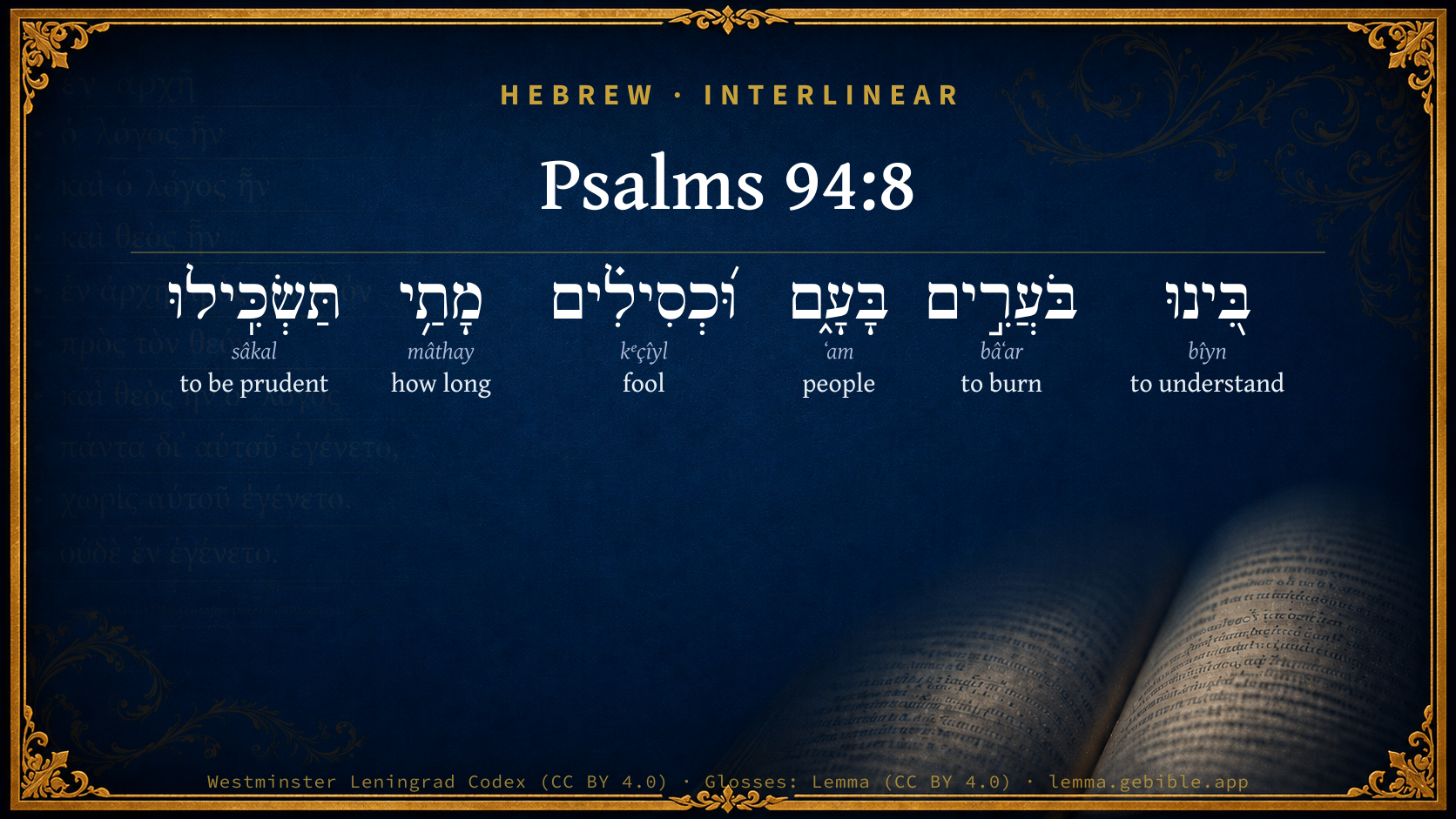
Psalms 94:8

Hebrew (Westminster Leningrad Codex) Psalms 94:8 appears in the Hebrew Old Testament. The text above is from the Westminster Leningrad Codex. Each word links to its Strong’s number, a concise gloss, and parsing drawn from the Open Scriptures Hebrew Bible morphology. Click any word for its full Brown-Driver-Briggs (BDB) entry.
Download image
Cite this verse

Psalms 94:8 (World English Bible). Public Domain. Lemma interlinear Bible study tool, https://lemma.gebible.app/v/psalms/94/8.

Show BibTeX & RIS
BibTeX
RIS
English Translation
Consider, you senseless among the people; You fools, when will you be wise?
World English Bible · Public Domain
Download a study sheet

One document with this verse’s original text, its word-by-word gloss line, the meaning frame, cross-references with their text, attributed commentary, and full source and license credits — printable, and it pastes into notes with its structure intact.

This verse Autodidact and up

Study sheet (.html) Plain text (.txt)

A passage Seminary Student

Up to 50 verses in one chapter. A passage sheet keeps up to 6 commentary sources and 12 cross-references per verse, in the order this page ranks them, and says so on the sheet whenever that leaves anything out. Ask for a single verse and you get the Autodidact verse sheet above.

Everything on this page stays free to read, with no account — the sheet is a download of what is already on screen, not access to it.

Want to remove ads? Support Godless Engineer
Compare translations 3

The same verse in 3 English versions, stacked beneath the original-language interlinear above. Click any original word for its lexicon entry.

Each is an independent rendering of the whole verse — the interlinear is not word-aligned to these translations.

Highlighted words mark where these versions differ — a whole-verse word diff, not a word-by-word alignment.

  • World English Bible Public Domain
    Consider, you senseless among the people; You fools, when will you be wise?
  • King James Version Public Domain
    Understand, ye brutish among the people: and ye fools, when will ye be wise?
  • unfoldingWord Literal Text CC BY-SA 4.0
    Understand, stupid ones among the people! O fools, when will you have insight?

unfoldingWord Literal Text — © unfoldingWord, licensed CC BY-SA 4.0. Word-aligned USFM3 via Door43 (git.door43.org/unfoldingWord/en_ult).

Versions to compare (up to 4)

3 of 4 selected

Show all 18 translations

Every available English version of this verse, each an independent rendering of the whole verse.

  • World English Bible Public Domain
    Consider, you senseless among the people; You fools, when will you be wise?
  • Berean Standard Bible Public Domain
    Take notice, O senseless among the people! O fools, when will you be wise?
  • Majority Standard Bible Public Domain
    Take notice, O senseless among the people! O fools, when will you be wise?
  • King James Version Public Domain
    Understand, ye brutish among the people: and ye fools, when will ye be wise?
  • American Standard Version (1901) Public Domain
    Consider, ye brutish among the people; And ye fools, when will ye be wise?
  • Revised Version (1885) Public Domain
    Consider, ye brutish among the people: and ye fools, when will ye be wise?
  • Geneva Bible (1599) Public Domain
    Vnderstande ye vnwise among the people: and ye fooles, when will ye be wise?
  • Douay-Rheims (1899) Public Domain
    Understand, ye senseless among the people: and, you fools, be wise at last.
  • Young's Literal Translation Public Domain
    Consider, ye brutish among the people, And ye foolish, when do ye act wisely?
  • Literal Standard Version CC BY-SA 4.0
    Consider, you brutish among the people, || And you foolish, when do you act wisely?
  • Unlocked Literal Bible CC BY-SA 4.0
    Understand, you stupid people! You fools, when will you ever learn?
  • unfoldingWord Literal Text CC BY-SA 4.0
    Understand, stupid ones among the people! O fools, when will you have insight?
  • Darby Bible Public Domain
    Understand, ye brutish among the people; and ye fools, when will ye be wise?
  • World Messianic Bible Public Domain
    Consider, you senseless among the people; you fools, when will you be wise?
  • Webster's Bible Public Domain
    Understand, ye brutish among the people: and ye fools, when will ye be wise?
  • Free Bible Version CC BY-SA 4.0
    Take another look, you stupid people! Fools—when will you ever get the point?
  • Bible in Basic English Public Domain
    Give your mind to my words, you who are without wisdom among the people; you foolish men, when will you be wise?
  • JPS Tanakh (1917) Public Domain
    Consider, ye brutish among the people; and ye fools, when will ye understand?

Literal Standard Version (2020), Covenant Press — licensed CC BY-SA 4.0. Text via the HelloAO Bible API (eBible.org). Unlocked Literal Bible (unfoldingWord) — licensed CC BY-SA 4.0. Text via the HelloAO Bible API (eBible.org). unfoldingWord Literal Text — © unfoldingWord, licensed CC BY-SA 4.0. Word-aligned USFM3 via Door43 (git.door43.org/unfoldingWord/en_ult). Free Bible Version, Dr. Jonathan Gallagher — licensed CC BY-SA 4.0. Text via the HelloAO Bible API (eBible.org).

Word by word

More ways to search: Search by grammar → Find every occurrence → Compare this word →

Practice this passage: Drill this verse → Learn its vocabulary →

About this verse

These counts appear in no published source. They are computed here, from the morphology-tagged text and Lemma’s own curated glosses. What Lemma adds →

6
words
6
distinct lemmas
Wisdom
section

Shared distinctive vocabulary

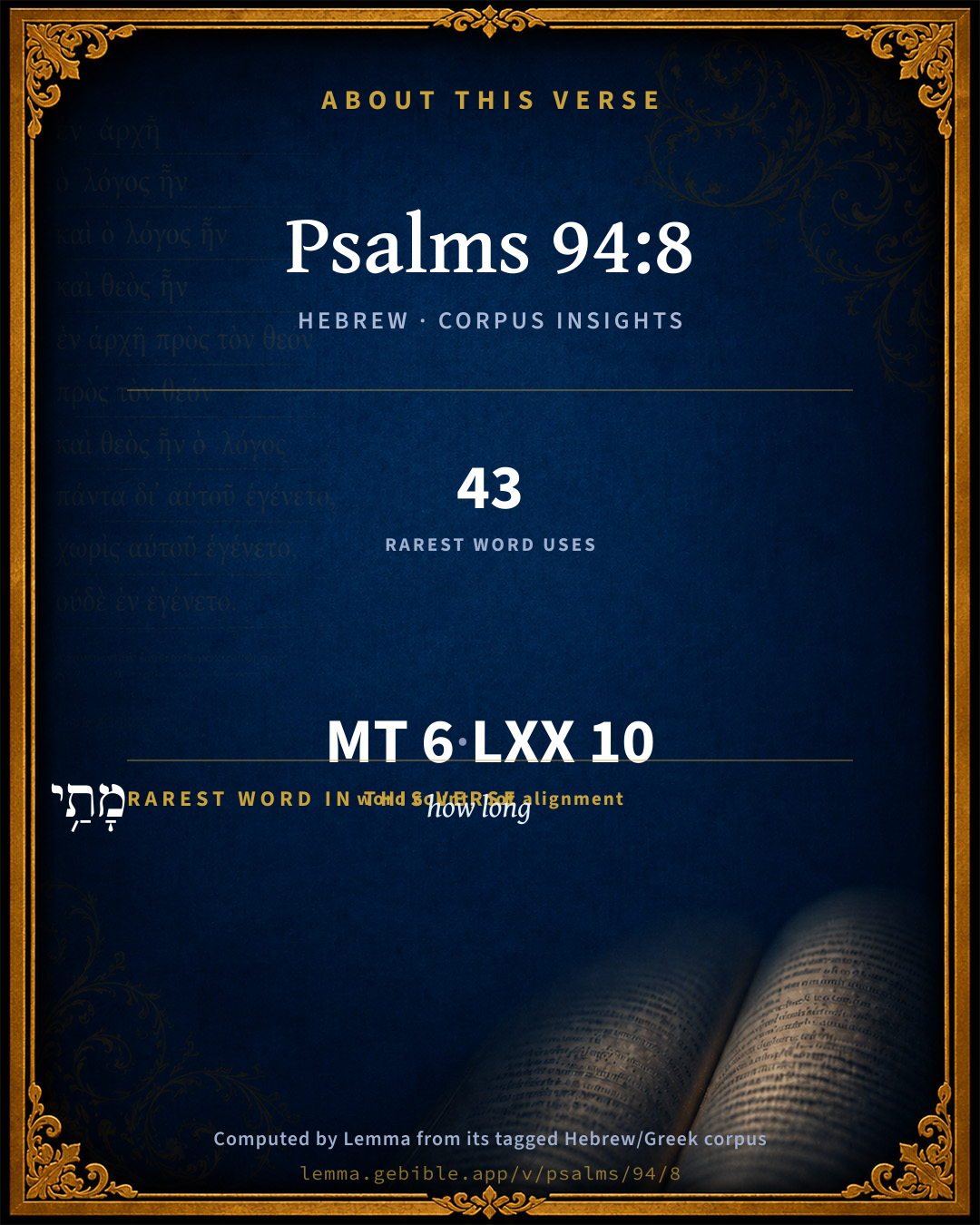
מָתַ֥י how long H4970 occurs in 40 verses of the Hebrew Bible. Also found in:

Grammatical profile

  • 3 verbs
  • 1 noun
  • 1 adjective
  • 1 particle

Verb forms

  • בִּ֭ינוּ Qal · Imperative
  • בֹּעֲרִ֣ים Qal · Participle Active
  • תַּשְׂכִּֽילוּ Hiphil · Imperfect

Hebrew & Septuagint length

In English translation the verse runs 13 words from the Hebrew and 14 from the Septuagint (LXX English) — closely comparable.

A rough comparison of the two English renderings, which tokenize alike — not a word-level alignment.

Word counts can differ between the Hebrew and the Greek without any difference in meaning — e.g. the Hebrew direct-object marker אֵת has no separate Greek word, and Greek often adds the article ὁ.

In the original languages it is 6 Hebrew tokens and 10 Greek tokens — but the two are counted differently (Hebrew bundles its prefixes and suffixes into one token; the Greek is in lemma form), so that isn’t a like-for-like length.

Cross-references

12

Topical passages linked to Psalms 94:8 in the Treasury of Scripture Knowledge — connected by theme and wording, ordered by reader-vote popularity; previews shown in the World English Bible.

  • Psalms 92:6 A senseless man doesn't know, Neither does a fool understand this:
  • Titus 3:3 For we were also once foolish, disobedient, deceived, serving various lusts and pleasures, living in malice and envy, hateful, and hating one another.
  • Psalms 49:10 For he sees that wise men die; Likewise the fool and the senseless perish, And leave their wealth to others.
  • Deuteronomy 32:29 Oh that they were wise, that they understood this, That they would consider their latter end!
  • Proverbs 12:1 Whoever loves correction loves knowledge, But he who hates reproof is stupid.
  • Isaiah 27:11 When the boughs of it are withered, they shall be broken off; the women shall come, and set them on fire; for it is a people of no understanding: therefore he who made them will not have compassion on them, and he who formed them will show them no favor.
  • Romans 3:11 There is no one who understands. There is no one who seeks after God.
  • Psalms 73:22 I was so senseless and ignorant. I was a brute beast before you.
  • Proverbs 8:5 You simple, understand prudence. You fools, be of an understanding heart.
  • Jeremiah 8:6–8 I listened and heard, but they didn't speak aright: no man repents him of his wickedness, saying, What have I done? everyone turns to his course, as a horse that rushes headlong in the battle.
  • Jeremiah 10:8 But they are together brutish and foolish: the instruction of idols! it is but a stock.
  • Proverbs 1:22 "How long, you simple ones, will you love simplicity? How long will mockers delight themselves in mockery, And fools hate knowledge?

Cross-references courtesy of OpenBible.info (CC BY 4.0).

Hebrew and Greek witnesses Masoretic Hebrew ↔ Greek Septuagint

The same verse in the two great witnesses to the Old Testament, shown verse-for-verse.

You’re reading Greek Psalm 93 (Hebrew Psalm 94). The Septuagint counts the superscription, so verse numbers can differ from the Hebrew — chapter-level alignment, not verse-by-verse. Numbering follows Rahlfs.

These are two independent witnesses, not word-aligned to each other, and the Septuagint is shown in lemma (dictionary) form.

Hebrew Psalms 94:8 Masoretic · Westminster Leningrad Codex

בִּ֭ינוּ בֹּעֲרִ֣ים בָּעָ֑ם וּ֝כְסִילִ֗ים מָתַ֥י תַּשְׂכִּֽילוּ

Consider, you senseless among the people; You fools, when will you be wise?

World English Bible · Public Domain

Greek LXX Greek Psalm 93:8 Septuagint · lemma form

συνἵημι δή ἄφρων ἐν ὁ λαός καί μωρός ποτέ φρονέω

Understand now, you⌃ simple among the people; and you⌃ fools, at length be wise.

LXX2012 (modern English Septuagint) · Public Domain

On this verse, Keil & Delitzsch discusses the Septuagint’s reading. Read the note in Commentary ↓

Hebrew: Westminster Leningrad Codex (CC BY 4.0). Greek: Septuagint (public domain); English from LXX2012 (modern English Septuagint) (Public Domain). How the Septuagint differs from the Hebrew →

Commentary

Notes on Psalms 94:8 from classic Christian and Jewish commentators (each source and its license shown beneath its notes). The classic Christian expositions comment on the surrounding passage and are grouped to its opening verse, so a note may address several verses; the Jewish commentaries on the Tanakh (Rashi and others) are per-verse, so they appear only where the commentator wrote on this verse.

Lemma curates 59 commentaries, every one of them public domain or Creative Commons licensed, each selected and text-cleaned for this edition rather than reprinted as found. About our sources →

Trapp's Complete Commentary

John Trapp

Psa 94:8 Understand, ye brutish among the people: and [ye] fools, when will ye be wise?

Ver. 8. Understand, ye brutish] Ye that are ringleaders to the rest, but no wiser than the reasonless creatures; yea, therefore worse, because ye ought to be better. Polybius complaineth of man’s folly, above that of other creatures, in those words, Caeterae animantes ubi semel offenderint, cavent; non vulpes ad laqueum, lupus ad foveam, cants ad fustem temere redibunt; Solus homo ab aeve ad aevum peccat fere in iisdem.

John Trapp, A Commentary or Exposition upon All the Books of the Old and New Testament (1647–1656) — public domain. Text from a community e-Sword module.

The Treasury of David

Charles H. Spurgeon

Ver. 8. Understand, ye brutish among the people. They said that God did not note, and now, using the same word in the original, the psalmist calls on the wicked to note, and have regard to the truth. He designates them as boors, boarish, swinish men, and well was the term deserved; and he bids them understand or consider, if they can. They thought themselves to be wise, and indeed the only men of wit in the world, but he calls them "boars among the people": wicked men are fools, and the more they know, the more foolish they become. "No fool like a learned fool" is a true proverb. When a man has done with God, he has done with his manhood, and has fallen to the level of the ox and the ass, yea, beneath them, for "the ox knoweth his owner, and the ass his master's crib." Instead of being humbled in the presence of scientific infidels, we ought to pity them; they affect to look clown upon us, but we have far more cause to look down upon them.

And ye fools, when will ye be wise? Is it not high time? Ye know the ways of folly, what profit have ye in them? Have ye no relics of reason left? no shreds of sense? If as yet there lingers in your minds a gleam of intelligence, hearken to argument, and consider the questions now about to be proposed to you.

Ver. 8-11. In these words the following particulars are to be observed. (1.) A certain spiritual disease charged on some persons, viz. darkness, and blindness of mind, appearing in their ignorance and folly. (2.) The great degree of this disease; so as to render the subjects of it fools. Ye fools, when will ye be wise? And so as to reduce them to a degree of brutishness. Ye brutish among the people. This ignorance and folly were to such a degree as to render men like beasts. (3.) The obstinacy of this disease; expressed in that interrogation, When will ye be wise? Their blindness and folly were not only very great, but deeply rooted and established, resisting all manner of cure. (4.) Of what nature this blindness is. It is especially in things pertaining to God. They were strangely ignorant of his perfections, like beasts: and had foolish notions of him, as though he did not see, nor know: and as though he would not execute justice, by chastising and punishing wicked men. (5.) The unreasonableness and sottishness of the notion they had of God, that he did not hear, did not observe their reproaches of him and his people, is shown by observing that he planted the ear. It is very unreasonable to suppose that he who gave power of perceiving words to others, should not perceive them himself. And the sottishness of their being insensible of God's all seeing eye, and particularly of his seeing their wicked actions, appears, in that God is the being who formed the eye, and gave others a power of seeing. The sottishness of their apprehension of God, as though he did not know what they did, is argued from his being the fountain and original of all knowledge. The unreasonableness of their expecting to escape God's just chastisement and judgments for sin, is set forth by his chastising even the heathen, who did not sin against that light, or against so great mercies, as the wicked in Israel did; nor had ever made such a profession as they. (6.) We may observe, that this dreadful disease is ascribed to mankind in general. The Lord knoweth the thoughts of MAN, that they are vanity. The psalmist had been setting forth the vanity and unreasonableness of the thoughts of some of the children of men; and immediately upon it he observes, that this vanity and foolishness of thought is common and natural to mankind. From these particulars we may fairly deduce the following doctrinal observation: That there is an extreme and brutish blindness in things of religion, which naturally possesses the hearts of mankind. Jonathan Edwards.

Ver. 8-15. God hath ability, bowels, verity. Ability, He that made the eye, cannot he see? He that planted the ear, cannot he hear? Ps 94:8-11.

Bowels, He doth but chasten his, not cast them off, Ps 94:12-14. Verity, this is but until a pit be made for the wicked, Ps 94:13. Mordecai is frowned upon, but till a gallows be made for Haman, and then judgment returns unto righteousness. Nicholas Lockyer.

Ver. 8. The duration of the reign of evil.

1. Till it has filled up its measure of guilt.

2. Till it has proved its own folly.

3. Till it has developed the graces and prayers of saints.

4. Till it has emptied man of all human trust and driven us to look to the Lord alone, his Spirit, and his advent.

Ver. 8. Practical Atheists.

1. Truly described.

2. Wisely counselled. C.A.D.

Ver. 8-11.

1. The Exhortation (Ps 94:8).

2. The Expostulation (Ps 94:9-10).

3. The Affirmation (Ps 94:11). G. R.

Psalms 94:9*

Charles H. Spurgeon's The Treasury of David (1869–1885) — public domain. Psalms only. Text from a community e-Sword/MySword module.

Joseph Benson's Commentary

Psa 94:8-9. Understand, ye brutish — Hebrew, בערים, bognarim; ye who are governed by your lusts and appetites, as the word signifies; who have only the shape, but not the understanding, reason, or judgment of men in you, or are not directed and governed thereby; who, though you think yourselves the wisest of men, yet, in truth, are the most brutish of all people; he that planted the ear — The word planted (Hebrew, נשׂע, notang) is very emphatical, signifying the excellent structure of the ear, or of the several organs belonging to the sense of hearing, and the wise position of all those parts in their proper places; shall he not hear? — He must necessarily hear. The truth of the inference depends upon that evident and undeniable principle in reason, that nothing can give to another that which it hath not either formally or more eminently in itself, and that no effect can exceed the virtue of its cause. He that formed the eye, &c. — By the word formed, (Hebrew, יצר, jotzer, concerning which see note on Gen 2:7,) he seems to intimate the accurate and most curious workmanship of the eye, which is observed by all who write on the subject.

Joseph Benson's Commentary on the Old and New Testaments (1811–1818) — public domain. Text from a community e-Sword module.

Whedon's Commentary on the Bible

Daniel D. Whedon

8. Understand, ye brutish among the people—The address in Psa_94:8-10 must be considered as applying to those Hebrews who inferred from the present calamity that God had ceased to take judicial notice of their sufferings, and had thus left them to their fate. See Jdg_6:13.

Brutish—Stupid, like cattle who have no reason, and are governed by selfish instinct and appetite.

Fools—Literally, Fat, heavy, phlegmatic, dull of apprehension, with the implied idea of impiety and disrelish for religion. The two words, (as in Psa_73:22,) denote a sensuous and irreligious person; the hardest to reach with spiritual truth.

Daniel D. Whedon (gen. ed.), Commentary on the Old and New Testaments (1874–1909) — public domain. Text from a community e-Sword module.

J. A. Alexander on Psalms

Joseph Addison Alexander

8. (Psa 94:8) Attend, ye brutish among the people; and ye fools, when will ye act wisely? See above, on Psa 73:22; Psa 92:6. The first verb is the same with that at the end of the preceding verse. It is stronger than the English word attend, implying in all cases an intelligent attention, so that it may be rendered, as it is by many, understand. The word translated brutish is a participle, denoting habitual conduct or a permanent condition. The question in the last clause is a virtual exhortation to being at once. The verb in this clause has its usual active meaning. See above, on Psa 2:10; Psa 14:2; Psa 41:1. In (or among) the people no doubt means in Israel itself, as in Jdg 5:9, where the form of expression is the same.

Joseph Addison Alexander, The Psalms Translated and Explained (1850) — public domain. Text from a community e-Sword module.

Tyndale Open Study Notes

Tyndale Open Resources

94:8-11 The psalmist rebukes human folly.

Tyndale Open Study Notes — © Tyndale Open Resources, licensed CC BY-SA 4.0. Text via the HelloAO Bible API.

Adam Clarke's Commentary

Verse 8. Understand, ye brutish] These are the same expressions as in Ps 92:6, on which see the note. See Clarke on Ps 92:6.

Adam Clarke's Commentary on the Bible (1810–1826) — public domain. Text from a community e-Sword/MySword module.

John Calvin's Commentaries

8 Understand, ye stupid among the people As it was execrable impiety to deny God to be Judge of the earth, the Psalmist severely reprimands their folly in thinking to elude his government, and even succeed by artifices in escaping his view. The expression, stupid among the people, is stronger than had he simply condemned them as foolish. It rendered their folly more inexcusable, that they belonged to the posterity of Abraham, of whom Moses said,

“What people is there so great, who have their gods so near unto them, as the Lord thy God hath this day come down unto thee? For this is your understanding and wisdom before all nations, to have God for your legislator.” (Deuteronomy 4:7)

Perhaps, however, he may be considered as addressing the rulers and those who were of higher rank in the community, and styling them degraded among the people, that is, no better than the common herd of the vulgar. Proud men, who are apt to be blinded by a sense of their importance, require to be brought down, and made to see that in God’s estimation they are no better than others. He puts them on a level with the common people, to humble their self-complacency; or we may suppose that he hints with an ironical and sarcastic allusion to their boasted greatness, that they were distinguished above others chiefly for pre-eminent folly — adding, at the same time, as an additional aggravation, that they were obstinate in their adherence to it; for as much is implied in the question, When will ye be wise? We might consider it an unnecessary assertion of Divine Providence to put the question to the wicked, Shall not he who made the ear hear? because there are none so abandoned as openly to deny God’s cognisance of events; but, as I have observed above, the flagrant audacity and self-security which most men display in contradicting his will, is a sufficient proof that they have supplanted God from their imaginations, and substituted a mere dead idol in his place, since, did they really believe him to be cognisant of their actions, they would at least show as much regard to him as to their fellow-creatures, in whose presence they feel some measure of restraint, and are prevented from sinning by fear and respect. To arouse them from this stupidity, the Psalmist draws an argument from the very order of nature, inferring that if men both see and hear, by virtue of faculties which they have received from God the Creator, it is impossible that God himself, who formed the eye and the ear, should not possess the most perfect observation.

John Calvin's Commentaries (1540-1563) — public domain. Text from the Calvin Translation Society English edition (1840s-50s) via the Christian Classics Ethereal Library (ccel.org). Calvin's coverage is partial (roughly two-thirds of the Bible); uncommented books and verses are honest gaps, never fabricated. The 19th-century editor's footnotes and remarks are omitted so the notes are faithfully Calvin's own voice.

Ellicott's Commentary for English Readers

(8-10) The reality of a Divine Providence is proved both from nature and history—from the physical constitution of man and the moral government of the world. The psalmist’s question is as powerful against modern atheism, under whatever philosophy it shelters itself, as against that of his day. Whatever the source of physical life or moral sense, their existence proves the prior existence of an original mind and will.

A Bible Commentary for English Readers, edited by Charles John Ellicott (1878–1897) — public domain. Text from a community e-Sword module.

The Cambridge Bible for Schools and Colleges

gen. ed. J. J. S. Perowne

8. Understand] Consider. Those Israelites are addressed who lack the spiritual discernment to realise that in spite of the temporary triumph of the wicked Jehovah still rules (Psa_92:6; Psa_73:22).

when will ye be wise?] When will ye understand? a word used of the intelligent consideration of God’s working in Psa_14:2; Psa_64:9; Psa_106:7.

8–11. From pleading with God the Psalmist turns to argue with those of his fellow-countrymen who are tempted to agree with their oppressors, and to think that Jehovah is wanting either in power or in will to defend them.

The Cambridge Bible for Schools and Colleges (gen. ed. J. J. S. Perowne; Cambridge University Press, 1878–1918) — public domain. Text from a community e-Sword module.

John Gill's Exposition

Understand, ye brutish among the people,.... Or the most brutish and stupid of all people; especially that profess themselves to be the people of God, or Christians, as the Papists do; and who seem to be the persons here addressed: "brutish"; to murder the servants of the Lord, and drink their blood, till inebriated with it; stupid to the last degree to think that hereby they did God good service: hence the pope, the head of them, is represented both in his secular and ecclesiastical power by two beasts; the one rising out of the sea with seven heads and ten horns, a monster in nature, most like a leopard, his feet as a bear's, and his mouth as a lion's, having the fierceness and cruelty of them all; and the other coming out of the earth with two horns like a lamb, but spake like a dragon, Rev 13:1, the exhortation to these brutish creatures supposes them to be without understanding, like the beasts by whom they are represented; or, however, that they did not make use of those intellectual powers which God had given them; had they, they would have learned more humanity to their fellow creatures, and more religion towards God; they would have known more of him than to have said and done what is before declared; wherefore they are called upon to "consider" (so the word (b) is sometimes rendered, Psa 50:22) the reasonings about it to be laid before them:

and ye fools, when will ye be wise? "fools" they are to worship stocks and stones, the images of the Virgin Mary, and other saints; to give into the gross atheism they do; to disbelieve the omniscience of God and his providence, at least to behave as though they did; and think to do the vilest actions with impunity; wherefore it would be their wisdom to relinquish such stupid notions, and do no more such foolish and wicked actions.

(b) "animadvertite", Junius & Tremellius, Piscator.

John Gill's Exposition of the Whole Bible (1746–1763) — public domain (CC PDM 1.0). Text via the HelloAO Bible API.

Albert Barnes' Notes on the Bible

Understand, ye brutish among the people - See Psa 73:22. The meaning here is, “You who are like the brutes; you who see and understand no more of the character and plans of God than the wild beasts of the desert.” The meaning is, that they did not employ their reason in the case; they acted like beasts, regardless of the consequences of their conduct - as if God would treat people as he does the beasts; as if there were no retribution in the future world.

And ye fools, when will ye be wise? - How long is this stupidity to continue? When will you attend to the truth; when will you act as immortal beings; when will you suffer your rational nature to lead you up to just views of God? It is implied that this folly had been manifested for a long period, and that it was time they should arouse from this condition, and act like people. With what propriety may this language be addressed still to the great mass of mankind! What numbers of the human race are there now, who in respect to God, and to the purpose for which they were made, evince no more wisdom than the brutes that perish! Oh, if people were truly wise, what a beautiful world would this be; how noble and elevated would be our now degraded race!

Albert Barnes' Notes on the Bible (1834–1885) — public domain. Text from a community e-Sword/MySword module.

Matthew Poole's English Annotations

You who, though you think yourselves the wisest of men, yet in truth are the most brutish of all people; for the Hebrews oft express their superlatives in this manner, as Pro 30:30; Son 1:8, &c. You that have only the shape, but not the understanding, of a man in you.

Matthew Poole's English Annotations on the Holy Bible (1683–1685) — public domain. Text from a community e-Sword/MySword module.

The Pulpit Commentary

Vers. 8-11. The appeal to Israel. The oppressors thought that their conduct would not be observed by God, or would not be taken into account. The psalmist appeals to them not to be so brutish and foolish (ver. 8), and argues, from the first principles of natural theology, that God must see and hear (ver. 9). If he chastises the heathen, why should he not also punish them (ver. 10)?

Understand, ye brutish among the people. (comp. Psa_92:6) That there were among God"s people some so "brutish" as to suppose that God either did not see or did not regard their misdoings, appears also from Psa_10:11, Psa_10:13. And ye fools, when will ye be wise? When will ye put away your folly, and allow Wisdom to enter into your hearts? She is always crying in the streets: when will ye consent to listen? (comp. Pro_1:20-23)

Vers. 8-10. An argument all should understand.

I ITS NATURE. It is an argument from what we see in ourselves to what exists in God. If God has given to us certain powers, such powers must exist in him.

II ITS FORCE. It is inconceivable that it should be otherwise. A man must have brutalized his soul, and become a fool, not to see this. God is not as man is the mere employer of force which he does not and cannot create, but he is behind all force, its Creator and Source.

III ITS SAFEGUARD.

1. For this argument needs guarding. If it be said that the presence of faculties in ourselves proves the existence of them in God, which is the argument in these verses, then might it not be said God is the author of the sin that is in us as well as the good, of that which is wrong as well as of that which is right? The heathen thought so, and hence they regarded their gods as altogether like themselves embodiments of not merely good qualities, but also of lust and hate and all abomination. The idea of a holy God they never knew. And sinful men now often say, "God made us so," and thus cast on him the responsibility for their sin. "He that planted in me the love of sin, doth he not love it too?" So they falsely reason.

2. But how must such wrong extension of the argument of these verses be met? By noting that man has not merely the powers of thought, feeling, will, but also of conscience. This last is the regal, the judicial faculty, and decides what is of God, and what is only the product of our corrupt nature. Apart from conscience, there could be no right or wrong, but it infallibly tells, by its "excusing and accusing," how far we may go in arguing from what we see in ourselves to what exists in God. Else a man might say, "He that made me to lust, shall he not lust?" The ancient Greeks and the whole heathen world did say this.

IV ITS MINGLED COMFORT AND WARNING.

1. As to the comfort this argument supplies.

(1) It shows that all our gifts are of God. "It is he that planted the ear," etc. (cf. Jam_1:16-18) As we think of the manifold advantages that come to us through these gifts of God, and what joy, can we fail to see the beneficence of our God?

(2) That they are reflections of God, mirrors, minute indeed, but yet true, of what he is. Therefore my thought tells of thought in him; my love, of his, my conscience, of moral judgment in him. It is our Lord"s argument. (Mat_7:9-11 Lu 15) But:

2. There is warning likewise. Against pride: "What hast thou that thou hast not received?" Against envy. We are as God willed us to be, and, if we be but obedient, equally well pleasing in his sight. Against trifling with sin. If we condemn it, and will to punish it if unrepented of, that condemnation and that will reveal what is yet more in God. They tell of judgment to come. S.C.

The Pulpit Commentary (1880–1919), ed. H.D.M. Spence-Jones & Joseph S. Exell — public domain. Text from a community e-Sword module.

Keil & Delitzsch

C. F. Keil & F. Delitzsch

The third strophe now turns from those bloodthirsty, blasphemous oppressors of the people of God whose conduct calls forth the vengeance of Jahve, to those among the people themselves, who have been puzzled about the omniscience and indirectly about the righteousness of God by the fact that this vengeance is delayed. They are called בערים and כסילים in the sense of Psa 73:21. Those hitherto described against whom God's vengeance is supplicated are this also; but this appellation would be too one-sided for them, and בּעם refers the address expressly to a class of men among the people whom those oppress and slay. It is absurd that God, the planter of the ear (הנּטע, like שׁסע in Lev 11:7, with an accented ultima, because the praet. Kal does not follow the rule for the drawing back of the accent called נסוג אחור) and the former of the eye (cf. Psa 40:7; Exo 4:11), should not be able to hear and to see; everything that is excellent in the creature, God must indeed possess in original, absolute perfection.

(Note: The questions are not: ought He to have no ear, etc.; as Jerome pertinently observes in opposition to the anthropomorphites, membra tulit, efficientias dedit.)

The poet then points to the extra-Israelitish world and calls God יסר גּוים, which cannot be made to refer to a warning by means of the voice of conscience; יסר used thus without any closer definition does not signify "warning," but "chastening" (Pro 9:7). Taking his stand upon facts like those in Job 12:23, the poet assumes the punitive judicial rule of God among the heathen to be an undeniable fact, and presents for consideration the question, whether He who chasteneth nations cannot and will not also punish the oppressors of His church (cf. Gen 18:25), He who teacheth men knowledge, i.e., He who nevertheless must be the omnipotent One, since all knowledge comes originally from Him? Jahve - thus does the course of argument close in Psa 94:11 - sees through (ידע of penetrative perceiving or knowing that goes to the very root of a matter) the thoughts of men that they are vanity. Thus it is to be interpreted, and not: for they (men) are vanity; for this ought to have been כּי הבל המּה, whereas in the dependent clause, when the predicate is not intended to be rendered especially prominent, as in Ps 9:21, the pronominal subject may precede, Isa 61:9; Jer 46:5 (Hitzig). The rendering of the lxx (Co1 3:20), ὅτι εἰσὶ μάταιοι (Jerome, quoniam vanae sunt), is therefore correct; המּה, with the customary want of exactness, stands for הנּה. It is true men themselves are הבל; it is not, however, on this account that He who sees through all things sees through their thoughts, but He sees through them in their sinful vanity.

Keil & Delitzsch — Biblical Commentary on the Old Testament (1861–1891) — public domain (CC PDM 1.0). Text via the HelloAO Bible API. (Old Testament only.)

unfoldingWord translationNotes

Door43 World Missions Community

General Information:

The writer now instructs the wicked people.

when will you ever learn?

This rhetorical question emphasizes the anger of the writer with the wicked people he is speaking to. This question can be translated as a statement. AT: "stop your foolish ways!" or "learn from your mistakes!" (See: Rhetorical Question)

He who made the ear, does he not hear? He who formed the eye, does he not see?

These rhetorical questions can be translated as statements or commands. AT: "God made ears, so he can hear. God made eyes, so he can see." or "God made ears, so stop acting as if he does not hear. God made eyes, so stop acting as if he does not see." (See: Rhetorical Question)

translationWords

people group

fool

unfoldingWord translationNotes — © Distant Shores Media and the Door43 World Missions Community, licensed CC BY-SA 4.0. Source: git.door43.org/Door43/en_tn.

Rashi

Rabbi Shlomo Yitzchaki (Rashi)

Understand, [you] most boorish of the people the most foolish peoples in the world.

Rashi on the Tanakh — English translations: “The Judaica Press complete Tanach with Rashi, translated by A. J. Rosenberg” (CC BY 4.0); “Pentateuch with Rashi's commentary by M. Rosenbaum and A.M. Silbermann, 1929-1934” (public domain); “The Metsudah Tanach series, Lakewood, N.J” (CC BY 4.0); and “The Book of Joshua, Metsudah Publications, 1997” (CC BY 4.0). Text via Sefaria.

Lesson kit

Teaching starters — assembled from the data on this page, not authored interpretation. Every prompt links to the verse data it draws on. Edit before teaching.

Psalms, in the Wisdom, opens this verse with 6 words (6 distinct Hebrew lemmas). Its most distinctive word is mâthay (“how long”). A historical commentator’s framing appears above. Read the whole chapter for the surrounding context.

Discussion questions

  1. How does “how long” (mâthay) shape what this verse is saying?
  2. How does Genesis 30:30, which shares the word «how long», read alongside this verse?
  3. These translations render this verse differently. What is at stake in choosing one wording over another?
  4. «בִּ֭ינוּ» is a Qal Imperative verb. How does that grammatical form shape the action described?
  5. Compare how Trapp's Complete Commentary and The Treasury of David read this verse. Where do they agree or differ?

Things to notice

Reading settings

Reading text

Shown beneath each verse's original-language words.

Old Testament
Old Testament edition

Read the OT as the Masoretic Hebrew (MT) or the Greek Septuagint (LXX).

English shown for the Greek Septuagint (in the Hebrew ↔ Greek comparison).

Comparing translations? Open the Compare panel on any verse page to stack up to four side by side.