Psalms 82:5

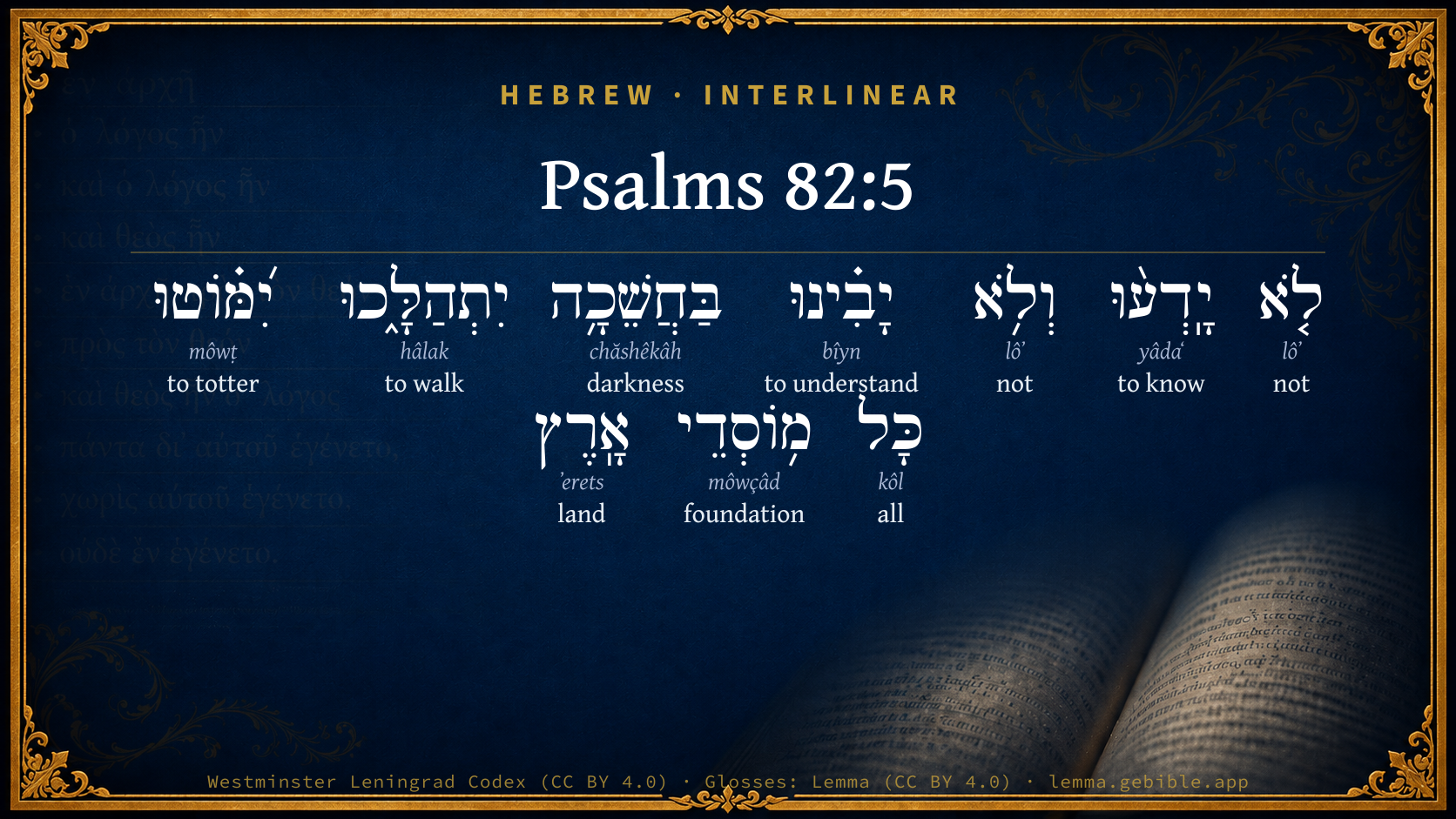
Hebrew (Westminster Leningrad Codex) Psalms 82:5 appears in the Hebrew Old Testament. The text above is from the Westminster Leningrad Codex. Each word links to its Strong’s number, a concise gloss, and parsing drawn from the Open Scriptures Hebrew Bible morphology. Click any word for its full Brown-Driver-Briggs (BDB) entry.
Download image
Cite this verse

Psalms 82:5 (World English Bible). Public Domain. Lemma interlinear Bible study tool, https://lemma.gebible.app/v/psalms/82/5.

Show BibTeX & RIS
BibTeX
RIS
English Translation
They don't know, neither do they understand. They walk back and forth in darkness. All the foundations of the earth are shaken.
World English Bible · Public Domain
Highlights
  • 1 first appearance in the Hebrew Bible
Full analysis ↓
Download a study sheet

One document with this verse’s original text, its word-by-word gloss line, the meaning frame, cross-references with their text, attributed commentary, and full source and license credits — printable, and it pastes into notes with its structure intact.

This verse Autodidact and up

Study sheet (.html) Plain text (.txt)

A passage Seminary Student

Up to 50 verses in one chapter. A passage sheet keeps up to 6 commentary sources and 12 cross-references per verse, in the order this page ranks them, and says so on the sheet whenever that leaves anything out. Ask for a single verse and you get the Autodidact verse sheet above.

Everything on this page stays free to read, with no account — the sheet is a download of what is already on screen, not access to it.

Want to remove ads? Support Godless Engineer
Compare translations 3

The same verse in 3 English versions, stacked beneath the original-language interlinear above. Click any original word for its lexicon entry.

Each is an independent rendering of the whole verse — the interlinear is not word-aligned to these translations.

Highlighted words mark where these versions differ — a whole-verse word diff, not a word-by-word alignment.

  • World English Bible Public Domain
    They don't know, neither do they understand. They walk back and forth in darkness. All the foundations of the earth are shaken.
  • King James Version Public Domain
    They know not, neither will they understand; they walk on in darkness: all the foundations of the earth are out of course.
  • unfoldingWord Literal Text CC BY-SA 4.0
    They do not know and they do not understand; they walk about in darkness. All of the foundations of the earth are shaken.

unfoldingWord Literal Text — © unfoldingWord, licensed CC BY-SA 4.0. Word-aligned USFM3 via Door43 (git.door43.org/unfoldingWord/en_ult).

Versions to compare (up to 4)

3 of 4 selected

Show all 18 translations

Every available English version of this verse, each an independent rendering of the whole verse.

  • World English Bible Public Domain
    They don't know, neither do they understand. They walk back and forth in darkness. All the foundations of the earth are shaken.
  • Berean Standard Bible Public Domain
    They do not know or understand; they wander in the darkness; all the foundations of the earth are shaken.
  • Majority Standard Bible Public Domain
    They do not know or understand; they wander in the darkness; all the foundations of the earth are shaken.
  • King James Version Public Domain
    They know not, neither will they understand; they walk on in darkness: all the foundations of the earth are out of course.
  • American Standard Version (1901) Public Domain
    They know not, neither do they understand; They walk to and fro in darkness: All the foundations of the earth are shaken.
  • Revised Version (1885) Public Domain
    They know not, neither do they understand; they walk to and fro in darkness: all the foundations of the earth are moved.
  • Geneva Bible (1599) Public Domain
    They knowe not and vnderstand nothing: they walke in darkenes, albeit all the foundations of the earth be mooued.
  • Douay-Rheims (1899) Public Domain
    They have not known nor understood: they walk on in darkness: all the foundations of the earth shall be moved.
  • Young's Literal Translation Public Domain
    They knew not, nor do they understand, In darkness they walk habitually, Moved are all the foundations of earth.
  • Literal Standard Version CC BY-SA 4.0
    They did not know, nor do they understand, || They habitually walk in darkness, || All the foundations of earth are moved.
  • Unlocked Literal Bible CC BY-SA 4.0
    They neither know nor understand; they wander around in the darkness; all the foundations of the earth crumble.
  • unfoldingWord Literal Text CC BY-SA 4.0
    They do not know and they do not understand; they walk about in darkness. All of the foundations of the earth are shaken.
  • Darby Bible Public Domain
    They know not, neither do they understand; they walk on in darkness: all the foundations of the earth are moved.
  • World Messianic Bible Public Domain
    They don’t know, neither do they understand. They walk back and forth in darkness. All the foundations of the earth are shaken.
  • Webster's Bible Public Domain
    They know not, neither will they understand; they walk on in darkness: all the foundations of the earth are out of course.
  • Free Bible Version CC BY-SA 4.0
    They don't have any wisdom; they live in the dark; the foundations of the earth are shaken.
  • Bible in Basic English Public Domain
    They have no knowledge or sense; they go about in the dark: all the bases of the earth are moved.
  • JPS Tanakh (1917) Public Domain
    They know not, neither do they understand; they go about in darkness; all the foundations of the earth are moved.

Literal Standard Version (2020), Covenant Press — licensed CC BY-SA 4.0. Text via the HelloAO Bible API (eBible.org). Unlocked Literal Bible (unfoldingWord) — licensed CC BY-SA 4.0. Text via the HelloAO Bible API (eBible.org). unfoldingWord Literal Text — © unfoldingWord, licensed CC BY-SA 4.0. Word-aligned USFM3 via Door43 (git.door43.org/unfoldingWord/en_ult). Free Bible Version, Dr. Jonathan Gallagher — licensed CC BY-SA 4.0. Text via the HelloAO Bible API (eBible.org).

Word by word

More ways to search: Search by grammar → Find every occurrence → Compare this word →

Practice this passage: Drill this verse → Learn its vocabulary →

About this verse

These counts appear in no published source. They are computed here, from the morphology-tagged text and Lemma’s own curated glosses. What Lemma adds →

10
words
9
distinct lemmas
Wisdom
section

Notable vocabulary

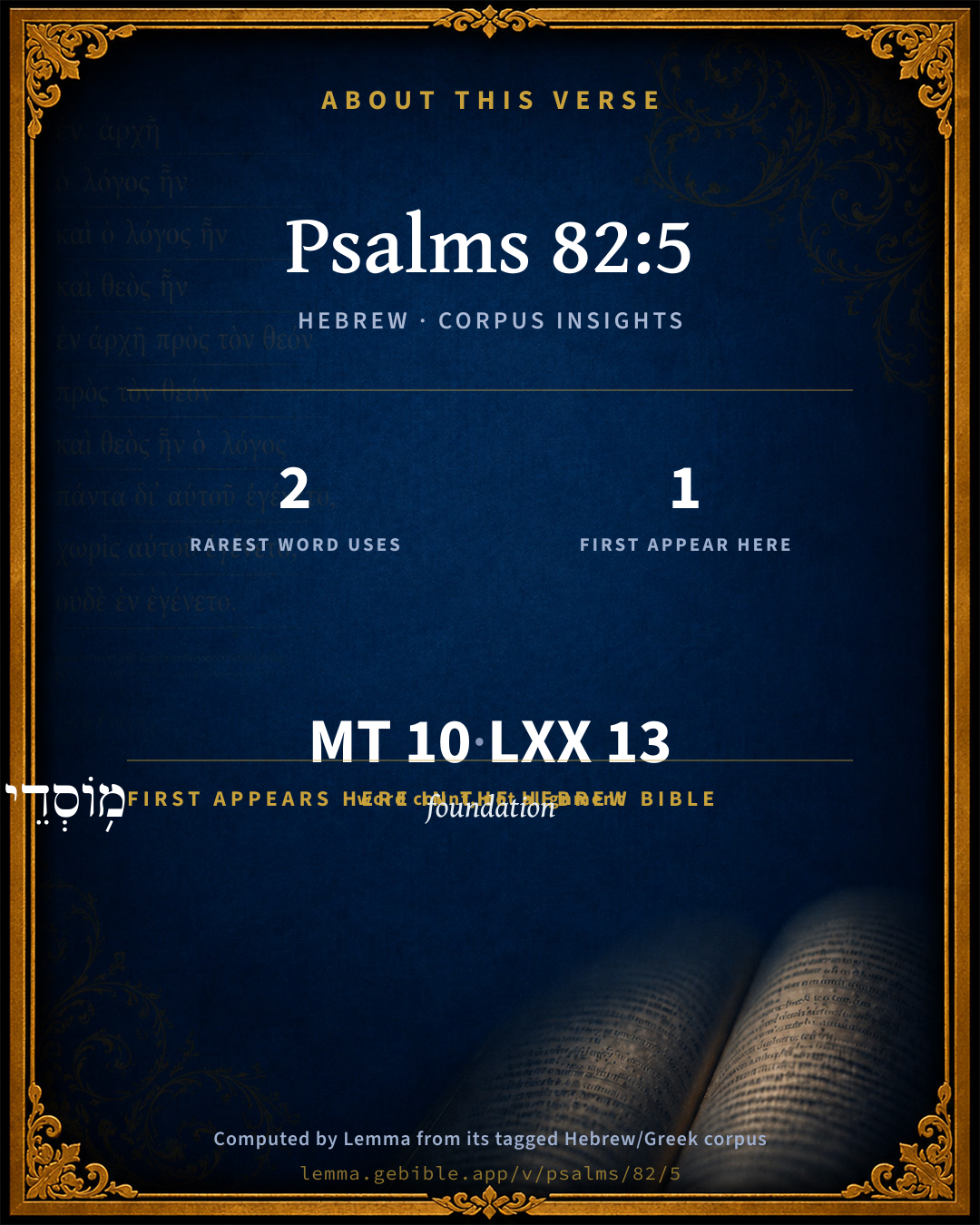
The rarest word here is מ֥וֹסְדֵי foundation H4144 — appearing just 2 times in the whole Hebrew Bible.

First appearance in Scripture

This word makes its first canonical appearance in the Hebrew Bible here:

  • מ֥וֹסְדֵי foundation H4144

Shared distinctive vocabulary

מ֥וֹסְדֵי foundation H4144 occurs in 2 verses of the Hebrew Bible. Also found in:

Grammatical profile

  • 4 verbs
  • 4 nouns
  • 2 particles

Verb forms

  • יָֽדְע֨וּ Qal · Perfect
  • יָבִ֗ינוּ Qal · Imperfect
  • יִתְהַלָּ֑כוּ Hithpael · Imperfect
  • יִ֝מּ֗וֹטוּ Niphal · Imperfect

Repetition

A word recurs within this verse — often emphatic in Hebrew:

Hebrew & Septuagint length

In English translation the verse runs 22 words from the Hebrew and 19 from the Septuagint (LXX English) — closely comparable.

A rough comparison of the two English renderings, which tokenize alike — not a word-level alignment.

Word counts can differ between the Hebrew and the Greek without any difference in meaning — e.g. the Hebrew direct-object marker אֵת has no separate Greek word, and Greek often adds the article ὁ.

In the original languages it is 10 Hebrew tokens and 13 Greek tokens — but the two are counted differently (Hebrew bundles its prefixes and suffixes into one token; the Greek is in lemma form), so that isn’t a like-for-like length.

Cross-references

17

Topical passages linked to Psalms 82:5 in the Treasury of Scripture Knowledge — connected by theme and wording, ordered by reader-vote popularity; previews shown in the World English Bible.

  • Psalms 11:3 If the foundations are destroyed, What can the righteous do?
  • Proverbs 2:13 Who forsake the paths of uprightness, To walk in the ways of darkness;
  • Micah 3:1 I said, "Please listen, you heads of Jacob, And rulers of the house of Israel: Isn't it for you to know justice?
  • Romans 1:28 Even as they refused to have God in their knowledge, God gave them up to a reprobate mind, to do those things which are not fitting;
  • Psalms 14:4 Have all the workers of iniquity no knowledge, Who eat up my people as they eat bread, And don't call on Yahweh?
  • Proverbs 1:29 Because they hated knowledge, And didn't choose the fear of Yahweh.
  • John 12:35 Jesus therefore said to them, "Yet a little while the light is with you. Walk while you have the light, that darkness doesn't overtake you. He who walks in the darkness doesn't know where he is going.
  • 1 John 2:11 But he who hates his brother is in the darkness, and walks in the darkness, and doesn't know where he is going, because the darkness has blinded his eyes.
  • Psalms 53:4 Have the workers of iniquity no knowledge, Who eat up my people as they eat bread, And don't call on God?
  • Psalms 75:3 The earth and all its inhabitants quake. I firmly hold its pillars. Selah.
  • Isaiah 5:7 For the vineyard of Yahweh of Hosts is the house of Israel, And the men of Judah his pleasant plant: And he looked for justice, but, behold, oppression; For righteousness, but, behold, a cry of distress.
  • Isaiah 59:9 Therefore is justice far from us, neither does righteousness overtake us: we look for light, but, behold, darkness; for brightness, but we walk in obscurity.
  • John 3:19 This is the judgment, that the light has come into the world, and men loved the darkness rather than the light; for their works were evil.
  • 2 Timothy 2:19 However God's firm foundation stands, having this seal, "The Lord knows those who are his," and, "Let every one who names the name of the Lord depart from unrighteousness."
  • Proverbs 4:19 The way of the wicked is like darkness. They don't know what they stumble over.
  • Ecclesiastes 2:14 The wise man's eyes are in his head, and the fool walks in darkness--and yet I perceived that one event happens to them all.
  • Ecclesiastes 3:16 Moreover I saw under the sun, in the place of justice, that wickedness was there; and in the place of righteousness, that wickedness was there.

Cross-references courtesy of OpenBible.info (CC BY 4.0).

Hebrew and Greek witnesses Masoretic Hebrew ↔ Greek Septuagint

The same verse in the two great witnesses to the Old Testament, shown verse-for-verse.

You’re reading Greek Psalm 81 (Hebrew Psalm 82). The Septuagint counts the superscription, so verse numbers can differ from the Hebrew — chapter-level alignment, not verse-by-verse. Numbering follows Rahlfs.

These are two independent witnesses, not word-aligned to each other, and the Septuagint is shown in lemma (dictionary) form.

Hebrew Psalms 82:5 Masoretic · Westminster Leningrad Codex

לֹ֤א יָֽדְע֨וּ וְלֹ֥א יָבִ֗ינוּ בַּחֲשֵׁכָ֥ה יִתְהַלָּ֑כוּ יִ֝מּ֗וֹטוּ כָּל מ֥וֹסְדֵי אָֽרֶץ

They don't know, neither do they understand. They walk back and forth in darkness. All the foundations of the earth are shaken.

World English Bible · Public Domain

Greek LXX Greek Psalm 81:5 Septuagint · lemma form

οὐ γιγνώσκω οὐδέ συνἵημι ἐν σκότος διαπορεύομαι σαλεύω πᾶς ὁ θεμέλιον ὁ γῆ

They know not, nor understand; they walk on in darkness: all the foundations of the earth shall be shaken.

LXX2012 (modern English Septuagint) · Public Domain

Hebrew: Westminster Leningrad Codex (CC BY 4.0). Greek: Septuagint (public domain); English from LXX2012 (modern English Septuagint) (Public Domain). How the Septuagint differs from the Hebrew →

Commentary

Notes on Psalms 82:5 from classic Christian and Jewish commentators (each source and its license shown beneath its notes). The classic Christian expositions comment on the surrounding passage and are grouped to its opening verse, so a note may address several verses; the Jewish commentaries on the Tanakh (Rashi and others) are per-verse, so they appear only where the commentator wrote on this verse.

Lemma curates 59 commentaries, every one of them public domain or Creative Commons licensed, each selected and text-cleaned for this edition rather than reprinted as found. About our sources →

Trapp's Complete Commentary

John Trapp

Psa 82:5 They know not, neither will they understand; they walk on in darkness: all the foundations of the earth are out of course.

Ver. 5. They know not, neither will they understand] q.d. There is no good to be done upon these uncircumcised vice gods, as they may in the worst sense be best styled; it is bootless to advise them to better, for they are set; they are as good every whit as ever they mean to be; and as for their duty, nec cogitant, nec curant, they neither know it nor care to know it, but blunder on in the dark, and are led blindling by their base lusts, which so they may satisfy, they pass not what becomes of the weal public, but oppose with crest and breast whatsoever crosseth their sinful designs. Hereby they cause mighty concussions, and draw down heavy judgments, Isa 24:18-19. Pessimi dantur, et ruunt omnia.

John Trapp, A Commentary or Exposition upon All the Books of the Old and New Testament (1647–1656) — public domain. Text from a community e-Sword module.

The Biblical Illustrator

Joseph S. Exell

Psa_82:5

All the foundations of the earth are out of course,

The radical wrongness of the world

I.

The foundation of mauve individual character is out of course. The true foundation of mans character implies the supremacy of the Divine over the human, the spiritual over the carnal. Instead of this, the character of mankind is generally organized on the principle that puts the carnal over the spiritual, the human over the Divine.

II. The foundation of mans social character is out of course. The true principle on which society should be formed is, Whatsoever ye would that men should do to you, do ye even so to them. Instead of this, alas! falsehood, fraud, cupidity, intensified selfishness, form the worlds platform of social action.

III. The foundation of mans political character is out of course. Righteousness is the only true and safe foundation of kingdoms. No human government can be safe or useful that aims not chiefly to develop the rights of men and to deal out justice to all. How often is it that the many are sacrificed to the few, the principles of rectitude for a miserable expediency.

IV. The foundation of mans religious character is out of course. Supreme sympathy with the supremely good is the foundation of all true religion. Instead of which, as a rule, the religions of the world,--even the religion of England,--are based on dogmas, or ceremonies, or on mawkish sentiment. (Homilist.)

The Biblical Illustrator, edited by Joseph S. Exell (c. 1880s–1900s) — public domain. Text from a community e-Sword module.

Joseph Benson's Commentary

Psa 82:5. They know not — That is, the magistrates, of whom this Psalm treats, are not acquainted with, and will not be at the pains to learn the truth and right of the causes which come before them, nor the duty of their place. Neither will they understand — This their ignorance is wilful and affected: they will not search out the truth, and they shut their eyes lest they should see what they do not love to see. They walk on — They persist and proceed: it is not one rash and transient action, but their constant course; in darkness — In ignorance, or in their sinful and unrighteous courses; being blinded by their corrupt affections and interests. All the foundations of the earth are out of course — This corruption of the supreme rulers flows from them to their inferior officers and members, and manifestly tends to the dissolution of all civil societies, partly by subverting that order and honesty by which they are supported, and partly by provoking God, the governor of the world, to destroy them for their wickedness. Green translates this verse, They are ignorant of their duty, and will not attend to it; but go on in the dark; all the foundations of the land are in a tottering state. The general meaning is, “Those that should rule the several nations of the earth uprightly, and preserve justice among men, are themselves the most unjust, and thereby the authors of all mischief to the world.” Respecting the word foundations, see on Psa 11:3.

Joseph Benson's Commentary on the Old and New Testaments (1811–1818) — public domain. Text from a community e-Sword module.

Whedon's Commentary on the Bible

Daniel D. Whedon

5. They know not— “The judges are ignorant of their duty.”—Ainsworth. They consider not the high dignity of their office, the fundamental laws of the theocracy, and that the existence of the nation depends on their fidelity. For more than sixty years, since the death of Solomon, the government had declined fearfully. We must understand God as still speaking to the judges, and Psa_82:5 refers to such as are described Psa_82:2, and will not practise the injunctions of Psa_82:3-4. Compare Mic_3:1 : “And I said,… O… ye princes of the house of Israel, is it not for you to know judgment.”

All the foundations of the earth are out of course—The principles of just government are the pillars of society, and when they are perverted by corrupt and ambitious rulers the foundations of the social fabric are shaken, and must fall. The figure is that of an earthquake shaking and heaving the solid earth, and demolishing human habitations. Compare note on Psa_75:3

Daniel D. Whedon (gen. ed.), Commentary on the Old and New Testaments (1874–1909) — public domain. Text from a community e-Sword module.

Keil & Delitzsch

C. F. Keil & F. Delitzsch

What now follows in Psa 82:5 is not a parenthetical assertion of the inefficiency with which the divine correction rebounds from the judges and rulers. In connection with this way of taking Psa 82:5, the manner in which the divine language is continued in Psa 82:6 is harsh and unadjusted. God Himself speaks in Psa 82:5 of the judges, but reluctantly alienated from them; and confident of the futility of all attempts to make them better, He tells them their sentence in Psa 82:6. The verbs in Psa 82:5 are designedly without any object: complaint of the widest compass is made over their want of reason and understanding; and ידעו takes the perfect form in like manner to ἐγνώκασι, noverunt, cf. Psa 14:1; Isa 44:18. Thus, then, no result is to be expected from the divine admonition: they still go their ways in this state of mental darkness, and that, as the Hithpa. implies, stalking on in carnal security and self-complacency. The commands, however, which they transgress are the foundations (cf. Psa 11:3), as it were the shafts and pillars (Psa 75:4, cf. Pro 29:4), upon which rests the permanence of all earthly relationships with are appointed by creation and regulated by the Tτra. Their transgression makes the land, the earth, to totter physically and morally, and is the prelude of its overthrow. When the celestial Lord of the domain thinks upon this destruction which injustice and tyranny are bringing upon the earth, His wrath kindles, and He reminds the judges and rulers that it is His own free declaratory act which has clothed them with the god-like dignity which they bear. They are actually elohim, but not possessed of the right of self-government; there is a Most High (עליון) to whom they as sons are responsible. The idea that the appellation elohim, which they have given to themselves, is only sarcastically given back to them in Psa 82:1 (Ewald, Olshausen), is refuted by Psa 82:6, according to which they are really elohim by the grace of God. But if their practice is not an Amen to this name, then they shall be divested of the majesty which they have forfeited; they shall be divested of the prerogative of Israel, whose vocation and destiny they have belied. They shall die off כּאדם, like common men not rising in any degree above the mass (cf. בּני אדם, opp. בּני אישׁ, Psa 4:3; Psa 49:3); they shall fall like any one (Jdg 16:7, Oba 1:11) of the princes who in the course of history have been cast down by the judgment of God (Hos 7:7). Their divine office will not protect them. For although justitia civilis is far from being the righteousness that avails before God, yet injustitia civilis is in His sight the vilest abomination.

Keil & Delitzsch — Biblical Commentary on the Old Testament (1861–1891) — public domain (CC PDM 1.0). Text via the HelloAO Bible API. (Old Testament only.)

J. A. Alexander on Psalms

Joseph Addison Alexander

5. (Psa 82:5) They know not and they will not understand; in darkness they will (still) walk; shaken are all the foundations of earth. This is the Lord's complaint of their incorrigible ignorance and indocility, which rendered even his divine instructions unavailing. The object of the first verbs is suggested by the context, as in Psa 14:4. What they did not know and would not understand was their judicial duty and responsibility, the end for which they were invested with authority. Darkness is a figure both for ignorance and wickedness. See Pro 2:13. The denial or perversion of justice is described as disorganising society. Compare the figures in Psa 11:3; Psa 75:3.

Joseph Addison Alexander, The Psalms Translated and Explained (1850) — public domain. Text from a community e-Sword module.

Tyndale Open Study Notes

Tyndale Open Resources

82:5 The unjust oppressors cannot bring or restore order. They wander about in darkness, unmoved by circumstances even when the whole world order falls apart around them (cp. 11:3).

Tyndale Open Study Notes — © Tyndale Open Resources, licensed CC BY-SA 4.0. Text via the HelloAO Bible API.

Geneva Bible (1599)

Geneva Bible translators

That is, all things are out of order either by their tyranny or careless negligence.

Geneva Bible (1599) marginal notes — public domain. Text via Bolls.life.

Adam Clarke's Commentary

Verse 5. They know not] The judges are not acquainted with the law of God, on which all their decisions should be founded.

Neither will they understand] They are ignorant and do not wish to be instructed. They will not learn; they cannot teach. Happy England! How different from Judea, even in the days of Jehoshaphat! All thy judges are learned, righteous, and impartial. Never did greater men in their profession dignify any land or country. - (1822.)

All the foundations of the earth] "All the civil institutions of the land totter." Justice is at the head of all the institutions in a well regulated state: when that gets poisoned or perverted, every evil, political and domestic, must prevail; even religion itself ceases to have any influence.

Adam Clarke's Commentary on the Bible (1810–1826) — public domain. Text from a community e-Sword/MySword module.

John Calvin's Commentaries

5 They know not, neither do they understand. After having reminded princes of their duty, the Psalmist complains that his admonition from their infatuation is ineffectual, and that they refuse to receive wholesome instruction; yea, that although the whole world is shaken to its foundations, they, notwithstanding, continue thoughtless and secure in the neglect of their duty. He chiefly reprobates and condemns their madness as manifested in this, that although they see heaven and earth involved in confusion, they are no more affected at the sight than if the care of the interests of mankind did not belong to them, of which they are, notwithstanding, in an especial manner the chosen and appointed conservators. I have stated a little before, that what chiefly deprives them of understanding is, that, being dazzled with their own splendor, and perversely shaking off every yoke, no religious considerations have the effect of inclining them to moderation. All sound knowledge and wisdom must commence with yielding to God the honor which is his due, and submitting to be restrained and governed by his word. The last clause of the verse, Although all the foundations of the earth are moved, is almost universally understood by interpreters in a different sense from that in which I have rendered it. They explain it as implying, that of all the calamities in the world the greatest is when princes neglect to execute the duties of their office; for it is the observance and prevalence of justice which constitutes the foundation on which the fabric of human society rests. Thus the sense, according to them, is, that the world is undermined and overthrown by the unjust tyranny of princes. I am far from rejecting this interpretation; but, as I have already hinted, I am more inclined to think, that we have here condemned the monstrous stupidity of judges, who can remain indifferent and unmoved in beholding the horrible confusion of civil society, yea even the very earth shaken to its foundations.

John Calvin's Commentaries (1540-1563) — public domain. Text from the Calvin Translation Society English edition (1840s-50s) via the Christian Classics Ethereal Library (ccel.org). Calvin's coverage is partial (roughly two-thirds of the Bible); uncommented books and verses are honest gaps, never fabricated. The 19th-century editor's footnotes and remarks are omitted so the notes are faithfully Calvin's own voice.

Ellicott's Commentary for English Readers

(5) Here we imagine a pause, that interval between warning and judgment which is God’s pity and man’s opportunity; but the expostulation falls dead without a response. The men are infatuated by their position and blinded by their pride, and the poet, the spectator of this drama of judgment, makes this common reflection. The perversion of judgment strikes him, as it could not fail to do, as an indication of total anarchy and a dissolution of society, a convulsion like an earthquake.

They know not.—Comp. Psa_58:4, “They have no knowledge;” there, too, of judges corrupted by the moral blindness which, as in the case of Lord Bacon, sometimes so strangely darkens those in whom intellectual light is most keen.

They walk on in darkness—Or, better, They let themselves walk in darkness; the conjugation implying that inclination or will, and not circumstance, brings this dullness to the dictates of justice and right.

All the foundations . . .—The very existence of society is threatened when the source of justice is corrupt.

“Back flow the sacred rivers to their source,

And right and all things veer around their course;

Crafty are men in council, and no more

God-plighted faith abides as once of yore.”

EUR. Med., 409.

A Bible Commentary for English Readers, edited by Charles John Ellicott (1878–1897) — public domain. Text from a community e-Sword module.

The Cambridge Bible for Schools and Colleges

gen. ed. J. J. S. Perowne

5. God is still the speaker; but instead of addressing the culprits, He describes their incorrigible blindness and obstinacy, before He pronounces sentence on them. They have no knowledge, neither will they get understanding, though these are the needful qualifications for a judge (1Ki_3:9 ff.): they walk on to and fro in darkness, complacently self-satisfied with their ignorance and moral darkness: and consequently all the foundations of the earth are shaken, the principles upon which the moral order of the world is based are imperilled. Cp. Psa_11:3, Psa_75:3, for the metaphor; and generally, Pro_2:10-15.

5–7. The character of these judges described and their sentence pronounced.

The Cambridge Bible for Schools and Colleges (gen. ed. J. J. S. Perowne; Cambridge University Press, 1878–1918) — public domain. Text from a community e-Sword module.

John Gill's Exposition

They knew not,.... The Targum adds, to do well. This is to be understood of unjust judges and wicked magistrates, who know not God, and have not the fear of him before their eyes, though he stands in the midst of them, and judges among them; which is the source of their unjust judging and unrighteous proceedings: for because they know not God, nor fear him, therefore they regard not men: nor do such know themselves; they are called gods, and they think they are so, and do not consider they are but men; they are the ministers of God, deputies under him, and are accountable to him: nor do they know their duty before pointed out; it is for them to know judgment, what is right, and what is wrong, that they may pronounce righteous judgment, Mic 3:2, but they do not know it, at least so as to practise it: nor did the Jewish rulers know Christ, which was the reason of their unrighteous dealing with him and with his followers; they put him to death, and so they did them, because they knew him not, Co1 2:8,

neither will they understand: the Targum adds, by way of explanation, "the law", the rule of judgment, which judges ought to understand; so the Jewish rulers, Pharisees and Sadducees, were upbraided by Christ with ignorance of the Scriptures, and the law of God, their false glosses of which he refutes, Mat 5:1 and their ignorance was wilful and affected, they shut their eyes against light and evidence, especially with respect to Christ; they could discern the face of the sky, but not the signs of the times, Mat 16:3, who so blind as they that will not see? and such were the Jewish rulers; see Isa 42:19,

they walk on in darkness; they chose darkness rather than light, and so were blind leaders of the blind, and were wilfully so, having their eyes blinded with gifts, Deu 16:19,

all the foundations of the earth are out of course; or "shaken" or "moved" (f): by the perversion of justice, towns, cities, commonwealths, kingdoms, and states, are thrown into the utmost disorder and confusion: as the king by judgment establisheth the land; Pro 29:4, so when judgment is not executed, it is unsettled, and thrown into confusion; or though (g) "the foundation", &c. though this is the case, yet unjust judges will go on, perverting judgment, even though, as at the deluge, the foundations of the earth were shaken and moved, for the violence, rapine, and oppression, the earth was then filled with, which Kimchi thinks is here referred to; and though a dissolution of the Jewish polity, civil and ecclesiastical, was threatened, because of such injustice; that God would once more shake the heavens and the earth, remove their church and civil state, when they should cease to be a nation, their city be destroyed, and their temple, not one stone left upon another; and yet such was the obstinacy of their wicked judges, that they would persist their wicked ways.

(f) "moventur", Vatablus; "dimoventur", Junius & Tremellius, Piscator; "commoventur", Gejerus; "nutant", Tigurine version. (g) So Ainsworth.

John Gill's Exposition of the Whole Bible (1746–1763) — public domain (CC PDM 1.0). Text via the HelloAO Bible API.

Albert Barnes' Notes on the Bible

They know not, neither will they understand - This is designed still further to characterize the magistrates at the time referred to in the psalm. They not merely judged unjustly, and were not merely partial in the administration of justice Psa 82:2, but they did not desire to understand their duty, and the true principles on which justice should be administered. They were at no pains to inform themselves, either in regard to those principles, or in regard to the facts in particular cases. All just judgment must be based

(a) on a true knowledge of what the law is, or what is right; and

(b) on a knowledge of the facts in a particular case. Where there is no such knowledge, of course there must be a mal-administration of justice.

One of the first requisites, therefore, in a magistrate is, that he shall have a proper knowledge of the law; his duty is to ascertain the exact facts in each individual case that comes before him, and then impartially to apply the law to that case.

They walk on in darkness - In ignorance of the law and of the facts in the case.

All the foundations of the earth - See Psa 11:3, note; Psa 75:3, note. All settled principles; all the things on which the welfare of society rests; all on which the prosperity of the world depends. The manner in which justice is administered is as if the very foundations of the earth should be disturbed, and the world should move without order.

Are out of course - Margin, as in Hebrew, moved. That is, they are moved from their proper place; the earth no longer rests firmly and safely on its foundation. This language is taken from the idea so often occurring in the Scriptures, and in the language of people generally, that the earth rests on solid foundations - as a building does. The idea is derived from the stability and fixedness of the earth, and from the fact that when a building is fixed and stable we infer that it has a solid foundation. The thought here is, that a proper administration of justice is essential to the stability and prosperity of a state - as essential as a solid foundation is to the stability of the edifice which is reared on it. The effect of a real-administration of justice in any community may be well compared with what the result would be if the foundations of the earth should be removed, or if the laws which now keep it in its place should cease to operate.

Albert Barnes' Notes on the Bible (1834–1885) — public domain. Text from a community e-Sword/MySword module.

Matthew Poole's English Annotations

They, the magistrates, of whom this Psalm treats,

know not, to wit, the truth and right of the cause, nor the duty of their place. Men are oft said in Scripture not to know what they do not love and practise.

Neither will they understand: this their ignorance is wilful and afflicted; they will not search out the truth, and they shut their eyes lest they should see what they would not.

They walk on; they persist and proceed; it is not one rash and transient action, but their constant course.

In darkness; either,

1. In ignorance; or,

2. In their sinful and unrighteous courses, as darkness is taken, Eph 4:17,18; 5:8; 1Jo 1:6; being blinded by their corrupt affections and interests, Exo 23:8.

All the foundations of the earth are out of course: this corruption of the supreme rulers doth flow from them to their inferior officers and members, and manifestly tends to the dissolution of all civil societies, partly by subverting that order and honesty by which they are supported, and partly by provoking God the Governor of the world to destroy them for their wickedness.

Matthew Poole's English Annotations on the Holy Bible (1683–1685) — public domain. Text from a community e-Sword/MySword module.

The Treasury of David

Charles H. Spurgeon

Ver. 5. They know not, neither will they understand. A wretched plight for a nation to be in when its justices know no justice, and its judges are devoid of judgment. Neither to know his duty nor to wish to know it is rather the mark of an incorrigible criminal than of a magistrate, yet such a stigma was justly set upon the rulers of Israel.

They walk on in darkness. They are as reckless as they are ignorant. Being both ignorant and wicked they yet dare to pursue a path in which knowledge and righteousness are essential: they go on without hesitation, forgetful of the responsibilities in which they are involved, and the punishment which they are incurring.

All the foundations of the earth are out of course. When the dispensers of law have dispensed with justice, settlements are unsettled, society is unhinged, the whole fabric of the nation is shaken. When injustice is committed in due course of law the world is indeed out of course. When "Justices' justice" becomes a byword it is time that justice dealt with justices. Surely it would be well that certain of "the great unpaid" should be paid off, when day after day their judgments show that they have no judgment. When peasants may be horsewhipped by farmers with impunity, and a pretty bird is thought more precious than poor men, the foundations of the earth are indeed sinking like rotten piles unable to bear up the structures built upon them. Thank God we have, as an almost invariable rule, incorruptible judges; may it always be so. Even our lesser magistrates are, in general, most worthy men; for which we ought to be grateful to God evermore.

Whole Psalm. Asaph, who has written so much in the previous Psalms of the coming of Christ in the flesh, now speaks of his second coming to judgment. Josephus Maria Thomasius. 1649-1713.

Ver. 5. They know not, neither will they understand, etc. Every judge must have in him (as Baldus actually said) two kinds of salt; the first is sal scientiae, that he may know his duty; the second is sal conscientiae, that he may do his duty. Such as fail in the first, are censured here with a nescierunt, and non intellexerunt; such as fall in the second, are branded here with an ambulant in tenebris. The dangers upon this neglect of these duties are two: the one concerning the whole commonwealth, All the foundations of the earth are out of course; the other especially touching the private persons of the judges, at the seventh verse, Ye shall die like men, and fall like one of the princes, and after death comes judgment, Ps 82:8: Arise, O God, judge the earth. Almighty God "standeth in the congregation of princes, and is a judge among gods; "he sits Chief Justice in every session and assize, to mark what matters pass, and how they pass, ready to judge those righteously, who judge others unjustly, "giving wrong judgment, and accepting the persons of the wicked." Ps 67:4 pros to krithrion tou yeou. Thus I have made the way plain before you; God infinitely rich in mercy grant, that both I in speaking, and you in hearing, may walk therein (as the blessed Apostle phraseth it, Ga 2:14) "with a right foot." They know not, neither will they understand. That is, they neither know God, who made them gods; nor yet understand his law, which is a lantern to their feet, and a light to their paths. Or, as Placidus Parmensis upon the place, They neither consider how they that be called gods, as commissioners and ministers of God, ought to judge others; nor yet remember how they shall be judged themselves at the last day, when "all the foundations of the world shall be moved, "and God himself shall "arise to judge the earth." Or, they be so corrupt and abominable, that they will neither learn what is their office from others, nor yet understand it by themselves. Or briefly, to give that gloss (which fits best I think the text, I am sure the time), Nescierunt quid facti, non intelexerunt quid juris; they were both ignorant in the matter of fact, as not searching out the cause; and ignorant in the matter of law, sitting (as Paul said of Ananias) to give judgment according to the law, and yet commanding that which is contrary to the law. The first concerns a good deal the jury, the second a great deal the judges; in both are condemned, as the nurses of all confusions in a commonwealth, ignorantia simplex, and affectata; simple ignorance, when as they be so shallow that they cannot; affected ignorance, when as they be so deep, that they will not understand what is right and reason. John Boys, in "The Judge's Charge, "1618.

Ver. 5.

I. The characters of wicked princes.

1. Ignorance: They know not.

2. Wilful blindness: Neither will they, etc.

3. Unrestrained perverseness: They walk on, etc. II. The consequences to others: All the foundations, etc.

1. Of personal security.

2. Of social comfort.

3. Of commercial prosperity.

4. Of national tranquillity.

5. Of religious liberty; all are out of course. G. R.

Ver. 5. (middle clause). A description of the pilgrimage of presumptuous sinners.

Psalms 82:6*

Charles H. Spurgeon's The Treasury of David (1869–1885) — public domain. Psalms only. Text from a community e-Sword/MySword module.

The Pulpit Commentary

They know not, neither will they understand. Scarcely "an aside from the indignant judge," as Professor Cheyne suggests, much less a remark interpolated by the poet (Ewald, Hitzig). Rather a complaint of human perversity, addressed by Jehovah to the angelic host who are present (ver. 1). It is not an accidental and excusable ignorance, but a wilful and guilty one that is spoken of. They walk on in darkness. Loving darkness rather than light, because their deeds were evil, (Joh_3:19) they walked in the way of darkness. (Pro_2:13) All the foundations of the earth are out of course; rather, are shaken. The fundamental bases on which the life of man upon the earth rests, the very principles of morality, are shaken, and totter to their fail, when those whose place it is to administer justice pervert it and deal out injustice instead.

The Pulpit Commentary (1880–1919), ed. H.D.M. Spence-Jones & Joseph S. Exell — public domain. Text from a community e-Sword module.

John Wesley's Explanatory Notes

They - The magistrates of whom this psalm treats. Know not - The duty of their place. Nor will - Their ignorance is wilful. Walk on - They persist: it is their constant course. In darkness - In their sinful courses. The foundations - This corruption of the supreme rulers, flows from them to their inferior officers and members.

John Wesley, Explanatory Notes Upon the Whole Bible (1754–1765) — public domain. Text via the GEBible commentary corpus.

unfoldingWord translationNotes

Door43 World Missions Community

They neither

Possible meanings are 1) "they" refers to the gods or 2) "they" refers to the wicked people.

they wander around in the darkness

Doing what is evil is spoken of as if they were walking in a very dark place. (See: Metaphor)

all the foundations of the earth crumble

The gods corrupting the moral order that Yahweh established is spoken of as if the gods were shaking the earth and making it fall apart. (See: Metaphor)

crumble

fall apart

translationWords

know

understand

darkness

found

unfoldingWord translationNotes — © Distant Shores Media and the Door43 World Missions Community, licensed CC BY-SA 4.0. Source: git.door43.org/Door43/en_tn.

Rashi

Rabbi Shlomo Yitzchaki (Rashi)

They did not know The judges who pervert justice.

and they do not understand that because of this iniquity, they will walk in the dark (on the order of [Exod. 23:8]: “for bribery blinds, etc.”), and all the foundations of the earth will totter because of it.

Rashi on the Tanakh — English translations: “The Judaica Press complete Tanach with Rashi, translated by A. J. Rosenberg” (CC BY 4.0); “Pentateuch with Rashi's commentary by M. Rosenbaum and A.M. Silbermann, 1929-1934” (public domain); “The Metsudah Tanach series, Lakewood, N.J” (CC BY 4.0); and “The Book of Joshua, Metsudah Publications, 1997” (CC BY 4.0). Text via Sefaria.

Lesson kit

Teaching starters — assembled from the data on this page, not authored interpretation. Every prompt links to the verse data it draws on. Edit before teaching.

Psalms, in the Wisdom, opens this verse with 10 words (9 distinct Hebrew lemmas). Its most distinctive word is môwçâd (“foundation”). A historical commentator’s framing appears above. Read the whole chapter for the surrounding context.

Discussion questions

  1. How does “foundation” (môwçâd) shape what this verse is saying?
  2. This is the first place “foundation” appears in Scripture (first appears here). What does its debut here establish?
  3. How does Proverbs 8:29, which shares the word «foundation», read alongside this verse?
  4. What does the repetition of “not” (2× in this one verse) do in this verse?
  5. These translations render this verse differently. What is at stake in choosing one wording over another?
  6. «יָֽדְע֨וּ» is a Qal Perfect verb. How does that grammatical form shape the action described?
  7. Compare how Trapp's Complete Commentary and The Biblical Illustrator read this verse. Where do they agree or differ?

Things to notice

Reading settings

Reading text

Shown beneath each verse's original-language words.

Old Testament
Old Testament edition

Read the OT as the Masoretic Hebrew (MT) or the Greek Septuagint (LXX).

English shown for the Greek Septuagint (in the Hebrew ↔ Greek comparison).

Comparing translations? Open the Compare panel on any verse page to stack up to four side by side.