
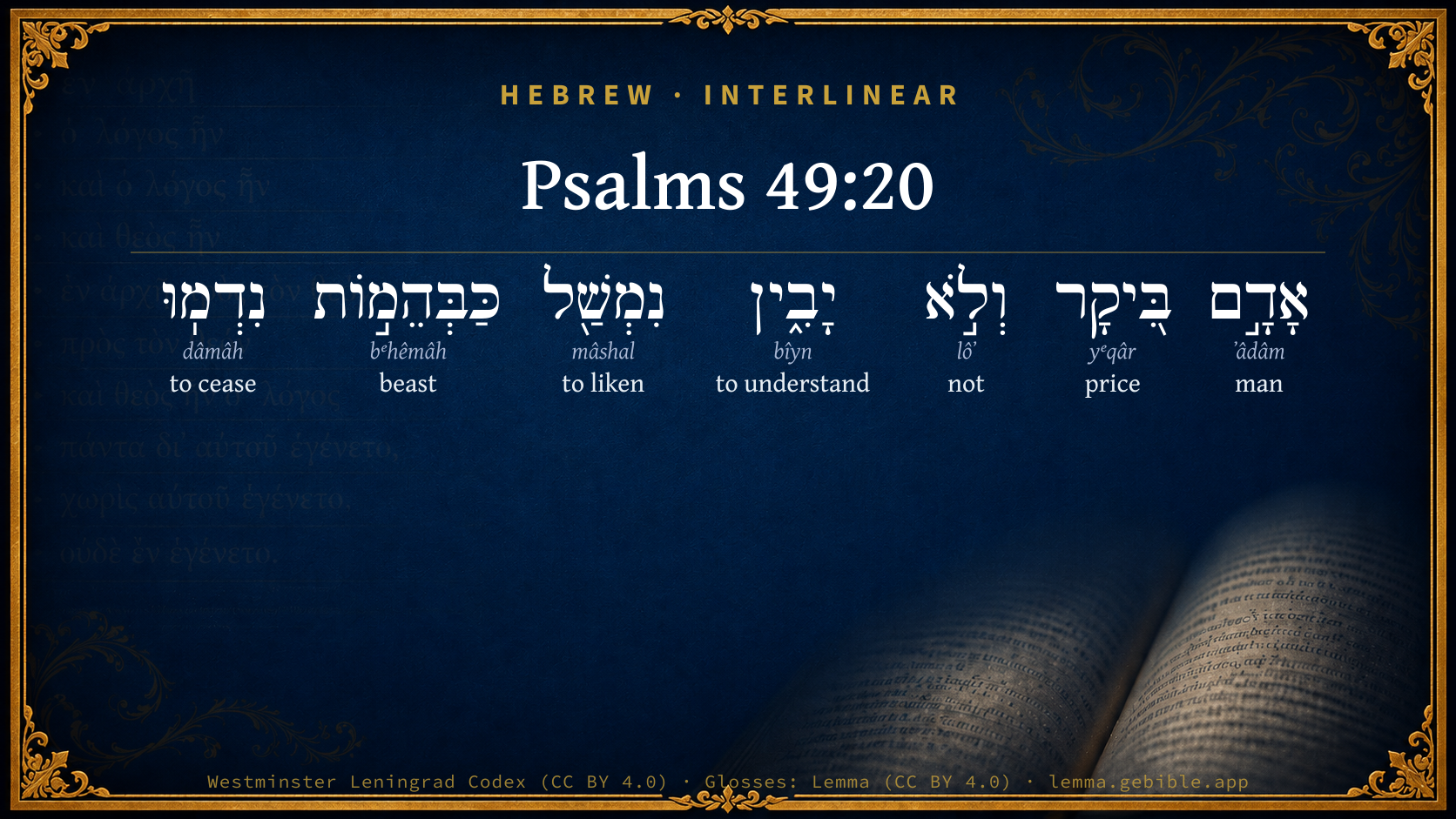
Psalms 49:20

Hebrew (Westminster Leningrad Codex) Psalms 49:20 appears in the Hebrew Old Testament. The text above is from the Westminster Leningrad Codex. Each word links to its Strong’s number, a concise gloss, and parsing drawn from the Open Scriptures Hebrew Bible morphology. Click any word for its full Brown-Driver-Briggs (BDB) entry.
Download image
Cite this verse

Psalms 49:20 (World English Bible). Public Domain. Lemma interlinear Bible study tool, https://lemma.gebible.app/v/psalms/49/20.

Show BibTeX & RIS
BibTeX
RIS
English Translation
A man who has riches without understanding, Is like the animals that perish.
World English Bible · Public Domain
Download a study sheet

One document with this verse’s original text, its word-by-word gloss line, the meaning frame, cross-references with their text, attributed commentary, and full source and license credits — printable, and it pastes into notes with its structure intact.

This verse Autodidact and up

Study sheet (.html) Plain text (.txt)

A passage Seminary Student

Up to 50 verses in one chapter. A passage sheet keeps up to 6 commentary sources and 12 cross-references per verse, in the order this page ranks them, and says so on the sheet whenever that leaves anything out. Ask for a single verse and you get the Autodidact verse sheet above.

Everything on this page stays free to read, with no account — the sheet is a download of what is already on screen, not access to it.

Want to remove ads? Support Godless Engineer
Compare translations 3

The same verse in 3 English versions, stacked beneath the original-language interlinear above. Click any original word for its lexicon entry.

Each is an independent rendering of the whole verse — the interlinear is not word-aligned to these translations.

Highlighted words mark where these versions differ — a whole-verse word diff, not a word-by-word alignment.

  • World English Bible Public Domain
    A man who has riches without understanding, Is like the animals that perish.
  • King James Version Public Domain
    Man that is in honour, and understandeth not, is like the beasts that perish.
  • unfoldingWord Literal Text CC BY-SA 4.0
    A human in honor, but he does not understand, he is likened to the beasts, they are destroyed.

unfoldingWord Literal Text — © unfoldingWord, licensed CC BY-SA 4.0. Word-aligned USFM3 via Door43 (git.door43.org/unfoldingWord/en_ult).

Versions to compare (up to 4)

3 of 4 selected

Show all 18 translations

Every available English version of this verse, each an independent rendering of the whole verse.

  • World English Bible Public Domain
    A man who has riches without understanding, Is like the animals that perish.
  • Berean Standard Bible Public Domain
    A man who has riches without understanding is like the beasts that perish.
  • Majority Standard Bible Public Domain
    A man who has riches without understanding is like the beasts that perish.
  • King James Version Public Domain
    Man that is in honour, and understandeth not, is like the beasts that perish.
  • American Standard Version (1901) Public Domain
    Man that is in honor, and understandeth not, Is like the beasts that perish. Psalm 50 A Psalm of Asaph.
  • Revised Version (1885) Public Domain
    Man that is in honour, and understandeth not, is like the beasts that perish.
  • Geneva Bible (1599) Public Domain
    Man is in honour, and vnderstandeth not: he is like to beasts that perish.
  • Douay-Rheims (1899) Public Domain
    He shall go in to the generations of his fathers: and he shall never see light.
  • Young's Literal Translation Public Domain
    Man in honour, who understandest not, Hath been like the beasts, they have been cut off!
  • Literal Standard Version CC BY-SA 4.0
    Man in honor, who does not understand, || Has been like the beasts, they have been cut off!
  • Unlocked Literal Bible CC BY-SA 4.0
    One who has wealth but no understanding is like the beasts, which perish.
  • unfoldingWord Literal Text CC BY-SA 4.0
    A human in honor, but he does not understand, he is likened to the beasts, they are destroyed.
  • Darby Bible Public Domain
    Man that is in honour, and understandeth not, is like the beasts that perish.
  • World Messianic Bible Public Domain
    A man who has riches without understanding, is like the animals that perish.
  • Webster's Bible Public Domain
    \\49:19\\He shall go to the generation of his fathers; they shall never see light.
  • Free Bible Version CC BY-SA 4.0
    Human beings, for all their fame, don't understand, and they die, just like the animals.
  • Bible in Basic English Public Domain
    Man, like the animals, does not go on for ever; he comes to an end like the beasts.
  • JPS Tanakh (1917) Public Domain
    (49-21) Man that is in honour understandeth not; he is like the beasts that perish.

Literal Standard Version (2020), Covenant Press — licensed CC BY-SA 4.0. Text via the HelloAO Bible API (eBible.org). Unlocked Literal Bible (unfoldingWord) — licensed CC BY-SA 4.0. Text via the HelloAO Bible API (eBible.org). unfoldingWord Literal Text — © unfoldingWord, licensed CC BY-SA 4.0. Word-aligned USFM3 via Door43 (git.door43.org/unfoldingWord/en_ult). Free Bible Version, Dr. Jonathan Gallagher — licensed CC BY-SA 4.0. Text via the HelloAO Bible API (eBible.org).

Word by word

More ways to search: Search by grammar → Find every occurrence → Compare this word →

Practice this passage: Drill this verse → Learn its vocabulary →

נִמְשַׁ֖ל
mâshal
H4911
“to liken”
Verb, Niphal, Perfect, 3rd Person, Masculine, Singular
Part of Speech
Verb
Stem
Niphal
Form
Perfect
Person
3rd Person
Gender
Masculine
Number
Singular
Full BDB Definition

Origin: denominative from H4912

TWOT: 1258 , 1258b

to represent, liken, be like - (Niphal) to liken, be like, be similar - (Hiphil) to compare - (Hithpael) to become like - to speak in a proverb, use a proverb, speak in parables, speak in sentences of poetry - (Qal) to use a proverb, speak a parable or proverb - (Piel) to make a parable - maker of parables (participle)
  1. אָדָ֣ם ʼâdâm H120 “man” Noun, Common, Masculine, Singular, Absolute
  2. בִּ֭יקָר yᵉqâr H3366 “in/at · price” Preposition + Noun, Common, Masculine, Singular, Absolute
  3. וְלֹ֣א lôʼ H3808 “and · not” Conjunction + Particle, Negative
  4. יָבִ֑ין bîyn H995 “to understand” Verb, Qal, Imperfect, 3rd Person, Masculine, Singular
  5. כַּבְּהֵמ֣וֹת bᵉhêmâh H929 “like/as the · beasts” Preposition, Determined + Noun, Common, Feminine, Plural, Absolute
  6. נִדְמֽוּ dâmâh H1820 “to cease” Verb, Niphal, Perfect, 3rd Person, Common, Plural

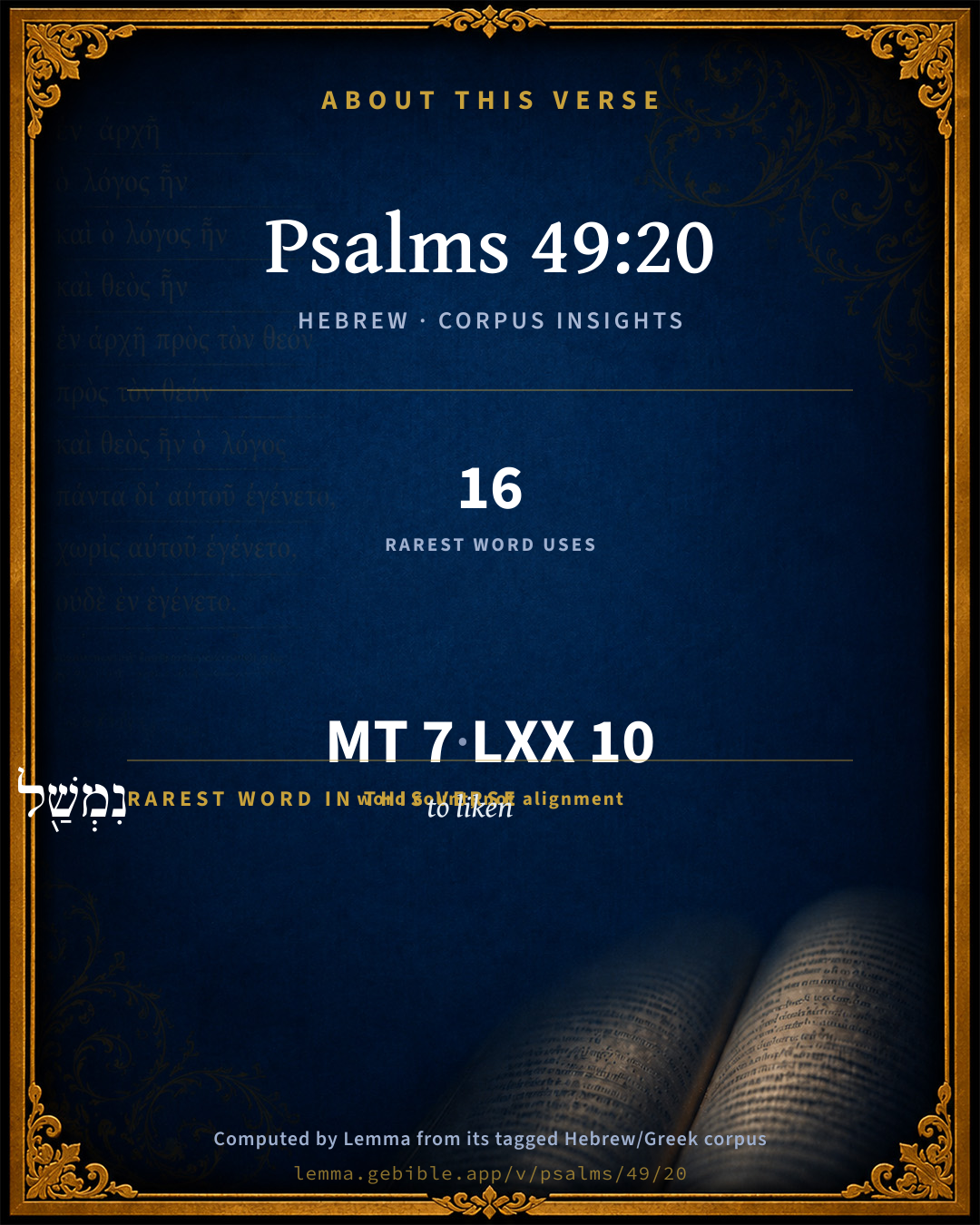
About this verse

These counts appear in no published source. They are computed here, from the morphology-tagged text and Lemma’s own curated glosses. What Lemma adds →

7
words
7
distinct lemmas
Wisdom
section

Notable vocabulary

The rarest word here is נִמְשַׁ֖ל to liken H4911 — appearing just 16 times in the whole Hebrew Bible.

Shared distinctive vocabulary

נִמְשַׁ֖ל to liken H4911 occurs in 15 verses of the Hebrew Bible. Also found in:

Grammatical profile

  • 3 verbs
  • 3 nouns
  • 1 particle

Verb forms

  • יָבִ֑ין Qal · Imperfect
  • נִמְשַׁ֖ל Niphal · Perfect
  • נִדְמֽוּ Niphal · Perfect

Hebrew & Septuagint length

In English translation the verse runs 13 words from the Hebrew and 18 from the Septuagint (LXX English) — closely comparable.

A rough comparison of the two English renderings, which tokenize alike — not a word-level alignment.

Word counts can differ between the Hebrew and the Greek without any difference in meaning — e.g. the Hebrew direct-object marker אֵת has no separate Greek word, and Greek often adds the article ὁ.

In the original languages it is 7 Hebrew tokens and 10 Greek tokens — but the two are counted differently (Hebrew bundles its prefixes and suffixes into one token; the Greek is in lemma form), so that isn’t a like-for-like length.

Cross-references

6

Topical passages linked to Psalms 49:20 in the Treasury of Scripture Knowledge — connected by theme and wording, ordered by reader-vote popularity; previews shown in the World English Bible.

  • Psalms 49:12 But man, despite his riches, doesn't endure. He is like the animals that perish.
  • Ecclesiastes 3:18–19 I said in my heart, "As for the sons of men, God tests them, so that they may see that they themselves are like animals.
  • Esther 7:10 So they hanged Haman on the gallows that he had prepared for Mordecai. Then was the king's wrath pacified.
  • Job 4:21 Isn't their tent-cord plucked up within them? They die, and that without wisdom.'
  • Esther 5:11–14 Haman recounted to them the glory of his riches, and the multitude of his children, and all the things in which the king had promoted him, and how he had advanced him above the princes and servants of the king.
  • Psalms 73:18–19 Surely you set them in slippery places. You throw them down to destruction.

Cross-references courtesy of OpenBible.info (CC BY 4.0).

Hebrew and Greek witnesses Masoretic Hebrew ↔ Greek Septuagint

The same verse in the two great witnesses to the Old Testament, shown verse-for-verse.

You’re reading Greek Psalm 48 (Hebrew Psalm 49). The Septuagint counts the superscription, so verse numbers can differ from the Hebrew — chapter-level alignment, not verse-by-verse. Numbering follows Rahlfs.

These are two independent witnesses, not word-aligned to each other, and the Septuagint is shown in lemma (dictionary) form.

Hebrew Psalms 49:20 Masoretic · Westminster Leningrad Codex

אָדָ֣ם בִּ֭יקָר וְלֹ֣א יָבִ֑ין נִמְשַׁ֖ל כַּבְּהֵמ֣וֹת נִדְמֽוּ

A man who has riches without understanding, Is like the animals that perish.

World English Bible · Public Domain

Greek LXX Greek Psalm 48:20 Septuagint · lemma form

εἰςἔρχομαι ἕως γενεά πατήρ αὐτός ἕως αἰών οὐ ὁράω φῶς

Man that is in honor, understands not: he is compared to the senseless cattle, and is like them.

LXX2012 (modern English Septuagint) · Public Domain

Hebrew: Westminster Leningrad Codex (CC BY 4.0). Greek: Septuagint (public domain); English from LXX2012 (modern English Septuagint) (Public Domain). How the Septuagint differs from the Hebrew →

Commentary

Notes on Psalms 49:20 from classic Christian and Jewish commentators (each source and its license shown beneath its notes). The classic Christian expositions comment on the surrounding passage and are grouped to its opening verse, so a note may address several verses; the Jewish commentaries on the Tanakh (Rashi and others) are per-verse, so they appear only where the commentator wrote on this verse.

Lemma curates 59 commentaries, every one of them public domain or Creative Commons licensed, each selected and text-cleaned for this edition rather than reprinted as found. About our sources →

Trapp's Complete Commentary

John Trapp

Psa 49:20 Man [that is] in honour, and understandeth not, is like the beasts [that] perish.

Ver. 20. Man that is in honour and understandeth not] Versus amoibaeus. See Psa 49:12, there is but little difference; Stultitiam patiuntur opes. The more a man hath of worldly wealth, and the less of spiritual and heavenly understanding therewith, the more bestial he is, and shall be more miserable. Caligula called his father-in-law, Marcus Silanus, χρυσουν προβατον, a golden brute, Quid cervo ingentia cornua, cum desit animus?

Vel mihi da clavem, vel mihi tolle seram.

John Trapp, A Commentary or Exposition upon All the Books of the Old and New Testament (1647–1656) — public domain. Text from a community e-Sword module.

Joseph Benson's Commentary

Psa 49:20. Man that is in honour, and understandeth not — That is, hath not true wisdom to know and consider what he is, and what is his true business and interest in this world, and what use he ought to make of his life, and of all his riches, and honour, and power; and whither he is going, and what course he should take for the attainment of true and lasting happiness; is like the beasts that perish — Though he hath the outward shape of a man, yet, in truth, he is a beast, a stupid and unreasonable creature, and shall perish like a brute beast made to be taken and destroyed.

Joseph Benson's Commentary on the Old and New Testaments (1811–1818) — public domain. Text from a community e-Sword module.

J. A. Alexander on Psalms

Joseph Addison Alexander

21. (Psa 49:20). Man (that is) in honour and understandeth not is likened to the beasts (that) are destroyed. The first verb in this verse and the first verb in Psa 49:13 (12) differ only in a single letter, in consequence of which they are confounded by the ancient Greek and Syriac translators, and some modern critics have proposed to amend one of the places by assimilation to the other. But the prevalent practice of the Hebrew writers, where the same burden or refrain recurs, is not to repeat it slavishly, but with some slight variation in the form, which not unfrequently suggests a new idea, or modifies the one before expressed. See above, on Psa 24:10; Psa 42:11 (10). So here, at the close of the first strophe, the rich fool is compared to the brutes that perish, with respect to the uncertainty of his enjoyments; and again at the close of the second, with respect to his irrationality, the points of comparison being distinct but inseparable. No wonder that the sinner is cut off unawares like the brutes, when in fact he is equally irrational. By tampering with the text of either passage, there fore, we take from the psalm one of its moral lessons, as well as one of its rhetorical beauties.

Joseph Addison Alexander, The Psalms Translated and Explained (1850) — public domain. Text from a community e-Sword module.

Geneva Bible (1599)

Geneva Bible translators

He condemneth man’s ingratitude, who having received excellent gifts of God, abuseth them like a beast to his own condemnation.

Geneva Bible (1599) marginal notes — public domain. Text via Bolls.life.

Jamieson, Fausset & Brown

Robert Jamieson, A. R. Fausset & David Brown

(Compare Psa 49:12). The folly is more distinctly expressed by "understandeth not," substituted for "abideth not."

Next: Psalms Chapter 50

Jamieson, Fausset & Brown — Commentary Critical and Explanatory on the Whole Bible (1871) — public domain (CC PDM 1.0). Text via the HelloAO Bible API.

Adam Clarke's Commentary

Verse 20. Man that is in honour] The rich and honourable man who has no spiritual understanding, is a beast in the sight of God. The spirit of this maxim is, A man who is in a dignified official situation, but destitute of learning and sound sense, is like a beast. The important place which he occupies reflects no honour upon him, but is disgraced by him. Who has not read the fable of the beautifully carved head? It was every thing that it should be, but had no brains.

This verse has been often quoted as a proof of the fall of man; and from ילין yalin, (in Ps 49:12,) which signifies to lodge for a night, it has been inferred that Adam fell on the same day on which he was created, and that he did not spend a single night in the terrestrial paradise. Adam, who was in a state of glory, did not remain in it one night, but became stupid and ignorant as the beasts which perish. But we may rest assured this is no meaning of the text.

ANALYSIS OF THE FORTY-NINTH PSALM

The doctrine taught by this Psalm is the following: That rich men be not proud of their wealth, nor poor men dejected nor humbled at their mean estate, since all men are mortal; and it is not the wealth of the one can make them happy, nor the poverty of the others can make them unhappy, there being another life by which the condition of both is to be judged.

The Psalm has three parts: -

I. An exordium or preface: Ps 49:1-4.

II. The matter proposed, debated, and argued, Ps 49:5-16.

III. The advice or admonition given, Ps 49:16-20.

I. In the exordium: -

1. He calls together his auditory: "All people, all nations, low, high, rich, and poor;" because what he speaks concerns all.

2. Then he calls them to be attentive. "Hear, give ear."

3. He labours to make them teachable, by commending the matter of which he treats; they are not frivolous, but weighty and important things: 1. "My mouth shall speak of wisdom," c. I will speak of what I know, and speak so that others may understand. 2. "I will incline my ear." I will teach you nothing but what I teach myself. 3. It is a parable which I am about to deliver, and will require all your attention. 4. That it may be brought to your ear with more delight, I shall accompany it with the harp: "I will open my dark saying upon the harp."

II. Having now assembled his congregation endeavoured to make them attentive, docile, and well-disposed, lest any should suppose that he was envious at the prosperity of the wicked, or had so little trust in God that he lived in terror of his adversaries; he says, "Wherefore should I fear in the days of evil, though the iniquity of my supplanters surrounds me?" He had no reason thus to fear; but the wealthy and ambitious had. And this he demonstrates two ways: for he takes away happiness from the one, Ps 49:6-15, and places happiness in the other, Ps 49:16.

1. They that trust in their wealth, and boast themselves in the multitude of their riches, are not happy, Ps 49:6. For wealth will not deliver in the evil day.

1. It will save no man's life: "None of them (the rich men) can redeem his brother, nor give to God a ransom for him." God will not be bribed to save any man's life.

2. It will save no man's soul. The ransom required for that is more valuable than any thing the earth can produce.

3. Suppose he was wise, and a long-lived man, yet he must die at last: "For he seeth that wise men die; likewise the fool, and the brutish."

4. Which sufficiently shows the vanity of their riches: 1. They leave them. 2. They leave these great riches. 3. They leave them to others; sometimes to children, but often to strangers, such as they thought never would have entered into their labours.

5. "Their thoughts are vain." For, 1. "Their inward thoughts are that their houses shall continue," c. 2. To this end, "They call their lands after their own names" they not only study to be rich, but they are vain-glorious also.

But their study is, 1. Vanity. 2. Folly.

1. Vanity: "Nevertheless, man being in honour, abideth not;" a change there will be, and the most glorious man will be like the beasts that perish.

2. Folly: "This their way is their foolishness." A great foolery to place their chief good in riches; yet their posterity act in the same way, tread in their steps, and pant after riches and honours.

To correct this propensity, he lays before them certain considerations relative to their future condition: -

1. "Like sheep they are laid in the grave." That is their common condition; like sheep they are fatted for slaughter.

2. "Death shall feed on them." The second death; for, like Dives, they shall be burned in hell; and the fire that cannot be extinguished shall feed upon their souls and bodies.

3. In the morning of the resurrection, the "upright shall have power over them." The righteous shall shine like the sun, when they shall be Christ's footstool. The godly shall be placed on the right hand, and seated on thrones to judge them; when they shall be seated on the left, and be condemned.

4. "Their beauty shall consume in the grave." Their riches, power, and glory, shall wax old as doth a garment: "For the figure of this world passeth away." Therefore the rich of this world, and the possessors of great glory, are not happy. He therefore sets down the happy man: the man who trusts in God, and lives to him, he is happy in life, notwithstanding his afflictions, and he shall be happy for ever. Therefore he says, "God will redeem my soul from the power of the grave," c.

1. He shall redeem me. All good men's souls.

2. Not from the grave, for die we must but from the hand, that is, the dominion and power, of death: "Death shall not reign over them."

3. The reason is, For he shall receive me - adopt me into his family, and make me a partaker of the Divine nature.

III. On these considerations, relative to good and bad men, and their different conditions, he admonishes the good that they be not troubled at the prosperity of the wicked: "Be not thou afraid," c.

1. Not at the great wealth of the rich: "Be not afraid when one is made rich."

2. Not at the glory and honour of the mighty: "Nor when the glory of his house is increased."

And he repeats the former reason: "For when he dieth, he shall carry nothing away his glory shall not descend after him." Their happiness, such as it was, was only momentary.

This he amplifies: Be it granted that they flattered themselves, and were flattered by others.

1. "Though while he lived he blessed his own soul." "Soul, take thy ease," c.

2. Though men will praise thee, and sound in thy ears, Well done! "so long as thou doest well to thyself," - heapest up riches, and followest after honour.

1. A mortal thou art, short-lived as all that went before thee: "He shall go to the generation of his fathers." And,

2. If wicked, be cast into utter darkness: "They shall never see the light."

3. Surely any man, however rich, however great, who understands not thus much, must be a beast and with this sentiment concludes the Psalm; and it is doubled that it may be remembered: "Man who is in honour, and understandeth not is like the beasts that perish." Even while he lives, without this understanding, his life is little more than the life of the beast.

Adam Clarke's Commentary on the Bible (1810–1826) — public domain. Text from a community e-Sword/MySword module.

John Calvin's Commentaries

20 Man is in honor, and will not understand Here the prophet, that he may not be understood as having represented the present life, which in itself is a singular blessing of God, as wholly contemptible, corrects himself as it were, or qualifies his former statements by a single word, importing that those whom he reprehends have reduced themselves to the level of the beasts that perish, by senselessly devouring the blessings which God has bestowed, and thus divesting themselves of that honor which God had put upon them. It is against the abuse of this world that the prophet has been directing his censures. They are aimed at those who riot in the bounties of God without any recognition of God himself, and who devote themselves in an infatuated manner to the passing glory of this world, instead of rising from it to the contemplation of the things which are above.

John Calvin's Commentaries (1540-1563) — public domain. Text from the Calvin Translation Society English edition (1840s-50s) via the Christian Classics Ethereal Library (ccel.org). Calvin's coverage is partial (roughly two-thirds of the Bible); uncommented books and verses are honest gaps, never fabricated. The 19th-century editor's footnotes and remarks are omitted so the notes are faithfully Calvin's own voice.

The Cambridge Bible for Schools and Colleges

gen. ed. J. J. S. Perowne

20. The refrain of Psa_49:12, repeated with a significant variation, qualifying the previous statement. It is not the rich and honourable man, as such, who is no better than the cattle that perish; but the rich man who is destitute of discernment, and knows no distinction between false and true riches, reckoning earthly and transitory wealth more precious than spiritual and eternal fellowship with God.

The Cambridge Bible for Schools and Colleges (gen. ed. J. J. S. Perowne; Cambridge University Press, 1878–1918) — public domain. Text from a community e-Sword module.

John Gill's Exposition

Man that is in honour,.... A wicked man, as the Targum; See Gill on Psa 49:12;

and understandeth not; from whence his riches and honour, come, and what use he should make of them, and for what end he has them; or that understandeth not spiritual things, which relate to the salvation of his soul; who does not know God in Christ, nor the way of salvation by Christ; nor has any experience of the work of the Spirit of God upon his soul; nor has any spiritual understanding of the doctrines of the Gospel; nor knows himself, his state and condition, and what true happiness is:

is like the beasts that perish; See Gill on Psa 49:12.

Next: Psalms Chapter 50

John Gill's Exposition of the Whole Bible (1746–1763) — public domain (CC PDM 1.0). Text via the HelloAO Bible API.

Albert Barnes' Notes on the Bible

Man that is in honor - Man that is in possession of wealth, or that occupies an exalted rank. See the notes at Psa 49:12.

And understandeth not - That is, who has no proper appreciation of what it is to be a man; of what is his true rank “as” a man; of his relations to God; of his condition as an immortal being - man that values himself only on the fact that he is rich; that lives for this world alone; that regards it as a sufficient distinction that he “is” rich; that degrades his nobler nature in the mere enjoyment of the pleasures of sense - is like the beasts - is in no way elevated above them.

Is like the beasts that perish - They live only for this life. They have no higher nature than that which pertains to the senses, and they live accordingly. The man who, though of exalted rank, lives for this life alone, herein resembles them. See the notes at Psa 49:12. Alas! what multitudes there are who thus live - whose only aim is to secure the wealth and the honors of this life - who have no more thought of a future state, and who form no more plans in regard to a future world, than do the brutes! For many there are in exalted stations, who are surrounded by all that wealth can give, yet who no more admit the thought of a future world into their hopes and plans than if they had no other endowment than the camel or the ox, and whose conduct in this respect would not be changed if all the higher endowments which constitute the nature of man were withdrawn, and they were at once reduced to the condition of a brute. While, therefore, the main purpose of this psalm is to show that wealth confers no “power” which is to be dreaded - that its possessor, though wicked, cannot permanently injure us, since he must soon pass away by death - the course of thought at the same time teaches us that we should not “desire” wealth as our portion; that we should not live for this, as the main object of life. The possessor of the most ample fortune must soon be laid in the grave. All that he has acquired will pass into other hands, and will be his no more. But he “has” a higher nature. He “may” live in a manner different from the brute that perishes. He “may” act with reference to a higher - an eternal - state of existence; and, when he dies, he “may” leave his earthly inheritance, whether great or small, only to enter on an inheritance that shall he permanent and eternal. “What shall it profit a man, if he shall gain the whole world, and lose his own soul?” Mar 8:36.

Albert Barnes' Notes on the Bible (1834–1885) — public domain. Text from a community e-Sword/MySword module.

Matthew Poole's English Annotations

Understandeth not, i.e. hath not true wisdom, to know and consider what he is, and what his true business and interest in this world is, and what use he should make of his life, and of all his riches, and honour, and power, and whither he is going, and what course to take for the attainmerit of true and lasting happiness.

Is like the beasts that perish; though he hath the outward shape of a man, yet in truth he is a beast, or a brutish, stupid, and unreasonable creature, and he shall perish like a brute beast made to be destroyed, 2Pe 2:12.

Matthew Poole's English Annotations on the Holy Bible (1683–1685) — public domain. Text from a community e-Sword/MySword module.

The Treasury of David

Charles H. Spurgeon

Ver. 20. The song ends with the refrain, Man that is in honour, and understandeth not, is like the beasts that perish. Understanding differences men from animals, but if they will not follow the highest wisdom, and like beasts find their all in this life, then their end shall be as mean and dishonourable as that of beasts slain in the chase, or killed in the shambles. From the loftiest elevation of worldly honour to the uttermost depths of death is but a step. Saddest of all is the reflection, that though men are like beasts in all the degradation of perishing, yet not in the rest which animal perishing secures, for, alas! it is written, "These shall go away into everlasting punishment." So ends the minstrel's lay. Comforting as the theme is to the righteous, it is full of warning to the worldly. Hear ye it, O ye rich and poor. Give ear to it, ye nations of the earth.

Ver. 20. Like the beasts that perish. My lords, it is no wonder at all, if men that affect beastly pleasures, and dote upon perishing honours, become like the beasts that perish. It is no miracle if he that lives like a beast dies like a beast. Take a man that hath lived like the fool in the gospel, and tell me, what hath this man done for his immortal soul more than a beast doth for its perishing soul? Soul, soul, cease from care, eat, drink, and take thine ease; this is the constant ditty of most men in honour: they have studied clothes and victuals, titles and offices, ways of gain and pleasure. Am I not yet at highest? They have, it may be, studied the black art of flattery and treachery; they understand the humour of the times, the compliances and dependences of this and other statesman, the projects of divers princes abroad, and the main design here at home. Is this all? Why, then be it known unto you, that the men of this strain have made no better provision for their precious souls, than if they had the soul, the vanishing soul of a beast within them; and certainly, if we were to judge of the substance of men's souls by their unworthy and sensual conversation, we might easily fall into that heresy, that dangerous dream of some who conceive that their souls are mortal. Francis Cheynell, in a Sermon entitled, "The Man of Honour, "... preached before the Lords of Parliament, 1645.

Ver. 20. Like the beasts that perish. Sin is both formaliter and effective vile. As it is so in itself, so it has made man vile. No creature so debased as man, being in this respect become viler than any creature. There is no such depravation in the nature of any creature, except in the diabolical nature. No creature ever razed God's image out of its nature, but only man. There is no aversions to the will of God, no inclination to what offends him, in any creature on earth but man. Man, then, who was once the glory of the creation, is become the vilest of all creatures, for that is vilest which is most contrary to the infinite glory, but so is our nature, "Man being in honour, abideth not, "is now like the beast that perish; nay, worse than they, if the greatest evil can make him worse. Man was made a little lower than the angels, crowned with glory, advanced to be lord and governor of all the works of his hands; and all creatures in this world were put under his feet. Ps 8:5-6. But by this natural corruption he that was but a little lower than the angels is now something below the beasts. He was to have dominion, but is made baser than those over whom he rules. They were put under his feet, but now he is as low as they. This is the sad issue of natural corruption. David Clarkson.

Ver. 20. Like the beasts. Man is so much a beast, that he cannot know himself to be one till God teach him. And we never learn to be men till we have learned that we were beasts...It is not said he is like this or that beast, but he is like the beasts that perish. Take any beast, or all beasts, the worst of beasts, he is the picture of them all, and he daily exemplifies the vilest of their qualities in his own. Joseph Caryl.

Ver. 20.

1. Men of spiritual understanding without worldly honour are higher than the angels of God in heaven.

2. Men in worldly honour without the true wisdom are worse than the beasts that perish. G. R.

Charles H. Spurgeon's The Treasury of David (1869–1885) — public domain. Psalms only. Text from a community e-Sword/MySword module.

The Pulpit Commentary

Man that is in honour, and under. standeth not, is like the beasts that perish. In ver. 12 the writer had said of all men, that they are "like the beasts that perish," which is true in one sense; i.e. in reference to this life. Now, having taken a loftier flight, and embraced in his mental vision the whole life of man, he makes an important qualification of what he had said. All men die; but only those who are "without understanding" die without hope the beasts:" for others there remains the hope enunciated in ver. 15.

The Pulpit Commentary (1880–1919), ed. H.D.M. Spence-Jones & Joseph S. Exell — public domain. Text from a community e-Sword module.

John Wesley's Explanatory Notes

Understandeth not - Hath not true wisdom. The beasts - Though he hath the outward shape of a man, yet in truth he is a beast, a stupid, and unreasonable creature.

John Wesley, Explanatory Notes Upon the Whole Bible (1754–1765) — public domain. Text via the GEBible commentary corpus.

Rashi

Rabbi Shlomo Yitzchaki (Rashi)

You shall come to the generation of his forefathers When you complete your days and die, you will come and see the generation of the wicked man being judged in Gehinnom, so that they will not see light to eternity.

Rashi on the Tanakh — English translations: “The Judaica Press complete Tanach with Rashi, translated by A. J. Rosenberg” (CC BY 4.0); “Pentateuch with Rashi's commentary by M. Rosenbaum and A.M. Silbermann, 1929-1934” (public domain); “The Metsudah Tanach series, Lakewood, N.J” (CC BY 4.0); and “The Book of Joshua, Metsudah Publications, 1997” (CC BY 4.0). Text via Sefaria.

Lesson kit

Teaching starters — assembled from the data on this page, not authored interpretation. Every prompt links to the verse data it draws on. Edit before teaching.

Psalms, in the Wisdom, opens this verse with 7 words (7 distinct Hebrew lemmas). Its most distinctive word is mâshal (“to liken”). A historical commentator’s framing appears above. Read the whole chapter for the surrounding context.

Discussion questions

  1. The word mâshal carries the sense “to liken.” How does it shape the verse?
  2. How does Numbers 21:27, which shares the word «to liken», read alongside this verse?
  3. These translations render this verse differently. What is at stake in choosing one wording over another?
  4. «יָבִ֑ין» is a Qal Imperfect verb. How does that grammatical form shape the action described?
  5. Compare how Trapp's Complete Commentary and Joseph Benson's Commentary read this verse. Where do they agree or differ?

Things to notice

Reading settings

Reading text

Shown beneath each verse's original-language words.

Old Testament
Old Testament edition

Read the OT as the Masoretic Hebrew (MT) or the Greek Septuagint (LXX).

English shown for the Greek Septuagint (in the Hebrew ↔ Greek comparison).

Comparing translations? Open the Compare panel on any verse page to stack up to four side by side.