
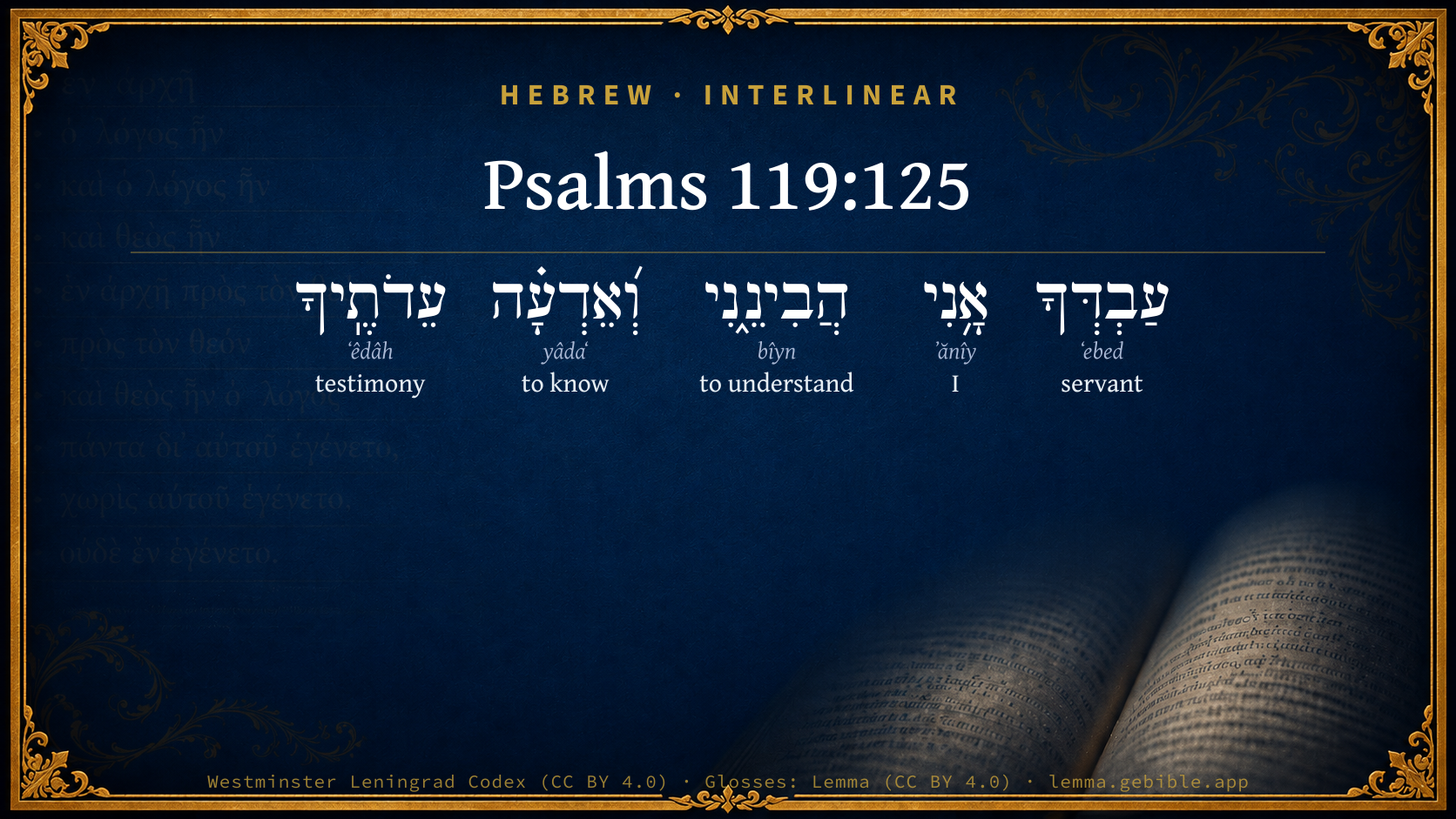
Psalms 119:125

Hebrew (Westminster Leningrad Codex) Psalms 119:125 appears in the Hebrew Old Testament. The text above is from the Westminster Leningrad Codex. Each word links to its Strong’s number, a concise gloss, and parsing drawn from the Open Scriptures Hebrew Bible morphology. Click any word for its full Brown-Driver-Briggs (BDB) entry.
Download image
Cite this verse

Psalms 119:125 (World English Bible). Public Domain. Lemma interlinear Bible study tool, https://lemma.gebible.app/v/psalms/119/125.

Show BibTeX & RIS
BibTeX
RIS
English Translation
I am your servant. Give me understanding, That I may know your testimonies.
World English Bible · Public Domain
Download a study sheet

One document with this verse’s original text, its word-by-word gloss line, the meaning frame, cross-references with their text, attributed commentary, and full source and license credits — printable, and it pastes into notes with its structure intact.

This verse Autodidact and up

Study sheet (.html) Plain text (.txt)

A passage Seminary Student

Up to 50 verses in one chapter. A passage sheet keeps up to 6 commentary sources and 12 cross-references per verse, in the order this page ranks them, and says so on the sheet whenever that leaves anything out. Ask for a single verse and you get the Autodidact verse sheet above.

Everything on this page stays free to read, with no account — the sheet is a download of what is already on screen, not access to it.

Want to remove ads? Support Godless Engineer
Compare translations 3

The same verse in 3 English versions, stacked beneath the original-language interlinear above. Click any original word for its lexicon entry.

Each is an independent rendering of the whole verse — the interlinear is not word-aligned to these translations.

Highlighted words mark where these versions differ — a whole-verse word diff, not a word-by-word alignment.

  • World English Bible Public Domain
    I am your servant. Give me understanding, That I may know your testimonies.
  • King James Version Public Domain
    I am thy servant; give me understanding, that I may know thy testimonies.
  • unfoldingWord Literal Text CC BY-SA 4.0
    I your servant; give me understanding, so that I can know your testimonies.

unfoldingWord Literal Text — © unfoldingWord, licensed CC BY-SA 4.0. Word-aligned USFM3 via Door43 (git.door43.org/unfoldingWord/en_ult).

Versions to compare (up to 4)

3 of 4 selected

Show all 17 translations

Every available English version of this verse, each an independent rendering of the whole verse.

  • World English Bible Public Domain
    I am your servant. Give me understanding, That I may know your testimonies.
  • Berean Standard Bible Public Domain
    I am Your servant; give me understanding, that I may know Your testimonies.
  • Majority Standard Bible Public Domain
    I am Your servant; give me understanding, that I may know Your testimonies.
  • King James Version Public Domain
    I am thy servant; give me understanding, that I may know thy testimonies.
  • American Standard Version (1901) Public Domain
    I am thy servant; give me understanding, That I may know thy testimonies.
  • Revised Version (1885) Public Domain
    I am thy servant, give me understanding; that I may know thy testimonies.
  • Geneva Bible (1599) Public Domain
    I am thy seruant: graunt mee therefore vnderstanding, that I may knowe thy testimonies.
  • Young's Literal Translation Public Domain
    Thy servant `am' I -- cause me to understand, And I know Thy testimonies.
  • Literal Standard Version CC BY-SA 4.0
    I [am] Your servant—cause me to understand, || And I know Your testimonies.
  • Unlocked Literal Bible CC BY-SA 4.0
    I am your servant; give me understanding so that I may know your covenant decrees.
  • unfoldingWord Literal Text CC BY-SA 4.0
    I your servant; give me understanding, so that I can know your testimonies.
  • Darby Bible Public Domain
    I am thy servant; give me understanding that I may know thy testimonies.
  • World Messianic Bible Public Domain
    I am your servant. Give me understanding, that I may know your testimonies.
  • Webster's Bible Public Domain
    I am thy servant; give me understanding, that I may know thy testimonies.
  • Free Bible Version CC BY-SA 4.0
    I am your servant. Please give me discernment so I can understand your instructions.
  • Bible in Basic English Public Domain
    I am your servant; give me wisdom, so that I may have knowledge of your unchanging word.
  • JPS Tanakh (1917) Public Domain
    I am Thy servant, give me understanding, that I may know Thy testimonies.

Literal Standard Version (2020), Covenant Press — licensed CC BY-SA 4.0. Text via the HelloAO Bible API (eBible.org). Unlocked Literal Bible (unfoldingWord) — licensed CC BY-SA 4.0. Text via the HelloAO Bible API (eBible.org). unfoldingWord Literal Text — © unfoldingWord, licensed CC BY-SA 4.0. Word-aligned USFM3 via Door43 (git.door43.org/unfoldingWord/en_ult). Free Bible Version, Dr. Jonathan Gallagher — licensed CC BY-SA 4.0. Text via the HelloAO Bible API (eBible.org).

Word by word

More ways to search: Search by grammar → Find every occurrence → Compare this word →

Practice this passage: Drill this verse → Learn its vocabulary →

About this verse

These counts appear in no published source. They are computed here, from the morphology-tagged text and Lemma’s own curated glosses. What Lemma adds →

5
words
5
distinct lemmas
Wisdom
section

Shared distinctive vocabulary

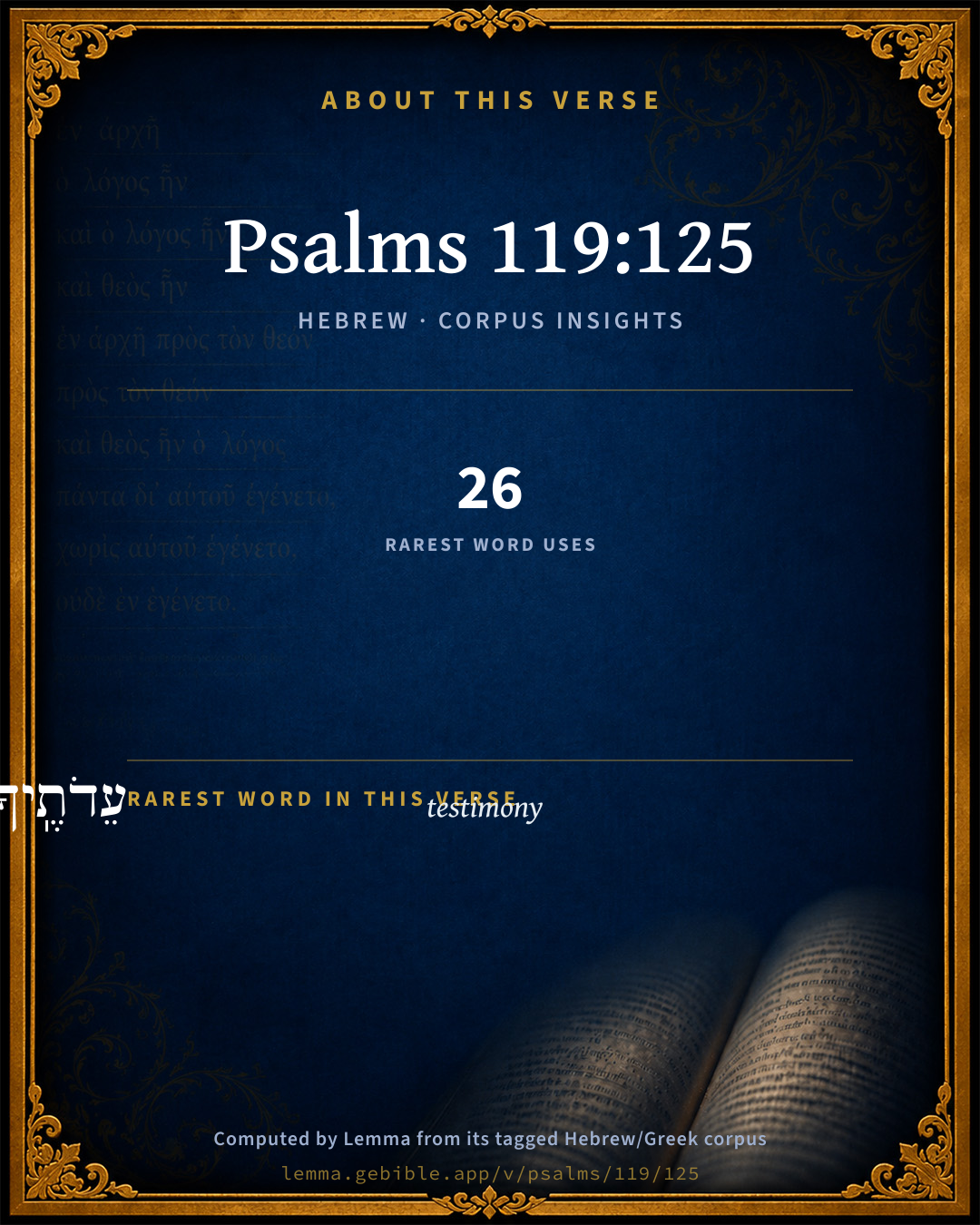
עֵדֹתֶֽיךָ testimony H5713 occurs in 25 verses of the Hebrew Bible. Also found in:

Grammatical profile

  • 2 verbs
  • 2 nouns
  • 1 pronoun

Verb forms

  • הֲבִינֵ֑נִי Hiphil · Imperative
  • וְ֝אֵדְעָ֗ה Qal · Cohortative

Hebrew & Septuagint length

In English translation the verse runs 13 words from the Hebrew and 12 from the Septuagint (LXX English) — closely comparable.

A rough comparison of the two English renderings, which tokenize alike — not a word-level alignment.

Word counts can differ between the Hebrew and the Greek without any difference in meaning — e.g. the Hebrew direct-object marker אֵת has no separate Greek word, and Greek often adds the article ὁ.

Cross-references

16

Topical passages linked to Psalms 119:125 in the Treasury of Scripture Knowledge — connected by theme and wording, ordered by reader-vote popularity; previews shown in the World English Bible.

  • James 3:13–17 Who is wise and understanding among you? Let him show by his good conduct that his deeds are done in gentleness of wisdom.
  • Psalms 116:16 Yahweh, truly I am your servant. I am your servant, the son of your handmaid. You have freed me from my chains.
  • Psalms 119:34 Give me understanding, and I will keep your law. Yes, I will obey it with my whole heart.
  • Proverbs 14:8 The wisdom of the prudent is to think about his way, But the folly of fools is deceit.
  • 2 Corinthians 3:5–6 not that we are sufficient of ourselves, to account anything as from ourselves; but our sufficiency is from God;
  • James 1:5 But if any of you lacks wisdom, let him ask of God, who gives to all liberally and without reproach; and it will be given to him.
  • Psalms 119:11 I have hidden your word in my heart, That I might not sin against you.
  • Psalms 119:18–19 Open my eyes, That I may see wondrous things out of your law.
  • Psalms 119:29 Keep me from the way of deceit. Grant me your law graciously!
  • Psalms 119:66 Teach me good judgment and knowledge, For I believe in your commandments.
  • Proverbs 9:10 The fear of Yahweh is the beginning of wisdom. The knowledge of the Holy One is understanding.
  • Romans 6:22 But now, being made free from sin, and having become servants of God, you have your fruit of sanctification, and the result of eternal life.
  • 2 Chronicles 1:7–10 In that night did God appear to Solomon, and said to him, Ask what I shall give you.
  • Psalms 86:16 Turn to me, and have mercy on me! Give your strength to your servant. Save the son of your handmaid.
  • Psalms 119:94 I am yours. Save me, for I have sought your precepts.
  • 2 Timothy 2:7 Consider what I say, and may the Lord give you understanding in all things.

Cross-references courtesy of OpenBible.info (CC BY 4.0).

Hebrew and Greek witnesses Masoretic Hebrew ↔ Greek Septuagint

The same verse in the two great witnesses to the Old Testament, shown verse-for-verse.

You’re reading Greek Psalm 118 (Hebrew Psalm 119). The Septuagint counts the superscription, so verse numbers can differ from the Hebrew — chapter-level alignment, not verse-by-verse. Numbering follows Rahlfs.

These are two independent witnesses, not word-aligned to each other, and the Septuagint is shown in lemma (dictionary) form.

Hebrew Psalms 119:125 Masoretic · Westminster Leningrad Codex

עַבְדְּךָ אָ֥נִי הֲבִינֵ֑נִי וְ֝אֵדְעָ֗ה עֵדֹתֶֽיךָ

I am your servant. Give me understanding, That I may know your testimonies.

World English Bible · Public Domain

Greek LXX Greek Psalm 118:125 Septuagint · lemma form

δοῦλος σύ εἰμί ἐγώ συνέτιζω ἐγώ καί γιγνώσκω ὁ μαρτύριον σύ

I am your servant; instruct me, and I shall know your testimonies.

LXX2012 (modern English Septuagint) · Public Domain

Hebrew: Westminster Leningrad Codex (CC BY 4.0). Greek: Septuagint (public domain); English from LXX2012 (modern English Septuagint) (Public Domain). How the Septuagint differs from the Hebrew →

Commentary

Notes on Psalms 119:125 from classic Christian and Jewish commentators (each source and its license shown beneath its notes). The classic Christian expositions comment on the surrounding passage and are grouped to its opening verse, so a note may address several verses; the Jewish commentaries on the Tanakh (Rashi and others) are per-verse, so they appear only where the commentator wrote on this verse.

Lemma curates 59 commentaries, every one of them public domain or Creative Commons licensed, each selected and text-cleaned for this edition rather than reprinted as found. About our sources →

Trapp's Complete Commentary

John Trapp

Psa 119:125 I [am] thy servant; give me understanding, that I may know thy testimonies.

Ver. 125. I am thy servant, give me understanding] I have voluntarily hired myself unto thee, chosen the things that please thee, and taken hold of the covenant, loving to be thy servant, Isa 56:4; Isa 56:6. Now, this is all the wages I crave of thee, "Give me understanding," &c. This David speaketh, saith one, in a real and heavenly complement with his Maker.

That I may know thy testimonies] Work done in the dark must be undone again; David, therefore, would fully know his Master’s mind, that he might acceptably do it.

John Trapp, A Commentary or Exposition upon All the Books of the Old and New Testament (1647–1656) — public domain. Text from a community e-Sword module.

J. A. Alexander on Psalms

Joseph Addison Alexander

125. (Psa 119:125) Thy servant (am) I; make me understand and let me know thy testi- monies. That thy servant is not a mere periphrasis for I or me in Psa 119:122 and elsewhere, appears from the first clause of the verse before us, where it constitutes the predicate of the proposition. In the second clause, we have the same choice of constructions as in Psa 119:116-117. Let me know, or (then) I shall know, or that I may know, all implying one another, and amounting to the same thing.

Joseph Addison Alexander, The Psalms Translated and Explained (1850) — public domain. Text from a community e-Sword module.

Tyndale Open Study Notes

Tyndale Open Resources

119:125 Simply possessing God’s law does not provide any benefits. The psalmist knows that only as the Lord gives discernment will he understand it.

Tyndale Open Study Notes — © Tyndale Open Resources, licensed CC BY-SA 4.0. Text via the HelloAO Bible API.

Adam Clarke's Commentary

Verse 125. I am thy servant] See on Ps 119:94.

Adam Clarke's Commentary on the Bible (1810–1826) — public domain. Text from a community e-Sword/MySword module.

John Calvin's Commentaries

125. I am thy servant, give me understanding. Here the prayer of the preceding verse is repeated. The repetition shows how ardently he wished the blessing prayed for, and how earnest and importunate he was in pleading with God for it. By the words he expresses still more plainly in what way it is that God teaches his own people — that he does so by illuminating with sound knowledge their understandings, which otherwise would be blind. It would profit us little to have the divine law sounding in our ears, or to have it exhibited in writing before our eyes, and to have it expounded by the voice of man, did not God correct our slowness of apprehension, and render us docile by the secret influence of his Spirit. We are not to suppose that David advances any meritorious claims before God when he boasts of being his servant. Men, indeed, commonly imagine that when we are previously well prepared, God then adds new grace, which they term subsequent grace. But the Prophet, so far from boasting of his own worth, rather declares how deep the obligations were under which he lay to God. It is not in the power of any man to make himself a servant of the Most High, nor can any man bring anything of his own as a price with which to purchase so great an honor. Of this the Prophet was well aware. He knew that there is not one of the whole human family who is worthy of being enrolled among that order; and therefore he does nothing more than adduce the grace he had obtained, as an argument that God according to his usual way would perfect what he had begun. In a similar manner he speaks in Psalm 116:6,

“I am thy servant and the son of thine handmaid:”

in which place it is abundantly manifest that he does not boast of his services, but only declares that he is one of the members of the Church.

John Calvin's Commentaries (1540-1563) — public domain. Text from the Calvin Translation Society English edition (1840s-50s) via the Christian Classics Ethereal Library (ccel.org). Calvin's coverage is partial (roughly two-thirds of the Bible); uncommented books and verses are honest gaps, never fabricated. The 19th-century editor's footnotes and remarks are omitted so the notes are faithfully Calvin's own voice.

John Gill's Exposition

PE.--The Seventeenth Part.

PE. Thy testimonies are wonderful,.... The Scriptures, which testify of God, his mind and will, are wonderful both with respect to the author of them, the things contained in them, and the use and advantage of them. They give an account of the wonderful works of creation; of their author and matter; of the manner, order, and time of their being wrought: they relate many wonderful events of Providence, both in a way of mercy and judgment; they declare several surprising miracles, wrought by Moses and others, and exhibit many marvellous things in types and figures: are full of prophecies of extraordinary things, have been exactly accomplished, and contain many exceeding great and precious promises; and abound with doctrines abstruse and recondite, hid from the carnal sense and reason of men; the mysteries of the Gospel, and of the grace of God, such as respect the divine Persons in the Trinity; the person and grace of Christ; the wonderful love of God and Christ towards men; the amazing blessings of grace through him, the resurrection of the dead, and eternal life by him;

therefore doth my soul keep them; as a rich treasure, which he laid up in the cabinet of his heart, and preserved as what was most rare and valuable: and such are the wonderful things in the word of God; and such is the efficacy of its doctrines, and the influence the truths of it have upon the minds of gracious persons; that these engage them to keep and observe the precepts it enjoins, and that heartily and sincerely, with their whole spirit and soul.

John Gill's Exposition of the Whole Bible (1746–1763) — public domain (CC PDM 1.0). Text via the HelloAO Bible API.

Albert Barnes' Notes on the Bible

I am thy servant - See the notes at Psa 116:16.

Give me understanding, that I may know thy testimonies - Since I am thy servant, instruct me in the knowledge of thy will. As I desire to obey thee, show me what will be acceptable obedience, or what thou dost require in order to acceptable service. This is a prayer of piety. A man who sincerely desires to obey God will make it a first point to ascertain what is his will, or what will constitute true obedience.

Albert Barnes' Notes on the Bible (1834–1885) — public domain. Text from a community e-Sword/MySword module.

The Treasury of David

Charles H. Spurgeon

Ver. 125. I am thy servant. This is the third time he has repeated this title in this one section: he is evidently fond of the name, and conceives it to be very effective plea. We who rejoice that we are sons of God are by no the less delighted to be his servants. Did not the firstborn Son assume the servant's form and fulfil the servant's labour to the full? What high, honour can the younger brethren desire than to be made like the Heir of things.

Give me understanding, that I may know thy testimonies. In the verse he sought teaching; but here he goes much further, and craves understanding. Usually, if the instructor supplies the teaching, the finds the understanding; but in our case we are far more dependent, must beg for understanding as well as teaching: this the ordinary cannot give, and we are thrice happy that our Divine Tutor can furnish us with it. We are to confess ourselves fools, and then our Lord will make us wise, as well as give us knowledge. The best understanding is that which enables us to render perfect obedience and to exhibit intelligent faith, and it is this which David desires, "understanding, that I may know thy testimonies." Some would rather not know these things; they prefer to be at ease in the dark rather than possess the light which leads to repentance and diligence. The servant of God longs to know in an understanding manner all that the Lord reveals of man and to man; he wishes to be so instructed that he may apprehend and comprehend that which is taught him. A servant should not be ignorant concerning his master, or his master's business; he should study the mind, will, purpose, and aim of him whom he serves, for so only can he complete his service; and as no man knows these things so well as his master himself, he should often go to him for instructions, lest his very zeal should only serve to make him the greater blunderer.

It is remarkable that the Psalmist does not pray for understanding through acquiring knowledge, but begs of the Lord first that he may have the gracious gift of understanding, and then may obtain the desired instruction. All that we know before we have understanding is apt to spoil us and breed vanity in us; but if there be first an understanding heart, then the stores of knowledge enrich the soul, and bring neither sin nor sorrow therewith. Moreover, this gift of understanding acts also in the form of discernment and thus the good man is preserved from hoarding up that which is false and dangerous: he knows what are and what are not the testimonies of the Lord.

Ver. 125. I am thy servant; give me understanding, etc. I am not a stranger to thee, but thine own domestic servant; let me want no grace, which may enable me to serve thee. William Cowper.

Ver. 125. I am thy servant. That thou art the servant of God, thou shouldest regard as thy chiefest glory and blessedness. Martin Geier.

Ver. 125.

1. An office accepted.

2. Fitness requested.

3. Discernment desired.

Ver. 125.

1. A cheerful acknowledgment: "I am thy servant."

2. A desire implied to serve more perfecty.

3. A need recognized Divine instruction in holy service.

4. A plea urged: "I am thy servant, "therefore "Teach me, "etc. W.H.J.P.

Psalms 119:126*

Charles H. Spurgeon's The Treasury of David (1869–1885) — public domain. Psalms only. Text from a community e-Sword/MySword module.

The Pulpit Commentary

I am thy servant; give me understanding, that I may know thy testimonies. As thy servant (see vers. 17, 23, 38, 49, 65, etc.), I have a claim upon thee for thy help. What I ask is discernment to understand the full meaning of thy Law (comp. vers. 34, 66, 73, 144).

The cry for spiritual discernment.

"Oh grant me understanding." By this term is often to be understood that particular spiritual discernment which is a special power of the spiritual man; of the man who looketh "not at the things which are seen, but at the things which are not seen; for the things which are seen are temporal; but the things which are not seen are eternal." It is scarcely possible to describe the spiritual man more sharply or more suggestively than is done by the Apostle Paul in these sentences. (2Co_4:18) By "understanding" is said to be meant "a deeper knowledge of God"s Law and dispensation," but this keeps us outside, on the surface of things; and what the good man wants is inward discernment of the relativity of Divine counsels, warnings, revealings, and promises, to himself. We only understand moral things as we discern their relativity. The immediate connection of the verse may be the delay of God"s judgment on the wicked. The good man often finds himself puzzled to explain God"s ways with the wicked. "If our heart fail in its longing for speedy retribution, "it is our own infirmity;" fuller conception of the mind of God would take away perplexity and impatience.

I SPIRITUAL DISCERNMENT AS ONE OF THE POWERS OF THE SPIRITUAL LIFE. The Divine life in man involves two things:

1. A quickening of the powers of the soul that have been dimmed and deadened by the service of self and sin.

2. A bestowment of fresh powers, as trusts (gifts) for the ministry to which the renewed man is called. Spiritual discernment is one of the natural powers that get quickened, freed from entanglements, and exercised. But it is a power whose vigor depends on the general culture of the spiritual life. It fades and revives with the variation of our soul-moods. So its renewal is a subject of prayer.

II SPIRITUAL DISCERNMENT AS THE WORK OF THE INDWELLING SPIRIT. This leads us into the Christian apprehension of the matter. In the renewed man the Holy Ghost abides. He works his work of grace in us through our faculties. These and especially our spiritual discernment, he quickens into power. R.T.

The Pulpit Commentary (1880–1919), ed. H.D.M. Spence-Jones & Joseph S. Exell — public domain. Text from a community e-Sword module.

unfoldingWord translationNotes

Door43 World Missions Community

give me understanding

The abstract noun "understanding" can be stated as a verb. AT: "enable me to understand what you want me to know" (See: Abstract Nouns)

It is time for Yahweh to act

The writer is speaking to Yahweh in the third person. This can be stated in second person. AT: "It is time for you to act, Yahweh" (See: First, Second, or Third Person)

people have broken your law

This is an idiom. Here "have broken" means "disobeyed." This is a way of saying the people have disobeyed God's law. (See: Idiom)

translationWords

understand

know

covenant

decree

law

unfoldingWord translationNotes — © Distant Shores Media and the Door43 World Missions Community, licensed CC BY-SA 4.0. Source: git.door43.org/Door43/en_tn.

Lesson kit

Teaching starters — assembled from the data on this page, not authored interpretation. Every prompt links to the verse data it draws on. Edit before teaching.

Psalms, in the Wisdom, opens this verse with 5 words (5 distinct Hebrew lemmas). Its most distinctive word is ʻêdâh (“testimony”). A historical commentator’s framing appears above. Read the whole chapter for the surrounding context.

Discussion questions

  1. The word ʻêdâh carries the sense “testimony.” How does it shape the verse?
  2. How does Genesis 21:30, which shares the word «testimony», read alongside this verse?
  3. The translations on this page render this verse differently — a whole-verse word diff, not a word-by-word alignment. What might account for the different wordings?
  4. «הֲבִינֵ֑נִי» is a Hiphil Imperative verb. How does that grammatical form shape the action described?
  5. Compare how Trapp's Complete Commentary and J. A. Alexander on Psalms read this verse. Where do they agree or differ?

Things to notice

Reading settings

Reading text

Shown beneath each verse's original-language words.

Old Testament
Old Testament edition

Read the OT as the Masoretic Hebrew (MT) or the Greek Septuagint (LXX).

English shown for the Greek Septuagint (in the Hebrew ↔ Greek comparison).

Comparing translations? Open the Compare panel on any verse page to stack up to four side by side.