
Isaiah 43:18

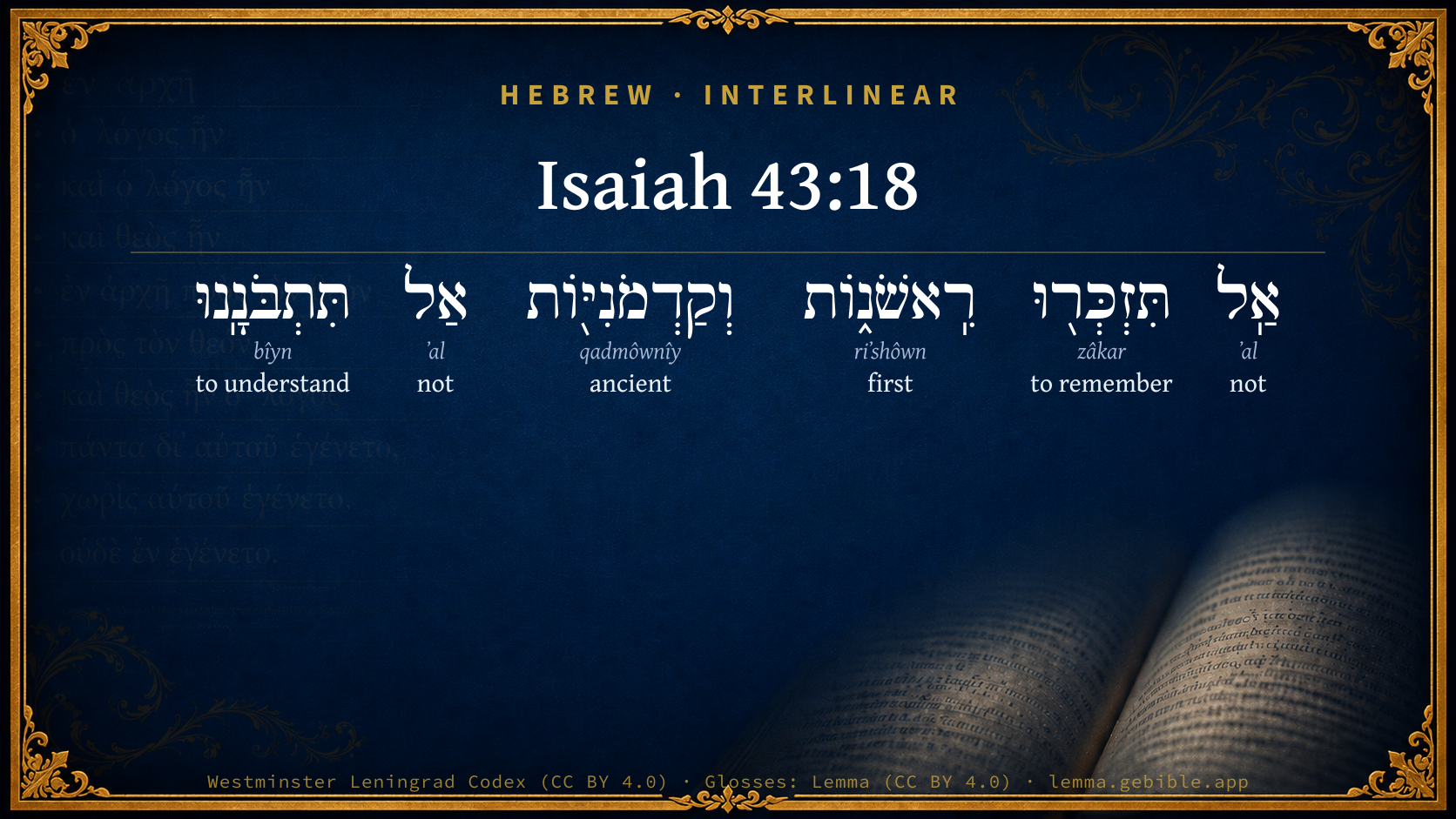
Hebrew (Westminster Leningrad Codex) Isaiah 43:18 appears in the Hebrew Old Testament. The text above is from the Westminster Leningrad Codex. Each word links to its Strong’s number, a concise gloss, and parsing drawn from the Open Scriptures Hebrew Bible morphology. Click any word for its full Brown-Driver-Briggs (BDB) entry.
Download image
Cite this verse

Isaiah 43:18 (World English Bible). Public Domain. Lemma interlinear Bible study tool, https://lemma.gebible.app/v/isaiah/43/18.

Show BibTeX & RIS
BibTeX
RIS
English Translation
Don't remember the former things, neither consider the things of old.
World English Bible · Public Domain
Download a study sheet

One document with this verse’s original text, its word-by-word gloss line, the meaning frame, cross-references with their text, attributed commentary, and full source and license credits — printable, and it pastes into notes with its structure intact.

This verse Autodidact and up

Study sheet (.html) Plain text (.txt)

A passage Seminary Student

Up to 50 verses in one chapter. A passage sheet keeps up to 6 commentary sources and 12 cross-references per verse, in the order this page ranks them, and says so on the sheet whenever that leaves anything out. Ask for a single verse and you get the Autodidact verse sheet above.

Everything on this page stays free to read, with no account — the sheet is a download of what is already on screen, not access to it.

Want to remove ads? Support Godless Engineer
Compare translations 3

The same verse in 3 English versions, stacked beneath the original-language interlinear above. Click any original word for its lexicon entry.

Each is an independent rendering of the whole verse — the interlinear is not word-aligned to these translations.

Highlighted words mark where these versions differ — a whole-verse word diff, not a word-by-word alignment.

  • World English Bible Public Domain
    Don't remember the former things, neither consider the things of old.
  • King James Version Public Domain
    Remember ye not the former things, neither consider the things of old.
  • unfoldingWord Literal Text CC BY-SA 4.0
    “May you not remember the former, and may you not regard the ancient.

unfoldingWord Literal Text — © unfoldingWord, licensed CC BY-SA 4.0. Word-aligned USFM3 via Door43 (git.door43.org/unfoldingWord/en_ult).

Versions to compare (up to 4)

3 of 4 selected

Show all 18 translations

Every available English version of this verse, each an independent rendering of the whole verse.

  • World English Bible Public Domain
    Don't remember the former things, neither consider the things of old.
  • Berean Standard Bible Public Domain
    “Do not call to mind the former things; pay no attention to the things of old.
  • Majority Standard Bible Public Domain
    “Do not call to mind the former things; pay no attention to the things of old.
  • King James Version Public Domain
    Remember ye not the former things, neither consider the things of old.
  • American Standard Version (1901) Public Domain
    Remember ye not the former things, neither consider the things of old.
  • Revised Version (1885) Public Domain
    Remember ye not the former things, neither consider the things of old.
  • Geneva Bible (1599) Public Domain
    Remember yee not the former things, neither regard the things of olde.
  • Douay-Rheims (1899) Public Domain
    Remember not former things, and look not on things of old.
  • Young's Literal Translation Public Domain
    Remember not former things, And ancient things consider not.
  • Literal Standard Version CC BY-SA 4.0
    Do not remember former things, || And do not consider ancient things.
  • Unlocked Literal Bible CC BY-SA 4.0
    “Do not think about these former things, nor consider the things of long ago.
  • unfoldingWord Literal Text CC BY-SA 4.0
    “May you not remember the former, and may you not regard the ancient.
  • Darby Bible Public Domain
    -- Remember not the former things, neither consider the ancient things:
  • World Messianic Bible Public Domain
    “Don’t remember the former things, and don’t consider the things of old.
  • Webster's Bible Public Domain
    Remember ye not the former things, neither consider the things of old.
  • Free Bible Version CC BY-SA 4.0
    But don't dwell on the past; don't concentrate on what happened back then.
  • Bible in Basic English Public Domain
    Give no thought to the things which are past; let the early times go out of your minds.
  • JPS Tanakh (1917) Public Domain
    Remember ye not the former things, neither consider the things of old.

Literal Standard Version (2020), Covenant Press — licensed CC BY-SA 4.0. Text via the HelloAO Bible API (eBible.org). Unlocked Literal Bible (unfoldingWord) — licensed CC BY-SA 4.0. Text via the HelloAO Bible API (eBible.org). unfoldingWord Literal Text — © unfoldingWord, licensed CC BY-SA 4.0. Word-aligned USFM3 via Door43 (git.door43.org/unfoldingWord/en_ult). Free Bible Version, Dr. Jonathan Gallagher — licensed CC BY-SA 4.0. Text via the HelloAO Bible API (eBible.org).

Word by word

More ways to search: Search by grammar → Find every occurrence → Compare this word →

Practice this passage: Drill this verse → Learn its vocabulary →

About this verse

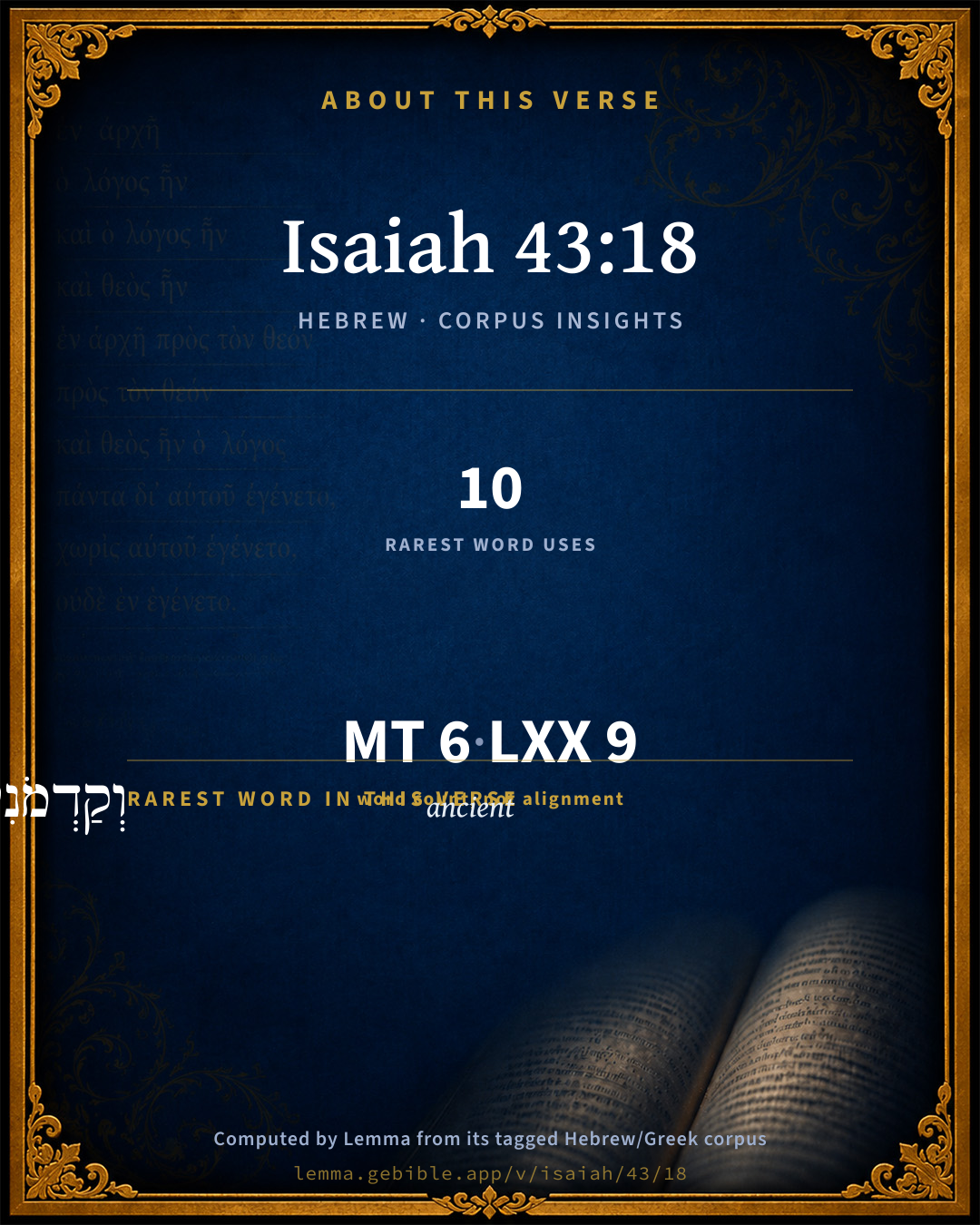
These counts appear in no published source. They are computed here, from the morphology-tagged text and Lemma’s own curated glosses. What Lemma adds →

6
words
5
distinct lemmas
Prophets
section

Notable vocabulary

The rarest word here is וְקַדְמֹנִיּ֖וֹת ancient H6931 — appearing just 10 times in the whole Hebrew Bible.

Shared distinctive vocabulary

וְקַדְמֹנִיּ֖וֹת ancient H6931 occurs in 10 verses of the Hebrew Bible. Also found in:

Grammatical profile

  • 2 verbs
  • 2 adjectives
  • 2 particles

Verb forms

  • תִּזְכְּר֖וּ Qal · Jussive
  • תִּתְבֹּנָֽנוּ Hithpolel · Jussive

Repetition

A word recurs within this verse — often emphatic in Hebrew:

  • אַֽל not H408 ×2

Hebrew & Septuagint length

In English translation the verse runs 11 words from the Hebrew and 12 from the Septuagint (LXX English) — closely comparable.

A rough comparison of the two English renderings, which tokenize alike — not a word-level alignment.

Word counts can differ between the Hebrew and the Greek without any difference in meaning — e.g. the Hebrew direct-object marker אֵת has no separate Greek word, and Greek often adds the article ὁ.

In the original languages it is 6 Hebrew tokens and 9 Greek tokens — but the two are counted differently (Hebrew bundles its prefixes and suffixes into one token; the Greek is in lemma form), so that isn’t a like-for-like length.

Cross-references

8

Topical passages linked to Isaiah 43:18 in the Treasury of Scripture Knowledge — connected by theme and wording, ordered by reader-vote popularity; previews shown in the World English Bible.

  • Isaiah 65:17 For, behold, I create new heavens and a new earth; and the former things shall not be remembered, nor come into mind.
  • 2 Corinthians 3:10 For most assuredly that which has been made glorious has not been made glorious in this respect, by reason of the glory that surpasses.
  • 1 Chronicles 16:12 Remember his marvelous works that he has done, His wonders, and the judgments of his mouth,
  • Deuteronomy 8:2 You shall remember all the way which Yahweh your God has led you these forty years in the wilderness, that he might humble you, to prove you, to know what was in your heart, whether you would keep his commandments, or not.
  • Isaiah 46:9 Remember the former things of old: for I am God, and there is none else; [I am] God, and there is none like me;
  • Jeremiah 16:14–15 Therefore, behold, the days come, says Yahweh, that it shall no more be said, As Yahweh lives, who brought up the children of Israel out of the land of Egypt;
  • Deuteronomy 7:18 you shall not be afraid of them: you shall well remember what Yahweh your God did to Pharaoh, and to all Egypt;
  • Jeremiah 23:7–8 Therefore, behold, the days come, says Yahweh, that they shall no more say, As Yahweh lives, who brought up the children of Israel out of the land of Egypt;

Cross-references courtesy of OpenBible.info (CC BY 4.0).

Hebrew and Greek witnesses Masoretic Hebrew ↔ Greek Septuagint

The same verse in the two great witnesses to the Old Testament, shown verse-for-verse.

These are two independent witnesses, not word-aligned to each other, and the Septuagint is shown in lemma (dictionary) form.

Hebrew Isaiah 43:18 Masoretic · Westminster Leningrad Codex

אַֽל תִּזְכְּר֖וּ רִֽאשֹׁנ֑וֹת וְקַדְמֹנִיּ֖וֹת אַל תִּתְבֹּנָֽנוּ

Don't remember the former things, neither consider the things of old.

World English Bible · Public Domain

Greek LXX Isaiah 43:18 Septuagint · lemma form

μή μνημονεύω ὁ πρῶτος καί ὁ ἀρχαῖος μή συνλογίζομαι

Remember you⌃ not the former things, and consider not the ancient things.

LXX2012 (modern English Septuagint) · Public Domain

Hebrew: Westminster Leningrad Codex (CC BY 4.0). Greek: Septuagint (public domain); English from LXX2012 (modern English Septuagint) (Public Domain). How the Septuagint differs from the Hebrew →

Targum (Aramaic paraphrase)

1

The Targum is the ancient Jewish Aramaic paraphrase of the Hebrew Scriptures — an interpretive translation, not the Hebrew text itself. Onkelos (literal) and Pseudo-Jonathan (expansive) render the Torah, and Jonathan the Prophets. Coverage is partial: where no permissively-licensed English translation exists for a verse, only the Aramaic is shown. This is verse-level text, not a word-by-word alignment to the Hebrew.

  1. Targum Jonathan Prophets (Joshua–Malachi)
    לָא תִדְכְּרוּן קַדְמָיָתָא וּדְמִן אַוְלָא לָא תִסְתַּכְּלוּן:

    Remember not the former things, neither consider the things of old.

    Targum Jonathan — Aramaic: “Mikraot Gedolot” (public domain). English: “Sefaria Community Translation” (CC0 1.0 (public-domain dedication)); “London "Chaldee Paraphrase," 1871” (public domain). Text via Sefaria.

Commentary

Notes on Isaiah 43:18 from classic Christian and Jewish commentators (each source and its license shown beneath its notes). The classic Christian expositions comment on the surrounding passage and are grouped to its opening verse, so a note may address several verses; the Jewish commentaries on the Tanakh (Rashi and others) are per-verse, so they appear only where the commentator wrote on this verse.

Lemma curates 59 commentaries, every one of them public domain or Creative Commons licensed, each selected and text-cleaned for this edition rather than reprinted as found. About our sources →

Trapp's Complete Commentary

John Trapp

Isa 43:18 Remember ye not the former things, neither consider the things of old.

Ver. 18. Remember ye not the former things,] sc., In comparison of those things I shall now do for you by Cyrus, but especially by Christ, who is that way in the wilderness, and that running rock. {1Co 10:4 Isa 43:14}

John Trapp, A Commentary or Exposition upon All the Books of the Old and New Testament (1647–1656) — public domain. Text from a community e-Sword module.

Joseph Benson's Commentary

Isa 43:18-19. Remember ye not the former things — But although your former deliverance out of Egypt was in itself a most glorious work, which you ought always to remember and consider; yet this other work, of your deliverance out of Babylon, and those blessings which shall follow upon it, and particularly that of sending the Messiah, shall be so transcendent a favour, that, in comparison thereof, all your former deliverances are scarcely worthy of your remembrance and consideration. See two parallel texts, Jer 16:14-15; Jer 23:5-8. From which passages laid together it appears that this latter deliverance, compared with that out of Egypt, is not to be confined to their restoration from captivity, but to be extended to the consequences thereof, and especially to the redemption of the Messiah. Indeed, otherwise the deliverance from Egypt was more glorious and wonderful, in many respects, than that out of Babylon. Behold, I will do a new thing — Such a work as was never yet done in the world. Now it shall spring forth — The Scripture often speaks of things at a great distance of time, as if they were now at hand, to make us sensible of the inconsiderableness of time and all temporal things, in comparison of God and eternal things; upon which account it is said, that a thousand years are in God’s sight but as one day. Shall ye not know it? — Certainly, you Jews shall know it by experience, and shall find I do not deceive you with vain hopes. I will make a way in the wilderness, &c. — I will give you direction and provision in the wilderness, where there is commonly no path, and where all necessaries are wanting; which, as it literally speaks of God’s conducting them through the great desert which lay between Babylon and Judea, so it is mystically meant of those spiritual blessings which God, in and through Christ, would confer upon all his people, not the Jews only, but also the Gentiles, who, in prophetical language, are often compared to a wilderness.

Joseph Benson's Commentary on the Old and New Testaments (1811–1818) — public domain. Text from a community e-Sword module.

Tyndale Open Study Notes

Tyndale Open Resources

43:18 God did not want the Israelites to forget the exodus from Egypt. However, they needed to look forward in faith to the spectacular event that was about to occur rather than dwelling on the past.

Tyndale Open Study Notes — © Tyndale Open Resources, licensed CC BY-SA 4.0. Text via the HelloAO Bible API.

Jamieson, Fausset & Brown

Robert Jamieson, A. R. Fausset & David Brown

So wonderful shall be God's future interpositions in your behalf, that all past ones shall be forgotten in comparison. Plainly the future restoration of Israel is the event ultimately meant. Thus the "former things" are such events as the destruction of Sennacherib and the return from Babylon. "Things of old" are events still more ancient, the deliverance from Egypt and at the Red Sea, and entry into Canaan [VITRINGA].

Jamieson, Fausset & Brown — Commentary Critical and Explanatory on the Whole Bible (1871) — public domain (CC PDM 1.0). Text via the HelloAO Bible API.

Ellicott's Commentary for English Readers

(18, 19) Remember ye not . . .—All the wonders of the great historic past of Israel were to be as nothing compared with the new manifestation of the power of Jehovah, which Isaiah sees as already dawning in the future.

Shall ye not know it?—Better, Will ye not give heed to it?

I will even make a way in the wilderness . . .—The literal and the spiritual senses melt into each other. The very beasts of the field shall lose their ferocity in the presence of the saints of God. For “dragons and owls,” read jackals and ostriches.

A Bible Commentary for English Readers, edited by Charles John Ellicott (1878–1897) — public domain. Text from a community e-Sword module.

The Cambridge Bible for Schools and Colleges

gen. ed. J. J. S. Perowne

18. Great as the wonders of the exodus were they shall be far surpassed by that which Jehovah is about to do. The verse resumes the opening clause of Isa_43:16.

Remember ye not …] Cf. Jer_16:14 f., Isa_23:7 f. It is not meant of course that the exodus shall be actually forgotten (see ch. Isa_46:9), but only that it shall no longer be the supreme instance of Jehovah’s redeeming power.

former things … things of old] Cf. ch. Isa_46:9. Obviously the expression “former things,” so often used of past events predicted, here includes the remote incidents of the deliverance from Egypt.

The Cambridge Bible for Schools and Colleges (gen. ed. J. J. S. Perowne; Cambridge University Press, 1878–1918) — public domain. Text from a community e-Sword module.

John Gill's Exposition

Behold, I will do a new thing,.... A wonderful and unheard of thing, and therefore introduced with a "behold", as a note of admiration; the same with the new thing created in the earth, Jer 31:22, the incarnation of the Son of God; who took flesh of a virgin, appeared in the likeness of sinful flesh, and was made sin and a curse for his people, in order to obtain eternal redemption for them; which blessing, though not newly thought of, resolved on, contrived, and agreed upon, that being from eternity; nor newly made known, or as to the virtue and efficacy of it, which had been from the beginning of the world, yet new as to the impetration of it by the blood and sacrifice of Christ; and may be also called "new", because excellent, it being of a spiritual nature, complete and eternal, and having so many valuable blessings in it, as justification, pardon, and eternal life:

now it shall spring forth; or bud forth as a branch, in a very short time, suddenly, and at once; one of the Messiah's names is that of the Branch; see Zac 3:8,

shall ye not know it? the Redeemer, and the redemption by him. It was known to them that looked for it, and to whom the Gospel is sent, and the Spirit reveals and applies it; these know the nature of it, own it to be of God, and know their interest in it, and know the author of it, in whom they have believed, by the characters given of him: and as this may have respect to the redemption of Christ, so to the conversion of the Gentiles, and to the grace of God dispensed through Christ to them; when old things passed away, and all things became new; a new covenant of grace was exhibited, a new church state set up, new ordinances appointed, and a new people called to partake of all this, on whom was a new face of things; and wonderful and excellent things were done for them, as follows:

I will even make a way in the wilderness; as there was a way made for the Israelites through the wilderness, which lay between Egypt and Canaan; and through another, which lay between Babylon and Judea; so the Lord would also make a way in the Gentile world, comparable to a wilderness for its barrenness and unfruitfulness, for the Gospel to enter into it, where it should run, and be glorified; where Christ, the way of salvation, should be made known; and where there should be a way for Christians to walk together, in the fellowship of the Gospel:

and rivers in the desert; the doctrines of the Gospel, and the ordinances of it, which should be preached and administered in the Gentile world, before like a desert; and the graces of the Spirit, which should be brought into the hearts of men by means of them; and the large communications of grace from Christ; and the discoveries of the love of God, with the blessings of it; compared to rivers for their abundance, and for the comforting, reviving, and fructifying nature of them.

John Gill's Exposition of the Whole Bible (1746–1763) — public domain (CC PDM 1.0). Text via the HelloAO Bible API.

Albert Barnes' Notes on the Bible

Remember ye not ... - So great and wonderful shall be God’s future interpositions in your behalf, that what he has done, great as that was, shall be comparatively forgotten.

The former things - The deliverance from Egypt, and the overthrow of his enemies there.

The things of old - The things that were formerly done.

Albert Barnes' Notes on the Bible (1834–1885) — public domain. Text from a community e-Sword/MySword module.

Matthew Poole's English Annotations

But although your former deliverance out of Egypt was in itself a most glorious work, which you ought always to remember and consider; yet this other work of your deliverance out of Babylon by Cyrus, and those blessings which shall follow upon it, and particularly that inestimable mercy of sending the Messiah, shall be so transcendent a layout, that, in comparison thereof, all your former deliverances are scarce worthy of your remembrance and consideration. Which exposition is confirmed by two parallel texts, Jer 16:14,15; 23:7,8. From all which texts laid together, it appears that this latter deliverance, compared with that out of Egypt, is not to be confined to their freedom from the Babylonish captivity, but to be extended to the consequences of it, and especially to the redemption by Christ, because otherwise that Egyptian deliverance was more glorious and wonderful in many respects than the Babylonian.

Matthew Poole's English Annotations on the Holy Bible (1683–1685) — public domain. Text from a community e-Sword/MySword module.

Whedon's Commentary on the Bible

Daniel D. Whedon

18. Remember ye not — An exhortation not to “remember” the fleeing dwellers, or that event, marvellous as that was: a more marvellous one is to come.

Daniel D. Whedon (gen. ed.), Commentary on the Old and New Testaments (1874–1909) — public domain. Text from a community e-Sword module.

The Pulpit Commentary

Remember ye not the former things. The old deliverance will be as nothing compared with the new. Israel must cast its eye forwards, not backwards. Mr. Cheyne well compares Jer_23:7, Jer_23:8, and also well notes that "the chief glories of the second manifestation are spiritual." Israel in the wilderness was a stiff-necked and rebellious people, given to murmuring, licentiousness, and idolatry. Israel, returned from Babylon, will no more hanker after idols, but will have God"s Law "put in their inward parts", (Jer_32:33) and will "show forth God"s praise" (ver. 21).

The Pulpit Commentary (1880–1919), ed. H.D.M. Spence-Jones & Joseph S. Exell — public domain. Text from a community e-Sword module.

John Wesley's Explanatory Notes

Remember not - Tho' your former deliverance out of Egypt was glorious: yet in comparison of that inestimable mercy of sending the Messiah, all your former deliverances are scarce worthy of your remembrance and consideration.

John Wesley, Explanatory Notes Upon the Whole Bible (1754–1765) — public domain. Text via the GEBible commentary corpus.

J. A. Alexander on Isaiah

Joseph Addison Alexander

“Remember not former things, and old things consider not.” As if He had said, why should I refer to ancient instances of God’s almighty intervention in behalf of His people, when others equally remarkable are yet to come? Some refer this to the advent of Christ, but most to the fall of Babylon and restoration of the Jews from exile. The necessity of this specific application by no means follows from the express mention of that event in v. 14; because, as we have seen, it is there introduced as a single illustration or example of a general truth, which had before been stated, and which may possibly be here repeated. This supposition is at least sufficient to meet all the requisitions of the text and context.

Joseph Addison Alexander, The Prophecies of Isaiah (1846–1847; New York: Scribner, 1870–1878) — public domain. Text from a community e-Sword module.

unfoldingWord translationNotes

Door43 World Missions Community

General Information:

Yahweh continues speaking to the people of Israel.

Do not think about these former things, nor consider the things of long ago.

These two phrases mean basically the same thing and emphasize that they are not to worry about what happened in the past. (See: Parallelism)

Look

This word is used to draw attention to the important information that follows. AT: "Listen" or "Pay attention"

do you not perceive it?

Yahweh uses a question to teach the people of Israel. This rhetorical question can be translated as a statement. AT: "surely you have noticed it." (See: Rhetorical Question)

translationWords

desert

unfoldingWord translationNotes — © Distant Shores Media and the Door43 World Missions Community, licensed CC BY-SA 4.0. Source: git.door43.org/Door43/en_tn.

Rashi

Rabbi Shlomo Yitzchaki (Rashi)

Remember not the first events These miracles that I mention to you, that I performed in Egypt do not remember them from now on, for you shall be engaged in this redemption, to thank and to praise.

do not meditate Do not ponder about them; do not pay attention to them.

Rashi on the Tanakh — English translations: “The Judaica Press complete Tanach with Rashi, translated by A. J. Rosenberg” (CC BY 4.0); “Pentateuch with Rashi's commentary by M. Rosenbaum and A.M. Silbermann, 1929-1934” (public domain); “The Metsudah Tanach series, Lakewood, N.J” (CC BY 4.0); and “The Book of Joshua, Metsudah Publications, 1997” (CC BY 4.0). Text via Sefaria.

Ibn Ezra

Rabbi Abraham ibn Ezra

Remember ye not by words, the former wonders.

Neither consider them in your minds.

Ibn Ezra on the Tanakh — English translations: “Sefaria Community Translation” (CC0 1.0 (public-domain dedication)); “Yalkut, Sifsei Chachomim Chumash, Metsudah Publications, 2009” (CC BY 4.0); and “Commentary of Ibn Ezra on Isaiah - trans. by M. Friedlander, 1873” (public domain). Text via Sefaria.

Lesson kit

Teaching starters — assembled from the data on this page, not authored interpretation. Every prompt links to the verse data it draws on. Edit before teaching.

Isaiah, in the Prophets, opens this verse with 6 words (5 distinct Hebrew lemmas). Its most distinctive word is qadmôwnîy (“ancient”). A historical commentator’s framing appears above. Read the whole chapter for the surrounding context.

Discussion questions

  1. What does “ancient” (qadmôwnîy) contribute to the verse as a whole?
  2. How does 1 Samuel 24:13, which shares the word «ancient», read alongside this verse?
  3. What does the repetition of “not” (2× in this one verse) do in this verse?
  4. The translations on this page render this verse differently — a whole-verse word diff, not a word-by-word alignment. What might account for the different wordings?
  5. «תִּזְכְּר֖וּ» is a Qal Jussive verb. How does that grammatical form shape the action described?
  6. Compare how Trapp's Complete Commentary and Joseph Benson's Commentary read this verse. Where do they agree or differ?

Things to notice

Reading settings

Reading text

Shown beneath each verse's original-language words.

Old Testament
Old Testament edition

Read the OT as the Masoretic Hebrew (MT) or the Greek Septuagint (LXX).

English shown for the Greek Septuagint (in the Hebrew ↔ Greek comparison).

Comparing translations? Open the Compare panel on any verse page to stack up to four side by side.