Daniel 11:37

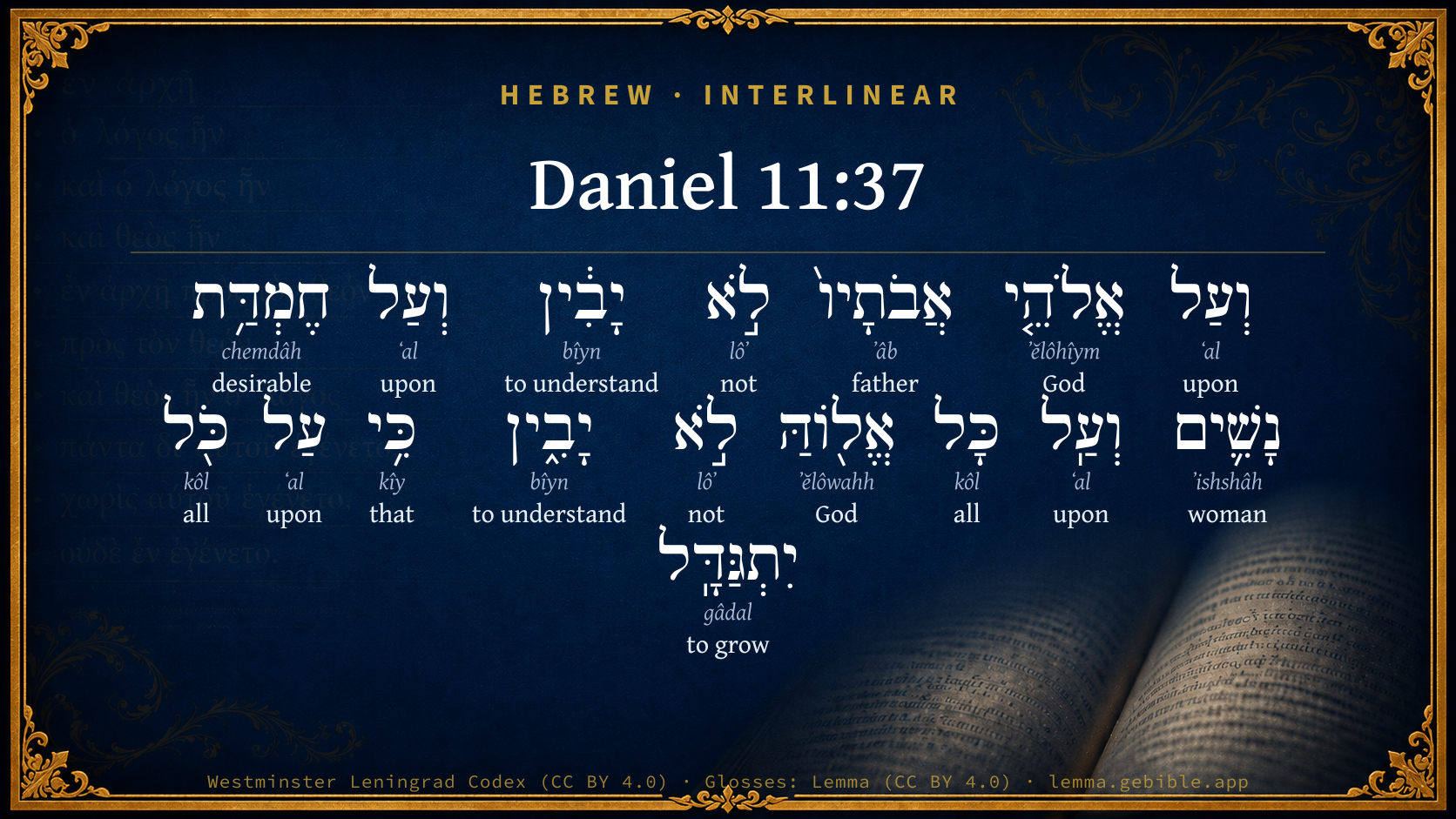
Hebrew (Westminster Leningrad Codex) Daniel 11:37 appears in the Hebrew Old Testament. The text above is from the Westminster Leningrad Codex. Each word links to its Strong’s number, a concise gloss, and parsing drawn from the Open Scriptures Hebrew Bible morphology. Click any word for its full Brown-Driver-Briggs (BDB) entry.
Download image
Cite this verse

Daniel 11:37 (World English Bible). Public Domain. Lemma interlinear Bible study tool, https://lemma.gebible.app/v/daniel/11/37.

Show BibTeX & RIS
BibTeX
RIS
English Translation
Neither shall he regard the gods of his fathers, nor the desire of women, nor regard any god; for he shall magnify himself above all.
World English Bible · Public Domain
Download a study sheet

One document with this verse’s original text, its word-by-word gloss line, the meaning frame, cross-references with their text, attributed commentary, and full source and license credits — printable, and it pastes into notes with its structure intact.

This verse Autodidact and up

Study sheet (.html) Plain text (.txt)

A passage Seminary Student

Up to 50 verses in one chapter. A passage sheet keeps up to 6 commentary sources and 12 cross-references per verse, in the order this page ranks them, and says so on the sheet whenever that leaves anything out. Ask for a single verse and you get the Autodidact verse sheet above.

Everything on this page stays free to read, with no account — the sheet is a download of what is already on screen, not access to it.

Want to remove ads? Support Godless Engineer
Compare translations 3

The same verse in 3 English versions, stacked beneath the original-language interlinear above. Click any original word for its lexicon entry.

Each is an independent rendering of the whole verse — the interlinear is not word-aligned to these translations.

Highlighted words mark where these versions differ — a whole-verse word diff, not a word-by-word alignment.

  • World English Bible Public Domain
    Neither shall he regard the gods of his fathers, nor the desire of women, nor regard any god; for he shall magnify himself above all.
  • King James Version Public Domain
    Neither shall he regard the God of his fathers, nor the desire of women, nor regard any god: for he shall magnify himself above all.
  • unfoldingWord Literal Text CC BY-SA 4.0
    He will pay no attention to the gods of his fathers or to the one desired by women. Neither will he pay attention to any other god. For he will magnify himself above all.

unfoldingWord Literal Text — © unfoldingWord, licensed CC BY-SA 4.0. Word-aligned USFM3 via Door43 (git.door43.org/unfoldingWord/en_ult).

Versions to compare (up to 4)

3 of 4 selected

Show all 18 translations

Every available English version of this verse, each an independent rendering of the whole verse.

  • World English Bible Public Domain
    Neither shall he regard the gods of his fathers, nor the desire of women, nor regard any god; for he shall magnify himself above all.
  • Berean Standard Bible Public Domain
    He will show no regard for the gods of his fathers, nor for the one desired by women, nor for any other god, because he will magnify himself above them all.
  • Majority Standard Bible Public Domain
    He will show no regard for the gods of his fathers, nor for the one desired by women, nor for any other god, because he will magnify himself above them all.
  • King James Version Public Domain
    Neither shall he regard the God of his fathers, nor the desire of women, nor regard any god: for he shall magnify himself above all.
  • American Standard Version (1901) Public Domain
    Neither shall he regard the gods of his fathers, nor the desire of women, nor regard any god; for he shall magnify himself above all.
  • Revised Version (1885) Public Domain
    Neither shall he regard the gods his fathers, nor the desire of women, nor regard any god: for he shall magnify himself above all.
  • Geneva Bible (1599) Public Domain
    Neither shall he regard the God of his fathers, nor the desires of women, nor care for any God: for he shall magnifie himselfe aboue all.
  • Douay-Rheims (1899) Public Domain
    And he shall make no account of the God of his fathers: and he shall follow the lust of women, and he shall not regard any gods: for he shall rise up against all things.
  • Young's Literal Translation Public Domain
    And unto the God of his fathers he doth not attend, nor to the desire of women, yea, to any god he doth not attend, for against all he magnifieth himself.
  • Literal Standard Version CC BY-SA 4.0
    And to the God of his fathers he does not attend, nor to the desire of women, indeed, he does not attend to any god, for he magnifies himself against all.
  • Unlocked Literal Bible CC BY-SA 4.0
    He will pay no attention to the gods of his ancestors or to the god desirable to women. Neither will he will pay attention to any other god. For all above every one he will make himself great.
  • unfoldingWord Literal Text CC BY-SA 4.0
    He will pay no attention to the gods of his fathers or to the one desired by women. Neither will he pay attention to any other god. For he will magnify himself above all.
  • Darby Bible Public Domain
    And he will not regard the God of his fathers, nor the desire of women; nor regard any +god: for he will magnify himself above all.
  • World Messianic Bible Public Domain
    He won’t regard the gods of his fathers, or the desire of women, or regard any god; for he will magnify himself above all.
  • Webster's Bible Public Domain
    Neither shall he regard the God of his fathers, nor the desire of women, nor regard any god: for he shall magnify himself above all.
  • Free Bible Version CC BY-SA 4.0
    He will have no time for the gods of his forefathers, nor for the one loved by women, nor for any other god, for he considers himself greater than any of these.
  • Bible in Basic English Public Domain
    He will have no respect for the gods of his fathers or for the god desired by women; he will have no respect for any god: for he will put himself on high over all.
  • JPS Tanakh (1917) Public Domain
    Neither shall he regard the gods of his fathers; and neither the desire of women, nor any god, shall he regard; for he shall magnify himself above all.

Literal Standard Version (2020), Covenant Press — licensed CC BY-SA 4.0. Text via the HelloAO Bible API (eBible.org). Unlocked Literal Bible (unfoldingWord) — licensed CC BY-SA 4.0. Text via the HelloAO Bible API (eBible.org). unfoldingWord Literal Text — © unfoldingWord, licensed CC BY-SA 4.0. Word-aligned USFM3 via Door43 (git.door43.org/unfoldingWord/en_ult). Free Bible Version, Dr. Jonathan Gallagher — licensed CC BY-SA 4.0. Text via the HelloAO Bible API (eBible.org).

Word by word

More ways to search: Search by grammar → Find every occurrence → Compare this word →

Practice this passage: Drill this verse → Learn its vocabulary →

חֶמְדַּ֥ת
chemdâh
H2532
“desirable of”
Noun, Common, Feminine, Singular, Construct
Part of Speech
Noun
Type
Common
Gender
Feminine
Number
Singular
State
Construct
Full BDB Definition

Origin: from H2531

TWOT: 673b

desire, that which is desirable (noun feminine) - pleasant, precious (adjective)
  1. וְעַל ʻal H5921 “and · upon” Conjunction + Preposition
  2. אֱלֹהֵ֤י ʼĕlôhîym H430 “God(s) of” Noun, Common, Masculine, Plural, Construct
  3. אֲבֹתָיו֙ ʼâb H1 “fathers · his” Noun, Common, Masculine, Plural, Construct + Suffix, Personal, 3rd Person, Masculine, Singular
  4. לֹ֣א lôʼ H3808 “not” Particle, Negative
  5. יָבִ֔ין bîyn H995 “to understand” Verb, Qal, Imperfect, 3rd Person, Masculine, Singular
  6. וְעַל ʻal H5921 “and · upon” Conjunction + Preposition
  7. נָשִׁ֛ים ʼishshâh H802 “women” Noun, Common, Feminine, Plural, Absolute
  8. וְעַֽל ʻal H5921 “and · upon” Conjunction + Preposition
  9. כָּל kôl H3605 “all of” Noun, Common, Masculine, Singular, Construct
  10. אֱל֖וֹהַּ ʼĕlôwahh H433 “God” Noun, Common, Masculine, Singular, Absolute
  11. לֹ֣א lôʼ H3808 “not” Particle, Negative
  12. יָבִ֑ין bîyn H995 “to understand” Verb, Qal, Imperfect, 3rd Person, Masculine, Singular
  13. כִּ֥י kîy H3588 “that” Conjunction
  14. עַל ʻal H5921 “upon” Preposition
  15. כֹּ֖ל kôl H3605 “all” Noun, Common, Masculine, Singular, Absolute
  16. יִתְגַּדָּֽל gâdal H1431 “to grow” Verb, Hithpael, Imperfect, 3rd Person, Masculine, Singular

About this verse

These counts appear in no published source. They are computed here, from the morphology-tagged text and Lemma’s own curated glosses. What Lemma adds →

17
words
11
distinct lemmas
Prophets
section

Notable vocabulary

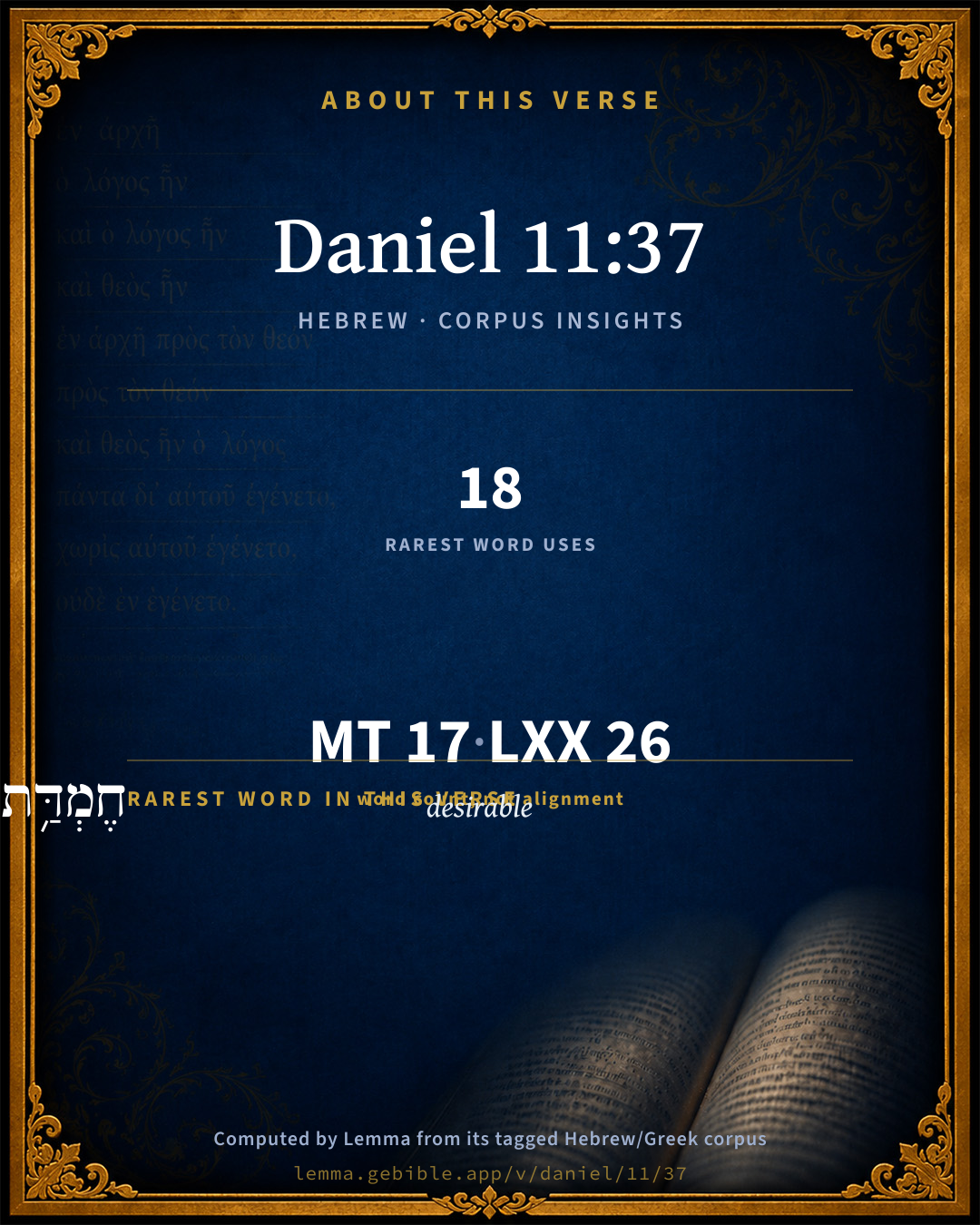
The rarest word here is חֶמְדַּ֥ת desirable H2532 — appearing just 18 times in the whole Hebrew Bible.

Shared distinctive vocabulary

חֶמְדַּ֥ת desirable H2532 occurs in 18 verses of the Hebrew Bible. Also found in:

Grammatical profile

  • 3 verbs
  • 7 nouns
  • 4 prepositions
  • 1 conjunction
  • 2 particles

Verb forms

  • יָבִ֔ין Qal · Imperfect
  • יָבִ֑ין Qal · Imperfect
  • יִתְגַּדָּֽל Hithpael · Imperfect

Repetition

Words recur within this verse — often emphatic in Hebrew:

  • וְעַל upon H5921 ×4
  • יָבִ֔ין to understand H995 ×2
  • כָּל all H3605 ×2
  • לֹ֣א not H3808 ×2

Hebrew & Septuagint length

In English translation the verse runs 25 words from the Hebrew and 28 from the Septuagint (LXX English) — closely comparable.

A rough comparison of the two English renderings, which tokenize alike — not a word-level alignment.

Word counts can differ between the Hebrew and the Greek without any difference in meaning — e.g. the Hebrew direct-object marker אֵת has no separate Greek word, and Greek often adds the article ὁ.

In the original languages it is 17 Hebrew tokens and 26 Greek tokens — but the two are counted differently (Hebrew bundles its prefixes and suffixes into one token; the Greek is in lemma form), so that isn’t a like-for-like length.

Cross-references

9

Topical passages linked to Daniel 11:37 in the Treasury of Scripture Knowledge — connected by theme and wording, ordered by reader-vote popularity; previews shown in the World English Bible.

  • Isaiah 14:13 You said in your heart, I will ascend into heaven, I will exalt my throne above the stars of God; and I will sit on the mountain of congregation, in the uttermost parts of the north;
  • 2 Thessalonians 2:4 he who opposes and exalts himself against all that is called God or that is worshiped; so that he sits as God in the temple of God, setting himself up as God.
  • 1 Timothy 4:3 forbidding marriage and commanding to abstain from foods which God created to be received with thanksgiving by those who believe and know the truth.
  • Genesis 3:5 for God knows that in the day you eat it, your eyes will be opened, and you will be like God, knowing good and evil."
  • Genesis 3:16 To the woman he said, "I will greatly multiply your pain in childbirth. In pain you will bring forth children. Your desire will be for your husband, and he will rule over you."
  • Deuteronomy 5:21 "Neither shall you covet your neighbor's wife; neither shall you desire your neighbor's house, his field, or his man-servant, or his maid-servant, his ox, or his donkey, or anything that is your neighbor's."
  • Deuteronomy 21:11 and see among the captives a beautiful woman, and you have a desire to her, and would take her to you as wife;
  • Song of Solomon 7:10 I am my beloved's. His desire is toward me.
  • Ezekiel 24:16 Son of man, behold, I take away from you the desire of your eyes with a stroke: yet you shall neither mourn nor weep, neither shall your tears run down.

Cross-references courtesy of OpenBible.info (CC BY 4.0).

Hebrew and Greek witnesses Masoretic Hebrew ↔ Greek Septuagint

The same verse in the two great witnesses to the Old Testament, shown verse-for-verse.

These are two independent witnesses, not word-aligned to each other, and the Septuagint is shown in lemma (dictionary) form.

Hebrew Daniel 11:37 Masoretic · Westminster Leningrad Codex

וְעַל אֱלֹהֵ֤י אֲבֹתָיו֙ לֹ֣א יָבִ֔ין וְעַל חֶמְדַּ֥ת נָשִׁ֛ים וְעַֽל כָּל אֱל֖וֹהַּ לֹ֣א יָבִ֑ין כִּ֥י עַל כֹּ֖ל יִתְגַּדָּֽל

Neither shall he regard the gods of his fathers, nor the desire of women, nor regard any god; for he shall magnify himself above all.

World English Bible · Public Domain

Greek LXX Daniel 11:37 Septuagint · lemma form

καί ἐπί ὁ θεός ὁ πατήρ αὐτός οὐ μή προνοέω καί ἐν ἐπιθυμία γυνή οὐ μή προνοέω ὅτι ἐν πᾶς ὑψόω καί ὑποτάσσω αὐτός ἔθνος ἰσχυρός

And he shall not regard any gods of his fathers, nor the desire of women, neither shall he regard any deity: for he shall magnify himself above all.

LXX2012 (modern English Septuagint) · Public Domain

On this verse, The Pulpit Commentary discusses the Septuagint’s reading. Read the note in Commentary ↓

Hebrew: Westminster Leningrad Codex (CC BY 4.0). Greek: Septuagint (public domain); English from LXX2012 (modern English Septuagint) (Public Domain). How the Septuagint differs from the Hebrew →

Commentary

Notes on Daniel 11:37 from classic Christian and Jewish commentators (each source and its license shown beneath its notes). The classic Christian expositions comment on the surrounding passage and are grouped to its opening verse, so a note may address several verses; the Jewish commentaries on the Tanakh (Rashi and others) are per-verse, so they appear only where the commentator wrote on this verse.

Lemma curates 59 commentaries, every one of them public domain or Creative Commons licensed, each selected and text-cleaned for this edition rather than reprinted as found. About our sources →

Trapp's Complete Commentary

John Trapp

Dan 11:37 Neither shall he regard the God of his fathers, nor the desire of women, nor regard any god: for he shall magnify himself above all.

Ver. 37. Neither shall he regard the God of his fathers.] He shall disannul his own ancient religion, caring neither for the old mumpsimus, {a} nor the new sumpsimus, {b} as they say, but showing himself to be a rank atheist. See 1Ma 1:43.

Nor the desire of women,] scil., In an honest lawful way of matrimony; but be addicted to vagrant lust, yea, and to the sin against nature with women, as some sense it, a Deo prohibito et perdito, in which case the Turkish women, when so abused by their husbands (those filthy beasts), may sue a divorce; which they do by taking off their shoes before the judge, and holding them the soles upward, but speaking nothing, for the unnameableness of the fact. {c}

Nor regard any god.] See my Commonplace of Atheism.

{a} One who obstinately adheres to old ways, in spite of the clearest evidence that they are wrong; an ignorant and bigoted opponent of reform. ŒD

{b} A correct expression taking the place of an incorrect but popular one (mumpsimus). ŒD

{c} Sir Henry Blount’s Voyage into the Levant.

John Trapp, A Commentary or Exposition upon All the Books of the Old and New Testament (1647–1656) — public domain. Text from a community e-Sword module.

Joseph Benson's Commentary

Dan 11:37. Neither shall he regard the God of his fathers — The god or gods worshipped in his own native country, namely, Syria. He made laws to abolish the religion of his country, and to bring in the idols of the Greeks. And though his predecessors had honoured the God of Israel, and given great gifts to the temple at Jerusalem, (2Ma 3:2-3,) he did the greatest indignities to God and his temple. Nor the desire of women — This, as some think, means, nor the god that is loved and adored by women; and, taking the clause in connection with the context, this seems the most natural sense of it; for the whole verse speaks of the impiety, or irreligion, of Antiothus, that he had no regard to any god whatever. What god this was that was the desire of women, cannot be certainly said; it is probable it was the moon, (the queen of heaven, as they used to call her,) or some other of the heavenly luminaries; for the Syrian women are described in Scripture as particularly attached to these. Or the expression may refer to his barbarous cruelty, and be intended to signify that he should spare no age nor sex, and should have no regard to women, however lovely or amiable. In fact, the author of the Maccabees informs us, that by his command mothers were killed with their children; and that there was killing of young and old, men, women, and children, slaying of virgins and infants, 2Ma 5:13. Nor regard any god: for he shall magnify himself above all — He shall not regard the gods of any country whatsoever, but think himself above them, and treat them as if he were so. He was so proud, that he thought himself above the condition of a mortal man; that he could command the waves of the sea, and reach the stars of heaven, as his insolence and haughtiness are expressed 2Ma 9:8; 2Ma 9:10.

Joseph Benson's Commentary on the Old and New Testaments (1811–1818) — public domain. Text from a community e-Sword module.

Tyndale Open Study Notes

Tyndale Open Resources

11:37-38 no respect for the gods of his ancestors: Antiochus IV forsook the Syrian gods in order to worship Greek gods. • The god loved by women might be one of the Canaanite or Egyptian fertility deities. • No god of fortresses is known from history, but this description might be fulfilled by the lavish gifts that Antiochus gave to cities and to Greek temples, perhaps to increase his reputation and power (see Livy, History 41.20).

Tyndale Open Study Notes — © Tyndale Open Resources, licensed CC BY-SA 4.0. Text via the HelloAO Bible API.

Geneva Bible (1599)

Geneva Bible translators

Signifying that they should be without all humanity: for the love of women is taken for singular or great love, as 2 Sam. 1:26.

The Romans shall observe no certain form of religion as other nations, but shall change their gods at their pleasures, yea, contemn them and prefer themselves to their gods.

Geneva Bible (1599) marginal notes — public domain. Text via Bolls.life.

Jamieson, Fausset & Brown

Robert Jamieson, A. R. Fausset & David Brown

Neither . . . regard . . . the desire of women--(Compare Eze 24:16, Eze 24:18). The wife, as the desire of man's eyes, is the symbol of the tenderest relations (Sa2 1:26). Antiochus would set at naught even their entreaties that he should cease from his attack on Jehovah's worship [POLANUS]. MAURER refers it to Antiochus' attack on the temple of the Syrian Venus, worshipped by women (1 Maccabees 6:1, &c.; 2 Maccabees 1:13). NEWTON refers it to Rome's "forbidding to marry." ELLIOTT rightly makes the antitypical reference be to Messiah. Jewish women desired to be mothers with a view to Him, the promised seed of the woman (Gen 30:23; Luk 1:25, Luk 1:28).

nor regard any god-- (Th2 2:4).

Jamieson, Fausset & Brown — Commentary Critical and Explanatory on the Whole Bible (1871) — public domain (CC PDM 1.0). Text via the HelloAO Bible API.

Adam Clarke's Commentary

Verse 37. Neither shall he regard the God of his fathers] That God who sent the evangelists and apostles to preach the pure doctrine. These true fathers of the Christian Church, and their God, this Church has not regarded, but put councils, and traditions, and apocryphal writings in their place.

Nor the desire of women] Both the Greek and Latin Church, in their antichristian enactments, have discouraged, and in several cases proscribed, marriage, under the pretense of greater chastity, to the discredit of God's ordinance, and Christianity itself.

Nor regard any god] For the mandates and decrees of that Church have been often in defiance of God and his word, for it has magnified itself above all power and authority in heaven and on earth. It professes to hold the keys, and to open and shut heaven at pleasure, both to states and individuals.

Adam Clarke's Commentary on the Bible (1810–1826) — public domain. Text from a community e-Sword/MySword module.

John Calvin's Commentaries

I do not wonder at those who explain this prophecy of Antiochus, experiencing some trouble with these words; for they cannot satisfy themselves, because this prediction of the angel’s was never accomplished by Antiochus, who did neither neglect all deities nor the god of his fathers. Then, with regard to the love of women, this will not suit this person. But it is easy to prove by other reasons already mentioned, the absence of all allusion here to Antiochus. Some refer this prophecy to the Pope and to Mohammed, and the phrase, the love of women, seems to give probability to this view. For Mohammed allowed to men the brutal liberty of chastising their wives, and thus he corrupted that conjugal love and fidelity which binds the husband to the wife. Unless every man is content with a single wife, there can be no love, because there can be no conjugal happiness whenever rivalry exists between the inferior wives. As, therefore, Mohammed allowed full scope to various lusts, by permitting a man to have a number of wives, this seems like an explanation of his being inattentive to the love of women. Those who think the Pope to be intended here remind us of their enforcing celibacy, by means of which the honor of marriage is trodden under foot. We know with what foulness the Roman Pontiffs bark when marriage is hinted to them, as we may see in the decrees of Pope Siricius, in the seventh chapter of the first volume of the Councils. They quote the passage, Those who are in the flesh cannot please God; and thus compare marriage with fornication, thereby disgracefully and reproachfully throwing scorn upon an ordinance sanctioned by God. We observe, then, some slight correspondence, but the remaining points will not suit this idea. Some assert that as Mohammed invented a new form of religion, so did the Pope; true indeed, but neither of them are intended here, and the reason is, because God wished to sustain the spirits of his people until the first coming of Christ. Hence he predicts by his angel the sufferings to be endured by the Church until Christ was manifest in the flesh. We must now come to the Romans, of whom we began to explain the passage.

The angel says, The king shall pay no regard to the gods of his fathers. The application of this clause is at first sight obscure; but if we come to reflect upon the outrageous pride and barbarity of the Romans, we shall no longer doubt the meaning of the Prophets words. The angel states two circumstances; this king should be a despiser of all deities, and yet he should worship one god, while the singular and magnificent pomp displayed should exceed all common practices. These two points, so apparently opposite, were found united in the Romans. Our explanation will appear clearer by adding the following verses,

John Calvin's Commentaries (1540-1563) — public domain. Text from the Calvin Translation Society English edition (1840s-50s) via the Christian Classics Ethereal Library (ccel.org). Calvin's coverage is partial (roughly two-thirds of the Bible); uncommented books and verses are honest gaps, never fabricated. The 19th-century editor's footnotes and remarks are omitted so the notes are faithfully Calvin's own voice.

Ellicott's Commentary for English Readers

(37) Neither shall they.—A further description is now given of the godlessness of this king, but the people of Israel are no longer mentioned in their relation to him. The northern king appears twice again in Palestine (Dan_11:41; Dan_11:45), and apparently dies there. He discards his hereditary religion, he has no regard to that natural affection which women look upon as most desirable, but exalts himself over all.

Desire of women.—The language used by Isaiah (Isa_44:9), “delectable things,” has led some commentators to think that an idol is here intended. It has been stated that the allusion is to the Asiatic goddess of nature, Mylitta, who, again, has been identified with the “queen of heaven” (Jer_7:18, where see Notes). The context, however, leads us rather to think of human affection, or some other thing highly prized by women, for the words “neither shall he regard any god” would be unmeaning if a god were designated by “the desire of women.” It should be remembered that according to Polybius xxvi. 10, sec. 11, Antiochus exceeded all kings in the sacrifices which he offered at the gates, and in the honours which he paid to the gods.

In his estate—i.e., in the place of the God whom he has rejected, he will worship the “god of forces.” There is no reason for taking this to be a proper name, as is done by the Syriac translator and Theodotion. It can only mean “fortresses” (see margin), so that the whole religion of this king is the taking of fortresses. To him war is everything, and to war everything else must give way. To war, as if it were a god, he does honour with all his wealth.

A Bible Commentary for English Readers, edited by Charles John Ellicott (1878–1897) — public domain. Text from a community e-Sword module.

The Cambridge Bible for Schools and Colleges

gen. ed. J. J. S. Perowne

37. And the gods of his fathers he will not regard] The honours paid by him to foreign deities implied a depreciation of the gods of his own country. He was particularly devoted to the cult of Jupiter Capitolinus, or Zeus Olympios. Even before he became king, while halting at Athens on his way home from Rome, he contributed largely to the restoration of the Olympieion in that city; afterwards, he built in Daphne, the suburb of Antioch, a temple to Zeus Olympios, with a colossal statue of the god, modelled on the famous one of Pheidias at Olympia, and began, though he did not live to complete it, a yet more magnificent temple to him in Antioch itself (Livy xli. 20). His coins also exhibit constantly (on the obverse) the head of either Zeus Olympios or Apollo; and, as was just remarked, in those belonging to the latter part of his reign the king himself bears the title Νικηφόρος,—an epithet belonging properly to Zeus.

and neither the desire of women, nor any god, will he regard] The ‘desire of women’ must, from the context, be the designation of some divinity—most probably (Ewald, Bevan) Tammuz, a celebrated Syrian and Phœnician deity, known to the Greeks as Adonis, whose rites were popular among women.

Adonis in the legend was a beautiful youth, the dearly loved spouse of Aphroditè, snatched from her by a cruel fate, and bitterly bewailed by her. The festival of Adonis consisted largely in an imitation of the mourning of Aphroditè, and hence was specially observed by women; cf. Eze_8:14 (where the prophet sees in vision, in the precincts of the Temple, ‘the women weeping for Tammuz’); Jerome on Ez. l. c. ‘plangitur a mulieribus quasi mortuus, et postea reviviscens canitur atque laudatur[388]’; Aristoph. Lysistr. 389 ff.; and Theocritus’ Idyll (xv.) entitled Ἀδωνιάζουσαι, or ‘Women keeping festival to Adonis.’ According to Hippolytus, Refut. Hær. Dan_11:9, the ‘Assyrians’ (? Syrians) called him the ‘thrice-desired (τριπόθητος) Adonis’: cf. Bion, in his Ἐπιτάφιος Ἀδώνιδος, ll. 24, 58.

[388] Cf. Milton, P. L. 1. 456 ff.:—

Tammuz came next behind,

Whose annual wound in Lebanon allured

The Syrian damsels to lament his fate

In amorous ditties all a summer’s day;

While smooth Adonis from his native rock

Ran purple to the sea—supposed with blood

Of Tammuz yearly wounded. The love-tale

Infected Zion’s daughters with like heat.

nor any god] While there were some gods whom Antiochus honoured by erecting to them costly temples, he was ready enough, if in need of funds, to rob other temples of their treasures. Polybius (xxxi. 4. 10) expressly says that he plundered very many temples (ἱεροσυλήκει δὲ καὶ τὰ πλεῖστα τῶν ἱερῶν) in order to obtain money for his extravagances. He made an unsuccessful attempt to pillage a wealthy temple in Persia shortly before his death (ib. xxxi. 11; 1Ma_6:1-4 : see below).

The Cambridge Bible for Schools and Colleges (gen. ed. J. J. S. Perowne; Cambridge University Press, 1878–1918) — public domain. Text from a community e-Sword module.

John Gill's Exposition

Neither shall he regard the God of his fathers,.... Of the apostles of Christ, from whom he pretends to descend, and whose successor he would be thought to be: now their God was the Lord Jesus Christ, whom they worshipped and adored, believed in, embraced, professed, and preached; but whom antichrist disregards, though he would be thought to be his vicar on earth; yet slights him, yea, opposes and acts contrary to him, in his offices of Prophet, Priest, and King, and therefore is rightly called antichrist:

nor the desire of women; or "wives" (p); not desirous of having wives, or enjoying women in lawful marriage; but forbidding his priests to marry, as is notoriously a tenet of antichrist, and foretold by the apostle, in agreement to this prophecy, Ti1 4:3, otherwise, none more lustful or desirous of women in an unlawful way than the Romish priests:

nor regard any god; either the true God, and his laws, or any god in a metaphorical sense, any king or potentate on earth; showing no respect to any authority, or to any laws, divine or human:

for he shall magnify himself above all; above all gods, real or nominal, as in Th2 2:4.

(p) "conjuges", Gejerus.

John Gill's Exposition of the Whole Bible (1746–1763) — public domain (CC PDM 1.0). Text via the HelloAO Bible API.

Albert Barnes' Notes on the Bible

Neither shall he regard the God of his fathers - The God that his fathers or ancestors had worshipped: That is, he would not be bound or restrained by the religion of his own land, or by any of the usual laws of religion. He would worship any God that he pleased, or none as he pleased. The usual restraints that bind men - the restraints derived from the religion of their ancestors - would in this case be of no avail. See the notes at Dan 11:36. This was in all respects true of Antiochus. At his pleasure he worshipped the gods commonly adored in his country, or the gods worshipped by the Greeks and Romans, or no gods. And, in a special manner, instead of honoring the god of his fathers, and causing the image of that god to be placed in the temple at Jerusalem, as it might have been supposed he would, he caused the altar of Jupiter Olympius to be set up there, and his worship to be celebrated there. In fact, as Antiochus had been educated abroad, and had passed his early life in foreign countries, he had never paid much respect to the religion of his own land. The attempt to introduce a foreign religion into Judea was an attempt to introduce the religion of the Greeks (Jahn, Heb. Commonwealth, p. 267); and in no instance did he endeavor to force upon them the peculiar religion of his own nation. In his private feelings, therefore, and in his public acts, it might be said of Antiochus, that he was characterized in an eminent degree by a want of regard for the faith of his ancestors. The language used here by the angel is what would properly denote great infidelity and impiety.

Nor the desire of women - The phrase “the desire of women” is in itself ambiguous, and may either mean what they desire, that is, what is agreeable to them, or what they commonly seek, and for which they would plead; or it may mean his own desire - that is, that he would not be restrained by the desire of women, by any regard for women, for honorable matrimony, or by irregular passion. The phrase here is probably to be taken in the former sense, as this best suits the connection. There has been great variety in the interpretation of this expression. Some have maintained that it cannot be applicable to Antiochus at all, since he was a man eminently licentious and under the influence of abandoned women. Jerome, in loc., John D. Michaelis, Dereser, Gesenius, and Lengerke suppose that this means that he would not regard the beautiful statue of the goddess Venus whose temple was in Elymais, which he plundered.

Staudlin and Dathe, that he would not regard the weeping or tears of women - that is, that he would be cruel. Bertholdt, that he would not spare little children, the object of a mother’s love - that is, that he would be a cruel tyrant. Jerome renders it, Et erit in concupiscentiis faminarum, and explains it of unbridled lust, and applies it principally to Antiochus. Elliott, strangely it seems to me (Apocalypse, iv. 152), interprets it as referring to what was so much the object of desire among the Hebrew women - the Messiah, the promised seed of the woman; and he says that he had found this opinion hinted at by Faber on the Prophecies (Ed. 5), i. 380-385. Others expound it as signifying that he would not regard honorable matrimony, but would be given to unlawful pleasures. It may not be practicable to determine with certainty the meaning of the expression, but it seems to me that the design of the whole is to set forth the impiety and hard-heartedness of Antiochus. He would not regard the gods of his fathers; that is, he would not be controlled by any of the principles of the religion in which he had been educated, but would set them all at defiance, and would do as he pleased; and, in like manner, he would be unaffected by the influences derived from the female character - would disregard the objects that were nearest to their hearts, their sentiments of kindness and compassion; their pleadings and their tears; he would be a cruel tyrant, alike regardless of all the restraints derived from heaven and earth - the best influences from above and from below.

It is not necessary to say that this agrees exactly with the character of Antiochus. He was sensual and corrupt, and given to licentious indulgence, and was incapable of honorable and pure love, and was a stranger to all those bland and pure affections produced by intercourse with refined and enlightened females. If one wishes to describe a high state of tyranny and depravity in a man, it cannot be done better than by saying that he disregards whatever is attractive and interesting to a virtuous female mind.

Nor regard any god - Any religious restraints whatever - the laws of any god worshipped in his own land or elsewhere - in heaven or on earth. That is, he would be utterly irreligious in heart, and where it conflicted with his purposes would set at nought every consideration derived from reverence to God. This harmonizes well with the previous declaration about women. The two commonly go together. He that is unrestrained by the attractive virtues of the female mind and character; he that has no regard for the sympathies and kindnesses that interest virtuous females; he that sees nothing lovely in what commonly engages their thoughts; and he that throws himself beyond the restraints of their society, and the effects of their conversation, is commonly a man who cuts himself loose from all religion, and is at the same time a despiser of virtuous females and of God. No one will expect piety toward God to be found in a bosom that sees nothing to interest him in the sympathies and virtues of the femme mind; and the character of a woman-hater and a hater of God will uniformly be found united in the same person. Such a person was Antiochus Epiphanes; and such men have often been found in the world.

For he shall magnify himself above all - Above all the restraints of religion, and all those derived from the intercourse of virtuous social life - setting at nought all the restraints that usually bind men. Compare the notes at Dan 8:10-11.

Albert Barnes' Notes on the Bible (1834–1885) — public domain. Text from a community e-Sword/MySword module.

Haydock's Catholic Bible Commentary

God. He laughed at religion, yet sometimes offered splendid presents and victims, which shewed his inconstancy. (Calmet) --- Women. He kept many concubines, (Diodorus) and committed the greatest obscenities publicly: mimis et scortis. (St. Jerome) --- Hebrew may have quite a different sense. He had no regard for the sex, (Calmet) killing all indiscriminately. (Grotius)

George Leo Haydock (1774–1849), Haydock's Catholic Family Bible and Commentary, 1859 edition — public domain. Excludes Psalms (Douay-Rheims chapter numbering differs from Protestant) and Deuterocanonical books (Catholic canon only).

Matthew Poole's English Annotations

Neither shall he regard the God of his fathers; he shall so far degenerate from the rule of Christ, and from primitive Christianity, that he shall be the head of that apostacy, 1Ti 4:1; 2Th 2:3; mark those places, the first whereof is so fully opened by Mr. Joseph Mede in his Doctrine of Demons. The other by Bishop Jewel in his comment on that place.

Nor the desire of women, i.e. the desire of wiving, i.e. forbidding to marry, forbidding priests marriage.

Matthew Poole's English Annotations on the Holy Bible (1683–1685) — public domain. Text from a community e-Sword/MySword module.

Whedon's Commentary on the Bible

Daniel D. Whedon

37. God — Or, gods. Antiochus did not reverence the deities of Syria which had been respected by his royal forefathers, but cared only for the “god of fortresses.” (See Dan_11:38.) The difference between he spoke “marvelous things against the God of gods” (Dan_11:36) and he “had no regard for the gods of his fathers” should be noted. According to this statement he cared nothing for the heathen gods, measuring them at their true worth; but the God of the Hebrews he feared and blasphemed.

He shall magnify himself above all — He “proudly” thought of himself “as if he were God” (2Ma_9:12); he allowed himself to be so addressed by the Samaritans (Josephus, Antiquities, XII, Dan_5:5).

Nor the desire of women — This is a name probably for the deity Tammuz (Adonis), whose worship was the most popular of all in Syria, and particularly with women. (See note Eze_8:4.) It is generally, however, referred to Nanaea, anciently identified with Artemis or Aphrodite, the feminine counterpart of Adonis, whose temple Antiochus once attempted to plunder.

Nor regard any god — He does not give any deity the proper honor, otherwise he would not magnify himself and his own will and his own honor above all temples and priests as he did. He even engraved “Theos” as his accepted title upon his coins.

Daniel D. Whedon (gen. ed.), Commentary on the Old and New Testaments (1874–1909) — public domain. Text from a community e-Sword module.

The Pulpit Commentary

Neither shall he regard the God of his fathers, nor the desire of women, nor regard any god: for he shall magnify himself above all. The Septuagint rendering is, "And to the gods of his fathers he will not have respect, and to the desire of women he will not have respect, because in everything he shall be exalted, and by him strong nations shall be subdued." The last clause belongs really to the next verse, of the first clause of which it is a variant reading. Theodotion is nearly identical in sense with this, "And no god of his fathers will he regard (sunhsei) and a desire of women." "This clause stands thus incomplete, as if the translator would have finished it with (aujtw) "to him regards no god, because over all he is exalted." The Peshitta rendering is, "And to the god of his fathers he shall not have regard; nor to the desire of women, nor any god, will he have respect; but over all he shall exalt himself." It is to be noted that the Peshitta renders as does the English Version, and has the singular, "the God of his fathers," not as the Greek versions, "the gods of his." The Hebrew might be either. The Vulgate agrees here with the Syriac. Neither shall he regard the God of his fathers. Antiochus is looked upon, not as a man of Macedonian or Greek descent, but as a Syrian, and certainly he had no reverence for the ancient gods of Syria. His opposition to the theocracy and to the worship of Jehovah was but a portion of a wide policy, the object of which was the abolition of all local cults. The desire of women. It might mean that he was not lustful; but there is no evidence that, like Charles XII, he was abstinent. On the ether hand, he never neglected war for luxury, as did some of the Hellenic kings. Moreover, it is almost imperative that it be an object of worship that is here referred to. Taking "the desire of women" as an object of worship, there is an interpretation which has come down to us from Ephrem Syrus and Jerome, that Beltis or Nanaea is here referred to; and the fact that in an attempt to plunder the temple of this goddess, in Elymais, Antiochus lost his life, supports this view. The worship is said to have been very lascivious. On the other hand, it was a worship that would not naturally be prominent to a Palestinian Jew. The suggestion of Ewald, that it was the worship of Adonis or Tammuz which Antiochus despised, is more likely to be meant here. For he shall magnify himself above all. Claiming the right of annulling worship, and taking the sacred utensils from the temple treasures, he allowed himself to be addressed by the Samaritans as a god. Antiochus was probably utterly without faith in the Divine; worship was merely policy.

The Pulpit Commentary (1880–1919), ed. H.D.M. Spence-Jones & Joseph S. Exell — public domain. Text from a community e-Sword module.

Keil & Delitzsch

C. F. Keil & F. Delitzsch

The exalting of himself above all on the part of the king is further described. "He shall not regard the gods of his fathers," i.e., shall cast aside the worship of the gods transmitted to him from his fathers. This again does not accord with Antiochus Epiphanes, regarding whom it is true that history records that he wished to suppress the worship practised by the Jews, but it knows nothing

(Note: The statement in 1 Macc. 1:41ff., "Moreover king Antiochus wrote to his whole kingdom that all should be one people, and every one should have his laws: so all the heathen agreed according to the commandment of the king," does not amount to a proof of this. "For," as Grimm rightly remarks, "the account of such a decree of Antiochus to all (not Hellenic) peoples of his kingdom is very doubtful. No profane historian records anything about it, neither does Josephus, nor the author of the second book of the Maccabees in the parallel passages. It is true that Antiochus, according to Livy, xli. 20, put great honour upon Jupiter by building a splendid temple to Tages, and according to Polybius, xxvi. 10, 11, he excelled all kings who preceded him in expensive sacrifices and gifts in honour of the gods; but this is no proof of a proselytizing fanaticism." The contrary rather appears from Josephus, Antt. xii. 5. 5, where the Samaritans, in a letter to Antiochus, declare, contrary to the opinion entertained regarding them by their governor, that by descent and custom they were not Jews. Their letter rests on the supposition that the royal decree was directed only against the Jews. Cf. Falthe, Gesch. Macedoniens, ii. p. 596. Diodorus also (xxxiv. 1), to whom Hitzig refers, only states that Antiochus wished to dissolve τὰ νόμιμα of the Jewish people, and to compel the Jews to abandon their manner of life (τὰς ἀγωγὰς μεταθέσθαι).

of attempts made by him to destroy the gods and the worship of other nations. The words which follow, נשׁים על־חמדּת, the old interpreters understood of the love of women, or of conjugal love; the modern, after the example of J. D. Michaelis and Gesenius, on the contrary, understand them of the goddess Anatis or Mylitta, the Assyrian Venus, and refer them specially to the spoiling of the temple of this goddess in Elymas (1 Macc. 6:1, cf. 2 Macc. 1:13). Ewald finally would understand by the expression "the desire of women," the Syrian deity Tammuz-Adonis. The connection requires us to think on a deity, because these words are placed between two expressions which refer to the gods. But the connection is not altogether decisive; rather the כּל על in the clause at the end of the verse denotes that the subject spoken of is not merely the king's raising himself above the gods, but also above other objects of pious veneration. A verbal proof that נשׁים חמדּת denotes the Anatis or Adonis as the favourite deity of women has not been adduced. For these words, desiderium mulierum, denote not that which women desire, but that which women possess which is desirable; cf. under Sa1 9:20. But it is impossible that this can be Anatis or Adonis, but it is a possession or precious treasure of women. This desirable possession of women is without doubt love; so that, as C. B. Michaelis has remarked, the expression is not materially different from נשׁים אהבת, the love of women, Sa2 1:26. The thought: "he shall not regard the desire of women, or the love of women," agrees perfectly with the connection. After it has been said in the first clause: he shall set himself free from all religious reverence transmitted from his fathers, from all piety toward the gods in which he had been trained, it is then added in the second clause: not merely so, but generally from all piety toward men and God, from all the tender affections of the love of men and of God. The "love of women" is named as an example selected from the sphere of human piety, as that affection of human love and attachment for which even the most selfish and most savage of men feel some sensibility. Along with this he shall set himself free from כּל־אלוהּ, from all piety or reverence toward God or toward that which is divine (Klief.). This thought is then established by the last clause: "for he shall magnify himself above all." To כּל על we may not supply אלוהּ; for this clause not only presents the reason for the foregoing clause, וגו כּל־אלוהּ על, but for both of the foregoing clauses. Hitzig and Kliefoth are right in their interpretation: "above everything, or all, gods and men," he shall magnify himself, raise himself up in arrogance.

Keil & Delitzsch — Biblical Commentary on the Old Testament (1861–1891) — public domain (CC PDM 1.0). Text via the HelloAO Bible API. (Old Testament only.)

Rashi

Rabbi Shlomo Yitzchaki (Rashi)

And he will not contemplate the God of his fathers he will not put his mind to the Holy One, blessed be He, Who is the God of Abraham, Isaac, and Israel, his [i.e., Israel’s] forefathers.

the most desirable of women the nation of Israel, [called] fairest of women.

Rashi on the Tanakh — English translations: “The Judaica Press complete Tanach with Rashi, translated by A. J. Rosenberg” (CC BY 4.0); “Pentateuch with Rashi's commentary by M. Rosenbaum and A.M. Silbermann, 1929-1934” (public domain); “The Metsudah Tanach series, Lakewood, N.J” (CC BY 4.0); and “The Book of Joshua, Metsudah Publications, 1997” (CC BY 4.0). Text via Sefaria.

Lesson kit

Teaching starters — assembled from the data on this page, not authored interpretation. Every prompt links to the verse data it draws on. Edit before teaching.

Daniel, in the Prophets, opens this verse with 17 words (11 distinct Hebrew lemmas). Its most distinctive word is chemdâh (“desirable”). A historical commentator’s framing appears above. Read the whole chapter for the surrounding context.

Discussion questions

  1. The word chemdâh carries the sense “desirable.” How does it shape the verse?
  2. How does Genesis 27:15, which shares the word «desirable», read alongside this verse?
  3. What does the repetition of “upon” (4× in this one verse) do in this verse?
  4. These translations render this verse differently. What is at stake in choosing one wording over another?
  5. «יָבִ֔ין» is a Qal Imperfect verb. How does that grammatical form shape the action described?
  6. Compare how Trapp's Complete Commentary and Joseph Benson's Commentary read this verse. Where do they agree or differ?

Things to notice

Reading settings

Reading text

Shown beneath each verse's original-language words.

Old Testament
Old Testament edition

Read the OT as the Masoretic Hebrew (MT) or the Greek Septuagint (LXX).

English shown for the Greek Septuagint (in the Hebrew ↔ Greek comparison).

Comparing translations? Open the Compare panel on any verse page to stack up to four side by side.